Tag Archives: Outback

Field of Lights

It was time for the Field of Lights tour.  We boarded a bus, got off 10 minutes later, walked around, and were back at the bunkhouse 40 minutes later.

“We could have almost walked to it, with flashlights!” Heidi said.

“I know.  It’s one of those things you don’t know until you’re there, and then it’s too late.”

But it was really cool, and beautiful.  There was no “tour,” unless you counted the 30-second orientation to the night sky given by a young guy with an extremely heavy Chinese accent who stood on a milk crate and pointed out the Southern Cross.  What this had to do with the lights wasn’t entirely clear.

The lights were a work by British artist Bruce Munro—50,000 of them glowing organically in the desert.
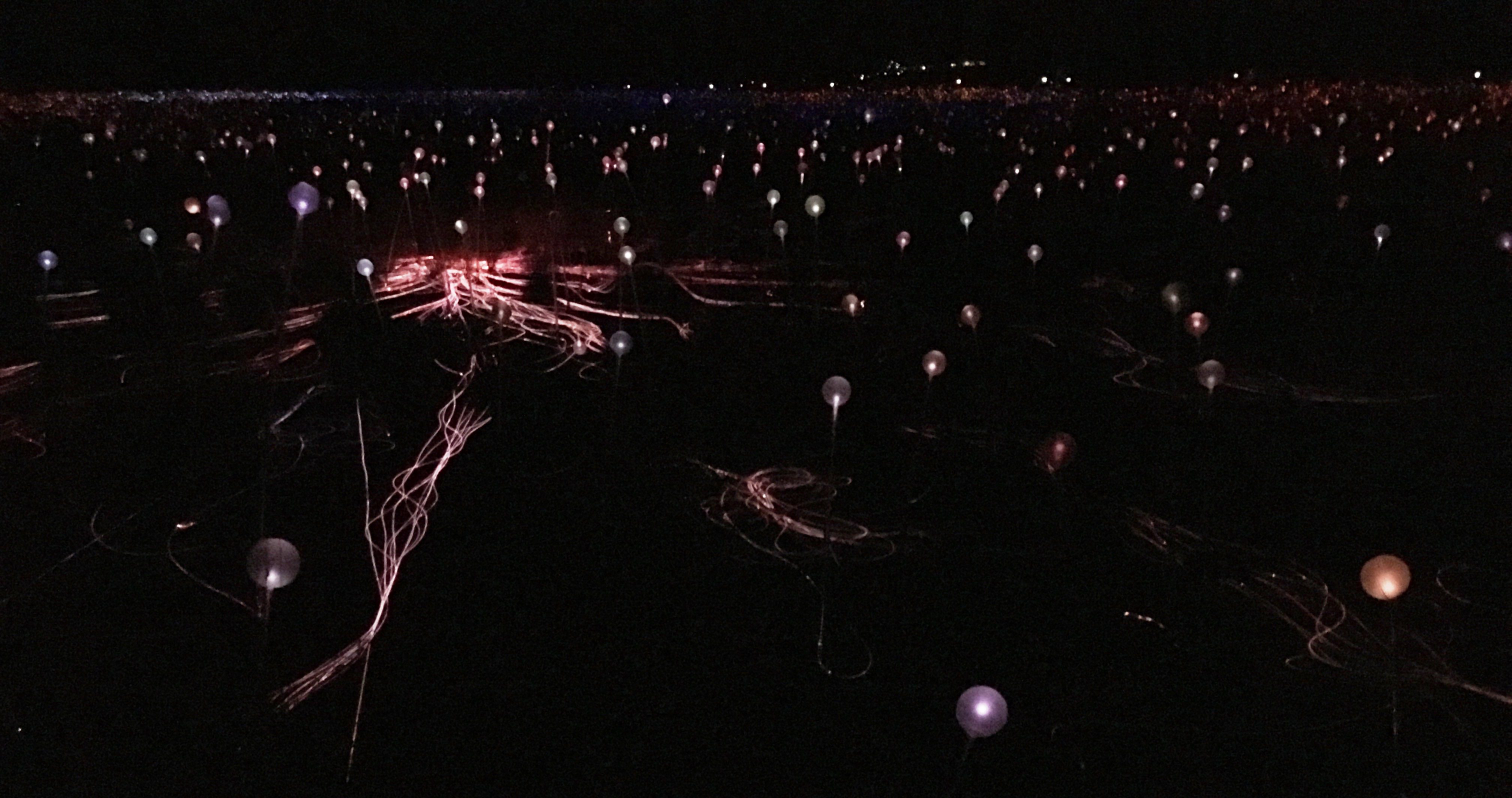
Heidi and I wandered in separate directions, lured by whatever instinct called.  I wandered a bit too far and started walking back briskly when I realized our 20 minutes of off leash time was almost up.  It was so dark that I headed in the wrong direction.  I imagined being stranded out here all night.  Would they turn the lights out?  Would I, as a Minnesotan, be able to survive the desert cold dressed only in light clothing and flip flops?  Would I have to stay awake all night to fend off the dingos? What if I stepped on a scorpion in the dark?  Could I collect enough dew from the spinifex grass to wash it out?

My daydreaming was interrupted by the sight of someone kneeling on the ground and vomiting violently.  I could make out that it was a man and his friend was standing over him patting his back at arm’s length.  “Must ‘ave been something ‘e ate, I reckon,” said the friend.

At the bus I let the Chinese star guide know there was a man down, and he hurried off.  He’d probably be in trouble if they got off schedule and the next batch of $42 tourists was delayed.

“Did you see that guy throwing up?” I asked Heidi as I sank into my seat.

“Yeah, how awful.  I wonder if it was from the $210 Sparkling Wine Sunset Dinner?” she asked, deadpan.

I woke up early and walked up to the lookout to see Ularu at dawn.  On my way back the quiet was broken by raucous cries coming from the branches above my head and I looked up to see a dozen large rose- and grey-colored birds squawking.

“Heidi, Heidi!” I whispered loudly back in the bunkhouse.  “Look at these birds I saw—they’re amazing!”

She looked blearily at my cell phone as I shoved it in her face and laughed, “Aw, Annie, those are Galahs.  They’re like your squirrels.”  Galahs, also known as the rose-breasted cockatoos.

“Well, we don’t have them in Minnesota,” I pouted.  “How d’ja sleep?”

“Not so well, thanks to this heat pipe two inches from my face,” Heidi said as she whacked it with her fist.

We knew today would be another long day, so we had paid $25 apiece for the breakfast buffet.  There was a $5 discount if you paid the night before.  I thought maybe this was so they would have a head count, but when we rocked up to the buffet I began to suspect that they didn’t want people to know how it was until it was too late.

Everything was cold.  Not cold as in refrigerated; as in “formerly hot but now not.” Cold, limp bacon.  Cold spaghetti (spaghetti is a real fav in Australia). Cold baked beans.  The scrambled eggs were sitting in a half inch of pale yellow water.  We stuffed ourselves with things that weren’t supposed to be hot, like yogurt and fruit and rolls.  The hostess, a middle-aged white woman, was friendly and attentive as she poured the lukewarm coffee.

“What’s the deal with tipping here?” I had asked the first day.  Heidi was adamant that no one tipped unless you were at a fancy restaurant with a large party and the service was exceptional.  Then you might round up the bill.

“We just pay people decent wages,” she explained, “so there’s no need to tip.”

Because It’s There

Our airport shuttle driver had informed us there was plenty of water in the outback but it was all underground.  Still, I began to notice a very strong conservationist approach in Australia, including this recycled toilet paper in the IGA.  I didn’t want to know the details of how it was made, and I probably wouldn’t use it myself, but I’m glad they make it and that someone must use it.

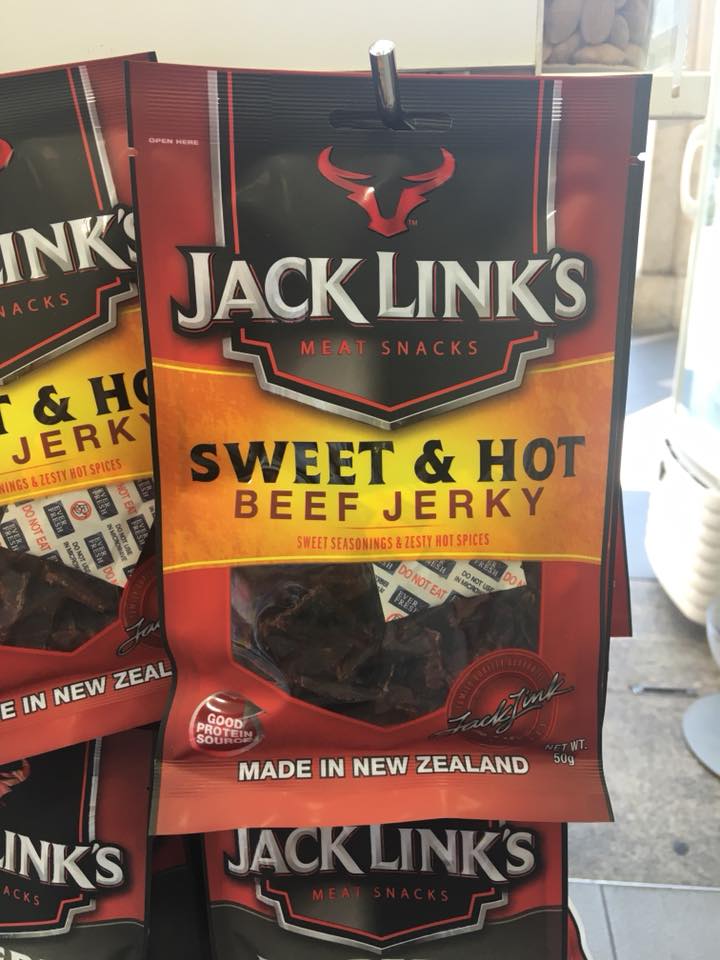
I was aghast that not only was there, as I had expected, Aussie biltong (beef jerky) but also Jack Links.  Jack Links is based in Wisconsin and I always buy it, thinking it is a local company.  But here was Jack Links jerky—made in New Zealand.  Maybe it’s not a Wisconsin company after all.

After our exciting afternoon watching football, photographing toilet paper, and buying kangaroo-themed tea towels, Heidi and I returned to the bunkhouse.  She went in search of the bath huts and my eye fell on a thick folder she’d tossed onto the bottom bunk.  It was stuffed with glossy brochures, pages of meticulous hand-written notes, and rows of calculations.

“I knew you and Danielle put a lot of time into this trip, but I didn’t realize how much,” I said as she rejoined me.

“Yes.  Well, they don’t make it easy.  Everything is a la carte, even Internet, which is why I printed everything out.”  We hadn’t had wireless or 4G or even one G since we left Sydney.

“There’s about a dozen different tiers of accommodations … the wireless … meals … excursions … the one we really struggled with was the Sounds of Silence Sparkling Wine and Sunset Dinner.  It’s all about seeing the stars, and what if it was cloudy?  You wouldn’t get your money back”

“How much was that?  I think I read in my guidebook that it cost $500 per couple.”

“It wasn’t that much.  It was ‘only’ $210 per person,” she replied.  “Of course that’s Aussie dollars.”

“It’s so confusing!  So what’s the $42 thing we’re doing tonight?”

“The Field of Lights.  I think it’s an art installation.”

“I guess we’ll find out.  Did you notice there’s a little sign near the bathhouse that says, ‘Ularu lookout’?”

“Yes!  Let’s see if we can see the sunset from there.”  So we did, for free.

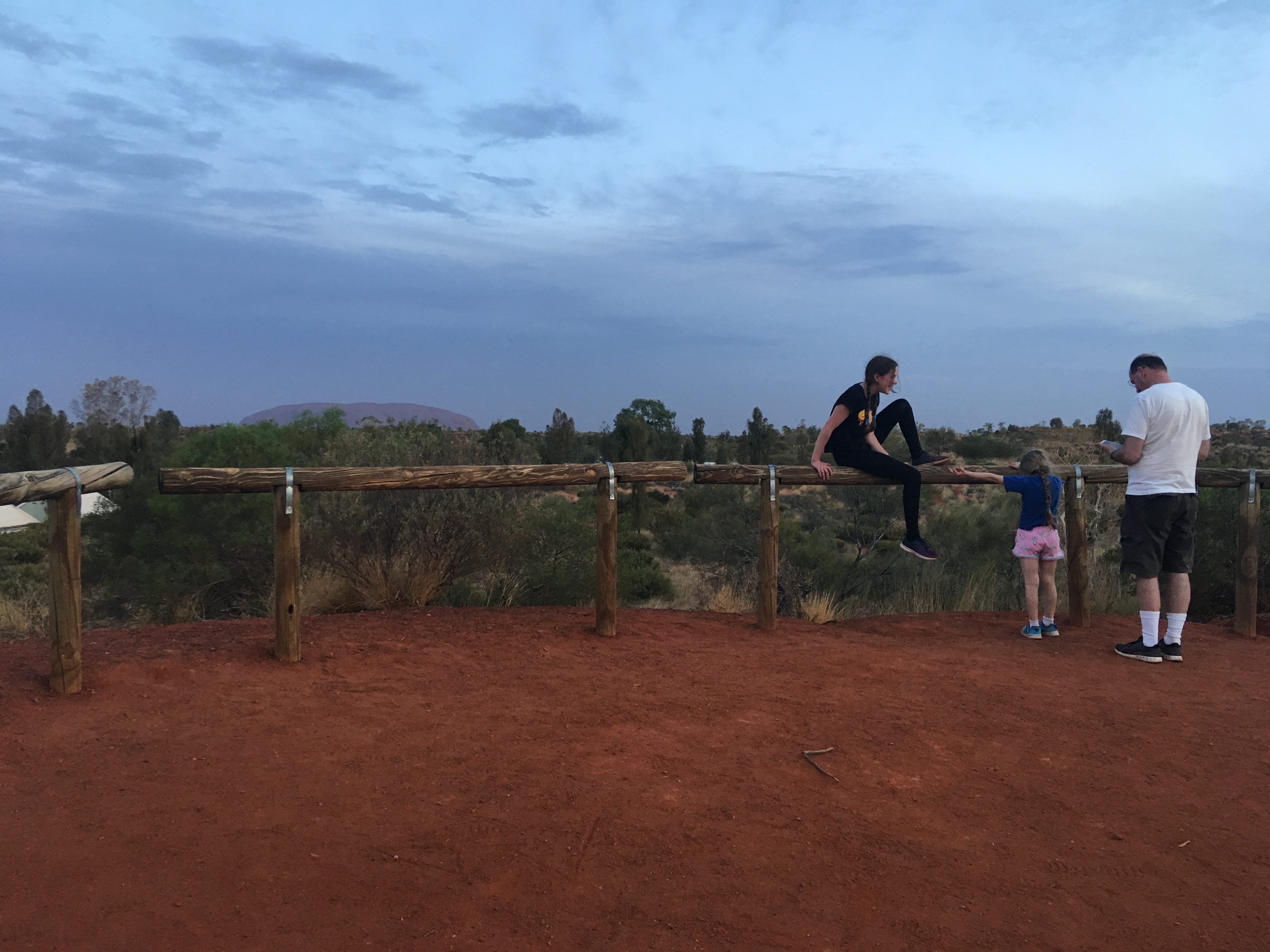
You can just see Ularu (oo’-la-roo) in the distance.

Ularu was formerly named Ayers Rock.  Because it’s a big rock.  It’s 863 meters (2,831 feet) high and 9.4 kilometers (almost six miles) in circumference.  I learned that Ularu is just the tail end of a snake-shaped rock formation, most of which is underground.

Like many such formations, people have always wanted to climb it, and there is a chain strung along posts hammered into the rock to facilitate this.

The local aboriginals, the Pitjantjatjara (pit’-in-jar-a) consider Ularu sacred.  They don’t claim to “own” it; they consider themselves its guardians and ask people not to climb, but people still do.

A woman started chatting with us as her kids climbed and did the limbo and swung on the fence rails, as kids do.  She had disconcerting false eyelashes, an extreme fake tan, and long acrylic fingernails.

“We all climbed the rock today.  It’s just one of those things you have to do.”  There was no hint of embarrassment.  I expected her to at least acknowledge that this was going against the wishes of the aboriginals, but no.

Heidi and I maintained neutral expressions.  The woman moved on from topic to topic, asking questions and not listening to our answers but using her queries to launch a new run-on story about booking holidays, the Australian school system, driving and cars, and I-can’t-remember-what-else.

Once the sun set, it was like someone had flipped off the lights; there was no lingering gloaming. It gave us an excuse to leave.   As we walked down the hill in the darkness while our new friend tried to round up her kids, I murmured to Heidi, “I felt judgey back there.”

“I know; me too, but it’s hard to understand why people still climb.”

The government has settled the matter once and for all, by banning the climb as of next year.

Aussie Rules

The bunkhouse was the best place we could have stayed because it motivated us to get out and explore.

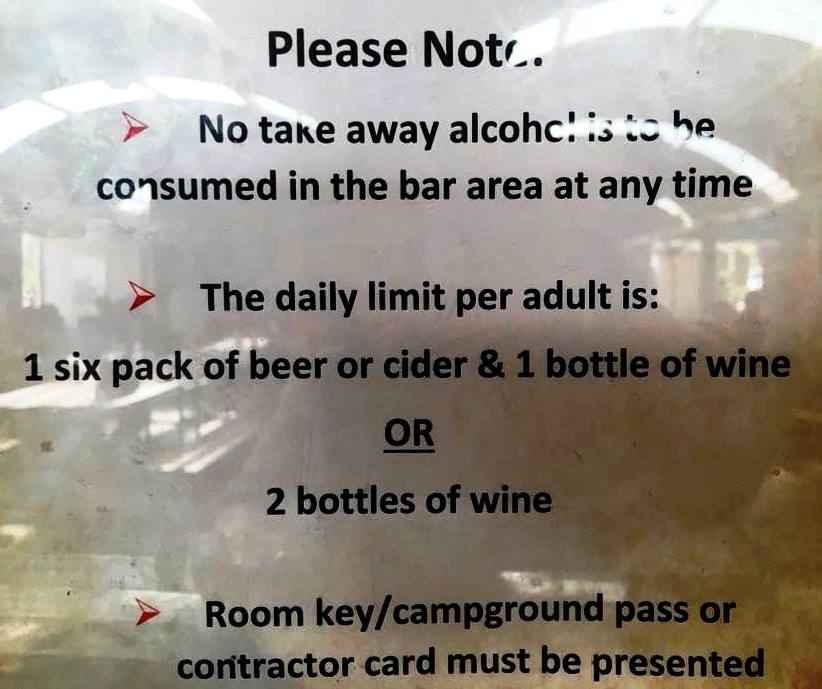
“Let’s get a beer,” I suggested, and we wandered until we found a large open-sided, tin-roofed beer hall from whence a lot of whooping was emanating.  I stopped to read the alcohol limits.

A six pack of beer and a bottle of wine, or two bottles of wine?  I would be flat out on the floor before I ever reached those limits.  There were multiple bartenders and the place was crowded and rowdy.  How could they track who-had-how-much?

“I wonder why you have to show your room key?” I asked the guy next to me at the bar as I looked it over.  “It doesn’t have a tracking chip in it to count drinks or anything.”

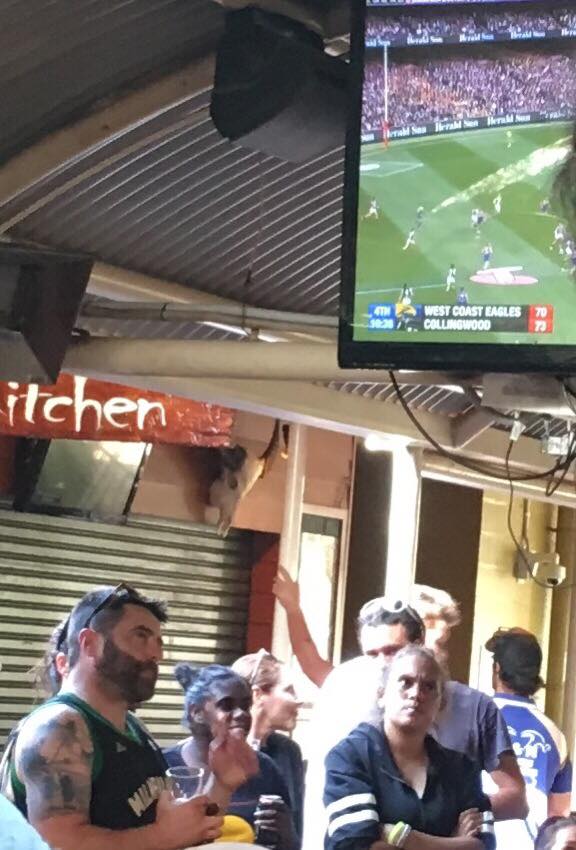
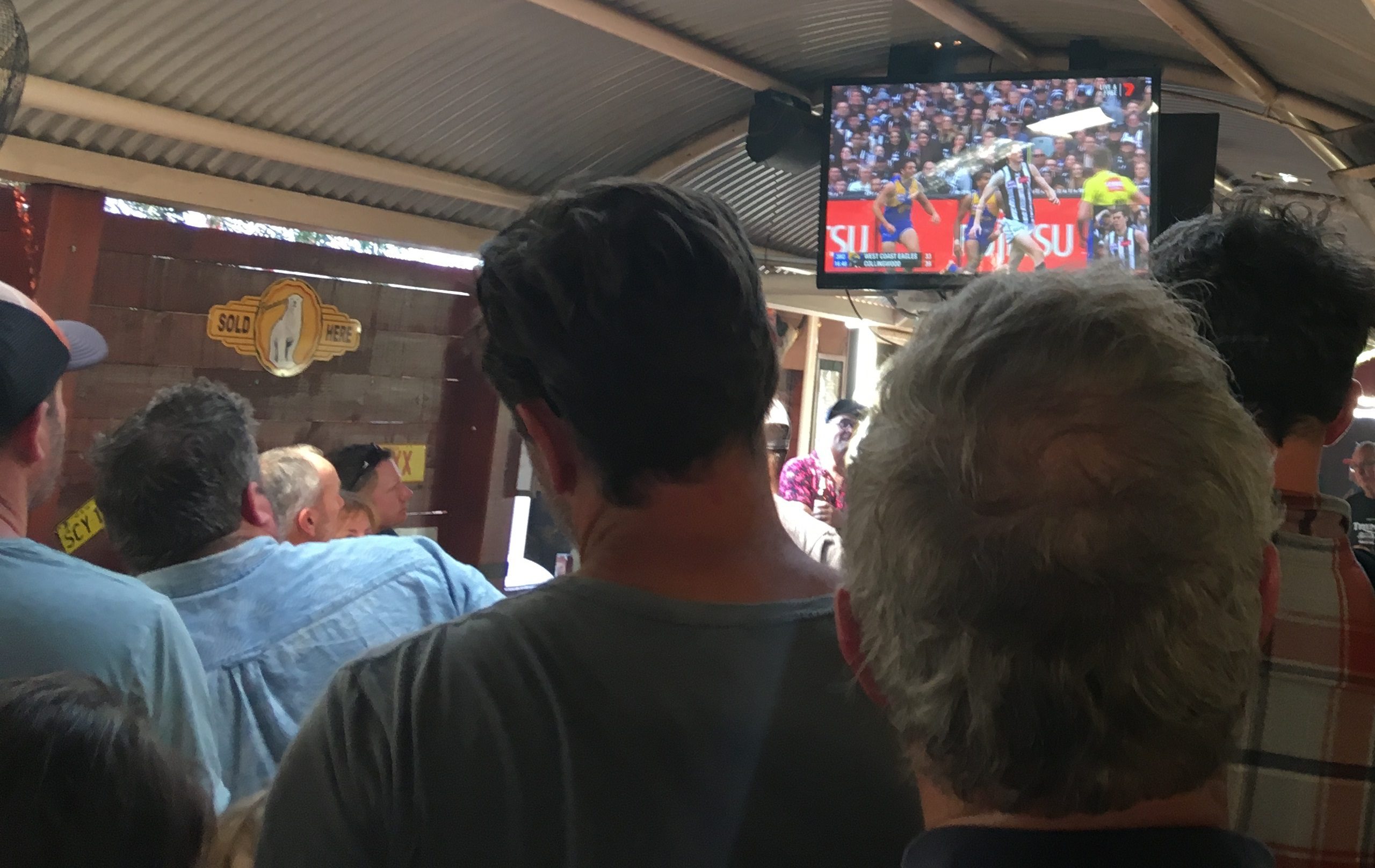
“It’s for the aboriginals,” he said.  “To keep them coming in here and getting pissed.  I have no idea if this was true or not.  I do believe I finally found my sport that day: Australia Rules Football. That was the draw today—the AFL Championship game between the West Coast Eagles, based in Perth, and Collingwood, based in Melbourne.

I didn’t know what was going on, just that very fit men in what look like wrestling uniforms were running around a round field and kicking, throwing, and bouncing an American-football-like ball and tackling each other.  The clock never stopped.

The men in the crowd weren’t bad either, if you like tall, rugged men with tattoos.

Heidi was ecstatic.  She’s a sporty person and she explained the game as we stood in the crowd and watched.  “Collingwood is Dean’s team,” she said, as she texted him a message of support.  Our friend Dean, who we would stay with in Melbourne in a few weeks.

Alas, Dean was destined for heartbreak this day, as the Eagles prevailed over Collingwood in what everyone seemed to agree was a great game.  I enjoyed it, to be sure, but I just have no patience for sports.  When people start talking about plays and stats and lineups my eyes go dim.

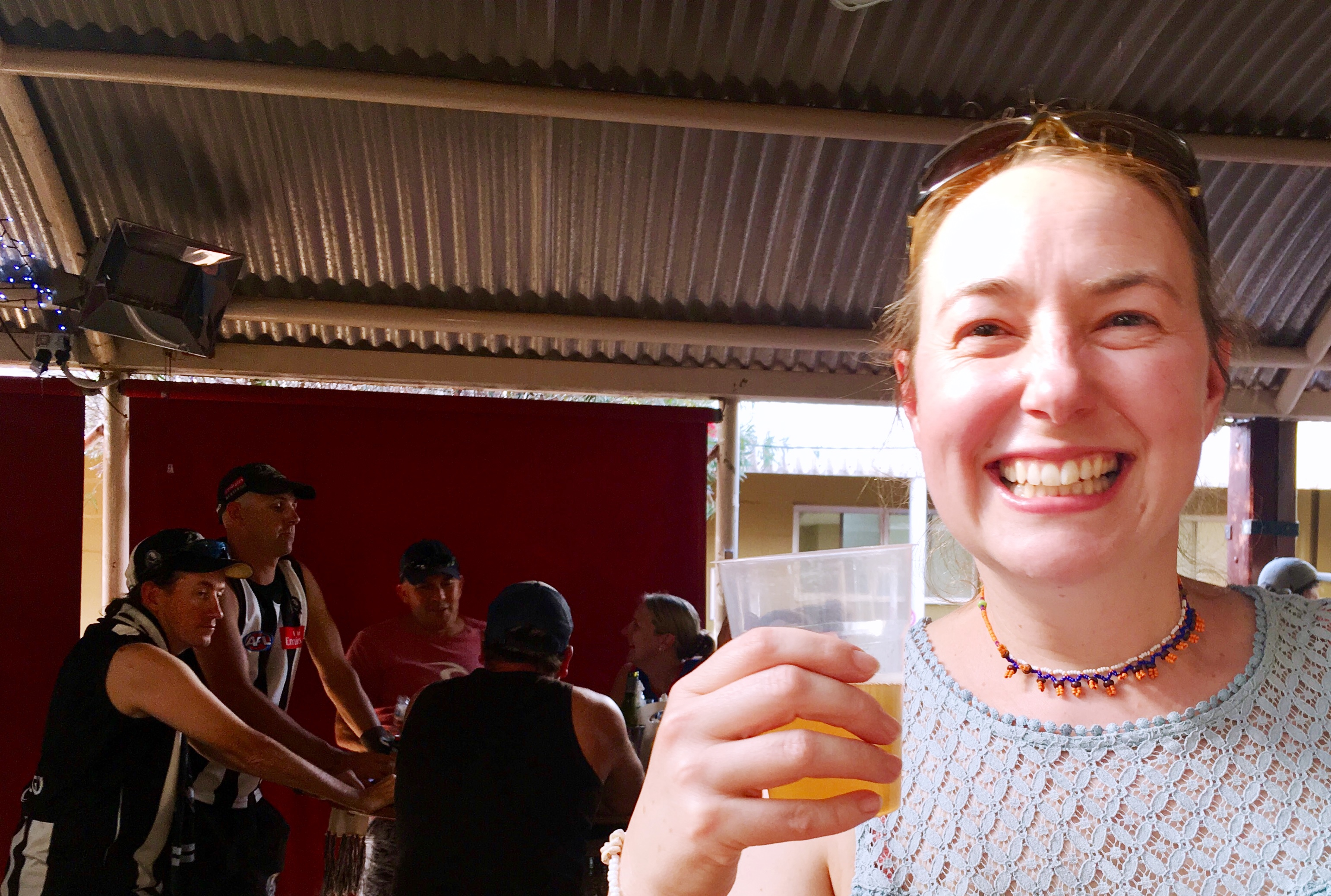
At the end the crowd became subdued.  The men in the background, behind Heidi below, were dejected at Collingwood’s loss.  More than one man and boy passed me on his way out with tears in his eyes.  The winners were also subdued—I didn’t notice any fist pumping or victorious howling.  Very civilized.

We walked to the “Town Hall” area, which had an IGA (a grocery), a few restaurants, and some stores that sold souvenirs and outdoor gear.

“I’d better get my souvenirs here, since we’ll be camping the rest of the time,” I said to Heidi as I stuffed my shopping basket with aboriginal-art-themed notepads, wacky Australian animal stickers, and a tea towel with kangaroos on it.

“Oh yes,” Heidi replied drily, “This will probably be your only chance to buy souvenirs.”

I bought a hat with a built-in fly net, a decision that would save me from bug-induced insanity while hiking.

We took a spin through the IGA and as is my habit when traveling I documented another culture through foods and household goods.  I was not disappointed; there were lots of items with Australian themes.

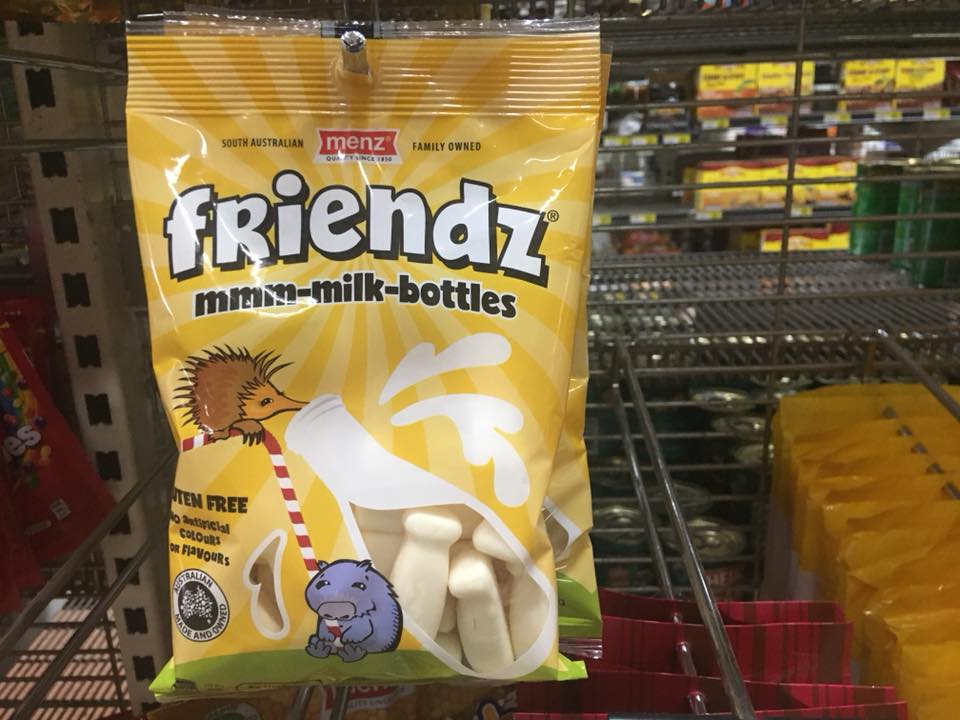
I’m not sure “furry” is an adjective I want applied to candy, but they sure were cute.

The one box of Emu oil moisturizer looked like it had been there for a decade and had been stepped on by a big dusty boot.

This soap was made in “Country” Australia.  Country means rural.

I wanted to buy some Strong and Bitey cheese, especially Bega brand, but we had no refrigeration in the bunk house.

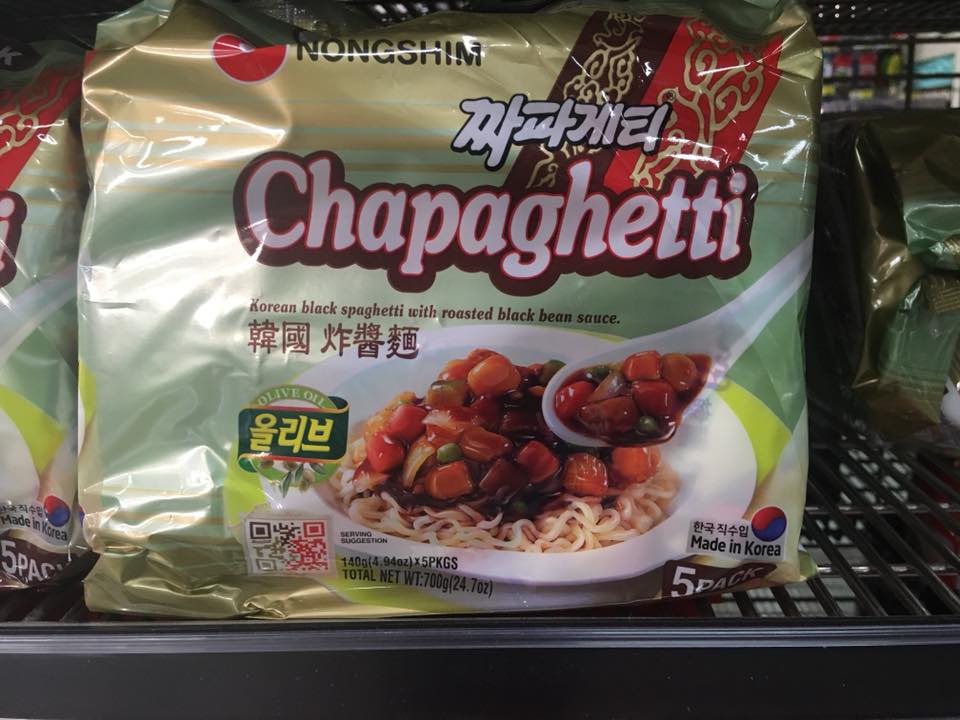
There were lots of Asian imports, like this ramen spaghetti with roasted black bean sauce from Korea.

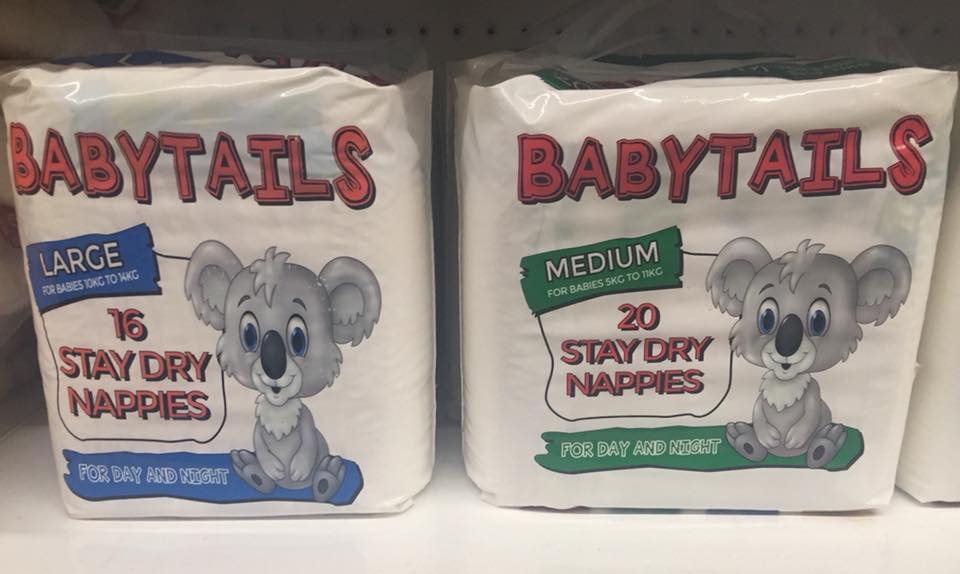
Adorable diapers with koalas.

Infant wind drops “provide relief from infant wind.”  What a relief.

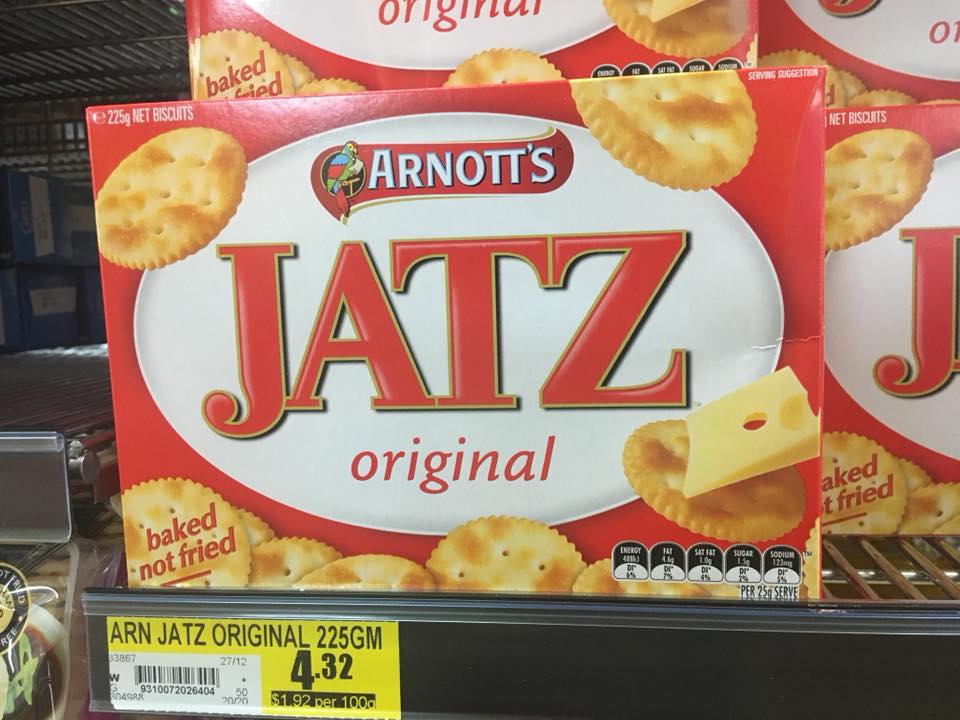
As I would learn, Jatz are the national crackers and people had strong opinions about them.

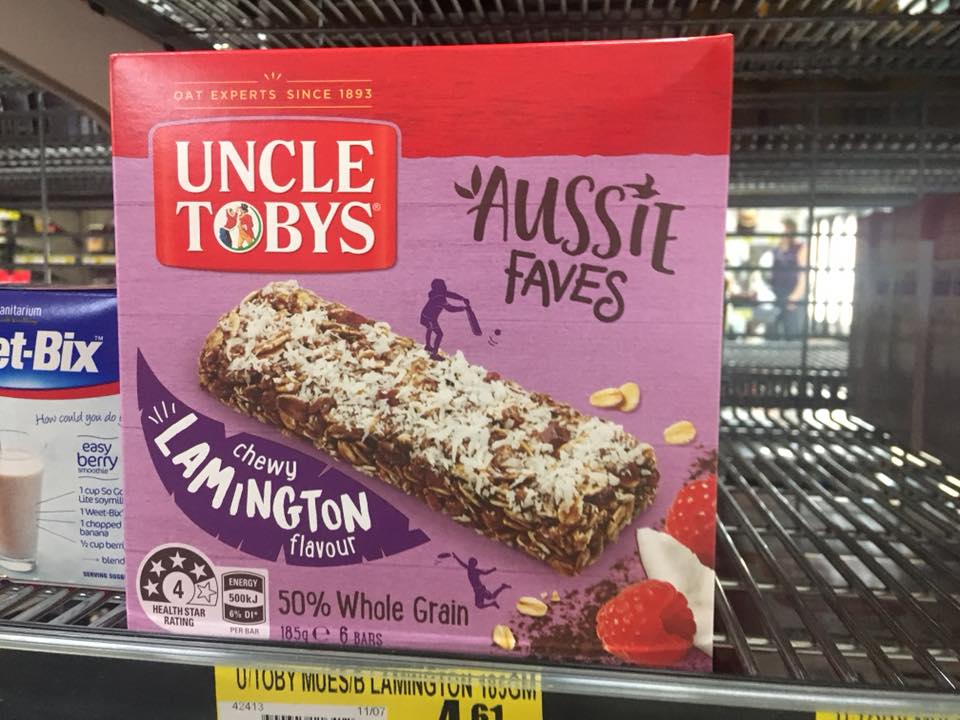
Lamingtons, which are rectangles of day-old chocolate cake with chocolate frosting sprinkled with coconut, are the national—and delicious—cake.

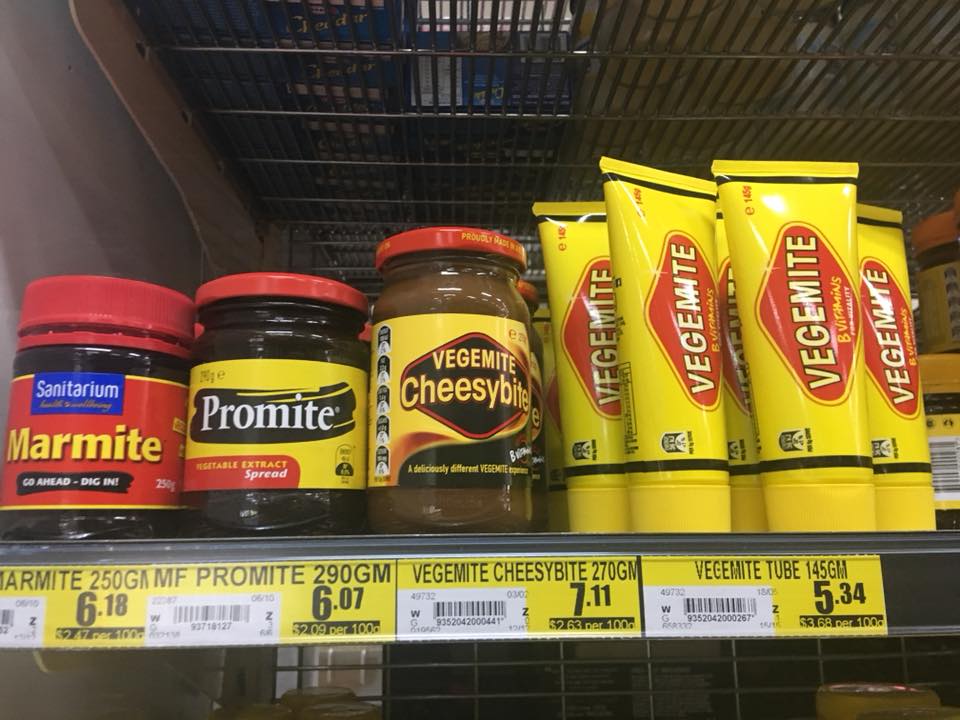
Various mites.  And no, I never did have a vegemite sandwich.