Category Archives: addiction

Happy New Year, You’re Beautiful!

Yesterday I went to the British Arrow Awards with Vince.  Five years ago, I would never have imagined going to the Walker Art Center to watch 70 minutes of British TV commercials with my son.

Five years ago, I would have spent New Year’s Eve an agony of wondering where he was.  Three years ago, I knew where he was—in prison.  Two years ago, he was living in my 10×10 foot (3×3 meter) spare room alongside the washer and dryer, and things were extremely tense.  A year ago, he had moved out with sober friends, had a job, a car, and things were looking up—or at least were stable.

Today, he has a job he likes with benefits—for the first time in his life.  He’s moving in with his girlfriend.  He’s got three and a half years of sobriety and works his program of recovery like today is his first day.  Well, maybe not every day, but he does work it.  I realize things could fall apart, as they have before, but I don’t worry about him every day like I used to.  It’s such a relief.  Thank you, Vince.

So even though it was -15F (-26C) I got in my frozen car and drove to Minneapolis to meet Vince and his girlfriend and her two daughters for Thai food and sushi.

I had bought two tickets to the Arrow Awards a month ago, then when I went back to buy more so others could join us, they were sold out.

There is a weird phenomenon in Minnesota.  It’s the only place in the US where we get 10-year-old episodes of EastEnders on TV and pay $14 to watch British TV commercials.  Two weeks ago, my local PBS station started airing the great series Dickensian, which Lynn and I had binge watched in Scotland.

So in addition to being quirky in a general way (Minneapolis-St. Paul is the #12 quirkiest metro area according to Travel + Leisure), we are eccentric in a particularly Anglophile way.

If you’ve been reading this blog for a while you will likely think I am an Anglophile and I am, but I am also a Francophile, and a Berlin-o-phile, and a Malta-o-phile, and So-Many-Other-Places-o-phile.  I’m sure there are plenty of fantastic shows and ads in other countries but since I don’t speak French or German or Maltese, I’m not qualified to writing about them.

The Walker Art Center is a place I like to know is there for other people, but where I never go except for this annual event.  I used to belong to the Walker when I was young and hip and trying to meet young, hip men.  But my days of pretending that giant rusty chains suspended from the ceiling are Avant-garde art are over.

The Walker screens back-to-back showings of the Arrow Awards Thursday through Saturday from 1:00-8:00pm and tickets sell out within days.  It must be a real income generator.

The ads make you laugh, then cry.  Two of the funniest, Vince and I agreed, were for Rustlers frozen hamburgers and the Lottery, featuring James Blunt.

And then, when we were laughing out loud, the next ad would be for UNICEF or another organization trying to get the world’s attention about the biggest refugee crisis since WWII.  I had heard about this theme ahead of time so I was prepared with Kleenex.

Since I work for an NGO and blog about travel, I am always feeling the juxtaposition of my safe, happy life with the terror and despair with which millions of people are living.  This was another contrast, in the newspaper a few weeks ago.
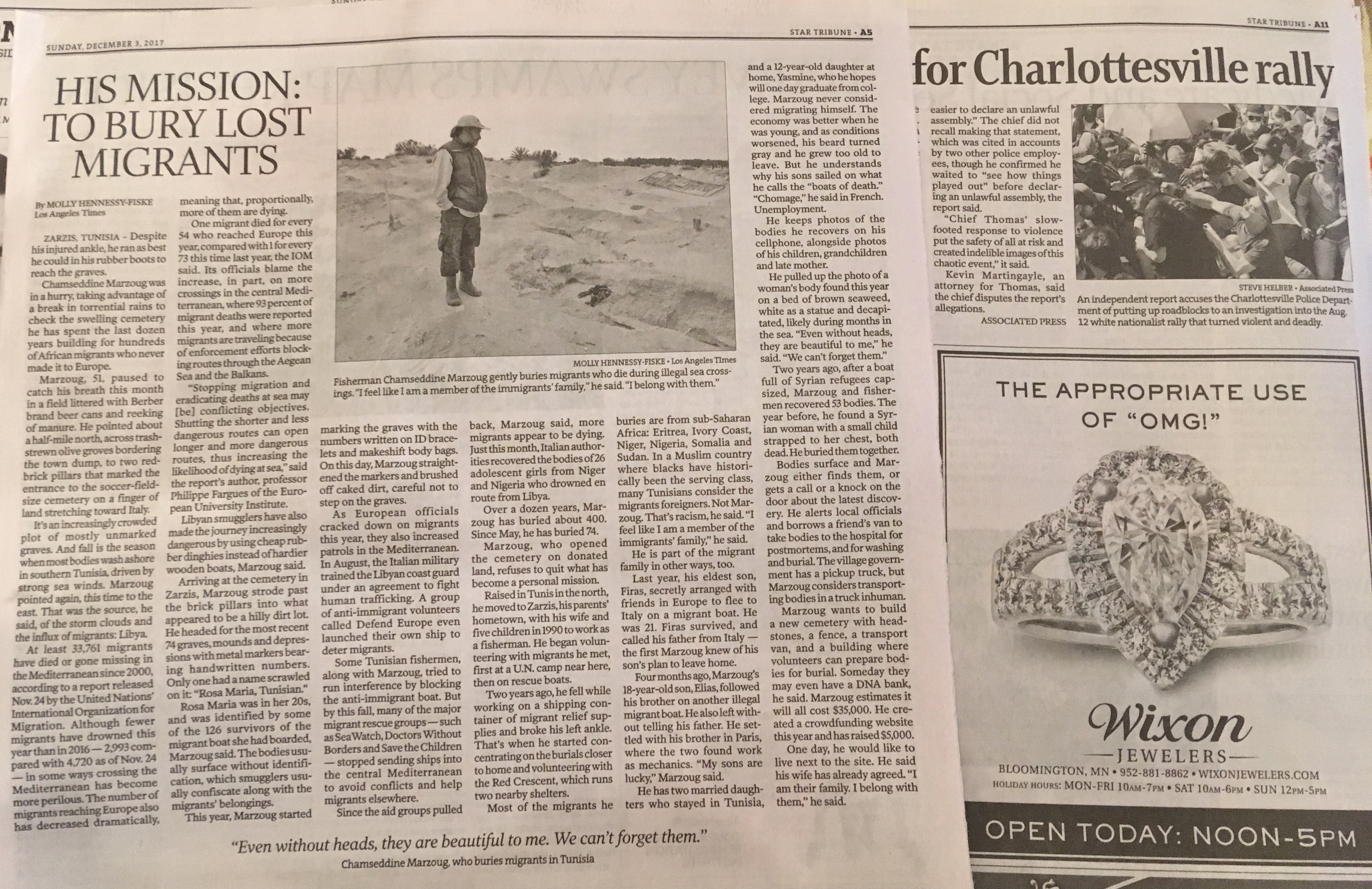
Articles about a man burying drowned migrants and the racist rally in Charlottesville, then an ad about diamond rings.

I don’t care about diamonds, but should I skip a trip this year and donate the money to UNICEF?  Do I justify travel, my one big indulgence, by saying it sustains me to carry out my work raising money for refugees?  Should I call travel an indulgence?  Do I have to justify myself?  I don’t think there are any right or wrong answers, but I constantly struggle with the questions.

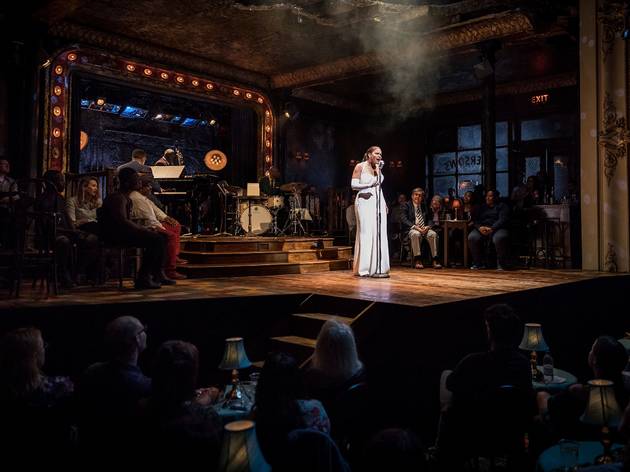
Lady Day

Lynn, Richard, Possum, and I made our way into the Wyndham, got some drinks, then headed into the auditorium.

The show was Lady Day at Emerson’s Bar and Grill.  The premise is that Billie Holliday, the American jazz icon, is performing at a run-down bar in Philadelphia right before she dies, age 44, in 1959.  It’s a two-hour monologue and song book, accompanied by a man who plays the piano, tries to stop her from shooting up, then procures heroin for her.

I don’t go to a lot of live theatre.  It always feels to me like people are talking in a stilted way: “Look at me—I’m acting!”  I was leery about going to any American show in Britain.  On my first trip to England, my cohort of volunteers—who were from all over Europe and Asia—insisted on going to a west end musical involving a loud-mouthed Texan in a big hat.  There was also lots of waving and shooting of guns.  I squirmed through the whole thing.  The group members loved it and laughed all night about “typical Americans.”

Lady Day would be performed by Audra McDonald, with actual audience members on stage as though they were customers at the bar.  This was a bit strange, since McDonald and the musicians were dressed in period costumes, while the customers/audience members were dressed in contemporary clothes.

We were seated at a café table right below the stage.

I loved Billie Holliday as much as anyone; I had listened to her songs over and over, especially in my angst-ridden 30s, but would I be able to sit through two hours of angst?  And my chair was wobbly!

Then McDonald began her performance, and within moments all distractions melted away and I was riveted.  I knew Billie Holliday’s story—raped as a child, raised by a single mother, addicted to drugs and alcohol, did prison time, full of regret over not having children and a string of abusive relationships.

McDonald’s voice was well up to the task of Holliday’s songs; when the first strains of “Strange Fruit” began I teared up instantly.

Southern trees bear strange fruit

Blood on the leaves and blood at the root

Black bodies swinging in the southern breeze

Strange fruit hanging from the poplar trees


Pastoral scene of the gallant south

The bulging eyes and the twisted mouth

Scent of magnolias, sweet and fresh

Then the sudden smell of burning flesh


Here is fruit for the crows to pluck

For the rain to gather, for the wind to suck

For the sun to rot, for the trees to drop

Here is a strange and bitter crop

So the show was about Holliday’s life, but also about racism in America, and the lot of being a famous woman performer, and love, and addiction. Believe it or not she was also very funny.  I wanted to run up onto the stage and hug McDonald/Holliday, tell her everything was going to be alright and that I would take her home and take care of her.

I didn’t find myself feeling defensive about the theme of racism.  In fact, just the opposite.  Racism is a reality in America and always has been.  It’s something we’ve had to struggle with, collectively.  We’ll probably never see the end of it.  I’d like to think that as older generations die off, younger ones will be less racist, but the crowds in Charlottesville at the white supremacist rally last year were mainly young men.

So why would I feel proud of my country?  Because at least half of us are fighting this shit. At least half of us are fighting back–marching, writing essays, lobbying our elected officials in opposition to racism and other “isms.”

The performance ended; we looked at each other and I spoke first, “I feel like a wrung out rag!”

“That was intense,” said Richard.

“I’m exhausted!” said Lynn,

Added Possum, “I never knew!”

We went back to the hotel, ordered some wine, and talked for hours about racism in our respective countries.

Lady Day at Emerson’s Bar and Grill was made into a TV show; if you want to watch it it’s here.

Have a box of Kleenex handy.

Elder, Kickin’ It

This is a series of posts about Belize that starts here.

In the real world, there is more bad news in addition to all the shenanigans in Washington.  Every day there are reports about all the people overdosing on Carfentanil, a synthetic opioid 10,000 times more potent than morphine.  The anniversary of Prince’s death just passed; he overdosed on a similar drug, Fentanyl.  Carfentanil was developed as a large animal anesthetic.  Really?  Who takes drugs like that?

Sadly, my dad did.  It was his birthday recently; he would have been 81 if he hadn’t overdosed in a Wisconsin motel room nearly 50 years ago, aged 32.  He died of a lethal combination of alcohol and Paraldehyde, which used to be prescribed to treat alcoholism.  Paraldehyde is classified as a “hypnotic” and has mostly been replaced by safer drugs. Was it an accident or intentional?  I’ll never know.  What I do notice is how little emotion I feel about it anymore.  That’s taken a long time and a lot of work.  He loved to travel, so I like to think he would be happy about my adventures.

After our snorkeling day, we were herded onto the van by Mark to attend a Garifuna drumming performance at the Hopkins Cultural Center.  It took an hour for us to drive the mile distance as the crow flies.  It was a very dark night. Thank goodness there were potholes the size of bathtubs full of water, which reflected the light from the three streetlights in town.

Eventually we were ushered into a large thatched-roof hut where we waited for our supper.  A woman about my age was the cook, and she was obviously working her ass off. She had been summoned on five minutes notice to produce food for 20 people, and after an hour her young adult children served up bowls of hudutu and fry bread.  Again, it was full of bones, but we were so hungry we had no complaints.

A 30-something man in a dashiki jumped up on the stage and started shouting into the mic.  “Let’s give a hand to Elder Elspeth for the wonderful meal!”

Elder?  If she was an elder, that made me one too.

The guy, whose name was Myron, launched into a long, disconnected rant about Garifuna culture.  I had read about it in the guide books, and he seemed to be making stuff up.  Garifuna is a language and a culture brought by mixed-race slaves from the Caribbean to Honduras, Nicaragua, and British Honduras—as Belize was then called—in the early 19th Century.  I asked a question; I don’t recall what it was because he angrily yelled, “No!” at me and resumed his animated monologue.  He seemed to have a chip on his shoulder.  He was very muscular—maybe he had ‘roid rage.

Myron went on for half an hour, then two other men joined him and they began drumming and singing manically in the Garifuna language.  It reminded me of a pow wow, where the first song is really cool, the second one is good, and then they all sound alike.

Despite it being ear-splittingly loud, I was trying hard not to nod off, as were the other snorkelers. Mercifully the trio only played five songs.  Then they jumped off the stage and started selling CDs and passing a hat for tips.  It was clear they couldn’t wait for us to get out of there.

Midnight.  One hundred Fahrenheit with 99% humidity.  I lay in my bed in the middle of the room, between Trudy and Emily.  Our table and chairs had disappeared while we were gone but we were beyond curious about why things came and went.

My Restless Legs Syndrome is always worse when it’s humid.  It sounds like a silly condition, but it’s ruined more nights of sleep than any worry or noise or excess of caffeine or alcohol.  Just as I’m falling asleep, I get a creeping feeling around my knees and have an overpowering urge to Move My Legs.

Then music started up in the distance, a low throbbing beat.  This would last for hours, I thought, as I kick, kick, kicked to the beat.

Make Mine a Double

This is a series of posts about Italy, Malta, and Spain that starts here.

After hitting the gift shop at the Prado and loading up on Hieronymus Bosch refrigerator magnets, bookmarks, and postcards, we crossed the roundabout toward the Thyssen Bornemisa Museum.

But first, some lunch.  We walked into the first restaurant we saw and followed the hostess down some stairs, through a hallway, up more stairs, and into a back dining room.  It was probably early for lunch in Spain—only 1:00—so we had the room to ourselves.

I don’t remember anything about the food.  I know we laughed over some of the Spanish to English translations on the menu, and at the fat German couple seated near us who ordered strudel and beer.  I vaguely noticed the place fill with people, then empty again while we ate and drank a bottle of house wine and talked and talked.

This may be the number one thing I love about traveling with a friend.  Leisurely meals.  At home I gulp down my food while reading a magazine or watching TV.  I’m usually in a hurry to get on to the next thing.  I barely notice what I’m shoveling in my mouth.

Suddenly we realized it was almost 4:00 so we hurried across the street to try to see everything in the museum in one hour.  What a relief—it was open until 7:00.

The main art museum in Minneapolis, the MIA, has collections—like Decorative Art, Textiles, and Sculpture; or Japanese and Korean Art.  The Thyssen Bornemisa reminded me of the Reina Sofia Museum, with one or a few pieces from lots of different artists scattered seemingly at random throughout a somewhat shabbier building.  It had one masterpiece each by van Gogh, Chagall, Degas, Cezanne, El Greco, Caravaggio, Monet, Picasso, Gauguin.  It reminded me of the “Greatest Hits” compilations music companies used to publish when people still bought CDs.

There was a variation on this famous painting by Holbein of Henry VIII; the original had been destroyed:

henry-8

We bought the obligatory postcards, bookmarks, and refrigerator magnets.  These make nice small gifts, or I think they do.  Maybe people hate them.

We went back to the hotel to freshen up, then back to the square where there were supposed to be loads of tapas restaurants.  This time we were determined to find an “authentic” tapas place, as if we knew what that would look like.  We found one that looked a little run down, and were soon being served, if you can use that term, by the crabbiest waiter ever.

The tables were covered with old linoleum.  Ours had some squeeze bottles of unknown contents and a pile of three thin, miniscule, nonabsorbent paper napkins.

“D’ya want something?” our waiter demanded brusquely in Spanish.  His clothes were rumpled and stained.

Lynn, always cheerful to servers, asked for red wine in English.  The waiter scowled and I repeated in Spanish, “vino tinto, por favor.”  He walked away without a word and returned with two smeary glasses of red wine, which he slammed down before us.  This place was authentic, alight.

“Para comer?” he demanded next.  To eat?  Lynn pointed to menu items and again he walked off without speaking, returned, and threw down some plates.  The food was basic but good.

I watched over Lynn’s shoulder as our waiter poured a half pint of beer, dumped in two very large shots of tequila, and poured it all down his throat.  Within minutes he was relatively cheerful, even coming to our table to ask if we liked our food.  I felt moved, imagining he got by like this hour by hour, night after night.

As I write this, I’m about to leave for Belize and Guatemala.  I’ve front loaded the blog to post throughout this trip, but I never know what kind of condition I’ll be in when I return so no promises about when the next post will be.

I don’t mean to sound melodramatic, but I’ve been on enough trips where I come home sick, or to some crazy family or work situation, so I’m cautious about committing to anything too soon after I get back.

Calling All Cons

Before I return to writing about my upcoming travel in Italy, Malta, and Spain, I’ll write a couple more posts about my other favorite topic: prison.

I was involved in two criminal justice reform evening events this week.  Normally I hate having commitments like these at night but these were commitments I chose to make.

The first was a phone bank event organized by the Restore the Vote Coalition.  It’s run by Take Action Minnesota and includes Jewish Community Action, a group I’ve written about being involved with.

Here’s why we were there: 47,000 ex prisoners in Minnesota cannot vote.  They’ve done their time but they’re still “on paper”—slang for probation or parole—and they can’t vote until they’re off paper.  Even though Vince has served his time, has been out for a year, has been sober for over two years, is working and paying taxes and rent, and taking his grandma to the grocery and doing all manner of other positive things, he’s not allowed to vote until 2018.

Our job was to call around 7,000 ex offenders who were probably off paper.  Since no sane person enjoys calling strangers—much less ex cons—the coalition tried to make it a fun by calling it a Restore the Vote Block Party.  They had blocked off their parking lot and had booths with a DJ and food, but it rained so we all huddled inside in their basement offices.

There were five or six speakers, including a rabbi and a young woman from Chicago whose father and uncles had been in prison as long as she’s been alive.  It was a very racially diverse group.  A couple guys lead a call and response to get us fired up, then we all dispersed to make calls or knock on doors.

All three of the African-American speakers said something along the lines of, “This is a problem that mostly affects black people.”  While it’s true that African Americans are disproportionately represented in prison compared to their percentage of the overall population, 56% of adult prisoners in Minnesota are white.  As of September 30, that’s 5,228 men and women, not counting juveniles or people in county jails.  I don’t think we do the cause any favors by making it all about race.  Race is a factor for sure, but so are class, poverty, abuse, education level, disabilities, chemical dependency, and many other issues.

There was an elaborate script probably written by a graduate student who’d never been near a prison, which went out the window the moment we started dialing.  We used a really cool online system.  I logged in and immediately a guy’s name came up with his age and phone number and the names of other people in his household.  I said to the leader, “I’d be really creeped out if stranger called me who knew I’d been in prison.”  I was assured that this was public information and that ex cons knew it.

I dialed 72 numbers in an hour and a half and spoke to exactly two ex cons.  About 80% of the numbers were disconnected, busy, wrong numbers, or no one answered.  The two guys I spoke with were opposites.  The first one, who was 28, had researched whether he was eligible to vote, was registered, and was committed to showing up at the polls.  The other guy, who was 56, said, “I ain’t never voted in my life and I ain’t gonna start now.”

I noted their names as I scrolled through the data base—Frank, Damarius, Jason, Katherine, Moua, John, Orville, Krystal, Matt, Jose, Abdi—all typical Minnesota names, all over the state, all ages, all races.  I reached quite a few mothers, which tugged at my heart strings.  They sounded care worn.  A couple said, “I don’t know where he is.”  Ugh.  I’ve been there.  One father told me, “He’s not here,” then, sadly, “He’s in the ground.”  What do you say to that?

“I’m so sorry,” I muttered.  “I’m sorry to have bothered you.  Have a nice night.”

I only reached two guys, but as our group of 80 volunteer callers got pledges to vote from 122 ex offenders.

It may not sound like much, but we did something.

Justice, Sweet and Sour

Summer is over, and so is my break from blogging.  In my last post, I listed all the things I was going to do with my extra time: sit outside in the morning with my coffee and listen to the birds, plan a fall trip, and figure out how to publish the first year of the blog as an e-book.  Oh—and write a novel.

I sat outside with my coffee once.  I am planning a fall trip to Italy, Malta, and Spain.  I didn’t write a novel, but Vince and I have started working with an editor on the e-book.

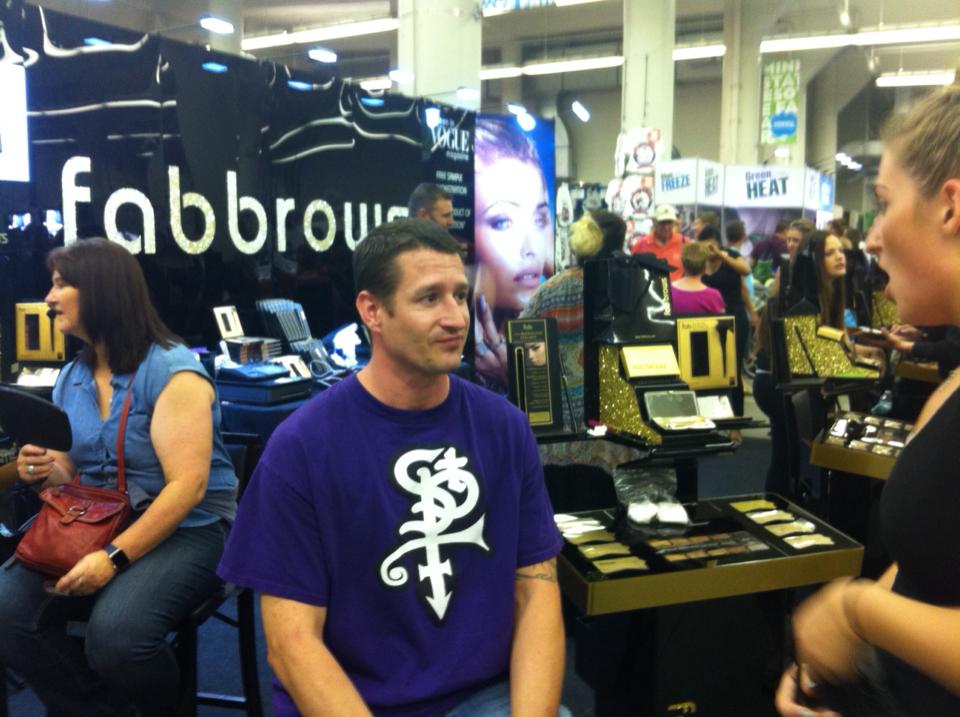
Mostly, I’ve tried to live in the moment.  Summer is so brief.  There were fun moments.  At a family weekend at a cabin, someone brought a Donald Trump piñata (Made in Mexico, appropriately).  I fostered a litter of seven kittens which drew visits from friends and family.  Vince and I went to the State Fair where, at the FabBrow booth, he insisted he wanted a uni-brow.  The makeup artists got back at him by making him look like a community theater actor.

pinatakittens

fabbrow

I spent a lot of time outdoors.  There were hikes and bike rides, and one day a friend and I spend hours making jewelry down at the river. Other times I packed a book and a beverage and biked to some quiet spot at a lake or the river.

The big local news this summer was of the killing of Philando Castille by a cop.  Castille was black.  The cop, Jeronimo Yanez, was Latino.  Castille was pulled over for a broken taillight.  He had a gun in his glove compartment, and believed that the proper procedure when interacting with a cop was to inform: “I’ve got a gun, and I’ve got a permit to carry it.”

I suppose Yanez didn’t hear anything after Castille said “I’ve got a gun.” Blam!  Shot point blank five times and left to bleed to death.  Castille’s girlfriend live streamed his last moments on Facebook.  I have not watched that video, but hundreds of thousands of people have.

I live within walking distance of the Governor’s mansion in St. Paul, where the inevitable protests took place. Traffic was blocked off by the police for a month and I was kept awake a couple nights by helicopter noise.  The protestors blocked off the nearby interstate and either police were patrolling with helicopters or it was news media copters, but they were loud.  Not that I’m comparing my minor inconvenience to the Castille’s family’s loss.

govs-mansion

This week marked one year since Vince was released from prison.  He is doing so well.  He just started a new job in catering, and he’s excited.  In a month he will go off intensive supervised release, which means he’ll be able to stay out past 10:30 or go to Wisconsin to visit cousins.  Best of all, he won’t have ISR agents showing up day and night asking him for urine samples.

Another event prompted me to write this post.

In 1989, an 11-year-old boy named Jacob Wetterling was abducted by a stranger at gun point in a small town in Minnesota. He was never found.

Vince was the same age as Jacob.  Vince became a Bar Mitzvah, got his first job, moved out, turned 20, had a serious girlfriend, had serious drug and alcohol problems, went to jail, got clean, relapsed, turned 30, moved to Lanesboro, went to prison, got out, and has two years of sobriety.  In a few months he’ll be 38.

This week, a man confessed to abducting, sexually assaulting, and executing Jacob Wetterling by shooting him in the head, then burying him—and returning a year later to move the remains.  Lying handcuffed in the last moments of his life, Jacob asked the man, “What did I do wrong?”

Vince was sentenced to over four years in prison for drug possession.  Because the statute of limitations has expired, Jacob’s killer will get 20 years on a child porn charge.  He’ll be a cho-mo—the most loathed prisoner among prisoners.  According to Vince, they are also considered a “protected class,” by officials, perhaps to prevent prison vigilantes from meting out real justice.

Me, Mom

Before I continue to the exciting conclusion of the road trip, I am sharing this post from Vince’s blog he wrote for Mother’s Day.

Mom, I know I’ve let you down. Over, and over again I’ve made a mess of my life and brought both of us shame.  There were years where you were unable to explain my whereabouts to family and friends, and times where you yourself didn’t know where I was. I’ve put you through more pain and distress than I care to recall.  I’ve not been a son to you for many years, and I have lost your trust far too many times.

But for some reason, you still love me. It’s an unconditional love that I’ve felt nowhere else. Even recently when we didn’t see eye to eye when we lived together, there was never any doubt that you loved me.  I wish I could promise that I will never be lead astray again by the temptation and allure of alcohol and the world of drugs, but I cannot because it’s the nature of the disease that I am always at risk of going back. Tomorrow, when we go out on our secret trip to an unknown location for Mother’s Day lunch, I will be repairing some of the damage I have caused. I will be repairing the bond that had been broken for so long as a result of my actions. I have nobody to blame but myself, which leaves only me to clean up the mess. And so far, I think it’s working.

It’s hard work, searching inside myself to figure out what’s been broken for so long. But through writing this blog, attending A.A., and working with a sponsor, I’m starting to change my life. I no longer do these things to avoid going back to prison, I do them because I want to be out here living life and being with my family as much as I can.

Although you had help from some family members raising me for a small portion of my childhood, I know that you were solely responsible for bringing me up and I know that you not only did the best you could without a father present, you truly were an amazing Mother, I just didn’t see it until later in life.

You imparted upon me how to be a good, loving person, and it took me about 20 years longer than it should have to recognize that. The things you showed me are the things I strive to emulate now because I know that they are righteous, moral, and honorable.

It doesn’t get any more honest than that. You were instrumental in keeping me sane throughout my prison term. You wrote to me, sent me money, and answered my calls. Not everybody is as lucky, or has a person that loves them no matter what. You moved just to accommodate me living with you when I got out, and I am so grateful for that. I may not have acted like it when I lived there, but that was because I was ashamed of myself, and I shut myself in my room, and my own little world where I felt comfortable. I’m breaking out of that shell slowly, and I won’t forget that it’s because of you that I’m even out here in the first place and had a warm safe place to sleep. Sometimes it takes a while to realize what I have to be grateful for, but eventually it comes.

Tomorrow is your day, and I’m excited that I have the ability to take you out for the day, and the means to make it happen. I think this will be the best Mother’s Day we’ve ever spent together, and I look forward to many more.

Mom, I know I’ve let you down. But I’m going to make it up by becoming a good son, and making up for all the hurt I’ve caused. I love you, Mom.

I told Vince, over the sushi feast he had planned, that I appreciated the post. I also told him that by changing his life, he is making amends to me and he never has to apologize for his past actions again.

Sushi n MeSushi n V

Jim Crow, Old and New

This is the latest in a series of posts about a road trip from St. Paul to New Orleans that starts here.

If you don’t learn something about yourself when you travel … well, that’s okay—I’m not going to sermonize—but I was pleased to learn something important about myself in Memphis.

In the morning, Lynn and I took a walk along the riverfront, which is beautiful:

memphis_riverfront

We walked back to Beale Street, found a restaurant, and ordered breakfast. We were excited to try southern foods like grits and biscuits.  We waited, and waited.  You could say this restaurant put the “wait” in waitress.  She kept coming by and giving us a dose of another southern treat—calling us “honey”, “sweetie”, and “darlin’” as in: “Your food’ll be up in just a minute, darlins’”

It seemed like half the morning passed away before we got our meals, then we wolfed them down and headed over to the National Civil Rights Museum.

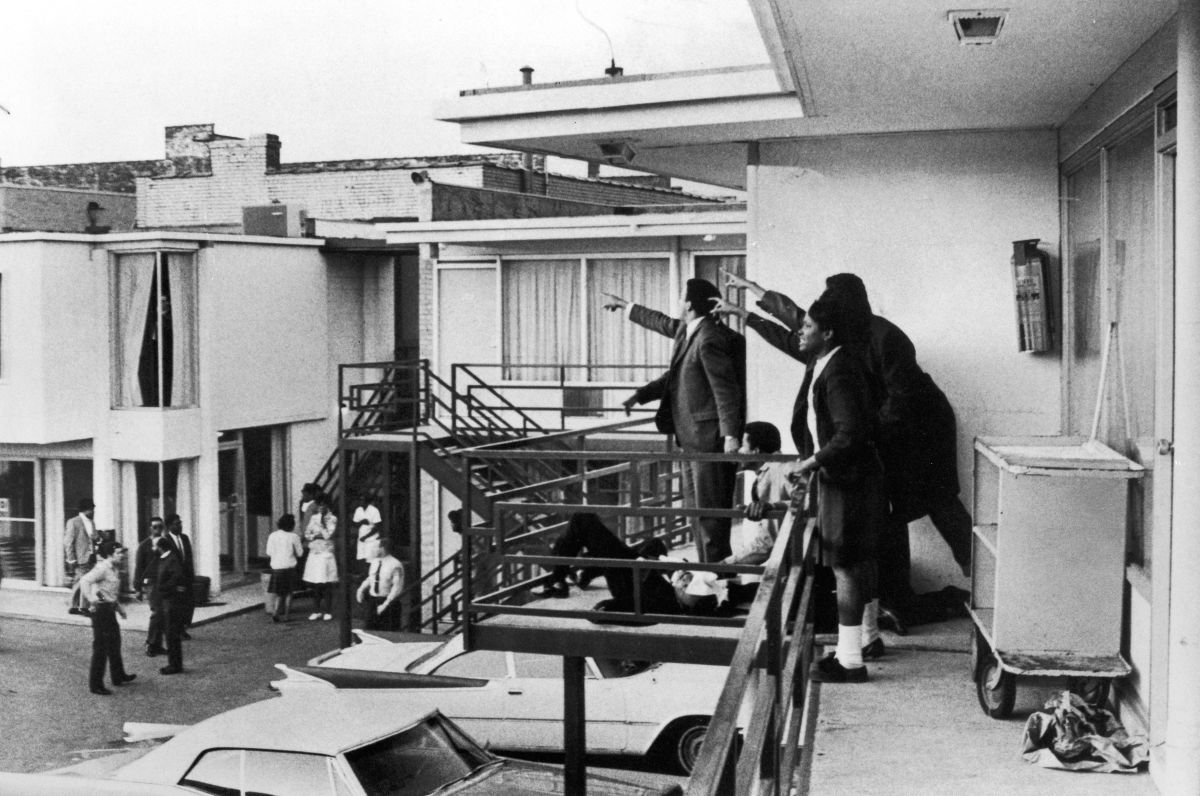
It was difficult to find—there was no signage—but then we turned a corner and there it was, the former Lorraine Motel where the Rev. Martin Luther King Jr. was assassinated.  I recognized it immediately, having seen it a hundred times in iconic photos.

TENNESSEE, UNITED STATES - APRIL 04:  Civil rights leader Andrew Young (L) and others standing on balcony of Lorraine motel pointing in direction of assailant after assassination of civil rights leader Dr. Martin Luther King, Jr., who is lying at their feet.  (Photo by Joseph Louw/The LIFE Images Collection/Getty Images)

And this was the beginning of learning something about myself, because I got so choked up I had to turn away so no one would see me in tears.

I have been to Holocaust museums in Washington, DC; Jerusalem, Berlin, Prague, Chicago, and elsewhere, and they’ve been tear-filled experiences too.  But then, I’m Jewish.  Were my tears only because the story was about my people?  That fear—that I only felt empathy for my own kind—was laid to rest in Memphis.

Can a Man

I wiped my tears away but they welled up continually inside the museum, which was one long, sad horror show that traced the abuse of African Americans from slave days up through the assassination in 1968.

There was a large group of school children, mostly African American, going through with docents.  I wondered what they felt seeing Africans in chains, the police dogs, the fire hoses?  If it was my kid I would want to be on the tour to put my arm around him.  There was the usual laughing and fooling around that any group of kids will exhibit, but I wondered if they would have trouble sleeping that night.

I commented to Lynn, “A coworker of mine at Oxfam used to find every opportunity to mention, ‘the UK never had slavery’ in a superior tone.”

“We may not have had slaves in the country, but we certainly benefited and participated in the system,” Lynn replied as we read a display about how global the slave trade was.

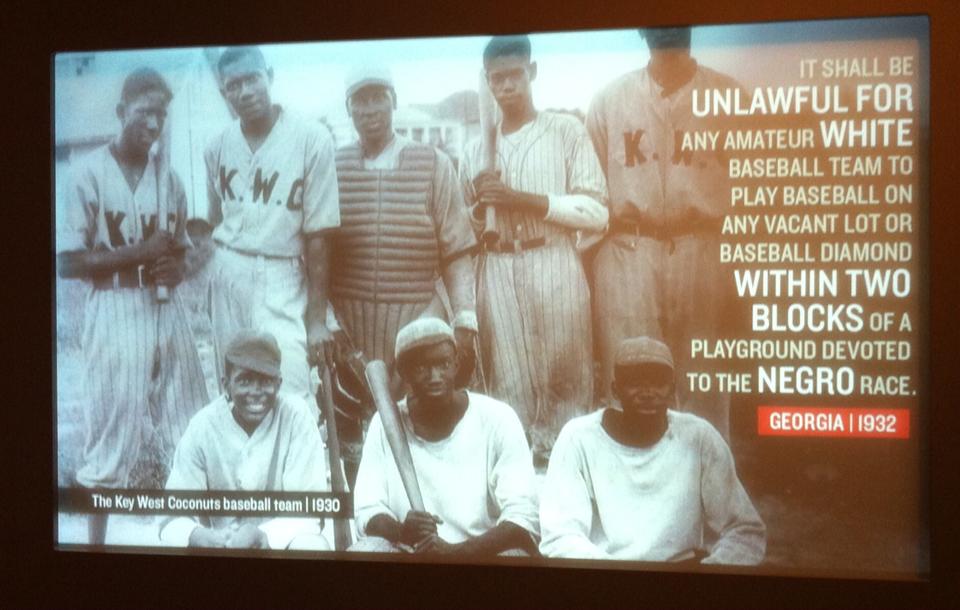
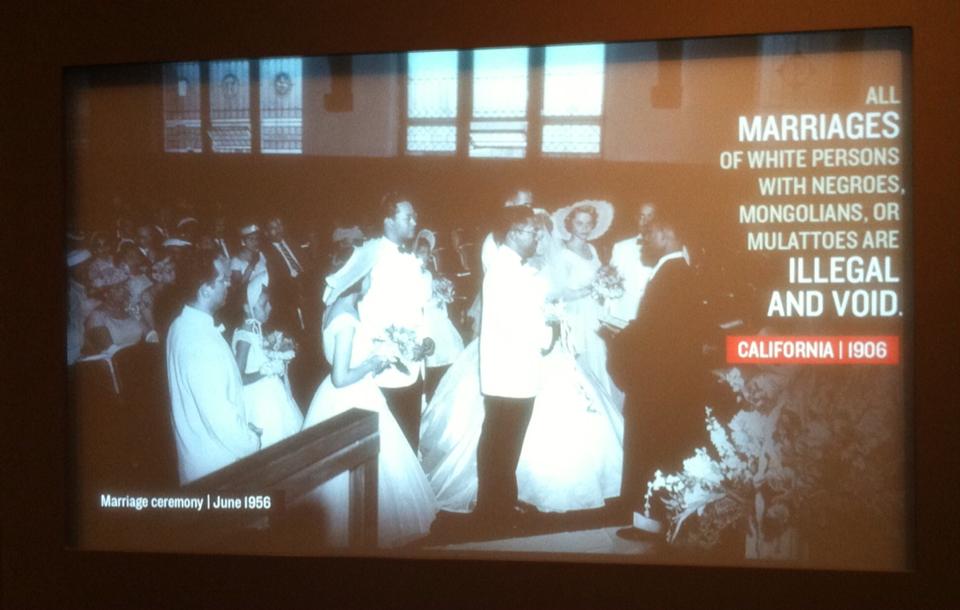
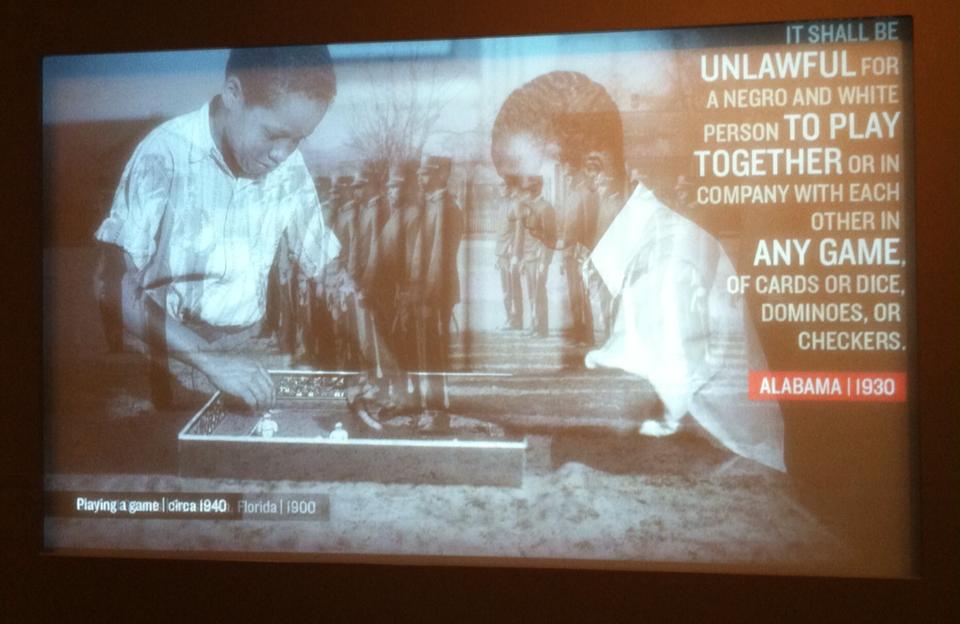
And of course it didn’t end with the abolition of slavery.  “Jim Crow” was the system in the southern United States from reconstruction up through the civil rights era in the 60s that kept “negros” in their place.  Here are a few of the ridiculous laws from that time:

Baseball Law Mulattos Checkers

Really?  Checkers!?  Who knew checkers could subvert the social order?

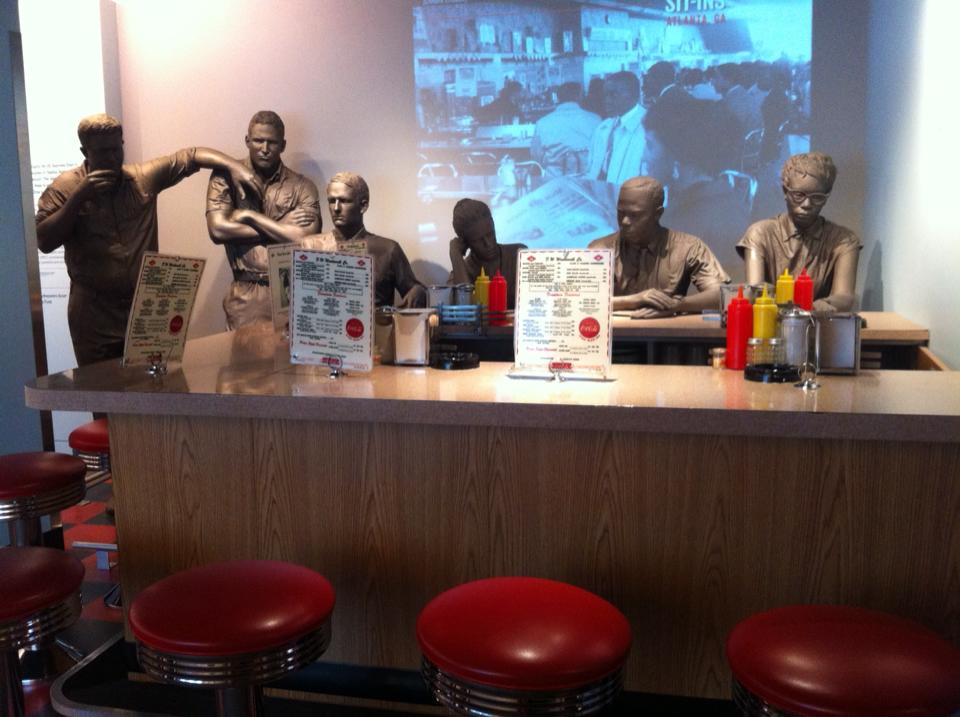
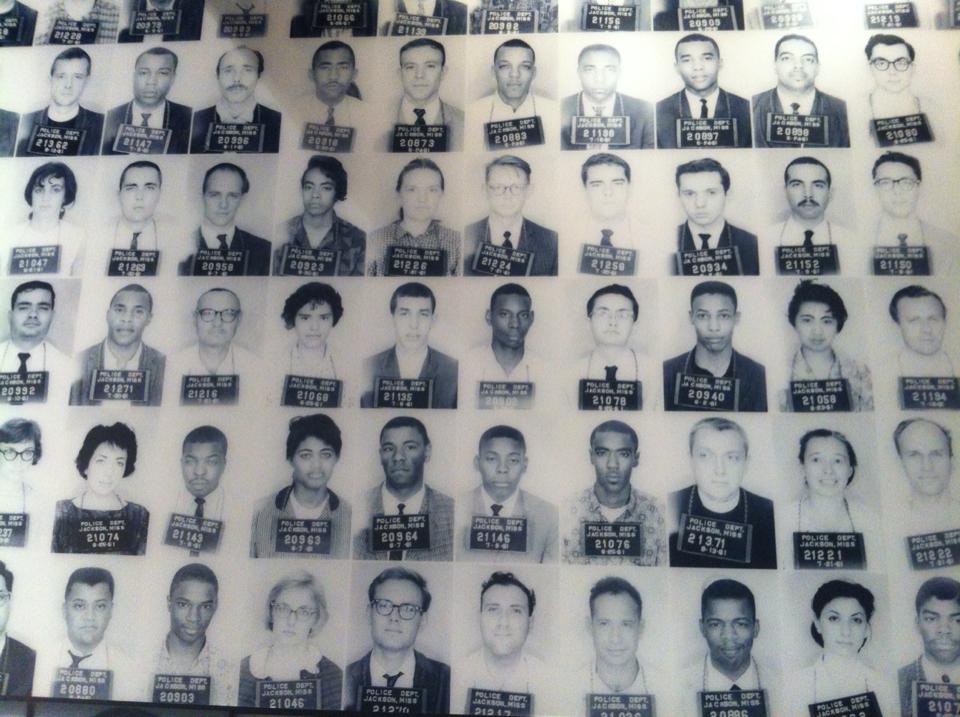
Then we marched slowly through exhibits about bus boycotts, lunch counter protests, and strikes.  Then there were the cross burnings, lynchings, and bombings by white racists; somewhat counterbalanced by the support of white and other allies (including Jews).

Lunch Counter I am a Man Bus Boycott Activists

I watched a video about James Meredith, the first black student to be accepted to the University of Mississippi, in Oxford Mississippi.  Of course he hadn’t mentioned his race in his application, and when he showed up to enroll all hell broke loose.  After weeks of rioting by whites, which resulted in two deaths, he was reluctantly let in, and as Lynn read later, he did graduate and lived a normal life afterwards.

The museum was really well done.  There was a second building that explored African American activism post 1968, but after three or four hours in the first building we had to leave.

Last week Vince and I talked to a group about mass incarceration.  One of the audience members referred to it as the New Jim Crow.  I agree, although in my opinion it’s about poverty, addiction, mental health, and class as much as racism.

Long Ago in a Land of Spandex

Greetings from St. Louis.  One more day of the road trip, and one more guest post from Vince.

Long Ago, In a Land of Spandex

It’s Friday again, my favorite day of the week. I like my job, but I like weekends more, and at this very moment it’s the longest possible time before more work.  This will be the seventh post now on the topic of my career.  Or careers.  Or lack thereof, uh, yeah.  I have no career; I have held many jobs over the years.

At this moment, I’m taking a break from packing my few belongings for the big move. I finally threw away all of my stuff from prison and boot camp. I was never going to use any of it, so I’m happy to toss it out.  Alright then, on with it.

After leaving Rochester and finding temporary shelter with a friend of a friend in Fountain, Minnesota, I was given a job as a line cook at Pedal Pusher’s Café in nearby Lanesboro.  The owners were a couple with three kids and they all lived upstairs of the restaurant. Looking back, it really sucks to see how things went down.  They were kind, generous people who went out of their way to help me when I was down.  They even let me sleep in their camper for a while after things went sour in Fountain, and while I waited to find an apartment of my own which they also loaned me the money for.

pedal-pushers-cafe-corner

Lanesboro is a bustling little city full of B&B’s, bike trails, trout fishing, tourists, and spandex,  It has a few restaurants too, and they were very busy in the summer. I hadn’t been on a line in some years when I started there, but I picked things back up pretty quickly. Time flew by, I worked hard, and started drinking hard.  I also met a new friend that would play a major role in my life for many years to come: gambling.

In the form of pull tabs, I whittled away my pay checks one dollar at a time for months. Eventually, I started taking advances on my pay checks, and very shortly after I started doing that, I started taking advances without their knowledge. This may come as a shock to some people with whom I have not been entirely honest over the years, but I’m letting it all out now.  I felt like a lowlife piece of shit, but unfortunately, I just did not care.  It didn’t take them long to catch on to me and I was eventually fired for stealing.

Unable to get unemployment benefits, I became withdrawn and moved in with an unenthusiastic friend and his soon to be wife.  I sat in that room for a month, maybe two.  I wore the same clothes, I ate ramen out of the package, and I cried every day.  I was too proud to ask for help.  I couldn’t take care of myself, I couldn’t find a job (because I absolutely was not looking), and I was about as close to having a suicidal urge as I’ve ever come.  Auspiciously, a very good friend of mine got me out of that trance and back into Fountain where I held a few more jobs.

About two weeks ago, I sent a letter to the owners of Pedal Pusher’s. I told them a lot of what has been going on with me, but more importantly, what was going on with me back then. I asked them to give me a chance to repair the damage I have created, and I included a small token of my sincerity in the form of money. I haven’t heard back from them and I don’t know that I ever will.  But I have done my part.  At the very least, I have tried to open an avenue of communication with them so that I may fix what has been broken for so long.  It was the first of many letters to many people, and with each one, I hope to feel a little more human again.

Time to Make a Move

Greetings from Oxford, Mississippi! This is a post written by Vince about his move. It will be bittersweet to come home to an empty house.

Time to Make a Move

Just shy of seven months as a free man, I am happy to report that, as a 37-year-old, I am moving out of my mother’s home. Again. Maybe for the fourth time in my life, and hopefully for the last.

I alluded to this in my last post but not before because I didn’t want to get overexcited about it until it was actually approved by my agents. Now it is official, and I can proudly relate this information to you: I AM MOVING!  Just two short days from now.

I have written about this move before, but as a failed attempt at leaving the nest possibly too early.  I’m moving into a house with two sober guys from the program, one of which I was in prison with, and I’ve worked with for some time. He no longer works with me, but we remain friends. I don’t know the other guy, but he’s sober, and that counts for a lot.

I’ve been to see the house once.  It’s small as you can see in the picture, but I’ll have my own room, so it isn’t like a sober house environment. There isn’t a house manager that watches over us, or anybody to give us random shakedowns and breathalyzers. I have my agents for that. This is a step forward.

V's House

It couldn’t come at a better time, in my opinion, as I will be moving on to the next phase of Intensive Supervised Release program soon after. That will open up a lot more time that I can spend doing things I want to do like go to more meetings, and spending more time with my family. I am also finishing the last three hours of my community service this week.

It’s all lining up.  Everything is going well in so many ways.  So I need to be really careful. For somebody like me, good news can be all I need to trick myself into thinking I deserve a reward.  Maybe I can go out and celebrate with just one drink, or just a little crack (“A little” crack doesn’t actually exist. It’s an all or nothing drug. For more information, go here). I mean, at this point I’ve built myself a pretty good network of people that I can reach out to if the urge hits me, but it’s always good to layer on the protection.

This disease of mine can also be described as an allergy. When I drink or do drugs, things just go haywire. My body responds differently to them than normal people.  Also, my allergy in particular is a little more severe than say, a gluten allergy. Oh, also I don’t believe that’s a real allergy, but I’m not a Doctor.  Anyhow, let’s say that somebody with a gluten allergy accidentally ingests some flour. Well, maybe an hour or so later, they fart a little and that causes some slight discomfort or embarrassment. Well, when I ingest a little alcohol, or maybe some meth, my world flips upside down.  I can no longer take care of myself financially, mentally, or physically. And this allergy affects others, too.  For example, if I smoke crack, you may no longer have a television, and some of your smaller valuables may go missing as well.

Simply put, chemicals make me not give a fuck about you or me.  And I’d really like to avoid all of that so that’s why I’ve immersed myself in this program of Alcoholics Anonymous. I’m not worried about relapsing because of my new place and my new freedoms, I’m excited to see what I can do with them.  And I’m really happy to be able to share this with you people. For you that are new to this blog, I encourage you to see where it all started almost two years ago with just five pieces of writing paper and a 3” flexible safety pen behind the unforgiving bars at St. Cloud Men’s Reformatory/State Prison.