Category Archives: Adventure

Wrestling with Restless

I started a blog in 2011 and fizzled out after about six weeks.  It was called Wrestling with Restless, and that could still be a perfect theme for me.

I’ve got a great life, from any outside perspective.  I’m healthy.  I have friends and family I’m connected to.  I’ve got an interesting job that pays decently and has good benefits.  My condo is beautiful and my son is out of prison and doing well.  I live in an area where the cost of living is reasonable and you can always find a parking spot.  We’re big on the arts—we’ve got loads of theater companies, symphony orchestras and chamber orchestras and operas, modern and traditional art museums, and sports teams.  Not that I care about sports.

It’s clean here.  It’s green.  We have good tap water.  It’s diverse—not like New York City diverse, but we’ve got the largest populations of Somali and Hmong and Burmese immigrants in the U.S.  There’s an international airport 10 minutes from my house but there’s also a state park with a lake and two rivers 5 minutes from the airport.  We’ve got light rail and bike lanes and farmers markets and microbreweries and farm-to-table restaurants and someone has even proposed opening a mill to make artisanal flour.  We’re one of the most progressive states, politically.   We’re always on those lists like “Top 10 Cities for Working Moms,” “Best Overall Quality of Life,” “Greenest Cities,” “Most LGBT Friendly Cities,” and on and on.

So why would I want to leave?

When I turned 40, in short order my boyfriend dumped me, I was fired from my job, and I was diagnosed with Multiple Sclerosis.  So I did what anyone would do—I booked myself into a one-week Spanish immersion class in Mexico.

I looked out the plane window as we flew over Mexico City.  I timed it—20 minutes to fly across from one end to the other.  That’s a long time!  I had never traveled to a developing country before, except to Cost Rica the year before with the ex-boyfriend, and we had stayed at a luxury resort.  When the exit doors of the airport slid open, a hundred men started yelling and waving at me.  “It’s a riot!” I thought, but they were only taxi drivers trying to get my business.

I picked the closest one, who took me to the hotel where I would spend one night before taking a bus to my school, in Cuernavaca.  At the desk, the clerk asked me, “Cual es su nombre?” and I answered “Uno,” thinking nombre must mean number, as in how many are in your party.  He somehow got my name out of me, then rattled off the list of things desk clerks tell you, including that something was “el sexto.”  I clutched my belongings about me and hurried off to my room, where it dawned on me he had been saying “sixth floor,” not propositioning me for sex.

That’s right, I spoke only about 10 words of Spanish.  I sat in my tiny concrete room trying to memorize the key phrases I would need to buy a bus ticket and get to Cuernavaca the next day.  There was one very small, square window near the top of the high ceiling, and all night I heard what sounded like a rabid baboon baying.  There was no glass or screen on the window.  Could whatever it was get into my room?  Why hadn’t I brought that mace someone had given me as a parting gift and which I had left at home to show how worry free I was?

As is usual with my series of posts, I will eventually make a point that that connects to my original question.

But until then: I have mentioned a lot of companies on this blog—Bob Barker, Pillow King, Mega Bank, Industrial Chemicals, Inc, etc.—always with withering disdain.  I am happy to now highly recommend a company called Amerispan.  I went to Mexico three times and to Spain once to study Spanish with the help of Amerispan.  My niece used them to do the same in Costa Rica.   More about them next time.

The Nitty Gritty

I wrote in my last post about how you can find adventure close to home. But you can experience it even closer—inside your own head. The best example I can give, for me, is the rush of adrenaline I get when I am planning a trip. Not on a trip, just anticipating it. Looking at maps, checking airfares, considering the pros and cons of various destinations, imagining all the fun I will have with my friends.

I’ve written about how these kinds of thoughts cause physical reactions in my body, like a racing heart and sweaty palms. But I’ve never known how that works.

Strangely enough it was an article about solitary confinement that explained the phenomenon. Solitary confinement: the opposite of travel, right? The full title of the article is “How would you do in Supermax? The answer may lie with imagination and grit.”

First, here’s the negative side of solitary, which will be no surprise to anyone with a shred of empathy:

“Solitary confinement has been linked to a variety of profoundly negative psychological outcomes, including suicidal tendencies and spatial and cognitive distortions. Confinement-induced stress can shrink parts of the brain, including the hippocampus, which is responsible for memory, spatial orientation, and control of emotions. In addition to these measurable effects, prisoners often report bizarre and disturbing subjective experiences after they leave supermax. Some say the world regularly collapses in on itself. Others report they are unable to lead ordinary conversations, or think clearly for any length of time. The psychiatrist Sandra Schank puts it this way: “It’s a standard psychiatric concept, if you put people in isolation, they will go insane.”

But here’s where the article veers away from the usual, “it’s horrible, we should stop it” article about solitary. This article examines how some prisoners use mental imagery to survive, and even rehabilitate themselves.

Mental imagery is basically imagining something so vividly that it affects you physically or psychologically. Lots of us do this involuntarily—for instance since I am terrified of public speaking, if I have to give some remarks I will probably have involuntary flashes of imagining myself stammering and making a fool of myself, and this will make me even more nervous, and it may actually cause me to do what I feared.

On the other hand, controlled mental imagery is considered so effective that it is used by athletes to improve their performance. Before a competition, for instance, they will close their eyes and imagine every detail of a successful performance, and this contributes to their bodies and minds performing successfully in reality.

With all external stimulation stripped away, some people in solitary use controlled mental imagery to stay sharp, pass the time, and keep their spirits up. No one tells them about it, or how to do it; they somehow figure it out on their own.

Why are some prisoners in solitary able to summon controlled mental imagery to improve their lot, while most are at the mercy of involuntary mental images?

That’s the second point of the article. The thinking is that this small subset of prisoners possesses a quality called grit. I’ve always wondered how it is that I overcame the odds and became as successful as I am, when there are so many other unmarried teen moms out there who are still mired in poverty. Well, I’ve got grit. If you want to find out if you have it, here’s an online test. Apparently I am in the 90th-99th percentile of other users who have taken it.

What is grit? I would call it “stick-to-it-tiveness.” An innate persistence, perseverance, single mindedness, and diligence despite setbacks.

So some prisoners, who happen to have grit, are able to use controlled mental imagery to improve themselves and leave prison better, not broken.

Where does grit come from? Why do some people have it and others don’t? Can it be learned? I don’t know the answers to these questions. I do know that if I could bottle grit and sell it, I would be a wealthy woman.

In Pig’s Eye

I’ve been writing about a road trip to South Dakota that I took for work last week. I can’t say a lot more about it. There were some eyebrow-raising moments which have to remain confidential.

But one of my intentions in blogging is to demonstrate how you can experience adventure close to home—and even in your head. You don’t have to spend thousands on a trip abroad. Your own neighborhood can hold surprises.

I’ve lived in St. Paul almost all my life. It’s not that big of a city—about 300,000 people. I went for a long walk on a Sunday afternoon and found the following things that were new to me.

I crossed the Smith Avenue Bridge, which everyone calls the High Bridge, because it’s, well, high. The High Bridge was new to me. What a view.  I know, my photos are not the best, but they’ll give you the general idea.

Bridgeview 2

Sadly, because it’s high, the High Bridge is one of the preferred bridges in the Twin Cities for people to jump from. There was this tender note from a stranger to a stranger.

Bridge Memorial

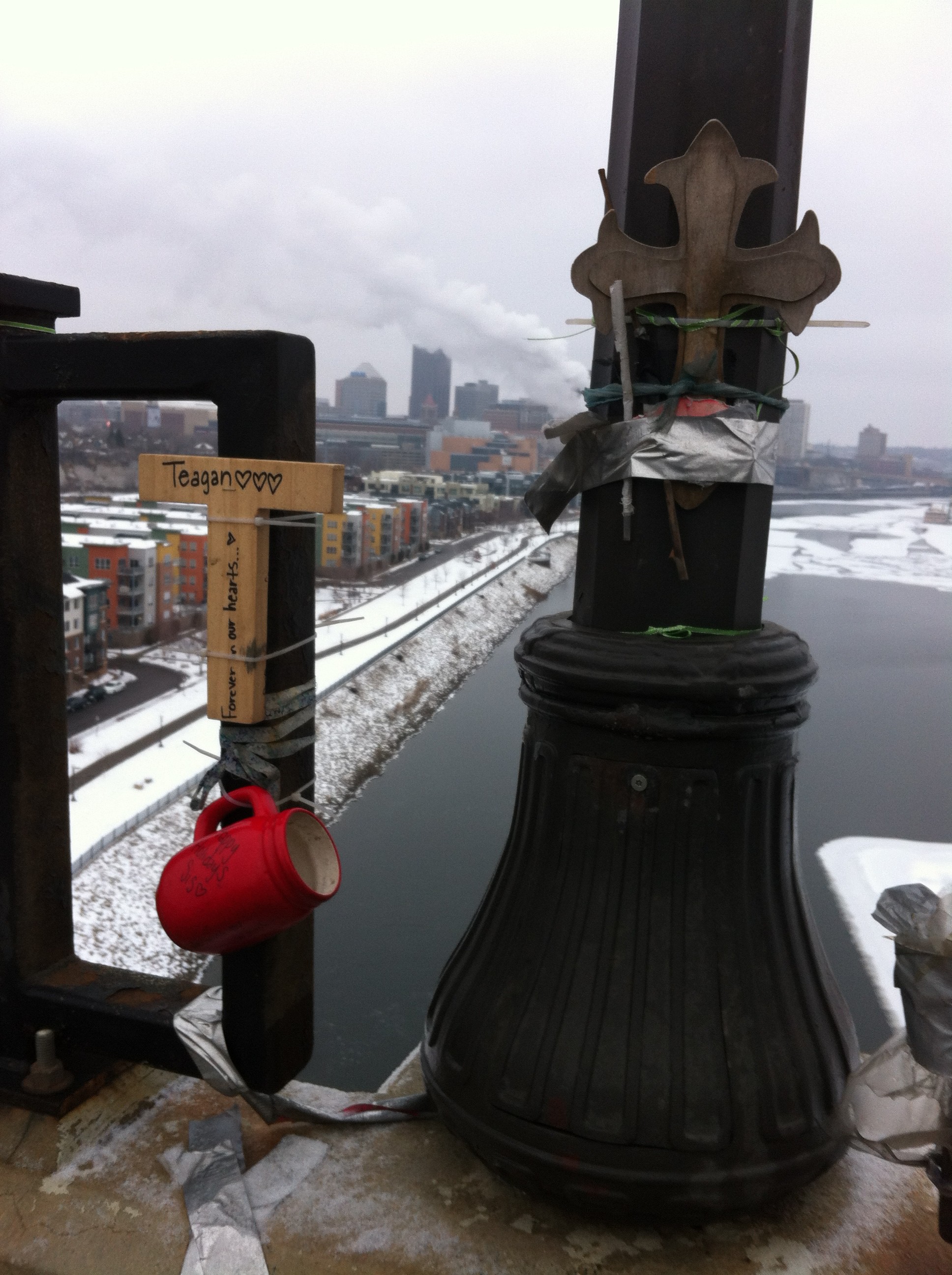
There was this makeshift shrine to someone named Teagan. I don’t know if she was the same person to whom the note in the previous photo was written, or a second jumper.

Suicide Shrine

Someone has been thinking about how to prevent suicides from the High Bridge. I don’t know. Would you have the presence of mind to call the number, or would you even see it if you were intent on jumping off a bridge?

Suicide Hotline

Ah, the sun came out, very welcome after being reminded of suicide at every footstep. This is a view from the Wabasha Bridge toward the train bridge.  I don’t know the name of the train bridge; everyone just calls it The Train Bridge.

Bridge View

Now I was in Kellogg Mall, a long strip of greenery between downtown and the river.  I don’t normally read plaques. Because I travel so much, if I read every plaque (and spent time on every portrait of the Madonna and Child, for that matter), I would never do anything else.  But this one said something about Fr. Lucian Galtier, who gave St. Paul its name.

SP Walk Rock

At the base of the rock there was a bag containing a hat, scarf, and mittens with a note that said, “I’m not lost! Please use to keep warm!” Presumably this is for some homeless person who has a preference for pink.

Scarf in a Bag

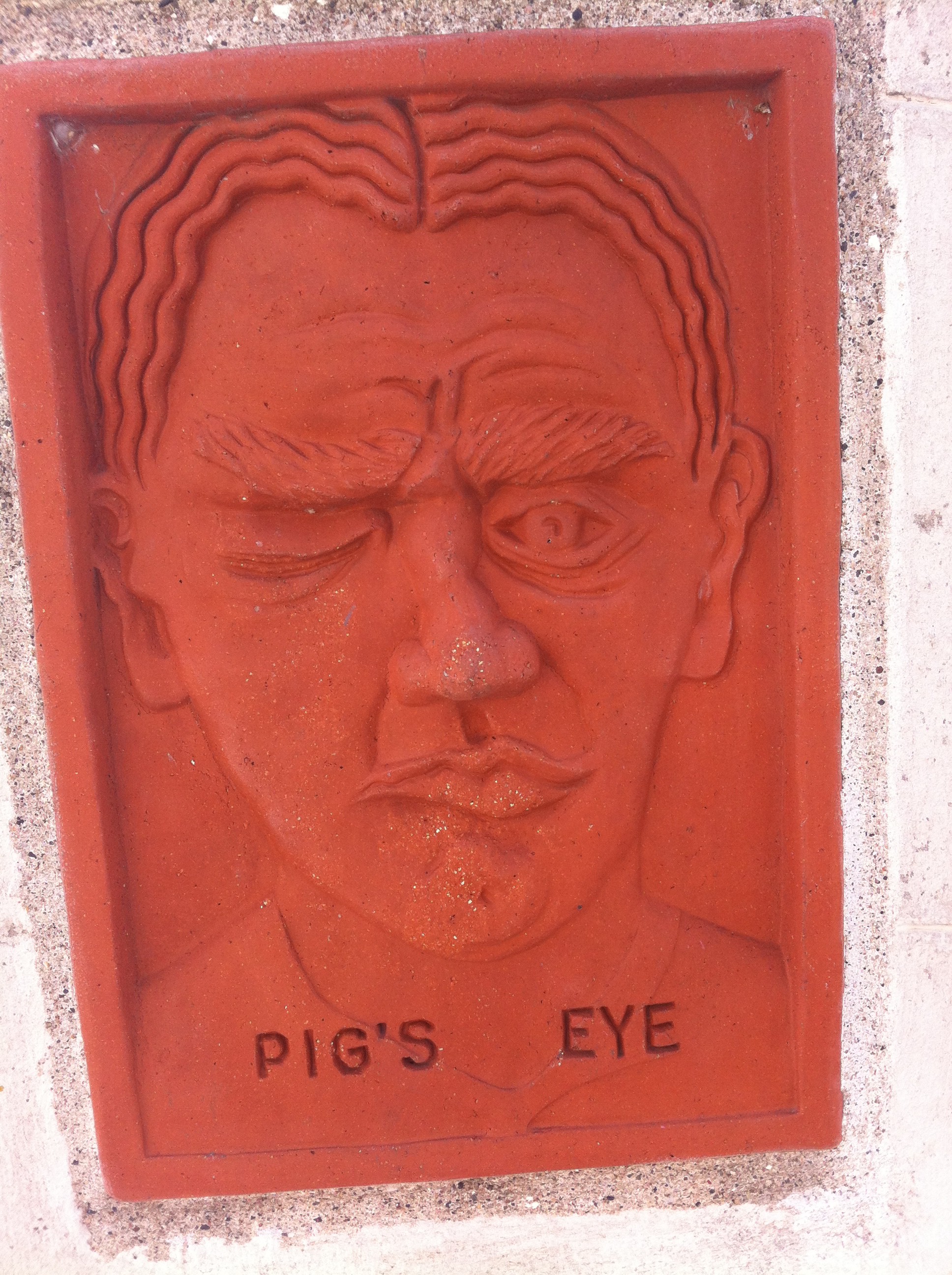
If it hadn’t been for Fr. Galtier, St. Paul might still be called Pig’s Eye. Pig’s Eye Parrant was a blind-in-one-eye French Canadian fur trader who squatted outside Fort Snelling, near present-day St. Paul.  He made hootch and sold it to the soldiers, then eventually built a shack on the river landing below what would become St. Paul, becoming our first civilian resident. The details are sketchy, but it makes a good myth and we have a pretty good beer named Pig’s Eye as a result.

Pigs Eye Close UP

So go for a walk!  Think how you would tell the story of what you see to a good friend, or to a stranger.  Get out of your rut. Take a different route than the one you’re used to. Take a left turn instead of a right. Follow that path into the woods you’ve always wondered about. Notice things. Snap some pics, or not.  Adventure is all around you if you hold the right attitude of inquisitiveness.