Category Archives: Budget travel

Rain, Snow, and Pesos

Here we are on our walking tour of Medellin.  From left, that’s me, Roxana, Lynn, Daniella our guide, and Ricardo.  See how sunny it is?

The sun didn’t last.  On our walk back from the Metro to Park Lleras, it began to rain buckets.  I was glad I had my packable poncho from the UK—and that I had actually brought it along.

As I write this, the sun is out in St. Paul and it’s supposed to hit nearly 60F/15C today.  Six days ago, we had a record-setting blizzard with 14 inches of snow that closed schools and businesses for the day.  I spent hours shoveling wet heavy snow and trying to get my car moved because the city had declared a snow emergency and there is a complicated set of rules for where you can park or you will be towed and have to pay a nearly $300 ransom to get your car back. I found a spot to park four blocks from my house then had to wade home through calf-deep snow.  The next day I had to move it again.

A guy who lives a few houses from me, and his adult daughter, came and helped.  He wore New York-style tortoise shell glasses and we made small talk about how the post office had accidentally delivered my issue of Foreign Policy magazine to his house. He was wearing gloves so I couldn’t see if he was wearing a ring or not.

My car was parked on a slight incline and the spinning tires had worn into shallow grooves of sheer ice.  It wasn’t just my car; there were people stuck kittywampus up and down the street.  A plow truck was jackknifed across the street, spinning its tires.  After an hour of shoveling and pushing back and forth with no results, another neighbor came along—a large guy with missing front teeth and a cigarette dangling from his unshaven face. “It’s a Mini!” he pronounced, as if we didn’t know that.  “Just push ‘er from the front on the side and spin ‘er around 180 degrees into the street!”  Which is what we did and “she” was free 30 seconds.

“I know cars!” the big guy crowed.  “I’m from Chicago, Illinois!”  I don’t know what being from Chicago had to do with car knowledge, but the next time I’m stuck, I’ll seek his help first.

Later, I helped another neighbor move her car.  When she lowered her window, a billow of pot smoke hit me in the face.  That evening I was so exhausted I could barely pour myself a drink, but at least I had waited until after the herculean physical exertion of car pushing and shoveling.

I got to my yoga class a few days later and realized I had no mat—because I had shoved it under one of my tires to get traction.  It hadn’t worked.  The spinning tire had just sent it whizzing through the air into the street, covered with black tire marks, blue ice salt, and crusty snow.

The point of this long detour of a story is, we Minnesotans tend to idealize the weather everywhere else and arrive unprepared for the fact that it can be bone-chillingly cold in San Francisco or Mexico.  Maybe, in my late 50s, I was finally gaining some common sense. Still, the poncho didn’t save my feet from getting soaked.

We made it to the Park of Bars, as Park Lleras should really be named, soaking and laughing and ready for some drinks and dinner.  We tipped Daniella generously (I hope she thought we were generous).  Roxana’s daughter Gabriella joined us, and we had a great long dinner with fantastic Peruvian-Venezuelan-Colombian food and several pitchers of Sangria.  Ricardo kept refilling my glass. Look how happy we all look!
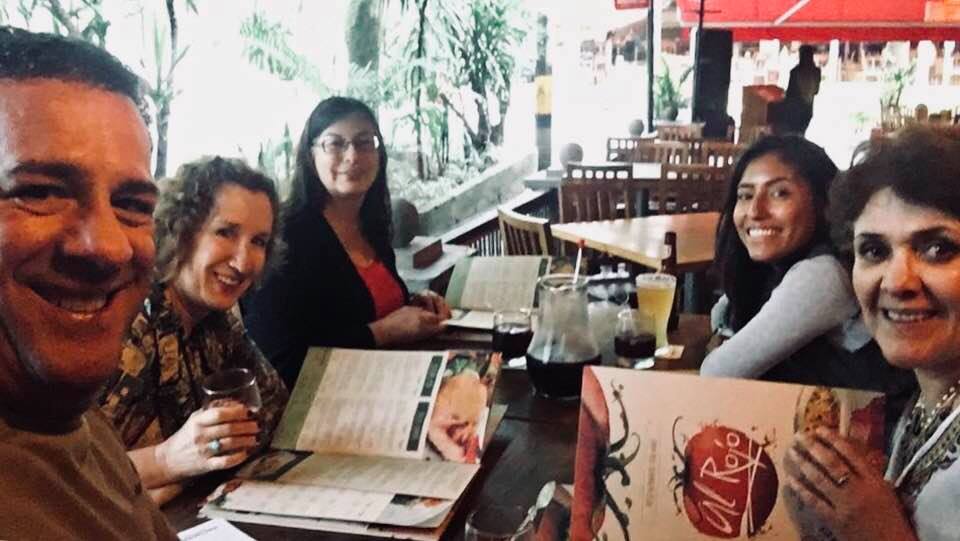
When it came time to pay the bill, the tab was something like 350,000 pesos.  “I know it’s real money,” I said in a low voice.  “But it feels like we’re playing Monopoly.”

“Just take off the zeros at the end and divide by three!” Gaby kept saying, exasperated.  We eventually figured out we each owed $25 for a three-hour-long, fantastic meal.

Fat Cats, Fat Ladies, Fat Men

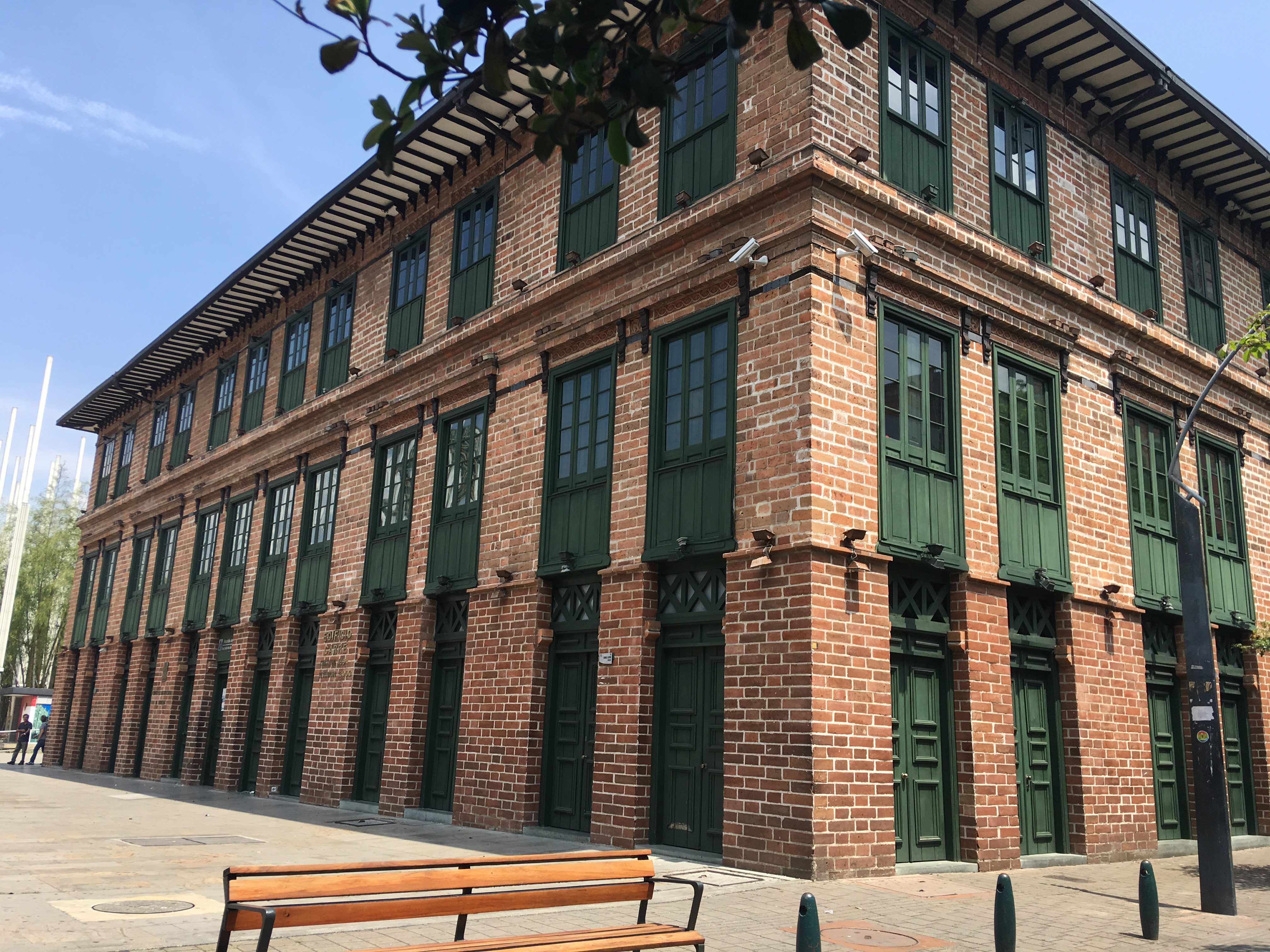
Daniella led us from the light tube square past a lovely old warehouse that was now the Education Ministry.

We entered a pedestrian mall lined with stalls selling everything from “Adidas” to batteries to bananas.

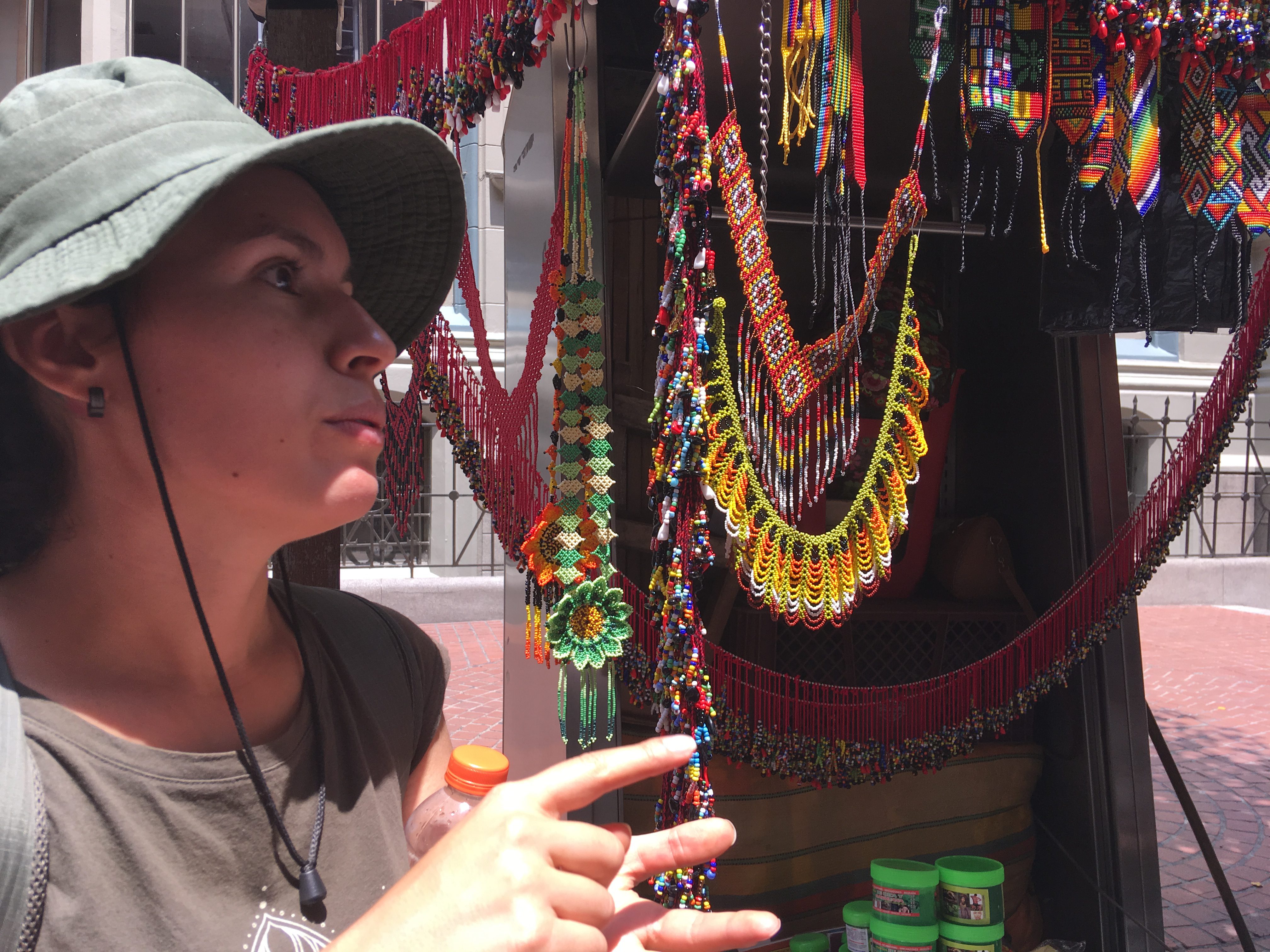
Here is Daniella explaining the significance of some indigenous jewellery.  “My mother doesn’t believe in religion and isn’t superstitious, but when I was a little girl and I got sick, she did buy one of these charms and tied it to my foot—just in case,” she ended with air quotes.  I bought two for the little kids in my life.

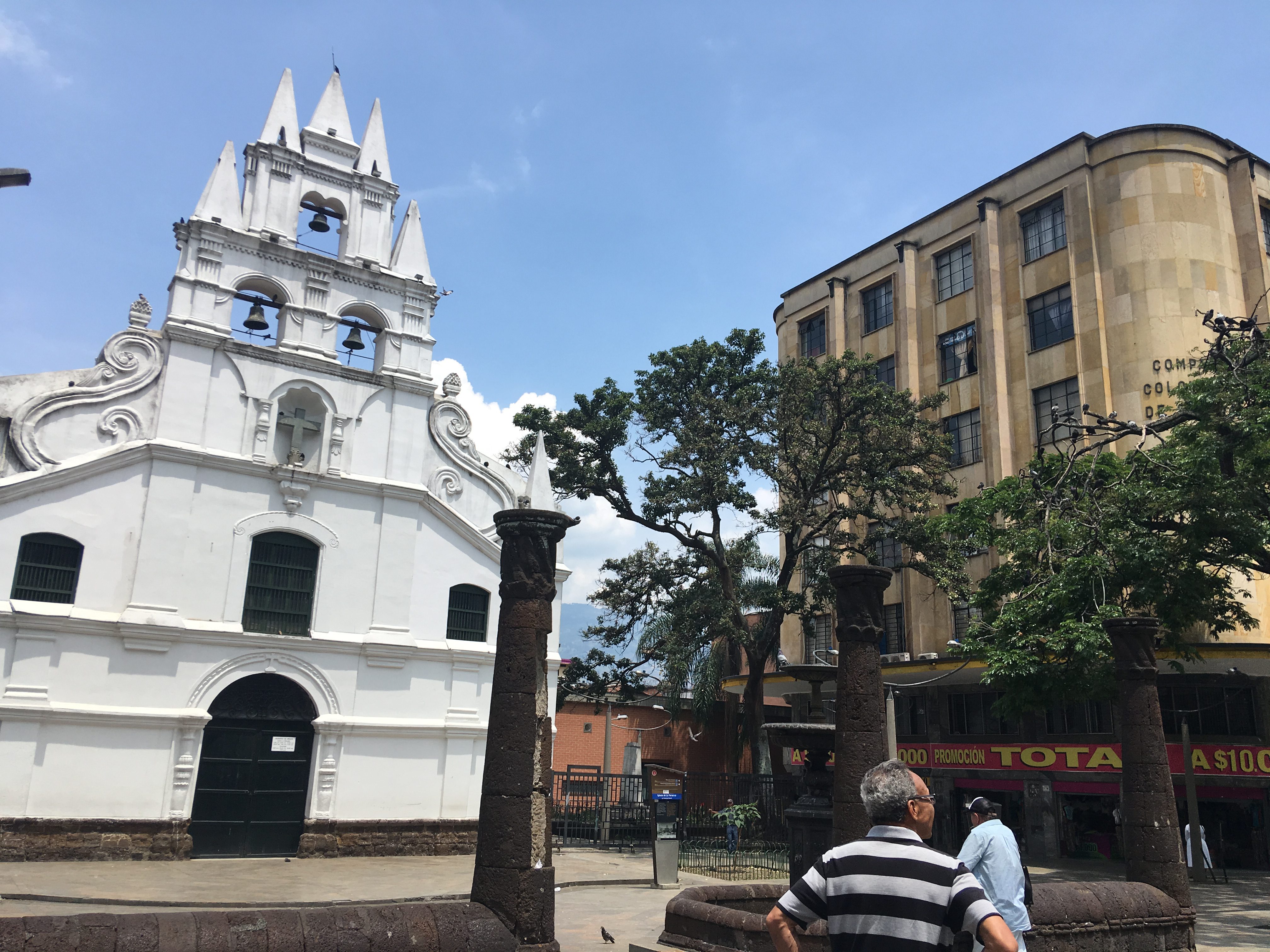
After a few blocks we began to enter an more open area leading to a very large square.  There was a beautiful colonial church—tainted by the fact that slaves had been sold in front—next to an art deco-era office building.

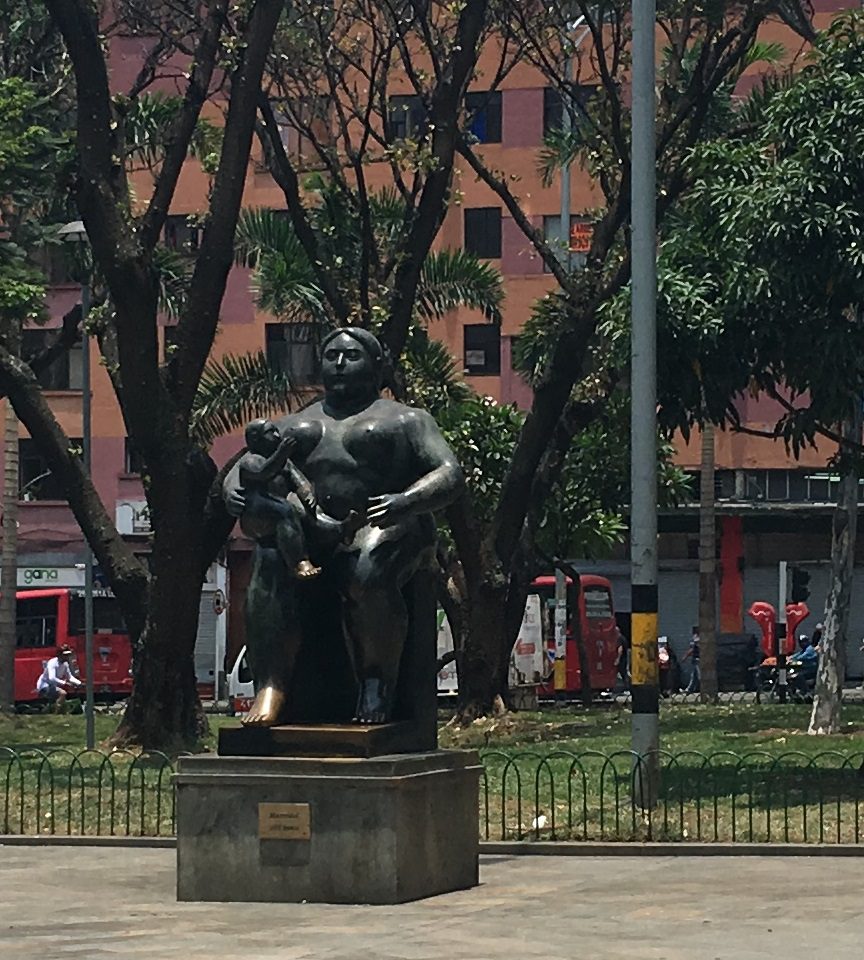
And then the Boteros began. I’d always thought of Botero as a novelty artist—an artist for whom it’s true that “a little goes a long way.”  But somehow, seen outdoors, in situ in the country of the artist’s birth, I became a fan. Here’s Ricardo taking a snap of Roxana.

This part of the tour must drive guides crazy.  We stopped every 10 feet to take photos.

This was my favorite.

We stopped for a coffee in a café overlooking the square. There were a lot of LLLs (large ladies in lycra) strolling by.

“I wonder if Botero was inspired by the women of Medellin,” I asked, hoping I didn’t sound like I was fat shaming, “or were the women of Medellin inspired by Botero?”

Daniella pointed out that all his figures looked like they’d been inflated with an air pump, not just the women. “He means to represent bloated political figures, and egos, and sometimes he’s just being humorous,” she said.

Our waiter had really been hustling to keep everyone served.  “He is Venezuelan,” Daniella said quietly. He is probably working illegally so they don’t have to pay him full wages.  It’s a big problem.”

“So there are Venezuelans here, in Medellin?” I asked.  “In the US, we read that they’re all on the border.”

“No!  They’re everywhere,” Daniella replied emphatically.

“And in the US they’re referred to as migrants,” I said, “probably because if they were officially declared refugees then the UN and US and other countries would be obligated to help them with funding.”

“Yes!” Roxana added, “They are refugees, not migrants!  ‘Migrants’ sounds voluntary.”

“They have no food, no petrol, no toilet paper,” said Daniella.  “How could you choose to stay if your children are hungry?”

We walked across the square toward the Metro.  This building, which looks like a cathedral or palace, is a government office building.

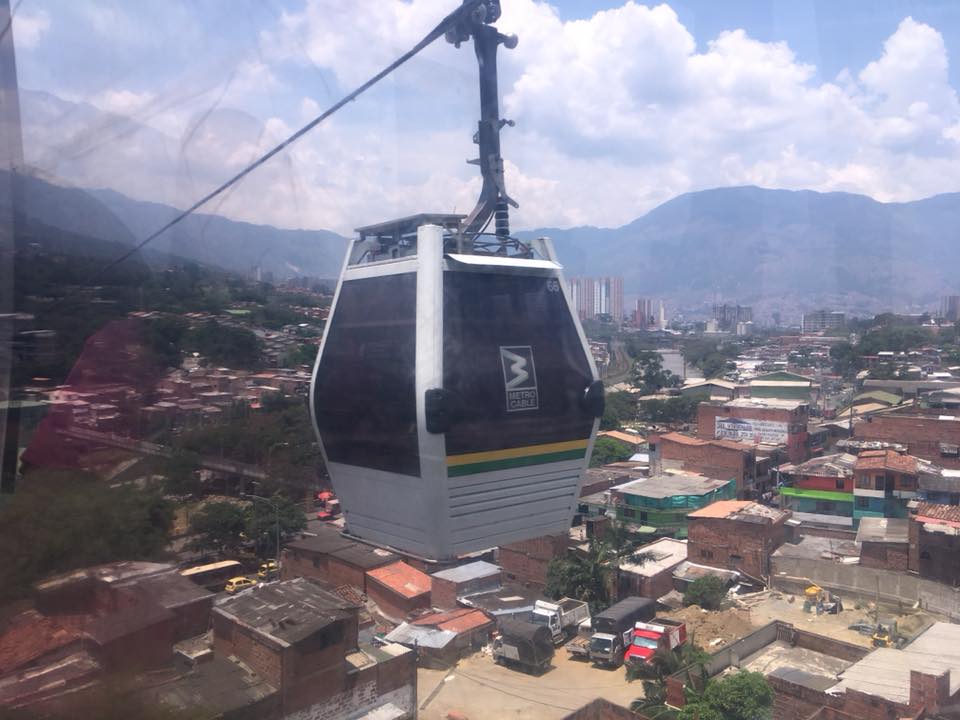
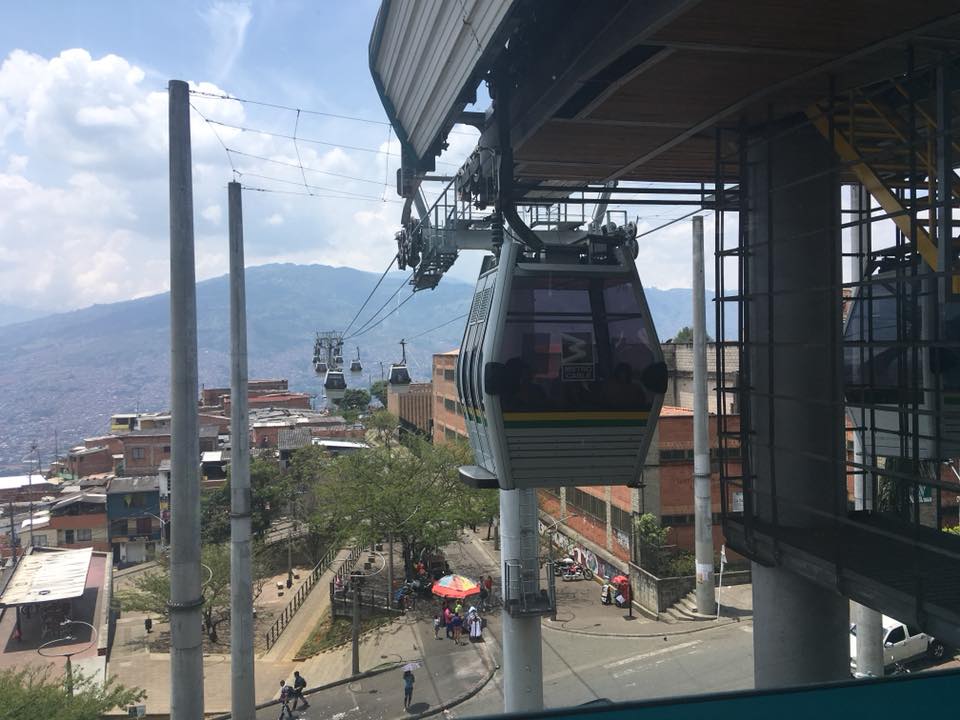
We rode the train a few more stops then got off to take the cable car system to the top of a mountain.  This is not a sight seeing ride, it’s public transport.

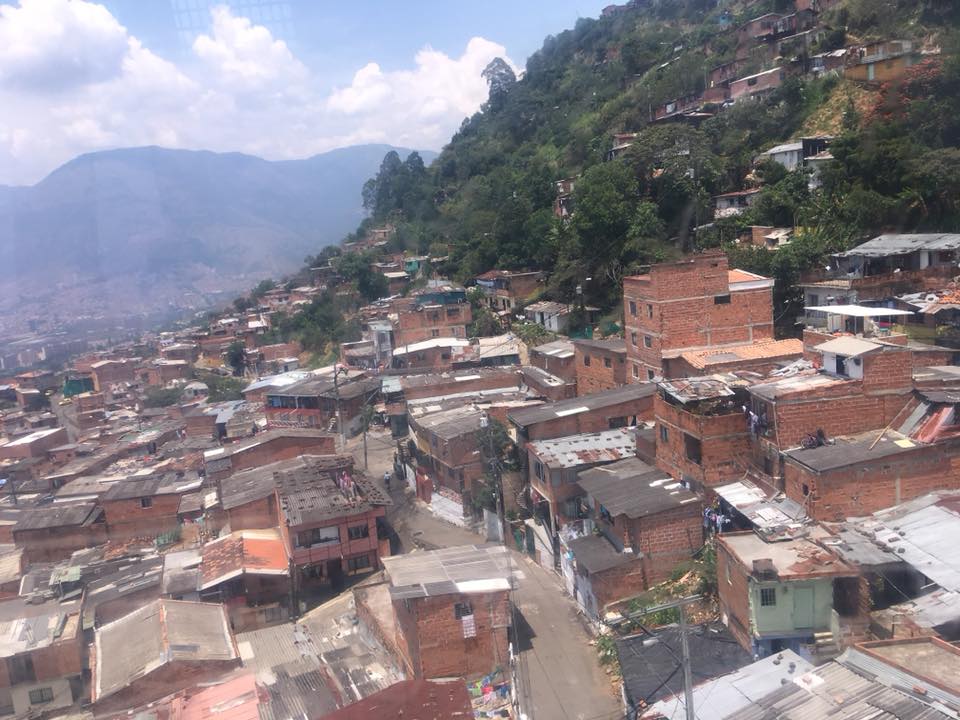
Up we went, over sprawling shanty towns. Six or eight people could sit comfortably in each car.

There was a stop midway.

We stayed on and kept going up, up, up.

Daniella kept saying the last stop was “RV Park,” which had me wondering if there would be trailer homes at the top.  Finally I consulted my Metro map and realized it was Arvi Park.

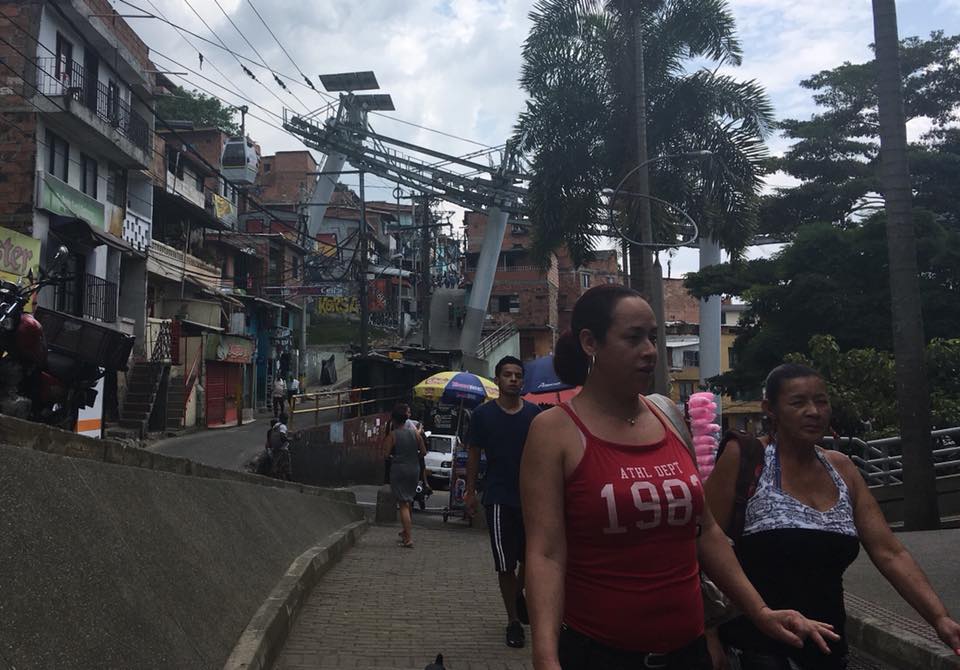
We wandered around the neighborhood at the top.  I imagine the cable cars solve any number of problems, like shrinking people’s commute times and helping women get around without being harassed, or kids being bullied or recruited into gangs.  Imagine, just sailing over the heads of your tormentors!

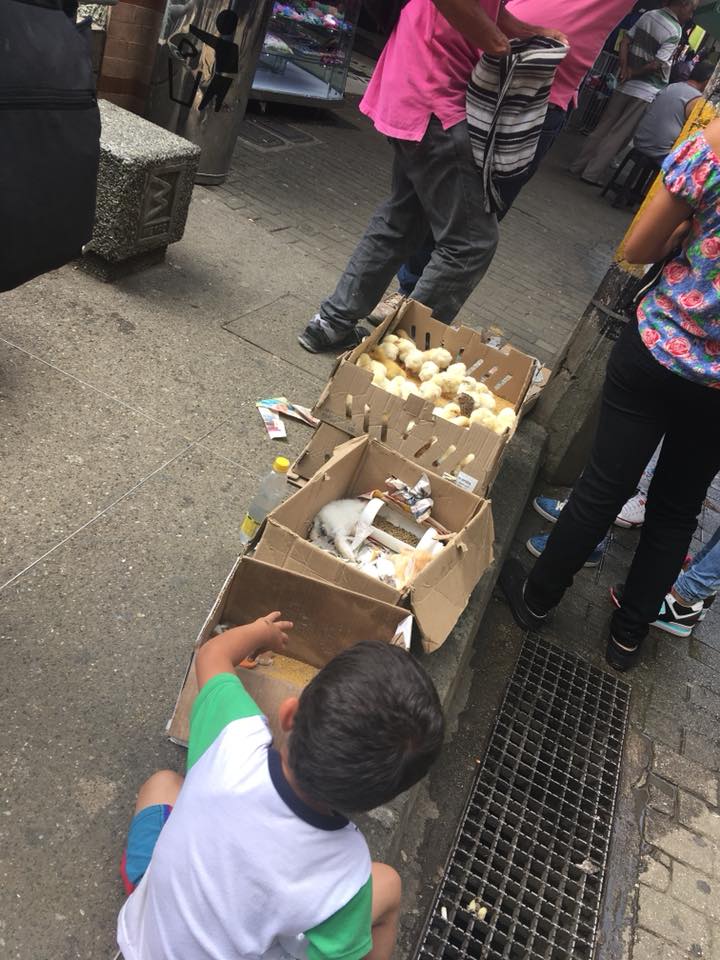
A little boy was running a street pet shop selling ducklings, rabbits and hamsters.

We walked to a cliff-side park where men were pushing little kids in what looked like go carts and young lovers were trying for a bit of privacy.  The smell of weed was pervasive.

There was a lot of poverty, but also a lot of art and people having fun out and about and clear efforts by some to improve their lots by adding second stories to their homes or painting them bright colors.

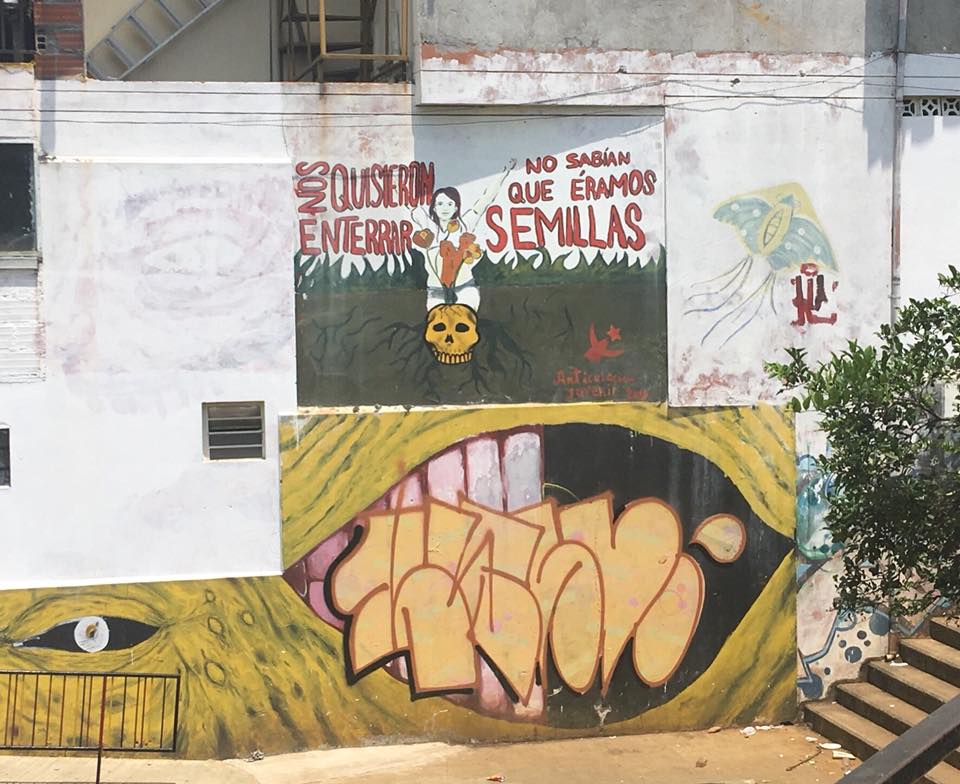
This mural says, “They tried to bury us. They didn’t know we were seeds.”

Medellin by Metro

Our tour was billed thusly: “You will take the public transport—the symbol of the city of Medellin, and visit the most important squares and learn about the extreme change that this city went through from being considered as the most dangerous city in the world to becoming the most modern city of Latin America.”

Daniella actually didn’t say much about “the drug thing” or Pablo Escobar.  I would have been interested to hear about it from a first-hand account, but having had a son who personally contributed to the international drug trade by being an addict and drug dealer, I was okay not knowing the details of how the US demand for drugs had made life hell for the residents of Medellin.

Daniella led us along the streets toward the Metro.  It was Monday, but a holiday, so traffic was light.

The walkway to the Metro itself afforded fantastic views of the city, with misty hills in the background.

The Virgin Mary stood guard at the entry to the station, blessing our travels.

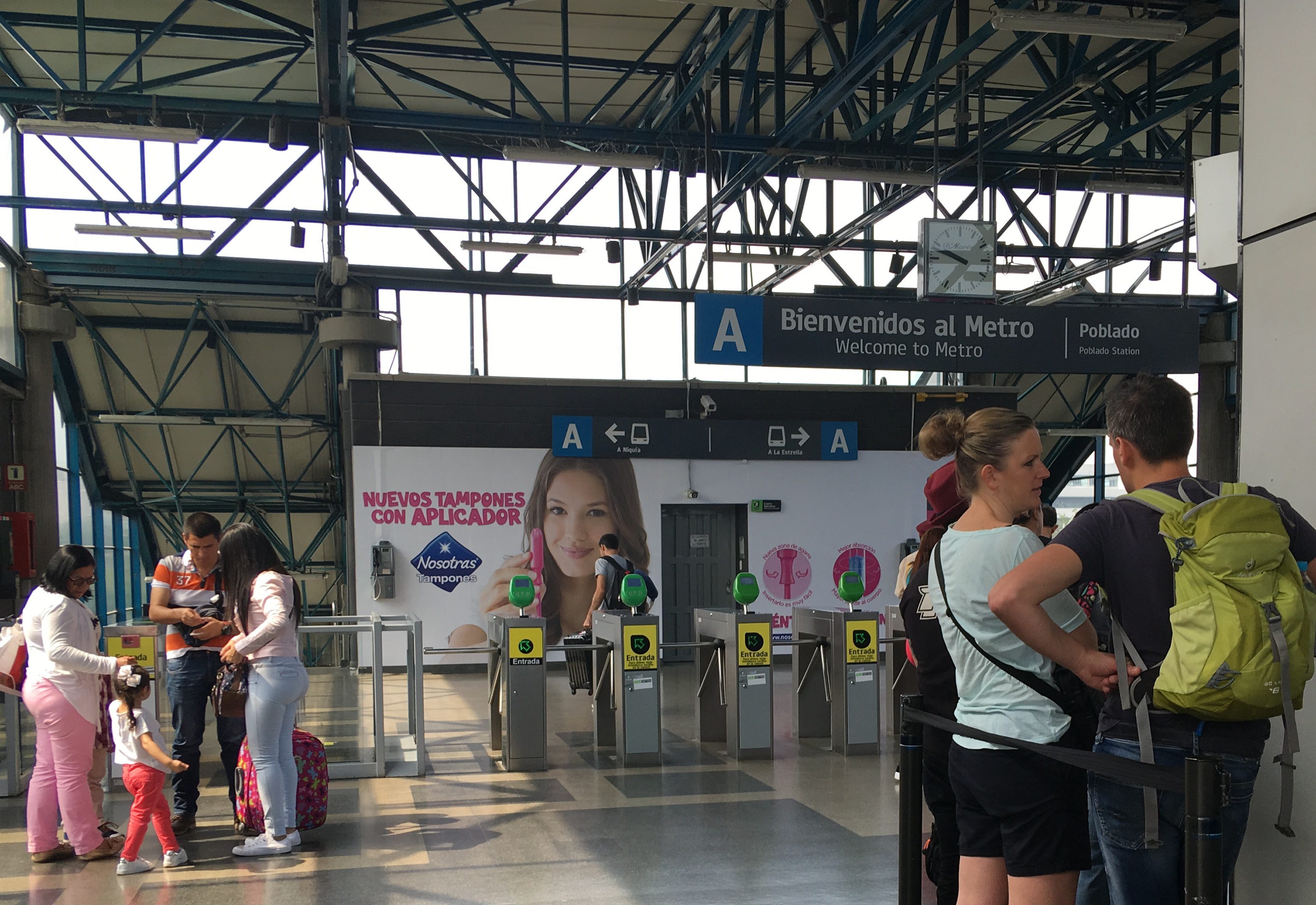
While inside, there was a 10 by 30 foot ad for tampons.

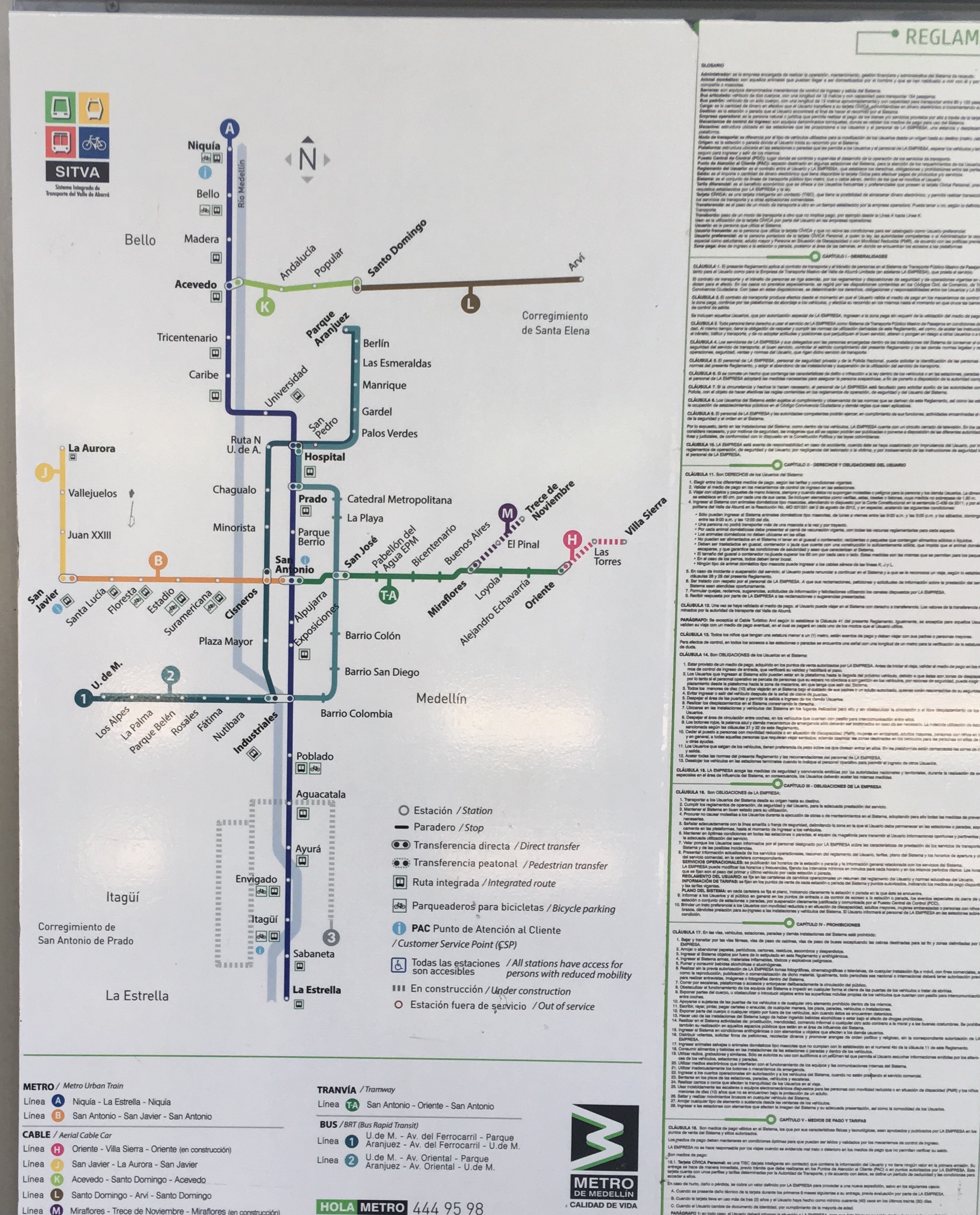
I snapped a photo of the Metro plan since they didn’t have artsy little handouts like in London.

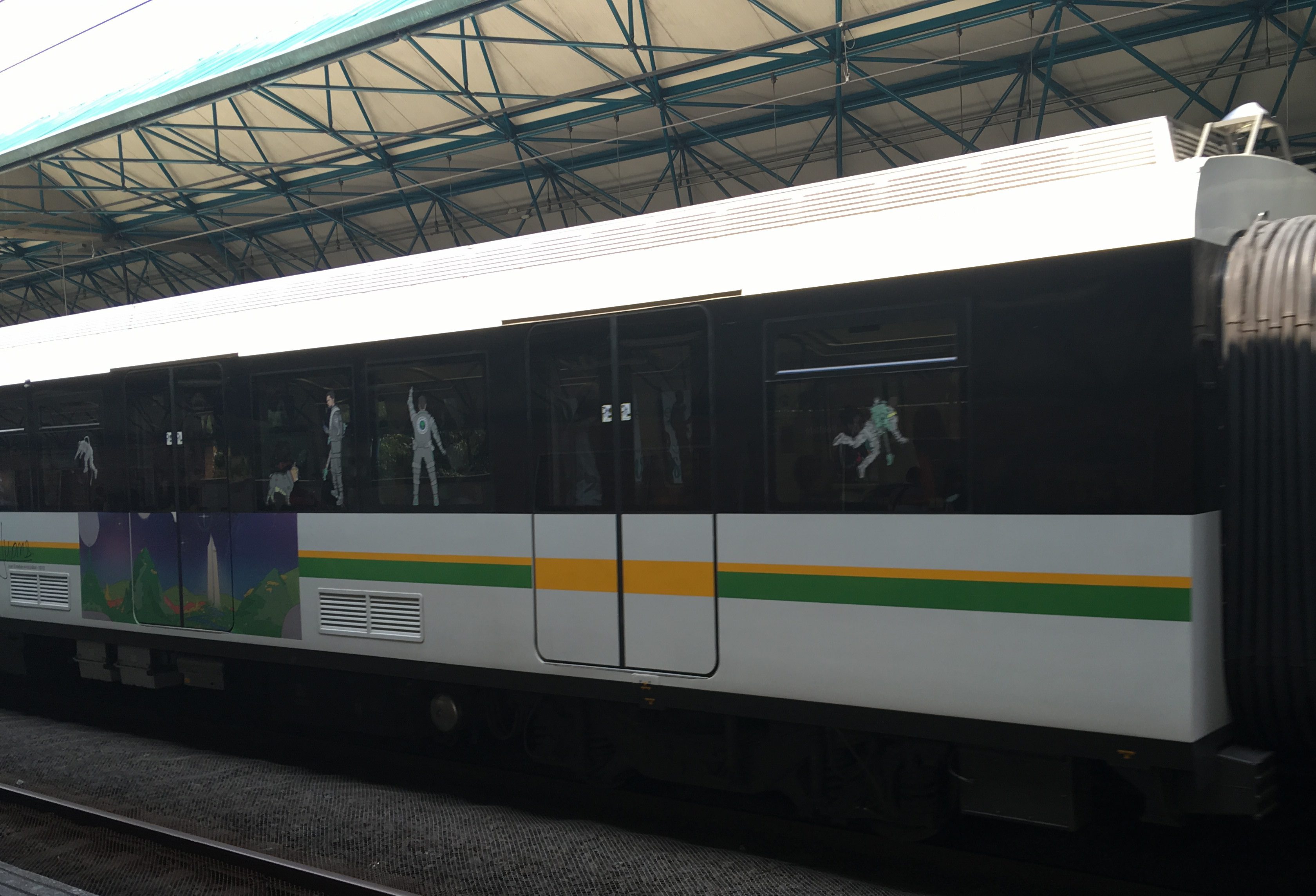
Daniella paid for our passes and away we went.  The station and the trains were spotless.

This was amazing, given that so many vertical surfaces in the city were covered with murals and just plain graffiti.  Daniella explained that the residents of Medellin felt proud ownership of their relatively-new Metro system, and thus didn’t want to see it go to pot like the filthy, tattered, litter-strewn systems in Washington, DC; London, Naples, and elsewhere.  I liked that.  A social compact.  If only we had more such things the US.

We rode the train a couple stops and emerged near the old central train station.  Daniella glanced around shiftily, then led us across the street to some metal barriers on the side of the station, which she proceeded to try to slide open.

“We will see if we can get in,” she said.  “Sometimes we are lucky, sometimes not.”

“Hey, hey!  Stop!  No entry!” a man in some kind of uniform yelled in Spanish from down the block.  He wasn’t threatening, but he wasn’t joking either.

Daniella looked momentarily deflated.  She turned and beamed at him as he approached, and they had a brief consultation. She led us around to the other side of the station, where she conferred with more guards.

I didn’t see any money exchanged.  I think we just caught the guards in a good mood. Regardless, they moved one of the metal barriers aside so we could scoot through to the plaza.

And what was so important here that it was guarded so closely?  This square was the site of Medellin’s city office buildings.  In St. Paul, you have to go through a metal detector to get into city hall, so Medellin is no more of a security state than we are.  In fact I thought there was much less of a military/security apparatus on display than in many other places I’ve traveled—notably London, Ramallah, Addis Ababa, and even Copenhagen.

But we were there for the art, not a lecture about government or Medellin’s recent history.

This soaring piece is by a sculptor named Betancourt. It contains all the elements of Colombia’s development, from natural resources, to horses and the rail road, to the indigenous workers and Spanish conquistadors. The four of us are very well traveled, and we were in awe.  The photo doesn’t do justice to the humbling feeling of standing beneath it.

We left the square, and Daniella thanked the guards who again moved the barrier so we could exit.  Across the street was another square filled with light tubes.

“The idea was to have 328, for the days in the Inca calendar,” Daniella explained.  “But they ran out of money so there are only 300.”

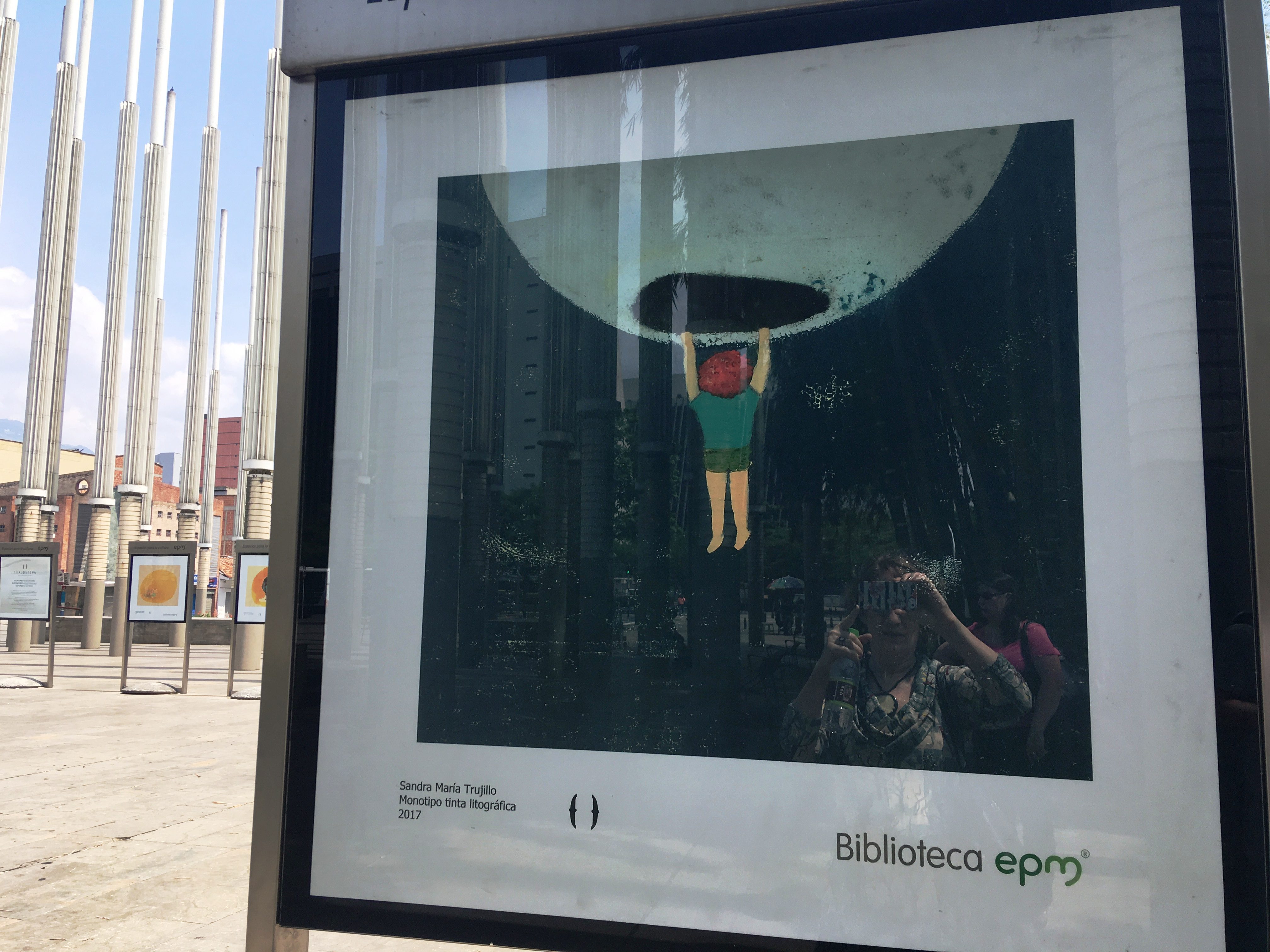
There was also a charming display of posters featuring children’s books, since the main public library was here.

“Are the tubes lighted up at night?” I asked.

“Yes, but don’t come here after dark; this square is full of drug addicts and robbers.”

Marmot in Medellin

It’s a good thing I friended our Bogota tour guide on Facebook, or I might not have known he was featured in a New York Times article about the city this week.  Here’s what it said about him:

“Cyclists here often seem as abundant as cars, streaming down equally abundant protected paths. Bogotá is credited as the first city to host a Ciclovía — and it still does, shutting down large swaths of street every Sunday for bikers, pedestrians and even acrobats.

“Itching to get on two wheels, I joined a three-hour ride that offered a fascinating look at the city through the eyes of our guide, Michael Steven Sánchez Navas, a graffiti artist and passionate enemy of inequality. He told us about Justin-Bieber-gate, when the Canadian singer tagged a wall under police protection just a few months after the police had shot and killed a popular graffiti artist — and inadvertently sparked a street artist uprising.”

If Michael told us that he, himself, was a graffiti artist, I missed it.  But it fits.

Back to Medellin.

The four of us sat around the lounge drinking coffee and waiting for our guide to arrive.

“Mota!” Roxana exclaimed, beaming at me from across the table.  Mota, short for marmota, meaning marmot, because I sleep a lot.  Roxana’s pet name for me.

Roxana and I met at the University of Minnesota School of Public Health where I was the director of development and she was the development assistant—a position for which she was way overqualified.  We soon spent our weekly meetings talking about our personal lives.  I was a hot mess.  My son was in jail, homeless, or missing much of the time due to his addictions.  I had been diagnosed with multiple sclerosis and was injecting myself with steroids every day.  I had such extreme vertigo at times that I couldn’t open my eyes or sit up.  I wasn’t able to focus on my job and my employment was precarious as a result. I either had insomnia or slept for 12-hour stretches.  Thus the marmota moniker. Roxana was like a mother to me during those dark days.

Finally, to everyone’s relief including mine, I was fired.  I went back to grad school, got a part time, completely flexible grad fellowship, and started to travel.  First I went to Mexico for a week to study Spanish.  It was such an exhilarating experience that I went back for three weeks, then three months.  My MS symptoms disappeared.  Eventually I was told there had been a mistake, that I didn’t have MS after all.  Now, I’m not saying that MS is just a symptom of stress.  Most people with MS really have MS, an extremely serious condition.  I got lucky and was misdiagnosed.

“When you first came to Scotland,” Lynn said, as we discussed how we had all met each other, “Richard was sure you had survived cancer or some terrible accident, because you had such zeal to see and experience everything. And you took all those pills.”

“Oh, those pills were just supplements that gave me expensive urine,” I said.  “And Richard wasn’t far off.  I did live for two years with that MS misdiagnosis. I thought I would be in a wheelchair within five years.”

That was 18 years ago.  When Roxana went through her divorce, I got to mother her.  Now that we’re both in good places we mostly talk about books, movies, politics, our families, and of course, travel.  She works two jobs and has built her own translation business so I don’t get to see her as often as I’d like.

I was excited to spend two whole days with Roxana and Lynn, and for them to get to know one another.

I had met Ricardo over one of many excellent dinners in Peru, where Roxana had been my excellent guide.  He reminds me of an old-time movie star like Cary Grant.  He’s smart, funny, and well traveled.  He worked for the Peru Tourism Board for years and is now with Regus , which rents out office space on an as-needed basis.

Our guide, Daniella, arrived.  She was a serious young woman, but she lighted up when she learned Roxana and Ricardo were Peruvian.  She was going to Peru the following week, so our guide would be getting tourist tips from her tourists.

Caracol de le Campana

I used the “emergency” What’s App number to ask Responsible Travel if we could add Roxana and Ricardo—the friends we were meeting here in Medellin—to our tour the next day.

“That’s fine,” was the answer, “But they will have to pay five dollars per person.”

Five dollars.  For a four-hour tour.  Done.

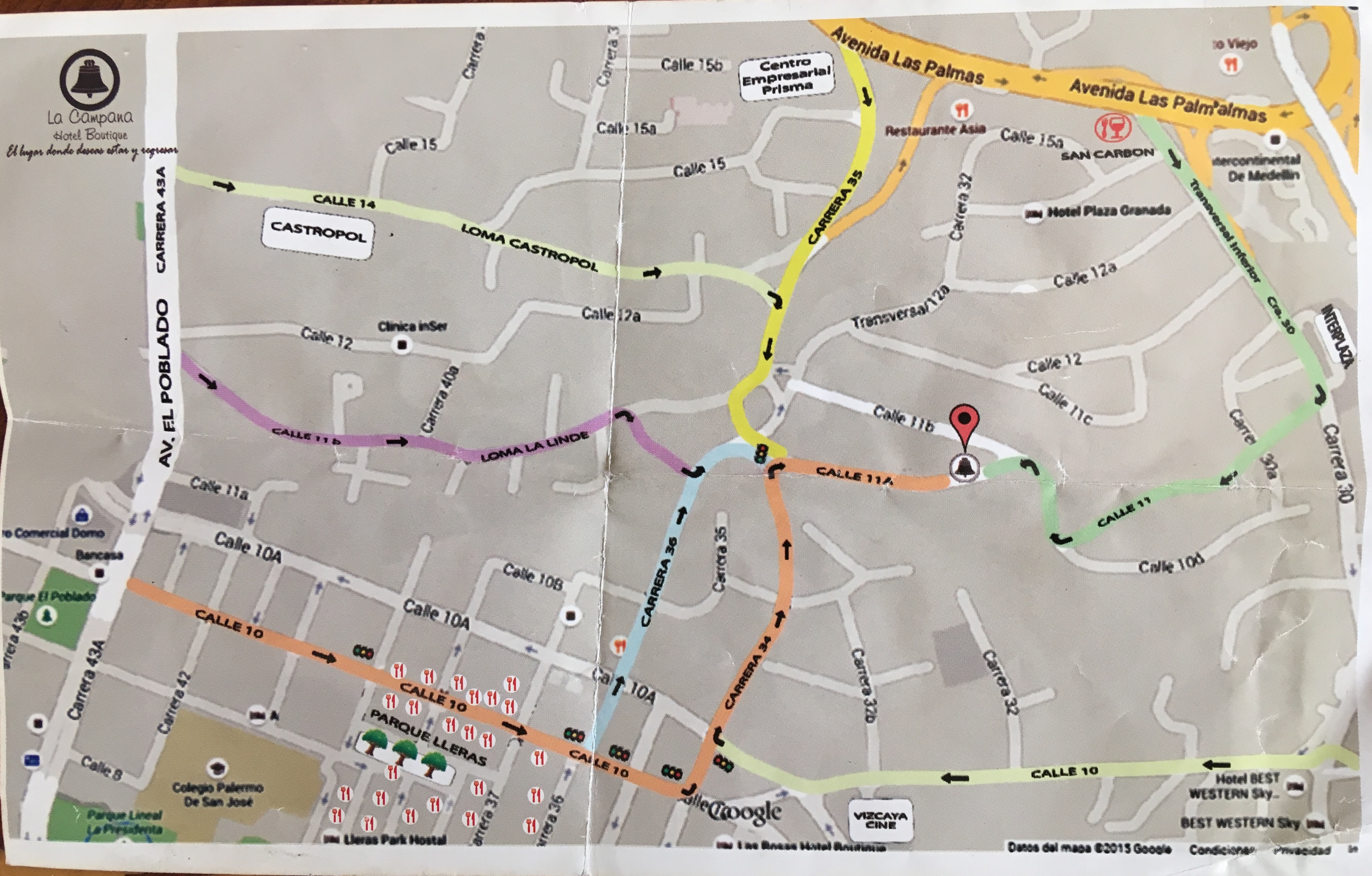
“I have no illusions of being able to find anything based on addresses,” I told Lynn.  We had both tried to make sense of the system.  The address of our hotel was CLL 11a 31a 70.

Lynn and I consulted the map, took a left outside of the hotel, and were immediately lost.  Medellin isn’t quite as high as Bogota—5,000 feet—but we were still plenty breathless.  Whichever way we turned, we were headed up a hill.  The few signs that existed made no sense to us.  But the neighborhood was lovely and I was in the mood for a hike after sitting in airports and planes and taxis all day.  There was little traffic, so hailing a taxi seemed unlikely.

“Let’s hail a taxi,” I heard Lynn panting behind me.  And as if she had magical powers, one appeared.  In minutes we were at Patrick’s Pub having a beer in Park Lleras, where we had agreed to meet Roxana and Ricardo.  As soon as I got a wireless signal there was a message from Roxana saying they were too tired and wet from getting caught in the rain to join us; they would meet us at our hotel in the morning for the tour.

Park Lleras is a neighborhood with many bars, much like Division Street in Chicago.  It’s a “safe zone” for tourists.  In addition to the Irish pub there was a British pub, complete with a red phone box out front as if to signal, “It’s okay!  We’ve got your lager here and sport on the big screen!  You can even call mummy from the phone box if you’re scared!”

We had a burger and chatted with the owner of Patrick’s, a guy from Boston.

“You should have seen this place on St. Patrick’s Day,” he recalled.

“We had 600 expats and tourists in here drinking green beer.  There’s this Irish expat, Jerry O’Brien, he drinks in here all the time and it’s scary how much, but on St. Patty’s Day he brought this Colombian woman he’d picked up at his bank for a ‘date.’

“Har, har, har!”  Somehow he even managed to laugh with a Boston accent, which I can’t capture in writing.

“After he’d had about six beers she asked him if they were just going to sit here and drink all day.  So he walks her out to the street, puts her in a cab, gives the cabbie a ten and tells him to take her wherever she wants to go, and waves her off!  Har, har, har.  Then he came back in here and drank eight more beers, then switched to Jamison and had 11 shots.  He was back the next morning for more.  A true Irish alcoholic.”

I felt queasy just thinking about drinking that much.  Time for an early night.

I always wake up first and go down to breakfast so as not to disturb Lynn, but it never works.  The more I try to be quiet, the more likely I am to bump into something in the dark and let out a yelp.

The breakfast area at La Campana was outdoors and surrounded by beautiful gardens.  I sat next to one of those walls of water that comes from some invisible source, making a nice swishing noise.  The breakfast was the same as in Bogota—eggs, arepas, fruit, juice, and coffee.

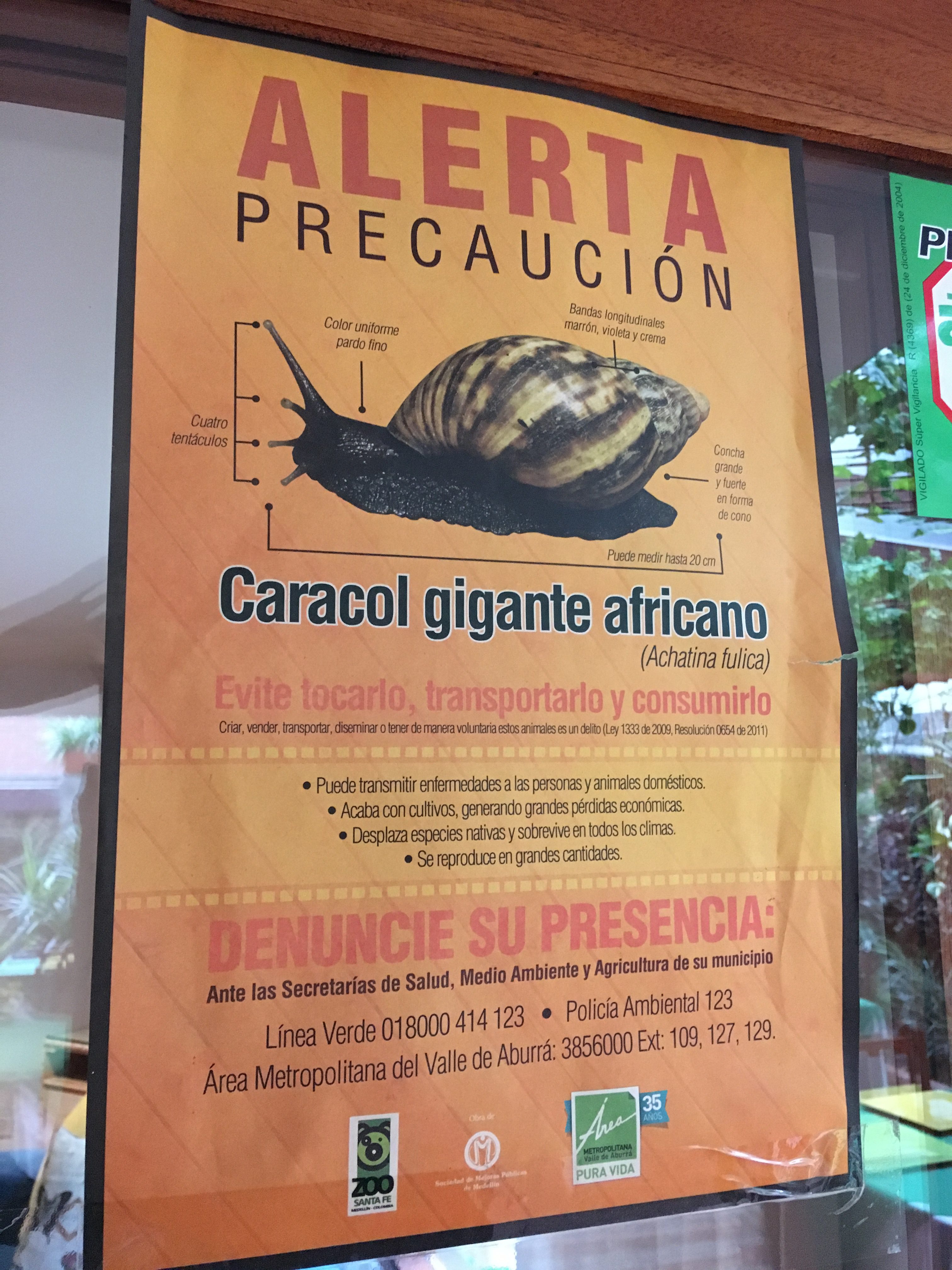
My appetite was a bit dampened by this large poster nearby.

“Avoid touching, transporting, and eating.”  I could do that.  Thankfully, I never saw any giant African snails.

Lynn joined me, then Roxana and Ricardo arrived and there were hugs and kisses and introductions all around. I had met Ricardo but Lynn had never met either of them.

“I can never remember how many kisses,” Lynn said.  “It’s different everywhere.”

“One kiss—on the right cheek,” instructed Roxana.

So now you know.

Fiery Waters and Stuffed Sausages

Too soon, it was time to leave Bogota.  I would definitely return to see more.

Our friendly driver and I chatted all the way to the airport as we drove past the throngs of bicyclists on a parallel, closed boulevard.  It was bicycle Sunday.

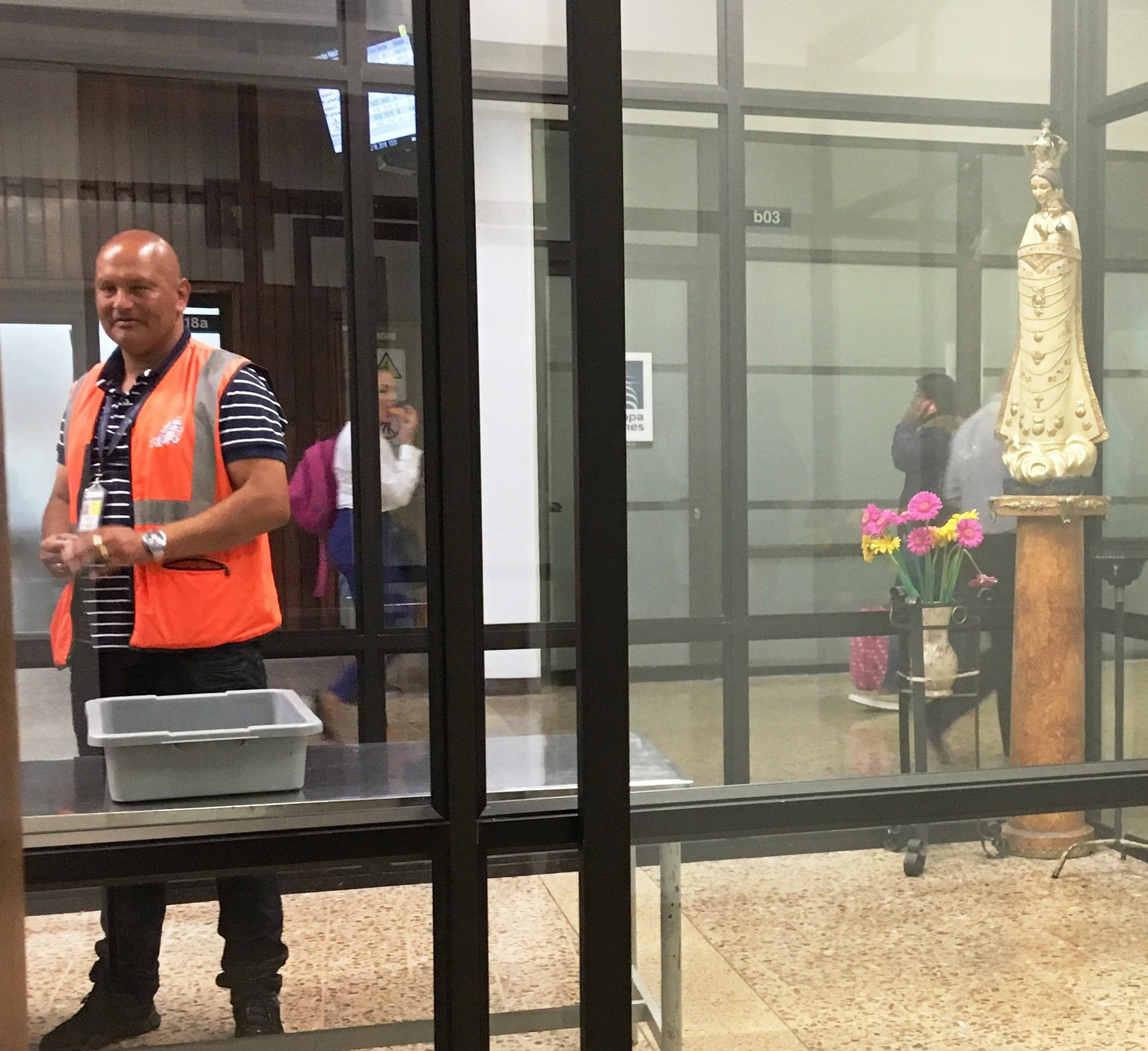
In the airport, we were looked after by the Virgin Mary and this hard guy. I wasn’t sure what his look implied as I took a photo of the BVM—was he amused?  Insulted?  Would he tackle me to the ground for taking photos in a security area?

Our 45-minute flight to Medellin was uneventful, but there was no driver waiting for us on the other end.  We waited 15 minutes, then I sent a What’s App message to Responsible Travel’s “emergency” number.

Responsible Travel quickly responded that they were checking.  Was this an emergency?  Not really.  But as the minutes ticked away, we thought it had been best to contact them.  If we took a taxi to our hotel, it might cost the driver—who perhaps was just stuck in traffic—his day’s big fare.

After half an hour, a man appeared and explained there had been two flights from Bogota at the same time and he had been waiting at the other one.  He seemed angry that we hadn’t been on the other flight. Had he not been given the flight information?  He stomped away with our bags, not looking back.  We ran to keep up with him, and this time I sat in the back because he was clearly unhappy and noncommunicative.  Was he mad that we had contacted Responsible Travel and “snitched” on him for being late?  It had only been a half hour delay, but we hadn’t known it was going to be a half hour, so what else should/could we have done?

When he dropped us at the hotel he managed to say thank you for the tip, then was gone.

La Campana (The Bell) Boutique Hotel was very nice, with two real beds this time.  The mattresses were as hard as concrete, and they must have been slung on ropes because they made loud creaking noises with every slightest move.

The art, once again, was “interesting,” this time by another European artist, Dali.

“There’s a mini bar!” I exclaimed happily.  It was stocked with water, which according to the menu cost 3000 pesos.  I was still getting used to the currency conversion and had my usual reaction to overpriced hotel room water until I realized it was only $1.

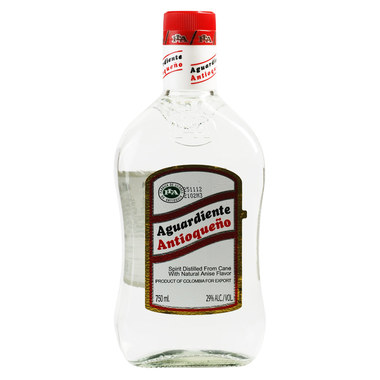
“Look, firewater!” I told Lynn as I held up one of three bottles in the mini bar.  And they were not mini bottles, but serious 750ml bottles.

Aguardiente literally means fiery water.  In Colombia, the eponymous local brand is distilled from sugar cane molasses and anise essential oils.  The resulting booze apparently tastes like pastis, sambuca, or anisette.  Ugh.  It wouldn’t be hard to resist.

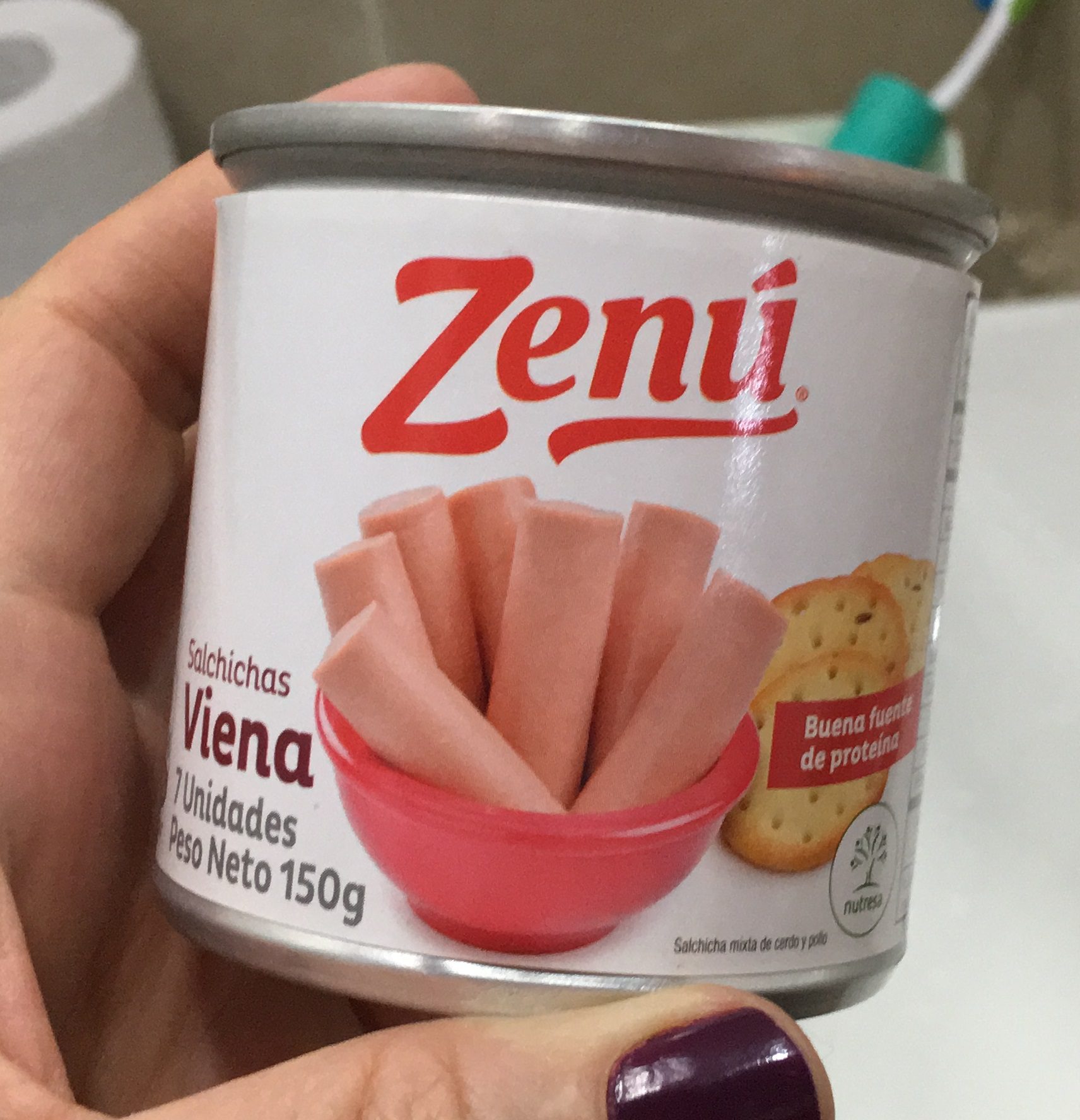
Lynn was ignoring me, until I got to the sausages.

“Salchichas Viena!”  I called out.

“You’re mad!” Lynn responded.  “Tell me you’re not going to eat those.”

“Of course not, they’re pork.  But you might like them, British person.  Oh wait—they’re probably not proper sausages ….”

Lynn and I have had long conversations in places from Chicago to Cornwall about what proper sausages are.  Anything that looks like severed human fingers are not.

The wireless signal was strong in the lobby but grew progressively weaker as we climbed the stairs and walked down the hall to our room.  In order to communicate with Roxana, who we hoped to meet later, I had to leave the room and walk down the hall to the top of the stairs.

This was okay.  I had little Internet access for 10 days, and I have to say my mind felt calmer.  Did I use this to reset my cell phone habits?  No.

We were to meet Roxana at the nearby Park Lleras, so we asked for a map at the desk.

“No one can find our hotel,” the desk clerk said, obviously shy about speaking English.

“Not even taxi drivers.  Walking is the best way to not get lost.”

Lynn turned to me.  “So we’re stuffed.”

Putting the Fun in Funicular

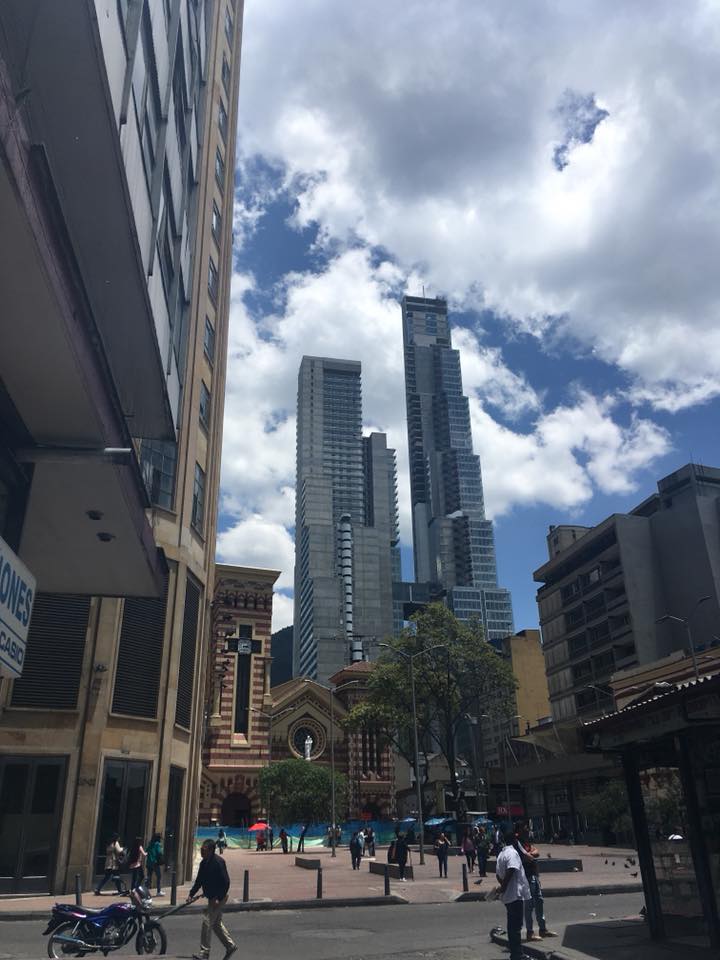
We continued along toward Monserrate, the mountain we would ascend to an additional 2,000 feet.  We passed the tallest buildings in Colombia, with Michael remarking “they’re also regarded as the ugliest.”  I liked them.

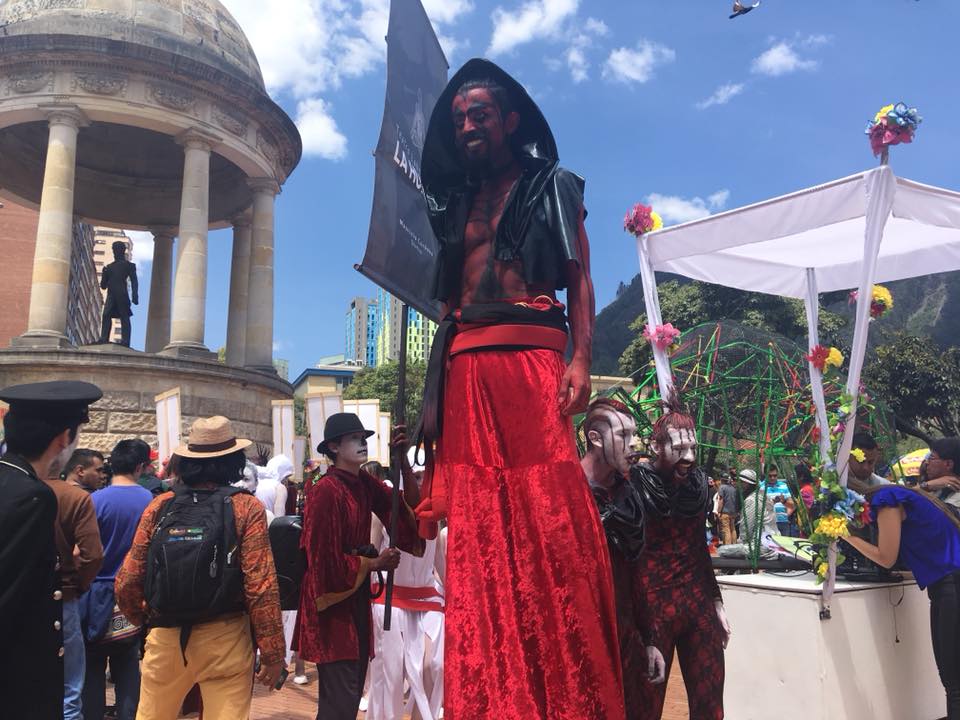
There was an international arts festival geared up to begin, and troupes of actors, jugglers, stilt walkers, and mimes suddenly filled the streets.  Michael ran into a friend and they settled into a lengthy catch up chat.  We were grateful for the rest and opportunity to take snaps.  Part of the backdrop was some colorful high rise buildings, which Michael said were expensive new apartments.

I was surprised to see topless women among the performers.  They were painted white, but they were topless.  No one else seemed to notice them.  I didn’t take photos only because I couldn’t get a clear shot without potentially seeming creepy.  When we asked Michael about them later he said he hadn’t noticed them.

I saw a woman breastfeeding in a grocery store in Nairobi once, but that’s not the same.  I’ve seen women sunbathing topless in France and men playing nude soccer in Berlin’s Tiergarten park, but that’s Western Europe.  Maybe the Catholic Church really has lost its sway in Colombia.  Maybe these women were from another country where toplessness is no big deal.  Maybe in this particular neighborhood, “anything goes.”
There was a group of police officers nearby but they were all absorbed in their cell phones.  Is it sad—or progress—that young, male cops were more interested in their phones than in naked women?

“In Minnesota,” I commented, “The police would arrest topless women.”  That’s our Puritan background.

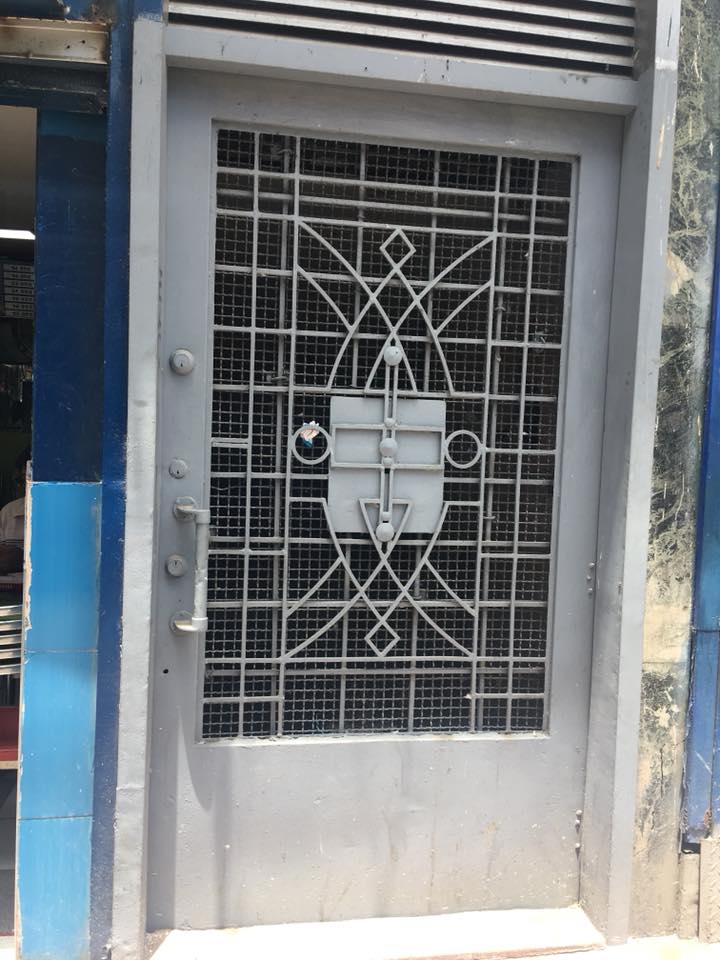
We moved on, passing through a neighborhood with art deco touches, like this door.

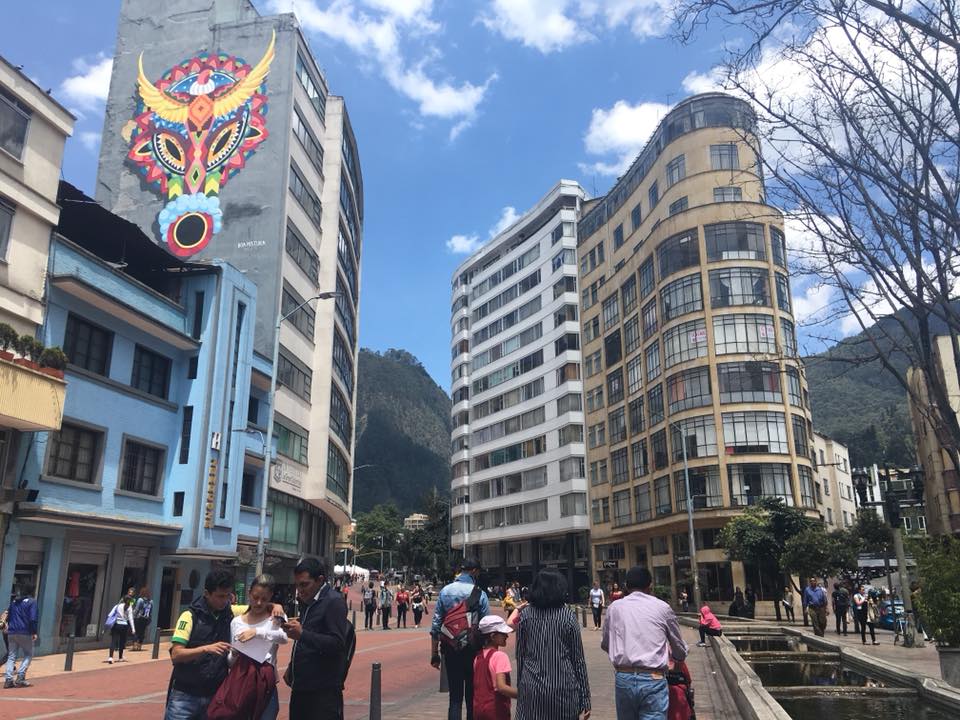
There was this contrast between the lovely old deco building on the right and the newer high rise on the left decorated with an eagle mural.  The contained stream in the bottom right flowed for many blocks.

We continued to slog uphill, Lynn and I moving slower and slower.  Finally, we reached the bottom of the mountain where we would catch a ride to the top in a funicular or a gondola.

“Do you mind if I leave you here?” Michael asked.  “I’m running behind.  It’s 2:00 and I’m supposed to meet my next tour.  I’ll give you the money for the tickets; that’s included in your tour.”

Of course we didn’t mind, and he was gone.  I see his posts on Facebook now and feel reassured that he’s not doing anything foolish provoke the authorities.  At least, not on Facebook.

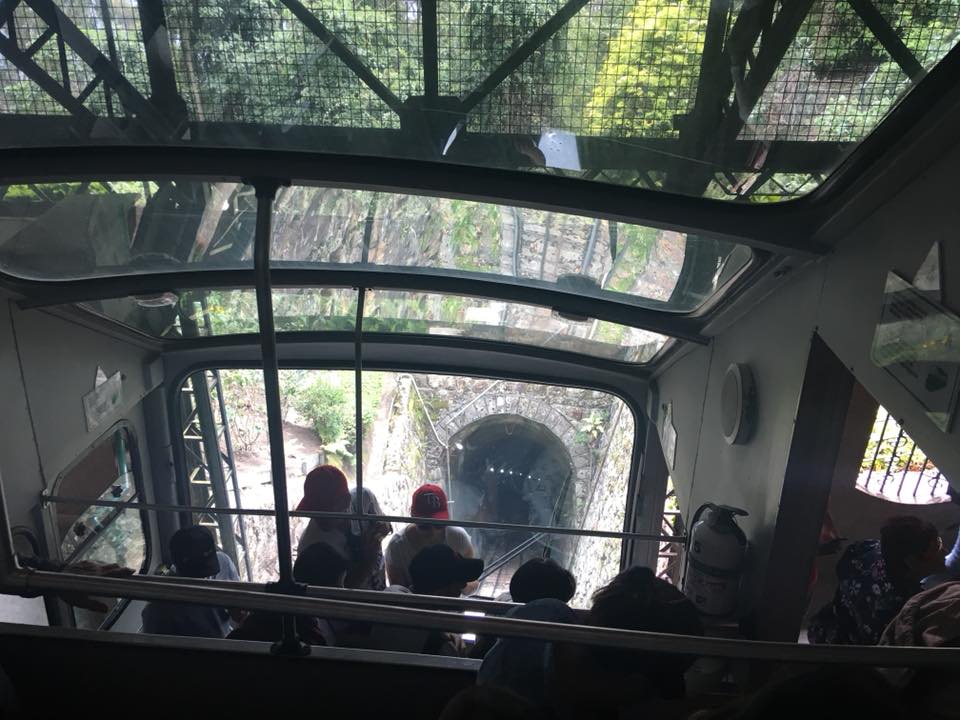
We were herded in to the funicular with hundreds of other tourists.  Since I’m not an engineer, I always marvel that these things actually work.  As per normal, all sorts of disaster scenarios flashed through my mind, including, This would be a bad time for raw-fruit-induced diarrhea to kick in.

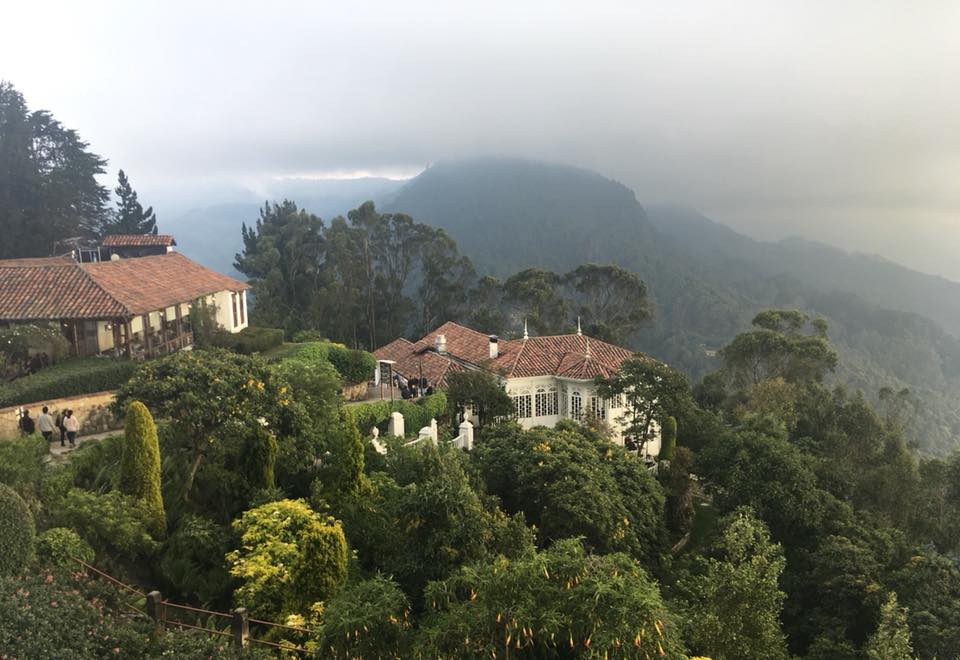
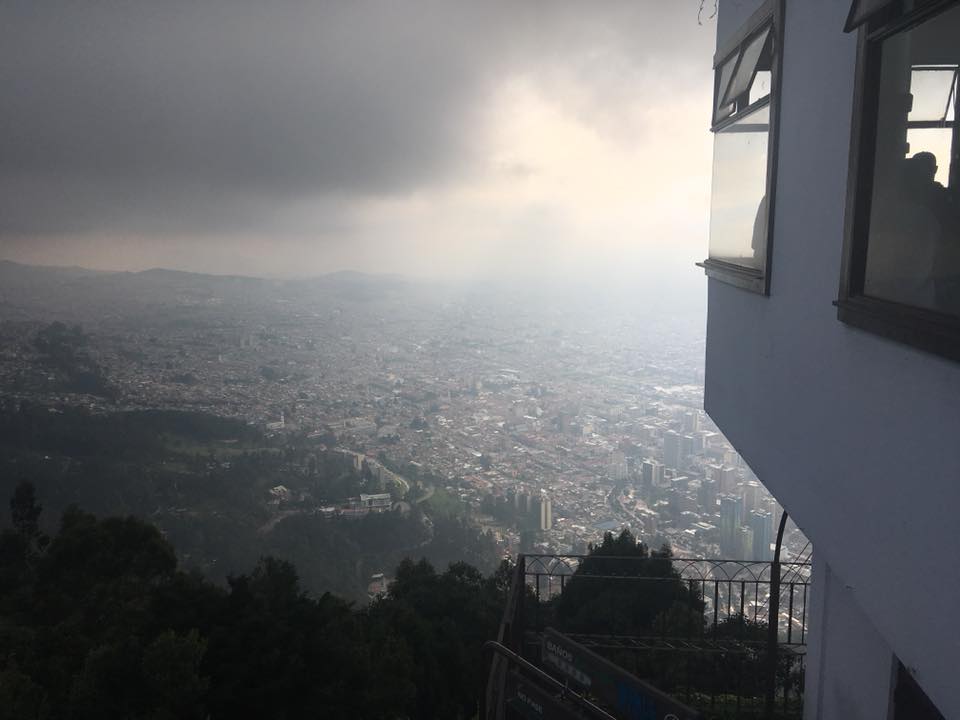
The breathlessness was worth it.

There was yet more slow walking uphill at the top of the mountain to reach the restaurants.  We stopped to take photos.

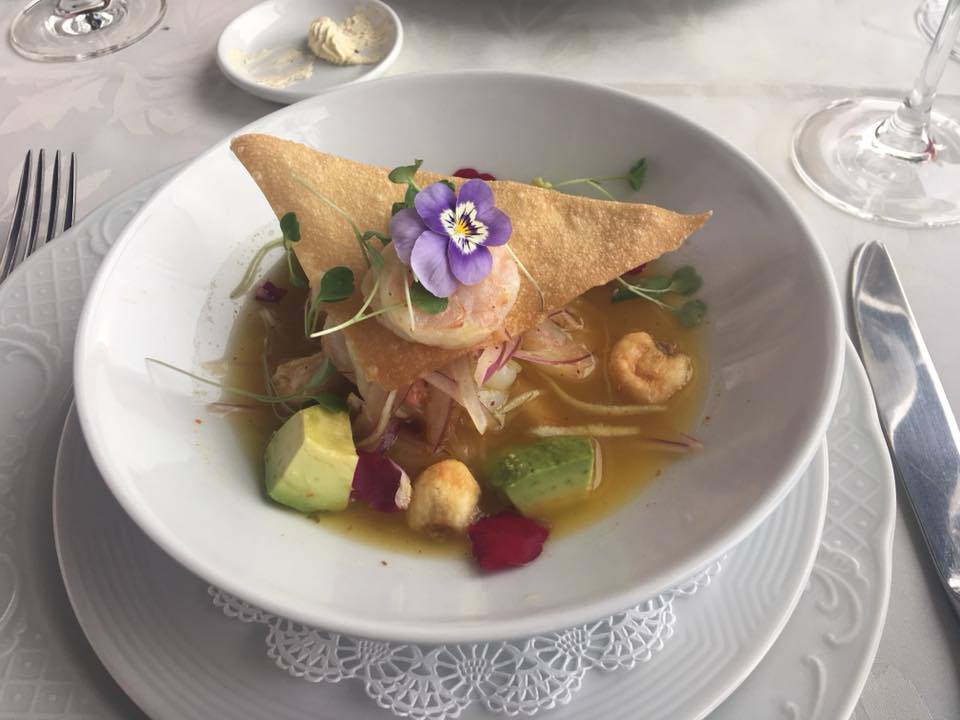
We picked the closest restaurant and were not disappointed.  White linen, stellar views, good wine, and the first of many ceviches.

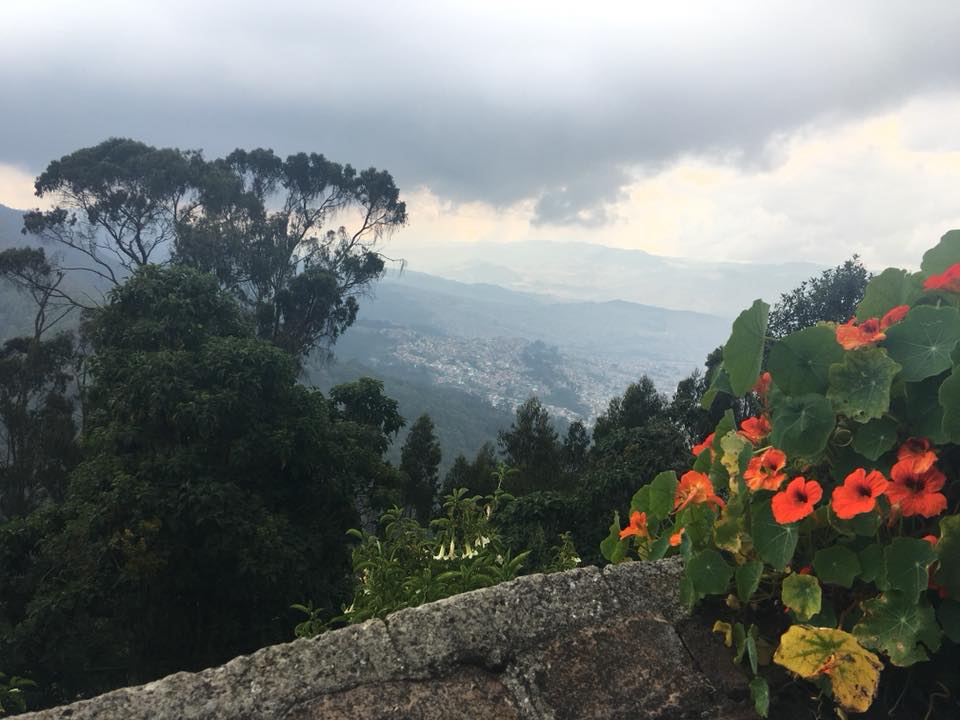
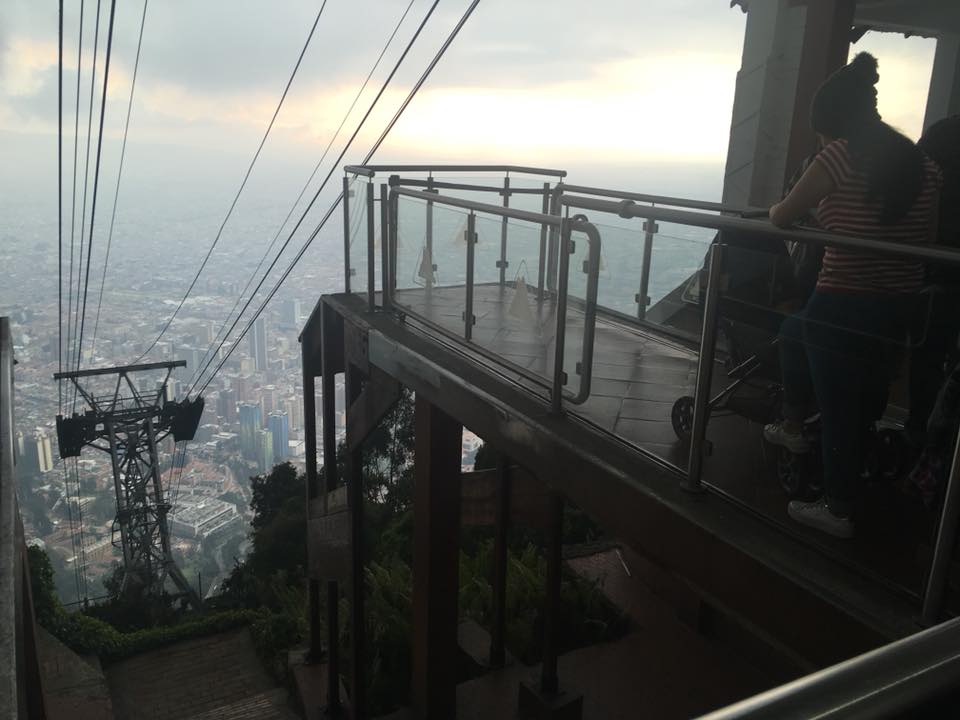
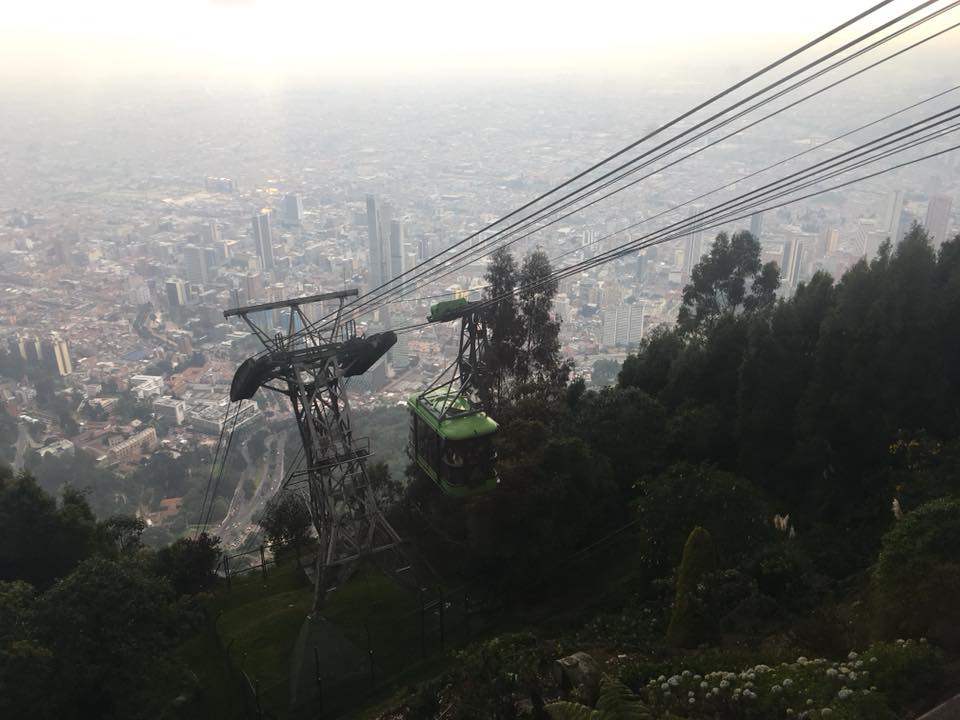
We had a leisurely lunch, then wandered toward the cable cars, which of course were up yet another hill.  But again, the views were breath taking—no pun intended.  We waited for half an hour with a hundred other people and no one complained; we were all gazing out the windows at the views.
Then, the descent.

At a junction, the car lurched and everyone went “Aaargh!!” then laughed sheepishly.

At the foot of Monserrate we hailed a taxi.  When he dropped us off he played a shell game with money and we were fairly sure he ripped us off.  But so what?  He got 18,000 pesos off of us—$6.  It wasn’t worth fighting over.

We had dinner that night at a Peruvian-Colombian restaurant where we were entertained by a jazz trio and two tables of fighting couples. The one nearest us—Germans, maybe?—sent her food back to the kitchen, complaining loudly that it wasn’t good, then sniped at each other and stalked out.

“I’d rather be alone!” Lynn said, speaking for us both.

Monstrances and Rolling Stones

Michael was, literally, a walking encyclopedia of knowledge about Colombia’s war-torn history.  That’s an overused term, “war torn,” but it fits.  We whizzed through a museum complex that featured fine art, massive coin-minting equipment, and gold objects. The complex itself was beautifully designed—simple, clean lines to show off the art and artifacts—and featured serene courtyards with gardens and fountains.

I would have loved to stop and just sit, or walk slowly through to see what all was on display.  But Michael had an itinerary he was holding to, and he seemed disdainful of the museums because they held items from the days of The Conquest and were sponsored by big banks.  I could have that last part wrong.  He was throwing so much information at us.  He showed us a collection of Catholic worship items; I believe one would be a called a Monstrance.  This is a picture of a Monstrance from an online search.

The one in the museum made the one above look bland.  We weren’t allowed to take photos, but it was encrusted with emeralds and pearls and adorned with gold filigree and gold figures from biblical scenes.  I don’t know what Monstrances are for, and I don’t care.  Lynn and I had seen one in Spain that was even more … monstrous. We were well aware that the gold, pearls, and emeralds had been plundered local, probably by enslaved indigenous people.

“I have mixed feelings about it,” said Michael.  “On the one hand it tells the story of the rape of our land by the Europeans and their church, but I think many people look at it and just think it’s a pretty object without knowing how blood was shed to make it.”

True.  I wondered what “regular” tour guides would say about it.  I could imagine some people I know exclaiming, “Oooh, look how gorgeous that is!  The Colombians sure are great goldsmiths!”

We were receiving a great education from Michael, but for three hours he had been marched us through the city in the heat and sun.  The hotel staff had said the water was okay to drink but when I went to fill my water bottle it smelled so strongly of chlorine I decided to leave it behind.

And the altitude was winding us.  I had gone from 700 to 8,660 feet above sea level.

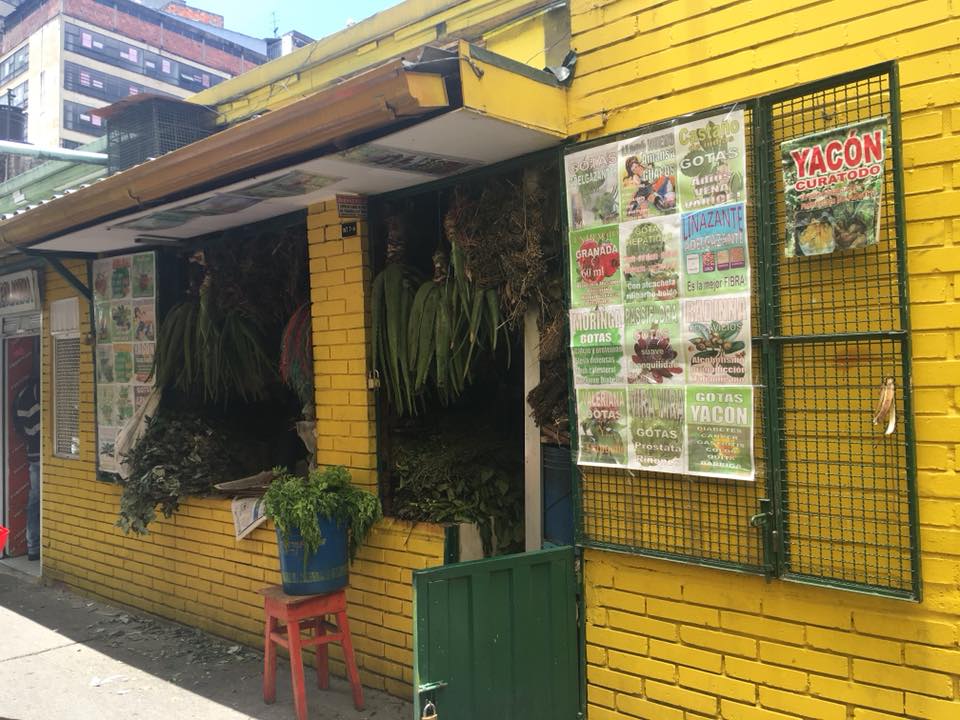
Just in time, Michael brought us to a covered market full of stalls selling fresh fish and seafood, beans and peas and spices and veg and fruits.  This little store outside the entrance to the market sold medicinal herbs.

I think Lynn and I both exclaimed, “Ahhhh….” as we entered, both because it was a respite from the heat and a feast for the eyes.

We stopped at the stall of a fruit vendor Michael knew.  “You can sample seven fruits for 6,000 pesos,” he informed us questioningly.  Did he think we were going to say no?  Six thousand pesos is $2.00.

I cannot tell you what the seven fruits were, only that they were delicious and revived us instantly.

“I keep thinking of that advice you read over and over in guide books,” I murmured to Lynn as we watched the vendor peeling and slicing the fruits.

She nodded.  “Only eat fruits you have peeled yourself.”

“But they’re so good!” answered, as sticky juice ran down my hands.

“Jorge has triplets,” Michael said by way of introduction of his friend.

“Oh, how old are they?” I asked in Spanish.

“The oldest one is 16,” he replied.

Hmmm.  Maybe Michael had meant “three children” by “triplets.”  I was too busy shoveling in fruit to ask a follow up question and besides, Michael and Jorge were clearly having a bit of catch up on the local gossip or something that didn’t need to include us tourists.

Then we were off again, and now we were walking slightly streets that led slightly uphill which normally I would have found invigorating.  But Lynn and I had to stop every now and then to catch our breath.

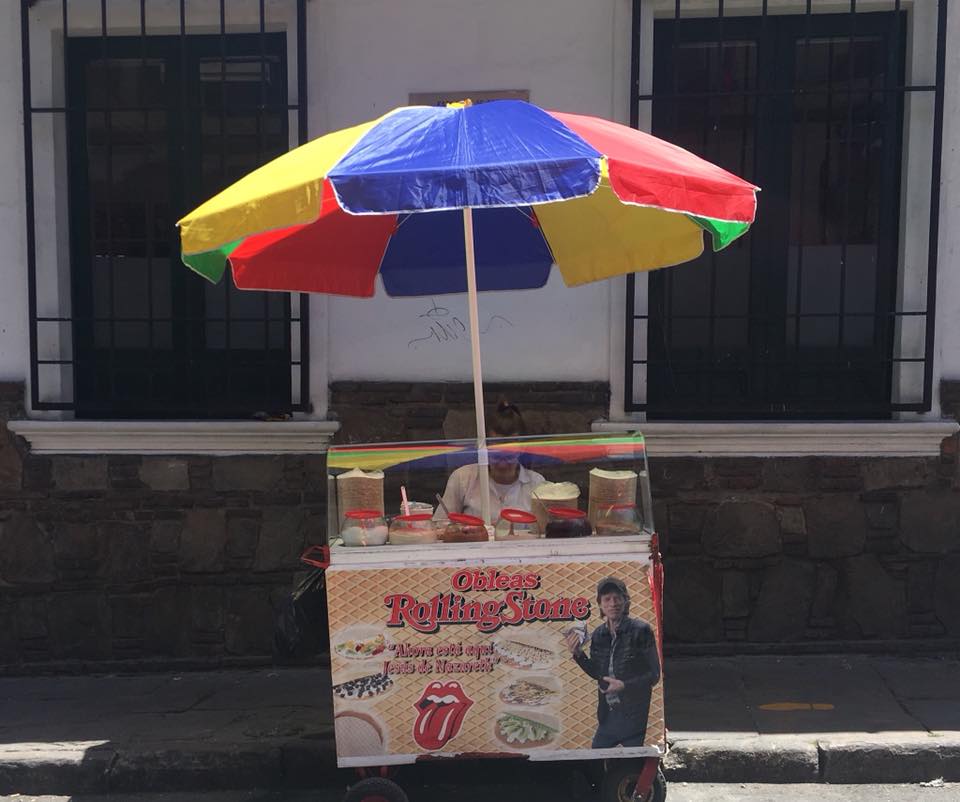
Michael took advantage of one pause to point out a vendor who had purportedly renamed her stall in honor a famous visitor.

Some Cold Truths

When I mention I’ve been to Colombia, I get two reactions.

One: “Cool!  That’s the hot new destination!”

Two: “Isn’t there a drug war there?”

Number one is true, while number two used to be true.  As usual, I had intended to brush up on my destination’s history but never did it justice.  I read an article here and there about the peace process and upcoming elections.  A former coworker had just moved to Bogota, where her husband is teaching at one of the universities on a Fulbright Fellowship.  She was sending me photos and updates, including that her husband had been tear gassed twice.

Tear gassed. Her take on it was that Colombians, despite no longer living under a state of war for the first time in decades, still have plenty to protest.  Below is a cut and paste directly from Wikipedia.

“The Colombian conflict began in the mid-1960s and is a low-intensity asymmetric war between Colombian governments, paramilitary groups, crime syndicates, and far-left guerrillas such as the Revolutionary Armed Forces of Colombia (FARC), and the National Liberation Army (ELN), fighting each other to increase their influence in Colombian territory. Two of the most important international actors that have contributed to the Colombian conflict are multinational companies and the United States.

“It is historically rooted in the conflict known as La Violencia, which was triggered by the 1948 assassination of populist political leader Jorge Eliécer Gaitán, and in the aftermath of United States-backed strong anti-communist repression in rural Colombia in the 1960s that led liberal and communist militants to re-organize into FARC.

“The reasons for fighting vary from group to group. The FARC and other guerrilla movements claim to be fighting for the rights of the poor in Colombia to protect them from government violence and to provide social justice through communism. The Colombian government claims to be fighting for order and stability, and seeking to protect the rights and interests of its citizens. The paramilitary groups claim to be reacting to perceived threats by guerrilla movements. Both guerrilla and paramilitary groups have been accused of engaging in drug trafficking and terrorism. All of the parties engaged in the conflict have been criticized for numerous human rights violations.

According to a study by Colombia’s National Centre for Historical Memory, 220,000 people have died in the conflict between 1958 and 2013, most of them civilians (177,307 civilians and 40,787 fighters) and more than five million civilians were forced from their homes between, generating the world’s second largest population of internally displaced persons. Seventeen percent of the population has been a direct victim of the war. 2.3 million children have been displaced from their homes, and 45,000 children killed, according to national figures cited by Unicef.”

The drug “lords” have been portrayed in recent Netflix series like Drug Lords and Narcos.  I intend to watch to see if they are glorified, and what mention is made of the US demand for cocaine which drove their business.

Michael recounted how his grandmother, as a child, had hidden in a trunk while her parents were murdered by some faction or other in the war.  He teared up.  He described in detail an incident in which he clearly felt his life, and the lives of his fellow activists, were in danger.  Again, he got emotional and wiped away tears.


“You’re traumatized,” I exclaimed, and gave him a gentle hug.  “You’ve got to get help and take care of yourself.  Traumatized people do risky things.”


“You’re different from most tourists,” he said.  “You’ve heard about the war and you know about the disappearances.”

I told him I work for a torture rehabilitation center and gave him my card.  Lynn mentioned she works for Oxfam, but he had never heard of it, despite it being one of the largest NGOs in the world.

This was when Lynn and I decided to friend him on Facebook.  He is surely being monitored by adversaries, and if they see he’s got XX “friends” in other countries it could be protective.  I don’t know.  I felt powerless.

Next was a memorial to Jorge Gaitán, believed to have been assassinated by the CIA in broad daylight on a crowded street.

Walking in Bogota

Our itinerary said we would have a private city tour “after breakfast.”  What did that mean, and how were we supposed to locate our guide, or vice versa?  Breakfast at the hotel was from 7-10am, so Lynn and I had a leisurely couple cups of coffee and caught up on life events since we’d seen each other in Scotland.

The standard breakfast in all four places we stayed in Colombia included: eggs however we wanted them, arepas or toast, juice, fruit, and coffee. Arepas are little round flat breads—slightly chewy inside and slightly crispy outside—made of ground maize (corn).  They’re standard fare in Colombia and Venezuela.  The fruit selection usually included fresh papaya, pineapple, melon and, at the first hotel, ground cherries.

It got to be 9:30 and there was no sign of a guide so we moved toward the lobby to figure out Plan B.  And there he was, waiting for us.

“I expected you at 9:00,” he said.  We explained the itinerary had been nonspecific.  It wasn’t a big deal, and we were soon on our way.

Michael was wearing bicycle gloves and carrying a bike helmet.  This was our introduction to how integral bike culture is in Colombia’s cities. Bogota, for instance, shuts down its main streets every Sunday for people to cycle from 7am to 2pm.  Since the next day was Sunday, we witnessed this as we were being driven to the airport.  There were thousands of people out bicycling—young and old, families and groups of teens.  Some stopped to chat or picnic on the grassy medians, but mostly they were peddling.

“Maybe that’s why you don’t see many fat people here,” I commented to our driver.  I said “fat” rather than “overweight” because I wasn’t sure how much English he understood.  He laughed and replied, in Spanish, that all the gorditos—fat people—lived on the coast, where it was too hot to exercise and they ate lots of fried food.

“I’m a student, a biker, and an activist,” Michael told us by way of introduction.  He appeared to be in his early 20s.  His English was great and very, very fast.  As he led us down the street it became clear he was an activist first and probably a biker second and student third.

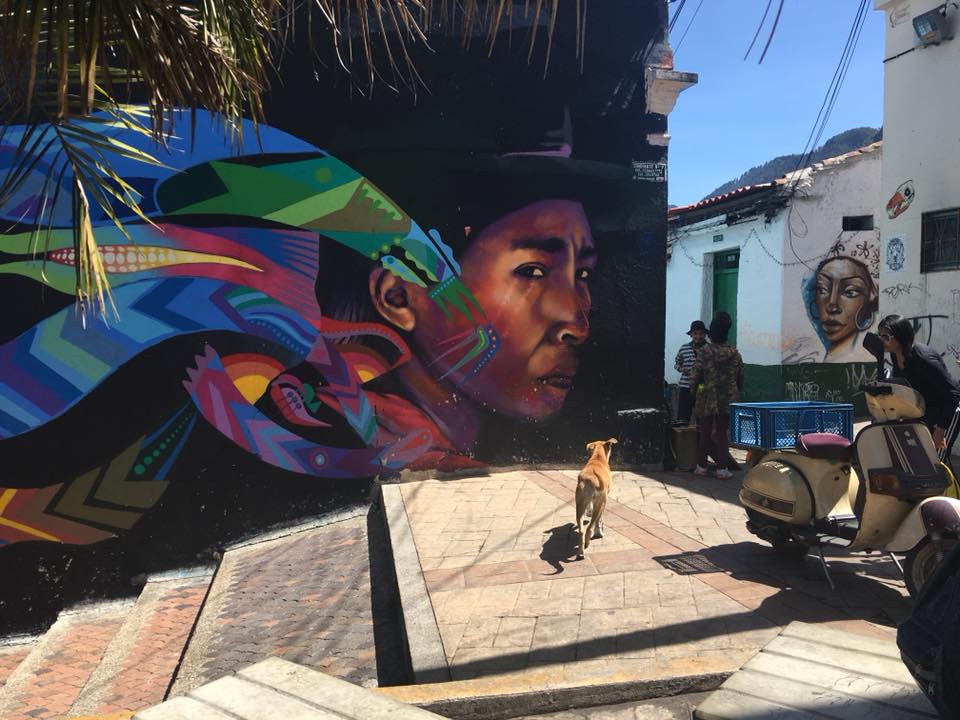
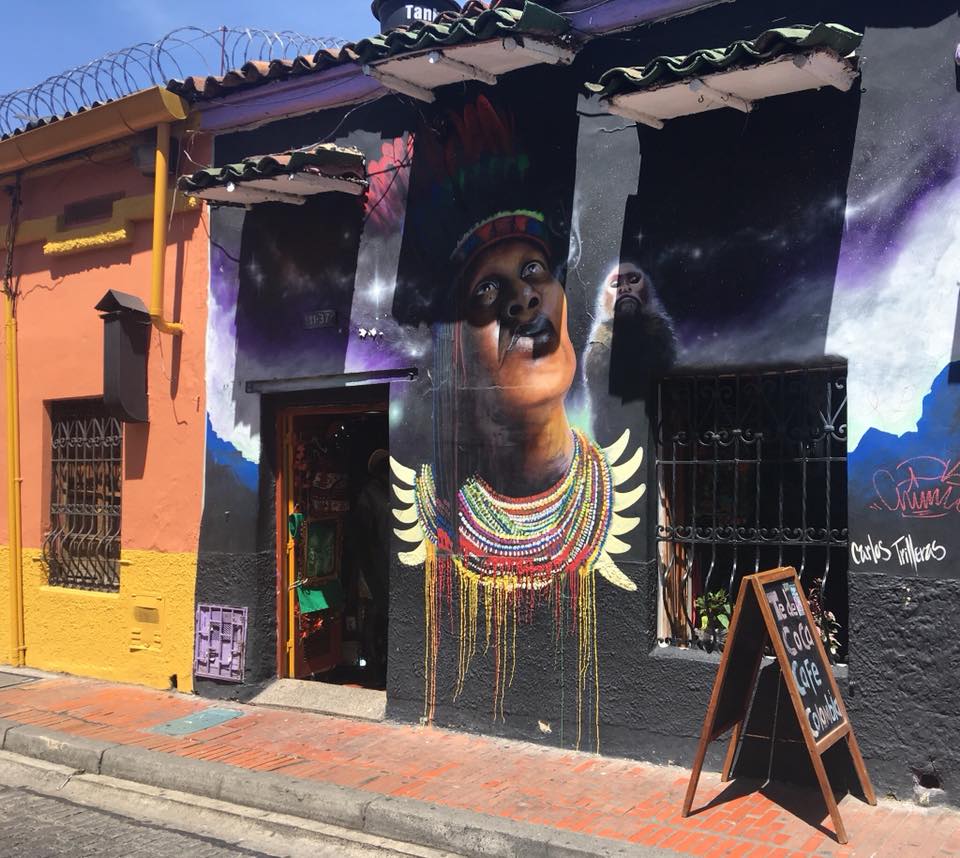
Bogota, Medellin, and Cartagena are home to impressive collections of public art.  Some is government-sponsored, but much of it is in the form of murals depicting political-socioeconomic themes.

“We don’t consider ourselves Colombian, or Ecuadoran, or Bolivian, or Peruvian,” Michael explained.  “We are indigenous, and we’re trying to make our voices heard but a handful of wealthy families own the country and control everything.

“For instance this is the Pachamama, the mother earth,” he said about this mural.

“That shop over there,” he indicated, “sells all the herbs used by indigenous healers.”

“Lots of tourists are coming now to try Ayahuasca.  It’s said it can cure any problems of the soul or mind or heart.”

“Maybe we could try it this afternoon,” I joked.

He didn’t think that was funny, and Lynn had wisely not joked along with me.

“It’s a medicine meant to be used only by shamans for spiritual purposes” Michael said, as he hurried us along.

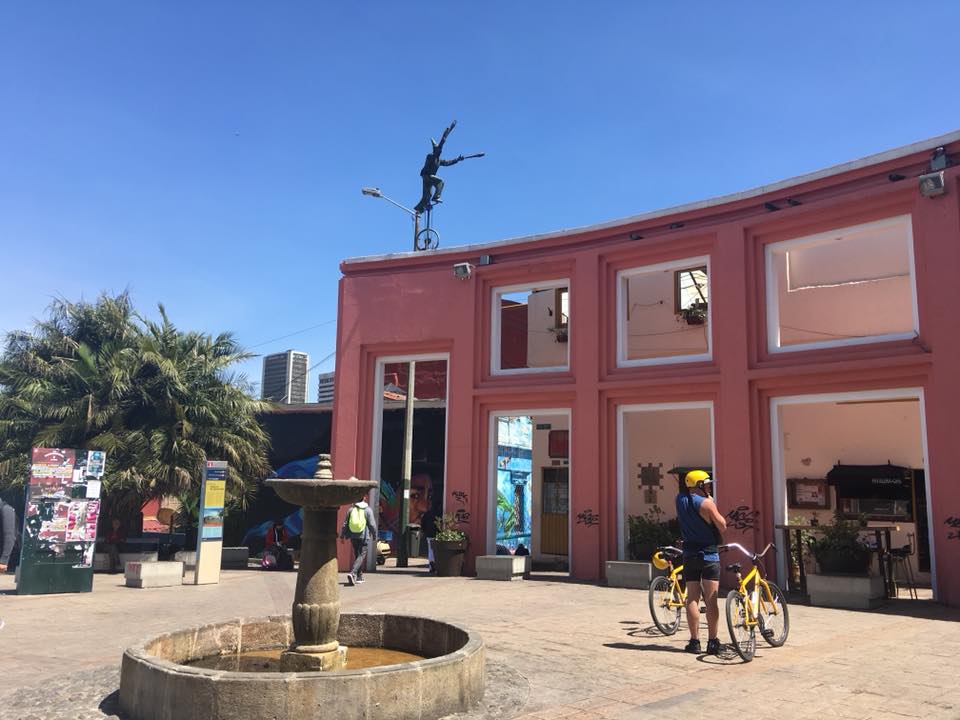
“The Spanish and other Europeans tried to erase the Andean people.  Slowly, we’re coming back.  See that man up there?”

“It’s one sculpture of a man who is not a conqueror.”

“He’s juggling, on a unicycle?” Lynn observed.

“Much of the art is designed to be non-threatening, so it won’t be taken down,” Michael explained.

We entered Bolivar Square.  Simón José Antonio de la Santísima Trinidad de Bolívar y Palacios—or just Simón Bolívar, the liberator of the above-named countries plus Panama.

If this had been Rome or Paris or London, this square would have had tens of thousands of tourists jostling each other for selfies and photo opps.  But this is Colombia, in the early stages of tourism.

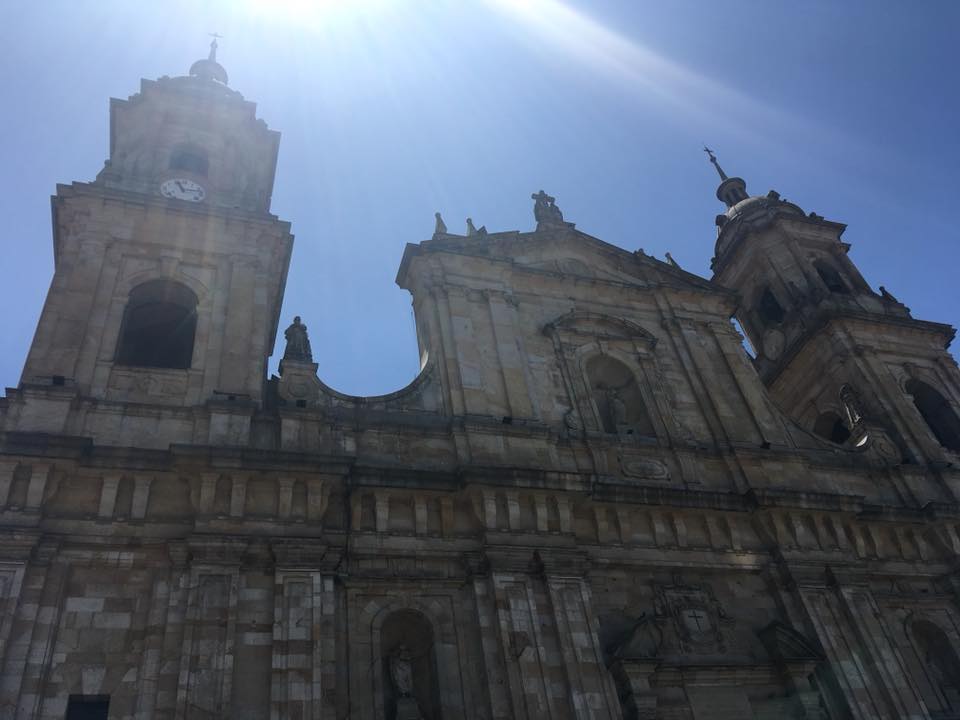
We stood in the square for a long while as Michael related the recnet history of double crosses, coups, war, and massacres.  No wonder people prefer to bike instead of attending church in the splendid but empty cathedral.