Category Archives: Culture shock

Getting There

This is a series of posts about Italy, Malta, and Spain that starts here.

I was on a train traveling from Naples to Sorrento, or to Campania.  I won’t keep you in suspense; the train eventually arrived in Sorrento, which is in the region of Campania.  It was a mystery to me why the train a region as the final destination instead of the city.

I spent almost two hours on a train whose destination I was unsure of.  I refused to ask anyone for help because I didn’t want to embarrass myself.  I thought about getting off, going back to Naples, and trying again.  I told myself that the worst case scenario would be if I had to take yet another train from “Campania” to Sorrento.  In the midst of my fretting, we approached Pompeii.  It had started to rain, hard.  Should I still get off there?  Where there any covered areas or was it all outside?  Maybe if I got off I could make sure I got on a train to Sorrento this time.  It was already 3:00 pm and darkness would fall at 5:30.  Was it possible to “do” Pompeii in two hours?  At the stop, inertia won and I stayed on the train to take my chances on where I would end up.  Who knew?  Maybe Campania was a nice city.

It’s not a very exciting ending, I know.  The point of this little story is that I learned some things about myself and traveling:

1) Despite what the travel guides say, European train travel is not “as easy as 1, 2, 3!”

2) I would rather end up in the wrong city than ask strangers for help.

3) Given a choice between taking a warm, dry train to the wrong city or spending a rainy afternoon in a muddy archaeological site, I will stay on the train.

The Hotel Rivoli had emailed to ask if I wanted a pick me up at the train station.  “Oh sure,” I thought, “You want to send your brother in law, who will over charge me.”  I didn’t reply.

I’m not usually that suspicious or rude but it appeared the hotel was only a 10-minute walk.  I had written down the route:  From Via Marziale, left on Corso Italia past Piazza Tasso and Piazza S Antonino, right on Largo Padre Reginaldo Giuliani, right on Via Santa Maria delle Grazie just in front of S Antonino Church.  How hard could that be?

Except that it was still raining when I arrived, so I hailed a cab.  I did what you’re supposed to do—ask how much the fare is before getting in—and the answer was €15.

I don’t know if this is true for you, but it’s interesting how I had spent hours looking at Google maps to sketch out how I would get from one place to another, and it all looked completely different once I was actually there.  While technically it would have been a short walk, given my track record of getting lost I would probably have ended up in the next town.  Five minutes later, the driver dropped me at the entrance of an alley that was too narrow for motor vehicles and pointed to the hotel.  I had to squeeze through a crowd in front of the Church of San Antonino to get to my hotel.

“You took a taxi?” asked the young woman at the desk.  “Fifteen euros!?” she exclaimed.  “We only charge five.”

My room was on the top floor—the third floor—and after that cramped little place in Rome I loved its spaciousness.  It was also decorated with clean, modern furnishings instead of 1950s polyester cabbage roses.

Unfortunately, the lock didn’t work and the door kept popping open.  The rain had stopped and I was dying to explore.  I flagged down a blonde, blue-eyed young woman whose name tag said Ugne.

“Oh, it works fine!” she smiled as she slowly demonstrated how to lock a door.  I smiled and waited until the door popped open.  “Oh no!  I will get help!”  She trotted off, and after waiting 15 minutes I pulled the door shut as tightly as I could, hoped for the best, and went out for a wander.
Naples to Sorrento via Compania

This is a series about Italy, Malta, and Spain that starts here.

The guidebooks and online travel guides all damned Naples.  “Noisy, crowded, filthy, smelly, and teeming with pickpockets and con artists,” was typical.  This was not alluring, so I intended to spend just enough time in Naples to transfer from one train to another.

The high-speed train to Naples was as advertised: fast, clean and comfortable, and punctual.  I was right on schedule!  I proceeded to wander around the Naples train station for almost an hour.  There had been a bathroom on the train but if you’ve ever used a toilet inside a fast-moving train, you’ll know why I held out for the train station.

There were no signs to indicate where the toilet was.  I walked what felt like a city block to one end of the station, then all the way to the opposite end.  Finally I spotted an information booth and asked the attendant.  The toilet was downstairs and, once I got there, I discovered it cost a Euro.  I didn’t have any coins so I walked back up to where the shops were.  When I waved my arms to make the toilet exit door open, half a dozen people pushed their way in without paying.  What a sucker I was!

I hiked back upstairs, grateful to be suitcase-free, and wandered to and fro trying to find the train to Sorrento.  It was called the Circumvesuviana—after Mount Vesuvius, I guess.  I found the train signage, such as it was, bewildering.  There seemed to be multiple names for the same train.  Or maybe it was like the Amtrak Acela, where Amtrak is the name of the company while Acela is a specific train?  Regardless, I saw no signs for the Circumvesuviana—which wouldn’t be hard to spot given how long its name was.

I approached the information booth attendant again, who informed me it was … downstairs.  It was at the end of a very long tunnel and I arrived to find throngs of people milling about the turnstiles.  Why?  There was nothing else there except a pastry shop, but they weren’t buying pastries or tickets for the Circumvesuviana.  I pushed my way through the crowd, bought my ticket, and slipped through the turnstile.

Here’s the station as we pulled away; other than this I didn’t see any graffiti or dodgy characters.

naples-train-station

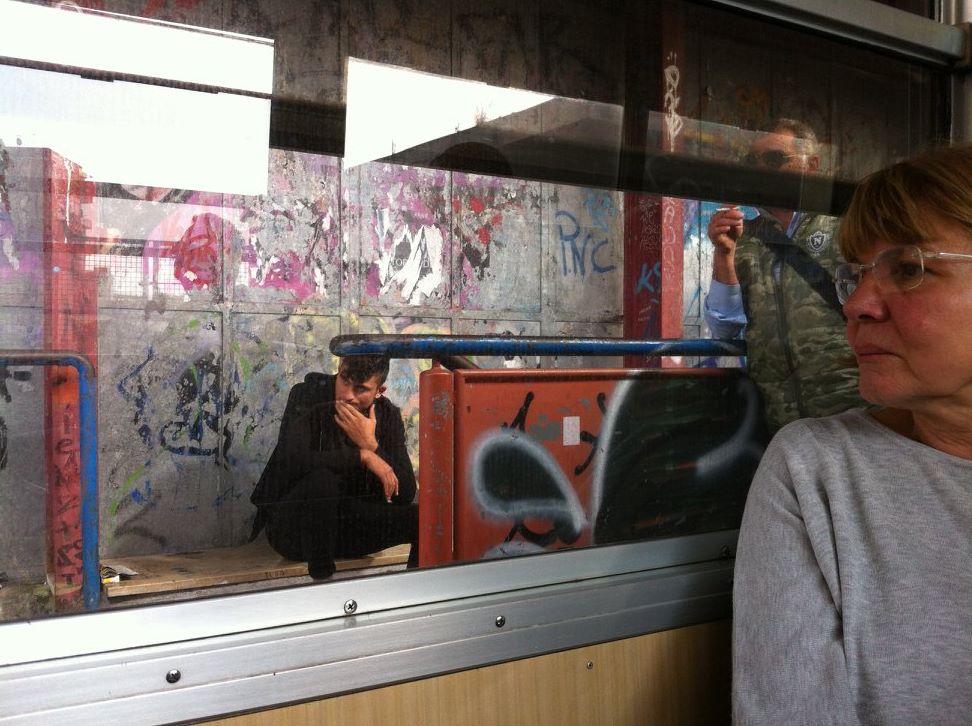
After the high speed train from Rome, the Circumvesuviana felt kind of old-timey—like a kiddie train at a fun fair.  There was lurching, stopping with no explanation in the middle of nowhere, and the occasional alarming metal-on-metal screeching noise.

It slowly wound its way out of the city.  Finally!  I was on my way to Sorrento.  I begun to relax.  I had survived the Naples train station without being mugged, and I had gotten on the right train.  I could just sit back and enjoy the scenery.

Less than five minutes later, we stopped at a station.  Then another station, and another.  Little did I know, there were 33 stops between Naples and Sorrento.  Basically, the Circumvesuviana is the local bus.  All I knew was, this was taking forever, and I had planned to stop in Pompeii on the way to Sorrento.

A recorded voice came on to announce something in Italian, and thankfully it was repeated in English.   The announcement was so long that by the time it finished we had stopped at a few more stops.  There was the usually stuff about not sticking your head out the window, especially if the train was approaching a tunnel.

The British-accented voice finally reached the end “… and our final destination, Campania.”

Campania!  What?  I sat up and scanned the car, expecting other travelers to look alarmed, but they were all asleep or staring unconcernedly at their phones.  There was no official to ask; did the train even have a driver?   There were no route maps in the car.  There was no wifi so I couldn’t pull up Google map. (I had opted not to pay for international data.) 

Then I caught a glimpse of the sea on my right.  Use common sense, Anne.  If Mt. Vesuvius appeared on the left—which it did after a few minutes—we were heading south.  But to where?

Happy Christmas, 10 Years On

This is a reprise post from last year.  Merry Christmas, ya’ll!

In keeping with my gradual transition to writing about unconventional travel and living abroad adventures, I’m looking back on the first Christmas I spent in the UK, 10 years ago.

I had learned a lot since arriving in October. Searching for housing, I had finally figured out that address numbers sometimes went up one side of a block and down the other. Also, many buildings just had names instead of numbers. The Oxfam head office was called John Smith House.

“House” was a misnomer because it was a modern, three-storey building in an industrial park across the motorway from the Mini Cooper factory, and 750 people worked there.

John Smith Houseatriumlobby

I could usually remember that the first floor was the “ground floor” and the second floor was the first floor. I had figured out that when my coworkers asked, “You awl right?” they weren’t concerned about my health; it was the same as someone in Minnesota asking, “How ya doin?” I was avoiding “creeping Americanisms” in my writing, as cautioned in the Oxfam writing manual, so was careful to write “storey” and “tonne” instead of “story” and “ton.” I was no longer taken aback when introduced to a 20-something coworker named Harriet, Richard, or Jane.

Most important, I had learned to avoid any references to my pants, as in, “I got my pants wet biking to work in the rain.” Trousers were pants, and pants were underwear. I loved the expression, “That’s just pants!” which meant something like “that’s insane!”

Everyone spoke in a low murmur. This was partly due to the open plan office, where six people shared one big desk, but I think it was also the culture. A few weeks after my arrival, a new Canadian employee came through for her induction (orientation), and her braying, Minnesota-like accent filled the whole building. One of those moments when I realized, “Ah, that’s what we sound like.”

At Oxfam, everyone walked fast. It was as if, by striding vigorously, they would personally Save the World.  My tall, ginger-haired colleague, Adele, was selling Palestinian olive oil out of her desk drawer. I enjoyed a daily fair-trade, organic chocolate bar from the cafeteria.  Oxfam had a Christmas bazaar in the atrium featuring beaded jewelry made by Masai woman who used the proceeds to buy goats.  Everyone was very earnest.

To be fair, the “Boxing Day”, or Indian Ocean, Earthquake and Tsunami (caution: upsetting video) had happened one year before, killing 230,000 people and leaving millions more without homes or livelihoods. Then, suicide bombers had struck the London transport system in July, killing 56 people and injuring over 700. The week I arrived in Oxford, an earthquake took 80,000 lives in Pakistan. People were reeling, but responding generously. Oxfam had received a tsunami of donations, internally referred to as the “Cat Fund”—for Catastrophe Fund—and rumour had it that they were struggling to do enough, fast enough, to respond.

But for now, Oxfam was abuzz with Christmas cheer. I look in my diary (date book) from that time, and I was busy meeting colleagues after work at pubs named The Marsh Harrier, the Eagle and Child, The Bear, Angel and Greyhound, and Jude the Obscure.

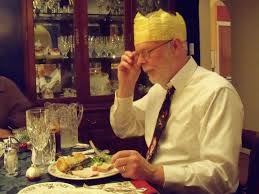
They called Christmas Crimbo, and presents pressies. There were crimbo crackers for sale, too, which are not a crunchy, salty snack, but shiny cardboard tubs “cracked” open at the festive table and containing a Christmas crown and trinkets.

C&CCrackers and CrownsC&C2

There was a panto in the Oxfam atrium, so to use all my new words in a sentence: “Are you going to the crimbo panto or shopping for pressies and crackers after work?”

And what is a panto? It’s slang for pantomime, an extravaganza that takes weeks of planning and involves elaborate costumes, jokes, dancing and singing, skits, and slapstick. Apparently it’s also done by families and in theatres but the only one I’ve ever seen was in the Oxfam atrium. Our usually-serious employees were dressed up as fairytale characters and making fun of themselves, our bosses, and our work. Very healthy, I thought. Take life seriously most of the time, then go all-out silly for a week.

The Queen’s Christmas Message that year was beautiful, in my opinion, and more relevant than ever.

queen

Art and The Avocado

This is a series of posts about Italy, Malta, and Spain that starts here.

As I exited the Borghese Gallery at exactly 2:00 pm I wondered, Why Caravaggio?  Why Bernini? Why did they become famous, while hundreds of other artists who had created most of the art in the gallery remained nameless nobodies?  How do some artists “break out” from the pack? Is it talent, connections, luck, or what?

I could appreciate how difficult it must have been to carve fingers out of marble.  Were no other sculptors able to do that—is that why Bernini stands out?  I could see how Caravaggio’s paintings were darker than his peers.  Is that why he’s considered so much greater than other painters?  Was “darker” a breakthrough in the 16th Century, like cubism would be in the 20th?  Even the worst artist in the gallery—if there was one—was infinitely better than I could ever be.  I felt like a philistine and resolved, as usual, to read up on what I had seen when I returned home.

I sat on a bench outside the gallery next to an elderly couple and pulled out my map so I could think about where to go next.  The man leaned over to me and asked where I was from.  He had never heard of Minnesota and his English was so-so, but that didn’t stop him from talking without interruption for 20 minutes straight.

He commandeered my map so I couldn’t walk away.  He was very nice but he made enough suggestions to keep me busy in Rome for a month.  “You must walk over to the other side of the river and see the Church of St. Celestine of the Bloody Hand,” he said enthusiastically.  “It’s like no other church you’ve ever seen!  It will only take you about a half hour to get there by taxi.”  I made up that church name, of course.

He paused, then sighed, “Ah, that’s-a-Roma.”

His wife leaned forward to peer around him at me with a look that said, “He always does this.”  She must have been 80 but she didn’t have a hair out of place and she was wearing a skirt and high heels.  He was wearing a black trench coat, open so I could see his tweed suit and silk tie.  They were both wearing boxy, trendy eyeglasses.

He said something that sounded like “I am an avocado.”  What?  “A lawyer—retired,” he said in English.  Ah, an avvocato—as in legal advocate— I nodded.

“You must see the Caravaggios in the Church of the Holy Martyrs of the Flagellation,” came next.  “Ah, that’s-a-Roma.”

“You are by yourself?” he asked.  “Alone?”  When I nodded he looked back at his wife and I couldn’t see their faces but I imagined they exchanged pitying glances.

Finally, I maintained eye contact and smiled while gently extracting my map from his hands, then walked off down the tree-lined lane.  They were such a sweet couple.  Why wasn’t I part of a sweet couple?  Why?  What had I done wrong?  Would I ever meet Mr. Right?  Why was I the Only One in the World who was alone?  Blah, blah, blah went my thoughts.  A few tears escaped, and I thought this would be a good time to sit on a bench, rest a bit, and gather my thoughts.  But counterintuitively, it’s often when I’m over tired that I have the urge to Press On No Matter What.  I was determined to find one of the things the old man had recommended—a church in the Piazza del Popolo which had two Caravaggios.

Despite it being close by, I got lost.  I consulted the map, then got lost again.   It was hot, I was hungry and tired.  The thoughts started again: What’s wrong with you?  You’re such an idiot.  No one else gets lost this much.  Finally I stumbled into the church and gazed at the Caravaggios.  Meh.  I think I had OD’d on art.  After three days of nonstop touring, I told myself I had nothing to prove.  I walked back to my hotel, polished off my complimentary prosecco, and slept for 12 hours.

This Way to the ?

This is a series of posts about Italy, Malta, and Spain that starts here.  I’ll be posting every other day for a while until the travel posts catch up with real time.

After five hours in the Vatican Museum, St. Peter’s Square and Basilica were anticlimactic.  The square was … well, a square, and it was filled with white plastic stacking chairs.  There were also plastic ropes demarcating lines this way and that like you would see at Disneyland.  I didn’t bother trying to photograph it because there was no way to capture how big it was without plastic paraphernalia in the way.  St. Peter’s Basilica was … huge, of course.  Maybe, after the glorious collections of the Vatican Museum, I was just beyond being wowed any further.

I did make tremendous progress on a census of nuns and priests I had started upon my arrival.  But it was the Vatican, after all, and I lost track when I reached 12 nuns and nine priests in less than an hour.  This was more nuns and priests than I had seen in the previous 30 years of my life.  Almost all of them appeared to be from the developing world.

The hotel desk clerk had been right, there did seem to be a lot of Argentinians around, drawn by the Argentinian Pope.  I could hear Spanish everywhere.  Its cadence was like a relentless rat-a-tat-tat, whereas Italian was more circular.

This may sound cliché and insensitive, but it’s true.  I didn’t see one obese person aside from a few Americans, who were clearly distinguishable by their sloppy sweats and athletic shoes.  Why are we such slobs?  You can’t even go to an orchestra performance anymore without half the people wearing jeans and sweatshirts with sports logos.

By contrast, the Spaniards and Italians were impeccably dressed—the men with flawlessly-shined dress shoes, women in heels and skirts, everyone in black finely-tailored overcoats.  The women had clearly made an effort to style their hair and accessorize.  Many of the men wore hats.  Not baseball caps—real dress hats like real men should wear.  Boy do I sound old.

What did I wear?  I compromised comfort and style by alternating between two black and grey outfits topped by a silver puffer vest with zip-able pockets, one of which was inside; a secure stash for cash and cards.  I switched my Dr. Scholl’s gel inserts between black boots and a pair of black Coach shoes that were really trainers but looked dressier.

I took the subway back to my hotel, thinking I would nap but I couldn’t.  I boomeranged back out into the streets and wandered around, eventually eating dinner in a tiny ristorante where the first of many waiters asked, “Only one?”

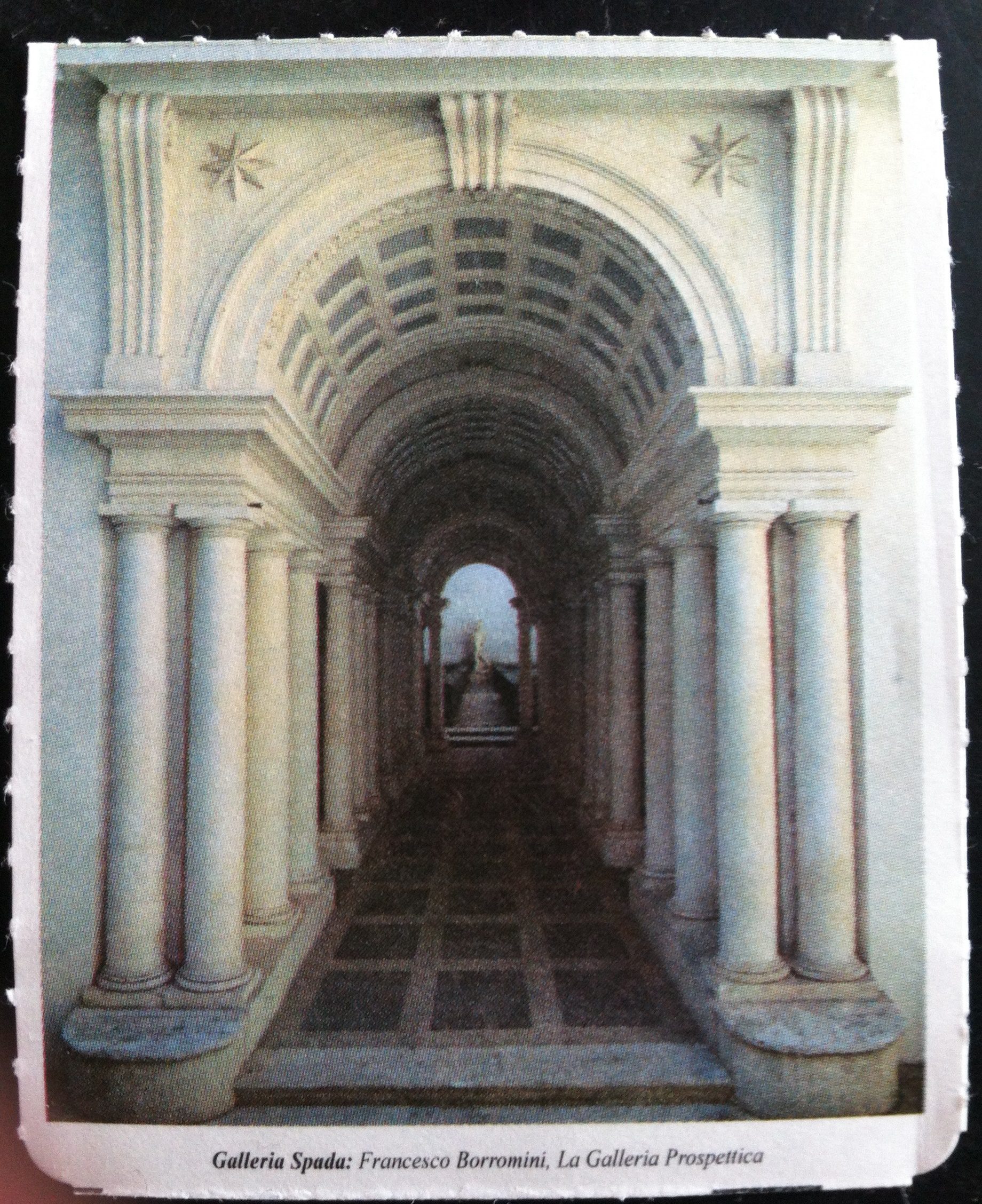
I had a ticket for the next day for the Borghese Gallery, which I’d never heard of until I started reading “Top 10 Rome” lists.  The ticket purchase required me to choose a seat, as if I were going to a concert.  Sometimes just buying a ticket is an adventure in itself.

borghese-2

borghese

My emailed ticket listed three different entry times and an exit time, so I wasn’t sure if I had booked a tour, a concert, a museum, or what.

I got to there early which was good because the place was run like a Swiss clock.  I waited in line to exchange my emailed ticket for a fancy one:

borghese-3

I never saw this passageway.

I got into another line to check my coat and bag, which was mandatory.  Then, being sensible, I waited in line for the bathroom, then got into line for the tour.  All of this took place in a cramped underground room with a hundred other people trying to figure out what they were supposed to be doing.

Finally it became clear to me that the tour was mandatory—you couldn’t wander through on your own and you were required to leave at the time indicated on the back of your ticket.  We all got radio receivers with headphones so the guide could talk at a normal volume.  At precisely 11:10 am, my group—Group 11—followed our guide to a fifth and final line where a guard scanned our tickets and then on into the gallery.

Three Hours in Rome

This is a series of posts about Italy, Malta, and Spain that starts here.

After gulping down a glass of the complementary Prosecco in my hotel room and wisely deciding not to pour the rest of it into my water bottle, I rushed out to see Rome.

People often talk disdainfully about “check list” travel: “I don’t want to do that “check the box” kind of travel. You know, where you run around like crazy trying to see all the famous sites in one afternoon?  You can’t appreciate them that way.  And you need time to process them afterwards, too.’”

I’ve said those words myself, and meant them.  It’s a nice sentiment.  But I had come 5,000 miles and although things were less expensive during the low season, I was still spending plenty of money on this trip.  Why not pack in as much in as possible?  Life is short, so before it got dark—in three hours—I was determined to at least scope out the Coliseum, the Roman Forum, Palatine Hill, and the Pantheon.

The Coliseum appeared to be a few short blocks away.  But “a few blocks” in Rome, for me, meant getting lost immediately, several attempts to surreptitiously look at my map, asking strangers for directions, stumbling upon the almost 2000-year-old Trajan’s Column, being distracted by block after block of Roman ruins, consulting the map again, getting lost again, and saying no to a dozen African immigrants selling selfie sticks along the way.

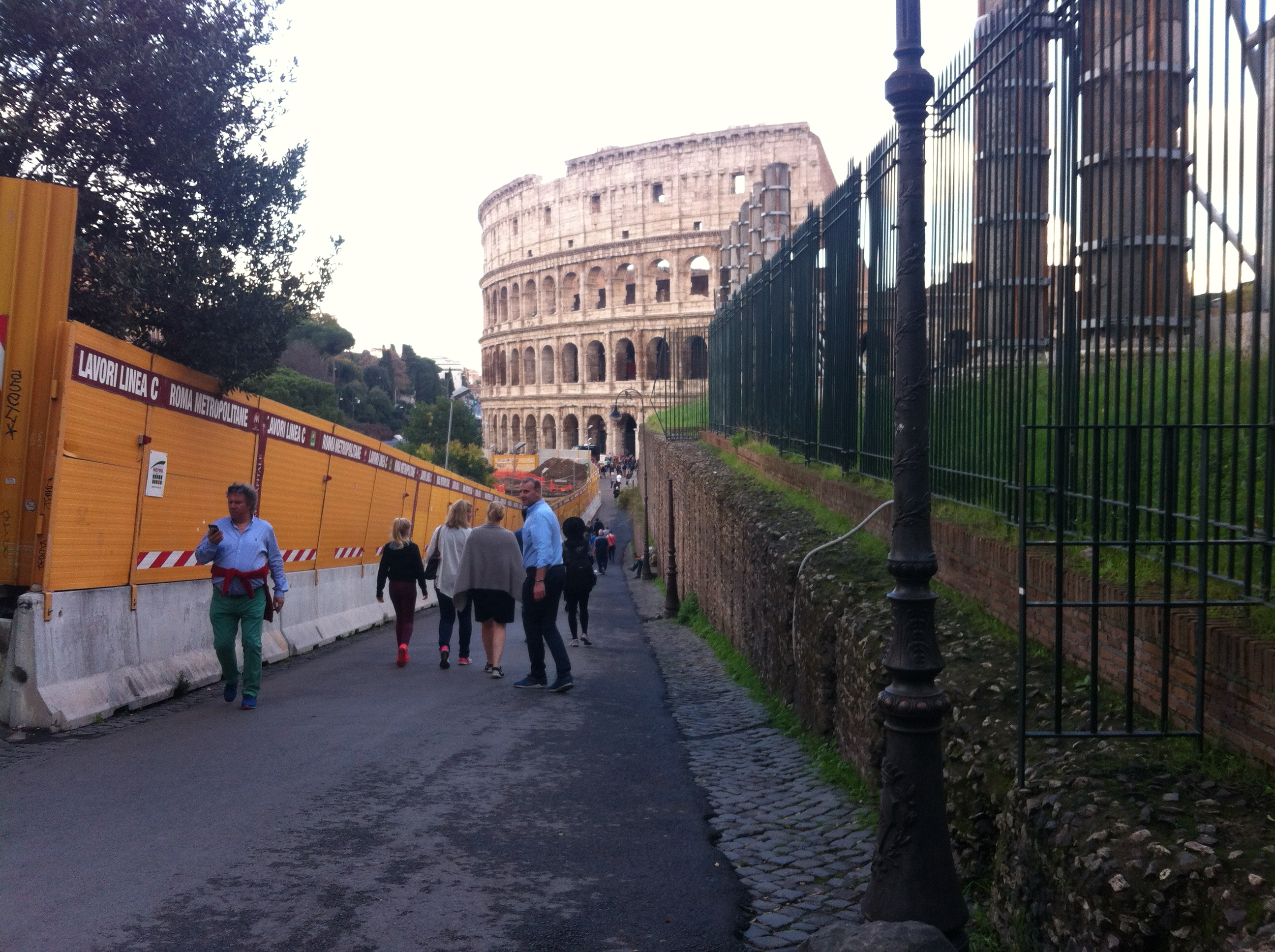
How would I ever find the Coliseum? Then I turned a corner, and there it was.

aproach-to-the-ampitheatre

Wow.  It’s one of those places you’ve seen in photos and movies hundreds of times but which still takes your breath away.  I wasn’t going in today, but I walked around it.  And I slowed down, savoring this rare feeling of awe.

flavian-amphitheatre

I had read and re-read descriptions of the sites, and they hadn’t given me a sense of their scope or how to tackle them.  Google maps are great, but they don’t indicate elevation.  So one thing appears close to another, but you don’t know about the 400 steps until you’re looking up at them from the bottom.  The Roman forum isn’t one thing; it’s a collection of hundreds of ruins including some intact buildings scattered over a huge swath of land adjacent to the Coliseum.  Apparently there were dozens exits but only one entrance, and that was a closely-held secret.  Palatine Hill is, thankfully, a real hill, but because everything is so packed together, I couldn’t back up enough to get perspective and see where it was.

I had bought my three-in-one ticket for the Coliseum, forum, and Palatine Hill online and it didn’t shed any light:

Gentile Cliente,
informiamo che è stata prodotta la fattura n. 01287080

Da questo momento è possibile accedervi direttamente cliccando qui
Se il file non viene visualizzato correttamente è possibile scaricare il programma Adobe Acrobat Reader cliccando qui  La fattura non sarà inviata tramite posta.

Ricordiamo inoltre che è comunque necessario STAMPARE LA FATTURA E CONSERVARLA ai fini delle vigenti disposizioni di legge. La fattura resterà a disposizione per almeno 1 anno.

ATTENZIONE: questo è una email AUTOMATICA, pertanto vi preghiamo di NON RISPONDERE a questo messaggio per avere assistenza.

In caso di necessità il nostro Servizio Clienti è a sua disposizione per qualsiasi informazione riguardante la transazione effettuata. Per contattarci la invitiamo esclusivamente a compilare il modulo Servizio Clienti all’indirizzo: http://www.ticketone.it/help

Cordiali Saluti

The links led to a receipt.  I knew enough Spanish to decipher that I was supposed to pay attention to something, save something, and not respond to this automated message.

This was going to be fun!

I hadn’t planned to go inside the Coliseum or immerse myself in any of it yet anyway, I just wanted to see the Coliseum and get the lay for the land.  The Pantheon?  That was “nearby” too, which I now knew meant, “Forget it, sucker—you’ll never find it by dark.”

I took my time strolling back to the hotel, retracing my steps, already feeling familiar with landmarks and knowing I could easily find my way back when I returned in two days.

Tomorrow: The Vatican.

Don’t Read This Post

Do not read this post or look at the photos if you think you will irreversibly upset by torture techniques.

This is a supplement to my last post, in which I described a museum exhibit about torture.  Interestingly, the museum—the Casa Sephardi in Granada, Spain—offered no spin on the exhibit.  It wasn’t a “human rights” museum, it made no call to action at the end. It also did not make light of torture.  It was just straight-out torture, torture, and more torture, leaving interpretation and follow up to the visitor.

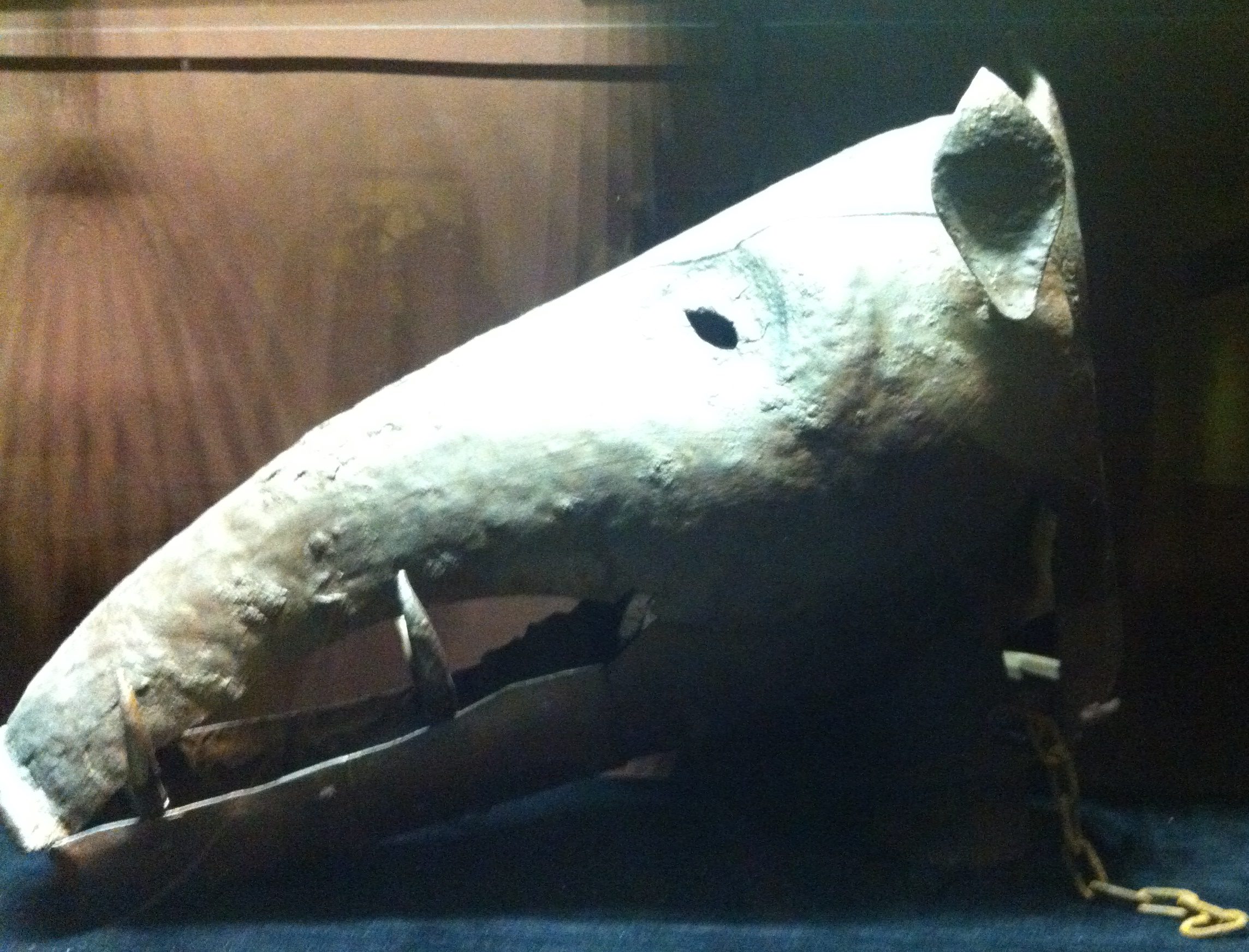
There were creepy masks people were forced to wear to be humiliated (as in women who had allegedly been unfaithful to their husbands).

mask-of-shame pigmask-2

The pig mask was, of course, specifically designed to humiliate Jews, who don’t eat pork.  These masks may look kind of funny (as in humorous), but they weren’t.  As you can read in the paragraph in the first photo, they often also had spikes in strategic places, cut into victims’ necks, and the wearers typically died of starvation.

This confirms another lesson about torture that is relevant today:  Torture is rarely used to get security information from terrorists to prevent attacks.  It’s almost always used to punish people and to intimidate others not to rebel.  It puts a chill on entire communities, who stop speaking out and being politically active. It’s the favorite tool of dictators.

To reinforce my point, here’s a photo of a set of branding irons.  The “crimes” for which people were branded included “slave”, “blasphemer”, and “rogue.”  Really—Rogue?  I can think of a dozen friends of mine who would have been branded by now.  I could have been branded as a blasphemer a hundred times over.

branding

The exhibit proceeded to get worse and worse.

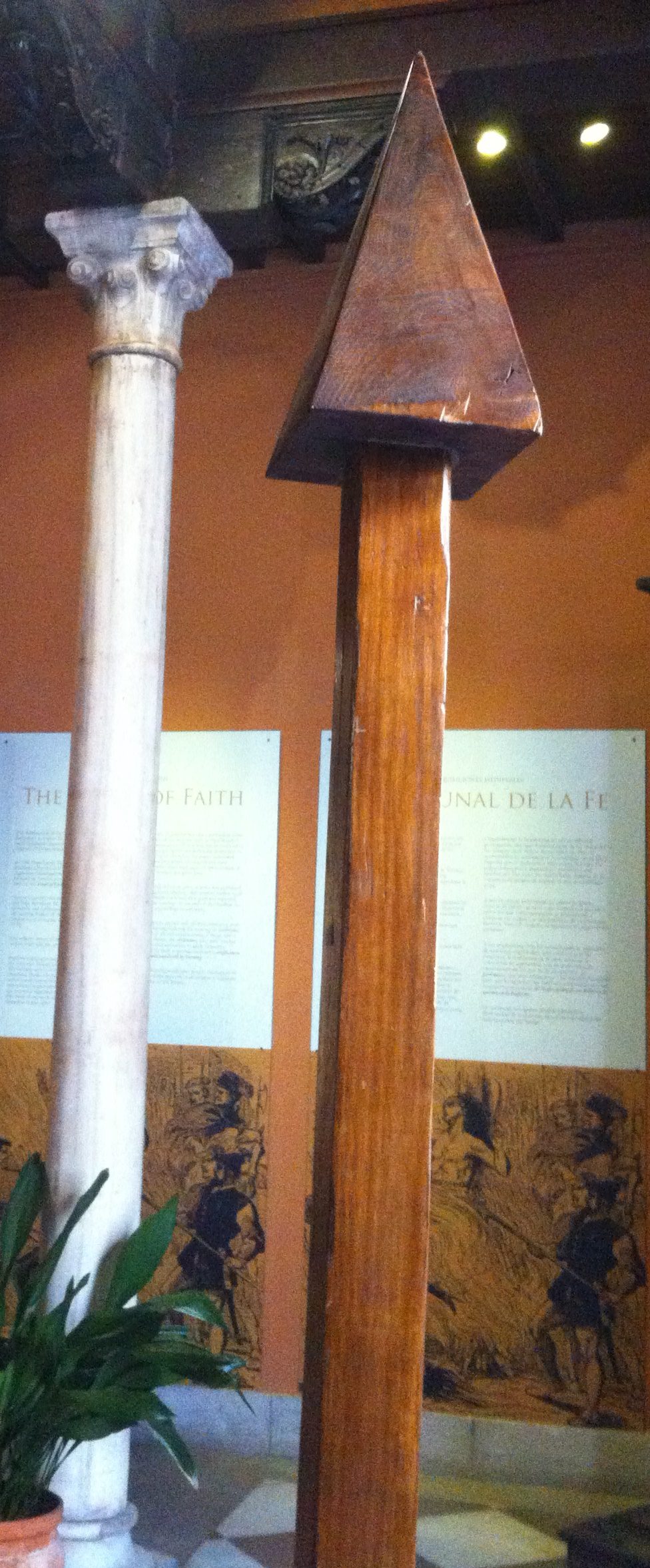
It included the iron maiden (not the rock band), thumb screws, chastity belts (for men and women; with and without spikes), the saw (victim hung upside down and sawed down the middle starting from the crotch), the iron bull (victim forced inside a hollow iron statue of a bull under which a fire was slowly built), the rack—with a without spikes—which pulled the victim’s spine and other joints apart one by one; the cage, in which victims were locked and suspended from a bridge where they were exposed to the elements and starved to death.

I will leave it to your imagination to figure out how the spike was used:

spike

I didn’t take photos of most of it; it was just too horrible to share.

If you have read this post, you are either very brave or a weirdo.  Or you are one of the over 50% of Americans who think that torture is okay.  If, like me, you don’t agree, please go to the Center for Victims of Torture website and sign the Reject Torture declaration.  Thanks, and I promise that the next post will be about Italian food or art or something more uplifting!

Back in the Homeland

15 museums

8 flights

7 hotels

6 palaces and villas

5 train rides

4 countries, if you count the Vatican

3 weeks

2 friends who are miraculously still good friends

1 drained bank account, but totally worth it

Zero muggings, rip offs, illnesses, or other crises.

Uncountable numbers of churches, nameless restaurants and cafes, glasses of wine, paintings of the Virgin Mary, and taxi rides to and from bus stations and airports.

I’m on a plane back home after 3 weeks of traveling around Italy, Malta, and Spain.  I’ve got nine hours ahead of me on the way to Atlanta, then another flight to Minneapolis/St. Paul before I land at 6:40pm.  They guy sitting next to me, Ryan, is from Atlanta.  He told me he was traveling on business and I immediately assumed he would be a conservative Republican who sells B2B online storage solutions or something but it turns out he works for a progressive Baptist international nongovernmental organization.  We chatted about what our respective organizations do, about how different countries examine their pasts, and then touched briefly on the election results before he put in his headphones to watch a movie and I flipped open my laptop.  He said half his organization’s employees are African American, and the day after the election their regular check-in meeting was just dead silence.

When I checked in with a colleague where I work (the Center for Victims of Torture), the day after the election, she said the office was like a morgue.  We had been running a two-month anti-torture campaign to educate people about how torture is illegal.  Now we may have to kick it into high gear to push back against US use of torture.

I’ll have a lot more to write about this trip, but speaking of torture, I visited a museum in Granada, Spain that advertised a special exhibition about torture.  Lynn rolled her eyes when I asked if she wanted to go. It was about the only time we didn’t do something together.

What I didn’t realize was that the museum’s name was Casa Sephardi, Sephardi being the term for Jews who used to live in Spain and Portugal.

The exhibit started off easy, with displays of artifacts like menorahs, prayer shawls, and wedding costumes.  Then came the Spanish Inquisition.  Jews had done well in Spain for the most part, sometimes prospering even more under Muslim protection than under Christian rule.  But, as has happened over and over throughout history, Jews became a victim of their own successes.  There were religious differences, for sure, but economics was a prime motivator to get rid of the Jews so their property could be confiscated.  In 1391, 4,000 Jews were massacred in Seville.  This was followed by mass forced conversion to Christianity.  Judaism provides a “get out” clause that allows us to convert if our life is at stake.  We’re practical like that.  So most Jews “converted” but continued to practice Judaism covertly.

The Inquisition imprisoned and tortured the Jews who had converted, sincerely or not, and their property was sold off to cover their expenses—which I guess would have included bread and water and manacles.  Their families were turned out into the streets.

Surprise!  They were all found guilty and executed.  In 1492, all the remaining Jews were expelled from Spain.  About a hundred years later, Muslims were also subjected to forced conversions, Inquisition and expulsion.

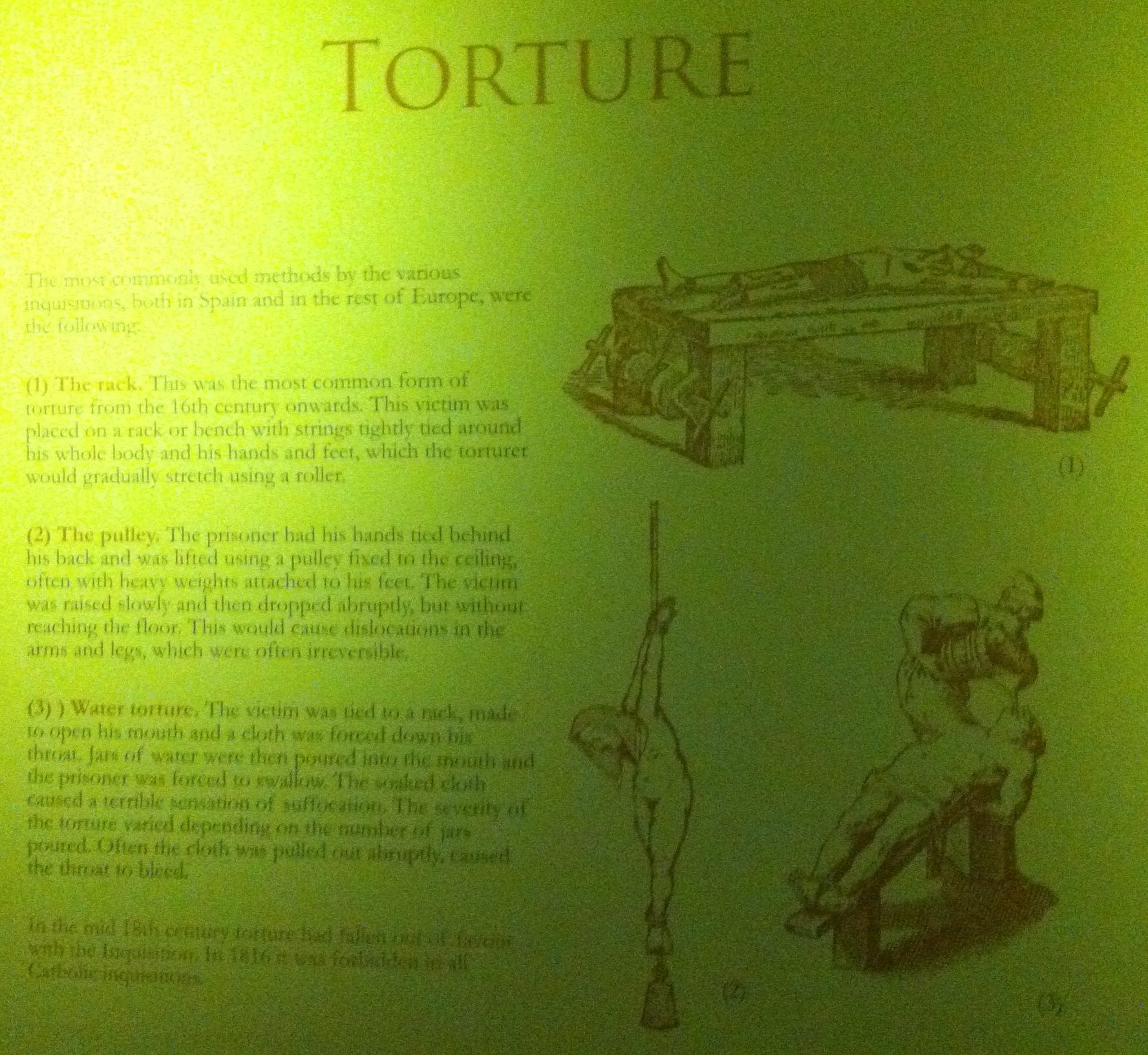
Lastly, there was the “special” exhibit about torture.  It was awful, truly awful, and I am someone who works for a torture rehabilitation center.  I’ll write about it more in a separate post, and stop reading here if you know you could be upset by disturbing images.

Here’s my take away: the displays, which appeared to be decades old, confirmed two themes in CVT’s anti-torture campaign:

Waterboarding is torture, and a medieval technique at that:

waterboarding

Torture is not effective in obtaining accurate information.

torture-does-not-work

This is one of the reasons travel is important, especially for us Americans, especially now: so we can learn from history (Spanish history is our history), learn from other cultures, learn the truth, and come back prepared to fight for our values.

Happy Thanksgiving to my American readers!  May we somehow find some harmony during the holiday season and in the year to come.

Donald Cometh, I Goeth

I woke up at 4:30 am this morning when my cousin messaged me to say, “It’s not looking good.”  I had asked him to let me know as soon as the election was called.  I figured I’d feel good and slightly relieved that Hillary was in, then roll over and go back to sleep.  Instead, his message had me wide awake and glued to the BBC for hours.

I won’t get into why I preferred Hillary over Donald.  My political leaning probably won’t come as a shock to you.  I keep thinking about how Minnesota elected as Governor a former “professional” wrestler named Jesse “The Body” Ventura about 10 years ago.  People were sick of lying, do-nothing politicians and he seemed like a refreshing change, representing the Independence Party. It turned out he was thin-skinned, got into fights with the media for doing their jobs, managed to insult every voter group, and accomplished nothing.

I’m still on Malta.  This morning I left the hotel before I knew the final election results but I felt numb and didn’t relish how I would feel once the shock wore off.

My first agenda item was a visit to the immigration office.

There is all sorts of stuff on social media about how we’ll all “just move to Canada.”  I find this rather maddening.  It’s sort of like how most Americans think Downton Abbey is a BBC production when it wasn’t.  We have certain fixed ideas about other countries that just aren’t accurate.

We think Canada is so nice that it would allow in 60 million Americans.  Sixty million depressed, angry Americans!  Canadians are nice, but not that nice.

Here’s the thing: Other countries don’t want foreigners taking their jobs any more than we do.  And you can’t just enter another country and start looking for work; they’ll want to see your work permit.  You may not even be able to cross the border without one.

I moved to the UK in 2005 on a student visa and after it expired I thought I’d just get a “regular” work visa.  I was quickly disappointed to learn that my chances of that were zero because I was applying for, essentially, writing jobs in the country of Shakespeare and Oxford and competing with English citizens and every qualified person from the EU and Commonwealth countries who wanted to move to the UK.

If I had gotten a job with an international company they might have sponsored me, but my career was in the nonprofit sector.  If I was fleeing war, I might have qualified as a refugee but fortunately that’s wasn’t the case.

I checked out moving to Canada about eight years ago and it was the same deal.  Unless you have a PhD in computer science or some other high-skill field, forget it.

The only country I can work in, no problem, is Israel.  That would not be without significant challenges; the politics there would probably drive me just as crazy.  To be honest, my biggest hesitation is that I feel too old to master a new language—one that’s only used in one country.  But it’s an option.

In preparing for this trip, I read that Malta had a “pay your way in” scheme. That is, if you bought a property here and had some amount of money in a Maltese bank account, you could become a citizen and work here.  I was just thinking about it as an adventure or maybe retirement option, but today it seemed more urgent.  Of course my 501K probably lost 5% overnight, so I figured I might have to wait til it rebounded.

So off I went.  I immediately got lost so asked a young man who appeared to be an immigrant if he knew where it was.  He was Ethiopian, and he informed me, “We are afraid of what Donald Trump will do.”  This would be the first of half a dozen times I heard the identical words from non Americans today.

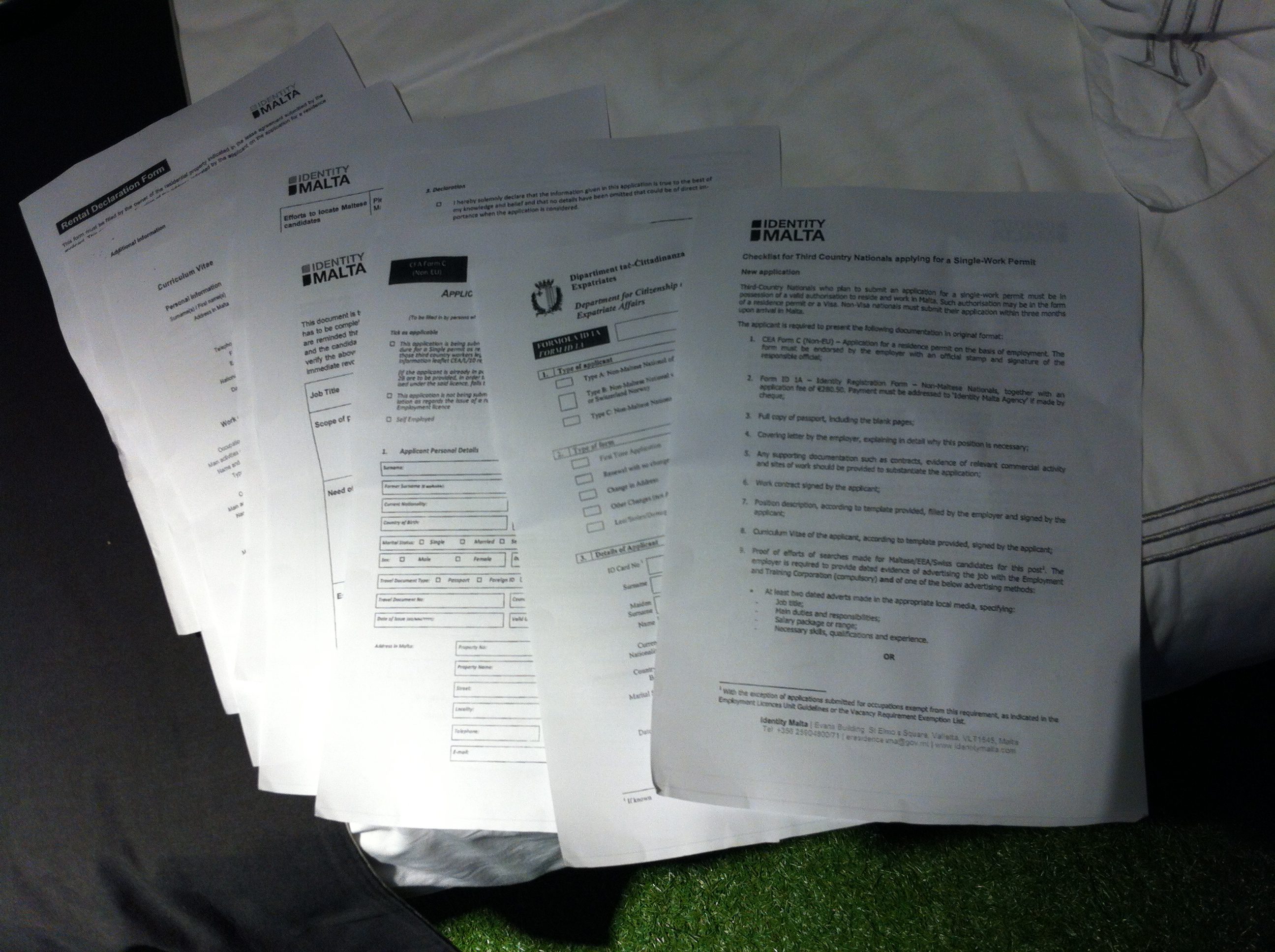
At the Immigration Ministry, the man at the desk informed me, “No more payment scheme.  You want work permit, here are papers.”  Here they are, double sided.  So I’m back to square one.

malta-immigration-papers

Those Who Fail to Learn from History

I am sitting in my hotel room in Valetta, the capital of Malta, watching the news of the US elections on CNN.  There’s not much to know yet, they show the same reel over and over.

Before it’s all over and just in case I choose to throw myself off a cliff here if the result doesn’t go the way I want it to, I wanted to write one post about this election.

There was an Afro Caribbean college kid in London being interviewed about something on TV, and he complained, “Why do we got to learn about stuff that happened hundreds of years ago, like how many wives Henry the eighth had, but we don’t learn nuffink about our own history?”  Well, fair enough.  He should learn all sorts of history—not just that of the white men.

But as it happens I’ve been thinking a lot about Henry VIII, because this summer I picked up a novel by Philippa Gregory at a little free library and got hooked—I’ve read five or six of her historical “bodice rippers” since.  She writes about the medieval period, including the Tudors which Henry VIII was one.  These books aren’t Great Literature and Gregory gets knocked for not being historically accurate, but she does have a PhD in history from the University of Edinburg and she tells these true-ish stories with so much tension you can’t put the book down.

What’s relevant to the US elections is the striking similarities between Henry VIII and Donald Trump.  Both were born into wealth and power.  Both had an older brother who was supposed to be the heir but who died young.  Both were told from a young age that they could do anything and no one ever said no to them.  Both used and discarded people at a whim, and both had thin skin and a mean streak.  Of course, this is just my opinion. We’ll find out in a matter of hours how many Americans think Donald Trump is a really great guy.

My point is that they are both types that recur throughout history and if we don’t know history, we may not be on guard against electing another one to public office. Also, over and over, people think “he couldn’t be that bad” and “it couldn’t happen here.”  We tend to believe horrific things only happened in the past or go on in “backward” countries.  I’m sure that’s what the Germans—the people who gave us Goethe and Beethoven—thought, right before they started making lamp shades out of human skin.

Am I being overly dramatic?  I hope so.  But better that than being “surprised” when Trump starts shipping planeloads of Muslim Americans “back to where they came from,” which is actually probably Silicon Valley, not the Swat Valley.

It feels funny, that every non-American I’ve met has said something like, “We’re all watching your elections.” Americans never follow anyone else’s elections like others follow ours, and it’s a reminder of our place in the world.  And they have also all said something like, “Don’t Americans remember what happened with Hitler/Mussolini/Franco?

We don’t.  Actually it’s worse than that—most Americans probably don’t even know who Mussolini or Franco were.

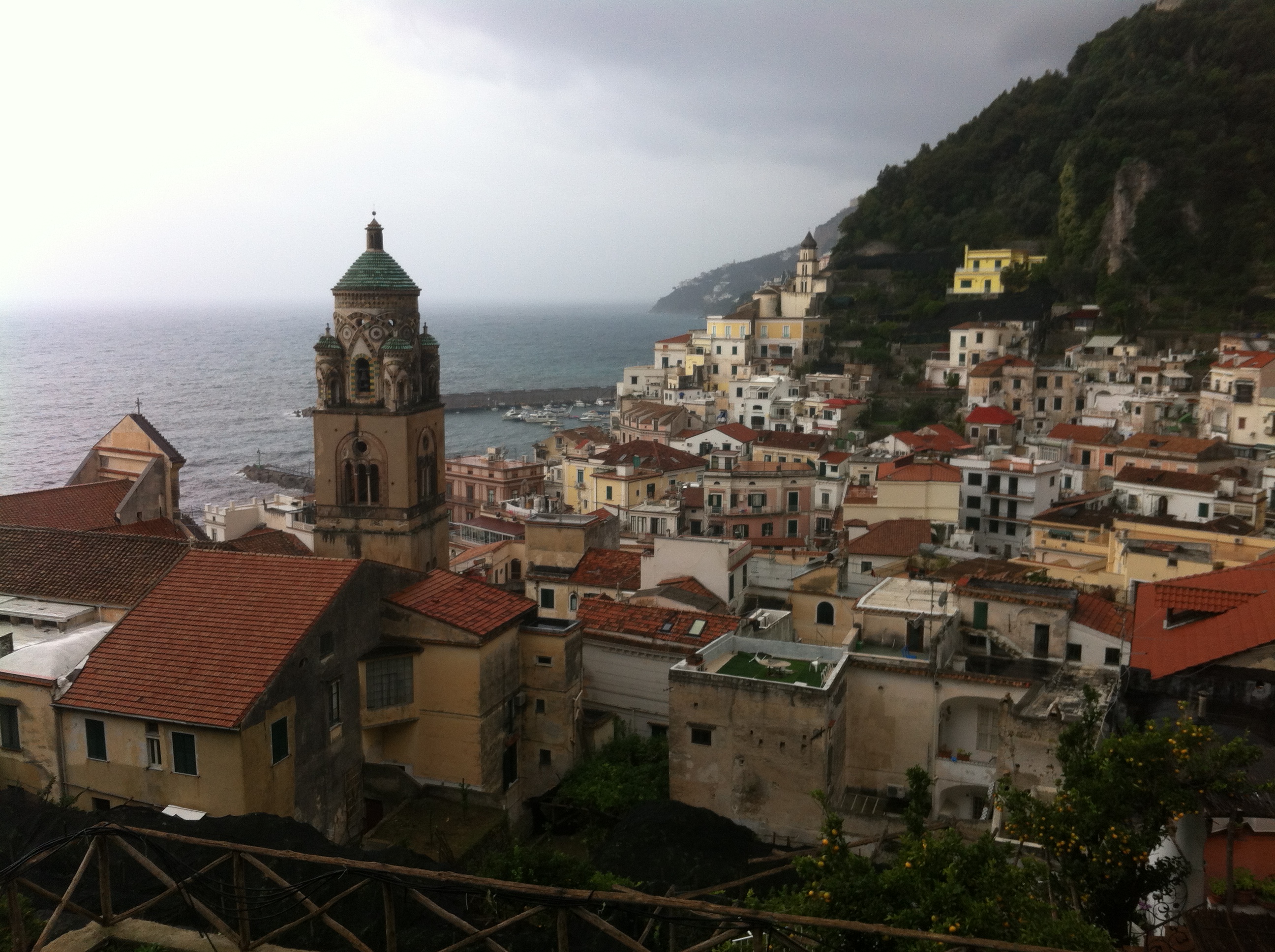
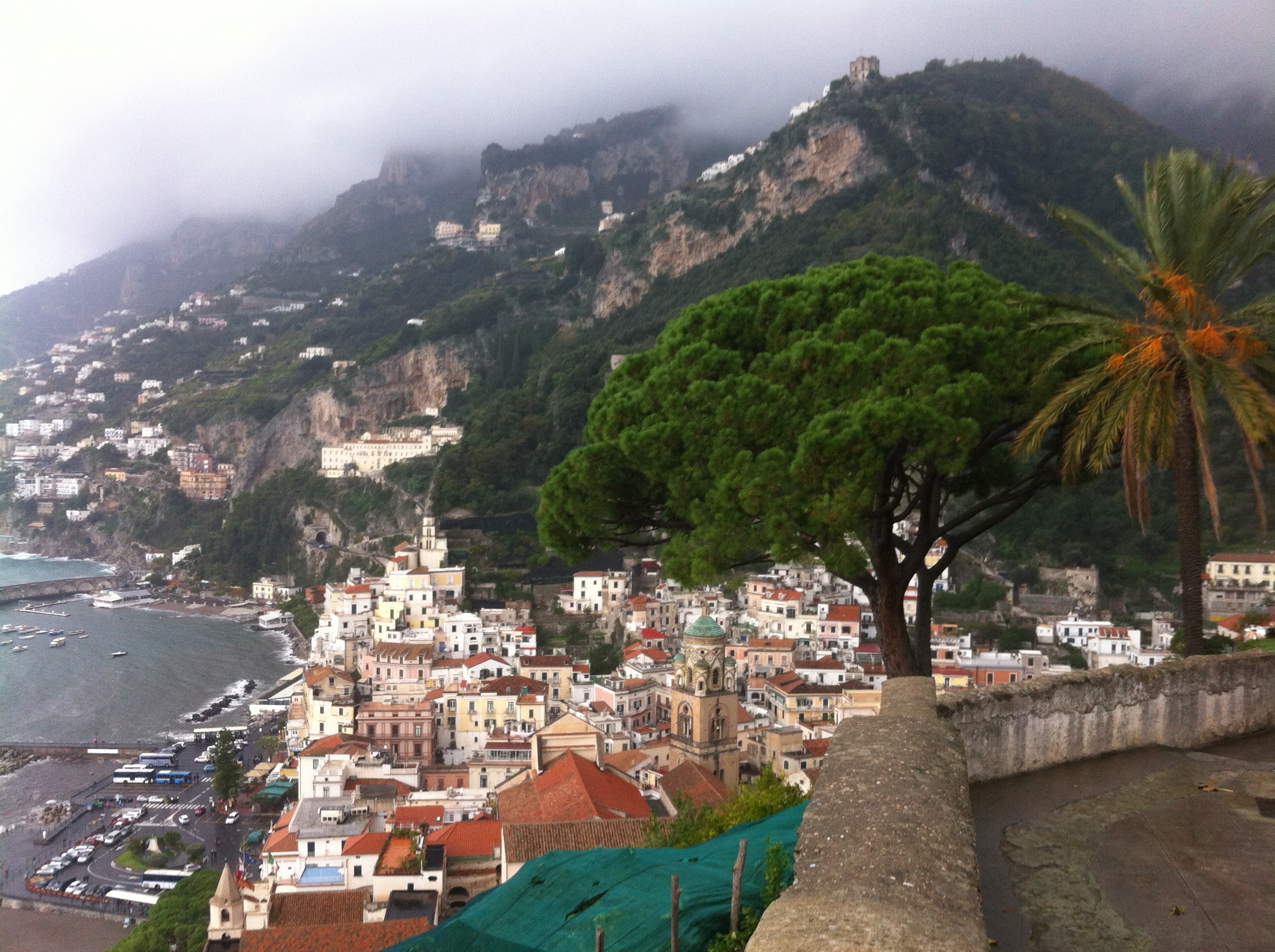
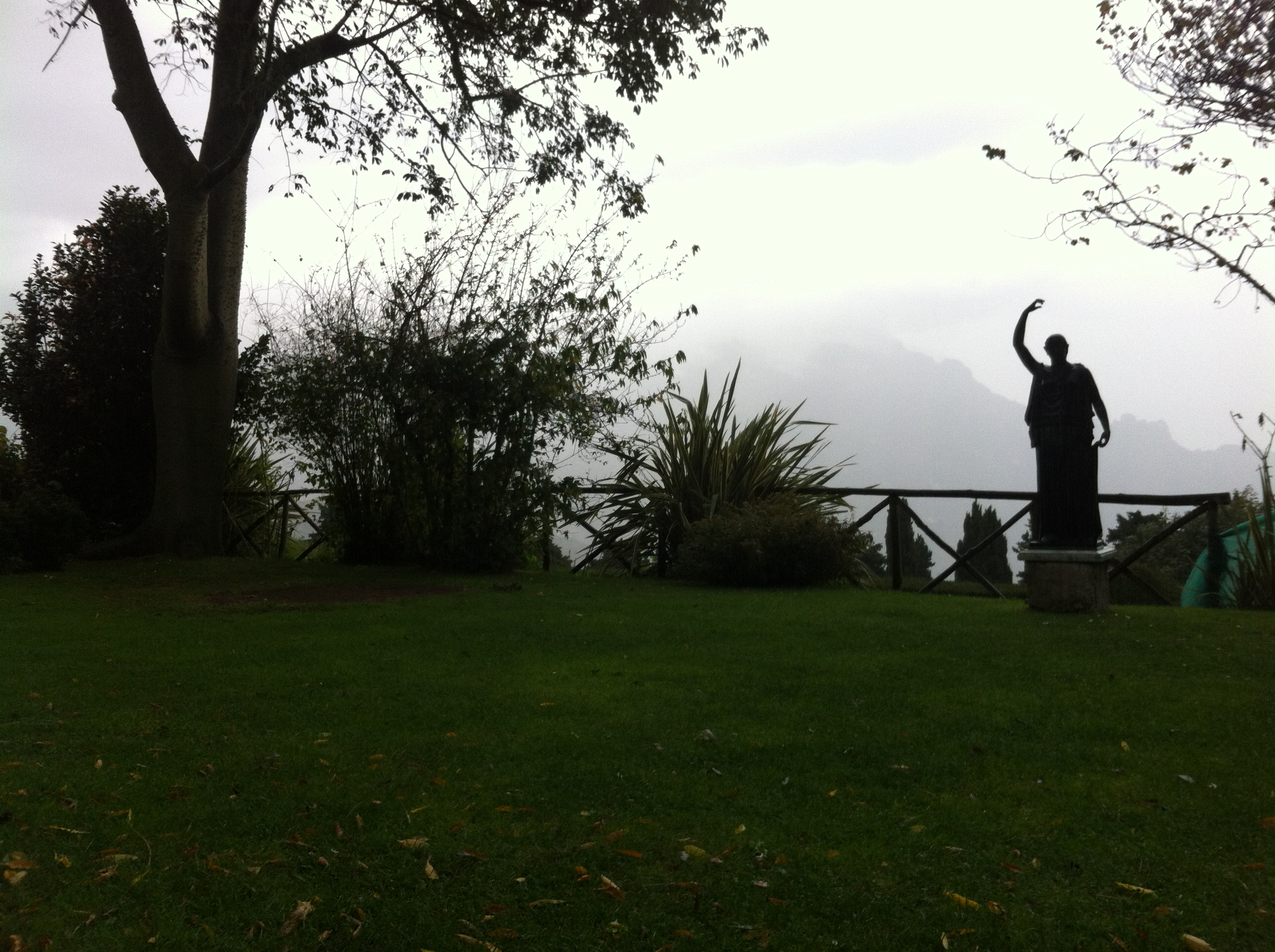
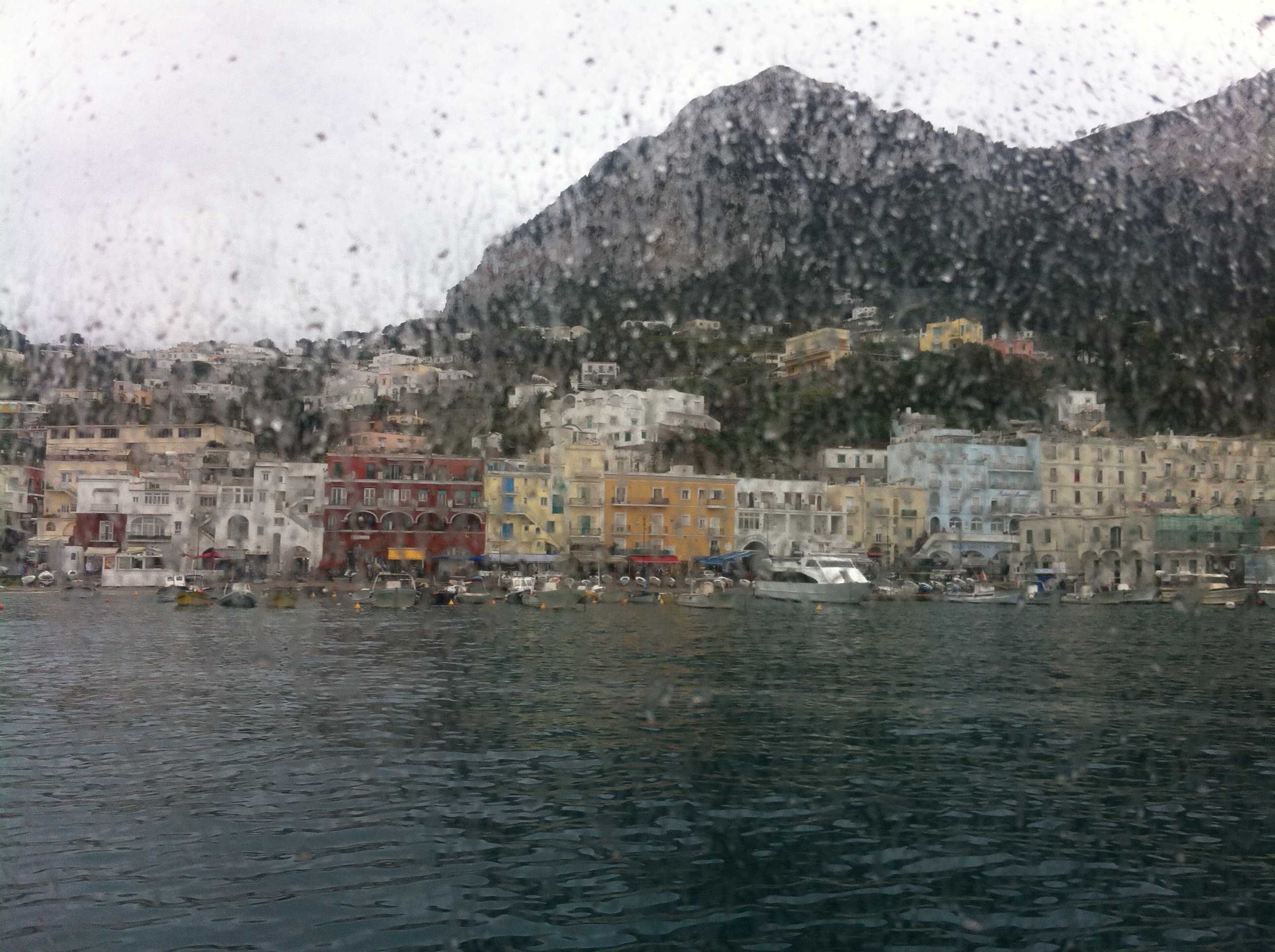
I will get back to writing about this trip, but I was probably overly optimistic to think I’d post a live post every night.  I spent the weekend in Sorrento, the Amalfi coast, and Capri.  It rained and rained and rained.  I made the best of it, I guess.  Rainy days have a beauty of their own. Here are a couple snaps:

amalfi-tower amalfi-view arm-waver rainy-view

I’ve been on Malta for only a couple hours and it was love at first sight. If the election doesn’t go the way I am hoping, I may claim political asylum!