Category Archives: Empathy

Tumblin’ and Floppin’

What was I thinking when I gave Vince a rock tumbler for Christmas? It’s his long-time hobby, and this is probably the third one I’ve bought him, but it’s the first time I’ve lived with the sound of it, cruncha-rugga-chugga-rugga 24/7. I don’t know how he can sleep with it in his room. .

Here’s an update on Vince’s and my living-together situation.

If I come home and he’s in the living room, he immediately gets up, goes to his room and shuts the door, and doesn’t come out again until the next morning. If I’m the one in the living room when he comes home, he goes straight to his room and doesn’t come out until the next morning. He doesn’t slam the door, so there’s nothing to point to and say, “Stop doing that!”

When we run into each other in the morning, the exchange is:

“Good morning.”

“Good morning.”

“Have a nice day.”

“You too.”

When I ask, “What are you up to today?” he tells me, but there is a tone, as though he thinks I am prying. If I call to him inside his bedroom, there is a long pause during which I imagine he is rolling his eyes, and then a drawn-out, “Yeh-sss?”

I managed to catch him long enough one day to say that people who live in the same house usually talk to each other now and then. He seemed to think I was trying to trick him into talking.

Things came to a head on Christmas day. I found myself crying in my room (into a pillow, so Vince wouldn’t hear, because I didn’t want him to think I was trying to manipulate him). I had been out 16 of the last 18 nights, trying to give him space.

I was tired. I had lost perspective. Was it nosy to ask, “How are you?” Was everything I did annoying? Was the sound of my voice noxious? Should I confront him? Try to be nicer? Suggest we go to counseling together? Ask him to move out? Go live in a motel? Was I acting like a martyr? Maybe if I bought some non-floppy slippers—because surely the sound of my footsteps must drive him crazy.

I recognize Vince’s behavior because I’ve acted the same in the past.

I had a roommate; I’ll call her Irene. She was from Ontario and taught theology at a local private university.

I could not stand being in the same room with her. Everything about her irritated me—her denim dresses and sturdy shoes, the giant jar of Branston Pickle in the fridge, the fact that her favorite color was navy blue.

When I heard her key in the door I would scurry to my room, silently shut the door, and not emerge until I knew the coast was clear. If she tried to make conversation I would deflect it with a curt answer and a stiff demeanor. If I did have to communicate something to her, I left a note on the dining room table.

Poor Irene! She was such a nice person, a good person. She had a sharp wit and obviously was no dummy. We could have had great conversations if I had been open to that. She was also wise, I see in retrospect, because she never got ruffled by my behavior, never seemed to take it personally.

And it wasn’t about her—I can see that now. It was about me being laid off from my job, Vince being missing for the umpteenth time, and other stressful events I can’t even recall now.

So Irene, if you ever read this, I apologize unequivocally. I was horrible to you. Better yet, I will write you an email after I finish this post, and apologize directly.

Vince, here is my version of a note on the dining room table to you. You’re doing so well (a job, a car—health insurance! 19 months of sobriety!). But I know it’s hard to have a social life under the probation restrictions. The solstice has passed, the days are getting longer, soon your time “off leash” time will double.

Now about that rock tumbler….

Happy Christmas, Ten Years On

In keeping with my gradual transition to writing about unconventional travel and living abroad adventures, I’m looking back on the first Christmas I spent in the UK, 10 years ago.

I had learned a lot since arriving in October. Searching for housing, I had finally figured out that address numbers sometimes went up one side of a block and down the other. Also, many buildings just had names instead of numbers. The Oxfam head office was called John Smith House.

“House” was a misnomer because it was a modern, three-storey building in an industrial park across the motorway from the Mini Cooper factory, and 750 people worked there.

John Smith Houseatriumlobby

I could usually remember that the first floor was the “ground floor” and the second floor was the first floor. I had figured out that when my coworkers asked, “You awl right?” they weren’t concerned about my health; it was the same as someone in Minnesota asking, “How ya doin?” I was avoiding “creeping Americanisms” in my writing, as cautioned in the Oxfam writing manual, so was careful to write “storey” and “tonne” instead of “story” and “ton.” I was no longer taken aback when introduced to a 20-something coworker named Harriet, Richard, or Jane.

Most important, I had learned to avoid any references to my pants, as in, “I got my pants wet biking to work in the rain.” Trousers were pants, and pants were underwear. I loved the expression, “That’s just pants!” which meant something like “that’s insane!”

Everyone spoke in a low murmur. This was partly due to the open plan office, where six people shared one big desk, but I think it was also the culture. A few weeks after my arrival, a new Canadian employee came through for her induction (orientation), and her braying, Minnesota-like accent filled the whole building. One of those moments when I realized, “Ah, that’s what we sound like.”

At Oxfam, everyone walked fast. It was as if, by striding vigorously, they would personally Save the World.  My tall, ginger-haired colleague, Adele, was selling Palestinian olive oil out of her desk drawer. I enjoyed a daily fair-trade, organic chocolate bar from the cafeteria.  Oxfam had a Christmas bazaar in the atrium featuring beaded jewelry made by Masai woman who used the proceeds to buy goats.  Everyone was very earnest.

To be fair, the “Boxing Day”, or Indian Ocean, Earthquake and Tsunami (caution: upsetting video) had happened one year before, killing 230,000 people and leaving millions more without homes or livelihoods. Then, suicide bombers had struck the London transport system in July, killing 56 people and injuring over 700. The week I arrived in Oxford, an earthquake took 80,000 lives in Pakistan. People were reeling, but responding generously. Oxfam had received a tsunami of donations, internally referred to as the “Cat Fund”—for Catastrophe Fund—and rumour had it that they were struggling to do enough, fast enough, to respond.

But for now, Oxfam was abuzz with Christmas cheer. I look in my diary (date book) from that time, and I was busy meeting colleagues after work at pubs named The Marsh Harrier, the Eagle and Child, The Bear, Angel and Greyhound, and Jude the Obscure.

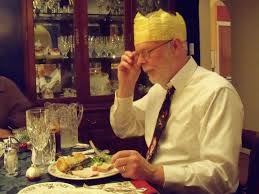
They called Christmas Crimbo, and presents pressies. There were crimbo crackers for sale, too, which are not a crunchy, salty snack, but shiny cardboard tubs “cracked” open at the festive table and containing a Christmas crown and trinkets.

C&CCrackers and CrownsC&C2

There was a panto in the Oxfam atrium, so to use all my new words in a sentence: “Are you going to the crimbo panto or shopping for pressies and crackers after work?”

And what is a panto? It’s slang for pantomime, an extravaganza that takes weeks of planning and involves elaborate costumes, jokes, dancing and singing, skits, and slapstick. Apparently it’s also done by families and in theatres but the only one I’ve ever seen was in the Oxfam atrium. Our usually-serious employees were dressed up as fairytale characters and making fun of themselves, our bosses, and our work. Very healthy, I thought. Take life seriously most of the time, then go all-out silly for a week.

The Queen’s Christmas Message that year was beautiful, in my opinion, and more relevant than ever.

queen

Lasagne, Interrupted

I came home from work, tired and famished.  I was lifting a big slice of lasagna out of a pan to a plate when the landline rang.

This is the phone I am required to have as a condition of Vince’s probation.  He was in the shower, and the phone is in his room.  I respect his space and don’t go in there except to the do the laundry.  (He shares his tiny space with the washer and dryer.)

Brrr-ing…brrr-ing…brrr-ing….  I stood with the lasagna poised between pan and plate.  It stopped.  Then Vince’s cell phone started up—vvvbbbb….vvvbbbbb…vibrating on silent.  It went on and on and still I stood drooling over my longed-for lasagna.

I heard the shower shut off and Vince’s voice, “Hello?  I’m in the shower.”  He repeated himself.  Did the person on the line not believe him?  Then: “MOM!  Will you let the agent in?”

I lowered the lasagna into the pan—it was lukewarm now anyway—and went to the front window.  Yep, there she was, sitting in her car at the bottom of the stairs.  I moved to the front door and opened it, waving down to her.  I stood waited while she got herself out of the car and moseyed up the stairs.

Do not sound sarcastic or mad, I told myself.

“Next time, why don’t you knock on the door?” I suggested.

“Oh, yeah!” she replied, as though she had never heard such an idea.

She stood in the dining room with the urinalysis cup while Vince threw on some clothes.   She smiled, I faked a smile back.  Vince entered the room, retrieved the cup from her, then returned to the bathroom.  As he was returning down the hall, the agent said loudly, “Be sure to tip the cup on its side so the urine gets on the test strip.”

Yum!

Maybe I should have exited at that point but I didn’t realize she was going to linger.  And did I mention I was hungry?

Vince sat at the dining room table.  The agent and I stood in opposite corners in the room.  I was half way into the kitchen, with one eye on the lasagna.

“How’re things goin’?” she asked.

“Fine,” was his reply.  He told the agent he was planning to buy a $300 car.  It would help him get around quicker and he could tinker with it on “the property” which includes the parking lot of the condos where we live.

“The big challenge,” I volunteered, “will be for him to find a landlord who accepts ex offenders.”

“That is a big problem,” she said, “Most landlords take advantage of them, because they can.”

My crabbiness quotient quadrupled.  Or maybe it was just plain anger.  Well, I’ve rarely had a good experience with a landlord, so why was I shocked that they would exploit ex offenders?

“We do know a guy who is open to ex offenders, and fair,” she continued.

One landlord in a metropolitan area of 3.5 million people.

She told Vince she would get him the landlord’s information, and left shortly thereafter.

Finally!  My lasagna.  I sat across from Vince and when I saw his face I thought, “Oh no, I’m in trouble now.”

Mom,” he began slowly, as though he was talking to an utter moron, “Don’t ever bring things up to the agents.  Now the next time one comes, they’ll grill me about why I want to move out.  ‘What’s wrong at home?’  ‘What’s going on with your mom?’”

“But…last week you told me you had that tip on a sober house.”  For a few days we had both been excited but it fell through.  “You want to move out, don’t you?”

“Yes, but we agreed I could stay a year.”

“Yes, but…you were talking about that house….  I thought she might have some resources.”

I ate my lasagna without gusto and offered him some, which he accepted.  “Do you really think I would try to get you in trouble, on purpose?” I asked.

“Sometimes I wonder,” he said.

Just like when he was inside, I didn’t know the rules until I broke one, and trying to be helpful only got me in trouble.

Crazy Eyes, Evil Eyes

The massacre in San Bernardino is really weighing on me.

Right after it happened, I wrote a post in which I suggested that mental illness could have been a factor, just as it is in many other cases.  Why do we assume that white guys are deranged, but Muslims are evil?  In this case, there was an additional question mark for me about possible post-partum depression, since the wife had given birth six months earlier.

But then we learned that both of the shooters in San Bernardino had been radicalized and had been planning some kind of attack for years.  I’ve spent more time than is probably healthy staring at photos of Syed Rizwan Farook and Tashfeen Malik.

They don’t look like these guys:

imagesimages (4)images (3)download (1)

They don’t look crazy.  They look dead.  Cold.

download

What kind of woman leaves her six-month-old infant behind, knowing she’ll never see her again—knowing her baby will be removed from the family, that her life will be tainted by a legacy of death?

What kind of son leaves his mother behind, knowing she’ll be interrogated by law enforcement?  Maybe the mother was involved, too.  In which case, what kind of son would leave his mother to face life in prison?  But these are silly questions.  This couple murdered 14 people and injured many more.  Why would they care about an old woman and a baby?

If they weren’t mentally ill, were they evil?  And what does that mean?  We can sometimes catch mental illness early and intervene.  But how would we spot evil?  Who would we call to report it?

There have been so many mass shootings in the U.S.  Until now I have reacted the same as anyone else—shaking my head, feeling bad for the victims, wondering when we will finally enact some reasonable gun reforms.  Then I’m over it.  Until now.

Where I work, at the Center for Victims of Torture, many of our clients come to us after suffering unimaginable torture during ethnic or religious conflicts in their home countries.  There is always the possibility that someone from the enemy side could enter the U.S. and come looking for them, just when they thought they were safe.  If someone would shoot up a center for developmentally disabled people, like the one in San Bernardino, why wouldn’t they shoot up a torture rehabilitation center?  There have been so many mass shootings, but this was the first one I could really imagine myself being involved in.  I imagine myself hiding in a bathroom stall or coat closet.  Of course I always—miraculously—am one of the survivors.

A father whose six-year old daughter was killed in the Newtown shooting was interviewed on public radio last week.   He and his wife are both scientists and they have started a research foundation to look into the connections between mental illness and violence.

The father said, “We have to recognize that, of course, all of our behavior comes from our brain. So just like any organ can be healthy or unhealthy, when there’s risk factors that lead to malfunction of certain circuits or regions of the brain, that’ll lead to bad behavior.  And yes, it is preventable. It’s a matter of chemistry and not character.”

I hope he’s right.  I hope someday we’ll discover that evil is a biochemical imbalance that can be fixed with a pill.  Maybe some day we’ll routinely test kids’ DNA and put them on medication if they’ve got the gene that could turn them into the next mass shooter.

The Most Wonderful Time of the Year

Today is the third day of Hannukah, a minor Jewish holiday that has morphed into more than it was ever meant to be because of its proximity to Christmas.

And that’s fine with me.

Hanukkah, which is spelled many different ways, marks the miracle that took place in what remained of the Second Temple in Jerusalem after the Maccabees (Jews) rebelled against the Greeks, who destroyed the temple.  This was 200-some years before the first Christmas.  Got that?

The story goes that the temple was purified with an oil lamp which miraculously burned for eight days even though there was only enough oil for one.

Most Jews, even the atheists like me, own an eight-branched candelabra called a Menorah which they dig out once a year for Chanukka.  Where I live, Jews comprise only one percent of the population, and so I have to drive across town to the one store that carries Hanuka supplies.

It’s a challenging time of year for families where part of the family is Jewish and another is Christian.  I say, why not enjoy both?  My tradition with Vince has been to wrap eight gifts and let him choose one each day.  Every year he gets a $2 bill, a pair of socks, a bag of Lemonheads, a couple other jokey little things, a thoughtfully chosen book that he’ll never read, and then a “real” gift like a Target gift certificate.

So we lighted the first candle on Monday night, and Vince got his $2.  I opened his present to me and it was an LED light bulb.  Clever!  Perfect for the festival of lights.

As I drive home in the dark from work, I am loving the Christmas displays on the big houses along my route.  Some are garish, some are tasteful, but they are lights–that’s what matters.

LightsLights2Lights3Lights 4

I’ve been meeting friends for happy hours in the most beautifully-decorated watering holes, like the lobby bar of the Commodore Hotel.  I organize a family outing or get together of some sort every year.  Last year the female relations got dressed up and went to Anthony Scornavacco Antiques and Heimie’s Haberdashery, which is located where my grandfather’s haberdashery was before he lost it during the Great Depression.

This year, I’ve invited my nieces and nephews over for a Cousins Cookie Baking Party.  Yep, we’ll make Hanukkah hedgehogs, gingerbread men/women and perhaps some transgendered persons or hedgehogs, and there will be some kind of dairy-free cookie for the vegans.

hedgehogs

Obviously I’m doing everything I can to make the short cold days of December more bearable.  I thought I was doing pretty well.  But then I got an email from the Rabbi who is the chaplain for Minnesota prisons.  She had contacted me shortly after Vince’s release to offer various kinds of support to him.  I don’t know if he responded to her, and I don’t need to know.

She was just writing to wish me a Happy Hanukkah and to say she was thinking of us and hoped we were doing well.  I was at work, at my desk with dozens of people around, and I got all choked up.  Why?  Because she was kind.  It’s always kindness that gets to me, not meanness.

She didn’t have to contact me, after three months.  By doing so, she acknowledged that our situation is challenging.  She offered to help in whatever way she could, but just knowing that someone was thinking of me and Vince was enough.  I’m starting to tear up again now, just thinking about it, so if there is someone you are thinking about but you haven’t told them, think about doing so today.

Poppies of Expectation

There’s a saying: “Expectations are disappointments in the making.”

That sounds so cynical. And as with all self-helpy kinds of things, I had to struggle with this concept intellectually before I could accept and employ it.

Some expectations are reasonable. I expected Vince to graduate from high school. I was bitterly disappointed when he didn’t. In this case the saying still holds true but you couldn’t fault me for the expectation, right? It’s a pretty minimal one held by most parents. (Vince has since earned his General Equivalency Diploma and finished two years of college.)

But there are other expectations that are unreasonable.

Vince wrote numerous times from boot camp about how he had spent four hours scrubbing the baseboard in the gym, or all day moving manure from Point A to Point B, or how he made his bed with sharp corners and ironed his clothes with exact creases. This was not the Vince I knew from before boot camp. “Wow!” I thought, “How wonderful that he’s learned to be a perfectionist clean freak like me!” I looked forward to him moving in. It would be great to have someone else in the house who would wash windows, dust and vacuum, wash the car (and here I got really carried way), paint the spare bedroom, clean the spider webs out of the basement, tear up the old patio and cart all the bricks away, maybe even wallpaper the dining room!

Ha. Suffice it to say that none of those things has happened. And why should they? Vince met the expectations of boot camp because his freedom was on the line. I had never even voiced my expectations to him—I was barely aware of them myself.

The progress I’ve made is this: I used to be completely unaware of my expectations, then feel shocked when they weren’t met. Now I catch myself—maybe not in the moment but eventually—and I laugh at myself a bit. The only disappointment I feel is in myself, for having unrealistic expectations.

Vince will never be a neatnik like me, but he does clean up after himself. He takes out the trash and puts gas in the car when the tank is low. He picks up items at the grocery that I forgot to get the day before. He replaces the toilet paper when it’s gone. He makes ribs and bakes cookies and offers them to me. He pays rent. He works full time and volunteers at the Goodwill on Sundays. He exercises. He’s started his own blog. He’s going to meetings and has sober friends.

I still have thoughts like, “I hope he goes back and finishes his degree,” and “I hope he meets a nice girl and gets married and has kids.” I notice these thoughts. I name them as expectations. I am kind to myself. I acknowledge that they could happen but that there are no guarantees and that Vince’s designs for his future may not match mine. Just for today, I’ll be grateful for what’s right. I will not go romping into the poppy field of expectations and disappointments.

Jailbird Rock

Wow!  I got another enthusiastic email from JPay, whose slogan is, “Making it Easier.”  I feel my blood pressure rise as I read that.  Nothing—nothing—makes having a loved in in prison easier.  And to the contrary, being ripped off in order to communicate with them adds financial strain on top of the shame, worry, anger, disappointment, and all the other negative emotions.

I will just repeat here what I wrote early on in this blog.  When people said, “At least you know where he is, and that he’s got a roof over his head and three meals so you don’t have to worry about him,” my response was, “That’s true.  There have been months and years when I didn’t know where Vince was and I worried myself sick imagining he was dead in a cornfield.

It was always that cornfield.  Maybe, as a city person, it was my worst-case scenario.  If I were going to be found dead, I would hope it was in my own home, fully dressed with my makeup on, after I had taken the empty wine bottles out to the recycling bins.  I shudder at the image of being found dead in a cornfield, where in my imagination it is always winter and crows are circling overhead.  Ugh.

All you have to do is watch the Prison Rape Elimination Act video to know that there is still plenty to worry about if your kid is in prison.

Back to JPay.  Here’s what they say about video visits:

There’s nothing quite like seeing your loved one in person. Visiting them at their correctional facility, however, can often be difficult; the prison or jail may be far away, and the security procedures can be invasive. Sometimes there’s just no way to be there in person.

“When physical visits are impossible or inconvenient, JPay’s Video Visitation lets you talk face-to face with your incarcerated friend or relative from the comfort of your own home. When you can’t be there, this is the next best thing.”

Wow, it almost brings a tear to my eye, how compassionate they are and how they want to help!  It’s almost like they know I was ejected from Moose Lake and banned from visiting my son for six months.

So, even though Vince is no longer incarcerated, I’ll share with you all the marvelous ways that JPay helps families stay in touch with incarcerated loved ones.

You could send them money so they can buy ramen and instant coffee—that’s only $9.95 per $100.  You could buy one short email for $2.00.  Or how about a first-class stamp?  JPay charges 40 cents to buy a 49-cent stamp.  That’s not a 9-cent discount, that’s 89 cents total for one stamp.

Finally, you could pay $9.95 for a 30-minute video visit.

This is new information to me; when I visited Vince the last time before he was released they were just rolling out this option and the rumor was that it would cost $99—not $9.95.  So, my apologies to JPay—$9.95 is actually a bargain compared to taking the day off work and driving for four hours to make a physical visit.

But on this day, JPay was emailing me to say I could fund a media account with no fees for this one day.  I could not figure out what a media account was; maybe it’s not available at the facility from which Vince was released.  Again, they show hip, attractive, young people having a great time … listening to tunes, I guess.

And at the very bottom are Apple AppStore and Google Play buttons—are these corporate giants getting in on the easy cash to made off of prison families?

A Crazy Idea?

I woke up in the dark at 5:40 am and wished I still believed in God.  Fourteen people dead at a center for developmentally disabled people in California.  I wished there was a higher power to whom I could appeal for help.  Help for us all.  For a moment, I thought I could feel something, then … nah … wishful thinking.

It’s up to us, people.  What “it” involves is a matter of dispute.

Someone asked on Facebook, “will this turn out to be a mentally-ill person?  Someone with extreme ideology?  A workplace grudge?”

There’s still a lot unknown, but it looks like it could be all three.  And I’m curious to learn if post-partum depression played a role in this latest incident, where a young mother dropped off her baby then went on a shooting rampage which she knew would result in her death or life in prison.

Here’s the liberal argument I hear: “Why do we label the white attackers mentally ill but the Muslim ones terrorists?”  I think what is really being expressed, by the conservative “side”, is that white attackers are deranged while Muslims are evil.

I’d like to flip that around and suggest that instead of considering every horrendous act an act of murder terrorism, we consider it an act of mental illness.  Hear me out.

I’m not a mental health clinician, but I have worked at two mental health clinics, where I have observed that mentally ill people often have religious fixations.  They think they are Jesus, they hallucinate angels, they hear demons telling them to do bad things.

A number of members of my family have suffered from Bipolar Disorder.  One was convinced that the Catholic Church had a conspiracy that had something to do with the numbers on the clock.

Anne, haven’t you noticed?  The numbers on the clock—there are 12 of them!  It’s so obvious that the Catholic Church is behind it.”

“Behind what?” I would ask.

He could never explain to my satisfaction what the numbers on the clock had to do with the Pope and the Catholic Church, but I would hear him out, hoping he wouldn’t call his parents next and burden them with his ranting.

If mentally ill people can have wacko Catholic theories, why wouldn’t they have wacko Muslim theories?

I was in the Middle East for work in February.  We were in Bethlehem on a long lunch break between meetings.  My two Palestinian colleagues and I were smoking shishas while my colleague from Minnesota gagged.

I had arrived in Amman the day ISIS released a video of them burning to death the Jordanian pilot they had captured.  The streets were packed with people waving the Jordanian flag and shouting.  They were angry, and I didn’t blame them.  I wish Americans got angry about wrong doing and demonstrated more often.

Omar turned to me.  “Tell us, what do you think about ISIS—these people who do such things?  We really want to know what Americans think.”

I had been thinking about this a lot.  “I think there’s an element of mental illness involved.  Who is it that most often gets schizophrenia and other serious mental illnesses?  Young men.  Who is it that is almost always behind violence?  I’m sorry, but it’s men.  And then you get them in a group—call it group think or herd mentality or whatever—and fire them up with ideological rhetoric, and put an AK47 in their hands…”

My Minnesota colleague disagreed.  She asserted that poverty and hopelessness were to blame.

Of course those are factors.  But I’ve been poor and hopeless, and I’ve never even shoplifted.  Millions of people around the world are desperately poor and they don’t kill people.  Many members of ISIS and Al Queda are not poor—they’ve got engineering degrees and come from middle class families.

If we do assume that mental illness is behind sadistic killings by ISIS or mass shootings in California and Connecticut, this does not mean the murderers are not responsible for their actions.  It does mean we can have hope, at least in the US, because there are effective means to identify and manage mental illness.

Mothers and Sons and Sibs

Once a month or so since I started this blog, I’ve posted a roundup of all the prison-related news.   Lately there has been a lull in the media, but not in my personal life.

I met a grade-school friend for dinner.  Even though I have a constant desire to live somewhere else or to at least travel constantly, as I get older I’ve found I appreciate the old friendships more.  We went to the same school, lived in the same neighborhood, spent a lot of time at each other’s houses.

And our sons have much in common.  Over dinner, she told me the long story of his unraveling. To protect her privacy I won’t go into detail, but he is looking at some serious prison time—maybe 10 years.  His circumstances didn’t come about over night; she’s been trying to balance support and detachment for 20 years.  All I could do was empathize about how powerless and bereft she felt.  She didn’t seem to feel the shame that was predominant for me when Vince was first imprisoned.  I think she was too exhausted.

Another friend, whose son is a Lutheran version of Vince, called to say she had phoned the police to report her son acting threateningly.  It took the police an hour to show up.  They took him down to the station and she didn’t know what would happen and she asked if she could sleep on my couch in case they let him go, because she was afraid.  I said of course.  The police did let him go and there was more drama but in the end they both slept under her roof and no one was hurt.

Two professional colleagues have brothers who were recently jailed for Driving Under the Influence, neither one for the first time.

One asked me if I thought she should bail her brother out.  In Alanon I learned not to give advice but to talk about my own experience and offer support.

“If you pay his bail,” I said, “expect to lose that money.  And since he’s looking at 10 years inside, don’t be surprised if he goes on a major bender.”

“But he’s going to live in the family cabin in the middle of the woods, and he won’t have a car,” she said.

“Is there a riding lawn mower or an ATV there?” I asked, and we laughed because there is a riding mower at the cabin and she knows he would ride it into town to the liquor store.

A member of my own family spent time in jail recently.  He managed to find an old grade school friend to bail him out.

Note to my grade school friend: If I ever wind up in jail I hope I can count on you to bail me out.

My relative is out now.  He was ordered to undergo mental health and chemical dependency assessments as a condition of his release.  This is a good thing but since he is homeless and unemployed and doesn’t have a vehicle, it’s hard to imagine how he will make it happen, even if he was enthusiastic about it, which he isn’t.  He calls his mother and hangs up, or leaves messages which start out sweet then turn sarcastic when she doesn’t pick up the phone.  She is doing a wonderful job of not reacting to him.  But then, she’s had 30 years of practice.

It’s never, ever just the person sitting in jail who is affected, it’s the whole family.  All the old narratives, grudges, and codependency kicks into overdrive.  Mothers feel guilty.  Fathers hide in their workshops.  Step parents are often the most sensible ones because their identities aren’t hanging on the offender’s actions.  Siblings are either overly involved, ordering everyone around like they have an invisible clipboard, or distance themselves even further from the family.

So what’s going on?  Is it the full moon, the holidays, the dark cold season?  Or because, like most people, I associate with people like myself?

Alone in the City of Dreaming Spires

I spent Thanksgiving in Wisconsin with my cousins, which is what I do every year. Vince couldn’t come because he is not allowed to leave Minnesota.

After eating way too much food, I made the mistake of checking Facebook right before I turned out the light. There were a couple posts from Vince. He sounded so lonely.

I couldn’t fall asleep. I laid there thinking about the time I learned to be alone. I think this is one of the most important skills we have to master in life.

I had moved to Oxford, England four months before my birthday. I rented a house with a three-legged cat named McCartney and housemate who went home to Scotland every weekend. I had a great job. I had joined a posh gym. I had made some acquaintances through work and Alanon meetings.

Red Door

This was before Skype or Facebook or What’sApp. My family and friends used email to communicate with me, but there was no internet at the house.

I don’t normally even care about my birthday. I hadn’t told my housemate or acquaintances it was my birthday because I didn’t want to seem like I was fishing for a fuss.

I walked into town to see a movie. February in England is dreary and drizzly. Well, most months are. In comparison to November, the sun was setting later (almost 5pm!) but the sky really only went from murky black to dark grey and back to murk again.

I got some popcorn and found a seat. Someone behind me said, “Pssst!” Hurrah! It was a friendly woman from my Alanon meeting named Rebecca. I wouldn’t spend my birthday alone after all! But she just said, “Nice to see you,” and that was that. I thought, unreasonably, “Why couldn’t she have invited me to sit with her and her friend?” I felt really put out.

The movie was Walk the Line, the Johnny Cash biopic. There’s a scene where Johnny is drying out and his family confronts a drug dealer with shot guns. The theater exploded in laughter. “Typical Americans!” I could hear around me.

I had picked a bad time to move to England. George W. Bush was using their air bases to transport terrorists and political prisoners in black helicopters, and most Brits were not happy about it. Most people were nice enough—if reserved—but I had been confronted by several very angry people who took me to task for everything my country had ever done wrong.

It really hit me that I was not only lonely but alone. I was on an island with 64 million people and I didn’t know a single one of them beyond asking the time of day. It was piercing.

I went home and had a few beers while I stared out the front window like some tragic heroine in a period movie. People strode past with their hands deep in their pockets and their heads down. I wallowed in self-pity. But somehow I knew I would get through it, that I wasn’t going to die of loneliness, that everything would change eventually—if not the next day then next week or next month. Everything did change. I’ve had a lot of great adventures on my own and with other people.

Now we can feel like we’re never alone by floating along on endless social media streams of cutsie platitudes and cat videos and political rants and “breaking news.”

Did Vince know that nothing stays the same forever? I finally fell into a worried, fragmented sleep. I dreamed that Vince fell into a river and was swept away into a big pipe. I ran along the river bank until I came to an opening in the top of the pipe. I could see his face underwater, looking up at me. The iron bars over the opening were wide enough for my hand to slip through so I could touch him, but too narrow for me to pull him through. Ugh. I woke up crying. I don’t need a psychiatrist to analyze that dream.