Category Archives: International Development

Glazed Olambrillas

This is a series of posts about Italy, Malta, and Spain that starts here.

If Lynn was as disappointed in the hotel breakfast buffet as I was, she didn’t show it, and it didn’t prevent us from holding our usual hour-long breakfast conversation.

Lynn had already informed me that she would boycott travel to the U.S. while Trump was in office.  She and her husband were contemplating a trip to Helsinki and Russia.  She had a friend, a former colleague from when she worked for Nokia, who might be interested in joining them.  Might I be interested in joining them?  It would be some anniversary of the Finnish composer Jean Sibelius’ … birth, death … I can’t remember, and Helsinki would spruce up its concert halls for a special slate of performances in his honor.  They would meet her Nokia friend in Helsinki, then take the train to Moscow and on to St. Petersburg to visit the Hermitage Museum.

“But wait,” I challenged her, “You’ll go to Russia, which has a despotic ruler, but you won’t come to the U.S.?”

“But you lot chose Trump,” Lynn replied. Ouch.

We talked about our travel bucket lists.  Both lists include Russia, specifically the Hermitage, and I would love to make a pilgrimage to Tolstoy’s house.  Mine list also includes: some sort of boat trip through the Amazon, a yoga/meditation spa retreat somewhere in southeast Asia possibly on a lagoon, hiking through Japan and eating sushi along the way instead of gorp, and—I recently snorkeled for the first time in Belize—anywhere that offers snorkeling on a reef gets extra points.

“I’d also like to spend some time living on a narrow boat to see how that would be,” I added.  “I looked at house boats in St. Paul a couple years ago.  They’re beautiful inside, lots of gorgeous woods, and you don’t pay property taxes!  But it’s Minnesota … in the winter you have to shrink wrap your boat in plastic or set bubblers around it to keep it from being crushed by ice.”

Lynn appeared to shudder; she is not a fan of boats, especially ones where you have to walk up a gang plank while the boat is rocking front to back and side to side.

“I quite fancy going to Ethiopia,” she said.  We had discussed the possibility of meeting up there the previous year, when I had thought I might go for work.  Alas, that didn’t materialize.  Then a state of emergency was declared due to protests by the country’s ethnic groups in which hundreds of people were killed.  Our talk pivoted to ethnic conflicts, war, international development, torture, and genocide.

“Well, that’s a good cue to move along to the Transito museum, isn’t it?” I suggested.  And so we did.

It’s actually called the Synagogue of El Transito.  It was founded by a guy named Samuel ha-Levi Abulafia, who was treasurer to the king of Castile in the mid-14th Century.  After the Jews were expelled a hundred and fifty years later, it was renamed the Church of the Transit of the Virgin.

Thankfully the place was only steps from our hotel so we were able to find it without getting lost. It was like a very, very small version of the Alhambra, with what I would call Moorish designs.  This made sense because most of the work on it was carried out by Muslim craftsman—back in the day when we all got along.  You know, that one day.
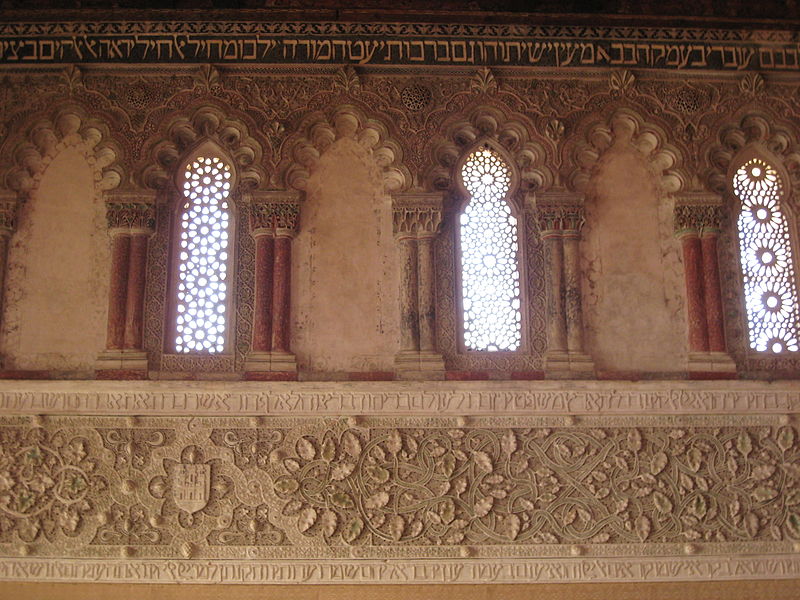
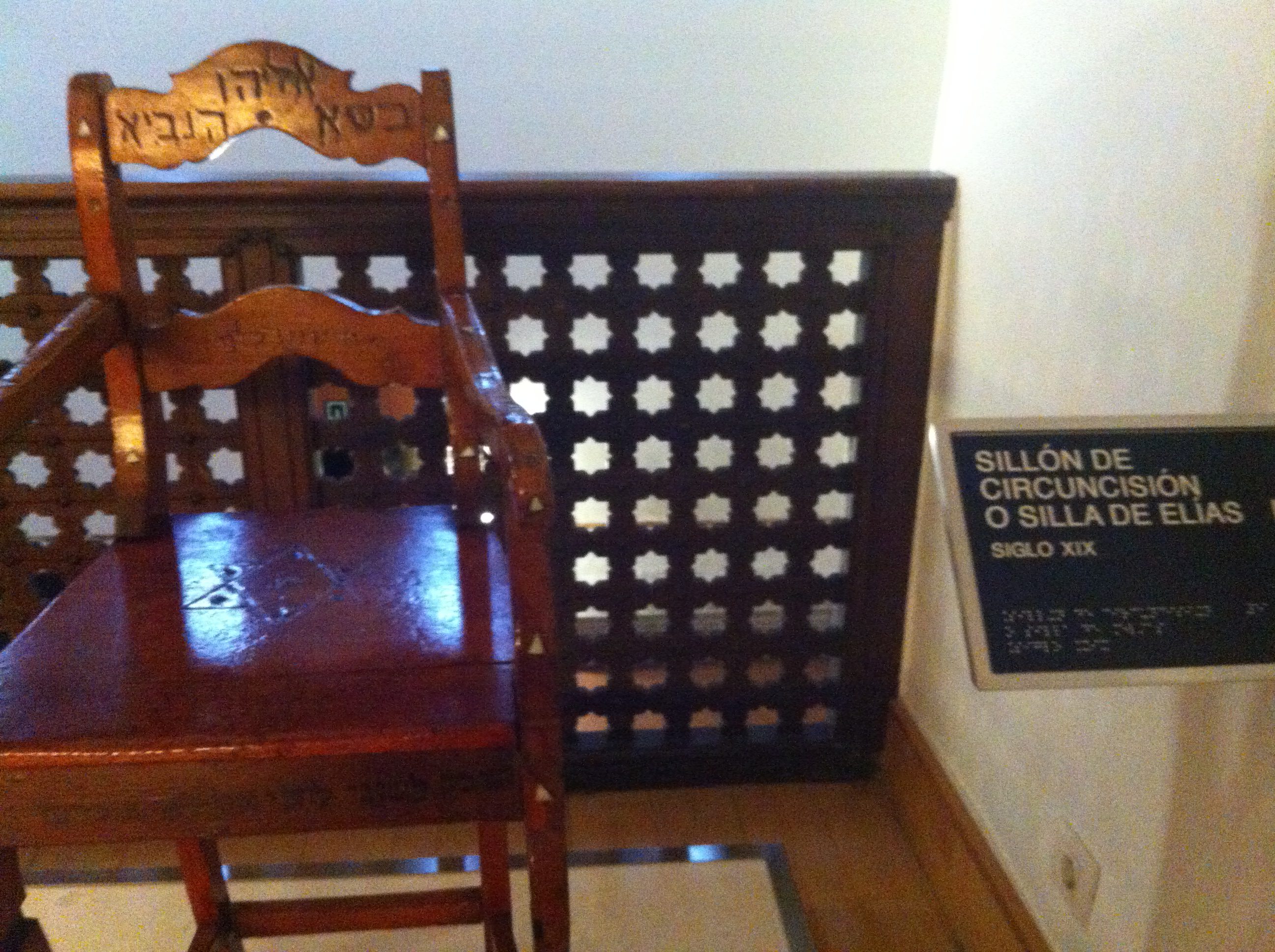
There was an attached museum with very, very detailed written history of the Jews in Spain, which I skipped, and a collection of Sephardi religious and household items in what used to be the women’s balcony (In Orthodox synagogues, women sat separate from men in a balcony or behind a screen where they can’t be seen, and they aren’t counted in the 10 attendees required to hold a service.)  This is a circumcision chair.  Don’t ask me how it’s used.
There were steps leading down to the foundation, which promised some marvelous archeological find but which contained only this sign:
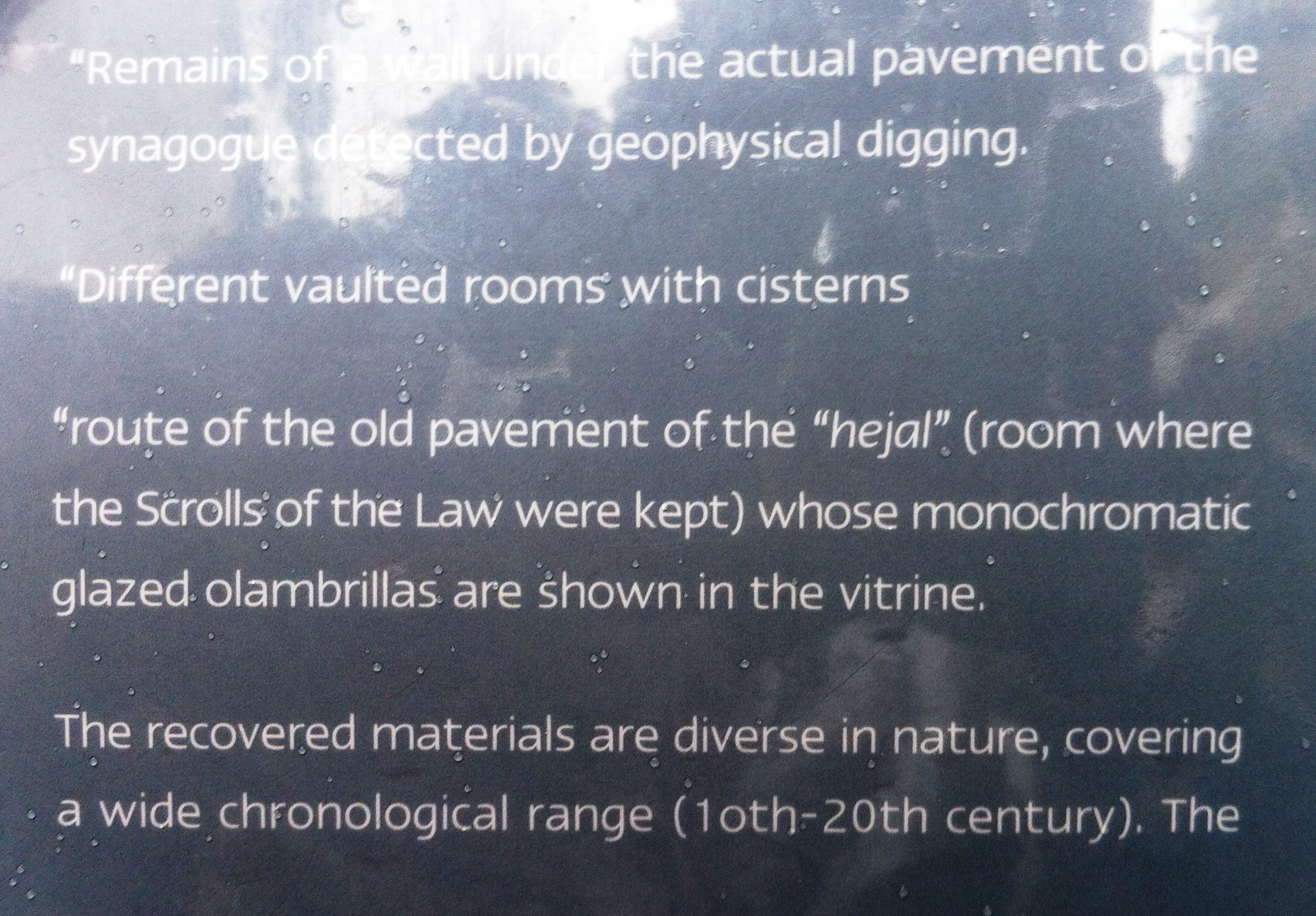
Glazed olambrillas? They sounded tasty, whatever they were.

We walked out to explore the city and find some lunch.

Bienvenido a España

This is a series of posts about Italy, Malta, and Spain that starts here.

I had been contacted by a head hunter about a job.  I wasn’t really looking, but I was intrigued this particular opportunity. It would be based in Cambridge, England.  Having lived in and loved Cambridge’s bigger twin Oxford, this was very appealing.  It was an environmental organization.  At the time, I thought that would be less depressing than torture, but now that the White House is full of climate change deniers, I’m not so sure.

The head hunter was in Madrid, and as I sat waiting for my flight—to Madrid—we tapped Skype messages back and forth.  She wanted to make sure I knew I would “have to” move to England for the job.  Was that okay with me?  Was it?! Yes, I replied, that was a plus, especially given the US election results.  She then wrote a number of long messages about how she and her colleagues at this international recruiting firm were shocked and worried, depressed and sickened.

She said she would put my CV forward, but I never heard from them. Oh well, it was nice to daydream about for a few weeks.

I sat next to a 30-something Maltese guy on my flight to Spain.  He had olive skin, light brown hair, and glass-green eyes.  I told him I had loved Malta and would like to go back.  He listened as I gushed about the sea views, the friendly people, the fishing village, the food, and the humble shops.

“Sometimes you forget,” he said reflectively, “when you have lived in a place all your life, how good it is.”

Lynn sent me a What’s App message telling me how to catch the airport bus to Madrid’s central station, Atocha.  Of course I wandered around the airport first for 15 minutes, but this time it wasn’t my fault.  There was construction everywhere, and if there ever had been signage, it had been removed or covered up.  I went up the escalator, down a long hall, back the other way, back down, down a long hall, then spied an information desk.  It was a handicapped assistance desk, but the two young employees behind it looked as though they hadn’t had a customer since 2010.  They were slouched over with their chins in their hands, looking at their cell phones.

I asked for directions to the bus stop in Spanish.

“This is the handicapped assistance desk,” the young woman said in English.

“I realize that,” I said back in English, “What would you tell a handicapped person?”

She reluctantly struggled to sit up and put aside her phone, while her male coworker ignored us and kept scrolling.  I wasn’t in Malta anymore. She gave me halfhearted directions which turned out to be wrong.  I finally stumbled upon the main assistance desk, which was hidden behind construction sheeting.  The employee there acted surprised by my question, as though I was the first person ever to ask where the bus stop was, but his directions were accurate.

The bus was direct and had wireless.  In half an hour I was at the station, where Lynn was waiting for me.

As usual when we meet up, we had a lot to say.  We don’t communicate a lot in between trips, except via Facebook, so there was a lot to catch up on.  The Brexit vote and Trump’s election alone would be fodder for hours of conversation.

We talked as we walked to the Hotel Paseo del Arte, sine very nice digs Lynn had booked, just two blocks from the station.  We cracked open that bottle of red wine she had ready and talked some more.  It was only 4:00 in the afternoon and life didn’t really get going in Madrid until 8:00, so we had plenty of time.

A couple hours flew by.  Lynn had scouted out that it was free admission night at the Reina Sofia art museum, home to Picasso’s masterpiece about war, Guernica.  Like our trip to Berlin the year before, this would be the first of about a dozen museums we would visit in two weeks.

The End of America

This is a series of posts about Italy, Malta, and Spain that starts here.

Before I move on to Spain, I’m inserting a few real-time updates.

It’s weird to be writing about the November election almost three months later. I recall my sense of unreality.  Unfortunately, that hasn’t changed. I can’t believe we are now using the words “President” and “Trump” together.  I am still in a state of denial, maybe because I haven’t figured out what to do, or how to live, in this new world.

I went on the women’s march in St. Paul with 100,000 other like-minded men, women, and children to protest the new administration’s policies and tone.  It was the first day in months I felt optimistic, but also, sadly, the last.

Conservatives think that liberals hate America.  That’s unfair.  We criticize our country when it acts wrongly.  That doesn’t mean we hate America.  It means we hold it to high standards.  For instance, one thing that has always made me proud of America is all the refugees we take in.  It’s not as many as 100 years ago.  It’s not as many as Germany.  Still, we were on track to accept 110,000 refugees in 2017, with about 10,000 slots designated for Syrians.  That’s one of the things that makes America great.  Oops, made.

All that is on hold for four months.  If and when it restarts, the number of refugees will be cut in half.  Syrians will be banned, along with people from other Muslim-majority countries except the ones Trump want to make deals with, like Saudi Arabia, the main producers of terrorists, including 15 of the 19 9/11 hijackers.

Why is Trump fixated on Syrians?  I don’t believe there have been any terrorist attacks perpetrated, anywhere, by Syrians.  In my opinion, Syrians are victims of war and terrorism.  But there are a lot of Syrian refugees, and they are in the news frequently, so maybe they’re just an easy target.  Most Americans haven’t heard of Tunisia, which actually produces a lot of terrorists.

The mood where I work, the Center for Victims of Torture, is dark.  Our clients in the US are afraid they’ll be deported, or that their families will never be allowed to join them.  We wonder if we will lose our government funding, and thus our jobs.  We worry this administration will return to the use of torture, which is illegal under US and international law.

There’s so much going down.  One final item: Donald Trump managed to talk about Holocaust Remembrance Day without mentioning Jews or antisemitism.  Was it intentional?  Ignorance?  As a Jew, I think it’s ominous. The Holocaust didn’t start with gas chambers, it started with nationalist words and laws against certain groups and bullying of the media and control of the messaging coming out of government agencies.

Thanks for reading this.  You probably already knew most of it.  Now you know why I write about travel and not politics most of the time.

My son and I went on a small adventure recently.  He had asked if I wanted to see John Cleese in person on a certain date, and I said, “sure!”  John Cleese is an English comedian and actor best known for the Monty Python movies and Fawlty Towers TV series.

What I didn’t realize until after Vince bought the tickets was that the show was on a Monday night, five hours away in Green Bay, Wisconsin.  So I took two days off work, got a room at EconoLodge, and we went on a road trip.

It was really fun.  We joked about the cheap hotel and the terrible steak dinner we had at Texas Roadhouse.  We visited Lambeau Field, home of the Green Bay Packers football team, which fits nicely into the neighborhood unlike our own new US Bank Stadium that looks like the Death Star.

We watched Monty Python and the Holy Grail, then listened to John Cleese tell stories for an hour.  Did you know Pink Floyd and Led Zeppelin financed the making of the Holy Grail, and that George Harrison paid for the Life of Brian, which he considers the troupe’s best film?  Cleese is almost 80, and still full of piss and vinegar. It was good to Just Laugh.

cleese

Tarxien Temples

This is a series of posts about Italy, Malta, and Spain that starts here.

As one does, I hopped off the Hop-On-Hop-Off bus in Tarxian, just outside of Malta’s capital city of Valetta.  I knew that the whole reason I was here—my desire to see the 3000 B.C. underground burial site called the Hypogeum of Hal Saflieni—was closed for renovation. How do you “renovate” a 5000-year-old burial site?  But the driver had said there were other ruins off to the right somewhere, so I decided to have a look.

Here’s something about Malta.  While Italy offers a full palette of colors—ochre, Pompeian red, peacock blue, cerulean, warm beiges, every iteration of green—Malta is monochrome.  Everything is built out of limestone, and limestone doesn’t have a lot of variation to it.  Also, the buildings on Malta are all built to about the same height—two or three stories.  A coworker who had been to Malta told me before I left, “It all looks the same.”  So before I left the bus stop, which had no sign, I took a mental snap shot of the area.  There was something called GymStars which I figured I could remember and which would be unusual enough that people might know it if I had to ask for directions.

Two other women had also hopped off the bus with me, or I should say, I hopped and they stepped down.  They were much too sensible to hop, with their sturdy shoes and serious rain coats and hats.  They were from England, so they were much better prepared for rain than I was.

They were in Malta for the annual convention of Soroptimist.  Had I heard of it?  Umm … it sounded vaguely familiar but a lot of things do to me.  If it was a missionary thing I didn’t want to know.  Was it like the Women’s Institutes—where women in rural England compete on pie baking and floral arrangements? I asked.

No, and here I quote from their website: “Soroptimist is an international volunteer organization working to improve the lives of women and girls, in local communities and throughout the world.”  The italics are theirs; why they emphasize international I don’t know.  Maybe so you don’t confuse it with that local Soroptimist group that keeps knocking on your door and trying to give you pamphlets.

I kicked myself for not knowing there was an international women’s conference in town during my visit.  How great would that have been to attend?  I wondered what kind of freebies they handed out.

We chatted a bit about my job working for a refugee organization and about their convention, but within a few minutes we were lost.

“The bus driver waved in this direction,” one of my companions said, “so we at least know we’re on the right track.”  We asked for directions, walked a few blocks, asked again, and so on for about 20 minutes until we stumbled upon the temples.

There was a tiny office and gift shop where I paid my €4 or whatever it was, then we stepped outside to see the site, which was covered by sailcloth to protect visitors against sun and rain.

The Tarxien temples are megalithic structures built between 3600 and 2500 B.C.  “Megalithic” means “relating to or denoting prehistoric monuments made of or containing megaliths,” or “massive or monolithic.”  You get the idea.

megalithic

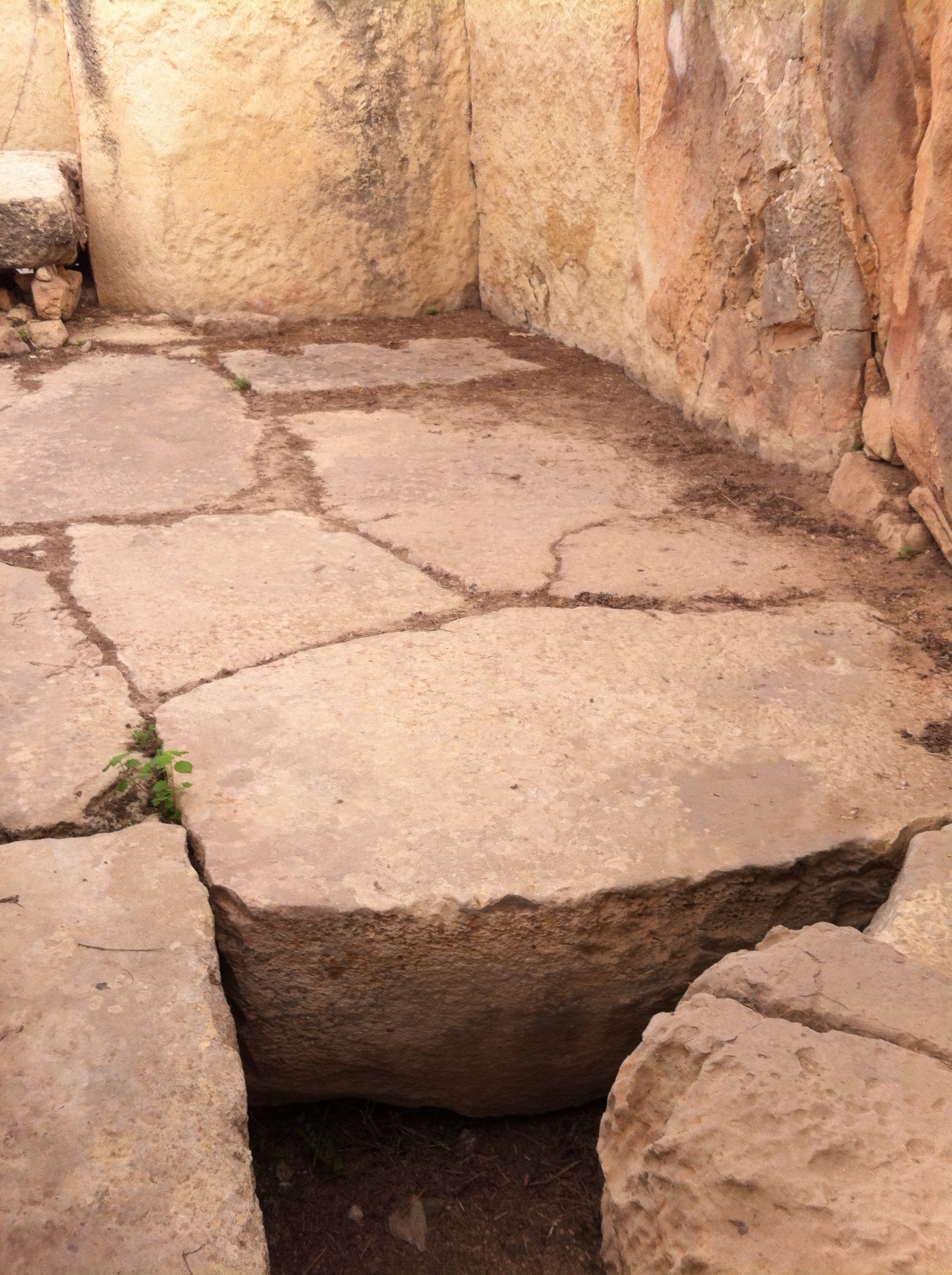
This was a floor section, about a foot and a half thick.

floor

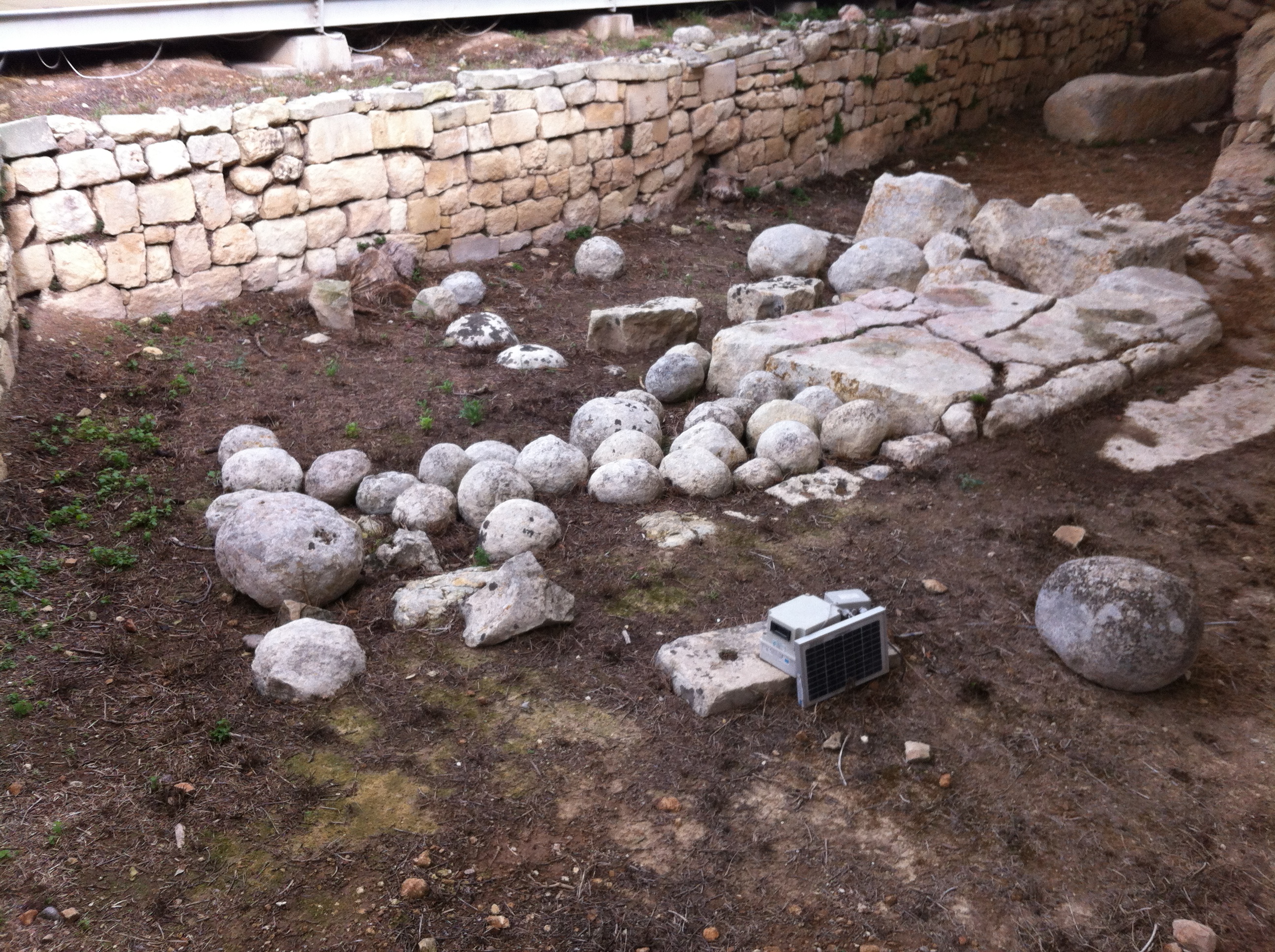
It is believed that these stone balls were used to roll the mega sized slabs into place. No doubt with slave labor.

balls

The holes in these slabs were thought to be used to lash doors to the walls.

door-holes

There wasn’t much left of the decoration except for this lovely half a fat person.

fat-lady

I glanced around to find my two Soroptimist friends.  They were still at the first signpost and were consulting a book, so they were clearly taking a deep dive and would be there for hours. It was 11:00 a.m.  I had 32 more bus stops to go and had to leave the next day, so off I went in search of the bus stop.

On the Move

This is a series of posts about Italy, Malta, and Spain that starts here.

I awoke in Malta to a new a racist, misogynist, and xenophobic regime in my poor country.  Of course that’s just my opinion and I’m one of those elitist, city-dwelling liberals who believes in facts.  Who needs facts when you have someone telling you what to think?

Based on the American news, I had expected to see hordes of refugees in Europe.  I follow the liberal news sources, and the scenes we see are of throngs of swarthy, dusty people behind fences, their fingers entwined in the chain links as they call out to be released from whatever camp they are in. Cut to scenes of dark young men sitting on the sidewalk in some European city, looking like they’re plotting something. Then there are the close-up shots of dusty, tired-looking women (always wearing hijabs) holding young children who have one tear rolling down their dusty cheek.

The impression we get from even the liberal news is that refugees are invading in massive numbers.  Specifically, Muslim refugees.  Now, I don’t know the exact numbers but since I work for an organization that serves refugees, I know there are many thousands of people seeking asylum in Europe.  However, the images we see didn’t play out for me in Europe.  I never saw crowds of refugees—unless they were wearing Prada and I mistook them for Italians.

I may as well say here that my American image of Italians as being dark, short, and well-dressed were confirmed on this trip.  The Maltese were also dark, even shorter, and while not as impeccably dressed as the Italians, I didn’t see many people wearing jeans or sweatshirts.  Many of the Maltese I saw also had beautiful green or amber-colored eyes.  Was this a result of the mingling of many nations that had taken place over millennia?

I could count on one hand the number of women I saw who were wearing hijabs.  I saw more nuns than black people during the entire three-week trip in three countries.

As I wrote on Election Day, I did meet an Ethiopian immigrant in Malta who went to the immigration office with me to find out if I could claim political asylum or just buy my way in.

After I learned that I couldn’t run away to Malta forever, I decided to at least see as much of it as I could in one day.  I had been up drinking espresso since 4:30 am and had had very unsettling news; what a perfect mode in which to explore a new country!

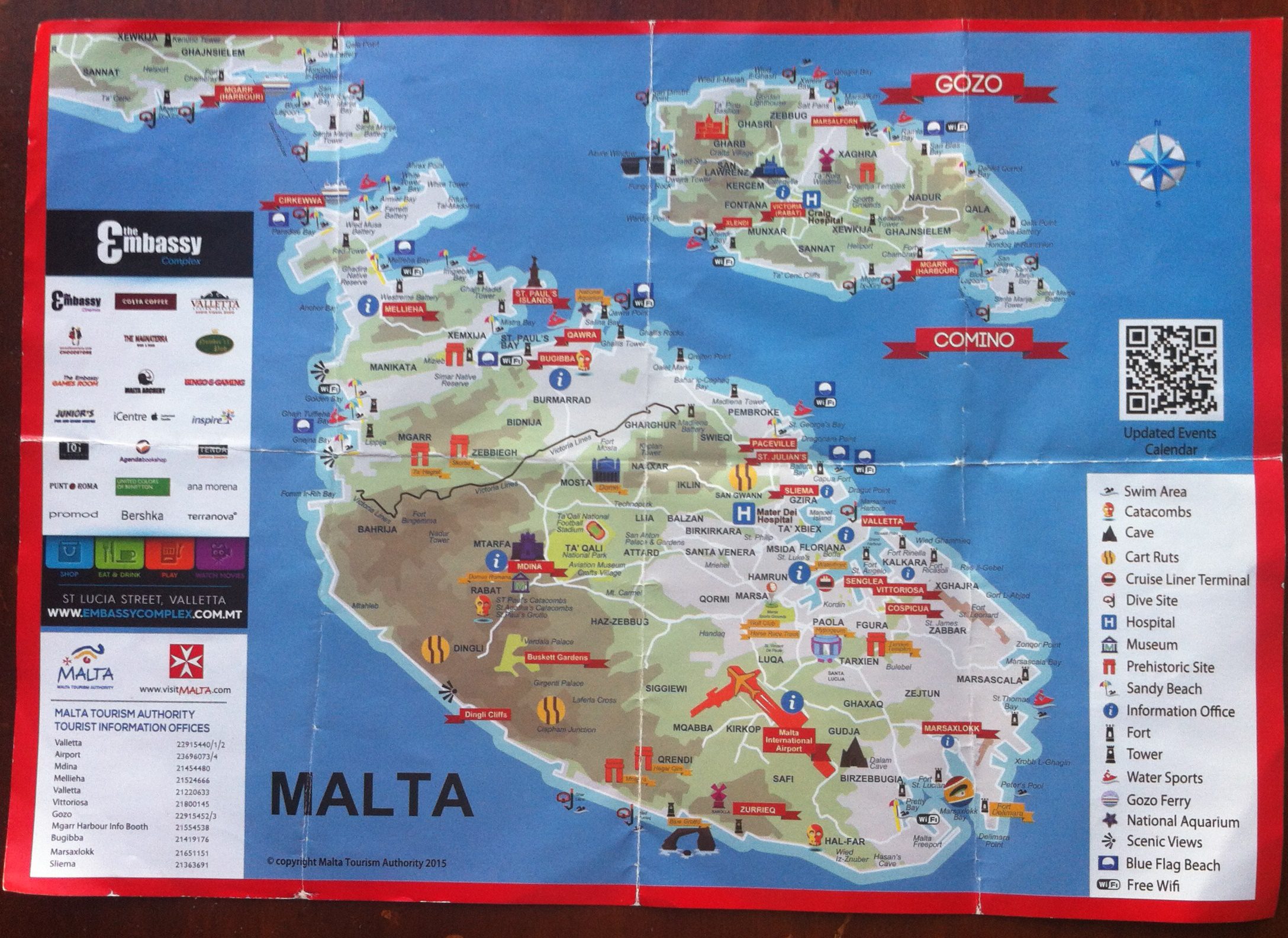
I found the Hop-On-Hop-Off Bus, which is a great way to get the layout of a city without having to figure out public transportation. Here is the map:

hop-on-hop-off

I ran to catch the bus, then sat for 45 minutes and talked to the driver and ticket seller until starting time. Both of the men appeared to be in their early 40s.  There were no other passengers, and the rain drizzled down continuously while we waited.

The driver didn’t have much to say but the ticket seller was up for talking. Topic number one was the American election, and they were as shocked as I was about the outcome.

“Probably some people here are happy about it,” the ticket seller said.  “Malta is a very conservative country.  Very Catholic.  Abortion is illegal and divorce was only legalized a few years ago.  Gay marriage?  Don’t bring it up.”

Maybe it hadn’t been such a great plan, me moving to Malta.

“But things are changing.  We’ve only got 400,000 people and of course a lot of the young ones have different ideas.”

Finally, the bus got going.  We stopped at a few hotels and picked up more passengers.  The first “stop,” if you could call it that, was in Tarxien, just outside of the capital city of Valletta.  The street was so narrow and congested that the bus basically slowed to a roll while some of us leaped off.  The driver waved his arm to the left and yelled, “Hypogeum!” then to the right and yelled, “temples!”

I was hopelessly lost within five minutes.

A Very Bad Good Woman

I’m interrupting my series of posts about Italy, Malta, and Spain to write about a memorable New Year’s Eve.

I was in Nairobi carrying out a number of volunteer projects for a human rights organization.  The most interesting was interviewing activists, including a dozen slum-dwelling women who were organizing to fight police shake downs and a guy who had been tortured after protesting the 2007 election results.

I was there for December and January, and just as I was ramping up, the director announced that the office would close for two weeks over Christmas and New Year’s.  I was renting a flat with a 22-year-old German guy who was also volunteering.  He was thrilled about this development and immediately made plans to go to Ethiopia with friends to take photos of the ancient churches there.  This would undoubtedly require massive amounts of alcohol.

The prospect of hanging out in the flat for two weeks was depressing.  Kenyan TV featured the  dregs of American shows, like Baywatch, Keeping Up with the Kardashians, and Beverly Hills Plastic Surgeon.  The Internet was maddeningly slow.  Going for walks was considered dangerous.  My supply of books was already running low; English ones were hard to come by and very expensive in the local malls.

So I booked myself on a safari.

I will always feel very lucky to have had this experience.  I went to Basecamp Masai Mara, a “luxury eco-resort” run by a Norwegian company where Senator Barak Obama had stayed with his family.  If it was good enough for them, it was good enough for me.  These links are to my safari Facebook albums.

The organization sponsoring my volunteer gig, American Jewish World Service, had paid my airfare to Nairobi.  For Americans, airfare is half the price of a safari.  It still wasn’t cheap, but it was possible.

So I spent 10 days going on game drives, touring a Masai clinic, reading, and sleeping.  Each morning I awoke to the dawn chorus of hooting, howling, growling, croaking, and cackling coming from the bush.

For each meal I sat at a white-linen-covered table, by myself except once, when a couple of fellow international development people invited me to join them.  He was Norwegian and she was Swedish.

“We know how it feels to eat alone,” he said.

For the last two nights I moved to a remote camp.  I spent New Year’s Eve gazing out over the Masai Mara and Just Being.  Words cannot describe the beauty of the land and the light.

At my last dinner, a Masai guide named Manfred pulled a chair up across the table from me.  This familiarity was unfamiliar behavior.  Manfred was 30ish and had a sweet, innocent face.  He was short and muscular and his skin had a reddish sheen from working outdoors.

He sat back in the cow-hide chair, spread his shoulders and legs wide, and clasped his hands together in front of his chest.  His body language wasn’t confrontational but he was staking his ground.  He smiled at the floor for a few seconds, then up at me.

“When you first arrived, we all thought you were a very bad woman, but now we know you are not.”

I wasn’t completely surprised by his comments.  I’d had the sense that they didn’t know what to make of me, a woman traveling alone.  But I wondered what theories they had about me.

“Did you think I deserted my husband and children?” I asked.

No, he shook his head but didn’t counter.

“Did you think I was a lesbian?” I asked next.

Manfred laughed uneasily, tipping his chair on its back legs.  Now that’s a universal male thing, I thought.

“No, we have had many homosexual guests and they are very nice people.”

That sounded like a line he’d been instructed to say.  I knew from interviewing a transgender activist that alternative sexual orientations had yet to gain acceptance in Kenya, to put it mildly. 

He couldn’t contain himself any longer; he leaned forward and said, “We thought you were a sex tourist.”

I burst out laughing.  I would turn 50 in a month.  I don’t condone sex tourism, but being suspected of it felt like a compliment.

Happy New Year’s!  Enjoy every moment of your precious life!

Happy Christmas, 10 Years On

This is a reprise post from last year.  Merry Christmas, ya’ll!

In keeping with my gradual transition to writing about unconventional travel and living abroad adventures, I’m looking back on the first Christmas I spent in the UK, 10 years ago.

I had learned a lot since arriving in October. Searching for housing, I had finally figured out that address numbers sometimes went up one side of a block and down the other. Also, many buildings just had names instead of numbers. The Oxfam head office was called John Smith House.

“House” was a misnomer because it was a modern, three-storey building in an industrial park across the motorway from the Mini Cooper factory, and 750 people worked there.

John Smith Houseatriumlobby

I could usually remember that the first floor was the “ground floor” and the second floor was the first floor. I had figured out that when my coworkers asked, “You awl right?” they weren’t concerned about my health; it was the same as someone in Minnesota asking, “How ya doin?” I was avoiding “creeping Americanisms” in my writing, as cautioned in the Oxfam writing manual, so was careful to write “storey” and “tonne” instead of “story” and “ton.” I was no longer taken aback when introduced to a 20-something coworker named Harriet, Richard, or Jane.

Most important, I had learned to avoid any references to my pants, as in, “I got my pants wet biking to work in the rain.” Trousers were pants, and pants were underwear. I loved the expression, “That’s just pants!” which meant something like “that’s insane!”

Everyone spoke in a low murmur. This was partly due to the open plan office, where six people shared one big desk, but I think it was also the culture. A few weeks after my arrival, a new Canadian employee came through for her induction (orientation), and her braying, Minnesota-like accent filled the whole building. One of those moments when I realized, “Ah, that’s what we sound like.”

At Oxfam, everyone walked fast. It was as if, by striding vigorously, they would personally Save the World.  My tall, ginger-haired colleague, Adele, was selling Palestinian olive oil out of her desk drawer. I enjoyed a daily fair-trade, organic chocolate bar from the cafeteria.  Oxfam had a Christmas bazaar in the atrium featuring beaded jewelry made by Masai woman who used the proceeds to buy goats.  Everyone was very earnest.

To be fair, the “Boxing Day”, or Indian Ocean, Earthquake and Tsunami (caution: upsetting video) had happened one year before, killing 230,000 people and leaving millions more without homes or livelihoods. Then, suicide bombers had struck the London transport system in July, killing 56 people and injuring over 700. The week I arrived in Oxford, an earthquake took 80,000 lives in Pakistan. People were reeling, but responding generously. Oxfam had received a tsunami of donations, internally referred to as the “Cat Fund”—for Catastrophe Fund—and rumour had it that they were struggling to do enough, fast enough, to respond.

But for now, Oxfam was abuzz with Christmas cheer. I look in my diary (date book) from that time, and I was busy meeting colleagues after work at pubs named The Marsh Harrier, the Eagle and Child, The Bear, Angel and Greyhound, and Jude the Obscure.

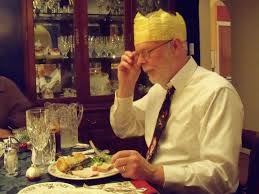
They called Christmas Crimbo, and presents pressies. There were crimbo crackers for sale, too, which are not a crunchy, salty snack, but shiny cardboard tubs “cracked” open at the festive table and containing a Christmas crown and trinkets.

C&CCrackers and CrownsC&C2

There was a panto in the Oxfam atrium, so to use all my new words in a sentence: “Are you going to the crimbo panto or shopping for pressies and crackers after work?”

And what is a panto? It’s slang for pantomime, an extravaganza that takes weeks of planning and involves elaborate costumes, jokes, dancing and singing, skits, and slapstick. Apparently it’s also done by families and in theatres but the only one I’ve ever seen was in the Oxfam atrium. Our usually-serious employees were dressed up as fairytale characters and making fun of themselves, our bosses, and our work. Very healthy, I thought. Take life seriously most of the time, then go all-out silly for a week.

The Queen’s Christmas Message that year was beautiful, in my opinion, and more relevant than ever.

queen

Desert Contrasts

This is the story of how I wound up in a brothel in Dubai, a series that starts here.

After finishing my meal at the brothel … er, TGI Thursdays, I took a taxi back to the hotel.  I apologized to Toni for yelling at her.  She apologized for calling herself an American.  Wait.  That doesn’t sound right.  You know what I mean.

I told her about the brothel and we shook our heads, imagining the young women in our lives working as prostitutes—or the men in our lives hiring prostitutes.  We talked about the irony that Dubai arrests tourists for making out on the beach, but that under the gaze of the Sheikh you could drink, smoke, and fornicate if you knew how to find the place.  We talked about puritanism, patriarchy, and power dynamics.  We agreed that Dubai wasn’t much different from North America, in that appearance and reality were completely different, like when you read about a child molester and you could bet he would turn out to be a Christian pastor or a Boy Scout leader.  We discussed the socioeconomic conditions and gender imbalances that made sex work the lesser of terrible ways to survive in a tough world.

We had a lot in common after all.  We bonded.  We agreed we didn’t need to spend every moment together.

The next day I took a bus to the Mall of the Emirates.  There was a young woman sitting across from me dressed in jeans, a tight-fitting but long-sleeved T-shirt, and a baseball cap.  The woman sitting behind her wore a full burqa; even the eye opening was covered with black mesh.

The bus route took us out of the old town through the desert.  I could see trailers in the distance—what we would call manufactured or mobile homes in the US.

It’s difficult to build an edifice complex without cheap labor.  These trailers in Dubai were home to the Pakistani, Bangladeshi, Sri Lankan, and other migrant workers who were building skyscrapers and malls for the Sheikh.  I had read about how they were exploited and trapped out in the desert before I’d left Dublin.  The trailers certainly looked desolate.  I wondered how many brothers, fathers, or husbands of the TGI Thursdays women were also making a living in Dubai.

The mall was like any mall in Minnesota.  Not.  It had an indoor ski resort!  It had shops where you could buy every kind of burqa you desired, as long as it was black.

mall-of-uaeburqa-shop

Like an idiot tourist I bought a three-foot-tall hookah pipe with lots of detachable, fragile parts which I then had to lug around with me on the bus, taxi, plane, and the bus in Dublin.  Having my arm in a sling didn’t help.  Take my advice, if you really want a hookah pipe, order it on Amazon.

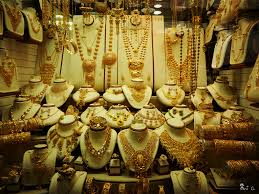
Later that day I wandered around the old part of town near our hotel looking at store after store that sold gold.  Who bought this stuff?

gold

Then I saw a beautiful tunic in a shop window and went in to try it on.  It was a bit big and the proprietor offered to tailor it for me on the spot.  He took the opportunity to fondle me and I thrust his hands away and he just laughed.  He did alter the tunic so I guess we both got what we wanted.  Below is what it looked like, modeled by a woman who actually looks good in it.

salwar-kameez

I bought some stamps at a kiosk so I could sent postcards.

emerati-stamps

I will give them the benefit of the doubt and assume they convey a message about zakat, or charity.

Toni and I went to a farewell banquet in the desert that night, complete with the obligatory camel ride and henna painting of our hands.  The next day, off we went back to Dublin.  Here’s a photo of the men’s and women’s mosques in the Dubai airport.

airport-mosque

I started this series as a way of examining things that can go wrong while traveling.  In one week I will be in Rome.  If nothing goes “wrong” there like it did in Dubai, I’ll be disappointed!

TGI Thursdays

This is the story of how I accidentally wound up in a brothel in Dubai, part of a series that starts here.

The hostess at TGI Thursdays looked at me like I was an alien, then slowly led me to a table in the center of the restaurant and left me with a menu, which was all in English.

She had an African accent and I didn’t hear enough of it to ID which country, but I’m pretty sure her real name wasn’t the one on her nametag—“Hi!  My name is Emily.”

She was about six feet tall, string-bean thin, and wore stiletto heels and a barely-there mini skirt.  I vaguely wondered if she changed into more modest clothes to get to and from work, but I didn’t really give it much thought.

I was hungry by now, so I was happy when the waiter appeared almost immediately.  He too looked at me strangely.  Whatever!  What was wrong with these people?  I ordered a club sandwich and a beer, then settled back and looked around.

Have you ever walked into a situation and thought nothing of it until it was too late to get out of it?

All the other women in the bar were either African or Asian, and none appeared to be older than 20.  They were all dressed like “Emily”—in high heels, mini skirts, and low-cut blouses.  They were literally hanging on the arms of fat, middle aged white men, many of whom were talking loudly, so I could hear their Australian, English, and American accents.  North American, that is—I’m sure most of them were Canadian, ha, ha.  These were oil workers, no doubt, and I was in a brothel.

The girls (I’ll call them girls because many appeared to be 17 or 18 years old) tittered and cooed at everything the men said, as if the men were the most fascinating, funny, and appealing male specimens ever.

“Ooh, Keef, you so funny!” a girl laughed near my table.  Keith was 50-something, ruddy faced, rotund, and very drunk.  He sat tilted as though he was about to keel over.

As all this sunk in, one of the few Arab patrons approached my table.  He was like a human cliche of an Arab man: wearing a kaffiyeh, sporting a Saddam Hussein-style black mustache, and smoking a cigarette in a short gold holder.  He leered at me as he circled my table several times.

I had the urge to bleat like a lamb.  Then he aggressively pulled out the chair opposite me and asked, “May I join you?”

“No!” I exclaimed, perhaps a bit too loudly.

A giant Sudanese bouncer sidled up to me and the Arab guy slinked away.

“Do you know where you are?” the bouncer asked in a low voice.

“Yeh-yes…” I replied, feeling sheepish (in the embarrassed sense, not in the about-to-be groped-or-worse sense).

“I will stand next to you while you enjoy your meal,” the bouncer said.

What could I say but, “Thank you?”

My club sandwich and beer arrived.  They were like any club sandwich and beer you would get anywhere else in the world.  I ate, drank, and did what I commonly do when I am dining alone; I wrote in my journal.  In this case, I took detailed notes, which is how I can write this narrative years later.

It’s not a very remarkable story.  I’m sorry if you’re disappointed that something more dramatic didn’t happen.  It was an eye opener for me.  I had seen adolescent girls in Jamaica with the proverbial obese middle-aged German men stuffed into Speedos.  I had read about human trafficking and sex workers in my master’s program.

But this was how the business actually worked.  Supply and demand.  I figured the maze I had walked through to get to the entrance was a means of shielding passersby from what was going on inside, and also of signaling to people like me who just wanted a sandwich and a beer, “This is something you should think twice about!”   Obviously I was too dense to get it.

To be continued …

Down and Out In Dublin

In my last post I wrote about the river of “what ifs” going through my head about my upcoming trip.  After writing it, I thought back on the worst things that have ever happened to me in my life.  All of them have happened at home.  The worst things that have happened to me while traveling?  Well, they’ve didn’t turn out so bad in the end.

For instance, I accidentally wound up in a brothel in Dubai.

But the story starts in “the other DUB city,” Dublin, where I was working for Oxfam Great Britain on contract for the summer.

Everyone thinks Ireland would be a great place to live, and that’s what I had expected.  But I hated it.

This was at the height of the inflationary period they called the Celtic Tiger—right before the Great Recession hit—and everything was colossally expensive.

I stayed in a 12-bed dorm in the Four Courts Hostel until I could find a flat.  The other 11 beds were occupied by immigrants from Poland and the Czech Republic who were almost out of money and facing the prospect of going back home as failures.  One woman was so depressed she stayed in bed all day with the blanket pulled over her head; I never actually saw her.   The only good thing about The Four Courts was the talking elevator that announced, “Turd Floor” in an Irish accent when it reached our floor.

I could go to the Oxfam Ireland office to work, but they didn’t really have space for me, so I worked out of the hostel dining hall while everyone else was out hustling during the day—except for the woman under the covers.

The streets were full of drunks, Irish and otherwise.  Lots of Brits and Dutch and Germans came to Dublin for their stag parties.  One morning I literally stepped over a drunken man vomiting in the gutter.  I don’t know how they afforded it, because a pint of unremarkable beer in a pub cost $8.  And maybe because Ireland’s economy was roaring, it seemed like the Irish were over being friendly to travelers.  The only friendly overture I had from an Irish person in my first few weeks was a shopkeeper telling me to “Have yourself some crack, now!”  That freaked me out until I realized he meant craic—which means “a good time” in Gaelic.

I had pictured myself working away in a cozy pub and making all sorts of new Irish friends, but I was bored and lonely.

In the UK and Ireland, it is much more common for people to share a flat or a house than it is in the US.  Having roommates is not just for young or poor people.  I would go to look at a flat and there would be a dozen desperate potential renters crowded around the front door.  When the landlord deigned to let us in, we would find a dingy, dirty, little hole with a bedroom featuring a sagging twin bed and a window looking out on a brick wall.  The rent for that bedroom and sharing everything else with two or three strangers was $500 a month each, easy.

Every night I climbed up to my top bunk and hunched over with my head against the moldy ceiling to read, hoping this would be my last night at the Four Courts.  Oh, did I mention I had broken my collar bone in a bike accident in Oxford a week before, and my arm was in a sling?

Everyone used a website called Gumtree to look for flats and jobs and probably to sell their bodies to pay rent.  I arranged to meet a potential landlord in a pub rather than go to his house alone.  It was love at first sight, for him.  Eddie was a good 10 years younger than me and at least a foot taller.  His teeth were brown from smoking and crooked from not being an American.  I wasn’t attracted to him and I knew it would be a bad idea to move in to the room he had for rent, but I agreed to come and see the place the next day.

To be continued …