Tag Archives: Aberdeenshire

To the Hill, and Through Hell

Richard asked if I wanted to climb a hill with him later.

“I told myself I was going to climb a hill a day in August, but so far I’m a bit behind.  Well, naught for eight,” he smirked.

“I have to work,” I replied, then caught myself. “What am I thinking?!  I can work when I get back.”  It’s just a hill, I told myself.

So after lunch we climbed Tap o’Noth.  Finn, the younger of the two Labradors, joined us.

“It usually takes two hours to reach the top,” Richard informed me on our drive to the “hill.” “It should be faster coming down,” said Richard, “but you do have to mind your step because it’s rocky and rutted.”

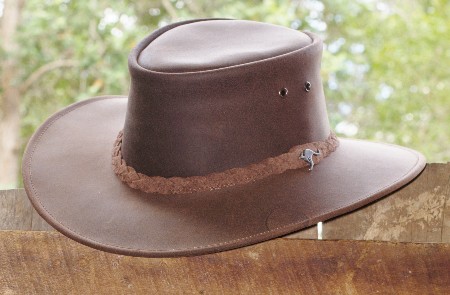
I was kitted out in wellies, a wool sweater, a heavy, oversized tweed coat, and an oiled hat, and had my Eco Chic rain poncho from Daniel at the ready.  All in all, a harmonious look.  You never know who you might run into on a hill in Scotland.

As is usual when I try to keep an open mind, I was rewarded.  This was the view of an abandoned farm from the base of the hill.

We wound our way through a magical glen of goats.
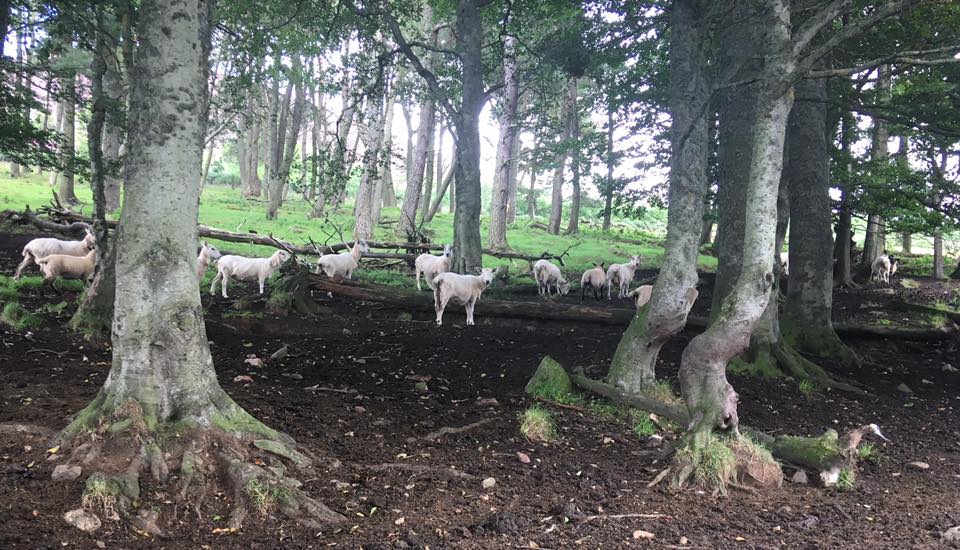
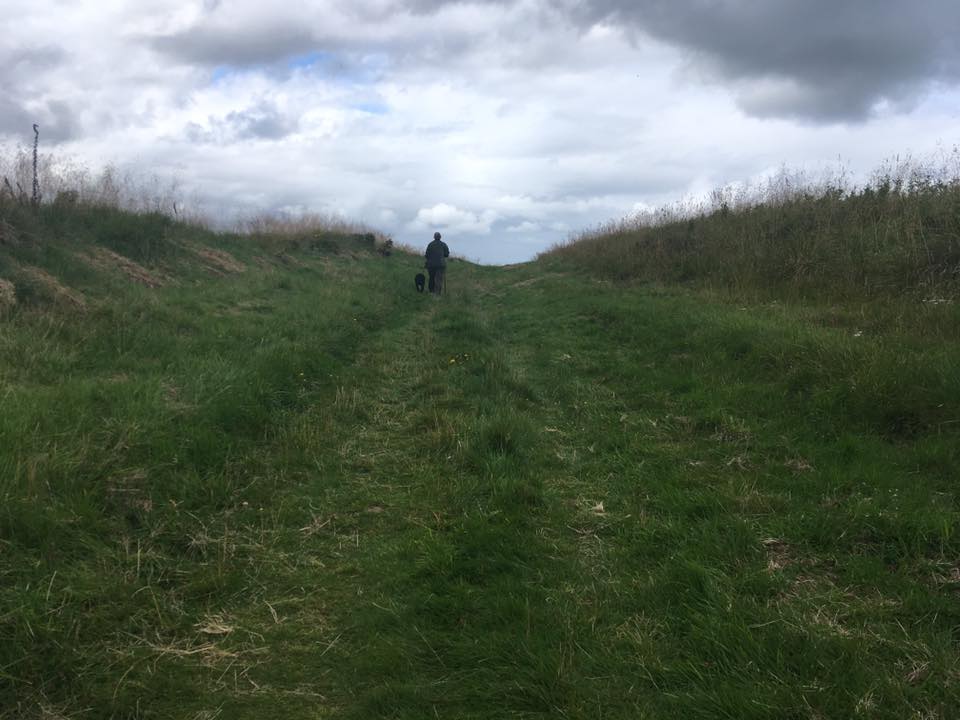
Then the real walk commenced.  Here’s the peak in the distance.
The weather shifted from cloudy and drizzly to sunny and back within minutes.
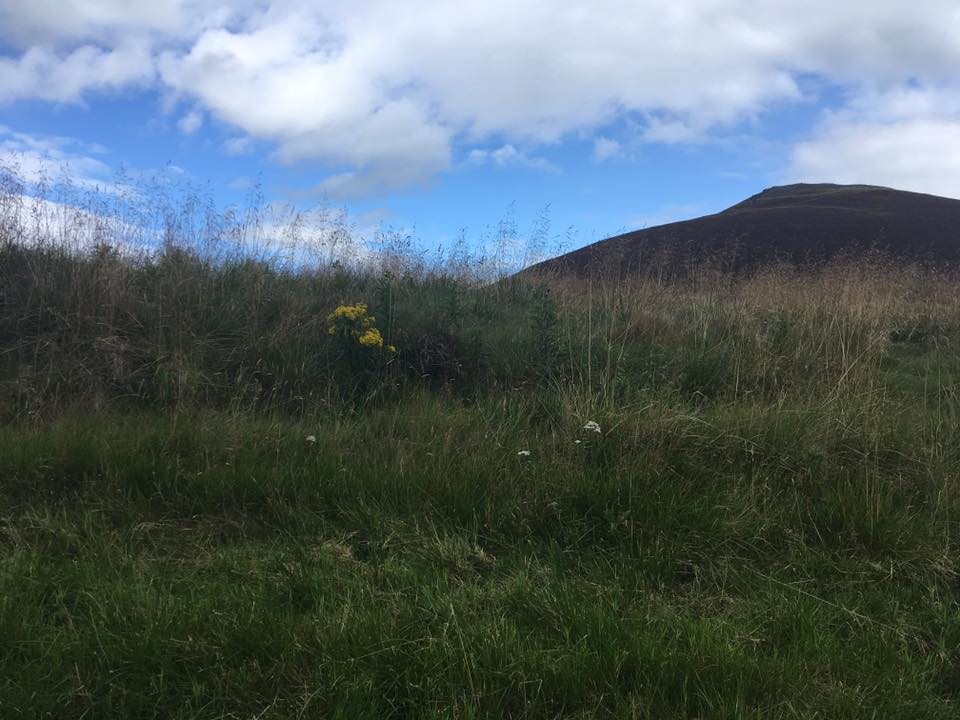
At first the path was grassy, then it gradually changed to rock and got steeper.  The grass was so wet it was like walking on a giant sponge.
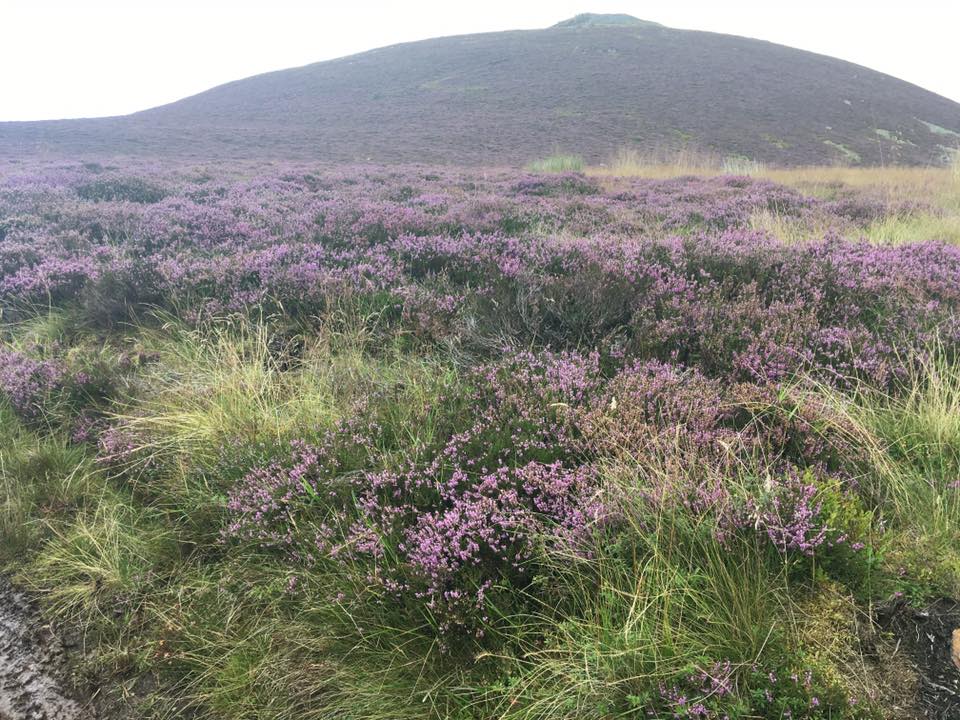
Heather, which looks brown from a distance.

It was one of those hikes where you are trying to stay dry but you get slimy inside your poncho from being covered in plastic, and you’re also trying to blow your nose and use your camera phone without getting your tissues and phone wet, and the next minute you need your sunglasses but they’re steamed up and oh my god look at that view! – then – oh boy – pay attention to your step; it’s a long drop off that cliff edge!

“This is the second-highest hill fort in Scotland,” Richard informed me.  I had no idea what that meant.  After two hours we rounded a bend and saw a jeep; how in the world had someone managed to drive up here?  A little further on, we saw people and tents.

An archaeological team from Aberdeen University was scraping away in the rain.  When they saw us they dropped everything and came toward us as though they were desperate for any excuse to stop.  They didn’t stay in the tents, they used them to keep paper dry.

I learned that the fort is possibly pictish. It slowly came into focus for me, as the leader of the team pointed out the rings of stone circling the hilltop that would have formed exterior and interior fortified walls.

The oldest artifacts date to 2000 BCE.  There are vitreous sections, meaning rock fused by high heat.  No one knows how ancient people could have generated enough heat to fuse rock.

I tried to imagine living here, with no heat except open fires, no electricity, dressed in a deer hide.  Brrr!

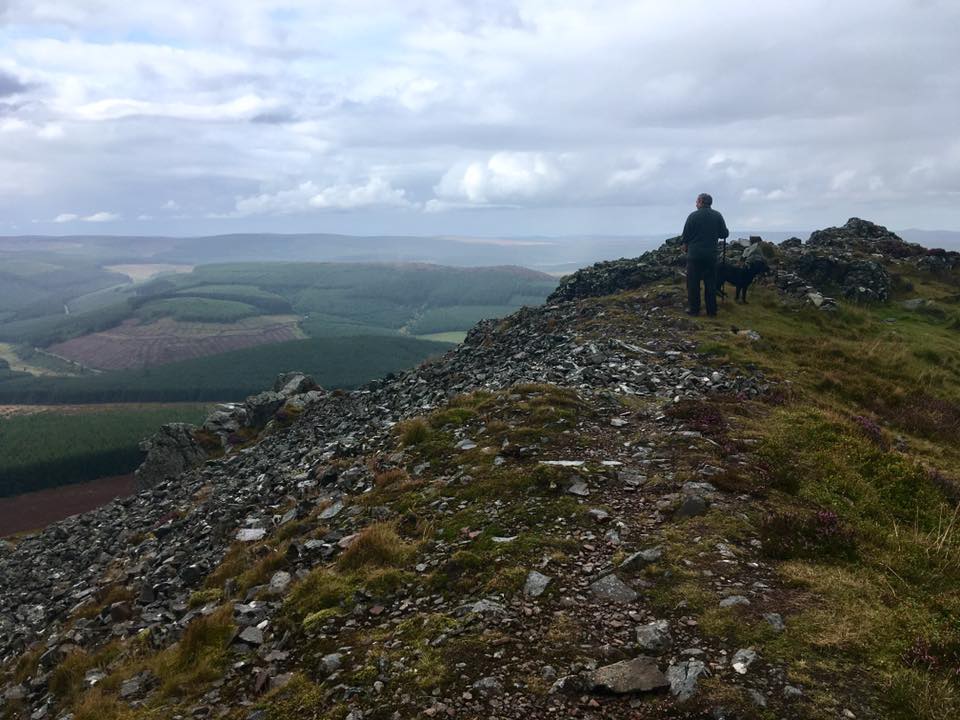
But the view….

Here are Richard and Finn contemplating the meaning of life.  Or just thinking about dinner.
We trotted down the hill. I stumbled twice and Richard gave me his walking stick.  I prayed he wouldn’t stumble because I wouldn’t be able to drive to A&E.

That night Richard picked the movie—a documentary about the Battle of the Somme.  A million young German, French, and British men died or were wounded over 161 days of trench-warfare horror.  The first day alone will go down as the worst day in the history of the British army, which suffered 57,470 casualties. I am not an expert on war, but it seemed to me that the allied leaders made every mistake that could be made.

I heard a sob from Richard and was surprised to see him crying.  “Such a stupid waste of young lives!” he exclaimed.  Why was I surprised?  Men who have actually served in the military don’t take war lightly, like some childish politicians.


Shooters and Shooters

One day when the weather was nice we had a late BBQ lunch on the patio. Richard grilled the steaks and chops and hamburgers Lynn had bought at Raeburns, while she and I drank wine.

This is a tricky thing about working from a distance and in a different time zone.  If your employer has a “no alcohol on the job” policy, does that include a four-hour break during which you have no work to do, but after which you’ll have a Skype meeting or the emails will flood in because it’s morning back at HQ?  I chose to almost never drink until I clocked off for the day, but once in a while I had one.

I needed it.  We heard a sound of low rumbling getting louder and closer.  “What is that?” I asked.

“Ah, just wait a moment,” Richard replied.

In a blink, a black, triangular aircraft swooshed over our heads, then another and another, and then it was over.  In a second.

Stealth bombers?” I asked incredulously.

“It’s the RAF,” Lynn said casually (RAF—Royal Air Force)  “You know how the chimneys form a cross if you were looking down on them? We think the RAF may use our house as a reckoning point for their exercises.”

“It’s been in the news, they’re practicing with the US air force because of North Korea,” Richard added.

North Korea.  They would shoot their first missile over Japan a few weeks later. As an aside, my sister-in-law is Japanese, and she was in Japan with my nephews (ages four and eight) at the time.  I was worried this might traumatize them, but the eight-year-old’s comment was, “The announcements went on the speakers and told us to get ready to go to the shelters.  It was so cool!”

Back at the BBQ, all was peaceful.  When we weren’t jawing about the impending nuclear holocaust, all we heard was wood pigeons, the click-click of the dogs’ nails on the flagstones as they circled around hoping for dropped food, the gentle rushing of the river depending on the direction of the breeze, and an occasional moooooo or bahhhh from one of the neighboring fields.  It was as though we had imagined the sorties.

I have never eaten so much meat in my life.  OK that’s a lie.  But I don’t get to eat that much meat very often, which is good, because I do love a good steak or juicy hamburger and my cholesterol is “borderline.” I took a few laps around the house and garden to shake off my lethargy.  In addition to my vow to exercise vigorously every day, I had pledged to meditate.  Ha.  I passed the monkey puzzle tree outside the gate (photos are from a gardening site).  This would be something to meditate on, I thought, and walked on.

Later, we reconvened for a typical evening of TV watching in the sitting room.  This is a room with two couches, as I call them; or settees, as Lynn calls them.  It’s a dark-wallpapered, cozy room, and each night Richard made a fire with wood or peat.   I assumed my station next to the fireplace with a cat while Richard and Lynn each had a couch and were draped with dogs.  Within minutes of whatever show we were watching starting, Richard would be asleep.  But this night, after going out to retrieve a cat that had stayed out after dark, he came rushing in to tell us, “Come out to the garden—there are shooting stars!”

I really didn’t want to go outside.  It was cold!  I was tired and a little tipsy.  I was sure I would never be able to spot the shooting stars.  But there, in the country, they were crystal clear and came one after another.  We stood out there in silence for 20 minutes until they trailed off.

Lynn was off to Oxford the next day.  “Richard—don’t forget to pick up the wine for the tutors’ dinner,” she instructed as she rushed off.  The tutors were professional musicians who taught at the annual Huntly Music School.  They would give a concert on Saturday, then come for dinner at Dunrovin.

The Attic

I got an email from the owner of the Perfect Duplex.

“None of the people who looked at the place yesterday were qualified,” she wrote.  “I was a world traveler before I became a landlord, and I think travelers are good people, so if you’re still interested, let me know.”

I guess she’d never had her wallet stolen in a hostel.  Travelers are like any other group of people in most ways.

But hey, if being a traveler got me the duplex, I wasn’t going to argue!  I should have wondered—if the caliber of potential renters in the neighborhood was low—that it signaled something.  I should have paid more attention to where exactly it was, on the crime-ridden East Side.  But I just wasn’t thinking. I asked my sister to go look at it.  She sent me a video and gave me a thumbs up.  My son sent the landlord a check for the deposit.

DONE.  Something easy, for once!

I wish I had taken before and after photos of the attic.  But I didn’t, so I’ll try to paint a picture for you.

You’ve got a general idea of the scale of Dunrovin House.  The attic is completely finished but to accommodate 15 chimneys, there are lots of angles.  You can see the chimneys and rooflines through the skylights set in each room.  The attic stairs lead up to a very wide hall and off of it are a full bathroom and one small and one large room, both being used as bedrooms.  This is the view from the large bedroom.

Lynn and Richard have talked of turning the attic into an apartment but then ask themselves, why?  Why would they want someone walking through their space, then stomping around over their heads?

But they will sell Dunrovin eventually, and Richard in particular wants to get the attic cleaned up.  Because, like attics anywhere, theirs has filled up with stuff.

Richard’s face lighted up when I agreed to clean out and paint the attic.

“And after you’ve done that, the wood paneling needs sanding and re-finishing.”

At first I thought he was joking.  Did I mention the attic has oak wainscoting?  And wood doors, and window frames?

“Richard,” I said evenly.  “There’s no way I could ever sand down all that paneling and refinish it.  My goal will be to finish the big room.  If I can get through that, I’ll see what’s next.”

“Maybe you could just oil the woodwork with boiled linseed oil,” he bargained.

Just?” I rejoindered, as we carried a 5-gallon pail of paint and all the cleaning and painting equipment up four flights of stairs from the basement.

Before I could paint or rub anything, I had to clear a path to the walls. I established seven piles: trash, recycle, donate, keep, “Give away as presents,” “Sell on Ebay?” and “Ask Lynn.”

There were many interesting items.  Dozens of silk scarves and pillow cases from Thailand and Indonesia.  Every size and style of travel equipment, including leather valises that weighed 20 pounds and a canvas bag big enough to smuggle a Labrador.  Hundreds of full-color flyers for a wind turbine campaign; I can’t remember if they were pro or con.  Hats in fancy hat boxes.  1970s sewing patterns.

When I invited Lynn up inspect my system, she began to move items from the “donate” and “toss” piles to the “keep” pile.  “My sewing patterns from when I was a teenager!  You can’t give those away!”

I get it.  It doesn’t matter if you’ll never use something again.  It doesn’t matter if you could sell it on Ebay and make a few bucks.  If it’s sentimental, it’s meaningful to you. I’ve pared back quite a bit throughout all my moves, but I’ve still hung on to small, useless things like a cigar cutter left behind by an old boyfriend and a pair of candle sticks that an old man at synagogue named Archie Vinitsky gave me in 1982 that I never use, but I’ll never part with. Then there’s the giant porcupine quill I picked up on safari 10 years ago, which is actually really useful for cleaning crevices.

Little Dramas, Big Traumas

After my action-packed day at the farmers market, Huntly Castle, and Bogairdy, there were days of routine, which was fine with me.

I needed to start looking for a place to live when I returned to the states in a month.  I had closed on the sale of my condo while I was in Eton, with my realtor standing in for me to sign all the papers.  I started to surf rentals on Craig’s List, and the perfect one popped up right away.  This never happens—I have always had to look at 25 places before I find the right one; I have always had to apply for 50 jobs in order to land a decent one; I won’t even mention dating here—the point is, I’ve always had to really hustle to get what I wanted. When I sent the owner of the perfect duplex an email she responded to say she had 10 people coming to look at it the next day so I should probably keep looking.  Darn.

It was weird to not have a mortgage or rent payment for a couple months.  I tried to give Lynn some cash for my keep but she fended me off, so I found other ways to contribute.

I was working on proposals to the British Department for International Development, or DfID, and another donor with an acronym everyone stumbled over—ELHRA.  During these intense proposal development times, the emails fly fast and furious.  I can easily receive 200 emails a day unless I hop on Skype (either chat or video/phone) to just talk through an issue.

I often had Skype calls in the late afternoon, and that was when the Internet slowed down.  Lynn and Richard’s theory was that, in the Aberdeenshire countryside, Internet was like an old-fashioned telephone party line. The kids came home from school and started streaking on Snapchat, the adults came home from work and logged on to Facebook, and everyone grumbled about how slow the connection was.

More than once, my Skype call would droop and I would walk through the house with my laptop yelling, “Can you hear me?” until I reached the library, where the router was.  Why being close to the router should help, I don’t know.  Richard would look up, startled, and abandon his desk to me, bless him.

“I was just shopping for flasks anyway.”  Richard collects antique flasks—pewter, leather, copper—they’re beautiful.

“You don’t need any more flasks!” Lynn would ring in.

It was around this time that I did problem solved with a donor, and this has possibly come back to my benefit.  It was someone at the US State Department; we had already been approved for a grant but she was having trouble opening one of our documents.  It’s a boring story but we went back and forth for an hour or so; I tried sending it via my Gmail account, I tried converting it to a different format, etc. until she discovered it was a glitch on their end.

Fast forward to yesterday.  I submitted a proposal to this same donor in the US Government online system, which is the most stressful part of the whole process.  That may sound silly, but if you do the slightest thing wrong they can disqualify you.  There can be technical problems with the online portal so we always allow two days before the actual deadline to upload everything.

I hit “Submit,” did a victory lap to the kitchen for some Girl Scout cookies, then logged off and left to take a much-anticipated day off.

I woke at 3am.  “Did I upload a pdf?!  Is that allowed?!”

This morning I checked and indeed, they require a word document, not a pdf.  I had pdf’d it out of habit.  My contact at State said it would be okay since I was letting her know ahead of the deadline.  I don’t think it was a quid pro quo; she’s just a reasonable, nice person.

This is my glamorous life in international development.  I have to keep in mind that, if we are funded, a thousand torture survivors will get help healing from their trauma.

Bogairdy House

That evening we went for dinner to a friend’s house.  I had met Andy; in fact he and his ex wife and their three sons had visited Minnesota years earlier—to shop at the Mall of America.  They stayed at a hotel near the mall and had done nothing but shop.

It had been a bad trip, with several of them getting sick. Once they were all well, I picked up Andy and his wife and one son in my Mini and drove them around the Twin Cities.

“Oh my!” exclaimed the wife as we drove along Summit Avenue. Her Scottish accent made it difficult for me to understand her. “I had no idea there were houses like this here!”  Andy is English so at one point I tactfully rephrased a question and asked it of him to get a clear answer.

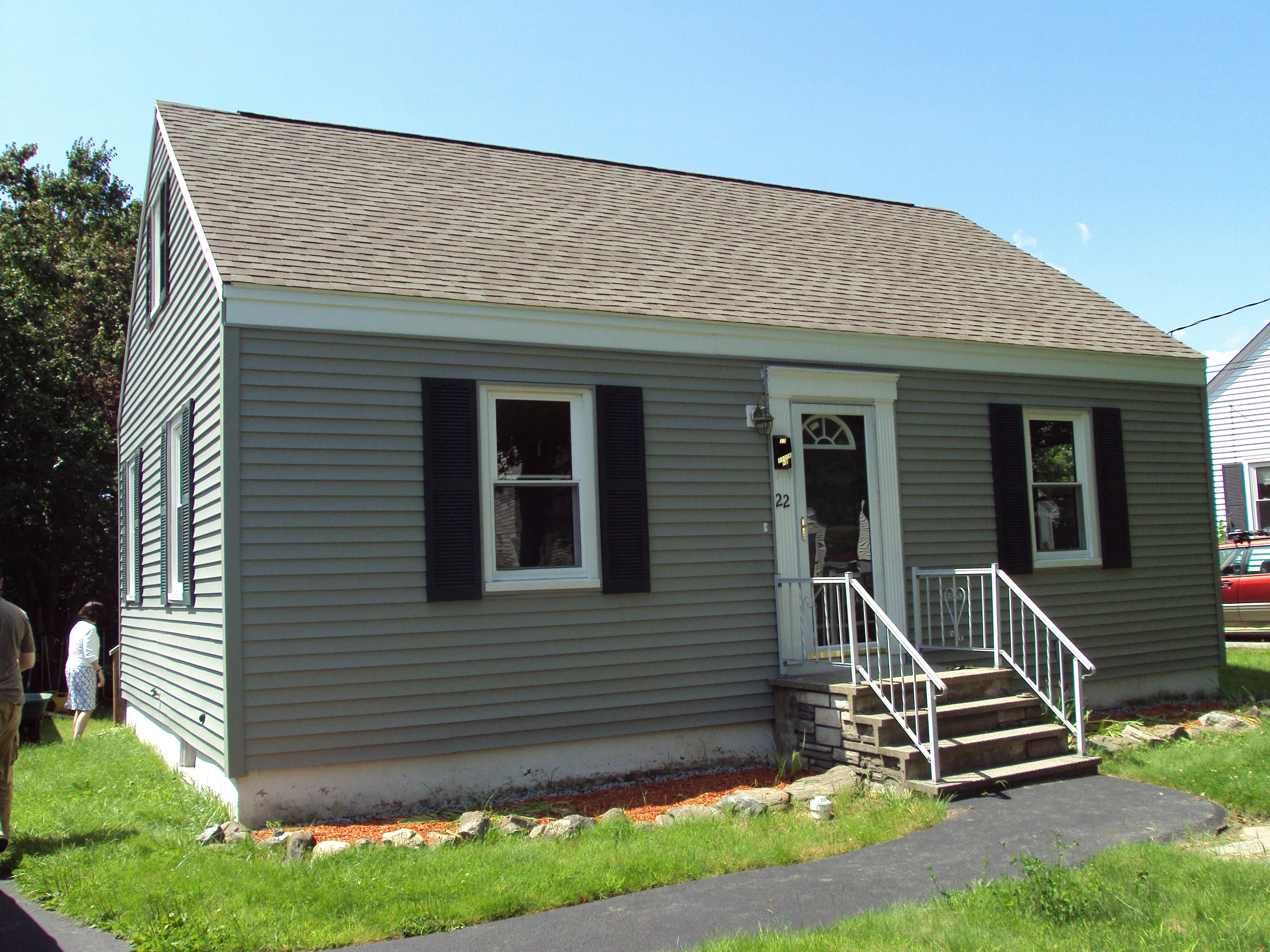
These are typical houses in Bloomington, the burb where the Mall of America is located:

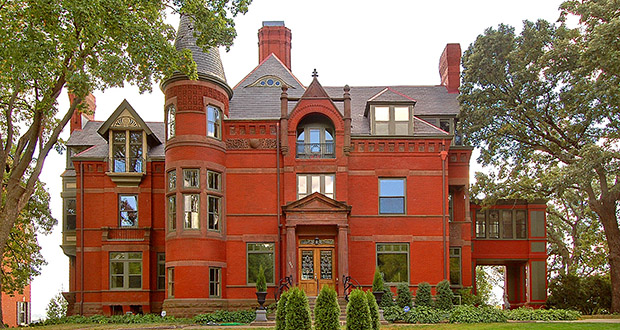
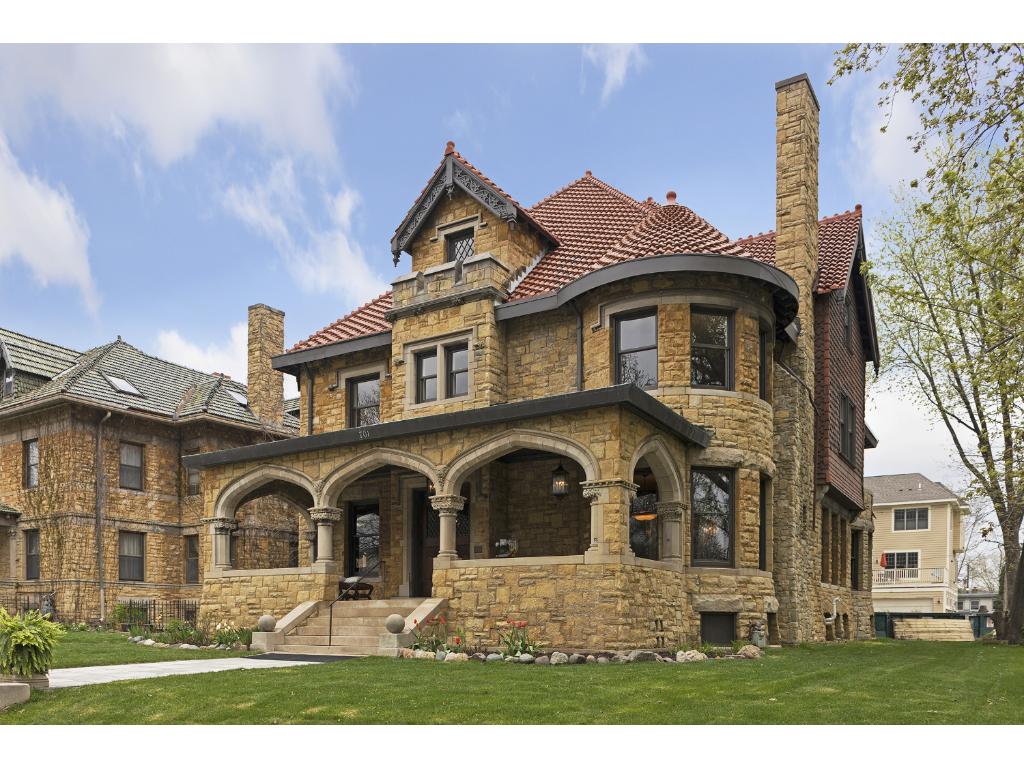
These are typical house on Summit Avenue, which runs six miles from the Mississippi River to downtown St. Paul.

I’m just sayin’.  There’s more to America than the Mall of America.  Mall of Gomorrah, as my mother calls it.  At the Cathedral, I swung around and drove back along Grand Avenue, which is lined with non-chain stores an restaurants.  I took them to the Walker Art Center sculpture garden and drove around the chain of lakes—Harriet, Calhoun, and Lake of the Isles—in Minneapolis.

Andy had been through seven-years of divorce hell and had come out the other side.  He was now with June, a lovely Scottish lady, and she had just moved in with him.  The house was called Bogairdy, and it’s a traditional but completely updated farm house.  Bogairdy was 15 minutes from Dunrovin.  The driveway seemed like it was half a mile long, and it was extremely narrow, rutted, and dark—I half expected a lion to run across our path, it felt so remote and of another place.

“We’re still trying to decide where to put all of our things,” Andy seemed to apologize.  The place was spotless and neat as a pin.  Whatever that means.
“It can’t be easy, combining two households when you’re in your 50s,” I replied.

“June brought all her plants,” Andy gestured to the front garden, which looked like an outdoor conservatory. I loved it.

“We’re trying to sell the place, but it could be a while,” June said.  “It’s a special property.”  If you’re in the market for a 5,158 square foot (479 square meters) farmhouse in the Scottish Highlands, here you go.  It is beautiful.

We had olives and wine in front of the fire in the sitting room, then sat down to a feast.  There must have been five courses, including a woodcock pie.

“Woodcock isn’t for everyone,” Andy said apologetically just as I began to chew.  “It’s a bit gamey.”  UGH.  That was an understatement.  It tasted a like liver to me, and that’s not good.  I forced it down, smiled wanly, and quickly asked him to pass the wine.

I don’t recall what we discussed over dinner but it was lively.  None of us talked about work, as would be standard in the US.  And it’s not like we don’t have interesting jobs.  Andy is an explosives expert and works in the oil industry.  June does something in banking but what, exactly, never came up.

After we had done our best to demolish the cheese plate, which is the standard dinner-ender in the UK as opposed to dessert in the US, June and Andy cleared the dishes.

“Quick, come here!” we heard June calling in a hushed voice from the entryway.

Lynn and Richard and I hurried over and looked to where she was pointing.  There was a young red fox prancing around the potted plants.  The moon was shedding a shimmery light on the scene.  “He comes every night,” June said.  “We think he’s hunting moths drawn by the porch light.”  We stood entranced for 15 minutes, watching him.  Then the fox ran off, the spell was broken, and we said our good-byes and went home. It had been a very long but good day.

Sacrificial Lamb

“I have to stop at Raeburns to order for the summer party,” Lynn said.  So we drove down a street I hadn’t seen, passing a bakery and confectioners that didn’t look as though it had sold anything since 1968.

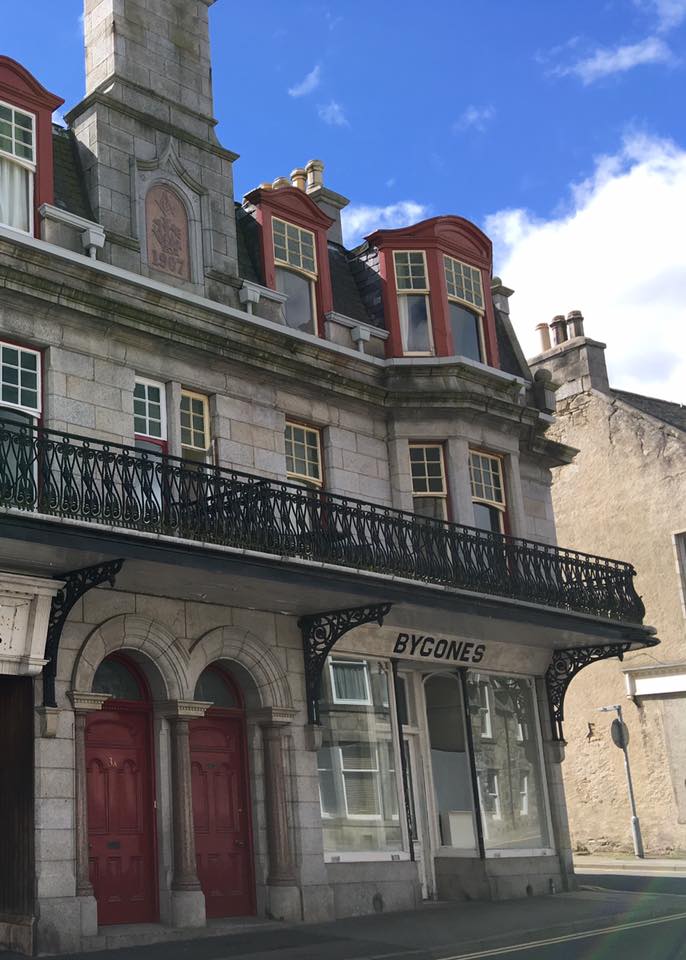
There was a lovely vacant building built in 1907; apparently the last failed business to give it a go there had been appropriately named Bygones.

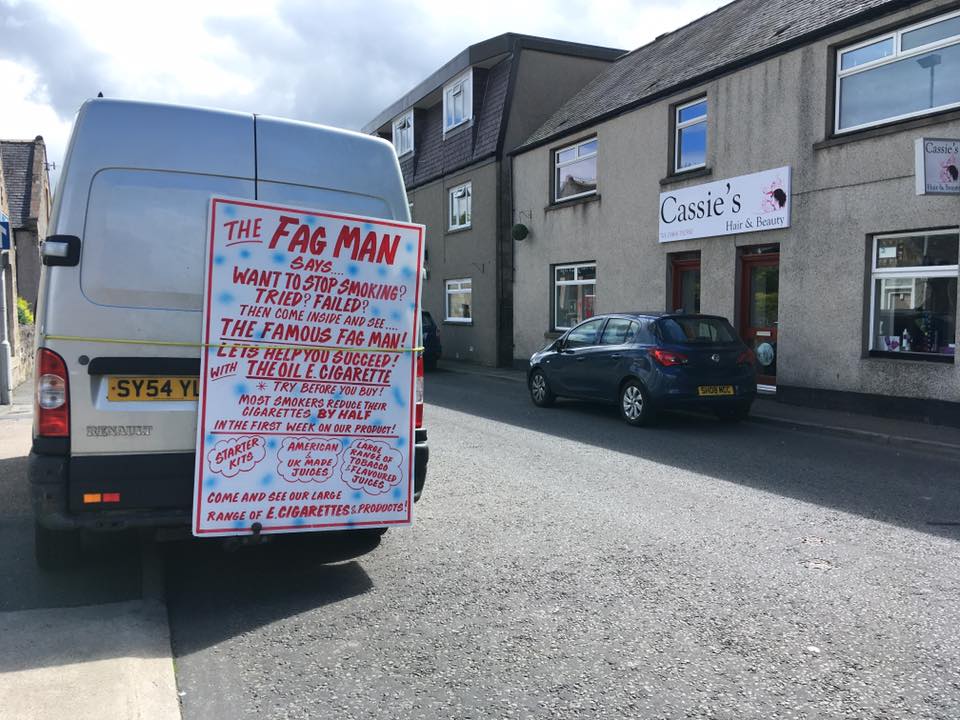
The one bustling business was this one.  At first I thought it was a mobile e-cigs vendor, but then I realized there was a tobacconist storefront and the owner had slapped this sign onto his van out front to ensure no one missed it.

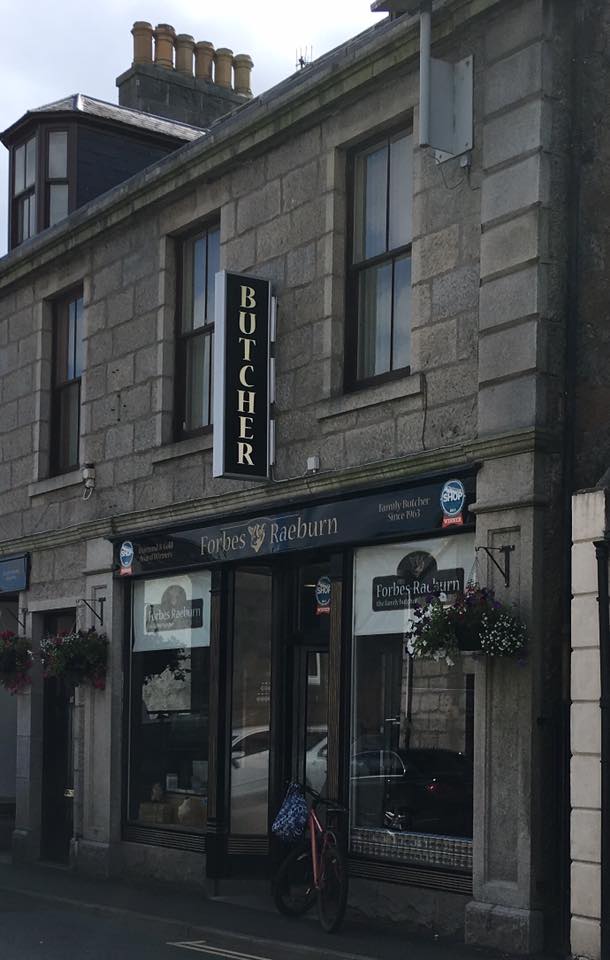
Then we were at Raeburn, the family butchers.  That doesn’t sound right.  It’s a family-owned business.  Lynn asked what meats she could order in quantity for BBQing at the summer party, and the lad behind the counter answered her.  Or at least I assumed he was answering her, because I couldn’t understand a word due to his accent.

Thanks to Richard being a mighty hunter, the freezers at Dunrovin were full of carcasses so we had no need for these.

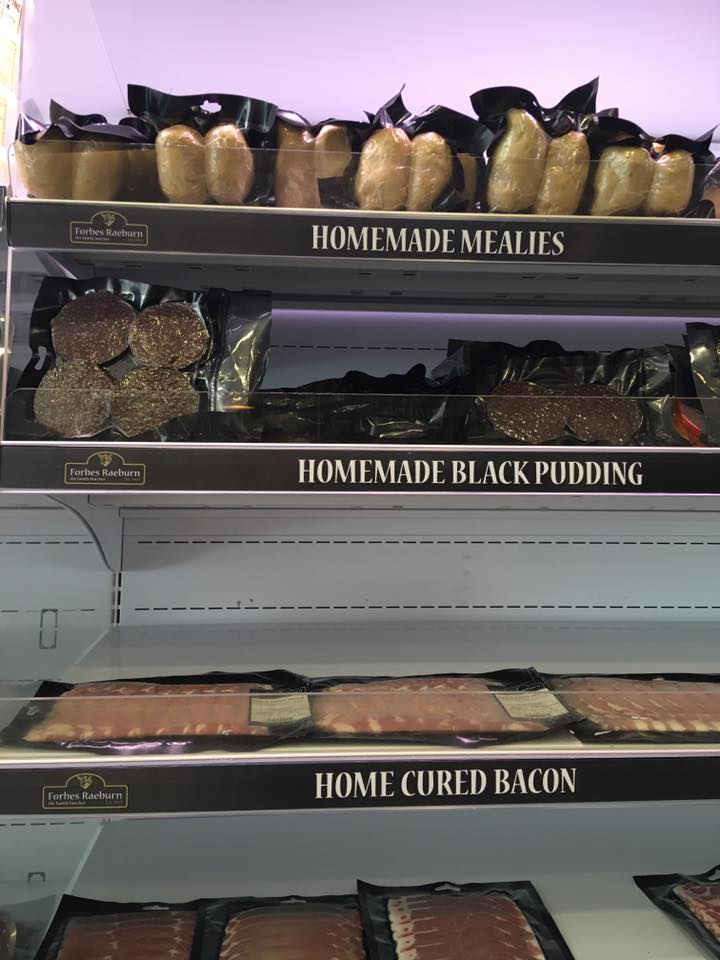
I gazed into the cold case.  I haven’t eaten pork in 40 years, but I appreciate the time and skill it takes to produce things with “home” in the name.  You know what bacon is.  In case you aren’t familiar with black pudding, it has nothing to do with dessert.  I find pudding to be one of the most confusing words in the British Isles. Black pudding is a sausage made of congealed pig’s blood.  Mealies aren’t worms; they are some kind of sausage.

Lynn placed her order and bought some steaks and chops and hamburgers for the three of us for a BBQ whenever the weather cooperated.  “Not sure what I ordered—I couldn’t understand a word he said!” she exclaimed.

“How are the charity shops here?” I asked as we drove past a couple on our way out of town.  This was Minnesota-speak for, “Let’s stop and shop!”  But Lynn is good at not getting my Minnesota hints.  It had been a long day, there would be another time.

As I write about my idyll in the UK, Oxfam is being slaughtered. Unless you live under a self-imposed news blackout (I wouldn’t blame you), you will have heard that Oxfam, Britain’s 4th-largest charity and one of the biggest international development organizations, has been under fire for employee sexual misconduct in the wake of the 2010 earthquake in Haiti.  220,000 people died in that quake.  People were desperate, homeless, hungry.  It was the perfect set up for relatively wealthy aid workers to buy sex.  Disgusting. From what I understand, Oxfam investigated and allowed the ringleader to resign in exchange for testifying against his peers. It’s unclear to me, but it seems they issued an internal report but not an external one.  The creep went on to work for a French charity and behaved badly there, too.

Depending on the newspaper, this was a cover up or a standard way of addressing a problem that occurs in many, if not all, workplaces that employ men. Sorry, men, but this is on you.

A detail I have not seen reported widely is from a Guardian interview with Oxfam’s chief exec in which he explained, “Had the [French] charity been familiar with British employment law, it would have understood that, when Oxfam would only confirm the employee had worked for them, this wasn’t a reference but an alarm bell.”

Yes.  That’s how it works.  I can only imagine the excruciating tradeoffs Oxfam had to make at that time. Fire the lead perpetrator?  Then we won’t get testimony and be able to root out all of them.  Let him resign, which makes it look like he was unhappy with us—but in exchange we get names and dates and details?

Oxfam has lost access to British government funding and 7,000 sustaining donors cancelled their direct debits in one week.  Friends who work there are stunned and angry.

The only good that could come of this is if all charities “drain the swamp”—if not for ethical reasons then at least to avoid bad publicity.

Hanging in Huntly

After thoroughly investigating Huntly Castle, I wandered around town to see what else there might be of interest.  The residential areas were unremarkable, lined with horrid pebble-dash houses.

I spotted a church that looked slightly interesting and started to cross the street when I sensed a vehicle driving along slowly behind me.  I was just about to turn and yell, “Fuck off, creep!” when I heard Richard calling, “Anne, do you want to ride back to Dunrovin with me?”

Feeling a little sheepish, I hopped into the Land Rover and declined a ride all the way back to the house but accepted a lift to the square.

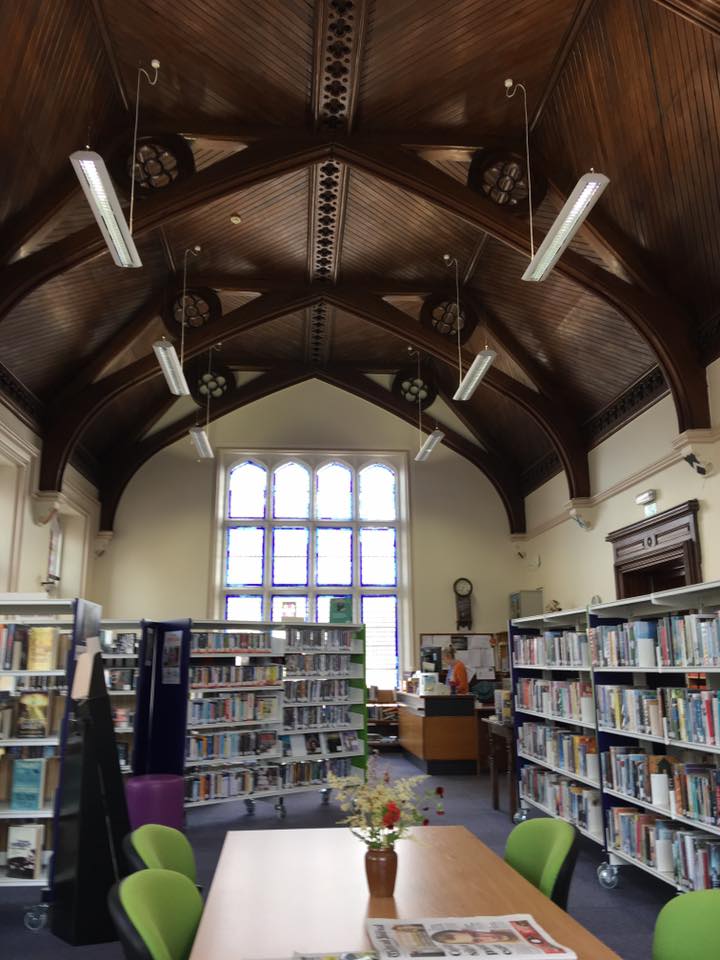
Lynn had sold all the raffle tickets and was now just enjoying chatting with all her fellow Huntly-ites.  I stepped into the library—built by someone akin to Andrew Carnegie but who did not emigrate to America. What a ceiling!

Sadly, while there was all sorts of hustle and bustle just outside, the library was dead.  The librarian looked up hopefully when I entered, pegged me as a tourist, and went back to whatever she was working on.

I walked down one street, then another.  There was the wonderful Huntly Area Cancer Support Centre.

When my sister had cancer, she was handed sheaths of paper with links to websites where she could get information and support. Ditto for her kids and me and my mother as caregivers.  But what my sister—who is an extreme extrovert—could have really used was a place to just go and hang out—with real people.

Lynn was done now and caught up with me.  “Let’s stop in at the bookshop,” she said, “I need to talk to someone there about the Hairst.” The Hairst is like a mega farmers market, a harvest festival held once a year in Huntly that draws people from all over.  The Hairst would feature the Harry Potter children’s party, which Lynn was helping to organize, a dog show, and other events.

Bookshop, as its name implied, sold books.  But it was all volunteer run, and it served as a place to drop in and chat about books, art, and community events.

Lynn talked with the volunteer at the till while I nosed around.

In addition to book, local “makers” sold their hand-made toys and cards and hand-knit scarves.  There was a sunny children’s nook, and I perused the Scottish-themed children’s books.  Another volunteer seemed to be tailing me.  Did she think I was a shoplifter?

“Are you American?” she finally asked.  Ah, that was it.  She had heard me speak and wanted to bend my ear about my war-mongering country and the insane Cheeto we have for a president.

I briefly considered claiming to be Canadian but if she caught me that would reinforce the stereotype of the untrustworthy American.

Instead she gushed, “Oh I so love America.  It’s too bad ….”  Her voice trailed off.

“I know, I know,” I said.

Then we talked about the bookstore and Huntly and what a cold summer it was.  Her name was also Ann but without an “e”.  She appeared to be about my age, and she lived with her mother.  “Mother needs round-the-clock care, so I can’t work and I only get two hours a day respite so I come to the bookstore to do a shift.”

So she volunteered during her two hours out of 24 that she was free.  Some people are a lot more self-sacrificing than I would be.  She was clearly ready for a long, long chat but I really wanted to check out the merch, so I just told her, “I don’t mean to be rude, but I’d really like to take a look at the books and the cards and so on.”

She smiled rather sadly and I felt a bit guilty but then I got lost in the books.  There were cheap used books and some new ones.  There were loads of old coffee table books with Scottish themes and history books about valiant Scottish history and people.  I cursed myself for blowing my cash on a made-in-China scarf at the Castle, although it did have cute foxes all over it.

Cock o’ the North

Huntly Castle is just a few blocks from the town square. I got some more cash out of the ATM just in case there was a gift shop.  The fivver was a new one to me, and the woman turned out to be Nan Shepherd, a “Scottish Modernist writer and poet.”  Don’t ask me what a Scottish Modernist is.  Or any kind of modernist, for that matter.

I walked down the appropriately-named Castle Street and through Gordon’s School, which is the local private (meaning public) high school.  Got that?

This is the lane leading to the castle, which is picturesque enough in its own right to warrant a wander.

The castle was built near the confluence of the rivers Deveron and Bogie, and there’s a lovely bridge before you turn toward the castle.

There was a small trailer at the entrance staffed by a young ranger or whatever they are called in Scotland.  It felt sort of like a state park in Minnesota, only with a 900-year-old castle.  The trailer included a wee gift shop.  While I checked out the tartan coin purses, Highland Cattle-themed wall calendars, and bagpipe CDs, the ranger chattered away with me.  Or at me.  It was a slow day and she was lonely, like park rangers everywhere.

I handed over a Nan Shepherd for the entrance fee and was on my way.  I recalled looking at the ouside of the castle with Lynn and Richard but why had I never gone inside?  The following week, Lynn and I took a long drive to an event, and we passed half a dozen castles and other mammoth buildings.  “There’s a manor over there,” Lynn waved nonchalantly.

“Wow!” I exclaimed, impressed by the house near the road that was a little smaller than Dunrovin.

“No … that’s the gatehouse,” Lynn corrected me.  “The manor is through the trees there.”

It was the height of summer so it was hard to see but I got the impression it was a Downton Abbey-sized house. “Wow,” I said again, humbled.  “Someone lives there?”

“Yes, some lord or other.”

To a native, thousand-year-old castles and manors and lords are a dime a dozen.  But for me, being from the land of shopping malls and Kim Kardashian, they still impress.

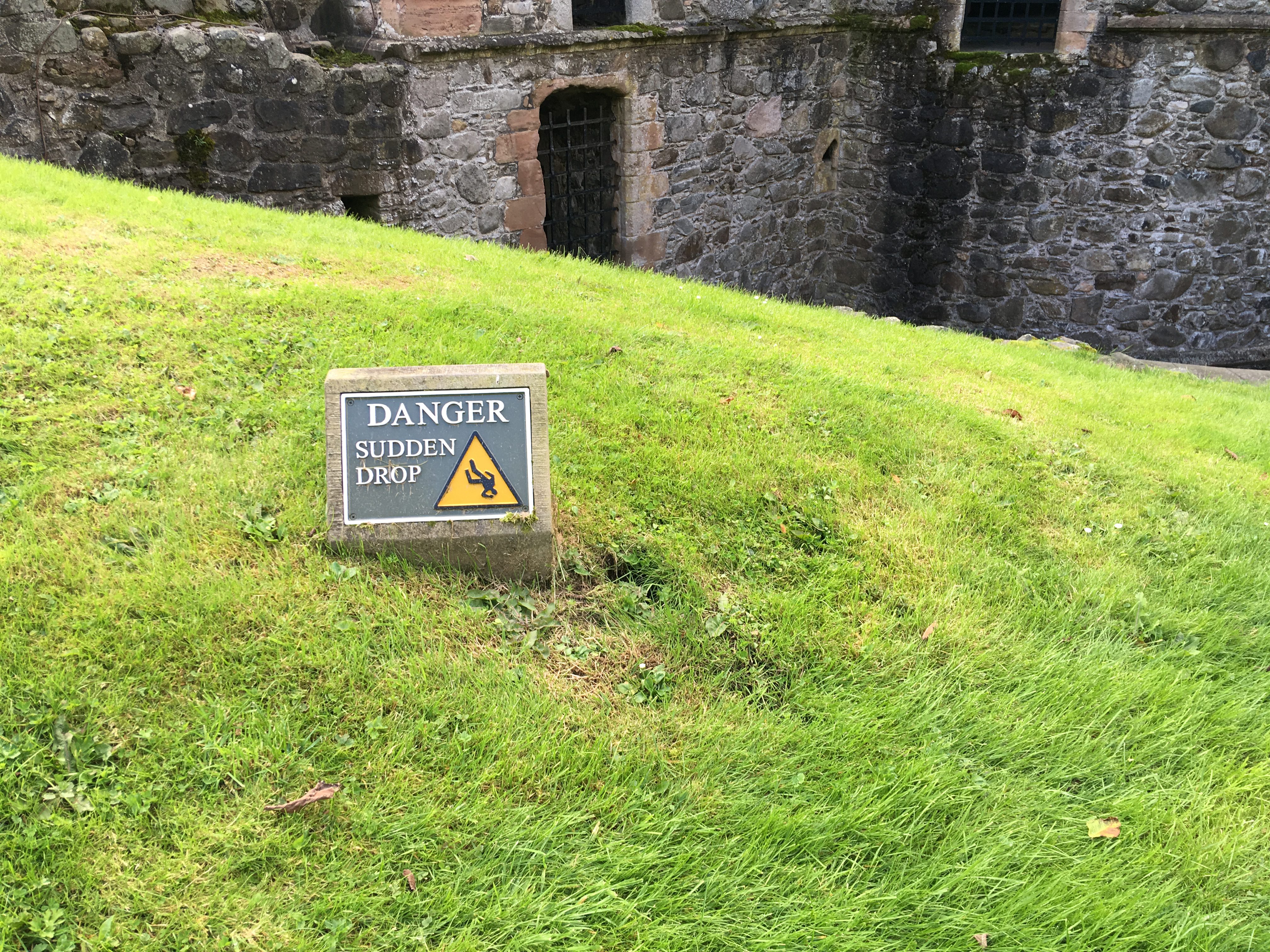
Back at Huntly Castle, I made sure to watch my step.

And then I was standing at the entrance, entranced.  There has been a castle here since the 12th Century. The original builder was Duncan, Earl of Fife.  The front section, which is the most intact, is French-inspired.  Did I mention it is a ruin?

The most famous occupant was George, Duke of Gordon, a well-known show off referred to as “The Cock o’ the North.”  To ensure you saw his name across the top of the castle, he added a pointing hand (to the left of the “G.”)

It was a beautiful day and the rose and ochre-colored stone was set off by the blue sky and emerald grass to marvelous effect.

The Gordons were Catholics in a Protestant country. During the English civil war the “popish” symbols were chiseled off the castle by Protestants.

Inside, this fireplace had whatever was Catholic removed from the top.

There were more fireplaces that appeared suspended in air because the wood floors were gone.

This was once a cozy sitting room at the top of a turret.

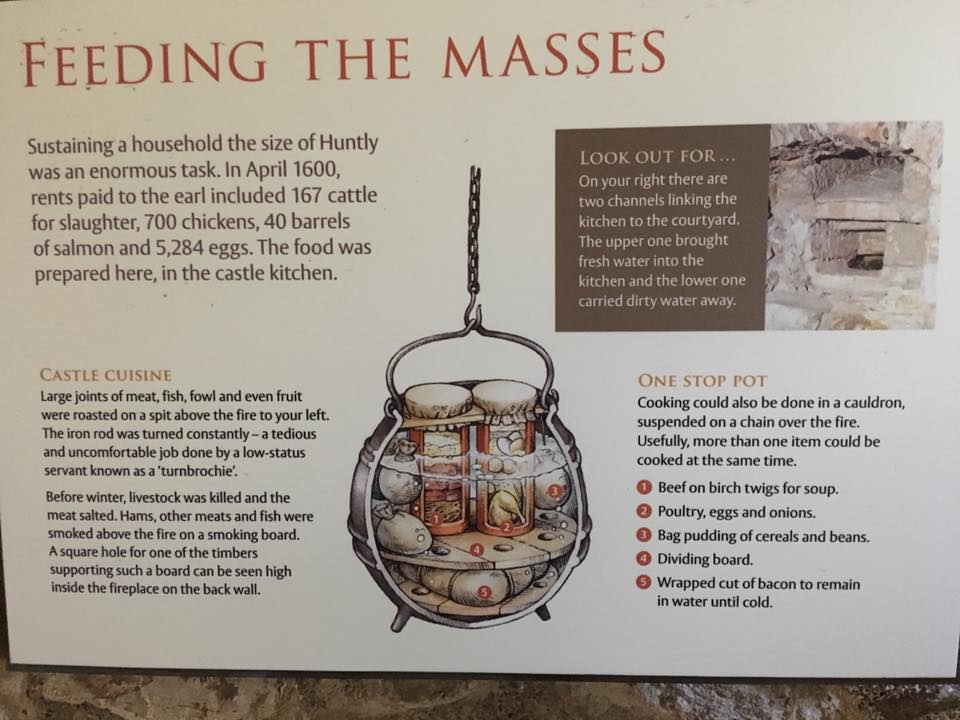
Mary queen of scots ate here, and when the Earl pulled out all the stops to impress her, she turned around and imposed higher taxes on him.  This described an early version of the crock pot.

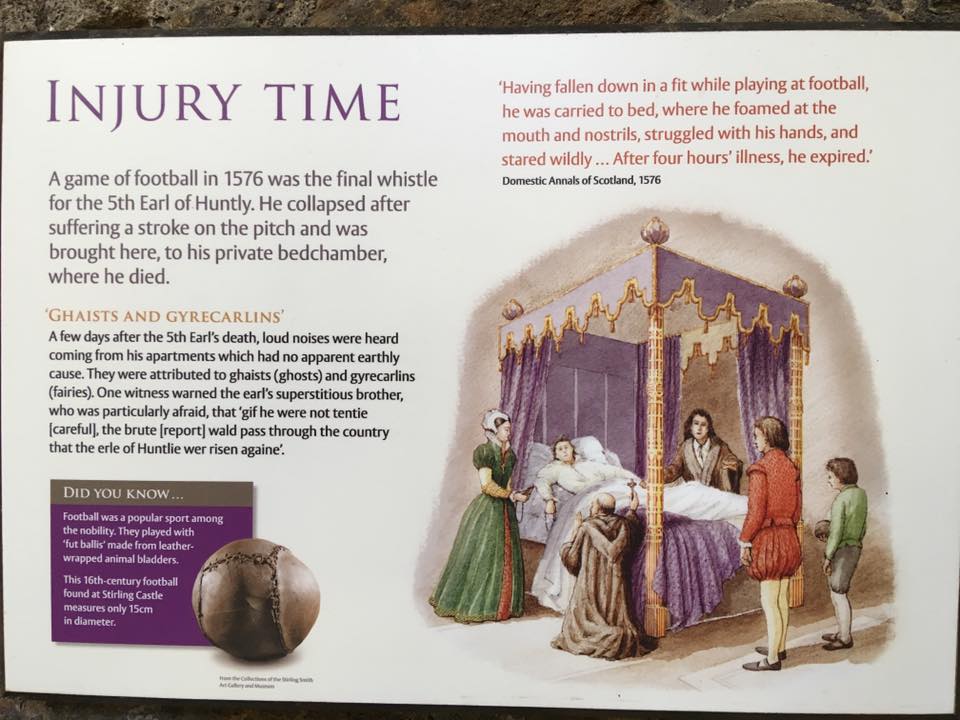
The 5th Earl of Huntly collapsed and died while playing football.  Probably had coronary heart disease from all the rich food.

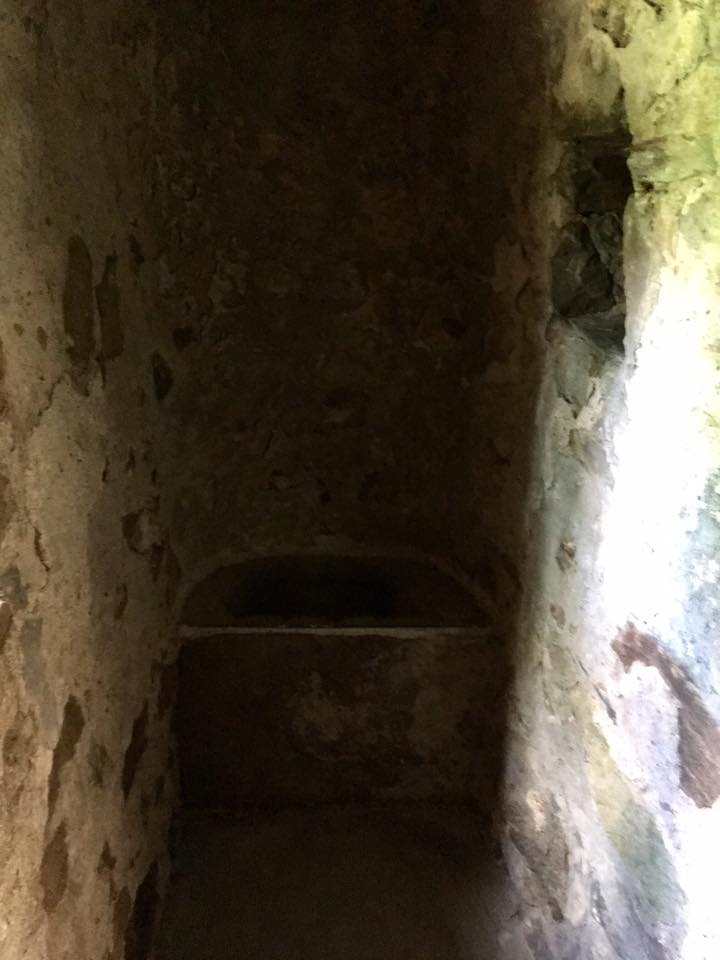
My flash wouldn’t work, or you would be gazing upon “the oldest wooden toilet seat in Scotland.”  Quite a claim to fame.

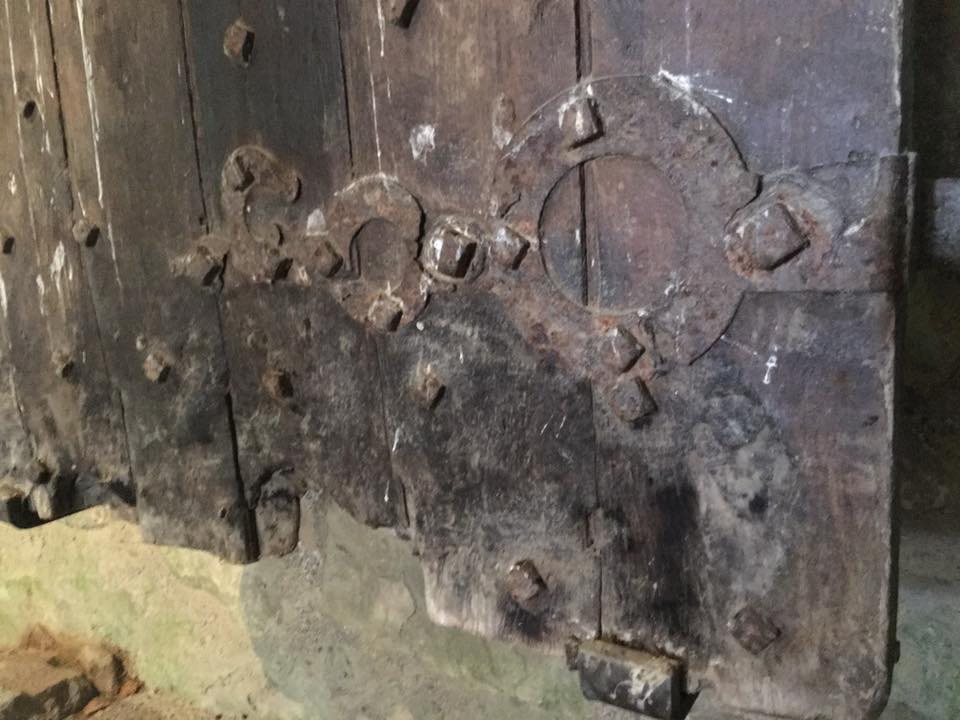
There was this old section of—it was claimed—an original door.  Fabulous.

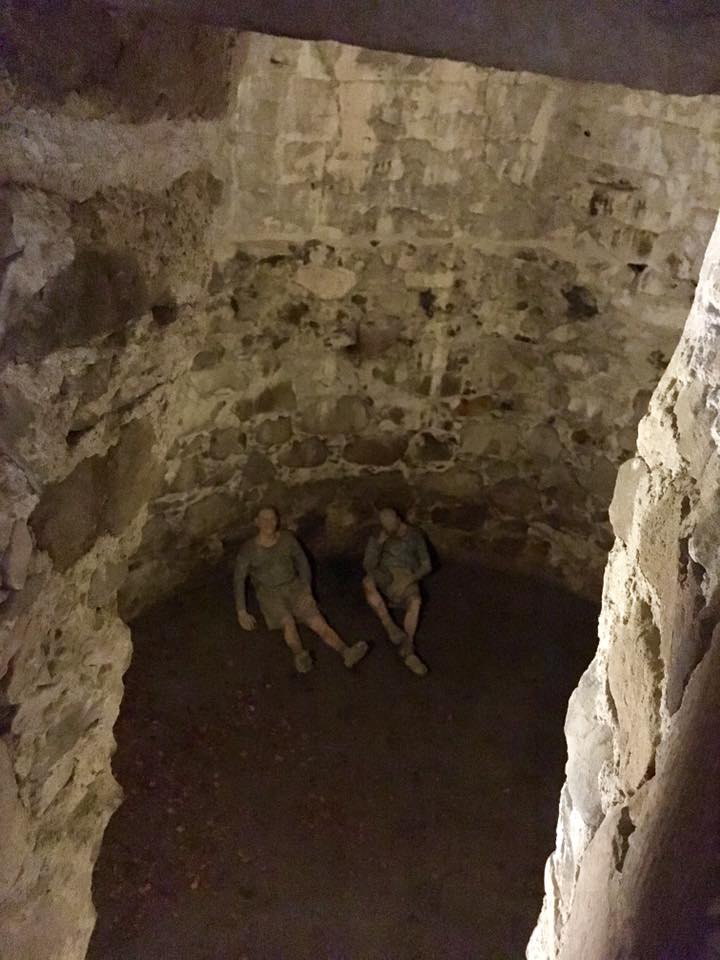
I climbed to the top then to the bottom, where my heart was chilled by this sight.

My son’s prison experience was bad enough; I can’t imagine being shut up in a mud floored, windowless dungeon with no heat.  (And no, those aren’t real prisoners; they’re dummies.)

This Little Piggy went to Market

I settled into a routine as I had in the south.  Get up early, blog and work, join Lynn and Richard for breakfast, then work some more.   I lay on my bed under the covers to keep warm, at first wondering, “How will I ever work without a desk?” but quickly getting used to tapping away on my keyboard in a reclining state.

Whenever I glanced out the window, Dottie the cat would be in position, staring at me like she was trying to communicate some vitally important matter of possibly national interest.  I tried to get into the habit of  rousing myself once an hour and take a lap around the property.  Dottie would accompany me down the drive, but at a distance of about 10 feet, as if to say, “I’m not with you, I just happen to be walking down the drive at the same time as you.”  Lord Parker would wait for me at the gate, then tail me as I walked the circular path around the garden.  When I got to the gate on the other side that led to the river, he would watch me beseechingly with his tawny, human-like eyes, maybe thinking, “maybe this time, maybe she’ll let me come too.”

There, I did it, I anthropomorphized.  I really don’t believe that animals have thoughts, but since we humans have more thoughts than we know what to do with, I guess it’s tempting to lay some of ours on other beings.

It was better than nothing that I walked around Dunrovin half a dozen times a day.  I would like to report that I also took long, vigorous walks every afternoon as I had in Eton and Windsor.  That was my goal.  But just the opposite took place, and I may well have to check into a fat farm to work off the pounds I gained in Scotland.

I blame it on the doubles.  Lynn has two small fridges in the kitchen and two freezers full of venison and other meats Richard has harvested, plus a pantry and a wine cellar. Then there was the double cream.  I continued my personal single, double, and clotted cream festival throughout the month, pouring it over or globbing it onto pastry shells, croissants, ice cream, strawberries, muesli, and anything else that didn’t move.

The three of us ate lunch and dinner together most days.  Lynn loves to cook, is a great cook, and doesn’t stint on rich ingredients or portions.  I feel so lazy saying this, but I only prepared about six meals the whole month.  When I offered, Lynn would usually say she already had the meal planned.  When I offered to make it, she would wave me off, saying it was no trouble.  We often had a salad and veggies, but they were in addition to a leg of lamb or shepherd’s pie.  I made lasagna and moussaka, then felt it was my duty to eat all the leftovers so they wouldn’t go to waste.
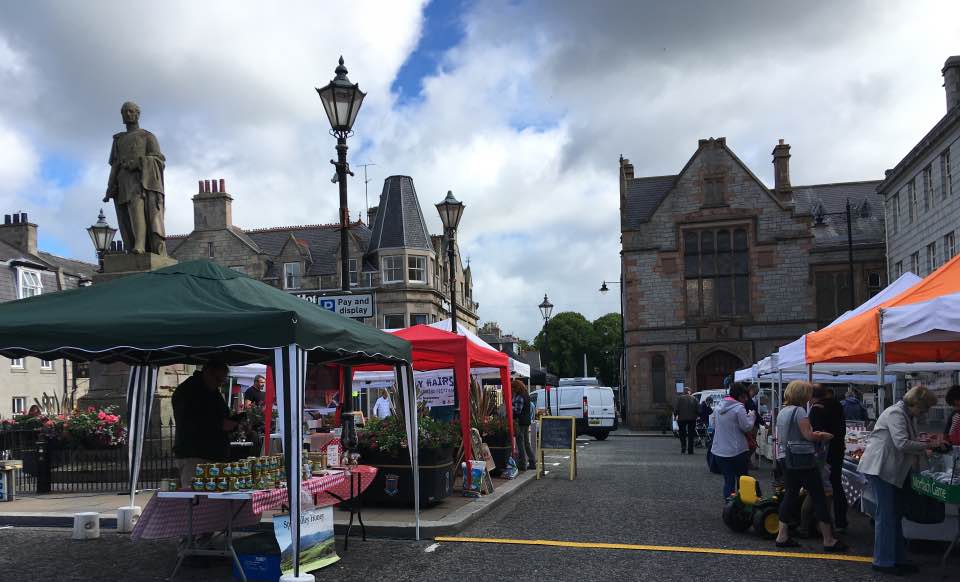
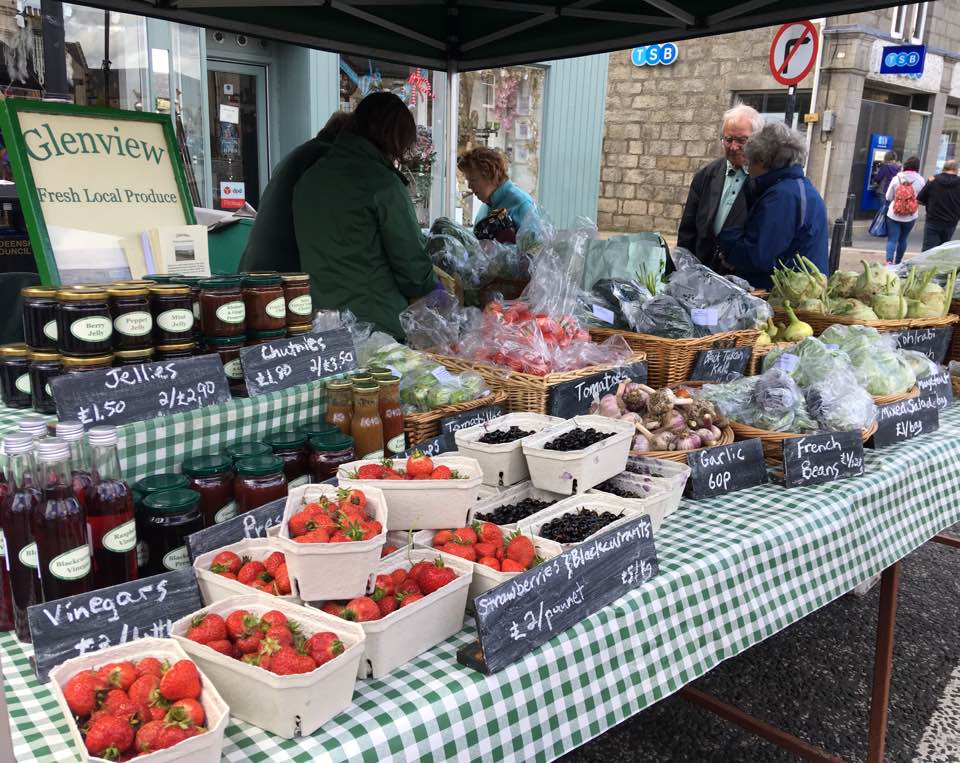
My first outing was to the Huntly Farmers’ Market, held once a month in the town square.

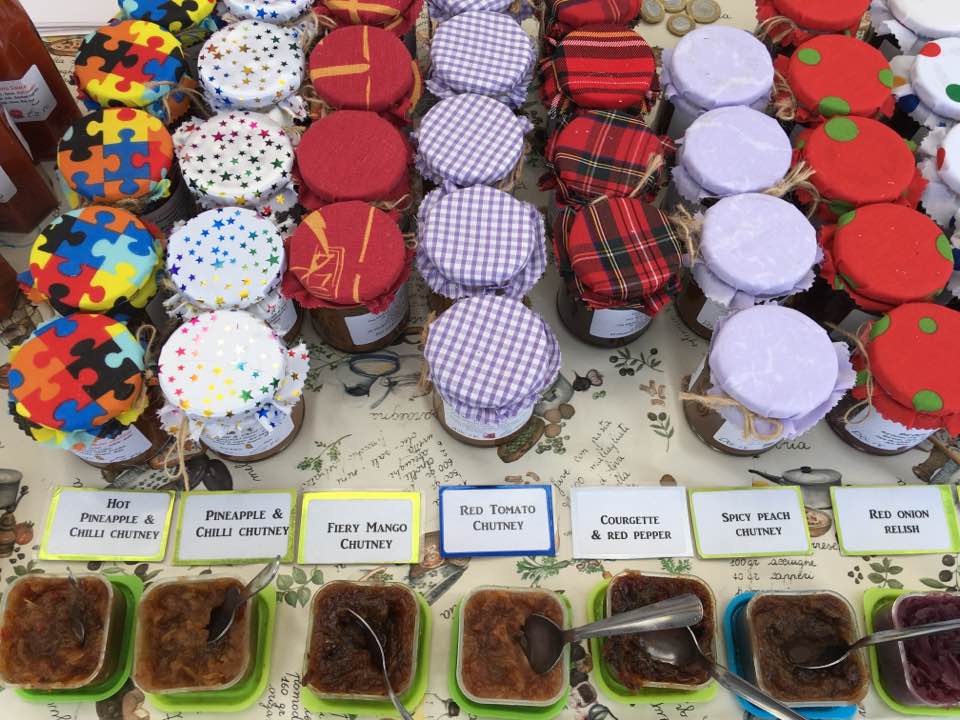
Bread, pastries, chutneys and jams and jellies, and beautiful berries.  All good vehicles for double cream.
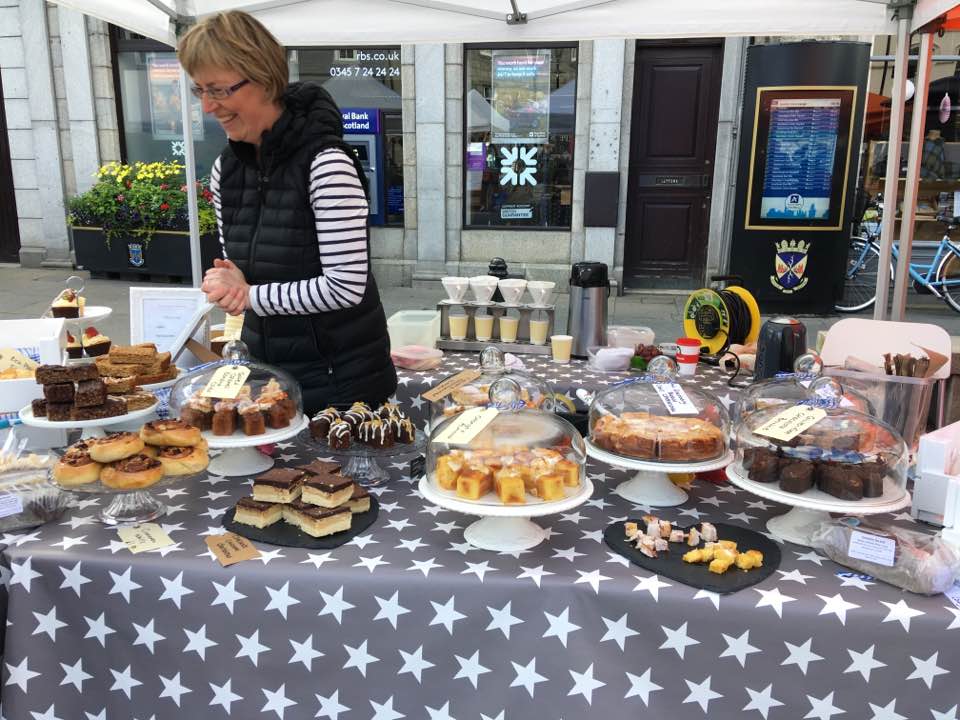
Have you ever been to a farmer’s market where they sell fresh fish?  I bought some langoustines for our supper.

Surprise!  There was wild game.

Then there was the paella man, a Spanish guy named Marco.  I bought a bowl then walked around while Lynn sold raffle tickets and promoted an upcoming Harry Potter children’s party.

I talked to a retired physician who, with his wife and daughter, runs a small charity which benefits local initiatives in Nepal; they invited me to a fundraiser that would involve ceili dancing.

I sat on a bench to finish my paella and the granite was so cold I let out a yelp.  A woman standing nearby immediately offered me her portable seat cushion, then we began to chat and—too late—I noticed her kiosk full of Jehovah’s Witness literature.  But she and her fellow adherents were very nice and didn’t push it.

I decided to have a wander to work off the paella and wound up at Huntly Castle.

Just another day in Scotland.

Hobs, Hospitality, and Hospital Supplies

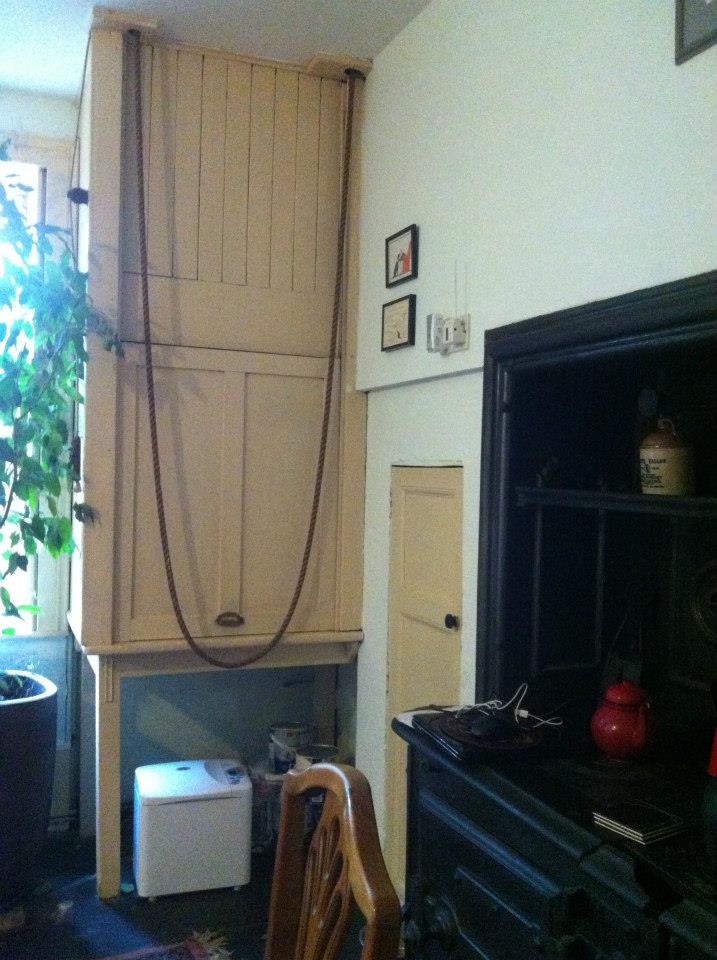
Since everyone at Dunrovin spent most of the time in the kitchen, it’s worth noting that we had plenty of ovens and stoves to choose from.  Or hobs and cookers, as they are called in Britain.  This is the oldest, a wood-burner, which must have been just too heavy to remove when the new-fangled Aga arrived.

There is a smaller version of this stove right next to it, to the right.  It’s like a toy stove, and I don’t have a photo of it, but it’s thought to have been used by the servants when the family was away.  After all, servants don’t need to eat big sumptuous meals, right?

Across the room from these is the Aga.  I’m not a plumber and I couldn’t play one on TV, but my understanding is that some Agas can actually serve as boilers for the whole house, and/or produce hot water for the house.

The concept of the Aga is simple and beautiful.  They are always on.  The basic model has one hot burner and one warm burner.  Also one hot oven and one warm one. So you never have to wait for a burner to heat up, or serve food that’s gone cold.

They are also works of art.

They cost an arm and a leg to operate because they are always on.  Since Lynn and Richard have a fourth set of modern ovens and cook tops, they only turn on the Aga for parties.

A few years ago when I was remodeling my miniscule kitchen I checked out Agas just for fun at my local appliance store.  They started at $5,000.  I settled for a flimsy Avanti, which cost $399.  I got what I paid for.

I was installed in the premium guest suite at Dunrovin.  And by premium I mean I had my own bathroom.  I have never had such a large room in any of my own houses or apartments.  It contained a queen-sized bed, a large wardrobe, a chest of drawers, a chair, and—mercifully—an electric space heater which I tried not to use “too much” but honestly I had it on most of the time when I was in the room.

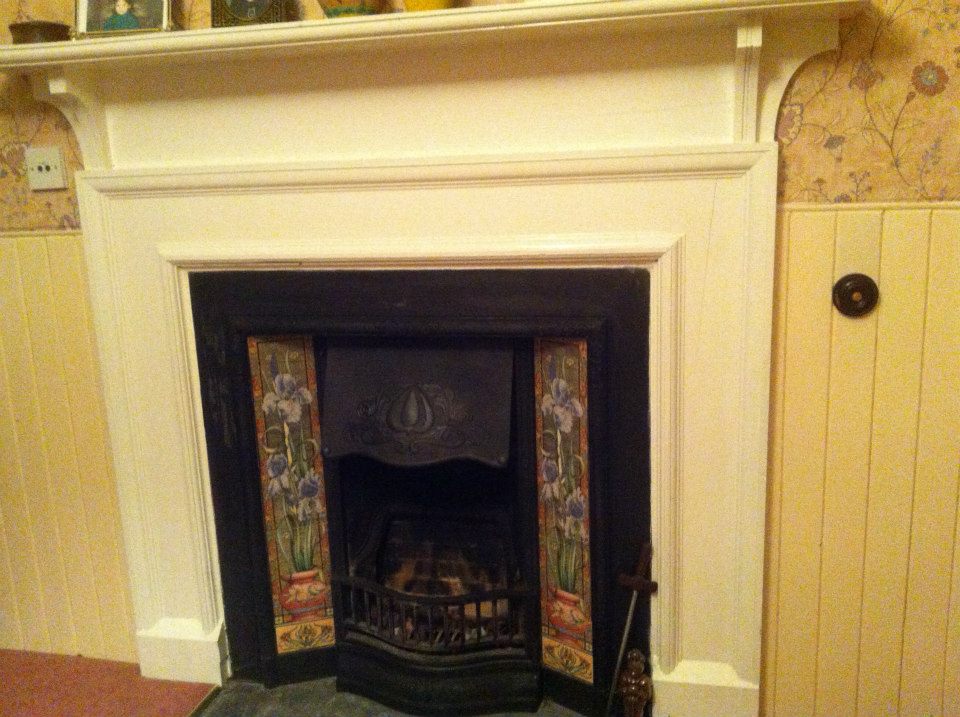
This is the fireplace in “my” room.  Note the bell next to it with which I could have used to summon a servant if I had been there 100 years earlier.

Knowing I am an early riser—I mean really early, like 5:30 am—Lynn had placed a tray in my room with a kettle, instant coffee, and tea.  I just had to remember to bring some milk up at night before I turned in, and I was all set to work in my room until a decent hour, like 8:00.  Otherwise, if I snuck down to the kitchen to make coffee I woke the dogs, who’s barking woke Lynn and Richard.

I’m sure Lynn thinks I’m weird for chronicling the ancient contents of the medicine cabinet in my room.  But I can’t help it—I notice details like this.  It’s not just the big things that make other countries interesting, it’s the details too.

I just checked and I also have items in my medicine cabinet that might seem peculiar to a foreigner—like Breathe Right Nasal Strips, a vial of essential oil (a gift; I would never buy such a thing myself), and a prescription medication that I wouldn’t be able to afford if I didn’t have health insurance through my job.  That’s a hat’s off to the NHS, in case you didn’t get it.

Here’s what I had to draw upon should I get terribly dirty or have an accident.

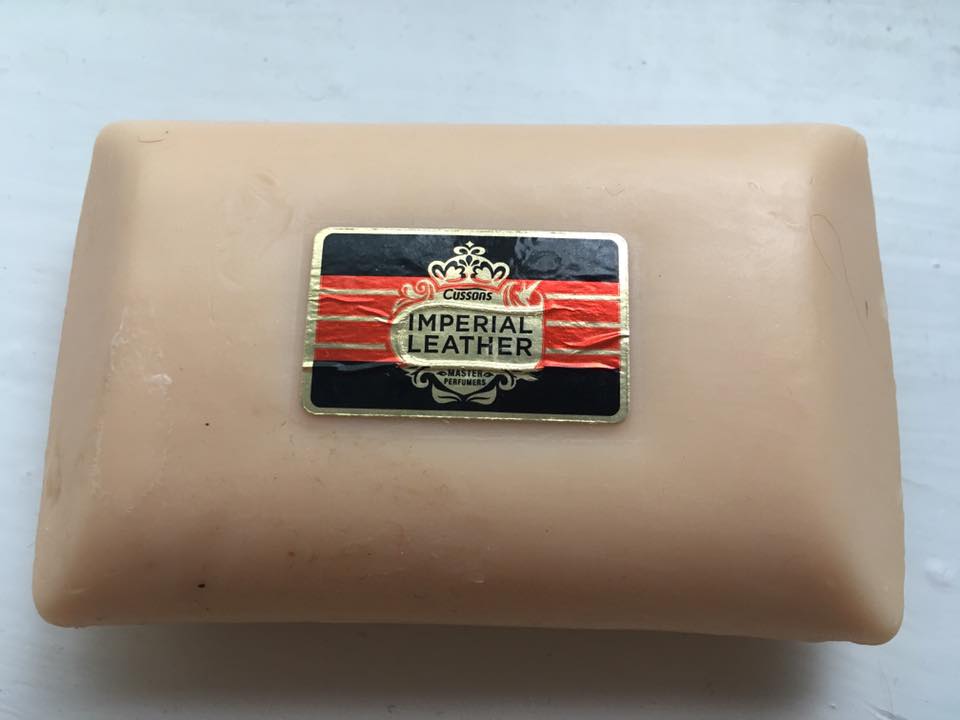
Imperial Leather soap, which comes with a metal logo embedded in it.  For any of you closet imperialists out there.

Dettol: It’s good to know Her Majesty Queen Elizabeth appointed someone to make a 74p product.

TCP: One product for everything from bad breath to acne.

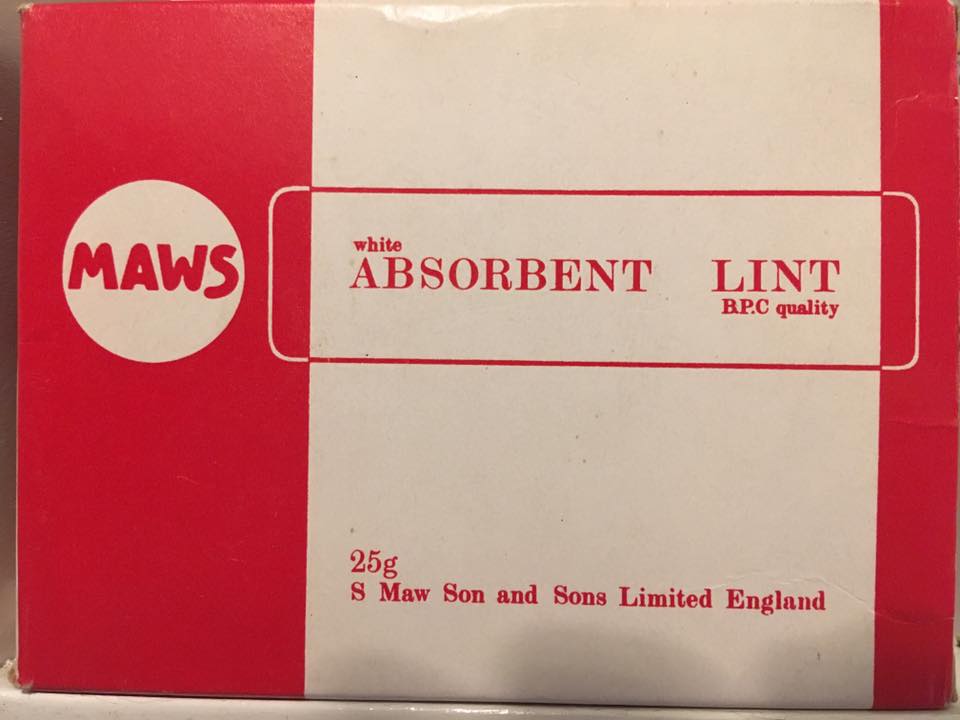
And lint.  It’s what I have always removed from the clothes dryer filter and thrown away.

If I were going to use lint as a medical treatment I would definitely demand that it be British made.  None of that fluffy French lint.