Tag Archives: Australia

Melbourne

Day 14 or 15 in Australia.  I was halfway through my time here.

In my last post I wrote that I’d gone to Greece with Heidi, Rob, and a second Aussie girl.  Her name was Melissa and I would not see her on this trip because it was just too dang complicated to get to her in Whyalla.  She’s a single mum who works full time so she couldn’t come to me.  Heidi and I had tried to work it out—I would have to fly to Adelaide, then rent a car and drive for five hours.  Heidi wouldn’t be able to accompany me so this could have been my initiation into driving on the left, but in the end there just wasn’t enough time.

I had bought a Minnesota baseball jersey for Melissa and a jersey from our soccer team for her son.  I stopped in the post office near the train station and mailed them.

The three of us then stood in front of the ticket machine at the station for 15 minutes trying to figure out what to do.  In Melbourne there is the Myki transport card, much like the Oyster in London or the Opal in Sydney.  You buy some initial credit then top up the card when needed.

Except there was no way to buy a card, and no information on where to get one.  Heidi and Danielle had Mykis from their last visit, but I didn’t.

“I’m okay with just getting on and talking my way out at the other end,” I said.

It took an hour to get into Melbourne, so I had plenty of time to come up with a sob story for why I had been unable to buy a Myki card.  But when the train deposited us at the Flinders Street Station, the bored guard just waved me out and over to a service window where I bought a card.

It’s a beautiful station.
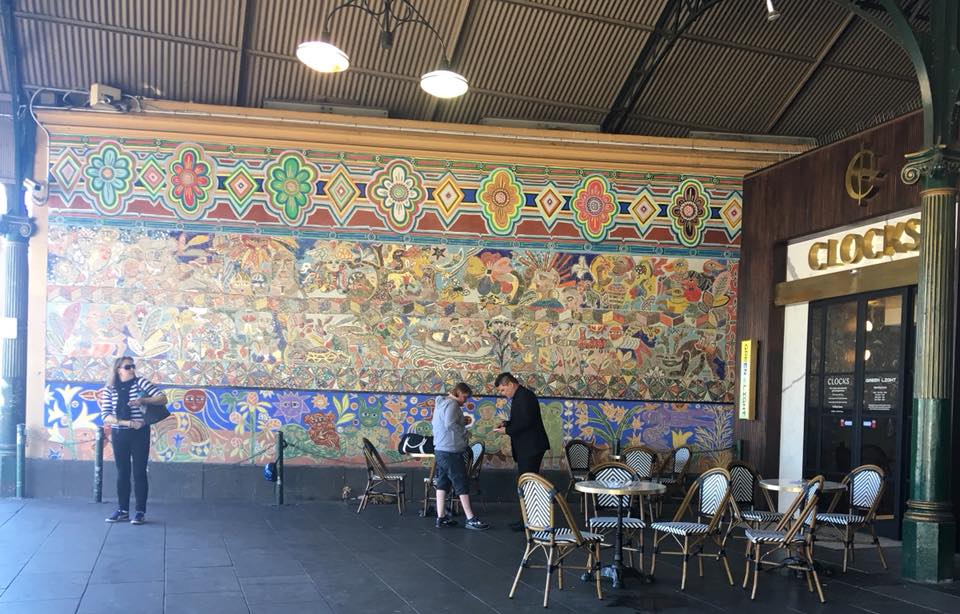
This was my first view of Melbourne.  Immediately, I had the impression of a very cosmopolitan, bustling, super-charged city. Sydney is a big city, but it somehow feels more laid back.

There were construction cranes in every direction.  The banner on the old church said “Refugees Welcome,” which was good because blonde, blue-eyed Aussies appeared to be in the minority.  At one point I lost my bearings and wondered if I had somehow been transported to Beijing.
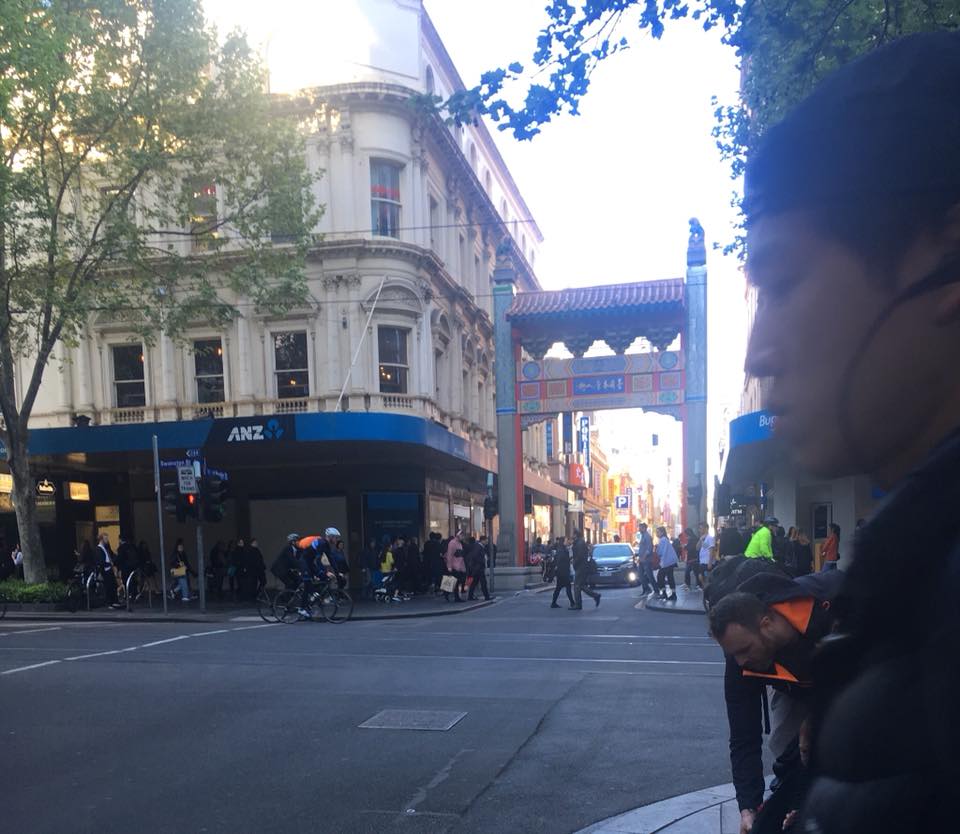
The streets were heaving with trams, buses, cabs, pedestrians, and bicyclists.  We made our way to David Jones, one of the big department stores, where I bought socks and boots for my cold feet.

“It’s almost racing season,” Heidi said excitedly, “so all the stores have their selections of frocks and hats on display.”

“Aww,” I replied, “I wish I could be here for that!  We could start an annual streak of dress-up sporting events, like Wimbledon last year.”  Yes, we had gone to Wimbledon in 2017, buying the cheap tickets and sitting on the lawn, drinking Pimms and watching the matches on the jumbotron.  It was a scene.  It was a blast.

I could have taken photos of frocks all day but Heidi and Danielle were on missions to find shoes for their dad and a watchband for their mum.  We went from store to store and never found either. I looked at jeans in Target but had no idea how Australian sizes correlated to American.

I was cold and tired.  Suddenly I that moment that comes during even the best trips, where I think, “I want to go home now.” And by home I mean my own home, with my bath and my bed and all my familiar things, where I can lounge on the couch watching TV in my pajamas while shoveling popcorn into my mouth.

Instead, we got on the train for the hour commute back to Dean and Lisa’s.  Their house was lovely and welcoming and comfortable, so if I couldn’t be taking the train back to my own home, theirs was a welcome second choice.

Within a few hours the five of us were seated in a cozy Argentine restaurant gabbling away over tapas and I was back to being the happy traveler.

Overlapping Circles

Under a heavy duvet I was warm but I knew it would be frosty once I got up that morning.

I’ve written about this before.  As I write this it is 13 degrees Fahrenheit (-11 Celsius) in St. Paul, Minnesota. This is normal.  It’s been cold and dark since November, and it will remain cold and dark until April.  And so there’s this psychological hurdle I can’t get over where I believe everywhere else must be warmer.  And mostly, everywhere else is.  But not Melbourne in spring.
I don’t know how cold it was in Melbourne last October—below 50F/8C in the house in the mornings, for sure.  I could hear a feeble whishing of air from a “heating vent.”  My heating vents at home issue forth gusts of hot air that could knock you off your feet.  There was no basement in Dean and Lisa’s house, and the windows weren’t double glazed, so any heat went straight out the windows, literally.

I summoned the courage to crawl out from under the duvet and made a run to the toilet room.  The dog, Penny, a black lab, came loping toward me and I hugged her, if nothing else for the warmth.  Heidi was up making a cup of tea.

“Oh hi there, how’d you sleep?”

“Really well,” I replied.  “I think I’m so tired here every night that even my Restless Legs are taking a vacation.”

Dean and Lisa had left for work.  They work at a nearby Aboriginal girls’ college, a boarding school, and—I’m not going to get this all right—but there is a branch component for Aboriginal kids in the outback.  So Dean flies to the back of beyond and stays for weeks at a time.  He loves the kids and the job, but there is nothing to do when he’s off duty.

“We don’t have a ute,” (a truck) he said, “although even if we did there’s nothing in town to do.”  Dean teaches maths and science and Lisa is the school’s e-learning coordinator.
Before leaving Minnesota I’d spoken with my cousin’s wife, who is Native American, about maybe bringing some Native American-related gifts for the girls at Dean and Lisa’s school.  “They’re Black, aren’t they?” she asked.  “Then get them some magazines like Ebony and Teen Jet.  They probably don’t see Black faces in ads or billboards or magazines.”

That was an excellent idea, so I had handed Dean a stack of teen mags.  But the one I had bought on a whim, a publication about how to live off the grid, would prove to be the most popular.  There was a full-page ad for guns on the back cover.  “But it’s got good articles on starting a worm farm and making lamp shades out of animal hides,” Dean had observed as he’d flipped through it.

How do we all know each other?  Simple.  Heidi was in Sharm El Sheikh, Egypt looking to go diving and someone said, “You should go see Dean; he’s an Aussie and he’s the Mayor of Sharm El Sheikh.”  The unofficial mayor, of course.  Dean had been living there for some time and knew who to talk to.

Eventually they both wound up living in London, where Dean met Rob, who is from Bemidji Minnesota.  A mutual friend introduced me to Rob when I was living in Oxford, and one day he said, “Hey Annie, wanna go to Greece next week?  There are these two Aussie girls who teach with me who want to go and we need four to avoid the single supplement.”

Heidi was one of the Aussie girls.

Dean and Lisa being at work gave me the opportunity to snoop around. Not that I looked in any of their drawers.

The house is perched on a steep hill.

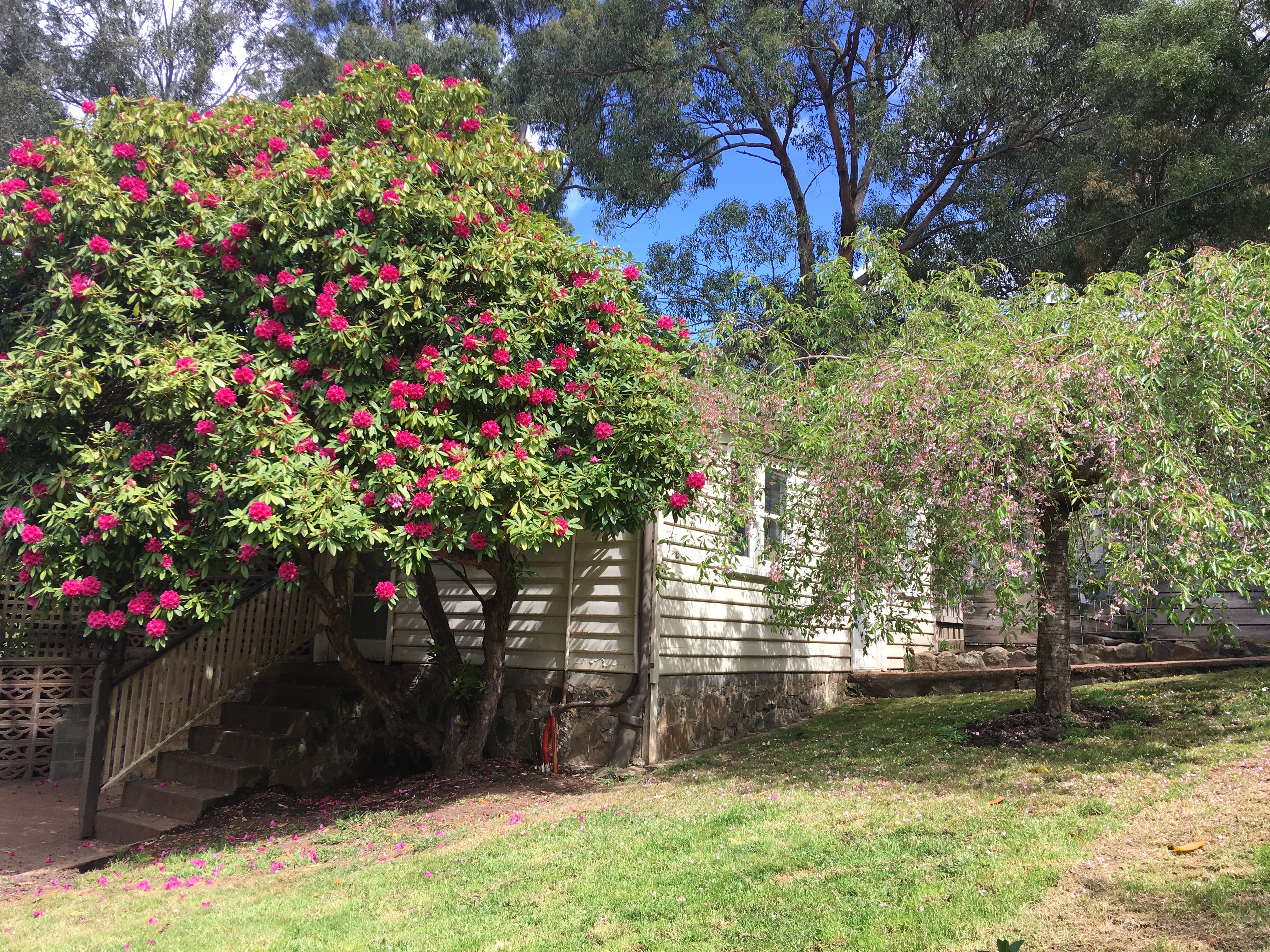
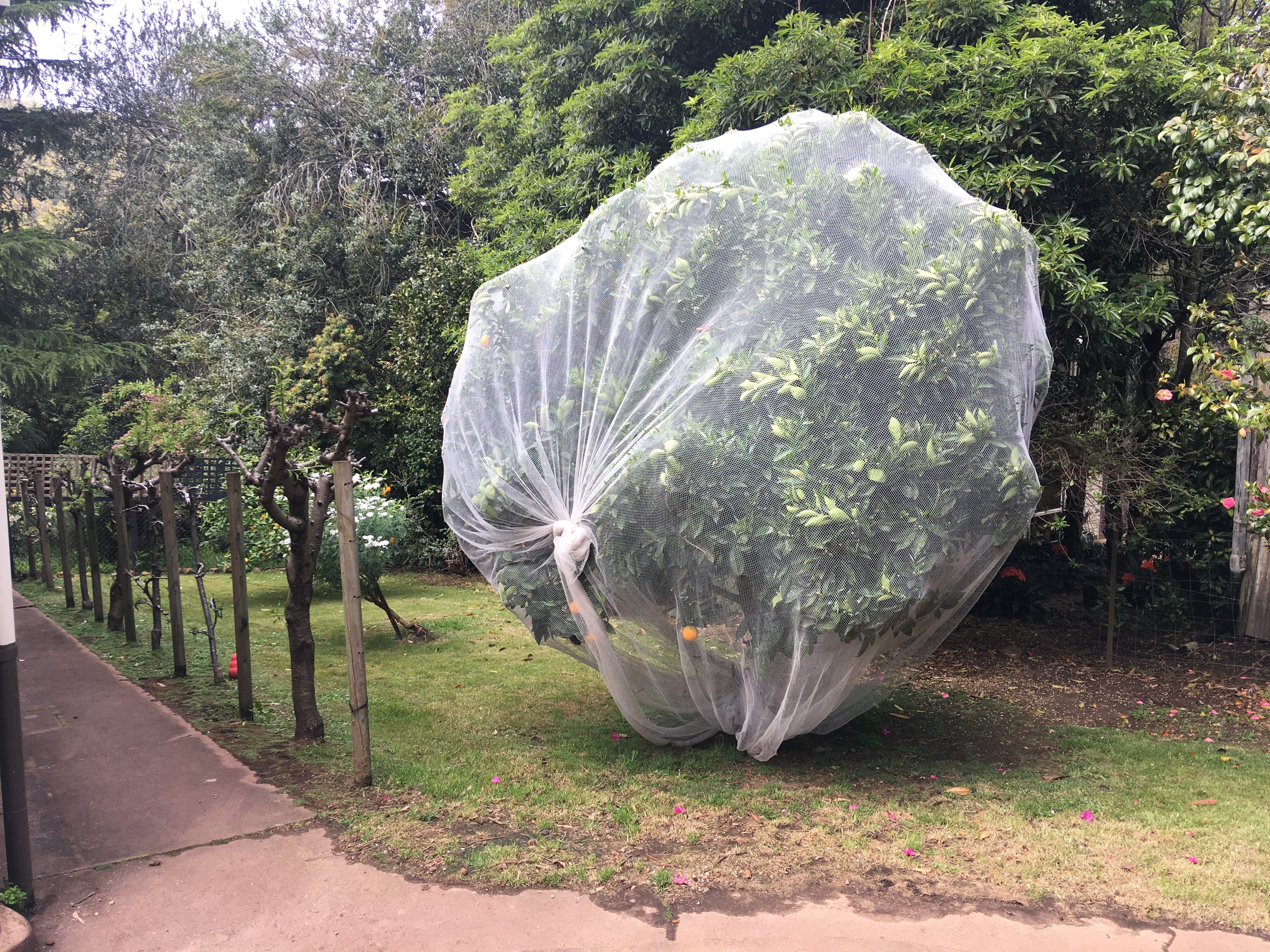
I couldn’t get over all the fruit trees growing—just growing!—in their yard.

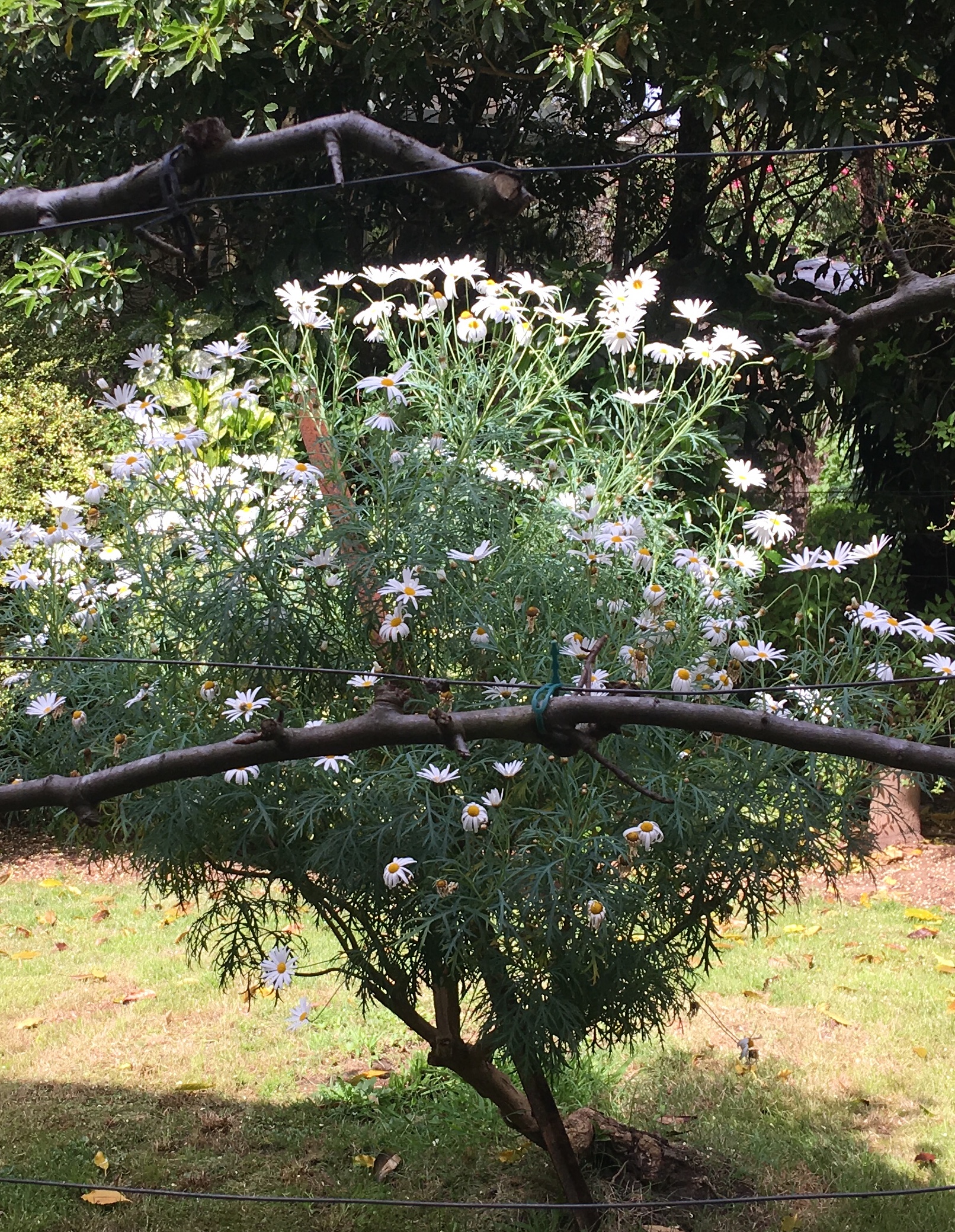
This appeared to be a giant daisy tree.

I have this plant in a pot at home but it’s 12 inches tall, not twelve feet.

The three of us faffed about for hours, then Dean came home on his lunch break to take us to the train station.

Sanctuary?

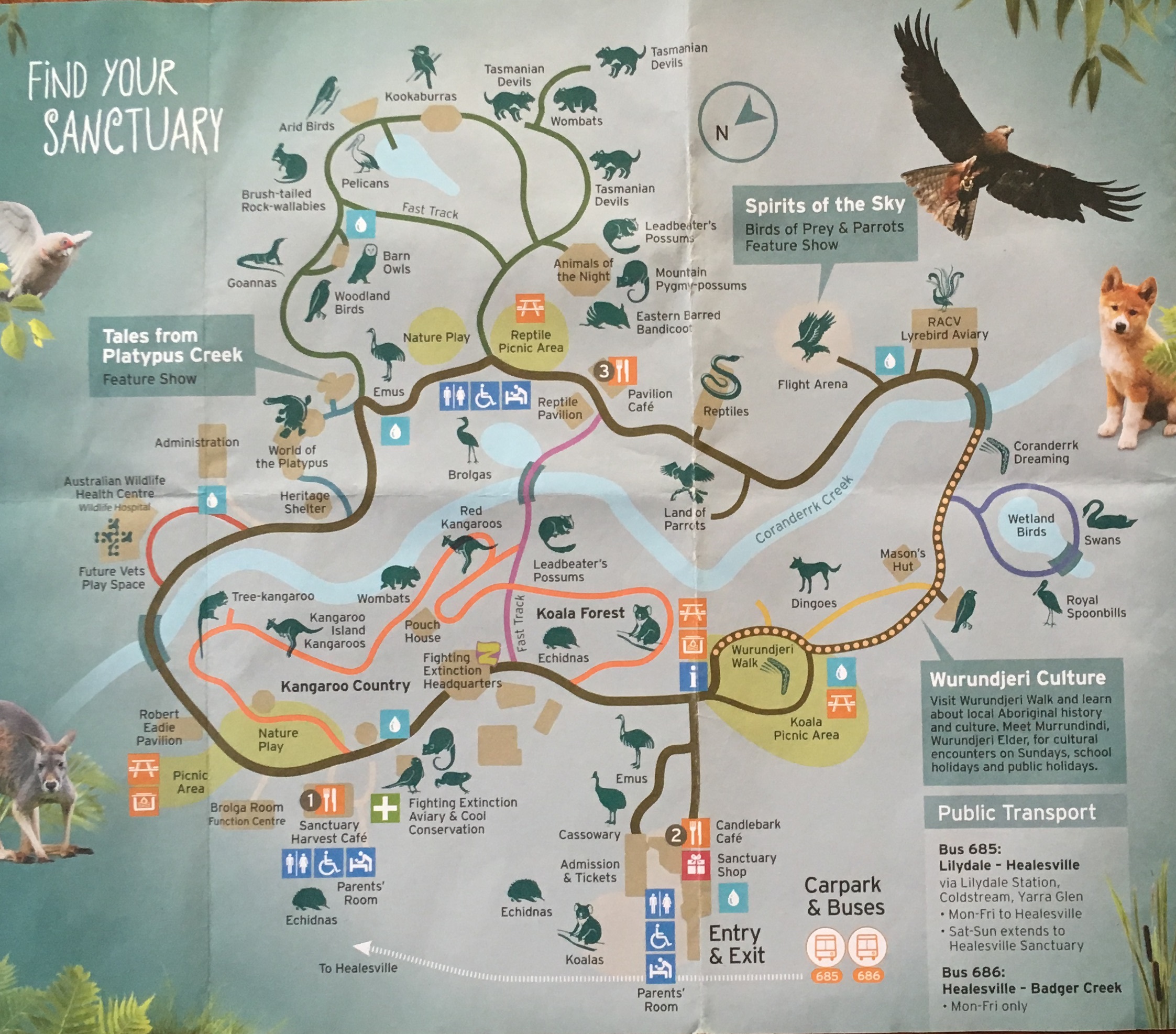
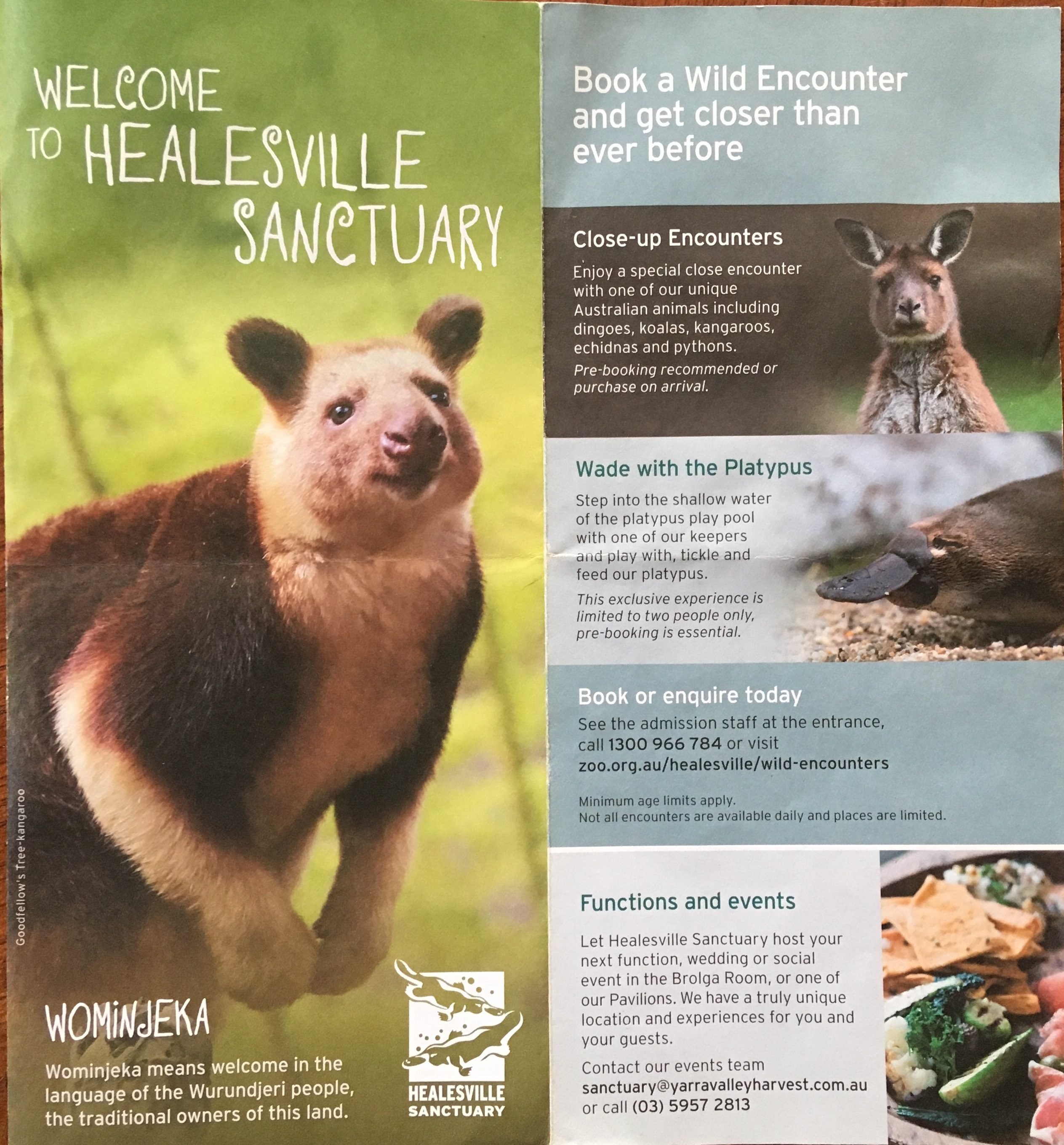
We pulled up to Healesville Sanctuary at 11am, grabbed our rain gear from the boot, and ran for the entrance.  The line wasn’t bad, since it was raining. We were handed a map, which looked like a bowl of, well, spag bol.

So we ran headlong, following signs to the platypus show, and rocked up as an employee was securing a chain across the entrance.

“I’m sorry,” she said firmly, “but it’s 11:15.  You can stand here and watch.”  Really.  You give some people a bit of power and it goes to their heads.

Still, we were close enough to get the gist of it; a ranger stood in a tank playing with a frisky platypus named Milton, and after the “show” we were allowed in to take a closer look.  This was the best of my photos.

Did you know they are frisky as kittens? Did you also know they have a spur which can excrete venom that causes excruciating pain?

Milton sure looked like he was having fun.  The ranger had a devil of a time getting him to stop fooling around and get back into his pen.

You may be wondering, “what’s the difference between a sanctuary and a zoo?”  None, I don’t think, except branding.  I did some freelance grant writing for the Minnesota Zoo back in the 80s, and they were talking about it being a “living ark” back then.  That is, zoos/sanctuaries are the only place to breed endangered species until and if their habitat can be restored.

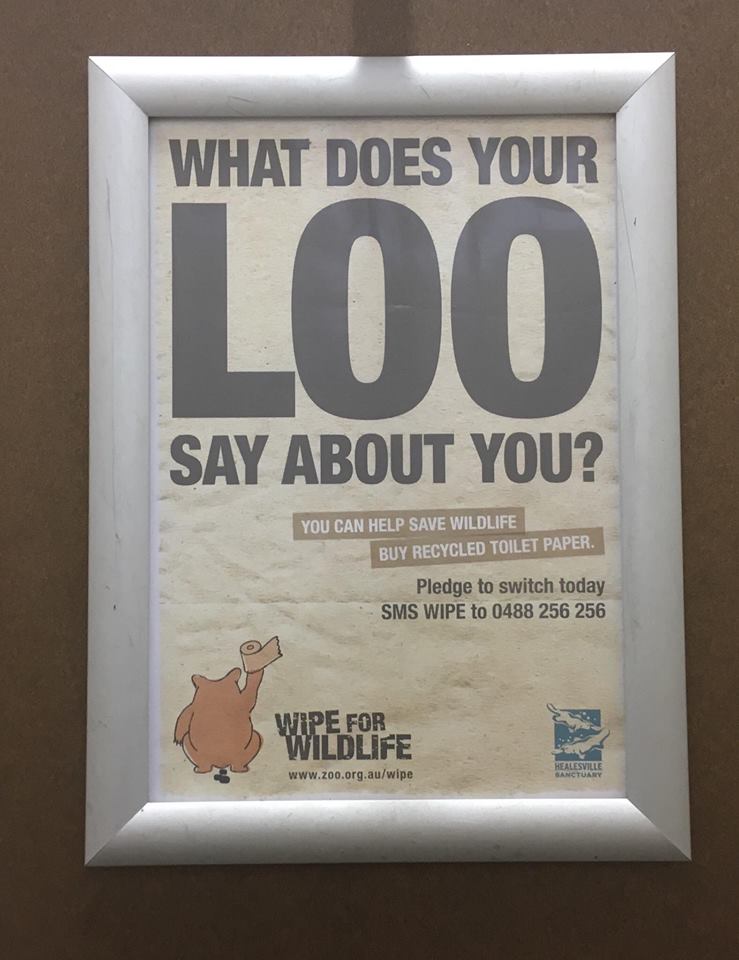
I’m sure they all struggle with conveying educational messages while allowing people to have fun.  And so there was the platypus show, a birds of prey show which was astounding, and all sorts of signage about not wasting water, etc.

At the end of the bird show they handed out refrigerator magnets about not using balloons at birthday parties.  One can only imagine what goes wrong when an eagle “captures” and eats a balloon.

It rained all day, but that meant we almost had the place to ourselves.

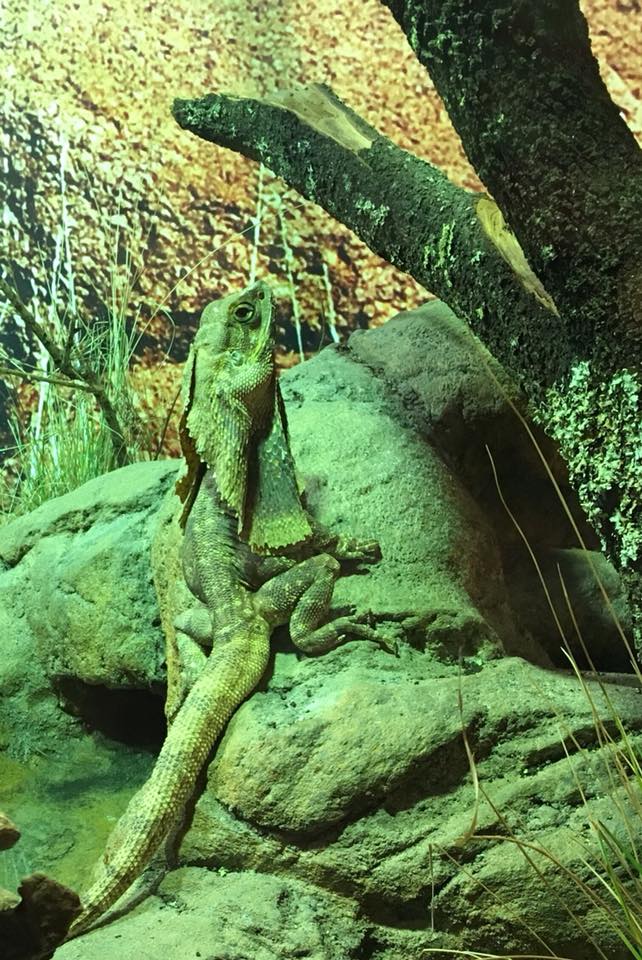
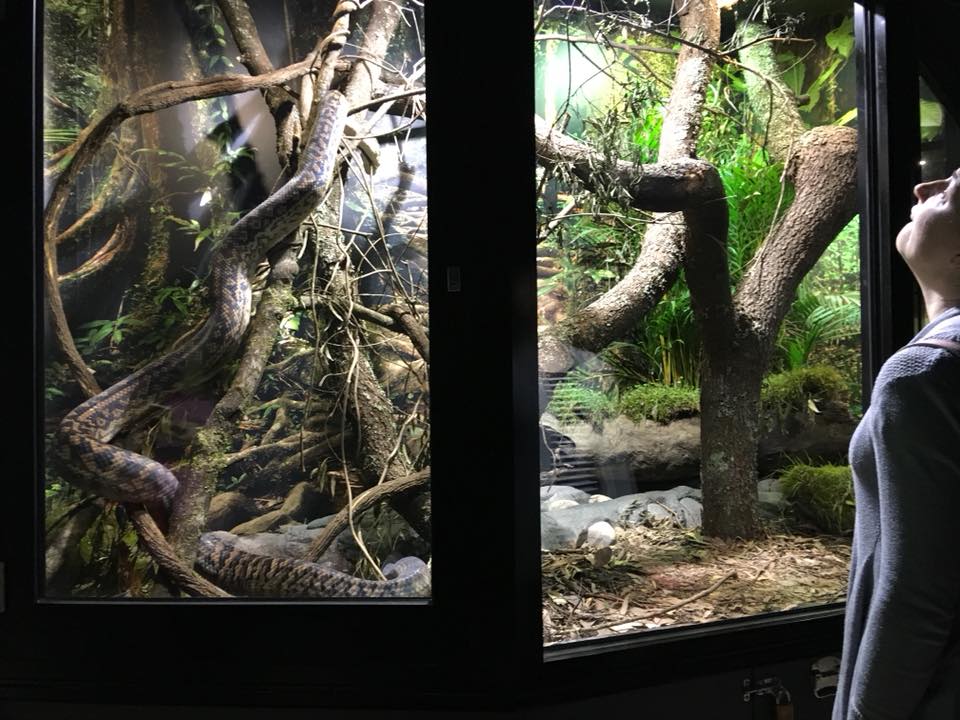
There were goannas and snakes.

And a building lighted with infrared, with every size and shape of hopping marsupial that lives in the Australian desert.

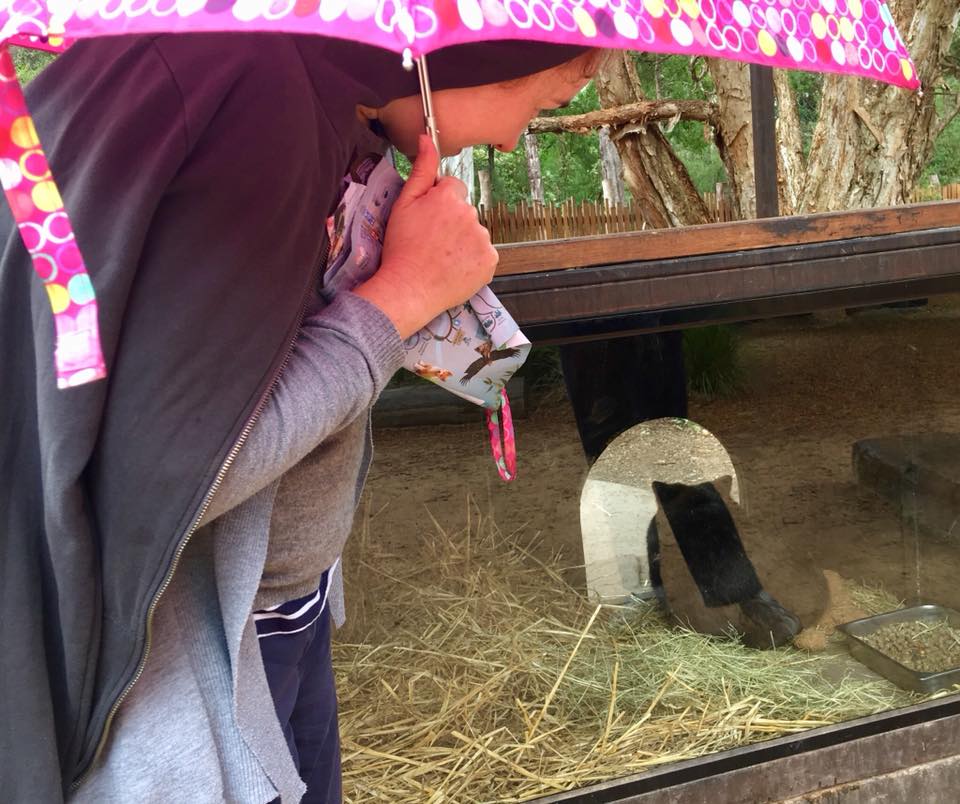
I have never claimed to be a great photographer, and they didn’t make it easy at Healesville.  I tried to just be in the moment.  When would I ever be back?

The bird area was a treat, at least for us humans.

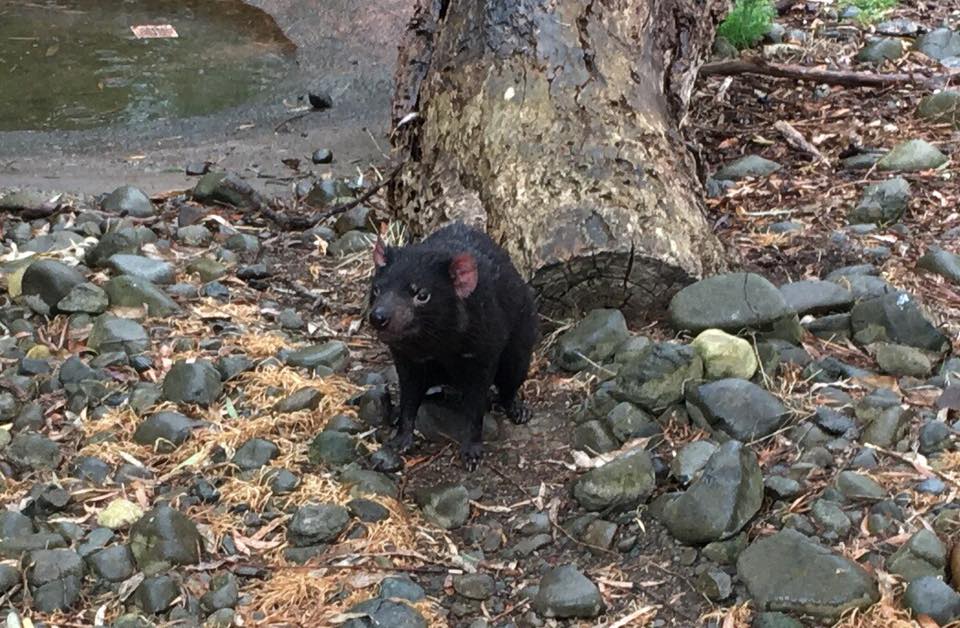
I made a lot of—probably—annoying comments like, “Tasmanian Devils remind me of pigs!” and “I didn’t realize XXX were so small/big!”  But really I was delighted with everything; I really felt like a kid.

Did you know Tasmanian Devil’s ears turn red when they’re agitated?  I read that they make “spine-chilling screetches” but didn’t hear any that day. Goodness me—I just found a recording of the noise, and it is indeed frightening.

Milton was a hard act to follow, but as we left the Tasmanian Devils I gushed to no one, “Those are my favorites!”

Sadly, they are endangered by the highly contagious Devil Facial Tumor Disease.  This really is a case of separating out healthy individuals until a cure is found.

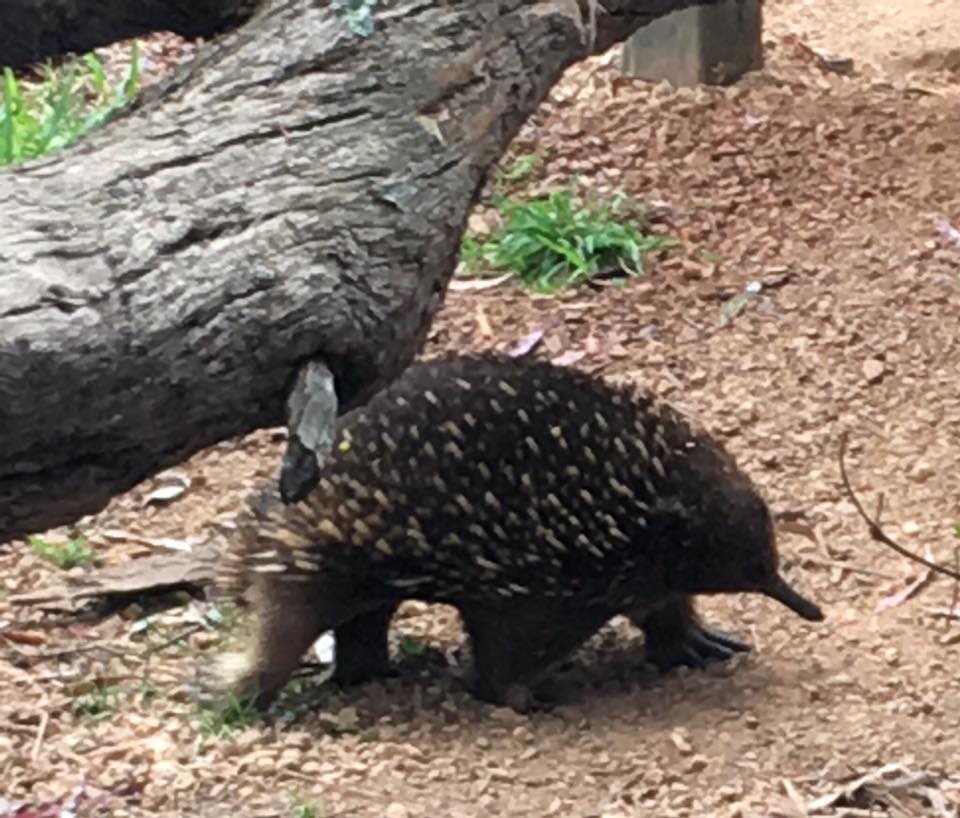
We had a late lunch in the nearly empty cafeteria while watching rangers play with echidnas.  That’s not a sentence you get to write every day.

I had really hoped to see a wombat, but only glanced the backside of one.

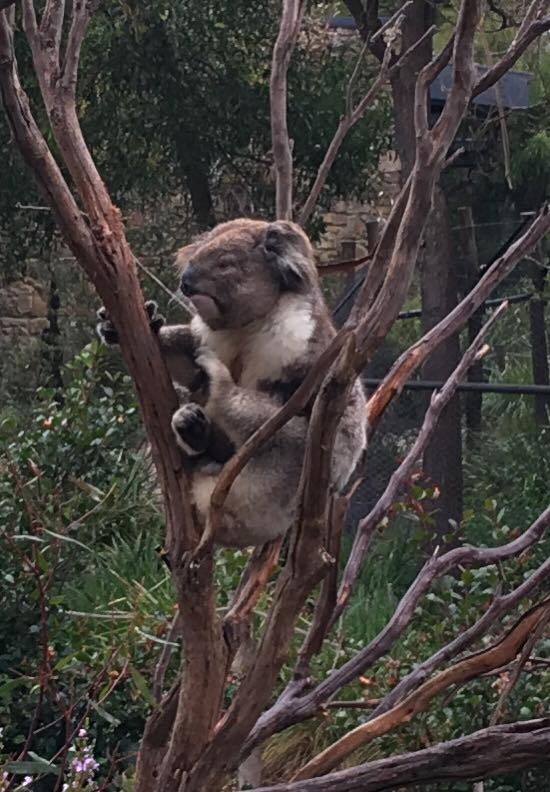
I felt sorry for the koalas until I read that doing nothing all day in a small space is their normal.

We sauntered through the kangaroo enclosure, then we slipped through a gate and there were the tree roos.  This really was my favorite.

After four hours on the road and five in the rain, it was time to leave for our friends’ house in Melbourne proper, which took an hour.  I was tired, but I managed to make conversation over a Thai takeaway before abruptly excusing myself and doing a face plant into bed.

Eternal Road Trip

Bedtime at the Paddlesteamer Motel.  The name makes it sound quaint, which is wasn’t. However, the décor was updated and it was very clean.

Heidi sat hunched over the guide book on the edge of the king-sized bed she would share with Danielle.  I had already crawled into my rollaway twin.  We were all testy after the long day on the road.

“We’ll need to leave here no later than 7am,” said Heidi firmly, not looking at Danielle.

“Yes, Miss bossy boots,” Danielle responded to no one.

Siblings. Heidi and Danielle got along remarkably well, considering the strains they were under.

I put in my earplugs, rolled over, and went to sleep.

We were up and out by 7am, Heidi stood at the open boot of the car and Danielle and I threw our bags over the balcony while the resident cat tried to trip us by threading our legs as we dashed in and out.

Our objective this morning was the Healesville Wildlife Sanctuary just outside of Melbourne.

“The platypus show is at 11:15,” Heidi had read, “and it shouldn’t be missed.”

“We should be able to just make it, if we run from the entrance gate,” she went on.  “It’ll be close; I reckon it’s a three and a half hour drive with no stops.”

From my bolthole in the back seat, I panicked and leaned forward to get my head through the seats for maximum impact and whined, “But we will stop for coffee, right?”

“Eeyehsss,” Heidi confirmed, in that drawn-out way Australians say “yes.”

We stopped at a truck stop somewhere—Wodonga?  Wangaratta?  Benalla?  There were also English names along the route: Glenrowan, Swan Pool, Winton, Merton.

It was a truck stop like in rural America, with a couple fast food restaurants, a convenience store and petrol station, and showers and maybe nap cubicles. We had passed innumerable road signs that warned, “Trouble Concentrating?  Power Nap Now” And “Stop, Revive, Survive.” A couple of groggy, grungy truckers in baggy jeans, heavy boots, and filthy t-shirts stared blearily at the menus.

One moved ahead to place his order and I could tell he was speaking Aussie English but I couldn’t understand a word.

“What’s with the chicken schnitzel on every menu?” I asked Heidi as we gazed up at the board.

“I don’t know … isn’t that normal?  Don’t they serve chicken schnitzel at MacDonald’s?”

“No.” I replied. The undecipherable guy had left with his order and I asked Heidi, “Could you understand him?”

“Yes, but barely.  He had a real proper country accent.”

“Ah, it’s similar in Minnesota.  The farther from the cities people grow up, the more pronounced their Mee’-nah-soda accent is.”

We were up.  “What’ll ya have, doll?” asked the cashier.

I ordered a coffee and toast with butter.

The guy who was stocking the cooler nearby mimicked my pronunciation: buh’-der.  Aussies would say buh-ter’, I think.

Back on the road, and we listened to more Australian music.  “This one’s about the Vietnam War,” explained Heidi.

“Great!”

I was Only 19,” by Redgum, could win the “Most Depressing Song” contest.  The refrain is:

And can you tell me, doctor, why I still can’t get to sleep?
And night time’s just a jungle dark and a barking M.16?
And what’s this rash that comes and goes, can you tell me what it means?
God help me
I was only nineteen

It’s important, though, to listen and learn and it might sound Pollyanna-ish, but I’ve got four nephews and two nieces to think about, since women can now serve in combat.

Don’t think it could never happen again.

We made one more pit stop, at a road house that was frozen in the 50s and run by a wizened Indian guy who was muttering to himself in front of a wood burning stove.  I bought a box of Shapes which I imagined would be his only sale of the day and hoped they wouldn’t be stale.

We wound along the Maroondah Highway, passing Yarck and Alexandra, then entered the Dandenong mountain range.  Heidi was asleep in the backseat.

“We have to wake her,” Danielle urged. But we couldn’t, I couldn’t capture it on camera, and we couldn’t do justice to describing the scenery later.

The Band Played Waltzing Matilda

We would make a detour to Wagga Wagga, where Heidi had attended Charles Sturt University.

“Wagga Wagga,” she said, “So nice they named it twice.”

We mosied around a riverside park.  Of course it had public barbeque stations, and the landscaping was lovely, with the wisteria and forsythia and other trellises in full spring bloom.  It was lovely until I got to the Sandakan Prisoner of War Memorial.

In 1942, 1,800 Australian soldiers were defending Malaya and Singapore from the Japanese.  When the Japanese took Singapore, they transported the Aussies to Sandakan, an island which is part of what is now Borneo. Borneo, a place I would love to go on vacation.

Half of Aussies died of “ill treatment” in the first year.  But wait, it gets worse! As the allies closed in, the Japanese marched the prisoners through the jungle toward the center, executing anyone who fell, then massacred all that survived except for six men who escaped.

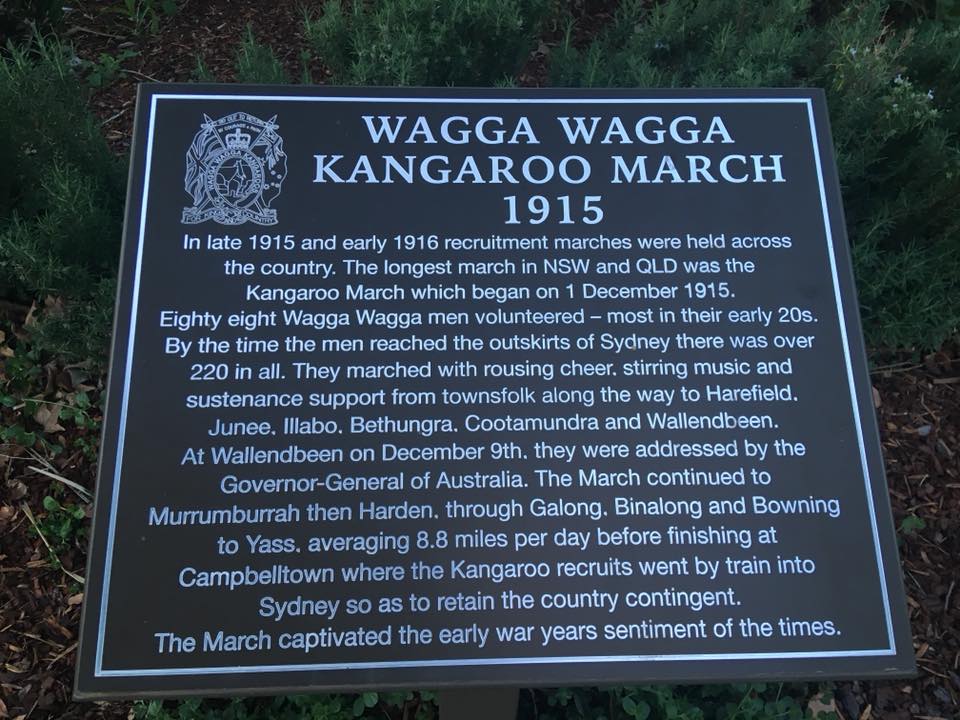
There was a second memorial, this one for the Wagga Wagga Kangaroo March during World War I.  It details the way recruits were rounded up and marched from town to town, with stirring speeches and music—as if they were going off to a festival, not a war.  The plaque didn’t mention how many of the recruits survived.

We drove on, subdued, and Heidi and Danielle played a mix of patriotic Australian music.  There was the beloved “I am Australian,” written and popularized by The Seekers.  Here’s one version, and here are the lyrics.

It acknowledges everyone who has contributed to making Australia Australia, including Aboriginals, convicts, and farmer’s wives.  The refrain is:

We are one, but we are many
And from all the lands on earth we come
We’ll share a dream and sing with one voice
I am, you are, we are Australian

Even the lyrics to the official anthem, “Advance Australia Fair,” are quite mild, extolling the beauty and bounty of the land—sort of like “America the Beautiful.”

Why does our American anthem have to be the very-difficult-to-sing, self-congratulatory ode to war, the “Star Spangled Banner” (rockets red glare, bombs bursting in air)?

“This one is about the kangaroo marches,” Heidi DJ’d as the next tune began.  “The Band Played Waltzing Matilda,” by The Pogues, has to be the most depressing song of all time.  These are the first two verses; there are three more that get progressively darker.

When I was a young man I carried my pack
And I lived the free life of a rover
From the Murrays green basin to the dusty outback
I waltzed my Matilda all over
Then in nineteen fifteen my country said Son
It’s time to stop rambling ’cause there’s work to be done
So they gave me a tin hat and they gave me a gun
And they sent me away to the war
And the band played Waltzing Matilda
As we sailed away from the quay
And amidst all the tears and the shouts and the cheers
We sailed off to Gallipoli

How well I remember that terrible day
How the blood stained the sand and the water
And how in that hell that they called Suvla Bay
We were butchered like lambs at the slaughter
Johnny Turk he was ready, he primed himself well
He chased us with bullets, he rained us with shells
And in five minutes flat he’d blown us all to hell
Nearly blew us right back to Australia
But the band played Waltzing Matilda
As we stopped to bury our slain
We buried ours and the Turks buried theirs
Then we started all over again

“Whoa!” cried Heidi, “Let’s switch gears!” and she popped on the actual old folksong, “Waltzing Matilda,” followed by “Down Under” by Men at Work, then a really stupid rendition of the Twelve Days of Christmas, Australian style.

It was dark now.  We stopped in central Wagga, got a pizza, and were eating it off the trunk of the car when all the power went out.

On the way to Albury, Heidi managed to find and book a motel on her phone, and at 10pm we pulled up in front of the Paddlesteamer Motel for the night.

Hoppers and Hunters and Kookas

The plan was to leave by 8am for Melbourne so we wouldn’t be driving in the dark.  However as things sometimes happen, we didn’t leave until 1:00pm so I had time to nose around the farm while Heidi and Danielle made sure Des and Hedy would be okay during the girls’ brief absence.

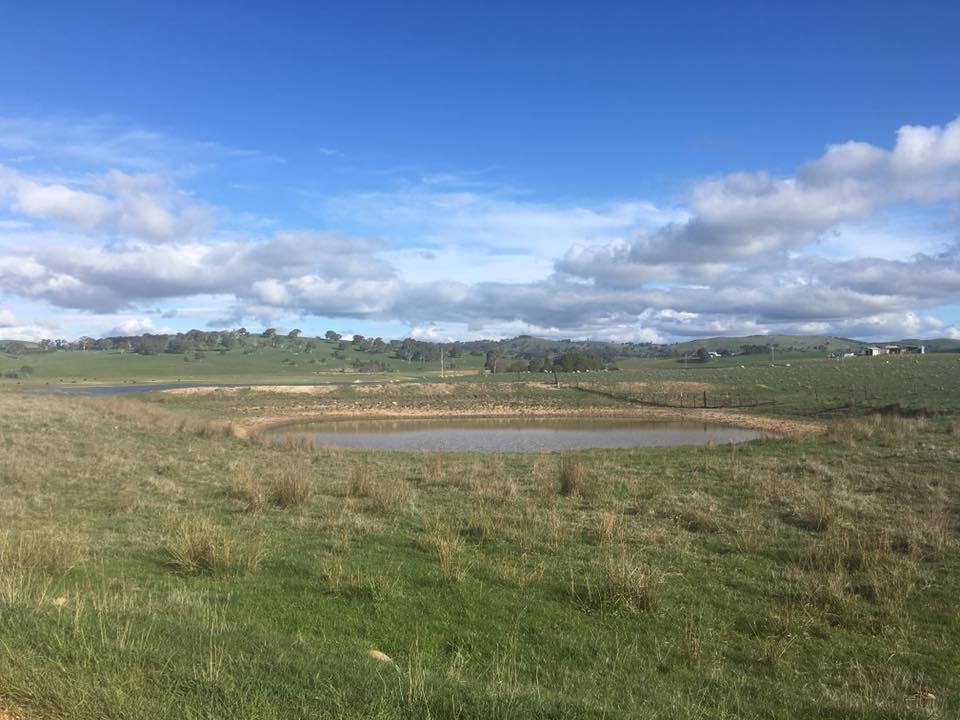
I ambled down the lane to the main road.  I gazed over the fields and thought, “This looks just like Minnesota.”

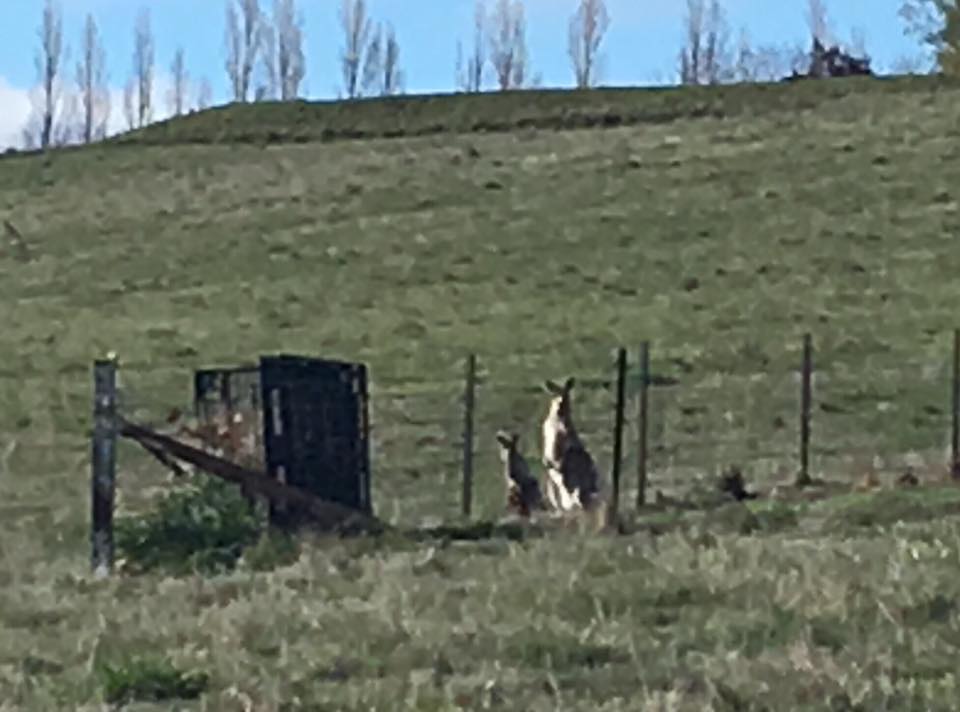
Except for the kangaroos.

I spotted this mother and her joey, and a couple other adults, and was entranced by the way they hopped.  It looks so inefficient and tiring.

Back in the house I reported my sightings to Hedy.  “They’re coming in closer and closer to towns and houses because of the drought,” she said.  “Last week I opened the blind on the kitchen door and there was a joey napping on the patio.  He looked up at me as if to say, ‘What are you looking at?’”

“There’s a Huntsman in the hall,” Danielle said casually, “If you want to see some proper Australian wildlife.”

Thankfully I am not afraid of spiders.

“Do you kill them?” I asked.

“Nah, we just let ‘em be,” replied Danielle.  “They’re good for hunting bugs, as their name implies.  That one’s been hanging around for a couple days.”

I walked around the house and noted the boxes of photo albums and strongboxes stored by the front door, ready to load into the car and spirit away in case of a bushfire.

“We keep the grass cut really short,” Heidi had told me.  “It’s not for appearances. It’s a fire deterrent.”

Scary stuff.  Australia routinely deals with deadly bushfires; the worst was the Black Saturday fire in 2009 that killed 173 people.  Two months after I returned home, we Americans would be watching in shock as the Camp Fire in northern California killed almost 90 people and nearly wiped the city of Paradise off the map.

As an aside, while reading up on fires I learned that the largest one in US history was in Cloquet, Minnesota in 1918—453 people died, 52,000 were injured or displaced, 38 communities were destroyed, and 250,000 acres were burned.

I admired the family photos on the baby grand piano, Hedy’s collection souvenir spoons from her travels, and shelves full of books.  I could easily spend a couple months here, curled up on the couch reading.

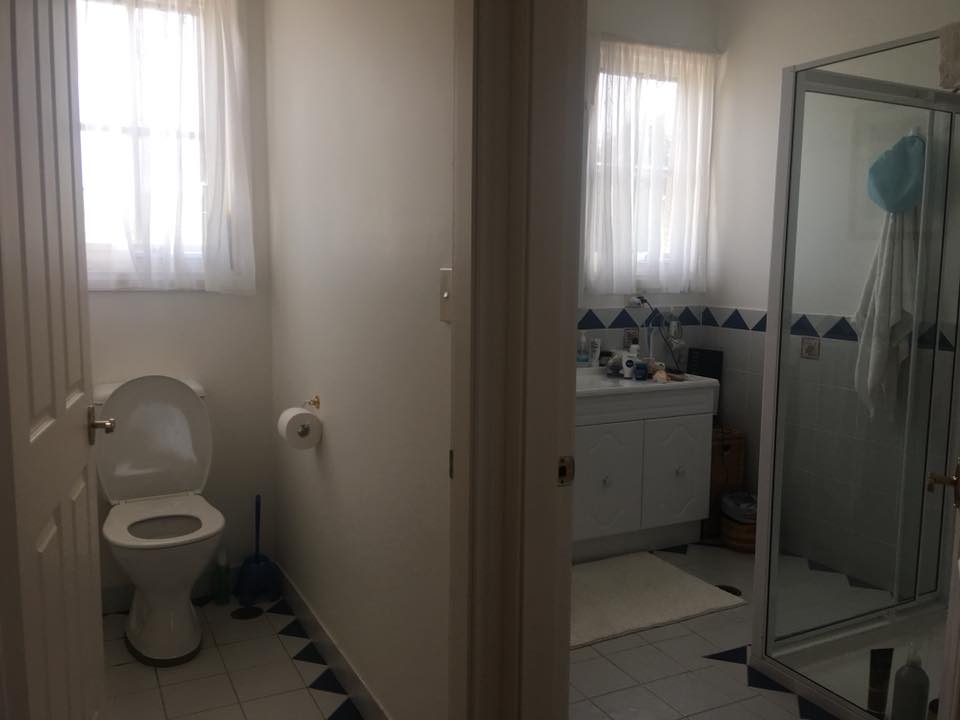
The only photo I took of the interior was one which illustrates an Australian oddity.  At least, it’s an oddity to Americans.

Yes, the toilet is in a separate room.  I don’t know what the thinking is behind this.  Entering this room removes any doubt about what activity you may be performing.  You are prevented  from running the water to cover up any awkward sound effects you may need to produce.  [And may I just insert here—Australian toilet paper is really thin.] Then, after you have finished, you have to exit the Toilet Room and into the Bath Room to wash your hands.

It ranks up (or down?) there with the Dutch toilet’s “viewing platform” and the English deep-bowl sound-enhancing toilet.

We made half a dozen stops on the way to Melbourne, but Facebook unhelpfully deleted almost all my photos.

Before exiting Blayneyshire, we cruised through the historic town of Carcour, population 200.  You will have to take my word for it; it was very picturesque.

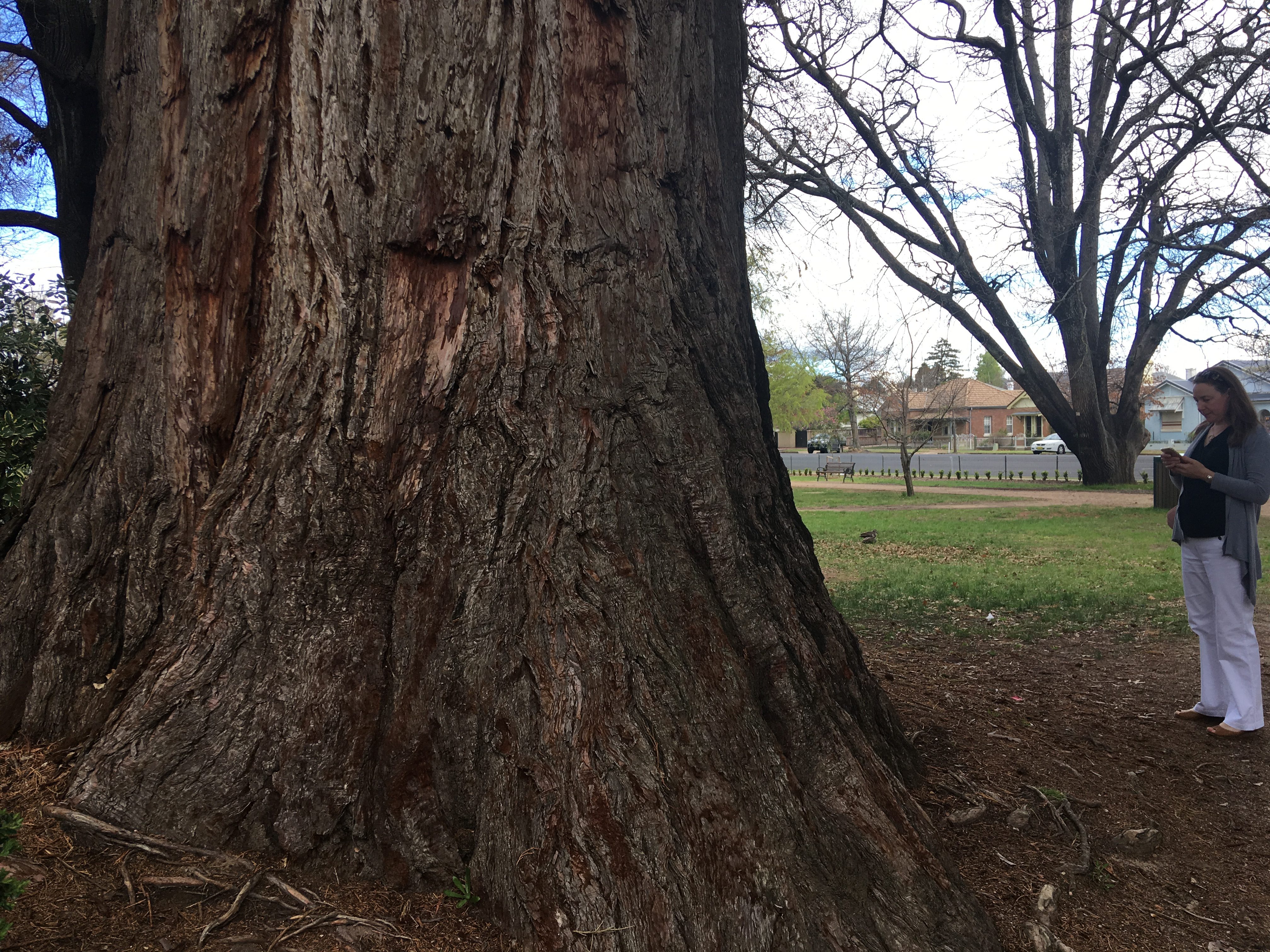
We stopped at several botanical gardens, since I had clearly established a reputation as someone obsessed with flora.  And why wouldn’t I be?  Here’s another massive tree.

GPS was intermittent, so there were some false starts and turns.  We passed Mandurama, Wattamondara, Koorawatha, Wombat, and Wallendbeen.

We stopped at a park in Cootamundra so I could receive a tutorial in cricket.  Cootamundra is the hometown of Donald Bradman, Australia’s most beloved cricket captain, and the park featured busts of every captain since the dawn of time.

Suddenly I was startled to hear insane laughter coming from the trees.  “My God, what is that!?” I called to Heidi.  It took her a few seconds to realize what I was talking about.  “Oh that?  That’s just kookas.”  Kookaburras.  Here’s a sample from YouTube.

Next stop: Wagga Wagga and the Sandrakan Memorial.

Bally Cotton

In the dark, the car headlights flashed onto a sign: Bally Cotton.  I went back and took a photo of it the next day.

“It was the name of the farm in Ireland Dad’s family came from,” Heidi explained.  Her dad’s family had been in Australia for several generations, while as I wrote before her mother had come as a refugee from Austria after World War II.

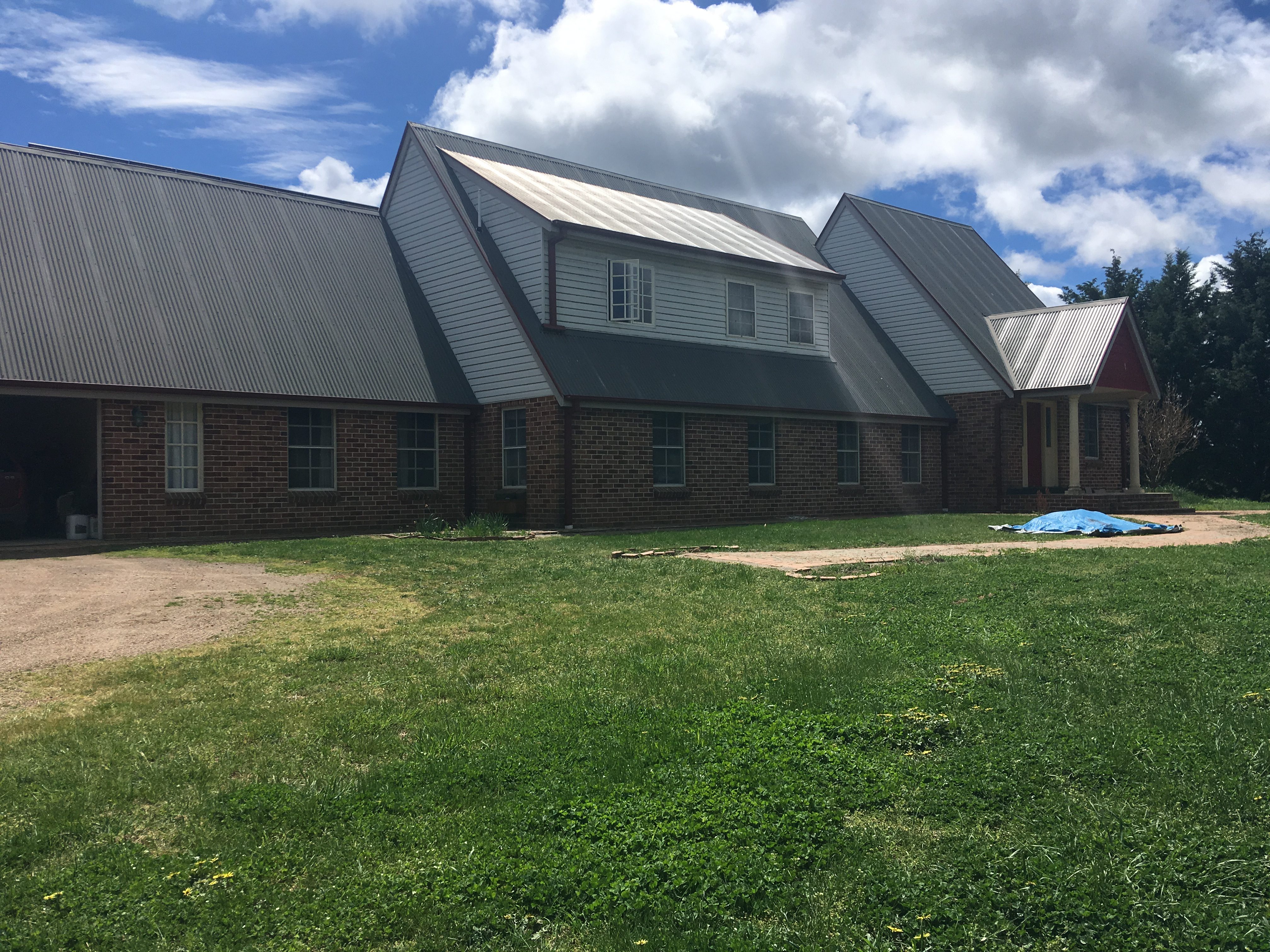
Her dad, Des, and her mum, Hedy, had met at work, at Commonwealth Bank.  Hedy had had to quit her job when she got married.  They had lived in a suburb of Sydney while Heidi and her sister Danielle were young, then bought this property and built their dream house. They had had cattle, but then health problems came and most of the land was now leased to a neighboring farmer.

One of the things that binds me with Heidi is that she and I are both supporting aged parents.  After visiting the farm, I will never again complain about having to drive 20 minutes to get to my mother’s assisted living facility, where there are no stairs, she gets three meals a day, someone does her laundry and gives her her medications, and she’s got loads of activities to choose from to keep her occupied.

Heidi makes this drive almost every weekend—it takes her four hours with no stops.  Danielle lives at the farm full time; it’s hard to imagine Des and Hedy being able to stay there otherwise because services just aren’t available—there aren’t enough home care providers and they would spend all day in their cars if there were.

Everything is a long-distance proposition, like getting groceries, going to the doctor, or getting an oil change.  “Blayney’s a dead town,” Heidi said.  “It had a movie theatre and a Chinese restaurant when we were kids, but then everything moved to Orange, another half hour away.”

Heidi pulled the car up into the driveway and we began carrying in our gear.  It was so dark we had to grope along the brick wall to the back door, which led to a gazebo.  Des was eating his supper and Hedy was doing what she had probably always done—cooking, cleaning, washing dishes.  They don’t use a dishwasher because it requires too much water.

I had met Hedy in London years ago and it was nice to now meet Des.  He’s had some serious health challenges uses a walker but his smile lights up the room.  Des and Hedy couldn’t have been more warm and welcoming.

Heidi showed me up to “my” room, which had been hers as a youth.  It was full of photos and mementos from high school and college days.

“But where will you sleep?”

“In with Danielle,” she replied.

“Oh you’re kidding!  Are you sure?  I could happily sleep on the couch. I could never share a bed with my sister—we both have the Restless Legs and we’d be kicking each other over the side all night.”

“Aw, no worries, Annie!  We both sleep like the dead.”

The next day was Heidi’s birthday.  We all went out for breakfast at a café.  When you have a parent who uses a wheelchair, a walker, or just moves slowly, you can’t be impatient or in a hurry.  I know this from transporting my own mother, and in my finer moments I think of the slow-motion process as mindfulness practice.

It was a cold, blustery spring day, but pleasant, sitting near a sunny window and reminiscing about Heidi as a child.

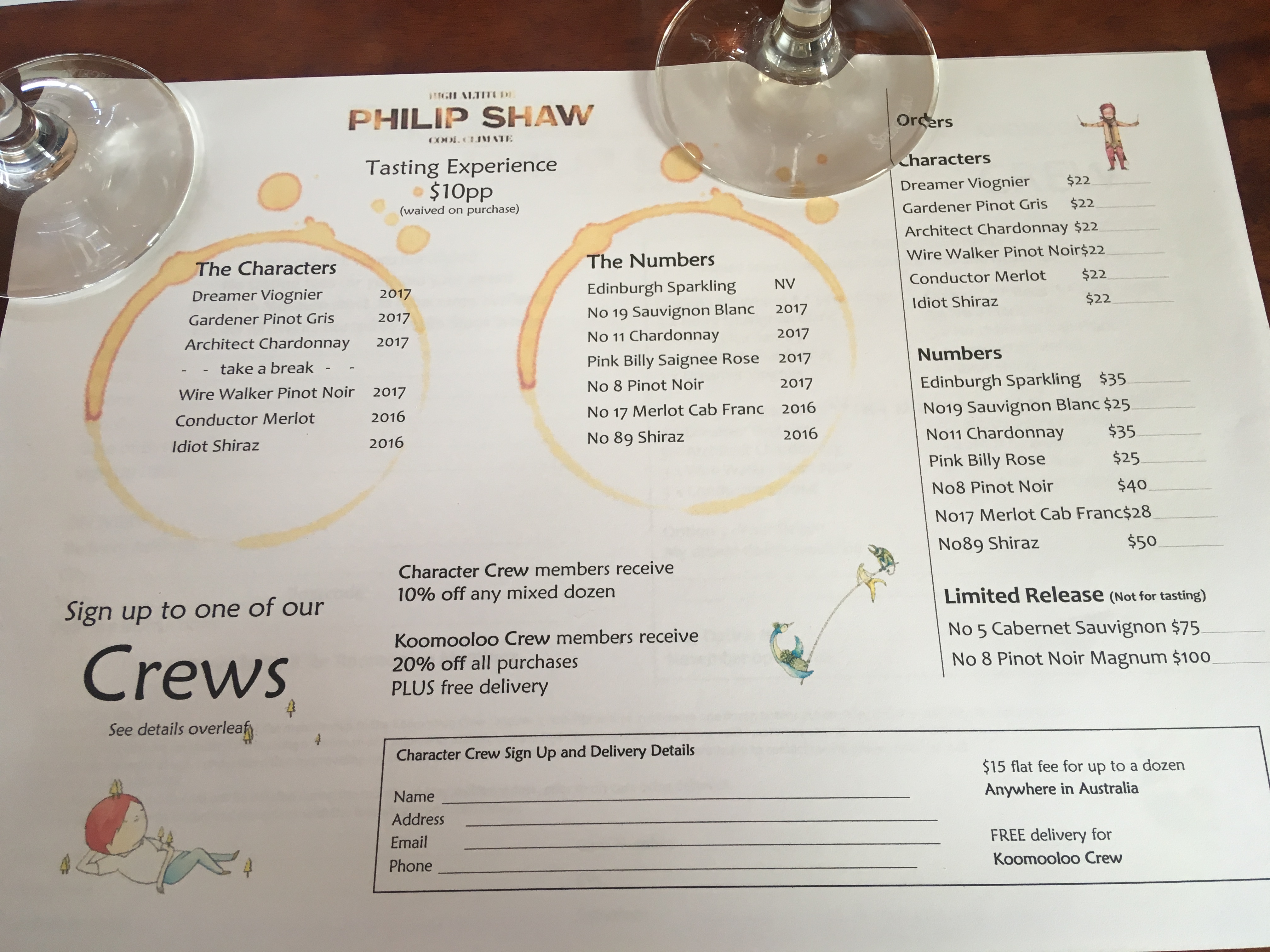
Next up for the birthday girl was wine tasting at Phillip Shaw, just outside of Orange.  We sat near the fireplace and there wasn’t a bad wine in the bunch.  They had a needlessly complicated system of characters and numbers which none of us could make any sense of.  I bought a bottle of champers for Heidi for her birthday, a bottle of red for Des and Hedy, and a bottle for the friends we would stay with in Melbourne.

We topped off the day with homemade stroganoff and a birthday cake, then turned in early.

Tomorrow we would hit the road again for the eight-hour drive to Melbourne.

Sydney to Blayney

Heidi and I would drive Auntie Margaret’s car to Blayney, a three—or five-hour—drive depending on the route.  Well, Heidi did all the driving, and thank goodness.  Someday I will overcome my phobia of driving on the left side of the road.  It’s on my bucket list.

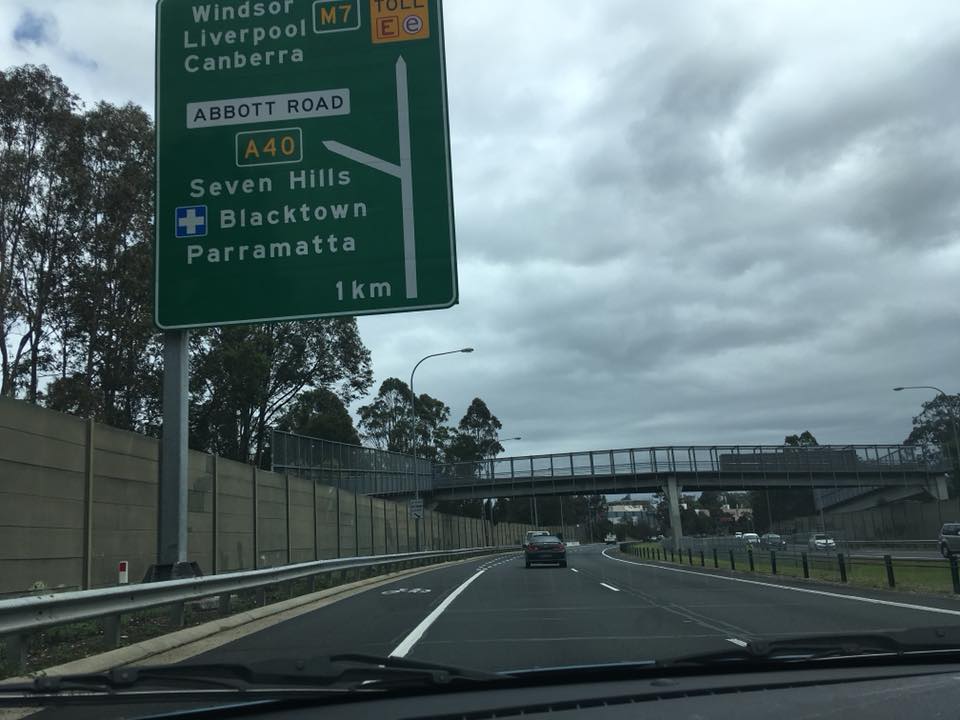
We headed northwest toward the Blue Mountains, passing English-sounding place names like Marsden Park, Liverpool, Londonderry, Windsor, Richmond, and Gros Vale.

Then there were the—presumably—Aboriginal names, like Paramatta, Winmalee, Berambing, Megalong, and Yaramundi.   We stopped in Kurrajong for a cup of coffee, then entered the Blue Mountains.

“If you roll down your window you can hear the Bell birds,” Heidi suggested.  Yes, Auntie Margaret’s car still has crank windows.  The bells echoed near and far in the forest of Blue Gum trees.  I would love to return some day and hike through to hear the bells without wind rushing by.

When I look at the map now, I’m amazed again by the distances.  There were no straight roads, so it didn’t pay to be in a hurry. Our next stop was Katoomba.  The main street was lined with head shops and cafes serving alfalfa sprout sandwiches but most everything was closed because it was late afternoon in the off season.

“Oh, sorry, our toilet is out of order,” said the owner of the one restaurant that was open.  “The public toilet is just down the block,” and he provided complex directions. Thankfully I had not been hydrating.  Heidi braved it, “And it was pretty much as bad as you would expect,” she reported.

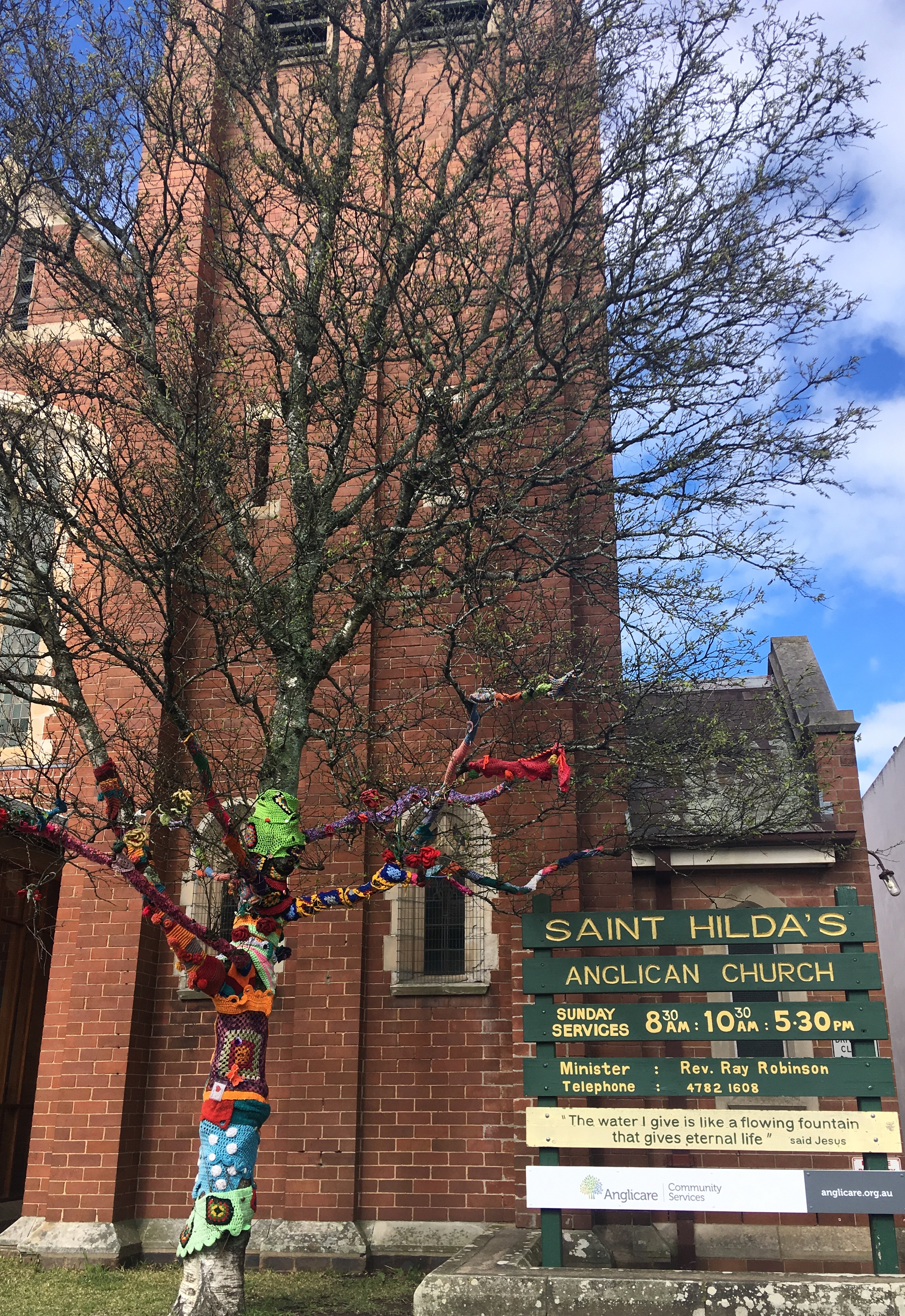
There was a church across the street with a tree out front covered in knitting.

I think Katoomba is probably a funky, fun town to visit in the high season.

Just outside of Katoomba was the reason we were there, the Three Sisters overlook.  My first stop was the toilet, and it made me wonder just who my fellow visitors would be.

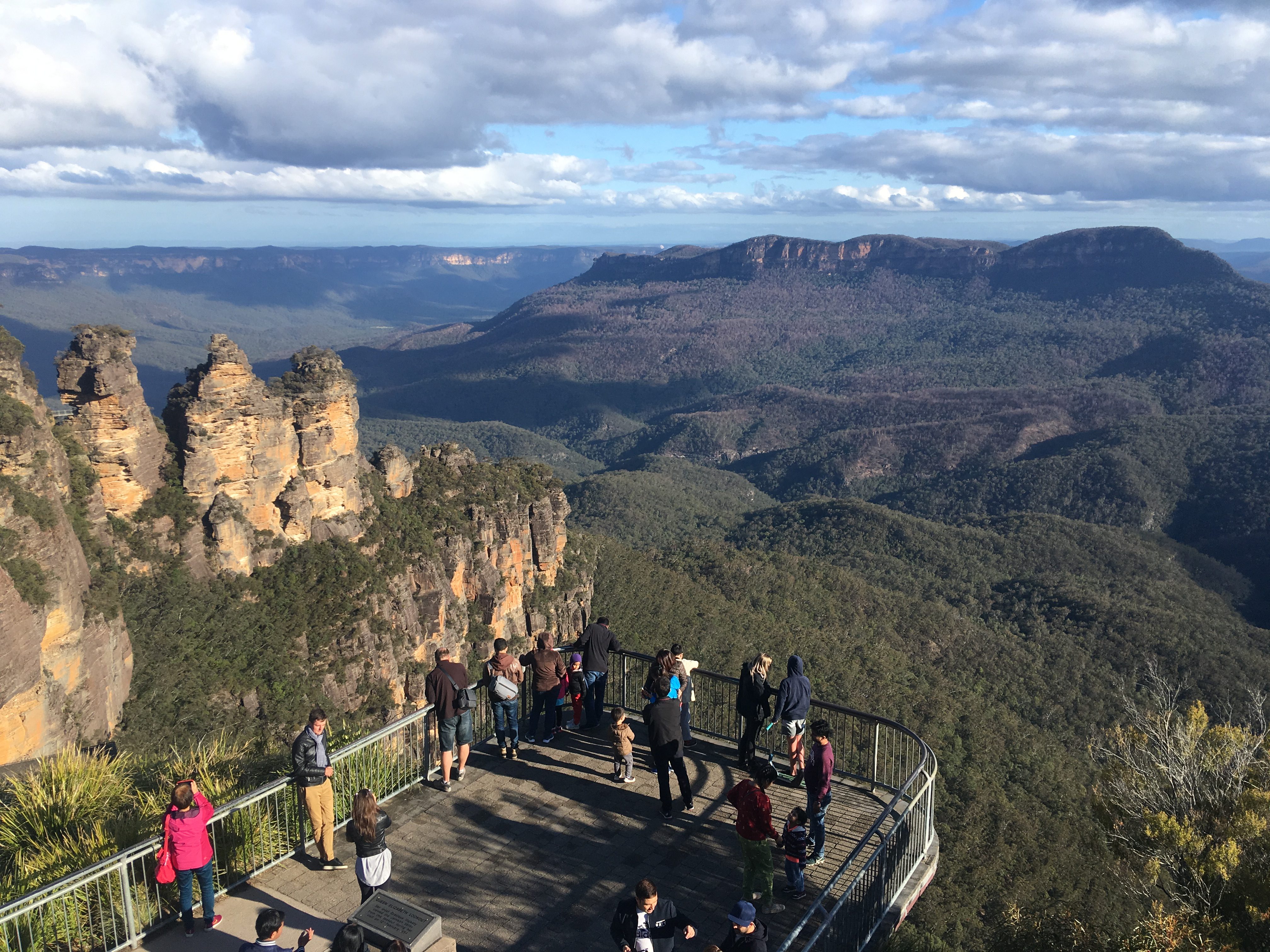
The Three Sisters is a geological formation overlooking a vast valley.

“Can you imagine?” I commented to Heidi. “The first Europeans crossing that valley?  It reminds me of the great north woods in Minnesota, where the Voyageurs came down through what’s now Canada, portaging their massive canoes, being eaten alive by mosquitoes. And they were just teenagers, basically, from poor farms in France and England and Ireland.”

“Yes,” Heidi replied.  “I think it was pretty much the same story here, except with lots of poisonous snakes and spiders and plants.”

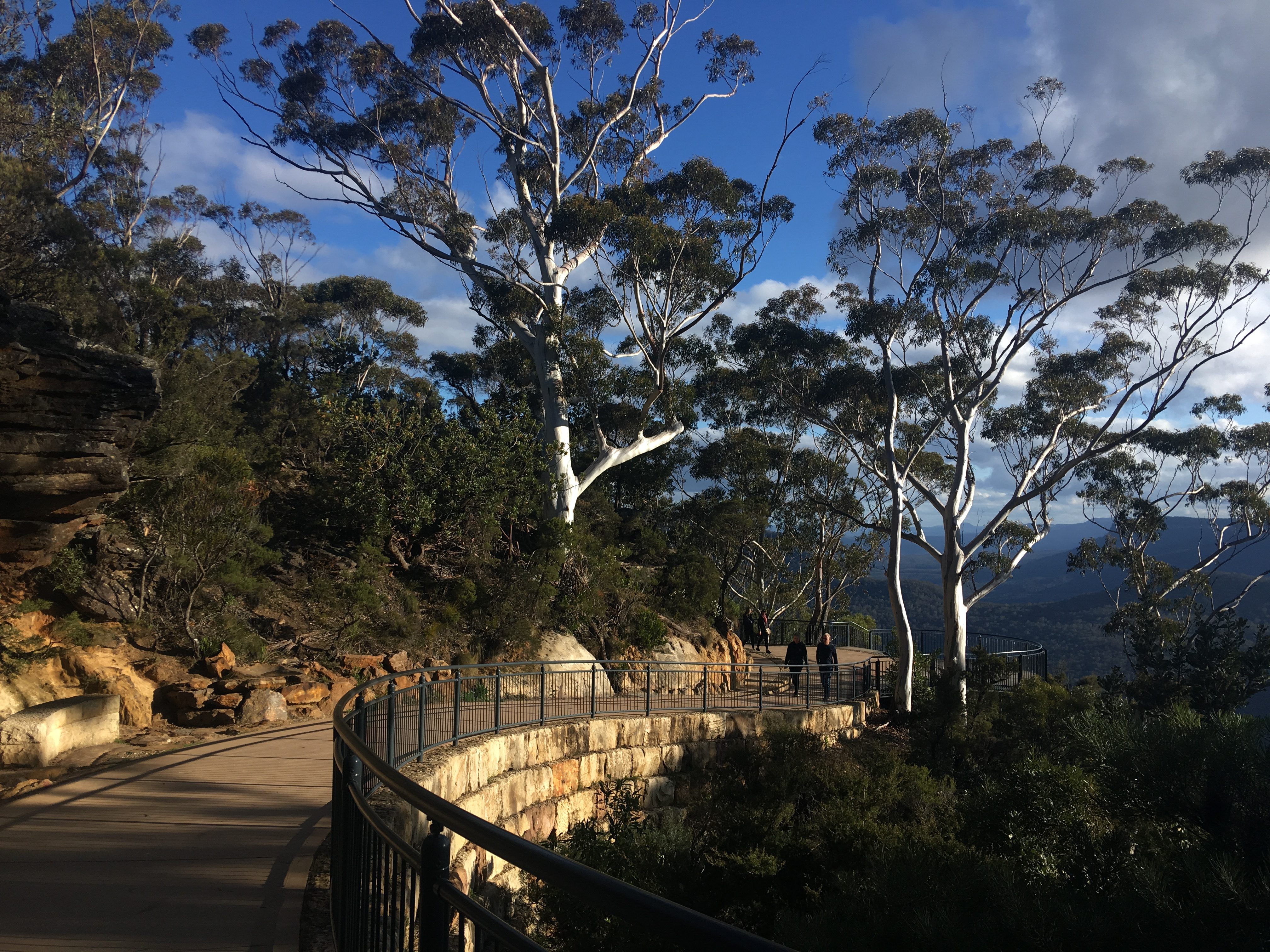
We took a short walk and the lowering sun threw luscious light on the gums and golden rock face.

We checked out another lookout, where a ranger who looked like Rip Van Winkle was being peppered with questions from visitors about the rocks, birds, and animals.  Most of the visitors were teens or 20-somethings from other counties and many were trying to get the perfect Instagram but they were also curious.  I know I will sound condescending when I say I found this heartening.

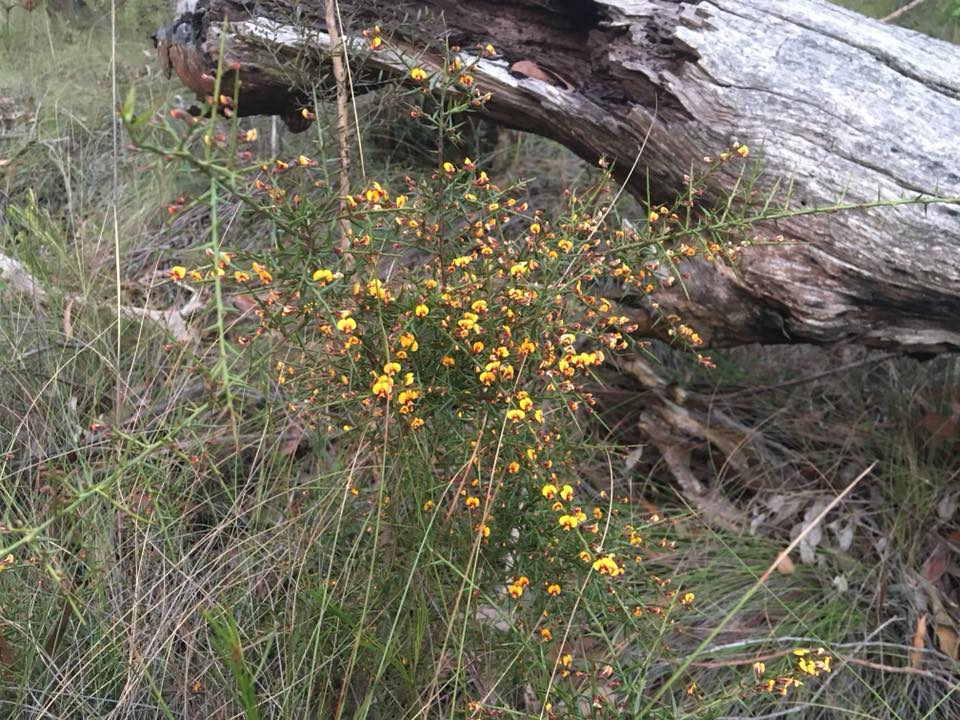
We drove on and took another scenic hike.  This turned out to be my favorite because the light made it all eerily beautiful.  There were these giant tulip-like flowers.

And these tiny ones.

“And I think these are Scribbly Gums,” Heidi pointed out a funny-looking tree that resembled an old man with scribbles on his skin.

“It’s getting dark,” she said.  “I don’t know how far the lookout is.”

“And it’s cold,” I added.

We turned a corner in the path and came upon a woman sitting on a bench. She was wearing sunglasses, and a parka with the hood pulled up around her face.

“Do you know how far the lookout is?” Heidi inquired.

“Noooot faarrrr,” the woman replied in a zombie voice.

We walked a few more yards, then turned back because it was getting too dark.  The woman was gone, and we never passed her even though we were hoofing it to keep warm.

One more stop in the Blue Mountains: The Hydro Majestic Hotel and Ballroom.

It was … well, deco-majestic.

Next time, I would stay the night.  We were tired and I worried about Heidi driving another two hours in the dark.

Alice to Sydney

“That was weird,” Heidi remarked as we walked on after talking to her student for a few minutes.  He was in the Red Centre for his school holiday, just like Heidi.

“You were just saying you could bump into Mr. Right around the next corner and then BAM, there was Griffin.”

“Next time I’ll specify that when I mention dating younger men I don’t mean teenagers.”

At the airport, we ran into Griffin again with his mum, who was wearing faux eyelashes.  Heidi chatted with them while I hit the gift shops to make sure I wasn’t leaving behind some important souvenir.

Then it was all aboard Flight QF791 to Sydney.  I couldn’t get the scene from the movie Rainman out of my head.  Dustin Hoffman’s character says to Tom Cruise, “Quantas never crashed.”  I couldn’t help it, I had to say it aloud to get it out of my head.  Heidi smiled indulgently.

Heidi queued up a podcast for me on her Aussie phone (as opposed to her UK phone).  I had never listened to a podcast before. I know they’re extremely popular and that the cell phone zombies all around me with earbuds in are probably listening to them.  Heidi, who spends so much time commuting, says they’re a God send.

Lost in Larrimah is a about a town of 11 people in the Outback from which one person goes missing.  It was how I learned the phrase “hooning around,” (hanging out) one of my favorite Aussie slang terms.

Sydney was cold and rainy.  The train was packed; a couple from Melbourne who were touristing in Sydney struck up a conversation with Heidi while I pretended to be extremely interested in a mobile phone advert on the wall to their left.

When Heidi mentioned we’d be driving to Melbourne in a few days, they started rattling off sights we had to see.  “Aww, you have to go see the blah blah blah!” and “You have to go see the blipplity doo doo.”  They even began providing web site addresses and street directions.

Am I the only one who finds this irritating?  Heidi was nodding pleasantly but noncommittally.  Sometimes I think I need to go live in a mountaintop cave with no human contact for a couple months to reset my tolerance for strangers.

I had topped up my Oyster card with $35, but it was minus $2 by the time we reached MacMahon’s Point.  Now it was Heidi’s turn to be irritated. “I know Sydney transport is stupidly expensive, but that just can’t be right!  I’ll call them tomorrow and fight it.  There has to be some mistake.”  She did call them eventually and spent forever being transferred and kept on hold, but got the money back.  Bravo, Heidi!

Auntie Margaret had left a bottle of cab sav for us and we partook of it while Heidi made spag bol.  Then we watched the journos on ABC and went to bed.

In the morning Heidi had to do some very thoughtful packing—she would be here, in Blayney, then Melbourne, then Canberra and possibly back in Blayney, then back to Sydney but she wasn’t sure where she’d be staying for Sydney Part II and she needed clothes for work, home, and traveling—all in the smallest bag that was not a carry on.

“I’ll go for a walk to get out of your hair,” I said, and Heidi showed me something called Wendy’s Secret Garden in nearby Lavender Bay.  She handed me her Aussie phone with the place mapped on it.  “It’s a real jumble around here,” she said.  “It looks close but it’s easy to get lost.”

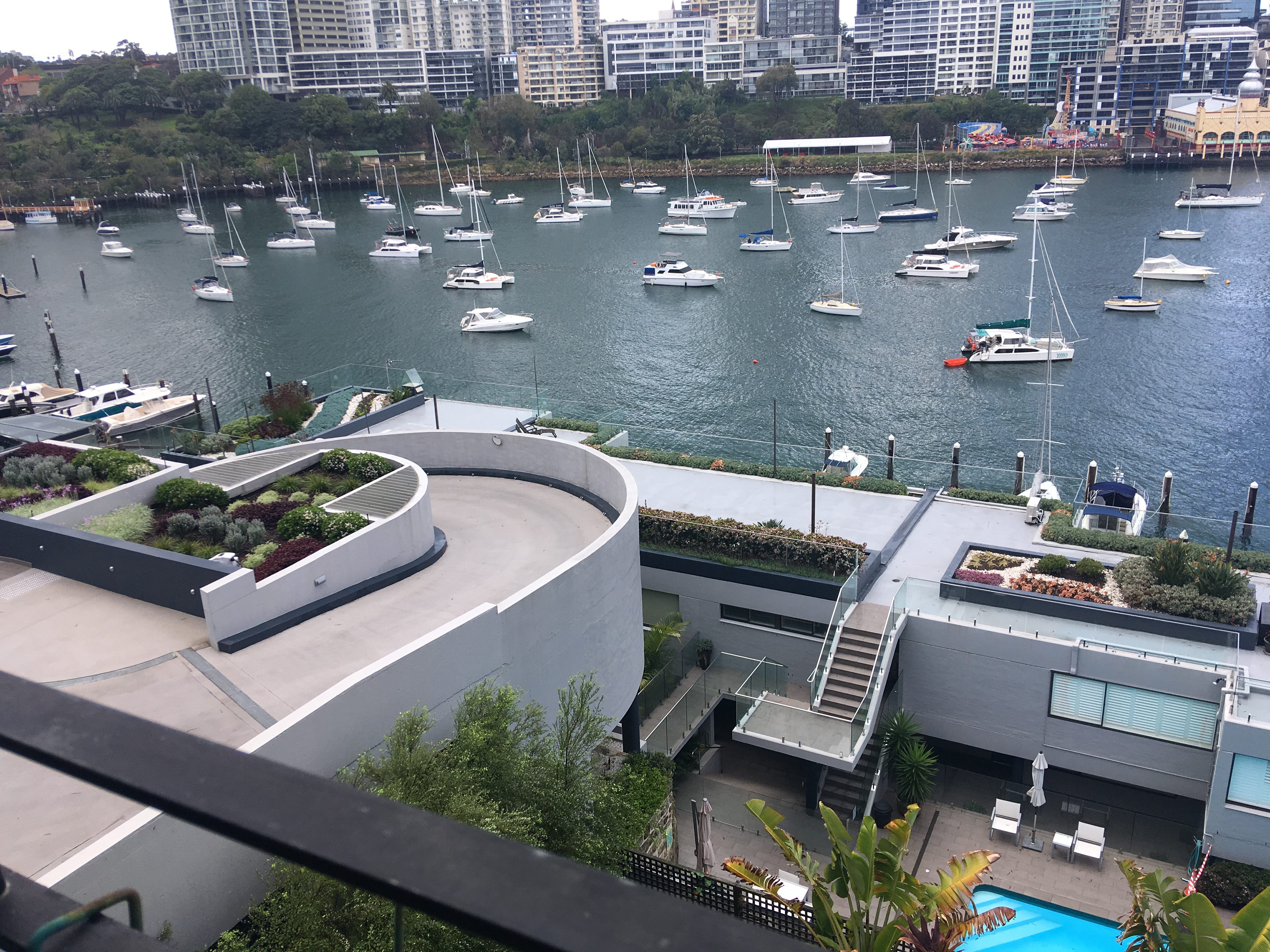
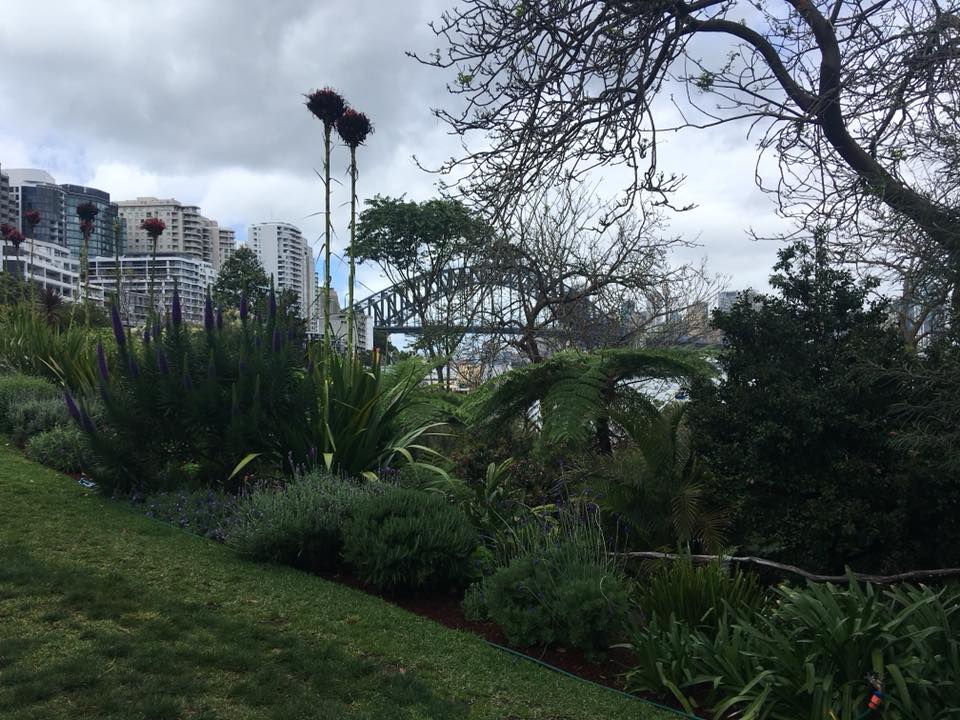
And I did get delightfully lost in the maze of alleys and dead-end streets below Auntie Margaret’s flat.  If I hadn’t, I would have missed views like this.

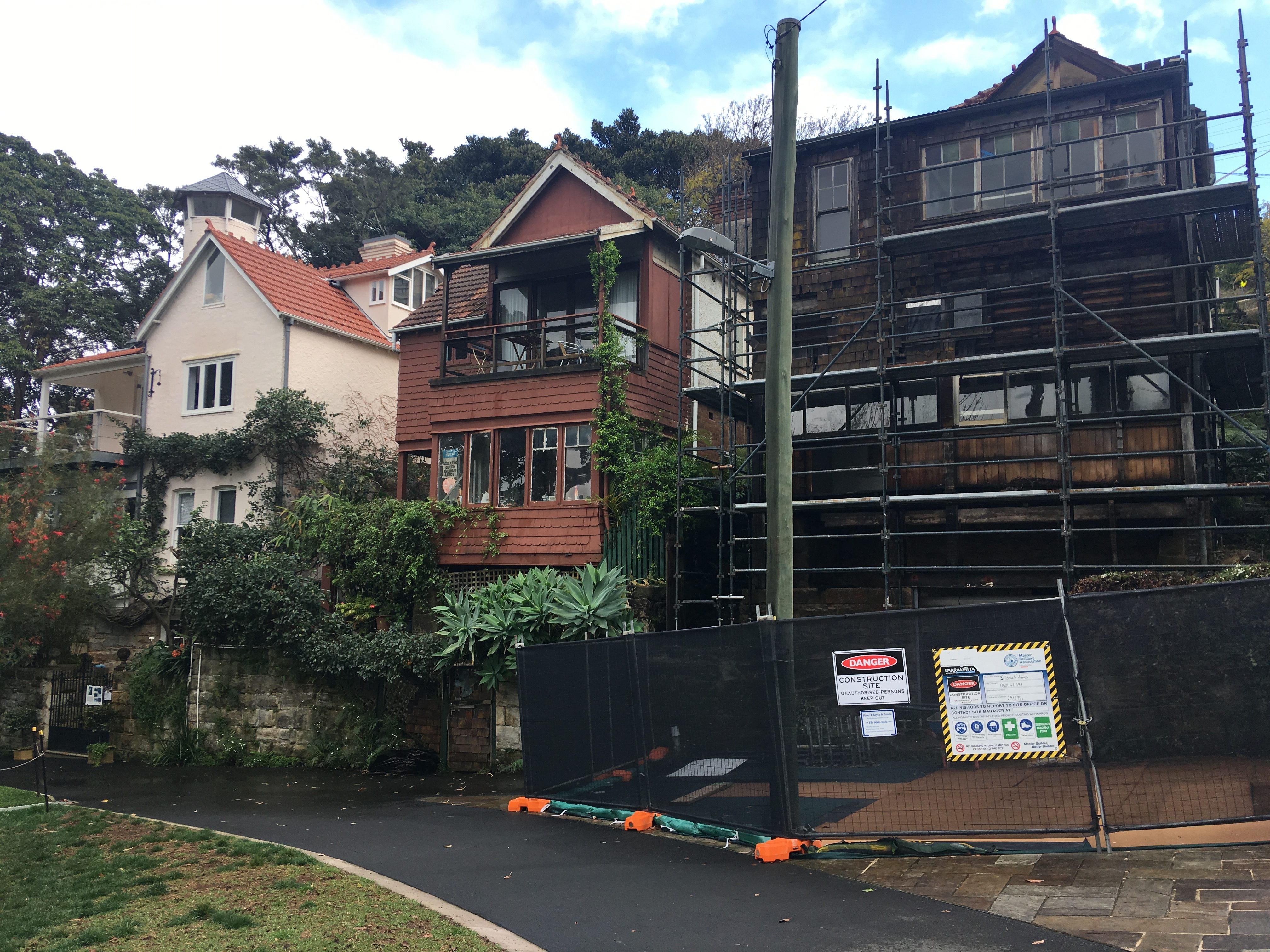
There were lots of renos and new construction going on, adding modern houses into gaps between older ones.

I passed a construction worker smoking a hookah.

The garden had been founded by Wendy Whiteley after her husband Brett, a famous artist, died.  It was all maintained by local volunteers.

Had I inhaled?  No, the garden really was magical.


Convos

Heidi and I watched The Bachelor finale, then looked at each other wordlessly as the credits rolled.

“Right!” she exclaimed as she leaped up.  “Looks like we’re not gonna make it to the laser light show, so it’s time to watch that Aussie slang video I’ve been meaning to show you.”

We watched two Aussie guys rattle off slang, like:

Reno—house renovation

Eggs benny—obvious

Salvo—Salvation Army

Sweet pots—sweet potatoes

Spag bol—spaghetti Bolognese

“I noticed one of your Lebanese coworkers referred to herself as a Leb—would it be okay for you, as a non-Leb, to use that term?” I queried Heidi.

“Hmmm…it could have a negative connotation … I think Leb is worse than Lebo, but personally I would avoid both just to be on the safe side.”

“And do you call Aboriginals Abos?”

“No!” Heidi said emphatically, as if I had used the N word.

“We make up new ones all the time,” she looked at the list of abbreviations I was compiling.  “We call the PM Sco Mo.”  Prime Minister Scott Morrison.

There were other Aussie slang bits I learned later, on my own, like that a squatter is not someone illegally taking over a property, but a property owner, and a bush ranger is not a forest ranger, but an outlaw.

Our convo (see how I did that?) pivoted to some old TV shows that had been on in the UK during our time there.

“I saw Jonah from Tonga in Scotland late one night,” I said.  “It was so shocking—the most politically-incorrect show I’ve ever seen.  I thought maybe I was having a dream.”

Jonah from Tonga—in which 40-year-old white Australian comedian Chris Lilley plays a 14-year-old Tongan boy, in brown face.

I continued. “If you replaced Tongans with Native Americans or African Americans and showed it in the US, the stereotypes would have people rioting in the streets, demanding it be axed.  The F bombs alone would make sure it would never air.

“That said, I thought it was really funny—maybe in a ‘Borat, I’m so shocked I’m having a knee-jerk laugh reaction kind of way.’”

“You should watch his first show, Summer Heights High,” suggested Heidi. “Chris Lilley plays Jonah, and a gay drama teacher, and a posh exchange student from a private girls’ school, and it’s hilarious.”

As it happened, the next show after The Bachelor was Black Comedy, a sketch show written and performed by Australian people of color. It was clever, but not shocking or side-splitting.  Maybe I was too tired to appreciate it.

At brekky the next morning we talked about dating.  We’d both received much unsolicited and often conflicting advice from well-meaning people:

You’re trying too hard.  When you stop looking, He will appear (He, always pronounced as if the “he” in question is God)

You’re not trying hard enough.  You should try (fill in the blank) speed dating, shopping at the most expensive grocery store in town, late at night, in heels; hanging out in coffee shops/libraries/sporting events/hardware stores; trying dating apps/sites, etc.

You’re too picky.

You’re not picky enough.

Don’t try to be funny. Men don’t like women to upstage them.

Men love women who make them laugh, so act cheerful and tell jokes.

Once you resolve all your issues, He will appear!  (Some of the most f-d up people I know are married.)

Find someone who has similar issues to yours so you understand each other.

You travel too much.  You should stay put so you’ll meet someone local.

You should go work in a refugee camp so you can meet a doctor.

You’re young looking and acting, so date younger men.

Men are only interested in younger women, so date older men.

Take up snowmobiling, even though you aren’t into it.

Pursue your own interests so you’ll meet men you have things in common with.

Maybe, unconsciously, you don’t really want to meet someone.

“I hate that one,” I said to Heidi as we got up to leave, “Still, it could happen—you could turn a corner and bump into Mr. Right.”

And just as we turned the corner there stood one of Heidi’s 17-year-old students.