Tag Archives: codependency

Boring but Important

ANNE

This blog touches on a lot of issues related to imprisonment, like addiction, drug laws, mental illness, and intergenerational poverty.  One thing I’ve been meaning to address is class, and historically, a four-year college degree has been the way for Americans to propel themselves from the “working class” to the middle class and beyond.

We talk a lot about race in this country, but we like to think we’re a classless society because we don’t have a monarchy.  We also like to believe that in America, anyone can overcome poverty to become a millionaire if they just work hard enough.  It’s exactly because of this myth, I think, that our class divide is so hard to overcome, because we don’t acknowledge that it exists or that the deck is stacked against many people.

I learned a lot about college financial aid and admissions by working at a consulting firm that specialized in enrollment management for private colleges.  What we did was this: our clients would send us the data on their freshman applicants, we would analyze it, then tell them which applicants to accept and how much money to offer them to come.  These financial “awards” were really mostly just discounts to entice desirable students to come to a particular college.

When we analyzed the data—no matter whether it was Occidental College in L.A. or Loyola University in Chicago or St. Olaf College in Northfield, Minnesota—there was one thing that students with the highest grades and test scores had in common.  Race?  No. High school attended?  No.  These things were factors but really it all boiled down to parental income.

Colleges often offered discounts to the richest families.  They call these awards things like “Presidential Scholarships” in hopes of flattering parents and beating their competitors.

Why do kids from high-income families do so well?  It’s not rocket science.  They have grown up in safe, lead-free homes with toys and books.  They went to preschool and well-resourced elementary schools.  Their parents attended every parent-teacher conference and made sure they did their homework.  They went to summer camps in the Adirondacks where they were on a lacrosse team, were immersed in French, or learned to play the marimba.  Colleges love these well-rounded students.

Wealthy families can also afford SAT/ACT prep classes.  They can afford to fly/drive to campus visits to the remote, pastoral towns where the most exclusive colleges are located.  They can hire tutors and college admission coaches.  These coaches do a brisk business in helping kids write the perfect application essay and advising parents on which colleges will give the biggest discounts.

But sometimes I think the biggest factor in driving kids toward academic success is that wealthy parents have expectations of them.

I don’t recall anyone having expectations of me, or talking to me about college when I was 17.  They may have, but I was so busy partying that I may not remember.  Our neighborhood was blue collar—every mom was a housewife and every husband was a car mechanic, a roofer, or worked in a can factory.  The only reason I even knew what a college was, was because there was a Catholic college nearby and my aunt had married a professor—the one “white collar” guy on the block.

Yet I knew I didn’t want to work in a can factory or be a housewife, and that college was my ticket out.  I applied to one college—Bemidji State University.  Bemidji State is in an extremely poor part of northern Minnesota near the White Earth Indian reservation.  It has a 90% acceptance rate and a 17% graduation rate (compared with around 7% and 99% for Harvard).  All I knew was that it sounded as far away from home as anything I could imagine.

By the time I got my acceptance letter, I was pregnant with Vince.  I wrote “deceased” on the envelope and threw it back in the mail.

I sometimes wonder what trajectory my life would have taken if I’d had some guidance about college, but on the whole I’ve made the best of it and have had a great life.

Small Comfort

VINCE

My squad mates made it official.  I will be the caller for the graduation march on September 8.  It’s a good feeling.  I’ve been working hard in many areas including marching in our squad formation.  It’s tough to get 17 men to turn at the same time on the correct foot, while singing our cadence.  But I know I’ll do well.

Yesterday I worked K.P. (kitchen duty) for only the third time since my arrival.  I didn’t go as much as most people because I’ve had a job that interfered with the scheduling…blah, blah.

I actually enjoyed it.  I worked about 14 hours in the back of the kitchen.  They were excited to have somebody that knew what he was doing.  I got to use the big Hobart slicer and was happy to discover that I still had good form.  And, I did not cut any fingers off.

This morning after our run we came back inside our barracks to discover that it had been “inspected.”  It happens about once a week.  If anything is wrong, they take the drawer out and empty it out on the bed.  In my case, I didn’t roll one of my underpants correctly so I had to re-fold my shirts, socks, sweats, and undies.  I’m usually one of the few that doesn’t get flipped but I knew I had been slacking for a few days.  It was just a little friendly reminder.

Flag detail is going well.  I’ve been on it three times and we haven’t dropped it.  I was the safety today.  My arms stay under the flag while it’s being folded.  It’s pretty cool.  I always wondered how the flag was put into such a nice triangle.  Now I know.

I’m I study hall right now.  Every Mon, Wed, and Fri we get an hour at night where everybody is quiet.  So quiet.  I can’t wait until I’m able to just go find a quiet place—and read, write, or do nothing at all.  I can’t wait to sit in a comfy chair and kick my legs up.  We have to sit straight up with the entirely of the bottom of our boots flat on the ground.  All day.  Every day.  Well, I mean when we’re sitting.

[ANNE: I received a postcard from Vince informing me that my last three letters to him had been destroyed.  There was an explanation given for only one: it had contained an image of a website.  All I could think of was that he had been urged to ask me for a list of AA meetings in our neighborhood, and I had copied a list off of the AA website, printed it, and mailed it to him.  I checked the Department of Corrections website and it said nothing about images of websites not being allowed in letters.

Man, was I upset!  Especially since I have an upcoming visit with Vince–the first in eight months.  Did they know about the blog, and were they pissed off about it?  Did they just not like the content of my letters for some reason?  Or was it totally capricious?  Would they find some reason to deny me a visit, after I drove for two hours to get there?  Would I be able to keep my mouth shut if they did?  I don’t have answers to any of these questions.  All I can do is try my best to suck it up if the guards give me any grief.  Trouble is, I am really bad at kowtowing to authority.]

Prison News Round Up Part II: The Good News

ANNE

In the same weekend as all the depressing news stories I listed two days ago, there were these two uplifting ones.

The Week published an excerpt of this article in Runners World.  Yes, Runners World—about a program at the Oregon State Penitentiary that allows outsiders (even women) to go inside and run with prisoners.  They even race half marathons.  For some inmates, the outside runners are the only visitors they see.  I am not a runner, but I’ve always been an exerciser—I go nuts if I skip my daily walk and I’ve been pretty faithful to weight training for 25 years.  I swear by exercise as the best medicine for everything from depression to anxiety to all sorts of physical ills.  So way to go, Oregon!

Second good news article: The good old New York Times can be depended on to run something about America prisons almost daily.  Usually it’s extremely depressing, but this past weekend there was this one about dogs in prisons that will make you dog lovers out there weep.  It made me weep, when I got to this line: “One older inmate cried when he met his puppy. ‘I haven’t touched a dog in 40 years.’”  It made me wonder how heart-wrenching it must be when these guys have to turn their dogs over after they’ve been trained to detect bombs, which is what the program does.

Vince and I wrote about the dog-training program at Moose Lake, where he was before boot camp.  Only about six prisoners out of a thousand get to participate, so it sounds good but it’s not exactly at scale.  As I’ve mentioned, I do foster care for kittens through the Humane Society.  Every day from about April through August, I get dozens of emails a day from them looking for fosters for cats and kittens.  Below are just two photos from the 13 emails I received today.  For some reason the world doesn’t seem to be flooded with stray puppies or dogs so much, except those taken in from domestic violence situations, which require months of special care.  Could it work to have prisoners foster kittens?  Is that a cray-cray or a win-win idea?

478cfb96-ca59-41c4-88e8-4f7206e744d1Kittens

I got some good news—my visitor request was approved!  That means that after I get home from Berlin I can visit Vince.  By that time, it will have been eight months since I’ve seen Vince.  The ban was for six months, but due to me being denied a visit, and to two chunks of international travel, it’s stretched out to eight.  And yet on every visitor application and in the information for families that the Department of Corrections publishes online, they tout the importance of family connections.  Ha.

Prison News Round Up

ANNE

I am leaving for Berlin in two days, so I’m going to review a pile of prison-related articles that I’ve accumulated—over a period of one weekend—that’s how often prison is in the news.  I’ll give you the downers first, then the positive ones.

Ohio is having trouble obtaining drugs used to execute people, so the Ohio DOC has obtained an import license from the Drug Enforcement Administration to buy sodium thiopental and pentobarbital from overseas.  Wow.  Where overseas, I wonder?  They “decline” to name the countries.  I’m thinking China, North Korea, Iran, or Yemen, since these are our fellow members of the death penalty club.  In case that doesn’t work, Ohio legislators passed an “execution secrecy law” (I am not making this up) in hopes it would get small-scale drug manufacturers called compounding pharmacies to sell them the drugs.  These are unregulated companies that have been in the news for sickening people with contaminated pharmaceuticals.  But hey, if you’re trying to kill someone, who cares what the quality of the drug is?

In Wisconsin, there is a prison guard shortage that has prompted two correctional facilities to call in guards from other institutions and pay overtime.  So let me get this straight—we pack our prisons full of nonviolent drug offenders, which costs us taxpayers an arm and a leg, then we have to pay overtime to get guard coverage, which costs us more.  Great system!

Which leads me to this editorial in the Minneapolis Star Tribune, “Finding solutions for overcrowded prisons.”   I like the opening line: “Either Americans are the most evil-people on Earth or there’s something terribly wrong with their criminal-justice system.”  They mention something that’s news to me: “It’s a stretch to suggest that the bloated prison population is due mainly to the sentencing of nonviolent drug offenders.  It’s not.  Most of the increase comes from locking up greater numbers of thieves and violent criminals and keeping them behind bars longer.  Even if all nonviolent drug offenders were set free today, the prison population of 2.2 million would drop to only 1.7 million … Still, on the margin, granting early release to nonviolent offenders and shortening sentences to better match crimes seems a sensible step….”

This information is new to me, and I wonder why I haven’t read it elsewhere.  Everywhere else, the narrative is that, if we just release all the nonviolent drug offenders, our prison population will be drastically reduced.  But if there are more violent criminals in America than elsewhere, maybe we are the most evil people on earth.

Still, 2.2 million total prisoners minus 1.7 million nonviolent drug offenders is 500 thousand people—not insignificant.  And when you figure it costs (on average) $31,000 a year to keep someone in prison, that’s over $1.5 billion a year.

On the same day, there was this feature article about Damon Thibodeaux, an 18-year-old who was wrongly convicted of rape and murder who spent 16 years on death row before being exonerated and freed, in large part due to the efforts of Minneapolis attorney Steve Kaplan.  Thibodeaux had been raped and beaten on a regular basis by his step “father” since the age of five and so he was easily bullied and manipulated into confessing to the crime.  It’s a heart-rending story, but it has a happy ending.  As I’ve written before, an important element of recovery from anything is feeling that you belong.  And Kaplan has gone the distance to help Thibodeaux adjust to life after prison by including him in family and other social gatherings.

And there was this little factoid in The Week: that every day, on average, a dozen people die behind bars.  The leading cause?  Suicide, in local jails; cancer elsewhere.

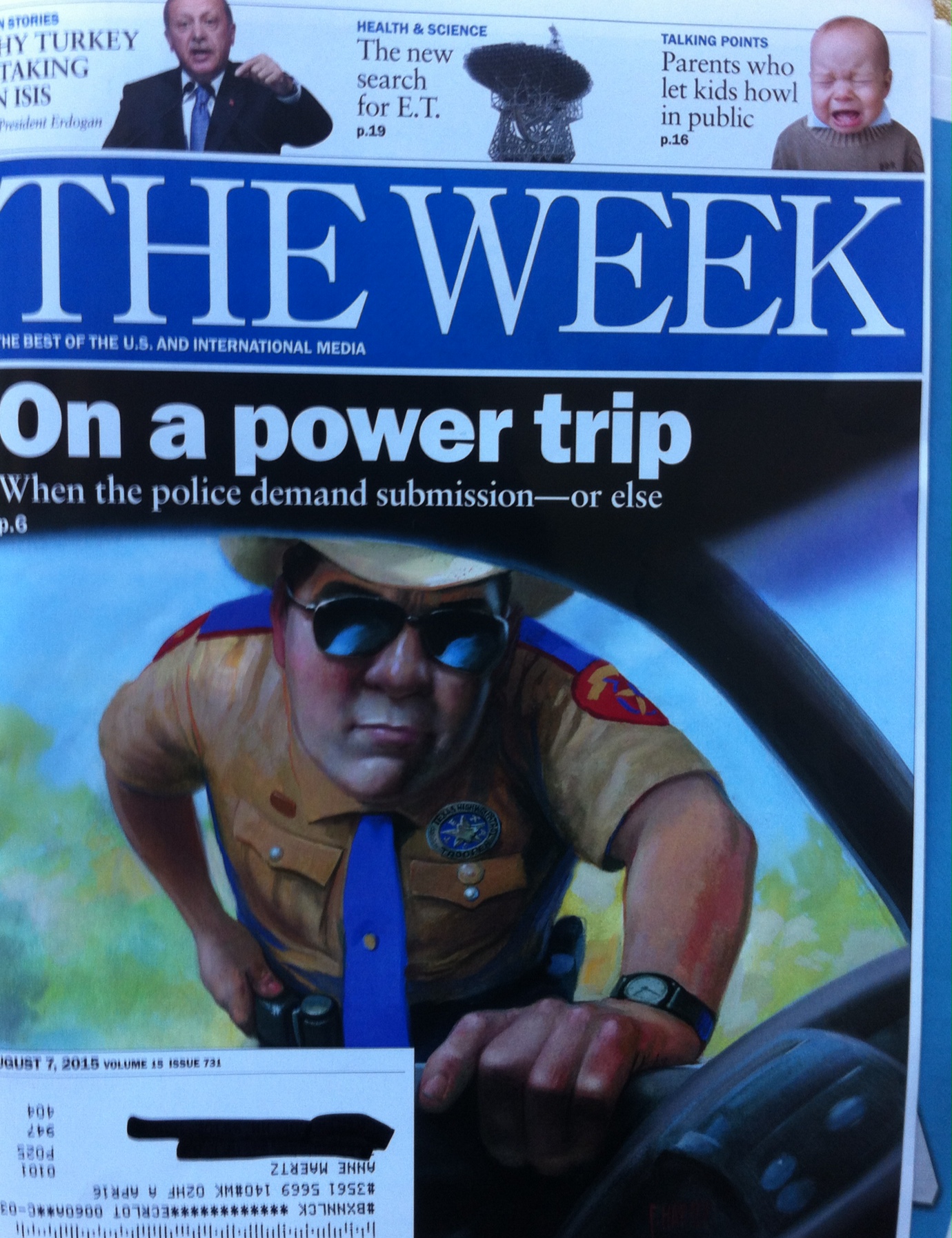
Below are some prison-related images.  The bully one made me shudder, because it’s how I felt when I was kicked out of Moose Lake for wearing “revealing clothing.”  It wasn’t about my clothing; it was a power trip.  Related to that is an interview with Richard Zimbardo, who led the Stanford Prison Experiment in which students were assigned to be prisoners or guards.  The “guards” quickly became sadistic.  “I lost my sense of compassion, I totally lost that,” said Zimbardo.

Next time, the good news.

DesktopBully

Pistoled Off

VINCE

A curious thing happened last night while we were all sleeping. There was a large boom. That is all we have been able to come up with. An incredible, loud boom that woke up everybody in all three barracks.

From where I lay, I could not see a clock. And even if there was one in my view my glasses were stored for the night. I could tell right away that everybody else seemed spooked. None of the usual elements associated with a noise you can feel were present. No soft tapping of rain on the roof. No creaking of window frames from wind. No random bright flashes of light. And no fading echo of thunder.

We do know that somewhere nearby is some sort of military facility. On occasion I’ve seen those gigantic helicopters with the twin propellers flying by low, enough to get our attention. So that is possibly the source of last night’s disturbance. Nobody here knows what a sonic boom sounds like so here we sit confused. That’s the whole story, I hope somebody out there can tell me with certainty what happened out there.

I have another favorite author. Bill Bryson has a way of reeling in my attention from page one. This week I picked up “In a Sunburned Country.” Cool. The first and only nonfiction book I had ever read prior to “A Short History of Nearly Everything” (my first Bryson experience) was six or seven years ago. Anthony Bourdain’s “Kitchen Confidential.”

I should say that I’ve read many books I suppose in school that would be nonfiction thus negating my last paragraph.

Anyhow. “In a Sunburned Country” is amazing for the first 77 pages I’ve been able to squeeze in since last evening with my busy schedule. It makes me want to travel, especially to Australia. I mean, who wouldn’t want to go there? If you’ve never read Bill Bryson, give him a shot.

51 days to go. 131 already down.

Last night the four blue-hat squads had a marching test for a chance to perform in a parade on National Night Out on August 4th. Well, the same people that didn’t want to help us out with pushups also didn’t care about marching. We didn’t do very well. Four months in and the same guys still have significant difficulty with left and right turns. They also happen to be the only guys in our squad that are here on pistol-related charges and/or don’t have drug problems. They have one more thing in common but it would be rude to mention it.

Squad Squabble

VINCE

We start Flag Detail tomorrow. We had a two hour training session yesterday on how to raise, lower, fold, carry, and store both the Minnesota State Flag and the American Flag. I will be involved in the process roughly every three days as we rotate. I’m a little nervous about it. Not because of punishment for doing something wrong, but because I have respect for the flags and I want to look good doing the job.

However … If somebody, even by accident, lets any part of either flag touch the ground, and staff finds out about it before we front-and-center about it, our sister squad and ours will owe 2,000 blue-hat pushups. That’s 2,000 sets of 40 divided up between 34 guys that need to be documented and completed over the next however many days are left when the potential event occurs. So needless to say, we’re going to be careful.

If it does touch the ground and we admit to it we split up 200 sets. EZ

It’s been a long day. I’ve run 4.2 miles, lifted weights for an hour, sat through three hours of treatment, cleaned the treatment building (my job), eaten three terrible meals, read the last 100 pages of my Bill Bryson book (awesome!), written four pages for you guys, written four pages on cross-addiction for treatment, and … well, that’s good enough right? My wrist is sore, so I say good day.

Less than 24 hours after writing the post about the Flag, somebody in my squad dropped it. The whole thing. Right on the ground. I was not in that five-man formation so I’m not feeling the “heat”, but I will be responsible for some pushups. The officer in charge of the detail isn’t here today so I can’t tell you much more.

As a squad we owe 200 sets of boot camp four-count pushups. That’s 40 each set. That’s 8,000 divided by 17 of us. That’s for one squad member dropping the flag, then being honest about it. Yesterday we knocked out 37 sets as a squad. We should be done in a couple days.

What surprised me is that a few of us quite vocally stated that they didn’t want to help at all. Their argument was based on the fictional idea that we wouldn’t help them if they had dropped Old Glory themselves. I feel a lot of anger toward them for that. We are over four months in and should be working as a squad, but some continue to have negative attitudes and no desire to change.

All that said, I know that I can only control my thoughts, feelings, and actions. And I am not staff. I just wish staff would do something about these people instead of pushing them through the program and back out on the streets. I’ve worked so hard to be where I am now, and it just doesn’t seem fair. And it isn’t, is it?

Empathy 101

VINCE

Tired.  Sometimes I don’t even notice it until about this time of day because we’re so active then we eat a huge dinner then come to study hall or an AA meeting for an hour.  I’ve been sitting down for five minutes and it’s really kicking in.  Exhaustion.  But we are not only not allowed to sleep from 0520 to 2120, we are not allowed to have the appearance of sleeping.  We cannot have our eyes closed for more than a three count (the speed of which is determined by any correctional officer) or we get formal discipline.  Yesterday, they caught somebody with their eyes closed who was going to be graduating and leaving tomorrow.  Well, not now.  They added a week stay at boot camp.  That’s not something I want to do.  So, I tell myself over and over that I have plenty of energy, and find a task, like writing, to keep my brain going.

Over the past week, our squad has been working on victim impact letters.  Our job was to think of five people, places, or things that have been directly affected by our crimes, and write a letter from them, to us.  This is the first time in four months that I actually saw some real emotion.  A few guys chose society, a few their children.  I chose my Mother.  And my mother is a good writer.  🙂

I write a lot.  For every post you see out there, I write an equal amount in here.  Most of what I write in here will never be seen, most of which is mundane and would not provide anything entertaining.  Some of what I write I will eventually share with you, just not until I leave here.

I shared my letter in class today and it was very well received, especially by the people that care about things and can understand big words.

If I had written this a year ago, I think I would have felt like a piece of $@*t.  But I’ve become close with her and I’ve changed a lot of my behaviors and thinking patterns and am heading in a very good direction which I know is a huge part of making amends.  Am I just rambling on?  I really want a nap.

Long story short: I love you Mom.  I’m sorry I was a crappy son for so long.  I am fixing it now.  I’ll be home in 56 days!

[ANNE: I am dying to know what “I” wrote to Vince, but he hasn’t sent me a copy of the letter.  I have had a lot of ups and downs over the last 20 years of his addiction.  The worst was when he relapsed after nearly five years of sobriety.  During those five years, even though he wasn’t using, he still had some really big attitude problems and unproductive ways of thinking.  Now he seems changed.  I am really excited for him.  Our relationship feels transformed.  Whether it is real and lasting once he is released remains to be seen.]

Addiction: Disease or Habit?

ANNE

I chanced upon this article, Addiction is Not a Disease, by Laura Miller in Salon.  It describes how addiction used to be considered a moral failing, then was reconsidered as a disease with the rise of 12 step programs, and now neuroscientists are thinking it’s more of an extreme habit.

Miller bases her article on the book Biology of Desire by Marc Lewis, a neuroscientist who is a former addict himself.  He posits that addicts have a “particular ‘emotional wound’ the substance helped them handle, but once they started using it, the habit itself eventually became self-perpetuating and in most cases ultimately served to deepen the wound.”

The disease model has been supported by the fact that addicts’ brains are different.

“The changes wrought by addiction are not, however, permanent, and while they are dangerous, they’re not abnormal. Through a combination of a difficult emotional history, bad luck and the ordinary operations of the brain itself, an addict is someone whose brain has been transformed ….

“More and more experiences and activities get looped into the addiction experience and trigger cravings and expectations like the bells that made Pavlov’s dogs salivate, from the walk home past a favorite bar to the rituals of shooting up. The world becomes a host of signs all pointing you in the same direction and activating powerful unconscious urges to follow them. At a certain point, the addictive behavior becomes compulsive, seemingly as irresistibly automatic as a reflex. You may not even want the drug anymore, but you’ve forgotten how to do anything else besides seek it out and take it.”

The good news is that habits can be unlearned.  AA and NA and other 12 step groups do work for a lot of people.  Others may need cognitive behavioral therapy, or meditation, or something else, or all of these things.  It’s kind of like how I fought long-term depression by trying everything, until something broke through.

I’m all for understanding the causes of things, in case that knowledge points to new solutions.  I’m also big on measuring success to discover what works.  This article in Scientific American basically concludes “we don’t know” whether AA works because (in my lay language) it’s too loosey goosey to study with the gold standard of the randomized clinical trial.  It works for some people and not for others, and there are probably as many reasons for both outcomes as there are members.

On a long drive a few evenings after reading the article about how addiction is not a disease, I caught this one-hour podcast about the history of Alcoholics Anonymous.  I knew most of the story already, how two chronic inebriates, Dr. Bob and Bill W., found each other and developed the AA program based on something called the Oxford Group, which had gotten started in England and which was overtly religious.

The story is poignant.  Both Bill and Bob were headed for early graves.  Instead, they met each other.  Talking about their problem with someone who also had it worked some magic that no amount of nagging by their wives or warnings from doctors could.  Bill’s wife Lois and another recovering alcoholic’s wife, Anne, founded Alanon, to help them recover from their own insanity caused by living with alcoholics.

There are lots of “gurus” out there who will tell you that you have to go to AA or Alanon every week for the rest of your life, or that you have to give up every mood-altering substance—from heroin to caffeine to sugar—or that “real” meditation is only done in the early morning, for a minimum of 45 minutes, sitting in the lotus position.

I say, be open to trying a variety of solutions, and equally willing to stop using things that aren’t working.  Why would you want to limit your options when you’re up against something that could make your life miserable, kill you, or land you in prison?

Softball, Kitten Ball, Hard Ball

VINCE

It’s my down day again.  They keep coming so fast, and only nine to go.

Today, I chose to be lazy.  I’m going to play cribbage as much as I can, and not do any treatment work.  I may sound like a rebel there but I don’t actually have any treatment work to do.

It’s been a huge boost to my confidence hearing that people are so willing to help me out.  I think it probably has a lot to do with the fact that they know a lot about my situation vs. just being some ex-convict in need.

Right now I’m sitting in my chair and everybody is being loud.  It’s so hard to concentrate sometimes.  In a few minutes though, I’m going outside to play kitten ball which is exactly like softball except for the ball is even bigger and actually soft.

[ANNE: I filed a request for aid with the ACLU (American Civil Liberties Union) back in March.  One of my neighbors (before I moved twice) is the executive director of the Minnesota chapter.  I took a risk and told her about Vince.  It always feels like a risk, doing that, although I’ve never received anything but kind words of support.

I had just received my BAN notice, and I specifically asked her if she thought I had any legal recourse.

She responded via email:

I am so sorry to read your email, your blog, and then think about you dealing with all this pain while at the same time looking for a place to move, packing and moving.

Prison administrators have a great deal of latitude in how they deal with inmates and visitors, so there may not be an infringement of constitutional rights here.  However, if there is a hook we can find that would indicate that your denial of visiting rights is retaliation for what you said, we might be able to do some advocacy for you.

I would suggest that you go on line and fill out an intake form.  Our process is all volunteer driven and we get far more requests than we can take on, but it would be worth your time to try.  Here’s the link to the form: http://www.aclu-mn.org/legal/fileacomplaint/

Again, I am so sorry.  I hope that we can help.

So I filed the complaint, and forgot about it.

Four months later.  I got a letter from the ACLU saying they couldn’t take my case.  Basically, due to their limited resources and all-volunteer attorneys, they have to prioritize cases that they think they can win, that won’t drain a lot of resources, and that will have an impact on lots of people.

My case…well it was really only a case of “he said/she said.”  I understand completely and I’m not surprised except that it took them four months to respond.

The six-month ban will end on July 30.  I will submit (the perfect word) my request for visitor’s privileges next week.  I am nervous that it may be rejected.  I still don’t know if they’re aware of the blog and may decide to “teach me a lesson” and “show me whose boss.”

If I am denied, then by the time Vince is released in September it will have been over eight months since I’ve seen him.  He’s excited about his graduation ceremony.  If I’m not approved to visit, I’ll have to just sit in my car out in the parking lot, I guess, until the ceremony is over and they send him out the gate.]

An Inspector Calls

The Department of Corrections sent an agent to inspect my condo and interview me.  Her title on her card is “CIP/ISR Agent.”  She is one of four agents monitoring 80 boot camp participants across five or six counties.

The agent (I’ll call her Holly) was one of those tall, corn-fed, blond Minnesotans with ruddy cheeks.  She was late because she’d come from visiting another mom whose son had been in for murder since he was 15—that was 22 years ago, which makes him the same age as Vince now.

“So she had a lot of questions,” she said.  Yeah, no kidding.  I had a lot too.  Holly walked through the condo but didn’t open the fridge or closets as I’d been told she has the right to do.  If I told you where I had stashed my beer and wine during her visit, I’d have to kill you.  (I will honor with the “no alcohol/drugs/firearms” policy once Vince is here, but he’s not here for over a month.)

She seemed awed by the condo.  “This isn’t like the typical house we see,” she said.  “Most of them are pretty run down.”

She explained that they would come to the house three times a week at random times.  It could be 5am or 3pm or 3am.  They can search the premises without a warrant at any time.  I guess I hadn’t realized that Vince will technically still be a prisoner, just one who is serving out his term in the family home.

She said Vince can’t leave town, have any other ex offenders over (whew!), or possess booze, drugs, or guns.  He won’t be released with an ankle bracelet but they will slap one on him if he makes a misstep.  During their three weekly visits they will do urinalysis tests and if they aren’t clean Vince will go straight back inside.

Holly told me I would need to get a land line but she backed off from me having to install a doorbell, which was a relief.  “We’ll just rap on the front window,” was her solution.

Vince will be allowed to search for work from 10am to 2pm weekdays.  He can to a workforce center or do it from home.  I went to a workforce center when I was unemployed a few years ago and they are great resources but they are depressing because they are full of unemployed people.

I asked if they would help Vince find a job, or give him leads.  She said they do pass along information, like the fact that Target refuses to hire ex offenders so he shouldn’t bother with them.

I told her that I was planning to let Vince use my car to look for work and she reminded me that he would have to be added to my insurance.  So we’ll put that plan on ice until I find out how much it will cost, and until Vince has a job and can pay for it.

I asked if Vince would have health insurance and she said he could apply for Medical Assistance.

I asked if it was a problem if I traveled, especially outside of the country, and she said no.

I asked her advice—should I set a time limit on how long he should live with me and if so how long?  She said they don’t give advice; that it’s up to Vince and me to set ground rules.

At the end of the visit we talked about his graduation ceremony and actual release and I fessed up that I had been banned and wasn’t sure if I’d be allowed in.  She was shocked and said she’d never heard of such a situation.  “The ceremony is really cool, so I hope you’ll get to see it,” were her parting words.