Tag Archives: Spain

True Friends, False Friends

This is a series of posts about Italy, Malta, and Spain that starts here.

Day Three in Madrid, I think.  Lynn and I arrived at the Royal Palace.  How did we get there?  I can’t remember.  This is one way in which traveling with a friend is different from solo travel.  When I travel alone, I am almost always “on” because it’s all up to me, and I remember every detail.  When I travel with a friend, I don’t recall things as clearly because they take on some of the “navigator” duties.   Actually, Lynn takes on more than her share.

I also don’t take as many photos when I’m with a fellow traveler. I don’t want to be one of those annoying people who says, “Ooh, stop, I want a shot of that!” every 10 feet.

There was no photography allowed in the palace anyway.  The only photo I came away with was this one, out in the plaza.  Lynn and I both fooled around and posed with spidey.
me-n-spidy

The palace was … well, palatial.  It was like a super-sized version of the Co-Cathedral on Malta, the one I wrote was like Donald and Melania’s penthouse.  Everything was gilded and gold plated, and there were actual gold plates set on the table in the dining hall.  I think the table was set for 30 people.  I wondered how many south American Indians had died for each of those gold plates.

There was very little signage.  We were basically herded on a one-way route through a series of rooms where all of exclaimed, “Wow!” in our respective languages. One room was where the king was dressed by his valets. Next was the chapel where he and the queen prayed.  “Chapel” sounds modest but it was as big as any church in my neighborhood. Another room was where he signed official documents.  Next was the throne room where he received official state visitors.  And so on.

The gift shop wasn’t very good, and we weren’t interested in entering the massive cathedral across the plaza.  It was only about 10:30 so we sat on a wall to figure out what to do next.  Lynn, keeper of the map, opened it up.

“I did do some research on each of the cities we’ll be in,” I said, “and the Sarolla Museum stood out to me as something to see.  I think it’s the home of the artist Sarolla.  I don’t know his first name.  I pointed out one of his paintings in the Prado.”

“Oh yes,” replied Lynn.  “The naked boys on the beach?”

“Yep,” I replied, scanning the map to find the house.  “Looks like we could take a bus there if we transfer …” I paused.  “But how about we just grab a taxi?”

“Yes, that’s fine with me!” Lynn replied enthusiastically.

It’s one of the perks of being older and having a bit more money. We had both used mass transit systems all over the world.  We wouldn’t take taxis everywhere in Spain, but figuring out a foreign bus system on the fly had no appeal today.

We got a female cab driver, a first for both of us.  She seemed to be driving in circles. Lynn and I exchanged looks.  A female cabbie could rip you off just as well as a male.  She spoke no English, so I asked in Spanish if this was the most direct route and she said there was a manifestación so she had to take a circuitous route to avoid the crowds.

“Manifestación” is what’s called a “false friend” in language learning, especially related languages. It doesn’t mean manifestation; it means a demonstration—like a street protest.  Some kind of labor dispute.  I knew what manifestación meant, and it made me feel a bit more confident about using my Spanish.

So I asked her if there were many women cabbies, to which she said yes, then let loose a blur of words so rapidly I could only catch about every fifth one.  So I don’t know if I really communicated clearly because I don’t think there are a lot of women cabbies, but who knows?  Maybe Spain is more egalitarian in that regard.

Be Mine, Be Thine

This is a series of posts about Italy, Malta, and Spain that starts here.

On the heels of Valentine’s Day and the last story about my worst trip re-entry ever, and having arrived home late last night from a group trip to Central America, I’d like to wish you all a Happy Valentine’s Day.

The composition of the group tour was typical of other such trips I’ve taken.  There were 10 of us plus the guide.  It was two married couples, three married people whose spouses hate the outdoors so they had come solo, and three single women.  I used to spend a lot more time wondering, “Why are so-and-so married and I’m not?” or wondering if I would meet a guy on one of these trips.  It could happen.  But all I could think of by the fourth or fifth day was “I want to be alone!”

I’ll write more about this trip once I’ve covered Spain, but for now I just wanted to repeat the theme I’ve written about annually on Valentine’s Day.

According to all the standardized tests I’ve taken, I am an extrovert.  I am sure that I’m not.  I get along well with people, I think.  I like meeting new people.  I like spending long blocks of time with certain people.  But when I am exhausted or stressed or just need to recharge, I want to be alone.  I think that’s the definition of an introvert.  Maybe because I’ve always worked in communications and development, I’ve learned to be comfortable being “on.”  But come Saturday, all I want is to hang out home alone.

Society has names for introverts: Loner, recluse, hermit, withdrawn, antisocial, wallflower, solitary, shy.

I am struggling to come up with a list of similar negative words for extroverts. The ones that come to mind are neutral or positive: Larger than life.  Life of the party.  Outgoing. Sociable.  Genial. Affable.

Think about it: The police catch a serial killer. The TV news interviews his next door neighbor. What does she always say? “He kept to himself.” As if that explains why he murdered people.

I happened to catch a TV show about eccentric people in Minnesota.  Apparently we are number one in that regard. They were interviewing the sister of Frank Johnson, maker of the world’s largest twine ball. When asked what she thought motivated her brother to undertake such an endeavor, her answer was, “Well you know, he never did marry.”

I never have married, but I’ve seen plenty of couples here and while traveling who look miserable together.  I just don’t buy society’s message that you have to be partnered to be fulfilled, happy, a valid person, whatever. It’s not that I’m opposed to it, I just don’t believe that being part of a couple fixes life’s problems. It’s like any other of life’s big choices—both being single and being partnered contain different trade offs.

I have often wondered if I could adjust to living with a partner.  I think I could; after all I’ve adjusted to living in other countries and had housemates and am in general an open-minded person who is comfortable with who I am.  I’m usually good at speaking up for what I want and don’t want, which seems like the basis of good communications.

Yadda yadda yadda.  Have a good Valentine’s Day with your sweetie, even if it’s your kid, or a friend, or your mom, or yourself.  Lord knows we can use all the love we can get in this angry world.

Make Mine a Double

This is a series of posts about Italy, Malta, and Spain that starts here.

After hitting the gift shop at the Prado and loading up on Hieronymus Bosch refrigerator magnets, bookmarks, and postcards, we crossed the roundabout toward the Thyssen Bornemisa Museum.

But first, some lunch.  We walked into the first restaurant we saw and followed the hostess down some stairs, through a hallway, up more stairs, and into a back dining room.  It was probably early for lunch in Spain—only 1:00—so we had the room to ourselves.

I don’t remember anything about the food.  I know we laughed over some of the Spanish to English translations on the menu, and at the fat German couple seated near us who ordered strudel and beer.  I vaguely noticed the place fill with people, then empty again while we ate and drank a bottle of house wine and talked and talked.

This may be the number one thing I love about traveling with a friend.  Leisurely meals.  At home I gulp down my food while reading a magazine or watching TV.  I’m usually in a hurry to get on to the next thing.  I barely notice what I’m shoveling in my mouth.

Suddenly we realized it was almost 4:00 so we hurried across the street to try to see everything in the museum in one hour.  What a relief—it was open until 7:00.

The main art museum in Minneapolis, the MIA, has collections—like Decorative Art, Textiles, and Sculpture; or Japanese and Korean Art.  The Thyssen Bornemisa reminded me of the Reina Sofia Museum, with one or a few pieces from lots of different artists scattered seemingly at random throughout a somewhat shabbier building.  It had one masterpiece each by van Gogh, Chagall, Degas, Cezanne, El Greco, Caravaggio, Monet, Picasso, Gauguin.  It reminded me of the “Greatest Hits” compilations music companies used to publish when people still bought CDs.

There was a variation on this famous painting by Holbein of Henry VIII; the original had been destroyed:

henry-8

We bought the obligatory postcards, bookmarks, and refrigerator magnets.  These make nice small gifts, or I think they do.  Maybe people hate them.

We went back to the hotel to freshen up, then back to the square where there were supposed to be loads of tapas restaurants.  This time we were determined to find an “authentic” tapas place, as if we knew what that would look like.  We found one that looked a little run down, and were soon being served, if you can use that term, by the crabbiest waiter ever.

The tables were covered with old linoleum.  Ours had some squeeze bottles of unknown contents and a pile of three thin, miniscule, nonabsorbent paper napkins.

“D’ya want something?” our waiter demanded brusquely in Spanish.  His clothes were rumpled and stained.

Lynn, always cheerful to servers, asked for red wine in English.  The waiter scowled and I repeated in Spanish, “vino tinto, por favor.”  He walked away without a word and returned with two smeary glasses of red wine, which he slammed down before us.  This place was authentic, alight.

“Para comer?” he demanded next.  To eat?  Lynn pointed to menu items and again he walked off without speaking, returned, and threw down some plates.  The food was basic but good.

I watched over Lynn’s shoulder as our waiter poured a half pint of beer, dumped in two very large shots of tequila, and poured it all down his throat.  Within minutes he was relatively cheerful, even coming to our table to ask if we liked our food.  I felt moved, imagining he got by like this hour by hour, night after night.

As I write this, I’m about to leave for Belize and Guatemala.  I’ve front loaded the blog to post throughout this trip, but I never know what kind of condition I’ll be in when I return so no promises about when the next post will be.

I don’t mean to sound melodramatic, but I’ve been on enough trips where I come home sick, or to some crazy family or work situation, so I’m cautious about committing to anything too soon after I get back.

Cannibals, Hallucinations, and Tyrants

This is a series of posts about Italy, Malta, and Spain that starts here.

Day Two in Madrid, spent in two big museums: the Prado and the Thyssen Bornemisa.

But first, I have to mention that Lynn was stressed out about how we would get to Granada.  Lynn is usually quite unflappable, so I figured it must be kind of a big deal but trusted that she would figure it out.

I realize that may sound lazy.  I have to admit that after all the planning I had done for Italy and Malta, I had kind of zoned out and let Lynn do all the work on Spain.  I listened with half an ear while I lounging on my hotel bed, scrolling through Facebook.  So I may not have this all exactly right, but apparently getting to Granada would be complicated and a long journey with a higher than preferable chance of getting stuck overnight in a tiny village that might not have any lodgings.

“I booked a train, but we have to stop in a small town somewhere, get off and take a bus to an even smaller town, and then take another bus because there’s construction on the line or something,” Lynn said.

“I’m sure it’ll be fine,” I responded.  This is one of the cons of traveling with someone—you can put all your faith in them, then wake up, too late, in a fleabag motel in a remote dusty village in nowhereseville, Spain. That’s pronounced no-wheres-vee-ya, by the way.

“We leave at nine in the morning and don’t arrive until nine at night, if all goes according to plan—which it looks like it won’t.”

“It’ll be an adventure!” I said absently, which was probably annoying.

“I’m just going to check flights,” Lynn said.  Twenty minutes later we were booked onto a Ryanair or some other cheapo airline flight that would get us to Grenada in half an hour.

This had finally got me engaged, since it would cost money.  Lynn wouldn’t tell me how much the flights were, beyond “dead cheap.”  Then she cancelled the train/bus tickets so she could get her money back, which made me feel better.

“Right!” she exclaimed with relief as she flipped her laptop off.  “On to the Prado!”

I had scoped out the Prado online before the trip and had a couple artists in mind that I wanted to check out.  Like Francisco Goya—I had seen this painting in one of my Spanish textbooks and wondered what else he had done.

saturn-devouring

Not surprisingly, most of Goya’s other paintings were dark and creepy too.  After all the Madonnas and baby Jesus’s I’d seen so far, I found then refreshing.

There was a room of Caravaggios which I slunk through quickly, and three rooms of El Grecos.  I had heard of El Greco and, maybe because I was raised in a Catholic milieu, seen his painting of St. Peter a million times.  It’s not at the Prado, but here it is to give you an idea of his style.

peter

I had never realized—duh—that El Greco was his nickname, probably because his real name was Doménikos Theotokópoulos and no one in Italy or Spain, where he lived most of his life, could pronounce it.

I knew nothing about Hieronymus Bosch, who turned out to be the most thought-provoking artist on display.  I could have spent days studying his Garden of Earthly Delights.  Here is just one of its dozens of detailed scenes:

garden-detail

Doesn’t it remind you of Salvador Dali?  Except that Dali painted in the 20th Century, and Bosch painted this around 1505.  Was he taking hallucinogenic drugs?  Was he mentally ill?  Or was he a very “outside the box” thinker?  If so, how is it that some people can do that?

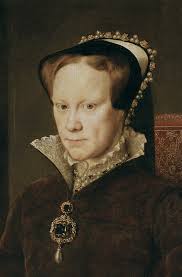
Finally, to satisfy my obsession with all things related to the Tudors, there was this portrait of Queen Mary, Henry the VIII’s daughter, otherwise known as Bloody Mary.

mary

Ugh, scary.

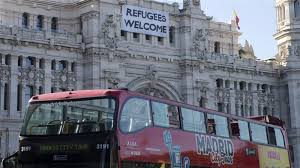
The Thyssen Bornemisa Museum was across a roundabout from the Prado, were this banner was displayed on a government building.  I’d love to see more of this in the USA right about now.

refugees-welcome

The Art of War and of Tapas

This is a series of posts about Italy, Malta, and Spain that starts here.

Lynn and I walked the two blocks to the Reina Sofia museum and were inside, for free, in a few minutes. Even with a floor plan, we couldn’t find Guernica, but we saw a lot of great stuff along the way.  Basquiat, Dali, Gris, Leger, Oldenberg, Ono, Rivera, Sutherland, Twombley, and Warhol.  The collection seemed to be a basket of one or two pieces each of mostly 20th Century artists from all over the world.  There also seemed to be a heavy emphasis on war.

Here is an image of Picasso’s Guernica on the museum’s website; I’m fairly certain I don’t have the rights to cut and paste it.  It’s an enormous mural—25 by 12 feet, and there was a crowd of people standing in front of it, mostly silent.  For once, they weren’t taking selfies or holding up their iPads to video record a great work of art.  Maybe that’s because the subject matter is so grim—the bombing of the Spanish village of Guernica by the Nazis and Spanish fascists in 1937—complete with women and babies and horses being blown to bits.

Sobered by Guernica and the other war-related pieces, it was time for more wine.

I’ve written about all the research I did for the Italy and Malta legs of my trip.  I give Lynn all the credit for Spain.  She found the hotels and figured out how we would get from Madrid to Grenada to Toledo and back to Madrid.  Thank You, Lynn!  She had also scoped out a square near our hotel that was supposed to have wall-to-wall tapas bars.

In case you don’t know what tapas are, they’re basically the Spanish version of hors d’oeuvres, appetizers, entrees, whatever you want to call them.  They are typically slices of baguette topped with ham and cheese, salmon, and other tasty things.  The idea is to go from one tapas bar to another, having a couple tapas and a glass of wine in each place until it adds up to a meal.  We walked toward the area Lynn had in mind, but when we reached what we thought was the right square, almost everything was closed.

“We must be too early,” Lynn said.

“Yeah, and it’s 8:30!” I replied.  Back home, I was usually in bed by 9:00, but I had made a vow to stay up late in Spain—the alternative would to go from lunch to breakfast without eating.

We found one place that was open and ordered the tapas selection from our waiter, whose name was Duong.  I think it’s safe to say he was of Vietnamese background.  I wondered if they hyphenated mixed nationalities in Spain, like we do in the US.  When the census came around, did Duong say he was “Asian-Spanish,” or just Spanish, or what?  The important thing was that, between his limited English, my rusty Spanish, and Lynn pointing at the menu, we managed to make known what we wanted. He brought the platter, which was mostly cheese and crackers and olives, not technically tapas.  It was a ton of good food and clearly we wouldn’t need to bar hop to fill up. I was starving by now so no complaints from me.

We ordered the house white wine, which was delicious.  Why can’t we have that in the US?  I think I’ve complained before about how, at least in Minnesota, the house wine or happy hour-featured wines are always like Manischewitz.  Or, as my mother calls it, Jewish cough syrup.

We sat and talked for an hour or more.  Unlike in Minnesota, the waiter didn’t come back to the table every five minutes to ask how our food was or ask if we wanted anything more, or otherwise interrupt our conversation.  He didn’t hover nearby waiting for us to put the last bite in our mouths, then close in to whisk away our plates and hand us the bill so he could turn the table and thus make more in tips.  This is one advantage of no or very limited tipping in Europe—there’s no incentive to hurry you out the door.

Bienvenido a España

This is a series of posts about Italy, Malta, and Spain that starts here.

I had been contacted by a head hunter about a job.  I wasn’t really looking, but I was intrigued this particular opportunity. It would be based in Cambridge, England.  Having lived in and loved Cambridge’s bigger twin Oxford, this was very appealing.  It was an environmental organization.  At the time, I thought that would be less depressing than torture, but now that the White House is full of climate change deniers, I’m not so sure.

The head hunter was in Madrid, and as I sat waiting for my flight—to Madrid—we tapped Skype messages back and forth.  She wanted to make sure I knew I would “have to” move to England for the job.  Was that okay with me?  Was it?! Yes, I replied, that was a plus, especially given the US election results.  She then wrote a number of long messages about how she and her colleagues at this international recruiting firm were shocked and worried, depressed and sickened.

She said she would put my CV forward, but I never heard from them. Oh well, it was nice to daydream about for a few weeks.

I sat next to a 30-something Maltese guy on my flight to Spain.  He had olive skin, light brown hair, and glass-green eyes.  I told him I had loved Malta and would like to go back.  He listened as I gushed about the sea views, the friendly people, the fishing village, the food, and the humble shops.

“Sometimes you forget,” he said reflectively, “when you have lived in a place all your life, how good it is.”

Lynn sent me a What’s App message telling me how to catch the airport bus to Madrid’s central station, Atocha.  Of course I wandered around the airport first for 15 minutes, but this time it wasn’t my fault.  There was construction everywhere, and if there ever had been signage, it had been removed or covered up.  I went up the escalator, down a long hall, back the other way, back down, down a long hall, then spied an information desk.  It was a handicapped assistance desk, but the two young employees behind it looked as though they hadn’t had a customer since 2010.  They were slouched over with their chins in their hands, looking at their cell phones.

I asked for directions to the bus stop in Spanish.

“This is the handicapped assistance desk,” the young woman said in English.

“I realize that,” I said back in English, “What would you tell a handicapped person?”

She reluctantly struggled to sit up and put aside her phone, while her male coworker ignored us and kept scrolling.  I wasn’t in Malta anymore. She gave me halfhearted directions which turned out to be wrong.  I finally stumbled upon the main assistance desk, which was hidden behind construction sheeting.  The employee there acted surprised by my question, as though I was the first person ever to ask where the bus stop was, but his directions were accurate.

The bus was direct and had wireless.  In half an hour I was at the station, where Lynn was waiting for me.

As usual when we meet up, we had a lot to say.  We don’t communicate a lot in between trips, except via Facebook, so there was a lot to catch up on.  The Brexit vote and Trump’s election alone would be fodder for hours of conversation.

We talked as we walked to the Hotel Paseo del Arte, sine very nice digs Lynn had booked, just two blocks from the station.  We cracked open that bottle of red wine she had ready and talked some more.  It was only 4:00 in the afternoon and life didn’t really get going in Madrid until 8:00, so we had plenty of time.

A couple hours flew by.  Lynn had scouted out that it was free admission night at the Reina Sofia art museum, home to Picasso’s masterpiece about war, Guernica.  Like our trip to Berlin the year before, this would be the first of about a dozen museums we would visit in two weeks.

Don’t Read This Post

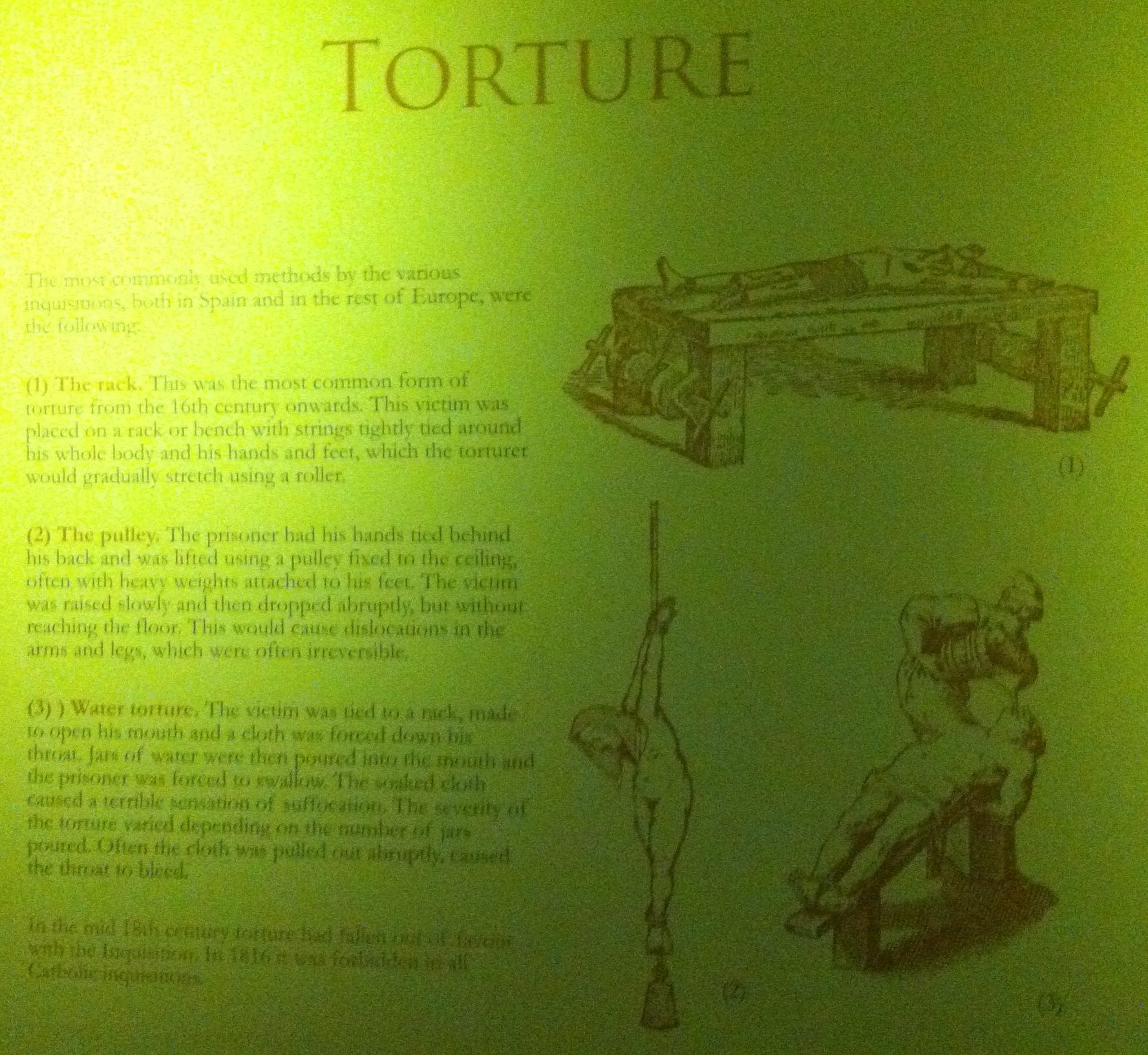
Do not read this post or look at the photos if you think you will irreversibly upset by torture techniques.

This is a supplement to my last post, in which I described a museum exhibit about torture.  Interestingly, the museum—the Casa Sephardi in Granada, Spain—offered no spin on the exhibit.  It wasn’t a “human rights” museum, it made no call to action at the end. It also did not make light of torture.  It was just straight-out torture, torture, and more torture, leaving interpretation and follow up to the visitor.

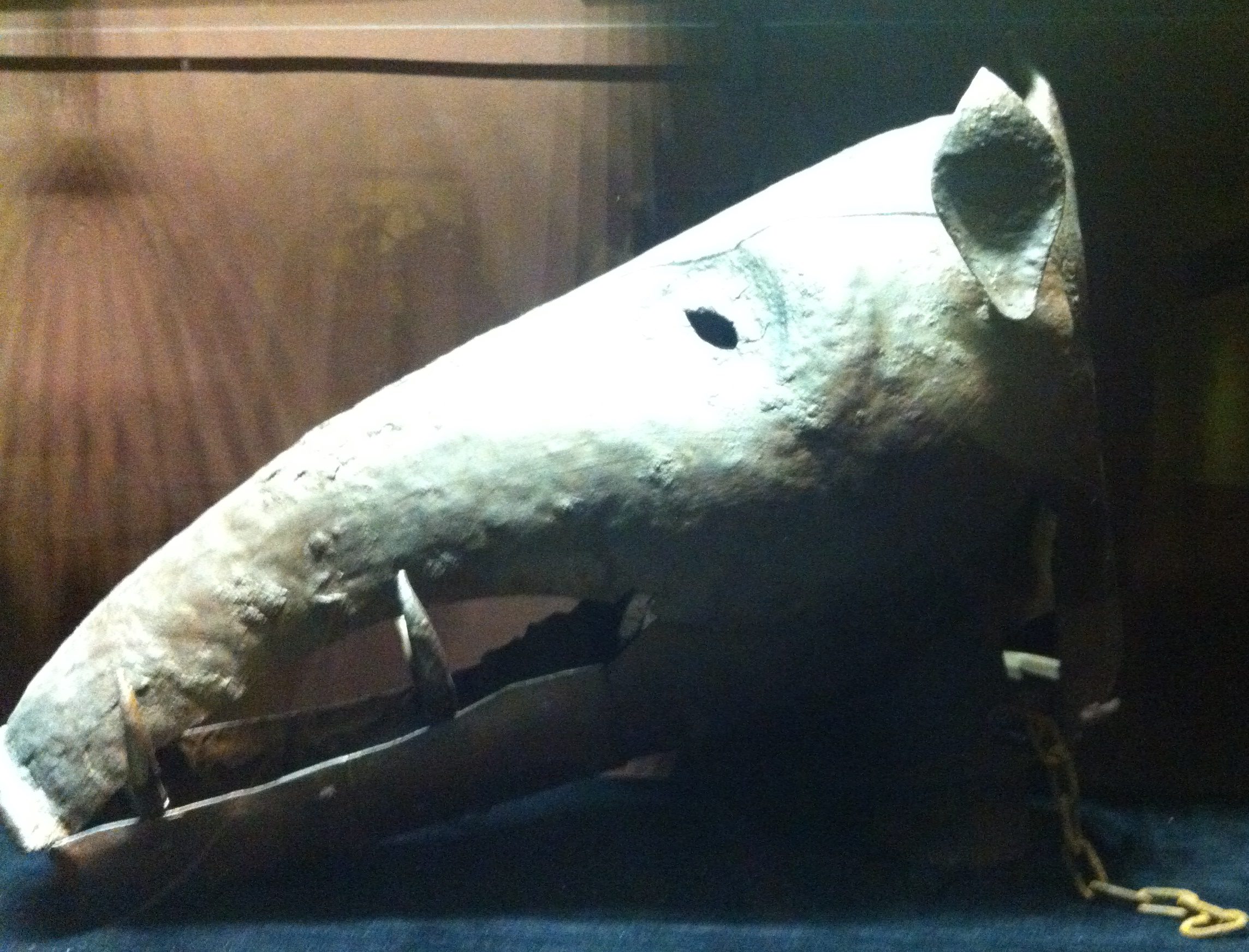
There were creepy masks people were forced to wear to be humiliated (as in women who had allegedly been unfaithful to their husbands).

mask-of-shame pigmask-2

The pig mask was, of course, specifically designed to humiliate Jews, who don’t eat pork.  These masks may look kind of funny (as in humorous), but they weren’t.  As you can read in the paragraph in the first photo, they often also had spikes in strategic places, cut into victims’ necks, and the wearers typically died of starvation.

This confirms another lesson about torture that is relevant today:  Torture is rarely used to get security information from terrorists to prevent attacks.  It’s almost always used to punish people and to intimidate others not to rebel.  It puts a chill on entire communities, who stop speaking out and being politically active. It’s the favorite tool of dictators.

To reinforce my point, here’s a photo of a set of branding irons.  The “crimes” for which people were branded included “slave”, “blasphemer”, and “rogue.”  Really—Rogue?  I can think of a dozen friends of mine who would have been branded by now.  I could have been branded as a blasphemer a hundred times over.

branding

The exhibit proceeded to get worse and worse.

It included the iron maiden (not the rock band), thumb screws, chastity belts (for men and women; with and without spikes), the saw (victim hung upside down and sawed down the middle starting from the crotch), the iron bull (victim forced inside a hollow iron statue of a bull under which a fire was slowly built), the rack—with a without spikes—which pulled the victim’s spine and other joints apart one by one; the cage, in which victims were locked and suspended from a bridge where they were exposed to the elements and starved to death.

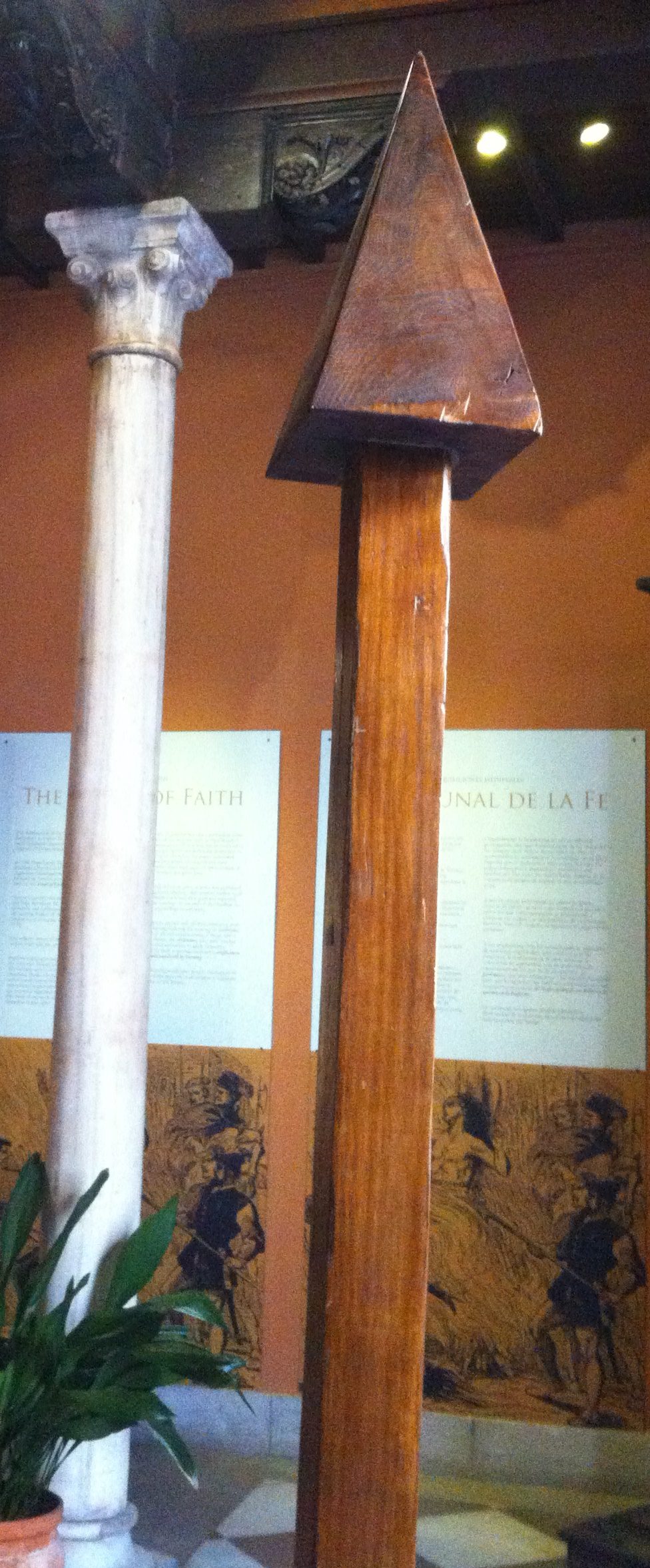
I will leave it to your imagination to figure out how the spike was used:

spike

I didn’t take photos of most of it; it was just too horrible to share.

If you have read this post, you are either very brave or a weirdo.  Or you are one of the over 50% of Americans who think that torture is okay.  If, like me, you don’t agree, please go to the Center for Victims of Torture website and sign the Reject Torture declaration.  Thanks, and I promise that the next post will be about Italian food or art or something more uplifting!

Back in the Homeland

15 museums

8 flights

7 hotels

6 palaces and villas

5 train rides

4 countries, if you count the Vatican

3 weeks

2 friends who are miraculously still good friends

1 drained bank account, but totally worth it

Zero muggings, rip offs, illnesses, or other crises.

Uncountable numbers of churches, nameless restaurants and cafes, glasses of wine, paintings of the Virgin Mary, and taxi rides to and from bus stations and airports.

I’m on a plane back home after 3 weeks of traveling around Italy, Malta, and Spain.  I’ve got nine hours ahead of me on the way to Atlanta, then another flight to Minneapolis/St. Paul before I land at 6:40pm.  They guy sitting next to me, Ryan, is from Atlanta.  He told me he was traveling on business and I immediately assumed he would be a conservative Republican who sells B2B online storage solutions or something but it turns out he works for a progressive Baptist international nongovernmental organization.  We chatted about what our respective organizations do, about how different countries examine their pasts, and then touched briefly on the election results before he put in his headphones to watch a movie and I flipped open my laptop.  He said half his organization’s employees are African American, and the day after the election their regular check-in meeting was just dead silence.

When I checked in with a colleague where I work (the Center for Victims of Torture), the day after the election, she said the office was like a morgue.  We had been running a two-month anti-torture campaign to educate people about how torture is illegal.  Now we may have to kick it into high gear to push back against US use of torture.

I’ll have a lot more to write about this trip, but speaking of torture, I visited a museum in Granada, Spain that advertised a special exhibition about torture.  Lynn rolled her eyes when I asked if she wanted to go. It was about the only time we didn’t do something together.

What I didn’t realize was that the museum’s name was Casa Sephardi, Sephardi being the term for Jews who used to live in Spain and Portugal.

The exhibit started off easy, with displays of artifacts like menorahs, prayer shawls, and wedding costumes.  Then came the Spanish Inquisition.  Jews had done well in Spain for the most part, sometimes prospering even more under Muslim protection than under Christian rule.  But, as has happened over and over throughout history, Jews became a victim of their own successes.  There were religious differences, for sure, but economics was a prime motivator to get rid of the Jews so their property could be confiscated.  In 1391, 4,000 Jews were massacred in Seville.  This was followed by mass forced conversion to Christianity.  Judaism provides a “get out” clause that allows us to convert if our life is at stake.  We’re practical like that.  So most Jews “converted” but continued to practice Judaism covertly.

The Inquisition imprisoned and tortured the Jews who had converted, sincerely or not, and their property was sold off to cover their expenses—which I guess would have included bread and water and manacles.  Their families were turned out into the streets.

Surprise!  They were all found guilty and executed.  In 1492, all the remaining Jews were expelled from Spain.  About a hundred years later, Muslims were also subjected to forced conversions, Inquisition and expulsion.

Lastly, there was the “special” exhibit about torture.  It was awful, truly awful, and I am someone who works for a torture rehabilitation center.  I’ll write about it more in a separate post, and stop reading here if you know you could be upset by disturbing images.

Here’s my take away: the displays, which appeared to be decades old, confirmed two themes in CVT’s anti-torture campaign:

Waterboarding is torture, and a medieval technique at that:

waterboarding

Torture is not effective in obtaining accurate information.

torture-does-not-work

This is one of the reasons travel is important, especially for us Americans, especially now: so we can learn from history (Spanish history is our history), learn from other cultures, learn the truth, and come back prepared to fight for our values.

Happy Thanksgiving to my American readers!  May we somehow find some harmony during the holiday season and in the year to come.

Fears of Flying

Here is a photo that summarizes my trip-planning progress:

travel-montage

I depart in 15 days.  I am in full-blown “What if?” mode.

What if I get pickpocketed in Rome (not a far-fetched scenario—my nephew’s wallet was stolen in Rome last year).  What if I’m packing too much into this itinerary and I won’t be able to appreciate it all?  What if I miss a flight/train/bus?  What if people feel sorry for me, a woman traveling alone?  What if I forget my phone charger?  What if I show up at a hotel and they have no record of my reservation and no rooms? What if I rent a car in Spain, and I forget to ask them to give me an English-language GPS, and my Spanish isn’t good enough for me to follow the directions?  What if my son doesn’t water my plants while I’m gone and they all die?  What if I fail to blog along the way, which means I’ll have schlepped my laptop all over for no reason?  What if I trip and fall into a cistern at Pompeii and it gets dark and no one knows I’m there and … are there wild jackals in Italy?

So you see, I have been busy.  I really should have pursued a career in disaster planning.  I would have been a natural at it.

I laugh kindly at myself as I observe the endless chain of what ifs come and go. I will prepare as well as I can. I will resist the urge to over prepare, because that would allow no space for spontaneity. I will deal with anything unexpected as it arises.

On Friday night my sister joined me and some friends for happy hour.  Long-time readers of this blog will remember that while my son was in prison, there was plenty of additional excitement in my life.  It’s never just one thing, is it?  There was a plumbing problem in my apartment which caused me to have no kitchen for six weeks. I tripped and sprained a knee ligament and was on crutches for about the same six weeks.  My mother was her third major car accident, which caused micro fractures in her spine and led to her giving up driving.

And then … my sister was battling Stage 4 colon cancer. She went through hell.  She’s been cancer free for a year and a half but she’s still dealing with the lingering effects of it all—the  surgeries, chemo, radiation, and all the other aspects of life that are affected by a life-threatening illness—finances, keeping up with a house and yard, two teenage kids, getting her strength back.  The list goes on.

How is this connected to traveling?  Because at happy hour we talked about the phrase “You’re so strong.”  My sister hears it a lot.  I used to hear it a lot when I was a single mom pulling myself up by the proverbial boot straps.  Other friends had been through trials and had heard it too.

We all agreed that we hate the phrase.

“What choice did I have?” my sister asked.  Right.  I had thought the same thing many times when people had said “You’re so brave!”  What choice did I have?  I admit I had occasional fantasies about dropping my son off at my mom’s and running away to Florida. I know there are people who abandon their kids, and people who avoid getting treatment for serious illnesses because they’re in denial or afraid.  But the vast majority of us just do what needs to be done because the alternative would be hurtful to ourselves or others.

“Being strong is when you are afraid of something,” said a member of our group, a psychotherapist who is also a cancer survivor.  “And you do it anyway, even though you could choose not to and there wouldn’t be any consequences.”

And that’s how this relates to travel, especially for someone like me who travels solo a lot.  I do have anxious thoughts about getting lost, being swindled, being disappointed.  But I go anyway.  The fear of regretting that I never saw the Amalfi Coast is stronger than the what ifs.

Red (and White) Flags

In one month I’ll be in Malta, a tiny country most people have never heard of.

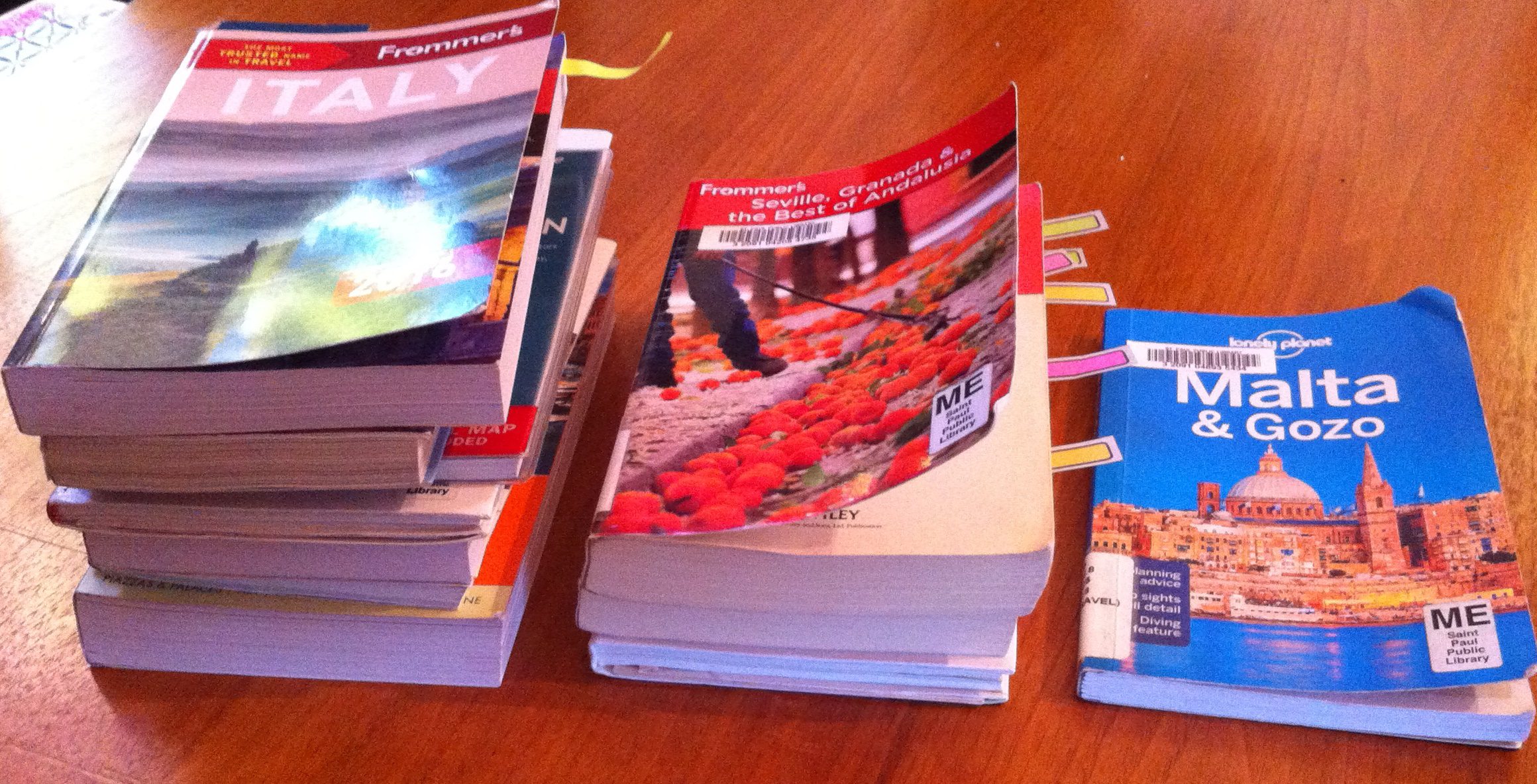
Here is a representative sampling of travel books available in the library for the three countries I’ll be visiting: Italy, Spain, and Malta.  There was a whole shelf of books about Italy, a half shelf for Spain, and one slim volume about Malta.  This should have told me something about what a hot (not) tourist destination Malta is.  But once I get something fired up in my imagination, there’s usually no turning back.

travel-books

Of course Vatican City is technically a country—the smallest in the world.  I’ll be visiting the Basilica of St. Peter and the Vatican Museum and I’m sure there are entire books about them, but I don’t need books to tell me I’ll be seeing a lot of paintings of the Virgin Mary and baby Jesus.

Someone at work laughed about me going to Malta and suggested that since I would also be visiting Vatican City, I could make this a grand tour of tiny countries.  You know, the ones that send one athlete to the Olympics—an athlete who doesn’t stand a chance?  I could have gone to San Marino, which is surrounded by Italy; and Monaco, which is on my bucket list.  Liechtenstein would be a bit further north in Europe, but not as far as the other five that round out the Top 10 List of tiny countries, which are all tropical islands: Nauru, Tuvalu, Saint Kitts and Nevis, Maldives, and Grenada.

The lack of interest in Malta may have something to do with how difficult it is to get there.  I will be leaving from Sorrento, where I will have spent three days seeing Pompeii, the Amalfi Coast, and Capri.  You would think, from reading the one book about Malta, that you could just hop a train to Naples and fly right to Malta.  Boom—easy!  But alas, this was the same book that told me I must see the underground, 5,000-year-old catacombs on Malta, the ones that are closed for renovation until 2017.  The book also said it would be “easy” to take a ferry from Italy to Malta.  However I need to get to Madrid afterwards and it would take two days to get to the coast of Spain by ferry.

All the flights from Naples left at either 6:00 in the morning or 4:00 in the afternoon.  They all connected somewhere else, which meant that reasonable-sounding 4:00 p.m. flight would get me into Malta at 11:30 at night.  And the 6:00 a.m. flights were much faster; I seriously considered one that had a 6-hour layover in Paris.  Finally, I decided to fly from Rome. This will require me to get up early—but not quite as early as the 6:00 a.m. flight—catch a train to Naples, then connect to Rome, then catch the express to the Rome airport, then fly at 11:00 a.m. to Catania—which is on Sicily, then finally arrive on Malta at 3:30 in the afternoon.  That is, if nothing goes wrong on any of the five legs of the journey.

malta-sorrento-map

Another puzzle has to do with baggage.  The flights to and from Malta are cheap—if I am willing to travel with only a carry-on bag weighing no more than 22 pounds.  I spend some time researching ultra light bags; I could get a nice one for $70.  Or I could just pay RyanAir $75 for the privilege of bringing a real suitcase with me.

I toy with the idea of traveling light.  It would be easier to get on and off all the trains and buses and planes. I’d be less conspicuous, since my regular suitcase is purple.  It could be kind of a cool challenge to wear only two outfits for a month, to say “no” to buying clothes in Italy, and eschewing souvenirs.  Plus I would be doing my small part to save the planet!

Nah.  I’ll bring my purple monster.  I like to have options.

I contemplate these “problems” knowing that countless refugees are attempting the crossing to Italy in rubber rafts before the sea gets too rough in November.