Category Archives: Adventure

Tikal

This is a series of posts about Belize and Guatemala that starts here.

Finally, Tikal.

This was where I regretted being a cheapskate and buying a rain jacket at the Goodwill.  It looked like a rain jacket and—most important—it looked good on me, but it turned out to be about as waterproof as a burlap bag.

It was raining when we arrived and it rained for the first hour.  And I don’t mean drizzle, I mean full-on, relentless downpour.  I guess this is why it’s called a rain forest.  And this was the dry season.

There were no modern buildings, and only a few sheltered places, like the toilets.  But it wasn’t like I was going to get cold.  It was around 90F, so I made up my mind that it was just water and it wasn’t going to spoil my time in Tikal.

I don’t know what I had expected.  I have been to Machu Picchu and Petra.  Tikal turned out to be similar in scale to Petra but verdant like Machu Picchu, and of course completely unique.  We were there from 8am until 3pm, so I won’t try to retell all the history or describe the structures, society, or ceremonies that took place there.  We walked as José Luis talked, stopping here and there to really dig into something, like this stele:

These are some of the structures you may have seen in movies.

What I hadn’t expected was the amazing flora, especially the tree bark, which called to mind abstract impressionist art.
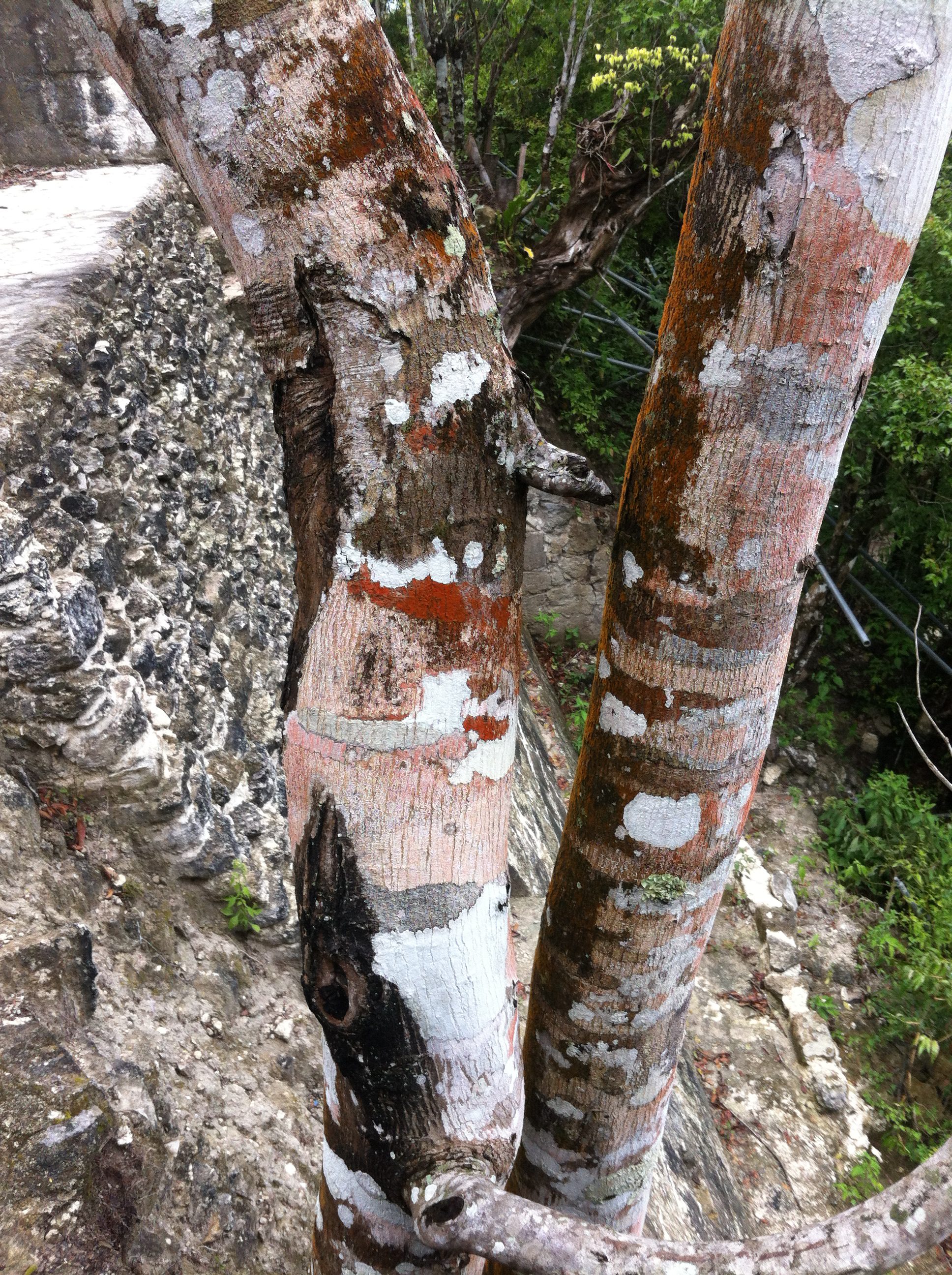
This is the (a?) Tree of Life.

This photo isn’t great, but it’ll give you an idea of how, high in the Tree of Life’s branches, there are air ferns.

You know, those little plants you can buy in the checkout line at the grocery?

Except that at Tikal, they were as big as tumbleweeds.

“And inside those ferns,” said José Luis, are growing other ferns, and cacti and other plants.  The birds nest in the air ferns and leave seeds in their droppings, which grow into plants.”

So the Tree of Life is host to ferns, which host birds, which result in other plants growing a hundred feet above the forest floor.  It was a “wow” moment.

Here’s another codependent but deadly plant relationship:
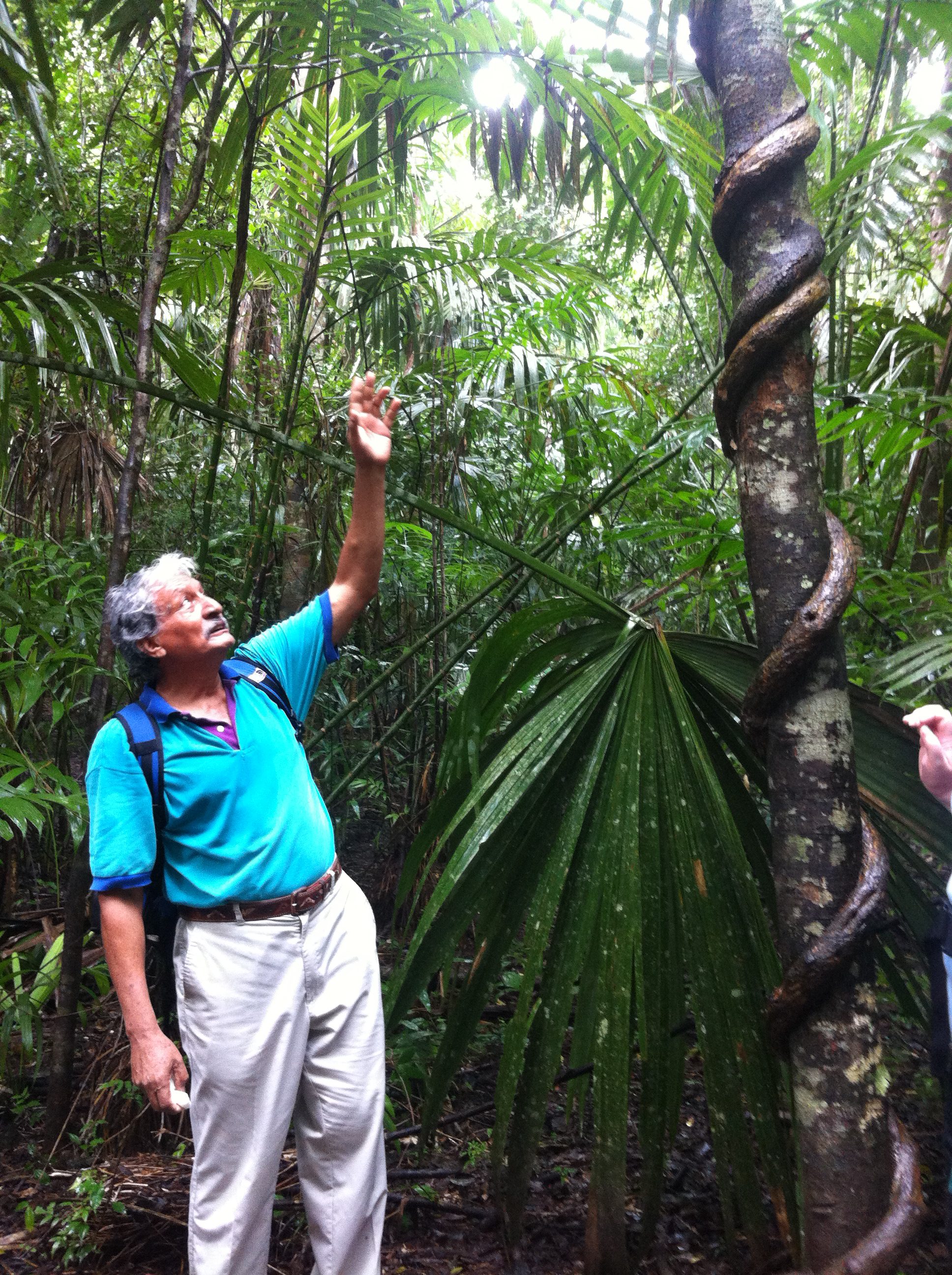
The vine uses the tree to reach the sunlight, in the process killing the tree, and then the vine dies as well.

We stopped at a gum tree and José Luis explained how gum was harvested and the history of Tikal and the Wrigley Company.  I have a piece of gum every day and I knew it had fake sweetener in it but I didn’t know that most gum is synthetic (plastic!) nowadays. [Note to self: research gum that actually contains gum.]

We walked through miles of hill-lined paths, which I thought were unremarkable until José Luis pointed out that the “hills” were actually unexcavated pyramids and other structures that had been buried under centuries of plant life and death. There would never be enough money to uncover all of them, but new technologies like lasers were being used to at least trace their outlines.
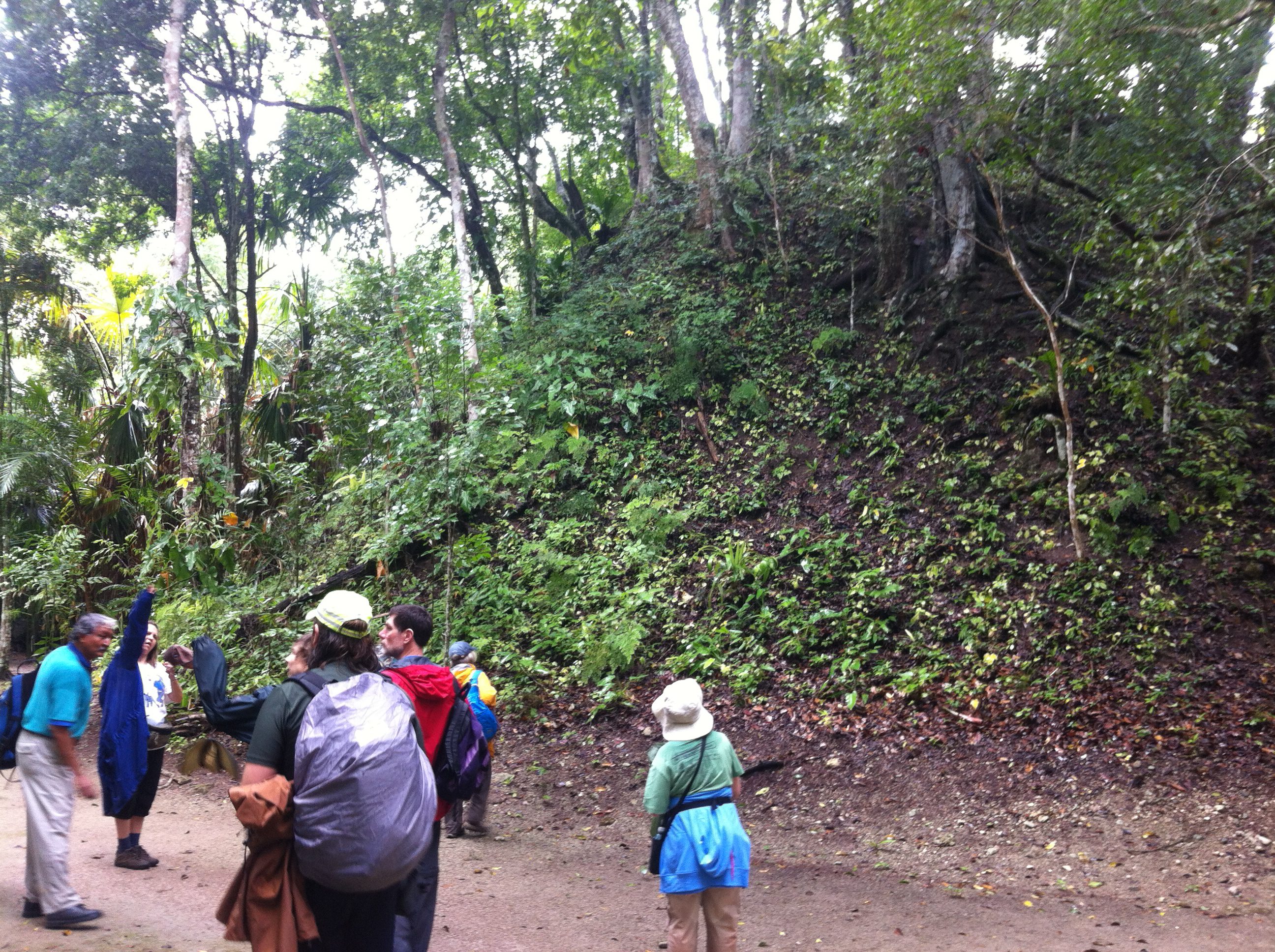
We hiked to the top of one of the tallest structures and again—a wow moment—what a view.  That’s me on the right, a snapped by Stan.  Everyone on the trip was very thoughtful about taking photos of each other, especially of the people who were traveling solo.

The last stop was the plaza major; there’s no way to capture it all so I plucked this aerial photo off the Internet.
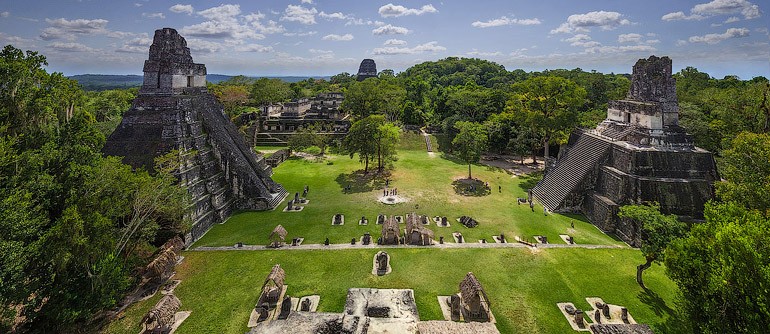
As I wrote in a previous post, Tikal wasn’t a city, but a ceremonial center.  José Luis went into great detail about the sports played here.  They sounded tiresome, but then I am not a sports lover.

It was a very long day, like walking through the biggest museum in the world, a museum without a roof.  I had worried that my fellow travelers who had allergies, illnesses, martyr complexes, and possibly broken bones, would fade long before we reached the plaza, but Tikal’s magic must have sustained them. We rode in silent awe all the way back to Don David’s.
I Don’t (Do) Mind

This is a series of posts about Belize and Guatemala that starts here.

Tikal would be a bucket list visit for anyone. This is from the itinerary:

“Tikal has over 17,000 stone buildings, most of them unexcavated. Our guide has a wealth of knowledge about Tikal and the Mayans—he helps you hear the roar of the crowd as if a Mayan king were making his entrance. From the scene of Temple V in ‘Star Wars’ to the growl of the Howler Monkeys, Tikal offers an experience like no other.”

At dinner with our guide, José Luis, he told how he had studied with professors of archaeology, anthropology, and cosmology at the University of California Berkeley and Yale.  “Study” probably isn’t the right word.  He had spent months at a time consulting with these professors in Berkeley and New Haven and had hosted them here. I don’t think he had an actual degree in anything, but so what—he was from the local area, had been a guide for 30 years, and had read and studied and consulted with other experts.  He was a seeker, curious, open minded.  José Luis was soft spoken, with a shaggy mane of hair and big mustache that make me think of Albert Einstein.  He was also that wisest kind of man—who knew there was much he didn’t know.

The rooms at Casa de Don David were basic.  A bare bulb hung from the ceiling, and the beds were so crammed into the small space I had to climb over the foot of Liz’s bed to get to the bathroom.  My mattress sagged in the middle and the pillow was lumpy.

“Are you okay with AC?” I asked.  “I don’t really like AC, but I’ve got Restless Legs and they’re always worse when it’s humid.”

“It doesn’t matter to me,” Liz replied.  “But we could just open the window.”

“Do you prefer to have the window open?” I asked.

“I’m fine either way,” she said.

“Okay, then I’ll turn on the AC.” I waved the remote toward the window unit above her bed.

“What if we opened the window?” Liz hinted again.

“You said you didn’t care either way,” I answered.

“Well maybe we could sort of open the window just a little bit.”  And so we turned on the AC and left the window open a crack.

The next morning we assembled at 5:30am in the lodge, gulped down cups of coffee, and inspected the bag lunches the kitchen had prepared.  The gluten-free people handed over their sandwiches and cookies to others.

Mike’s wife, Joan, appeared with a black eye and her arm in a makeshift sling.  Her hand and wrist were puffed up to twice their normal size, and horribly bruised.  “I tripped on a sidewalk paver,” she explained.  We suggested she see a doctor.

“Don’t worry about me; I’ve got high pain tolerance from my fibromyalgia.”

That’s good, I thought.  It would be really inconvenient if her wrist was broken and she had to be airlifted from Tikal.

We piled into the van with one extra person, José Luis.  Stan was a good sport and huddled in the luggage section in the fetal position.

As we entered the grounds of Tikal, José Luis warned that we must never, never, never wander off by ourselves.

“The jungle is so dense,” he explained, “that once you are a few meters in, you can’t hear or see the road.

“There was a German explorer who thought he would go of on his own, since he had climbed Kilimanjaro and paddled the Amazon.  He had a GPS.  But GPS don’t work here.  It’s a dead spot.  He was missing for four days and nearly died of exposure.  We have to rescue people all the time”

“How far is a meter?” Liz asked no one in particular.  “I can never remember my metric system.”

“It’s about the same as a yard,” Stan answered from the back.  “A yard and a few inches, I think.”

“Close enough for government work,” Liz said.  I had never heard this phrase before and didn’t give it much thought until the third or fourth time Liz used it.

Signs and Wonders

This is a series of posts about Belize and Guatemala that starts here.

We had a couple hours to kill before having dinner with our guide for Tikal the following day.  I wandered around the thatched-roofed lodge, which overlooked a broad lawn stretching down to the lake.  The lodge had the usual things you find in such places: piles of musty old board games, shelves with books in German and Swedish left by past travelers, wall-mounted maps with the “You are Here” worn away by hundreds of fingers pointing and saying to their companions, “Look, we’re here.”

There was a small gifty area with bags of coffee, cacao products, and beautiful carved hardwood objects.  I bought a couple pairs of earrings for $5 each.

There was wireless, but the signs providing the password were clear that it was extremely weak and that to be fair to others, no one should be streaming movies or playing online video games.

Bird-feeding platforms were mounted around the railing circling the dining hall, and although it was dark now and there were no birds I was curious to see what kind of food they used.  I reached the farthest one that was tucked in a corner, and noticed a man sitting at a nearby table watching me.

He was around 60, with a full, bushy beard not like a cool hipster one, with a baseball cap pulled down tight and smeary aviator glasses.  This look typically says—in my opinion—“I’m not good with people and if I could get away with wearing a mask, I would.”

He smiled at me in an encouraging way.  I am always curious about solo travelers in far-flung places, so I said hello. That was enough to initiate an hour-long lecture by him about Tikal, the universe, aliens, and how he was better qualified to lead tours of Tikal than the native guides.

His name was Brian, he was Canadian, and he had applied for one of the coveted official Tikal guide licenses.  “I would be the very first non-Guatemalan guide,” he said proudly.

He lived at a nearby B&B and came to the lodge for the wireless.  I noticed he hadn’t ordered anything.

He thought he would hear about the license the following week, but his visa was about to expire so he had to return to Canada and then come back.  He didn’t speak Spanish, so he wasn’t 100 percent clear on what was going on, and he suspected them of being partial to Guatemalans.

“I’ve followed the Guatemalan guides around and listened to the rubbish they spout,” he said, as our Guatemalan waitress came by and asked if we wanted anything.  I nodded enthusiastically and ordered beers for Brian and myself.

“The natives don’t know what they’re talking about.  They have no education or training; sometimes I think they just make things up.”

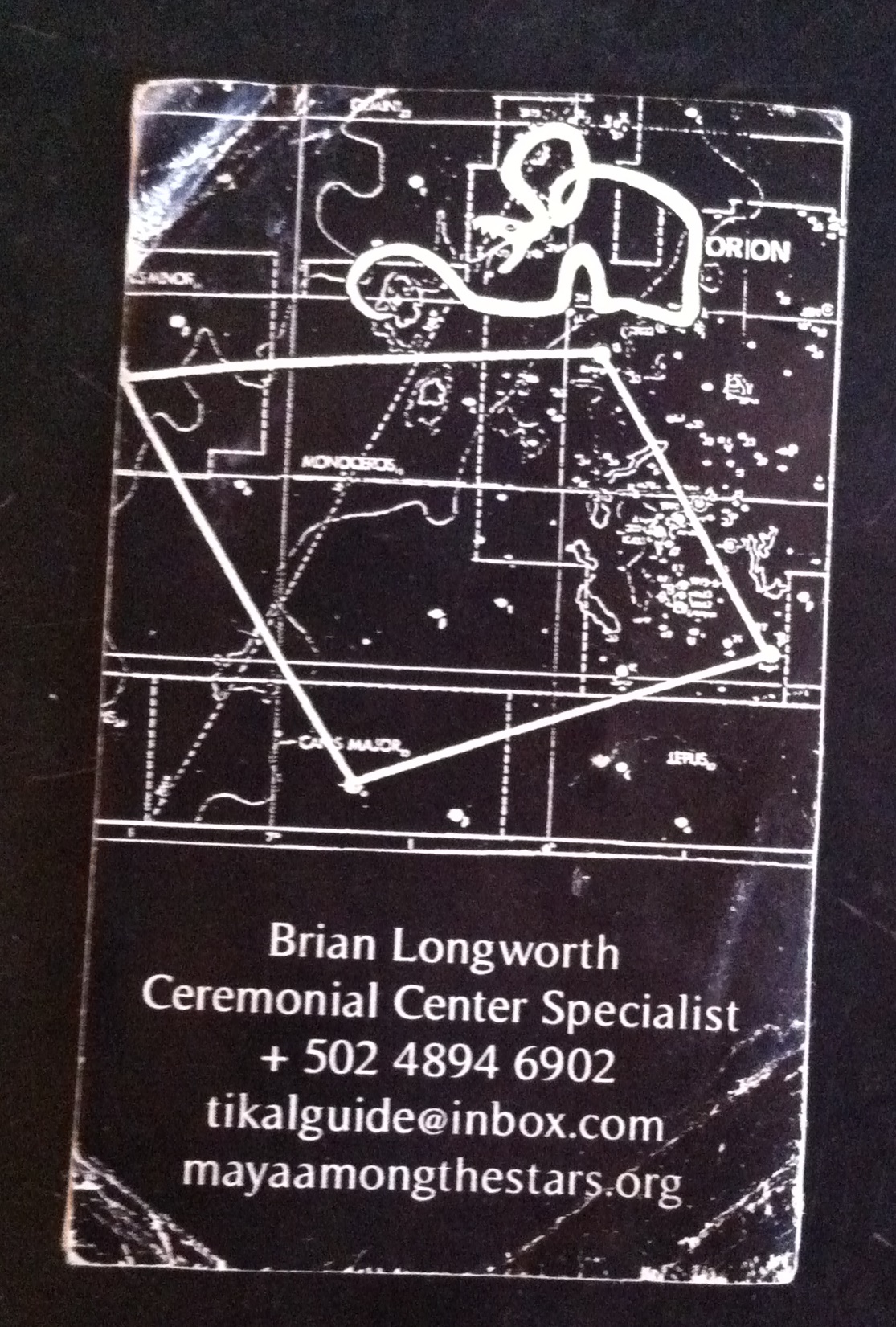
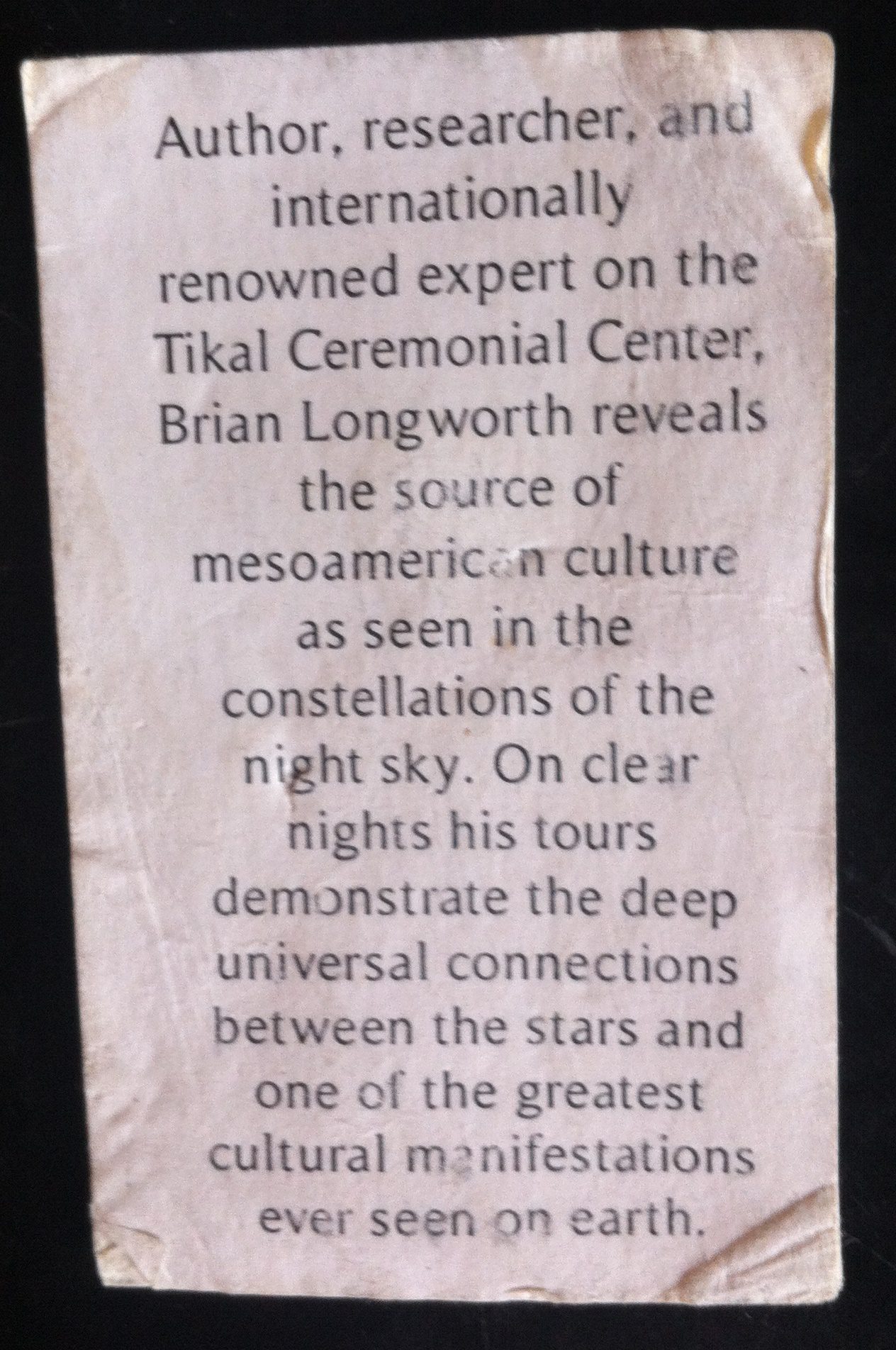
Brian had written books on Tikal.  Here is his card, which tells you everything you need to know:

If you go to the website on the card, you can buy the domain name for just $19.99 a year.

Brian was passionate about Tikal.  He whipped open his laptop and showed me elaborate schematics of the temples and their relations to constellations.  Of course I’m getting this all wrong because I’m not an expert.  Who knows, maybe Brian really does know more about Tikal than all the local experts and professors at McGill.  It must be painful to know all the answers and not be recognized for it.

I have a knack for finding one-way talkers.  Sometimes I avoid engagement; sometimes I give them 10 minutes to see how entertaining they are.  Tonight I had nothing better to do so I listened to Brian go on.  Eventually though, he got so deep into his theories that it was time to make my escape.

Just then, Mike helpfully wandered by.  Like an insect into a spiders’ web.

“Mike!” I said, “Meet Brian.  He’s an expert on Tikal.  Let me buy you a beer,” I said as I got up and went to the bar.

When I delivered Mike’s beer he was so engrossed in Brian’s story he didn’t notice I had abandoned him.

Comings and Goings

Back to Belize.  This is a series of posts about Belize and Guatemala that starts here.

My group had exited Belize.  Now, we had to get the van out.  As we waited, two pre-teen boys approached us.

“We will help you cross the border,” one exclaimed enthusiastically in English. That was all the English he knew.  It was unclear how they proposed to help us, aside from loitering around and smiling a lot at us.  Maybe they were counting on us gringos falling in love with their adorableness and giving them big tips.

I chatted with them in Spanish and learned that Juan was Mexican but his family had fled to Guatemala to escape gang violence.  He didn’t say where his father was; it was just his mother and nine siblings.

“Why aren’t you in school?” I asked.

“We don’t have money for uniforms,” he answered.

Miguel was Guatemalan and he had a similar story about his family not being able to afford uniforms.  Was it true?  Who knows.  It is a common problem around the world.

After an hour our van was released and we lined up at Guatemalan border control.  As is usual for border controls, one line was for foreigners and one was for nationals.  Our line included a bunch of old hippies in flowing skirts and Birkenstocks, some Mennonite women in flowing skirts and veils that made them look like nuns, and us—by now disheveled from standing in the scorching sun.

The other line was composed of local women in flowing skirts and sandals, nuns, and bedraggled small business people carrying Hefty bags full of bagged crisps they had bought on one side and would sell on the other.

Our line was tall, their line was short. Our line was pale and sunburned, theirs was brown and sunburned. Our line was anxious and loud and full of questions; theirs was quiet and patient.

Juan and Miguel hovered nearby, “helping” us.  After 45 minutes I approached the counter and the border control agent flipped through my passport.  “Oh my, you have traveled a lot,” he commented, smiling.  He lingered over the colorful visa stamps for Kenya and Jordan. He was the first and only border control agent I’ve encountered who was friendly.

Stamp.  I was in. While we waited for everyone in the group to get through, we approached the money changers with fistfuls of currency to trade our Belizean dollars for Guatemalan Quetzals. Here is a Belizean Dollar; I love that Queen Elizabeth is sharing space with a jaguar.

And here is a Quetzal:

I don’t know who the guy is but he sure is handsome, if you can overlook the mustache.

There was a black truck nearby, probably seized from narcos, that was wrapped in so much Crime Scene tape it looked like a Christmas present.  Without thinking, I whipped out my phone and snapped a photo of it.

Mike stepped forward, “No photos!”

Yikes, he was right, I dropped my phone in my pocket and thankfully wasn’t hauled in for questioning.  I won’t compound my recklessness by posting it on my blog.

It was time to leave our fixers, Juan and Miguel.  I gave them a couple bucks each and I think others in my group did as well.  Not bad for a couple of hours work, and I hope they really did use the money for school costs.

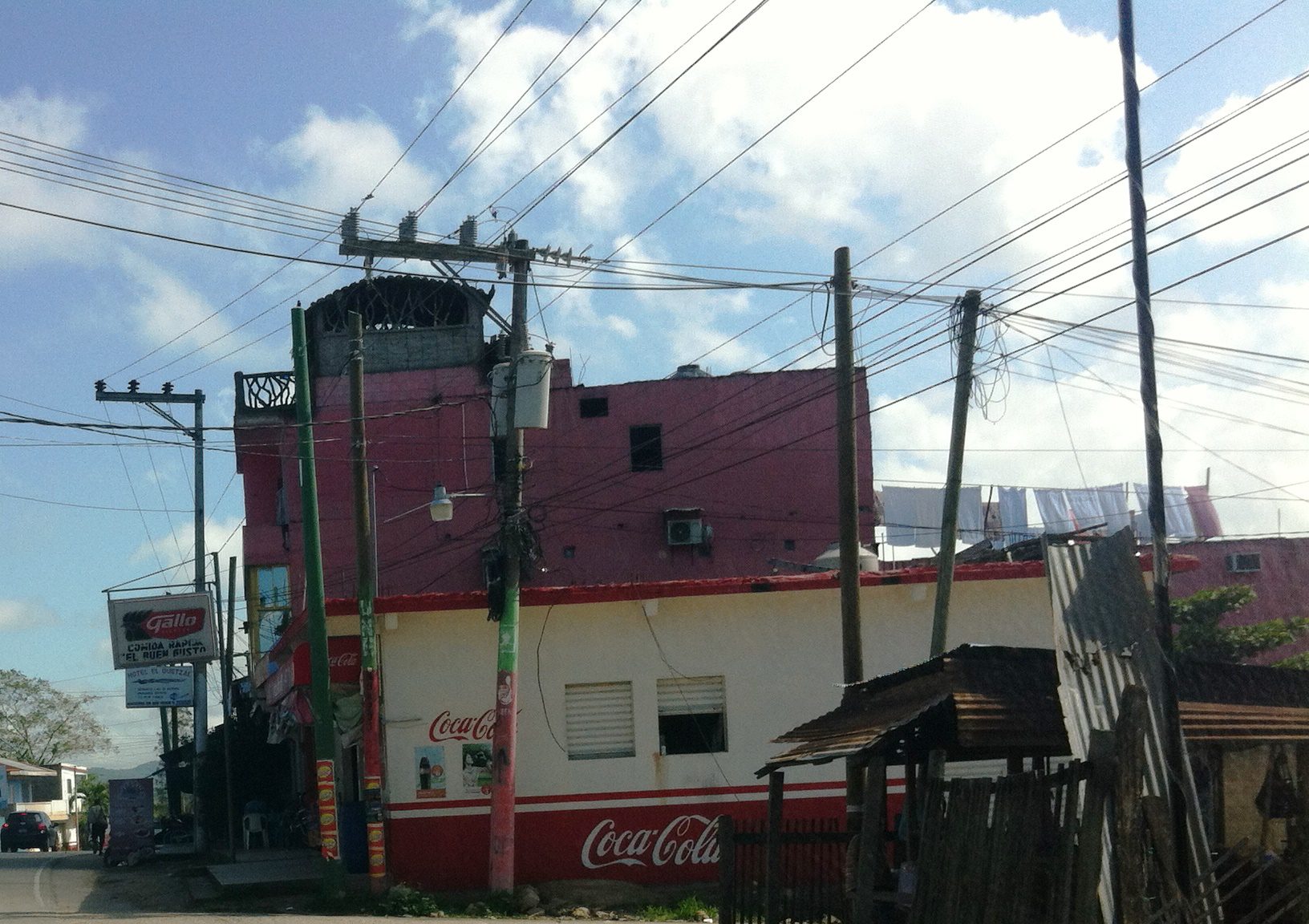
Off we were to the town of El Remate, our perch for Tikal the next day.  As we drove I jotted down Spanish words I didn’t know to check later.  There was a sign I didn’t know the meaning of: “Poblado.”  I later learned it meant populated area.  It was posted every mile or so, which would seem to dilute its warning to watch out for kids running across the road.

We pulled up at La Casa de Don David, our hotel. I ran down to the viewing platform overlooking Lake Itza to catch the sunset. There was a system by which you could order drinks on a phone, and the lodge delivered them via zip line, accompanied by disco lights and music.

But who needed alcohol, really, with views like this?

Flantastic

This is a series of posts about Belize and Guatemala that starts here.

The cave canoeing was great.  We have a lot of caves in St. Paul carved by nature and teenagers out of the limestone cliffs that line the banks of the Mississippi.  Some are large enough that they were used by mobsters as speakeasies during Prohibition.  But limestone is soft, so there are no stalactites or mites or clumps of diamond-like crystals or splotches of yellow and pink mineral deposits that create 40-foot high abstract impressionist-like paintings on the walls, like there were in Belize.

We glided through the darkness as Jose and Alex pointed these things out with their headlamps as though they knew by feel exactly where they were.  Jose had a degree in Geology and, during the school year, taught the subject at the high-school level, so he was a great guide.

It was very peaceful, unless you were afraid of bats, the dark, drowning, or enclosed spaces.

Jose and Alex talked to one another from time to time in Spanish.  When canoes passed going in the other direction, Jose would talk to their guides in the local Belizean Kriol (their spelling).  Then he would effortlessly switch to English to point out some formation to us.  I have always envied this facility with multiple languages. I asked him which languages Belizeans learn, and when.

“English is the official language, so we learn it in school. But we learn Kriol from the cradle, the closer you get to the Guatemalan border, the more people you will find who also speak Spanish.”

Back on dry land, Mike’s wife whipped up a big meal for us, served with the ubiquitous Belizean beer, Belikin.  “You want dessert?” she asked.  Everyone nodded; we hadn’t had dessert the night before.

“What do you think it will be?” someone asked.

“It’ll be flan,” I pronounced confidently.  At that moment Mike’s wife and her helper returned with a dozen servings of flan.  Everyone stared at me.

“I’ve been to Costa Rica and El Salvador, Mexico, Cuba … flan is the standard dessert.  And it’s delicious.”  Most of them had never heard of it.

“Does it contain dairy?” “Is there gluten in it?”  began the questions to Mike’s wife.  Some of us without sensitivities happily ate their servings.

The guy who had read every road sign out loud the day before said, “You sure enjoyed being right about that, didn’t you?”

I’m pretty sure he was irritated not because I had known dessert would be flan, but because I had been so confident.  If I had been a man making such a confident statement, maybe it wouldn’t have been received negatively.  I don’t know.

All I can do is look at my own behavior; I can’t change someone else.  I’m afraid I can sound like a know-it-all.  I didn’t want to be like the guy from Jersey I’d met in Amalfi who spewed out a constant stream of facts. I decided to reign myself in a bit.  After all, what difference did it make if they knew flan was coming ahead of time or were surprised by it?

We drove to the border and began the laborious ritual that goes with land border crossings.  There, I did it again!  I wrote that like I’m an expert.

I’ve only ever done two land border crossings: Crossing from Minnesota into Canada is still pretty easy; you wave your passport at the border agent as you roll past in your car.

The second was the opposite, when I crossed from Jordan into the Occupied Palestinian Territories/Israel over the Allenby Bridge.  This was complicated by me being with a Palestinian colleague who had an extensive arrest record.

As far as I knew, none of us had records that would land us in a Guatemalan prison.  The agents weren’t rude or suspicious, just very, very slow.  Mark had researched the process as much as he could without actually going through it.  He handed over an envelope full of US 20s, then we stood in lines for an hour to have our passports manhandled and stamped.  That was the exit from Belize, next we had to get into Guatemala.

No Way Out

This is a series of posts about Belize and Guatemala that starts here.

Mike’s Place is a tourist complex where we would go kayaking or canoeing—it wasn’t  clear—in caves. Mike’s also featured “zip lining, hiking/swimming/rock climbing, food/drink/picnic/BBQ, and Wifi.”

Wifi, in case you wanted to watch a movie set in a jungle after hiking through a jungle.

Mike’s had been founded by a Canadian guy named Mike.  Here is a picture of him when he arrived in Belize.

Mike no longer looked like this.  He had probably partaken of a lot more food/drink/picnic/BBQ than hiking/swimming/rock climbing.  But never mind, he had a beautiful Belizean wife about 30 years younger than him.  She did the cooking and serving, and she seemed to adore Mike.

After 30 minutes of milling about, discussing vital questions such as “Should I bring a water bottle into the cave?” “Are there bats in the cave?” “Is there a place to go to the bathroom in the cave?” Jose our guide finally corralled us at the water’s edge and gave us a five-minute background on the history, geology, and safety concerns of canoeing in caves.

I live in Minnesota so I have done a lot of canoeing on rivers, in lakes, and in wilderness areas near the Canadian border.  I know how to steer; it’s really simple.  But I had no idea what to expect of canoeing in a cave. I had questions too, but I kept my mouth shut in hopes we would get going sooner and just find out once we were in inside what was involved. Would the water be calm or would there be currents?  How deep would it be?

These questions were not answered on the Wilderness Adventure website, and that’s okay—I don’t want to know everything in advance or it wouldn’t have been an adventure. When Mark and I had talked on the phone he hadn’t known anything about the canoeing either, since he had never been to Belize.  The packing list had recommended water gear as though it would be a serious canoe trip, and I had jettisoned mine after moving twice in three months the previous year.  I had gone shopping for water shoes and water-repellant clothes, none of which are cheap or findable in second-hand stores.  I browsed the water shoes and dropped them like they were red hot when I saw the price tags.  In the end, I brought some cheap Sketchers sandals I found at TJ Maxx.  Worst case scenario, I would throw them away if this canoe adventure turned out to be rigorous.

It was extremely tame.  They made us wear life jackets and helmets—because it was a cave with some low hanging outcrops—but we never paddled faster than two miles per hour.

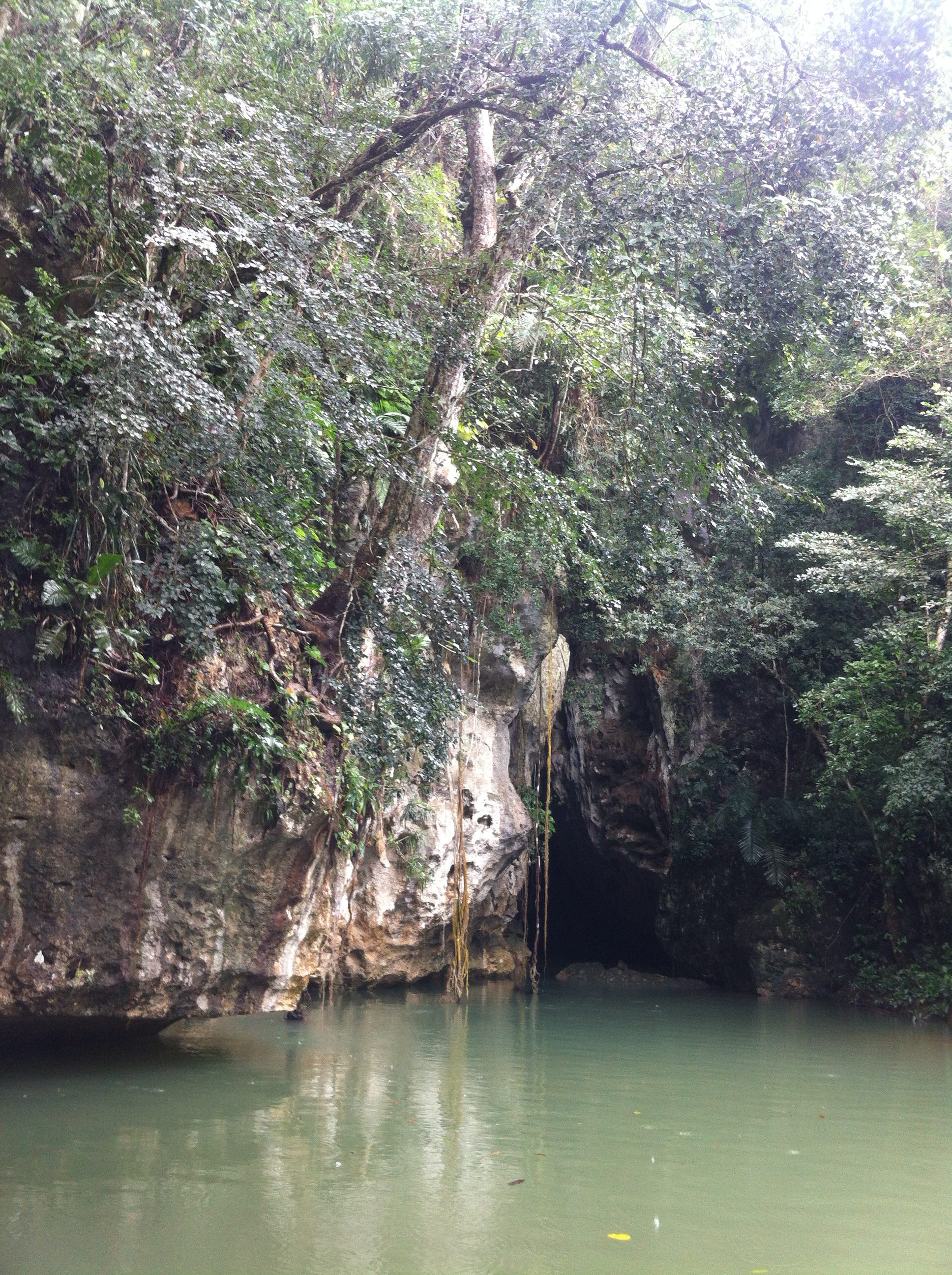
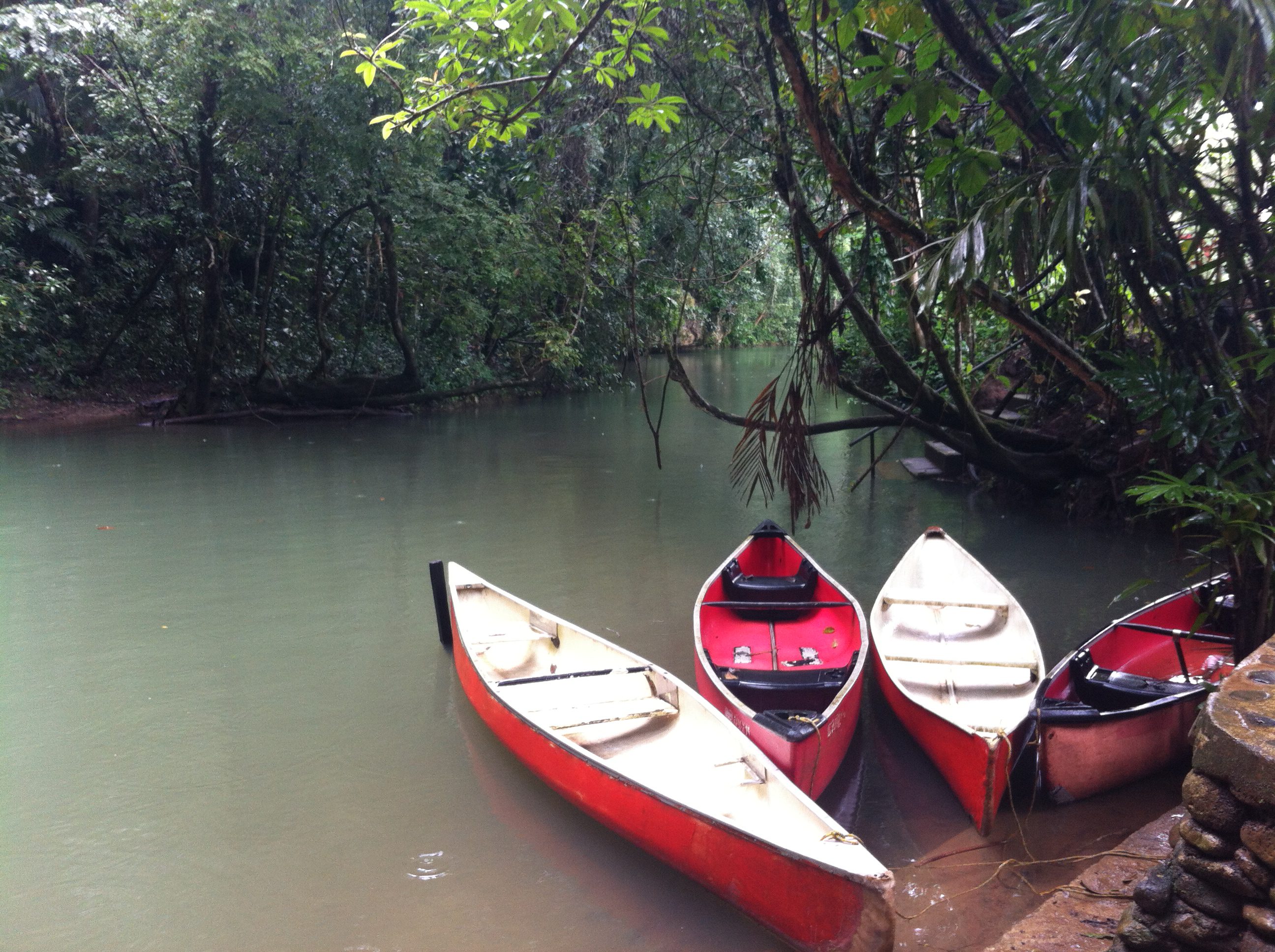
Here is the cave entrance and the canoes.

As we paddled into the silent cave, the hooting of a barn owl that sat in a niche high above the entrance echoed in the darkness, which closed on us as soon as we were a few meters in.

A second guide, Alex, had been called in from his Sunday off because Mike hadn’t been expecting our group.  We drifted along at a leisurely pace, looking at the formations and ancient pots left by the Maya (maybe).  We paddled about a mile into the interior, and I asked Alex about his life.

He was 25 and from El Salvador, from whence his family had fled during the civil war.  He lived with his mother; his father had gone north to California, where he had a successful business.  Alex’s siblings had followed his father one by one and wanted him to join them.  He hadn’t seen his father in over 20 years.  He had no future in Belize.  But he was the youngest child, and his mother wanted to stay in Belize.

“Last month,” he said, “My father got me a visa and I was prepared to go.  But I just couldn’t leave my mother.”

I groaned internally.  Donald Trump had just issued a decree ordering the number of refugees admitted to the US in 2017 be cut in half.  Alex had probably missed his last chance.

Unbelizable!

This is a series of posts about Belize and Guatemala that starts here.

We were at the Crystal Paradise Resort in San Ignacio, Belize.  It had been a grueling day of cars, planes, airport trains, planes, and then a five-hour ride in a van over bumpy roads to get here, but it was all worth it.

There was nowhere to go for the evening, and nothing to do.  We had some beers in the central cabana, then dinner, served family style.  The food was really good, I wolfed it down and probably murmured, “Mmmm” out loud several times.  Other people, they had questions.  Was the bread gluten free?  Was the rice vegan?  Can I exchange the potatoes for carrots instead?  Can I have the salsa on the side?  Is the salsa spicy?  And so on.

I’m not a gastroenterologist.  I know there really is something called Celiac disease.  My stomach doesn’t like greasy foods, so I believe people when they say that something—usually it’s gluten but I’ve heard dairy, sugar, and all sorts of other foods—makes them uncomfortable.  But there is a certain segment of the population that is on a crusade against gluten, or dairy, or some other food.  They say things like, “Dairy is evil!”  As if a food group has intentions to harm them.  I can’t imagine life without dairy.  To me, cottage cheese is a food of the gods.

Then there are the people who say they’ve lost weight on a gluten free diet.  “Good for you,” I said to one such friend.  “But do you think maybe you’ve lost weight because you’ve cut bread, potatoes, rice, corn, and pasta out of your diet?  In other words, you’re just eating less—aka ‘on a diet?’”  That had not occurred to her.  Somehow, it was easier to think she was following dietary restrictions because she had a “condition” than to think she was just on a diet.

The family who ran the resort accommodated every request.  They must be used to American tourists.  Finally, everyone was happy and during dinner we got to know each other a bit better because we were facing each other, not crammed side to side into a van.

I might have been the first one to turn in for the night, and even though the bed was hard and the pillow was lumpy and Liz snored, I slept like a rock.

Morning.  Early morning, that’s my habit.  I was up at 5 or so and went outside to sit under a thatched hut to listen to the rain and the birds.  I tried to write down the bird sounds. Ooo, ooo, ooo.  Aaargh.  Wheeep! Wheeep!  Harff.  WooHoo!  I could have sat there all day, but I needed coffee.  I walked to the central hut and joined Stan, the other early riser and a veteran bird watcher.  He was there with his binoculars and already had noted a dozen different birds in his notebook.

A tiny toucan landed on a branch 20 feet from us, cocked its head at us, then flitted away.

“Wow!” Stan and I both exclaimed, “Did you see that?”

After breakfast, another great meal, we were off to canoe into the Chiquibul cave system into the “Mayan underworld known as Xibalba.”  We were promised it contained sacrificial remains and “spectacular stalagmites and stalactites, and the footholds carved by the Mayans over 1,500 years ago.”

We were back in the van for another bone jarring but much shorter ride, capped off with a steep hairpin road that descended way, way, way down into a valley.  At one point it felt like the van was going to topple over the cliffside,  and I involuntarily yelled, “Jesus Christ!”  This got Liz laughing, and she couldn’t stop.  In her southern Ohio drawl she kept saying, “Ah never heard anahthing so funny!  A Jew saying Jesus Chrahst!”  It was infectious; everyone in the van was soon laughing hysterically, although it may have been out of fear.

At the bottom, we met Jose, who would be our cave guide.

“Welcome to the Chiquibul caves!” he said enthusiastically.  “They’re unbelizeable!”

Yes, he said unbelizeable—you better belize it.

Getting Along

This is a series of posts about Belize and Guatemala that starts here.

Finally, we were all squished into the van and Mark pulled out of the airport parking lot with Jesse in the passenger seat holding a map on his lap. I had expected Mark to use Google maps on his phone or at least a GPS, but he only ever consulted paper maps—and I have to say it made the journey feel more adventurous.

If this had been the USA, or Germany, we would have made our destination in an hour.  But this was Belize, and once we got away from Belize City, the roads were so bad we could only go about 25 miles per hour.

I had experienced bad roads in El Salvador and Costa Rica, but I hadn’t been to Latin America for a decade and I realized I’d expected conditions had improved.  They hadn’t, at least not in Belize.

The houses and other buildings were either half built or half falling apart.  Every surface was faded, rusted, crooked, or flaking.

How can I describe the roads?  The word Horrendous fits.  We have potholes in Minnesota due to the freezing and thawing in winter.  They have potholes because the roads just aren’t paved, or they get washed out during the rainy season.  There’s probably no money to maintain them, and corrupt contractors likely factor in, too.

Mark wove around as much as he could to avoid the craters, but that only added swerving motion to the up and down lurching and the side-to-side swaying.  It was like being on a boat in choppy water.

I had foolishly obeyed Mark’s first request for us to get in the van, so I was belted into the far back seat where the motion was worst.

Why is it that people feel compelled to read signs out loud?  A certain person I was sitting announced, “Rosa’s Tienda,” as we passed Rosa’s Tienda.  “Belmopan, 45,” he read as we passed that sign.  “Entering Cayo District,” as (you guessed it) we entered Cayo District.

And so on.

After an hour I turned to him and yelled, “Shut the fuck up!  We can all read!”

No, of course I didn’t. I did it in my head.  I’d like to say I found a direct but kind way to tell him to stop reading every sign, but this was only Day One.  I would be spending many hours in the van with these people.  If I blew my cool right away maybe they would turn against me and shun me.  That would really be a vacation buzz kill.

Later I learned that others had been having the same thoughts. Maybe someone had a word with him, because after the first day it stopped.

We jostled and bounced along the Western Highway, past the Hummingbird Highway to Roaring Creek, the charmingly spelled “Camolote”—a misspelling of Camelot?  I felt heart burn coming on.  I never get heart burn, but I suppose the van ride was doing to my digestive system what shaking does to a bottle of soda.

We passed misty mountains and clear-cut forests.  We passed the towns of Tea Kettle, Ontario Village, Mount Hope, Unitedville, Santa Elena, and finally arrived in San Ignacio, the last town before we turned off for the Crystal Paradise. None too soon, we went into a store to buy snacks, and I quickly got back in the van in the front row.  Much better.  Everyone agreed we would rotate seats, which was very civilized.

We drove around in circles looking for the turnoff until Mark stopped and asked some loitering teenagers if they know where it was.  They did—it was right before the Pepe Sanchez Insurance Agency.

After an early morning flight, a tense standoff at border control, and five hours on the road, we pulled up to the Crystal Paradise at dusk.  We were finally, really “in” Belize.

It really was paradise, at least for this Minnesotan who had left behind snow and cold.

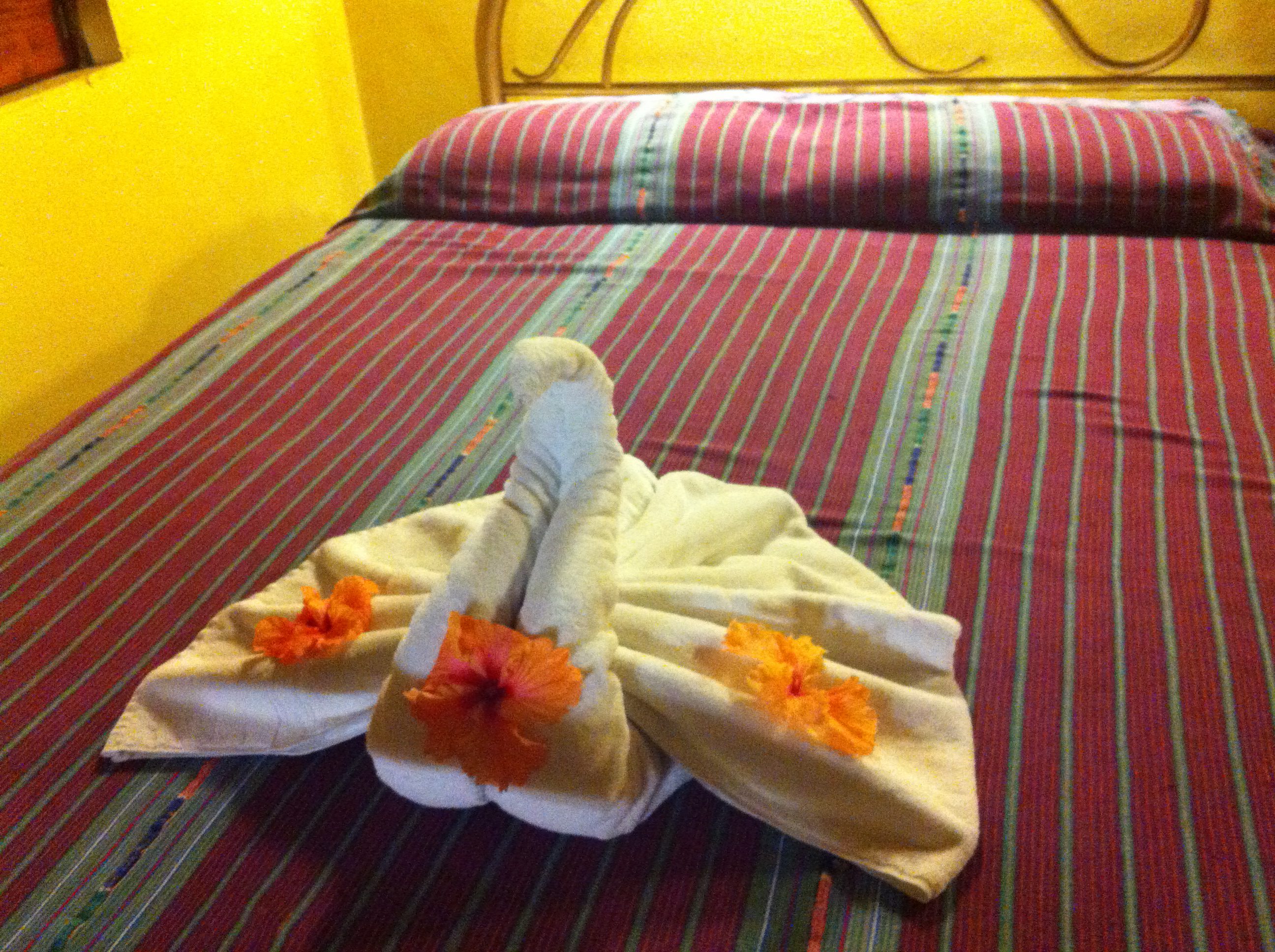
Liz and I were sharing a room and we oohed and ahed over these swan creations, then fell face first onto our beds for a nap.

The People

This is a series of posts about Belize and Guatemala that starts here.

Here’s the demographic run down on who was on this trip in Belize. There was Mark, who I’ve introduced as the trip leader, who was probably 28 years old.  He had a man bun, wore braided leather bracelets, and had very, very dark brown eyes.  A few times I found him staring intensely at me, like he was trying to read my mind, but then I realized he was just spaced out.

This is where it gets tricky.  I’ve used Mark’s real name because he’s on the Wilderness Inquiry website so you could figure out who he was if you had nothing better to do.

I’ve changed everyone else’s names.  I told the group I write a travel blog and that I would be writing about the trip, including about them. After all, isn’t it often the people you meet that make the most interesting stories?

When I whipped out my notebook to jot down place names and such, people would ask, “Is that for your blog?” and I would answer yes.  None of them asked how to get to the blog, but if any of them ever find their way here I wouldn’t want them to feel trashed.  We were all being ourselves, even if some of our selves were more irritating than others.

Even though I write things down, this blog would never pass a fact-checker’s muster.  So you can take the following as generally correct information.

Our group ranged from 45 to 75 years old, so I wonder if Mark felt like a baby boomer baby sitter.  There were two married couples from Minnesota. Inga’s family was Latvian and she had lived there before moving to the Pacific Northwest where she met Jesse, who was Native American and worked for some tribal concern.  They had moved to Minnesota when he got a job at a big foundation.  That had ended now, so they were in a life stage of trying to decide what next.

Mike and Joan were suburbanites and newly empty nesters.  They had a daughter with autism, and it had been an exhausting journey helping her to become independent. They were “reconnecting,” as they put it, on this trip.  Mike did something in IT and Joan was a stay-at-home mom.

There were two married people whose spouses would have hated this kind of travel.  Bugs?  Heat?  Hiking?  No way!  So they came by themselves.

Stan was a soft-spoken retired postal worker from Pittsburgh.  “I’m taking my wife on one of those Viking River Cruises in Europe next fall,” he told us.  “That’s her kind of travel—white linen table clothes, shopping, and museums.”

Stacy was a retired band teacher from New Jersey.  She and I were both Jewish, and we joked how about how it’s unusual to have 20% Jewish representation on a tour.

The last member of the group was a never-married woman my age named Liz.  She was from Columbus, Ohio and had worked in the mortgage department at a giant bank for 30 years.

So that was us—pretty homogeneous—mostly white, middle class, and middle aged.  When you think about it, it’s people like us who have the time and funds to do things like this.

Trudy’s interpreter, Emily, was the youngest among us at 45.  She lived a few blocks from me, was married to a guy from Zanzibar, and had four kids.

If you’ve ever been on a group trip, maybe you’ve experienced this—you are immediately drawn to one person, feel repelled by another, feel neutral about a third, and so on.  Emily and I hit it off right away, probably because we had both lived abroad.  While others on the trip had traveled internationally, there’s a big difference between that and living or working abroad.

Which brings me to some current news: I’m going to Ethiopia for work!  I’ve always wanted to write a sentence like that, and now I can.  It will be sometime in the next six weeks, so on top of planning my three months in Europe and the UK, this will give me writing fodder for years.

Herding Cats

This is a series of posts about Belize and Guatemala that starts here.

My post about overbooked flights coincided with the story of that guy who was dragged off the United Airlines flight. My bumping experience was different, to say the least.

Flying from Minneapolis to London, Delta picked me out of the crowd at the gate and told me I had to give up my seat.  I started to protest, when the gate agent said, “We’ll put you on another flight that leaves an hour from now … it gets into Heathrow an hour earlier,” she added in a low voice.  “And we’ll give you a $750 voucher.”  Still, my reflex was to open my mouth and complain but something stopped me.  “And we’ll seat you in first class,” she added.

“Um, okay?!” I said.  My luggage went with the first flight but that turned out okay, because I was staying on a farm in a remote village called Oddington.  If my bag had come with me, I would have had to schlep it on and off several trains and buses.  This way, the airline delivered it the farmhouse door the next morning.

You are probably thinking this story belongs with those mythical tales about unicorns, but it really happened.

I stood by the border agent’s booth in Belize for 30 minutes.  She granted me permission to use my phone to try to contact the tour leader, Mark.  I tried a text, then phoning, which later cost me $15, and I got voice mail.  I tried an email but my phone or the connection was too slow for it to send.

Two drunk Canadian women in their 50s came through and noticed me standing there.  I explained the sitch.  “We’re staying at the Funky Dodo Hostel,” one whispered loudly, six inches from the border agent.  “Tell her you’re staying there.” She fumbled in her purse and pulled out the address and loudly “whispered” it while looking in my direction with unfocused eyes.  The people behind her in line were getting irritated.  She repeated the address several times, then shambled away with her friend.

The border agent and I smirked at each other.  She made me sweat another 10 minutes, then led me over to another booth where second agent flipped through my passport, stamped it in the most bored, sarcastic way, and let me in.

It was a rookie mistake.  This was Mark’s first time leading an international trip, and someone at Wilderness Inquiry should have trained him on it. It wasn’t his fault.  But I should have known. Each of the nine other members of my group was similarly detained, so Mark had been waiting in the arrivals hall for four or five hours.

Well, we were finally all here.  The arrivals hall was chaotic.  The Belize airport was built in sleepier times, and now Belize is a hot tourist destination so it’s just too small.

Mark kept trying to round us up and get us into our 12-passenger Ford Econoline rental van.  This was complicated by the fact that we had a deaf woman among us, Trudy.  Trudy was a firecracker—in her 70s, maybe 5’ tall, divorced with four grown children, retired—she had traveled with Wilderness Inquiry to Peru, Australia, and New Zealand.  As I’ve written, WI’s thing is inclusion, which is great, but Trudy was all over that airport checking out the gift shops. Mark would yell after her, realize that was pointless, then yell at her interpreter, Emily, who was also with us on the trip.  Then Emily would march after Trudy and sign furiously.  There were others who ignored Mark throughout the trip.  Today was the first of many times we would wait for them in the van.  That sounds worse than it was; we were a pretty easy going group.  After all, we were on vacation.

At last, we were all gathered in the Econoline with our luggage and on our way to the Crystal Paradise Resort, 70 miles from Belize City and only about 13 miles from the Guatemalan border.  This would position us for the crossing into Guatemala and on to Tikal the following day.