Category Archives: Adventure

On Our Last Leg

This is the last post in a series of 32 posts about a road trip to New Orleans that starts here.

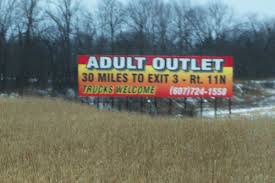
Why are there so many anti-Abortion billboards in Minnesota?  I don’t know.  On this road trip we passed through nine states, including Minnesota.  Some states had a sprinkling of anti-abortion billboards, but mainly they had billboards for adult superstores.


adults Lions den truckers x

“Southern X Posure.”  Get it?  Do you get it?  I love the euphemism “Gentlemen’s Club.” Really, no actual gentleman would step foot in one, right?  But seeing these every couple of miles makes you wonder if there are any gentlemen left.

Why was it okay to advertise porn in Tennessee, one of the most conservative states, while in Minnesota—one of the most liberal states, we were bombarded with anti-abortion billboards?  Maybe the social conservatives who live here feel outnumbered, and therefore that they must fight harder than if they lived in Tennessee.

The route from Albert Lea, Minnesota to the Minneapolis/St. Paul airport wasn’t very interesting, just a straight shot up Interstate 35.  We passed more towns with old world names, like Geneva, Manchester, Kilkenny, and Dundas.  There was the sadly-named Hope, Minnesota.  Had the founders, in their denim overalls, chin beards, and gingham frocks, engaged in some magical thinking?  “If we name our settlement Hope, surely the Good Lord will cause us to flourish!”

Here is Hope’s claim to fame: “Hope had a depot on the Chicago, Rock Island and Pacific Railroad.  A post office called Hope has been in operation since 1916.”  Hope is an unincorporated township, which means the U.S. Census doesn’t bother listing its population, so I can’t tell you whether it is tiny, miniscule, or sub-atomic.

We crossed the Minnesota River as we approached the airport. The Minnesota originates in Big Stone Lake, near the South Dakota border, and flows east until it merges into the Mississippi. I let Lynn believe we were crossing the Mississippi one more time—after gazing out over it in Memphis, New Orleans, and Hannibal.

In 11 days, we had driven 2,660 miles (4,280 kilometers).  If we had followed the Mississippi, we would have driven 4,640 miles because it meanders.  Some day I would like to take a meandering road trip.

Don’t get me wrong, we saw a lot and had a great time.  We saw cranberry fields and went to a Native American pow wow in Wisconsin.  In Chicago, we saw the world’s largest Tiffany glass dome and one of the iconic painting, American Gothic.  We were moved to tears in the American Civil Rights Museum in Memphis.  We spent five days in New Orleans with friends, heard lots of music, and ate lots of Cajun and creole food.  Lynn and I spent six days in a Mini Cooper and were still speaking to each other.  We had the chance to try pickled pigs lips.  Instead, we ate at a Cracker Barrel.

We did go off piste a few times, but it would be great to take a road trip with no time limits.

Instead, I dropped Lynn off at the airport at 7:00pm to catch her 9:00pm flight, and drove home.

It was good to be home but it also felt weird.  I had bought this condo so my son would have a supportive place to live when he was released from prison.  I had told myself that I was buying a condo because it made financial sense, and maybe it did, but underlying the decision was my desire to give him a fighting chance of making it once he was released.  (My apartment landlord wouldn’t have allowed him to live with me.)

And Vince was making it.  He had a job, he was sober, and after seven months he had moved out to his own place—the day before Lynn arrived.  So now I stood in the doorway of the empty bedroom.  I felt a little sentimental, but I was mainly happy for Vince and for me that we both had our own space.

The next day I went back to work and got down to writing proposals to fund torture rehabilitation—and banking more paid time off for the next holiday.

Endless Iowa

This is the latest post in a series about a road trip to New Orleans that starts here.

There was no time to visit any of the Mark Twain historic sites, so Lynn and I rolled out of Hannibal and headed north.  Even though Minnesota borders Iowa to the north, and Vince lived in southern Minnesota for years, I had never crossed the state line into Iowa.  All I had ever heard about it was that it was flat and full of corn fields and pigs.  That you could actually smell pigs on a breezy day.  That did not appeal to my sense of adventure.

But there was no other way to get from Missouri to Minnesota, so I lost my Iowa virginity.  How bad could it be?  I prefer landscapes of woods and water, but fields must have their own beauty.

Here is what I imagined:
iowa-farmland

Here is what we saw for five hours:

spent-corn-field

It was early spring and everything was still brown. And flat, flat, flat.

Desra had given me some very good advice.  “Iowa has half the population of Missouri, so there aren’t as many towns. If you think you’re going to need gas, don’t wait until your tank is almost empty.”  She was right.  In the hundred miles between Cedar Rapids and Waterloo, the two largest cities we passed, there was only one exit of note, to a place aptly called Center Point Travel Plaza.  The other exits led off into corn fields.

I’m sure Iowa is beautiful in the spring, when the bright green corn shoots up from the black earth.  I’m sure there are many fine people in Iowa, and it’s a great place to raise kids. That’s what people say when a place is boring, “It’s a great place to raise kids.”

It’s not like I live in some mega city like New York or Shanghai or London.  Most people outside of the U.S. have never heard of Minnesota.  Most people on the coasts sneer at the Midwest, which includes Minnesota and Iowa. We are derisively referred to as “fly over country.”  But I’m never bored in Minnesota.  I think I would kill myself if I had to live in Center Point, Iowa.

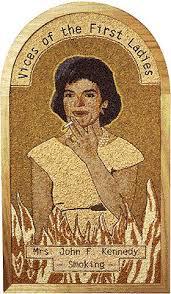
Why do people think places like Iowa are good places to raise children?  Because they’re safe, probably.  But children are also able to create their own adventures wherever they are.  In fact, the less there is to do, the more inventive they become. Winters are long on the prairie.  They force people to create entertainments and art out whatever is at hand, like fabric scraps and seeds:

State fair bama Bachmann Vices of the first lady

I’m afraid kids raised with screens won’t have the patience to create great works of art like these.

And so we crossed Iowa, and I began to feel like I was in a trance because there was nothing to look at and no variation of the landscape. There weren’t even any billboards, probably because there wasn’t enough traffic to entice advertisers. I could see how people dozed off and ended up in a corn field.

We stopped to get gas and bought snacks to tide us over instead of having a meal.  I got my standard road trip meal—teriyaki beef jerky and a Diet Pepsi.  I whined about how boring Iowa was the whole way, to help me stay awake.  Lynn must have found that pretty boring.

We killed an hour talking about some sort of test she uses to assess what roles people play in work meetings.  Obviously no one fits neatly into one role every time.  There are the obvious ones like the Leader, the Compromiser, the Ideas Person; and the unhelpful roles like the Avoider and the Clown. I consider myself a leader with ideas, and I think others are stupid if they don’t immediately see the brilliance of my ideas.  Hmmm…that may actually make me a Show Off or an Autocrat.

Finally we crossed the border into Minnesota.  I had imagined it would be dramatically different—Minnesota would be gently rolling wooded hills dotted with sky blue lakes.

But no, for at least an hour it was the same as Iowa, with the addition of anti-abortion billboards.

antiabortion 2 antiabortion 4 antiabortion 1 antiabortion 3

Wayside Waylay

This is the latest post in a series about a road trip to New Orleans that starts here.

Our last day, and it would be a long one.  Eight and a half hours of driving, not counting stops.  Lynn’s flight left at 9pm, and we had been hearing how long the lines at the airports were. It seemed like a good idea to not push our luck by dawdling along the way.

I did want to stop in Hannibal, Missouri, which my mom and her husband had described as quaint and which was the boyhood home of Mark Twain.  But that was at least two hours out of St. Louis and we hadn’t eaten breakfast.  I stopped at a wayside rest to get some advice on where to eat.

If you’ve never done a road trip in the U.S., wayside rests are located about every 100 miles and have their own freeway exits.  They vary from just a gravel parking lot with a pit latrine to a gleaming air conditioned building with vending machines.  But there are no museums or gift shops or restaurants.  I like them because you can get in and out in five minutes without getting distracted. Usually.

This one in Missouri was the rare wayside rest with an information desk.  The woman was very friendly and a font of information.  Well, more like a slow-motion geyser.  She spoke with a slow southern drawl.  “Ya’ll could drive along the river, it’s very picturesque.”  She handed me a map of the Scenic River Road.  We didn’t have time, sadly, for the scenic route.  She highly recommended we take some extra time and go to a small town whose name I can’t remember.  She handed me five maps and brochures.  Looking at the map now, which town was it?  It couldn’t have been Mexico, Paris, or Florida—I would have remembered those.

“It’s a historic town with an absolutely darling downtown and a famous restaurant that serves throwed rolls.”  She handed me another brochure and tried to explain what throwed rolls were but I couldn’t get the concept.  “It’s only 20 minutes off the interstate.  Ya’ll can get cheese grits, and buttered corn bread, and….”  Mmmmmm.

People think that providing lots of choices is a good thing, but after 11 days on the road I was done making decisions, even about where to eat.

“We’re kind of in a hurry, I’m afraid, so it’ll have to be somewhere right off the highway.”

She handed me more maps and brochures for restaurants and scenic attractions. She must get mostly retired people who had all the time in the world.  Lynn had abandoned me.  “I’d better check on my friend,” I lied.  “She gets upset if I keep her waiting.”

The info lady looked disappointed.  “Just a few more suggestions,” she pleaded.  More brochures, more maps.  It must get lonely working in a highway wayside rest.

“My friend has to catch a flight to London,” I said, backing away as if the flight was imminent.

Meanwhile, I kept getting texts from Air B&B and the Quality Inn urging me to “Write a review of your stay!”

“Do your own marketing,” I muttered.  I am definitely happier when I get breakfast.

Lynn insisted she wasn’t hungry, so rather than look like a whining hungry weakling, I drove straight through to Hannibal.

This is a postcard depicting Hannibal:

Postcard Hannibal

This is what Hannibal really looked like:

boarded up houses

Dilapidated houses, block after block after block.  Was this a result of the Great Recession, or a longer term decline?  There was no signage directing visitors to a historic district, but by just following the streets downhill, I eventually hit the river front, where a couple natives out for a walk pointed the way.

The downtown was quaint.  It consisted of about four blocks of antique stores, a boarded up theater, a couple restaurants, and half a dozen Mark Twain historic sites.

Quaint Hannibal

We settled in at Becky Thatcher’s Diner, and the food was fantastic.  Really fantastic, not just because I was starving.  Lynn had corned beef hash for the first time and I had a huge omelet with potatoes.  Neither of us talked much, unless you count “Mmmm” as a word.

Who Doesn’t LOVE?

This is the latest post in a series about a road trip to New Orleans that starts here.

After re-gifting the doughnuts to our neighbors, Lynn and I drove off laughing.  “Who doesn’t love doughnuts!?” That was our topic of conversation as we drove downtown in search of breakfast and the famous arch.

“People assume that everyone loves whatever they love,” I said.

“Yes,” replied Lynn, “Who doesn’t love chocolate?”  Lynn is allergic to chocolate.

“Who doesn’t love ice cream?” I asked.  “I don’t like cold food, in general.”

“Neither does Richard,” said Lynn about her husband.  I always keep his meals warm in the Aga or he’ll whinge that they’re cold.

Aga—the iconic British range.  Whinge—a British term similar to whine.

ATC3_AGA-Total-Control-3-Oven

“Who doesn’t love candles?” Lynn said next.  “I don’t understand this obsession with candles—artificially fruit scented.  ‘Natural’ pine.  Apple pie.”

“Doughnuts!” I offered.  Then, “Who doesn’t love kittens?  People who are allergic to them, that’s who.”

Then—it couldn’t be avoided—I asked “Who doesn’t love dogs?”  Lynn has seven dogs, and I don’t care for dogs.  I could write several posts on this, but I worry about the hate mail I would get.  There is a secret cabal out here of people who don’t care for dogs, but we keep our mouths shut until the dog’s nose is in our crotch or it’s jumping up on us with muddy paws.  It seems acceptable to make jokes about killing your kids while bashing people who don’t love dogs.  Here is one of the more tame Facebook posts I’ve seen on the subject.

dogs

Wow.  Really?  I don’t have a soul because I don’t care for dogs?  That seems harsh.  And the fact that I love my family and adore little kids and have lots of friends doesn’t make up for it?  Oh that’s right—those are just people, and people are hard work.

Anyway, Lynn seems to accept me anyway, although she may wonder if I have a soul.

All this time we were driving into downtown St. Louis, or Sen Louie, as Lynn pronounced it.  We hadn’t seen anything that my mom’s husband had recommended, but there just wasn’t time. This was going to be our big miles day—almost 600 from (965 kilometers) from St. Louis straight to the Minneapolis/St. Paul International airport via Iowa.

But we had to see the Gateway Arch, which was built to symbolize the westward expansion of the United States.  It’s 630 feet tall (192 meters), and it’s beautiful.  I thought that Lynn, having worked and lived off and on in Finland for years, would appreciate that it was designed by a Finnish-American architect, Eero Saarinen.

I had been to St. Louis decades earlier and took the elevator to the top of the arch.  I don’t remember much about it.  Apparently there’s a riverside park and museum at the base.  But we never saw any of that, because the construction and traffic in downtown St. Louis was horrendous.  We spent a precious half hour driving around in circles and waiting at excruciatingly-long traffic lights for nonexistent cross traffic.  We caught glimpses of the arch but there were no signs indicating how to get to it.

Finally, I found a parking lot with a good view of the thing, we snapped some photos, and left town.

the arch

Note to self: I need to learn how to erase ill-placed streetlamps such as in the photo above.

My vision had been for us to have a solid breakfast at some nice café at the foot of the arch with a view of the Mississippi.  Instead, I had a protein bar that had been in the back seat of the car for 10 days and Lynn went hungry until we got to Hannibal, two hours north on the Mississippi, past Chesterfield, Troy, Eolia, Bowling Green, and New London.

“New London!” said Lynn, studying the map.  “I’m sure it’s rich in culture and history.”

“We’ve got one in Minnesota, too.  There’s probably a New London in every state.”

“Well they had great hopes, didn’t they, these people who started places like Oxford, Mississippi and New London, Missouri? They really were very brave and idealistic.

“But let’s not stop there.”

Notes from an Anglo-Irish-German-Czech-American Jewish Atheist

This is the latest post in a series about a road trip to New Orleans that starts here.

Desra gave us a ride back to the Air B&B.  Inside, Lynn said pensively, “If I went to dinner in London with someone who was Afro Caribbean, I don’t think the subject of race would even come up—but we spent the whole dinner tonight talking about race.”

Of course they don’t have African Americans in England.  The race labels were confusing when I lived there, especially who was covered by “Asian.”  In Minnesota, Asians are Chinese, Japanese, Vietnamese, Cambodian, Lao, and Thai.  By far the largest group, the Hmong, are mountain tribes people from Laos, Vietnam, Thailand, and China—where they are called the Miao. That’s pronounced “meow.”  Our newest arrivals are the Karen, an ethnic group from Burma/Myanmar.

In England, an Asian is most likely from India, Pakistan, or Bangladesh.

Lynn herself is Anglo Indian because her ancestry is English and Indian.  Note that the Anglo comes first, whereas in the U.S., we say “African American” or “Muslim American.”

This labeling is all very fraught with the peril of offending one side or another.

“What if you were having dinner with a Pakistani or other Muslim?” I asked Lynn.  “Would race or religion be a theme in every angle of the conversation?”

“Hmmm…maybe,” replied Lynn. “Yes, that might be it.  It’s not that we don’t have prejudice in the UK.  But I think it’s the Muslim population that’s getting the brunt of the suspicion and animosity, especially since September 11 and seven seven.”

July 7, 2007—the day on which 52 people were killed and 700 injured on the London transport system in an Islamist terrorist attack.  I remember watching it on the news, in Spanish, from my bed in a hotel in Cusco, Peru, where I was vomiting my guts out into an ice bucket after eating some bad guinea pig. That’s a story for another post, but here’s a free tip for you: never use a hotel ice bucket for ice.

We reference so much with these simple dates: 9/11, 7/7.   So much has changed.  In the U.S., half the population—the conservative half—replaced its constant fear of a mass attack by communists with fear of a Muslim attack, which has made possible the rise of a demagogue like Donald Trump.  The strange thing is, they don’t fear the white guy next door with 50 guns who just lost his job and his wife and is acting strangely—just “the Muslims.”

The third major terrorist attack in the west was 11-M, the train bombings in Madrid on March 11, 2004.  Almost 200 people were killed and 2,000 were injured.  I don’t remember where I was that day.  But I do vividly recall being in Spain sometime after 9/11 but before 11-M studying Spanish.  I was chatting with a British woman and somehow 9/11 came up.

“Now you lot know what we’ve been living with all these years from the IRA,” she said casually about the attack in which nearly 3,000 people died.

Back in St. Louis after a good night’s sleep, Lynn and I were preparing for our last day on the road.

“What do we do with the doughnuts?” she asked.

I carried the box out with us, thinking I would take them home to Vince.  Then I spotted a kid on the porch of the house next door and approached him.

“Hey kid, want a box of doughnuts?”  He was chubby and his eyes said Yes as he also backed away from me toward the door and called, “Daddy!”  The father came rushing outside, looking panicked. I could just picture myself at the police station: “No officer, really! I just wanted to give him the doughnuts; I wasn’t trying to lure him into my car.”

I offered the box to the father, who looked inside to make sure they really were doughnuts (I wonder what else he suspected could be inside?  Snakes?).  He looked up at me with a grin, thanked me, and the two of them hurried inside, where I could hear the boy calling out excitedly, “Mom! We got doughnuts!”

Smoked, with a Side of Shouting

This is the latest post in a series about a road trip to New Orleans that starts here.

Desra was waiting in the Shaved Duck when Lynn and I arrived. I immediately noticed that the music was deafening.  The tiles floors and tin ceiling didn’t help.  There was nothing else in the vicinity and Desra had picked the restaurant so I didn’t want to dis her choice, plus I didn’t want to be one of Those Old People who complains about loud music.

I wasn’t sure what the concept for the Shaved Duck was.  Was it code for something? “Shaved duck” suggested something vaguely naughty.

On the back of the menu it stated that the place was “a smokehouse and gathering place.”  The menu featured Slow Smoked Duck Breast, Smoked Meatloaf, and Loaded Smoked Potato Wedges, which were essentially French fries covered with pulled pork, baked beans, bacon, white cheddar cheese, and Bourbon barbeque sauce.  As is the trend, there was a fancy version of macaroni and cheese, this one topped with duck and jalapeño chili.  I was pleased to see an iceberg lettuce wedge salad on the menu, a classic that’s making a comeback.  The one at the duck added bacon and cherry tomatoes and came with ranch dressing; in my opinion it should just be really fresh, crisp iceberg lettuce with Roquefort dressing.

I had a vegetable and smoked Mozzarella sandwich, and we shared some buttermilk cornbread and crab cakes.  What I really wanted was shrimp ‘n’ grits, but my health-conscious conscience was saying I should ease back into my healthy eating habits. I keep myself on a pretty tight leash.  But I still had two days left of the vacation.  Why couldn’t I just order what I really wanted?  Sigh.

I caught up with Desra, who I hadn’t seen since we finished grad school 10 years earlier.  Her master’s degree was in Urban Planning and mine was focused on Foreign Policy. She reminded me she had run for Minneapolis City Council, which isn’t for the faint of heart.  She then led a nonprofit neighborhood association until she met her husband and moved to St. Louis a few months earlier.  Her husband taught African-American history at a community college and was working on his PhD, which I assume will get him onto the tenure track at a university.

She had a huge, blindingly brilliant diamond ring which I admired.  I sighed inwardly when she mentioned how old she was—the same age as Vince.  Wouldn’t it be wonderful if my son could meet such an accomplished, upbeat, beautiful bride?

I  hadn’t realized she was originally from New Orleans, so Lynn and I talked about that—or rather shouted.  I described our visit to the civil rights museum, which she hadn’t visited yet. We talked about real estate prices in St. Louis vs. Minneapolis.  Desra was job hunting and seemed positive she would find something soon.

The duck was packed, and there was a raucous group near us with one woman who kept braying loudly, “Har, Har, HAR!”  Do restaurants crank up the volume to create a festive atmosphere?  Or maybe they want us to hurry up and leave so they can turn more tables?

Sometimes if I am on my own turf I will ask a server to lower the volume.  But again, I didn’t want to be an old fogey.  I also began to worry that maybe I had some early hearing loss.

Much of the conversation touched on race issues.  All the subjects above—from a recent Minneapolis electoral race to real estate to the higher education system.  This brought us to the question of fraternities and sororities.

“Yes,” asked Lynn, leaning forward to make herself heard, “We don’t have them in the UK.  What’s their origin?  Were they designed to exclude black students?”

I could hear one out of five words Desra said.  She hadn’t belonged to a sorority, but there were certainly black sororities and fraternities, so the Greek system wasn’t inherently racist, but of course it depended on the campus.

We exited the restaurant Desra exclaimed, “I can’t believe how loud it was in there!  I feel like I’m deaf now!”

Doughnuts!!!

This is the latest post in a series about a road trip to New Orleans that starts here.

Inside our Air B&B, there were a dozen doughnuts on the kitchen table with a note: “Welcome to our Air B&B!  We hope you will enjoy your stay in St. Louis!!!”

Now I’m sure the owners of this place are very nice people.  However I have to say that the overuse of exclamation marks is bordering on an epidemic.  Just the other day, I read a brochure from Ramsey County about recycling and it contained seven exclamation marks.  I’m guilty of over punctuating myself.  In my defense, everyone else does it, so if I don’t end my emails to coworkers with exclamation marks, I feel like I’m being a bitch.  If I don’t end garnish every Facebook post with an “!” I fear I’m not as enthusiastic about cats in clothes dryers as I should be.

“Who doesn’t love doughnuts!” I said with gusto.

“I don’t!” Lynn exclaimed.

“Neither do I!” And it was true; we both find them disgusting.  I don’t understand the obsession with doughnuts.  When Krispy Kreme opened in Minnesota it was bigger than a Springsteen concert.

“But what will we do with them?” Lynn looked worried.  If we don’t eat them, they’ll think we were unappreciative, which of course we are but we don’t want them to know that.

“We could dump them in the trash behind some other house,” I suggested.  “But that seems wasteful.”

Lynn was perusing the hand written notes on a bulletin board on the kitchen wall.

“Dear Yuri,” she read. “Thank you so much for sharing your home with us!!”

She paused, then turned and looked at me.  “They’re all the same: Thank you for sharing your home with us … thank you for opening your home to us … but … this place isn’t free, is it?”

“No!  I paid $125 for the night,” I replied.  “It’s very nice.  It’s worth $125.  But they aren’t sharing it, they’re renting it out.  I don’t know why it’s called the sharing economy. That makes it sound like you’re doing it out of altruism. Uber’s another one—Uber drivers don’t give free rides.  My sister is an Uber driver and she’d never do it if it wasn’t for the money.  Maybe we’re just old and we don’t understand.”

“Very strange,” Lynn pronounced. “Well it was very kind of them to leave the doughnuts, but I rather wish they’d left a bottle of wine.”

We walked toward the botanical gardens and arrived just in time to be told, “We close in one hour, so you’ll have to hurry.”

Since we could never see it all by hurrying anyway, we took our time and walked through an enormous domed structure. It held several different environments, from tropical rain forest to Mediterranean. There were Dale Chihuly glass sculptures throughout.  Chihuly is really prolific.  We’ve got a massive sun sculpture of his at the entrance of the Minneapolis Institute of Arts.  The Chicago botanical gardens features quite a few.  Now I admired more.  Not bad for a guy who is blind in one eye, eh?

st louis botanical 3 st louis botanical 2 st louis botanical sunburst

I loved the Mediterranean garden, which reminded me of a long, long hike I took along the Mediterranean coast of France.  How is it that you can be in one place and enjoy it because it reminds you of another place?

The gardens were a great way to decompress after the drive, and I later learned that they are considered the best botanical gardens in America.

Next, my plan was for us to walk to the restaurant where we would meet a woman I’d gone to grad school with for dinner.  On the map it looked like it was a couple blocks away.  I asked one of the botanical garden employees, just to be on the safe side.  She was extremely friendly but suggested it was too far to walk.  Well!  Too far for some people, maybe, but not me.

“Are you okay with walking?” I asked Lynn.

“Shhure…” she said, uncertainly.  And so we walked, and it turned out to be two miles, but we’d worked up an appetite by the time we arrived at the Shaved Duck.

Oxford to St. Louis via Festus

This is the latest post in a series about a road trip to New Orleans that starts here.

While Lynn slept, I explored the breakfast bar at the Quality Inn in Oxford, Mississippi.  It offered weak coffee, powdered “milk”, white bread for toast, single serving boxes of corn flakes, single portion bags of instant grits and oatmeal, and … do-it-yourself waffles.

These weren’t toaster-ready waffles. I watched people try to figure out the waffle maker one after another as I ate my instant grits.  Where was the batter?  How did it come out of the container?  Where did it go into the waffle maker?  Then what?  How long did you keep the lid closed?  Where you supposed to flip it over?  How did you get the waffles out?  It looked simple, but to someone from…oh, let’s say China, it must have been about as familiar as I would have felt trying to make dim sum.

Meanwhile, I was keeping an ear on the conversation of two guys at the next table, who appeared to be truckers.  I had heard the word “Jesus” and “Bible” and assumed they were fervent Christians, so I avoided eye contact.  One was flipping through a pile of magazines.  Maybe they were having a bible study at the Quality Inn.  Finally I was able to pull my attention away from the Chinese guy fumbling with the Made-in-China waffle maker and was able to listen in on the conversation next to me. “These born agains are fucking crazy,” the guy with the magazines said.  “They don’t reason.  They cain’t tell the difference between opinion and fact.  They only know what they’ve been told to think by their preachers.”

“Ah know, ah know,” replied his companion.  “They’re wreckin’ ar country.  We used to be superior for our inventions and idee-urs but now everybody’s laughin’ at us.”

“Everybody but Saudi Arabia,” replied the first guy.  “They probably love that we’ve stopped using our brains.”

This went on for some time and I was able to very subtly—I hope—get a look at the magazines, which included Popular Mechanics and National Geographic.  So they must believe in evolution!  Did you know that 42% of Americans believe God created the world in seven days?  I can barely bring myself to type that, it’s so embarrassing.  That’s an average, of course, and a much higher percentage of young people, urban dwellers, and yes—northerners believe in evolution.

I’m aware it can be irritating when I reproduce people’s accents in writing, but I did it above to make a point.  Well, two points.  First, I’m aware I’m prejudiced against southerners and second, there are southerners who don’t fit my stereotypes.

I had the urge to reach across and introduce myself, “Hi, I’m Anne!  I’m from Minnesota, and I’d just like to say how thrilled I am to discover free thinkers in Mississippi!”

Instead I went next door to Starbucks and got a decent cup of coffee.

We headed north again, toward St. Louis.  This would be a short day: we would only put around 400 miles on the odometer.

The drive was uneventful. We passed by Memphis, then veered northeast near the town of Marked Tree.  We passed Osceola, Tennessee; Blytheville, Arkansas; Hayti, Missouri; then Portageville, Tiptonville, Sikeston, Cape Girardeau, Pocahontas, Ste. Genevieve, Prairie du Rocher, and Festus.

St. Louis was the first place I used Air B&B.  We were staying in the upper part of a fourplex on Flad Avenue, in the Shaw neighborhood, chosen because it was a short walk to the Missouri Botanical Garden.  Shaw appeared to be a historically African American neighborhood that was being gentrified.

Flad ave

We had been instructed to park behind the building, but a pack of bearded, plaid-shirted hipsters who resembled Neanderthals were unloading a truck in the alley.  They smiled dumbly at us and clearly weren’t going to put themselves out to get out of our way, so we parked on the street.

I had received several texts from the Air B&B owner, Yuri, about gaining entrance, and it went without a hitch.  There were two bedrooms, a bath and a kitchen that would be our base for exactly 17 hours.

Death, Doom, Darkness, and Dinner

This is the latest post in a series about a road trip to New Orleans that starts here.

Lynn and I dumped our bags in our room at the Quality Inn, then headed in to central Oxford. Since visiting the Civil Rights Museum in Memphis, I had thought it would be a nice bookend to visit the University of Mississippi campus where James Meredith was denied entrance as the first African American student.  Riots ensued, and two people died before he was finally allowed to enroll.

After passing another five miles of chain stores, we turned a corner and suddenly it was like we had entered a portal into ye olde tyme worlde. The old town square was compact; we walked around its circumference in 10 minutes.  There were the usual plethora of gift shops and upscale women’s clothing stores.  Maybe because it’s a university town, there were also two good bookstores.

Ox Town Sq Sq Books Bookstore

I had finished reading Memoir of a Geisha.  I won’t claim it was Great Literature, but it was a good story.  At the end of the first chapter I had already been thinking, “Oh no!  I don’t want this to end!  What will I read when I finish it?”

At Square Books, I found Geisha, a Life by Mineko Iwasaki, who the author of Memoir of a Geisha had interviewed extensively for his book.  Apparently she was so unhappy with how he portrayed geisha life that she decided to write her own side of the story.  I was a little leery of how well it could be written, since she’d had no academic schooling and I don’t believe she speaks English.  But it turned out to be every bit of a page turner as the first book.

At Rebel Bookstore I bought The Optimist’s Daughter by Eudora Welty whom I’d never read.  Believe me, it’s not optimistic.  Southern writers tend to be dark and slow paced and there’s always a funeral.  Faulkner is the best example.  I enjoy a good Faulker, but you have to be in the right frame of mind.  If you are depressed when you attempt to read As I Lay Dying, it might put you over the edge.  Lynn had never heard of Faulker, who grew up in Oxford.

In case you’re wondering, other famous Southern writers—at least to Americans—include Kate Chopin (The Awakening), Robert Penn Warren (All the King’s Men), Katherine Anne Porter (Ship of Fools and many short stories), Flannery O’Connor (Wise Blood), Carson McCullers (The Heart is a Lonely Hunter), Harper Lee (To Kill a Mockingbird), Truman Capote (In Cold Blood), William Styron (Sophie’s Choice), Anne Tyler (The Accidental Tourist), Barbara Kingsolver (The Poisonwood Bible), Anne Rice (Interview with the Vampire), Ernest Gaines (A Lesson Before Dying), John Grisham (The Firm), Pat Conroy (Prince of Tides), and James Dickey (Deliverance).  If you’ve read any of these, you know most of them are about themes like child molestation, racism, death, rape, adolescent angst, murder, poverty, and of course, vampires.

One of my all-time favorite novels is Their Eyes were Watching God, by Zora Neale Hurston, an African-American writer who was born in Notasulga, Alabama.

There are two major exceptions to the rule that southern writers pen morbidly dark tales.  One is Margaret Mitchell, who wrote Gone with the Wind.  The other is Mark Twain, author of The Adventures of Huckleberry Finn and The Adventures of Tom Sawyer.

After buying our books, we searched for a place to eat and found a steakhouse.  Lynn treated.  I rarely have steak (ha ha!) and it was delicious.  We had a long conversation about mustards and in the end, agreed that brown was superior to yellow.  This was not as boring as it sounds.

Then we drove through the University of Mississippi campus looking for a memorial to James Meredith, which we never found.  I don’t know if there is one.  If there isn’t, there should be.  What we did see was one fraternity and sorority house after another.

“We don’t have them in England,” Lynn said.  “Were they formed to keep Black students out?” Lynn asked.  I had no idea, but we would find out in St. Louis.

Tiny Boxes, Big Boxes

This is the latest post in a series about a road trip to New Orleans that starts here.

When I was planning the trip, I intentionally chose a stop in Oxford, Mississippi as an ironic nod to that other Oxford where Lynn and I had met.  But mostly, I wanted to stop in one smallish town, after Chicago, Memphis, and New Orleans.  Oxford’s population is around 20,000, so it’s not that small, but it is in comparison to the others.

And yet it turned out to be the type of place I had dreaded.

In his 1989 book The Lost Continent: Travels in Small Town America, Bill Bryson writes about how every town has the same chain stores and restaurants. 1989!  How much worse would it be now, I feared?  Was I going to drive 2,660 miles just to see the same stores I could see in my own town?

When I was a kid, there was a tiny store at the end of our block called Goldenbergs. I don’t know what these little stores are called elsewhere but in the US we called them “Mom and Pop” or “Dime Stores.”  (A dime is 10 cents, for you readers outside the US.)

They were called Mom and Pop because they were usually run by a married couple and the family lived above the store.

I remember standing inside on the creaky wood floors gazing up at the jars of candy on the countertop.  This was where the dime came in—you could buy a single piece of Laffy Taffy, a small pack of Necco Wafers, or a roll of Smarties for a dime.  These were called penny candy, but by the time I was spending my newspaper delivery money I guess inflation had nudged them up to a dime.

Penny Candy

Mr. and Mrs. Goldenberg had been on there for decades.  When my mother was five, two of her cousins died of meningitis and their house had to be quarantined.  There was a yellow tape circling the property.  I suppose it said something like: Do Not Cross by Order of the Department of Public Health.  Every day Mr. Goldenberg would dip under the tape to deposit a box of food on the back step—then run like hell.

I only have a fuzzy memory of Goldnbergs because it was torn down when I was 10 and replaced with an automatic car wash.

Entering Oxford required driving a five-mile gauntlet of Costcos, Walmarts, Home Depots, and other “Big Box” stores.  We’ve gone from the dime store to the warehouse store, and mom and pop are probably working at the register making minimum wage with no benefits.  Who buys only one piece of candy?  That’s for suckers!  Now you can spend your weekends in a windowless warehouse and get a case of candy.  It’ll be so cheap—you have to buy it!

On Monday you can brag about how you got a case of 500 Mars Bars for only $50.  Who cares if they’ll be stale by the time you can eat them all, or if you really shouldn’t be eating them at all?  They’re so cheap!  Watch out for that one coworker, the one who will try to one-up you with his story about the 100 rolls of paper towels he got for $129.

The main drag into Oxford also featured the predictable chains: Olive Garden, Batteries Plus, Panera, Tires Plus, Walgreens, and Starbucks.

And I had booked us into a Quality Inn—a chain!  It was across from Express Lube and flanked by Starbucks and Verizon.

Lynn checked us in and as soon as she opened her mouth, the manager, who was Indian, asked, “Where are you from?”

“North London,” she replied.

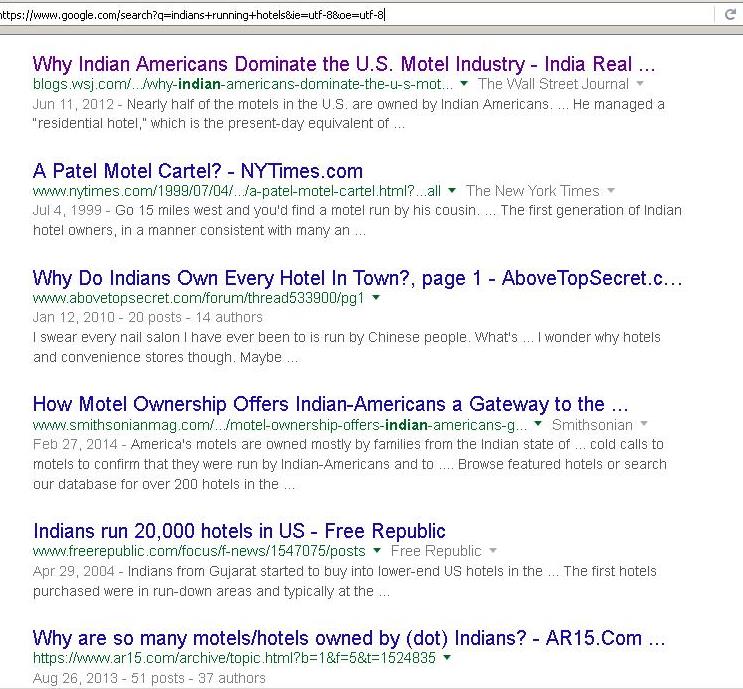
“I’m from north London too!” he exclaimed.  It may seem strange that an Indian guy from London would be running a Quality Inn in Mississippi, but Indians actually own half the hotels and motels in America.  I’m not making that up:

Indians

There were little Indian-influenced flourishes, like a glittery, purple-topped table in our room, that gave a bit of relief from the bland, tan town of Oxford.  At least what we’d seen of it so far.