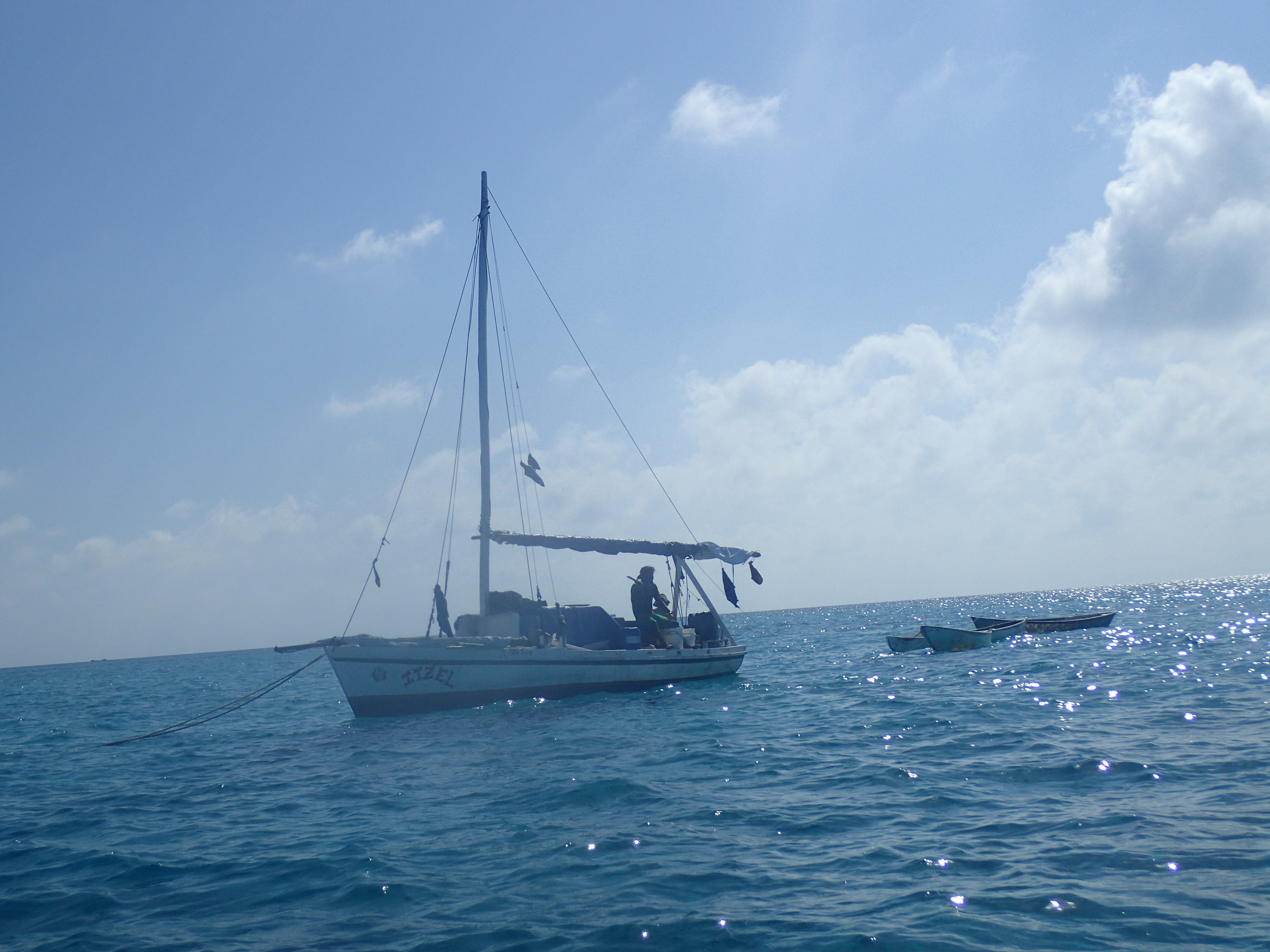
Category Archives: Joie de vivre

Thunder and Rain

As you know if you’ve been reading this blog for a while, I am really good at getting lost.  I can study a map for half an hour, even write directions on the palm of my hand so I don’t have to take out the map in public, then I walk out the hotel door and will be deeply, hopelessly lost in five minutes.

Ingrid, thankfully, has a well-honed sense of direction.  We came out of the underground station in Salzburg—the worst for getting lost because you don’t know which direction is north, etc.—and she pointed, “Our hotel is that way.”

“Um…I think it’s the other way,” I suggested tentatively.  Why was I even bothering to trust my “sense of direction?”  Ingrid had us to the hotel in no time, with no detours.

As is unfailingly the case in Europe, the room was on the top floor and there was no elevator so I had to lift and drag my suitcase up six flights of stairs, one step at a time.  The hotel, Pension Elizabeth, was basic and functional.  When I booked it and requested a room with two beds I had received a message, “We will do our best to accommodate your request.”  And they had.  The room had a queen sized bed with a folding cot right next to it, which was quite comfortable, according to Ingrid—who made the sacrifice of sleeping on it.

It was early evening on a public holiday, so the city was quiet.  The holiday is called Whitsun, or Pentecost, which for most Europeans is now just a Day Off.  We ran across the street toward a neon sign that flashed Pizzeria.  The place was run by Bangladeshis, and the only other customers were half a dozen motorcyclists with Bison Thunder emblazoned on the backs of their black leather jackets; they were smoking cigarettes and drinking beers at an outside table.  I thought they might be a gang, although they appeared to have escaped from a geriatric home.  Turns out that Bison Thunder was an Austrian motorcycle made in the1920s, just like the geezers riding them.

Ingrid and I took a table inside and ordered.  I got a panini and she got schnitzel, which is a breaded meat dish.

“The sky is very dark,” announced the owner from the doorway.

Suddenly the heavens opened up and buckets of marble-sized hail thundered down.  The bison thunderers scurried inside as the cafe umbrellas pitched over.  Cars stopped in the middle of the street, then crawled onward slowly.  We all oohed and ahhed and ate and drank from inside the restaurant as we watched the show.  Then Ingrid and I and the bikers retired to Pension Elizabeth for the night.

Salzburg is the city of Mozart.

I never listened to classical music until about five years ago, when I became serious about meditating.  I had a score (ha, ha) of meditation CDs, and my favorite was called Zen Garden.  It was a collection of classical hits overlaid with chirping crickets and birds.  Sounds woo-woo, I know, but it helped me fall asleep many nights.  Eventually, I quit meditating, gave my old school CD player and CDs away, and had music only on my phone.  I did it because I thought everyone was doing it and it would simplify my life, but I regret it.  The quality of music on an iphone is just not good.  If and when I settle down anywhere again, I’m going to go all the way back to my first gen of music and buy a record player.

Anyway, meditation was my gateway to classical music, which I listen to instead of the news, especially since November 2016.

The next day, Ingrid and I walked into the city center and spent hours in the two Mozart museums—one a house where he lived with his family as a youth; the other where he lived as an adult with his wife and children.

Mozart was composing by the age of five and performing for royalty at 17.  There were numerous references to him being “childlike,” and “in his own world.”  Was Mozart special needs?  Was he an 18th Century rain man?

Independence Day

Happy Independence Day, if you are an American.  I’ve spent the last month with friends and colleagues who are Dutch, Japanese, Kenyan, Ethiopian, Eritrean, Australian, and British.  Now I am in England, where for a long time I had daydreams of moving permanently.  Today I read an article in the Sunday Times by Andrew Sullivan, an English-born journalist who became an American citizen after living there for 30 years.

He says a lot of things about why he has chosen to become an American.  He says it suits his temperament—“independent, pushy, outspoken.”  Um, that doesn’t sound like a compliment.  He talks about how England is focused on the past while American relentlessly strides toward the future.  Americans are optimistic; he finds it funny that a common response to every proposal is, “Sure!”  He appreciates that no one categorizes him based on his accent, and no one cares what class he’s from.  He admires how America has accepted and integrated more immigrants than any country in history.  He notes that America is both “deeply conservative and equally radical,” how if you fail in one part of the country you can start over in another, and he marvels that he was made editor of a national magazine at the age of 28.  There’s plenty that horrifies him about the States, like our gun obsession.

I can’t say I disagree with him on any points.  For me, the word that sums us up as a people is Independence, which many translate into “no one can tell me what to do,” as when former National Rifle Association president and B actor Charlton Heston’s famously said, “you’ll have to pry my gun from my cold, dead hands.”  We don’t like signs.  We don’t like rules.  If someone is poor, we expect them to “pull themselves up by their own bootstraps.”  We look down on anyone who accepts government assistance, even though over 50% of us get it in some form.  We like to believe we are pioneers, clearing the land and building our own house with a white picket fence.

I thought about going to an American expat bar in London on the 4th of July, then came to my senses and realized it could be a terrorist target.  That’s a shame.  I’ll go for a long walk along the Thames instead.

If you’ve ever been to the Netherlands, you probably know that the Dutch are the tallest people on earth.  The average Dutch man is six feet (183 centimeters) tall.  When Ingrid and Chris and I went shopping, I lost them in the store and I thought, “I’ll look for the tall guy,” then realized that Chris, at 6’4”, isn’t exceptionally tall.

Ingrid, however, is short, thanks to her Austrian mother, who met her father through a pen pal program.  The fact that Ingrid speaks German would come in handy.

Since I had a big suitcase, Chris drove us to the local train station.  I averted my eyes while they said good-bye.  It was sweet.  They just celebrated their 18th wedding anniversary.

While Ingrid and I waited at Central Station, I noticed these eyeball-like contraptions everywhere.  Were they CCTV?  Ingrid didn’t know.  If they were cameras, they weren’t catching much because it was early morning on a Dutch holiday.  I realize this is not a great photo but I was trying to take it surreptitiously in case security didn’t have a sense of humor.

On the train, which was clean and quiet, we moved east through Arnhem toward the German border.  We would pass through Duisburg, Dusseldorf, Cologne, Frankfurt, Mannheim, and Munich on our way.

We passed the time talking, which always makes time fly.  Unless you’re with someone you can’t stand, in which case it makes you want to hurl yourself off the train.

I perused the train magazine, whose cover featured a famous actress I’d never heard of who had great eyebrows.  “The Big Wanderlust” was clear, and something I could relate to.

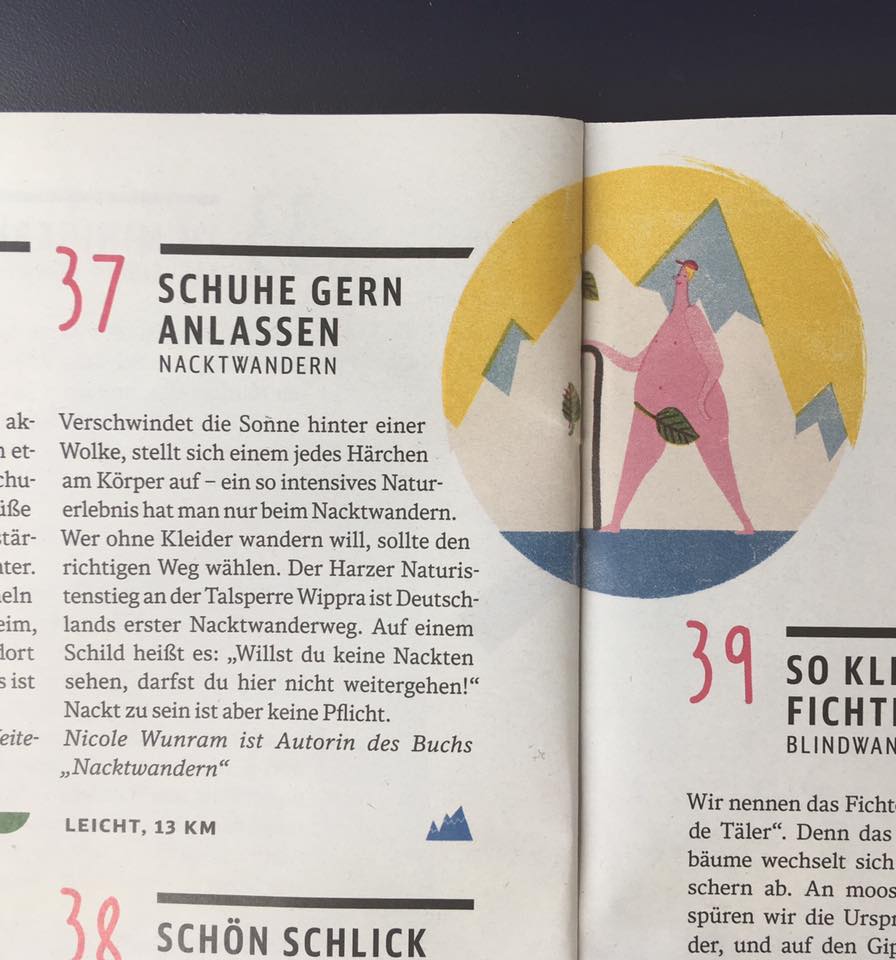
Ingrid translated an article about naked hiking.

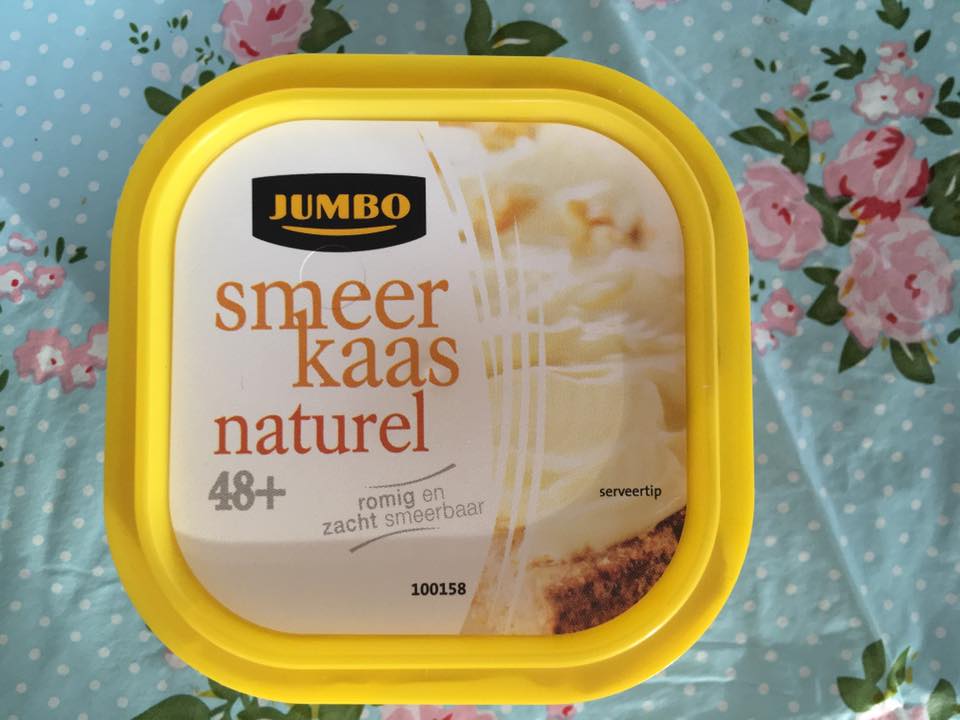
We ate crackers and the funny-sounding (to me) smeer kass.

We passed the enormous Cologne cathedral.

After nine and a half hours, we rolled into Salzburg.

Dutch Landscapes

I’ve spent the last two weeks traveling around the south coast of England—Cornwall, Devon, and Dorset, and now I am ensconced in Eton, home of the boys’ boarding school of the same name that was founded in the 15th Century by Henry VI.

I’ve visited so many quaint little seaside towns, shopped in so many independent stores, and supped in so many Ye Olde Tyme pubs that I’ve lost track.  But all this is to say that it makes me sad that people come to the UK and never leave London.  They say London is a country all its own, and that’s probably true.  But there’s so much more to Britain than London.

And that’s true of the Netherlands, too.  Most people only ever visit Amsterdam. They wander around the red light district (tee hee), take pictures of the canals and all the bicyclists, smoke some pot in a “coffee shop,” and go see the old masters at the Rijksmuseum.

I feel really fortunate that I had my personal guide and good friend Ingrid to show me around. As I wrote in my last post, she lives in Utrecht, a sizeable university town about 45 minutes from Amsterdam.  Probably everything in the Netherlands is about 45 minutes from Amsterdam.

My first night there, I was awake late because it was light out until 11pm.  Then I woke early because it got light at around 4am. Besides, I was excited about the day ahead, which Ingrid had promised would involve bicycling in a national park.

We drove about 45 minutes to Park De Hoge Veluwe. I am no great judge of space but it had to be larger than Central Park in New York.  We parked the car near the entrance, bought our tickets, and picked out bikes in the bike lot.  The bikes were all white, all had child seats, and they were free.  There were no helmets or locks in sight.

The great thing about biking in the Netherlands is, it’s so flat.  Therefore it was no need for more than one gear, since the biggest hill wouldn’t cause you to break a sweat even if you were totally out of shape.  The weather is also mild, so no sweating.

I loved it, biking along on a beautiful summer day in the wild with a good friend.

We arrived at our first destination, the St.Hubertus Jachthuis, a hunting lodge built by the Dutch architect H. P. Berlage in 1915 for a German couple, the Kröller-Müllers, with money pilfered from her father’s company.

Hmmm … it reminds me of something ….

The lake is artificial; the first iteration drained because they hadn’t realized it was sandy soil underneath.

Inside, Berlage had created a unitary design—from floor to ceiling and everything in between, the furniture, carpets, art, light fixtures, etc. were designed as a single work of art.  It was never meant to be lived in, but to be a monument to his genius.  Frau Müller had other plans, fired him, and lived out her days here.

Ingrid joined a group of Dutch tourists with a Dutch guide, while I listened to an English tour on a handset.  The English version would finish, then the Dutch docent would talk on and on for another 15 minutes before we moved on to the next room.  Was it because Dutch words are so long?  No, I learned afterwards, it was because the Dutch guide was telling the group a lot of bonus tidbits, like that Frau Müller had a young male “companion” on whom she lavished attention.

After the tour, we biked to the Kröller-Müller Museum.  Frau Müller was an art hound, and luckily for us she used a lot of the money embezzled from her family company to buy art.

The museum had an incredible collection of van Goghs, most of which I had never seen.  It held lots of other famous painters too, but annoyingly it closed at 5:00 and its surrounding sculpture garden closed at 4:30.  Why?  It was summer.  It was light out until 11.  We arrived at 4:15, made a beeline for the van Goghs, and only saw the rest in passing.

Auf Wiedersehen

Greetings from Salzurg, Austria.  I am sitting in the breakfast lounge at Pension Elizabeth, where Abba is playing on a loop, the Internet is super slow, and the hotel staff are having some kind of meeting with a salesperson at the next table.

I’ll leave for the airport in a few hours to fly to Ethiopia, where I’m told I’ll have no Internet.  I would love to say I’m going to write enough posts to take you along with me, but that’s a fairy dream.  Complications are following me, and I can’t say I’ve really had one day off since I left 11 days ago.

I’ve got 200 emails in my work inbox.  The June 1 payment from my renters back home hasn’t shown up in my checking account.  I am getting texts and phone calls from someone who needs to know something about the sale of my condo and I have no idea who they’re from or what they’re about.

The most “exciting” complication happened when I flew from Copenhagen to Amsterdam.  I received a reminder from Expedia the night before to check in.  Norwegian Air’s website didn’t recognize the routing number but I got a message that said, “Don’t Worry! We’re still working on our website.”  Really?  Did Norway just get the Internet?

The train to the airport the next day left late and stopped twice to let other trains go by in the other direction.  In general, I think this is good, but not when it keeps you standing still for 20 minutes at a time. Finally, we were told to get off and take another train.  I had, as they always advise you, allowed plenty of time to get to the airport early but got there about an hour before my flight was to leave.

And Norwegian Air had no record of the flight.

It’s a long story, but I ran from one terminal to another, then back again, then back in the other direction, and was quoted up to $800 for a new ticket.  I did all this with my big bag full of books, since I hadn’t been able to check it.

In the end, I was lucky to get the last seat on a Scandinavian Airlines flight for $406.  Expedia says their records show I took the Norwegian flight.  They are telling me to call Norwegian Air id I still think there is a problem.  Call?—as in make an international call that will cost me $1 a minute to sit on hold?  I protested, but Expedia hasn’t responded.  If anyone has advice to doing battle with Expedia, please let me know.

Four hundred bucks is a lot of money to lose, but also in the mad rushing around in the airport, I must have dropped my bag on my foot.  Once I arrived in the Netherlands and took my socks off at my friend’s house, I saw an alarming gold-ball sized green swelling on the top of my left foot.  I immediately thought of the American journalist Miles O’Brien, who had a freak accident where something fell on his arm.  The incident seemed mild, but it caused something called Acute Compartment Syndrome.  He had to have his arm amputated.  Boy, is he good looking—you really should check out that article.

My foot swelling went down that night, but my whole foot has been black and blue for a week.  I showed it to my friend and we went down a check list: it’s not numb.  I can bend my toes.  It’s tender to the touch but not painful to walk.  The swelling is gone.

Good to go to Ethiopia, right!?

Other than the potentially fatal foot injury, $406 loss, and the nonstop rain that follows me everywhere, I’ve had a great time so far.

Okay, I’m off to bring the rain to Ethiopia.

I’ll write more when I get to Cornwall, England in a week or so.

Buh Bye Belize

This is a series of posts about Belize that starts here.

Atop Victoria Peak, I went off by myself and gazed at the view.

Travel is made of moments like this. There’s all the frantic planning, the upsets when things go wrong, the annoyances of other people and disappointments in yourself.  Then there are the moments where you find yourself feeling accomplished and staring at a beautiful view—and not thinking about what’s next, or being bothered by other people still blabbering away.

Serenity.  Mindfulness.  Presence.  In the moment. Whatever you call it, it feels wonderful and I experience it much more when I’m traveling than in my “real” life.

After savoring our hiking feat and the rewarding views, we descended.  Liz and Mike immediately flanked me.

“I’d like to hike alone,” I said.  Whereas earlier I would have spoken through gritted teeth and my irritation might have been hurtful, now I was pleasant but firm.

Mark was behind them, giving me a bemused look.

Liz and Mike looked surprised but walked off, blabbering away loudly about nothing.

Why can’t people stand to being alone, or in silence?

I took my time walking down, since descending is harder on the knees than climbing. I have no knee problems and I’d like to keep it that way. I came across Emily, and she and I walked together for a while, not talking except to point out an occasional find, like this eight-inch high anthill.

Then I spotted a spotted moth about the size of my open hand and silently pointed it out to Emily.  We watched it flit from tree to tree.

Back in Hopkins, we had a last fancy supper at a local club.  The waiter patiently answered “Yes ma’am,” “No ma’am,” as Joan asked about gluten and dairy and meat and eggs and MSG.

The talk turned to what we would be happy to get home to.  Smooth roads was number one. That led to talk of cars.

“I drive a Prius,” Joan said drearily.  Of course you do, I thought.

“Anne drives a Mini Cooper,” Mark said enthusiastically.  “It’s the smallest BMW and it’s as fuel-efficient as a Prius.  They’re such cool cars.”  I was so happy he had said it and not me. I am as much a snob about my car as any Prius driver.  “And they’re really fun to drive!” I added.

“I smile whenever I see one,” Mark said.

You might think I hated certain people on this trip.  I didn’t. They bugged me from time to time and the feeling might have been mutual. I wasn’t going to change them.  All I could do was try to be aware of, and keep a lid on, my tendencies toward sanctimoniousness and speaking like a walking encyclopedia.

This is one of the tradeoffs of group travel.  And for the moments of snorkeling heaven and climbing a mountain peak, it was worth it.

Our last day in Belize.  As on the other mornings, I walked down to the beach to see if a yoga session had materialized.  It hadn’t.  I did a few forward falls and mountain poses and headed back to the lodge for coffee.

Jeanie came in and said, “Whew!  What a great yoga session!”

“What?  Where?  I was just down on the beach and no one was there.”

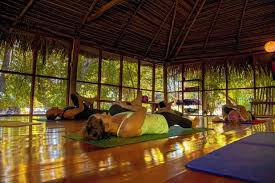
“In the yoga studio,” she replied.  Yoga studio?  A detail she had omitted.  She led me through the jungle to what was, by far, the most beautiful building at Jeanie’s (and it was minus the people in this photo).

This side trip made me the last person into the van, where I wound up in the back row between Liz and Mike.  Emily, in front, turned and gave me a look that said, “Nah, nah … so happy it’s not me!”  We shared a secret laugh and that helped.

Our legs were covered with bites—hundreds of them.  We were also feeling the effects of the water.  I won’t go into detail, but let’s say we were relieved to arrive at the airport.

My flight was first, so I yelled, “Safe travels, everyone!” and ran off with a backwards wave.

Suspended

This is a series of posts about Belize that starts here.

We sat in the sand under a shade tree enjoying our lunch break before more snorkeling.

Here’s something I never knew about snorkeling: it is very dehydrating.  There are lots of articles about it; it’s something about the lack of gravity when you’re in the water, apparently.  Whatever the case, the public toilet on the island was half a mile off, so we all started pretending we couldn’t get enough of the water, wading in and saying things like, “Ooh, I just can’t stay away from of this beautiful water!”  What else could we do?

Emily and I had become pals.  We had both lived and worked or gone to school in other countries. We lived in the same neighborhood now.  And we had both been observing the martyrdom, endless list of food restrictions, and other “interesting” behavior of our fellow tour members.

“Do you have any gluten-free options?” asked Joan as the pulled-pork sandwiches were being handed out.  Lincoln, our boat captain, smiled and shook his head no.  Joan sat back in the shade, her arm still in a makeshift sling from her fall the first day.  She didn’t say, “I’ll just go hungry then,” but she didn’t need to; it was all in her body language.  Neither she nor Liz had gone in the water. This wasn’t surprising about Joan, who was stick-thin and sickly looking and had fibromyalgia.  But Liz was in good shape.

“Ah just didn’t feel lahk it,” she drawled.  If she was hoping we would ask her to explain why, she was disappointed.

The rest of us really couldn’t wait to get back in. As we were putt-putting out to the reef area, I spoke with Vanessa, our guide.

Vanessa had finished two years of college to become an English teacher.  Then she got this summer job as a snorkeling guide and she never went back.  I can’t say I blame her.  When she said she missed writing, I suggested she could write a blog about snorkeling and she liked that idea.  I hope she does it.

We approached a boat where fishermen were cleaning their catch of conches and throwing the leftover scraps into the sea.

We jumped in, and almost immediately I said into my mask, “That looks like a turtle!” only it sounded like, “Flaploogglaga blurpple!”

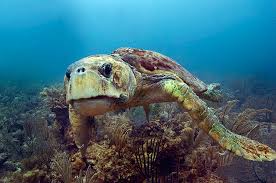
And it was a turtle, an old Loggerhead about five feet from snout to tail.  This is not “our” turtle but it’ll give you an idea of what she looked like.

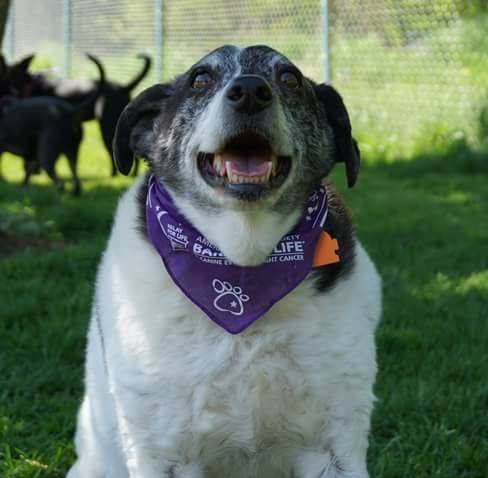
She reminded me of my son’s ancient dinosaur-like dog, Willie, without the purple bandana.

Then there were the rays—Eagle rays and Spotted Rays—also as long as I was tall, also prehistoric looking, also a photo stolen off the web.

I wish I could say I took these photos, but as you know if you’ve been reading this blog for a while, I take terrible photos above water, never mind below water.

But other people in my group had Go-Pros and water proof cameras.

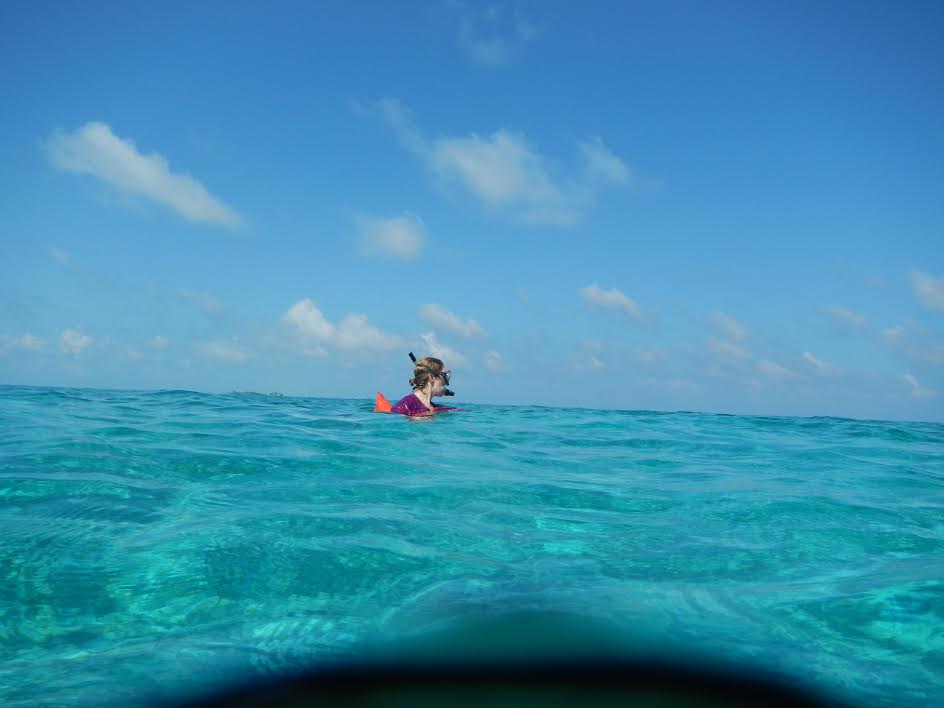
Here I am, looking like a scene out of Jaws:

Lincoln and Vanessa kept calling out, “Over here!  There’s a lobster / Garfish / Lionfish / Clownfish!  Everyone would swim after them to have a look.  Everyone but me. I reached an area where the sea floor must have been 30 feet below me but the water was so clear it felt like I was suspended in air.  Suddenly I felt panic that I would plummet to the bottom.  That passed and I just floated meditatively.  Doing nothing, going nowhere.  No To-Do list.  I caught myself thinking, “I can’t wait to do this again!” then laughed at myself and focused on the fact that I was there, in heaven, right now.

The meditative mood stayed with me for the rest of the evening.  Walking back to Jeanie’s, we were passed by a teenage boy on a tuk tuk—a motor scooter—with a fat baby balanced on the handle bars.  The baby was laughing with delight as the scooter bucked up and down over the potholes.  I vowed to be more like a baby—unafraid, in the moment, joyful.

Heaven

This is a series of posts about Belize that starts here.

The gang returned from watching Scarlet Macaws.  None had been exsanguinated by crocodile syndrome.  That was good.  Much as some of them irritated me, I wouldn’t want anyone to go that way.

I was sitting in the lodge having a beer when they pulled up in the van.

“Hey there, good lookin’!” shouted Mike.  This was how he was.  From the first day when he sat next to me in the van and read every sign out loud, he had touched my arm, or nudged me, and said things like, “Lucky me, I get to sit next to a pretty lady!” and “Look at that bird, baby!”

I had chosen to ignore him rather than say anything.  Joan, his wife, rolled her eyes at me when he said these things.

He wasn’t a creeper, he was just a clueless, harmless dork.

They ordered drinks and sat around talking about their day.  They had seen lots of birds, including Scarlet Macaws.  The sun set and it was time to head to a local restaurant for dinner.  Mark drove the van while most of us walked so we wouldn’t have our digestive systems jostled.

The restaurant was called Innie’s.  Innie, the proprietor, was what we used to call a “full-figured” woman.  She was around 65, and she explained, “I’ve got seven daughters, and they’ve all got names that rhyme with mine—Ginnie, Winnie, Minnie, Vinnie—for Vincenza—and they all run businesses.  Ginnie’s got herself a hair salon, Minnie does taxes, Skinnie rents scooters, two of them run another restaurant.”

The specialty of the house was hudutu, a fish stew made with coconut milk which sounded delicious but which took an hour to appear and had so many bones you couldn’t really appreciate it.   It was served with the bread that came with every meal—something like Native American fry bread.  It was okay.

Walking back to Jungle Jeanie’s, Mike pointed at a grove of tall slender plants and wondered what they were.

“I think it’s sugar cane,” I said.

“No, it’s not, he said.

Ugh.  Whatever.

We returned to our respective huts.  In ours, a twin bed had appeared in the middle of the room on the first level.

“I don’t care who gets it,” said Liz.

I wasn’t going to play the “I don’t care but I really do” game.

“Good!”  I said, “then I will.”

Snorkeling was the agenda for the whole Day Six.  I wasn’t really up for it; I get claustrophobic and I don’t know how to swim.  I seriously considered having another day of nothing on the beach.

But I went, and it was the best day yet.  Maybe the best day of my life.

Our guide suggested I wear a life preserver around my waist so I wouldn’t have to even think about staying afloat.  I had no pride around that; it was a great idea.  I donned the snorkel and mask, sat on the sand in the shallow water, and tried to put my face underwater.  Once, twice, three times—I couldn’t do it.

This felt like a matter of pride.  I was going to at least get my face underwater once.  I finally did, and was instantly hooked.

How to describe it?  I floated near the water’s surface and gazed at hundreds of species of fish and coral.  All colors, all shapes, large and small.  The water was warm and clear as air.  It was like flying, like flying in a dream.  I couldn’t help exclaiming, “Wow! I see a clown fish!” except it sounded like “Waaaahhhh, aslubbba blabba blish!”  Then I laughed, which also sounded funny and made me laugh more.  No one could hear me.  It was one of the rare times in my life that I felt childlike wonder and playful joy.

We snorkeled for hours, then they rounded us up for lunch on a small island with million dollar homes.  We sat on the beach and munched on our pulled pork sandwiches.  Emily, being married to a Muslim, didn’t eat pork either, so the guides gave us their BBQ chicken sandwiches and we were all happy.

A Long Night

This is a series of posts about Belize that starts here.

The first night at Jungle Jeanie’s was a long one.  It was hot and humid.  Because our hut was in the jungle and not on the shore, there was no breeze.  My hair turned into a giant fuzzball.  My skin felt soft as a baby’s bottom, but there was no one to appreciate it.

This was also the night that Liz started to fart.  The first time, she did the thing that middle-aged women do—“Oops, sorry! Tee hee hee,” like they are embarrassed.  But then she kept farting and stopped apologizing or even acknowledging it.  I was sharing a small, stuffy loft with her.

I climbed over her and down the ladder to the bathroom all four of us would share for the next four nights.  I sat on the toilet trying to figure out where I could go to get some shut eye.  The hammocks on the beach looked tempting but what about the mosquitos?  Then I heard a thump, thump, thumping and Trudy pounded on the door.  It was no use, I couldn’t say, “I’ll be out in a minute,” since she couldn’t hear me.

I handed the loo over to her and sat in the dark at the table in the center of the room.  Except that it wasn’t dark.  “I’m watching Game of Thrones,” explained Emily from her bed, from which emanated the bright glow of her phone.

“I can’t believe how noisy Trudy is,” I remarked, listening to her clunking around in the bathroom.

“Oh yeah,” said Emily.  “People think deaf households are quiet, but they’re actually noisier than most because they aren’t getting feedback.  They’re always slamming doors, throwing things on the floor, and yelling.”  And farting with impunity, I thought.

She put down her phone and sat up.  We talked for a while, about how she went to Tanzania for college, met her future husband on the first day, and got engaged two days later.  “We’ve been married for 20 years and have four kids, so we had pretty good instincts.  Or we just got lucky.”  She and her family lived a few blocks from me in St. Paul.  They went back to Tanzania to visit his family every year.

Trudy came out of the bathroom and started signing.

“She’s pissed off about the bed,” Emily translated.  “It’s lumpy.  But she’s always pissed off or crabby about something.”

“Are you friends?” I asked.

“No!  We just met in Belize.  Wilderness Inquiry taps a pool of interpreters for these trips, and my number came up.  With Trudy it’s her way or the highway.  I don’t think I’d want to interpret for her on a regular basis.  Of course, she probably had to be hard and demanding to get anything in life.”

Trudy was sitting on the edge of her bed moaning and groaning, which I took to mean that her back hurt.  Liz was snoring up in the loft.

“She was put a home for deaf children in the 50s, when she was five,” Emily continued.   She signed to Trudy that she was telling me this.

Five.  How heartbreaking.

Trudy nodded and added in sign, “Yes, it wasn’t a nice place.  They were assholes to me.”

And yet, she had attended college, had a career, married, and had four children.  Her husband had also been an asshole.  She’d divorced five years earlier and had been traveling ever since.

After talking for an hour, I reluctantly climbed back up to the loft.  Finally, around 2am, we all settled down and slept.

Until 5am.  Today was a field trip to the Mayan village of Red Bank to see Scarlet Macaws.  It would involve kayaking and hiking and a picnic lunch by the river.

I waved as they all drove off.  “Watch out for crocodiles,” I whispered sweetly.

I was going to have a Day Off.  I was going to be alone!  I lay in a hammock and read a book, “The Trip to Echo Spring: On writing and drinking,” by an English journalist.  I took a bumpy ride on one of Jeanie’s broken down bicycles with no helmet, brakes, or gears, then napped.

Despite

Life has been throwing a lot my way lately, or at least throwing a lot at people I love.  I debated whether to write about it, then remembered that the tagline of this blog is “Living well despite what life throws at you.”

It’s one thing to live large when everything is going well, it’s quite another to keep embracing life when things are not so great.

My life is fine, aside from the new upstairs neighbor, who I suspect of making wine late at night (stomp, stomp, stomp!). I have spoken to him and it is better, but I have to wear ear plugs a couple nights a week.  I worry that the people who are renting my condo while I’m in the UK/Europe/Ethiopia this summer will be bothered.

Work has been a pressure cooker; this week I submitted almost $5 million worth of funding applications for projects in Iraq and Ethiopia.  The teams were dispersed around the globe, from Kurdistan to The Gambia, which has only 14% Internet penetration. I do get a buzz out of pulling everything together to meet deadlines, and then I collapse in exhaustion.

On to the people I love: Vince broke up with his girlfriend, and for some reason it hit me hard.  I was so happy that Vince had, for a while, a fun relationship that didn’t involve drugs or alcohol.  But I realized my reaction was partly about me.  A few weeks after I turned 40, my serious boyfriend dumped me.  I wondered if that was it—I would never meet anyone again.  After all, I was 40!  Vince will be 39 this year.  I have no idea if he feels like it’s over—I hope not—but I did.

The thing that’s really thrown me is hearing from Son #2 after a four-year silence.

I wrote a series of seven posts about Vince’s brother, who I gave up for adoption. I’ve never written about how I found him after many attempts and despite Catholic Charities’ best efforts to thwart us both.

I hesitated to write about this, but then—catatonic on the couch after all my proposals were done—I caught an episode of Call the Midwife that had an adoption storyline and I was reminded that the silence and shame that surrounds adoption has got to be broken.

Vince and I met him once, over 15 years ago.  We met at a restaurant; I can’t remember exactly when or where because it was so surreal.

His name was the same as one of my brothers, but I will call him by the name I gave him, Isaac.  He looked a lot like Vince but with different coloring.  I asked if I could give him a hug and he said, “Of course!” and hugged me for a long time.  Several hours of talking passed like seconds.  We hugged goodbye and pledged to stay in touch.

It didn’t’ happen.  Isaac’s adoptive mother was opposed to him meeting me, and he was already going behind her back.  But he and Vince continued to meet up and developed a bond; Vince wrote about it here.  It wasn’t a happy ending, but there’s hope now that Vince is in recovery.

Isaac sent me an email out of the blue about five years ago, with photos of his wife and kids.  My grandchildren, who I’ve never met.  His wife has the same name as my mother.

He said he would like for me to meet them, but then he disappeared again.  I didn’t pursue it him because I didn’t want to be disappointed again.

Isaac wrote to me again last month.

His wife has Multiple Sclerosis.  Severe, aggressive MS that affects her vision, speech, and mobility. He and I have been writing for about a month now, and I am hopeful we can stay in touch this time, but it’s stirring up a lot of regret, resentment, love, and hope.

Back to Reality

This is the final post in a series about Italy, Malta, and Spain that starts here.

Our last night in Toledo.  We had dinner at a restaurant called Dehera d’ Majazul.  I don’t know what that name means but it sounded nice.  The food was unremarkable, but the waitress was memorable.  She looked to be about 18, she was very pregnant, and she had eyes tattooed on the insides of her forearms.  She spoke no English and I found myself looking at the eyes on her arms instead of the ones on her face as I tried to make conversation.

Not for the first time, I had assumed a person with tattoos would be rough and hard.  But she was sweet.  This was her first baby, she was very excited, and no, it wasn’t hard working on her feet.  Well, she was a baby herself, like I was when I had Vince. You can do anything when you’re 18.

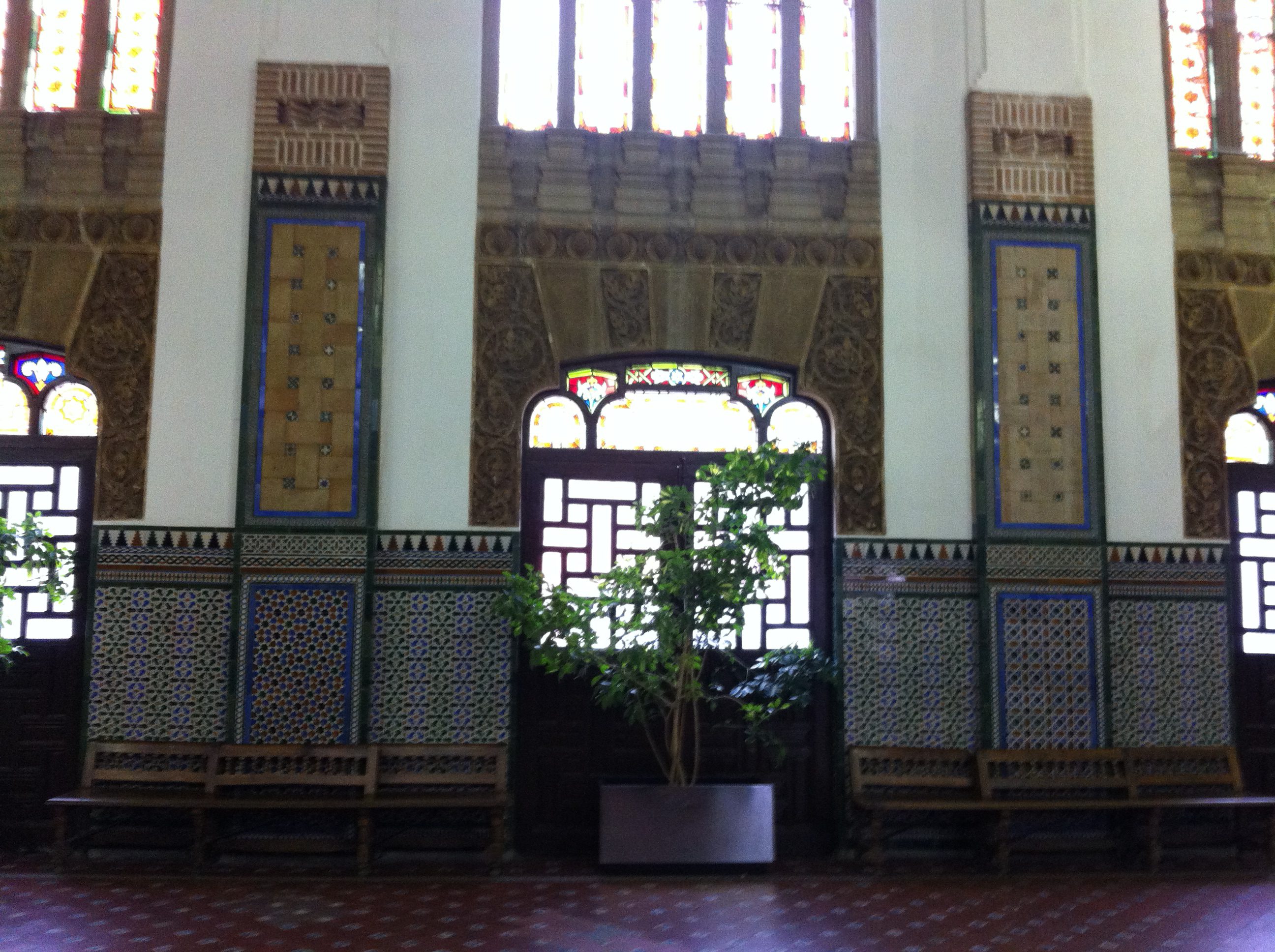
The Toledo train station may have been the most ornate building we saw in all of Spain.  Here are a few photos to give you an idea.  I’ve got a a new camera in the works, so you won’t have to wince at my shitty photos much longer.

They screened our bags before letting us onto the platform, but the bored “guard” couldn’t have been bothered to look at the monitor. Really, what is the point of making passengers line up and hoist our bags onto and off of a conveyor belt?  I guess it was all for show.  Some politician in Madrid can say, “We take security very seriously.”

You would think the Spaniards, of all people, really would take it seriously, since Madrid trains were the target of terrorist bombings in 2005 that killed nearly 200 people and injured 2,000.

The arrived in Madrid in half an hour, and it was like going through a portal to another world.  We left behind dark, cramped, steeped-in-medieval-history Toledo for the sprawling, brightly colored high-rise apartment buildings that run for miles before you enter Madrid itself.

Naturally, the taxi stand was on the opposite side of the station, across a treacherously busy thoroughfare, and there were no signs for it.  We asked strangers until we found it.  The driver didn’t know how to find the hotel.  It wasn’t in his GPS and he seemed to have lost his map-reading skills—if he had ever had them—since like our waitress he also appeared to be 18.  He asked if we knew how to get there and handed us the map.  Lynn and I rolled our eyes at each other.

Eventually, after much muttering of mierda! and puta madre! we arrived at our hotel, a functional place near the airport.  It was only 5:00, so the bar and restaurant weren’t open.

We decided to go for a wander around the neighborhood, because unlike most airport hotels which are in deserted warehouse areas, this one was set in a regular neighborhood.

I quickly spotted a pair of blue velvet pants in a shop window.  “I’ve got to have those!” I exclaimed, pulling the door open.  “I’ve always wanted a pair of blue velvet pants.”

“Oh please,” Lynn shuddered, “Don’t say pants!”  Because pants, of course, means underpants to an English person.  It was a Chinese shop full of the cheapest, tawdriest clothes you’ve ever seen.  I loved it!

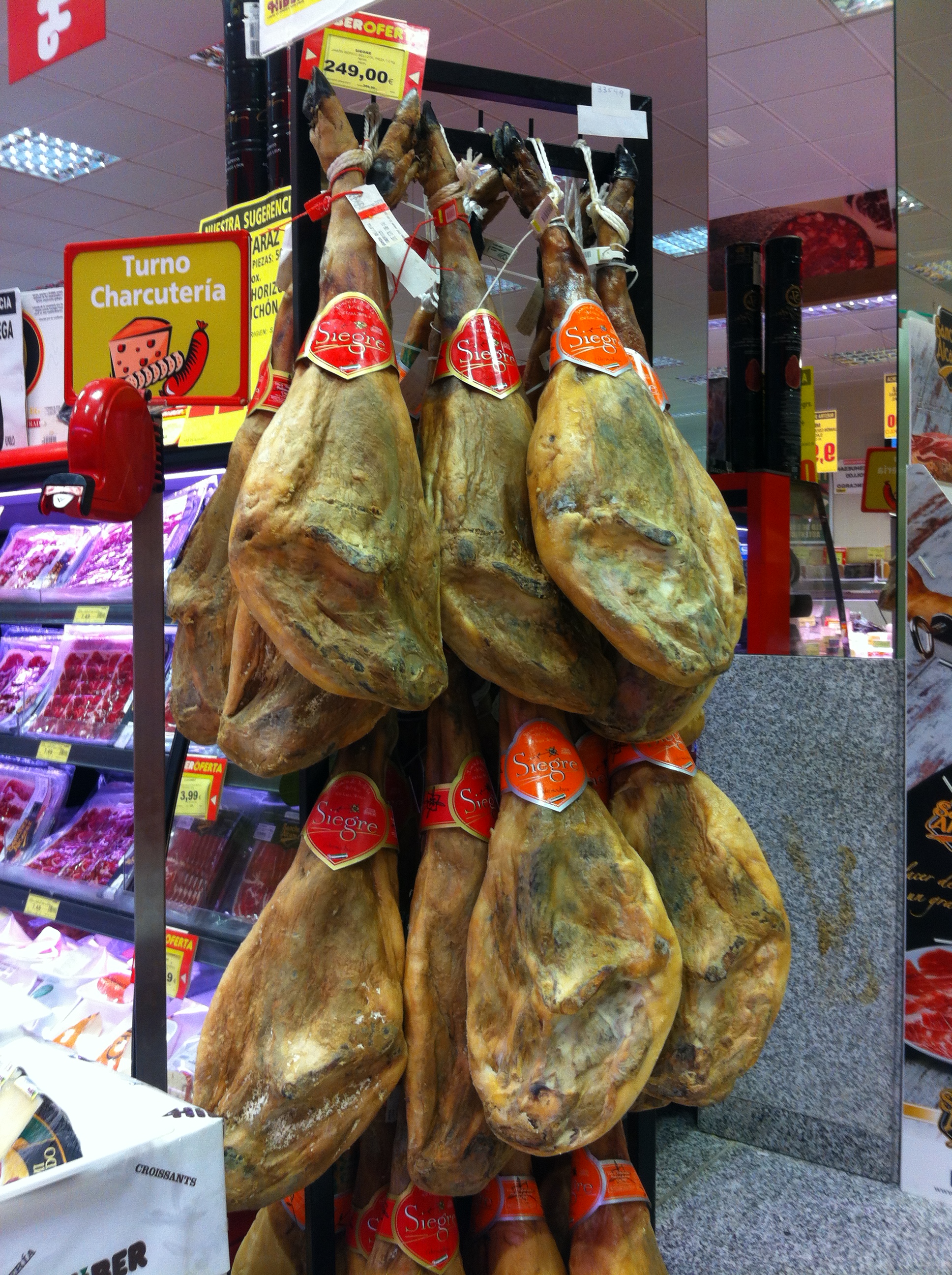
Next we rootled up and down the aisles of a grocery.  If you love pig-derived foods, you’d love this store.

I always buy Vince foods with funny names when I travel, and this time it was Bonka.  What a great name for … coffee?

Fancy some Chilly gel for your intimate places?  I love the literal name for stain remover—quitamanchas—“get out spots.”

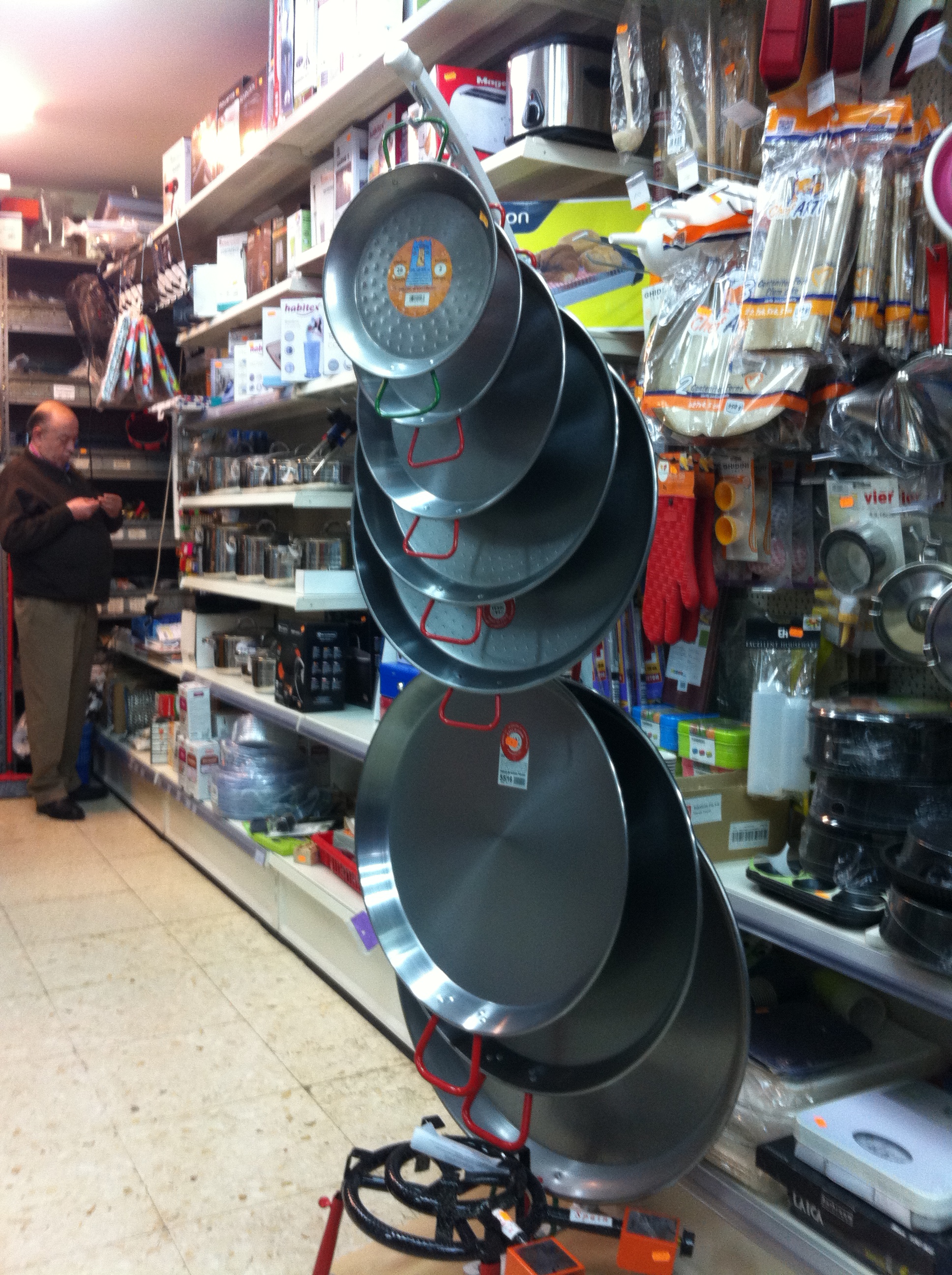
Our final stop was a hardware store, which offered every size of paella pan.

And that was that.  We had a salty, fatty dinner at the hotel, slept, jumped on a shuttle at 6:30 a.m., and flew out in our separate directions.

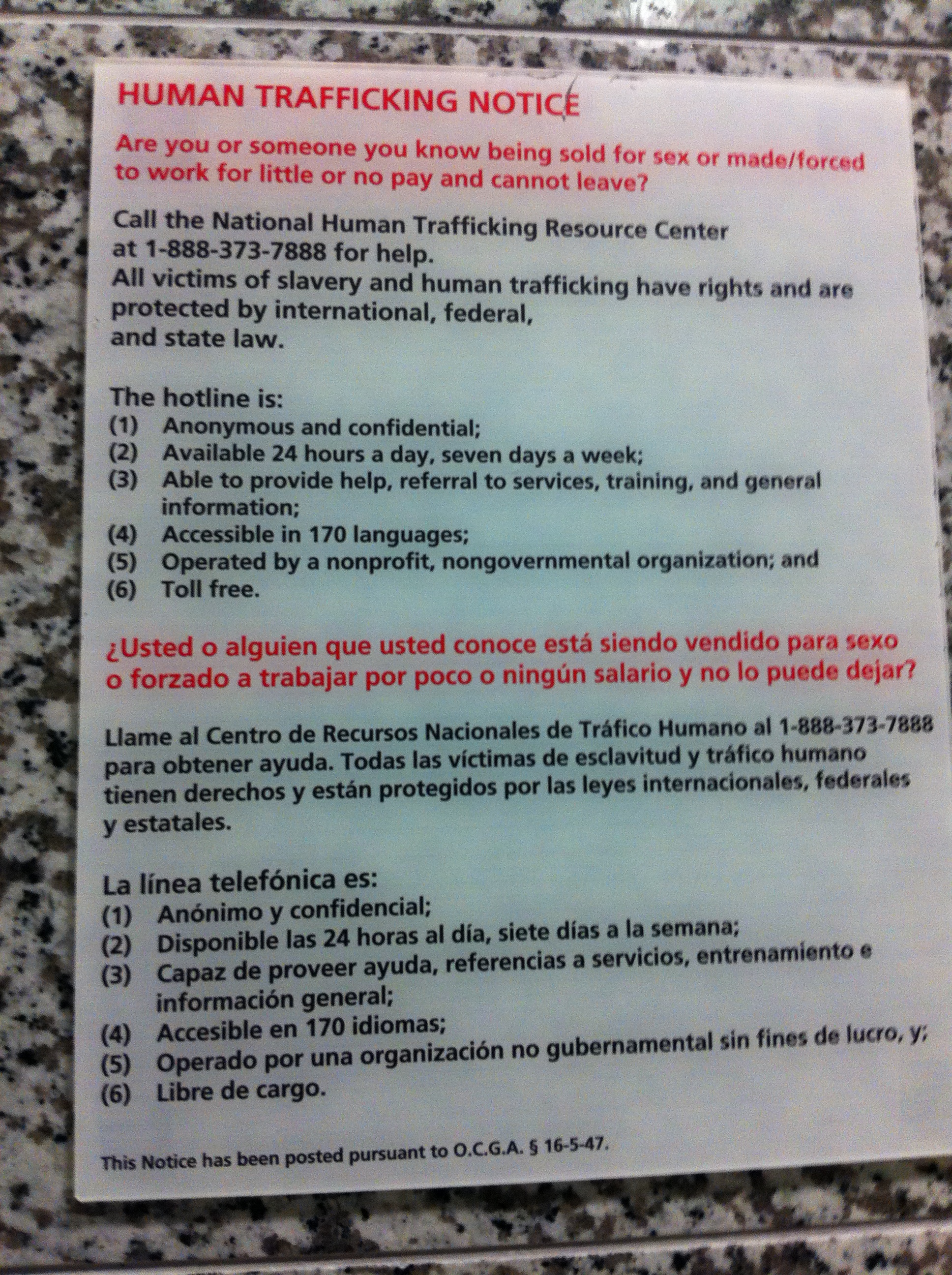
In the bathroom in the immigration hall in Minneapolis/St. Paul airport, there was this sign.

Sigh.  Vacation over.  Soon, back to work raising money for torture rehabilitation.