Category Archives: Poverty

The Awakening

This is the seventh post in a series that started here.

I wrote in the first post in this series, “Wrestling with Restless,” that I would eventually make a point about my question: “Why would I want to leave Minnesota, one of the cleanest, healthiest, most progressive states in the U.S.—a state with great microbreweries—to go study/work/volunteer in a developing country?”

I’m finally at the point of making the point.

I was on a bus in central Mexico with 50 other mostly American Spanish-immersion students, and we had just been directed to gaze upon a garbage dump a big as a mountain.  It was beautiful—from afar.  Trash is colorful.  Flocks of seagulls soared and reeled above it and the sun glinted off the metal and glass it contained.  Our guide had called it a garbage dump city.  Why would anyone live in a garbage dump?  The stench would be overpowering!  Think of the filth and the disgusting things you would see!

To my relief, we didn’t stop but kept going until we arrived at Nuetros Pequeños Hermanos, or Our Little Brothers and Sisters.  As I mentioned previously, the Spanish school we attended specialized in Spanish for social workers, health care professionals, and teachers.  I wasn’t any of those; I just had just liked the school so much the first time that I wanted to return for more.   Now here I was, about to tour an orphanage.

We piled out of the bus and someone walked us around.  This is how I know I was having a Yerkes-Dodson moment, because I cannot remember whether it was a man or a woman or a priest or one of the older kids or a volunteer.

“We have 550 children here, from toddlers to teenagers,” the guide informed us.  “Most of them aren’t orphans; their parents are just too poor to feed them.  Or they’re alcoholics, or unwed mothers, or mentally ill, or in prison.”  The guide talked as we walked.  We passed a half dozen teenage boys shaving the heads of little boys.  We stood and listened in a dorm with rows of bunk beds and cartoon murals on the walls.

“Then there are the children from the garbage dump city,” the guide said.  I was transfixed.  “Hundreds of families make their living by picking through the rubbish and salvaging anything that can be sold.  Mostly it’s metals like copper but also appliances, furniture, shoes ….  We send buses every morning to pick up about 250 children.  We bring them here, give them showers, delouse them and put them in clean clothes, and they spend the day in school here.  Then we bring them home at the end of the day.”

Home.  To the garbage dump city.

We kept walking; we saw the dark little volunteer quarters and the kitchen garden tended by the older children.  A teenage girl and boy were flirting over a fence.  Since it was a Catholic home, I assumed there was no sex education or birth control.  How many babies were born here, to children like them?

The census of children is lower now than when I was there, but at that time, as I did the math, they were in charge of feeding, educating, housing, clothing, and providing health care to about 800 children.

“We have a dozen homes in nine countries,” the guide stated.  This is the moment when I had my “international awakening,” for lack of a better term.  I don’t know if there are homes like this any more in the U.S.  There are thousands of children are in the foster care system.

But the scale of this … for every adorable, doe-eyed two year old there were a dozen or a hundred more who needed someone to care for them.

I felt like I was in one of those videos where the camera pulls back from the earth so you feel lifted off the ground. You look down on the tree tops, then you can see rivers and highways, then shorelines of countries.  You zoom out farther until you are looking down on the blue marble we called Earth, and then out, out, out until you can see the Milky Way.

The Mountain

This is the sixth post in a series on studying Spanish in Mexico that starts here.

I returned from my inaugural week of Spanish immersion and started graduate school. A few months later, I returned for three more weeks.

It was on this was the trip that I had my “international awakening”—the experience that committed me to working in international development. Years before, I had worked for the American Refugee Committee for two years on contract, writing their newsletters and annual reports. I read a lot of background materials and interviewed employees to get material. I already knew that terrible things were happening in Sudan; this work required me to know the gory details. However, nothing compares to being there.

I returned to the same school and requested a home stay with Mirta. I couldn’t wait to see her again and bask in the warmth of her household. Since I was in grad school, I could take all the classes I wanted in addition to those in my program, so I already had a semester of Spanish under my belt and I was excited to be able to talk to her more. Things had been falling into place: The maid’s name wasn’t Ella. “Ella,” meant “she” in Spanish. If you know Spanish you may be shaking your head that I didn’t know this sooner, but it was one of many light-bulb moments in learning a language I found thrilling.

Since I was staying for three weeks, I would be more involved in the life of the school. Cemanahuac specializes in Spanish for teachers, social workers, and heath care professionals. They asked me to bring donations of vitamins if I could, so I took up a collection and filled a suitcase.

Lisa n Alex

This is my former housemate and her son. I financed this trip, and many to come, with funds from my part-time student job, student loans, and rent from people who shared my space or rented the whole place when I went for extended periods.

Mirta had no recollection of me. I felt wounded. That first week in Cuernavaca had been so vivid to me. I attempted to jog her memory, “I’m from Minn-eh-sota, near Can-a-da, where it’s very cold, remember?” I said in Spanish.

She gave me a kindly but blank look. She nodded and smiled but it was obvious I was a blank slate to her. I knew Mirta was married to an elderly, retired doctor she had to care for and support. She had this big compound too, and she worked as hard as the maid to keep it up. Mirta needed students to pay the bills. She was saintly, listening to our stammering, canned Spanish 101 attempts at conversation. She was genuinely warm. We weren’t all white 22 year olds. But as soon as one student left another arrived, and we probably all blurred together.

There’s a phenomenon where people go on tours of slums in the developing world and snap photos of the residents like they’re zoo animals. I hope I wasn’t like that, but my mouth may have gaped open a few times.

I was really into my Spanish studies and hadn’t paid much attention to where we were going for a “field trip” on Saturday. About 50 of us traipsed onto a bus and we drove for an hour. My head was swiveling back and forth from whatever conversation I was having with the student in the seat next to me—she was an African American woman who worked for the U.S. State Department as some kind of administrator and lived in Washington, D.C.—and the scenery out the window.

I was looking at her when I saw her eyes lock on to something in the distance over my shoulder. “What is that?” she wondered.

I turned to look and my first thought was, “A mountain?”

“But look how colorful it is. And why are there so many seagulls?”

“It’s beautiful,” I said.

Then one of our teachers stood up, pointed to the mountain, and announced, “Welcome to Miacatlán garbage dump city.”

Garbage City GullsG Dump City

Dakota Bound

I’m on a road trip! No, not to New Orleans. Believe it or not, I am going to meet with three potential donors in Sioux Falls, South Dakota. Yee haw!

Here’s the deal. The Center for Victims of Torture, where I work, does psychotherapy, physical therapy, and social work for survivors of torture and war trauma. We do it in groups in Jordan, for instance, because all the clients speak the same language. We do it on an individual basis in Minnesota, because clients come from 36 different countries and speak myriad languages which must often be translated, which doubles the time everything takes.

This is all good as far as it goes, except that there are an estimated 1.3 million torture survivors in the US alone. We do a lot of training to try to equip professionals outside of CVT to recognize and help torture survivors. But there’s also no way we can train every doctor, social worker, cop, or immigration officer that might come into contact with a survivor.

People have been talking about doing something with technology at CVT for years, but without funding that’s just dreaming. Part of my job is to find new sources of funding, and that’s what I hope I’ve done. I won’t bore you with the details, but there are three HUGE international development innovation funds that we hope to tap. To do this, we need to find partners who know how to reach patients in remote or difficult to access situations. That’s why we’re going to South Dakota.

It’s so important, when you’re trying to get people fired up about complicated ideas, that you have the right people on your team. My co-pilots on this trip are a colleague who is from Sioux Falls and whose father has opened some doors for us, and CVT’s clinical advisor for our international programs, who is Kenyan and a PhD psycholgist. He describes the needs this way:

In Nairobi, there are thousands of Somali torture survivors living in the slums who are not there legally, under the protection of the United Nations. They literally cannot leave their dwellings during the day, because the Kenyan police will round them up and shake them down for bribes. Which would you choose: Pay a bribe, or be sent back to Somalia where you may face certain death? They may not have iphones, but could we develop a text-based therapy intervention?

Among the survivors who are in Nairobi legally, there are many Congolese and people of other non-English speaking nationalities. Kenya is an English-speaking country. The refugee kids may have already missed years of schooling due to being forced to serve as child soldiers and living on the run or hiding. Now they spend 12 hours a day in school—regular school, plus an extra block of time added on to learn English. They have survived unimaginable horrors. Many of them need psychotherapy or physical therapy, but they don’t have time for it. Could we develop a game-like therapy intervention that would appeal to youth?

CVT also works in Dadaab, the largest refugee camp on earth, in northern Kenya near the Somali border. Its population is about the same as Minneapolis—about 350,000 people. Could we do tele-therapy with them—either mental health or physical? If so we could reach so many more people. We could also use videoconferencing to train our own and other organizations’ staff.


“Do they all have smart phones in Dadaab?” I asked. I have been to Nairobi but not Dadaab.

“I don’t know,” he replied. “We would have to do a survey to determine who has the old Nokias, how many have smart phones. The Chinese are making big inroads into the African market with cheap smart phones. Most Kenyans use their mobiles for everything. They don’t have tablets or desk tops or TVs or land lines. They’ve basically skipped over those generations of devices and they do everything on mobiles.”

I love projects like this. They’re big, messy, uncertain, and complicated. They require me to work with people with whom I don’t normally interact. They may have big payoffs. And in this case they require a road trip.

Feelin’ the Bern

Before I leave the series on Cuba that started here, I have to tell you about the Bernie Sanders rally I attended last week. I was vaguely aware that it was happening, when my cousin called and said her two youngest kids (ages 14 and 18) were begging to go. So they drove the one-hour drive from Wisconsin to see Bernie. We bumped in to another nephew; he’s 18, too. The 18 year olds are looking forward to voting for the first time, mainly because of Bernie.  Vince won’t be able to vote for at least seven years.

The rally was at the Roy Wilkins Auditorium in downtown St. Paul. I was also vaguely aware that Roy Wilkins had been an African American civil rights leader but was wowed when I Googled him later and read his bio: He was a leader with the National Association for the Advancement of Colored People for 40 years, where he succeeded W.E.B. DuBois as editor of Crisis Magazine. He was an advisor to the War Department during World War II and a consultant to the American delegation at the United Nations conference in San Francisco in 1945. He led the fight to end school segregation. Lyndon Johnson awarded him the Medal of Freedom, the US’s highest civilian honor. When he died, Ronald Reagan ordered all government flags be flown at half-staff.

What a cool guy. And what a perfect venue for Bernie to hold his rally, since he’s way behind Hillary on support from African Americans.

I wondered if many in attendance had ever heard of Roy Wilkins. When I walked in, I must have lowered the average age by about 20 years. Bernie drew a crowd of almost 15,000 people, and my guesstimate is that 90% of them were under the age of 30.

We found seats in the overflow room and watched on a big screen while Bernie was introduced by a young Somali American woman. Then, Bernie himself walked into the overflow room—and the crowd went wild. We were on our feet, chanting, “Ber-nee, Ber-nee Ber-nee!” and “Feel the Bern!” I hadn’t been paying much attention to the race until now and was hesitant to stand up and cheer a candidate I knew next to nothing about, but the enthusiasm was irresistible.

Bernie delivered a brief but fiery speech, even though he was clearly on the verge of laryngitis. Then he headed for the main auditorium to the accompaniment of more stomping and cheering. Back on the big screen, Minnesota Congressman Keith Ellison was introducing Bernie to the main room. I was surprised. Endorsing Bernie was, in my opinion, a move of conscience, one the Democratic Party will not be happy about. But Ellison, who is the first Muslim member of Congress, seems to be a man of principle. I’ve heard him referred to as the Muslim Paul Wellstone—our beloved, principled Minnesota Senator who died in a plane crash a decade ago.

Like Wellstone (and me), Bernie is a Jewish Atheist. I didn’t think anyone in the crowd would be put off by that, but having Ellison and the Somali woman introduce him can’t hurt with African American and Muslim voters.

Bernie’s message was loud and clear: We need a revolution! We need to stop all the money flowing to Wall Street. College should be free for everyone! The minimum wage should go up to $15 an hour! And so on with a long list of drastic reforms.

As usual, I’m skeptical. Bernie’s ideas tap into a deep anger among many Americans who feel they’re being screwed by the system. I get it. But would he be able to accomplish much, pitted against an oppositional Republican majority in Congress? Also, economics is complicated. You pull a string out of a tangle and you can’t necessarily predict what other strings are going to become more tangled or come loose as a result.

The day after the rally, I read this article about US relations with Cuba which laid bare our opposing systems: the US wants to do business with entrepreneurs and small businesses, while Cuba insists that we deal only with their government. Bernie calls himself a Democratic Socialist. Is that some sort of hybrid system? I need to educate myself more.

Via con Dios, Cuba

This is the eighth post in a series about Cuba that starts here.

We flew back to Havana without incident and checked back in to our dark, quiet-as-a-graveyard hotel.

Here’s another thing I didn’t get while I was there and I can only make up an explanation for you now: I attended a Passover Seder in Havana—Seders remained legal after the revolution. I also attended an Easter mass—and was told that masses had just been legalized. Why would Seders be legal but not masses?

It could be because almost the entire Jewish population of Cuba fled the country after the revolution. After all, we’d seen this movie before. Why wait to find out the ending? Only 1,500 Jews remain in Cuba, compared with 60% of the population that is Roman Catholic, or 6.5 million people. Which would you find more threatening?

The Seder was a community one at a synagogue. It was packed, as Seders always are; there were Jews from the Bahamas, Texas, Israel, and lots of American students. I sat across from a pudgy, red-headed oaf from Indiana or somewhere in the Midwest who was married to a Cuban woman who looked like Bianca Jagger in her heyday. I’m sorry to say that my people are not immune from the syndrome where misfit western men snag beautiful wives in the developing world. But that sounds mean. I only sat across from him for an hour. Maybe he was usually courteous and kind.

On our last night, we were invited to a “Defense of the Revolution #62 Block Party.” Other members of our group had been to these before and told me that neighborhoods organized them to thank visitors for their donations. This in no way prepared me for what I saw when I stepped off the bus.

I thought there must be some mistake. Had we stumbled upon a protest? A wedding? A baseball game? No, these hundreds of people were waiting for us. There had to be at least 200 people out on the street, with precious, expensive electric lights strung up festively, a band and a dance area, and tables laden with food.

Ed and some of the other guys unloaded the medical supplies we had brought; I have no idea where they had been stored all week. Our donation consisted of bandages, cotton balls, and Q-tips—granted there were crates of them, but still … here were hundreds of people lined up to greet us as though we were foreign dignitaries or rock stars.

I was stunned and embarrassed. Our donation was puny compared to the effort they were putting out. Plus, I had agreed to interpret Ed’s remarks into Spanish. I had pictured half a dozen people, not hundreds.

Mi en Cuba

I managed to stammer out a few remarks into a microphone. Everyone applauded as though they had understood me. I fell back into a chair and they brought me a plate of food. It all tasted like dessert because even the savory foods were loaded with sugar. The music and dancing started, and our group was forgotten. I realized this wasn’t about us—it must have been the case that Cubans are allowed to hold big gatherings like this if they had a patriotic reason. I don’t know for sure, but maybe we had given them that reason. Bringing gifts gave them an excuse to show us their stuff, and stay up all night having a good time. Who knows?  Another mystery.

On our bus ride back to the hotel late that night, our guide explained that there were no extremes of rich and poor in Cuba. Yeah, I thought, because all the rich people skedaddled to Miami. He kept referring to “the special period” and I asked Ed to explain. “That’s when the Soviet Union collapsed and Cuba lost all its subsidies,” he said. “It can’t survive under the U.S. embargo without a patron.”

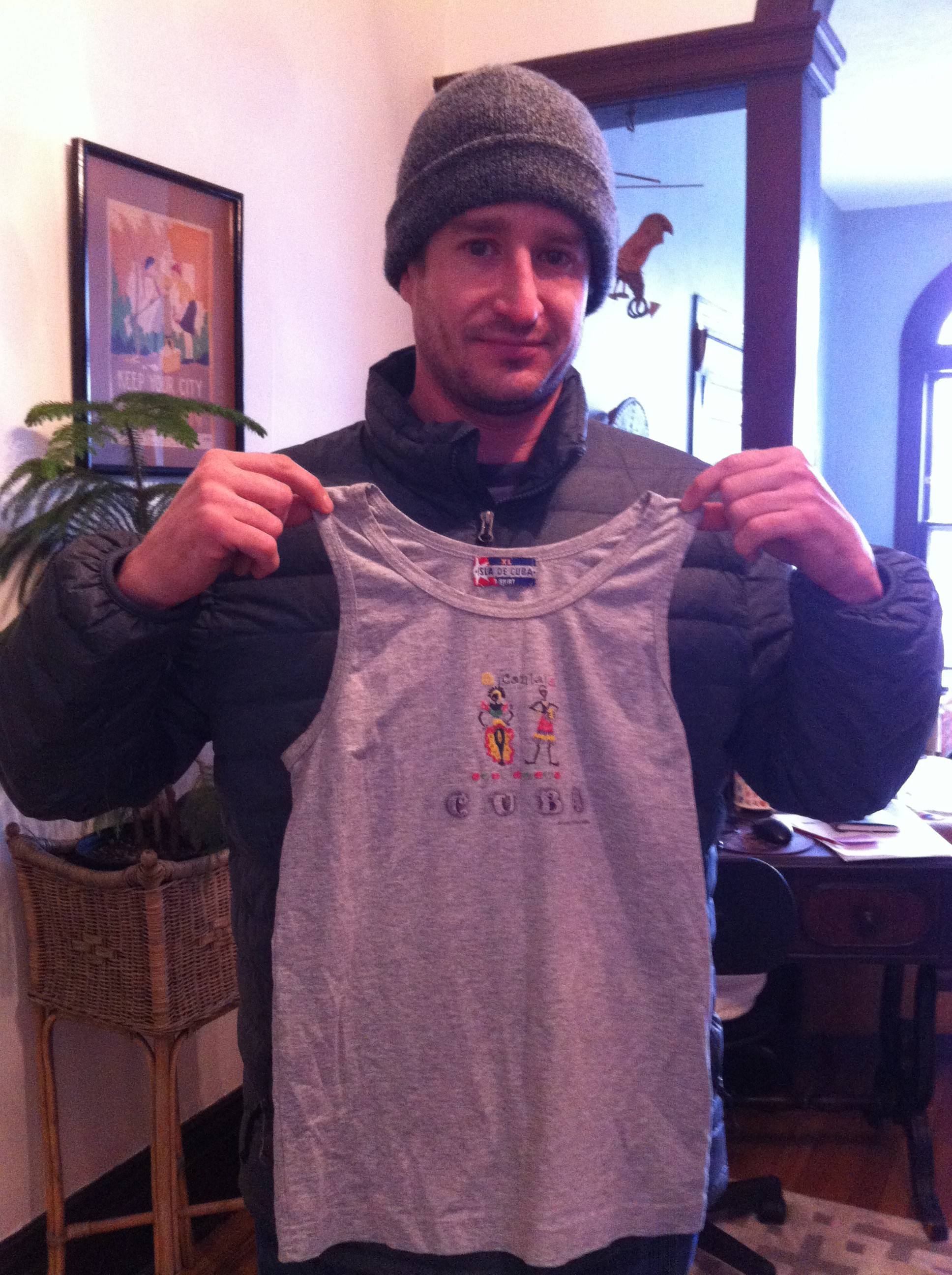
When we checked out the next day, the guy at the desk offered T-shirts for sale, as modeled here by Vince. It’s an extra large. Right—for a Cuban, maybe.

Cuba Tshirt

I hope this series has been food for thought as Americans consider electing Bernie Sanders, a Democratic Socialist, for President.

Sig Heil, la Revolucion

This is the sixth post in a series about Cuba that starts here.

I was in Santiago de Cuba with my 82-year-old new best friend, Shirley, and the Marin Interfaith Task Force on the Americas.

We went to hear music, the ostensible reason we had flown over 500 miles in a Russian rust bucket of a plane with pilots who worried about funny noises. The music happened in a very decrepit but charming sort of open hall with cavernous ceilings and rickety benches for seating, if you could find a space to sit. The walls had peeling layers of old paint in different colors; I knew people in the states who would have paid big money to get that look.

“These guys are famous!” exuded Ed. “I can’t believe how lucky we are to hear them live!” I had never heard of the band and couldn’t tell them from the ones that preceded or followed them. Not that they weren’t great—to my unsophisticated ear they all sounded marvelous. There were no CDs or T-shirts for sale, and no posters I could take a photo of to help me remember who they were.

The next day we toured Castillo de San Pedro de la Roca, a 17th Century Spanish fort. All I remember about that is how hot, hot, hot it was, and how I kept trying to find a sliver of shade to stand in while the guide yammered on about history.

We went to a (thankfully) shaded glen to listen to a priestess speak about Santeria, an African religion practiced in some parts of Cuba. There were endless gods and goddesses of wind, water, fire, battle, fertility, and so on. It was all very interesting but I forgot all of it by the next day. I have friends who can recite historical dates and names—in which year the artist Diego Blahblabla painted that Madonna with child in that old church in such-and-such a small city. But not me. If I hadn’t jotted notes each night in my hotel room I would never have remembered as much as I have here. And of course the great goddess Google has helped me reconstruct a lot as well.

We toured a primary school. Our guide explained that education was compulsory to 9th grade, so everyone can read and write. Well education is compulsory through 10th grade in the U.S., but that doesn’t mean everyone can read and write. There are things you hear on tours in other countries that are just best to keep your mouth shut about.

The guide told us about the Cuban emphasis on arts—painting, music, dance, literature. Everyone played a musical instrument, wrote poetry, or could illustrate a point with interpretive dance. Then there was the love of baseball. All boys played baseball and loved it. So much for women being full comrades. I figured there were at least a couple boys who did not love baseball and would have preferred to be ballet dancers. In my head I heard my friend Bette, the one who is married to a Cubano who has made documentary films about baseball, saying “They promote the arts and baseball because they are disciplines. They distract people from how hunger, and their lack of basic rights.”

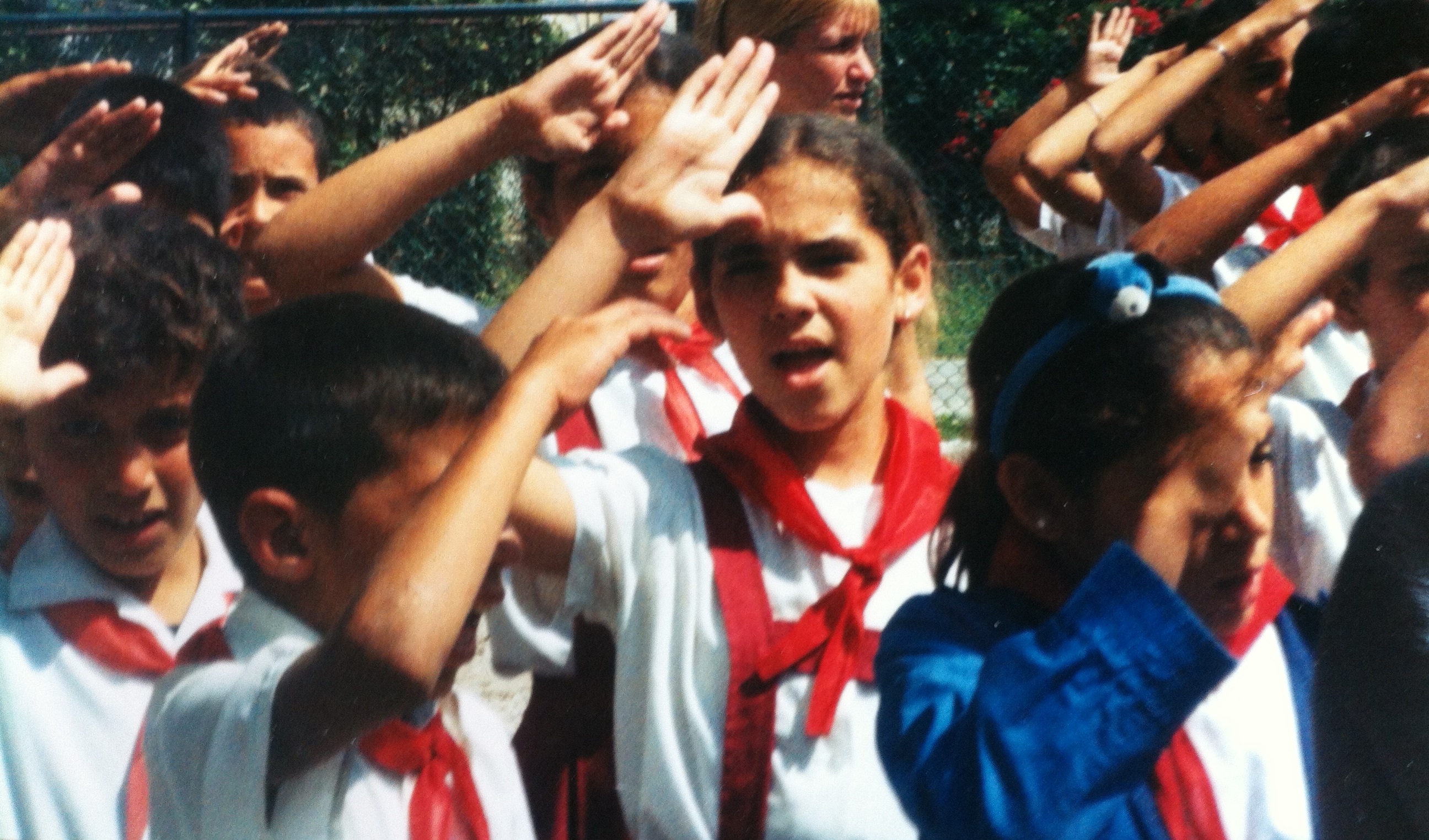
Our guide paraded the children out onto the playground for us, where they sang a patriotic song and made a disturbing gesture very much like the Hitler salute.

Cuban Kids

We went inside and viewed an empty classroom, which had rows and rows of new computers. “These were donated by the Spanish government,” our guide said proudly.

This was when I forgot to keep my mouth shut. “So the kids can surf the Internet?” I asked.

“These computers are state of the art,” the guide continued, ignoring my question.

“Do you get a fast Internet connection?” I kept on, cluelessly.

“They have the highest memory capacity available in the world.”

Oops, I finally got it. There was no Internet. Nowadays Cubans can buy “access”—meaning the government blocks many sites and monitors what users look at—for $2 an hour, a huge expense for the average person who earns $20 a month.

Beinvenidos al Hotel California

This is the fifth post in a series about Cuba that starts here.

After a few days in Havana we packed our bags and flew to Santiago de Cuba, a city on the other end of the island. The plane took off as soon as the last passenger stepped on board, half an hour before our scheduled departure. What if that person had been half an hour late? Would we have waited for him?

The plane was basic. The little signs you see in planes, the ones that say, “Fine for Tampering with Smoke Alarm” were in Russian. At least, I assumed it was Russian, and that they said the usual things. The seat tray in front of me was a piece of plywood held in place by chains and hooks that would have cost $5 at Ace Hardware. As we ascended, mist seeped into the cabin. No one else seemed alarmed so I tried to stay calm.

About an hour into the flight, the co-pilot came on to make an announcement. I could understand his Spanish perfectly; maybe he wasn’t Cuban. I was happy to be able to tell my group what was going on. “Ladies and gentlemen,” I translated, “We are hearing a strange noise somewhere in the aircraft and we can’t figure out what it is, so we’re going to turn around and go back to Havana.” Everyone laughed nervously, then fell silent as the plane banked steeply.

We sat on the ground in Havana for a while before taking off again. “Ladies and gentlemen,” the co-pilot said as we took off, “We apologize for the delay. The pilot is new and neither of us has flown this kind of plane before.” What “kind of plane” did he mean, I wondered? A Russian plane? A run-down plane? There was no mention of the funny noise. Presumably whatever had been rattling had been fixed, or determined to not be life threatening.

The first thing you notice about Santiago is that it is HOT. Hot as hell and humid. I don’t mind heat to a point, but if it’s too hot, this Minnesota-bred traveler’s brain and body become lethargic. We had flown almost 550 miles to experience “real” Cuban music that could not be heard in the capitol. I’m not a music connoisseur; most music sounds good to me unless it’s horribly out of key or country (which seem like the same thing to me), so I was skeptical.

We were transported to our “hotel”, which seemed to be some kind of abandoned camp compound with whitewashed, cement buildings spread out over several acres. I checked into my room and collapsed onto the bed, so out of it that I wondered if I was being drugged. Of course there was no air con, not even a fan, and no window screens, which allowed clouds of gnat-sized mosquitos into the room. The walls were bare and white, there was a bare bulb overhead and a double bed with a thin white sheet. The bathroom was the same as in Havana, with one threadbare towel and transparent toilet paper but instead of a flimsy toilet seat there was no toilet seat. Nice!

I turned on the black and white TV and there was only one channel; I believe Bonanza was on again. I groaned and attempted to wrap myself in the sheet like a giant burrito to keep the mosquitos at bay.

I woke up to knocking.

“Come to the pool!” a woman’s voice called.

Pool!? I detangled myself from the sheet and saw that my left arm, which had fallen out of the burrito, was covered with hundreds of tiny red welts. I flung the door open and there was one of my fellow travelers, an 80-something lady who had been subjected to a strip search at the airport upon our arrival and had taken it all in stride. She had a bottle of rum in one hand and a cigar in the other. Ten minutes later we were floating on a life preserver in the deserted but clean pool, sipping smoooth rum out of the bottle and smoking an even smoooother cigar. Cuba was heaven.

Cigars? Cigarettes?

This is the fourth post in a series about Cuba that starts here.

I was in Havana with the Marin Interfaith Task Force on the Americas, which has a tour coming up in April if you’re keen to visit the island.

Before the U.S. began its rapprochement with Cuba, Americans either had to go there illegally by flying from Canada or Mexico, or were required to have permission from the U.S. Treasury’s Office of Foreign Assets Control, or OFAC. And on these government-sanctioned trips, it wasn’t like you could just do whatever you wanted; the itinerary had to be vetted and approved and you couldn’t go off leash from your tour group. We carried OFAC letters on us at all times and, according to Ed, our Marin Task Force leader, OFAC probably had someone tailing us. And our Cuban guide was probably reporting back to his masters about … what? As I wrote in the first post, the Task Force was composed of a bunch of old hippies and me. But maybe the Task Force had been infiltrated by the CIA, and Ed was a plant?

I think in 10 years we will look back on this period and laugh about it. It was very cloak and dagger, and needlessly so.

I know, I know, you want me to stop going on about the politics and write about the rum and cigars and food and music, right?

Okay. First, the food. Everywhere we went, it was pretty much the same. Chicken, rice, and cabbage. Rice, chicken, and cabbage. Cabbage, chicken and rice. Obviously they had no problem providing themselves with these staples. According to Ed, the CIA had purposely introduced a swine plague that killed all the pigs on the island; that was why there was no pork. Why they couldn’t have grown something colorful–a little Swiss Chard or some carrots, I don’t know.

If you like sugar, you would love Cuba. Every drink is loaded with it, and we were offered desserts galore. The Cuba Libre was the standard drink, and it seemed to contain rum, mint leaves, and about a half a cup of sugar.

We toured a rum factory, which looked like something out of Victorian England. It appeared to have been built and hundred years before and never updated. Not that there’s necessarily anything wrong with that—they certainly cranked out some smooth rum. We all bought bottles “to support the economy.”

We toured a cigar factory. The images here are from the Great Google but look similar to my tour, during which we weren’t allowed to take photos.

Cigar FactoryCigar Factory 2

The cigar factory is the single most vivid memory from the trip because the aroma was like nothing I’ve experienced before or since. Heavenly.

I bought a box “for a friend.” This is one of the reasons I love travel. I spend money on things I would never buy at home, and I can tell myself they’re gifts or that I’m supported a developing economy. And then I can enjoy them myself.

The cigar factory was also notable because it was a multistory, rickety, wood frame building. It reminded me of a barn inside, with bales of tobacco leaves piled around the perimeters and men standing at wooden tables in the center rolling the cigars (and cigarettes) by hand. One match and the whole place would have gone up like a roman candle. The workers were allowed a cigar allowance, we were told.

This seemed contrary to the anti-smoking campaign I’d heard about, in which Fidel was lauded for quitting and everyone was encouraged to follow the example of el Comandante Jefe.

When I returned to my hotel room and went to put my bottle of rum in the fridge, I found two eggs inside, wrapped in an embroidered handkerchief. Were they a gift, or had the maid forgotten her lunch? If they weren’t a gift, maybe the dancing lady hadn’t been a gift either. Maybe I should leave some money for it? I left a $10 bill with a note in my execrable written Spanish that this was for the beautiful dancing lady. I hoped the same maid came every day so there wouldn’t be an unfortunate misunderstanding.

All for None, None for All

This is the second post in a series about Cuba that begins here.

I searched for my photos from Cuba and since I was well organized back in the day when we printed photos and put them in albums, I was able to find them quickly. I realized it’s been 12 years since I went to Cuba. That adds weight to my disclaimer that things have changed from what I’m going to describe. Mainly, everything has gone downhill.

I met my fellow travelers in the Miami airport. There were two dozen of them and I must have brought the average age down to about 60 when I showed up. They were pretty much as I expected; all the men had grey beards and ponytails and the women wore long tie-dyed skirts with Birkenstocks. They were a nice bunch of people, mostly couples but as usual on tours there were a few divorcees who put the tank in cantankerous. Ed was our leader. He had been to Cuba many, many times and he would be indispensable in interpreting what our guides said. Not because they spoke Spanish—because they had to speak Propaganda. Of course Ed had his own agenda, so much remained a mystery.

All the other people waiting for the flight to Havana were Cuban Americans, and they also fit a stereotype. Picture Desi Arnaz, then picture him about 30 pounds overweight, wearing an untucked-in Guayabera shirt, the flashiest designer sun glasses you’ve ever seen, dripping with gold chains, bracelets, rings, and a watch as big as Big Ben.

Ed explained to me in a low voice, “That’s how they get funds into the country for their relatives. They can’t smuggle dollars in, but their family can sell that jewelry on the black market.”

What struck me almost immediately upon arrival was that there was no advertising. There was propaganda galore—on wall murals, billboards, and ubiquitous images of Che and Fidel and other revolutionaries. But there were no billboards for products like laundry detergent or for stores or restaurants—because there were no stores or restaurants. There was almost nothing to buy, anywhere.

Che

But who needs stores when everything is provided by the state? “From each according to his ability, to each according to his need,” is the saying popularized by Karl Marx. Every Cuban got a house, medical care, electricity, food, an education—and cigars! The house might be about to collapse, the electricity might be out for hours a day, and the food might be basic (rice, chicken, and beans), but they could all depend on their monthly rations.

Everyone had a job, too. I had doubts about whether “ability” was factored in. I used a restaurant bathroom and was dismayed to find the toilet was broken. An elderly woman appeared with a bucket of water and dumped it in. Was that the best job they could come up for her based on her ability? No, Ed explained. Aside from professions like physicians, everyone was just assigned a job that needed doing. Or a job that didn’t need doing. These “make-work” jobs were in evidence everywhere. We were told to get in a van so we could be driven 25 feet from Point A to Point B at the airport. There were people sweeping clean sidewalks and guards guarding empty buildings. All of them—doctor, driver, toilet flusher—earned about the same per month.

There was one government-sanctioned store called a dollar store. American dollars are the currency in Cuba, and I mean cash. There were no ATMs, no credit cards or checks accepted anywhere, even at the hotel.

What was for sale in the dollar store? Nothing touristy, and nothing for a dollar. Everything was expensive. The store was tiny but packed in everything from clothing to washing machines. It reminded me of an old timey Woolworths, with no American goods, of course. There was an appliance brand called Vince which I assumed was Spanish or Italian. Trade with Cuba was in defiance of the U.S. Government, Ed said later. Spain was also financing renovation of the historic waterfront, the Malecon, on and off—the pauses due to bullying threats from the U.S.

Malecon

¡Cuba, si!

There’s a lot of interest in travel to Cuba now. That is, travel by Americans, because most everyone else in the world has been going all along.

If you were to tell me, “I can only afford one trip this year. Where should I go?” my answer would be, “¡Cuba, si!”

Why? Because it’s the most different place you can go and not worry (too much) about being thrown in prison for 10 years.

I don’t know for sure, but I think most Americans imagine Cuba is a poorer version of Mexico, with better music and more baseball. Cuba is a lot poorer than Mexico, and there is great music and an obsession with baseball, but it’s more like Russia or China than the rest of Latin America.

Think about it: It’s a socialist country. If you harbor romantic ideas about communism or socialism, go to Cuba.

I went to Cuba about 10 years ago. I had been writing papers about the Cuban Missile Crisis for my master’s program, and my friend Bette was married to a Cuban guy named Lumino. Lumino was only allowed to visit Cuba, where his children and grandchildren lived, every two years. “Each time we go,” Bette told me, “It’s more desperate than the last visit.” She gave me a book titled Cuba: Neither Heaven nor Hell. I was intrigued.

So one cold Minnesota day when I had nothing better to do I Googled “tours to Cuba” and up popped the Marin Interfaith Task Force on the Americas. Within a couple hours I was signed up to go on a legal trip to Cuba.

I love it when trips come together like this, spontaneously and easily.

The Taskforce is basically a bunch of old hippies who live in the richest county in America (I don’t know how that works). They’ve been agitating against U.S. meddling in Latin America for decades. One of their strategies is organizing mission trips—not in the religious sense but to learn about situations on the ground first hand, to show solidarity, and to introduce new people to the cause.

There’s also the little fact that, in order for Americans to visit Cuba back then, they had to be on some sort of official mission. We were supposedly humanitarians on a medical mission to deliver medical supplies. While Cuba has one of the best public health systems in the world, they were so financially strapped due to the U.S.’s strangulating policies that they lacked basic things like soap and bandages. I write in the past tense because this is changing. But it will take a while to make up for decades of deprivation.

I want to note here that the Taskforce has a trip to Cuba coming up in April. The theme is “Environmental Justice in Cuba: A Study of Cuba’s Environmental and Social Policies and Practice.”

Anyone can join them; as their flyer says, “All are welcome to join this delegation! Professors, Students, Researchers, Activists!” They’ll tour Havana and the western provinces over 10 days and the cost is about $2,700, which includes everything except maybe your flight to Miami from wherever you live.

If you think that sounds expensive, I cannot emphasize enough how valuable it is that the Taskforce secures your travel visa for you and works with a tour company that knows the ins and outs of making arrangements in a country where everything is a mystery to outsiders. Plus, you would be covered by Cuban health insurance while you’re there! Ideally you don’t want to get sick or injured at all, but how cool would it be to experience the Cuban health system first hand, especially since I delivered a case of bandages to them 10 year ago? You’d have dinner party invitations for years based on that story alone.

I used student loan money to pay for my Cuba trip. I know, I know that’s a big no-no. You’re only supposed to use student loan money for tuition and education-related expenses. I would argue that actually going there was a much better education than reading books and articles and writing papers about Cuba. I’ll write about it in my next few posts.