Category Archives: suicide

Ultimate Price

VINCE

Very rarely in my life have I had to deal with death. Most recently, a friend paid the ultimate price in a fiery wreck during the time I was out on bail from my drug charge, back in March of ’14. Most likely she had fallen asleep while driving, as I had done so many times in the past. Unfortunately for her, she was pinned inside the truck and more than likely burned to death along with her dog when the gas tank exploded, as evidenced by the claw marks inside the plastic by the door. I have seen pictures of the vehicle and the body after the accident, and I wish I had not. I have seen a lot in my day, and I have seen a lot of death on the internet. But nothing could have prepared me for seeing somebody I actually knew. I could make out the features, especially the teeth and facial bone structure. It was unsettling, if not disturbing.

I met Christie and Mackenzie (names changed) at a mutual friend’s house in Chatfield in the Winter of 2012. They were both alcoholics and low-level drug dealers (allegedly), and had formed up as a lesbian couple a number of years before I met them and were living together in **. *******.  I took a liking to them right away because they seemed like they were still fun people, a rarity among meth users.  I started selling to them (allegedly) pretty quickly after that, so I would often go to their house.  It is there that I started to see the devastation more common to our kind.

The house was in complete disarray.  Shit everywhere, broken glass on the floor, rotting food on the counters, and paraphernalia abundant.  What I wasn’t expecting was the blatant domestic arguments that would occur directly in front of me.  These women would really get heated.  On more than one occasion I saw bruises and lesions on both of them but they would never come to blows in front of me or anybody that I knew.  It got really uncomfortable for me on more than one occasion, and one of them would leave, or, more commonly, I would.  Over and over, of course, they would come back to each other, make up, and start over.  My guess is that the accident occurred on a morning after the evening of a fight, although this would never be confirmed.

An early Thursday morning on U.S. Hwy. 14 in Lewiston, MN in March of 2014 would be a day any friends of the couple would never forget.  A westbound pickup truck crossed the center line and smashed into a construction vehicle head-on and caught fire, killing my friend and her dog.  I’m not going to provide any more details, but the internet has all sorts of resources, and it would be pretty easy to find.  Just keep the names private please.

What transpired afterward was even worse for me, because her partner went crazy, very slowly, before I went to prison, and she was eventually arrested for robbery, possession of meth with a handgun, and a number of lesser charges.

Christie frequently suffered delusions after the accident, and often accused her friends, myself included, of being responsible for Mackenzie’s death.  Contributing to the  insanity was the lack of sleep that is the result of methamphetamine use, and depression, a result I’m sure of losing one’s life-mate or partner.  She would ramble incoherently and shout at the walls.  She would speak of conspiracies involving women breaking in through cracks in the walls.  She was arrested for robbing somebody of $400 in her own living room at gunpoint.  The person she robbed had reported seeing an earlier robbery in which she twisted somebody’s arm behind her back, accusing her of being responsible for Mackenzie’s death, then took $500 from her purse.  She was arrested three days later and her house was searched yielding scales, bags, drugs, and a loaded rifle on the couch.  She’s not currently in jail or prison that I can find.  I wish her the best.

Mackenzie– I am sorry I wasn’t a better friend. I will never forget your laugh, or your cry. Go be with the angels now.

Prison News Round Up

ANNE

I am leaving for Berlin in two days, so I’m going to review a pile of prison-related articles that I’ve accumulated—over a period of one weekend—that’s how often prison is in the news.  I’ll give you the downers first, then the positive ones.

Ohio is having trouble obtaining drugs used to execute people, so the Ohio DOC has obtained an import license from the Drug Enforcement Administration to buy sodium thiopental and pentobarbital from overseas.  Wow.  Where overseas, I wonder?  They “decline” to name the countries.  I’m thinking China, North Korea, Iran, or Yemen, since these are our fellow members of the death penalty club.  In case that doesn’t work, Ohio legislators passed an “execution secrecy law” (I am not making this up) in hopes it would get small-scale drug manufacturers called compounding pharmacies to sell them the drugs.  These are unregulated companies that have been in the news for sickening people with contaminated pharmaceuticals.  But hey, if you’re trying to kill someone, who cares what the quality of the drug is?

In Wisconsin, there is a prison guard shortage that has prompted two correctional facilities to call in guards from other institutions and pay overtime.  So let me get this straight—we pack our prisons full of nonviolent drug offenders, which costs us taxpayers an arm and a leg, then we have to pay overtime to get guard coverage, which costs us more.  Great system!

Which leads me to this editorial in the Minneapolis Star Tribune, “Finding solutions for overcrowded prisons.”   I like the opening line: “Either Americans are the most evil-people on Earth or there’s something terribly wrong with their criminal-justice system.”  They mention something that’s news to me: “It’s a stretch to suggest that the bloated prison population is due mainly to the sentencing of nonviolent drug offenders.  It’s not.  Most of the increase comes from locking up greater numbers of thieves and violent criminals and keeping them behind bars longer.  Even if all nonviolent drug offenders were set free today, the prison population of 2.2 million would drop to only 1.7 million … Still, on the margin, granting early release to nonviolent offenders and shortening sentences to better match crimes seems a sensible step….”

This information is new to me, and I wonder why I haven’t read it elsewhere.  Everywhere else, the narrative is that, if we just release all the nonviolent drug offenders, our prison population will be drastically reduced.  But if there are more violent criminals in America than elsewhere, maybe we are the most evil people on earth.

Still, 2.2 million total prisoners minus 1.7 million nonviolent drug offenders is 500 thousand people—not insignificant.  And when you figure it costs (on average) $31,000 a year to keep someone in prison, that’s over $1.5 billion a year.

On the same day, there was this feature article about Damon Thibodeaux, an 18-year-old who was wrongly convicted of rape and murder who spent 16 years on death row before being exonerated and freed, in large part due to the efforts of Minneapolis attorney Steve Kaplan.  Thibodeaux had been raped and beaten on a regular basis by his step “father” since the age of five and so he was easily bullied and manipulated into confessing to the crime.  It’s a heart-rending story, but it has a happy ending.  As I’ve written before, an important element of recovery from anything is feeling that you belong.  And Kaplan has gone the distance to help Thibodeaux adjust to life after prison by including him in family and other social gatherings.

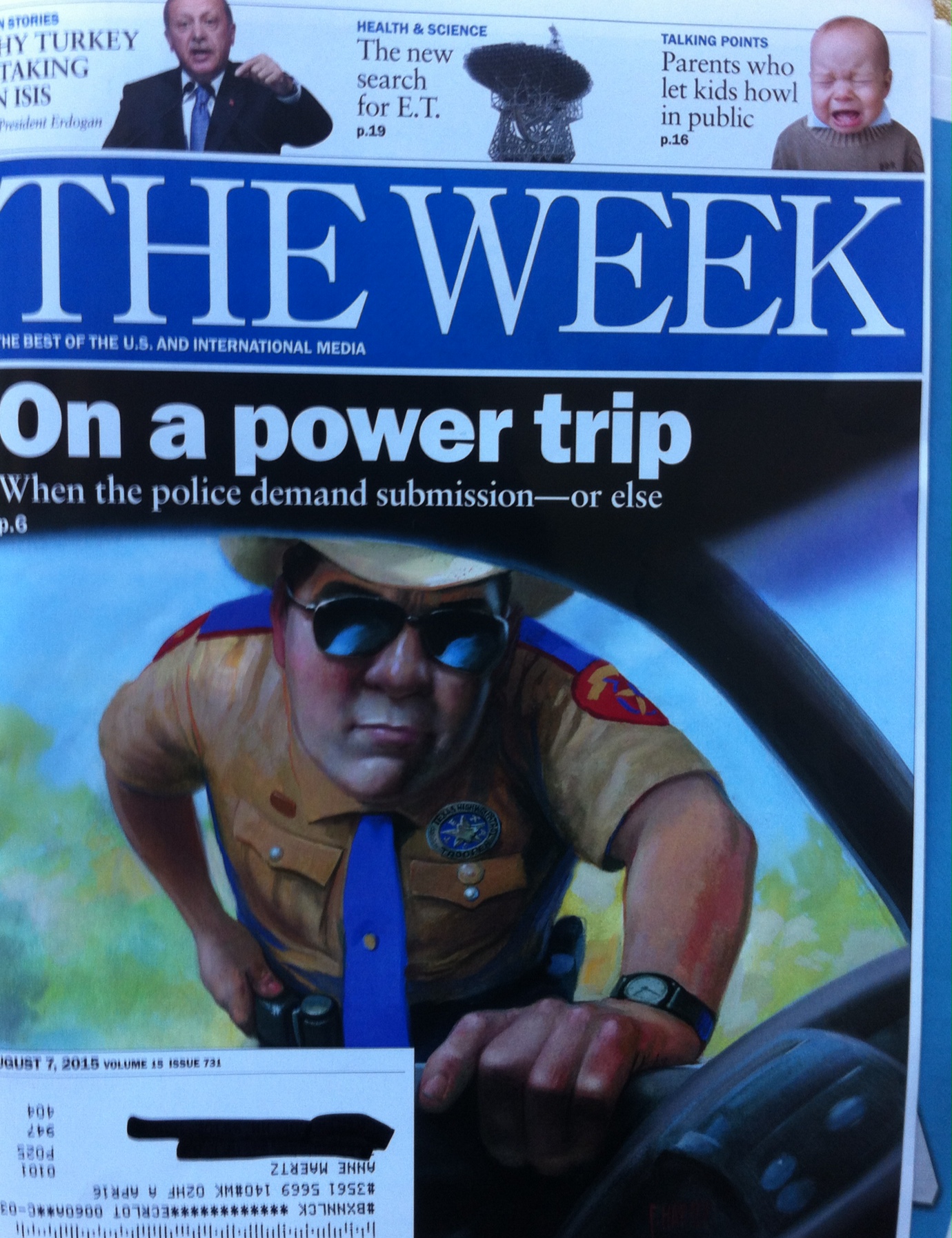
And there was this little factoid in The Week: that every day, on average, a dozen people die behind bars.  The leading cause?  Suicide, in local jails; cancer elsewhere.

Below are some prison-related images.  The bully one made me shudder, because it’s how I felt when I was kicked out of Moose Lake for wearing “revealing clothing.”  It wasn’t about my clothing; it was a power trip.  Related to that is an interview with Richard Zimbardo, who led the Stanford Prison Experiment in which students were assigned to be prisoners or guards.  The “guards” quickly became sadistic.  “I lost my sense of compassion, I totally lost that,” said Zimbardo.

Next time, the good news.

DesktopBully

All Lives Matter

ANNE

I have been avoiding the story of Sandra Bland since it broke about 10 days ago.  I was afraid it would be too heartbreaking.  I think I’m overwhelmed—a sure sign is that I switched to classical Minnesota Public Radio from the news version.  The case of Freddie Grey, the black man who died of broken neck after being handcuffed, put into the back of a police van, and driven all over town while he was tossed around helplessly, was my (heart)breaking point.

But this morning I switched back to the news and caught this story about Sandra Bland.  It contains audio clips of the interaction between Bland and the officer who pulled her over for not signaling a lane change.  In case you aren’t aware of what happened next, the interchange escalated, she was arrested and thrown in jail, where she allegedly hanged herself.

It was really, really hard to listen to, but not for the reason I’d expected.  I had assumed I would feel angry and powerless because yet another African American was dead after an interaction with a police officer.  And I did feel that.

But Sandra Bland reminded me so much of me—specifically my confrontation with a correctional officer that got me ejected from Moose Lake Correctional Facility and banned from visiting Vince for six months.  You can hear it in her voice, and in her pauses.  She is sick and tired of kowtowing.  Bland didn’t lose it as quickly as I did, but she was probably trying to put the brakes on herself since she is black, after all.

I wonder what would have happened to me if I had been black?  Would I have been thrown to the ground, arrested, and taken to jail?

I struggle with the race issue.  I know that black men, especially, are arrested and incarcerated at a higher rate than white ones.  After a police officer shot and killed a black teenager, Michael Brown, in Ferguson, Missouri, the U.S. Justice Department conducted an investigation which found a pattern of racial bias between 2012 and 2014 violating the Constitution and federal law.   For instance, while the population of Ferguson is 67% black, 93% of arrests were of black people.  You could say, “Maybe black people commit more crime,” but for even minor offenses like jay walking, nearly 100% of the arrests are of black people.  And when whites are arrested for jay walking, they are 68% more likely to have their charges dismissed than blacks are.

So why do I struggle with “the race issue” when it seems so clear cut?  It’s not that I doubt that black men are arrested and incarcerated at higher rates than white ones.  It’s that my son—despite the fact that he is white—is still in prison.  He is still serving a way-too-long sentence for his crimes and he is still being exploited for nearly free labor.  We are still paying through the nose for things like stamps, emails, and ramen.  It remains to be seen, but I am afraid he will be released with very, very little in the way of support or resources.  And he’s one of the lucky ones—he’s got me and others who are rooting for him and offering to buy him bedding or pants.

Yes, blacks are incarcerated at higher rates than whites; currently at St. Cloud they represent 31% of the prison population while they represent only 5% of Minnesota’s overall population.  But since whites make up 85% of Minnesota’s population, their numbers in Minnesota prisons are higher—there are 627 white men in St. Cloud, compared with 335 black men.

Do people think Vince shouldn’t be where he is—because he’s white?  Would some people dismiss him as a loser because, being white, he has no excuse not to be a mid-level manager by now with a wife and two kids and a house with a white picket fence in the suburbs?  Do people think all white men have it made by virtue of white privilege, and therefore the only explanation when they fail is that they’re bad seeds?

Je Pay

VINCE

I’ve been reading “Always Looking Up” by Michael J. Fox for a day or so during my short periods of free time. I’ve always been interested in reading about him. He was a good part of my entertainment when I was young, on Family Ties, and in movies such as Back to the Future. I don’t believe he’s acted since 2000, so when I saw his face on a book in our small library I picked it up.

He and I have a lot in common. He’s a famous actor with Parkinson’s Disease, and I’m a prisoner that takes medication for Parkinson’s Disease. It’s like we’re twins.

Anyhow, I don’t really have anything more to say on that subject, except that I was just mentioning it’s a good book so far. Inspirational is the word I think I’m supposed to use.

[ANNE: A few updates:

Someone from the Department of Corrections called and asked if I was indeed Anne Maertz, if I was willing to house Vince upon his release, if I owned my home. I said yes and yes and yes. Then she said, “I need to confirm that you have no firearms or alcohol in your home.” I stifled a laugh because I have learned that DOC people don’t like it when you laugh. “You mean when Vince comes to live with me, right? Not as of this moment?” She said yes and I confirmed that I don’t have any firearms and my house will be alcohol free when Vince is released. But I could not resist saying, “You realize there are 50 bars and liquor stores within walking distance of where I live, right?” She said she did realize that but that this was their policy.

When I’m not feeling contrary, I can see the logic of the policy. Most suicides are committed with firearms found in the home. Without instant access, many suicides could be prevented. Same for chemical dependency relapses. Say Vince is feeling despondent at 3am. If there’s beer in the fridge, it would be so easy for him to walk 10 feet down the hall and medicate himself. But with nothing in the house and no bars or liquor stores open at that time, he would be forced to deal with his feelings and cravings until morning, and as the AA slogan goes, “Each day a new beginning.”

My other interaction was with the prison industrial complex. As I wrote a couple weeks ago, the Minnesota DOC has switched email vendors. This sent me into a tizzy because email is the one cheap, dependable system that actually had worked for us to communicate. I finally found time to set up an account with the new vendor. They asked for my address, phone number, credit card number, and date of birth. That last one seemed unnecessarily intrusive.

The new vendor, J Pay, has a slick website with photos of people who look like they are having the time of their lives.

It calls account credit “stamps.” Is that so you don’t realize it’s money? After multiple failed attempts, I was able to buy $2.00 worth of “stamps,” which is the maximum one can purchase at a time.

It costs .40 per “stamp.”  The emails you can send are only about 1/3 as long–it’s difficult to tell before you hit “send.”  Most people are not going to do the math, but I am not most people. The old system worked out to about 10 cents per page, while this one will be 40 cents per page. I would say, cynically, that they count on people being too overwhelmed or math-impaired to figure this out, but actually it doesn’t matter – we are prisoners to J Pay and other such legal scams. The only other option is to send only postal mail. If I am realistic, that’s just not going to happen. I like to send Vince newspaper articles about baseball, and those are not allowed to be mailed to prisoners. Don’t ask me why.

At the bottom of the J Pay website were the usual social media buttons—“Like us on Facebook!” they implored. Right! As if J Pay is some sort of uber cool product I want to give free PR.

The Restorative Powers of Kittens

ANNE

When Vince and I started blogging, I didn’t realize that a theme of redemption would emerge. Vince is transformation is probably obvious. Mine is subtler and has unfolded over many years.

I have been thinking about this lately because in the spring and sumer I get dozens of emails a day from the Humane Society about stray kittens. What does this have to do with redemption?

I signed up to do foster care of kittens a couple years ago. These kittens are born in warehouses or barns or even under car hoods. The mothers, if they survive, are emaciated and barely old enough to conceive. So that’s part of what makes fostering redemptive for me—giving care to vulnerable teen moms that I didn’t receive myself.

I keep these kittens, with or without moms, until they are old enough to be spayed/neutered, then turn them back to the Humane Society. It’s not all fun; I’ve had entire litters die because the mother was so dehydrated. Kittens have been smothered by their litter mates. One lost an eye to the claws of a litter mate. So it’s kind of a nature-tooth-and-claw experience.

People wonder how I don’t get so attached to them that I want to keep them. I think fostering is the ideal set up—I get the cuteness of kittens and the Humane Society pays all the vet bills and provides the supplies. I travel too much to have a permanent pet. When I turn them back in, I know they will be adopted immediately—there’s a huge demand for kittens. And I’m not even that much of a pet person.

So why do I do it, and what does it have to do with redemption? I think it goes back to one of the few memories I have of my dad.

A few weeks before he left home forever, he had been gone for weeks and showed up with a black kitten. I must have been seven, and my three younger siblings were thrilled. I was too, but also leery because I knew my mother was not thrilled. I can see now that the kitten was my dad’s wedge to get back in—if my mother had demanded he turn around and leave, “and take the darn kitten with you,” she would have been the bad guy.

I remember dad telling us to hold her gently and not fight over her because she was a living creature with feelings. He said her name was Surprise! and told us to always say it that way, like there was an exclamation point.

So then dad was back home, and the next day he went out to buy some cat food and kitty litter. He was gone all afternoon and missed dinner. My mom tried to put us to bed early. We did what we usually did, laughed at her and ran in four different directions. But I also can still feel how anxious we all were.

Dad made his appearance just as the cat had crapped under someone’s bed. My mom began to reproach him because of course he was drunk and hadn’t brought home any pet supplies.

We kids were giggling until dad roared, “I’ll Get that goddamn cat!” He ripped the kitten out of my sister’s hands, strode to the top of the stairs, and hurled her down the staircase like a fast ball, screaming, “You goddamn piece of shit!” He raced down to the landing, grabbed Surprise before she could get oriented, and sent her hurtling down the second set of stairs to the first floor.

All of us—my mom and the four of us kids—huddled at the top of the stairs. Someone was whimpering but I had learned to be silent, no matter how frightened I was.

That’s when I had the thought that would teach me to never make wishes:

I wish he was dead.”

A few months later, he was.

Surprise! not only survived but had a litter of eight black kittens six months later.

Much later, there was a (nonviolent) incident involving cats and Vince but that’s his story.

Who could not feel their soul restored by kittens?

IMG_2326[1]

Don’t Cry for Me, Minnesota

ANNE

It’s Memorial Day, so here’s a post about death.

Am I the only one who thinks about death all the time? Bear with me. Honestly, I’m not depressed and I don’t find it depressing to think about death. If you do, maybe you should skip this post.

Death has been a preoccupation of mine since my dad died, when I was eight. When Vince was missing for that first worst year, all I could think of was him lying face up behind a garbage dumpster, eyes staring, with a bullet hole in his forehead. Ok, I also imagined him dead in a gulley, in a corn field, in the river, and any number of other cold, isolated, lonely places. But that’s not the kind of dwelling on death I’m talking about here.

My mother is continually clearing out her house, shifting mementos onto me and my siblings. She had a shoebox of loose family photos that we looked through together. Birthday parties, picnics, and school plays from the 1930s, 40s, and 50s. “This is my cousin’s fifth birthday party,” she explained, showing me a summertime photo of small children assembled around a cake on a picnic table in someone’s back yard, wearing birthday hats. Little girls with Shirley Temple curls and elaborate home-sewn flouncy dresses. Boys with bow ties and their hair slicked down like Alfalfa. The cars parked in the background had gorgeous fins.

“My cousin and another child got sick after the party and they both died the next day—it was meningitis.” Her finger traced the circle of five-year olds. “I don’t remember who the other child was. We had to be quarantined, so they ran a yellow QUARANTINE tape around our yard. We couldn’t leave or have visitors for a week. Mr. Goldenberg, who owned the five-and-dime at the end of the block, would bring a box of food, set it near the back gate, and run back down the alley.”

Let’s face it, all these photos will be pitched into a dumpster when she dies. I won’t remember who any of the children are.

And so it goes. We are born and, if we’re lucky, someone loves us and takes care of us. Lots of photos are taken to celebrate our milestones. When we enter adulthood we are so focused on achieving goals that we don’t realize we will never be this healthy, energetic, or attractive again.

Now at 55 I have dozens of photo albums that will go into a dumpster when I die. I have thousands of photos on Facebook that will likely sit in cyberspace as long as servers exist, of interest to no one except maybe some future social anthropologist.

And so I—my whole life—my loves and dramas and losses, my story, all my brilliant ideas and daydreams and real dreams, my travels, my elaborately decorated dining rooms for dinner parties and painstakingly tended gardens, the thousands of miles I have walked and millions of repetitions I have done at the gym, my friends far and near, the millions of dollars I’ve raised for good causes, maybe even those good causes and their organizations themselves—will disappear.

We’re all on a conveyer belt. We move along it, conscious of it or not. We can’t get off, we can’t go back, and we don’t know when we’ll reach the end of the belt and fall off into … ??

A lot of people are sure they know the answer to that but I’m not one of them.

Again, I don’t find any of this depressing, or feel sorry for myself—I just find it intriguing. So what should we do while we’re here? The only conclusions I’ve reached for myself, after 55 years of armchair philosophizing, are: 1) it feels better to do good things than bad ones; 2) it’s important to have fun while you have the chance; and 3) if I ever stop seeking the answers to life’s imponderable questions, I’m as good as dead.

California Dreaming

ANNE

And then Kermit changed his mind. He just wasn’t ready to get married. It was too late for me to keep my job or housing. He mailed me a check to carry me over for a month.

So Vince and I never moved to California. Instead, we moved into a friend’s unheated attic that winter until we could get a foothold and start over. Then we moved again, and that didn’t work out, so we moved again. Vince changed schools three times that year. I started working as a freelance writer so I could say I was self employed instead of unemployed. Also because I was too depressed to get out of bed, so woodenly depressed that I wasn’t thinking about Vince. Facing the impact of my behavior on him would have produced such massive guilt that it would have pushed me over the edge.

But wait, there’s more!

I went back to Kermit, after months of him apologizing, begging, wooing, and having massive bouquets of flowers delivered to my door.

And so Kermit and Vince and I flew back and forth, and the hurled Coke can turned into me being hurled—hurled, punched, kicked, and strangled. Once, in the course of strangling me, Kermit broke his own thumb. I can still see him standing over me, as I choked and gasped my way back to consciousness. “You bitch! Look what you did—you broke my thumb!”

A few years ago I had an x-ray for some reason, and the doctor asked me about my old neck injury. “Looks like you had a pretty significant injury,” he said. I had no idea what it could be, until a few days later it dawned on me that this was probably from the time Kermit had tried to strangle me.

The only ones who knew what was really going on were the St. Paul Police, St. Paul Fire Department, and Vince.

Kermit and I went camping in the Grand Canyon, where he beat me black and blue in our tent (but only where clothing would cover the bruises; he never hit me in the face). I escaped to the car, locked myself in, and shivered through the night. Back in St. Paul, I went to the police, who photographed my bruises. They couldn’t do anything because Kermit was in another state, but I thought telling others would keep me from going back to him.

When I tried to cut it off, Kermit would call 911, say he was my doctor, and tell them he feared I was having seizures. Would they go to my house right away and check on me, breaking down the door if necessary? I would hear banging on the door at 3 am, and find firefighters with axes posed to smash down the door.

I kept flying out to see him, spending money I didn’t have. That’s right, Kermit never paid. One of his recurring accusations was that I was a gold digger, so although he made at least 10 times what I did, he never paid for my tickets. He did fly Vince out for the World Series, and they drove up to Oakland in a limo. He bought Vince an A’s hat and jacket and full collection of baseball cards. Vince was in thrall to him.

Kermit and I took a road trip to Napa and visited vineyards. He bought expensive bottles of wine for his “collection” Which never made it back because he drained them all.   He told me he had access to drugs he could use to kill me if I tried to leave him, and no one would ever be able to figure it out because, after all, he was a genius.

I can’t bring myself to write about how it ended, but it finally did, with an interstate restraining order against him.

Vince knew I had done the right thing but he was crushed to lose his idol. Was it this episode that set Vince on the road to prison—on top of not having a dad, growing up in poverty, having a depressed mom, and being genetically loaded for addiction, compounded by all his bad choices?

Doctor Wonderful

ANNE

People have asked how Vince can write so well, considering he dropped out of school at 16. First, I read and talked to him from Day One. Second, I got a full scholarship to send him to a Montessori preschool. Then, even though I am such a city person that I break into hives when I pass outside the city limits, I moved to a suburb in order to send him to the highest-ranked public school system in Minnesota.

Vince was 10 when I finally finished my college degree. That enabled me to get a new job that paid $20,000 a year—$20,000!—that seemed like a fortune. I also loved the job, which was at a private university. Vince and I lived in a safe and clean—if vanilla—subsidized housing project. I had pulled myself up by the bootstraps, and the future looked like it would only get better.

Here is where I “mom up” to the episode that really blew us off course and (I think) screwed Vince up.

As I type the words, “And then I met a man…” I feel my palms start sweating and my stomach tighten.

Let’s just call the man Kermit, because he was about as short, slippery, and spineless as a frog.

Kermit was originally from California and was finishing his neurosurgery residency in Minnesota. He adored Vince, the poor fatherless boy with the big brown eyes and quick wit, and Vince adored him. Kermit adored me, too, the spunky single mother with blonde hair and great legs who read novels by the pile. He only read medical journals.

Looking back, I guess I fell in love with him because I felt sorry for him. He had been abused by his mother. He told me about it in great detail. I tried to empathize by telling him about my alcoholic father who had beaten my mother in front of me and then committed suicide. He said that wasn’t the same thing at all—since my dad had died so long ago I shouldn’t blame my problems on him. Besides, Kermit would say as he slugged down his fifth rum and coke, you can’t hold an alcoholic accountable for what they do when they’re drunk; they can’t help it. Now, his mother was really abusive, and she didn’t even drink! The Witch was still alive. Becoming a brain surgeon had been his plan to escape from her and never have to ask her or his dad, who was a saint, for anything ever again.

There were a few episodes of foreshadowing, like when he got jealous and hurled a can of Coke against my kitchen wall, and left me to wipe up the mess. Or when a cop pulled him over for erratic driving, and he flashed his hospital ID and told the cop, “You wouldn’t want to throw me in jail, would you officer? I might be the one you need to operate on you if you get shot.” He laughed about it when he told me later.

But then he moved back to California to join a practice there, and begged me to marry him and join him. I said yes.

He was living in a penthouse apartment overlooking the Pacific, but he hired a realtor who started sending me full-color glossy profiles of million-dollar houses. “Just get rid of all your furniture and move out there asap!” he’s say. “You can go shopping wherever you want and buy all new furniture!” He had bought a red Maserati, but he would buy me an SUV—a Mercedes, of course—not a Ford! Vince would go to a private boarding school, and wait—what? When I expressed hesitation, Kermit accused me of not wanting the best for my child.

Alarm bells were going off in my head but I ignored them. My friends and family were beside themselves that I had not only met a man, but a rich one—a doctor! And so I quit my new job, gave notice on the subsidized townhouse, and gave away most of my belongings. We were moving to California! What could possibly go wrong?

See You on the Other Side

VINCE

Three days until freedom, 183 days until my release.

I will not be able to write as frequently from boot camp but I will when I can and I think it will be even more powerful than ever. The following story will be the last thing that I write from Moose Lake.

In the last 10 years, I have spent three + years on meth, six + years as a drunk, and eight months in prison.

By far, being a drunk took the worst toll on me. It didn’t land me in the clink, but I lost so much of myself that it’s really hard for me to look back on it and be honest about it.

My mother has written about it from her perspective and I’ve always just kind of brushed it off, not wanting to deal with the truth.

Truth is, I was a mess. Every day. Drunk. I held jobs through most of it. But in every other aspect of life I failed.

Every cent I had went to booze. No room for food, clothing. I guess I paid my rent most of the time.

I had three days off per week. So starting right when I woke up, I would drink my breakfast, say 7 a.m. Drink beers and smoke cigarettes until the bar opened at 11 a.m., then drink into oblivion until I blacked out. Waking up somehow back in my apartment, or somebody else’s.

I’ve woken up on pool tables. In the middle of the street surrounded by police. Under water, naked, having just tipped my best friend’s canoe, losing it forever. And once I woke up and I realized I was clutching a fully loaded shotgun, with my finger on the trigger guard, safety off. I’m not saying I was suicidal, but I did question my motivation. Then laughed it off.

Every day, for years, I woke up with no food in the fridge. I worked in restaurants, but I still only really ever ate one meal a day, four days a week. I was not healthy.

It’s Tuesday morning. 7:50 a.m. In 24 hours I will be leaving this terrible place, in search of the tools that will make it so I never have to re-visit the places I have just described.

I had a picture of me taken one week before boot camp which my mother will somehow put near this last post, and we will put up a new picture in six months, just to show the physical improvement gained through the program. I weigh 200 pounds here. We’ll hopefully see a transformation. Again, I will keep writing, just not so much.

Pre Boot Camp

I really enjoy reading the feedback we’ve been getting keep it coming.

Alright, it’s time to go get my life back. Wish me luck.

Here I go.

The Creep

ANNE

Ouch. That Eminem song … so many ways I could go with that.

When I was in Istanbul in November, there was a guy from the Philippines in my meetings. His name was J.P. Morgan. No, J.P. Morgan is not a Filipino name. His father had changed the family name in hopes that it would bring prosperity. It didn’t.

I happened to be seated next to J.P.—John—on a dinner cruise the first night. I thought, “Oh no, trapped on a boat for three hours next to this guy—what could we possibly have in common?”

But then we started talking and by the end of the cruise I was calling him “son” and he was calling me “mom.”

John’s father was an alcoholic who had left the family when John was small. John was pimped out at the age of 10, sold to strangers for sex until he was too old and no longer desirable—19 or 20—and he began pimping out younger kids in order to make a living and survive.

By the time I met him, John was Vince’s age, had recovered long ago, and ran a recovery program for street kids. Here we are, talking about his “River of Life” program.  To prostituted young men, John has become their idol, big brother, and mentor. Everybody, including notorious gang leaders, listens intently to John and follows every word he says.

JP Morgan

John and another sex worker had had a son together. He was a teenager now, and John was doing his best to keep tabs on him, though the mother was an addict and moved around a lot.

I asked John if he thought that kids being raised by single mothers was the biggest reason that kids got in to trouble. He looked squarely at me and wagged his finger. “No. It is not the mothers. It’s the fathers.” Alcoholic fathers. Abusive fathers. Fathers who gamble away their paychecks. Fathers who leave.

On Vince’s first birthday I called to invite his father to have cake with us, and he said he was too busy with “business.” A drug deal, in other words. I never saw him again, except briefly in a crowd.

From time to time I would ask Vince if it bothered him that he didn’t have a father. “Let’s just call him The Creep,” he said once, and we laughed and I never really got an answer, if he had one to give.

Vince never asked about The Creep. The Creep’s dad had been a barge worker and his mother was a telephone operator who had grown up on a reservation. They lived in a dilapidated farm house in Rush City filled with cigarette smoke and no heat and large bowls of bite-sized Snickers and a big-screen TV. The Creep and I visited his grandmother once, on the rez. She lived in a tar paper shack without indoor plumbing or electricity.

I never mentioned to Vince that the Creep had been a drug dealer from a small town who didn’t have a car or a phone, a high-school dropout who worked as a clerk in a gas station. A guy who aspired to nothing more than hanging out with his friends, drinking and smoking pot, laughing and telling stories about drinking and smoking pot. I never mentioned any of these things because I didn’t want Vince to be influenced by them, if he harbored some unconscious admiration for The Creep.

The Creep had had a son with another woman before I met him, and went on to father four more children. I got $103 in child support once, but that was it.

I’m not trying to shift blame; after all I must have had a far stronger influence on Vince since I was there 24/7 for 16 years, right?  I don’t spend all day analyzing and angsting over why Vince is who he is.  But for every Vince, there are 10,000 more like him in prison, in Minnesota alone.  I’m sure they all derailed for a different mix of complicated reasons, just as I succeeded despite a complicated mix of factors that should have kept me down.  If someone could figure it all out, they would deserve to win the Nobel Peace Prize.

Babies