Category Archives: Travel

Two Birds in Paradise

This is the fourth post in a series on studying Spanish in Mexico that starts here.

My host mother and I had been tossed around in the back of the mini bus for 20 minutes when she jumped up and exclaimed what I could only guess meant, “We’re here!”

The combi slowed to a roll but didn’t actually stop as we stepped off in front of an office.

Patologia

Mirta led me to the locked gate to the right—the one with graffiti scrawled on it, handed me a key, and showed me how to use it.

Now that we were here—now that I had made it from the airport to the hotel, taken a bus to Cuernavaca, seen the school, and successfully managed to keep up with Mirta, my tension drained away and I suddenly “got” a word: llave—key.

I felt joy.  I could do this!  I could get around in a foreign country, meet exciting new people, and learn a foreign language!  I only had to memorize about 10,000 more words and learn how to conjugate 500 verbs.

If you live in Los Angeles or Miami, Mirta’s house would be unremarkable.  It was a walled compound with a main house, another smaller house, and a garden with a pool.

Cuerna Home

Mirta walked me into the kitchen of the main house, wagging her finger to indicate that the rest of the place was off limits.  Darn, I wouldn’t be able to relax on that plastic-covered couch under the oil painting of The Last Supper I caught a glimpse of from the kitchen.

She also made clear that the fridge was off limits.  She demonstrated how to use the five-gallon water bottle which was to be my only source of water.  She laid down the times for breakfast, lunch, and dinner.  It was amazing how much she could communicate with charades-like gestures.

A young woman entered with a toddler.  I assumed this was Mirta’s daughter and grandson until she picked up a mop and started swabbing the floor.  From what I could gather, her name was Ella.

I followed Mirta like a duckling to the smaller house where I would spend the week.  Everything was covered in green tile except the ceiling.  It would have felt like an asylum except that the window looked out on the garden full of Birds of Paradise.  Those are run-of-the-mill in Mexico—like daisies in Minnesota—but to me they were spectacular and I would later amuse Mirta by taking endless photos of them.

Bird of Paradise

Mirta pointed to the bare bulb in the middle of the sitting room ceiling and made clear that I was not to waste electricity.  She oriented me to the bathroom, showing me eight fingers to indicate how many minutes of hot water were available to shower each day.  There was a drain in the floor with a plate over it and a brick on top of the plate.  Do not remove, I was warned, with some scary faces.  In Minnesota, we get rats coming up from the river through the sewers into people’s basement toilets.  I wondered if that was the foe here, or something else?

Mirta opened the bedroom door to reveal two twin beds.  A young woman was hunched over on one of them, holding a blow dryer and looking dejected.

“Hi, I’m Zoe,” she said, in a North American accent.  I had known I would share my quarters with another student, and this was her.  Mirta showcased the one-drawer night stand next to my bed, then exited with a reminder about meal times.

“My blow dryer won’t work!”  Zoe exclaimed.  She started to whimper quietly.  “I forgot to bring an adapter.  Do you have one?”

When I said no she wondered out loud, “I wonder if Mirta has a blow dryer she would let me use?”  I thought that was highly unlikely, given we weren’t allowed beyond the kitchen or even to open the refrigerator.   Zoe really started to cry.  “And I can’t call my parents!  My cell doesn’t work and Mirta won’t let me make a long-distance call on her phone!”

I was afraid Zoe was destined to be an example of a Yerkes-Dodson Law fail.

Losing My Words

This is the third post in a series about studying Spanish in Mexico that starts here.

And so I arrived in Cuernavaca, Mexico, to drench myself in Spanish language and culture for a week.

Through this company, Amerispan, I had bought a cheap package that included my classes and a homestay. I had splurged and spent an extra $40 or something for someone to meet me at the bus station and take me to the school. I made that call after seeing that the school was called Cemanahuac. What?! That didn’t sound Spanish, and I had no idea how to pronounce it. Now I see that they’ve added a helpful transliteration to their website: sem-ah-NOW-ock, and I can tell you that was the name used by the Aztecs to refer to their world.

For the umpteenth time I apologize for my lousy photos:

Cemanahuac PoolCemanahuac Hut

If you live in Indonesia or El Salvador or anywhere else that is tropical, you won’t think anything of this place. But to me, coming from a cold, drab grey Minnesota winter, it was paradise. I could hardly believe that I was going to spend a week studying here. I would have been happy to skip the studying and spend the week lying by the pool with a book.

Amerispan no longer lists Cemanahuac as a language school choice on its website. That’s sad, and I wonder if it’s due to all the drug gang violence, or something else?

I wandered around the school, probably with a dazed smile on my face, until someone called my name: “Anna Mah-eeeertz?” I don’t know how long they had been calling it before I realized it was me.

I knew from studying up on the Amerispan website that someone from my host family would come to take me to the home, but now I had left English behind—completely. That was their philosophy, total immersion.

But it wasn’t too hard to figure out that the secretary of the school was introducing me to a woman whose name was apparently Mierda. I could see the other office employees behind her, laughing up their sleeves. I would learn eventually that Mirta was Cuban, and that Mirta was a Cuban name. But she pronounced it Mierda and in Mexico and elsewhere Mierda means shit.

Mirta seemed oblivious to this, and as I got to know her better over the course of the week I found she was one of those happy, smiling people who just ignore bad things. Mirta was about 60. She was plump in a matronly way, with dark red hair, and she was dressed like my grandma used to dress in the 70s—in polyester elastic waist pants and a button up shirt—both in pastel colors, and sturdy black shoes.

She pointed toward the exit and said what sounded like, “Yabba da dabba da blabba de doo.”

All I could do was smile and nod; I didn’t even know to ask, “Que?” and even if I had I couldn’t have understood the answer. I followed her out into the street.

She walked so fast I had to hop skip to keep up with her. We reached a corner and she pointed to a bread store and said something. Then we turned, turned again at the next corner, walked about three more blocks, and while she talked and pointed to things along the way. We came to a crazily busy intersection where she stood for a while talking and gesticulating some more, until a mini bus arrived. She pointed to above the windshield, and I could make out a number and what I assumed was the month of Noviembre. Why would a bus route be named a date? I followed her on to the combi and she showed me the coins I had to pay, which meant nothing to me.

This was my introduction to the wonders of combi décor. There were several small statues of the Virgin Mary glued to the dashboard, the rest of the surface was covered in orange fake fur, and there were holy cards suspended above the driver’s head. We needed all the good-luck juju, for sure, as the bus lurched out into the stream of traffic.

Yikes, Yerkes!

This is the second in a series of posts about studying Spanish in Mexico that starts here.

My life had gone off the rails shortly after my 40th birthday and it seemed like the obvious thing to do was to run away to Mexico and learn Spanish. I had never been to Mexico. I had studied Spanish in high school, but Spanish class followed my free hour, which I spent smoking pot, so while I probably appeared to be enjoying the class immensely, the only words I had retained were cerveza and fiesta. Those weren’t going to get me a bus ticket.

But somehow I managed to fly to Mexico City, then take a bus to Cuernavaca. I was well prepared by Amerispan, the company I used to find a language school.

It just occurred to me that I am actually a sort of expert on travel, study, and volunteering abroad programs due to all the things sparked by this first trip to Mexico.

First, I wrote my master’s thesis on international immersion programs (meaning that you live with a host family in order to learn about culture and/or language). I researched a dozen of them and read up on the psychology of immersion learning. Did you know there’s a psychological theory called the Yerkes-Dodson law which says that the ideal learning experience requires you to be pushed out of your comfort zone—but if you are pushed too far your mind will shut down?

Second, I have participated in half a dozen immersion programs. There was the Volunteers for Peace trip, where I babysat Pakistani kids and studied racism with a group of other volunteers in the East End of London. There were my four trips with Amerispan. I did an internship for Global Volunteers, which offers “volunteer vacations.” There was my trip to Cuba to deliver medical supplies with the Marin Interfaith Taskforce on the Americas. I went back to England to volunteer for Oxfam, then got a full-time job there. I spent two months interviewing human rights activists in Nairobi, Kenya under the auspices of American Jewish World Service.

There was one close call. A few years ago, I had a plane ticket to go to Kolkata, India to volunteer for two years with CUSO International. This is a Canadian organization similar to the Peace Corps but without the political agenda. They flew me to Vancouver for a three-day interview and to Ottawa for five days of training. I had received all my shots, had my letter of resignation ready, and was packing my belongings to put them in storage.

Then I read the blog of the volunteer I would be replacing. She described coming home to find a giant rat standing on its hind legs on her bed and hissing at her. “I’m not afraid of rats,” I told myself. She painted a picture of her lodgings, a windowless room with no air con or even a fan, in a city where the average daily temperature was 104F (40C). “Well I wanted to get away from winters!” was my rationale for why I could hack it. But then there was her description of the pitch dark shower that had soft muck on the floor from which giant winged insects arose when she started the water—which was only a dribble—I immediately wrote to CUSO and backed out.

I felt a little guilty, but I would have felt worse if they had had to pay to wack-evac me later.

Third, I am co-teaching a class about this whole subject, for the second year. Last night we talked about the spectrum of providers. This blog doesn’t have any advertising, so I’ll give Amerispan a shout out here, again. I think it’s great because it really helps you think through what your priorities are and what you can tolerate. They specialize in language studies, study abroad, and international volunteer opportunities. They gave me enough guidance to find my way to Cuernavaca on my own, but it was loose enough that I got my fill of adventure. And that’s what gives you a feeling of accomplishment and scratches the itch for the next trip.

Wrestling with Restless

I started a blog in 2011 and fizzled out after about six weeks.  It was called Wrestling with Restless, and that could still be a perfect theme for me.

I’ve got a great life, from any outside perspective.  I’m healthy.  I have friends and family I’m connected to.  I’ve got an interesting job that pays decently and has good benefits.  My condo is beautiful and my son is out of prison and doing well.  I live in an area where the cost of living is reasonable and you can always find a parking spot.  We’re big on the arts—we’ve got loads of theater companies, symphony orchestras and chamber orchestras and operas, modern and traditional art museums, and sports teams.  Not that I care about sports.

It’s clean here.  It’s green.  We have good tap water.  It’s diverse—not like New York City diverse, but we’ve got the largest populations of Somali and Hmong and Burmese immigrants in the U.S.  There’s an international airport 10 minutes from my house but there’s also a state park with a lake and two rivers 5 minutes from the airport.  We’ve got light rail and bike lanes and farmers markets and microbreweries and farm-to-table restaurants and someone has even proposed opening a mill to make artisanal flour.  We’re one of the most progressive states, politically.   We’re always on those lists like “Top 10 Cities for Working Moms,” “Best Overall Quality of Life,” “Greenest Cities,” “Most LGBT Friendly Cities,” and on and on.

So why would I want to leave?

When I turned 40, in short order my boyfriend dumped me, I was fired from my job, and I was diagnosed with Multiple Sclerosis.  So I did what anyone would do—I booked myself into a one-week Spanish immersion class in Mexico.

I looked out the plane window as we flew over Mexico City.  I timed it—20 minutes to fly across from one end to the other.  That’s a long time!  I had never traveled to a developing country before, except to Cost Rica the year before with the ex-boyfriend, and we had stayed at a luxury resort.  When the exit doors of the airport slid open, a hundred men started yelling and waving at me.  “It’s a riot!” I thought, but they were only taxi drivers trying to get my business.

I picked the closest one, who took me to the hotel where I would spend one night before taking a bus to my school, in Cuernavaca.  At the desk, the clerk asked me, “Cual es su nombre?” and I answered “Uno,” thinking nombre must mean number, as in how many are in your party.  He somehow got my name out of me, then rattled off the list of things desk clerks tell you, including that something was “el sexto.”  I clutched my belongings about me and hurried off to my room, where it dawned on me he had been saying “sixth floor,” not propositioning me for sex.

That’s right, I spoke only about 10 words of Spanish.  I sat in my tiny concrete room trying to memorize the key phrases I would need to buy a bus ticket and get to Cuernavaca the next day.  There was one very small, square window near the top of the high ceiling, and all night I heard what sounded like a rabid baboon baying.  There was no glass or screen on the window.  Could whatever it was get into my room?  Why hadn’t I brought that mace someone had given me as a parting gift and which I had left at home to show how worry free I was?

As is usual with my series of posts, I will eventually make a point that that connects to my original question.

But until then: I have mentioned a lot of companies on this blog—Bob Barker, Pillow King, Mega Bank, Industrial Chemicals, Inc, etc.—always with withering disdain.  I am happy to now highly recommend a company called Amerispan.  I went to Mexico three times and to Spain once to study Spanish with the help of Amerispan.  My niece used them to do the same in Costa Rica.   More about them next time.

The Nitty Gritty

I wrote in my last post about how you can find adventure close to home. But you can experience it even closer—inside your own head. The best example I can give, for me, is the rush of adrenaline I get when I am planning a trip. Not on a trip, just anticipating it. Looking at maps, checking airfares, considering the pros and cons of various destinations, imagining all the fun I will have with my friends.

I’ve written about how these kinds of thoughts cause physical reactions in my body, like a racing heart and sweaty palms. But I’ve never known how that works.

Strangely enough it was an article about solitary confinement that explained the phenomenon. Solitary confinement: the opposite of travel, right? The full title of the article is “How would you do in Supermax? The answer may lie with imagination and grit.”

First, here’s the negative side of solitary, which will be no surprise to anyone with a shred of empathy:

“Solitary confinement has been linked to a variety of profoundly negative psychological outcomes, including suicidal tendencies and spatial and cognitive distortions. Confinement-induced stress can shrink parts of the brain, including the hippocampus, which is responsible for memory, spatial orientation, and control of emotions. In addition to these measurable effects, prisoners often report bizarre and disturbing subjective experiences after they leave supermax. Some say the world regularly collapses in on itself. Others report they are unable to lead ordinary conversations, or think clearly for any length of time. The psychiatrist Sandra Schank puts it this way: “It’s a standard psychiatric concept, if you put people in isolation, they will go insane.”

But here’s where the article veers away from the usual, “it’s horrible, we should stop it” article about solitary. This article examines how some prisoners use mental imagery to survive, and even rehabilitate themselves.

Mental imagery is basically imagining something so vividly that it affects you physically or psychologically. Lots of us do this involuntarily—for instance since I am terrified of public speaking, if I have to give some remarks I will probably have involuntary flashes of imagining myself stammering and making a fool of myself, and this will make me even more nervous, and it may actually cause me to do what I feared.

On the other hand, controlled mental imagery is considered so effective that it is used by athletes to improve their performance. Before a competition, for instance, they will close their eyes and imagine every detail of a successful performance, and this contributes to their bodies and minds performing successfully in reality.

With all external stimulation stripped away, some people in solitary use controlled mental imagery to stay sharp, pass the time, and keep their spirits up. No one tells them about it, or how to do it; they somehow figure it out on their own.

Why are some prisoners in solitary able to summon controlled mental imagery to improve their lot, while most are at the mercy of involuntary mental images?

That’s the second point of the article. The thinking is that this small subset of prisoners possesses a quality called grit. I’ve always wondered how it is that I overcame the odds and became as successful as I am, when there are so many other unmarried teen moms out there who are still mired in poverty. Well, I’ve got grit. If you want to find out if you have it, here’s an online test. Apparently I am in the 90th-99th percentile of other users who have taken it.

What is grit? I would call it “stick-to-it-tiveness.” An innate persistence, perseverance, single mindedness, and diligence despite setbacks.

So some prisoners, who happen to have grit, are able to use controlled mental imagery to improve themselves and leave prison better, not broken.

Where does grit come from? Why do some people have it and others don’t? Can it be learned? I don’t know the answers to these questions. I do know that if I could bottle grit and sell it, I would be a wealthy woman.

Go West, Ye Seekers!

This is the third in a series of posts about a road trip to South Dakota that starts here.

The trip was a good start in helping my organization figure out how it can reach many more torture survivors using technology. But first, you’re probably all wondering about the four-hour drive—was it scenic? Here is a photo of the view out my window:

Snow

And another one; notice how I included a post in this one, just to spice it up:

Snow2

But wait! There was more to see as we got closer to Sioux Falls, like these billboards:

SF BIllboard

Yes, Sioux Falls has jobs. Their unemployment rate is the 4th lowest in the country—an eye-popping 2.3%, which is actually a problem.

It’s a nice small city, with about 165,000 people and growing. There appears to be more diversity than you would expect, with immigrants attracted to jobs in the Morrell meat packing plant and other industries. There’s no corporate income tax in South Dakota, so a lot of banks and credit cards companies are based there. And as in St. Paul and Minneapolis, where there are corporate headquarters, there is an orchestra, an airport, good restaurants and high-end shops, public art, and nice parks with bike paths.

There’s also no individual income tax in South Dakota, so if you’re looking for a job, you can find one in Sioux Falls and live like a monarch.

Our first visit was to Avera, which is a health system. It was founded by nuns which has become the largest provider of telemedicine in the U.S. What does that look like? I had no idea what to expect. But then we were led onto a sort of viewing deck from which we could see hives of doctors, nurses, pharmacists, and technicians tending to patients and lending back up to doctors in dozens of hospitals and clinics in 10 states. There was an e-ER, and e-Urgent Care, e-pharmacy, and so on.

There is a monitor, camera, and microphone installed at the foot of each patient’s bed in the hospital in, say…Thermopolis, Wyoming (an actual place). The doctor there can’t figure out what’s going on with a patient—in such a small place he just doesn’t see enough variety to recognize sepsis, or some other serious but not very common condition. The Avera e-docs can actually see and talk to the patient, diagnose him, recommend treatment, then monitor his vitals to make sure he’s responding—all from 677 miles away.

They also demonstrated an app that patients can use like urgent care, without having to leave the house. All their medical records are available to the clinician, who the patient can see and talk with via a secure Skype-like application that is compliant with all our complex medical privacy laws in the U.S.

Then, just for me, one of our hosts discussed their eCorrectional Health program. “Usually when a prisoner is seriously ill, they have to transfer him to a hospital, which can cost thousands of dollars. With eCorrectional Health, the facility physician can get a diagnosis and treatment recommendations without having to take the prisoner out of the prison. It saves a lot of resources.

“Everyone is happy…well, except for the prisoner, who doesn’t get a change of scenery.”

Knowing the medical, dental, optometry, and pharmacy “care” Vince received inside three different prisons, I think this eCorrectional thing may be a vast improvement. Prisoners may not get to leave prison, but they probably receive better care, from people whose humanity hasn’t been tainted and warped from working in the prison system.

We left Avera with our mouths hanging open, we were so impressed. The potential to expand the number of clients we reach is mind boggling. We’ve got a long way to go, but we’ll talk with Avera next week about potentially partnering to pilot something.

Dakota Bound

I’m on a road trip! No, not to New Orleans. Believe it or not, I am going to meet with three potential donors in Sioux Falls, South Dakota. Yee haw!

Here’s the deal. The Center for Victims of Torture, where I work, does psychotherapy, physical therapy, and social work for survivors of torture and war trauma. We do it in groups in Jordan, for instance, because all the clients speak the same language. We do it on an individual basis in Minnesota, because clients come from 36 different countries and speak myriad languages which must often be translated, which doubles the time everything takes.

This is all good as far as it goes, except that there are an estimated 1.3 million torture survivors in the US alone. We do a lot of training to try to equip professionals outside of CVT to recognize and help torture survivors. But there’s also no way we can train every doctor, social worker, cop, or immigration officer that might come into contact with a survivor.

People have been talking about doing something with technology at CVT for years, but without funding that’s just dreaming. Part of my job is to find new sources of funding, and that’s what I hope I’ve done. I won’t bore you with the details, but there are three HUGE international development innovation funds that we hope to tap. To do this, we need to find partners who know how to reach patients in remote or difficult to access situations. That’s why we’re going to South Dakota.

It’s so important, when you’re trying to get people fired up about complicated ideas, that you have the right people on your team. My co-pilots on this trip are a colleague who is from Sioux Falls and whose father has opened some doors for us, and CVT’s clinical advisor for our international programs, who is Kenyan and a PhD psycholgist. He describes the needs this way:

In Nairobi, there are thousands of Somali torture survivors living in the slums who are not there legally, under the protection of the United Nations. They literally cannot leave their dwellings during the day, because the Kenyan police will round them up and shake them down for bribes. Which would you choose: Pay a bribe, or be sent back to Somalia where you may face certain death? They may not have iphones, but could we develop a text-based therapy intervention?

Among the survivors who are in Nairobi legally, there are many Congolese and people of other non-English speaking nationalities. Kenya is an English-speaking country. The refugee kids may have already missed years of schooling due to being forced to serve as child soldiers and living on the run or hiding. Now they spend 12 hours a day in school—regular school, plus an extra block of time added on to learn English. They have survived unimaginable horrors. Many of them need psychotherapy or physical therapy, but they don’t have time for it. Could we develop a game-like therapy intervention that would appeal to youth?

CVT also works in Dadaab, the largest refugee camp on earth, in northern Kenya near the Somali border. Its population is about the same as Minneapolis—about 350,000 people. Could we do tele-therapy with them—either mental health or physical? If so we could reach so many more people. We could also use videoconferencing to train our own and other organizations’ staff.


“Do they all have smart phones in Dadaab?” I asked. I have been to Nairobi but not Dadaab.

“I don’t know,” he replied. “We would have to do a survey to determine who has the old Nokias, how many have smart phones. The Chinese are making big inroads into the African market with cheap smart phones. Most Kenyans use their mobiles for everything. They don’t have tablets or desk tops or TVs or land lines. They’ve basically skipped over those generations of devices and they do everything on mobiles.”

I love projects like this. They’re big, messy, uncertain, and complicated. They require me to work with people with whom I don’t normally interact. They may have big payoffs. And in this case they require a road trip.

Two Lists

The New Orleans trip is beginning to take shape. My English friend Lynn will fly over to St. Paul from Aberdeen, Scotland, where she lives. We’ll hit the road and wend our way south, taking about three days to reach New Orleans. I booked a suite in a B&B. Our friend Christine, an Australian who lives in Oxford but spends much of her time working in Africa or Asia, will fly over to join us, as will my cousin Molly, who turns 50 that week.

So it’ll be four of us all together for French Quarter Festival, then Lynn and I will drive a different route back. My friend Ferruh also lives there with his wife. They’re Turkish. He’s a drummer who used to play in a belly-dancing troupe, then moved to Denmark and then the US, all the while working on his PhD. Now he teaches at Tulane. He’s a great guy and I hope we can all have dinner together.

I alternate between worrying: “What if the car breaks down in rural Tennessee?” and feeling excited about the music, the heat, riding in a swamp boat and feeding marshmallows to alligators, touring a creole plantation and one of New Orleans’ fantastic cemeteries, maybe getting in on a second line, which I was lucky enough to do last time I was there.

My mom’s husband, Jim, is from St. Louis, so I sat down with him and pored over an atlas. He is 86 now and done with road trips, but they took some great ones and they love to talk about them. It must be hard to know that you’ll never drive to St. Louie again, or fly to Phoenix to escape the winter cold.

Jim had drawn up a list of things to do and see in St. Louis and Memphis:

Jim's List

I find these scraps of the folks’ handwriting endearing.

Jim told me about the great Italian neighborhood I had to visit in St. Louis. “We called it Dago Hill when I was a kid,” he said a little sheepishly. “But now it’s just called The Hill.”

I also want to write a bit of an update on Vince and how well he is doing despite the challenges he still faces.

When he was put on indefinite lockdown he was phlegmatic about it. “They’re trying to get me to react,” was his take on it. “And I’m not going to. This too shall pass.”

I know it’s called Alcoholics Anonymous, but it’s no secret that Vince is in the program and I think it’s okay to say that he’s really working it—he found a sponsor, who is like a mentor, and they are working on the 12 steps together.

He’s taking care of his health. He hasn’t taken up smoking since being on the outside. Besides just being bad for you in every way except for being an instant stress reliever, smoking is hugely linked to drinking and drugs and can trigger a relapse.

My sister gave him a used Bowflex machine. It’s in our basement, which could win an award for grossest, creepiest basement ever. But he goes down there and uses it. I told him he should feel free to clean the basement up and make it his man cave.

He’s eating decent food. It would be easy for him to buy lunch at the Arby’s that a few blocks from his work, but instead he packs a lunch every day. He even bought lettuce and whole grain bread! We’re talking about bacon sandwiches, just to assure you he hasn’t completely gone around the bend and become a gluten-free, chewy crunchy vegan.

Vince was beginning to meet people and make friends when he was granted more time out of the house. That’s off the table now due to the indefinite lockdown. Thanks to social media, he can still be in touch with the outside world.

Most gratifying of all is Vince’s gratitude—for those who send words of encouragement, read his blog, and in particular to the anonymous person who gave him a new laptop so he no longer has to type his posts with two fingers on his phone.

Reductive Seduction

There’s a great article circulating among international development people that also addresses mass incarceration in the US. Who knew there were so many connections between these two worlds of mine?

Written by Courtney Martin, it’s titled, “The Reductive Seduction of Other People’s Problems.” I’ll quote the opening here:

“Let’s pretend, for a moment, that you are a 22-year-old college student in Kampala, Uganda. You’re sitting in class and discreetly scrolling through Facebook on your phone. You see that there has been another mass shooting in America, this time in a place called San Bernardino. You’ve never heard of it. You’ve never been to America. But you’ve certainly heard a lot about gun violence in the U.S. It seems like a new mass shooting happens every week.

“You wonder if you could go there and get stricter gun legislation passed. You’d be a hero to the American people, a problem-solver, a lifesaver. How hard could it be? Maybe there’s a fellowship for high-minded people like you to go to America after college and train as social entrepreneurs. You could start the nonprofit organization that ends mass shootings, maybe even win a humanitarian award by the time you are 30.

“Sound hopelessly naïve? Maybe even a little deluded? It is. And yet, it’s not much different from how too many Americans think about social change in the ‘Global South.’”

These are real Tindr photos from her article:

World SaverWorld Saver2

Martin goes on to write about the problem of mass incarceration in this country—where are all the new graduates lined up to campaign for change on that? I’ve never met one. I have, however, met many young people who fervently want to work for my organization. Whenever we post a job, we get hundreds of applications, even for admin positions. We get a lot of candidates who can recite all 30 articles of the Universal Declaration of Human Rights, but they can’t enter names into a data base without lots of mistakes. They have no interest in fundraising, finance, HR, or any of the other jobs that keep a nonprofit organization humming. They want to get their foot in the door, then jump to the first “meaningful” job that comes open.

They’re not bad people. I don’t blame them for wanting a job that might send them off around the world to help torture survivors, a job that will cause their peers to fawn over them with admiration. As an English friend once said, “You’ve got a job that’s every Lib Dem’s wet dream.” I once had a woman bow down to me when I told her where I work. Super uncomfortable.

And let’s face it, for those of us who crave the exotic, Nairobi fits the bill a lot better than Moose Lake, Minnesota.

When I was in the Occupied Palestinian Territories … there — I did that thing that my set does. We start sentences with, “When I was in Peru …” or Ethiopia, or wherever. I’m sure people who don’t travel to those places, or who wouldn’t be caught dead in those places, find it really annoying.

But, when I was in the Occupied Palestinian Territories, I was invited to write an article about it for a local publication. I did, but I also wrote about Vince’s being in prison, mass incarceration, and how people in the US seem to care a lot more about Palestinians than prisoners who live a few miles away. I can’t be sure why, but they never published it.

You may be thinking, “Who is she to criticize–why doesn’t she work on prison reform?  Erm…I am, in my own way.  There’s nothing wrong with wanting to work on international issues; just be aware of your motivations and your ego.

To quote Martin’s article further: “Most American kids … have some sense of how multi-faceted problems like mass incarceration really are. Choosing to work on that issue … means studying sentencing reform. The privatization of prisons. Cutting-edge approaches already underway, like restorative justice and rehabilitation. And then synthesizing, from all that studying, a sense of what direction a solution lies in and steadfastly moving toward it.”

Maybe Martin’s article will inspire someone to become the Martin Luther King Jr. of prison reform.

Via con Dios, Cuba

This is the eighth post in a series about Cuba that starts here.

We flew back to Havana without incident and checked back in to our dark, quiet-as-a-graveyard hotel.

Here’s another thing I didn’t get while I was there and I can only make up an explanation for you now: I attended a Passover Seder in Havana—Seders remained legal after the revolution. I also attended an Easter mass—and was told that masses had just been legalized. Why would Seders be legal but not masses?

It could be because almost the entire Jewish population of Cuba fled the country after the revolution. After all, we’d seen this movie before. Why wait to find out the ending? Only 1,500 Jews remain in Cuba, compared with 60% of the population that is Roman Catholic, or 6.5 million people. Which would you find more threatening?

The Seder was a community one at a synagogue. It was packed, as Seders always are; there were Jews from the Bahamas, Texas, Israel, and lots of American students. I sat across from a pudgy, red-headed oaf from Indiana or somewhere in the Midwest who was married to a Cuban woman who looked like Bianca Jagger in her heyday. I’m sorry to say that my people are not immune from the syndrome where misfit western men snag beautiful wives in the developing world. But that sounds mean. I only sat across from him for an hour. Maybe he was usually courteous and kind.

On our last night, we were invited to a “Defense of the Revolution #62 Block Party.” Other members of our group had been to these before and told me that neighborhoods organized them to thank visitors for their donations. This in no way prepared me for what I saw when I stepped off the bus.

I thought there must be some mistake. Had we stumbled upon a protest? A wedding? A baseball game? No, these hundreds of people were waiting for us. There had to be at least 200 people out on the street, with precious, expensive electric lights strung up festively, a band and a dance area, and tables laden with food.

Ed and some of the other guys unloaded the medical supplies we had brought; I have no idea where they had been stored all week. Our donation consisted of bandages, cotton balls, and Q-tips—granted there were crates of them, but still … here were hundreds of people lined up to greet us as though we were foreign dignitaries or rock stars.

I was stunned and embarrassed. Our donation was puny compared to the effort they were putting out. Plus, I had agreed to interpret Ed’s remarks into Spanish. I had pictured half a dozen people, not hundreds.

Mi en Cuba

I managed to stammer out a few remarks into a microphone. Everyone applauded as though they had understood me. I fell back into a chair and they brought me a plate of food. It all tasted like dessert because even the savory foods were loaded with sugar. The music and dancing started, and our group was forgotten. I realized this wasn’t about us—it must have been the case that Cubans are allowed to hold big gatherings like this if they had a patriotic reason. I don’t know for sure, but maybe we had given them that reason. Bringing gifts gave them an excuse to show us their stuff, and stay up all night having a good time. Who knows?  Another mystery.

On our bus ride back to the hotel late that night, our guide explained that there were no extremes of rich and poor in Cuba. Yeah, I thought, because all the rich people skedaddled to Miami. He kept referring to “the special period” and I asked Ed to explain. “That’s when the Soviet Union collapsed and Cuba lost all its subsidies,” he said. “It can’t survive under the U.S. embargo without a patron.”

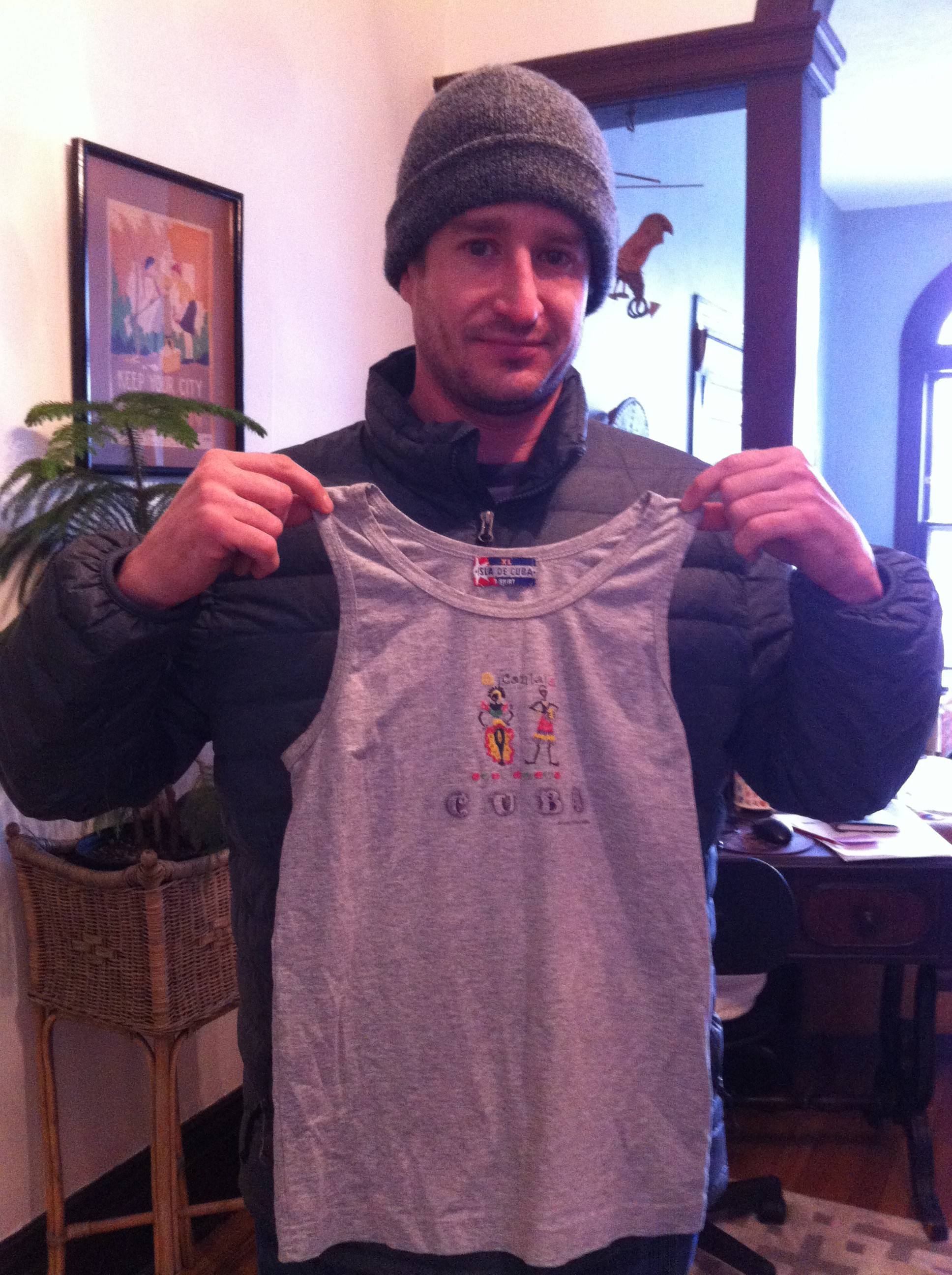
When we checked out the next day, the guy at the desk offered T-shirts for sale, as modeled here by Vince. It’s an extra large. Right—for a Cuban, maybe.

Cuba Tshirt

I hope this series has been food for thought as Americans consider electing Bernie Sanders, a Democratic Socialist, for President.