Signs and Mysteries

3am.  Lynn was snoring lightly.  I crammed in some earplugs and eventually got back to sleep, my mind awhirl with thoughts about my next move.

7am.  Lynn was calling, “Anne, wake up, your alarm is going.”

“Aww, I’m sorry!” I said as I rolled out of bed for a scheduled call with my family. I made a mental note to change my alarm from harp music to something easier to hear with earplugs.

The family was gathered for a birthday, and they passed Vince’s phone around.  I got to see an extreme close-up of my mom’s nose and then of her husband’s ear.  They don’t quite get how it works.  Some day that will be me.

A couple hours later Lynn and I were in a covered mall in Naramachi, the neighborhood near our hotel.  On our first day, we hadn’t found the “atmospheric” sections but after wandering farther we got why the guides promoted it.  Like most places except Disneyland, it is a patchwork of old and new.

Most everything was closed.  We tried to decipher the directory.
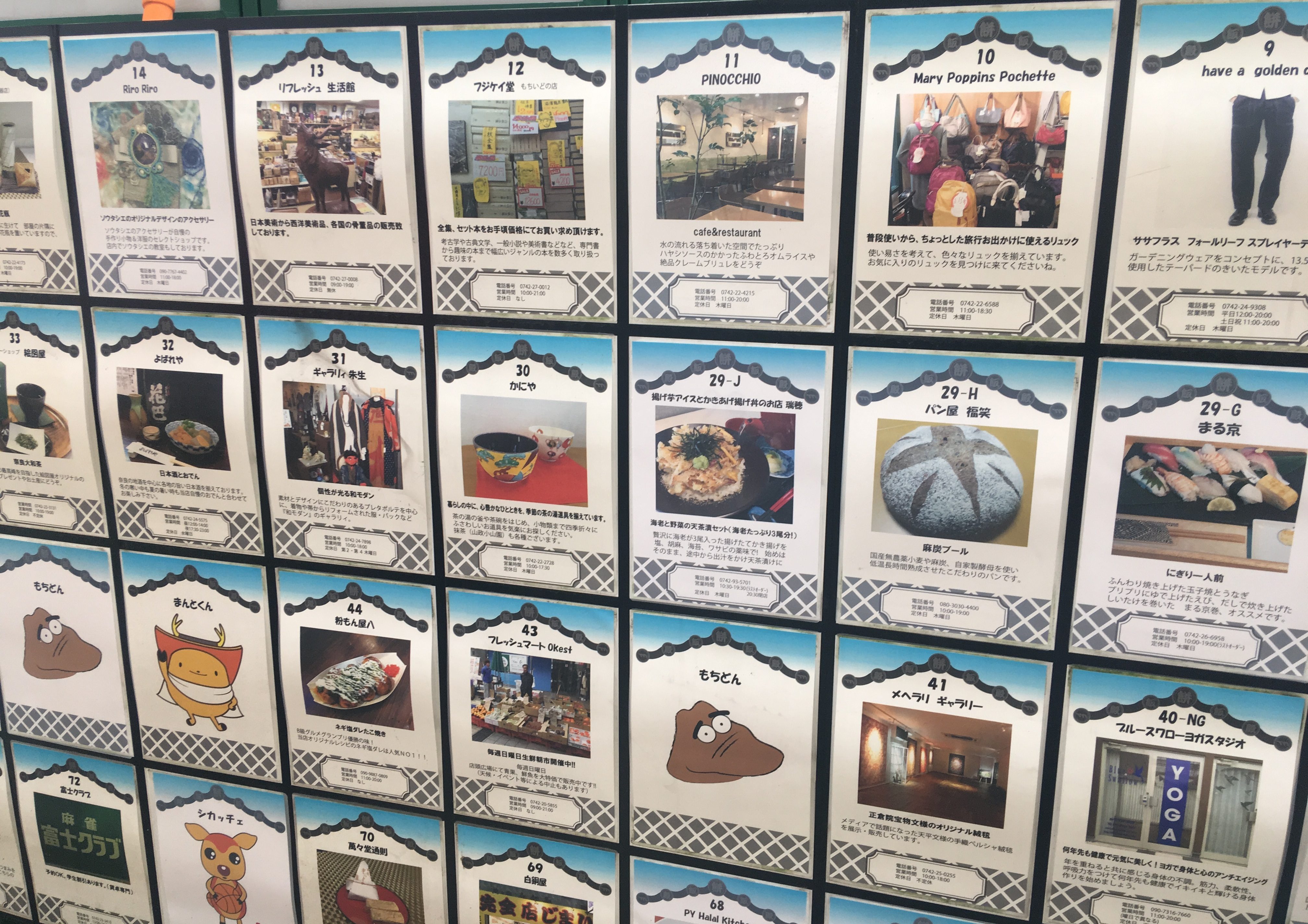
“I hope they don’t really sell owls,” Lynn the animal lover said.
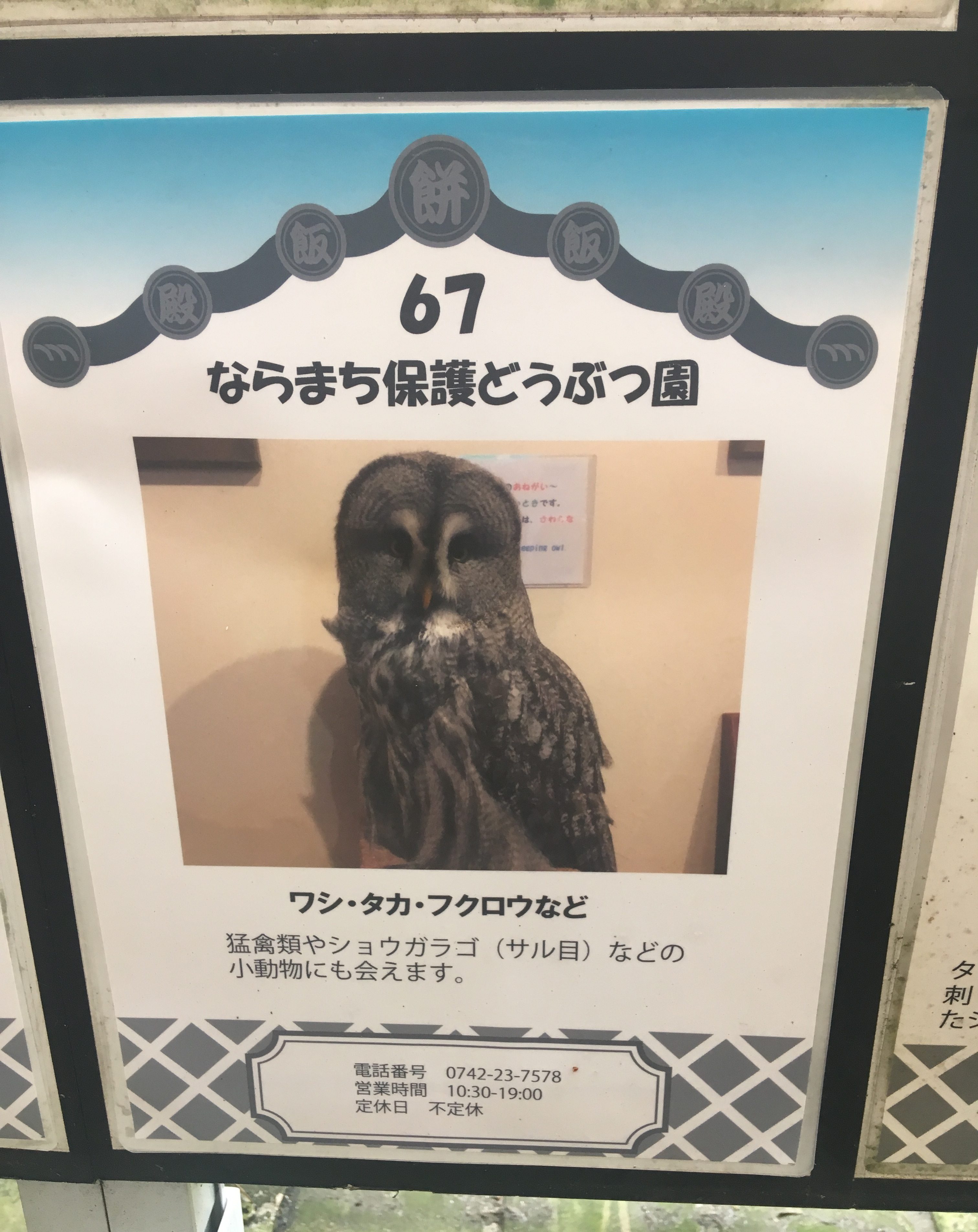
“Tofu n’ donuts,” I read.  “‘The tofu donuts incident’? What the…”
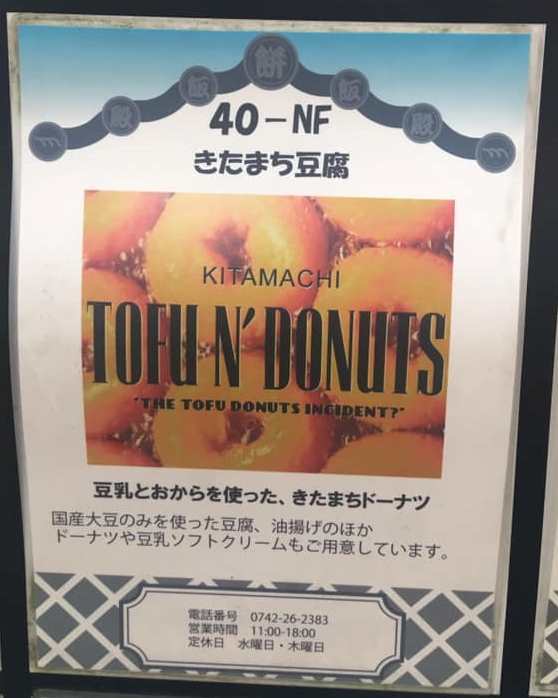
“Maybe it means the tofu donuts experience?” Lynn posited, “or maybe it’s a reference to the war of the tofu and donuts, much like they refer to World War II as the ‘unfortunate period.’”

“That’s pants!” I riffed, using the British slang word for something that’s all wrong.  “And what do pants have to do with having a golden day?”
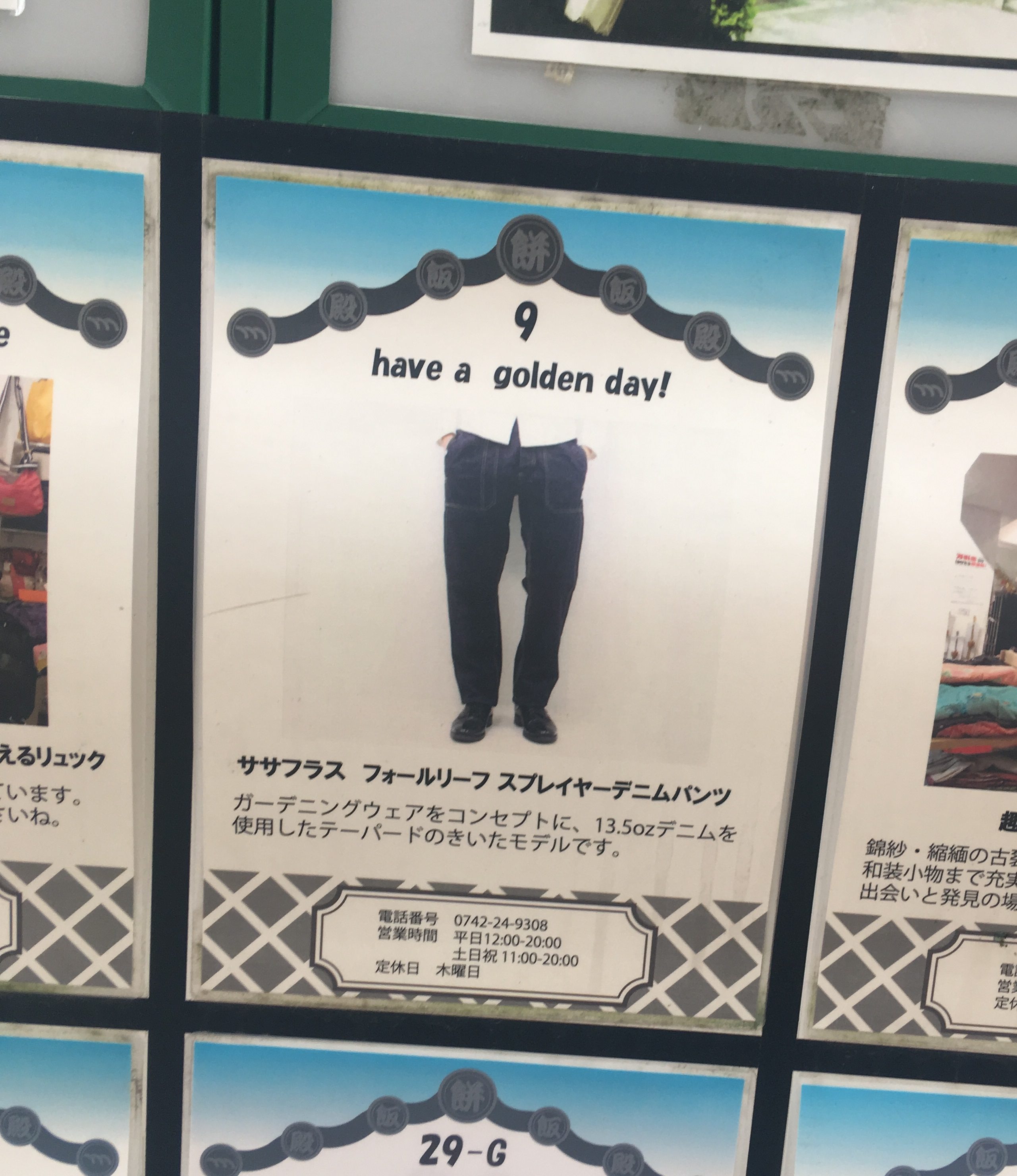
“It doesn’t bear thinking about!” Lynn shuddered as she walked away.

The only place open was a grocery, so we had a gander and I bought seaweed and bonito and a giant sushi takeaway for breakfast.  We sat in an area with picnic tables while I ate.  “Sushi for breakfast would be a fish too far,” Lynn said.  “Give me kippers or nothing.”

There were three coffee shops on the periphery of the seating area, but none were open and no signs indicated opening hours.

After I ate my sushi like a starving shark, we walked until we found a restaurant that was open.

“The selection doesn’t look very appetizing,” I commented.
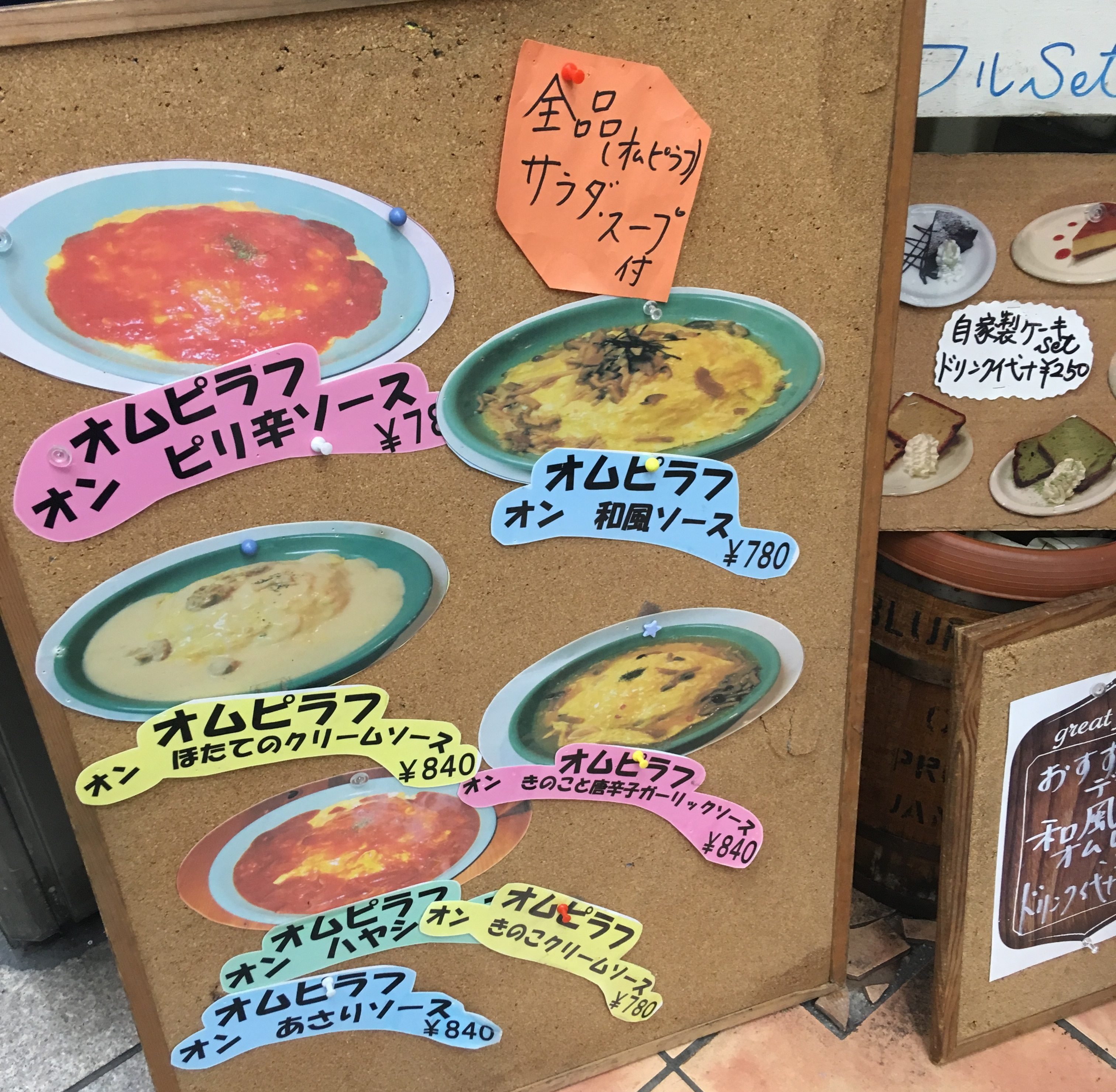
“But it’s open,” Lynn said.  “How bad could it be?

The place was run by a husband and wife team; he was the cook and server and she worked the register, which was festooned with tree branches decorated with tiny colorful ribbons and flags.  There was only one other customer; he was smoking and reading a newspaper.

The proprietor handed us menus, saying, “No English,” apologetically.  “No worries,” Lynn replied, giving him a big smile.

The pictures were the same as on the sign board outside.  “So do you want red, tan, or white food this morning?” I asked her.  The proprietor returned and Lynn pointed to sandwiches, then coffee.  I only wanted coffee, which caused confusion.  There was much holding up of fingers and nodding and smiling and pointing.  Five minutes later he brought two huge plates of sandwiches and two bitter coffees and a tiny pitcher of gooey sugary white stuff.

The sandwiches were like the ones we’d been served on our first day at the Nara Hotel—they seemed to manifest the Japanese idea of what westerners liked—soft, white bread with the thinnest slices of cucumber and ham slathered with mayonnaise, crusts removed and cut into triangles.

I transferred half of mine onto Lynn’s plate when she was done so they would think we both ate half our food.

Outside, the mall was now bustling.  I found a knife shop where I bought what I hoped would be a good knife for Vince.  We stopped and ogled a bun-making operation which used something like the machine below.

I almost took a photo, then thought, “They’re not in the business of providing photo opps; they’re out to sell buns!”  So I bought a half dozen green buns filled with bean paste and ate one, then ate them all.

“Where to start?” Lynn mused as we consulted the area map. “The calligraphy museum, the toy museum, the period houses, or the mosquito net museum?”
Crusty and Wiped

The restaurant that my guidebook had recommended for lunch specialized in kamameshi, a local fare.  The place was packed and there were a dozen people crammed into the entry way waiting for a table.  A server thrust menus at us and ordered, “You pick food before you get table!”

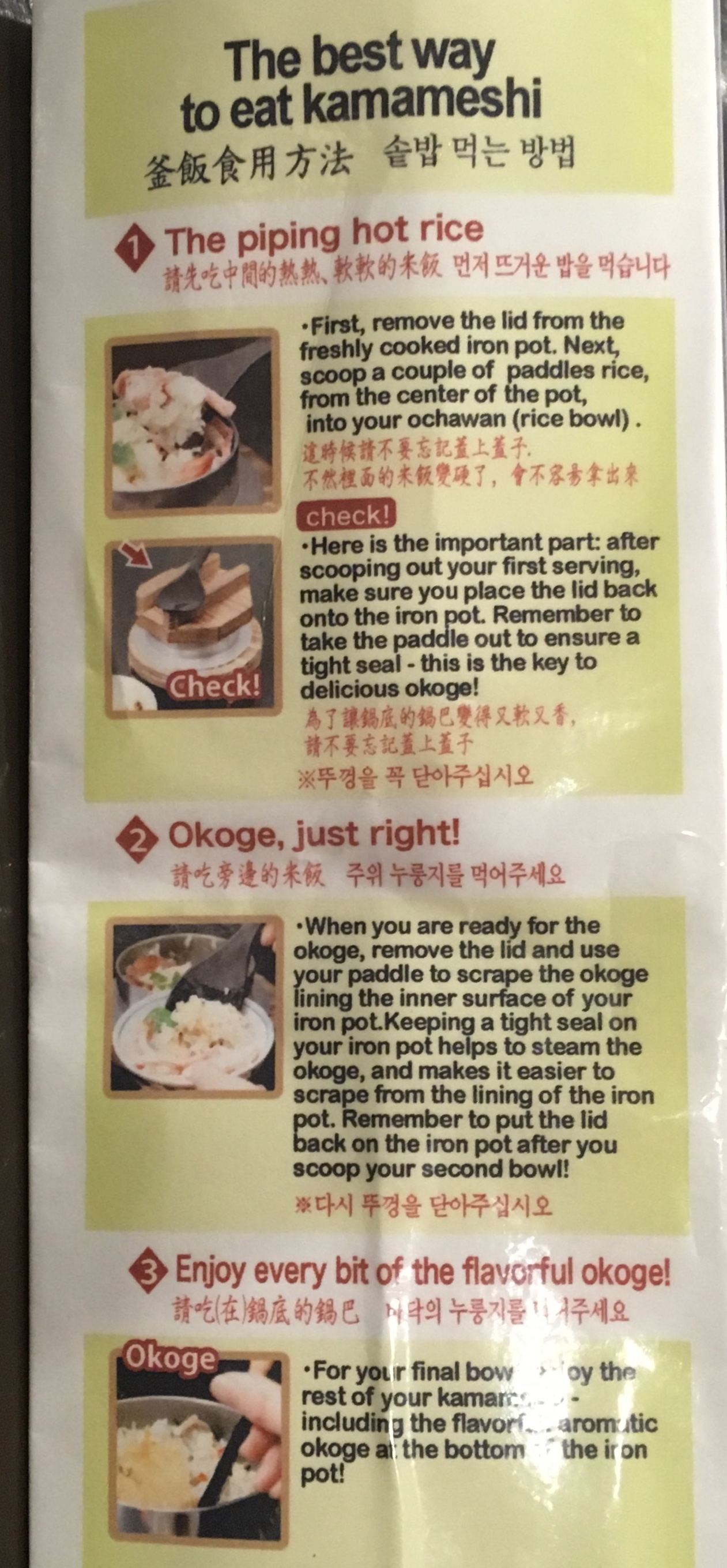
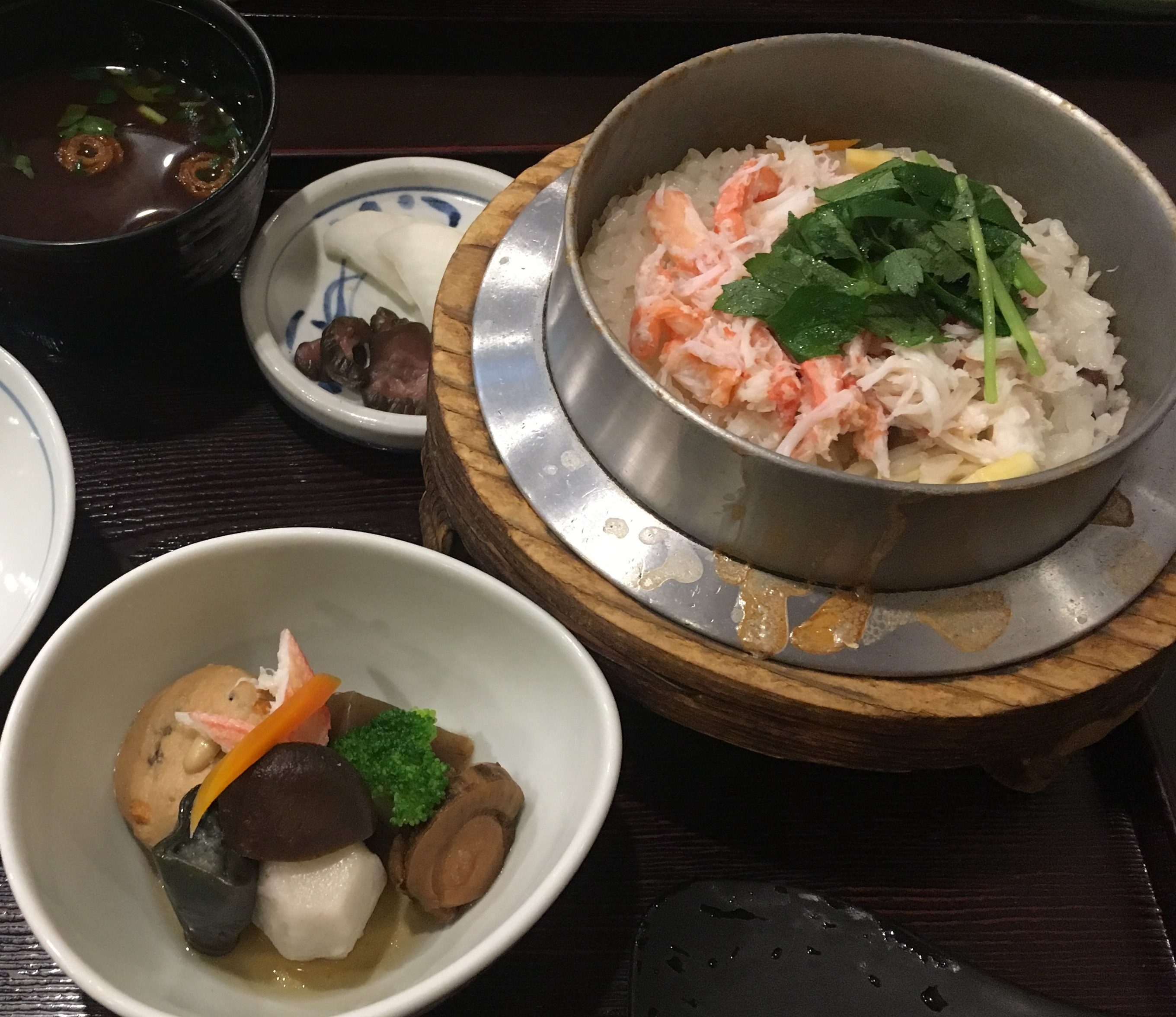
The menu was simple; I ordered crab and Lynn ordered shrimp kamameshi.  What is kamameshi, you ask?  We too wondered as we read the eating instructions.

“It’s very complicated,” Lynn said.

“This is the important part,” I read, “after scooping out your first serving, make sure you place the lid back onto the iron pot. Remember to take the paddle out to ensure a tight seal—this is the key to delicious okoge!”

“What’s okoge?”

“I guess we’re going to find out.”

“There are certainly lots of exclamation marks,” Lynn counted, “I hope it lives up to the exciting taste experience implied herein.”

To be honest it was just okay.  Okoge turned out to be rice that is crusted onto the side of the pot.

A boy of around seven was sitting with his family at another table, playing a game on some device.  The device was not on silent and a constant refrain of “bloop, bloop, BLOOPITY BLING bing bing bing” filled the restaurant.  I won’t say what nationality the family was.  Everyone in the place, including the servers, were staring daggers at them but they were oblivious.

After lunch we found Isuin Garden, one of two “famous” gardens Lynn had bookmarked to visit in Nara.  At the entryway, a man in a pink hat bowed and introduced himself as a volunteer tour guide, then set off at a brisk pace.  Lynn and I barely had time to exchange glances that said, “Please, no!” before we were forced to march after him.

Now, when I speak Spanish it is at a very slow pace because I know my Spanish isn’t great.  Our guide, whose English was just okay, didn’t let that slow him down.  He spoke a blue streak while pointing and waving and telling jokes—we thought they were jokes because he laughed, so we laughed too—it would have felt rude not to.  He was delightful, and we got a bonus aerobic workout racing up and down hills and over bridges and across stepping stones.

After about 20 minutes he rather abruptly bowed and raced off, leaving us at the far end of the garden, presumably to return to the entry and collect another group of unsuspecting tourists.  Lynn and I wandered, off leash.

I was mesmerized by this 100-year-old glass in the tea house.  The photo doesn’t do it justice, but it was slightly wavy.  How wonderful that it has survived time, earthquakes, and war.

This lady seemed happy to have me include her in my photo, to give a sense of scale.  Exquisite, isn’t it?

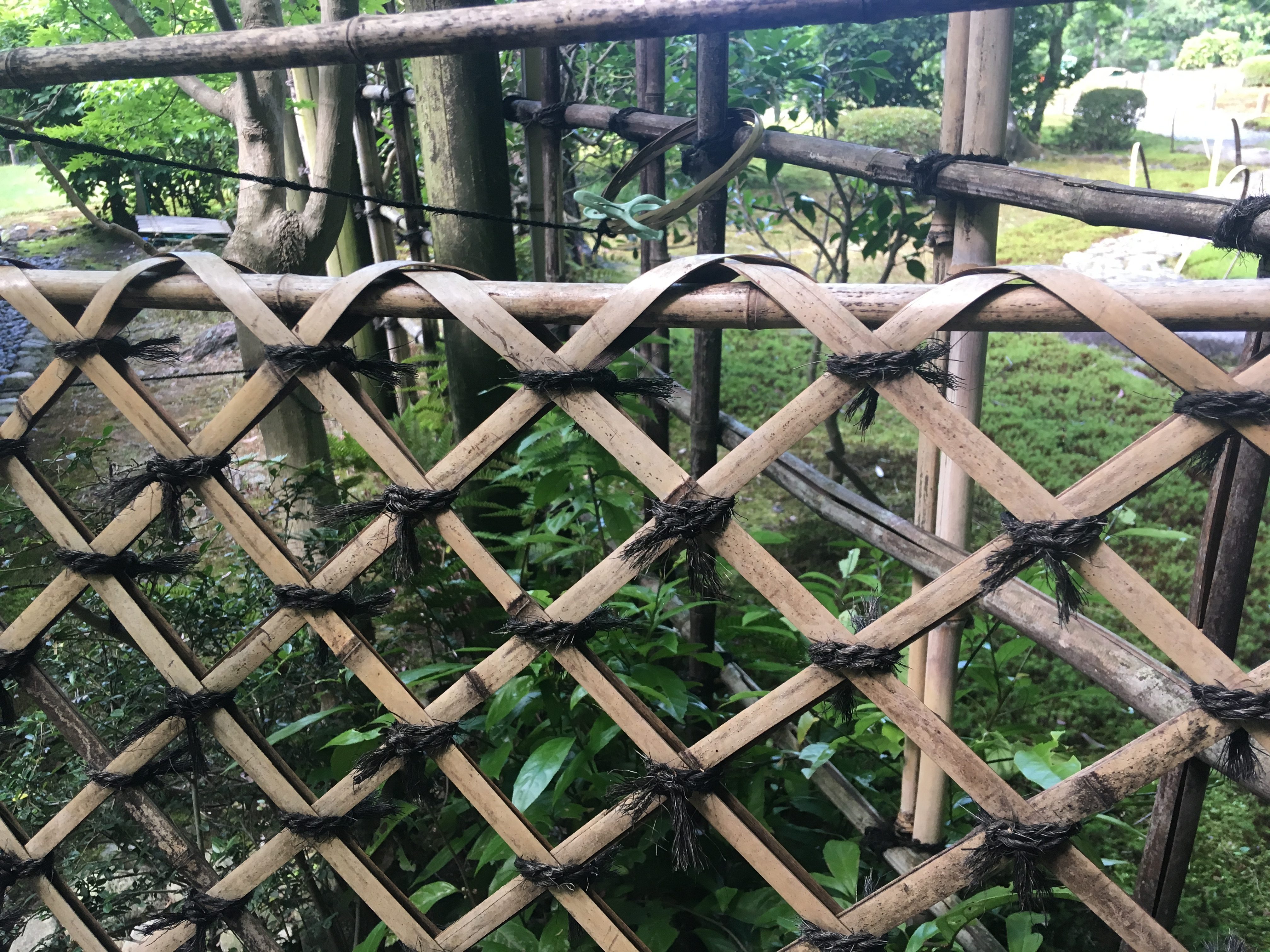
Lynn picked up more bamboo tricks she can try in her Scottish garden.

We consulted our maps and decided to walk to the art museum.  The heat was stultifying so it was slow progress.  We passed Nara City Hall, which we thought looked vaguely like a samurai helmet.

There was a gigantic gift shop next to city hall.  The art museum was closed, so we returned to the gift shop, where Lynn found saki for Richard.  I bought some rice crackers and stood outside feeling the sweat roll down my back while I noshed.  It was only about 3pm, but I had hit a wall.

Some travel days are like that.  You just can’t force yourself to do one more thing.

“Would you be okay with going back to the hotel to veg?” I asked Lynn.

“We did hike a mountain this morning,” she reminded me.

I bought a beer in the vending machine outside our room and drank it while reading, scrolling through social media, and watching news of the G20 Summit.  True to form, Trump was insulting the Japanese—his hosts and our ally.

Later, we ventured back up to the rooftop lounge.

“You came back!” our server from the previous night exclaimed.

“I’m not sure if he was pleased to see us, or shocked,” Lynn said after he seated us at “our” table.

Walking Wakakusa

A newspaper was deposited outside our hotel room door each morning.  All the news was about the G20 Summit taking place in Osaka just as I would be transiting through on my way to Koyasan.

“You might want to ask if there will be train disruptions,” Lynn suggested.  “Security will be massive since Trump will be there.”

I hadn’t heard that name for a couple weeks and now we would be in the same city, if briefly. Why couldn’t he stay in Washington and eat hamburgers?

At the station, the JR information people had no idea what the G20 Summit was, much less whether it would affect my itinerary.

“Well I tried,” I shrugged as we walked on to find breakfast.

“Oh, oh, let’s try here!” I enthused as we passed a vending machine restaurant.  “It’s on my list of quirky Japanese things to try.”

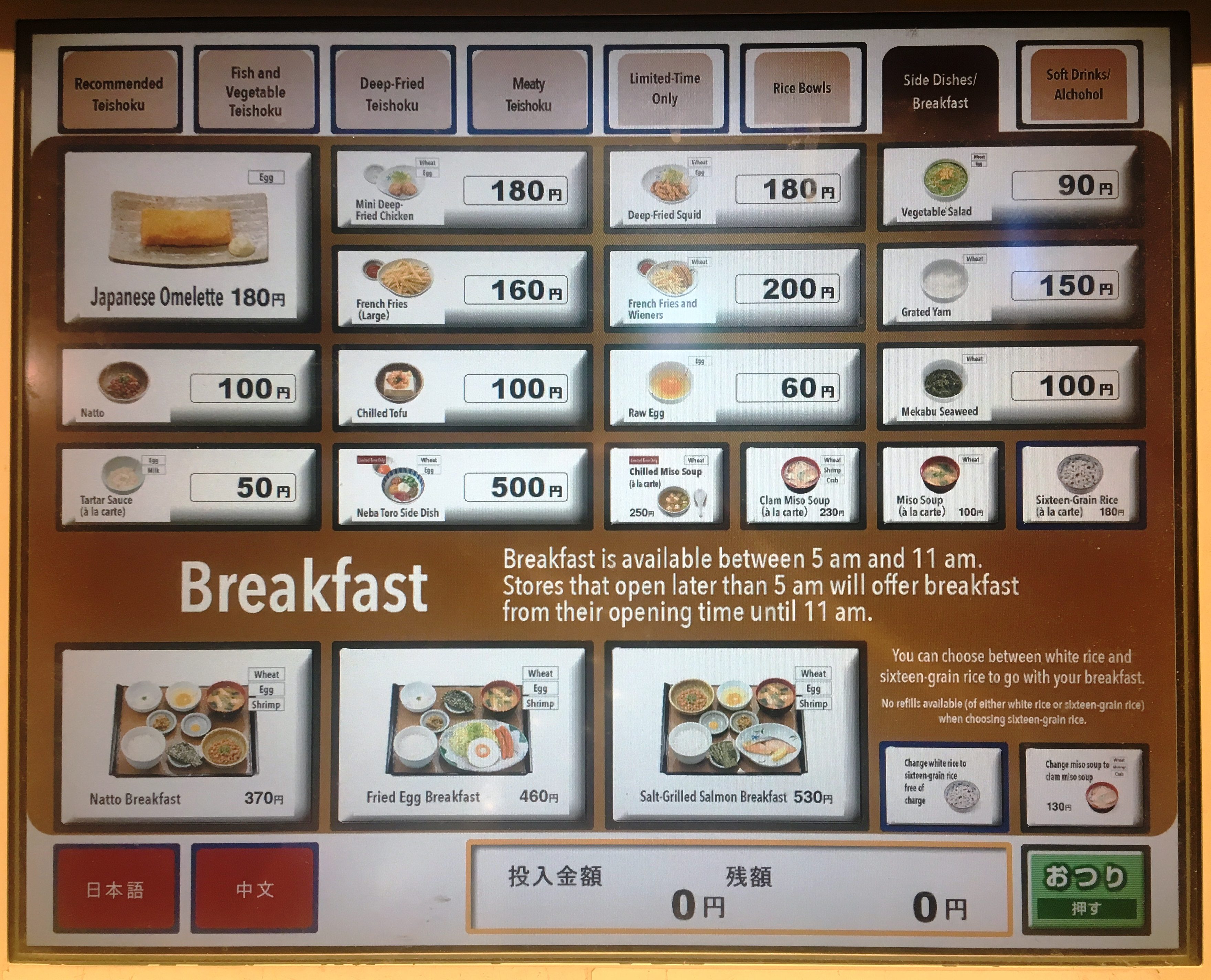
Vending machine restaurants are restaurants with vending machines at the entrance.  You pick out your meal and pay for it, get a ticket, then are seated at a table to await your order.  The idea is to streamline the order process, I guess.  They eliminate jobs for real people in the restaurant but must create jobs for coders in Tokyo.

There were three machines.  Lynn and I stood before them in some consternation, pressing buttons, feeding in coins, and collecting meal tickets while one after another, Japanese customers came and went at the third machine.

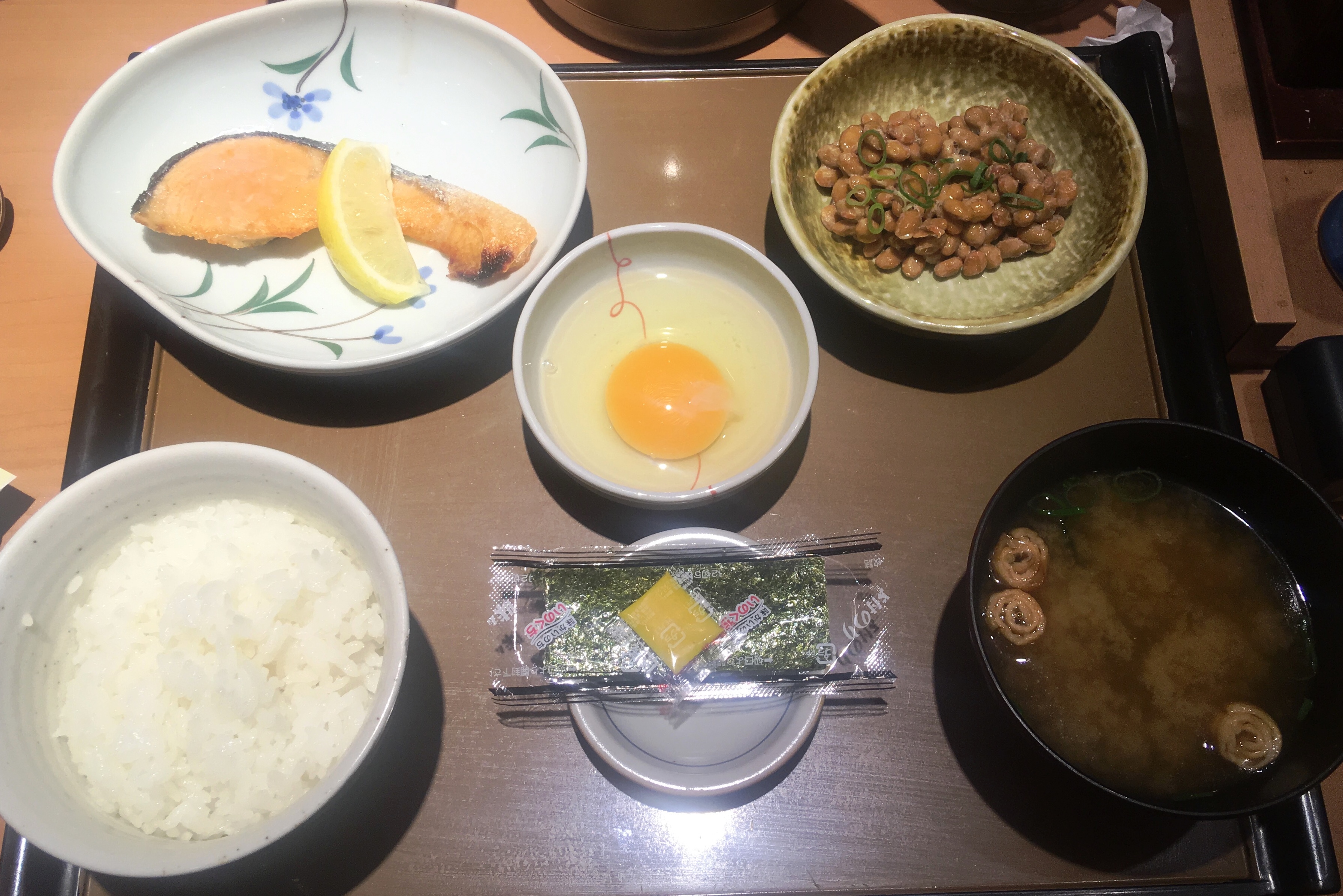
“I just want the standard Japanese brekky with smoked salmon, miso, and that rice and nori thing,” I said.  “There’s a picture of it but 530 yen?  That seems too cheap.”

“I just ordered five breakfasts … or none,” Lynn said.  “I really do not want a raw egg!”

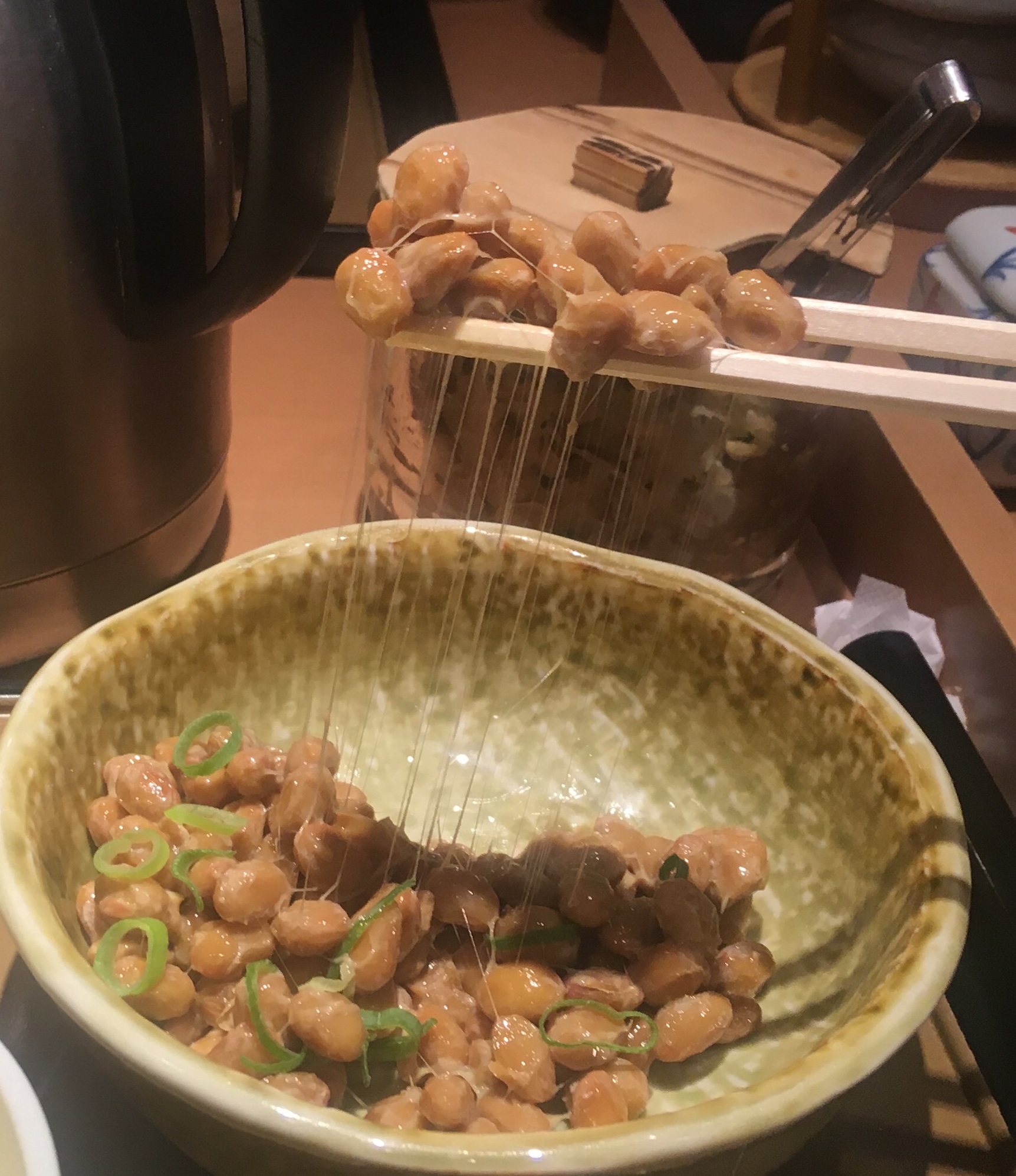
So we each received a raw egg and slimy beans.

I took a close up so you can see the strings of slime in case you’ve never seen slimy bean strings.

Lynn flagged down the server, whose job was to deliver trays from the kitchen and collect tickets.

“Excuse me,” she said as she held up the plate with her raw egg, “could I have this cooked?”

No,” he said, and walked away.

“Well that was clear,” Lynn said.

Slimy beans are very nutritious, so I mixed mine with rice and miso, doused it all with soy sauce, and cleaned my plate.

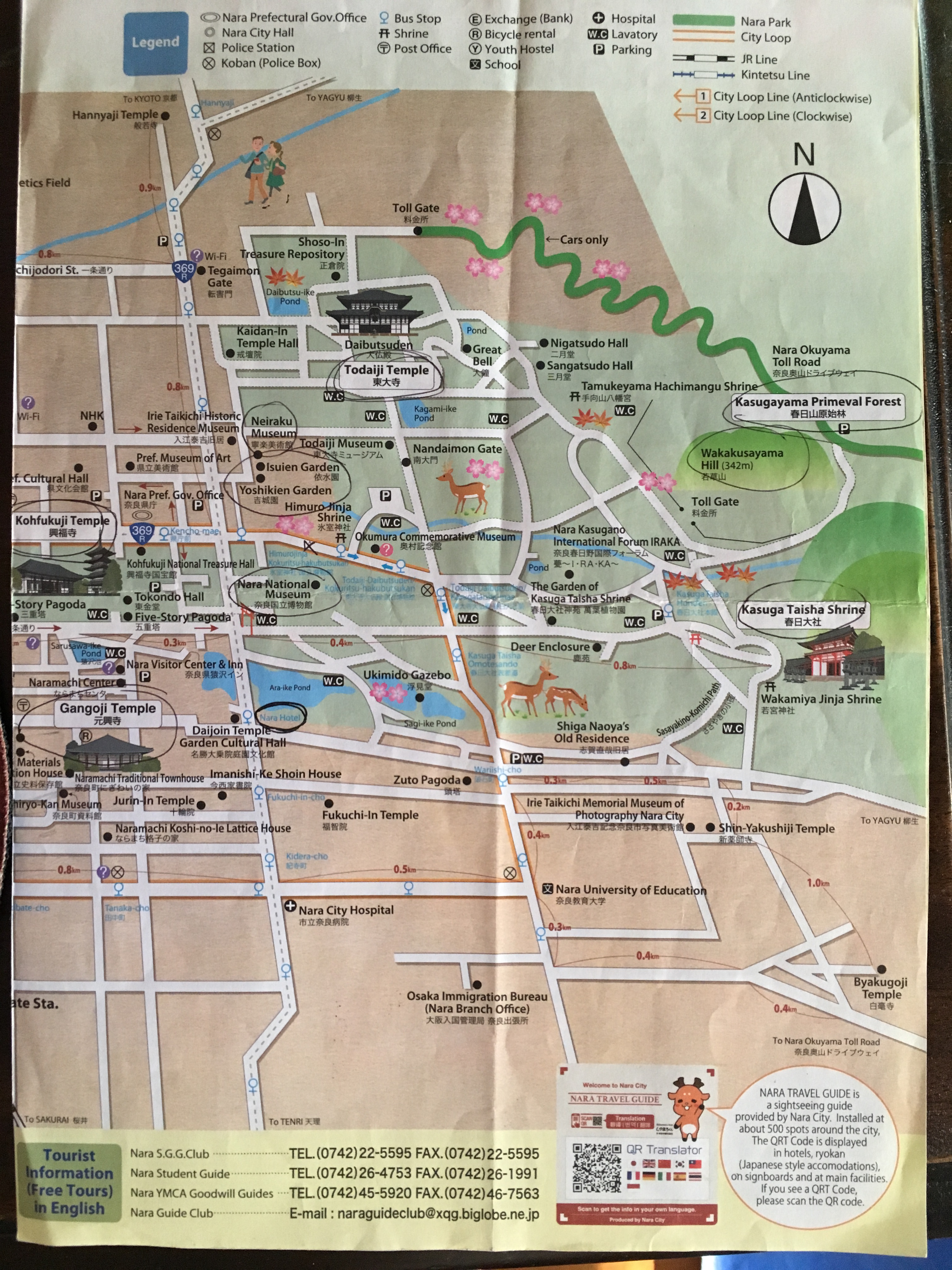
Today we would need a good breakfast because we were hiking Mount Wakakusa.  “I really want to see the Kasu … gaya…ga…yama Primeval Forest.  Let’s hope we can just point to the name on the map and won’t have to pronounce it,” I said as we headed into the Information Office.  The green squiggly line on the map indicates the road to the top of the mountain, and no pedestrians are allowed on it.

It was recommended to us that we take a taxi to the top then walk down “the back way.”  This felt wimpy to me but once we were in the taxi it became clear we could never have walked up.  The narrow road really did squiggle, and at a very steep incline.  It would have taken hours to walk.

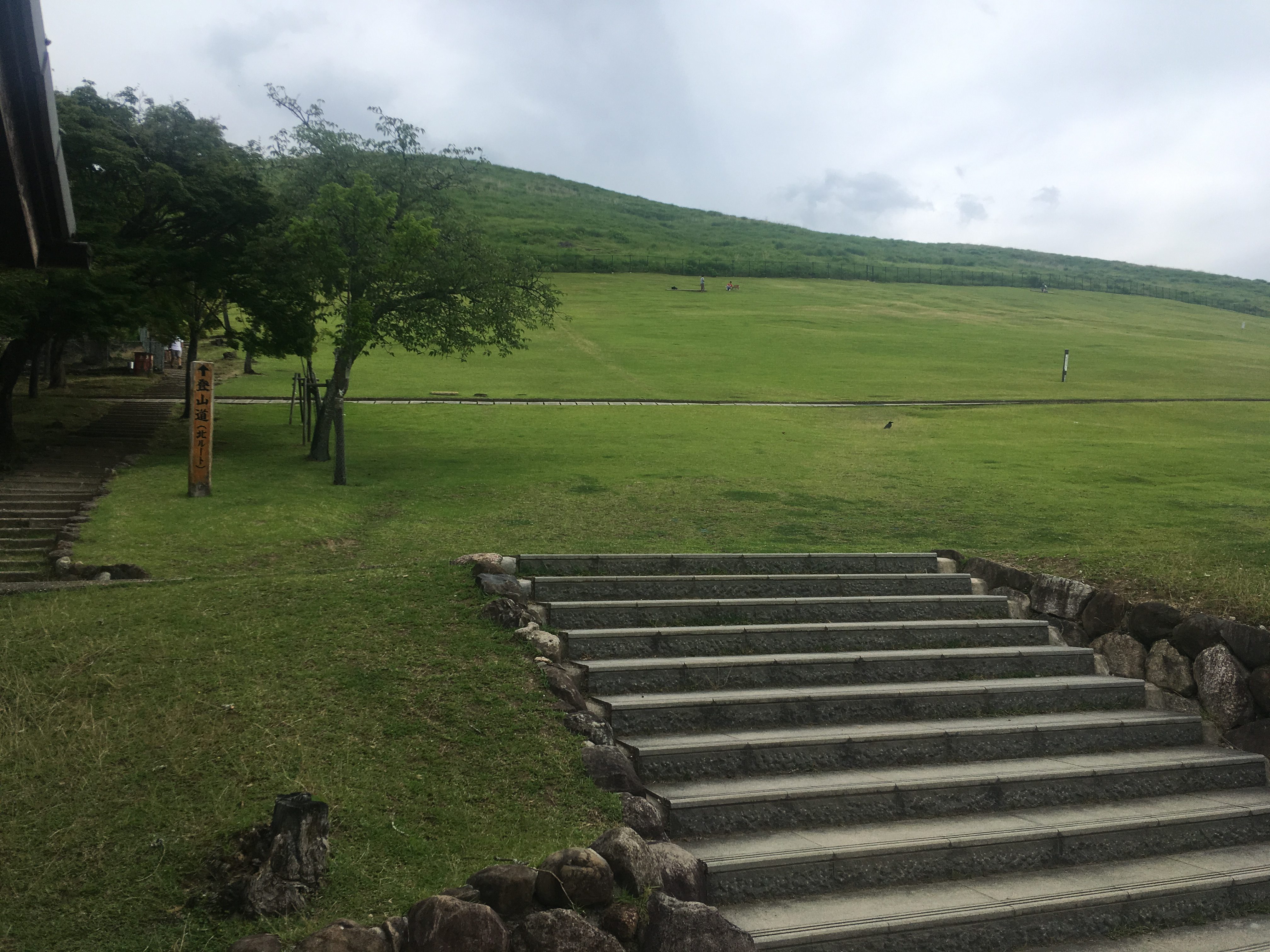
We enjoyed the views of the city and surrounding countryside from the mountaintop, then proceeded to walk down.

Thousands of uneven stone steps were interspersed with grassy slopes.  There was a kiosk, literally in the middle of nowhere, from which a man sold hiking passes.

“Once again, I will just say that I’m glad to be doing this while my knees are still good,” I tossed back to Lynn.

At the bottom there was a small kiosk staffed by a friendly woman who sold passes to hikers going up the way we’d come down.

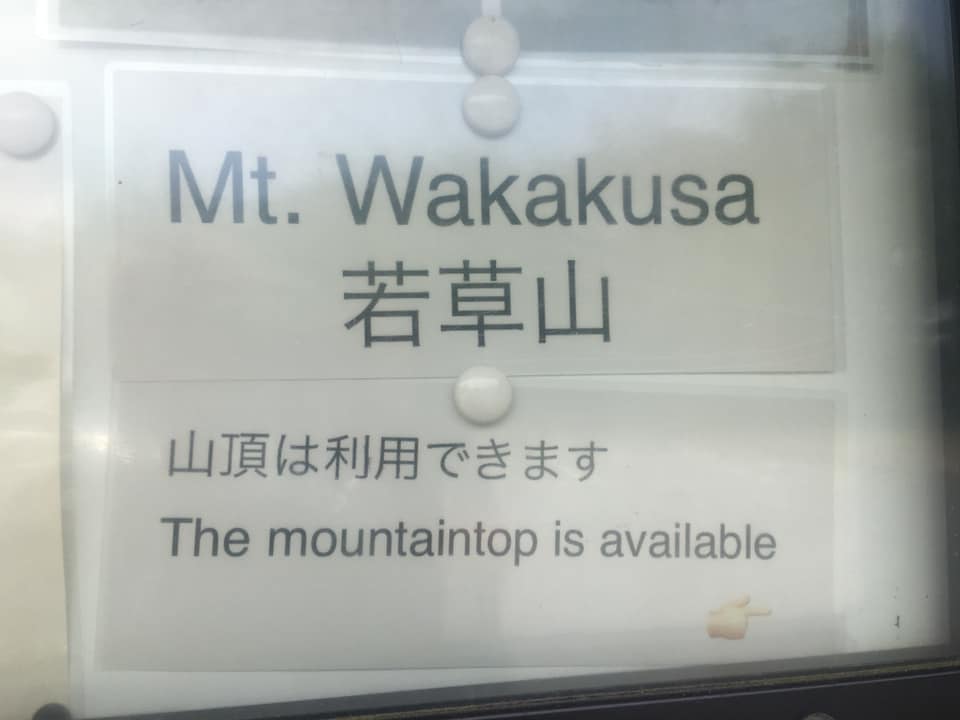
I wondered at this sign.

What would it take for the mountaintop to not be available?

“Thank you for resisting the urge to roll down the slope,” Lynn said as she pointed to the list of don’ts.

We asked directions to Kauga Taisha Shrine which was supposedly nearby, but never found it.

It was lunchtime anyway.  We found the one restaurant I had on my list, and a good thing, too, because it was closing the next day for a year of renovation.

Forty for Ninety

“According to this,” I read to Lynn from my newly-purchased copy of “Etiquette Guide to Japan,” my captive audience on the bed across the way, “Japanese are so accustomed to a specific Japanese way of doing things that they developed an extreme sensitivity to any deviation from the norm.

“Unexpected or nonstandard behavior not only disrupted the cultural imperative of harmony, it was extremely stressful and could be dangerous to the individuals concerned.

“Get a load of this—when Japanese businessmen first started coming to the west in the 50s and 60s, they found our ‘casual, chaotic’ behavior so shocking that some of them had to be whack-evac’d!”  That’s a term used in the NGO world, along with medivac and alc-a-vac.

“It could have been the large helpings of meat that westerners served them at every meal, too, it says here.  Japanese weren’t used to it.”

“And—this explains a lot!—Japanese behavior is so predictable that they almost have telepathy among themselves.”  I turned to Lynn to make sure she was listening.  “The Japanese … point to this ‘telepathy’ as one of the cultural characteristics that made their culture superior.”

“Interesting,” Lynn said. “What about dinner?  It’s getting on for six o’clock.”

“Want to take a cab somewhere?”

“But where?

“I’ve got the name of a restaurant written down somewhere, but I think it’s only open for lunch.  We could walk across the street to the convenience store and buy instant noodles.”

Lynn gave me a look that said “I am not an instant-noodles-in-the-room kind of person.”

“Let’s investigate the rooftop lounge with the $40 beers,” she suggested.  “That can’t be right.”

And it wasn’t.  But first, we stood looking at the board, working up courage to mount the stairs to the lounge.  What if a beer really did cost $40?  Should we ask first, prepared to walk out?  Would they feel complained against and maybe commit suicide?

To be clear, I don’t think suicide is a joking matter.  My own dad died of suicide (probably).  But I was quite certain no one was really going to commit suicide because tourists declined to pay $40 for a beer.

At the top of the stairs, the maître d’ handed us a menu on which was written in English, “All You Can Drink in 90 Minutes Set Meal, Y40000.”  Lynn and I exchanged excited glances.  It wasn’t a beer for $40, it was all you could drink and a meal for $40.

“Yes, this will do,” Lynn told the maître d’. We were led out onto a lawn with panoramic views of the city.  A few other tables were filled with Japanese.  Glasses of wine arrived with large plates of what I can only describe as Japanese tapas.  Piano music wafted from inside the lounge with great old hits like “As Time Goes By,” and “What a Wonderful World.”

The waiter returned after a few minutes and asked if we wanted anything else.

“More wine?” I held up my empty glass.  He looked a bit taken aback, but brought refills.

“They didn’t see us coming,” Lynn said.  We ate, drank, and watched the pinks and oranges of the sky turn into purple, blue, and black as we had one of our long discussions.  We talked about Richard’s mum, who had died recently, aged 99.  That led to talk about my mother and Lynn’s relations who are in their “twilight years.”

“It’s so depressing,” I commented.  “I need another glass of wine.”  This time the waiter looked amused as he refilled our glasses.

“I think he’s resigned himself to us, as westerners, being able to drink up the stock,” Lynn said.  “They’re probably placing bets in the kitchen on how many glasses we’ll drink.”

Lynn told a story about conducting a workshop at an employee retreat in Poland when she worked for Nokia; let’s just say it involved a different workplace drinking norm than in the UK or US.

All the other guests had left and our 90 minutes was up.”

Back in the room I read that we should have held our glasses with both hands as they were refilled.  “We missed our chance to demonstrate our exceptionally good manners and character.

“We’ve got two more nights to prove we’re not barbarians.”

Great Shakes n Buddha

The Okumura Commemorative Museum is sponsored by the Okumura Company, which makes earthquake protection systems for buildings.  This was the first of half a dozen tiny specialty museums we visited in Nara, which were one of the reasons I loved the city.

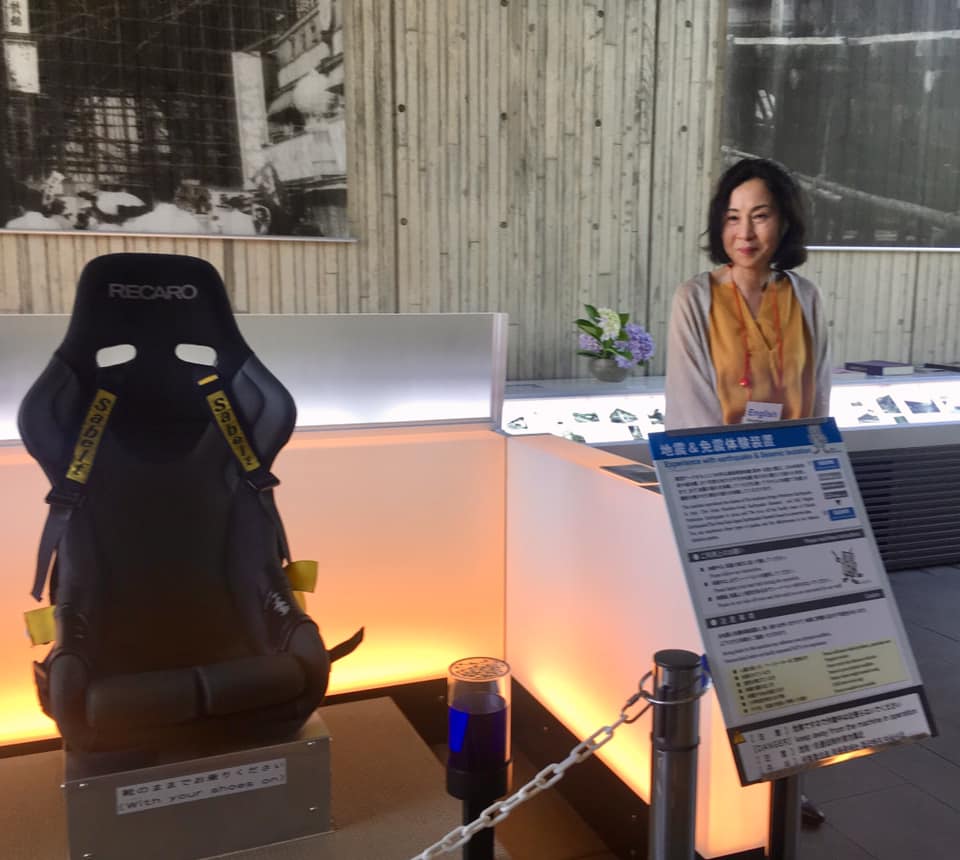
After being strapped into the simulator, the man below held up the card to the right and explained that I was about to experience the great such-and-such earthquake of 18–.  The chair shook violently sideways, slowed, shook again, etc.  He pointed to another location on the map and told me which one I would sample next.  This went on, with Lynn standing by giving me a devilish look.  She has done earthquakes—in particular aftershocks in the wake of the 2005 Boxing Day Tsunami in Indonesia, where she worked for Oxfam.

The simulator was fun, like a carnival ride.  We were all laughing.  But you could imagine, if you were in your home when the jolts started and your ceiling was collapsing, it wouldn’t be fun at all.

Next our guide demonstrated how Okumura systems protect high-rise buildings.  The building on the left swayed back and forth precipitously when he pushed the “Earthquake” button, while the one on the right barely moved.  My very imperfect understanding is that builders employ something like ball bearings at the base of new construction.  When an earthquake hits, these buildings roll with the movement instead of resisting it—like the old analogy of a willow and an oak in a storm—one bends and survives, one is rigid and topples over.

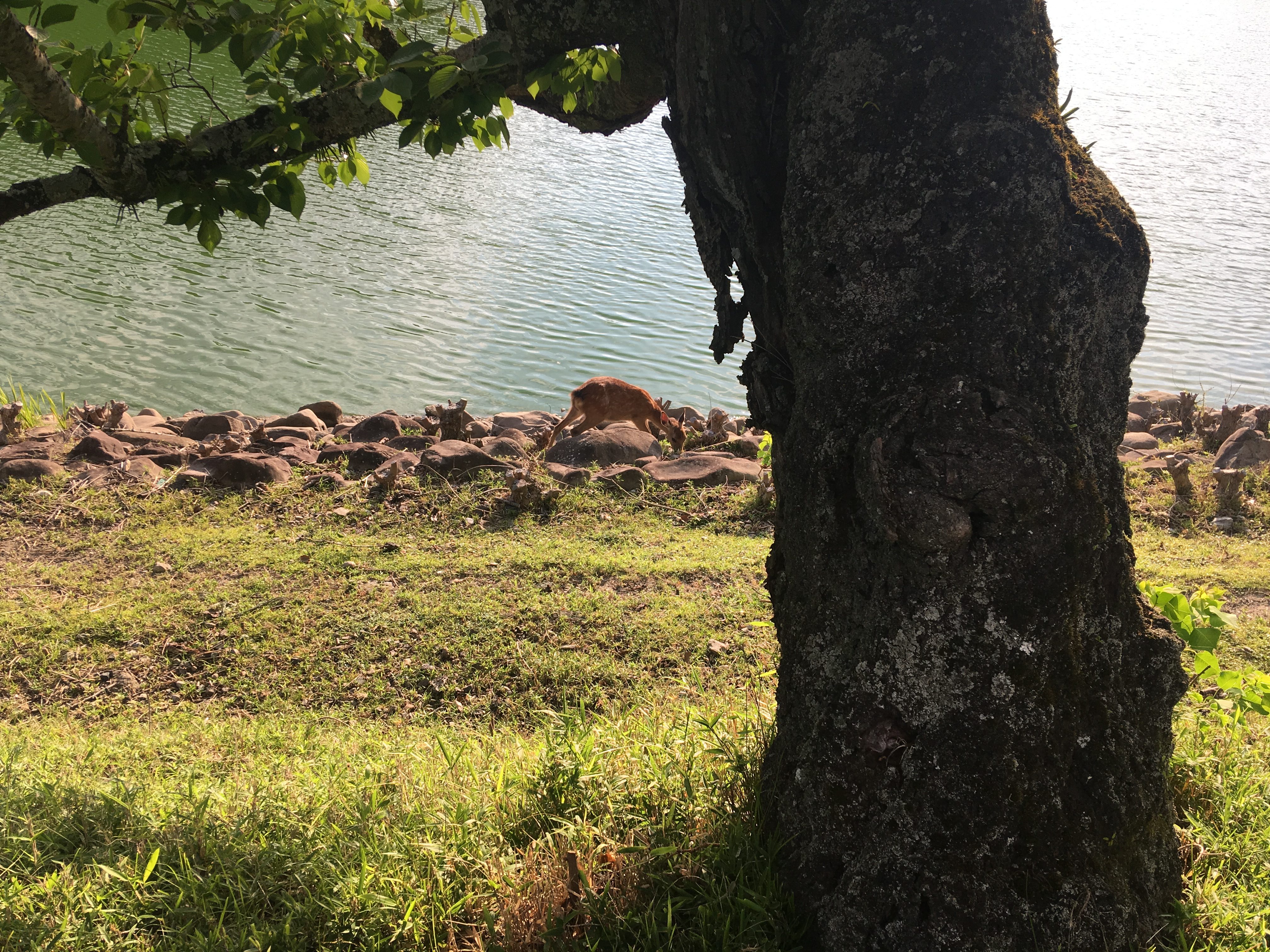
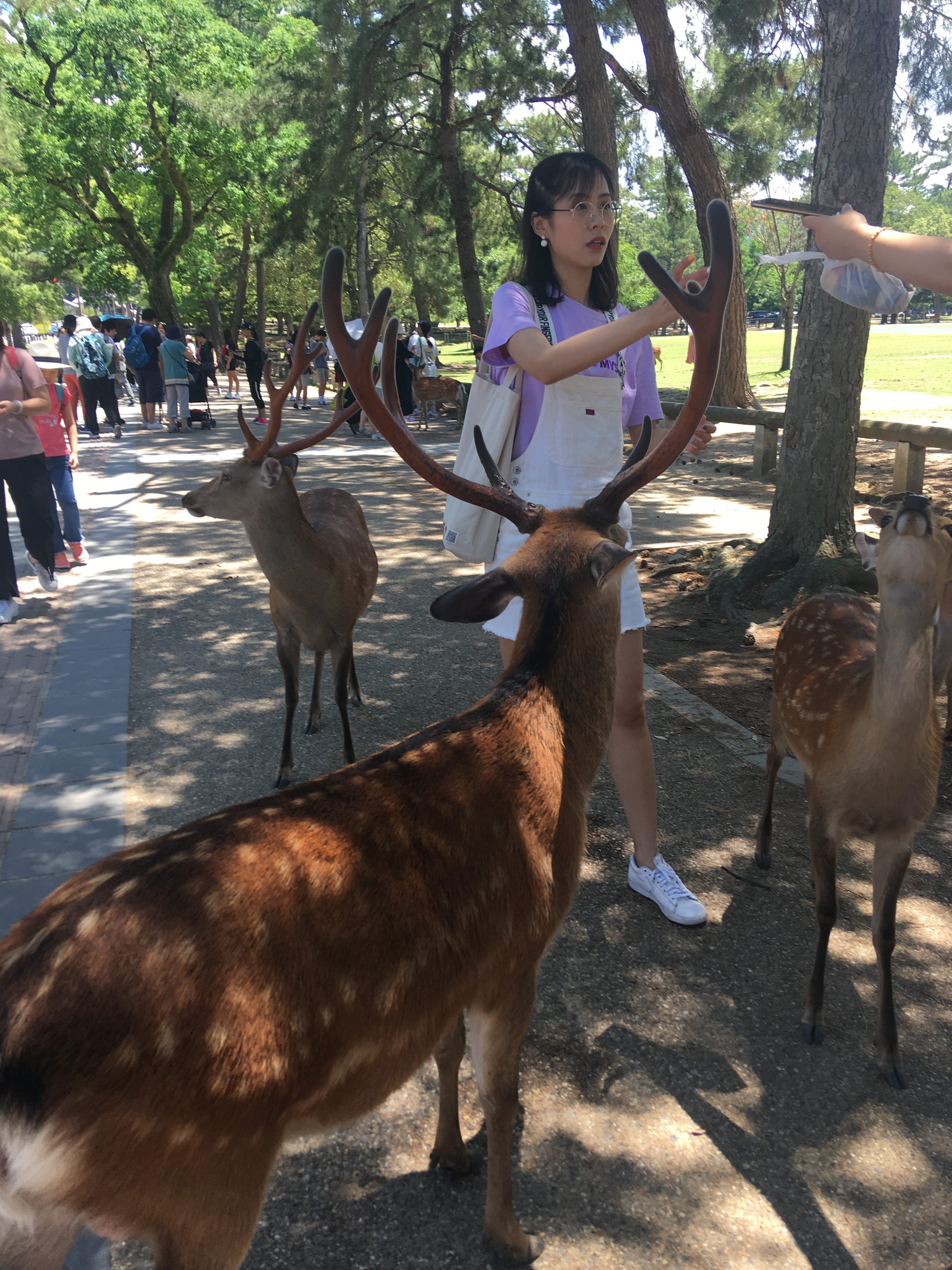
Nara is famous for deer.  On our first foray from the hotel, we passed a reservoir and I pointed to the water’s edge.  “Look! A deer!  I wonder if we’ll see any more—I’d better take a picture.”

As our vista opened up onto the main park we could see gangs of deer everywhere, like Canadian Geese in a Minnesota park.

Vendors sold what looked like large Catholic communion wafers for tourists to feed to the deer.  The deer were aggressive; jostling each other, lunging at the wafers, and giving an occasional nip to any tourist who didn’t fork over a wafer fast enough.

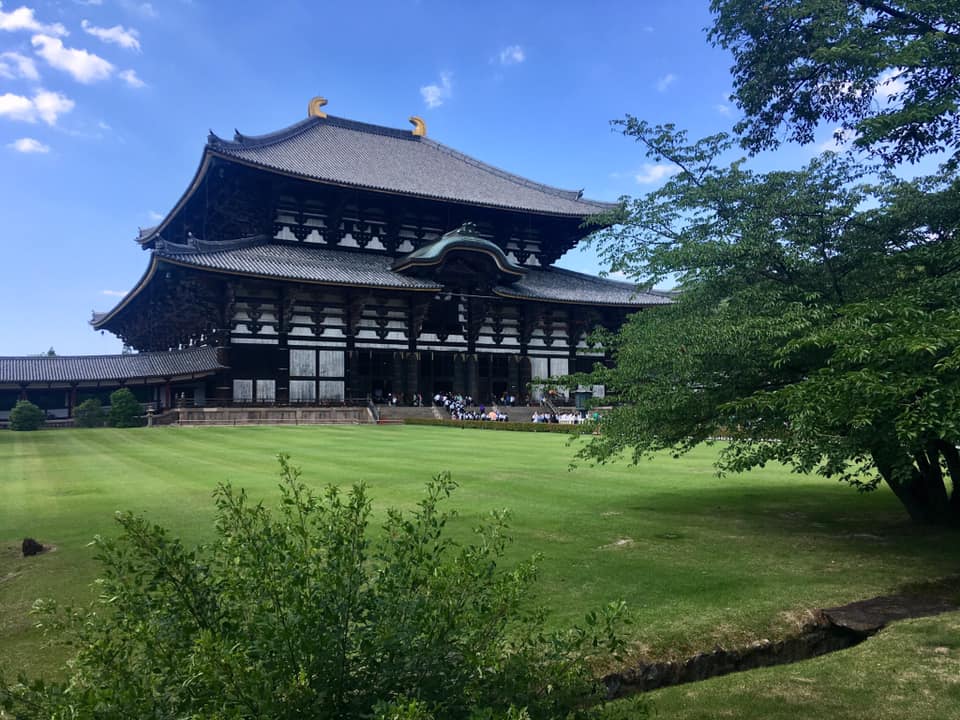
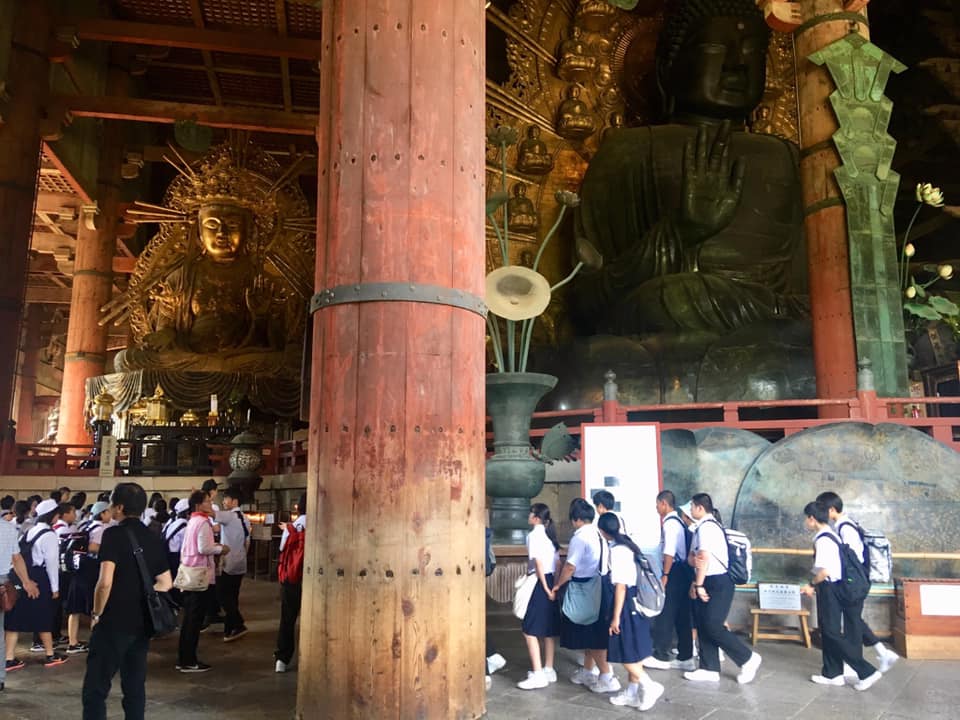
Time for the main event—Todaiji Temple.  “It’s the largest wooden building in the world,” Lynn read from her guide book.  Yes, she often carries guidebooks in her capacious handbag.  Selfishly, this is convenient for me; she lugs the weight around and is a handy reference.

Todaiji from a distance appeared to be computer generated, it was so immense.

We had been walking for almost an hour in the heat so we rested on a bench in the shade before tackling the interior, which was heaving with school groups.

“The great Buddha is 15 metres high,” Lynn read.  I tried to do the math in my head but just now Googled it.  That’s almost 50 feet high.

“Another popular attraction is a pillar with a hole in its base the same size as the Daibutsu’s nostril. It is said that those who can squeeze through this opening will be granted enlightenment in their next life.”

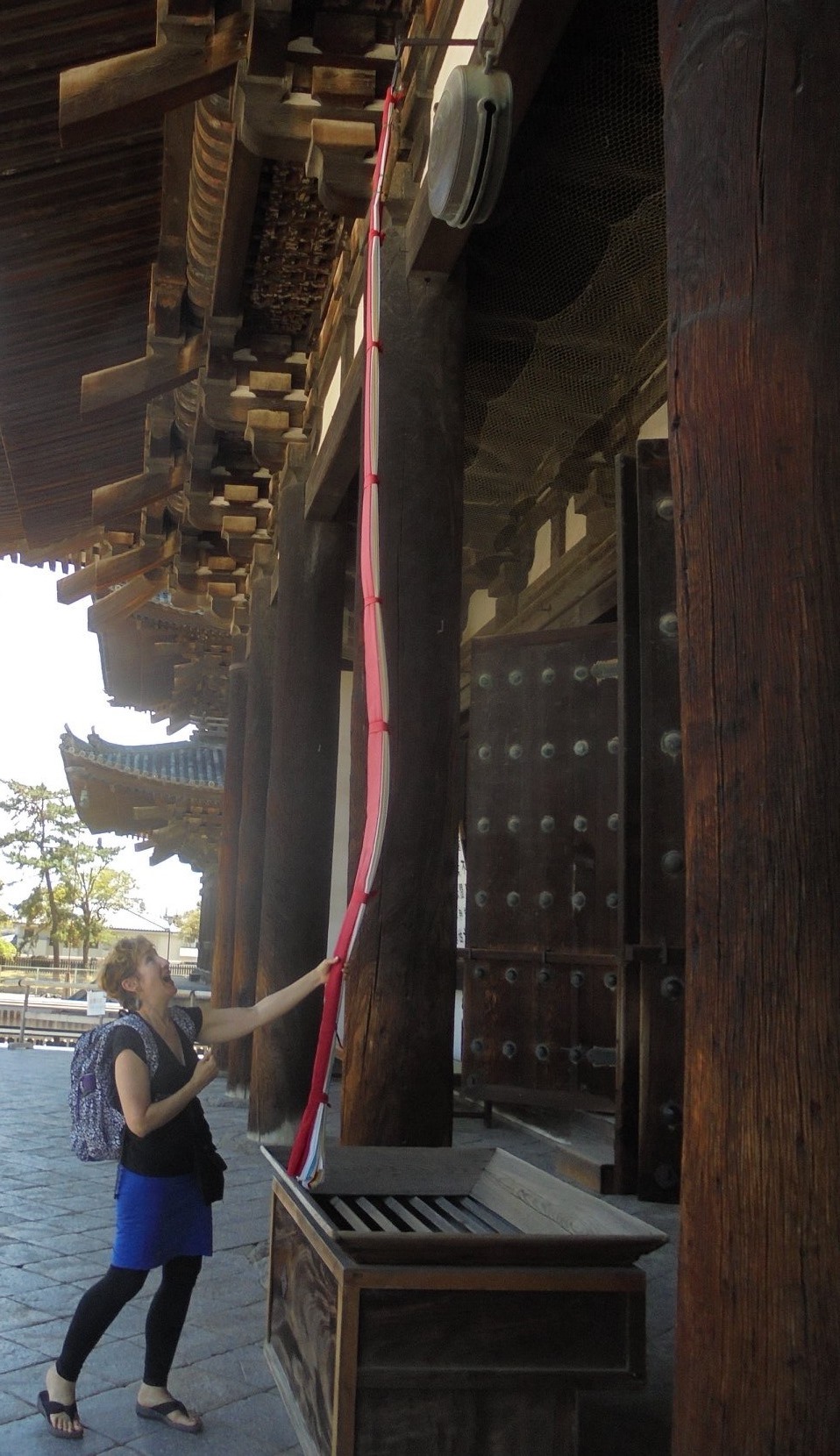
“Charming,” I remarked as we hoisted ourselves onwards.  Near the entrance, Lynn snapped me ringing the bell.

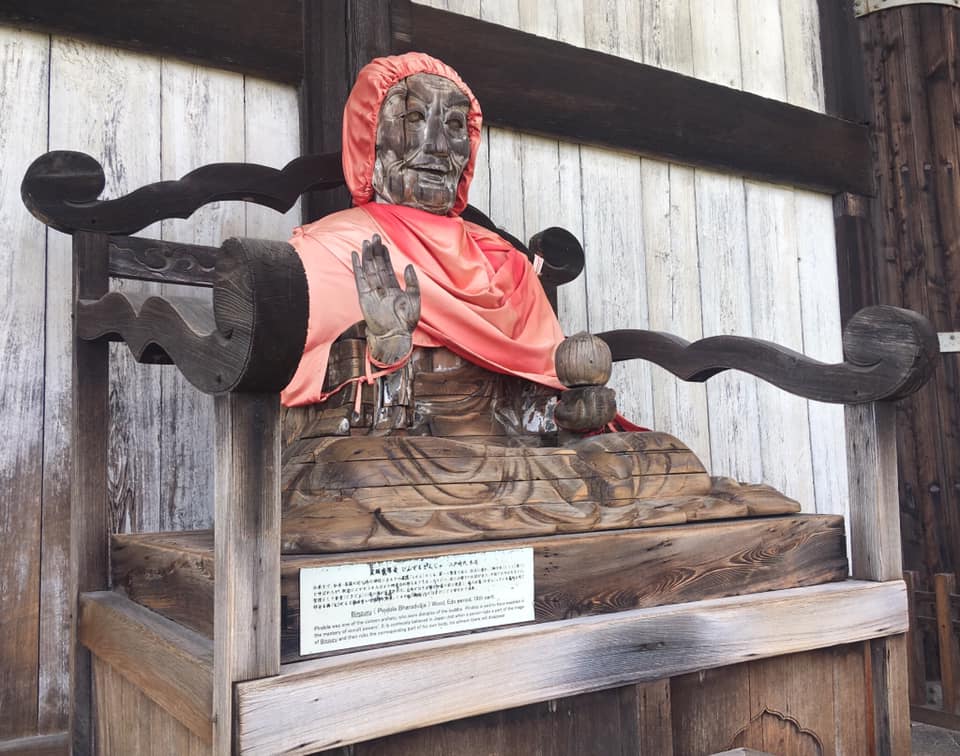
A witch-like Bodhisattva glowered nearby.

Inside, the Bodhisattva of wisdom and memory sat to the left of the Great Buddha.  This may have explained all the school groups.

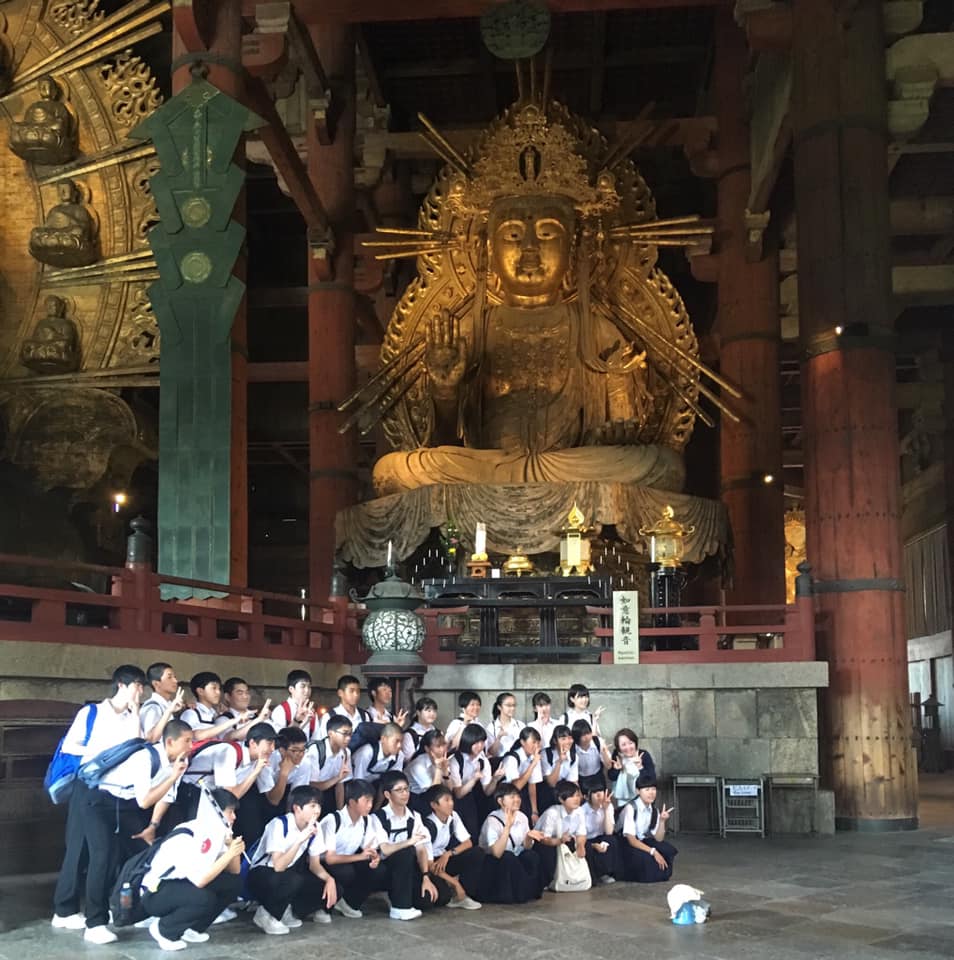
The kids seemed to be having more fun goofing around than praying for success in their exams.

Here they are posing before the Bodhisattva who presides over the six realms of rebirth.

This solicitation of funds to rebuild Notre Dame was touching.

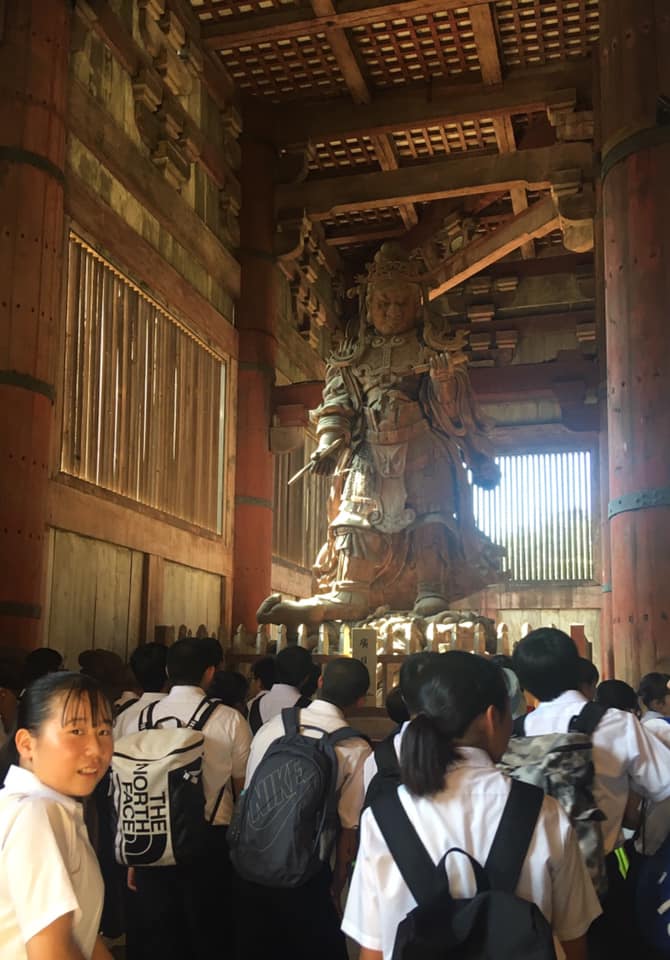
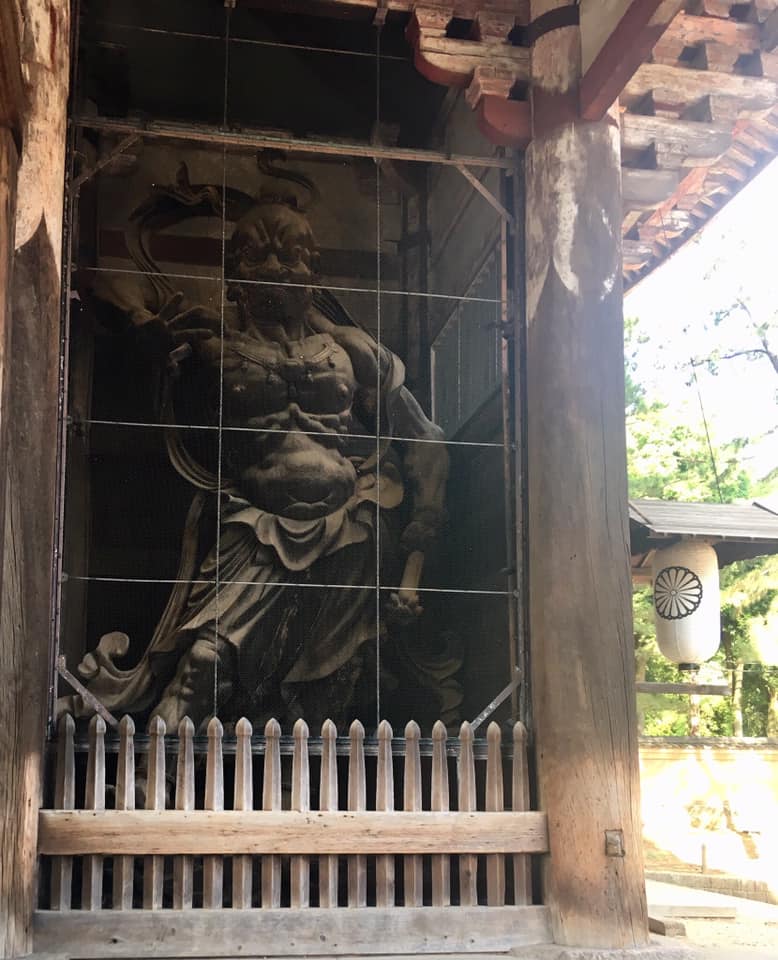
These looked like murals but were statues guarding the Great Buddha.

We slogged back to the hotel, telling ourselves we would go out later for dinner.  On our respective beds, I interrupted whatever Lynn was doing on her phone to read from the “Etiquette Guide to Japan” I had purchased in Kyoto.

“Why didn’t I buy this a month ago?” I asked myself. “Even the mildest criticism, if not followed by apologies, could cause a Japanese person to commit suicide.

“I hope I haven’t left a trail of death in my wake!”

Wobbling, Walking, Slaking, and Shaking

We took the hotel shuttle to Nara Station; well—the Japan Rail station—there is also a Kintetsu Rail Nara Station.  I was nervously psyching myself up to buy tickets to Shimoda for my nine-year-old nephew and me.

“Provide only information that’s necessary,” Lynn advised.  “Don’t raise red flags by saying he’s not your child.”

I was ready with Google Translate but the JR agent used a tiny blue device to facilitate our conversation.  It looked like it was decades old, so the Japanese must have been way ahead of Google on real-time conversation translators, although this provided text, not voice.

The transaction seemed to go smoothly, but there was no way of really knowing if I had what I needed until I met up with my sister-in-law’s parents the following week and they could read the tickets.

Next, breakfast at Le Bon Vie in the station.  I picked out a melon bun because I liked the sound of “melon bun.”  It contained no melon; it was a green bun filled with golden custard.  Pretty oishi anyway.  Lynn had something cheesy.  We munched and sipped our coffees accompanied by The Beegees “Stayin’ Alive” blaring on the Muzak.  Or is it all Pandora or Spotify now?

“Oh my god!” Lynn sputtered as she spotted something in front of the JR ticket window.  I followed her stare and nearly spit out my bun.  A young woman, a westerner, was buying tickets and trying to get organized.  She was very tall, maybe six feet, and barely dressed.  She wore a sleeveless, low-cut jumper with shorts so short her buttocks hung out as she bent over to arrange something in her backpack.  This view competed with that of her pendulous white breasts hanging down, bra-less, up top.

“I don’t know where to look!” I exclaimed.  “There’s cleavage coming and going!”

“Avert your eyes!” Lynn advised.  “And we wonder why more conservative cultures think western women are slappers.”

“I hope she’s not American—or Canadian so people will assume she’s American.”

“She’s so tall and blonde.  Let’s assume she’s Swedish.”

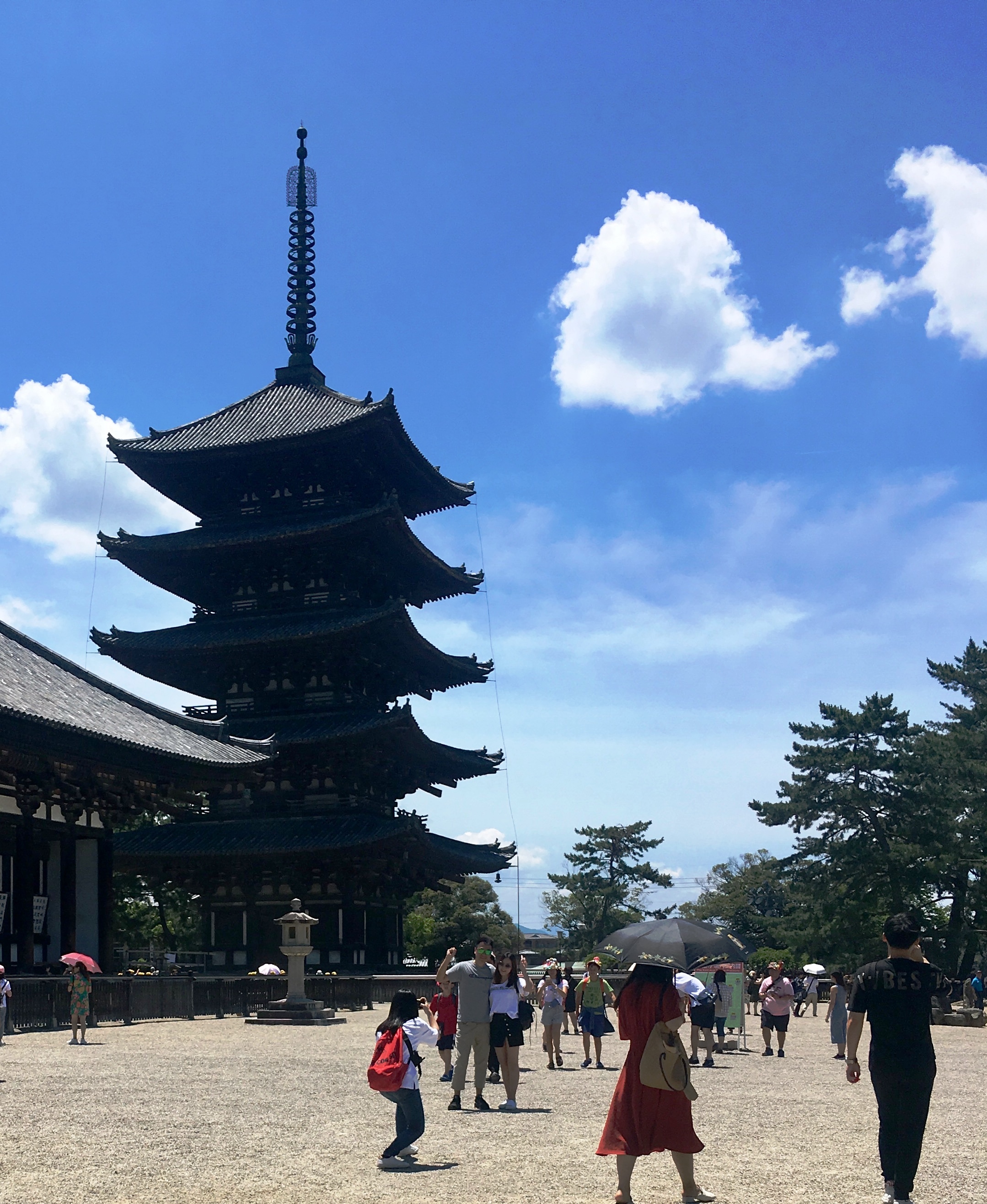
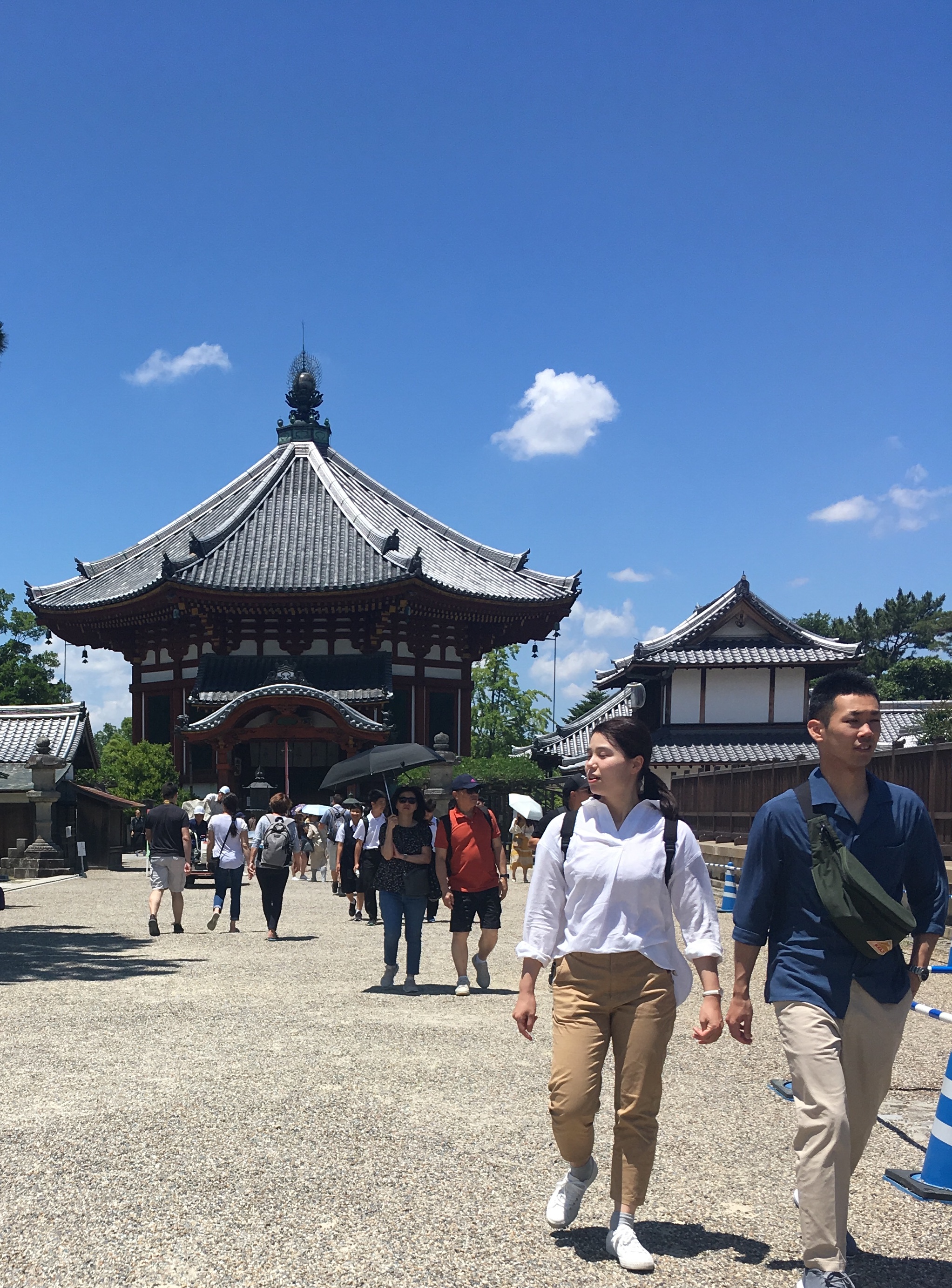
We took the shuttle to the other Nara Station, which was closer to the temple complex we wanted to visit that morning, Kohfukuji. There were four or five buildings; all charged 500 yen, or about $5.  I settled for exterior photos of the “famous” five-story and octagon pagodas.

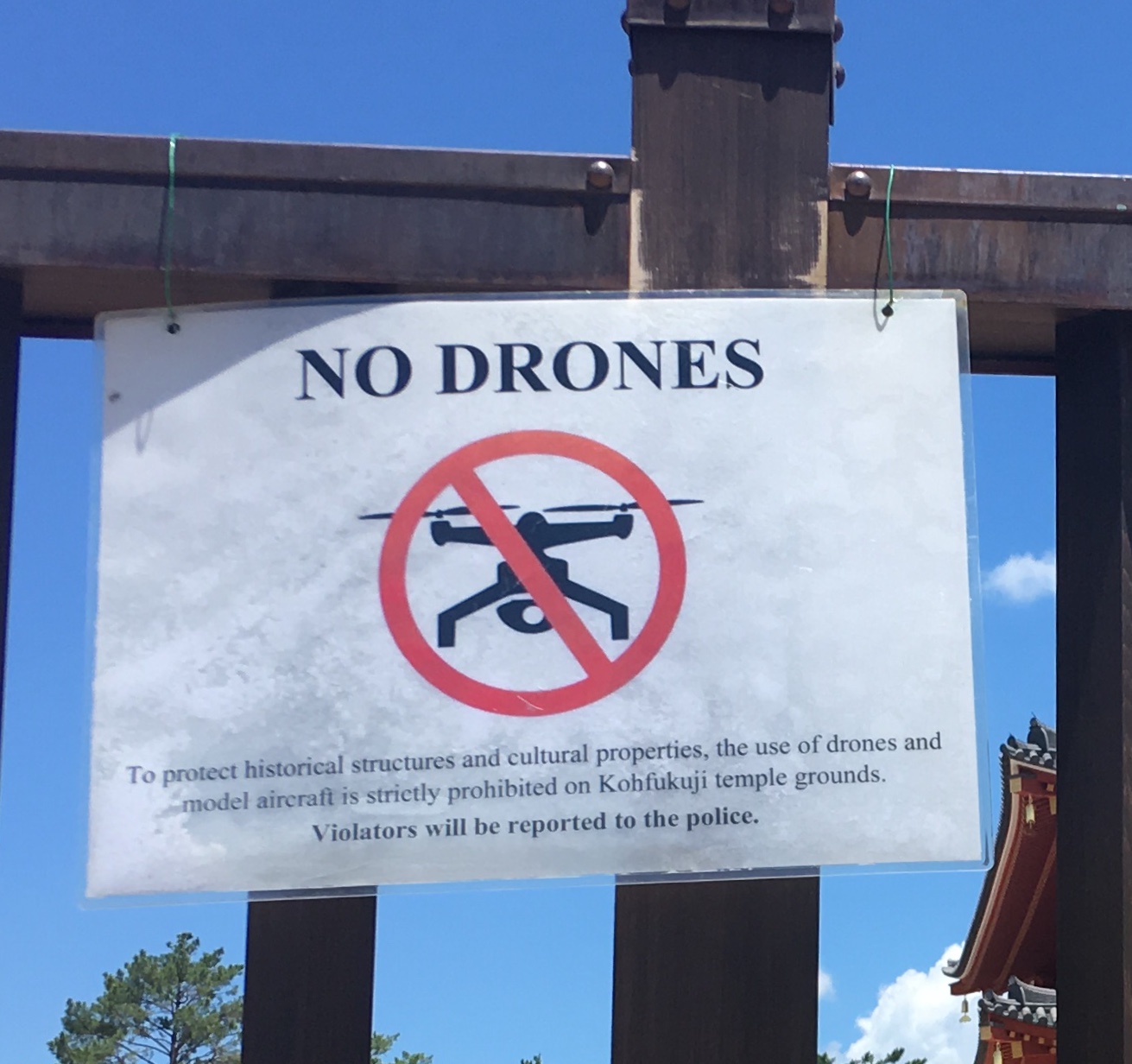
I appreciated this sign.

The compound was peaceful and the inner shrine was beautiful.  In the tiny shop, I noted the usual selection of book covers, notebooks, and plastic paper sheaths.  I wondered how long it would take the Shrine Gift Shop Buyers Association to realize no one buys these items anymore.  Maybe I’m wrong. Maybe plastic paper sheaths are big in Japan.

Lynn had picked out some postcards.  She opened her bulging coin purse to show the all her small change.  “Can you help me use this?”

The girl good-naturedly counted out about a hundred coins.  Lynn thanked her profusely.

Across the road was the Nara National Museum.  It looked close, but the first building we reached was closed for remodeling.  And the next.  We walked around a third building looking for an entrance, to no avail, then followed signs to an underground passage that finally led to the entrance.

There was a fantastic exhibit of Buddha statues; no photos allowed.  In the gift shop I passed on the souvenir wash clothes—another common gift shop item I wondered about—and bought Vince a notebook.  The lines were vertical instead of horizontal and I thought he’d get a kick out of that.

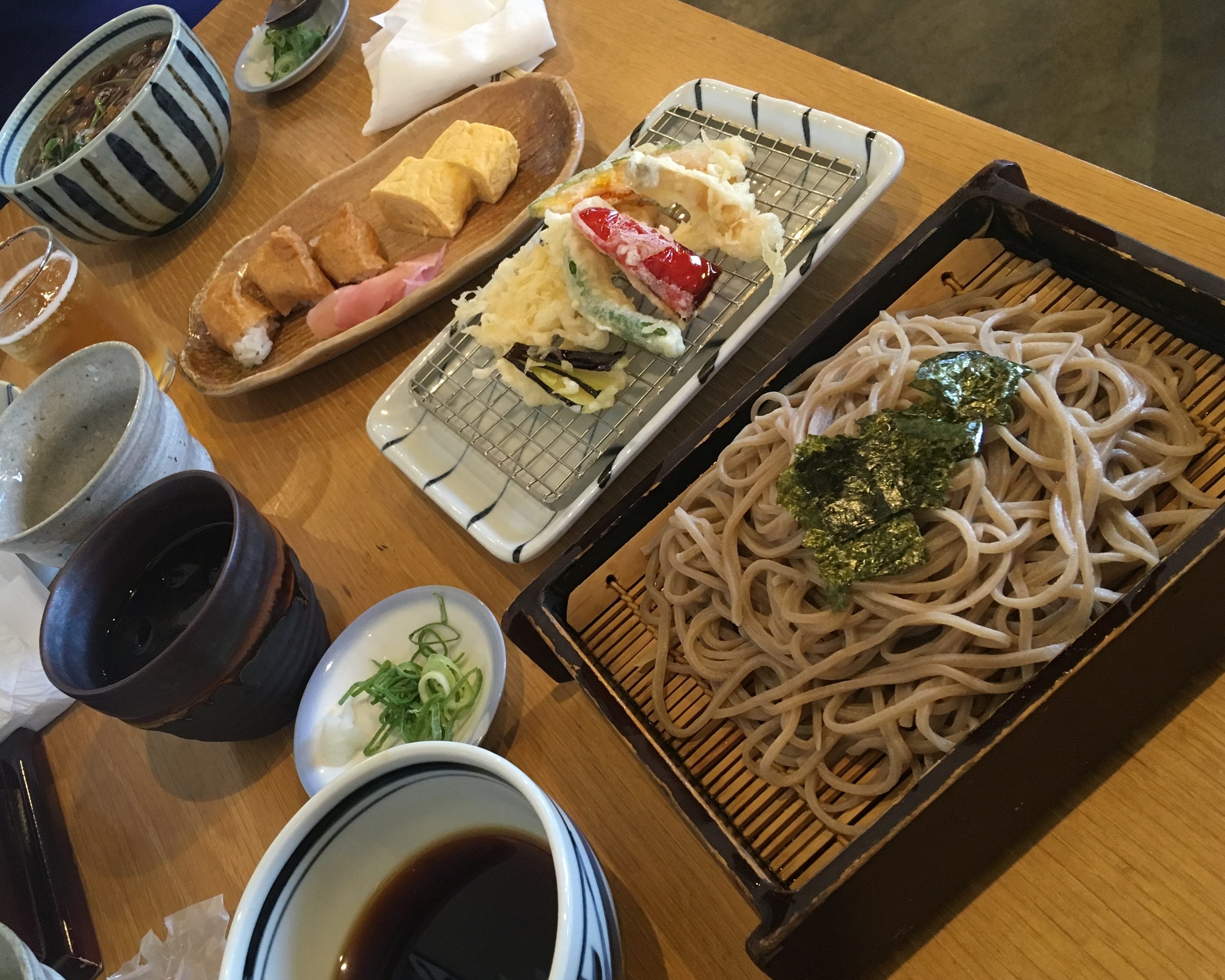
It was lunch time, so we stepped into the first place that was open for some soba.

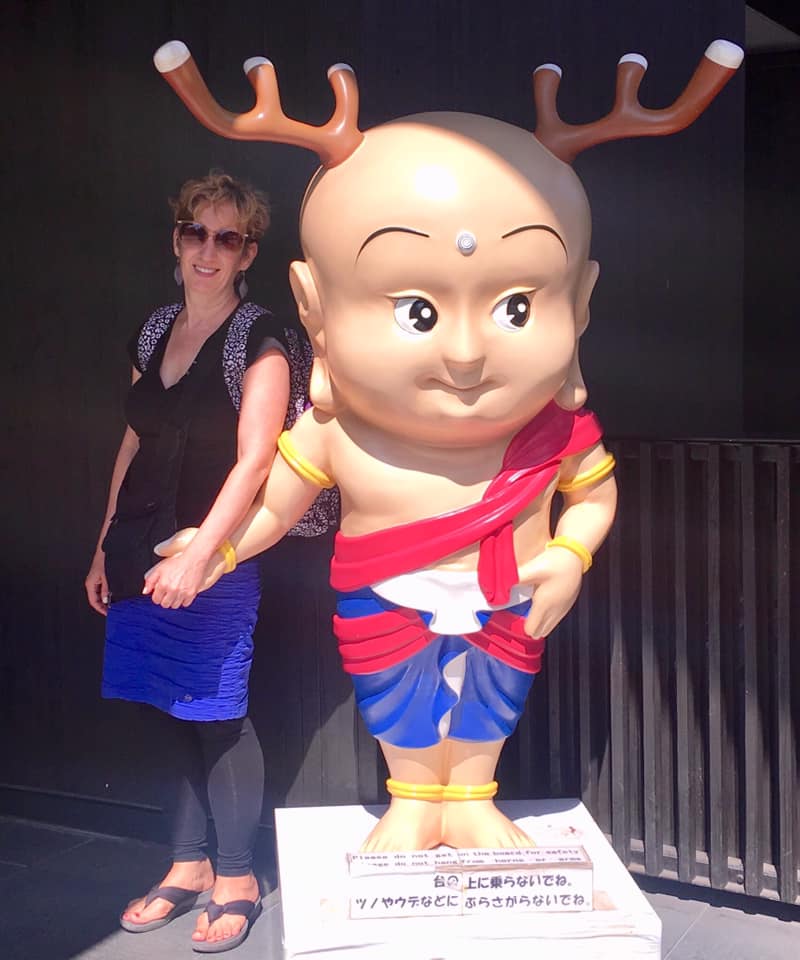
They had a soju promotion going.  Since it was about a hundred degrees outside the firewater was refreshing but may have been a bad idea because I then proceeded to pick up a guy who was half Buddha and half deer.

Steps away was an earthquake museum.  Here’s the simulator before I was strapped into it, where my Soju was shaken, not stirred.

Lynn recorded my ignominious tour of Japan’s Greatest Quakes.  Thankfully I don’t think she knows how to post video to social media.

needs and NEEDS

In real time, last weekend I spoke at a synagogue about my son’s incarceration and its aftermath.  There were about 20 people in attendance and I was nervous.  I rarely speak in front of groups, and this was a sensitive subject.  But it went fine.  Unfortunately, I know my stuff when it comes to being a prison mom, and authenticity carried the day.

They specifically wanted to know about challenges of re-entry into society. I described them in detail: housing (few landlords wants to rent to an ex con), employment (ditto, although some employers are known for be open minded), social support (many ex-offenders have been written off by family and friends), mental health and sobriety (it’s hard to stay on a healthy path when your housing is precarious and you can’t afford food, etc), medical and dental care (thank you, University of Minnesota School of Dentistry, for discount care!) and finances (prisoners net about 25 cents an hour in their jobs; Vince had amassed $300 after working full time for a year).

Supervision makes all of the above more difficult. A revolving door of agents can shop up at the ex-offender’s job or house anytime, day or night, and demand a urine sample.  Vince lived with me, and I had to have a landline installed because the Department of Corrections is not operating in the 21st Century yet.

The agents strictly enforce rules one day and let things slide the next; the capriciousness of the system is enough to drive anyone mad.

“What about voting rights?” someone asked.  It is thought that most ex-offenders would vote Democratic if allowed to vote.

“To be honest, that’s the least of their concerns, for sure when they are first released,” I replied.

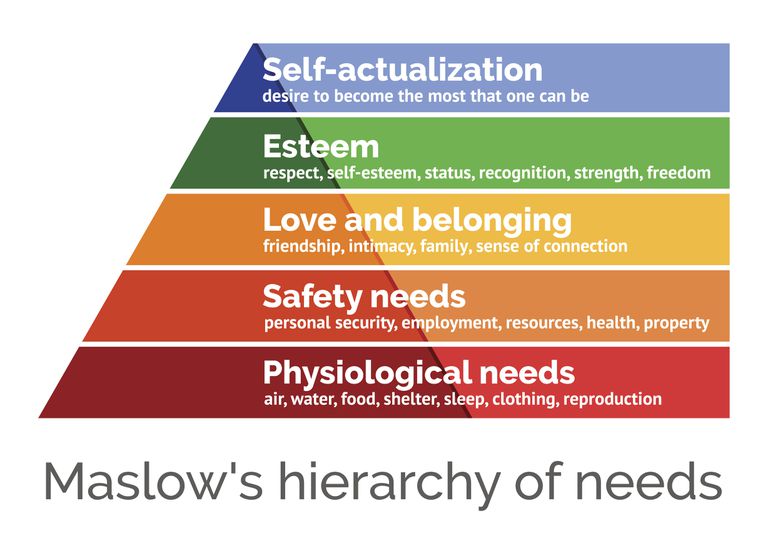
Think of Maslow’s Hierarchy of Needs.  Ex-offenders are struggling at the bottom.

A few days later I was at a friend’s house.  She and a neighbor agreed they want a Democratic presidential candidate who will bring about drastic—not incremental—change. Free college education.  Reparations for slavery.  Medicare for all.  Green New Deal.

I think about my coworkers at the YMCA.  They’re a racially diverse group of mostly blue collar young people who will probably vote Democratic—if they vote.

In nine months since I’ve worked there, none of them has ever talked about climate change, institutional racism, voting rights, or gender-neutral bathrooms.

Their concerns are: Where can I get the best deal on snow tires?  Should I make tacos or spaghetti for dinner tonight?  Should I color my hair red or get highlights or keep it black?

My coworkers aren’t at the very basic level of needs, but I worry.  If the Dems choose a candidate that Trump can paint as “extreme,” I don’t think ex-prisoners or my coworkers will vote at all.

It’s not that they’re incapable of understanding higher-level issues.  It’s that they have more basic needs demanding their attention and they’re not going to get fired up about a candidate who lectures from a flip chart about emissions trading.

In Nara, I deployed my secret weapon, a stash of five pills leftover from one of my Restless Legs Syndrome prescriptions.  I slept well for the first time in 16 nights and was giddy with energy when I awoke.  Lynn was still asleep so I hung out in the huge bathroom and made coffee with this …

… while I talked to Vince on Facebook.

“I think it must have taken five mechanical engineers to design this,” I said as I demonstrated it to my son.

Vince laughed at the thing.  “Bring me one, will you?” he requested, “so I can show it to my coworkers in the kitchen?”

“Will do,” I replied.  The connection failed so I took selfies of myself in the Nara Hotel yukata.  I never take selfies, so you know I was feeling good.

“Why don’t you just take medication every night?” Lynn asked later.  Fair question.

“Because it works, and then it stops working, and then I need to take more and more, and then it starts to actually make the symptoms worse, and then I have to go through an excruciating withdrawal process,” I explained.

“But for today, I feel human again!”

Nosing Around Naramachi

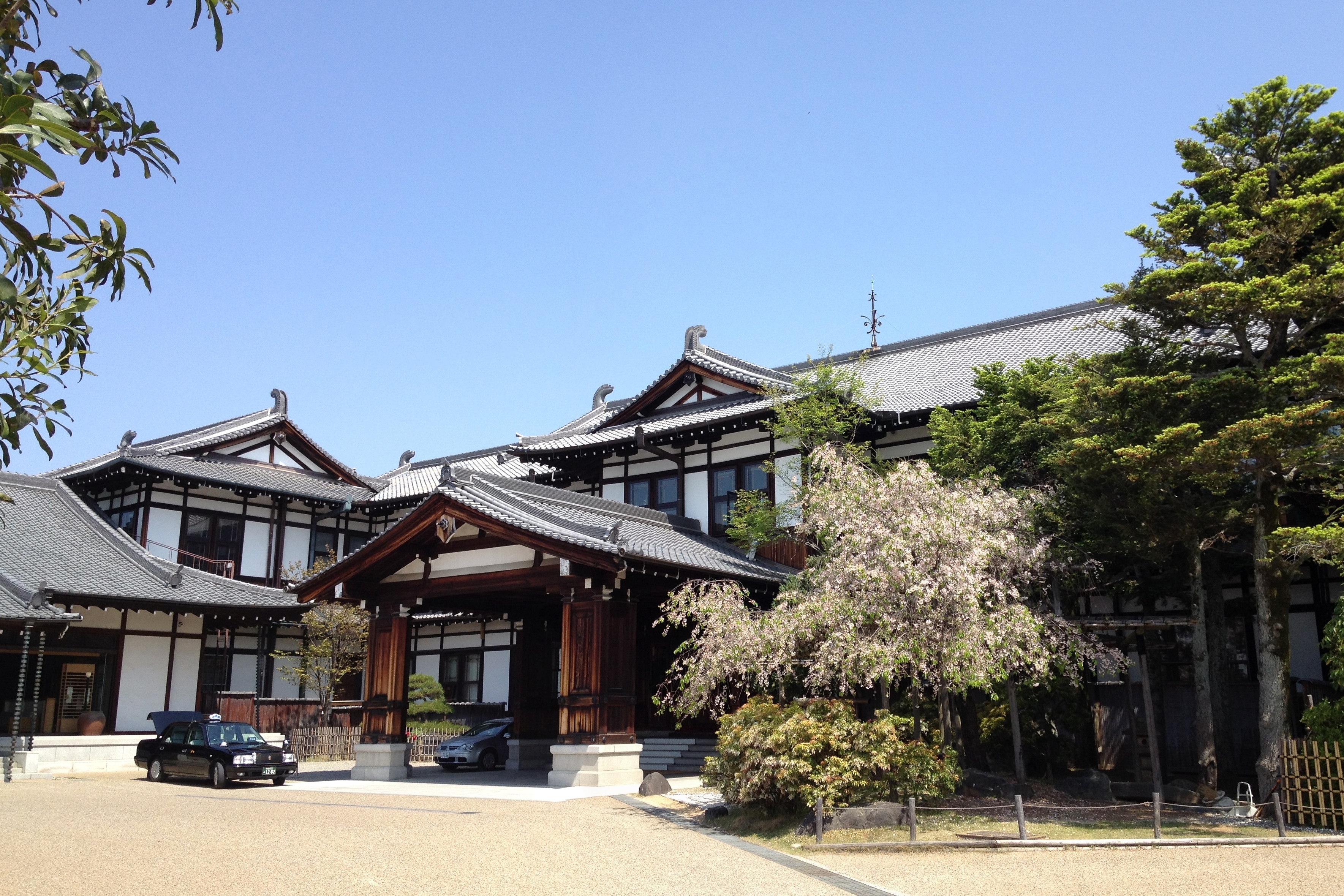
Waiting to get into our room, Lynn and I decided to have a snack in the Nara Hotel lounge.  The room hadn’t been updated in decades; it was dreary and the carpet was stained and worn.

The menu was geared to westerners.  We ordered a very expensive platter of sandwiches which comprised of crustless, doughy white bread smeared with the thinnest layer of cucumbers and tomatoes and cut into triangles.  The mixed nuts were reliably salty and filling and the black tea was served with real cream.

“I can’t see us eating here every night if these prices are indicative of the food joints,” I said. Throughout the hotel, we’d seen a cafe, a restaurant, a bar, this lounge, and other eating and drinking establishments.

“But if you noticed from the taxi on the way in,” Lynn replied, “There’s nothing nearby. We’ll have to figure out where the nearest restaurants are.  If we have to take taxis to get to them, we may as well eat here.”

A young woman escorted us to our room.  “Down two levels, in the basement,” she pantomimed as she pulled a trolley with our cases down several long hallways.

“There are windows?” I asked, alarmed.

“Oh yes!” she replied, laughing as she pressed the elevator button.  “It will take time,” she said, and walked away.  As we waited, we tried to decode a sign promoting beers on a rooftop terrace.

“Forty thousand yen?” I said in disbelief.  “That’s about forty bucks … for a beer?  I’m sure the view is very nice, but ….”

Our girl guide returned.  The “modern” wing of the hotel was very 80s style, in teal, grey, and mauve. There were more long hallways. I noticed vending machines selling beer for 2,500 yen—$2.50.

The room was geared to feel familiar to the western visitor, complete with a fake fireplace with plastic logs.

“It’s very spacious,” Lynn commented.

“Yes, and clean.”  A sliding glass door lead out to a cement patio without furniture. “This will be a good place to hang washing.”

I had read an article about Nara in Conde Nast Traveler which mentioned the Nara Hotel. You could walk down a set of stone steps (of course!) to the “atmospheric” Naramachi neighborhood of tiny streets and houses.

“It sounded really easy in the article,” I told Lynn as we reached the bottom of the steps.

“Don’t believe it!” she replied.

We did find it, despite ourselves, and I can’t say it was as I’d expected.  It was a typical urban neighborhood with streets, narrow alleys, and houses and shops.  Kind of like west St. Paul.

Why does the same place strike one person as “unforgettably atmospheric” and another as ho hum?

We accidentally found a temple, the Gangoji.  It had a beautiful inner shrine and nice collection of Buddha statues in an air-conditioned building.  No photos were allowed.

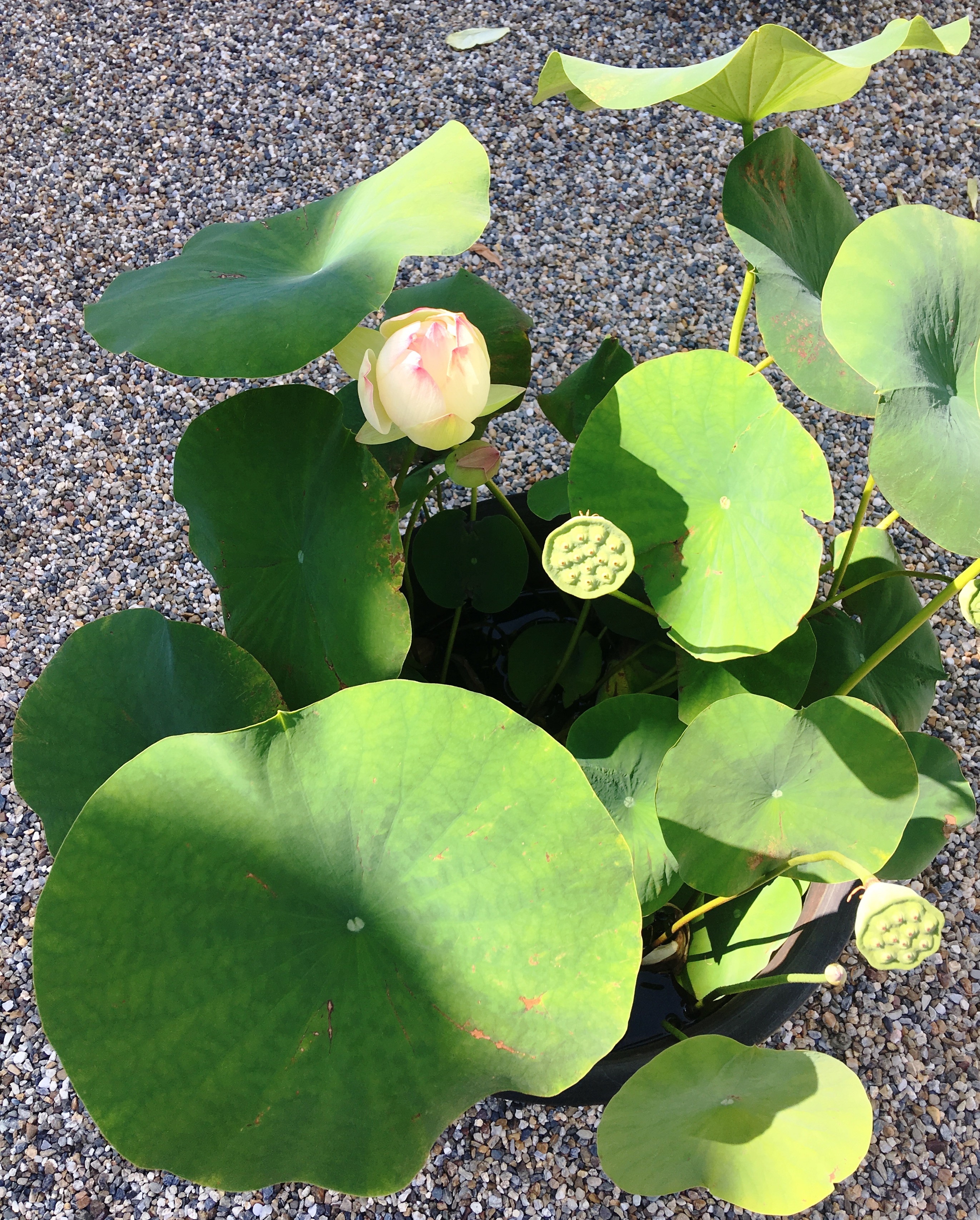
The courtyard was strewn with lotuses.  Would they stay in pots all summer?  There wasn’t a body of water nearby that I could see.

“You know how Taro had us use lotus root in our stir fry?” I reminded Lynn.  “I wonder if you can just go out in a kayak and pull them up?  We’ve got millions of ‘em in Minnesota.”

“Oh I should think not,” she replied.  “Wild ones are probably full of parasites.”

Not oishi.  As it turns out, harvesting wild lotuses in Minnesota is not allowed; I don’t know it it’s because of parasites or something else.

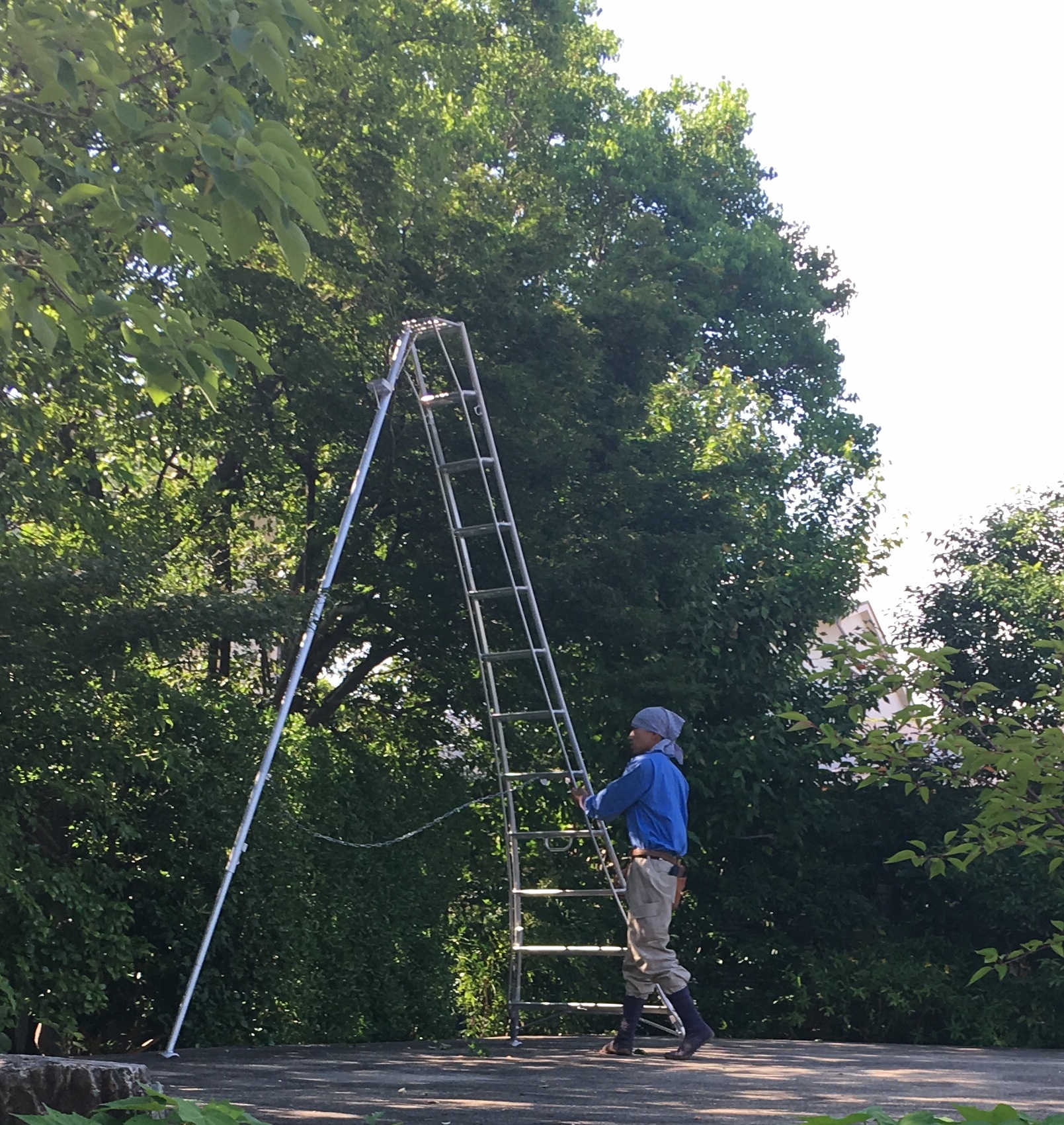
The only other photo I took at Gangoji was of a workman setting up a dicey-looking ladder.  I mean really—a three-legged ladder?

We walked back out into Naramachi and I may have startled Lynn when I expressed a great deal of excitement over a little housewares shop.  Inside, it was about the size of my bedroom and packed to the rafters with pots, straw brooms, plastic tub sets, and clothes-drying contraptions, most of it covered in dust.  An ancient woman sat behind a smeared glass counter; she didn’t move and her expression never changed.  Was she dead?  I found an omelet pan for about $5 but the mood for buying one had passed.

On to Nara

Nara was the capitol of Japan before Kyoto, which was the capitol before Tokyo.

Over a tasty Japanese breakfast at Shijo Station, we discussed whether to make a detour to the iconic shrine, Fushimi Inari-taisha. It’s in all the guides.  It really is iconic.

But it would not be empty.  “I hate to say it, but I’m inclined to save it for next time,” I said.  “I’m kind of shrined out.”

“Shrined out” was a term I’d seen frequently in reference to Japan.  Now I was living it.

There comes a point where you just cannot appreciate one more dragon fountain or anything that is the Largest, Oldest, or contains The Most gates, bodhisattvas, or peony carvings.

“But I’ve been here a week longer than you, and I’ve been to Nikko, where I saw I-don’t-know-how-many shrines.”

Lynn was fine with skipping it. She’s spent a lot of time working in Thailand, Vietnam, Indonesia, and China. She’s been to Bhutan and India, many times. She knows from shrines.

“I don’t remember things anyway,” she reminded me.  I think she does, but I know what she means. The brain can only store so many memories.

Nara is ninety minutes from Kyoto by local train.  The seats faced in, for maximum people watching.  A tough-looking young woman sat across from me.  I guessed she was American, and when we made eye contact I asked where she was from.  “Pittsburgh,” she grunted, then stared at her screen for the rest of the journey.

A Japanese man with boils the size of ping-pong balls covering his arms boarded and sat diagonally from me.  Despite the sweltering heat he was wearing a scarf to cover his neck and half his face.  More boils, I thought.  What a terrible condition, whatever it was.  He fell asleep.

A Japanese girl of around 17 boarded, sat next to the man with the boils, and recoiled almost imperceptibly when she glanced down at his arm next to hers.  Would she get up and move somewhere else?  No.  She sat ramrod stiff and stared straight ahead.  She was wearing a sailor outfit with a skirt so short I had to avert my eyes.

“Did you see that guy with the giant boils?” I asked Lynn when we got off in Nara.  “And the girl with the cutesy sailor’s outfit, and that tough broad across from us?  She was from Pittsburgh.”

“No,” Lynn replied.  Did she think I was making up these characters?  “I must have dozed off.”  I envy her ability to sleep anywhere.

A friendly man at Nara Station Information Desk told us we could catch a free shuttle to Nara Hotel.  I had booked the room and they hadn’t sent any information about this.  We stood where he pointed although there was no sign.  After 20 minutes we gave up and hailed a cab.

At the hotel we were handed a shuttle schedule; it ran every half hour.  I suggested that they send this information to guests ahead of time.  It could have saved us ten bucks.  The desk clerk smiled and nodded but clearly nothing was going to change.

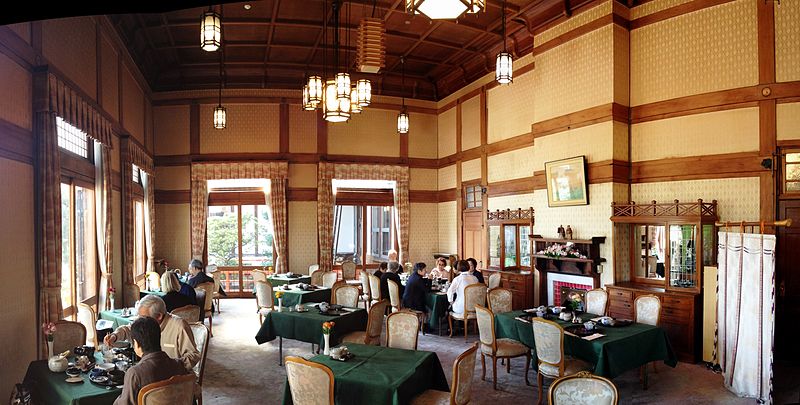
The Nara Hotel is a grand old dame celebrating her 100th anniversary this year.

After two weeks in cramped, basic rooms, I had thought it would be nice to splash out.  The photo montage on their webpage was extraordinary.  They’d hosted many famous guests—there was even a photo of Albert Einstein playing the piano in their lounge.

“The old part of hotel is closed for earthquake proofing,” the clerk said.  “We put you in modern wing.”

Rats. I hoped it wasn’t too sterile or modern.  We couldn’t get into the room for a couple hours so we had a nose around the lobby.  There was a timeline of famous visitors.  Charlie Chaplan!  Helen Keller.  Richard Nixon, the Dalai Lama, Marlon Brando, Joe DiMaggio (his wife Marilyn Monroe cancelled; things must not have been going well).  Multple visits by Japanese, British, and European royals.

Then there was this.

“1941: The Pacific War Broke Out.”

I really, really wanted to peel off that strip of paper and see if it said, “Japanese starts Pacific War by attacking Pearl Harbor” underneath.

Comfort Food

“Where should we go for breakfast?” I asked Lynn the next morning.

“Dean and Deluca?”

“We’ve gone there twice.  How about we try that authentic-looking place across from it?”

“All right,” Lynn said doubtfully.  “As long as you don’t make me eat horse sashimi or deep-fried chicken tendons.”

“Or chicken chops.”

We snickered. How bad could it be?

“I wouldn’t call it bad, I’d call it interesting,” Lynn said. There had been no photos on the menu so we’d guessed our best based on the English translations.  Our plates contained Texas toast topped with a thick layer of mashed potatoes, then Sriracha sauce, and crowned with about a pound of shredded iceberg lettuce.

“But it’s authentic,” I insisted.  We were the only westerners in the place.

And here I will sound like a whiney tourist, but it was really hard to get milk for my coffee.  Where you could find it, the coffee in Japan was extremely strong.  If I asked, I received one tiny plastic tub of “cream” which contained about a half teaspoon of white syrup.  If I asked for more they would bring me one more, to total about a teaspoon.

Wah wah. At least the coffee was strong, not weak.  It’s just a tea country, not a coffee country.

“Let’s go to Dean and Deluca tomorrow,” I capitulated.

Today we were visiting the famous Golden Pavilion, Rokuon-ji.

“Or is it Kinkaku-ji?” I wondered, looking at the map.

“We’ll find out … or we won’t,” Lynn answered as we walked toward Kyoto’s main station to catch bus 205.

“Didn’t we take the 205 to the cooking class?” I asked.

“Yes, it must be a different 205.”

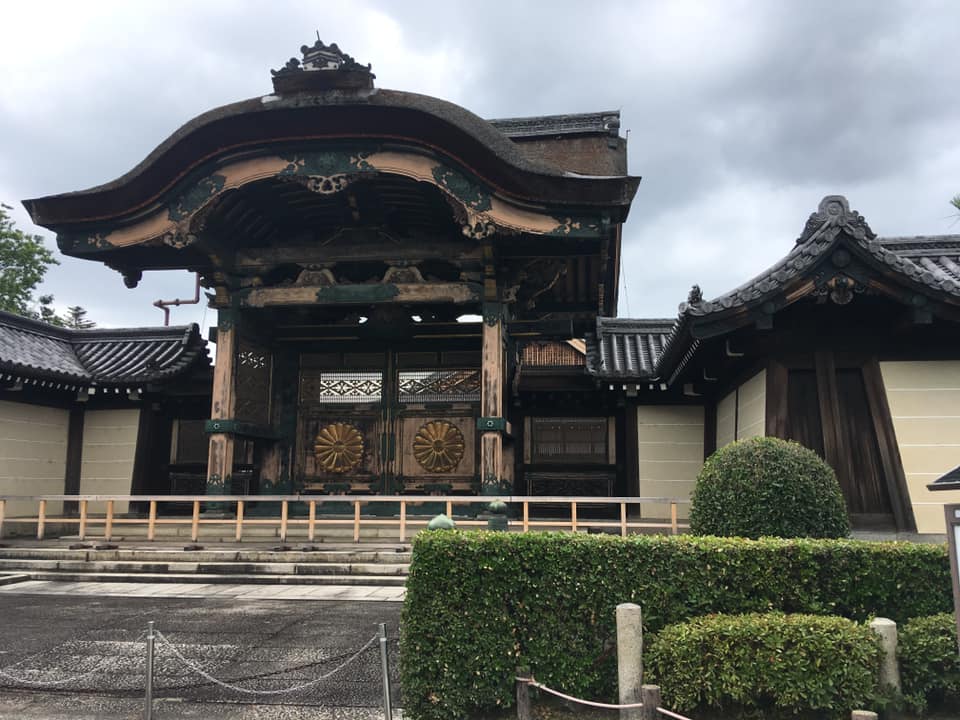
We chanced upon a temple complex and walked in, as long as we were there.  This turned out to be Higashi Hongen-ji, which neither of us had seen on a map or guide.

It was impressive, with a beautiful dragon at the hand-washing station and ornate detail on every door and pillar.

“… established in 1602 by shōgun Tokugawa Ieyasu when he split the Shin sect in two …” Lynn read.

“There’s a hair rope!” I interrupted.  “When the shrine ran out of rope the monks made one out of their hair.”

“I think I can live without seeing that,” Lynn responded.

I just googled the hair rope.  Call me biased but it can’t rival the world’s largest twine ball in Darwin, Minnesota.

The shrine had a nice gift shop where I bought an exquisite fan for my future daughter in law.

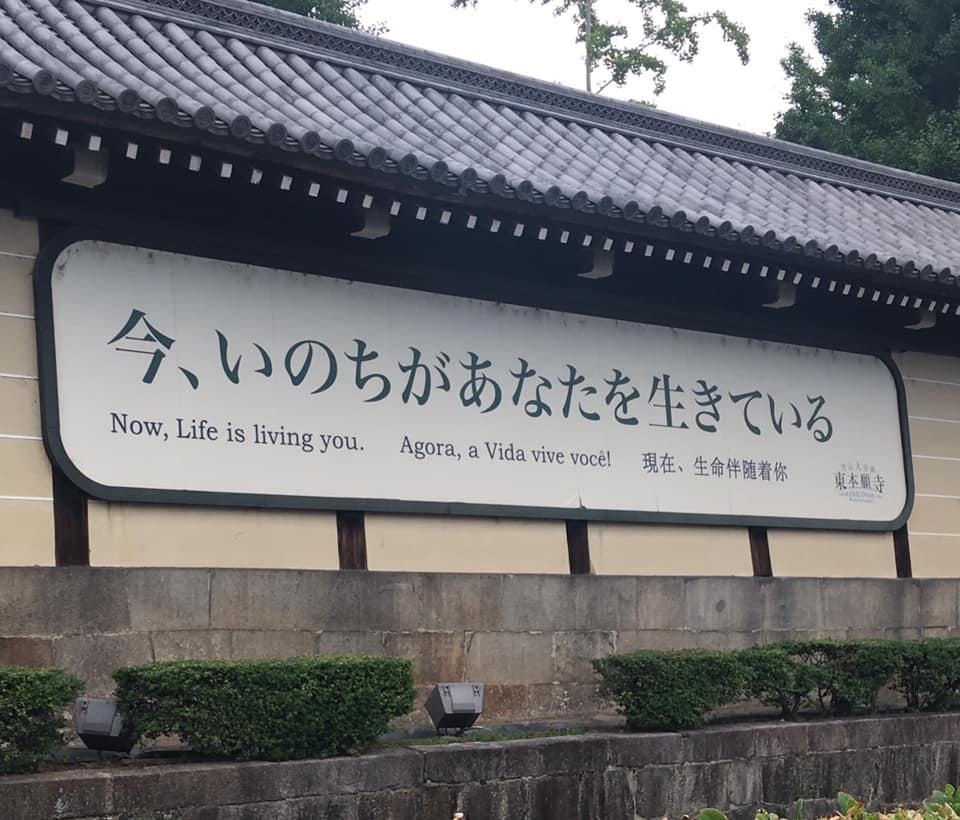
The shrine had inspirational messages on its outer walls.

We stood and pondered what “Now, life is living you,” meant.

“It’s either really deep, or makes no sense at all,” I said.

“I’m afraid I’m not deep enough to understand it,” Lynn said, and we walked on.

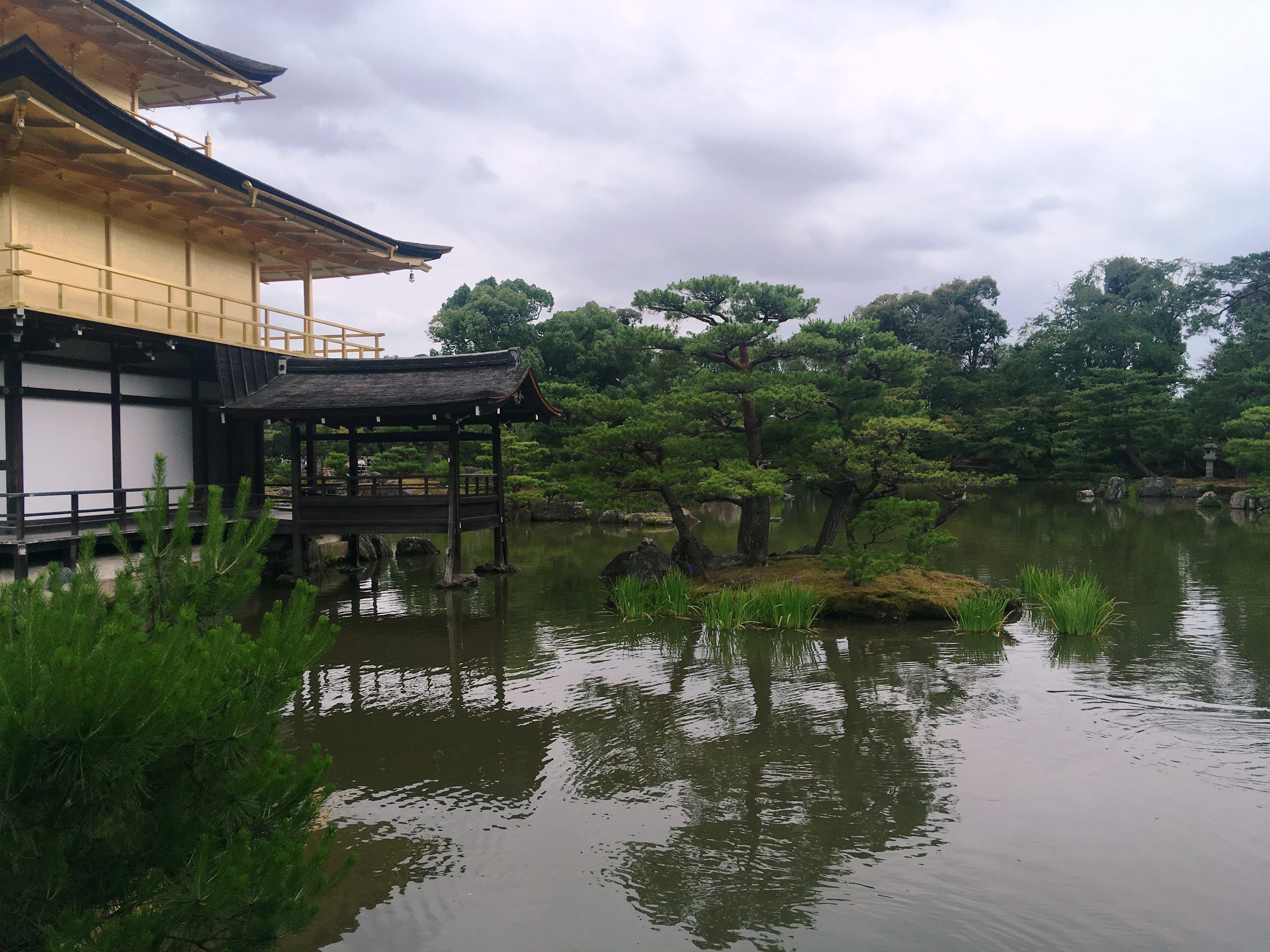
Half an hour later, we stood admiring the Golden Pavilion.

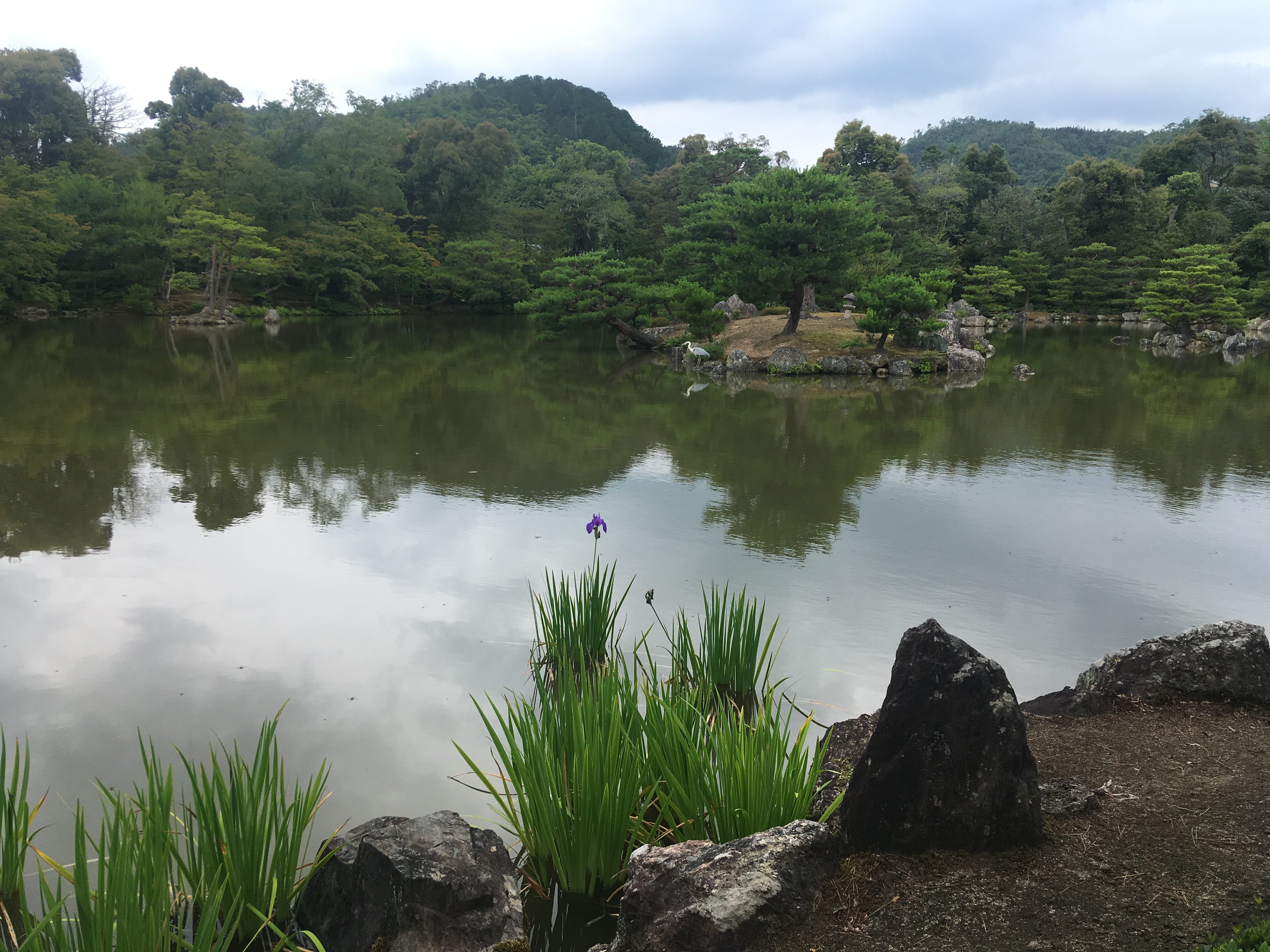
It really is layered in gold.  It’s surrounded by a lake and gardens, so you can get photos that don’t show the thousands of tourists.

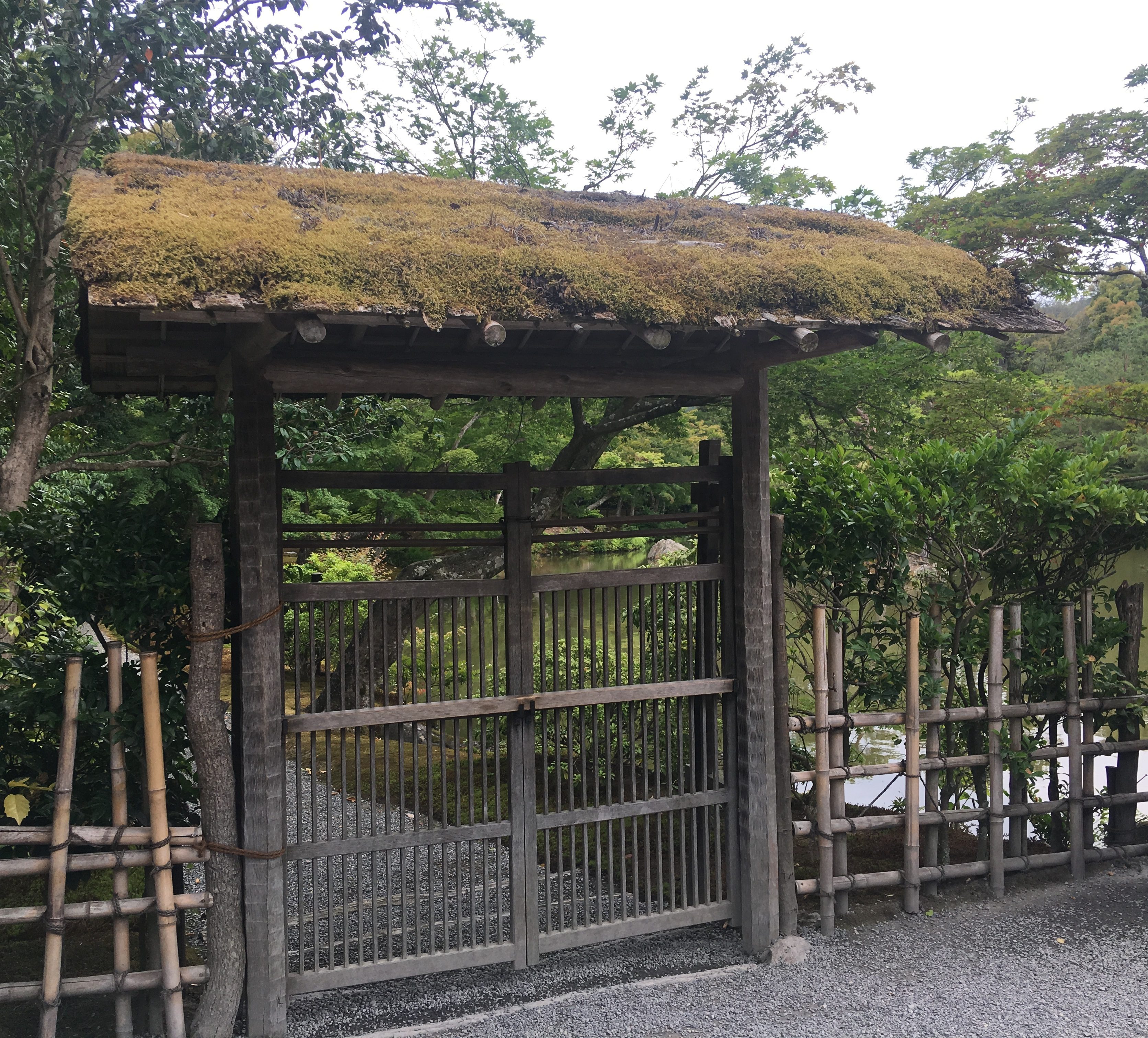
I felt claustrophobic in the crowd so I stepped aside and contemplated this moss-covered gateway.

You can’t go inside or get close to the temple, so we were back on the bus in 20 minutes.

Lynn studied her map.

“We’ve still got the Fushimi Inari-taisha shrine to see,” she pointed out.  “It’s in the other direction, also about 20 minutes out.  We could see it on the way to Nara tomorrow.”

“That’s the one with all the red gates?” I asked.

“They’re iconic gates,” Lynn replied.

Kyoto Station is part of a massive mall.  Of most importance, it’s air conditioned.  We nosed around Isetan, another department store.  We were interested in buying an omelet pan so we could make the Japanese-style omelets we had practiced with Taro, but they were asking $50 for one here.

On the 11th floor there was a restaurant advertising a sushi set meal for $55 for two, including a glass of saki.  Aside from a salty custard and green jellied cubes, the sushi felt familiar.

“Isn’t it interesting,” I pondered, “how sushi, of all things, has become the iconic Japanese food in the west.”

“Yes,” said Lynn, “It’s almost like comfort food.”