Tag Archives: human rights

Prison as Trauma

Most people never get to go to an event about prison.  I went to two in one week.

The first was a phone-a-thon to ex cons.  It felt like a worthwhile use of my time and I would recommend doing something similar if you are depressed, angry, or frightened about some issue.  Like oh, let’s say … a presidential election.

Two nights later was an event I organized at my workplace, the Center for Victims of Torture (CVT), and co-sponsored by Jewish Community Action.  It sounds complicated, I know.  What does torture in foreign countries have to do with prisons in Minnesota?

A lot, it turns out.

It was a small event, just 18 of us, but to us Jews the number 18 is a mystical one symbolizing “chai,” the Hebrew word for life.

I was a little concerned that the topic might be a tough one for Vince, my son, who had actually experienced some of the things we would discuss.  My childhood friend whose son is in prison came, and I was worried it might add to her worries.

Our first speaker was a CVT psychotherapist who described quite viscerally how trauma happens and what its effects are.  She had us close our eyes and imagine a baby.  Assuming he has a loving parent who holds him and meets his needs, he learns to trust people and look to them for help in times of need.

Trauma happens to almost everyone, eventually.  It could include abuse and neglect in childhood, a serious illness, the death of a loved one, or a car accident.  Normally, we turn to other humans for comfort.

Torture is intentionally perpetrated by one human being against another under “color of law.”  In other words, it’s authorized or at least there’s a “wink and a nod” from some type of government official.

Usually, there is no one to turn to for comfort because you are locked in a cell.  Your torturers may have your family locked up too; in fact one of the most common forms of torture is to force someone to watch or listen to a loved one being tortured.

Much of the abuse that takes place in US prisons every day—assaults, rapes, solitary confinement—would likely be legally ruled as torture if we ever investigated it fully, in my opinion.

Torture destroys trust.  Rebuilding trust is at the core of recovery.

The second speaker was a CVT volunteer who is a practitioner of Rolfing Structural Integration.  I don’t know jack about rolfing, but she does it for our clients for free and it helps them.  She talked about the physical fallout of trauma, which starts in the brain.  When someone feels threatened, the first thing they do is look for other humans for help, as the psychotherapist had said.  If they are being threatened by those other humans, the right side of their brains “light up” and they go into flight or fight mode like an animal.  I think we’ve all heard about that, right?  What I didn’t know is that the left side of the brain shuts down.  That’s the organizing, verbal, and thinking side of the brain.

And so people who have been tortured, for example, cannot put into words what happened.  On the witness stand they come off as not very believable.

One thing I also didn’t know which I found fascinating was that people kept in small spaces actually stop being able to see beyond the parameters of that space.  Someone kept in solitary for a certain length of time, when they get out, cannot see farther than six feet in front of their face.  They regain their vision eventually, but!

Vince was the third speaker.  He and I read excerpts from blog posts he wrote in solitary, where he was kept after being transferred to Moose Lake—because they didn’t have a regular cell ready.  They told him it would be temporary.  How long would you assume “temporary” meant? Six days, as it turned out. He described the cell and his experience in great detail. I felt myself getting outraged again.  We haven’t talked about it, but I wonder if it raised feelings for him too.

Jim Crow, Old and New

This is the latest in a series of posts about a road trip from St. Paul to New Orleans that starts here.

If you don’t learn something about yourself when you travel … well, that’s okay—I’m not going to sermonize—but I was pleased to learn something important about myself in Memphis.

In the morning, Lynn and I took a walk along the riverfront, which is beautiful:

memphis_riverfront

We walked back to Beale Street, found a restaurant, and ordered breakfast. We were excited to try southern foods like grits and biscuits.  We waited, and waited.  You could say this restaurant put the “wait” in waitress.  She kept coming by and giving us a dose of another southern treat—calling us “honey”, “sweetie”, and “darlin’” as in: “Your food’ll be up in just a minute, darlins’”

It seemed like half the morning passed away before we got our meals, then we wolfed them down and headed over to the National Civil Rights Museum.

It was difficult to find—there was no signage—but then we turned a corner and there it was, the former Lorraine Motel where the Rev. Martin Luther King Jr. was assassinated.  I recognized it immediately, having seen it a hundred times in iconic photos.

TENNESSEE, UNITED STATES - APRIL 04:  Civil rights leader Andrew Young (L) and others standing on balcony of Lorraine motel pointing in direction of assailant after assassination of civil rights leader Dr. Martin Luther King, Jr., who is lying at their feet.  (Photo by Joseph Louw/The LIFE Images Collection/Getty Images)

And this was the beginning of learning something about myself, because I got so choked up I had to turn away so no one would see me in tears.

I have been to Holocaust museums in Washington, DC; Jerusalem, Berlin, Prague, Chicago, and elsewhere, and they’ve been tear-filled experiences too.  But then, I’m Jewish.  Were my tears only because the story was about my people?  That fear—that I only felt empathy for my own kind—was laid to rest in Memphis.

Can a Man

I wiped my tears away but they welled up continually inside the museum, which was one long, sad horror show that traced the abuse of African Americans from slave days up through the assassination in 1968.

There was a large group of school children, mostly African American, going through with docents.  I wondered what they felt seeing Africans in chains, the police dogs, the fire hoses?  If it was my kid I would want to be on the tour to put my arm around him.  There was the usual laughing and fooling around that any group of kids will exhibit, but I wondered if they would have trouble sleeping that night.

I commented to Lynn, “A coworker of mine at Oxfam used to find every opportunity to mention, ‘the UK never had slavery’ in a superior tone.”

“We may not have had slaves in the country, but we certainly benefited and participated in the system,” Lynn replied as we read a display about how global the slave trade was.

And of course it didn’t end with the abolition of slavery.  “Jim Crow” was the system in the southern United States from reconstruction up through the civil rights era in the 60s that kept “negros” in their place.  Here are a few of the ridiculous laws from that time:

Baseball Law Mulattos Checkers

Really?  Checkers!?  Who knew checkers could subvert the social order?

Then we marched slowly through exhibits about bus boycotts, lunch counter protests, and strikes.  Then there were the cross burnings, lynchings, and bombings by white racists; somewhat counterbalanced by the support of white and other allies (including Jews).

Lunch Counter I am a Man Bus Boycott Activists

I watched a video about James Meredith, the first black student to be accepted to the University of Mississippi, in Oxford Mississippi.  Of course he hadn’t mentioned his race in his application, and when he showed up to enroll all hell broke loose.  After weeks of rioting by whites, which resulted in two deaths, he was reluctantly let in, and as Lynn read later, he did graduate and lived a normal life afterwards.

The museum was really well done.  There was a second building that explored African American activism post 1968, but after three or four hours in the first building we had to leave.

Last week Vince and I talked to a group about mass incarceration.  One of the audience members referred to it as the New Jim Crow.  I agree, although in my opinion it’s about poverty, addiction, mental health, and class as much as racism.

Easter Interlude

I was Skyping with someone at work who is an attorney who documents torture and other human rights abuses perpetrated against Syrians.  I loved this quote she had on her Skype account:

I arise in the morning torn between a desire to improve the world and a desire to enjoy the world. This makes it hard to plan the day.

It was said by E.B. White, who along with William Strunk wrote The Elements of Style, usually just referred to as “Strunk and White.”  It was first published in 1918 and is considered one of the most influential English language books.  It was like a Bible to me when I first began my career.  Basically, in a little over a hundred pages (1999 edition), they tell you everything you need to know about punctuation, grammar, composition and commonly misused phrases and words.

Here’s another quote from White: “Writing is an act of faith, not a trick of grammar.”  That’s a great affirmation from someone who basically inscribed the Ten Commandments of writing on paper.  As someone who often wonders, “Why am I writing this blog?” I appreciate this one.

And finally, “It is not often that someone comes along who is a true friend and a good writer.” I hope I am both.

I’m going to share a couple posts from my son Vince in the next week or so. We started Breaking Free as a co-blog, to write about his experiences in prison and mine as a prison mom.  Is that a thing?  It is now.

Easter Interlude

The anxiety started a little over a week ago, when I found out how soon Easter actually was this year. I was finally going to jump over another big hurdle. I’ve been out of prison now for almost seven months and haven’t had the opportunity to attend a gathering with the extended family, and today was that day.

I don’t actually know what it was that I was afraid of. I guess it’s the fact that I haven’t seen them for a decade and I really don’t know that any of them have any idea where I’ve been. I visualize a hundred conversations all ending abruptly when they ask what I’ve been doing, or why they haven’t seen me in so long. And of course it’s not their fault that they’d be curious, we’re family. My grandparents are wonderful but as far as I know, they didn’t really spread the word about my trip to prison, or my years of alcoholism and drug addiction. And there’s the shame factor for me that I didn’t really want to go into any of that at Easter (or ever). I mean who wants to hear such a sad story on Jesus’ Birthday? Or whatever it is.

All the worry and apprehension was for naught. I was greeted with hugs, handshakes, and warmth. And truth be told, I felt some connection with a few of them that it turns out I really missed. And once again I was sitting at the table with my family, laughing, conversing, and feeling all the uneasiness dissipate. I didn’t recognize a few of them as they had all literally aged ten years and were just kids the last time I had seen them.

I think what I realized is that it doesn’t matter where I’ve been for so long, only that I am here now. Not just in this particular situation, but in everything. It took me a while to adapt to life outside the walls, but now that I have been away for a while, I think I can let that go. That time of my life is over, and even though I constantly need to be work on recovery, it’s not so much about not going back, but being able to move forward.

I just got home from the gathering and wanted to get those words down while the event was still fresh in my mind. I feel really good right now. As if a weight has been lifted off of me. But like many of these weights, it was put there by me.  I need to quit that. I’m a work in progress.

Croeso i Gymru

Before I resume my series on the UK road trip I have to mention a meeting I attended today.  For those who are new to this blog, I work for an organization that provides psychological and physical rehabilitation to torture survivors.  We had a lunchtime talk by an attorney who is representing one of the 70-some detainees at Guantanamo.  I can’t repeat much of what he said because it is top secret.  Seriously!  I’ve always wanted to say that and now it’s true.

Let’s just say that he firmly believes his client is innocent, that his client was tortured severely and repeatedly, and that his client has horrendous, humiliating physical problems as a result.  As the attorney described his client’s symptoms I watched as, one by one, we stopped eating our lunches.

Well, I kept eating.  I felt like a schmuck but it was my only chance to wolf something down between meetings.

Again, for those of you who are new to the blog, it began when my son Vince went to prison.  He was never tortured, unless you count being kept in solitary confinement for a week.  However, this attorney described actions taken by Gitmo guards that were just like things done by guards in Minnesota.  Mostly, it involved random acts of violation.  For instance, out of nowhere they would go into his cell and rifle through his things and scatter them around.  They weren’t expecting to find anything; it was about throwing him off balance, making it clear they could do whatever they wanted whenever they wanted, and intimidating him so he would never feel safe.

Now he is home free and doing well.  But I found myself feeling upset during the meeting.  It’s well understood in our organization that many former prisoners have PTSD from what they endured on the inside.  I sometimes think I have what’s called secondary trauma, which is caused by hearing the stories of people who have suffered.  So even though I’ve never been in prison I am affected by it.  I just needed to get that off my chest.  Thanks for reading.

Back to the road trip!

Rebecca packed all our gear into the Micra and we were off to Wales.  We agreed at the start that I wouldn’t drive, since I had never driven in Britain and didn’t have an international driver’s license.  But mainly it was because every time she took a turn I was inclined to yell, “head on collision!” because in my mind we were in the wrong lane.

It’s only about 200 miles from Oxford to St. David, Wales, but it was spring so road projects had sprung up everywhere, along with the famous bluebells.

BluebellsRoad Works

We were headed for Abergavenny to spend a night at Rebecca’s brother’s house.  The route was clear as a corn maze.  I had never encountered round abouts and I asked Rebecca to explain the rules to me.

She tried, but I think it’s one of those things—if you grow up knowing it, you just know it—and you can’t explain it to someone else.

Bewildering Sign

We stopped at an outdoor store to buy fuel for the camp stove, which they call meths.  Even Rebecca, a native who had visited Wales many times, was stumped by this one.

ParkingParking 2

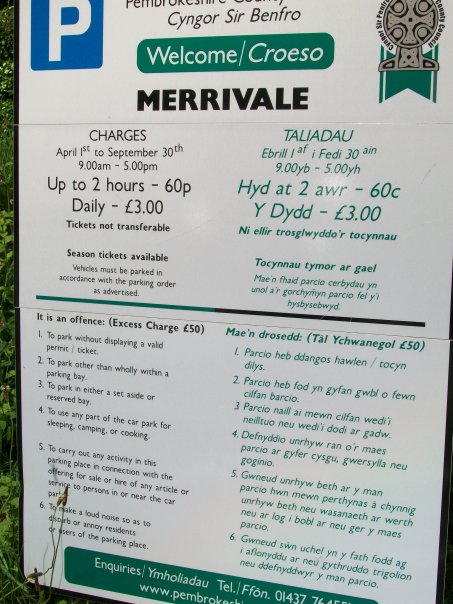
Back on the road, I asked, “How is it that Wales is part of the UK but still separate country?” Again, she tried, but it seemed to be another case of “it’s clear and obvious if you were raised here, and it’s hopelessly bewildering if you weren’t.”

We had dinner with Rebecca’s brother and his wife.  Rebecca referred to her sister-in-law’s “charming Welsh accent” but I couldn’t hear it.  We left their house early the next morning; ominous dark clouds and high winds increased as we drove toward St. David’s.

We found the campground at dusk, and when we checked in, the woman in the office retracted her lips and sucked in her breath.  She didn’t tell us we couldn’t camp, but she clucked and fussed with a worried frown on her face before she finally pointed out our site, on the edge of the cliff overlooking the sea.

How’s that for a cliff hanger?  Ha ha ha.

Updates Part II

In the prison good news / bad news” category, I’ve got some doozies.

First, I was highly amused to read about a brilliant project in which prisoners create portraits of people they think should be in prison. This was in The Guardian—a liberal British newspaper that reliably reports on the most embarrassing elements of American life:

“To find the artists, the activists approached art rehabilitation programs in prisons, but those groups were not interested in being involved with something political. So the pair turned to eBay, where there is a section devoted to art made by prisoners and sold by family members. They found similar prison art networks on Facebook and began conversations with the families of people whose worked they liked. From there, word spread around prisoners and other artists began sending them work.”

No surprise, they’ve captured (ha ha) the usual suspects (ha ha ha) in art: the Koch brothers, Goldman Sachs’ Lloyd Blankfein, BP’s former boss Tony Hayward. But then there was the CEO of one of my favorite companies, along with Pillow King and Bob Barker Inc. (that’s sarcastic, in case you can’t tell): JPay.

I was disappointed to see that the guy’s name is Ryan Shapiro. He must have a Catholic mom and a Jewish dad. I hate to see stories that reinforce the stereotype that Jews are better at making money than most people. Exploiting—oops, I mean “providing services” to prisoners and their families is very, very lucrative.

JPay Prez

Speaking of Jews and prison, a local organization called Jewish Community Action (JCA) has taken up two prison-related issues:

“Jewish Community Action is currently working on two campaigns related to criminal justice reform and the impact of mass incarceration: One addressing the for-profit private prison system and seeking to push back on the building and opening of private prisons in Minnesota, and one demanding the restoration of voting rights to felons who have completed incarceration and are living and working in their communities.”

I wrote to the executive director and shared the link to this blog. I can’t remember exactly what I wrote; I share the blog with a lot of similar organizations and usually hear nothing back. I mentioned that we’re Jewish and that we’d be happy to support their efforts if we were able. The executive director and two staff members replied—first, to assure me that ours is not the only Jewish family that’s had a run-in with the law or the prison system and second, to ask if Vince and I would come in and meet with them. That will be in a couple weeks and I’ll write more after we meet.

I am not a big fan of Oprah; I have nothing against her but she tends to promote books like The Book Thief, which I regard as one of the most poorly-written books I’ve ever read. But she is currently promoting a book written by an ex offender, Shaka Senghor, called Writing My Wrongs: Life, Death, and Redemption in an American Prison. Next week, Oprah will air an interview with Senghor on her network, OWN TV. I haven’t read the book; I’m only mentioning it because it’s written by an ex offender.

I’ve only ever read one prison memoir, and I can highly recommend it: Willow in a Storm, by James Peter Taylor. The writing is just okay, but the story is harrowing and heart breaking and he tells it real.

Finally, there is this (in the end) uplifting story about Albert Woodfox, who spent FORTY YEARS in solitary for the murder of a prison guard at Angola prison in Louisiana.  He maintained his innocence all these years.  He was released on his 69th birthday.

Updates

Travel, addiction, prison … sometimes I feel I have to justify why I write about these seemingly unrelated topics. How about this: they all fall under the meta theme of “feeling trapped, or just bored, and wanting to escape.” There—does that explain it?

I was at a big work meeting and we were discussing human rights in the countries where we operate in the Middle East and Africa. Someone said, “What about solitary confinement? Shouldn’t we be advocating against it?” Everyone clamored in agreement. As far as I know, I am the only employee with a family member who has actually been in solitary. I was tempted to raise my hand and make a speech about how, if we decided to advocate against solitary confinement, we’d damn well better include the United States. But I didn’t feel like being a spokesperson for prison reform that morning.

Vince is off lockdown, after a month of confinement to the house except for work and AA meetings. It may not sound that bad—after all he had Facebook and phone to communicate with friends. He could binge-watch movies and cook real food and look out windows and take a shower without 50 other guys around. He had a pretty good attitude toward it, but I know he was really chaffing toward the end. He had steadily been earning freedoms after his release, then they were all taken away. The offense was so petty compared to the consequence. Most of all, he just had no power or choice about his comings and goings.

Regardless, it’s over now, and today we are doing a make-up birthday outing for me—going to hear the Minnesota Orchestra play the entire score of Sgt. Pepper’s Lonely Heart’s Club Band, accompanied by some Finnish choir. I expect it will be either fantastic or dreadful.

Nothing has happened with the Sentencing Reform and Corrections Act of 2015 in the five weeks since I wrote about it and about how Republicans are using its bipartisan popularity to shove in language making it harder to prosecute corporate criminals.

Then there’s the controversy swirling around The Violent Crime Control and Law Enforcement Act of 1994, which is being blamed for creating mass incarceration. Bernie Sanders says he only signed it because of the good stuff in it, even though he disagreed with the sentencing parts. Hillary has been confronted by Black Lives Matter activists about ruining millions of Black people’s lives because she voted for it. Bill Clinton has disavowed it—his own law. I give him credit for that, even though it may only be a political tactic. Ugh. I would have to write five more posts to get to the bottom of that one, if I ever could.

Anyway, a poll from Pew Charitable Trusts shows that all Americans—Democrats, Republicans, Independents, men, women, Latinos, African Americans, seniors, young voters, and even law enforcement households agree we need to fix our broken federal prisons system. If you’re an American and you agree, please sign this petition urging Congress to pass the Act now. These are all the celebs who are endorsing the call for reform.

new_Cut50_Celebs-04_REVISED-900px

A lot of what I do in my job involves raising funding from foundations. I was happy to see that 42 foundations have banned the box on their employment applications that asks, “Have you ever been convicted of a felony?” This is really only symbolic, since foundations have abysmal records of hiring people of color or even just people who aren’t wealthy and well connected. But they are calling on all philanthropic institutions to follow suit, so maybe it’ll catch on.

Anytime anyone speaks out in support of ex offenders I am thrilled. The president of the Rosenberg Foundation, in announcing the foundations’ move, said, “It is time to end the pervasive discrimination against people with past criminal records. The era of mass incarceration and the war on drugs have done severe damage to families and communities, with an enormously disproportionate impact on people of color. Everyone deserves a second chance and the opportunity to compete for a job.”

Dakota Bound

I’m on a road trip! No, not to New Orleans. Believe it or not, I am going to meet with three potential donors in Sioux Falls, South Dakota. Yee haw!

Here’s the deal. The Center for Victims of Torture, where I work, does psychotherapy, physical therapy, and social work for survivors of torture and war trauma. We do it in groups in Jordan, for instance, because all the clients speak the same language. We do it on an individual basis in Minnesota, because clients come from 36 different countries and speak myriad languages which must often be translated, which doubles the time everything takes.

This is all good as far as it goes, except that there are an estimated 1.3 million torture survivors in the US alone. We do a lot of training to try to equip professionals outside of CVT to recognize and help torture survivors. But there’s also no way we can train every doctor, social worker, cop, or immigration officer that might come into contact with a survivor.

People have been talking about doing something with technology at CVT for years, but without funding that’s just dreaming. Part of my job is to find new sources of funding, and that’s what I hope I’ve done. I won’t bore you with the details, but there are three HUGE international development innovation funds that we hope to tap. To do this, we need to find partners who know how to reach patients in remote or difficult to access situations. That’s why we’re going to South Dakota.

It’s so important, when you’re trying to get people fired up about complicated ideas, that you have the right people on your team. My co-pilots on this trip are a colleague who is from Sioux Falls and whose father has opened some doors for us, and CVT’s clinical advisor for our international programs, who is Kenyan and a PhD psycholgist. He describes the needs this way:

In Nairobi, there are thousands of Somali torture survivors living in the slums who are not there legally, under the protection of the United Nations. They literally cannot leave their dwellings during the day, because the Kenyan police will round them up and shake them down for bribes. Which would you choose: Pay a bribe, or be sent back to Somalia where you may face certain death? They may not have iphones, but could we develop a text-based therapy intervention?

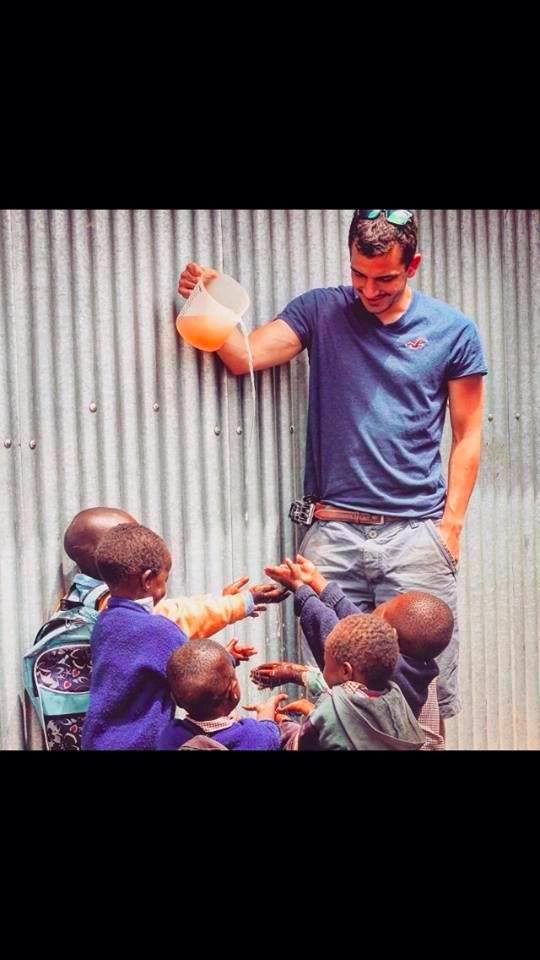
Among the survivors who are in Nairobi legally, there are many Congolese and people of other non-English speaking nationalities. Kenya is an English-speaking country. The refugee kids may have already missed years of schooling due to being forced to serve as child soldiers and living on the run or hiding. Now they spend 12 hours a day in school—regular school, plus an extra block of time added on to learn English. They have survived unimaginable horrors. Many of them need psychotherapy or physical therapy, but they don’t have time for it. Could we develop a game-like therapy intervention that would appeal to youth?

CVT also works in Dadaab, the largest refugee camp on earth, in northern Kenya near the Somali border. Its population is about the same as Minneapolis—about 350,000 people. Could we do tele-therapy with them—either mental health or physical? If so we could reach so many more people. We could also use videoconferencing to train our own and other organizations’ staff.


“Do they all have smart phones in Dadaab?” I asked. I have been to Nairobi but not Dadaab.

“I don’t know,” he replied. “We would have to do a survey to determine who has the old Nokias, how many have smart phones. The Chinese are making big inroads into the African market with cheap smart phones. Most Kenyans use their mobiles for everything. They don’t have tablets or desk tops or TVs or land lines. They’ve basically skipped over those generations of devices and they do everything on mobiles.”

I love projects like this. They’re big, messy, uncertain, and complicated. They require me to work with people with whom I don’t normally interact. They may have big payoffs. And in this case they require a road trip.

Reductive Seduction

There’s a great article circulating among international development people that also addresses mass incarceration in the US. Who knew there were so many connections between these two worlds of mine?

Written by Courtney Martin, it’s titled, “The Reductive Seduction of Other People’s Problems.” I’ll quote the opening here:

“Let’s pretend, for a moment, that you are a 22-year-old college student in Kampala, Uganda. You’re sitting in class and discreetly scrolling through Facebook on your phone. You see that there has been another mass shooting in America, this time in a place called San Bernardino. You’ve never heard of it. You’ve never been to America. But you’ve certainly heard a lot about gun violence in the U.S. It seems like a new mass shooting happens every week.

“You wonder if you could go there and get stricter gun legislation passed. You’d be a hero to the American people, a problem-solver, a lifesaver. How hard could it be? Maybe there’s a fellowship for high-minded people like you to go to America after college and train as social entrepreneurs. You could start the nonprofit organization that ends mass shootings, maybe even win a humanitarian award by the time you are 30.

“Sound hopelessly naïve? Maybe even a little deluded? It is. And yet, it’s not much different from how too many Americans think about social change in the ‘Global South.’”

These are real Tindr photos from her article:

World SaverWorld Saver2

Martin goes on to write about the problem of mass incarceration in this country—where are all the new graduates lined up to campaign for change on that? I’ve never met one. I have, however, met many young people who fervently want to work for my organization. Whenever we post a job, we get hundreds of applications, even for admin positions. We get a lot of candidates who can recite all 30 articles of the Universal Declaration of Human Rights, but they can’t enter names into a data base without lots of mistakes. They have no interest in fundraising, finance, HR, or any of the other jobs that keep a nonprofit organization humming. They want to get their foot in the door, then jump to the first “meaningful” job that comes open.

They’re not bad people. I don’t blame them for wanting a job that might send them off around the world to help torture survivors, a job that will cause their peers to fawn over them with admiration. As an English friend once said, “You’ve got a job that’s every Lib Dem’s wet dream.” I once had a woman bow down to me when I told her where I work. Super uncomfortable.

And let’s face it, for those of us who crave the exotic, Nairobi fits the bill a lot better than Moose Lake, Minnesota.

When I was in the Occupied Palestinian Territories … there — I did that thing that my set does. We start sentences with, “When I was in Peru …” or Ethiopia, or wherever. I’m sure people who don’t travel to those places, or who wouldn’t be caught dead in those places, find it really annoying.

But, when I was in the Occupied Palestinian Territories, I was invited to write an article about it for a local publication. I did, but I also wrote about Vince’s being in prison, mass incarceration, and how people in the US seem to care a lot more about Palestinians than prisoners who live a few miles away. I can’t be sure why, but they never published it.

You may be thinking, “Who is she to criticize–why doesn’t she work on prison reform?  Erm…I am, in my own way.  There’s nothing wrong with wanting to work on international issues; just be aware of your motivations and your ego.

To quote Martin’s article further: “Most American kids … have some sense of how multi-faceted problems like mass incarceration really are. Choosing to work on that issue … means studying sentencing reform. The privatization of prisons. Cutting-edge approaches already underway, like restorative justice and rehabilitation. And then synthesizing, from all that studying, a sense of what direction a solution lies in and steadfastly moving toward it.”

Maybe Martin’s article will inspire someone to become the Martin Luther King Jr. of prison reform.

Via con Dios, Cuba

This is the eighth post in a series about Cuba that starts here.

We flew back to Havana without incident and checked back in to our dark, quiet-as-a-graveyard hotel.

Here’s another thing I didn’t get while I was there and I can only make up an explanation for you now: I attended a Passover Seder in Havana—Seders remained legal after the revolution. I also attended an Easter mass—and was told that masses had just been legalized. Why would Seders be legal but not masses?

It could be because almost the entire Jewish population of Cuba fled the country after the revolution. After all, we’d seen this movie before. Why wait to find out the ending? Only 1,500 Jews remain in Cuba, compared with 60% of the population that is Roman Catholic, or 6.5 million people. Which would you find more threatening?

The Seder was a community one at a synagogue. It was packed, as Seders always are; there were Jews from the Bahamas, Texas, Israel, and lots of American students. I sat across from a pudgy, red-headed oaf from Indiana or somewhere in the Midwest who was married to a Cuban woman who looked like Bianca Jagger in her heyday. I’m sorry to say that my people are not immune from the syndrome where misfit western men snag beautiful wives in the developing world. But that sounds mean. I only sat across from him for an hour. Maybe he was usually courteous and kind.

On our last night, we were invited to a “Defense of the Revolution #62 Block Party.” Other members of our group had been to these before and told me that neighborhoods organized them to thank visitors for their donations. This in no way prepared me for what I saw when I stepped off the bus.

I thought there must be some mistake. Had we stumbled upon a protest? A wedding? A baseball game? No, these hundreds of people were waiting for us. There had to be at least 200 people out on the street, with precious, expensive electric lights strung up festively, a band and a dance area, and tables laden with food.

Ed and some of the other guys unloaded the medical supplies we had brought; I have no idea where they had been stored all week. Our donation consisted of bandages, cotton balls, and Q-tips—granted there were crates of them, but still … here were hundreds of people lined up to greet us as though we were foreign dignitaries or rock stars.

I was stunned and embarrassed. Our donation was puny compared to the effort they were putting out. Plus, I had agreed to interpret Ed’s remarks into Spanish. I had pictured half a dozen people, not hundreds.

Mi en Cuba

I managed to stammer out a few remarks into a microphone. Everyone applauded as though they had understood me. I fell back into a chair and they brought me a plate of food. It all tasted like dessert because even the savory foods were loaded with sugar. The music and dancing started, and our group was forgotten. I realized this wasn’t about us—it must have been the case that Cubans are allowed to hold big gatherings like this if they had a patriotic reason. I don’t know for sure, but maybe we had given them that reason. Bringing gifts gave them an excuse to show us their stuff, and stay up all night having a good time. Who knows?  Another mystery.

On our bus ride back to the hotel late that night, our guide explained that there were no extremes of rich and poor in Cuba. Yeah, I thought, because all the rich people skedaddled to Miami. He kept referring to “the special period” and I asked Ed to explain. “That’s when the Soviet Union collapsed and Cuba lost all its subsidies,” he said. “It can’t survive under the U.S. embargo without a patron.”

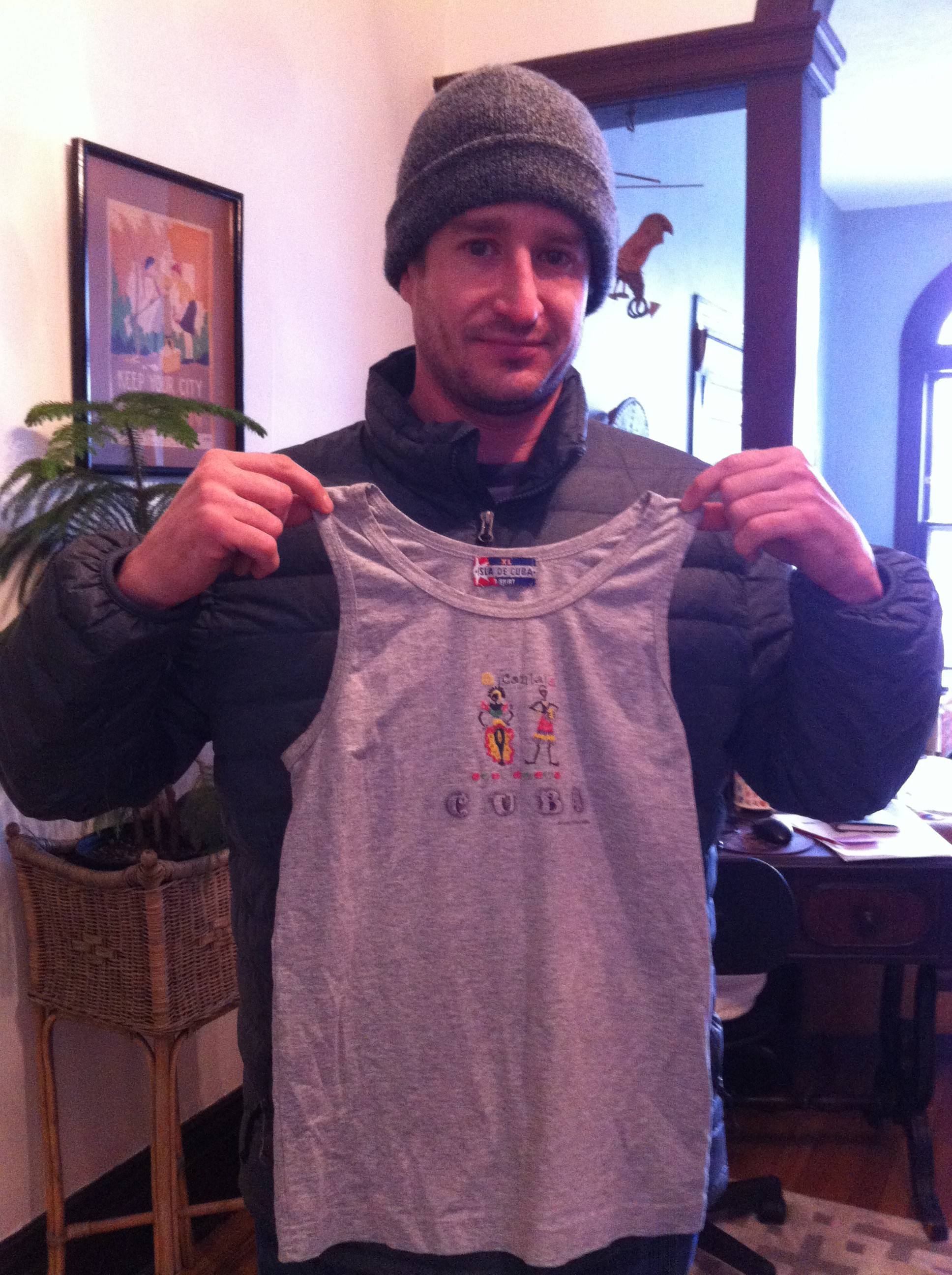
When we checked out the next day, the guy at the desk offered T-shirts for sale, as modeled here by Vince. It’s an extra large. Right—for a Cuban, maybe.

Cuba Tshirt

I hope this series has been food for thought as Americans consider electing Bernie Sanders, a Democratic Socialist, for President.

Gittin’ in Trouble

This is the seventh post in a series about Cuba that starts here.

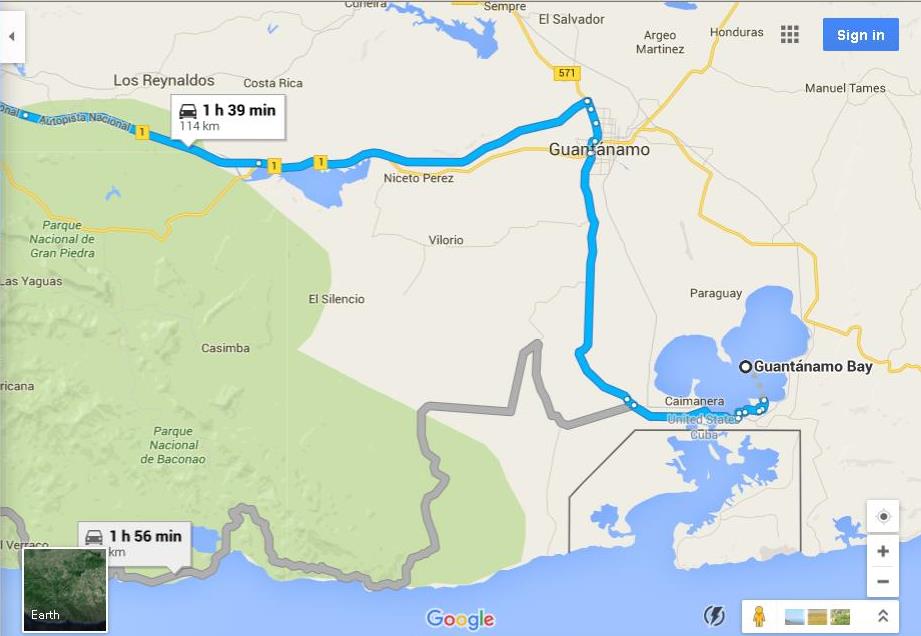
Before we left Santiago de Cuba, we took an excursion to the nearby Parque Nacional de Gran Peidra—a sort of national park. I love the outdoors and got excited that we might go on a hike, but we only skirted the park on our way to our real destination, Guantanamo Bay.

If you look at Google maps, it’s really confusing. What you would think was the U.S. territory with the detention center is marked as Cuban territory. Google has steered me wrong before, mostly memorably in Nairobi where it sent me to a slum instead of to the Ford Foundation’s offices, so I would never count on it except for a rough approximation.

Guantanamo

There was excitement on the bus as we got closer to Guantanamo. “Get out your OFAC letter!” someone exclaimed. “We’re being tailed by the CIA!”

As I mentioned previously, we were required to carry letters from the U.S. Office of Foreign Assets Control at all times to show we were there legally. I couldn’t imagine we would get anywhere near Gitmo—you didn’t have to see it to know it would be surrounded by 20-foot razor-wire fences and heavily-armed guards. What were we going to do, ram the gate? That would put a crimp in my plans to apply for jobs with the CIA and the Foreign Service!

But then the bus stopped, and most of us waited while a couple of Interfaith Task Forcers got off and held an animated conversation with the driver and our guide. Then we turned around and went back to Santiago. I will never know how the leaders of the Task Force talked our guide and the Cuban bus driver into driving to Guantanamo Bay, or how close we really got, or exactly where its limits are.

That’s the thing about travel, if you’re doing it right. You’ll come home shaking your head and laughing to yourself because there was some mysterious situation for which you’ll never have an explanation. That’s assuming no one got hurt or arrested, of course.

Now that I am working for the Center for Victims of Torture, it would be hugely prestigious to be able to say casually, “I was arrested at Guantanamo a couple years ago.”

CVT has been active in advocating for the closure of Guantanamo. First—obviously—because we, torture people there (yes, we, if you’re an American). Half the American population (and I think we can guess who their presidential candidates are) believe there’s nothing wrong with torture. “How we gonna catch the bad guys if we don’t torture people, huh?”

I could write 10 posts about why that’s a dumb statement, but for now I’ll just say, if you think torture is okay, go read someone else’s blog. And even if I thought it was okay, it’s still illegal.

The Universal Declaration of Human Rights, which came about in response to the WWII and specifically the Holocaust, outlawed torture. Ronald Reagan signed the international Convention Against Torture in 1984. President Obama issued an executive order on his second day in office banning torture. In November last year, Congress passed the National Defense Authorization Act, which “placed all U.S. government interrogations under the United States Army Field Manual on Interrogations, and requires that the International Committee of the Red Cross have prompt access to all prisoners in United States’ custody.” In other words, there are grownups in charge now.

Very few people know everything that’s gone on at Gitmo, but we do know that people have been detained indefinitely, without charge or trial. If you imagine yourself in one of those prisoner’s paper slippers, you will understand why they go on hunger strikes. We then subject them to another form of torture, forced feeding. If you wonder, “how bad could that be?” watch this video of the rapper Mos Def being force fed; he volunteered to show us what it really involves.

Back in Santiago, none of this was on my mind. My biggest concern was finishing my master’s and getting a job. Vince’s time in prison, and researching prison for this blog, changed all that.