Tag Archives: human rights

When Worlds Collide

I’ve been writing a series of posts about traveling in Cuba that starts here. I am pausing that for a day to write about an unsettling experience where my worlds collided.

I volunteer with the Minnesota International NGO Network, or MINN. MINN is composed of Minnesota companies and nonprofits that work overseas, like my employer, the Center for Victims of Torture (CVT).

Last year MINN launched a class called MINNspire, which helps 50-somethings to explore doing something abroad. This could be anything from volunteering with Peace Corps, to teaching English as a second language, to consulting on communications, as I have done. MINN isn’t there to find them placements; we’re there to guide them through the thought process. I led one of the four sessions last year and will do the same this year—I think.

I was excited that we had 18 people registered—about twice the number as last year. It’s kind of a big commitment to come to something after work, in the dark, during the winter.

I walked in and said hi to my friend Carolyn, one of the four facilitators of the class. There were already two students in the room. Carolyn said to me, in a way that told me we might have an “issue”, “Something really interesting happened with registration. I spoke to a Rotary Club that happened to have a lot of members of the DOC, and we’ve got 10 people from the DOC registered for the class.”

The Department of Corrections. The people I never wanted anything to do with, ever again.

I had come from work, where I had spent the day writing about Eritrean torture survivors. Eritrea is known as the “North Korea of Africa.” They have forced conscription, which means every young man must join the military or go to prison. In the military, they are worked like slaves and their service is indefinite. If they try to escape, Eritrea throws them into underground prisons where they are tortured. If they make it to Ethiopia, they wind up in refugee camps with no future, and their family back home is persecuted. Sometimes they try fleeing to Israel, the one country that reluctantly takes them in, but often they are caught by—essentially—desert pirates called Rashida who hold them for ransom, torturing them while their families listen helplessly on the other end of the phone.

As you might imagine, a lot of Eritrean torture survivors have PTSD, and that is where CVT comes in. We provide trauma therapy and we hope to add physical therapy next year.

So I was writing about this all day and then I stepped into a room of people who had been my and my son’s tormentors for a year and a half.

I am in no way comparing what I went through to what Eritreans have endured. My point is that I know firsthand what a flashback feels like. A surge of adrenaline surged through me. My heart started racing and my palms got sweaty. I felt a powerful urge to bolt.

“I figure if I was a prison warden for 20 years, I can do anything!” one of the women exclaimed. The thought of her volunteering in an orphanage made me uneasy.

“My son just finished the boot camp program,” I told them. Might as well get it out there before she said something that would cause me shoot my mouth off. They oohed and ahhed said what a great program that was.

Carolyn knows my back story and has a high EQ.   She emailed later:

“I would never imagine that you would come face to face with your oppressor in MINNspire.  I mean, last year you were in Palestine, looking for ways to collaborate, professionally, with enemies of the Jewish state and now you come to St Paul and you are asked to teach the people whom you’ve written about for years.

“ I have to shake my head at what the universe is throwing at you.  But if anyone can handle it, you can.”

I hope she’s right, because I thought about backing out of the class but I’ve decided to stick it out.  I’ll keep you posted.
Sig Heil, la Revolucion

This is the sixth post in a series about Cuba that starts here.

I was in Santiago de Cuba with my 82-year-old new best friend, Shirley, and the Marin Interfaith Task Force on the Americas.

We went to hear music, the ostensible reason we had flown over 500 miles in a Russian rust bucket of a plane with pilots who worried about funny noises. The music happened in a very decrepit but charming sort of open hall with cavernous ceilings and rickety benches for seating, if you could find a space to sit. The walls had peeling layers of old paint in different colors; I knew people in the states who would have paid big money to get that look.

“These guys are famous!” exuded Ed. “I can’t believe how lucky we are to hear them live!” I had never heard of the band and couldn’t tell them from the ones that preceded or followed them. Not that they weren’t great—to my unsophisticated ear they all sounded marvelous. There were no CDs or T-shirts for sale, and no posters I could take a photo of to help me remember who they were.

The next day we toured Castillo de San Pedro de la Roca, a 17th Century Spanish fort. All I remember about that is how hot, hot, hot it was, and how I kept trying to find a sliver of shade to stand in while the guide yammered on about history.

We went to a (thankfully) shaded glen to listen to a priestess speak about Santeria, an African religion practiced in some parts of Cuba. There were endless gods and goddesses of wind, water, fire, battle, fertility, and so on. It was all very interesting but I forgot all of it by the next day. I have friends who can recite historical dates and names—in which year the artist Diego Blahblabla painted that Madonna with child in that old church in such-and-such a small city. But not me. If I hadn’t jotted notes each night in my hotel room I would never have remembered as much as I have here. And of course the great goddess Google has helped me reconstruct a lot as well.

We toured a primary school. Our guide explained that education was compulsory to 9th grade, so everyone can read and write. Well education is compulsory through 10th grade in the U.S., but that doesn’t mean everyone can read and write. There are things you hear on tours in other countries that are just best to keep your mouth shut about.

The guide told us about the Cuban emphasis on arts—painting, music, dance, literature. Everyone played a musical instrument, wrote poetry, or could illustrate a point with interpretive dance. Then there was the love of baseball. All boys played baseball and loved it. So much for women being full comrades. I figured there were at least a couple boys who did not love baseball and would have preferred to be ballet dancers. In my head I heard my friend Bette, the one who is married to a Cubano who has made documentary films about baseball, saying “They promote the arts and baseball because they are disciplines. They distract people from how hunger, and their lack of basic rights.”

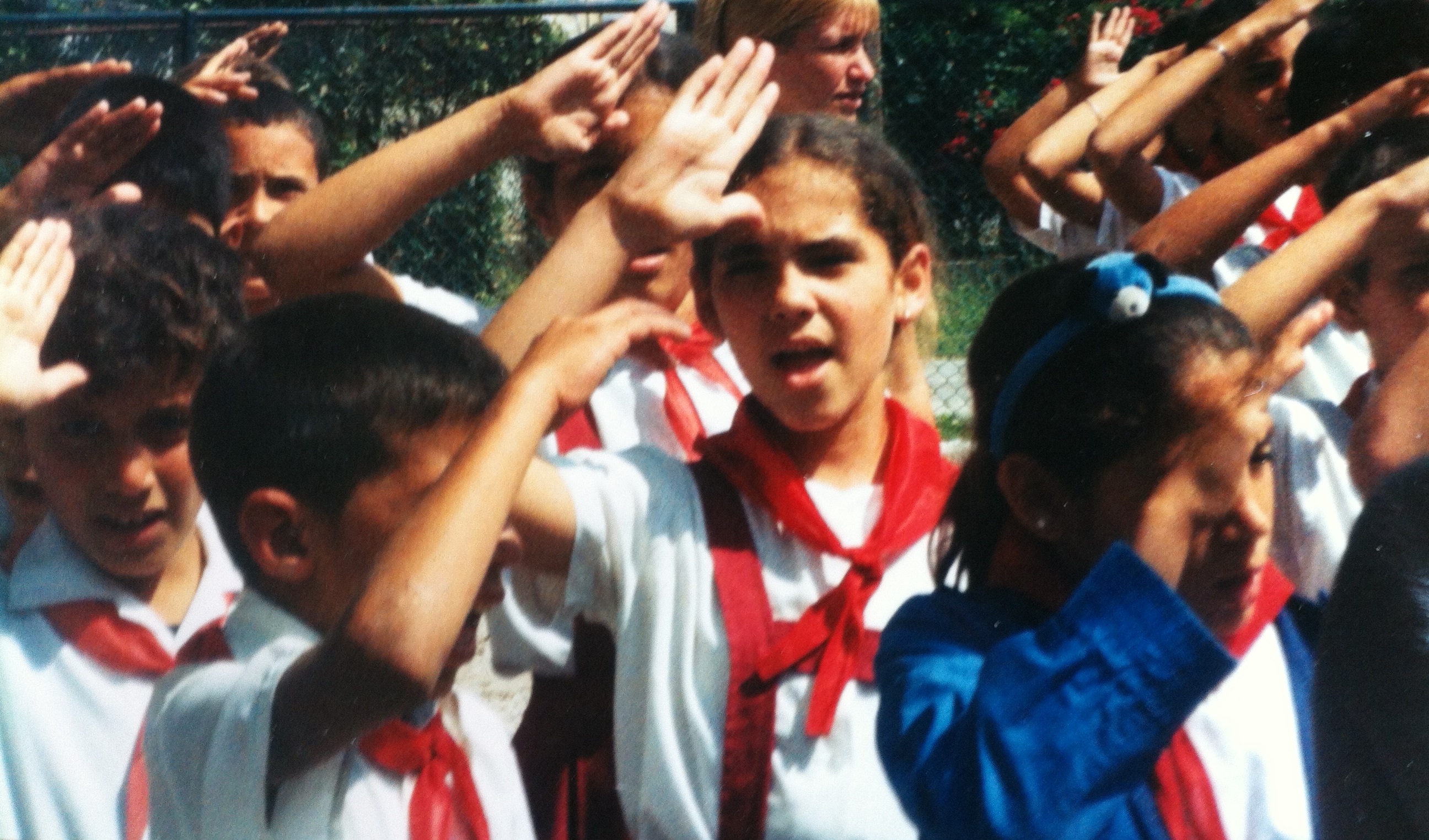
Our guide paraded the children out onto the playground for us, where they sang a patriotic song and made a disturbing gesture very much like the Hitler salute.

Cuban Kids

We went inside and viewed an empty classroom, which had rows and rows of new computers. “These were donated by the Spanish government,” our guide said proudly.

This was when I forgot to keep my mouth shut. “So the kids can surf the Internet?” I asked.

“These computers are state of the art,” the guide continued, ignoring my question.

“Do you get a fast Internet connection?” I kept on, cluelessly.

“They have the highest memory capacity available in the world.”

Oops, I finally got it. There was no Internet. Nowadays Cubans can buy “access”—meaning the government blocks many sites and monitors what users look at—for $2 an hour, a huge expense for the average person who earns $20 a month.

Beinvenidos al Hotel California

This is the fifth post in a series about Cuba that starts here.

After a few days in Havana we packed our bags and flew to Santiago de Cuba, a city on the other end of the island. The plane took off as soon as the last passenger stepped on board, half an hour before our scheduled departure. What if that person had been half an hour late? Would we have waited for him?

The plane was basic. The little signs you see in planes, the ones that say, “Fine for Tampering with Smoke Alarm” were in Russian. At least, I assumed it was Russian, and that they said the usual things. The seat tray in front of me was a piece of plywood held in place by chains and hooks that would have cost $5 at Ace Hardware. As we ascended, mist seeped into the cabin. No one else seemed alarmed so I tried to stay calm.

About an hour into the flight, the co-pilot came on to make an announcement. I could understand his Spanish perfectly; maybe he wasn’t Cuban. I was happy to be able to tell my group what was going on. “Ladies and gentlemen,” I translated, “We are hearing a strange noise somewhere in the aircraft and we can’t figure out what it is, so we’re going to turn around and go back to Havana.” Everyone laughed nervously, then fell silent as the plane banked steeply.

We sat on the ground in Havana for a while before taking off again. “Ladies and gentlemen,” the co-pilot said as we took off, “We apologize for the delay. The pilot is new and neither of us has flown this kind of plane before.” What “kind of plane” did he mean, I wondered? A Russian plane? A run-down plane? There was no mention of the funny noise. Presumably whatever had been rattling had been fixed, or determined to not be life threatening.

The first thing you notice about Santiago is that it is HOT. Hot as hell and humid. I don’t mind heat to a point, but if it’s too hot, this Minnesota-bred traveler’s brain and body become lethargic. We had flown almost 550 miles to experience “real” Cuban music that could not be heard in the capitol. I’m not a music connoisseur; most music sounds good to me unless it’s horribly out of key or country (which seem like the same thing to me), so I was skeptical.

We were transported to our “hotel”, which seemed to be some kind of abandoned camp compound with whitewashed, cement buildings spread out over several acres. I checked into my room and collapsed onto the bed, so out of it that I wondered if I was being drugged. Of course there was no air con, not even a fan, and no window screens, which allowed clouds of gnat-sized mosquitos into the room. The walls were bare and white, there was a bare bulb overhead and a double bed with a thin white sheet. The bathroom was the same as in Havana, with one threadbare towel and transparent toilet paper but instead of a flimsy toilet seat there was no toilet seat. Nice!

I turned on the black and white TV and there was only one channel; I believe Bonanza was on again. I groaned and attempted to wrap myself in the sheet like a giant burrito to keep the mosquitos at bay.

I woke up to knocking.

“Come to the pool!” a woman’s voice called.

Pool!? I detangled myself from the sheet and saw that my left arm, which had fallen out of the burrito, was covered with hundreds of tiny red welts. I flung the door open and there was one of my fellow travelers, an 80-something lady who had been subjected to a strip search at the airport upon our arrival and had taken it all in stride. She had a bottle of rum in one hand and a cigar in the other. Ten minutes later we were floating on a life preserver in the deserted but clean pool, sipping smoooth rum out of the bottle and smoking an even smoooother cigar. Cuba was heaven.

Cigars? Cigarettes?

This is the fourth post in a series about Cuba that starts here.

I was in Havana with the Marin Interfaith Task Force on the Americas, which has a tour coming up in April if you’re keen to visit the island.

Before the U.S. began its rapprochement with Cuba, Americans either had to go there illegally by flying from Canada or Mexico, or were required to have permission from the U.S. Treasury’s Office of Foreign Assets Control, or OFAC. And on these government-sanctioned trips, it wasn’t like you could just do whatever you wanted; the itinerary had to be vetted and approved and you couldn’t go off leash from your tour group. We carried OFAC letters on us at all times and, according to Ed, our Marin Task Force leader, OFAC probably had someone tailing us. And our Cuban guide was probably reporting back to his masters about … what? As I wrote in the first post, the Task Force was composed of a bunch of old hippies and me. But maybe the Task Force had been infiltrated by the CIA, and Ed was a plant?

I think in 10 years we will look back on this period and laugh about it. It was very cloak and dagger, and needlessly so.

I know, I know, you want me to stop going on about the politics and write about the rum and cigars and food and music, right?

Okay. First, the food. Everywhere we went, it was pretty much the same. Chicken, rice, and cabbage. Rice, chicken, and cabbage. Cabbage, chicken and rice. Obviously they had no problem providing themselves with these staples. According to Ed, the CIA had purposely introduced a swine plague that killed all the pigs on the island; that was why there was no pork. Why they couldn’t have grown something colorful–a little Swiss Chard or some carrots, I don’t know.

If you like sugar, you would love Cuba. Every drink is loaded with it, and we were offered desserts galore. The Cuba Libre was the standard drink, and it seemed to contain rum, mint leaves, and about a half a cup of sugar.

We toured a rum factory, which looked like something out of Victorian England. It appeared to have been built and hundred years before and never updated. Not that there’s necessarily anything wrong with that—they certainly cranked out some smooth rum. We all bought bottles “to support the economy.”

We toured a cigar factory. The images here are from the Great Google but look similar to my tour, during which we weren’t allowed to take photos.

Cigar FactoryCigar Factory 2

The cigar factory is the single most vivid memory from the trip because the aroma was like nothing I’ve experienced before or since. Heavenly.

I bought a box “for a friend.” This is one of the reasons I love travel. I spend money on things I would never buy at home, and I can tell myself they’re gifts or that I’m supported a developing economy. And then I can enjoy them myself.

The cigar factory was also notable because it was a multistory, rickety, wood frame building. It reminded me of a barn inside, with bales of tobacco leaves piled around the perimeters and men standing at wooden tables in the center rolling the cigars (and cigarettes) by hand. One match and the whole place would have gone up like a roman candle. The workers were allowed a cigar allowance, we were told.

This seemed contrary to the anti-smoking campaign I’d heard about, in which Fidel was lauded for quitting and everyone was encouraged to follow the example of el Comandante Jefe.

When I returned to my hotel room and went to put my bottle of rum in the fridge, I found two eggs inside, wrapped in an embroidered handkerchief. Were they a gift, or had the maid forgotten her lunch? If they weren’t a gift, maybe the dancing lady hadn’t been a gift either. Maybe I should leave some money for it? I left a $10 bill with a note in my execrable written Spanish that this was for the beautiful dancing lady. I hoped the same maid came every day so there wouldn’t be an unfortunate misunderstanding.

¡Me Encanta Bailar!

This is the third in a series of posts about Cuba which starts here.

We checked into our hotel, the Habana Libre, a mid-century modern. It must have been splendid in its heyday. It wasn’t run down so much as dead. Deathly quiet, no people except the guy at the desk. The lights were dim. We made our ways to the elevator and when I got off at my floor it was so dark I had to grope my way along until my eyes adjusted to the dark. The room was spacious and clean if Spartan. It was as if slowly, over the years, the art, the phone, the clock alarm, the drinking glasses, every little comfort you expect in a hotel had been stripped away.

In the bathroom I had my introduction to some of the disconcerting results of the U.S. embargo. In particular, crude oil, with which plastic is made, was banned, and so the shower curtain was about as thick as a Walmart bag, and the toilet seat was like a large white Frisbee with a hole in the middle—so thin it couldn’t be well secured to the toilet so it slipped around underneath me. The toilet paper? Well let’s just say that if you toilet papered someone’s house with it, the first light rain would wash it away, it was so insubstantial. There was no soap or shampoo or washcloth but there was a towel—one—also so thin and threadbare you could hold it up to the light and even that dim light showed through it. I was the only one who got off at my floor; it seemed like they had distributed our group one or two people per floor.

There was a mini refrigerator with nothing in it and a black and white TV. I flipped it on and there seemed to be two channels: one with old American TV shows like Bonanza, the other featuring nonstop speeches by various politicians. This was when I discovered that all the hard work I had invested into studying Spanish would really pay off. Not! Cuban Spanish is so different, and so fast, that a lot of Spanish speakers from Mexico or Spain have a hard time understanding it.

Suddenly, there was a hard knock at the door. I jumped and yelled, “Who is it?” then, “Quien es?” The knocking continued so I went right up to the door to see if I could see anything through the peephole but whoever it was must have been standing to the side. I repeated, “¿Quién es?” then “Que quieres?” The knocking stopped, then a woman’s voice shouted something that sounded like “Pocky robbabab ocalaca macanaca!” She said it with great gusto. Was she being attacked? Should I open the door and let her in? There was no phone from which to call the desk, and even if I had had a cell phone twelve years ago there would have been no reception in Cuba. The pounding resumed, along with more incomprehensible Spanish and shouting. Eventually she must have given up and gone away.

The next day our group had a walking tour around the city. I had been to Mexico, Jamaica, and to El Salvador, so I wasn’t a complete newbie to the developing world or Latin America. I had also lived in some pretty poor neighborhoods in St. Paul. I was struck by how there were no homeless people here, no beggars, no children selling Chiclets. There was no graffiti or litter. Was that because people couldn’t buy anything, so they had nothing to throw on the ground? Or would they be thrown in prison if they did? Or was it all a front for tourists?

I returned to my room without incident and found this sitting on my bedside table.

Cuban Dancer

Who had left her—was she a peace offering? Anyway, she’s come with me on my travels ever since. When I get to wherever I am staying in Nairobi or Dubai or Dublin, I set her on my bedside table. Her head got lost somewhere along the way, which maybe symbolizes even more the carefree traveling spirit I endeavor to be.

All for None, None for All

This is the second post in a series about Cuba that begins here.

I searched for my photos from Cuba and since I was well organized back in the day when we printed photos and put them in albums, I was able to find them quickly. I realized it’s been 12 years since I went to Cuba. That adds weight to my disclaimer that things have changed from what I’m going to describe. Mainly, everything has gone downhill.

I met my fellow travelers in the Miami airport. There were two dozen of them and I must have brought the average age down to about 60 when I showed up. They were pretty much as I expected; all the men had grey beards and ponytails and the women wore long tie-dyed skirts with Birkenstocks. They were a nice bunch of people, mostly couples but as usual on tours there were a few divorcees who put the tank in cantankerous. Ed was our leader. He had been to Cuba many, many times and he would be indispensable in interpreting what our guides said. Not because they spoke Spanish—because they had to speak Propaganda. Of course Ed had his own agenda, so much remained a mystery.

All the other people waiting for the flight to Havana were Cuban Americans, and they also fit a stereotype. Picture Desi Arnaz, then picture him about 30 pounds overweight, wearing an untucked-in Guayabera shirt, the flashiest designer sun glasses you’ve ever seen, dripping with gold chains, bracelets, rings, and a watch as big as Big Ben.

Ed explained to me in a low voice, “That’s how they get funds into the country for their relatives. They can’t smuggle dollars in, but their family can sell that jewelry on the black market.”

What struck me almost immediately upon arrival was that there was no advertising. There was propaganda galore—on wall murals, billboards, and ubiquitous images of Che and Fidel and other revolutionaries. But there were no billboards for products like laundry detergent or for stores or restaurants—because there were no stores or restaurants. There was almost nothing to buy, anywhere.

Che

But who needs stores when everything is provided by the state? “From each according to his ability, to each according to his need,” is the saying popularized by Karl Marx. Every Cuban got a house, medical care, electricity, food, an education—and cigars! The house might be about to collapse, the electricity might be out for hours a day, and the food might be basic (rice, chicken, and beans), but they could all depend on their monthly rations.

Everyone had a job, too. I had doubts about whether “ability” was factored in. I used a restaurant bathroom and was dismayed to find the toilet was broken. An elderly woman appeared with a bucket of water and dumped it in. Was that the best job they could come up for her based on her ability? No, Ed explained. Aside from professions like physicians, everyone was just assigned a job that needed doing. Or a job that didn’t need doing. These “make-work” jobs were in evidence everywhere. We were told to get in a van so we could be driven 25 feet from Point A to Point B at the airport. There were people sweeping clean sidewalks and guards guarding empty buildings. All of them—doctor, driver, toilet flusher—earned about the same per month.

There was one government-sanctioned store called a dollar store. American dollars are the currency in Cuba, and I mean cash. There were no ATMs, no credit cards or checks accepted anywhere, even at the hotel.

What was for sale in the dollar store? Nothing touristy, and nothing for a dollar. Everything was expensive. The store was tiny but packed in everything from clothing to washing machines. It reminded me of an old timey Woolworths, with no American goods, of course. There was an appliance brand called Vince which I assumed was Spanish or Italian. Trade with Cuba was in defiance of the U.S. Government, Ed said later. Spain was also financing renovation of the historic waterfront, the Malecon, on and off—the pauses due to bullying threats from the U.S.

Malecon

¡Cuba, si!

There’s a lot of interest in travel to Cuba now. That is, travel by Americans, because most everyone else in the world has been going all along.

If you were to tell me, “I can only afford one trip this year. Where should I go?” my answer would be, “¡Cuba, si!”

Why? Because it’s the most different place you can go and not worry (too much) about being thrown in prison for 10 years.

I don’t know for sure, but I think most Americans imagine Cuba is a poorer version of Mexico, with better music and more baseball. Cuba is a lot poorer than Mexico, and there is great music and an obsession with baseball, but it’s more like Russia or China than the rest of Latin America.

Think about it: It’s a socialist country. If you harbor romantic ideas about communism or socialism, go to Cuba.

I went to Cuba about 10 years ago. I had been writing papers about the Cuban Missile Crisis for my master’s program, and my friend Bette was married to a Cuban guy named Lumino. Lumino was only allowed to visit Cuba, where his children and grandchildren lived, every two years. “Each time we go,” Bette told me, “It’s more desperate than the last visit.” She gave me a book titled Cuba: Neither Heaven nor Hell. I was intrigued.

So one cold Minnesota day when I had nothing better to do I Googled “tours to Cuba” and up popped the Marin Interfaith Task Force on the Americas. Within a couple hours I was signed up to go on a legal trip to Cuba.

I love it when trips come together like this, spontaneously and easily.

The Taskforce is basically a bunch of old hippies who live in the richest county in America (I don’t know how that works). They’ve been agitating against U.S. meddling in Latin America for decades. One of their strategies is organizing mission trips—not in the religious sense but to learn about situations on the ground first hand, to show solidarity, and to introduce new people to the cause.

There’s also the little fact that, in order for Americans to visit Cuba back then, they had to be on some sort of official mission. We were supposedly humanitarians on a medical mission to deliver medical supplies. While Cuba has one of the best public health systems in the world, they were so financially strapped due to the U.S.’s strangulating policies that they lacked basic things like soap and bandages. I write in the past tense because this is changing. But it will take a while to make up for decades of deprivation.

I want to note here that the Taskforce has a trip to Cuba coming up in April. The theme is “Environmental Justice in Cuba: A Study of Cuba’s Environmental and Social Policies and Practice.”

Anyone can join them; as their flyer says, “All are welcome to join this delegation! Professors, Students, Researchers, Activists!” They’ll tour Havana and the western provinces over 10 days and the cost is about $2,700, which includes everything except maybe your flight to Miami from wherever you live.

If you think that sounds expensive, I cannot emphasize enough how valuable it is that the Taskforce secures your travel visa for you and works with a tour company that knows the ins and outs of making arrangements in a country where everything is a mystery to outsiders. Plus, you would be covered by Cuban health insurance while you’re there! Ideally you don’t want to get sick or injured at all, but how cool would it be to experience the Cuban health system first hand, especially since I delivered a case of bandages to them 10 year ago? You’d have dinner party invitations for years based on that story alone.

I used student loan money to pay for my Cuba trip. I know, I know that’s a big no-no. You’re only supposed to use student loan money for tuition and education-related expenses. I would argue that actually going there was a much better education than reading books and articles and writing papers about Cuba. I’ll write about it in my next few posts.

UN-Doing the War on Drugs

I ended my last post by saying I would write about a road trip I am contemplating, from St. Paul to New Orleans.  I don’t know enough to write about it yet, so for now I will revert to one of this blog’s main topics, addiction—and all the consequences of addiction and trying to stop it.

I’m very excited that the United Nations will hold a review of the whole drug control system in April in New York.  It’s called the Special Session of the United Nations General Assembly on the World Drug Problem, or the horrible acronym UNGASS. I’d like to thank the Open Societies Foundation (OSF) for its reporting on this.  OSF promotes research documenting the heavy costs of the war on drugs and shares success stories from countries that have implemented smart policies.  I’ve plagiarized their recent blog posts quite heavily here.

The last time the UN had a special session on drugs, in 1998, the focus was “the total elimination of drugs from the world.”  Ha!  I wonder if there were any actual addicts or former drug dealers involved in coming up with that totally unrealistic goal.

Because it didn’t go well.  The war on drugs has led to public health crises, mass incarceration, corruption, and black market–fueled violence.  Governments—especially those in Latin America that have to deal with the fallout of bad drug policies—have pushed for this UNGASS.

Citizens are fed up too.  A few years ago, a coalition of organizations and individuals in Uruguay pushed until the country voted to become the first country in the world to establish a legal, government-controlled marijuana market.  The main objective of the law was to eliminate narcotrafficking.  But they also have a positive goal, to make the new marijuana production chain beneficial for poor segments of society and a sustainable business for small producers with limited resources.

For the first time, there is significant dissent at the local, national, and international levels.

UNGASS is an opportunity to put an end to the horrors of the drug war and instead prioritize health, human rights, and safety.

I didn’t even know that there was an International Narcotics Control Board, did you?  That sounds creepy.  And it acts like a bully, apparently.

For instance, in the 90s, Switzerland had a major drug problem.  There were open-air drug scenes and one of the highest rates of HIV in Western Europe.  The government pioneered services such as heroin prescriptions, supervised consumption rooms, and community-based treatment.  The Swiss people approved this policy through a series of referenda.

What happened?  The number of new heroin users declined from 850 in 1990 to 150 in 2002; drug-related deaths declined by more than 50 percent; new HIV infections dropped 87 percent, and there was a 90 percent reduction of property crime committed by people who use drugs.

But the UN’s Control Board accused the Swiss of “aiding and abetting the commission of crimes involving illegal drug possession and use.”

On the other hand, when Bulgaria introduced a law that made possession of tiny amounts of drugs punishable with mandatory incarceration for as long as 15 years, the Control Board praised their “political commitment and the will to deal with drug abuse.”  I’ve never been to Bulgaria, but life in a Bulgarian prison sounds horrifying.

OSF is publishing a series of reports in advance of UNGASS, including research into drug courts and their unintended consequences, and an examination of how the drug war affects girls and women uniquely.  You can sign up for their updates here.  Want to get more involved or have a say?  Check out this cool website, Stop the Harm.

So there!  After my recent buzzkill series of posts, I’m happy to share with you some good news and some easy ways to contribute to fixing this world’s drug problem—for real this time.

Au Mal Pain

As usual, the prison news includes the good, the bad, and the disgusting.

The good: If I didn’t work in fundraising I might not have caught this item.  The California Endowment has announced it will divest its assets from companies that run private prisons, jails, detention centers, and correctional facilities.  This is fantastic!  The California Endowment is a foundation with $3,668,459,217 in assets.  That’s real money, and maybe it will start a trend.  I look at foundation tax returns almost every day, so I see where they invest their money.  It’s disgusting to see a foundation with a portion of its assets invested in a weapons manufacturer, for instance, and making grants for international poverty programs.  In part, it’s all the small arms the U.S. peddles to warlords abroad that destabilize developing countries and keep them impoverished.  That’s an extreme example but I bet it’s not that uncommon.  If you have retirement investments, you too may own part of Alliant Techsystems or Prison Corporation of America, and you are probably earning fantastic rates of return.

The not-so-good news, also in California, is a report that found abuse, racism, and cover ups a physically isolated prison about 90 miles northwest of Reno.  The town in which the prison is located, Susanville, has fewer than 16,000 people, and the two correctional facilities are its largest employers.  “Employees form tight-knit social groups known as “cars” that can foster what the report terms “a code of silence” that makes it difficult to report wrongdoing.”  They are accused of abusing physically-disabled and minority prisoners, inciting attacks against sex offenders, and conspiring to impede the investigation.   The prison’s nearly 3,500 inmates won’t report abuse because they fear the nearly 1,000 employees will find out and retaliate.  If this is true in this case, why wouldn’t it be true in Moose Lake, where Vince was incarcerated?  Moose Lake has a population of only about 2,700 and, as you might guess from its name, it’s in the sticks.

Then there are two items that would be ridiculous if they weren’t true.

First, rapper Nicki Minaj did a December 10 interview with Billboard Magazine in which she spoke out against mass incarceration, lengthy drug sentences, and the racial bias in sentencing: “What it has become is not a war on drugs.  It has become slavery.  When I see how many people are in jail, I feel like, ‘Wait a minute. Our government is aware of these statistics and thinks it’s OK?’ The sentences are inhumane.”

Earlier this year, she had said about Barak Obama’s prison clemency program, “I thought it was so important when he went to prisons and spoke to people who got 20 and 30 and 40 and 50 years for drugs. There are women who are raped, people who are killed and [offenders] don’t even serve 20 years.”

I guess you could call it a case of bad timing, then when Minaj’s brother was arrested December 3 for raping a 12-year-old girl.  She posted his $100,000 bail.  Blood is thicker than principles, I guess, and I’m not being sarcastic.  As his sister, she probably believes there’s a good explanation.

Last, in prison food news, the New York Times reports that the state’s prisons have announced they will stop serving Disciplinary Loaf—also known as NutriLoaf—to prisoners in solitary confinement.  It was served with a side of cabbage.

God, sometimes I wonder if you think I make this stuff up—that’s why I provide links.

This menu change is part of a slew of reforms to solitary confinement practices.  It was brought about as the result of a lawsuit by the American Civil Liberties Union, whose director said, “Food is very important to prisoners in a deprived and harsh environment; it is one of the very few things they have to look forward to.”

I’ve pasted the recipe below in case you want to serve it to your family over the holidays.

Recipe for Nutraloaf

Makes 50 loaves.

Ingredients

5 pounds whole wheat flour

20 pounds all purpose flour

1.5 gallons milk, 1 percent

8 ounces fast active dry yeast

4 pounds sugar

2 ounces salt

2.5 pounds powdered milk, nonfat

2 pounds margarine

5 pounds shredded potatoes (with skin)

2 pounds shredded carrots


Preparation

  1. Preheat oven to 350 degrees.
  2. Heat milk to 105 degrees, then add sugar, salt and yeast. Let stand for 5 minutes.
  3. Add both flours and dry milk, then mix.
  4. Add margarine, potatoes and carrots. Mix for 10 minutes.
  5. Cover bowl with plastic wrap and let dough rise.
  6. Grease and flour loaf pans and add dough.
  7. Bake loaves for 40 to 45 minutes.


Have a Little Kidney with that Turkey

Happy Thanksgiving, to those of you in the U.S.  I’ve been kind of mired in negativity lately.  Here’s a little story that jolted me back into an appreciation of how good I’ve got it.

A woman approached Vince on the train platform to ask if he would sign a petition.  For those of you who started reading this blog in the last month or so, Vince is my son who was released from prison a few months ago and who is living with me.  He blogs here.

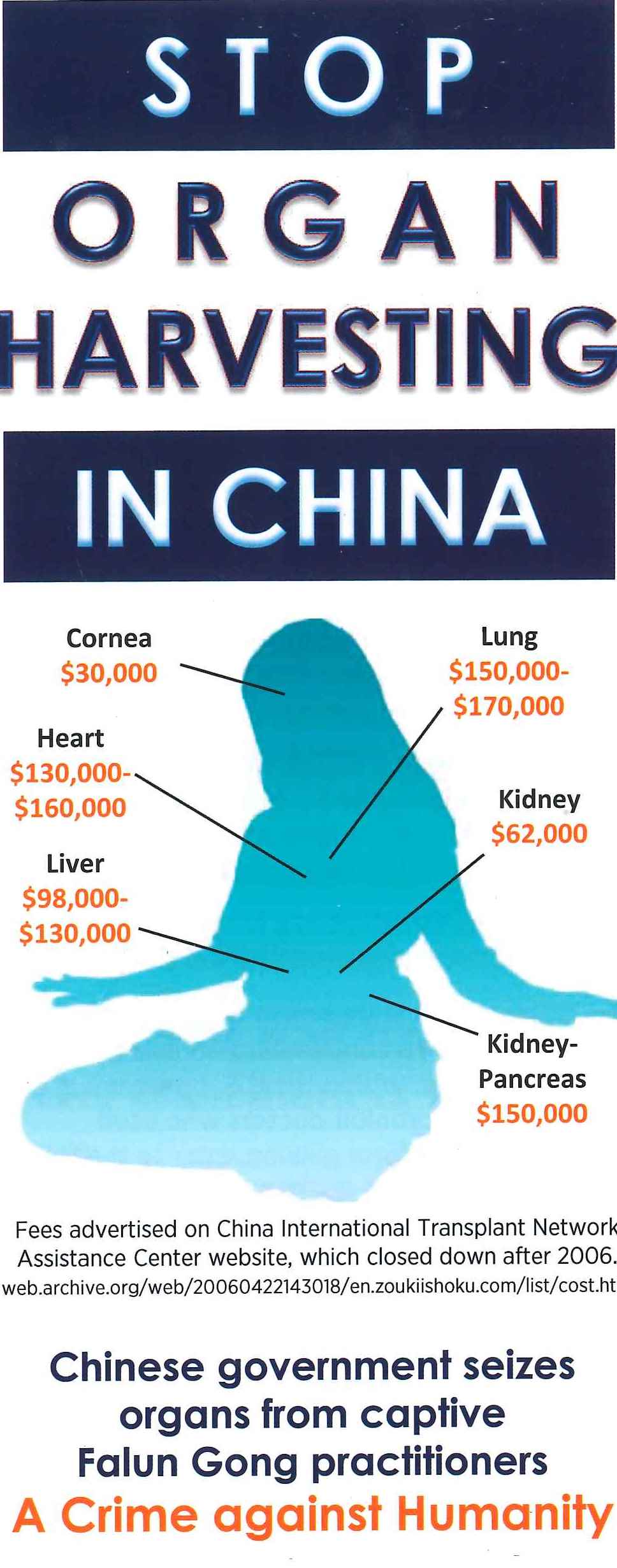
Anyway, on his way home from work, this woman approached and asked if he knew about … wait for it … organ harvesting in China.

Organ Harvesting

I work at a place called the Center for Victims of Torture and had a son in prison.  I thought I had heard everything.

Apparently, back in the 90s, the Chinese government gave the stamp of approval to a Buddhism-derived religion called Falun Gong (also called Falun Dafa), which promotes truthfulness, compassion, and tolerance.  I guess the government approved of it because it represented traditional Chinese ways, including meditation.

Falun Gong became wildly popular, and soon people were meditating in public parks by the thousands.  The government saw this as a threat and began to crack down.  Adherents are now routinely thrown into labor camps and tortured.  According to the brochure, captive Falun Gong practitioners are blood-typed and used as a large, live organ donor bank, killed on demand for “transplant tourists”—people who travel from other countries and pay for an organ transplant.  Do they know that someone will be killed to save their lives?  How can they not?  Again, according to this brochure, the wait for a kidney in the U.S. is five years.  In China, it’s 15 days.  Well that is slightly suspicious, don’t you think?

So why isn’t the west up in arms about this, like they are about the Palestinians or the Syrians?  Maybe it’s because China doesn’t have freedom of the press?  We know about the plight of the Palestinians because, ironically, Israel has a free press.  We know about the horrors Syrians have endured because they’ve managed to escape to other countries where reporters can talk to them and we see them in our Facebook feeds and on Yahoo News every day.

I don’t know who this young woman was who approached Vince on the train platform, but he thought she was Chinese.  So apparently Chinese in the U.S. are getting organized.  The brochure and their website are pretty basic.  If the Chinese can hack into the CIA’s websites, why haven’t they taken down the Falun Gong one?  I am very skeptical on a lot of issues, but this woman cared enough to stand on a train platform on a very cold Minnesota day and approach strangers with brochures.  If it’s not true, why would there be an organized effort against it?

I’m sorry if I ruined your appetite for turkey and mashed potatoes.  This story makes me feel grateful to not be in a gulag waiting to be murdered so my organs can be sold to wealthy transplant tourists.  No, wait…that’s kind of extreme.  I’m grateful that I can write about this, share the story, spread the word, and maybe contribute in some way to ending it.  Here’s a petition you can sign and share with others if you want.  Thank you.