Tag Archives: travel

Tech Troubles

Before resuming my story about house sitting and working from the UK, I want to acknowledge that while my posts are always tagged “Budget Travel,” I wouldn’t be able to call half of it that if it weren’t for Lynn.  She paid for the cottage in Cornwall, the rental car, the hotel with the crunchy gravel in Shaftsbury.  I do my best to pay for things when we travel together.  I snuck down to the front desk and paid for our stay at the Fern Hill Hotel in Lyme Regis, and I would try to snatch and pay the bill for meals as often as I could, but Lynn is pretty good at snatching the bill herself.

We’ve discussed it and we’ll probably discuss it in the future.  If you’re going to travel with a friend you’ve got to be able to talk about money or it could be kaput for the friendship.

But living in Eton for the month of July really was almost free of costs.  I had sold my condo back home so I had no mortgage payment, association dues, or utility bills.  Of course I had no home to return to, but I would figure that out later.

Second, housesitting for Sam meant a free place to stay just outside of London for a month.   Sam asked me to pay the bills, which amounted to £100, or about $130.  Of course I bought groceries and of course I wanted to eat in the pubs and restaurants and go into London which cost about $13.00 each way.  I used the local Leisure Centre to lift weights a couple times a week and that was $13.00 per time.  After a couple weeks I asked for and got a “prospective members pass,” which probably saved me a hundred bucks.  I was honest.  I said I would never be a member because I would be gone in a month.  I think they felt sorry for me that I was paying $13.00 for just an hour of access to the gym.

I haven’t added up how much the month in Eton cost and I won’t bother because whatever it was, it was worth it.

Before I turn to describing the house and Eton and beyond, I just came across a list of annoying, mostly tech problems I dealt with while I was there.

The Internet in Eton was very, very, slow.  This surprised me—I assumed a town with a world-famous school would have super-fast Internet and I’m not sure what the deal was.  One theory I’ve heard is that Britain was one of the earliest countries to get Internet access to its population.  Now that’s out of date and an infrastructure upgrade is called for, but no one wants to pay for it.

I was still after Expedia about screwing up one of my June flights and eventually they refunded my money and gave me a $50 voucher, but it took patience and persistence.  I’m sure they count on most people just giving up.

When I booked a flight to Scotland on Flybe, they charged me seven times.

Delta came through with a $250 voucher for ripping my suitcase.  They were the most responsive and least hassle-y of all the companies I dealt with.

My mouse died.  Yes, I am mouse dependent.  A new one was only 10 quid but finding one was inconvenient.

The closing on my condo went smoothly, but it was another story trying to cut the cord with my Internet provider back home.  I am still battling them three months later.

A&T made me run a gauntlet to unlock my new phone.

My bank blocked my account access even though I had told them I was traveling.

Sam’s printer only worked about every fifth print job.

I couldn’t copy and paste anything from my remote work desktop.

A Skype “upgrade” left colleagues unable to hear me.

So if you have a fantasy about running away to live the simple life in another country, forget it.  In fact first-world problems can be more of a hassle because you may not be able to make phone calls and you may not know where to go for help.

A Worldview from The Hill

A free day in Washington, DC.  There’s so much to see there.  It was a tossup between the two new museums, one dedicated to African Americans and one to Native Americans.  I chose the latter, since I had been to a Native wedding the previous weekend and had been thinking about cultures and spiritual traditions and my lack thereof.  Maybe I could learn something here.

And I hit the food-for-thought jackpot.  There was an entire exhibit about Native American cosmologies—worldviews and philosophies related to the creation and order of the universe.  It would take an encyclopedia to do justice to Native American cosmologies, so I apologize in advance for what I am about to get wrong or leave out.

I watched a 15-minute introductory video which made the point that the term “American Indian” encompasses hundreds of tribes from Bolivia to Alaska and from Seattle to Florida and that they all have their own traditions and customs.  The video showed a guy doing something most people would associate with Native Americans—drumming in a pow wow or carving a totem or some such (I can’t remember) and he said, “This isn’t something we do for fun—this is the way it is.”

I’ve been to pow wows so I think I know what he meant.  A non-Native could come away from a pow wow thinking, “Well that seemed like a nice excuse to dance and socialize and I’m glad they let me observe but it seemed kind of cheesy and repetitive and I don’t need to go again.”  Whereas for Natives who take it seriously, the regalia and music and dancing have significance way beyond their outward appearance.

The cosmology exhibit featured eight tribes.  An impression I’ve always had about Indian spirituality is that it’s nature based.  Having been raised in a Catholic milieu, I can’t think of anything related to the natural world in Catholicism.

Judaism, the world religion with which I’ve always identified, has a few nature-focused holidays.  Sukkot requires us to build a temporary dwelling outdoors and eat in it every day for 10 days to remind ourselves of the 40 years we spent wandering in the desert.  Tu B’Shvat is the New Year of Trees and we … plant trees.  We throw bread on the water (a river or lake) during the High Holidays to symbolize casting away our sins.  But these are once-a-year holidays.  We used to sacrifice bulls under the full moon but thankfully discarded that tradition.

The natural world was the starting point all of the tribal cosmologies.  Basically, each worldview started with some kind of geographic division: the four compass directions or, in the case of the Mapuche, six dimensions including the water below and Father God above.  Each natural sphere is associated with values or animals or human traits.

The values overlapped but weren’t exactly the same from tribe to tribe.  The Lakota Souix and Anishinabe are tribes that inhabit Minnesota and vast areas beyond.  Lakota values corresponding to the four compass points are generosity, wisdom, respect, and fortitude.  Anishinabe values also include wisdom, respect, and fortitude—plus love, courage, honesty, humility, and truth—but not generosity.  The Maya value wisdom, honesty, integrity, faithfulness, authority, and spiritual leadership.  The Yu’pik value respect, loyalty, and authority.
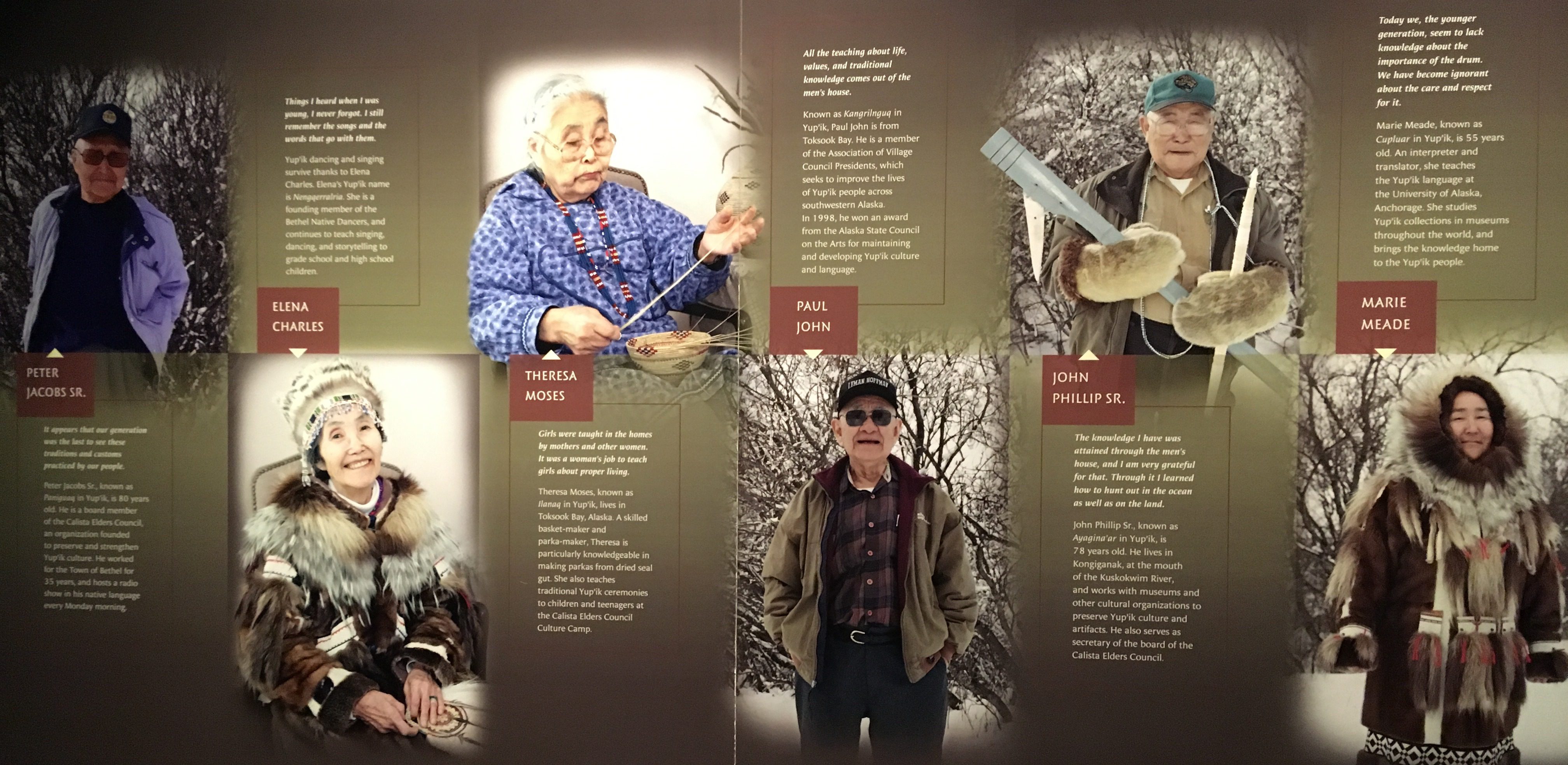
These are Yu’pik elders consulted on the exhibit.

In Judaism, I would say justice is the primary value.  I thought maybe the Lakota value of truth was close to this but for them “truth” is about things that are eternal, like the sun and the moon—things that never change.  Courage was the closest to justice; in the case of Natives it means moral strength to do the right thing.

I won’t get into the forms of worship—if that’s the correct word—but it does seem true that Native practices—at least the eight tribes represented here—really did spring from and revolve around nature.

Some tribes had worldviews that included an afterlife; some didn’t even have a future tense.  One of the afterlives was described as “a place where you go when you die to dance forever.”  I’m sure that sounds great to some people but not to me.  I’m a horrible dancer.

A Little Lunch

The workshop continued with a series of speakers, the younger ones speaking in vocal fry.  I’m not the first one to notice this trend, and I haven’t heard an explanation for it.  My theory is that it’s a class marker—a way for young, mostly white women to signal to each other that they are highly educated members of the professional class.  I find it irritating but no one under 30 seems to even notice it.

They also used a lot of modifiers like “sort of” and “kind of.”  I’ve written about this before but here I noticed the younger men as well as women doing it.  I realize it’s an unconscious habit, but did it originate from a need to ingratiate one’s self?  Is it something you would hear in a corporate setting, or is it only used in the nonprofit and government world, where everyone is concerned with not appearing too overbearing?

The third feature of the younger speakers was fast mumbling.  They would let fly a lightning bolt of words that dropped to an indecipherable end.

These people were clearly smart and earnest and good speakers in general.  I thought back to when I was 30.  Did I talk in some way that grated on my elders’ ears?  I don’t think so.  Back then, valley speak was the speech trend derided by all, and that wasn’t anything you would have adopted at work to get ahead.

Wait, that’s a lie.  I know I say “like” way too much.  That comes from working at a university for 10 years, where I was surrounded by students who did it.  Because yes, speech styles are contagious.


Lunch time.  I know USG agencies try to use taxpayer dollars responsibly, but really, the box lunch was a huge disappointment.  Mine contained rendered “turkey breast” on white bread with a limp piece of iceberg lettuce.  There was a four-ounce bottle of water and a small bag of potato chips but no potato salad or cole slaw, no cookie, not even a pickle.

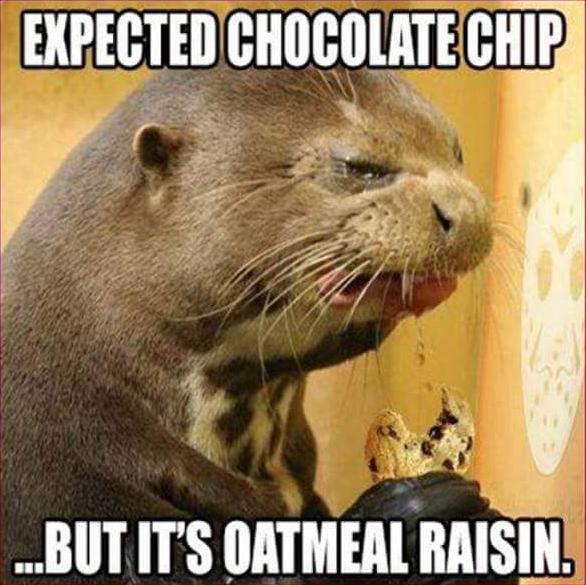
But I was one of the lucky ones.  As I watched others open their boxes, some of them looked like this otter who thought he was getting a chocolate chip cookie but it was oatmeal raisin.

Their boxes contained Fritos, not potato chips.  The woman across from me said, “I haven’t had Fritos since I was 12.”

“Right?” the guy next to her said (“right?” is another new filler), “and there’s a reason for that.  They suck.”  They looked around hopefully, as though maybe one of us lucky ones who got potato chips might want to trade.  Each table had a pile of Fritos bags at the end of lunch.

The networking was good though.  It was so nice to be around people who do similar work on similar issues. I exchanged a lot of business cards and will be following up to try to establish partnerships with other organizations.

For the afternoon sessions I moved to be away from the paper rustling sigher and wound up sitting right behind a head bobber.  This guy nodded enthusiastically at everything every speaker said.  As usual I seemed to be the only one who noticed.  Why am I so bothered by the way people talk or sigh or crinkle their gum wrappers or nod?  Sometimes I think I must be farther along the spectrum than most people.

After the workshop I walked up to Dupont Circle.  I had stayed there years ago and remembered it as a lively shopping area.  But there were no shops except CVS and a comic book store.  It was lively with restaurants but I didn’t feel like fine dining alone.

I walked back toward the flat and went into the Marriott across the street from it.  There was a beautiful, quiet outdoor area with comfy seating.  The rest of the customers were inside watching a football game.  “You get $2 off your beer because of the game!” exclaimed my server.  “Wow, that’s awesome!” I replied, as I sat with my back to windows and read my book for hours before going back for my second night in the grotty flat.

No Spies just Blue Skies

I lay in bed composing a scathing review of the Air B&B in my head.  The one photo of the place hadn’t done it injustice enough.  When I did fall asleep I slept straight through the night for eight hours, which never happens.

I quickly dressed and gathered my few belongings.  I just had to check in for my flight before I left for the workshop, since the agenda said there would be “no internet” in the venue and I would leave for the airport straight from there.  Hmm … I wondered why I hadn’t received an email from Delta yet?

A cold wave of panic flushed through me when I saw that my flight was … tomorrow, not tonight.  Noooo!!  I had briefly discussed staying two nights with our travel agent but distinctly remembered sending him an email saying I’d settled on just one night.  It was my bad, I know.  It’s my responsibility to check the details before accepting an itinerary.  The agent had been careless, and so had I.  This was what moving, my mom’s stroke, and moving my mom had done to my brain, I guess.

Thank goodness I had only written the scathing review in my head, because now I had to ask if I could stay here one more night.  The manager said yes, and even said she wouldn’t charge me because the cleaners hadn’t shown up before my arrival.  That explained a few things.

I felt virtuous, saving my organization hundreds of dollars, even though I was sure my coworkers wouldn’t be lining up to do the same.  I didn’t have my laptop so I wouldn’t be able to get much work done.  I would take a day off in DC, which was something to look forward to.  But first, the USG workshop.

No internet in the venue—I wondered if that was some kind of cool spy vs. spy thing where they blocked satellite transmissions? No, it turned out they had just meant there was no wireless.  Correction: one person did.

Since the election, federal employees have left Washington in droves. The new administration put a hiring freeze in place, so every bureau is woefully understaffed.  The poor DRL people are no exception.  Three of them were trying to work out how to make coffee for 150 people.  This was bureaucracy in action, and it failed miserably.  They blew a fuse and had to start over.  Finally, we all lined up to get a lukewarm cup, only to be greeted by a sign, “No Food or Drink in Auditorium.”  The coffee servers literally winked and nodded at us as we filed in with our cups in hand.

I found a seat and introduced myself to the guy on my right.  He had a heavy accent and I thought he said he was from Grecian Aid but based in the Dominican Republic.  “That must be interesting,” I said, “working for a Greek organization from Latin America.”  He looked at me a long time, then smiled.  “Eet ees Chreeeshchun Aid,” he said slowly, handing me his card that said Christian Aid.

“Ahh,” I smiled, “that makes more sense.”  We talked shop; we were both what’s called “new business” people and we had a lot in common.

The first speaker opened by admonishing us not to have any food or drink in the auditorium, as she winked toward her cup of coffee balanced on the lectern.

A paper-shuffling sigher had sat behind me.  On my left was a woman wearing a flower-festooned headband.  Was she from Ukraine?

I looked around to see about half the audience paying attention while the rest were staring at their mobiles while the speakers were trying to hold their attention.

The content was helpful, and chock full of insider lingo like, “Decisions were made on 7th Floor,”  “Folks at post want this,” and “’F’ Indictors.”

One speaker mentioned “blue sky options.”  I had no idea what this meant but I always come back from workshops with jargon to spring on my coworkers to make them think I’m up to date.  Once I Googled it and knew what it meant I would try to drop it at least once in every meeting.

In Eton, In DC

From Shaftsbury, Lynn and I drove to Eton where I would house sit for a month.  But first we had to find it.  It looked so easy on the map but as usual we got terribly lost and since Sam was expecting me at 12:30 I got panicky and may have been a bit short with Lynn.  Well, I know I was, but as a Minnesotan this took the form of hinting about what I thought she should do.

The map wasn’t detailed enough. We didn’t have a GPS.  I couldn’t call Sam with my phone because I didn’t have international service and I couldn’t message him because I had let my data plan lapse because I “never needed it.”

“Use my phone,” Lynn offered.  I managed to switch it to airplane mode and it took me 20 minutes to figure that out, with Lynn trying to assist while driving 80MPH.  I got Sam’s voice mail.  We drove in circles around Windsor, the town across the Thames from Eton.  Looking back, I don’t know why we didn’t try to find it using Google maps on Lynn’s phone, but we didn’t.

Finally I glimpsed a cathedral-like building in the distance. “That must have something to do with Eton College,” I said.  “It looks like one of the colleges at Oxford.”

“Well spotted!” Lynn cried with relief.  “Now what’s the address?”

“123 High Street,” I said confidently from memory.  We paced the high street, and Lynn declared, “There is no 123!”  She burst out laughing when I checked and said weakly, ‘Oops, it’s 321.”

Five minutes later Sam was greeting us at the door.  Greeting me, I should say.  He gave Lynn directions to Heathrow, waved her off, and ushered me in.  Poor Lynn, I later learned, had had hopes of using the bathroom but she kept a stiff upper lip until she got to the airport.

In real time, I just returned from Washington, DC and I’ll write a few posts about that before returning to my summer in the UK.

I went for a workshop for grantees of the State Department’s Bureau of Democracy, Human Rights, and Labor, or DRL.  Don’t ask me why it’s not BDHRL, but I’m okay with that.

I won’t go into the content of the workshop because then I’d have to kill you.  Just kidding, you would die of boredom before I could kill you.

The building in which the workshop was held does not have an address and is not on Google maps.  Really.  I don’t know if this is intentional—for security purposes?—or just part and parcel of the crazy patchwork of streets that is DC.

The cheapest hotel our travel agent could find was $585 a night.  That wasn’t some 5 star place, just a Marriott.  I found a studio apartment on Air B&B for $182 within walking distance of the venue. My expectations of it were low but when I arrived I had to lower then further.  The studio was in a 40s-era building that had been badly renovated.  It was on the George Washington University campus and in keeping with that was reminiscent of a dorm room.  Not that I’ve ever been in a dorm room, but think: cheap Walmart navy blue bedspreads with pilly grey sheets on twin beds, bare walls, a giant-screen TV, and a window with a view of a brick wall.  Here is a picture of the bathroom “door” from inside the bathroom.

Good thing I wasn’t sharing the room with a coworker.  I was motivated not spend any time here.

I did a recon to ensure I could find the workshop in the morning.  I copied the map from the agenda onto my palm.  There was no signage, but I was pretty sure I’d located the building, so I wandered on and accidentally found the area with the Washington Monument, White House, and other iconic places. There were the usual protesters in front of the White House, but far fewer than I remembered from past visits.

Darkness forced me to return to the room.  I crawled into bed fully dressed so I wouldn’t catch cooties. Thank god I was only here one night.

Getting the Shaft in Shaftsbury

Shaftsbury, England.  I awoke before dawn to the sound of a car driving slowly into the gravel parking lot.  The driver got out and walked to the entrance, crunch, crunch, crunch.  I was just falling back to sleep when he or she must have gone back out to get luggage.  More crunch, crunch, crunch on top of rolling crunchiness.  Another car pulled in, more heavy rolling crunchiness.

Lynn exclaimed from the darkness on her side of the room, “Whoever thought it was a good idea to have a gravel driveway in a hotel?!”

“I know!  Well at least no invading armies are going to sneak up on us.”

“Right.” she replied drily.

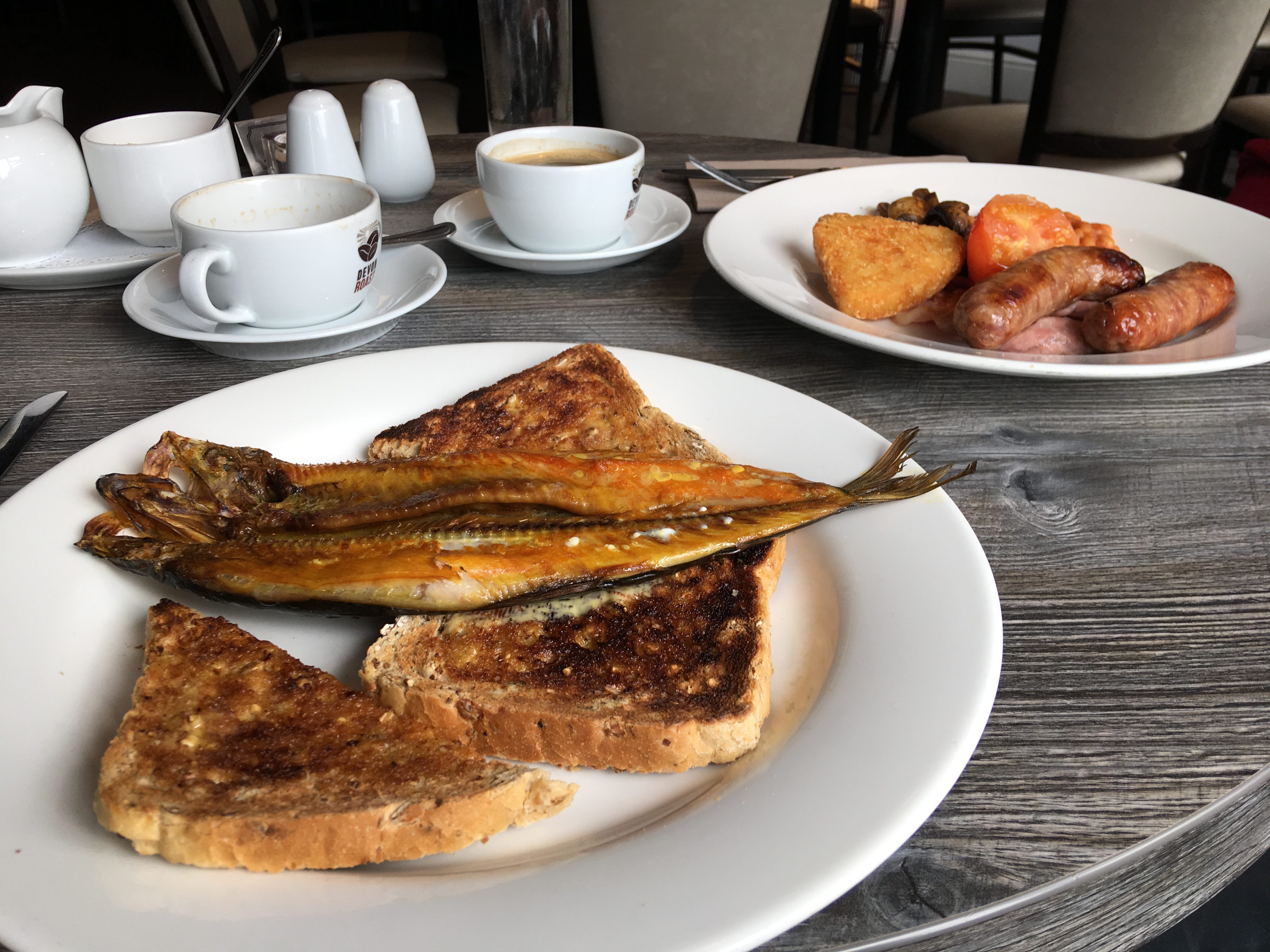
There was no going back to sleep now so we went down to breakfast. I ordered kippers, which I’d had never had, and Lynn had a Full English minus the blood sausage.

Blood sausage is just what it sounds like, sausage made of blood.  I think it’s a food that’s traditional and no one really likes it but they keep it on the menu for tradition’s sake.  Most Brits I’ve mentioned it to made a horrid face.  Is it like lutefisk or gefilte fish?  No one likes either one, but people put it out once a year because it’s “tradition.”  Blood sausage is on the menu everywhere, so I don’t know, maybe lots of people love it.  What do you think?

Me, I love fish, so I was happy with the kippers.

The Daily Mail had this cover in regard to the Grenfell Tower fire:

I think the Queen learned some lessons in the aftermath of Princess Diana’s death, when she was accused of being cold.  Maybe she can give Theresa May some pointers about getting down with the people.

We walked into town to Shaftsbury Abbey, or what was left of it.

The abbey had been a regional center of power until Henry VIII had it destroyed along with all the other monasteries in the 16th Century. The piles of stones on either side are where the pillars of the nave were.

A small display inside the visitors’ centre featured a few shattered carvings, remnants of painted sculptures, and a diorama of what the abbey had looked like.  It must have been enormous and fantastically beautiful.  Henry VIII was known to appreciate beautiful things, so why destroy the abbey, down to the ground?  Why not just seize the gold candlesticks and leave the building with its gilded arches and ornate carvings?  It was a display of power, of course.  He had half a dozen of his own palaces, so a couple hundred monasteries out in the sticks were no loss.  He was a red-headed megalomaniac who loved his palaces and couldn’t stand for anyone else to … wait, why does that sound familiar?

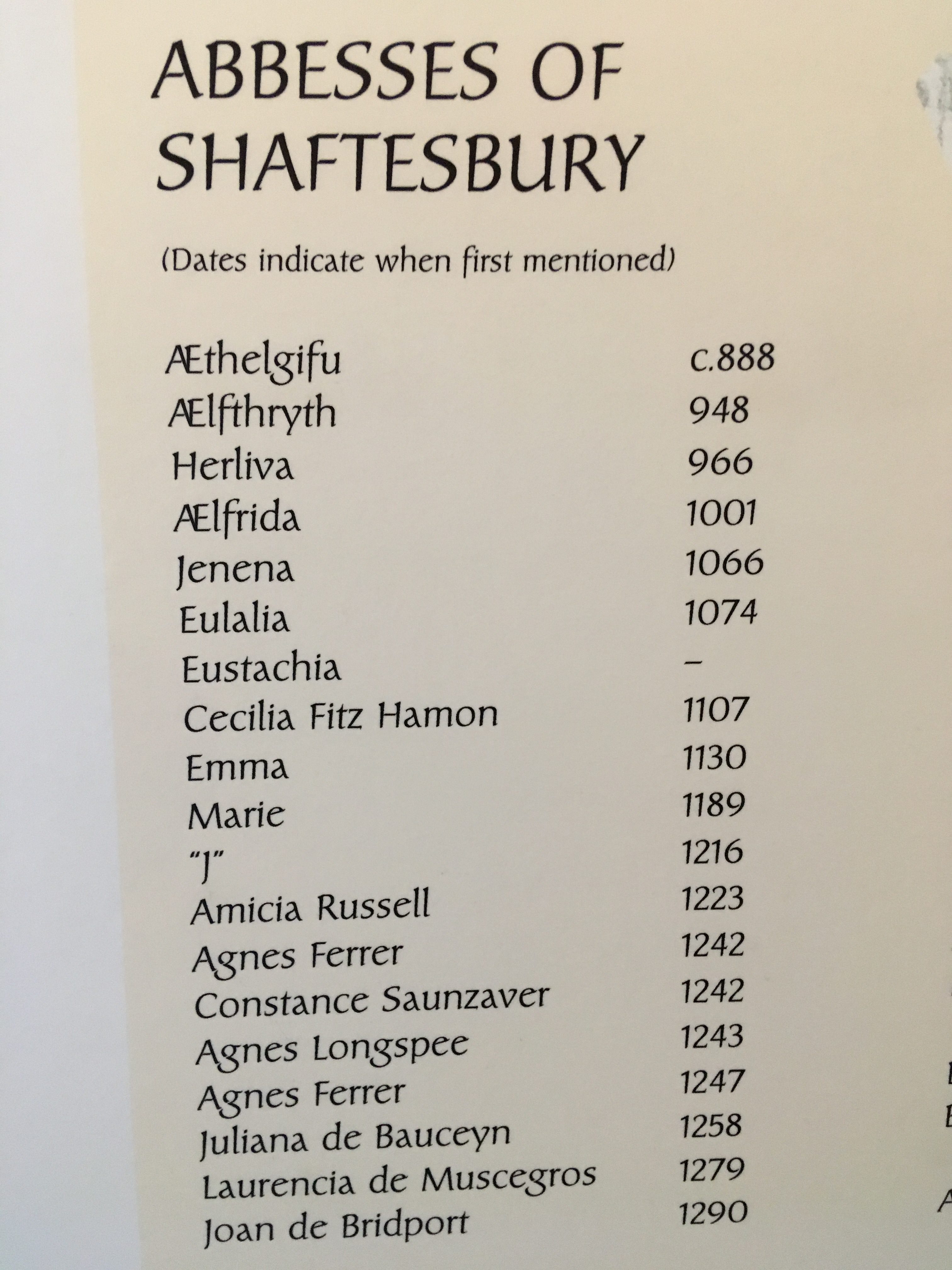
Here are the names of some of the abbesses.

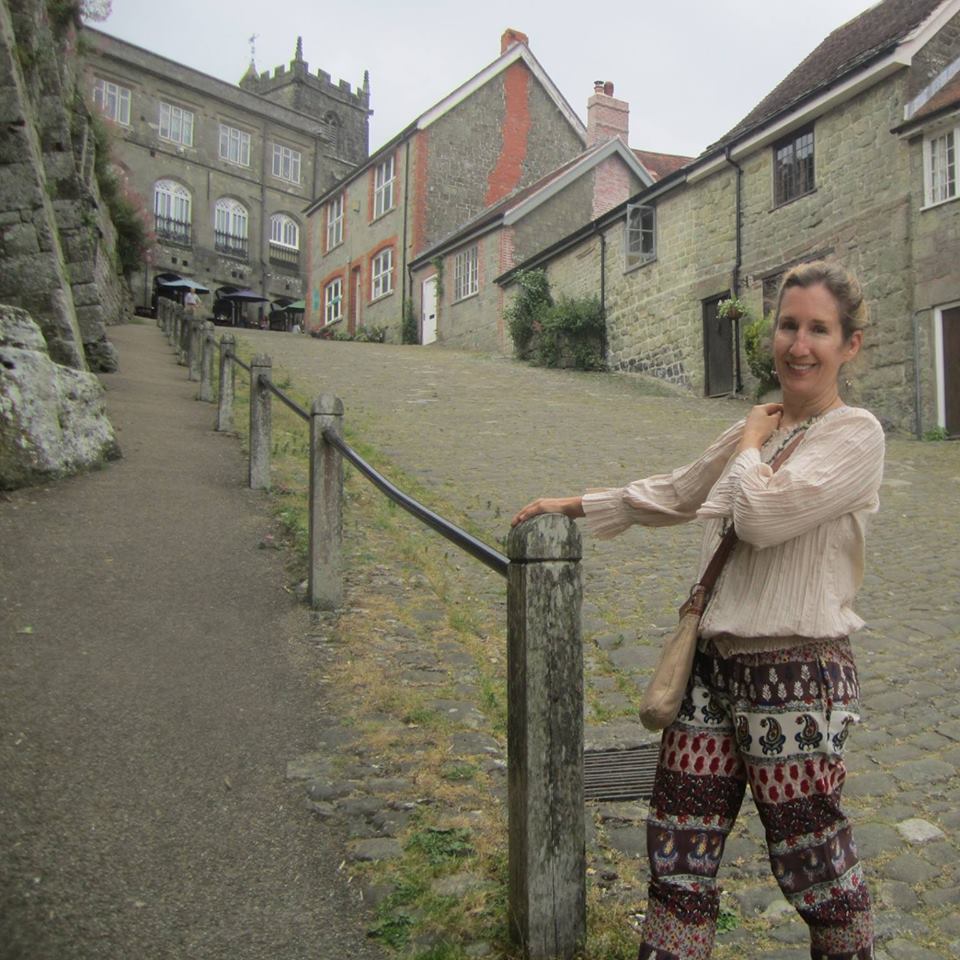
It was lunchtime  and we picked our way carefully down Gold Hill to find a pub someone had recommended.

I had one of the most memorable meals of the summer at this pub, a fish pie with turmeric.

I tried to replicate it once since I’ve been home but didn’t get it right.

Of course what goes down must come up—no, I didn’t vomit up the fish pie—we had to walk back up the hill.

We walked a few paces, stopped to take photos, then walked some more.

It’s not that we couldn’t have hiked straight up the hill without a break—really.  But it is true that a summer of fish pies and pints means I really need to get back to the gym.  Maybe tomorrow.  Maybe next week.

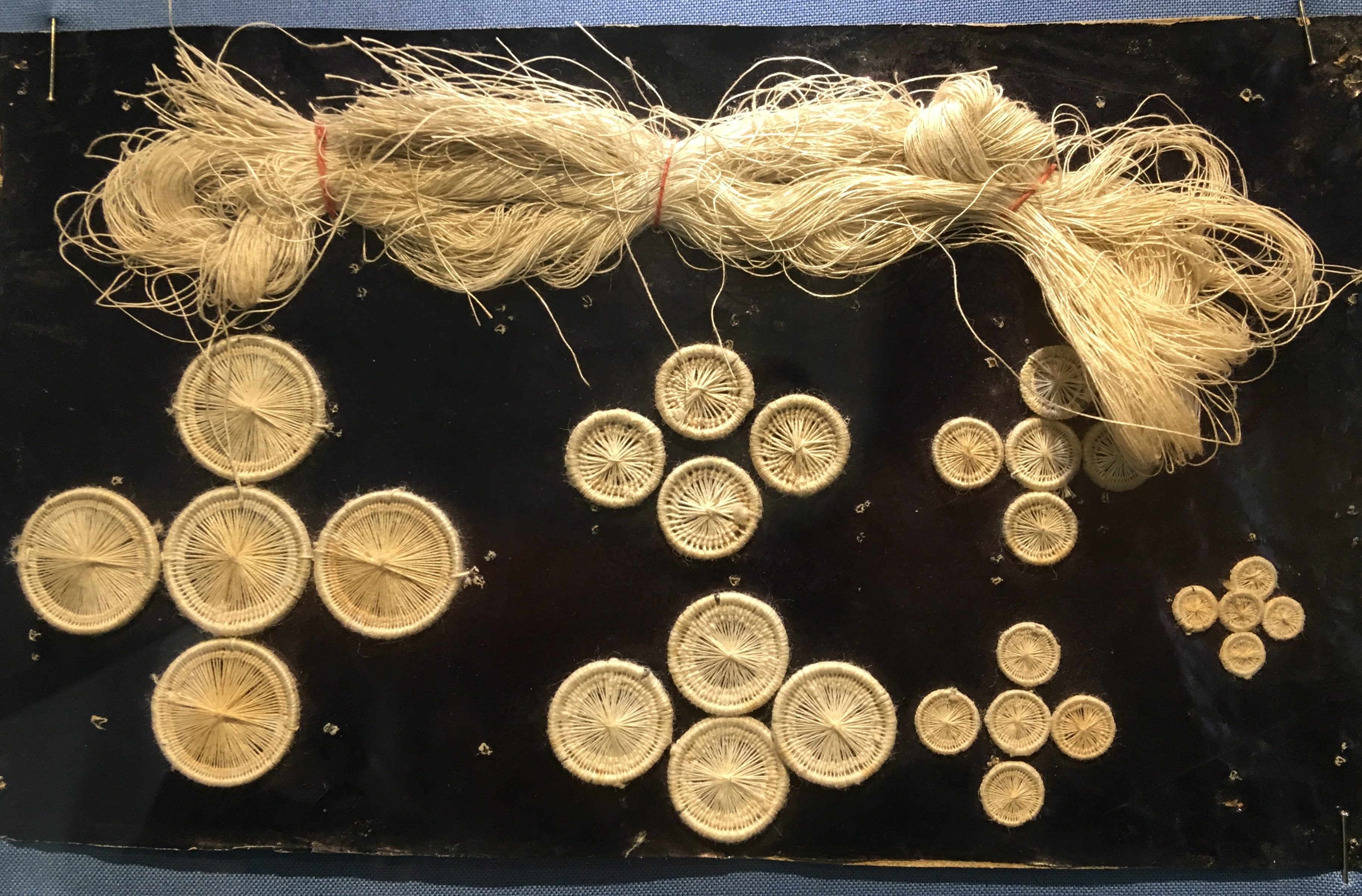
Next we visited the historical museum.  Shaftsbury was once a center for cottage industries, which just means people sat in their cottages and made things, like buttons. These are the forms and the finished buttons.

In the 17th and 18th Centuries thousands of women and children were employed making “Dorset Buttons.” The button-making machine caused these cottage industries to collapse after 1750, and the gentry “helped the unemployed workers to emigrate to Canada and Australia.” That’s one way to solve your unemployment problem.

FYI, I’m going to DC for work and won’t be blogging for a week or so.

Losing Our Traditions

In a recent post I wrote about character differences between Americans and Brits.  Such subjects are always fraught with peril.  Reflecting on it, I may have made it sound like all Englishmen are passively sitting around doing nothing about the problems of daily life, while all Americans are tackling their daily problems head on.  That’s not the case, of course.  I have a very deep respect for the British people which stems, in part, from how they defended the rest of humanity from the Nazis for two years while being bombed.  I admire that they (in general) place a greater emphasis on the common good rather than on individual rights, as we Americans do.  That’s why they have the NHS and sensible gun laws and public footpaths.

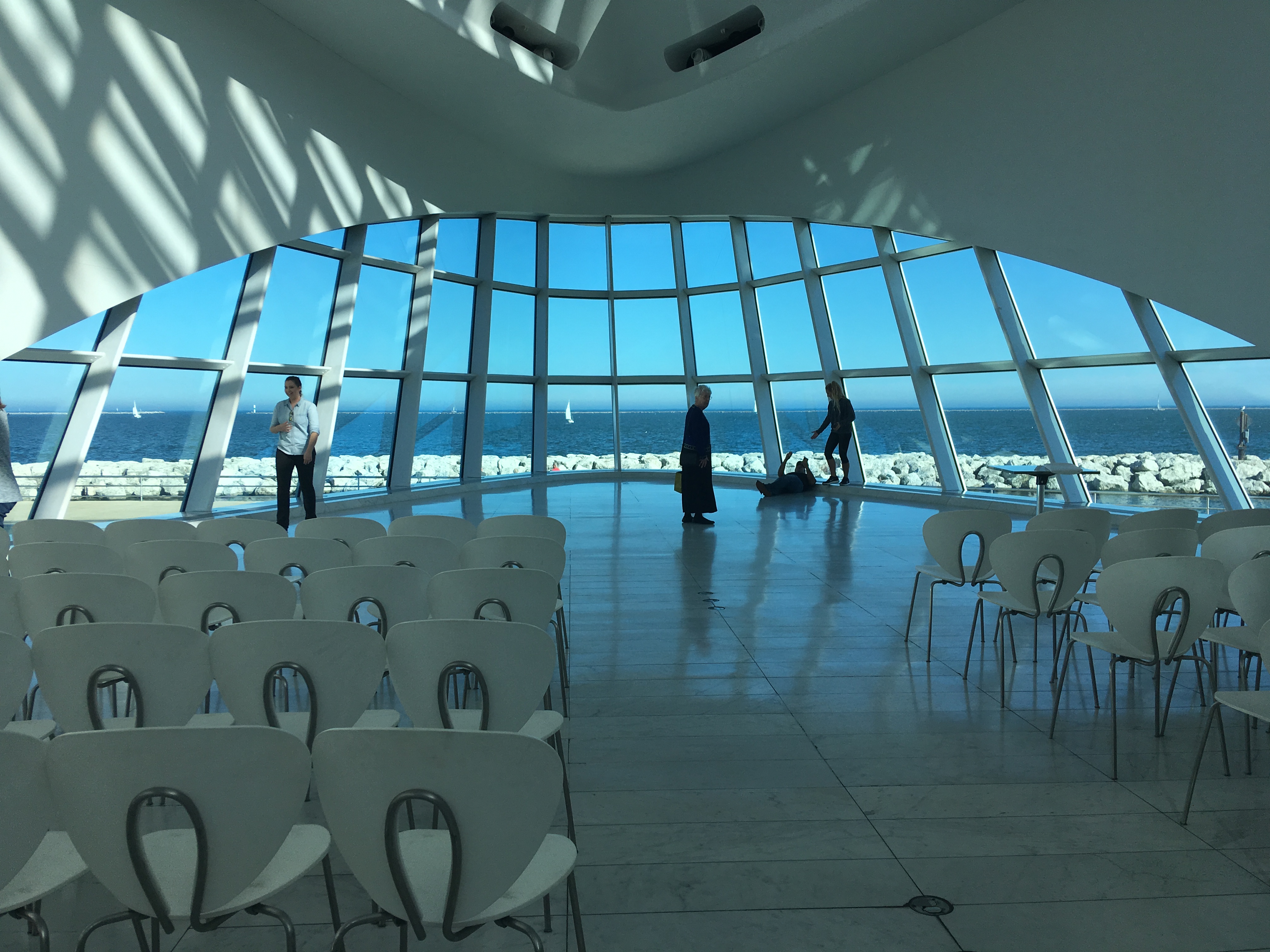
Culture is so complicated.  I attended a wedding this weekend in Milwaukee, Wisconsin, where the bride and groom were both Native American.  Everyone in my family was excited to attend an Indian wedding.  But the bride, my niece, is Ojibway, while the groom is a member of a Pacific Northwest tribe.  She is also half Mexican-American, and he is half Scottish-American.  So what kind of Indian wedding would it be, and how would the other strains of ancestry be acknowledged?

They did a beautiful job of covering all the bases.  The music featured native drumming, a bagpiper, a Mexican-American singer and string orchestra, and a Motown trio.  The bride wore a white dress and stilettos and the groom wore a tux—with moccasins and a leather headband with eagle feathers.

At the end of the 10-minute ceremony performed by my cousin under the authority granted him free online as a Universal Life Church Minister, the couple were draped with an Indian blanket.  The meal included salmon and huckleberry jam flown in from Portland, Oregon.  A scholar read a wedding blessing in Ojibway.  An elder from the Pacific Northwest spoke about the sacredness of water, land, and animals.  The bride read a list of all the ethnic identities in attendance, including a dozen Native tribes and a dozen European ancestries.

The bar was open for one hour, maybe in recognition of all the alcoholics and recovering alcoholics in attendance—of all ethnicities.

The venue was the fantastic Milwaukee Art Museum, designed by a Spanish architect.

This made me wonder, what culture would my son or my nieces or nephews focus on, if at all, at their weddings?  I raised my son in the Jewish faith and community but he has no longer has any belief or affiliation.  None of us have any direct connections to our European ancestors.  What are we?  Americans, of course.  But what kind?  Who is our tribe?  What are our values and traditions?  We read the New York Times, listen to National Public Radio, and don’t feel unpatriotic driving Japanese or German cars.  I don’t see how any of that would play out at a wedding, but I’m sure my creative younger relatives will think of something.

Lynn and I arrived in Shaftsbury after circling the wrong roundabout three times, then circling the right one another three times.

“It looks like there’s a wedding here,” I observed as we pulled into the hotel parking lot.  There were a lot of dressed-up people milling about.  Then I saw the hearse.

“What a strange place to hold a funeral,” Lynn commented.

The Royal Chase Hotel was billed as a historic 18th Century monastery but it had been stripped of all character and was now just another Best Western hotel.  It was basic; it was fine; we wouldn’t be spending much time in it anyway.  That’s what you tell yourself when you arrive at a hotel that’s seen better days, right?

But it was true.  We loved Shaftsbury and spent most of our two days out and about.  It is home to Gold Hill, site of a Hovis Bread commercial every English person of a certain age remembers.

We walked to the hill, and it was really scenic.  Pictures don’t do it justice.  It was Sunday evening and all the attractions were closed, so sat in silence on a bench at the top of the hill for 20 minutes, enjoying the view.

Big and Bigger

On to our final stop, Shaftsbury, via Sherborne.  I love its Wiki description:

Sherborne is a market town and civil parish in north west Dorset, in South West England. It is sited on the River Yeo, on the edge of the Blackmore Vale, 6 miles east of Yeovil. The A30 road, which connects London to Penzance, runs through the town.

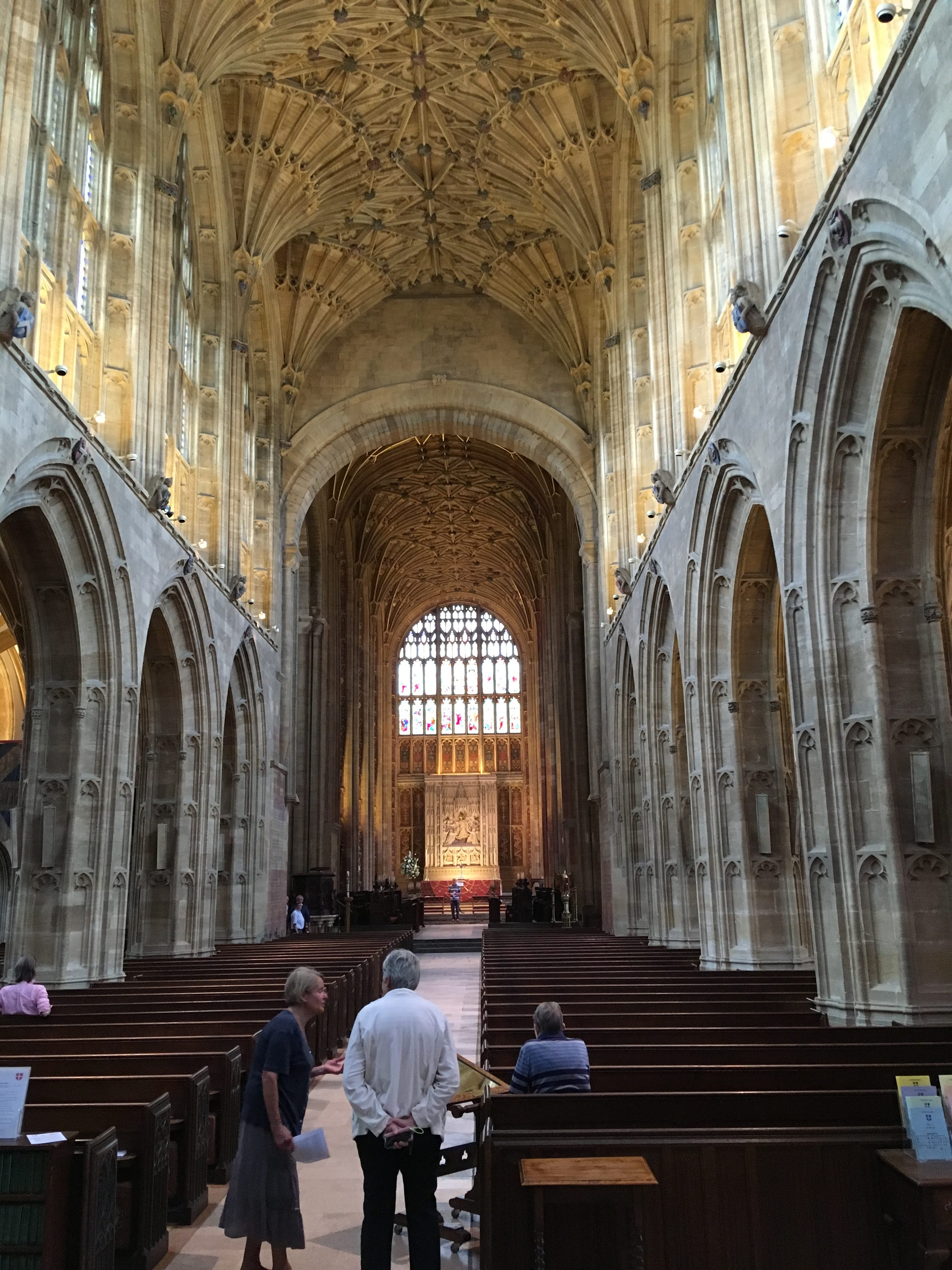
Sherborne has a famous Abbey, the exterior too big to capture in a photo, but here is the interior.

A man was singing snippets of songs to test out the acoustics, which were great.  In fact, the elderley woman giving him and his wife a tour declared,  “Aren’t they orgasmic!” and this word rippled throughout the church.

This gate is carved out of wood.

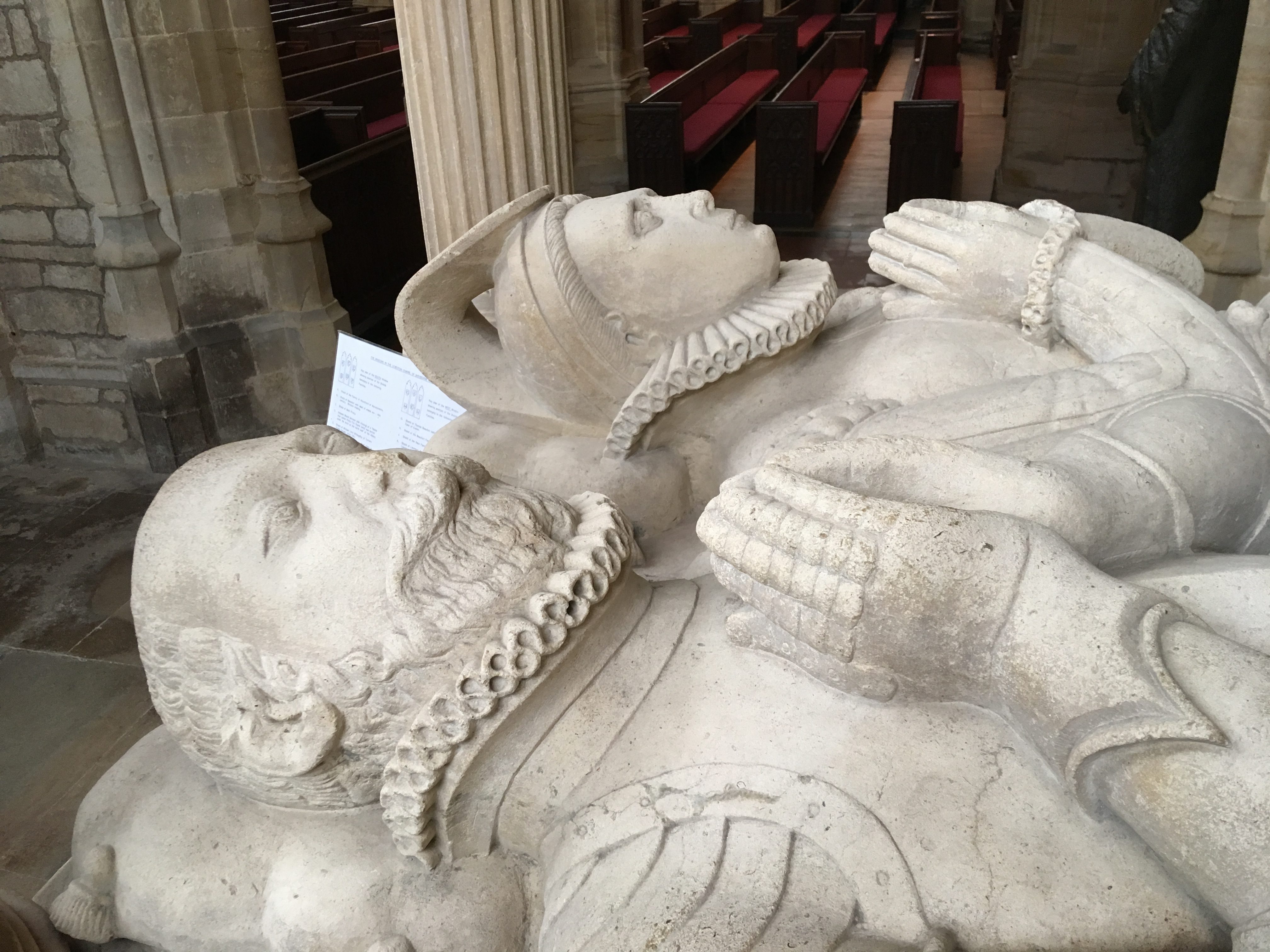
There was the usual tomb of a dead 16th Century couple who may have founded or rebuilt or otherwise bankrolled the abbey; I don’t recall their names and sadly few other visitors will, even though the final resting place they splashed out on is so magnificent.

There was this more modest tomb containing six people, including children who died at 50 weeks and three years and someone’s 16-year-old wife.  You wonder if anyone in town lived to a ripe old age, which back then would have been about 40.

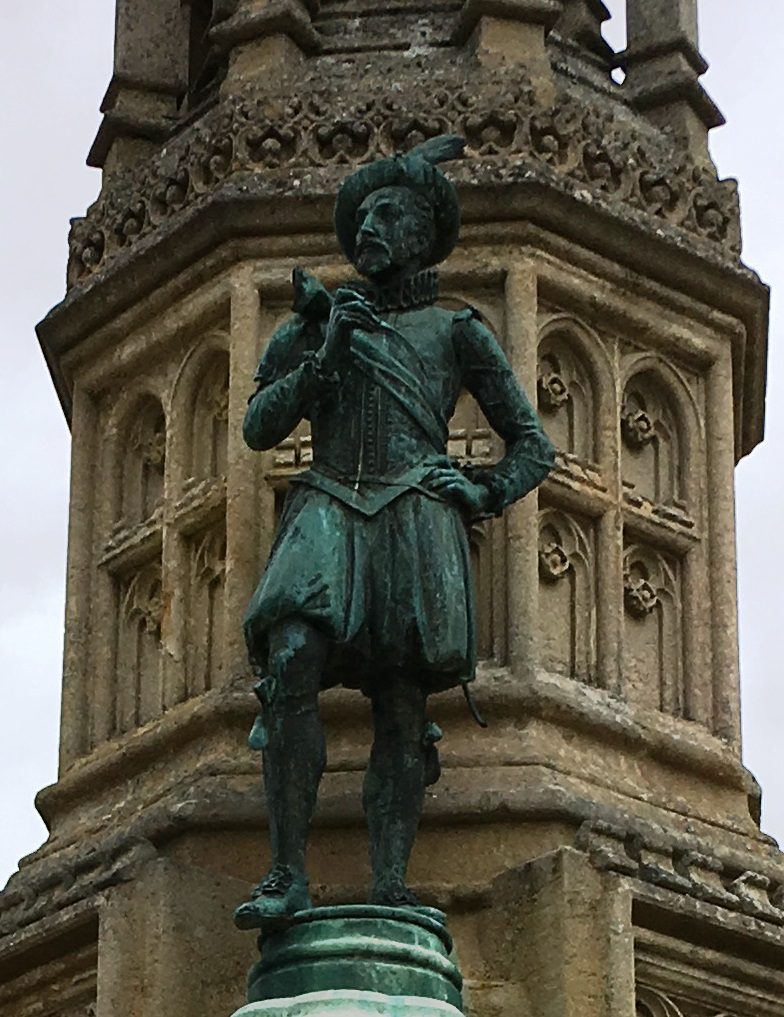
There was this splendid fellow on a monument out front, and a beautiful wrought-iron gate which was marred by a modern sign posted next to it which said, “No Dogs, No Cycling, No Ball Games.”  This was according to the Ecclesiastical Court Jurisdiction Act of 1860 and meant to protect “this consecrated ground.”

There are thousands of churches and abbeys and minsters and cathedrals in the UK.  Fewer than five percent of English people attend church.  The figure is almost nine percent in Scotland, but still much lower than the 38% of Americans who attend church on a weekly basis.

I’m an atheist Jew who loves old churches.  You don’t need to be a fervent believer in Jesus to feel uplifted—if not orgasmic—by soaring vaulted ceilings, stained glass, and all the history embodied—literally—in tombs.  I always drop some coins in the donation box.

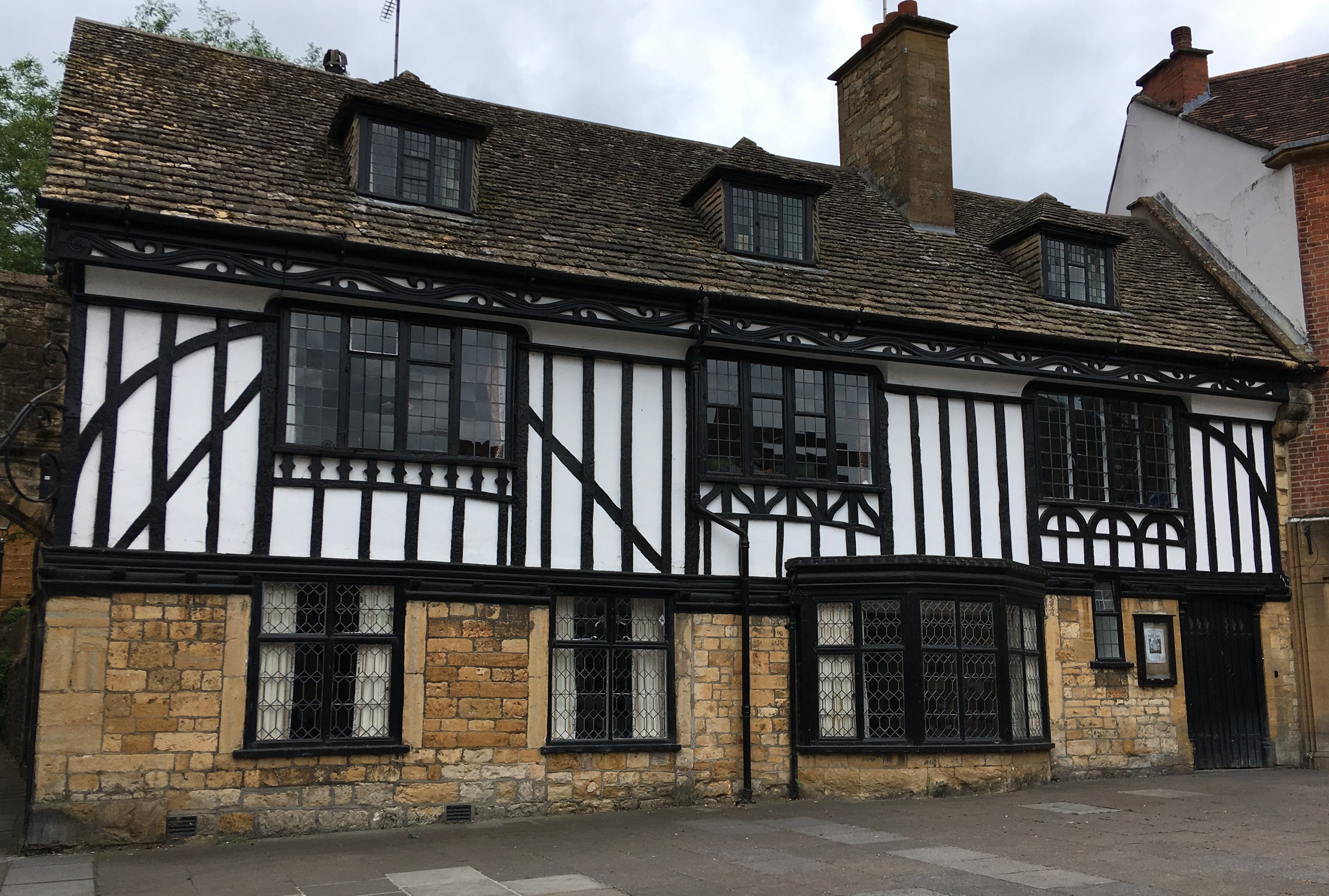
Sherborne itself was a pretty town, with some well-preserved half-timber buildings.

And a gorgeous building that I believe was formerly some kind of monks’ residence, now converted into luxury flats, complete with signs that warned, “Private Property, No Entrance.”

And adjacent to the parking lot, this classic scene:

There are two Sherborne castles—“old” and “new.”  We stopped in the National Trust office to ask directions and walked off clutching maps.  We were soon leaving town on a narrow road with no sidewalk.  One sign early on pointed to the castle, then there were no more. We walked and walked.  A high wall on one side of the road prevented us from seeing what might be on the other side and the road had curve after curve which prevented us from seeing what was ahead.  It was high noon on a hot day.  We stopped in a shady spot for a rest.

“Do we keep walking?” I asked.

“It could be just around the next bend,” Lynn replied.  “Or we could be completely lost, as usual.”

“Yep.  I’m hungry.  Let’s give up and go to that historic pub the National Trust lady told us about.”

“Okay … but if we can’t find a castle don’t get your hopes up about finding a pub.”

We managed to follow the directions and find two other pubs.  No one had ever heard “Sherborne’s Oldest Pub” promoted in the tourist office and on the map.  Every English town has a pub called The George; we had lunch there.  I had a steak and kidney pie with a pint and Lynn had a fish pie with a ginger ale.

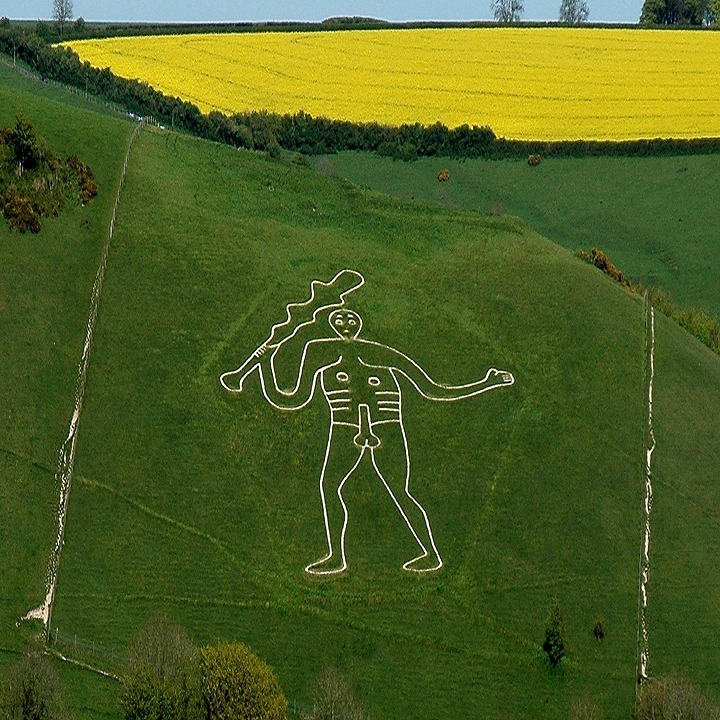
Next stop: the Cerne Giant.  Trigger warning: If you are offended by penises, stop reading now.  Although, if you are offended by penises you are probably already offended just by me writing the word penis.

Here he is, cut into the turf and filled with chalk.  Saxon god?  Political satire?  Teen prank?  The story is unknown but most agree he dates to the 17th Century.

Hanging On

Thank god this week is over.  I am moved into my new place.  My mom and her husband are moved into their new place, although we had to ask the movers to return furniture to their old house because it wouldn’t fit into the apartment.  I spent yesterday unpacking and arranging so my mom will feel at home when she is discharged from the hospital on Tuesday.  It was a lot of work, but the six of us pitched in and nothing broke and no one cried or said anything they’ll have to apologize for.

Today I will drive to Milwaukee.  By the time I get there I expect my back will be in a rigor mortis-like state from all the lifting, bending, and reaching I did yesterday.  But I’m going for a wedding, and I love weddings.  My niece is getting married.  She and her betrothed are Native American.  When I RSVP’d I joked, “I’ve always wanted to go to an Indian wedding!” but I think she is so stressed that she didn’t get it.  The venue is the Milwaukee Art Museum, and the family is staying at an Irish-style hotel.  My cousin got his Universal Life Minister license in order to officiate.  I’m going to wear the fascinator I bought in Eton this summer.  This is not my fascinator, but I wish it was.

Back to the south of England.

Lynn and I, emboldened by our successful use of public transport to Abbottsbury, decided to hop a bus into Lyme Regis.

No one I have ever met in the UK drinks and drives.  Not even one drink.  The blood-alcohol limit is the same as in the US (.08%) but lower in Scotland (.05%).  Of course some people drink and drive, but in general I think people in the UK take “drink driving,” as they call it, more seriously.  You see more drunk people on buses and trains as a result, but at least they’re not driving. We didn’t want to get drunk, but it would be nice for Lynn to be able to have one drink.

We checked out a charming mill area with shops, art museums, and a brewery.  Most were closed for the season.  None of the open ones accepted cards, and there were no working ATMs.  Lynn wanted to buy several pieces pottery but between the two of us we could only scrape up enough for one.

“There is an ATM up the hill,” said a cashier, “but it’s been broken for months.”

I bought two pints with the cash I had left and we sat in the sun and had a great conversation about the differences between the British and American characters.  “Do you think it’s true,” I asked, “the Pink Floyd lyrics: ‘hanging on in quiet desperation is the English way?’  Stiff upper lip … keep calm and carry on and all that?”

In this cash machine situation, it seemed that—with tourist season around the corner—no one had done anything to get it fixed.

“Americans would be storming the bank to demand action—now!”

“We would see that as pointless,” said Lynn.  “You know how British banks are.”

She didn’t say it, but many Brits would also find the American approach undignified.

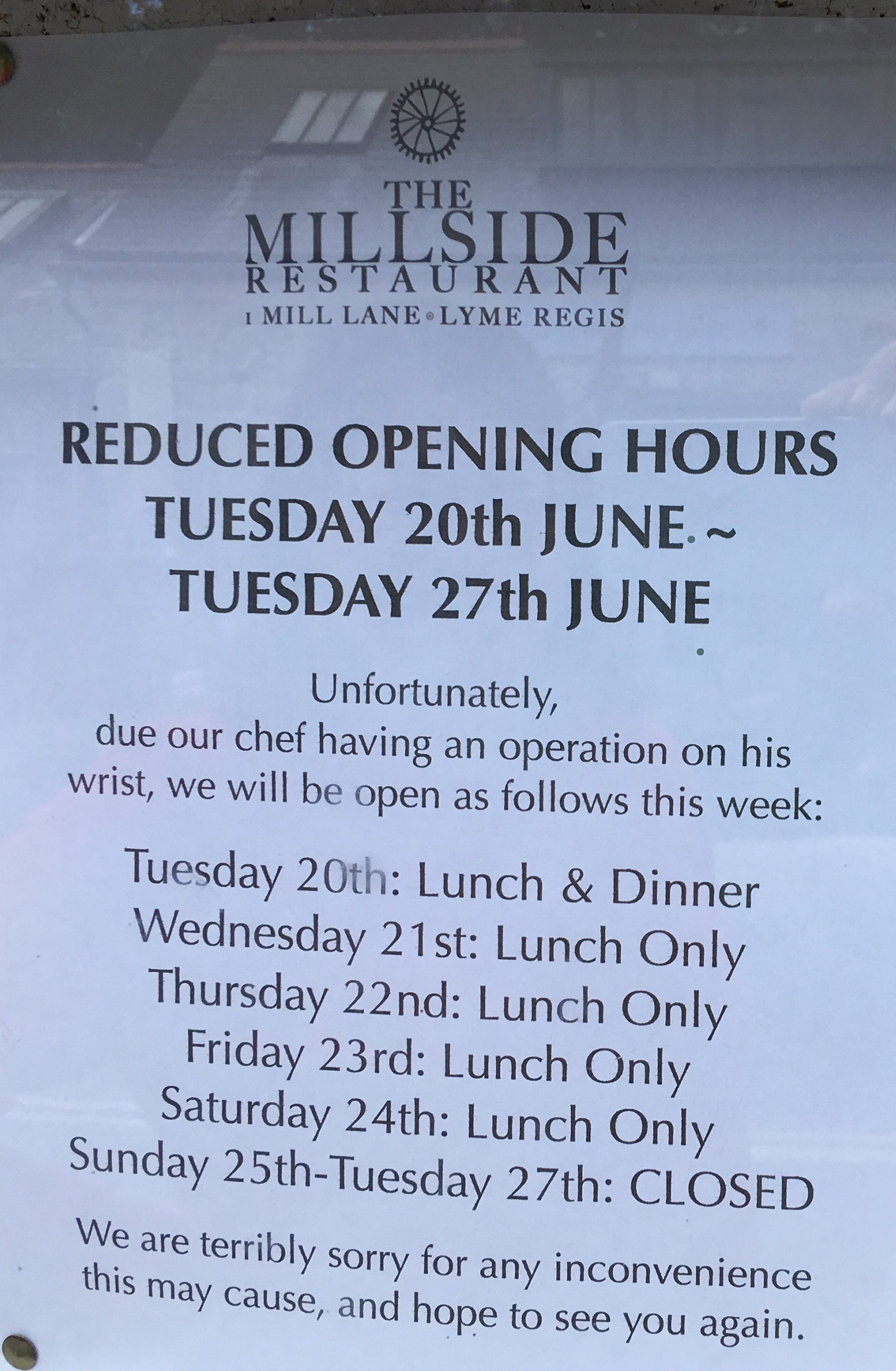
Another example, below.  Maybe they tried really hard to find another chef to fill in, and couldn’t.  Sadly they will not see us again because we were tourists.

Another cultural difference of note, in light of the Las Vegas shooting: the attitude toward guns.  Lynn’s husband has a gun room.  He’s got hunting guns galore, but no hand guns.  They are all registered, and the police can show up at any time to make sure they’re locked up and that Lynn doesn’t have the key.  If a friend or neighbor notices him acting irrationally, he can be reported to the police, who can revoke his license.  This is fine with him because Brits have the attitude, “We’re all in this together.”  This would never be tolerated in the US, where we care more about our own rights than the rights of society as a whole. So I have little hope that our gun laws or culture will change.

Travelers and Travellers

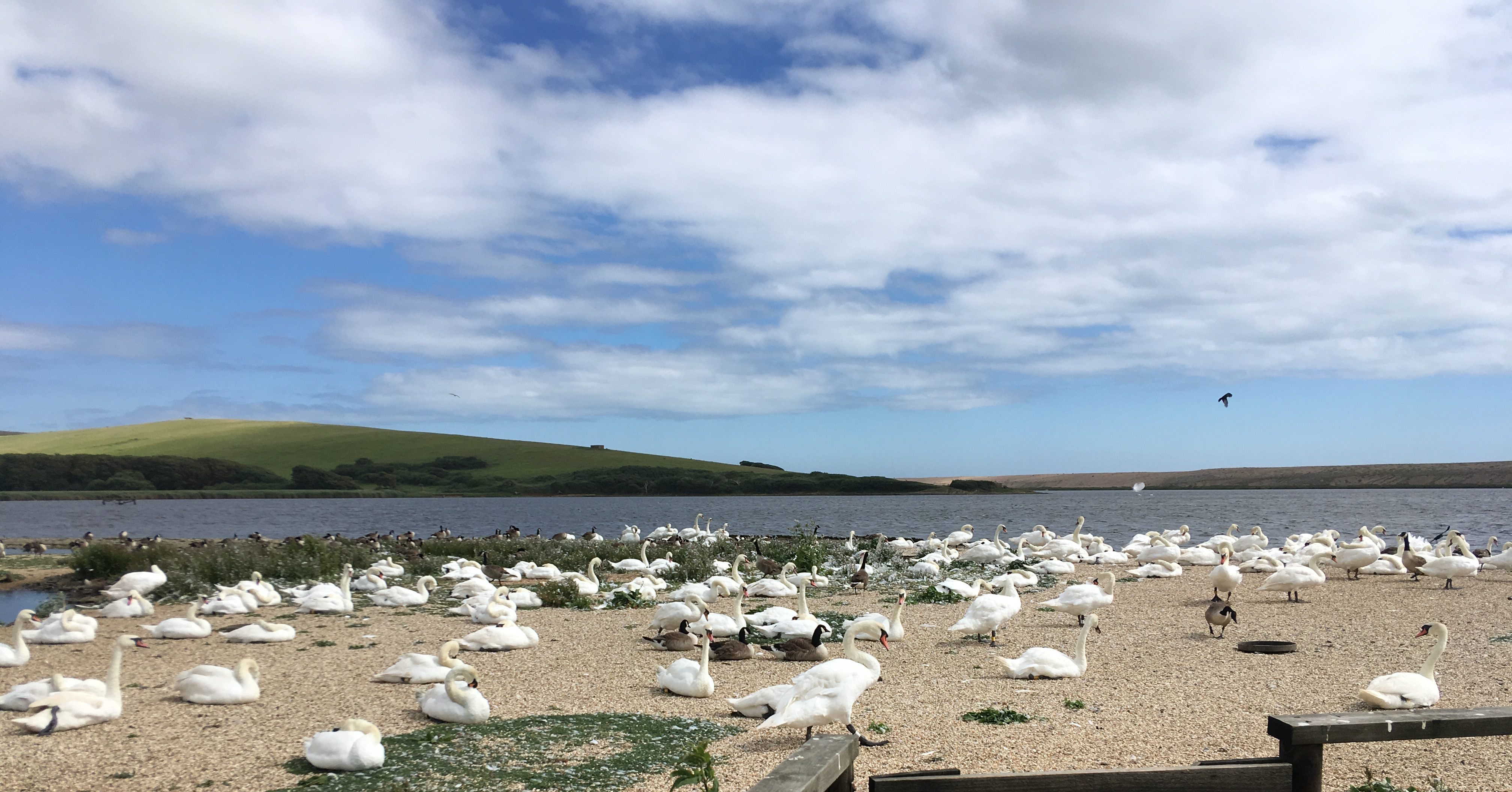
Lynn proposed taking a break from driving for a day, so we took a bus to Abbottsbury, home to the world’s largest colony of mute swans. Yes!  I know you’ve been wondering where the world’s largest colony of mute swans is, and now you know.

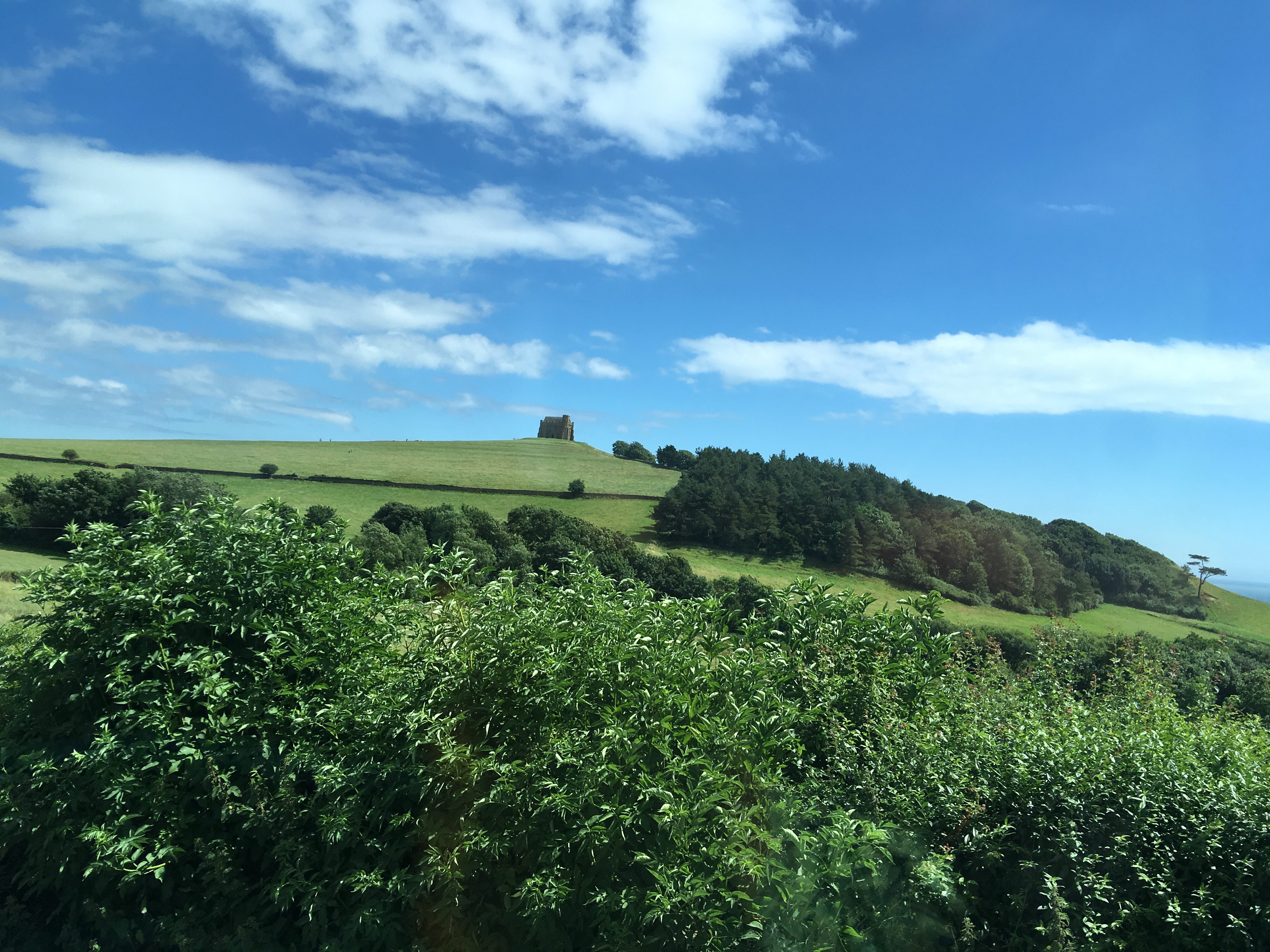
We Americans are so car dependent.  Thing is, on many routes you can see so much more from trains and buses.  This was the case on the route from Charmouth to Abbottsbury, which wound through gentle rolling hills overlooking the sea.  It was a double-decker bus and in addition to the views, we had the double-decker bonus of an entertaining and slightly menacing fellow passenger.

This guy was sitting in the front left bench on the top of the bus with his dog.  A young boy was slumped in the bench on the other side.

“I’m a Traveller,” he turned to announce to us in a phlegmy smoker’s voice.

I capitalize Traveller and use two “ls” because Travellers are what we in the States might call Gypsies, which some consider a pejorative term for the Roma people.  Irish Travellers are an ethnic group, while the British term Traveller seems to be a catch-all for nomadic people who might be Irish Travellers, Roma, new age drifters, or others of indeterminate origins.  Some of them travel in family groups in old-style wagons or caravans.  They take over farm fields or urban vacant lots and are reputed to steal anything local that isn’t nailed down.  They don’t send their kids to school or use the NHS or work except for odd jobs. After a few days or weeks they skedaddle, leaving behind mountains of trash for the land owner to pay to remove.

Our Traveller was clearly agitated—on drugs?  He turned and yelled at Lynn to ask where she was from—it was like I was invisible, which was fine with me—and when she said north London that was all he needed to go off on a rant.

“I’m a Traveller,” he repeated, as he stood up and began removing his shirt.  “I got my best friend here,” he gestured at the dog.  “And my kid over there,” he waved his hand dismissively at the boy.  “My partner’s had a baby, so I thought it’d be a good idea for us to go off and leave ‘er alone for a while.”

Yes, every woman’s dream—to have a baby and be left alone, probably in a filthy squat, with no medical care or support of any kind.  Maybe I had it all wrong.   Maybe she was in good hands.  I hope so.

He peeled of his shirt and rubbed his hands all over his torso.  Yes, he was high.  He had an almost-gone splif he kept putting in his mouth, holding his lighter to it, then remembering he was on a bus and putting it away.

He went on about London—how it had changed, how everything is different now, how expensive it is.  He talked about his dog and what a good friend he was.  The boy sat silent in the corner of his seat.

We passed through Chideock and Eype, then stopped in Bridwell, where the driver announced we would wait for 10 minutes.  The Traveller jumped up and ran down the steps to smoke his splif, leaving behind the dog and his kid.  The dog started wandering down the aisle.  The Traveller reappeared, yelling and cursing at the dog to “get yer feckin arse” back on the bench.  He put his shirt back on, then took it off half way, then sat down and was quiet.

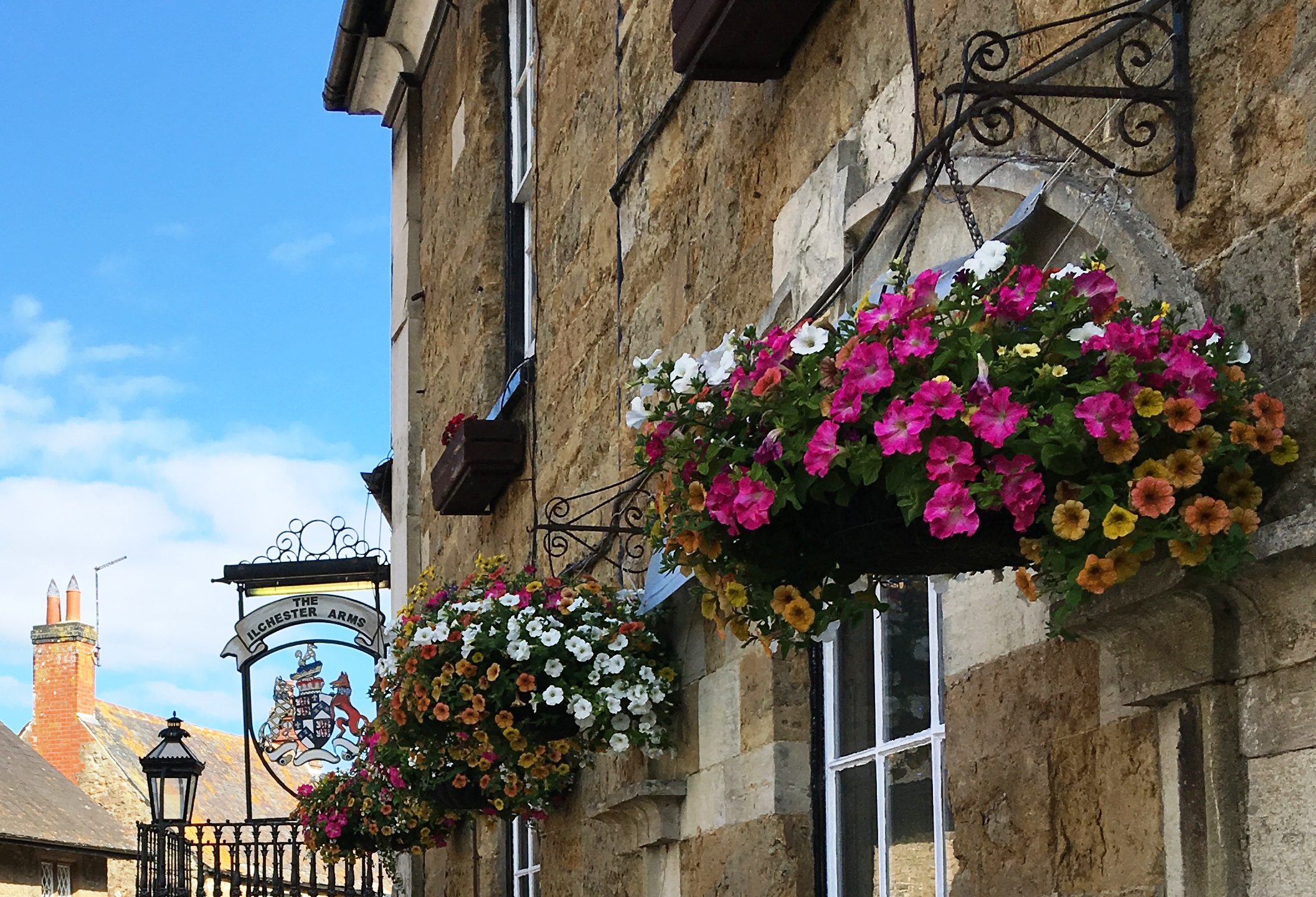
Lynn and I and the two other passengers, an elderly stone-faced couple, proceeded to enjoy the tranquil scenery.  These photos are from some small town; it could have been Litten Cheney, Littlebredy, or Puncknowle.

I love how the hat shop is proud to be “known in both hemispheres.”

The Traveller and his entourage disembarked somewhere before Abbotsbury, which was a relief.  There isn’t a lot to say about the swannery, except that it was peaceful and good to learn there is a job called “Swanherd” that probably doesn’t involve sitting at a computer or in meetings all day.