Tag Archives: travel

¡Me Encanta Bailar!

This is the third in a series of posts about Cuba which starts here.

We checked into our hotel, the Habana Libre, a mid-century modern. It must have been splendid in its heyday. It wasn’t run down so much as dead. Deathly quiet, no people except the guy at the desk. The lights were dim. We made our ways to the elevator and when I got off at my floor it was so dark I had to grope my way along until my eyes adjusted to the dark. The room was spacious and clean if Spartan. It was as if slowly, over the years, the art, the phone, the clock alarm, the drinking glasses, every little comfort you expect in a hotel had been stripped away.

In the bathroom I had my introduction to some of the disconcerting results of the U.S. embargo. In particular, crude oil, with which plastic is made, was banned, and so the shower curtain was about as thick as a Walmart bag, and the toilet seat was like a large white Frisbee with a hole in the middle—so thin it couldn’t be well secured to the toilet so it slipped around underneath me. The toilet paper? Well let’s just say that if you toilet papered someone’s house with it, the first light rain would wash it away, it was so insubstantial. There was no soap or shampoo or washcloth but there was a towel—one—also so thin and threadbare you could hold it up to the light and even that dim light showed through it. I was the only one who got off at my floor; it seemed like they had distributed our group one or two people per floor.

There was a mini refrigerator with nothing in it and a black and white TV. I flipped it on and there seemed to be two channels: one with old American TV shows like Bonanza, the other featuring nonstop speeches by various politicians. This was when I discovered that all the hard work I had invested into studying Spanish would really pay off. Not! Cuban Spanish is so different, and so fast, that a lot of Spanish speakers from Mexico or Spain have a hard time understanding it.

Suddenly, there was a hard knock at the door. I jumped and yelled, “Who is it?” then, “Quien es?” The knocking continued so I went right up to the door to see if I could see anything through the peephole but whoever it was must have been standing to the side. I repeated, “¿Quién es?” then “Que quieres?” The knocking stopped, then a woman’s voice shouted something that sounded like “Pocky robbabab ocalaca macanaca!” She said it with great gusto. Was she being attacked? Should I open the door and let her in? There was no phone from which to call the desk, and even if I had had a cell phone twelve years ago there would have been no reception in Cuba. The pounding resumed, along with more incomprehensible Spanish and shouting. Eventually she must have given up and gone away.

The next day our group had a walking tour around the city. I had been to Mexico, Jamaica, and to El Salvador, so I wasn’t a complete newbie to the developing world or Latin America. I had also lived in some pretty poor neighborhoods in St. Paul. I was struck by how there were no homeless people here, no beggars, no children selling Chiclets. There was no graffiti or litter. Was that because people couldn’t buy anything, so they had nothing to throw on the ground? Or would they be thrown in prison if they did? Or was it all a front for tourists?

I returned to my room without incident and found this sitting on my bedside table.

Cuban Dancer

Who had left her—was she a peace offering? Anyway, she’s come with me on my travels ever since. When I get to wherever I am staying in Nairobi or Dubai or Dublin, I set her on my bedside table. Her head got lost somewhere along the way, which maybe symbolizes even more the carefree traveling spirit I endeavor to be.

All for None, None for All

This is the second post in a series about Cuba that begins here.

I searched for my photos from Cuba and since I was well organized back in the day when we printed photos and put them in albums, I was able to find them quickly. I realized it’s been 12 years since I went to Cuba. That adds weight to my disclaimer that things have changed from what I’m going to describe. Mainly, everything has gone downhill.

I met my fellow travelers in the Miami airport. There were two dozen of them and I must have brought the average age down to about 60 when I showed up. They were pretty much as I expected; all the men had grey beards and ponytails and the women wore long tie-dyed skirts with Birkenstocks. They were a nice bunch of people, mostly couples but as usual on tours there were a few divorcees who put the tank in cantankerous. Ed was our leader. He had been to Cuba many, many times and he would be indispensable in interpreting what our guides said. Not because they spoke Spanish—because they had to speak Propaganda. Of course Ed had his own agenda, so much remained a mystery.

All the other people waiting for the flight to Havana were Cuban Americans, and they also fit a stereotype. Picture Desi Arnaz, then picture him about 30 pounds overweight, wearing an untucked-in Guayabera shirt, the flashiest designer sun glasses you’ve ever seen, dripping with gold chains, bracelets, rings, and a watch as big as Big Ben.

Ed explained to me in a low voice, “That’s how they get funds into the country for their relatives. They can’t smuggle dollars in, but their family can sell that jewelry on the black market.”

What struck me almost immediately upon arrival was that there was no advertising. There was propaganda galore—on wall murals, billboards, and ubiquitous images of Che and Fidel and other revolutionaries. But there were no billboards for products like laundry detergent or for stores or restaurants—because there were no stores or restaurants. There was almost nothing to buy, anywhere.

Che

But who needs stores when everything is provided by the state? “From each according to his ability, to each according to his need,” is the saying popularized by Karl Marx. Every Cuban got a house, medical care, electricity, food, an education—and cigars! The house might be about to collapse, the electricity might be out for hours a day, and the food might be basic (rice, chicken, and beans), but they could all depend on their monthly rations.

Everyone had a job, too. I had doubts about whether “ability” was factored in. I used a restaurant bathroom and was dismayed to find the toilet was broken. An elderly woman appeared with a bucket of water and dumped it in. Was that the best job they could come up for her based on her ability? No, Ed explained. Aside from professions like physicians, everyone was just assigned a job that needed doing. Or a job that didn’t need doing. These “make-work” jobs were in evidence everywhere. We were told to get in a van so we could be driven 25 feet from Point A to Point B at the airport. There were people sweeping clean sidewalks and guards guarding empty buildings. All of them—doctor, driver, toilet flusher—earned about the same per month.

There was one government-sanctioned store called a dollar store. American dollars are the currency in Cuba, and I mean cash. There were no ATMs, no credit cards or checks accepted anywhere, even at the hotel.

What was for sale in the dollar store? Nothing touristy, and nothing for a dollar. Everything was expensive. The store was tiny but packed in everything from clothing to washing machines. It reminded me of an old timey Woolworths, with no American goods, of course. There was an appliance brand called Vince which I assumed was Spanish or Italian. Trade with Cuba was in defiance of the U.S. Government, Ed said later. Spain was also financing renovation of the historic waterfront, the Malecon, on and off—the pauses due to bullying threats from the U.S.

Malecon

¡Cuba, si!

There’s a lot of interest in travel to Cuba now. That is, travel by Americans, because most everyone else in the world has been going all along.

If you were to tell me, “I can only afford one trip this year. Where should I go?” my answer would be, “¡Cuba, si!”

Why? Because it’s the most different place you can go and not worry (too much) about being thrown in prison for 10 years.

I don’t know for sure, but I think most Americans imagine Cuba is a poorer version of Mexico, with better music and more baseball. Cuba is a lot poorer than Mexico, and there is great music and an obsession with baseball, but it’s more like Russia or China than the rest of Latin America.

Think about it: It’s a socialist country. If you harbor romantic ideas about communism or socialism, go to Cuba.

I went to Cuba about 10 years ago. I had been writing papers about the Cuban Missile Crisis for my master’s program, and my friend Bette was married to a Cuban guy named Lumino. Lumino was only allowed to visit Cuba, where his children and grandchildren lived, every two years. “Each time we go,” Bette told me, “It’s more desperate than the last visit.” She gave me a book titled Cuba: Neither Heaven nor Hell. I was intrigued.

So one cold Minnesota day when I had nothing better to do I Googled “tours to Cuba” and up popped the Marin Interfaith Task Force on the Americas. Within a couple hours I was signed up to go on a legal trip to Cuba.

I love it when trips come together like this, spontaneously and easily.

The Taskforce is basically a bunch of old hippies who live in the richest county in America (I don’t know how that works). They’ve been agitating against U.S. meddling in Latin America for decades. One of their strategies is organizing mission trips—not in the religious sense but to learn about situations on the ground first hand, to show solidarity, and to introduce new people to the cause.

There’s also the little fact that, in order for Americans to visit Cuba back then, they had to be on some sort of official mission. We were supposedly humanitarians on a medical mission to deliver medical supplies. While Cuba has one of the best public health systems in the world, they were so financially strapped due to the U.S.’s strangulating policies that they lacked basic things like soap and bandages. I write in the past tense because this is changing. But it will take a while to make up for decades of deprivation.

I want to note here that the Taskforce has a trip to Cuba coming up in April. The theme is “Environmental Justice in Cuba: A Study of Cuba’s Environmental and Social Policies and Practice.”

Anyone can join them; as their flyer says, “All are welcome to join this delegation! Professors, Students, Researchers, Activists!” They’ll tour Havana and the western provinces over 10 days and the cost is about $2,700, which includes everything except maybe your flight to Miami from wherever you live.

If you think that sounds expensive, I cannot emphasize enough how valuable it is that the Taskforce secures your travel visa for you and works with a tour company that knows the ins and outs of making arrangements in a country where everything is a mystery to outsiders. Plus, you would be covered by Cuban health insurance while you’re there! Ideally you don’t want to get sick or injured at all, but how cool would it be to experience the Cuban health system first hand, especially since I delivered a case of bandages to them 10 year ago? You’d have dinner party invitations for years based on that story alone.

I used student loan money to pay for my Cuba trip. I know, I know that’s a big no-no. You’re only supposed to use student loan money for tuition and education-related expenses. I would argue that actually going there was a much better education than reading books and articles and writing papers about Cuba. I’ll write about it in my next few posts.

Road Tripping

My friend Lynn turns 60 in July—I can’t believe it! I’m not far behind.

She’s lined up some bucket list trips to celebrate. Now, Lynn has been everywhere—she worked for Nokia and routinely traveled from London to Helsinki to Australia and back in the space of days. I think her record was 32 countries in one year.

So you would think it would be challenging for her to come up with a dream list of destinations, but no. Whenever I’ve asked, thinking she’ll be stumped she easily rattles off half a dozen places she’d like to see.

So she’s rounded up a group of people to go to the Glastonbury Festival in June. The line-up is unbelievable: Foo Fighters, the Who, Florence and the Machine, Kanye West, Motorhead, Pharrell Williams, Mary J. Blige, Patty Smith, Alabama Shakes, and Burt Bacharach (!?). The downside? Camping in a heaving-with-humanity, mud-filled field with porta-potties.

glastoTents_2579820b

Lucky for me, Lynn’s list includes New Orleans, and I’m in on that. I’ve been to NOLA, but will be happy to return. It’s one of those places, like Los Angeles, where anything goes—where no one pays any attention to you if you’re wearing a clown wig or are half naked. Or completely naked. Not that I will be walking around naked, but you know what I mean. In the Midwest we have a narrower tolerance. Maybe that’s why one of our prune-faced stock phrases is, “That’s different” or “That’s interesting,” to mean, “That’s weird and I don’t approve.”

Lynn and I met in Oxford and shared a house for six months. I’ve enjoyed the generous hospitality of her and her husband Richard’s home in the Scottish Highlands half a dozen times. We’ve traveled together to Prague, Venice, and Berlin, and she’s been to Minnesota. So we know we can tolerate each other’s idiosyncrasies … not that I have any.

Vince has been writing about drugs lately in his blog. My drug is travel. I think about New Orleans and immediately the possibilities begin to flag out:

“As long as I’m going, why not go down to Shreveport or Baton Rouge? I wonder what they’re like? Or, why not drive down from Minnesota!?”

My heart stars to race.

Google maps aids and abets me. A quick search reveals that I could stop in St. Louis, Nashville, and Jackson, Tennessee. I’ve never been to those last two!

My palms are sweating and my breathing is shallow.

Then Lynn throws gas on the fire:

“Why don’t I fly to St. Paul and we can do a road trip together?” I hear her pronouncing “St. Paul” the British way, “Sen Pauuuuls.”

I’m also emailing back and forth with my Turkish friend Ferruh, a former neighbor who now in New Orleans and teaches a Tulane. He’s sending me links to shotgun houses we could rent. Now we need to find a place with multiple beds because our Australian friend Christine, aka Possum, is going to join us.

It’s zero outside today in Minnesota. I troll from listing to listing of B&Bs and boutique hotels with lush courtyards with fountains and pools and all within walking distance of the French Quarter and Frenchman Street.

WOW man! The colors! My head feels like it’s going to explode.

Wait—what if, as long as we’re doing a road trip, I just blow all my vacation time and take us through southern Wisconsin (very scenic in the springtime)? We could see Spring Green, the Frank Lloyd Wright home. Then on to Madison, where my cousin Bob lives … his wife is Native, maybe she could hook us up with a pow wow—foreign visitors love that kind of thing.

Then—on to Chicago! We have to go to Chicago, right?

As long as we’re that far east, maybe we could go through Kentucky—Hey!—When is the Kentucky Derby? I’ve always wanted to go to the Kentucky Derby ….

My mother calls and when I tell her what I’m up to she suggests we go through the Smoky Mountains. Where are the Smoky Mountains? I am clutching a paper map now, my hands are trembling with excitement. Half the day has passed without my noticing.

Happy Christmas, Ten Years On

In keeping with my gradual transition to writing about unconventional travel and living abroad adventures, I’m looking back on the first Christmas I spent in the UK, 10 years ago.

I had learned a lot since arriving in October. Searching for housing, I had finally figured out that address numbers sometimes went up one side of a block and down the other. Also, many buildings just had names instead of numbers. The Oxfam head office was called John Smith House.

“House” was a misnomer because it was a modern, three-storey building in an industrial park across the motorway from the Mini Cooper factory, and 750 people worked there.

John Smith Houseatriumlobby

I could usually remember that the first floor was the “ground floor” and the second floor was the first floor. I had figured out that when my coworkers asked, “You awl right?” they weren’t concerned about my health; it was the same as someone in Minnesota asking, “How ya doin?” I was avoiding “creeping Americanisms” in my writing, as cautioned in the Oxfam writing manual, so was careful to write “storey” and “tonne” instead of “story” and “ton.” I was no longer taken aback when introduced to a 20-something coworker named Harriet, Richard, or Jane.

Most important, I had learned to avoid any references to my pants, as in, “I got my pants wet biking to work in the rain.” Trousers were pants, and pants were underwear. I loved the expression, “That’s just pants!” which meant something like “that’s insane!”

Everyone spoke in a low murmur. This was partly due to the open plan office, where six people shared one big desk, but I think it was also the culture. A few weeks after my arrival, a new Canadian employee came through for her induction (orientation), and her braying, Minnesota-like accent filled the whole building. One of those moments when I realized, “Ah, that’s what we sound like.”

At Oxfam, everyone walked fast. It was as if, by striding vigorously, they would personally Save the World.  My tall, ginger-haired colleague, Adele, was selling Palestinian olive oil out of her desk drawer. I enjoyed a daily fair-trade, organic chocolate bar from the cafeteria.  Oxfam had a Christmas bazaar in the atrium featuring beaded jewelry made by Masai woman who used the proceeds to buy goats.  Everyone was very earnest.

To be fair, the “Boxing Day”, or Indian Ocean, Earthquake and Tsunami (caution: upsetting video) had happened one year before, killing 230,000 people and leaving millions more without homes or livelihoods. Then, suicide bombers had struck the London transport system in July, killing 56 people and injuring over 700. The week I arrived in Oxford, an earthquake took 80,000 lives in Pakistan. People were reeling, but responding generously. Oxfam had received a tsunami of donations, internally referred to as the “Cat Fund”—for Catastrophe Fund—and rumour had it that they were struggling to do enough, fast enough, to respond.

But for now, Oxfam was abuzz with Christmas cheer. I look in my diary (date book) from that time, and I was busy meeting colleagues after work at pubs named The Marsh Harrier, the Eagle and Child, The Bear, Angel and Greyhound, and Jude the Obscure.

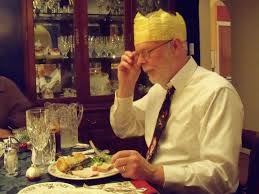
They called Christmas Crimbo, and presents pressies. There were crimbo crackers for sale, too, which are not a crunchy, salty snack, but shiny cardboard tubs “cracked” open at the festive table and containing a Christmas crown and trinkets.

C&CCrackers and CrownsC&C2

There was a panto in the Oxfam atrium, so to use all my new words in a sentence: “Are you going to the crimbo panto or shopping for pressies and crackers after work?”

And what is a panto? It’s slang for pantomime, an extravaganza that takes weeks of planning and involves elaborate costumes, jokes, dancing and singing, skits, and slapstick. Apparently it’s also done by families and in theatres but the only one I’ve ever seen was in the Oxfam atrium. Our usually-serious employees were dressed up as fairytale characters and making fun of themselves, our bosses, and our work. Very healthy, I thought. Take life seriously most of the time, then go all-out silly for a week.

The Queen’s Christmas Message that year was beautiful, in my opinion, and more relevant than ever.

queen

Hedgehogs, Mice, and Echidnas, Oh My

I pride myself on writing realistically about life. You can count on me to tell the truth as I know it, to question everything, and to imagine the worst case scenario. I don’t know why the Pentagon hasn’t called me yet to offer me a disaster-planning job.

But that doesn’t mean I’m depressed, or even “unhappy”—the more generic term. Being a highly-analytical thinker has its rewards. I notice and think about things that other people do not. There’s often absurd fodder for laughs. Sometimes I’m the only one laughing, but that’s okay, right?

There was an article in the Sunday paper about a study that debunked the popular myth that “happy” people are healthier and live longer. Yes! My friend who works in an old folks home—or whatever they’ve been rebranded as now—has always said, “There are plenty of miserable, crabby 90 year olds. And they’ve always been that way, because their kids tell me they have.”

About five years ago, I kicked the depression that had dogged me all my life. Since then I have felt mostly contentment, punctuated with the normal situationally-appropriate emotions. I felt angry when my landlord raised my rent $300 a month, which forced me to move. I was stressed when I moved again three months later so Vince could live with me. I was anxious when Vince was in solitary confinement. I cried for everything my sister and her kids went through when she had cancer. I felt awe hiking in Petra, in the Jordanian desert, and nervous about crossing over into the Palestinian territories. I felt powerless rage when I was banned from visiting Vince. I had a blast with my friends in Berlin. I’ve been bored at work. I was proud when Vince led his squad at his graduation from boot camp. I am excited at the prospect of remodeling my kitchen.

Hey, I guess I just wrote my Christmas letter!  What a year it’s been.

None of it lasts. Some people figure this out somehow, much earlier in life than I did. Emotions come and go. The pleasant and the unpleasant, they’re all fleeting. So enjoy the nice ones while they last and know that the bad ones will dissipate. Don’t panic if you feel blue once in a while. Don’t latch on to the negative feelings or thoughts. If the blues don’t go away for weeks, of course, seek professional help.

In the last week I’ve had some really good times with people I love.

Yesterday I took my mother to tour the Purcell Cutts House, a prairie-style home build in 1913 and owned by the Minneapolis Institute of Arts. This is the living room:

Purcell Cutts

The guide explained that the simple, serene style was in part a reaction to the chaos of the age. The architect was from Chicago, which was the industrial center of the U.S. Meat packing and other industries attracted droves of immigrants and African Americans from the south. There wasn’t enough housing, and the water and sewer systems weren’t up to par. There were no child labor laws, workers’ compensation, welfare, or social security.

So architects brought nature and art inside. Obviously this was not a house that could be produced on a mass scale. The immigrants and African Americans still lived in poorly-heated hovels. But at least this one architect could escape all that and find sanctuary at home!

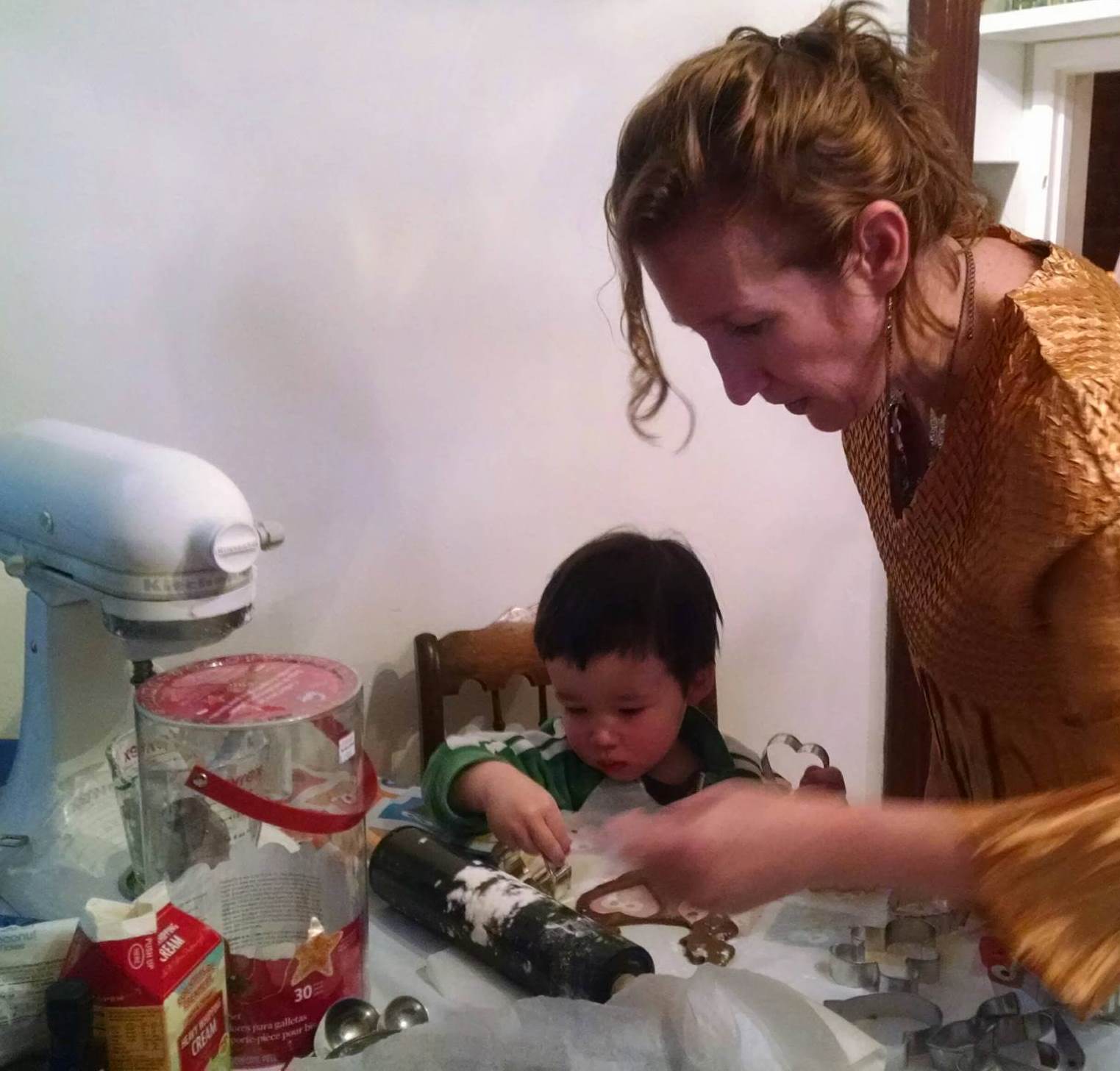
Last weekend, I hosted a cookie-baking party for Vince and his cousins.

Hannukah HedgehogsTaisei n me

They’re not pretty, but we had fun. Strangely, Vince and I had prepared enough dough to yield 16 dozen cookies but only nine dozen made it to the final stage. Hmmm…or should I say, Mmmmm….cookie dough?

So enjoy the moments that contain things you love. In my case: design, craftsmanship, nature, history. Kids, creativity, and cookie dough.

Do Gooder Abroad

The first overseas trip I took was to London. It was 1987, and Vince and I had become obsessed with Dr. Who and spoke to each other in terrible English accents. I read that the guy who played the Doctor, Tom Baker, was going to be in a play in London. Like so many trips I’ve taken since, it was that slim thread of a reason that got me started.

But I had also gone to a lecture by Arthur Frommer, the travel guru, on how to travel cheap. He mentioned volunteering with places like Volunteers for Peace. I paid my $400 for the one-week “experience”, bought a plane ticket, and away I went.

Looking back, I can hardly believe I did it. The only other country I’d ever visited was Canada, where in those days you could flash your driver’s license as you drove over the border. I don’t remember what I did there; probably fed potato chips to black bears out of the car window.

My mom was more than happy to keep Vince, who was nine. He was happy to be spoiled.

I went a week before the program started and from dawn to dusk saw all the sights. With my map in hand, searching hopefully for a street sign and stopping people to ask directions, I must have reminded them of Crocodile Dundee in the scene where he says “G’day, mate,” to every passerby on the sidewalks of New York. As I was informed in due course by my fellow volunteers, I was a “typical American” because I wore jeans and what we used to call tennis shoes and I complained that there was no Diet Coke or ice or ketchup.

I was dazzled by the Crown Jewels. I saw Tom Baker on stage in “An Inspector Calls.” I went to Friday services at a synagogue and saw a woman with numbers tattooed on her arm. I got lost over and over which led me to the Dickens Museum, which turned out to be my favorite museum. I was propositioned by a creep in Hampstead. I stayed in a “hotel room” the size of a cracker box with a cold water bathtub down the hall lighted by a dim, bare bulb. I got the exchange rate backwards and paid way too much for a sweatshirt at the Hard Rock Café. I stole some toilet paper from a public toilet that had “Council Property” printed on every square.

You know, the usual London stuff. I took a lot of pictures of cars; I’m not sure why.

UKCars

My VFP group included 20 20-somethings from Poland, West Germany, Holland, India, Sweden, Italy, Spain, and Mauritius, a country I’d never heard of.

We were there for a “work camp”—a terrible name but basically VFP housed us in flats in London’s East End and we babysat immigrant kids during a school holiday so their parents wouldn’t have to take time off work. The flats had peeling wallpaper, cold water, and mattresses on the floor. The smell of rotting garbage was constant.

I was bewildered that my fellow volunteers weren’t hooking up or drinking. I would have expected that from an American group, but these kids were so serious.

Bengalis

At night we were lectured to about how the Bengalis and Pakistanis and Indians came to work in the East End basically as indentured servants, and how now the National Front was outraged they “these people” were bringing their families over.

NF Boys

The kids were adorable and they knew an opportunity when they saw it. Another volunteer and I tried to take a dozen kids to Epping Forest, but before we got there they scrambled over the wall of a private garden and stripped all the apples off the trees. The homeowner ran out, screaming. I think if we hadn’t been foreign volunteers, she would have called the police.

This was when I thought, “What am I doing here, babysitting other people’s kids while mine is 4,000 miles away!?” It was my first extended time away from Vince and I couldn’t wait to get home.

And as soon as I got home I couldn’t wait to go on another trip.

Alone in the City of Dreaming Spires

I spent Thanksgiving in Wisconsin with my cousins, which is what I do every year. Vince couldn’t come because he is not allowed to leave Minnesota.

After eating way too much food, I made the mistake of checking Facebook right before I turned out the light. There were a couple posts from Vince. He sounded so lonely.

I couldn’t fall asleep. I laid there thinking about the time I learned to be alone. I think this is one of the most important skills we have to master in life.

I had moved to Oxford, England four months before my birthday. I rented a house with a three-legged cat named McCartney and housemate who went home to Scotland every weekend. I had a great job. I had joined a posh gym. I had made some acquaintances through work and Alanon meetings.

Red Door

This was before Skype or Facebook or What’sApp. My family and friends used email to communicate with me, but there was no internet at the house.

I don’t normally even care about my birthday. I hadn’t told my housemate or acquaintances it was my birthday because I didn’t want to seem like I was fishing for a fuss.

I walked into town to see a movie. February in England is dreary and drizzly. Well, most months are. In comparison to November, the sun was setting later (almost 5pm!) but the sky really only went from murky black to dark grey and back to murk again.

I got some popcorn and found a seat. Someone behind me said, “Pssst!” Hurrah! It was a friendly woman from my Alanon meeting named Rebecca. I wouldn’t spend my birthday alone after all! But she just said, “Nice to see you,” and that was that. I thought, unreasonably, “Why couldn’t she have invited me to sit with her and her friend?” I felt really put out.

The movie was Walk the Line, the Johnny Cash biopic. There’s a scene where Johnny is drying out and his family confronts a drug dealer with shot guns. The theater exploded in laughter. “Typical Americans!” I could hear around me.

I had picked a bad time to move to England. George W. Bush was using their air bases to transport terrorists and political prisoners in black helicopters, and most Brits were not happy about it. Most people were nice enough—if reserved—but I had been confronted by several very angry people who took me to task for everything my country had ever done wrong.

It really hit me that I was not only lonely but alone. I was on an island with 64 million people and I didn’t know a single one of them beyond asking the time of day. It was piercing.

I went home and had a few beers while I stared out the front window like some tragic heroine in a period movie. People strode past with their hands deep in their pockets and their heads down. I wallowed in self-pity. But somehow I knew I would get through it, that I wasn’t going to die of loneliness, that everything would change eventually—if not the next day then next week or next month. Everything did change. I’ve had a lot of great adventures on my own and with other people.

Now we can feel like we’re never alone by floating along on endless social media streams of cutsie platitudes and cat videos and political rants and “breaking news.”

Did Vince know that nothing stays the same forever? I finally fell into a worried, fragmented sleep. I dreamed that Vince fell into a river and was swept away into a big pipe. I ran along the river bank until I came to an opening in the top of the pipe. I could see his face underwater, looking up at me. The iron bars over the opening were wide enough for my hand to slip through so I could touch him, but too narrow for me to pull him through. Ugh. I woke up crying. I don’t need a psychiatrist to analyze that dream.

Enough, Already!

This post has nothing to do with mass incarceration or terrorism or any of the other lighthearted subjects I write about, but I wonder if it wears away at me nonetheless, day after day.

Have you noticed the proliferation in unnecessary noise and lights?

For instance, I spent a night in a hotel this weekend and I counted the unnecessary lights as I tried to get to sleep.  There was a white light on the smoke detector, a red one on the TV, another one on the DVD player, one on the phone, a green one on the key card holder by the door, another on the bedside clock.  Why?  I had closed the drapes to block out the millions of lights from the skyscrapers surrounding the 23rd floor room, but that didn’t do anything to block the lights inside.  Were the technicians who designed all these gadgets worried I might get up in the middle of the night and crash into the TV screen because I can’t see it in the dark?

The previous week, my friend Sarah and I were hanging out at the Mississippi River.  We meet up there every couple of weeks on nice days, bring chairs, and watch eagles soar and the sun sparkling on the water as it rolls by and we update each other on our lives.

There is an off-leash dog park across the river from the park we hang out in.  It’s a source of occasional irritating noise pollution in the form of barking, but on this day it was incessant.  There must have been 10 dogs barking for a half hour or more.

Then, a guy backed his boat trailer into the river and proceeded to rev his engine, which in addition to generating annoying noise, produced billows of diesel fumes.  Sarah and I and the others around us exchanged looks.  How long would this go on?

Being a direct person, I walked over and waved at the guy to get his attention.  I asked how long he would be revving his boat engine.  He said, “Five minutes—why?”  I said, “Because it’s noisy and the diesel fumes are unpleasant.”  He said, “It’s a boat landing!”  I replied, “It’s a boat landing that’s part of a public park.”

Sarah and I and our neighboring nature lovers picked up our chairs and moved upwind of him, which didn’t do anything to decrease the noise.  We expected him to purposely keep on for longer than five minutes but true to his word he finished and left.

“I was thinking the other day,” said Sarah, who is as curmudgeonly as I am, “of all the ways this park could be ruined.

“First, they’ll install wireless, and put up signs everywhere announcing it as a great new feature.”  As she said this, a couple strolled by on the beach with their two young children, both the parents staring down at their phones while the kiddies toddled near the river’s edge.

“Then they’ll install a massive screen across this space in front of us, so we can watch videos of the river, at the river …”

She was interrupted by a loud buzzing noise.  I’m not kidding.  It was a drone.  Everyone stared over at it, and Sarah whipped out her camera to take a picture.  “Don’t encourage him!” I pleaded.  But she wanted a photo to show her son.  The drone droned on for 10 minutes or so, then the owner must have gotten bored and left.  So much for watching eagles soar.

There are lots more unnecessary lights and noises at work, at home, in bars and restaurants, on trains, and especially in airports.  Argh!  Don’t get me started on airports and airplanes.

Does all this screen presence and beeping/barking/buzzing/bloop bloop blooping bother me so much because I am old?  Do younger people, the so-called digital natives, just not notice it?  Maybe they actually like it?  Maybe they actually need it?

Being There

There’s been a lot of righteous indignation that people are so heartbroken over the Paris terrorist attacks—so upset that they’ve taken action, by changing their Facebook profile photos! But no one changed their Facebook photo when terrorist attacks took place in Lebanon, or Iraq, or Nigeria.

Is this Islamaphobia? Well sure it is, with some people, but not for most.

I think it has a lot more to do with familiarity, in two ways.

First, in 2014 there were 16 terrorist attacks in Lebanon. 16! So far in 2015 there have “only” been seven. I looked it up on that great scholarly source, Wikipedia, because I had been thinking, “Bombings happen all the time in Lebanon” and I wanted to make sure I wasn’t just imagining that. I wasn’t.

In 2014 there were three terror attacks in France, all carried out by lone extremists, and one person died. So the attacks that came in January were the launch of a new era.

I’m not saying, “So what?” about terror attacks in Lebanon. I’m just saying that the frequency of them numbs us to the point where we might roll our eyes and shake our heads and maybe think for 10 seconds, “Those poor people. What a terrible way to live.” But we don’t change our Facebook photos.

Then there’s the other aspect of familiarity: Many westerners (North Americans, Europeans, Aussies, and Kiwis) have been to Paris. We may have studied French in high school or college. We’ve certainly seen Paris, and France, in films and TV shows and heard it referenced in music. How many westerners have been to Beirut? Studied Arabic? Can you name one movie set in Lebanon?

When I googled “films set in Lebanon” I found 16. I’d only heard of one—the James Bond film The Man with the Golden Gun. When I googled “films set in France” there were so many I couldn’t count them. There were 16 alone that started with the letter “L,” including the good old oldie Lust for Life, starring Kirk Douglas as Vincent van Gogh.

So my point is, empathy is about being able to imagine yourself in someone else’s situation. Even if we’ve never been to Paris, we have seen it so many hundreds of times that we feel it’s familiar, and it’s easier to imagine ourselves in that MacDonald’s where one of the terrorists blew himself up.

I went to the Middle East for work earlier this year. I was fortunate to be able to take some extra time to visit Petra, a 2,000-year-old city built by a people called the Nabateans who have since vanished from history. I hiked, bullshitted with the Bedouin guides, and savored the astonishing beauty of the place and the silence—so rare in our world.

TreasuryMoi

A few months later, ISIS starting destroying ancient sites in Syria and Iraq, most notably Palmyra. Palmyra was built thousands of years before Petra and had similarly stunning structures.

A year ago, I might have rolled my eyes and shaken my head and thought, “That’s terrible,” then gone on my way. But now I felt sick to my stomach and I couldn’t get it out of my mind.

So having been to a very similar place, I got it. I got it on a visceral level what a loss to our world the destruction of Palmyra was and I started worrying that ISIS might get to Petra eventually.  Stone buildings aren’t people, but you know what I mean.

Travel creates empathy. Not always, but often. Ironically, the attacks in Paris will probably cause people to stay home or travel only to the safe, sanitized foreign destinations like all-inclusive resorts in Cancun and Ibiza.