Category Archives: Budget travel

Losing My Words

This is the third post in a series about studying Spanish in Mexico that starts here.

And so I arrived in Cuernavaca, Mexico, to drench myself in Spanish language and culture for a week.

Through this company, Amerispan, I had bought a cheap package that included my classes and a homestay. I had splurged and spent an extra $40 or something for someone to meet me at the bus station and take me to the school. I made that call after seeing that the school was called Cemanahuac. What?! That didn’t sound Spanish, and I had no idea how to pronounce it. Now I see that they’ve added a helpful transliteration to their website: sem-ah-NOW-ock, and I can tell you that was the name used by the Aztecs to refer to their world.

For the umpteenth time I apologize for my lousy photos:

Cemanahuac PoolCemanahuac Hut

If you live in Indonesia or El Salvador or anywhere else that is tropical, you won’t think anything of this place. But to me, coming from a cold, drab grey Minnesota winter, it was paradise. I could hardly believe that I was going to spend a week studying here. I would have been happy to skip the studying and spend the week lying by the pool with a book.

Amerispan no longer lists Cemanahuac as a language school choice on its website. That’s sad, and I wonder if it’s due to all the drug gang violence, or something else?

I wandered around the school, probably with a dazed smile on my face, until someone called my name: “Anna Mah-eeeertz?” I don’t know how long they had been calling it before I realized it was me.

I knew from studying up on the Amerispan website that someone from my host family would come to take me to the home, but now I had left English behind—completely. That was their philosophy, total immersion.

But it wasn’t too hard to figure out that the secretary of the school was introducing me to a woman whose name was apparently Mierda. I could see the other office employees behind her, laughing up their sleeves. I would learn eventually that Mirta was Cuban, and that Mirta was a Cuban name. But she pronounced it Mierda and in Mexico and elsewhere Mierda means shit.

Mirta seemed oblivious to this, and as I got to know her better over the course of the week I found she was one of those happy, smiling people who just ignore bad things. Mirta was about 60. She was plump in a matronly way, with dark red hair, and she was dressed like my grandma used to dress in the 70s—in polyester elastic waist pants and a button up shirt—both in pastel colors, and sturdy black shoes.

She pointed toward the exit and said what sounded like, “Yabba da dabba da blabba de doo.”

All I could do was smile and nod; I didn’t even know to ask, “Que?” and even if I had I couldn’t have understood the answer. I followed her out into the street.

She walked so fast I had to hop skip to keep up with her. We reached a corner and she pointed to a bread store and said something. Then we turned, turned again at the next corner, walked about three more blocks, and while she talked and pointed to things along the way. We came to a crazily busy intersection where she stood for a while talking and gesticulating some more, until a mini bus arrived. She pointed to above the windshield, and I could make out a number and what I assumed was the month of Noviembre. Why would a bus route be named a date? I followed her on to the combi and she showed me the coins I had to pay, which meant nothing to me.

This was my introduction to the wonders of combi décor. There were several small statues of the Virgin Mary glued to the dashboard, the rest of the surface was covered in orange fake fur, and there were holy cards suspended above the driver’s head. We needed all the good-luck juju, for sure, as the bus lurched out into the stream of traffic.

Yikes, Yerkes!

This is the second in a series of posts about studying Spanish in Mexico that starts here.

My life had gone off the rails shortly after my 40th birthday and it seemed like the obvious thing to do was to run away to Mexico and learn Spanish. I had never been to Mexico. I had studied Spanish in high school, but Spanish class followed my free hour, which I spent smoking pot, so while I probably appeared to be enjoying the class immensely, the only words I had retained were cerveza and fiesta. Those weren’t going to get me a bus ticket.

But somehow I managed to fly to Mexico City, then take a bus to Cuernavaca. I was well prepared by Amerispan, the company I used to find a language school.

It just occurred to me that I am actually a sort of expert on travel, study, and volunteering abroad programs due to all the things sparked by this first trip to Mexico.

First, I wrote my master’s thesis on international immersion programs (meaning that you live with a host family in order to learn about culture and/or language). I researched a dozen of them and read up on the psychology of immersion learning. Did you know there’s a psychological theory called the Yerkes-Dodson law which says that the ideal learning experience requires you to be pushed out of your comfort zone—but if you are pushed too far your mind will shut down?

Second, I have participated in half a dozen immersion programs. There was the Volunteers for Peace trip, where I babysat Pakistani kids and studied racism with a group of other volunteers in the East End of London. There were my four trips with Amerispan. I did an internship for Global Volunteers, which offers “volunteer vacations.” There was my trip to Cuba to deliver medical supplies with the Marin Interfaith Taskforce on the Americas. I went back to England to volunteer for Oxfam, then got a full-time job there. I spent two months interviewing human rights activists in Nairobi, Kenya under the auspices of American Jewish World Service.

There was one close call. A few years ago, I had a plane ticket to go to Kolkata, India to volunteer for two years with CUSO International. This is a Canadian organization similar to the Peace Corps but without the political agenda. They flew me to Vancouver for a three-day interview and to Ottawa for five days of training. I had received all my shots, had my letter of resignation ready, and was packing my belongings to put them in storage.

Then I read the blog of the volunteer I would be replacing. She described coming home to find a giant rat standing on its hind legs on her bed and hissing at her. “I’m not afraid of rats,” I told myself. She painted a picture of her lodgings, a windowless room with no air con or even a fan, in a city where the average daily temperature was 104F (40C). “Well I wanted to get away from winters!” was my rationale for why I could hack it. But then there was her description of the pitch dark shower that had soft muck on the floor from which giant winged insects arose when she started the water—which was only a dribble—I immediately wrote to CUSO and backed out.

I felt a little guilty, but I would have felt worse if they had had to pay to wack-evac me later.

Third, I am co-teaching a class about this whole subject, for the second year. Last night we talked about the spectrum of providers. This blog doesn’t have any advertising, so I’ll give Amerispan a shout out here, again. I think it’s great because it really helps you think through what your priorities are and what you can tolerate. They specialize in language studies, study abroad, and international volunteer opportunities. They gave me enough guidance to find my way to Cuernavaca on my own, but it was loose enough that I got my fill of adventure. And that’s what gives you a feeling of accomplishment and scratches the itch for the next trip.

Wrestling with Restless

I started a blog in 2011 and fizzled out after about six weeks.  It was called Wrestling with Restless, and that could still be a perfect theme for me.

I’ve got a great life, from any outside perspective.  I’m healthy.  I have friends and family I’m connected to.  I’ve got an interesting job that pays decently and has good benefits.  My condo is beautiful and my son is out of prison and doing well.  I live in an area where the cost of living is reasonable and you can always find a parking spot.  We’re big on the arts—we’ve got loads of theater companies, symphony orchestras and chamber orchestras and operas, modern and traditional art museums, and sports teams.  Not that I care about sports.

It’s clean here.  It’s green.  We have good tap water.  It’s diverse—not like New York City diverse, but we’ve got the largest populations of Somali and Hmong and Burmese immigrants in the U.S.  There’s an international airport 10 minutes from my house but there’s also a state park with a lake and two rivers 5 minutes from the airport.  We’ve got light rail and bike lanes and farmers markets and microbreweries and farm-to-table restaurants and someone has even proposed opening a mill to make artisanal flour.  We’re one of the most progressive states, politically.   We’re always on those lists like “Top 10 Cities for Working Moms,” “Best Overall Quality of Life,” “Greenest Cities,” “Most LGBT Friendly Cities,” and on and on.

So why would I want to leave?

When I turned 40, in short order my boyfriend dumped me, I was fired from my job, and I was diagnosed with Multiple Sclerosis.  So I did what anyone would do—I booked myself into a one-week Spanish immersion class in Mexico.

I looked out the plane window as we flew over Mexico City.  I timed it—20 minutes to fly across from one end to the other.  That’s a long time!  I had never traveled to a developing country before, except to Cost Rica the year before with the ex-boyfriend, and we had stayed at a luxury resort.  When the exit doors of the airport slid open, a hundred men started yelling and waving at me.  “It’s a riot!” I thought, but they were only taxi drivers trying to get my business.

I picked the closest one, who took me to the hotel where I would spend one night before taking a bus to my school, in Cuernavaca.  At the desk, the clerk asked me, “Cual es su nombre?” and I answered “Uno,” thinking nombre must mean number, as in how many are in your party.  He somehow got my name out of me, then rattled off the list of things desk clerks tell you, including that something was “el sexto.”  I clutched my belongings about me and hurried off to my room, where it dawned on me he had been saying “sixth floor,” not propositioning me for sex.

That’s right, I spoke only about 10 words of Spanish.  I sat in my tiny concrete room trying to memorize the key phrases I would need to buy a bus ticket and get to Cuernavaca the next day.  There was one very small, square window near the top of the high ceiling, and all night I heard what sounded like a rabid baboon baying.  There was no glass or screen on the window.  Could whatever it was get into my room?  Why hadn’t I brought that mace someone had given me as a parting gift and which I had left at home to show how worry free I was?

As is usual with my series of posts, I will eventually make a point that that connects to my original question.

But until then: I have mentioned a lot of companies on this blog—Bob Barker, Pillow King, Mega Bank, Industrial Chemicals, Inc, etc.—always with withering disdain.  I am happy to now highly recommend a company called Amerispan.  I went to Mexico three times and to Spain once to study Spanish with the help of Amerispan.  My niece used them to do the same in Costa Rica.   More about them next time.

The Nitty Gritty

I wrote in my last post about how you can find adventure close to home. But you can experience it even closer—inside your own head. The best example I can give, for me, is the rush of adrenaline I get when I am planning a trip. Not on a trip, just anticipating it. Looking at maps, checking airfares, considering the pros and cons of various destinations, imagining all the fun I will have with my friends.

I’ve written about how these kinds of thoughts cause physical reactions in my body, like a racing heart and sweaty palms. But I’ve never known how that works.

Strangely enough it was an article about solitary confinement that explained the phenomenon. Solitary confinement: the opposite of travel, right? The full title of the article is “How would you do in Supermax? The answer may lie with imagination and grit.”

First, here’s the negative side of solitary, which will be no surprise to anyone with a shred of empathy:

“Solitary confinement has been linked to a variety of profoundly negative psychological outcomes, including suicidal tendencies and spatial and cognitive distortions. Confinement-induced stress can shrink parts of the brain, including the hippocampus, which is responsible for memory, spatial orientation, and control of emotions. In addition to these measurable effects, prisoners often report bizarre and disturbing subjective experiences after they leave supermax. Some say the world regularly collapses in on itself. Others report they are unable to lead ordinary conversations, or think clearly for any length of time. The psychiatrist Sandra Schank puts it this way: “It’s a standard psychiatric concept, if you put people in isolation, they will go insane.”

But here’s where the article veers away from the usual, “it’s horrible, we should stop it” article about solitary. This article examines how some prisoners use mental imagery to survive, and even rehabilitate themselves.

Mental imagery is basically imagining something so vividly that it affects you physically or psychologically. Lots of us do this involuntarily—for instance since I am terrified of public speaking, if I have to give some remarks I will probably have involuntary flashes of imagining myself stammering and making a fool of myself, and this will make me even more nervous, and it may actually cause me to do what I feared.

On the other hand, controlled mental imagery is considered so effective that it is used by athletes to improve their performance. Before a competition, for instance, they will close their eyes and imagine every detail of a successful performance, and this contributes to their bodies and minds performing successfully in reality.

With all external stimulation stripped away, some people in solitary use controlled mental imagery to stay sharp, pass the time, and keep their spirits up. No one tells them about it, or how to do it; they somehow figure it out on their own.

Why are some prisoners in solitary able to summon controlled mental imagery to improve their lot, while most are at the mercy of involuntary mental images?

That’s the second point of the article. The thinking is that this small subset of prisoners possesses a quality called grit. I’ve always wondered how it is that I overcame the odds and became as successful as I am, when there are so many other unmarried teen moms out there who are still mired in poverty. Well, I’ve got grit. If you want to find out if you have it, here’s an online test. Apparently I am in the 90th-99th percentile of other users who have taken it.

What is grit? I would call it “stick-to-it-tiveness.” An innate persistence, perseverance, single mindedness, and diligence despite setbacks.

So some prisoners, who happen to have grit, are able to use controlled mental imagery to improve themselves and leave prison better, not broken.

Where does grit come from? Why do some people have it and others don’t? Can it be learned? I don’t know the answers to these questions. I do know that if I could bottle grit and sell it, I would be a wealthy woman.

In Pig’s Eye

I’ve been writing about a road trip to South Dakota that I took for work last week. I can’t say a lot more about it. There were some eyebrow-raising moments which have to remain confidential.

But one of my intentions in blogging is to demonstrate how you can experience adventure close to home—and even in your head. You don’t have to spend thousands on a trip abroad. Your own neighborhood can hold surprises.

I’ve lived in St. Paul almost all my life. It’s not that big of a city—about 300,000 people. I went for a long walk on a Sunday afternoon and found the following things that were new to me.

I crossed the Smith Avenue Bridge, which everyone calls the High Bridge, because it’s, well, high. The High Bridge was new to me. What a view.  I know, my photos are not the best, but they’ll give you the general idea.

Bridgeview 2

Sadly, because it’s high, the High Bridge is one of the preferred bridges in the Twin Cities for people to jump from. There was this tender note from a stranger to a stranger.

Bridge Memorial

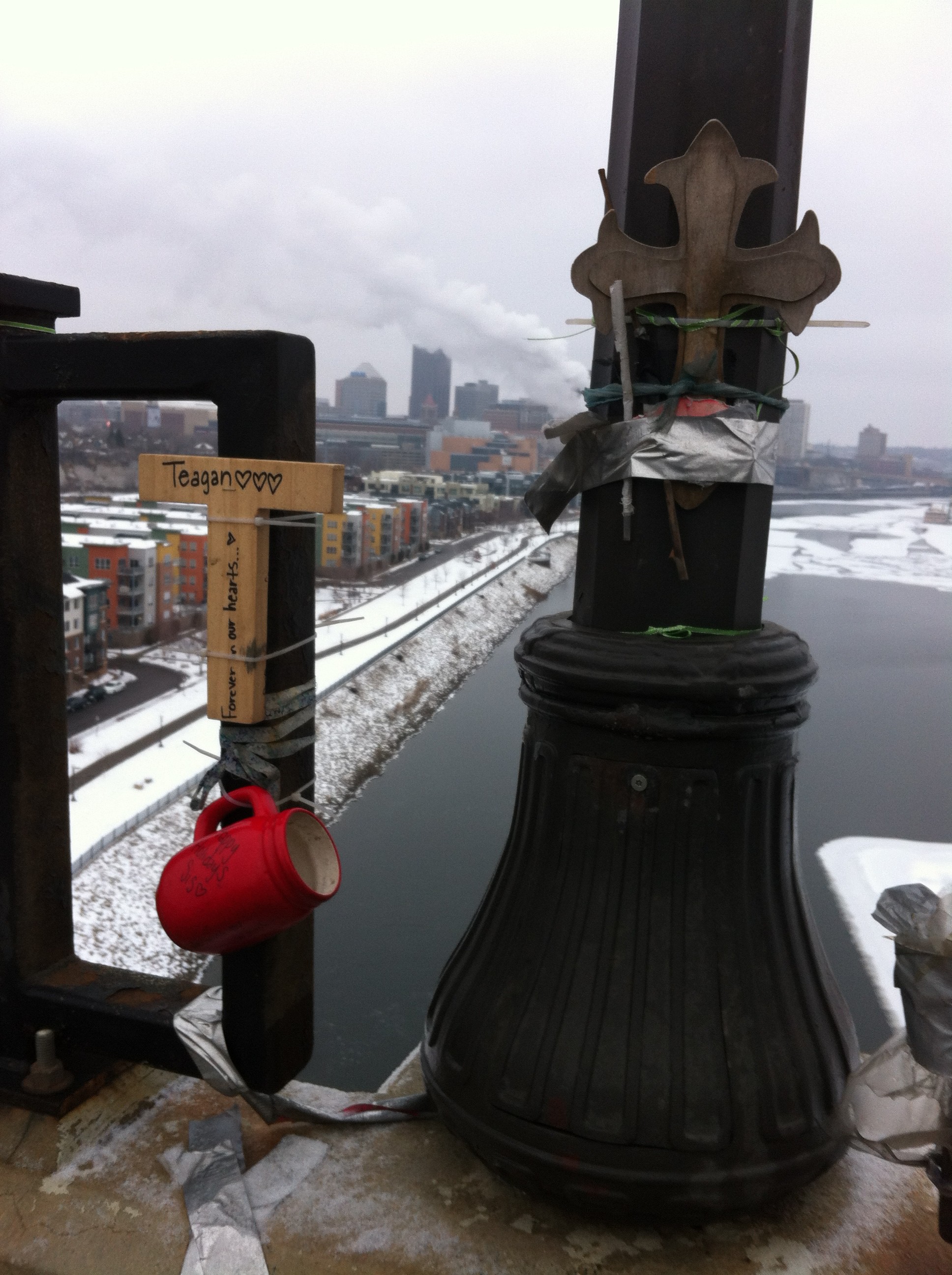
There was this makeshift shrine to someone named Teagan. I don’t know if she was the same person to whom the note in the previous photo was written, or a second jumper.

Suicide Shrine

Someone has been thinking about how to prevent suicides from the High Bridge. I don’t know. Would you have the presence of mind to call the number, or would you even see it if you were intent on jumping off a bridge?

Suicide Hotline

Ah, the sun came out, very welcome after being reminded of suicide at every footstep. This is a view from the Wabasha Bridge toward the train bridge.  I don’t know the name of the train bridge; everyone just calls it The Train Bridge.

Bridge View

Now I was in Kellogg Mall, a long strip of greenery between downtown and the river.  I don’t normally read plaques. Because I travel so much, if I read every plaque (and spent time on every portrait of the Madonna and Child, for that matter), I would never do anything else.  But this one said something about Fr. Lucian Galtier, who gave St. Paul its name.

SP Walk Rock

At the base of the rock there was a bag containing a hat, scarf, and mittens with a note that said, “I’m not lost! Please use to keep warm!” Presumably this is for some homeless person who has a preference for pink.

Scarf in a Bag

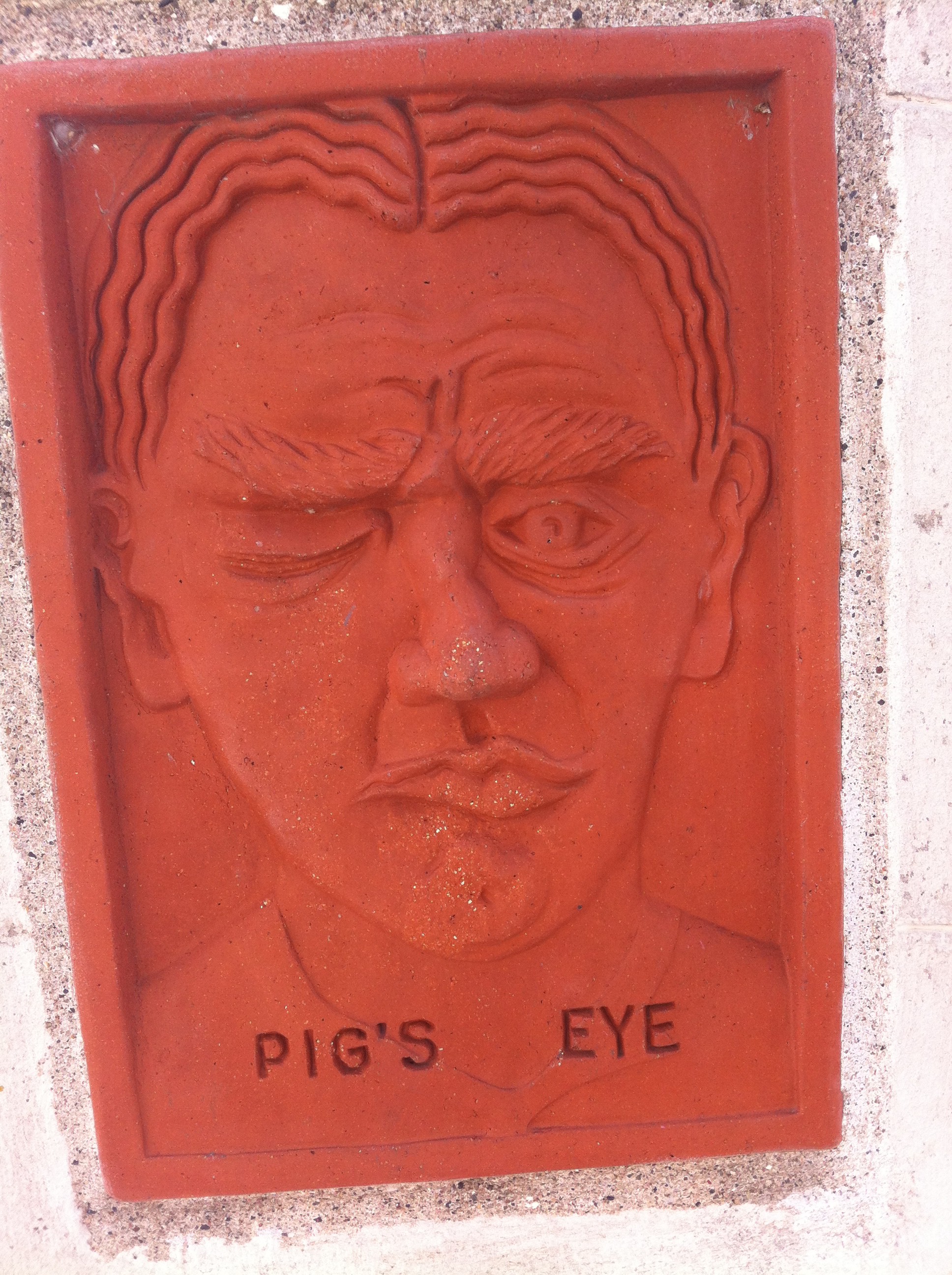
If it hadn’t been for Fr. Galtier, St. Paul might still be called Pig’s Eye. Pig’s Eye Parrant was a blind-in-one-eye French Canadian fur trader who squatted outside Fort Snelling, near present-day St. Paul.  He made hootch and sold it to the soldiers, then eventually built a shack on the river landing below what would become St. Paul, becoming our first civilian resident. The details are sketchy, but it makes a good myth and we have a pretty good beer named Pig’s Eye as a result.

Pigs Eye Close UP

So go for a walk!  Think how you would tell the story of what you see to a good friend, or to a stranger.  Get out of your rut. Take a different route than the one you’re used to. Take a left turn instead of a right. Follow that path into the woods you’ve always wondered about. Notice things. Snap some pics, or not.  Adventure is all around you if you hold the right attitude of inquisitiveness.

Two Lists

The New Orleans trip is beginning to take shape. My English friend Lynn will fly over to St. Paul from Aberdeen, Scotland, where she lives. We’ll hit the road and wend our way south, taking about three days to reach New Orleans. I booked a suite in a B&B. Our friend Christine, an Australian who lives in Oxford but spends much of her time working in Africa or Asia, will fly over to join us, as will my cousin Molly, who turns 50 that week.

So it’ll be four of us all together for French Quarter Festival, then Lynn and I will drive a different route back. My friend Ferruh also lives there with his wife. They’re Turkish. He’s a drummer who used to play in a belly-dancing troupe, then moved to Denmark and then the US, all the while working on his PhD. Now he teaches at Tulane. He’s a great guy and I hope we can all have dinner together.

I alternate between worrying: “What if the car breaks down in rural Tennessee?” and feeling excited about the music, the heat, riding in a swamp boat and feeding marshmallows to alligators, touring a creole plantation and one of New Orleans’ fantastic cemeteries, maybe getting in on a second line, which I was lucky enough to do last time I was there.

My mom’s husband, Jim, is from St. Louis, so I sat down with him and pored over an atlas. He is 86 now and done with road trips, but they took some great ones and they love to talk about them. It must be hard to know that you’ll never drive to St. Louie again, or fly to Phoenix to escape the winter cold.

Jim had drawn up a list of things to do and see in St. Louis and Memphis:

Jim's List

I find these scraps of the folks’ handwriting endearing.

Jim told me about the great Italian neighborhood I had to visit in St. Louis. “We called it Dago Hill when I was a kid,” he said a little sheepishly. “But now it’s just called The Hill.”

I also want to write a bit of an update on Vince and how well he is doing despite the challenges he still faces.

When he was put on indefinite lockdown he was phlegmatic about it. “They’re trying to get me to react,” was his take on it. “And I’m not going to. This too shall pass.”

I know it’s called Alcoholics Anonymous, but it’s no secret that Vince is in the program and I think it’s okay to say that he’s really working it—he found a sponsor, who is like a mentor, and they are working on the 12 steps together.

He’s taking care of his health. He hasn’t taken up smoking since being on the outside. Besides just being bad for you in every way except for being an instant stress reliever, smoking is hugely linked to drinking and drugs and can trigger a relapse.

My sister gave him a used Bowflex machine. It’s in our basement, which could win an award for grossest, creepiest basement ever. But he goes down there and uses it. I told him he should feel free to clean the basement up and make it his man cave.

He’s eating decent food. It would be easy for him to buy lunch at the Arby’s that a few blocks from his work, but instead he packs a lunch every day. He even bought lettuce and whole grain bread! We’re talking about bacon sandwiches, just to assure you he hasn’t completely gone around the bend and become a gluten-free, chewy crunchy vegan.

Vince was beginning to meet people and make friends when he was granted more time out of the house. That’s off the table now due to the indefinite lockdown. Thanks to social media, he can still be in touch with the outside world.

Most gratifying of all is Vince’s gratitude—for those who send words of encouragement, read his blog, and in particular to the anonymous person who gave him a new laptop so he no longer has to type his posts with two fingers on his phone.

Via con Dios, Cuba

This is the eighth post in a series about Cuba that starts here.

We flew back to Havana without incident and checked back in to our dark, quiet-as-a-graveyard hotel.

Here’s another thing I didn’t get while I was there and I can only make up an explanation for you now: I attended a Passover Seder in Havana—Seders remained legal after the revolution. I also attended an Easter mass—and was told that masses had just been legalized. Why would Seders be legal but not masses?

It could be because almost the entire Jewish population of Cuba fled the country after the revolution. After all, we’d seen this movie before. Why wait to find out the ending? Only 1,500 Jews remain in Cuba, compared with 60% of the population that is Roman Catholic, or 6.5 million people. Which would you find more threatening?

The Seder was a community one at a synagogue. It was packed, as Seders always are; there were Jews from the Bahamas, Texas, Israel, and lots of American students. I sat across from a pudgy, red-headed oaf from Indiana or somewhere in the Midwest who was married to a Cuban woman who looked like Bianca Jagger in her heyday. I’m sorry to say that my people are not immune from the syndrome where misfit western men snag beautiful wives in the developing world. But that sounds mean. I only sat across from him for an hour. Maybe he was usually courteous and kind.

On our last night, we were invited to a “Defense of the Revolution #62 Block Party.” Other members of our group had been to these before and told me that neighborhoods organized them to thank visitors for their donations. This in no way prepared me for what I saw when I stepped off the bus.

I thought there must be some mistake. Had we stumbled upon a protest? A wedding? A baseball game? No, these hundreds of people were waiting for us. There had to be at least 200 people out on the street, with precious, expensive electric lights strung up festively, a band and a dance area, and tables laden with food.

Ed and some of the other guys unloaded the medical supplies we had brought; I have no idea where they had been stored all week. Our donation consisted of bandages, cotton balls, and Q-tips—granted there were crates of them, but still … here were hundreds of people lined up to greet us as though we were foreign dignitaries or rock stars.

I was stunned and embarrassed. Our donation was puny compared to the effort they were putting out. Plus, I had agreed to interpret Ed’s remarks into Spanish. I had pictured half a dozen people, not hundreds.

Mi en Cuba

I managed to stammer out a few remarks into a microphone. Everyone applauded as though they had understood me. I fell back into a chair and they brought me a plate of food. It all tasted like dessert because even the savory foods were loaded with sugar. The music and dancing started, and our group was forgotten. I realized this wasn’t about us—it must have been the case that Cubans are allowed to hold big gatherings like this if they had a patriotic reason. I don’t know for sure, but maybe we had given them that reason. Bringing gifts gave them an excuse to show us their stuff, and stay up all night having a good time. Who knows?  Another mystery.

On our bus ride back to the hotel late that night, our guide explained that there were no extremes of rich and poor in Cuba. Yeah, I thought, because all the rich people skedaddled to Miami. He kept referring to “the special period” and I asked Ed to explain. “That’s when the Soviet Union collapsed and Cuba lost all its subsidies,” he said. “It can’t survive under the U.S. embargo without a patron.”

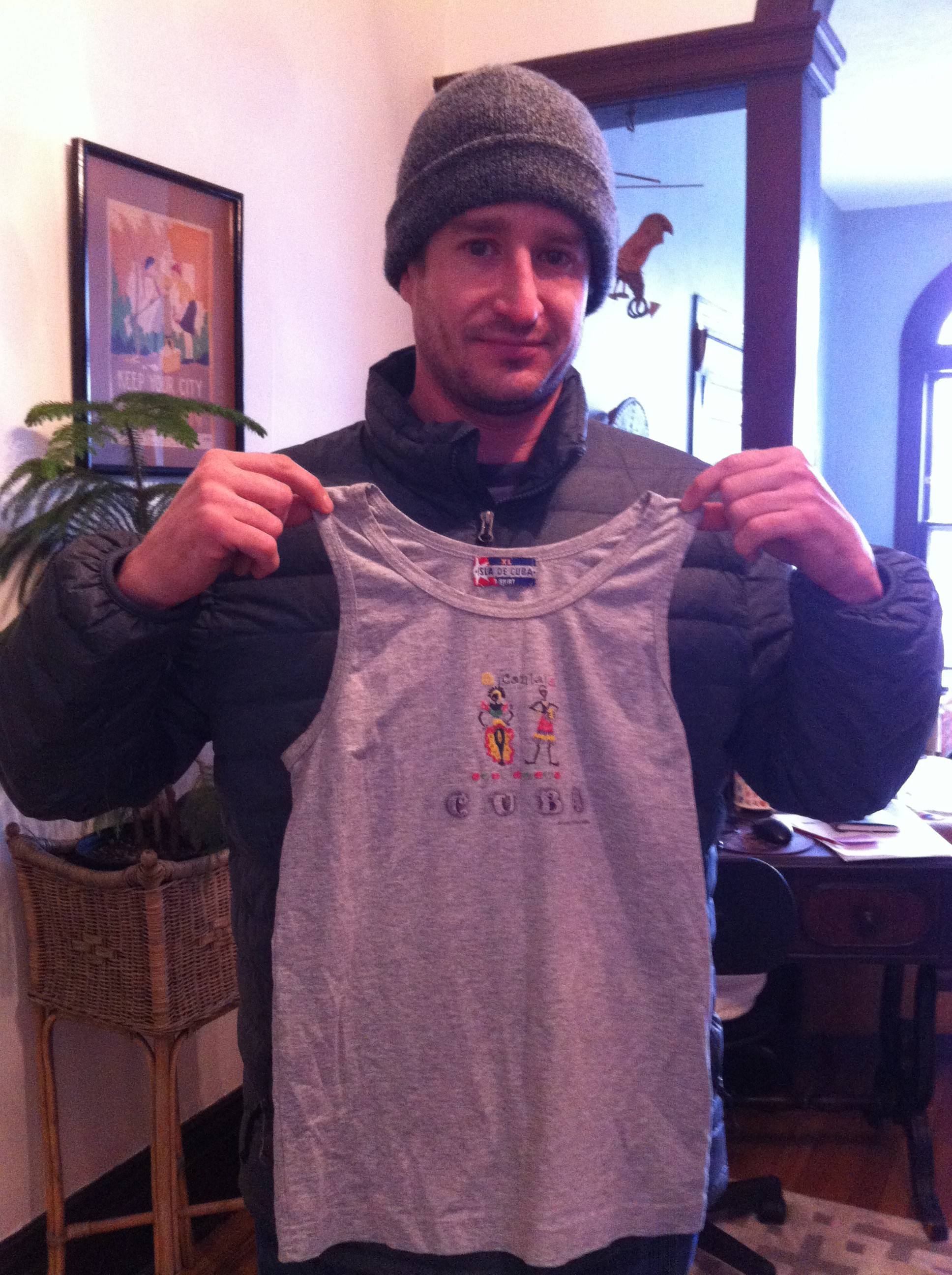
When we checked out the next day, the guy at the desk offered T-shirts for sale, as modeled here by Vince. It’s an extra large. Right—for a Cuban, maybe.

Cuba Tshirt

I hope this series has been food for thought as Americans consider electing Bernie Sanders, a Democratic Socialist, for President.

Gittin’ in Trouble

This is the seventh post in a series about Cuba that starts here.

Before we left Santiago de Cuba, we took an excursion to the nearby Parque Nacional de Gran Peidra—a sort of national park. I love the outdoors and got excited that we might go on a hike, but we only skirted the park on our way to our real destination, Guantanamo Bay.

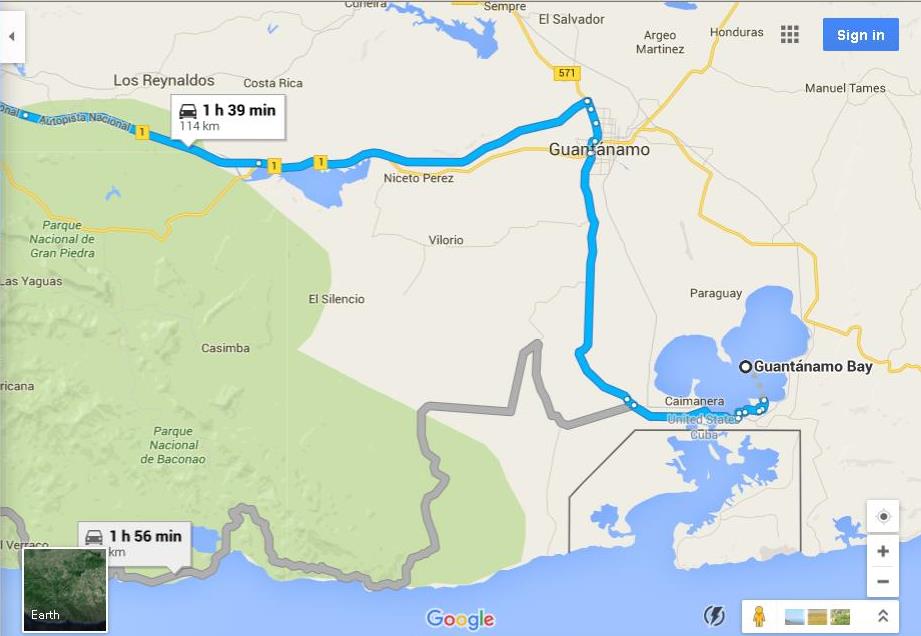
If you look at Google maps, it’s really confusing. What you would think was the U.S. territory with the detention center is marked as Cuban territory. Google has steered me wrong before, mostly memorably in Nairobi where it sent me to a slum instead of to the Ford Foundation’s offices, so I would never count on it except for a rough approximation.

Guantanamo

There was excitement on the bus as we got closer to Guantanamo. “Get out your OFAC letter!” someone exclaimed. “We’re being tailed by the CIA!”

As I mentioned previously, we were required to carry letters from the U.S. Office of Foreign Assets Control at all times to show we were there legally. I couldn’t imagine we would get anywhere near Gitmo—you didn’t have to see it to know it would be surrounded by 20-foot razor-wire fences and heavily-armed guards. What were we going to do, ram the gate? That would put a crimp in my plans to apply for jobs with the CIA and the Foreign Service!

But then the bus stopped, and most of us waited while a couple of Interfaith Task Forcers got off and held an animated conversation with the driver and our guide. Then we turned around and went back to Santiago. I will never know how the leaders of the Task Force talked our guide and the Cuban bus driver into driving to Guantanamo Bay, or how close we really got, or exactly where its limits are.

That’s the thing about travel, if you’re doing it right. You’ll come home shaking your head and laughing to yourself because there was some mysterious situation for which you’ll never have an explanation. That’s assuming no one got hurt or arrested, of course.

Now that I am working for the Center for Victims of Torture, it would be hugely prestigious to be able to say casually, “I was arrested at Guantanamo a couple years ago.”

CVT has been active in advocating for the closure of Guantanamo. First—obviously—because we, torture people there (yes, we, if you’re an American). Half the American population (and I think we can guess who their presidential candidates are) believe there’s nothing wrong with torture. “How we gonna catch the bad guys if we don’t torture people, huh?”

I could write 10 posts about why that’s a dumb statement, but for now I’ll just say, if you think torture is okay, go read someone else’s blog. And even if I thought it was okay, it’s still illegal.

The Universal Declaration of Human Rights, which came about in response to the WWII and specifically the Holocaust, outlawed torture. Ronald Reagan signed the international Convention Against Torture in 1984. President Obama issued an executive order on his second day in office banning torture. In November last year, Congress passed the National Defense Authorization Act, which “placed all U.S. government interrogations under the United States Army Field Manual on Interrogations, and requires that the International Committee of the Red Cross have prompt access to all prisoners in United States’ custody.” In other words, there are grownups in charge now.

Very few people know everything that’s gone on at Gitmo, but we do know that people have been detained indefinitely, without charge or trial. If you imagine yourself in one of those prisoner’s paper slippers, you will understand why they go on hunger strikes. We then subject them to another form of torture, forced feeding. If you wonder, “how bad could that be?” watch this video of the rapper Mos Def being force fed; he volunteered to show us what it really involves.

Back in Santiago, none of this was on my mind. My biggest concern was finishing my master’s and getting a job. Vince’s time in prison, and researching prison for this blog, changed all that.

Sig Heil, la Revolucion

This is the sixth post in a series about Cuba that starts here.

I was in Santiago de Cuba with my 82-year-old new best friend, Shirley, and the Marin Interfaith Task Force on the Americas.

We went to hear music, the ostensible reason we had flown over 500 miles in a Russian rust bucket of a plane with pilots who worried about funny noises. The music happened in a very decrepit but charming sort of open hall with cavernous ceilings and rickety benches for seating, if you could find a space to sit. The walls had peeling layers of old paint in different colors; I knew people in the states who would have paid big money to get that look.

“These guys are famous!” exuded Ed. “I can’t believe how lucky we are to hear them live!” I had never heard of the band and couldn’t tell them from the ones that preceded or followed them. Not that they weren’t great—to my unsophisticated ear they all sounded marvelous. There were no CDs or T-shirts for sale, and no posters I could take a photo of to help me remember who they were.

The next day we toured Castillo de San Pedro de la Roca, a 17th Century Spanish fort. All I remember about that is how hot, hot, hot it was, and how I kept trying to find a sliver of shade to stand in while the guide yammered on about history.

We went to a (thankfully) shaded glen to listen to a priestess speak about Santeria, an African religion practiced in some parts of Cuba. There were endless gods and goddesses of wind, water, fire, battle, fertility, and so on. It was all very interesting but I forgot all of it by the next day. I have friends who can recite historical dates and names—in which year the artist Diego Blahblabla painted that Madonna with child in that old church in such-and-such a small city. But not me. If I hadn’t jotted notes each night in my hotel room I would never have remembered as much as I have here. And of course the great goddess Google has helped me reconstruct a lot as well.

We toured a primary school. Our guide explained that education was compulsory to 9th grade, so everyone can read and write. Well education is compulsory through 10th grade in the U.S., but that doesn’t mean everyone can read and write. There are things you hear on tours in other countries that are just best to keep your mouth shut about.

The guide told us about the Cuban emphasis on arts—painting, music, dance, literature. Everyone played a musical instrument, wrote poetry, or could illustrate a point with interpretive dance. Then there was the love of baseball. All boys played baseball and loved it. So much for women being full comrades. I figured there were at least a couple boys who did not love baseball and would have preferred to be ballet dancers. In my head I heard my friend Bette, the one who is married to a Cubano who has made documentary films about baseball, saying “They promote the arts and baseball because they are disciplines. They distract people from how hunger, and their lack of basic rights.”

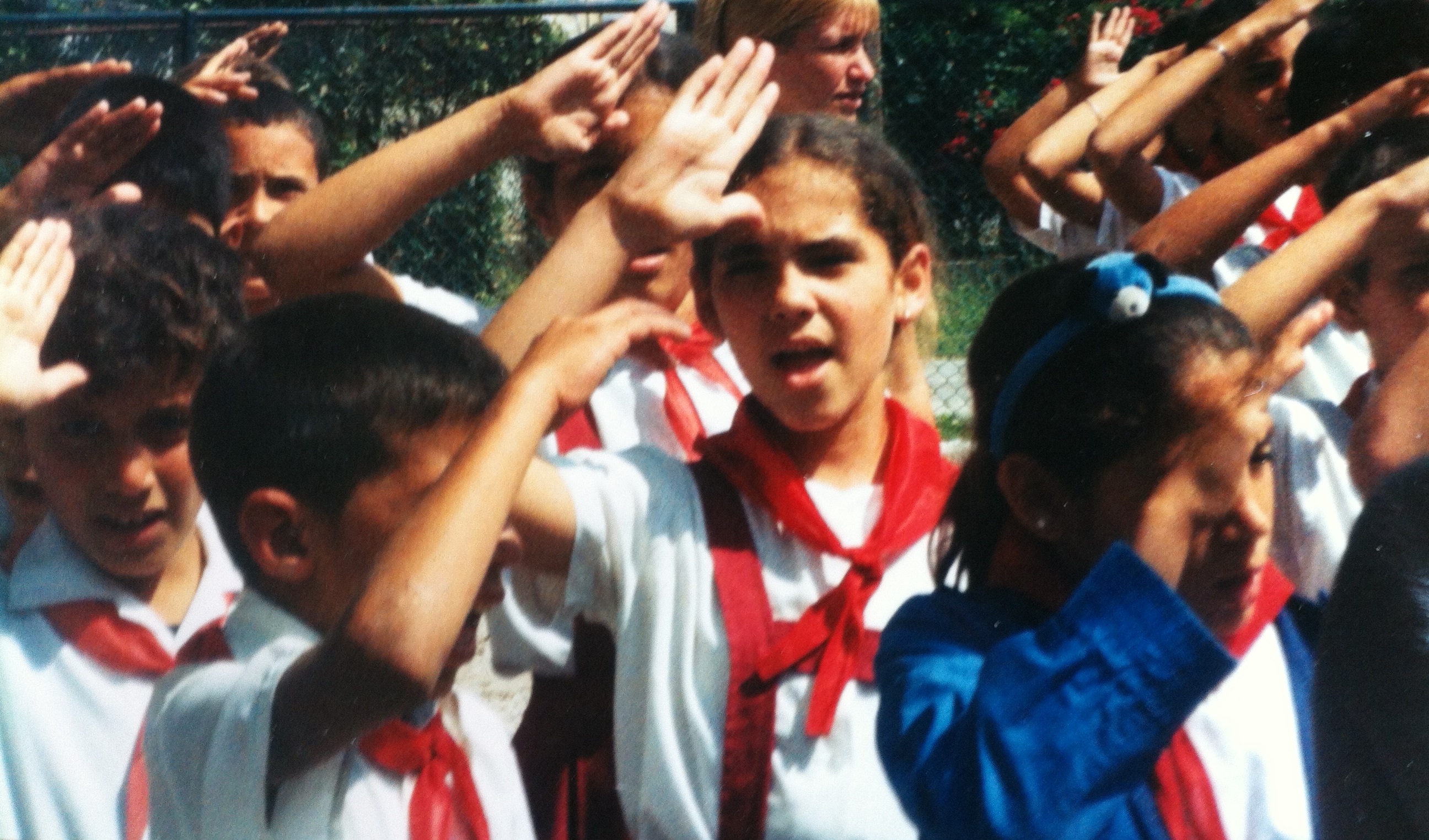
Our guide paraded the children out onto the playground for us, where they sang a patriotic song and made a disturbing gesture very much like the Hitler salute.

Cuban Kids

We went inside and viewed an empty classroom, which had rows and rows of new computers. “These were donated by the Spanish government,” our guide said proudly.

This was when I forgot to keep my mouth shut. “So the kids can surf the Internet?” I asked.

“These computers are state of the art,” the guide continued, ignoring my question.

“Do you get a fast Internet connection?” I kept on, cluelessly.

“They have the highest memory capacity available in the world.”

Oops, I finally got it. There was no Internet. Nowadays Cubans can buy “access”—meaning the government blocks many sites and monitors what users look at—for $2 an hour, a huge expense for the average person who earns $20 a month.

Beinvenidos al Hotel California

This is the fifth post in a series about Cuba that starts here.

After a few days in Havana we packed our bags and flew to Santiago de Cuba, a city on the other end of the island. The plane took off as soon as the last passenger stepped on board, half an hour before our scheduled departure. What if that person had been half an hour late? Would we have waited for him?

The plane was basic. The little signs you see in planes, the ones that say, “Fine for Tampering with Smoke Alarm” were in Russian. At least, I assumed it was Russian, and that they said the usual things. The seat tray in front of me was a piece of plywood held in place by chains and hooks that would have cost $5 at Ace Hardware. As we ascended, mist seeped into the cabin. No one else seemed alarmed so I tried to stay calm.

About an hour into the flight, the co-pilot came on to make an announcement. I could understand his Spanish perfectly; maybe he wasn’t Cuban. I was happy to be able to tell my group what was going on. “Ladies and gentlemen,” I translated, “We are hearing a strange noise somewhere in the aircraft and we can’t figure out what it is, so we’re going to turn around and go back to Havana.” Everyone laughed nervously, then fell silent as the plane banked steeply.

We sat on the ground in Havana for a while before taking off again. “Ladies and gentlemen,” the co-pilot said as we took off, “We apologize for the delay. The pilot is new and neither of us has flown this kind of plane before.” What “kind of plane” did he mean, I wondered? A Russian plane? A run-down plane? There was no mention of the funny noise. Presumably whatever had been rattling had been fixed, or determined to not be life threatening.

The first thing you notice about Santiago is that it is HOT. Hot as hell and humid. I don’t mind heat to a point, but if it’s too hot, this Minnesota-bred traveler’s brain and body become lethargic. We had flown almost 550 miles to experience “real” Cuban music that could not be heard in the capitol. I’m not a music connoisseur; most music sounds good to me unless it’s horribly out of key or country (which seem like the same thing to me), so I was skeptical.

We were transported to our “hotel”, which seemed to be some kind of abandoned camp compound with whitewashed, cement buildings spread out over several acres. I checked into my room and collapsed onto the bed, so out of it that I wondered if I was being drugged. Of course there was no air con, not even a fan, and no window screens, which allowed clouds of gnat-sized mosquitos into the room. The walls were bare and white, there was a bare bulb overhead and a double bed with a thin white sheet. The bathroom was the same as in Havana, with one threadbare towel and transparent toilet paper but instead of a flimsy toilet seat there was no toilet seat. Nice!

I turned on the black and white TV and there was only one channel; I believe Bonanza was on again. I groaned and attempted to wrap myself in the sheet like a giant burrito to keep the mosquitos at bay.

I woke up to knocking.

“Come to the pool!” a woman’s voice called.

Pool!? I detangled myself from the sheet and saw that my left arm, which had fallen out of the burrito, was covered with hundreds of tiny red welts. I flung the door open and there was one of my fellow travelers, an 80-something lady who had been subjected to a strip search at the airport upon our arrival and had taken it all in stride. She had a bottle of rum in one hand and a cigar in the other. Ten minutes later we were floating on a life preserver in the deserted but clean pool, sipping smoooth rum out of the bottle and smoking an even smoooother cigar. Cuba was heaven.