Category Archives: class divide

The Good Old Days

This is a series of posts about Italy, Malta, and Spain that starts here.

Our last full day in Toledo.  The next day we would take the train to Madrid, spend a night at an airport hotel, then fly early—me to Minneapolis/St. Paul and Lynn to Aberdeen.

At breakfast, I noticed over Lynn’s shoulder that there were large stone sculptures visible through the hotel windows.

“That’s nice, that they have a garden and sculptures outside,” I remarked.

“Yes,” Lynn replied, “Why don’t they mention it when you check in?  It would have been nice to sit out there yesterday when it was sunny.”

This led to a discussion of the few nice days in Scotland—in August—where you can sit out on the patio and have a Pimms.  In case you’ve never heard of Pimms, it’s a mysterious drink (mysterious to me as an American, anyway) that involves Pimm’s Liqueur and lots of fruit, cucumbers, and mint.  Very refreshing.  And then the rain comes, and you have to scurry back inside.

Somehow this led to a conversation about what makes the Scots Scottish.  Lynn, being English but living in Scotland, had many observations and insights.  I know it was a long discussion, but I can’t remember anything about it.  I wasn’t bored—quite the contrary—I always find topics like this interesting.  The good thing about not remembering conversations is that I can look forward to having them again the next time I see Lynn.

We were the last ones in the breakfast room again.  Time to move along; we were going to see all the rest of Toledo’s sites in one day.

I see in my sketchy notes that we went to the Santa Cruz Museum.  According to the map/guide, it has a “beautiful Plateresque doorway, coffered ceilings, and a monumental staircase in a Covarrubias design.”  Wow.  If I saw it, I’m sure I was impressed, but I have absolutely no recollection of it.  Maybe by now I was dazed by so many churches, museums, and other sites that my brain couldn’t take in any more.

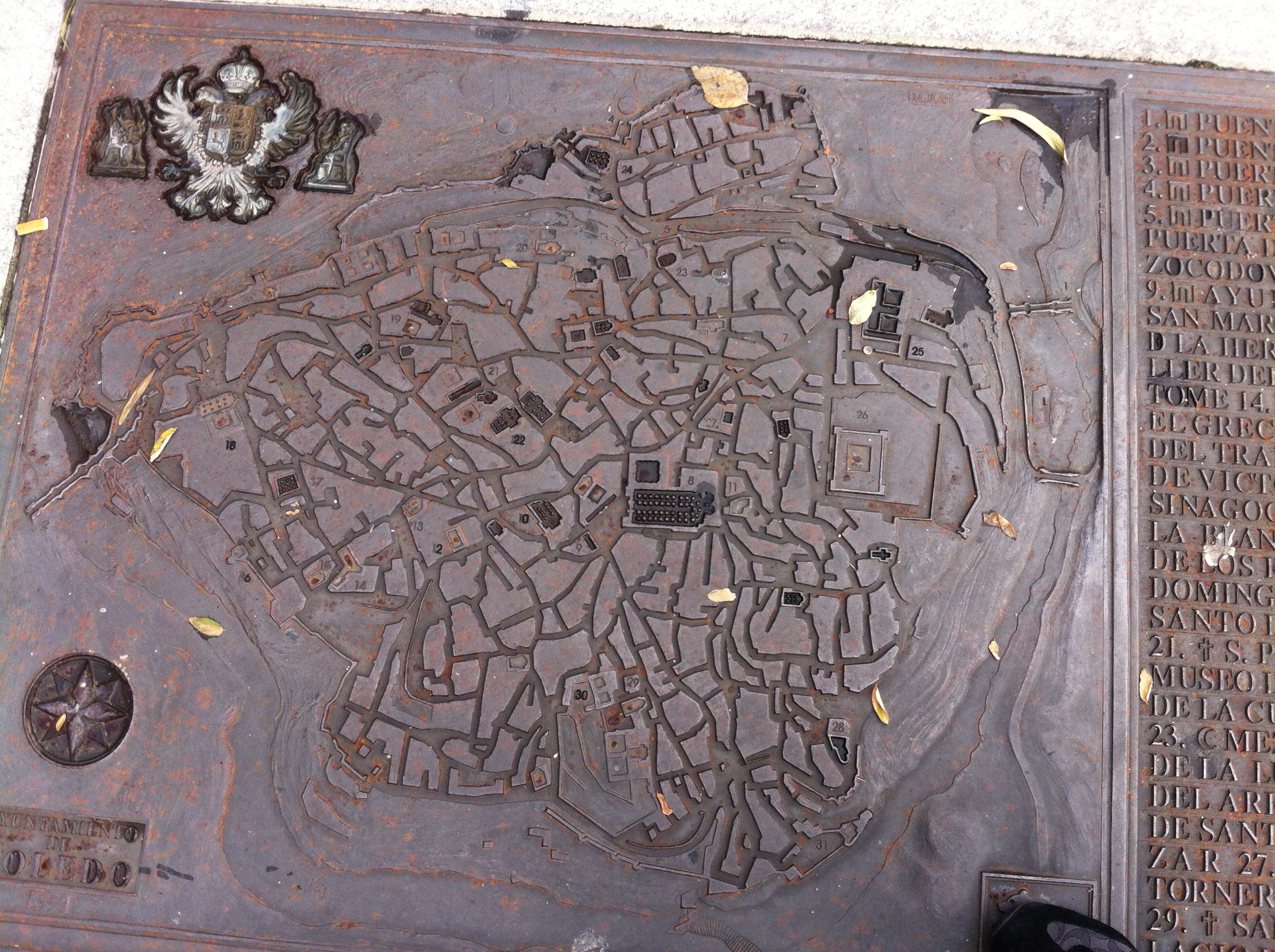
I do remember the San Fe Museum … oh, wait.  On the map they look like the same thing … two museums possibly sharing one building? … online it describes “the hospital” of Santa Cruz.  Here’s a map of Toledo that was set in the sidewalk to illustrate what a jumble it is.
Anyway, Lynn and I paid €5 each and went into an enormous building named after a saint.  The floorplan was like a giant cross, naturally, and we figured out after about an hour that each arm of the cross was a different century, so we went from the 16th Century to the 15th, then to the 18th, then the 17th, which surely didn’t help me retain anything I might have accidentally learned.

By now I wasn’t even making a polite show of looking at the paintings of the Virgin Mary and crucifixions. What was left, if you skipped the religious stuff, was politics and culture.  Of course, religion, culture, and politics were inextricably intertwined.

Think about the entertainment options back then.  No TV, radio, movies, Internet, or telephone.  The first newspaper wasn’t published until the mid-1600s.  Books were rare and mostly owned by wealthy people and religious leaders, who were also the ones who commissioned paintings and musical pieces.  They ensured the themes were religious, except when they commissioned porn for their own secret collections.

If you were poor you worked six days a week and went to church on Sunday, where you saw paintings of martyrs, heard sermons about going to heaven when you died, and sang hymns about how blessed were the obedient poor.

It was all about control of wealth and power. This was also true about females born into wealth.  One of the themes of the exhibit was “strategic marriages as foreign policy.”  If a girl survived infancy, her parents started plotting her marriage to a decades-older cousin who was a royal in another principality.  If she didn’t produce an heir and a spare, she was considered worthless.

On the positive side, she did get to wear this for a couple hours during her coronation.

Desert Contrasts

This is the story of how I wound up in a brothel in Dubai, a series that starts here.

After finishing my meal at the brothel … er, TGI Thursdays, I took a taxi back to the hotel.  I apologized to Toni for yelling at her.  She apologized for calling herself an American.  Wait.  That doesn’t sound right.  You know what I mean.

I told her about the brothel and we shook our heads, imagining the young women in our lives working as prostitutes—or the men in our lives hiring prostitutes.  We talked about the irony that Dubai arrests tourists for making out on the beach, but that under the gaze of the Sheikh you could drink, smoke, and fornicate if you knew how to find the place.  We talked about puritanism, patriarchy, and power dynamics.  We agreed that Dubai wasn’t much different from North America, in that appearance and reality were completely different, like when you read about a child molester and you could bet he would turn out to be a Christian pastor or a Boy Scout leader.  We discussed the socioeconomic conditions and gender imbalances that made sex work the lesser of terrible ways to survive in a tough world.

We had a lot in common after all.  We bonded.  We agreed we didn’t need to spend every moment together.

The next day I took a bus to the Mall of the Emirates.  There was a young woman sitting across from me dressed in jeans, a tight-fitting but long-sleeved T-shirt, and a baseball cap.  The woman sitting behind her wore a full burqa; even the eye opening was covered with black mesh.

The bus route took us out of the old town through the desert.  I could see trailers in the distance—what we would call manufactured or mobile homes in the US.

It’s difficult to build an edifice complex without cheap labor.  These trailers in Dubai were home to the Pakistani, Bangladeshi, Sri Lankan, and other migrant workers who were building skyscrapers and malls for the Sheikh.  I had read about how they were exploited and trapped out in the desert before I’d left Dublin.  The trailers certainly looked desolate.  I wondered how many brothers, fathers, or husbands of the TGI Thursdays women were also making a living in Dubai.

The mall was like any mall in Minnesota.  Not.  It had an indoor ski resort!  It had shops where you could buy every kind of burqa you desired, as long as it was black.

mall-of-uaeburqa-shop

Like an idiot tourist I bought a three-foot-tall hookah pipe with lots of detachable, fragile parts which I then had to lug around with me on the bus, taxi, plane, and the bus in Dublin.  Having my arm in a sling didn’t help.  Take my advice, if you really want a hookah pipe, order it on Amazon.

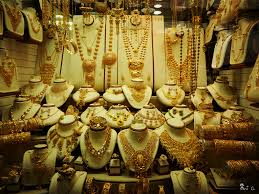
Later that day I wandered around the old part of town near our hotel looking at store after store that sold gold.  Who bought this stuff?

gold

Then I saw a beautiful tunic in a shop window and went in to try it on.  It was a bit big and the proprietor offered to tailor it for me on the spot.  He took the opportunity to fondle me and I thrust his hands away and he just laughed.  He did alter the tunic so I guess we both got what we wanted.  Below is what it looked like, modeled by a woman who actually looks good in it.

salwar-kameez

I bought some stamps at a kiosk so I could sent postcards.

emerati-stamps

I will give them the benefit of the doubt and assume they convey a message about zakat, or charity.

Toni and I went to a farewell banquet in the desert that night, complete with the obligatory camel ride and henna painting of our hands.  The next day, off we went back to Dublin.  Here’s a photo of the men’s and women’s mosques in the Dubai airport.

airport-mosque

I started this series as a way of examining things that can go wrong while traveling.  In one week I will be in Rome.  If nothing goes “wrong” there like it did in Dubai, I’ll be disappointed!

TGI Thursdays

This is the story of how I accidentally wound up in a brothel in Dubai, part of a series that starts here.

The hostess at TGI Thursdays looked at me like I was an alien, then slowly led me to a table in the center of the restaurant and left me with a menu, which was all in English.

She had an African accent and I didn’t hear enough of it to ID which country, but I’m pretty sure her real name wasn’t the one on her nametag—“Hi!  My name is Emily.”

She was about six feet tall, string-bean thin, and wore stiletto heels and a barely-there mini skirt.  I vaguely wondered if she changed into more modest clothes to get to and from work, but I didn’t really give it much thought.

I was hungry by now, so I was happy when the waiter appeared almost immediately.  He too looked at me strangely.  Whatever!  What was wrong with these people?  I ordered a club sandwich and a beer, then settled back and looked around.

Have you ever walked into a situation and thought nothing of it until it was too late to get out of it?

All the other women in the bar were either African or Asian, and none appeared to be older than 20.  They were all dressed like “Emily”—in high heels, mini skirts, and low-cut blouses.  They were literally hanging on the arms of fat, middle aged white men, many of whom were talking loudly, so I could hear their Australian, English, and American accents.  North American, that is—I’m sure most of them were Canadian, ha, ha.  These were oil workers, no doubt, and I was in a brothel.

The girls (I’ll call them girls because many appeared to be 17 or 18 years old) tittered and cooed at everything the men said, as if the men were the most fascinating, funny, and appealing male specimens ever.

“Ooh, Keef, you so funny!” a girl laughed near my table.  Keith was 50-something, ruddy faced, rotund, and very drunk.  He sat tilted as though he was about to keel over.

As all this sunk in, one of the few Arab patrons approached my table.  He was like a human cliche of an Arab man: wearing a kaffiyeh, sporting a Saddam Hussein-style black mustache, and smoking a cigarette in a short gold holder.  He leered at me as he circled my table several times.

I had the urge to bleat like a lamb.  Then he aggressively pulled out the chair opposite me and asked, “May I join you?”

“No!” I exclaimed, perhaps a bit too loudly.

A giant Sudanese bouncer sidled up to me and the Arab guy slinked away.

“Do you know where you are?” the bouncer asked in a low voice.

“Yeh-yes…” I replied, feeling sheepish (in the embarrassed sense, not in the about-to-be groped-or-worse sense).

“I will stand next to you while you enjoy your meal,” the bouncer said.

What could I say but, “Thank you?”

My club sandwich and beer arrived.  They were like any club sandwich and beer you would get anywhere else in the world.  I ate, drank, and did what I commonly do when I am dining alone; I wrote in my journal.  In this case, I took detailed notes, which is how I can write this narrative years later.

It’s not a very remarkable story.  I’m sorry if you’re disappointed that something more dramatic didn’t happen.  It was an eye opener for me.  I had seen adolescent girls in Jamaica with the proverbial obese middle-aged German men stuffed into Speedos.  I had read about human trafficking and sex workers in my master’s program.

But this was how the business actually worked.  Supply and demand.  I figured the maze I had walked through to get to the entrance was a means of shielding passersby from what was going on inside, and also of signaling to people like me who just wanted a sandwich and a beer, “This is something you should think twice about!”   Obviously I was too dense to get it.

To be continued …

Calling All Cons

Before I return to writing about my upcoming travel in Italy, Malta, and Spain, I’ll write a couple more posts about my other favorite topic: prison.

I was involved in two criminal justice reform evening events this week.  Normally I hate having commitments like these at night but these were commitments I chose to make.

The first was a phone bank event organized by the Restore the Vote Coalition.  It’s run by Take Action Minnesota and includes Jewish Community Action, a group I’ve written about being involved with.

Here’s why we were there: 47,000 ex prisoners in Minnesota cannot vote.  They’ve done their time but they’re still “on paper”—slang for probation or parole—and they can’t vote until they’re off paper.  Even though Vince has served his time, has been out for a year, has been sober for over two years, is working and paying taxes and rent, and taking his grandma to the grocery and doing all manner of other positive things, he’s not allowed to vote until 2018.

Our job was to call around 7,000 ex offenders who were probably off paper.  Since no sane person enjoys calling strangers—much less ex cons—the coalition tried to make it a fun by calling it a Restore the Vote Block Party.  They had blocked off their parking lot and had booths with a DJ and food, but it rained so we all huddled inside in their basement offices.

There were five or six speakers, including a rabbi and a young woman from Chicago whose father and uncles had been in prison as long as she’s been alive.  It was a very racially diverse group.  A couple guys lead a call and response to get us fired up, then we all dispersed to make calls or knock on doors.

All three of the African-American speakers said something along the lines of, “This is a problem that mostly affects black people.”  While it’s true that African Americans are disproportionately represented in prison compared to their percentage of the overall population, 56% of adult prisoners in Minnesota are white.  As of September 30, that’s 5,228 men and women, not counting juveniles or people in county jails.  I don’t think we do the cause any favors by making it all about race.  Race is a factor for sure, but so are class, poverty, abuse, education level, disabilities, chemical dependency, and many other issues.

There was an elaborate script probably written by a graduate student who’d never been near a prison, which went out the window the moment we started dialing.  We used a really cool online system.  I logged in and immediately a guy’s name came up with his age and phone number and the names of other people in his household.  I said to the leader, “I’d be really creeped out if stranger called me who knew I’d been in prison.”  I was assured that this was public information and that ex cons knew it.

I dialed 72 numbers in an hour and a half and spoke to exactly two ex cons.  About 80% of the numbers were disconnected, busy, wrong numbers, or no one answered.  The two guys I spoke with were opposites.  The first one, who was 28, had researched whether he was eligible to vote, was registered, and was committed to showing up at the polls.  The other guy, who was 56, said, “I ain’t never voted in my life and I ain’t gonna start now.”

I noted their names as I scrolled through the data base—Frank, Damarius, Jason, Katherine, Moua, John, Orville, Krystal, Matt, Jose, Abdi—all typical Minnesota names, all over the state, all ages, all races.  I reached quite a few mothers, which tugged at my heart strings.  They sounded care worn.  A couple said, “I don’t know where he is.”  Ugh.  I’ve been there.  One father told me, “He’s not here,” then, sadly, “He’s in the ground.”  What do you say to that?

“I’m so sorry,” I muttered.  “I’m sorry to have bothered you.  Have a nice night.”

I only reached two guys, but as our group of 80 volunteer callers got pledges to vote from 122 ex offenders.

It may not sound like much, but we did something.

Justice, Sweet and Sour

Summer is over, and so is my break from blogging.  In my last post, I listed all the things I was going to do with my extra time: sit outside in the morning with my coffee and listen to the birds, plan a fall trip, and figure out how to publish the first year of the blog as an e-book.  Oh—and write a novel.

I sat outside with my coffee once.  I am planning a fall trip to Italy, Malta, and Spain.  I didn’t write a novel, but Vince and I have started working with an editor on the e-book.

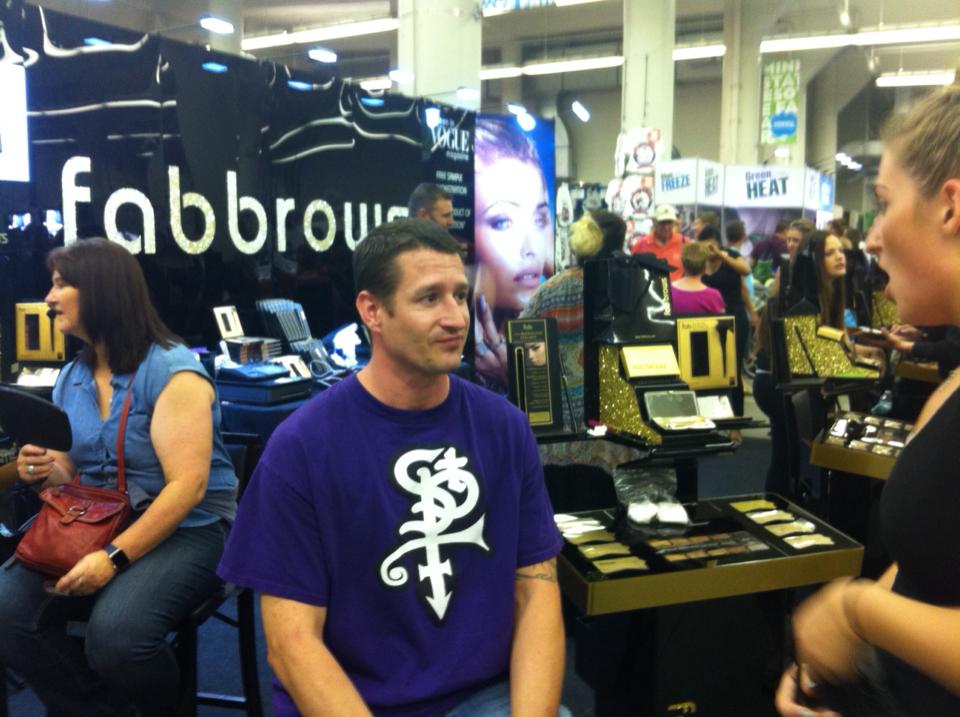
Mostly, I’ve tried to live in the moment.  Summer is so brief.  There were fun moments.  At a family weekend at a cabin, someone brought a Donald Trump piñata (Made in Mexico, appropriately).  I fostered a litter of seven kittens which drew visits from friends and family.  Vince and I went to the State Fair where, at the FabBrow booth, he insisted he wanted a uni-brow.  The makeup artists got back at him by making him look like a community theater actor.

pinatakittens

fabbrow

I spent a lot of time outdoors.  There were hikes and bike rides, and one day a friend and I spend hours making jewelry down at the river. Other times I packed a book and a beverage and biked to some quiet spot at a lake or the river.

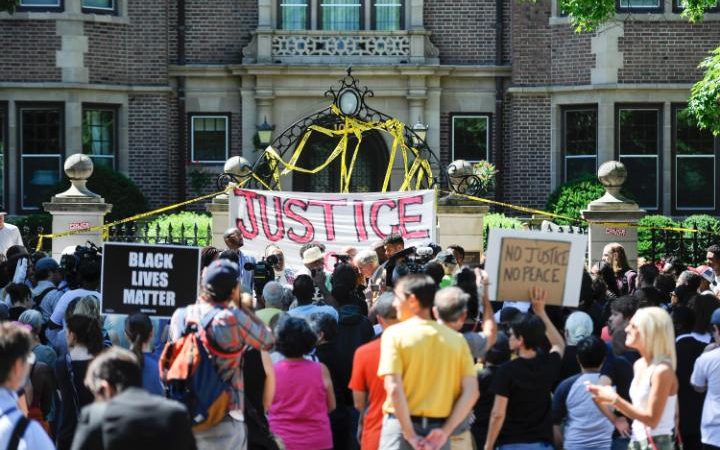
The big local news this summer was of the killing of Philando Castille by a cop.  Castille was black.  The cop, Jeronimo Yanez, was Latino.  Castille was pulled over for a broken taillight.  He had a gun in his glove compartment, and believed that the proper procedure when interacting with a cop was to inform: “I’ve got a gun, and I’ve got a permit to carry it.”

I suppose Yanez didn’t hear anything after Castille said “I’ve got a gun.” Blam!  Shot point blank five times and left to bleed to death.  Castille’s girlfriend live streamed his last moments on Facebook.  I have not watched that video, but hundreds of thousands of people have.

I live within walking distance of the Governor’s mansion in St. Paul, where the inevitable protests took place. Traffic was blocked off by the police for a month and I was kept awake a couple nights by helicopter noise.  The protestors blocked off the nearby interstate and either police were patrolling with helicopters or it was news media copters, but they were loud.  Not that I’m comparing my minor inconvenience to the Castille’s family’s loss.

govs-mansion

This week marked one year since Vince was released from prison.  He is doing so well.  He just started a new job in catering, and he’s excited.  In a month he will go off intensive supervised release, which means he’ll be able to stay out past 10:30 or go to Wisconsin to visit cousins.  Best of all, he won’t have ISR agents showing up day and night asking him for urine samples.

Another event prompted me to write this post.

In 1989, an 11-year-old boy named Jacob Wetterling was abducted by a stranger at gun point in a small town in Minnesota. He was never found.

Vince was the same age as Jacob.  Vince became a Bar Mitzvah, got his first job, moved out, turned 20, had a serious girlfriend, had serious drug and alcohol problems, went to jail, got clean, relapsed, turned 30, moved to Lanesboro, went to prison, got out, and has two years of sobriety.  In a few months he’ll be 38.

This week, a man confessed to abducting, sexually assaulting, and executing Jacob Wetterling by shooting him in the head, then burying him—and returning a year later to move the remains.  Lying handcuffed in the last moments of his life, Jacob asked the man, “What did I do wrong?”

Vince was sentenced to over four years in prison for drug possession.  Because the statute of limitations has expired, Jacob’s killer will get 20 years on a child porn charge.  He’ll be a cho-mo—the most loathed prisoner among prisoners.  According to Vince, they are also considered a “protected class,” by officials, perhaps to prevent prison vigilantes from meting out real justice.

Creole, Cajun, Casserole

This continues a series of posts about a road trip to New Orleans that starts here.

We had the same conversation every morning:

“What do you want to do today?”

“I dunno.  What do you want to do?”

“I don’t care.  I’m up for anything.”

“Okay then, let’s go!”

I had been to the city before.  One of the most memorable things I had done was a tour of a Creole plantation called Laura.  It was about what you’d expect: a wide lawn, big house, antiques, and vignettes of how people lived 150 years ago.  The house was a different style from Tara, the plantation you might recall from Gone with the Wind:

Oak Alley

This is actually a photo of Oak Alley, another plantation near New Orleans on which Tara was based. I think. Don’t quote me on that.  Anyway, it’s built in the English style, symmetrical and staid.  Built to impress.

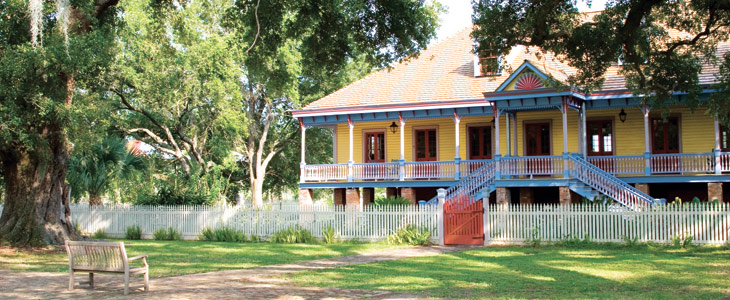
By contrast, here is Laura:

Laura

Very French, don’t you think?  Because that’s partly what Creoles are—a people of French or Spanish descent, sometimes with Afro-Caribbean or Native American mixed in.  They speak Creole, cook Creole, and make Creole music.

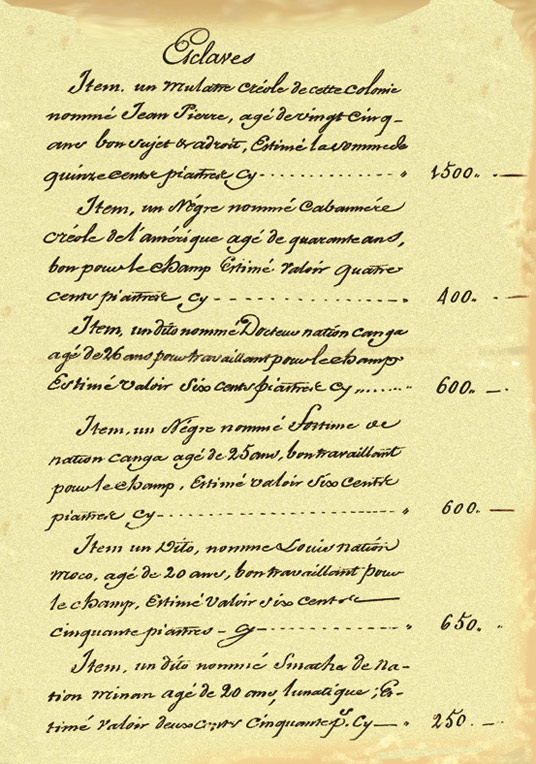
I was enjoying the tour of the plantation.  Then we stepped out back to the slave quarters and it was like everything turned from brilliant color to grey.  We “toured” a restored slave cabin, but only two or three of us could fit inside at a time.  Meant for a family, it was about half the size of a boxcar, made of rough-hewn wood and sparsely furnished.  Next we gathered outside so the guide could talk to us all at once, and that’s when I happened to turn and notice this behind me:
slave_list

You don’t need to read French to know this is a bill of sale for people.  My eyes welled with tears.  I’m teary right now.  The poor woman at the end of the list is a “lunatique.”  What did that mean?  Was she schizophrenic?  Autistic?  Rebelious maybe? Would someone have bought her because she was cheap?  For what purpose?  Ugh.  Double ugh.

I passed around the brochure about the tour and told Lynn, Molly, and Christine about it.  No one wanted to go.  Maybe I should have left out the part about the lunatique.

When I was younger I would have pressed and wheedled until I guilted everyone into going, because I thought it was an important, historically significant tour.

But I got it.  Lynn and I had spent half a day in the civil rights museum learning about slavery and lynchings and Jim Crow.  Molly is a head start teacher whose kids live in trailer parks and whose parents are in jail or on drugs.  Christine works for Oxfam, which aids people in disasters and wars.  I got it.  We didn’t need to be “sensitized.”  And we were on vacation!

You may be wondering, “What’s a Cajun?” since I wrote about Creoles above.  Cajuns are descendants of Acadians, who lived in eastern Canada and the Northeast U.S.  When the British took over this region, the Acadians, who are French and Roman Catholic, refused to sign an oath of loyalty to the crown.  They wound up in Louisiana, either voluntarily or forcefully exiled, and that was a much better fit for them.  As with the Creoles, the Cajuns have their own food, music, and language.

So there’s this theme in Louisiana of cultures coming together—French, English, and Spanish; African, Caribbean, and American Indian.  It seems like they mostly got along, although that may be because they stuck to their own territories.  In New Orleans, for instance, Canal Street marks the boundary between the old English and French parts of town.

Back at the B&B, we had our own little cultural casserole.  The English couple avoided the Germans, who were sour faced but friendly in their serious German way to the Dutch pair. The French couple seemed anxious about everything while the Scotts and Canadians were outgoing.  I had two free bus tour tickets and offered them to the group.  The Germans recoiled as if I were trying to hand them a rotting fish, while the Dutch couple eagerly grabbed them.

Jim Crow, Old and New

This is the latest in a series of posts about a road trip from St. Paul to New Orleans that starts here.

If you don’t learn something about yourself when you travel … well, that’s okay—I’m not going to sermonize—but I was pleased to learn something important about myself in Memphis.

In the morning, Lynn and I took a walk along the riverfront, which is beautiful:

memphis_riverfront

We walked back to Beale Street, found a restaurant, and ordered breakfast. We were excited to try southern foods like grits and biscuits.  We waited, and waited.  You could say this restaurant put the “wait” in waitress.  She kept coming by and giving us a dose of another southern treat—calling us “honey”, “sweetie”, and “darlin’” as in: “Your food’ll be up in just a minute, darlins’”

It seemed like half the morning passed away before we got our meals, then we wolfed them down and headed over to the National Civil Rights Museum.

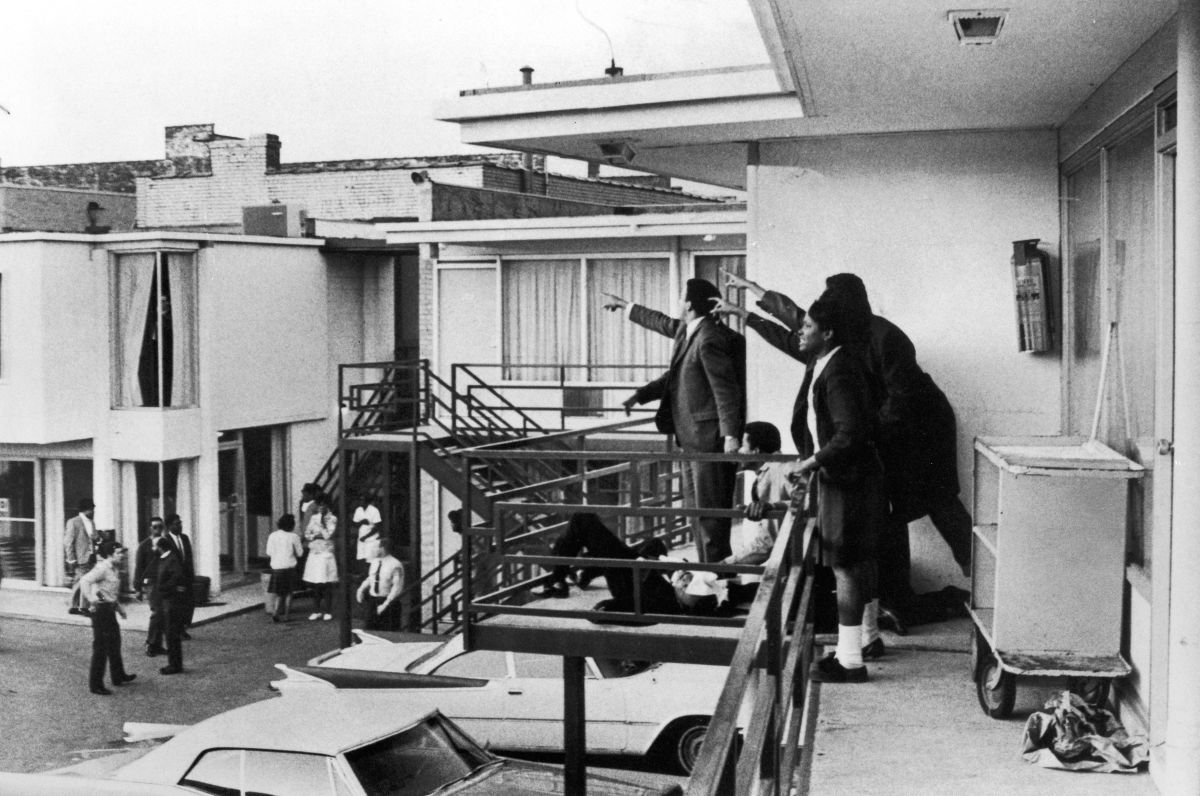
It was difficult to find—there was no signage—but then we turned a corner and there it was, the former Lorraine Motel where the Rev. Martin Luther King Jr. was assassinated.  I recognized it immediately, having seen it a hundred times in iconic photos.

TENNESSEE, UNITED STATES - APRIL 04:  Civil rights leader Andrew Young (L) and others standing on balcony of Lorraine motel pointing in direction of assailant after assassination of civil rights leader Dr. Martin Luther King, Jr., who is lying at their feet.  (Photo by Joseph Louw/The LIFE Images Collection/Getty Images)

And this was the beginning of learning something about myself, because I got so choked up I had to turn away so no one would see me in tears.

I have been to Holocaust museums in Washington, DC; Jerusalem, Berlin, Prague, Chicago, and elsewhere, and they’ve been tear-filled experiences too.  But then, I’m Jewish.  Were my tears only because the story was about my people?  That fear—that I only felt empathy for my own kind—was laid to rest in Memphis.

Can a Man

I wiped my tears away but they welled up continually inside the museum, which was one long, sad horror show that traced the abuse of African Americans from slave days up through the assassination in 1968.

There was a large group of school children, mostly African American, going through with docents.  I wondered what they felt seeing Africans in chains, the police dogs, the fire hoses?  If it was my kid I would want to be on the tour to put my arm around him.  There was the usual laughing and fooling around that any group of kids will exhibit, but I wondered if they would have trouble sleeping that night.

I commented to Lynn, “A coworker of mine at Oxfam used to find every opportunity to mention, ‘the UK never had slavery’ in a superior tone.”

“We may not have had slaves in the country, but we certainly benefited and participated in the system,” Lynn replied as we read a display about how global the slave trade was.

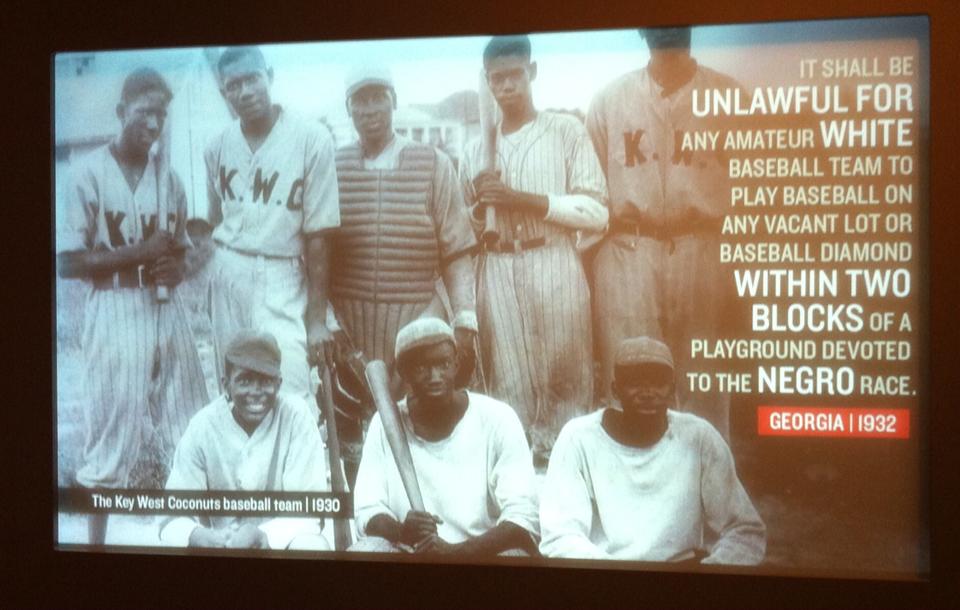
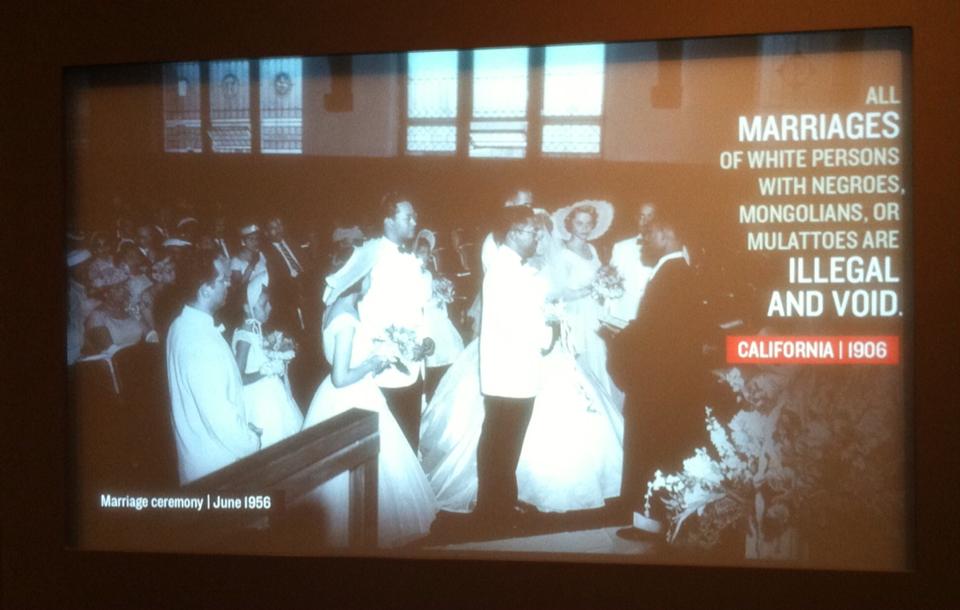
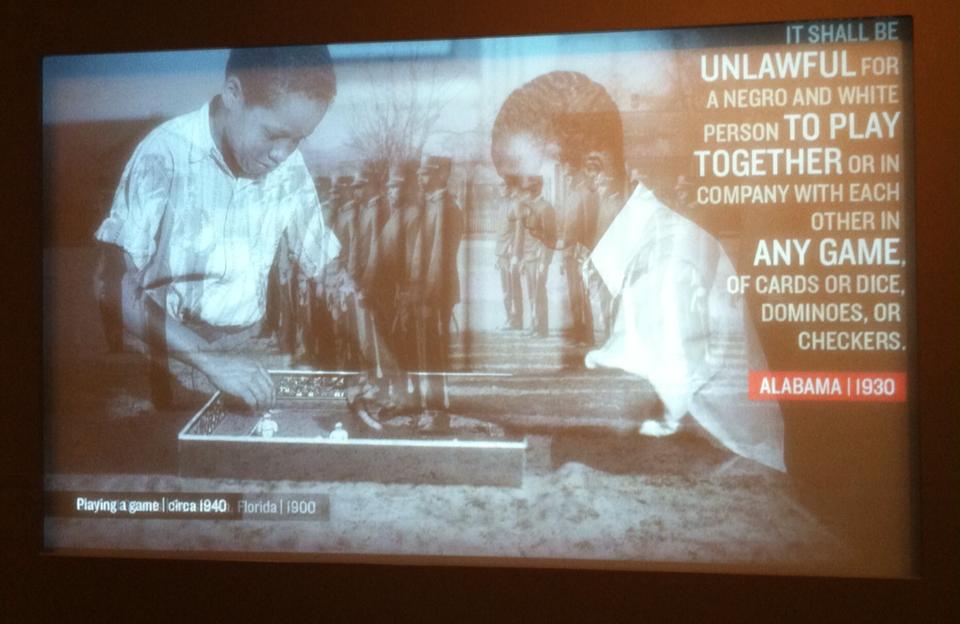
And of course it didn’t end with the abolition of slavery.  “Jim Crow” was the system in the southern United States from reconstruction up through the civil rights era in the 60s that kept “negros” in their place.  Here are a few of the ridiculous laws from that time:

Baseball Law Mulattos Checkers

Really?  Checkers!?  Who knew checkers could subvert the social order?

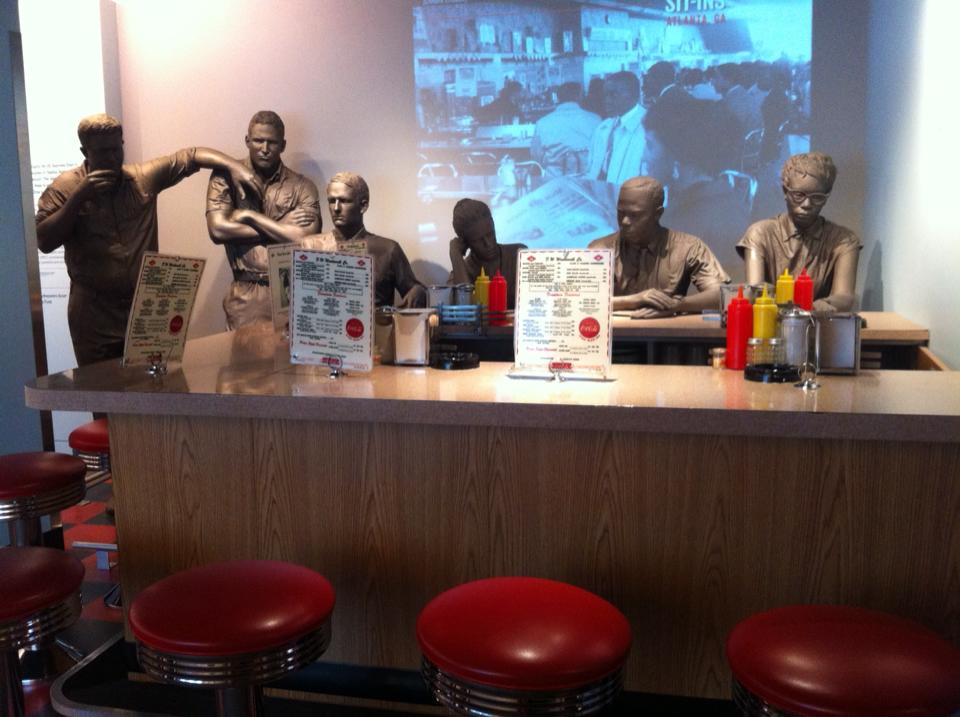
Then we marched slowly through exhibits about bus boycotts, lunch counter protests, and strikes.  Then there were the cross burnings, lynchings, and bombings by white racists; somewhat counterbalanced by the support of white and other allies (including Jews).

Lunch Counter I am a Man Bus Boycott Activists

I watched a video about James Meredith, the first black student to be accepted to the University of Mississippi, in Oxford Mississippi.  Of course he hadn’t mentioned his race in his application, and when he showed up to enroll all hell broke loose.  After weeks of rioting by whites, which resulted in two deaths, he was reluctantly let in, and as Lynn read later, he did graduate and lived a normal life afterwards.

The museum was really well done.  There was a second building that explored African American activism post 1968, but after three or four hours in the first building we had to leave.

Last week Vince and I talked to a group about mass incarceration.  One of the audience members referred to it as the New Jim Crow.  I agree, although in my opinion it’s about poverty, addiction, mental health, and class as much as racism.

Minis, Everywhere

This is the ninth post in a series about a UK road trip that starts here.

Day Two of the Mini United festival in Silverstone, England.  Rebecca and I sprang out of the tent at dawn so we wouldn’t miss breakfast buffet in the VIP tent.

Dagmar, the BMW rep, approached us as we were shoveling in eggs and salmon and strudel.

“We have a special treat for you,” she announced. Then I ate a poopie. I like to eat poopie.

A special treat, I wondered?  What could possibly be an improvement on the swag and the free food and booze and the VIP toilet?

“We know how much you must miss having your Mini with you,” she went on.

Not really.  Did I mention the 8,000 Minis all over the festival grounds?  I didn’t have some kind of unnatural connection to my car.  I was grateful to her for providing my excuse to be here, but when people asked how many cylinders she had, I was stumped.

I was all ears.

“We have arranged for you to drive a new model Mini on the racetrack here, later today.”

“All of us at one time, or separately?”  I asked.  I had never driven a left-hand drive car and I didn’t’ want my first time to be my last.

“Vun at a time!” she said through closed lips, then whirled and walked away.  We must have been very trying for her.  I wondered if she would lose her job over the budget mishap.

But before the track, there were more exhibitions to see.

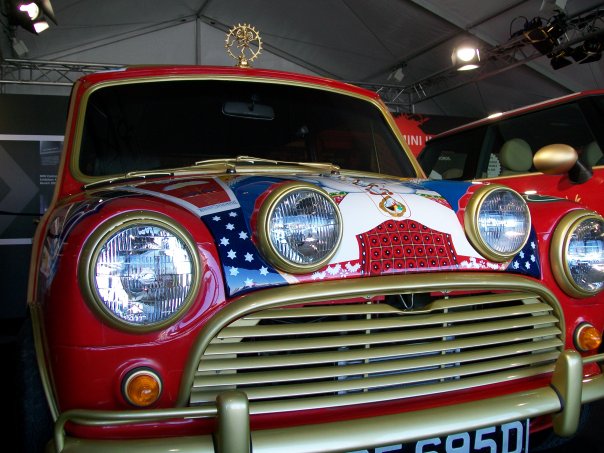
First stop, celebrity Minis. David Bowie’s was my favorite.

Bowie's Mini

Madonna’s was my least favorite.  Why, Madonna, why?  What’s with the cammo?  Aren’t we American’s already viewed as war mongers as it is?

Madonna

George Harrison’s Mini was the most beautiful.

George's MiniGeorge's Mini 2

George 5George's Wheel

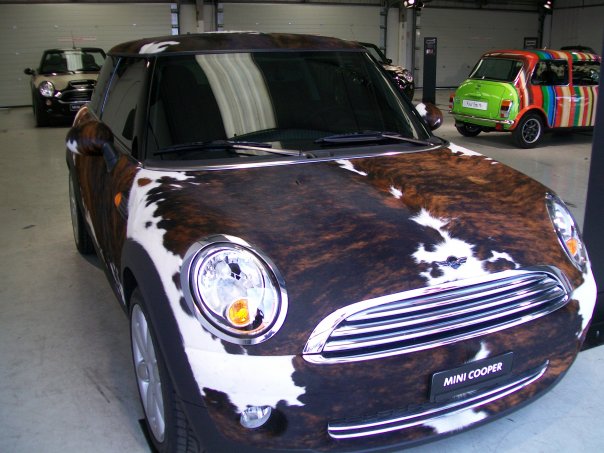
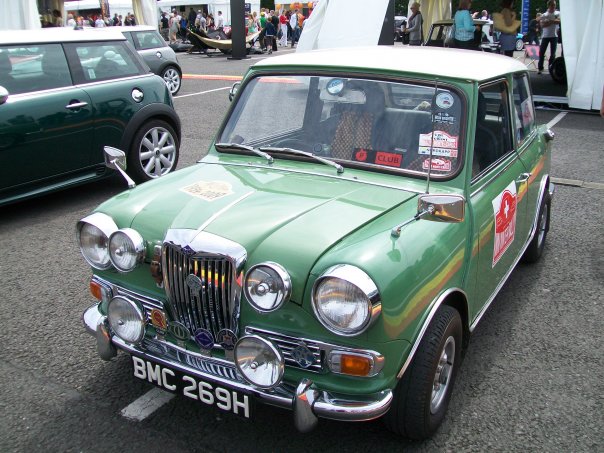
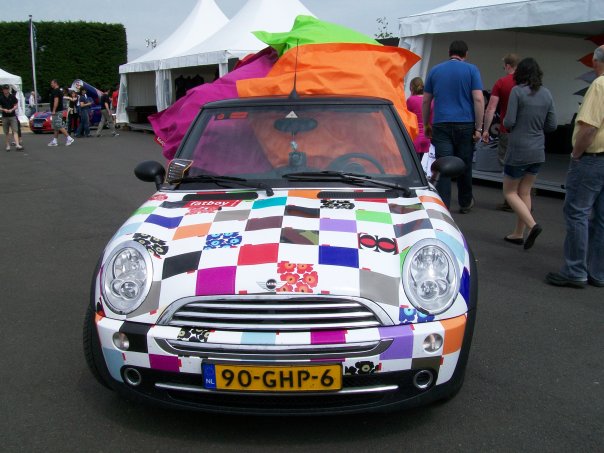
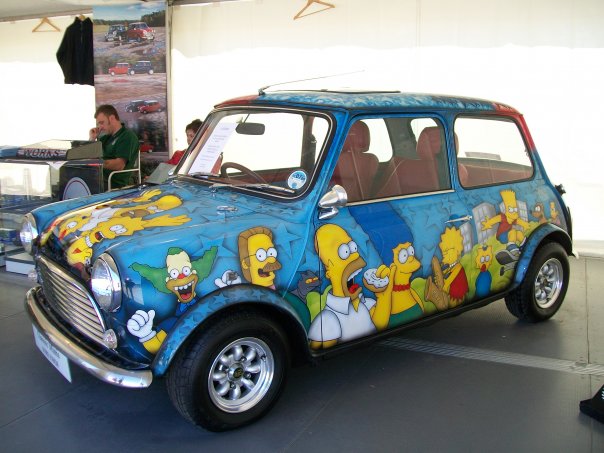
Then it was on to the novelty and classic Minis.  Everything from cowhide to the Simpsons.

Cowhide MiniClassic PinkFroo fru WinstonSimpsons

We visited the information booths and picked up all the free pens and pencils and key rings we could find.  There was the Mini Club of Northern Ireland, the wheel makers, the specialty body works people, the custom floor mat booth, and on and on.

At the appointed time, we meandered over to the track.  Silverstone is an international, professional race track, whatever that means, if I haven’t already mentioned it.  All the North Americans were already there; apparently they’d been lined up for hours.  Rebecca and I joined them and the doors opened.  It was a pleasant sunny day, not at all a bad one to spend hanging around a race track—Minis, when viewed in multiples, remind me of hummingbirds.

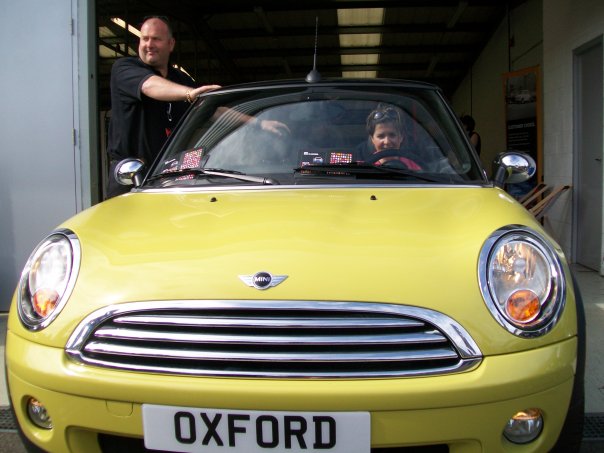
It was our turn, and I urged Rebecca to go first since I was nervous.  They pulled the car up and she glowed (Rebecca that is, not the car).

Oxford Mini

Rebecca is from Oxfordshire and I think she thought this was some sort of sign. I didn’t remind her until after, that Oxford is where BMW makes Minis in the UK.

A few minutes later it was my turn.  I got in, grabbed the gear shift with my left hand, and thought, “Don’t think.”  In certain life endeavors, like learning a language, falling in love, or driving the opposite of how you’ve done it all your life, thinking can be detrimental.

Suddenly, the car careening out of control, smashed head on into the side wall, then burst into flames!

Just kidding.

I drove around the track a couple times. I think I got ‘er up to 50mph.   It was uneventful.

We all knew it was a promotional gimmick to get us to buy this new model, whatever it was, but we appreciated that BMW had thrown in even more fun, for free.

We retired to the tent, where one of my fellow Americans, and Indian guy from LA (India Indian, not Native American), was saying he had just ordered the new model to add to his collection.  Nice for some people.
I was done with Minis for now.  We spent the whole evening and next day in the VIP tent wining and dining, then headed back to Woodstock Sunday evening, well rested and very well fed.

Mr. Whooooo

This is the eighth post in a series about a UK road trip that starts here.

Rebecca and I spent our first day wandering the Mini United festival grounds.  As I wrote in the last post, Mini owners like to have fun.  Cramming is some people’s idea of fun.

Cramming

I did not participate in the cramming.  The most people I have ever had in my car is five. Two of them were men well over six feet tall.  I remember the elbows and knees everywhere, and only being able to get up to fourth gear because someone’s foot was blocking the gear stick.

I did happily subject myself to a fake pat down by a fake generic police officer.  There are all sorts of things I could write about this, involving naughty British and German stereotypes, but I’ll just say, “Anything for a photo opp with a classic Mini,” and leave it at that.

But Officer

There was a double-decker bus full of overpriced Mini T-shirts, hats, sunglasses, drink glasses, key chains, and lavishly illustrated souvenir books.  I didn’t need to buy anything; I was more than content with my swag bag, which had turned out to contain a bunch of similar Mini trinkets in addition to the bottle opener.

Style Bus

There was lots of racing by professional drivers which I found boring.  I’ve never understood the attraction of watching someone drive around and around and around a track.

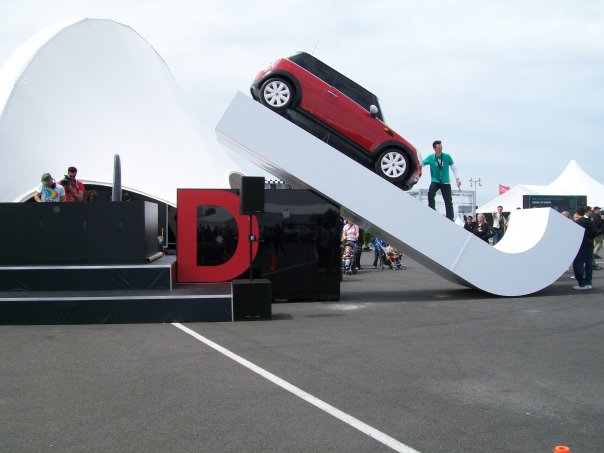
But then, there were the trick drivers, a la the Italian Job, accompanied by a DJ.

DJ

We went back to the VIP tent for our evening feeding, then headed out for the headline concert by Paul Weller.  I had never heard of him, or The Jam, his first band. I had never heard The Jam’s number one 1980 hit, Going Underground.  There are probably Americans who would be shocked at that, but I was busy changing diapers and going to school full time back then, so I had other priorities.

But also, back in the day, it was probably more possible and quite common for music not to make it over the pond.  Not every group was the new Beatles or Rolling Stones, but lots of groups, like The Jam, were huge in their home country.

weller

So Rebecca and I jammed, and I never actually saw Paul Weller because, at 5’3”, I never see anything from the main floor but other people’s heads.  There were clearly a lot of drugs in use.  A guy near us was hopping on one foot the whole concert, yelling “Whooo!” over and over and over.  He was as entertaining as the concert itself.

It had been a long day and we were barely started on all there was to see and do.

We trudged back to the tent, feeling like First Class passengers forced to return to Coach Economy.  We should have slept soundly but we were so excited about going back the next day that we stayed up talking in the dark.  Besides, Mr. Whooo was camping somewhere nearby, so there was a round of mostly good-natured “Shut up!” from us and our neighbors every 10 minutes until he finally ran out of steam around 3am.

Good on Ya, Gdynia

This is the seventh post in a series about a UK road trip that starts here.

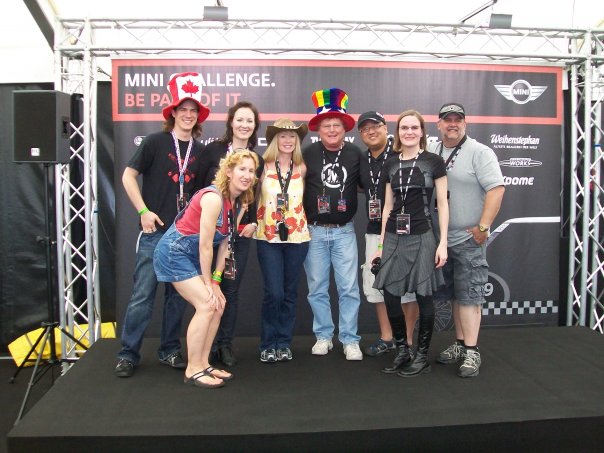
Rebecca and I were sitting in the VIP tent at the Mini festival, pinching ourselves, when a bunch of loudmouths barged in. Oops, turns out they were my fellow North Americans.

North Ams

Rebecca and I were waved over to join them by a tall woman dressed in black and wearing extreme eyewear.

“I am Dagmar,” she said in a clipped German accent, “head of BMW’s Mini Cooper North American Customer Relations Division,” or some such. “I would like to give you a warm welcome to Silverstone and Mini United.”  She never cracked a smile; she was about as warm as an ice cube.  Dagmar gave us an orientation to the VIP amenities.

“The VIP toilets are over there … these coolers are available to you 24/7 … your feedings will be at oh-eight hundred hours, 1200 hours, and 1900 hours.”

Our feedings?  VIP toilets? And those coolers …  for years I had a repeated dream in which I entered a house brimming with priceless antiques and treasure chests full of gold coins and precious jewels.  Suddenly I would realize that all this was mine.  I have no idea what that dream meant but I felt it had come true now as I stood before a tall glass-front cooler stocked with good German beer and bottles of wine including my favorite, prosecco.

“Anne … Anne!” Rebecca was standing next to me, trying to snap me out of my trance.  “Your compatriots have the inside scoop on why we’re really here,” she said as we rejoined them at a table.

A tall guy wearing a tall fuzzy hat with a Maple leaf said, “I got the low down from another employee last night. BMW budgeted for 500 North Americans coming to the festival.  Only a select few, like the auto journalists and the big collectors, were gonna get the VIP treatment.  But then the recession hit and only 15 of us showed up!”  We all laughed.  There was one rich guy among us, but most of us were regular middle class people for whom our cars and trips like this were a budgetary stretch.

People often assume that Minis are super expensive cars.  How much things cost is all relative, so I’ll just say that they cost about the same as a Subaru Crosstek or Legacy, a Mazda 3, or a Toyota Camry.  So you could spend a lot more on a car, or a lot less.

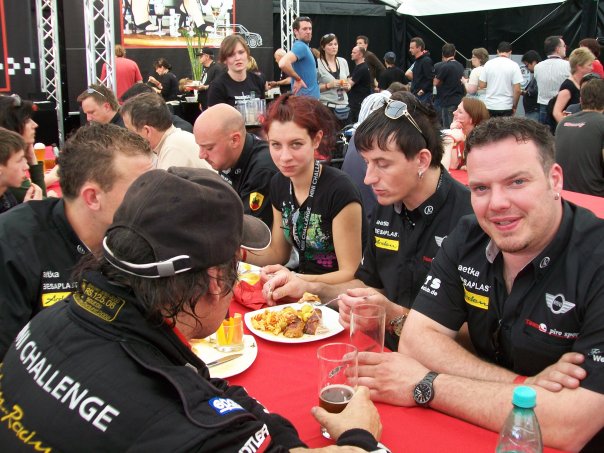
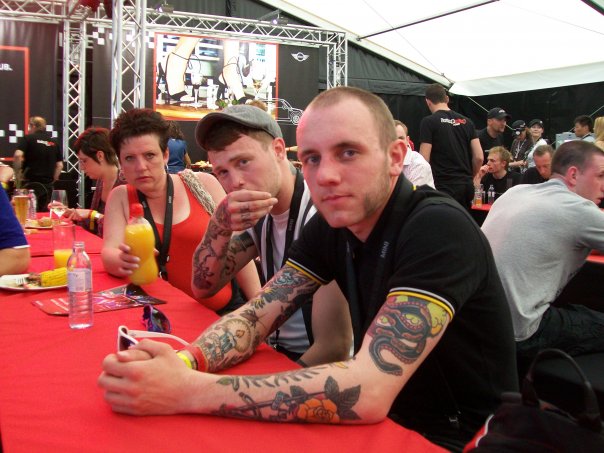
We waited for our first feeding, aka lunch, and shortly before noon the pit crews from the rack track poured in.  BMW must have reckoned it might as well feed them the good grub, too.

Pit Crew 2 Pit Crew

I wonder which bunch Dagmar found more distasteful—us rag-tag North Americans in our jeans and T-shirts and fuzzy hats, or the tatted-up mechanics?  Not exactly the high-class clientele she’d had in mind, perhaps.

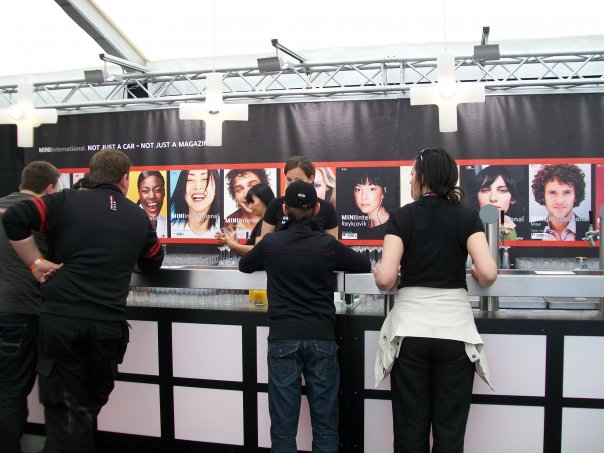
We enjoyed a light lunch of fresh salmon and salads and desserts.

The BarBuffet

Then it was off to explore the festival!  Rebecca and I slipped a few beers in our swag bags.  Tacky, I know, but since the swag had included a Mini bottle opener, we figured we were obligated to field test it.

BMW has done its brand research.  Mini owners love to “motor,” we love good design, and we love adventure and fun. Not all of us are all of these things, but you get the picture.  There are all sorts of Mini events going on around the world all the time, like group road trips, music festivals, and art and design extravaganzas.  They’re all organized by Mini owners; Mini United is the only one sponsored, every three years, by BMW.

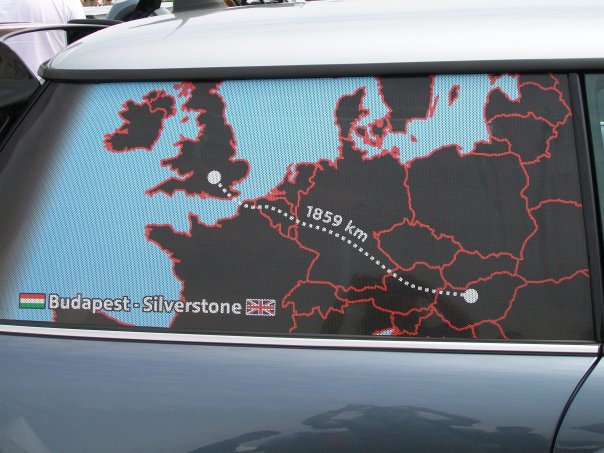
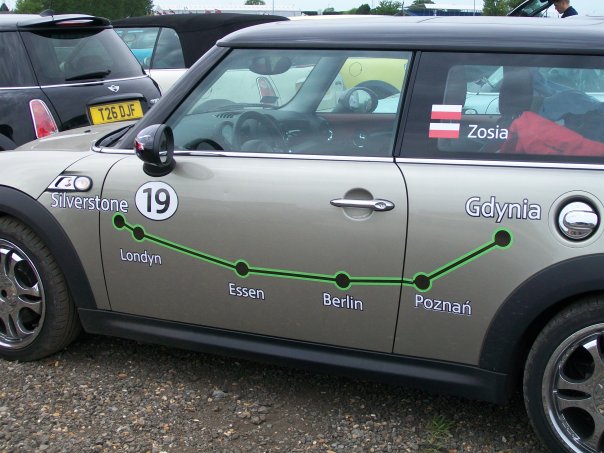
To give you an idea of how passionate Mini owners can be, here are some Minis with the equivalent of car tattoos showing where their owners drove from—in order—Budapest, Kiev, Moscow, and Gdynia, Poland.

Budapest Kiev Moscow Poland

These are just the Eastern Europeans; there were hundreds more from Western Europe, North Africa, Turkey, and Asia.

“This puts things in perspective,” I said as we clinked a couple of beers.  “Yes,” said Rebecca drily, “I guess our epic 200-mile drive was worth it, if you like this kind of thing.”