Category Archives: class divide

Accidental VIPs

This is the sixth post in a series about a UK road trip that starts here.

We had arrived in Silverstone, England for the Mini United festival tired, hungry, crabby, and on a budget.  “You can sleep when you’re dead,” is one of my mottos.  Hungry could be fixed with overpriced, tasteless vendor food, but a budget was a budget, and incompatible with a long weekend of overpriced vendor food.  I was doing okay financially—obviously—since I could afford the airfare to get there.  But Rebecca worked as a carer, which is someone who cares for elderly and handicapped people in their homes.  It’s a super important and supremely underpaid job.

We crawled out of the tent and surveyed our surroundings.

Tent City Tee pees

Yes, teepees—they’re big over there.  I subtly strolled by one that was open to get a look at the interior but didn’t have the guts to take a picture. There’s a permanent platform, so you’re never going to get wet unless it’s flood-mageddon.  You rent the teepee with all the gear, which can include cots and coolers and all the bulky heavy stuff that’s a drag to store and pack if you own it.

Is this cultural appropriation?  I don’t know. Maybe they’re just triangle-shaped tents.  It’s not like these campers were dressing in rawhide and eating dried strips of deer meat and doing war dances.  At least, not that I saw.

We used the porta loos, which weren’t bad as far as giant storage containers of feces and urine go.  There were sinks with warm water but no showers.

I was having a hard time getting excited. But hey, it was just three days.  How bad could it be?  I didn’t want to ask Rebecca what she was thinking because it had been my fool idea to come here.

We slogged for what seemed like a mile, following the other ratty-looking campers, to get to the registration point. “Okay I’ll just say it,” I said.  “We can walk back to the tent and cook over the stove every meal, which will take forever but save us money.  Or we can buy the overpriced food at the concessions.”  I was wondering how much a beer would be.

“Yep,” Rebecca replied, stonily.  Then she turned to me with a forced but radiant smile, “Let’s just see how it goes!”

“Hmm … what a novel but healthy idea!”  I was on board.

“We can always bitch and moan later.”

“Yes, it’s a beautiful day!” I replied, and it was.  We were tromping through a farm field on a sunny, warm spring day.

We arrived at the registration point and there was a line a hundred people deep.  An employee came by and scanned our confirmations.  “Oh,” he said meaningfully, “You’re North Americans.”  I didn’t correct him, that Rebecca was not a North American, in case that was a bad thing which would cause her to be ejected.

He waved us over to a different line where no one was waiting.  This was good.  I showed the confirmation.  “Welcome!” our staff greeter said enthusiastically.  “Here’s your swag bag.”  He handed us each some nice-looking messenger-type bags emblazoned with the festival logo and stuffed with … stuff, to be revealed.  “And these are your VIP badges.”

Rebecca and I exchanged glances that said, “do we keep our mouths shut, or not?”

“Thanks for thinking we are VIPs,” I said regretfully, “But we just paid the regular admission like everyone else.” I waved my arm toward the hoi polloi waiting in the very long line.

This guy had the best job in the world, because he got to say this to people: “You are VIPs, because you–you North Americans–are our best customers.”  I didn’t feel like an uber customer, but I just smiled and nodded in order not to break the magic.

We made our way straight to the VIP lounge, where we sat speechless, smiling dumbly at one another, emitting the occasional giggle.  “What if it’s a mistake?” I kept asking.

“Let’s just stay in here the whole time so we don’t have to risk not being re-admitted!” was Rebecca’s idea. And that’s pretty close to what we did.


VIP Lounge

Updates

Travel, addiction, prison … sometimes I feel I have to justify why I write about these seemingly unrelated topics. How about this: they all fall under the meta theme of “feeling trapped, or just bored, and wanting to escape.” There—does that explain it?

I was at a big work meeting and we were discussing human rights in the countries where we operate in the Middle East and Africa. Someone said, “What about solitary confinement? Shouldn’t we be advocating against it?” Everyone clamored in agreement. As far as I know, I am the only employee with a family member who has actually been in solitary. I was tempted to raise my hand and make a speech about how, if we decided to advocate against solitary confinement, we’d damn well better include the United States. But I didn’t feel like being a spokesperson for prison reform that morning.

Vince is off lockdown, after a month of confinement to the house except for work and AA meetings. It may not sound that bad—after all he had Facebook and phone to communicate with friends. He could binge-watch movies and cook real food and look out windows and take a shower without 50 other guys around. He had a pretty good attitude toward it, but I know he was really chaffing toward the end. He had steadily been earning freedoms after his release, then they were all taken away. The offense was so petty compared to the consequence. Most of all, he just had no power or choice about his comings and goings.

Regardless, it’s over now, and today we are doing a make-up birthday outing for me—going to hear the Minnesota Orchestra play the entire score of Sgt. Pepper’s Lonely Heart’s Club Band, accompanied by some Finnish choir. I expect it will be either fantastic or dreadful.

Nothing has happened with the Sentencing Reform and Corrections Act of 2015 in the five weeks since I wrote about it and about how Republicans are using its bipartisan popularity to shove in language making it harder to prosecute corporate criminals.

Then there’s the controversy swirling around The Violent Crime Control and Law Enforcement Act of 1994, which is being blamed for creating mass incarceration. Bernie Sanders says he only signed it because of the good stuff in it, even though he disagreed with the sentencing parts. Hillary has been confronted by Black Lives Matter activists about ruining millions of Black people’s lives because she voted for it. Bill Clinton has disavowed it—his own law. I give him credit for that, even though it may only be a political tactic. Ugh. I would have to write five more posts to get to the bottom of that one, if I ever could.

Anyway, a poll from Pew Charitable Trusts shows that all Americans—Democrats, Republicans, Independents, men, women, Latinos, African Americans, seniors, young voters, and even law enforcement households agree we need to fix our broken federal prisons system. If you’re an American and you agree, please sign this petition urging Congress to pass the Act now. These are all the celebs who are endorsing the call for reform.

new_Cut50_Celebs-04_REVISED-900px

A lot of what I do in my job involves raising funding from foundations. I was happy to see that 42 foundations have banned the box on their employment applications that asks, “Have you ever been convicted of a felony?” This is really only symbolic, since foundations have abysmal records of hiring people of color or even just people who aren’t wealthy and well connected. But they are calling on all philanthropic institutions to follow suit, so maybe it’ll catch on.

Anytime anyone speaks out in support of ex offenders I am thrilled. The president of the Rosenberg Foundation, in announcing the foundations’ move, said, “It is time to end the pervasive discrimination against people with past criminal records. The era of mass incarceration and the war on drugs have done severe damage to families and communities, with an enormously disproportionate impact on people of color. Everyone deserves a second chance and the opportunity to compete for a job.”

The Awakening

This is the seventh post in a series that started here.

I wrote in the first post in this series, “Wrestling with Restless,” that I would eventually make a point about my question: “Why would I want to leave Minnesota, one of the cleanest, healthiest, most progressive states in the U.S.—a state with great microbreweries—to go study/work/volunteer in a developing country?”

I’m finally at the point of making the point.

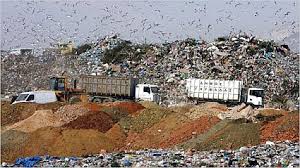
I was on a bus in central Mexico with 50 other mostly American Spanish-immersion students, and we had just been directed to gaze upon a garbage dump a big as a mountain.  It was beautiful—from afar.  Trash is colorful.  Flocks of seagulls soared and reeled above it and the sun glinted off the metal and glass it contained.  Our guide had called it a garbage dump city.  Why would anyone live in a garbage dump?  The stench would be overpowering!  Think of the filth and the disgusting things you would see!

To my relief, we didn’t stop but kept going until we arrived at Nuetros Pequeños Hermanos, or Our Little Brothers and Sisters.  As I mentioned previously, the Spanish school we attended specialized in Spanish for social workers, health care professionals, and teachers.  I wasn’t any of those; I just had just liked the school so much the first time that I wanted to return for more.   Now here I was, about to tour an orphanage.

We piled out of the bus and someone walked us around.  This is how I know I was having a Yerkes-Dodson moment, because I cannot remember whether it was a man or a woman or a priest or one of the older kids or a volunteer.

“We have 550 children here, from toddlers to teenagers,” the guide informed us.  “Most of them aren’t orphans; their parents are just too poor to feed them.  Or they’re alcoholics, or unwed mothers, or mentally ill, or in prison.”  The guide talked as we walked.  We passed a half dozen teenage boys shaving the heads of little boys.  We stood and listened in a dorm with rows of bunk beds and cartoon murals on the walls.

“Then there are the children from the garbage dump city,” the guide said.  I was transfixed.  “Hundreds of families make their living by picking through the rubbish and salvaging anything that can be sold.  Mostly it’s metals like copper but also appliances, furniture, shoes ….  We send buses every morning to pick up about 250 children.  We bring them here, give them showers, delouse them and put them in clean clothes, and they spend the day in school here.  Then we bring them home at the end of the day.”

Home.  To the garbage dump city.

We kept walking; we saw the dark little volunteer quarters and the kitchen garden tended by the older children.  A teenage girl and boy were flirting over a fence.  Since it was a Catholic home, I assumed there was no sex education or birth control.  How many babies were born here, to children like them?

The census of children is lower now than when I was there, but at that time, as I did the math, they were in charge of feeding, educating, housing, clothing, and providing health care to about 800 children.

“We have a dozen homes in nine countries,” the guide stated.  This is the moment when I had my “international awakening,” for lack of a better term.  I don’t know if there are homes like this any more in the U.S.  There are thousands of children are in the foster care system.

But the scale of this … for every adorable, doe-eyed two year old there were a dozen or a hundred more who needed someone to care for them.

I felt like I was in one of those videos where the camera pulls back from the earth so you feel lifted off the ground. You look down on the tree tops, then you can see rivers and highways, then shorelines of countries.  You zoom out farther until you are looking down on the blue marble we called Earth, and then out, out, out until you can see the Milky Way.

The Mountain

This is the sixth post in a series on studying Spanish in Mexico that starts here.

I returned from my inaugural week of Spanish immersion and started graduate school. A few months later, I returned for three more weeks.

It was on this was the trip that I had my “international awakening”—the experience that committed me to working in international development. Years before, I had worked for the American Refugee Committee for two years on contract, writing their newsletters and annual reports. I read a lot of background materials and interviewed employees to get material. I already knew that terrible things were happening in Sudan; this work required me to know the gory details. However, nothing compares to being there.

I returned to the same school and requested a home stay with Mirta. I couldn’t wait to see her again and bask in the warmth of her household. Since I was in grad school, I could take all the classes I wanted in addition to those in my program, so I already had a semester of Spanish under my belt and I was excited to be able to talk to her more. Things had been falling into place: The maid’s name wasn’t Ella. “Ella,” meant “she” in Spanish. If you know Spanish you may be shaking your head that I didn’t know this sooner, but it was one of many light-bulb moments in learning a language I found thrilling.

Since I was staying for three weeks, I would be more involved in the life of the school. Cemanahuac specializes in Spanish for teachers, social workers, and heath care professionals. They asked me to bring donations of vitamins if I could, so I took up a collection and filled a suitcase.

Lisa n Alex

This is my former housemate and her son. I financed this trip, and many to come, with funds from my part-time student job, student loans, and rent from people who shared my space or rented the whole place when I went for extended periods.

Mirta had no recollection of me. I felt wounded. That first week in Cuernavaca had been so vivid to me. I attempted to jog her memory, “I’m from Minn-eh-sota, near Can-a-da, where it’s very cold, remember?” I said in Spanish.

She gave me a kindly but blank look. She nodded and smiled but it was obvious I was a blank slate to her. I knew Mirta was married to an elderly, retired doctor she had to care for and support. She had this big compound too, and she worked as hard as the maid to keep it up. Mirta needed students to pay the bills. She was saintly, listening to our stammering, canned Spanish 101 attempts at conversation. She was genuinely warm. We weren’t all white 22 year olds. But as soon as one student left another arrived, and we probably all blurred together.

There’s a phenomenon where people go on tours of slums in the developing world and snap photos of the residents like they’re zoo animals. I hope I wasn’t like that, but my mouth may have gaped open a few times.

I was really into my Spanish studies and hadn’t paid much attention to where we were going for a “field trip” on Saturday. About 50 of us traipsed onto a bus and we drove for an hour. My head was swiveling back and forth from whatever conversation I was having with the student in the seat next to me—she was an African American woman who worked for the U.S. State Department as some kind of administrator and lived in Washington, D.C.—and the scenery out the window.

I was looking at her when I saw her eyes lock on to something in the distance over my shoulder. “What is that?” she wondered.

I turned to look and my first thought was, “A mountain?”

“But look how colorful it is. And why are there so many seagulls?”

“It’s beautiful,” I said.

Then one of our teachers stood up, pointed to the mountain, and announced, “Welcome to Miacatlán garbage dump city.”

Garbage City GullsG Dump City

Two Birds in Paradise

This is the fourth post in a series on studying Spanish in Mexico that starts here.

My host mother and I had been tossed around in the back of the mini bus for 20 minutes when she jumped up and exclaimed what I could only guess meant, “We’re here!”

The combi slowed to a roll but didn’t actually stop as we stepped off in front of an office.

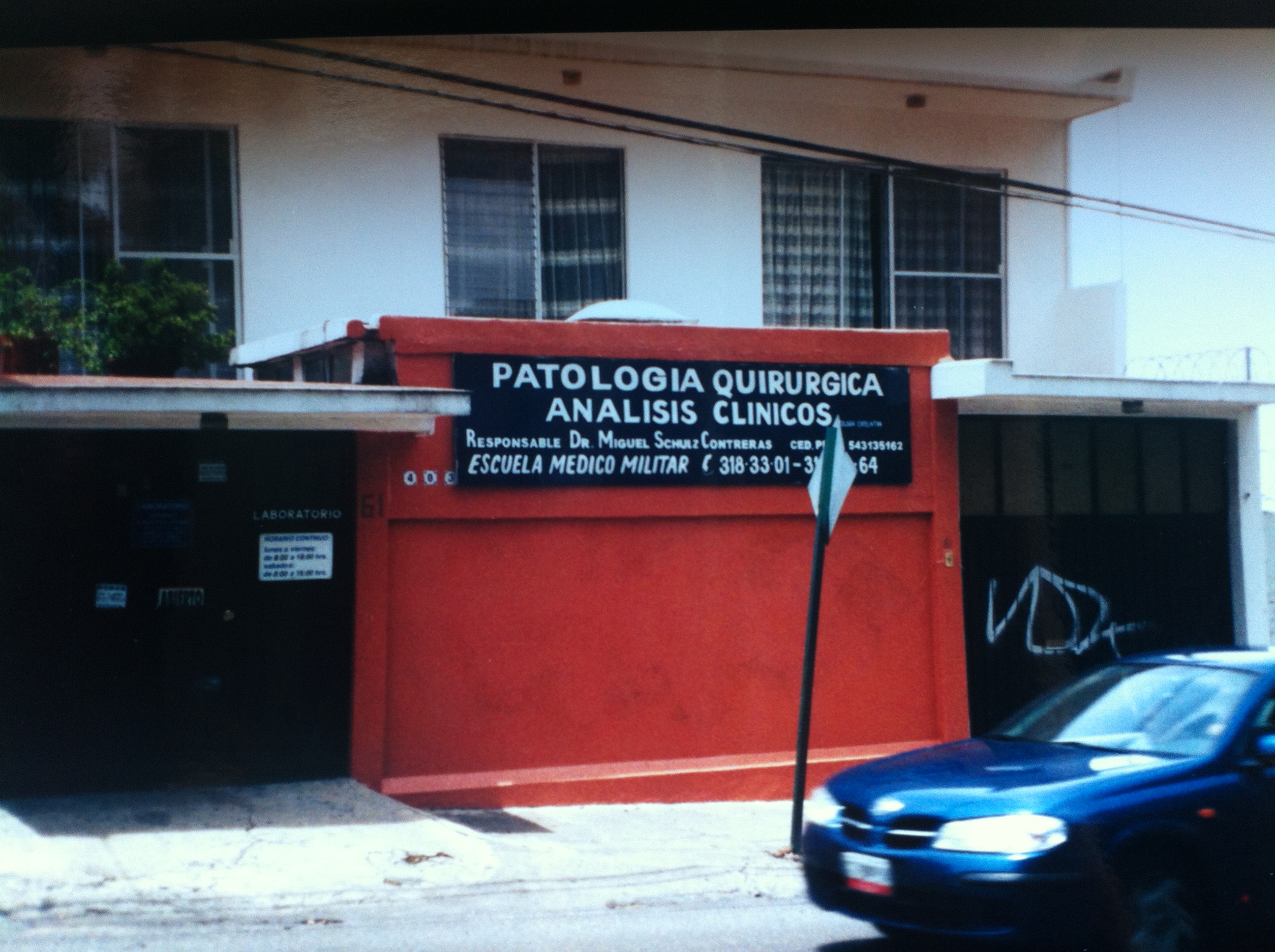
Patologia

Mirta led me to the locked gate to the right—the one with graffiti scrawled on it, handed me a key, and showed me how to use it.

Now that we were here—now that I had made it from the airport to the hotel, taken a bus to Cuernavaca, seen the school, and successfully managed to keep up with Mirta, my tension drained away and I suddenly “got” a word: llave—key.

I felt joy.  I could do this!  I could get around in a foreign country, meet exciting new people, and learn a foreign language!  I only had to memorize about 10,000 more words and learn how to conjugate 500 verbs.

If you live in Los Angeles or Miami, Mirta’s house would be unremarkable.  It was a walled compound with a main house, another smaller house, and a garden with a pool.

Cuerna Home

Mirta walked me into the kitchen of the main house, wagging her finger to indicate that the rest of the place was off limits.  Darn, I wouldn’t be able to relax on that plastic-covered couch under the oil painting of The Last Supper I caught a glimpse of from the kitchen.

She also made clear that the fridge was off limits.  She demonstrated how to use the five-gallon water bottle which was to be my only source of water.  She laid down the times for breakfast, lunch, and dinner.  It was amazing how much she could communicate with charades-like gestures.

A young woman entered with a toddler.  I assumed this was Mirta’s daughter and grandson until she picked up a mop and started swabbing the floor.  From what I could gather, her name was Ella.

I followed Mirta like a duckling to the smaller house where I would spend the week.  Everything was covered in green tile except the ceiling.  It would have felt like an asylum except that the window looked out on the garden full of Birds of Paradise.  Those are run-of-the-mill in Mexico—like daisies in Minnesota—but to me they were spectacular and I would later amuse Mirta by taking endless photos of them.

Bird of Paradise

Mirta pointed to the bare bulb in the middle of the sitting room ceiling and made clear that I was not to waste electricity.  She oriented me to the bathroom, showing me eight fingers to indicate how many minutes of hot water were available to shower each day.  There was a drain in the floor with a plate over it and a brick on top of the plate.  Do not remove, I was warned, with some scary faces.  In Minnesota, we get rats coming up from the river through the sewers into people’s basement toilets.  I wondered if that was the foe here, or something else?

Mirta opened the bedroom door to reveal two twin beds.  A young woman was hunched over on one of them, holding a blow dryer and looking dejected.

“Hi, I’m Zoe,” she said, in a North American accent.  I had known I would share my quarters with another student, and this was her.  Mirta showcased the one-drawer night stand next to my bed, then exited with a reminder about meal times.

“My blow dryer won’t work!”  Zoe exclaimed.  She started to whimper quietly.  “I forgot to bring an adapter.  Do you have one?”

When I said no she wondered out loud, “I wonder if Mirta has a blow dryer she would let me use?”  I thought that was highly unlikely, given we weren’t allowed beyond the kitchen or even to open the refrigerator.   Zoe really started to cry.  “And I can’t call my parents!  My cell doesn’t work and Mirta won’t let me make a long-distance call on her phone!”

I was afraid Zoe was destined to be an example of a Yerkes-Dodson Law fail.

The Fox and the Hen House

This is the second in a series of posts about a road trip to South Dakota that starts here.

When you think about it, South Dakota makes sense. It’s a very rural state where people have a hard time getting to an ER or clinic. Therefore the largest provider of telemedicine in the world is in South Dakota. We’ll also visit a guy who is the CEO of the country’s largest ethanol producer, and his wife, who have an interest in east Africa.

Then we’ll visit the Helmsley Trust, which is named for the late Leona Helmsley. One of Leona Helmsley’s grandsons lives in South Dakota, and I imagine that’s why the trust is in Sioux Falls. Leona, originally named Lena Rosenthal, was the daughter of Polish Jewish immigrants and became a hotel tycoon in New York City. Sadly she spent time in prison for income tax evasion and was controversial for being demanding. I’m sure she was demanding. You don’t get to be a billionaire by being meek. But when Donald Trump is demanding, no one thinks twice about it.

Leona Helmsley left $12 million to her dog in her will, and the Helmsley Trust, which has around $5.4 billion in assets, was originally mandated to only benefit dogs.

By the time you read this I’ll be back from this exciting trip and will let you know how it went. I don’t expect anyone to write us a big check. Fund raising—or development as it’s called in the US, is a long-term process of relationship building.

Here are a few prison-related updates.

Close to home, Vince got the final word on his punishment for not answering the phone when a probation agent called. He’ll be on lockdown for a total of a month and have an extra month added to his probation. I told a friend about it; she works for the St. Paul City Council and was an admin at the St. Paul Police Department before that so she is no stranger to bureaucracies and the sometimes difficult people who work in them.

“I always figure the guy had a fight with his wife,” was her assessment. “If he hadn’t, or if Vince had a different agent that day,” Vince’d still be on track to finish his probation on time.”

“Are they trying to goad him into doing something that’ll send him back to prison?” I wondered. “He also got two parking tickets that day—one was for parking more than 12 inches from the curb. Do you think they could be in cahoots with the police?”

“No,” she laughed. “They’re not that organized. It’s just random.”

On the prison reform front, the New York Times ran an editorial, “Holding Sentence Reform Hostage.” The pending legislation would “reduce absurdly long mandatory minimum sentences for many nonviolent drug crimes, give judges more control over the terms of punishment and provide inmates with more opportunities to get out early by participating in rehabilitation programs.”

Some Republicans are scaremongering, Willy Horton style. At least that sort of makes sense.

But some Republicans say they won’t approve the bill unless it includes a change in federal law that would make corporations and their executives harder to prosecute for environmental or financial crimes. This has nothing to do with prison reform but is a standard tactic used by politicians to get what they want without having to work hard for it. I know, it’s hard to believe they could be much lazier.

In my opinion, this is evil. I don’t like to call people evil, I really don’t. But making it easier for companies like BP or Goldman Sachs to get off the hook?

In related but also absurd-news category, there’s this item: Former Tyco CEO, Who Served Time in Prison, Appointed Chair of Prisoner-Assistance Nonprofit.

Dennis Kozlowski, who did six years for stealing millions of dollars from his own company, is now in charge of the Fortune Society, a nonprofit that helps former prisoners find jobs, housing, health care, and education.  What a great idea: putting an old, white, rich man–a former thief–in charge of a  nonprofit with $10.8 million in assets.  How nice for him.  What could possibly go wrong?

Housespotting

 Today is my last day housesitting for my friend. It’s been two glorious weeks of having a place to myself. It isn’t that Vince is a terrible roommate. The timing has worked out well, because Vince has been on lockdown for the whole time, meaning he cannot leave the house except for work and a couple AA meetings. I hope he has enjoyed having the place to himself; I think I get on his nerves.

My friend is a psychotherapist and her husband is a retired computer-something from the university. So they’re middle class but combined they can afford this four-bedroom house in the most sought-after neighborhood of St. Paul, St. Anthony Park. The house has at least twice as much space as my condo, and it’s got 25 windows vs. eight in my place, so it’s flooded with light. That means a lot during a Minnesota winter. I could never, ever afford to buy a house like it on my own, so I’m enjoying it while I can.

St. Anthony Park is near the university’s very large St. Paul campus, which is focused on agriculture, so there are lots of open fields—probably sown with GMO crops—but they look pretty even in the winter. And there’s a great collection of mid-Century modern homes nearby, so I’ve been enjoying walks among them.

mid mod 4mid mod 1

mid mod 3mid mod 2

Another reason I’m enjoying this stint in St. Anthony is that I just like change, in general. I like having to travel a different route to the gym, cooking in a new kitchen, perusing other people’s bookshelves, and even just figuring out how to use unfamiliar appliances.

My commute to work from the condo isn’t long—15-20 minutes—but this house is only 5 minutes away, so I’ve been a happy commuter for two weeks.

Those are the obvious reasons I am enjoying my house sitting gig, but most of all, I like being alone. And I feel like I have to justify that somehow, because our society frowns on that.

Think about it: The police catch a serial killer. The TV news interviews his next door neighbor. What does she always say? “He kept to himself.” As if that explains why he murdered people.

I happened to catch a TV show about eccentric people in Minnesota. They were interviewing the sister of Francis Johnson maker of the world’s largest twine ball. When asked what she though motivated her brother to undertake such an endeavor, her answer was, “Well you know, he never did marry.”

Loner, recluse, hermit. I am struggling to come up with a list of similar negative words for extreme extroverts.

I just realized that this post will go up on Valentine’s Day. Happy Valentine’s Day to you all! I don’t have a valentine this year, but I never rule out the possibility that I could bump into Mr. Right at the grocery or happy hour or on a plane. It’s been 56 years and it hasn’t happened yet. I would be happy if that happened, but will also be content if it doesn’t.

I just sent a valentine to U.S. Speaker of the House Paul Ryan, urging him to pass the prison reform bill currently under consideration in Congress.  It was easy–please do the same if you are a US citizen.  Just watch this video valentine from Alicia Keys, then submit the form that follows it.

Alicia and Paul

Feelin’ the Bern

Before I leave the series on Cuba that started here, I have to tell you about the Bernie Sanders rally I attended last week. I was vaguely aware that it was happening, when my cousin called and said her two youngest kids (ages 14 and 18) were begging to go. So they drove the one-hour drive from Wisconsin to see Bernie. We bumped in to another nephew; he’s 18, too. The 18 year olds are looking forward to voting for the first time, mainly because of Bernie.  Vince won’t be able to vote for at least seven years.

The rally was at the Roy Wilkins Auditorium in downtown St. Paul. I was also vaguely aware that Roy Wilkins had been an African American civil rights leader but was wowed when I Googled him later and read his bio: He was a leader with the National Association for the Advancement of Colored People for 40 years, where he succeeded W.E.B. DuBois as editor of Crisis Magazine. He was an advisor to the War Department during World War II and a consultant to the American delegation at the United Nations conference in San Francisco in 1945. He led the fight to end school segregation. Lyndon Johnson awarded him the Medal of Freedom, the US’s highest civilian honor. When he died, Ronald Reagan ordered all government flags be flown at half-staff.

What a cool guy. And what a perfect venue for Bernie to hold his rally, since he’s way behind Hillary on support from African Americans.

I wondered if many in attendance had ever heard of Roy Wilkins. When I walked in, I must have lowered the average age by about 20 years. Bernie drew a crowd of almost 15,000 people, and my guesstimate is that 90% of them were under the age of 30.

We found seats in the overflow room and watched on a big screen while Bernie was introduced by a young Somali American woman. Then, Bernie himself walked into the overflow room—and the crowd went wild. We were on our feet, chanting, “Ber-nee, Ber-nee Ber-nee!” and “Feel the Bern!” I hadn’t been paying much attention to the race until now and was hesitant to stand up and cheer a candidate I knew next to nothing about, but the enthusiasm was irresistible.

Bernie delivered a brief but fiery speech, even though he was clearly on the verge of laryngitis. Then he headed for the main auditorium to the accompaniment of more stomping and cheering. Back on the big screen, Minnesota Congressman Keith Ellison was introducing Bernie to the main room. I was surprised. Endorsing Bernie was, in my opinion, a move of conscience, one the Democratic Party will not be happy about. But Ellison, who is the first Muslim member of Congress, seems to be a man of principle. I’ve heard him referred to as the Muslim Paul Wellstone—our beloved, principled Minnesota Senator who died in a plane crash a decade ago.

Like Wellstone (and me), Bernie is a Jewish Atheist. I didn’t think anyone in the crowd would be put off by that, but having Ellison and the Somali woman introduce him can’t hurt with African American and Muslim voters.

Bernie’s message was loud and clear: We need a revolution! We need to stop all the money flowing to Wall Street. College should be free for everyone! The minimum wage should go up to $15 an hour! And so on with a long list of drastic reforms.

As usual, I’m skeptical. Bernie’s ideas tap into a deep anger among many Americans who feel they’re being screwed by the system. I get it. But would he be able to accomplish much, pitted against an oppositional Republican majority in Congress? Also, economics is complicated. You pull a string out of a tangle and you can’t necessarily predict what other strings are going to become more tangled or come loose as a result.

The day after the rally, I read this article about US relations with Cuba which laid bare our opposing systems: the US wants to do business with entrepreneurs and small businesses, while Cuba insists that we deal only with their government. Bernie calls himself a Democratic Socialist. Is that some sort of hybrid system? I need to educate myself more.

Via con Dios, Cuba

This is the eighth post in a series about Cuba that starts here.

We flew back to Havana without incident and checked back in to our dark, quiet-as-a-graveyard hotel.

Here’s another thing I didn’t get while I was there and I can only make up an explanation for you now: I attended a Passover Seder in Havana—Seders remained legal after the revolution. I also attended an Easter mass—and was told that masses had just been legalized. Why would Seders be legal but not masses?

It could be because almost the entire Jewish population of Cuba fled the country after the revolution. After all, we’d seen this movie before. Why wait to find out the ending? Only 1,500 Jews remain in Cuba, compared with 60% of the population that is Roman Catholic, or 6.5 million people. Which would you find more threatening?

The Seder was a community one at a synagogue. It was packed, as Seders always are; there were Jews from the Bahamas, Texas, Israel, and lots of American students. I sat across from a pudgy, red-headed oaf from Indiana or somewhere in the Midwest who was married to a Cuban woman who looked like Bianca Jagger in her heyday. I’m sorry to say that my people are not immune from the syndrome where misfit western men snag beautiful wives in the developing world. But that sounds mean. I only sat across from him for an hour. Maybe he was usually courteous and kind.

On our last night, we were invited to a “Defense of the Revolution #62 Block Party.” Other members of our group had been to these before and told me that neighborhoods organized them to thank visitors for their donations. This in no way prepared me for what I saw when I stepped off the bus.

I thought there must be some mistake. Had we stumbled upon a protest? A wedding? A baseball game? No, these hundreds of people were waiting for us. There had to be at least 200 people out on the street, with precious, expensive electric lights strung up festively, a band and a dance area, and tables laden with food.

Ed and some of the other guys unloaded the medical supplies we had brought; I have no idea where they had been stored all week. Our donation consisted of bandages, cotton balls, and Q-tips—granted there were crates of them, but still … here were hundreds of people lined up to greet us as though we were foreign dignitaries or rock stars.

I was stunned and embarrassed. Our donation was puny compared to the effort they were putting out. Plus, I had agreed to interpret Ed’s remarks into Spanish. I had pictured half a dozen people, not hundreds.

Mi en Cuba

I managed to stammer out a few remarks into a microphone. Everyone applauded as though they had understood me. I fell back into a chair and they brought me a plate of food. It all tasted like dessert because even the savory foods were loaded with sugar. The music and dancing started, and our group was forgotten. I realized this wasn’t about us—it must have been the case that Cubans are allowed to hold big gatherings like this if they had a patriotic reason. I don’t know for sure, but maybe we had given them that reason. Bringing gifts gave them an excuse to show us their stuff, and stay up all night having a good time. Who knows?  Another mystery.

On our bus ride back to the hotel late that night, our guide explained that there were no extremes of rich and poor in Cuba. Yeah, I thought, because all the rich people skedaddled to Miami. He kept referring to “the special period” and I asked Ed to explain. “That’s when the Soviet Union collapsed and Cuba lost all its subsidies,” he said. “It can’t survive under the U.S. embargo without a patron.”

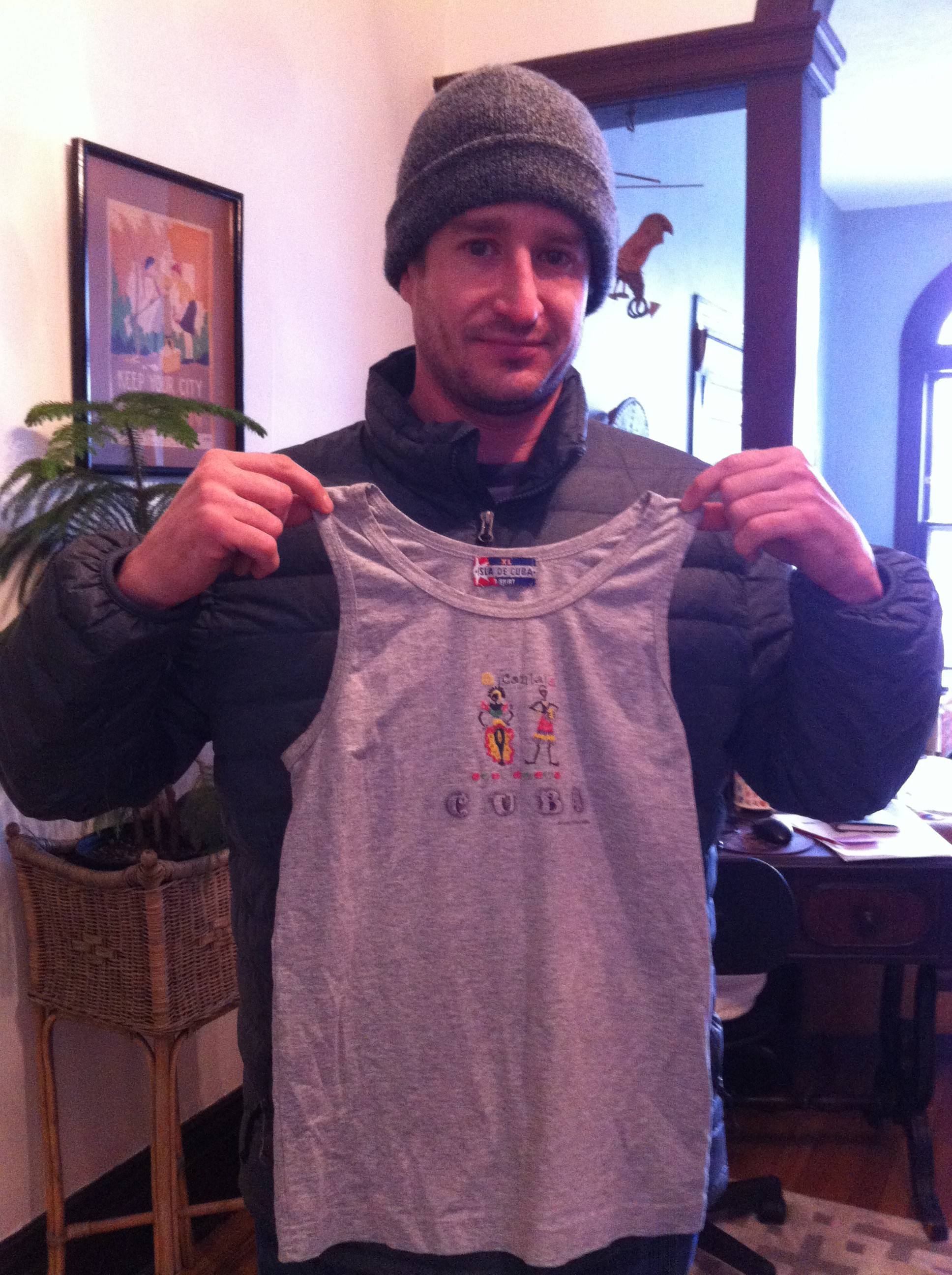
When we checked out the next day, the guy at the desk offered T-shirts for sale, as modeled here by Vince. It’s an extra large. Right—for a Cuban, maybe.

Cuba Tshirt

I hope this series has been food for thought as Americans consider electing Bernie Sanders, a Democratic Socialist, for President.

¡Me Encanta Bailar!

This is the third in a series of posts about Cuba which starts here.

We checked into our hotel, the Habana Libre, a mid-century modern. It must have been splendid in its heyday. It wasn’t run down so much as dead. Deathly quiet, no people except the guy at the desk. The lights were dim. We made our ways to the elevator and when I got off at my floor it was so dark I had to grope my way along until my eyes adjusted to the dark. The room was spacious and clean if Spartan. It was as if slowly, over the years, the art, the phone, the clock alarm, the drinking glasses, every little comfort you expect in a hotel had been stripped away.

In the bathroom I had my introduction to some of the disconcerting results of the U.S. embargo. In particular, crude oil, with which plastic is made, was banned, and so the shower curtain was about as thick as a Walmart bag, and the toilet seat was like a large white Frisbee with a hole in the middle—so thin it couldn’t be well secured to the toilet so it slipped around underneath me. The toilet paper? Well let’s just say that if you toilet papered someone’s house with it, the first light rain would wash it away, it was so insubstantial. There was no soap or shampoo or washcloth but there was a towel—one—also so thin and threadbare you could hold it up to the light and even that dim light showed through it. I was the only one who got off at my floor; it seemed like they had distributed our group one or two people per floor.

There was a mini refrigerator with nothing in it and a black and white TV. I flipped it on and there seemed to be two channels: one with old American TV shows like Bonanza, the other featuring nonstop speeches by various politicians. This was when I discovered that all the hard work I had invested into studying Spanish would really pay off. Not! Cuban Spanish is so different, and so fast, that a lot of Spanish speakers from Mexico or Spain have a hard time understanding it.

Suddenly, there was a hard knock at the door. I jumped and yelled, “Who is it?” then, “Quien es?” The knocking continued so I went right up to the door to see if I could see anything through the peephole but whoever it was must have been standing to the side. I repeated, “¿Quién es?” then “Que quieres?” The knocking stopped, then a woman’s voice shouted something that sounded like “Pocky robbabab ocalaca macanaca!” She said it with great gusto. Was she being attacked? Should I open the door and let her in? There was no phone from which to call the desk, and even if I had had a cell phone twelve years ago there would have been no reception in Cuba. The pounding resumed, along with more incomprehensible Spanish and shouting. Eventually she must have given up and gone away.

The next day our group had a walking tour around the city. I had been to Mexico, Jamaica, and to El Salvador, so I wasn’t a complete newbie to the developing world or Latin America. I had also lived in some pretty poor neighborhoods in St. Paul. I was struck by how there were no homeless people here, no beggars, no children selling Chiclets. There was no graffiti or litter. Was that because people couldn’t buy anything, so they had nothing to throw on the ground? Or would they be thrown in prison if they did? Or was it all a front for tourists?

I returned to my room without incident and found this sitting on my bedside table.

Cuban Dancer

Who had left her—was she a peace offering? Anyway, she’s come with me on my travels ever since. When I get to wherever I am staying in Nairobi or Dubai or Dublin, I set her on my bedside table. Her head got lost somewhere along the way, which maybe symbolizes even more the carefree traveling spirit I endeavor to be.