Category Archives: International Development

Red (and White) Flags

In one month I’ll be in Malta, a tiny country most people have never heard of.

Here is a representative sampling of travel books available in the library for the three countries I’ll be visiting: Italy, Spain, and Malta.  There was a whole shelf of books about Italy, a half shelf for Spain, and one slim volume about Malta.  This should have told me something about what a hot (not) tourist destination Malta is.  But once I get something fired up in my imagination, there’s usually no turning back.

travel-books

Of course Vatican City is technically a country—the smallest in the world.  I’ll be visiting the Basilica of St. Peter and the Vatican Museum and I’m sure there are entire books about them, but I don’t need books to tell me I’ll be seeing a lot of paintings of the Virgin Mary and baby Jesus.

Someone at work laughed about me going to Malta and suggested that since I would also be visiting Vatican City, I could make this a grand tour of tiny countries.  You know, the ones that send one athlete to the Olympics—an athlete who doesn’t stand a chance?  I could have gone to San Marino, which is surrounded by Italy; and Monaco, which is on my bucket list.  Liechtenstein would be a bit further north in Europe, but not as far as the other five that round out the Top 10 List of tiny countries, which are all tropical islands: Nauru, Tuvalu, Saint Kitts and Nevis, Maldives, and Grenada.

The lack of interest in Malta may have something to do with how difficult it is to get there.  I will be leaving from Sorrento, where I will have spent three days seeing Pompeii, the Amalfi Coast, and Capri.  You would think, from reading the one book about Malta, that you could just hop a train to Naples and fly right to Malta.  Boom—easy!  But alas, this was the same book that told me I must see the underground, 5,000-year-old catacombs on Malta, the ones that are closed for renovation until 2017.  The book also said it would be “easy” to take a ferry from Italy to Malta.  However I need to get to Madrid afterwards and it would take two days to get to the coast of Spain by ferry.

All the flights from Naples left at either 6:00 in the morning or 4:00 in the afternoon.  They all connected somewhere else, which meant that reasonable-sounding 4:00 p.m. flight would get me into Malta at 11:30 at night.  And the 6:00 a.m. flights were much faster; I seriously considered one that had a 6-hour layover in Paris.  Finally, I decided to fly from Rome. This will require me to get up early—but not quite as early as the 6:00 a.m. flight—catch a train to Naples, then connect to Rome, then catch the express to the Rome airport, then fly at 11:00 a.m. to Catania—which is on Sicily, then finally arrive on Malta at 3:30 in the afternoon.  That is, if nothing goes wrong on any of the five legs of the journey.

malta-sorrento-map

Another puzzle has to do with baggage.  The flights to and from Malta are cheap—if I am willing to travel with only a carry-on bag weighing no more than 22 pounds.  I spend some time researching ultra light bags; I could get a nice one for $70.  Or I could just pay RyanAir $75 for the privilege of bringing a real suitcase with me.

I toy with the idea of traveling light.  It would be easier to get on and off all the trains and buses and planes. I’d be less conspicuous, since my regular suitcase is purple.  It could be kind of a cool challenge to wear only two outfits for a month, to say “no” to buying clothes in Italy, and eschewing souvenirs.  Plus I would be doing my small part to save the planet!

Nah.  I’ll bring my purple monster.  I like to have options.

I contemplate these “problems” knowing that countless refugees are attempting the crossing to Italy in rubber rafts before the sea gets too rough in November.

The Grey Lady Stumbles

This is the seventh post in a series that started here.

I left Cuernavaca having learned a lot of Spanish and with a new vocation.  Off and on since then, I have worked in international development.  That doesn’t mean I don’t care about causes here at home.  I just think that, as a mission driven person, I do better work if I’m passionate about a cause.  And for many reasons, I am passionate about trying to end poverty and suffering in the developing world.

Before I left Cuernavaca, I booked six more weeks of Spanish immersion through Amerispan.  This time I would go to Morelia, a beautiful colonial city that is no longer an Amerispan choice.  I’m guessing this is due to Morelia’s unfortunate #1 ranking as the city most caught in the drug war that has erupted in Mexico since I was there.

And that’s my transition back to one of my favorite subjects, addiction.

The New York Times published an article a few weeks ago about an alternative treatment approach to addiction.   I read it, cut it out, and was saving it to write a post about.  My initial reaction to it was, “Why not?  Why wouldn’t you try both traditional treatment and AA and this thing, if you could afford the time and money.”  But now I’m having second thoughts.

In a nutshell, the article profiles a psychiatrist who has opened a new addiction clinic that approaches addiction as a chronic disease and treats it with drugs, in place of the Twelve Steps and AA.

At least three people have brought the article up to me in conversation, so it’s causing a stir.

When I revisited it for this post, I noticed it was in the Science section, which implies that the content is scientifically valid.  Plus it’s the New York Times, right?  It’s got to be true.

When I searched the NYT website for “addiction,” I found that all the other articles about addiction are either in the Opinion or the News sections.  So you’ve got news about a big drug bust in upstate New York, for example, and then people ringing in with their opinions on what should be done about the drug crisis and the related problem of mass incarceration.

I scrolled to the bottom to read the comments.  There must be hundreds, I thought, and I wondered how many commenters would hail this as a godsend or criticize it as irresponsible.  But there was no comments, and no way to make comments.  That’s strange, I think.

Among other things, Dr. Mark Willenbring states that 60 percent of addiction is attributable to a person’s genetic makeup.  The NYT adds that this is “scientifically unassailable” but offers no evidence.

Dr. Willinbring, a psychiatrist, is no slacker.  For five years he headed the federal agency that studies addiction.  Coincidentally, he’s a Minnesotan and he opened a private clinic called Alltyr in 2012.  It’s within walking distance from my house.

Alltyr treats addiction as a chronic medical condition.  Its treatment plans include drugs used to treat depression, anxiety, ADHD, or chronic pain; family “training,” and cognitive behavioral therapy—which, as I’ve written, was a worked miracles for me.  Alltyr also uses anti-relapse drugs, and I wondered what that meant.

I didn’t have to wait long to find out.

A friend and her husband have been struggling with his drinking.  He was on a wait list for Hazelden Betty Ford, one of the world’s premier rehab centers, also within walking distance of my house.  Then he read the New York Times article.  Alltyr got him in the next day, and after pooh-poohing Hazelden, he cancelled his reservation there.   (Despite Alltyr dismissing traditional treatment, I can’t find any evidence in the article that its method works.)

Alltyr put him on two anti-relapse drugs.  I spoke with my friend the next day.  “He must have still had alcohol in his system,” she said, “because he was so sick he couldn’t get out of bed—much less go to work—for two days.  He said it was like all the worst anxiety he’s ever had in his life rolled into one giant ball and stuffed into his chest.”

The Awakening

This is the seventh post in a series that started here.

I wrote in the first post in this series, “Wrestling with Restless,” that I would eventually make a point about my question: “Why would I want to leave Minnesota, one of the cleanest, healthiest, most progressive states in the U.S.—a state with great microbreweries—to go study/work/volunteer in a developing country?”

I’m finally at the point of making the point.

I was on a bus in central Mexico with 50 other mostly American Spanish-immersion students, and we had just been directed to gaze upon a garbage dump a big as a mountain.  It was beautiful—from afar.  Trash is colorful.  Flocks of seagulls soared and reeled above it and the sun glinted off the metal and glass it contained.  Our guide had called it a garbage dump city.  Why would anyone live in a garbage dump?  The stench would be overpowering!  Think of the filth and the disgusting things you would see!

To my relief, we didn’t stop but kept going until we arrived at Nuetros Pequeños Hermanos, or Our Little Brothers and Sisters.  As I mentioned previously, the Spanish school we attended specialized in Spanish for social workers, health care professionals, and teachers.  I wasn’t any of those; I just had just liked the school so much the first time that I wanted to return for more.   Now here I was, about to tour an orphanage.

We piled out of the bus and someone walked us around.  This is how I know I was having a Yerkes-Dodson moment, because I cannot remember whether it was a man or a woman or a priest or one of the older kids or a volunteer.

“We have 550 children here, from toddlers to teenagers,” the guide informed us.  “Most of them aren’t orphans; their parents are just too poor to feed them.  Or they’re alcoholics, or unwed mothers, or mentally ill, or in prison.”  The guide talked as we walked.  We passed a half dozen teenage boys shaving the heads of little boys.  We stood and listened in a dorm with rows of bunk beds and cartoon murals on the walls.

“Then there are the children from the garbage dump city,” the guide said.  I was transfixed.  “Hundreds of families make their living by picking through the rubbish and salvaging anything that can be sold.  Mostly it’s metals like copper but also appliances, furniture, shoes ….  We send buses every morning to pick up about 250 children.  We bring them here, give them showers, delouse them and put them in clean clothes, and they spend the day in school here.  Then we bring them home at the end of the day.”

Home.  To the garbage dump city.

We kept walking; we saw the dark little volunteer quarters and the kitchen garden tended by the older children.  A teenage girl and boy were flirting over a fence.  Since it was a Catholic home, I assumed there was no sex education or birth control.  How many babies were born here, to children like them?

The census of children is lower now than when I was there, but at that time, as I did the math, they were in charge of feeding, educating, housing, clothing, and providing health care to about 800 children.

“We have a dozen homes in nine countries,” the guide stated.  This is the moment when I had my “international awakening,” for lack of a better term.  I don’t know if there are homes like this any more in the U.S.  There are thousands of children are in the foster care system.

But the scale of this … for every adorable, doe-eyed two year old there were a dozen or a hundred more who needed someone to care for them.

I felt like I was in one of those videos where the camera pulls back from the earth so you feel lifted off the ground. You look down on the tree tops, then you can see rivers and highways, then shorelines of countries.  You zoom out farther until you are looking down on the blue marble we called Earth, and then out, out, out until you can see the Milky Way.

The Mountain

This is the sixth post in a series on studying Spanish in Mexico that starts here.

I returned from my inaugural week of Spanish immersion and started graduate school. A few months later, I returned for three more weeks.

It was on this was the trip that I had my “international awakening”—the experience that committed me to working in international development. Years before, I had worked for the American Refugee Committee for two years on contract, writing their newsletters and annual reports. I read a lot of background materials and interviewed employees to get material. I already knew that terrible things were happening in Sudan; this work required me to know the gory details. However, nothing compares to being there.

I returned to the same school and requested a home stay with Mirta. I couldn’t wait to see her again and bask in the warmth of her household. Since I was in grad school, I could take all the classes I wanted in addition to those in my program, so I already had a semester of Spanish under my belt and I was excited to be able to talk to her more. Things had been falling into place: The maid’s name wasn’t Ella. “Ella,” meant “she” in Spanish. If you know Spanish you may be shaking your head that I didn’t know this sooner, but it was one of many light-bulb moments in learning a language I found thrilling.

Since I was staying for three weeks, I would be more involved in the life of the school. Cemanahuac specializes in Spanish for teachers, social workers, and heath care professionals. They asked me to bring donations of vitamins if I could, so I took up a collection and filled a suitcase.

Lisa n Alex

This is my former housemate and her son. I financed this trip, and many to come, with funds from my part-time student job, student loans, and rent from people who shared my space or rented the whole place when I went for extended periods.

Mirta had no recollection of me. I felt wounded. That first week in Cuernavaca had been so vivid to me. I attempted to jog her memory, “I’m from Minn-eh-sota, near Can-a-da, where it’s very cold, remember?” I said in Spanish.

She gave me a kindly but blank look. She nodded and smiled but it was obvious I was a blank slate to her. I knew Mirta was married to an elderly, retired doctor she had to care for and support. She had this big compound too, and she worked as hard as the maid to keep it up. Mirta needed students to pay the bills. She was saintly, listening to our stammering, canned Spanish 101 attempts at conversation. She was genuinely warm. We weren’t all white 22 year olds. But as soon as one student left another arrived, and we probably all blurred together.

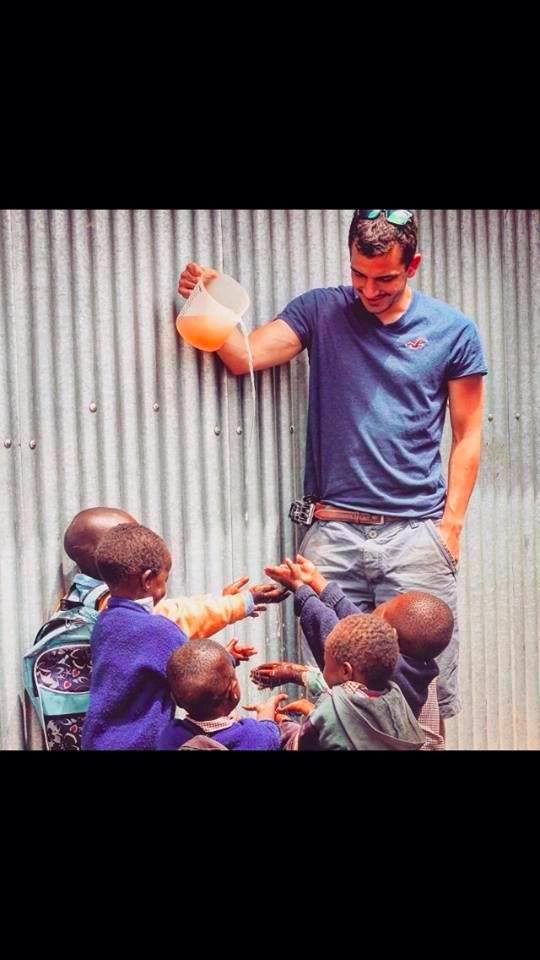
There’s a phenomenon where people go on tours of slums in the developing world and snap photos of the residents like they’re zoo animals. I hope I wasn’t like that, but my mouth may have gaped open a few times.

I was really into my Spanish studies and hadn’t paid much attention to where we were going for a “field trip” on Saturday. About 50 of us traipsed onto a bus and we drove for an hour. My head was swiveling back and forth from whatever conversation I was having with the student in the seat next to me—she was an African American woman who worked for the U.S. State Department as some kind of administrator and lived in Washington, D.C.—and the scenery out the window.

I was looking at her when I saw her eyes lock on to something in the distance over my shoulder. “What is that?” she wondered.

I turned to look and my first thought was, “A mountain?”

“But look how colorful it is. And why are there so many seagulls?”

“It’s beautiful,” I said.

Then one of our teachers stood up, pointed to the mountain, and announced, “Welcome to Miacatlán garbage dump city.”

Garbage City GullsG Dump City

Losing My Words

This is the third post in a series about studying Spanish in Mexico that starts here.

And so I arrived in Cuernavaca, Mexico, to drench myself in Spanish language and culture for a week.

Through this company, Amerispan, I had bought a cheap package that included my classes and a homestay. I had splurged and spent an extra $40 or something for someone to meet me at the bus station and take me to the school. I made that call after seeing that the school was called Cemanahuac. What?! That didn’t sound Spanish, and I had no idea how to pronounce it. Now I see that they’ve added a helpful transliteration to their website: sem-ah-NOW-ock, and I can tell you that was the name used by the Aztecs to refer to their world.

For the umpteenth time I apologize for my lousy photos:

Cemanahuac PoolCemanahuac Hut

If you live in Indonesia or El Salvador or anywhere else that is tropical, you won’t think anything of this place. But to me, coming from a cold, drab grey Minnesota winter, it was paradise. I could hardly believe that I was going to spend a week studying here. I would have been happy to skip the studying and spend the week lying by the pool with a book.

Amerispan no longer lists Cemanahuac as a language school choice on its website. That’s sad, and I wonder if it’s due to all the drug gang violence, or something else?

I wandered around the school, probably with a dazed smile on my face, until someone called my name: “Anna Mah-eeeertz?” I don’t know how long they had been calling it before I realized it was me.

I knew from studying up on the Amerispan website that someone from my host family would come to take me to the home, but now I had left English behind—completely. That was their philosophy, total immersion.

But it wasn’t too hard to figure out that the secretary of the school was introducing me to a woman whose name was apparently Mierda. I could see the other office employees behind her, laughing up their sleeves. I would learn eventually that Mirta was Cuban, and that Mirta was a Cuban name. But she pronounced it Mierda and in Mexico and elsewhere Mierda means shit.

Mirta seemed oblivious to this, and as I got to know her better over the course of the week I found she was one of those happy, smiling people who just ignore bad things. Mirta was about 60. She was plump in a matronly way, with dark red hair, and she was dressed like my grandma used to dress in the 70s—in polyester elastic waist pants and a button up shirt—both in pastel colors, and sturdy black shoes.

She pointed toward the exit and said what sounded like, “Yabba da dabba da blabba de doo.”

All I could do was smile and nod; I didn’t even know to ask, “Que?” and even if I had I couldn’t have understood the answer. I followed her out into the street.

She walked so fast I had to hop skip to keep up with her. We reached a corner and she pointed to a bread store and said something. Then we turned, turned again at the next corner, walked about three more blocks, and while she talked and pointed to things along the way. We came to a crazily busy intersection where she stood for a while talking and gesticulating some more, until a mini bus arrived. She pointed to above the windshield, and I could make out a number and what I assumed was the month of Noviembre. Why would a bus route be named a date? I followed her on to the combi and she showed me the coins I had to pay, which meant nothing to me.

This was my introduction to the wonders of combi décor. There were several small statues of the Virgin Mary glued to the dashboard, the rest of the surface was covered in orange fake fur, and there were holy cards suspended above the driver’s head. We needed all the good-luck juju, for sure, as the bus lurched out into the stream of traffic.

Yikes, Yerkes!

This is the second in a series of posts about studying Spanish in Mexico that starts here.

My life had gone off the rails shortly after my 40th birthday and it seemed like the obvious thing to do was to run away to Mexico and learn Spanish. I had never been to Mexico. I had studied Spanish in high school, but Spanish class followed my free hour, which I spent smoking pot, so while I probably appeared to be enjoying the class immensely, the only words I had retained were cerveza and fiesta. Those weren’t going to get me a bus ticket.

But somehow I managed to fly to Mexico City, then take a bus to Cuernavaca. I was well prepared by Amerispan, the company I used to find a language school.

It just occurred to me that I am actually a sort of expert on travel, study, and volunteering abroad programs due to all the things sparked by this first trip to Mexico.

First, I wrote my master’s thesis on international immersion programs (meaning that you live with a host family in order to learn about culture and/or language). I researched a dozen of them and read up on the psychology of immersion learning. Did you know there’s a psychological theory called the Yerkes-Dodson law which says that the ideal learning experience requires you to be pushed out of your comfort zone—but if you are pushed too far your mind will shut down?

Second, I have participated in half a dozen immersion programs. There was the Volunteers for Peace trip, where I babysat Pakistani kids and studied racism with a group of other volunteers in the East End of London. There were my four trips with Amerispan. I did an internship for Global Volunteers, which offers “volunteer vacations.” There was my trip to Cuba to deliver medical supplies with the Marin Interfaith Taskforce on the Americas. I went back to England to volunteer for Oxfam, then got a full-time job there. I spent two months interviewing human rights activists in Nairobi, Kenya under the auspices of American Jewish World Service.

There was one close call. A few years ago, I had a plane ticket to go to Kolkata, India to volunteer for two years with CUSO International. This is a Canadian organization similar to the Peace Corps but without the political agenda. They flew me to Vancouver for a three-day interview and to Ottawa for five days of training. I had received all my shots, had my letter of resignation ready, and was packing my belongings to put them in storage.

Then I read the blog of the volunteer I would be replacing. She described coming home to find a giant rat standing on its hind legs on her bed and hissing at her. “I’m not afraid of rats,” I told myself. She painted a picture of her lodgings, a windowless room with no air con or even a fan, in a city where the average daily temperature was 104F (40C). “Well I wanted to get away from winters!” was my rationale for why I could hack it. But then there was her description of the pitch dark shower that had soft muck on the floor from which giant winged insects arose when she started the water—which was only a dribble—I immediately wrote to CUSO and backed out.

I felt a little guilty, but I would have felt worse if they had had to pay to wack-evac me later.

Third, I am co-teaching a class about this whole subject, for the second year. Last night we talked about the spectrum of providers. This blog doesn’t have any advertising, so I’ll give Amerispan a shout out here, again. I think it’s great because it really helps you think through what your priorities are and what you can tolerate. They specialize in language studies, study abroad, and international volunteer opportunities. They gave me enough guidance to find my way to Cuernavaca on my own, but it was loose enough that I got my fill of adventure. And that’s what gives you a feeling of accomplishment and scratches the itch for the next trip.

Wrestling with Restless

I started a blog in 2011 and fizzled out after about six weeks.  It was called Wrestling with Restless, and that could still be a perfect theme for me.

I’ve got a great life, from any outside perspective.  I’m healthy.  I have friends and family I’m connected to.  I’ve got an interesting job that pays decently and has good benefits.  My condo is beautiful and my son is out of prison and doing well.  I live in an area where the cost of living is reasonable and you can always find a parking spot.  We’re big on the arts—we’ve got loads of theater companies, symphony orchestras and chamber orchestras and operas, modern and traditional art museums, and sports teams.  Not that I care about sports.

It’s clean here.  It’s green.  We have good tap water.  It’s diverse—not like New York City diverse, but we’ve got the largest populations of Somali and Hmong and Burmese immigrants in the U.S.  There’s an international airport 10 minutes from my house but there’s also a state park with a lake and two rivers 5 minutes from the airport.  We’ve got light rail and bike lanes and farmers markets and microbreweries and farm-to-table restaurants and someone has even proposed opening a mill to make artisanal flour.  We’re one of the most progressive states, politically.   We’re always on those lists like “Top 10 Cities for Working Moms,” “Best Overall Quality of Life,” “Greenest Cities,” “Most LGBT Friendly Cities,” and on and on.

So why would I want to leave?

When I turned 40, in short order my boyfriend dumped me, I was fired from my job, and I was diagnosed with Multiple Sclerosis.  So I did what anyone would do—I booked myself into a one-week Spanish immersion class in Mexico.

I looked out the plane window as we flew over Mexico City.  I timed it—20 minutes to fly across from one end to the other.  That’s a long time!  I had never traveled to a developing country before, except to Cost Rica the year before with the ex-boyfriend, and we had stayed at a luxury resort.  When the exit doors of the airport slid open, a hundred men started yelling and waving at me.  “It’s a riot!” I thought, but they were only taxi drivers trying to get my business.

I picked the closest one, who took me to the hotel where I would spend one night before taking a bus to my school, in Cuernavaca.  At the desk, the clerk asked me, “Cual es su nombre?” and I answered “Uno,” thinking nombre must mean number, as in how many are in your party.  He somehow got my name out of me, then rattled off the list of things desk clerks tell you, including that something was “el sexto.”  I clutched my belongings about me and hurried off to my room, where it dawned on me he had been saying “sixth floor,” not propositioning me for sex.

That’s right, I spoke only about 10 words of Spanish.  I sat in my tiny concrete room trying to memorize the key phrases I would need to buy a bus ticket and get to Cuernavaca the next day.  There was one very small, square window near the top of the high ceiling, and all night I heard what sounded like a rabid baboon baying.  There was no glass or screen on the window.  Could whatever it was get into my room?  Why hadn’t I brought that mace someone had given me as a parting gift and which I had left at home to show how worry free I was?

As is usual with my series of posts, I will eventually make a point that that connects to my original question.

But until then: I have mentioned a lot of companies on this blog—Bob Barker, Pillow King, Mega Bank, Industrial Chemicals, Inc, etc.—always with withering disdain.  I am happy to now highly recommend a company called Amerispan.  I went to Mexico three times and to Spain once to study Spanish with the help of Amerispan.  My niece used them to do the same in Costa Rica.   More about them next time.

Go West, Ye Seekers!

This is the third in a series of posts about a road trip to South Dakota that starts here.

The trip was a good start in helping my organization figure out how it can reach many more torture survivors using technology. But first, you’re probably all wondering about the four-hour drive—was it scenic? Here is a photo of the view out my window:

Snow

And another one; notice how I included a post in this one, just to spice it up:

Snow2

But wait! There was more to see as we got closer to Sioux Falls, like these billboards:

SF BIllboard

Yes, Sioux Falls has jobs. Their unemployment rate is the 4th lowest in the country—an eye-popping 2.3%, which is actually a problem.

It’s a nice small city, with about 165,000 people and growing. There appears to be more diversity than you would expect, with immigrants attracted to jobs in the Morrell meat packing plant and other industries. There’s no corporate income tax in South Dakota, so a lot of banks and credit cards companies are based there. And as in St. Paul and Minneapolis, where there are corporate headquarters, there is an orchestra, an airport, good restaurants and high-end shops, public art, and nice parks with bike paths.

There’s also no individual income tax in South Dakota, so if you’re looking for a job, you can find one in Sioux Falls and live like a monarch.

Our first visit was to Avera, which is a health system. It was founded by nuns which has become the largest provider of telemedicine in the U.S. What does that look like? I had no idea what to expect. But then we were led onto a sort of viewing deck from which we could see hives of doctors, nurses, pharmacists, and technicians tending to patients and lending back up to doctors in dozens of hospitals and clinics in 10 states. There was an e-ER, and e-Urgent Care, e-pharmacy, and so on.

There is a monitor, camera, and microphone installed at the foot of each patient’s bed in the hospital in, say…Thermopolis, Wyoming (an actual place). The doctor there can’t figure out what’s going on with a patient—in such a small place he just doesn’t see enough variety to recognize sepsis, or some other serious but not very common condition. The Avera e-docs can actually see and talk to the patient, diagnose him, recommend treatment, then monitor his vitals to make sure he’s responding—all from 677 miles away.

They also demonstrated an app that patients can use like urgent care, without having to leave the house. All their medical records are available to the clinician, who the patient can see and talk with via a secure Skype-like application that is compliant with all our complex medical privacy laws in the U.S.

Then, just for me, one of our hosts discussed their eCorrectional Health program. “Usually when a prisoner is seriously ill, they have to transfer him to a hospital, which can cost thousands of dollars. With eCorrectional Health, the facility physician can get a diagnosis and treatment recommendations without having to take the prisoner out of the prison. It saves a lot of resources.

“Everyone is happy…well, except for the prisoner, who doesn’t get a change of scenery.”

Knowing the medical, dental, optometry, and pharmacy “care” Vince received inside three different prisons, I think this eCorrectional thing may be a vast improvement. Prisoners may not get to leave prison, but they probably receive better care, from people whose humanity hasn’t been tainted and warped from working in the prison system.

We left Avera with our mouths hanging open, we were so impressed. The potential to expand the number of clients we reach is mind boggling. We’ve got a long way to go, but we’ll talk with Avera next week about potentially partnering to pilot something.

Dakota Bound

I’m on a road trip! No, not to New Orleans. Believe it or not, I am going to meet with three potential donors in Sioux Falls, South Dakota. Yee haw!

Here’s the deal. The Center for Victims of Torture, where I work, does psychotherapy, physical therapy, and social work for survivors of torture and war trauma. We do it in groups in Jordan, for instance, because all the clients speak the same language. We do it on an individual basis in Minnesota, because clients come from 36 different countries and speak myriad languages which must often be translated, which doubles the time everything takes.

This is all good as far as it goes, except that there are an estimated 1.3 million torture survivors in the US alone. We do a lot of training to try to equip professionals outside of CVT to recognize and help torture survivors. But there’s also no way we can train every doctor, social worker, cop, or immigration officer that might come into contact with a survivor.

People have been talking about doing something with technology at CVT for years, but without funding that’s just dreaming. Part of my job is to find new sources of funding, and that’s what I hope I’ve done. I won’t bore you with the details, but there are three HUGE international development innovation funds that we hope to tap. To do this, we need to find partners who know how to reach patients in remote or difficult to access situations. That’s why we’re going to South Dakota.

It’s so important, when you’re trying to get people fired up about complicated ideas, that you have the right people on your team. My co-pilots on this trip are a colleague who is from Sioux Falls and whose father has opened some doors for us, and CVT’s clinical advisor for our international programs, who is Kenyan and a PhD psycholgist. He describes the needs this way:

In Nairobi, there are thousands of Somali torture survivors living in the slums who are not there legally, under the protection of the United Nations. They literally cannot leave their dwellings during the day, because the Kenyan police will round them up and shake them down for bribes. Which would you choose: Pay a bribe, or be sent back to Somalia where you may face certain death? They may not have iphones, but could we develop a text-based therapy intervention?

Among the survivors who are in Nairobi legally, there are many Congolese and people of other non-English speaking nationalities. Kenya is an English-speaking country. The refugee kids may have already missed years of schooling due to being forced to serve as child soldiers and living on the run or hiding. Now they spend 12 hours a day in school—regular school, plus an extra block of time added on to learn English. They have survived unimaginable horrors. Many of them need psychotherapy or physical therapy, but they don’t have time for it. Could we develop a game-like therapy intervention that would appeal to youth?

CVT also works in Dadaab, the largest refugee camp on earth, in northern Kenya near the Somali border. Its population is about the same as Minneapolis—about 350,000 people. Could we do tele-therapy with them—either mental health or physical? If so we could reach so many more people. We could also use videoconferencing to train our own and other organizations’ staff.


“Do they all have smart phones in Dadaab?” I asked. I have been to Nairobi but not Dadaab.

“I don’t know,” he replied. “We would have to do a survey to determine who has the old Nokias, how many have smart phones. The Chinese are making big inroads into the African market with cheap smart phones. Most Kenyans use their mobiles for everything. They don’t have tablets or desk tops or TVs or land lines. They’ve basically skipped over those generations of devices and they do everything on mobiles.”

I love projects like this. They’re big, messy, uncertain, and complicated. They require me to work with people with whom I don’t normally interact. They may have big payoffs. And in this case they require a road trip.

Reductive Seduction

There’s a great article circulating among international development people that also addresses mass incarceration in the US. Who knew there were so many connections between these two worlds of mine?

Written by Courtney Martin, it’s titled, “The Reductive Seduction of Other People’s Problems.” I’ll quote the opening here:

“Let’s pretend, for a moment, that you are a 22-year-old college student in Kampala, Uganda. You’re sitting in class and discreetly scrolling through Facebook on your phone. You see that there has been another mass shooting in America, this time in a place called San Bernardino. You’ve never heard of it. You’ve never been to America. But you’ve certainly heard a lot about gun violence in the U.S. It seems like a new mass shooting happens every week.

“You wonder if you could go there and get stricter gun legislation passed. You’d be a hero to the American people, a problem-solver, a lifesaver. How hard could it be? Maybe there’s a fellowship for high-minded people like you to go to America after college and train as social entrepreneurs. You could start the nonprofit organization that ends mass shootings, maybe even win a humanitarian award by the time you are 30.

“Sound hopelessly naïve? Maybe even a little deluded? It is. And yet, it’s not much different from how too many Americans think about social change in the ‘Global South.’”

These are real Tindr photos from her article:

World SaverWorld Saver2

Martin goes on to write about the problem of mass incarceration in this country—where are all the new graduates lined up to campaign for change on that? I’ve never met one. I have, however, met many young people who fervently want to work for my organization. Whenever we post a job, we get hundreds of applications, even for admin positions. We get a lot of candidates who can recite all 30 articles of the Universal Declaration of Human Rights, but they can’t enter names into a data base without lots of mistakes. They have no interest in fundraising, finance, HR, or any of the other jobs that keep a nonprofit organization humming. They want to get their foot in the door, then jump to the first “meaningful” job that comes open.

They’re not bad people. I don’t blame them for wanting a job that might send them off around the world to help torture survivors, a job that will cause their peers to fawn over them with admiration. As an English friend once said, “You’ve got a job that’s every Lib Dem’s wet dream.” I once had a woman bow down to me when I told her where I work. Super uncomfortable.

And let’s face it, for those of us who crave the exotic, Nairobi fits the bill a lot better than Moose Lake, Minnesota.

When I was in the Occupied Palestinian Territories … there — I did that thing that my set does. We start sentences with, “When I was in Peru …” or Ethiopia, or wherever. I’m sure people who don’t travel to those places, or who wouldn’t be caught dead in those places, find it really annoying.

But, when I was in the Occupied Palestinian Territories, I was invited to write an article about it for a local publication. I did, but I also wrote about Vince’s being in prison, mass incarceration, and how people in the US seem to care a lot more about Palestinians than prisoners who live a few miles away. I can’t be sure why, but they never published it.

You may be thinking, “Who is she to criticize–why doesn’t she work on prison reform?  Erm…I am, in my own way.  There’s nothing wrong with wanting to work on international issues; just be aware of your motivations and your ego.

To quote Martin’s article further: “Most American kids … have some sense of how multi-faceted problems like mass incarceration really are. Choosing to work on that issue … means studying sentencing reform. The privatization of prisons. Cutting-edge approaches already underway, like restorative justice and rehabilitation. And then synthesizing, from all that studying, a sense of what direction a solution lies in and steadfastly moving toward it.”

Maybe Martin’s article will inspire someone to become the Martin Luther King Jr. of prison reform.