Category Archives: mass incarceration

The Grey Lady Stumbles

This is the seventh post in a series that started here.

I left Cuernavaca having learned a lot of Spanish and with a new vocation.  Off and on since then, I have worked in international development.  That doesn’t mean I don’t care about causes here at home.  I just think that, as a mission driven person, I do better work if I’m passionate about a cause.  And for many reasons, I am passionate about trying to end poverty and suffering in the developing world.

Before I left Cuernavaca, I booked six more weeks of Spanish immersion through Amerispan.  This time I would go to Morelia, a beautiful colonial city that is no longer an Amerispan choice.  I’m guessing this is due to Morelia’s unfortunate #1 ranking as the city most caught in the drug war that has erupted in Mexico since I was there.

And that’s my transition back to one of my favorite subjects, addiction.

The New York Times published an article a few weeks ago about an alternative treatment approach to addiction.   I read it, cut it out, and was saving it to write a post about.  My initial reaction to it was, “Why not?  Why wouldn’t you try both traditional treatment and AA and this thing, if you could afford the time and money.”  But now I’m having second thoughts.

In a nutshell, the article profiles a psychiatrist who has opened a new addiction clinic that approaches addiction as a chronic disease and treats it with drugs, in place of the Twelve Steps and AA.

At least three people have brought the article up to me in conversation, so it’s causing a stir.

When I revisited it for this post, I noticed it was in the Science section, which implies that the content is scientifically valid.  Plus it’s the New York Times, right?  It’s got to be true.

When I searched the NYT website for “addiction,” I found that all the other articles about addiction are either in the Opinion or the News sections.  So you’ve got news about a big drug bust in upstate New York, for example, and then people ringing in with their opinions on what should be done about the drug crisis and the related problem of mass incarceration.

I scrolled to the bottom to read the comments.  There must be hundreds, I thought, and I wondered how many commenters would hail this as a godsend or criticize it as irresponsible.  But there was no comments, and no way to make comments.  That’s strange, I think.

Among other things, Dr. Mark Willenbring states that 60 percent of addiction is attributable to a person’s genetic makeup.  The NYT adds that this is “scientifically unassailable” but offers no evidence.

Dr. Willinbring, a psychiatrist, is no slacker.  For five years he headed the federal agency that studies addiction.  Coincidentally, he’s a Minnesotan and he opened a private clinic called Alltyr in 2012.  It’s within walking distance from my house.

Alltyr treats addiction as a chronic medical condition.  Its treatment plans include drugs used to treat depression, anxiety, ADHD, or chronic pain; family “training,” and cognitive behavioral therapy—which, as I’ve written, was a worked miracles for me.  Alltyr also uses anti-relapse drugs, and I wondered what that meant.

I didn’t have to wait long to find out.

A friend and her husband have been struggling with his drinking.  He was on a wait list for Hazelden Betty Ford, one of the world’s premier rehab centers, also within walking distance of my house.  Then he read the New York Times article.  Alltyr got him in the next day, and after pooh-poohing Hazelden, he cancelled his reservation there.   (Despite Alltyr dismissing traditional treatment, I can’t find any evidence in the article that its method works.)

Alltyr put him on two anti-relapse drugs.  I spoke with my friend the next day.  “He must have still had alcohol in his system,” she said, “because he was so sick he couldn’t get out of bed—much less go to work—for two days.  He said it was like all the worst anxiety he’s ever had in his life rolled into one giant ball and stuffed into his chest.”

Go West, Ye Seekers!

This is the third in a series of posts about a road trip to South Dakota that starts here.

The trip was a good start in helping my organization figure out how it can reach many more torture survivors using technology. But first, you’re probably all wondering about the four-hour drive—was it scenic? Here is a photo of the view out my window:

Snow

And another one; notice how I included a post in this one, just to spice it up:

Snow2

But wait! There was more to see as we got closer to Sioux Falls, like these billboards:

SF BIllboard

Yes, Sioux Falls has jobs. Their unemployment rate is the 4th lowest in the country—an eye-popping 2.3%, which is actually a problem.

It’s a nice small city, with about 165,000 people and growing. There appears to be more diversity than you would expect, with immigrants attracted to jobs in the Morrell meat packing plant and other industries. There’s no corporate income tax in South Dakota, so a lot of banks and credit cards companies are based there. And as in St. Paul and Minneapolis, where there are corporate headquarters, there is an orchestra, an airport, good restaurants and high-end shops, public art, and nice parks with bike paths.

There’s also no individual income tax in South Dakota, so if you’re looking for a job, you can find one in Sioux Falls and live like a monarch.

Our first visit was to Avera, which is a health system. It was founded by nuns which has become the largest provider of telemedicine in the U.S. What does that look like? I had no idea what to expect. But then we were led onto a sort of viewing deck from which we could see hives of doctors, nurses, pharmacists, and technicians tending to patients and lending back up to doctors in dozens of hospitals and clinics in 10 states. There was an e-ER, and e-Urgent Care, e-pharmacy, and so on.

There is a monitor, camera, and microphone installed at the foot of each patient’s bed in the hospital in, say…Thermopolis, Wyoming (an actual place). The doctor there can’t figure out what’s going on with a patient—in such a small place he just doesn’t see enough variety to recognize sepsis, or some other serious but not very common condition. The Avera e-docs can actually see and talk to the patient, diagnose him, recommend treatment, then monitor his vitals to make sure he’s responding—all from 677 miles away.

They also demonstrated an app that patients can use like urgent care, without having to leave the house. All their medical records are available to the clinician, who the patient can see and talk with via a secure Skype-like application that is compliant with all our complex medical privacy laws in the U.S.

Then, just for me, one of our hosts discussed their eCorrectional Health program. “Usually when a prisoner is seriously ill, they have to transfer him to a hospital, which can cost thousands of dollars. With eCorrectional Health, the facility physician can get a diagnosis and treatment recommendations without having to take the prisoner out of the prison. It saves a lot of resources.

“Everyone is happy…well, except for the prisoner, who doesn’t get a change of scenery.”

Knowing the medical, dental, optometry, and pharmacy “care” Vince received inside three different prisons, I think this eCorrectional thing may be a vast improvement. Prisoners may not get to leave prison, but they probably receive better care, from people whose humanity hasn’t been tainted and warped from working in the prison system.

We left Avera with our mouths hanging open, we were so impressed. The potential to expand the number of clients we reach is mind boggling. We’ve got a long way to go, but we’ll talk with Avera next week about potentially partnering to pilot something.

The Fox and the Hen House

This is the second in a series of posts about a road trip to South Dakota that starts here.

When you think about it, South Dakota makes sense. It’s a very rural state where people have a hard time getting to an ER or clinic. Therefore the largest provider of telemedicine in the world is in South Dakota. We’ll also visit a guy who is the CEO of the country’s largest ethanol producer, and his wife, who have an interest in east Africa.

Then we’ll visit the Helmsley Trust, which is named for the late Leona Helmsley. One of Leona Helmsley’s grandsons lives in South Dakota, and I imagine that’s why the trust is in Sioux Falls. Leona, originally named Lena Rosenthal, was the daughter of Polish Jewish immigrants and became a hotel tycoon in New York City. Sadly she spent time in prison for income tax evasion and was controversial for being demanding. I’m sure she was demanding. You don’t get to be a billionaire by being meek. But when Donald Trump is demanding, no one thinks twice about it.

Leona Helmsley left $12 million to her dog in her will, and the Helmsley Trust, which has around $5.4 billion in assets, was originally mandated to only benefit dogs.

By the time you read this I’ll be back from this exciting trip and will let you know how it went. I don’t expect anyone to write us a big check. Fund raising—or development as it’s called in the US, is a long-term process of relationship building.

Here are a few prison-related updates.

Close to home, Vince got the final word on his punishment for not answering the phone when a probation agent called. He’ll be on lockdown for a total of a month and have an extra month added to his probation. I told a friend about it; she works for the St. Paul City Council and was an admin at the St. Paul Police Department before that so she is no stranger to bureaucracies and the sometimes difficult people who work in them.

“I always figure the guy had a fight with his wife,” was her assessment. “If he hadn’t, or if Vince had a different agent that day,” Vince’d still be on track to finish his probation on time.”

“Are they trying to goad him into doing something that’ll send him back to prison?” I wondered. “He also got two parking tickets that day—one was for parking more than 12 inches from the curb. Do you think they could be in cahoots with the police?”

“No,” she laughed. “They’re not that organized. It’s just random.”

On the prison reform front, the New York Times ran an editorial, “Holding Sentence Reform Hostage.” The pending legislation would “reduce absurdly long mandatory minimum sentences for many nonviolent drug crimes, give judges more control over the terms of punishment and provide inmates with more opportunities to get out early by participating in rehabilitation programs.”

Some Republicans are scaremongering, Willy Horton style. At least that sort of makes sense.

But some Republicans say they won’t approve the bill unless it includes a change in federal law that would make corporations and their executives harder to prosecute for environmental or financial crimes. This has nothing to do with prison reform but is a standard tactic used by politicians to get what they want without having to work hard for it. I know, it’s hard to believe they could be much lazier.

In my opinion, this is evil. I don’t like to call people evil, I really don’t. But making it easier for companies like BP or Goldman Sachs to get off the hook?

In related but also absurd-news category, there’s this item: Former Tyco CEO, Who Served Time in Prison, Appointed Chair of Prisoner-Assistance Nonprofit.

Dennis Kozlowski, who did six years for stealing millions of dollars from his own company, is now in charge of the Fortune Society, a nonprofit that helps former prisoners find jobs, housing, health care, and education.  What a great idea: putting an old, white, rich man–a former thief–in charge of a  nonprofit with $10.8 million in assets.  How nice for him.  What could possibly go wrong?

Reductive Seduction

There’s a great article circulating among international development people that also addresses mass incarceration in the US. Who knew there were so many connections between these two worlds of mine?

Written by Courtney Martin, it’s titled, “The Reductive Seduction of Other People’s Problems.” I’ll quote the opening here:

“Let’s pretend, for a moment, that you are a 22-year-old college student in Kampala, Uganda. You’re sitting in class and discreetly scrolling through Facebook on your phone. You see that there has been another mass shooting in America, this time in a place called San Bernardino. You’ve never heard of it. You’ve never been to America. But you’ve certainly heard a lot about gun violence in the U.S. It seems like a new mass shooting happens every week.

“You wonder if you could go there and get stricter gun legislation passed. You’d be a hero to the American people, a problem-solver, a lifesaver. How hard could it be? Maybe there’s a fellowship for high-minded people like you to go to America after college and train as social entrepreneurs. You could start the nonprofit organization that ends mass shootings, maybe even win a humanitarian award by the time you are 30.

“Sound hopelessly naïve? Maybe even a little deluded? It is. And yet, it’s not much different from how too many Americans think about social change in the ‘Global South.’”

These are real Tindr photos from her article:

World SaverWorld Saver2

Martin goes on to write about the problem of mass incarceration in this country—where are all the new graduates lined up to campaign for change on that? I’ve never met one. I have, however, met many young people who fervently want to work for my organization. Whenever we post a job, we get hundreds of applications, even for admin positions. We get a lot of candidates who can recite all 30 articles of the Universal Declaration of Human Rights, but they can’t enter names into a data base without lots of mistakes. They have no interest in fundraising, finance, HR, or any of the other jobs that keep a nonprofit organization humming. They want to get their foot in the door, then jump to the first “meaningful” job that comes open.

They’re not bad people. I don’t blame them for wanting a job that might send them off around the world to help torture survivors, a job that will cause their peers to fawn over them with admiration. As an English friend once said, “You’ve got a job that’s every Lib Dem’s wet dream.” I once had a woman bow down to me when I told her where I work. Super uncomfortable.

And let’s face it, for those of us who crave the exotic, Nairobi fits the bill a lot better than Moose Lake, Minnesota.

When I was in the Occupied Palestinian Territories … there — I did that thing that my set does. We start sentences with, “When I was in Peru …” or Ethiopia, or wherever. I’m sure people who don’t travel to those places, or who wouldn’t be caught dead in those places, find it really annoying.

But, when I was in the Occupied Palestinian Territories, I was invited to write an article about it for a local publication. I did, but I also wrote about Vince’s being in prison, mass incarceration, and how people in the US seem to care a lot more about Palestinians than prisoners who live a few miles away. I can’t be sure why, but they never published it.

You may be thinking, “Who is she to criticize–why doesn’t she work on prison reform?  Erm…I am, in my own way.  There’s nothing wrong with wanting to work on international issues; just be aware of your motivations and your ego.

To quote Martin’s article further: “Most American kids … have some sense of how multi-faceted problems like mass incarceration really are. Choosing to work on that issue … means studying sentencing reform. The privatization of prisons. Cutting-edge approaches already underway, like restorative justice and rehabilitation. And then synthesizing, from all that studying, a sense of what direction a solution lies in and steadfastly moving toward it.”

Maybe Martin’s article will inspire someone to become the Martin Luther King Jr. of prison reform.

Locked Down

As I write this, the phone is ringing. The landline, that is, that I am required to have as a condition of Vince living with me. I had forgotten how loud a landline phone is, and we can’t turn it on silent because Vince has to answer it when he’s home. He’s not home now but I hesitate to turn it off because I might forget to turn it back on, and that could get him into trouble.

When we first got it, there were numerous calls for Mohamed, apparently the previous number holder. Those finally tapered off, but there are still calls now and then. Like now. And the phone is still ringing … 15, 16, 17 rings … I am tempted to pick it up and tell whoever it is to bugger off, but if it’s a robo caller, that just verifies that the number is a potential customer to be strafed with more calls. Still ringing … 18, 19, 20 … ah, silence, finally!

My birthday was last week, and I asked Vince if he would consider going to a classical music concert with me at the James J. Hill House, St. Paul’s equivalent of Downton Abbey.

HillHill Hall

I was pleasantly surprised when he said yes. In fact, he was excited to go, and he spent the next few weeks searching for nice clothes to wear. I told him that Minnesotans are sloppy, but he wanted to dress up anyway. I thought that was great. I always dress up too.

He found a good pair of men’s dress shoes during his community service job at the Goodwill. If you’re a thrift store shopper, you know that decent shoes are the hardest thing to find second hand.

I’m house sitting for a friend for two weeks, and it’s heavenly to have my own place. I’m sure Vince is happy to have the condo to himself, too. Unfortunately, this was the week that the condo association chose to have the chimneys cleaned, and the sweep dropped his tools down our chimney, breaking the flue control so it’s stuck open, allowing all the warm air to be sucked out. I’m just home to write this post, and it’s really cold in here. After many calls back and forth, a guy finally came and shoved a tarp up inside of the chimney. He promised someone would come back “soon” to fix the flue.

It was also at the Goodwill that our concert plan came undone. Vince’s probation officer called him twice, and Vince didn’t answer because he just didn’t hear his phone ring. It’s true, cell phones don’t ring nearly as loudly as landlines. Vince works in a warehouse amid fork lifts and dumpsters and people yelling, so that seemed like a reasonable explanation, but not to a probation agent. Or at least, not to this one on this particular day.

The agent put him on indefinite lock down, which means Vince can’t leave the house except for work or AA meetings. So he’s back to square one.

This happened just a few hours after I posted this piece about the Department of Corrections people in the class I am co teaching. Connection? I don’t know. Just because you’re paranoid doesn’t mean someone isn’t really out to get you, right? And I had written and rewritten this piece to tone it down in case someone with the DOC was monitoring the blog.

This all happened the day before the concert. Vince called his agent and left a message asking for an exception for this one night—his mom’s birthday, tickets reserved weeks in advance, etc. The agent never even called him back. I told Vince we will go to another event.

I went to the concert by myself. The mansion was open for wandering, and it is splendid. Some people, including me, were dressed up but most were not. The woman in front of me looked as though she had just gotten out of bed and hadn’t bothered to run a comb through her hair. Yuck. The music was not good. I go to a lot of classical concerts and it’s rare to have someone play painfully badly, but this was the night. Oh well. I went, and that’s what counts.

Gittin’ in Trouble

This is the seventh post in a series about Cuba that starts here.

Before we left Santiago de Cuba, we took an excursion to the nearby Parque Nacional de Gran Peidra—a sort of national park. I love the outdoors and got excited that we might go on a hike, but we only skirted the park on our way to our real destination, Guantanamo Bay.

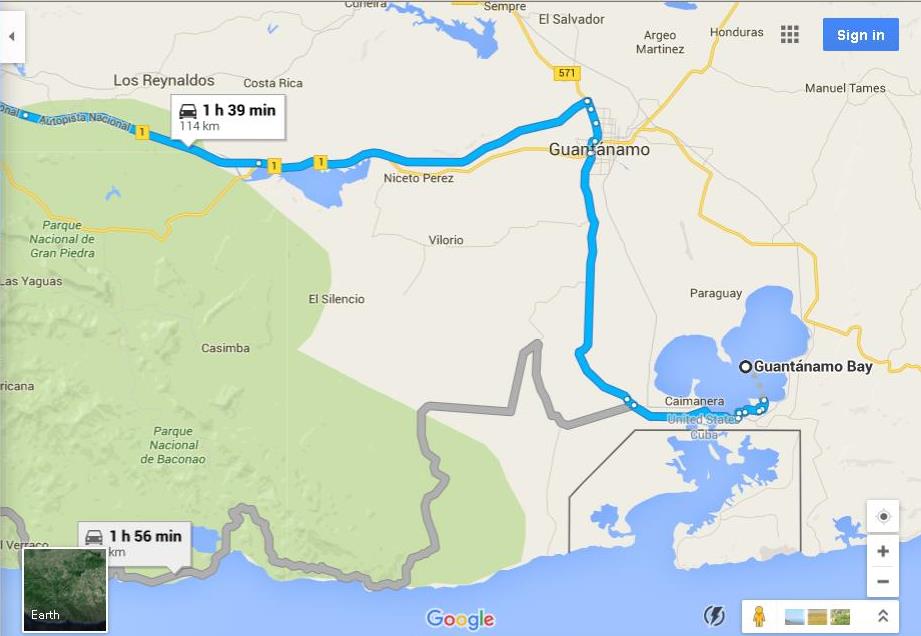
If you look at Google maps, it’s really confusing. What you would think was the U.S. territory with the detention center is marked as Cuban territory. Google has steered me wrong before, mostly memorably in Nairobi where it sent me to a slum instead of to the Ford Foundation’s offices, so I would never count on it except for a rough approximation.

Guantanamo

There was excitement on the bus as we got closer to Guantanamo. “Get out your OFAC letter!” someone exclaimed. “We’re being tailed by the CIA!”

As I mentioned previously, we were required to carry letters from the U.S. Office of Foreign Assets Control at all times to show we were there legally. I couldn’t imagine we would get anywhere near Gitmo—you didn’t have to see it to know it would be surrounded by 20-foot razor-wire fences and heavily-armed guards. What were we going to do, ram the gate? That would put a crimp in my plans to apply for jobs with the CIA and the Foreign Service!

But then the bus stopped, and most of us waited while a couple of Interfaith Task Forcers got off and held an animated conversation with the driver and our guide. Then we turned around and went back to Santiago. I will never know how the leaders of the Task Force talked our guide and the Cuban bus driver into driving to Guantanamo Bay, or how close we really got, or exactly where its limits are.

That’s the thing about travel, if you’re doing it right. You’ll come home shaking your head and laughing to yourself because there was some mysterious situation for which you’ll never have an explanation. That’s assuming no one got hurt or arrested, of course.

Now that I am working for the Center for Victims of Torture, it would be hugely prestigious to be able to say casually, “I was arrested at Guantanamo a couple years ago.”

CVT has been active in advocating for the closure of Guantanamo. First—obviously—because we, torture people there (yes, we, if you’re an American). Half the American population (and I think we can guess who their presidential candidates are) believe there’s nothing wrong with torture. “How we gonna catch the bad guys if we don’t torture people, huh?”

I could write 10 posts about why that’s a dumb statement, but for now I’ll just say, if you think torture is okay, go read someone else’s blog. And even if I thought it was okay, it’s still illegal.

The Universal Declaration of Human Rights, which came about in response to the WWII and specifically the Holocaust, outlawed torture. Ronald Reagan signed the international Convention Against Torture in 1984. President Obama issued an executive order on his second day in office banning torture. In November last year, Congress passed the National Defense Authorization Act, which “placed all U.S. government interrogations under the United States Army Field Manual on Interrogations, and requires that the International Committee of the Red Cross have prompt access to all prisoners in United States’ custody.” In other words, there are grownups in charge now.

Very few people know everything that’s gone on at Gitmo, but we do know that people have been detained indefinitely, without charge or trial. If you imagine yourself in one of those prisoner’s paper slippers, you will understand why they go on hunger strikes. We then subject them to another form of torture, forced feeding. If you wonder, “how bad could that be?” watch this video of the rapper Mos Def being force fed; he volunteered to show us what it really involves.

Back in Santiago, none of this was on my mind. My biggest concern was finishing my master’s and getting a job. Vince’s time in prison, and researching prison for this blog, changed all that.

When Worlds Collide

I’ve been writing a series of posts about traveling in Cuba that starts here. I am pausing that for a day to write about an unsettling experience where my worlds collided.

I volunteer with the Minnesota International NGO Network, or MINN. MINN is composed of Minnesota companies and nonprofits that work overseas, like my employer, the Center for Victims of Torture (CVT).

Last year MINN launched a class called MINNspire, which helps 50-somethings to explore doing something abroad. This could be anything from volunteering with Peace Corps, to teaching English as a second language, to consulting on communications, as I have done. MINN isn’t there to find them placements; we’re there to guide them through the thought process. I led one of the four sessions last year and will do the same this year—I think.

I was excited that we had 18 people registered—about twice the number as last year. It’s kind of a big commitment to come to something after work, in the dark, during the winter.

I walked in and said hi to my friend Carolyn, one of the four facilitators of the class. There were already two students in the room. Carolyn said to me, in a way that told me we might have an “issue”, “Something really interesting happened with registration. I spoke to a Rotary Club that happened to have a lot of members of the DOC, and we’ve got 10 people from the DOC registered for the class.”

The Department of Corrections. The people I never wanted anything to do with, ever again.

I had come from work, where I had spent the day writing about Eritrean torture survivors. Eritrea is known as the “North Korea of Africa.” They have forced conscription, which means every young man must join the military or go to prison. In the military, they are worked like slaves and their service is indefinite. If they try to escape, Eritrea throws them into underground prisons where they are tortured. If they make it to Ethiopia, they wind up in refugee camps with no future, and their family back home is persecuted. Sometimes they try fleeing to Israel, the one country that reluctantly takes them in, but often they are caught by—essentially—desert pirates called Rashida who hold them for ransom, torturing them while their families listen helplessly on the other end of the phone.

As you might imagine, a lot of Eritrean torture survivors have PTSD, and that is where CVT comes in. We provide trauma therapy and we hope to add physical therapy next year.

So I was writing about this all day and then I stepped into a room of people who had been my and my son’s tormentors for a year and a half.

I am in no way comparing what I went through to what Eritreans have endured. My point is that I know firsthand what a flashback feels like. A surge of adrenaline surged through me. My heart started racing and my palms got sweaty. I felt a powerful urge to bolt.

“I figure if I was a prison warden for 20 years, I can do anything!” one of the women exclaimed. The thought of her volunteering in an orphanage made me uneasy.

“My son just finished the boot camp program,” I told them. Might as well get it out there before she said something that would cause me shoot my mouth off. They oohed and ahhed said what a great program that was.

Carolyn knows my back story and has a high EQ.   She emailed later:

“I would never imagine that you would come face to face with your oppressor in MINNspire.  I mean, last year you were in Palestine, looking for ways to collaborate, professionally, with enemies of the Jewish state and now you come to St Paul and you are asked to teach the people whom you’ve written about for years.

“ I have to shake my head at what the universe is throwing at you.  But if anyone can handle it, you can.”

I hope she’s right, because I thought about backing out of the class but I’ve decided to stick it out.  I’ll keep you posted.

UN-Doing the War on Drugs

I ended my last post by saying I would write about a road trip I am contemplating, from St. Paul to New Orleans.  I don’t know enough to write about it yet, so for now I will revert to one of this blog’s main topics, addiction—and all the consequences of addiction and trying to stop it.

I’m very excited that the United Nations will hold a review of the whole drug control system in April in New York.  It’s called the Special Session of the United Nations General Assembly on the World Drug Problem, or the horrible acronym UNGASS. I’d like to thank the Open Societies Foundation (OSF) for its reporting on this.  OSF promotes research documenting the heavy costs of the war on drugs and shares success stories from countries that have implemented smart policies.  I’ve plagiarized their recent blog posts quite heavily here.

The last time the UN had a special session on drugs, in 1998, the focus was “the total elimination of drugs from the world.”  Ha!  I wonder if there were any actual addicts or former drug dealers involved in coming up with that totally unrealistic goal.

Because it didn’t go well.  The war on drugs has led to public health crises, mass incarceration, corruption, and black market–fueled violence.  Governments—especially those in Latin America that have to deal with the fallout of bad drug policies—have pushed for this UNGASS.

Citizens are fed up too.  A few years ago, a coalition of organizations and individuals in Uruguay pushed until the country voted to become the first country in the world to establish a legal, government-controlled marijuana market.  The main objective of the law was to eliminate narcotrafficking.  But they also have a positive goal, to make the new marijuana production chain beneficial for poor segments of society and a sustainable business for small producers with limited resources.

For the first time, there is significant dissent at the local, national, and international levels.

UNGASS is an opportunity to put an end to the horrors of the drug war and instead prioritize health, human rights, and safety.

I didn’t even know that there was an International Narcotics Control Board, did you?  That sounds creepy.  And it acts like a bully, apparently.

For instance, in the 90s, Switzerland had a major drug problem.  There were open-air drug scenes and one of the highest rates of HIV in Western Europe.  The government pioneered services such as heroin prescriptions, supervised consumption rooms, and community-based treatment.  The Swiss people approved this policy through a series of referenda.

What happened?  The number of new heroin users declined from 850 in 1990 to 150 in 2002; drug-related deaths declined by more than 50 percent; new HIV infections dropped 87 percent, and there was a 90 percent reduction of property crime committed by people who use drugs.

But the UN’s Control Board accused the Swiss of “aiding and abetting the commission of crimes involving illegal drug possession and use.”

On the other hand, when Bulgaria introduced a law that made possession of tiny amounts of drugs punishable with mandatory incarceration for as long as 15 years, the Control Board praised their “political commitment and the will to deal with drug abuse.”  I’ve never been to Bulgaria, but life in a Bulgarian prison sounds horrifying.

OSF is publishing a series of reports in advance of UNGASS, including research into drug courts and their unintended consequences, and an examination of how the drug war affects girls and women uniquely.  You can sign up for their updates here.  Want to get more involved or have a say?  Check out this cool website, Stop the Harm.

So there!  After my recent buzzkill series of posts, I’m happy to share with you some good news and some easy ways to contribute to fixing this world’s drug problem—for real this time.

The Choice

This is the second in a series of posts, starting with this one.

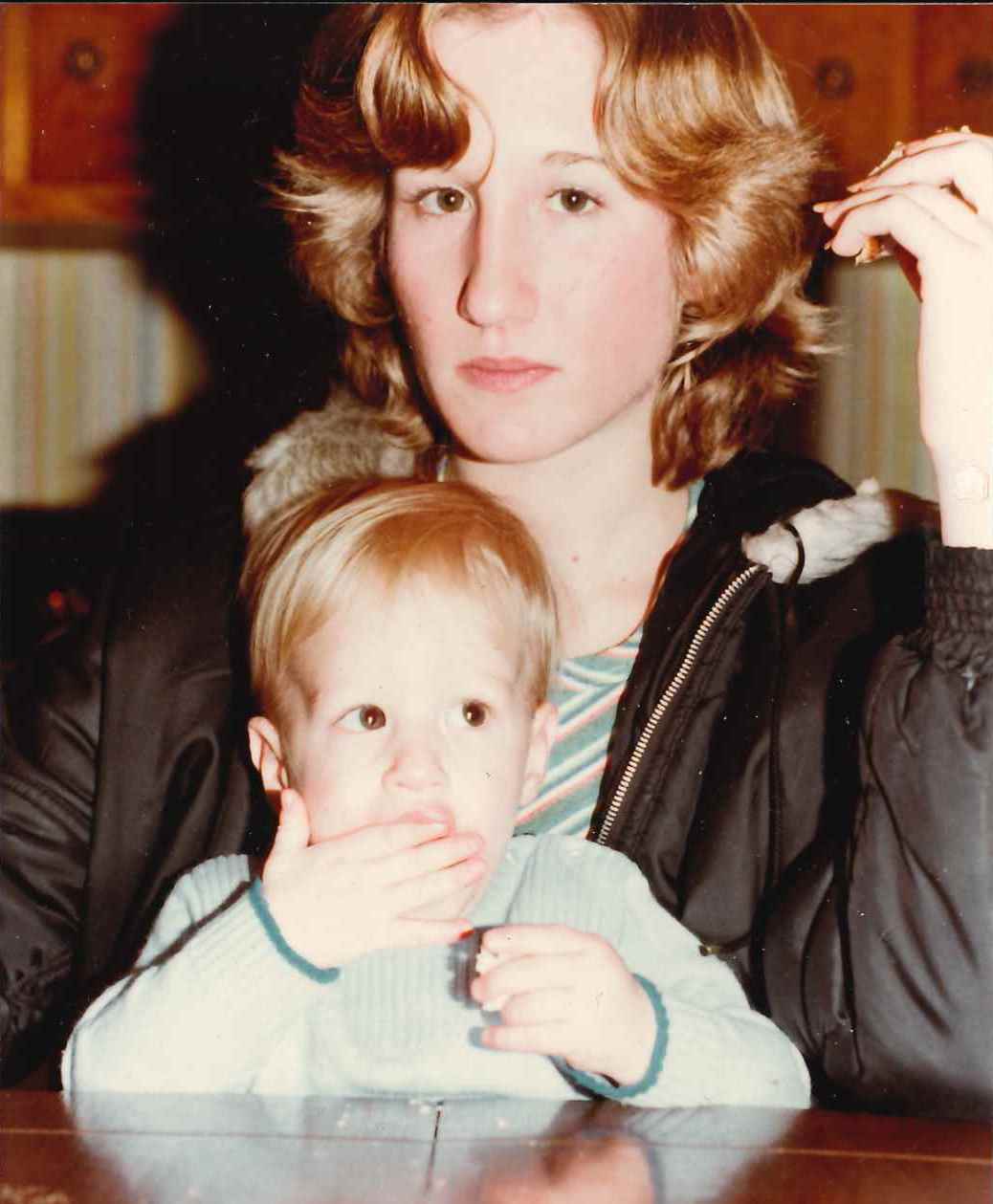
I was unmarried and pregnant with a one-year-old baby, on welfare, living in public housing.  I was 19.

I had just started to feel better about myself and the future.  The first pregnancy had been due to carelessness.  This time it was due to birth control failure.  It was painful knowing people thought I was stupid.

I had just gotten rid of my pet rat, Smiley, because I couldn’t afford to feed him.  If I couldn’t afford to feed a rat, how could I afford to feed another kid?

I had gone to a doctor because I was exhausted.  His name was Charlie Brown, believe it or not.

I figured he would say I was anemic.

He laughed a yucky laugh when he saw the look on my face.

“That’s what happens to girls like you.”

“What?” I was confused.

“Girls who sleep around shouldn’t be surprised when this happens.”

“But it’s the same father.”

He glanced at Vince as though he was a cockroach.

“So the father is white?”  He lowered his voice.  “I know some people who would pay handsomely to adopt this baby.”

If a doctor named Charlie Brown said this to me today, I would punch him in the face, then sue him.  Instead, I thanked him mechanically and never returned.

In spring semester I would take Statistics, English Literature, and part two of Pathology, Anatomy and Physiology, and Abnormal Psychology.  My favorite class was Pathology.  The Hennepin County medical examiner taught it; his name was Vincent which I took as a good sign.  It was basically one long gruesome slide show—or should I say, sideshow.  There was the guy who had been decapitated when his snowmobile ran into a barbed wire fence, a baby born without a brain, and a glistening, five-foot-long tapeworm with eye-like markings.   I loved it.  I didn’t want to drop out.

I went to see a social worker at Catholic Charities.  Her name was Judy.

“You could give the gift of life to a childless couple!” she exclaimed.  I had an image of her as a Tyrannosaurus Rex, drooling and flapping her little claws over this baby.  This white baby.

I didn’t care about helping some rich couple who probably lived in the burbs and had a foosball table in their basement.

“I don’t want Vincent to be an only child,” I said.  My siblings and I didn’t always get along, but I imagined being an only child as very lonely.

“You can always have more children,” said Judy, “when you’re married.  You’re certainly fertile!”

My psych instructor gave a lecture on “high risk youth,” the new buzz phrase.  There were certain early experiences, like being beaten, locked in a basement, or put up for adoption, that caused youth to become drug addicts, criminals, and psychotic.

“Statistics show our prisons are full of men who were abused, neglected, or abandoned by their parents—usually single mothers on welfare.”

My best friend from high school was adopted.  I thought about the times I had seen her mother belittling her.  “You’re so fat!  Are you going to wear that?”  What if I gave this baby up for adoption, which I now understood was an act of abandonment, and his new parents abused him?

I told some of my classmates and they urged me to have an abortion.  “At this stage it’s just a clump of cells,” they reasoned.  This was true, but I couldn’t have an abortion so soon after giving birth.  I couldn’t explain it.  I just couldn’t do it.

“Don’t be a tool of the pro-lifers!” the one male student in my class said.  That was a valid concern too, but I had to set it aside.  Choice meant choice, right?

My mother didn’t tell me what to do.  “If you go through with adoption,” she said, I don’t want you anywhere near the family.  It’s got to be our secret”

Sad Mom

Tumblin’ and Floppin’

What was I thinking when I gave Vince a rock tumbler for Christmas? It’s his long-time hobby, and this is probably the third one I’ve bought him, but it’s the first time I’ve lived with the sound of it, cruncha-rugga-chugga-rugga 24/7. I don’t know how he can sleep with it in his room. .

Here’s an update on Vince’s and my living-together situation.

If I come home and he’s in the living room, he immediately gets up, goes to his room and shuts the door, and doesn’t come out again until the next morning. If I’m the one in the living room when he comes home, he goes straight to his room and doesn’t come out until the next morning. He doesn’t slam the door, so there’s nothing to point to and say, “Stop doing that!”

When we run into each other in the morning, the exchange is:

“Good morning.”

“Good morning.”

“Have a nice day.”

“You too.”

When I ask, “What are you up to today?” he tells me, but there is a tone, as though he thinks I am prying. If I call to him inside his bedroom, there is a long pause during which I imagine he is rolling his eyes, and then a drawn-out, “Yeh-sss?”

I managed to catch him long enough one day to say that people who live in the same house usually talk to each other now and then. He seemed to think I was trying to trick him into talking.

Things came to a head on Christmas day. I found myself crying in my room (into a pillow, so Vince wouldn’t hear, because I didn’t want him to think I was trying to manipulate him). I had been out 16 of the last 18 nights, trying to give him space.

I was tired. I had lost perspective. Was it nosy to ask, “How are you?” Was everything I did annoying? Was the sound of my voice noxious? Should I confront him? Try to be nicer? Suggest we go to counseling together? Ask him to move out? Go live in a motel? Was I acting like a martyr? Maybe if I bought some non-floppy slippers—because surely the sound of my footsteps must drive him crazy.

I recognize Vince’s behavior because I’ve acted the same in the past.

I had a roommate; I’ll call her Irene. She was from Ontario and taught theology at a local private university.

I could not stand being in the same room with her. Everything about her irritated me—her denim dresses and sturdy shoes, the giant jar of Branston Pickle in the fridge, the fact that her favorite color was navy blue.

When I heard her key in the door I would scurry to my room, silently shut the door, and not emerge until I knew the coast was clear. If she tried to make conversation I would deflect it with a curt answer and a stiff demeanor. If I did have to communicate something to her, I left a note on the dining room table.

Poor Irene! She was such a nice person, a good person. She had a sharp wit and obviously was no dummy. We could have had great conversations if I had been open to that. She was also wise, I see in retrospect, because she never got ruffled by my behavior, never seemed to take it personally.

And it wasn’t about her—I can see that now. It was about me being laid off from my job, Vince being missing for the umpteenth time, and other stressful events I can’t even recall now.

So Irene, if you ever read this, I apologize unequivocally. I was horrible to you. Better yet, I will write you an email after I finish this post, and apologize directly.

Vince, here is my version of a note on the dining room table to you. You’re doing so well (a job, a car—health insurance! 19 months of sobriety!). But I know it’s hard to have a social life under the probation restrictions. The solstice has passed, the days are getting longer, soon your time “off leash” time will double.

Now about that rock tumbler….