Doughnuts!!!

This is the latest post in a series about a road trip to New Orleans that starts here.

Inside our Air B&B, there were a dozen doughnuts on the kitchen table with a note: “Welcome to our Air B&B!  We hope you will enjoy your stay in St. Louis!!!”

Now I’m sure the owners of this place are very nice people.  However I have to say that the overuse of exclamation marks is bordering on an epidemic.  Just the other day, I read a brochure from Ramsey County about recycling and it contained seven exclamation marks.  I’m guilty of over punctuating myself.  In my defense, everyone else does it, so if I don’t end my emails to coworkers with exclamation marks, I feel like I’m being a bitch.  If I don’t end garnish every Facebook post with an “!” I fear I’m not as enthusiastic about cats in clothes dryers as I should be.

“Who doesn’t love doughnuts!” I said with gusto.

“I don’t!” Lynn exclaimed.

“Neither do I!” And it was true; we both find them disgusting.  I don’t understand the obsession with doughnuts.  When Krispy Kreme opened in Minnesota it was bigger than a Springsteen concert.

“But what will we do with them?” Lynn looked worried.  If we don’t eat them, they’ll think we were unappreciative, which of course we are but we don’t want them to know that.

“We could dump them in the trash behind some other house,” I suggested.  “But that seems wasteful.”

Lynn was perusing the hand written notes on a bulletin board on the kitchen wall.

“Dear Yuri,” she read. “Thank you so much for sharing your home with us!!”

She paused, then turned and looked at me.  “They’re all the same: Thank you for sharing your home with us … thank you for opening your home to us … but … this place isn’t free, is it?”

“No!  I paid $125 for the night,” I replied.  “It’s very nice.  It’s worth $125.  But they aren’t sharing it, they’re renting it out.  I don’t know why it’s called the sharing economy. That makes it sound like you’re doing it out of altruism. Uber’s another one—Uber drivers don’t give free rides.  My sister is an Uber driver and she’d never do it if it wasn’t for the money.  Maybe we’re just old and we don’t understand.”

“Very strange,” Lynn pronounced. “Well it was very kind of them to leave the doughnuts, but I rather wish they’d left a bottle of wine.”

We walked toward the botanical gardens and arrived just in time to be told, “We close in one hour, so you’ll have to hurry.”

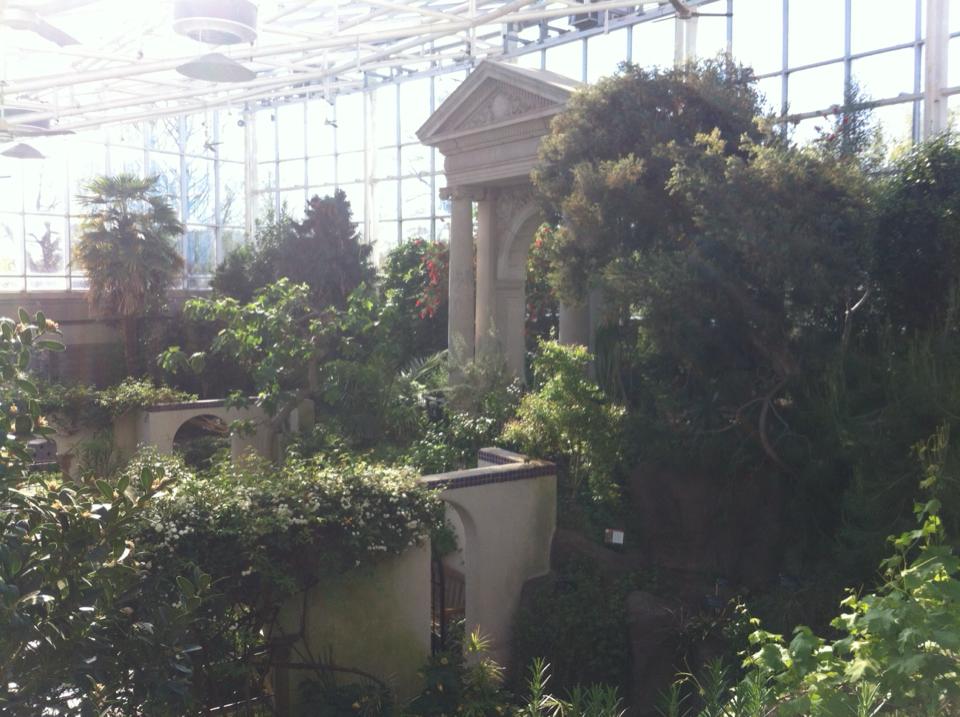
Since we could never see it all by hurrying anyway, we took our time and walked through an enormous domed structure. It held several different environments, from tropical rain forest to Mediterranean. There were Dale Chihuly glass sculptures throughout.  Chihuly is really prolific.  We’ve got a massive sun sculpture of his at the entrance of the Minneapolis Institute of Arts.  The Chicago botanical gardens features quite a few.  Now I admired more.  Not bad for a guy who is blind in one eye, eh?

st louis botanical 3 st louis botanical 2 st louis botanical sunburst

I loved the Mediterranean garden, which reminded me of a long, long hike I took along the Mediterranean coast of France.  How is it that you can be in one place and enjoy it because it reminds you of another place?

The gardens were a great way to decompress after the drive, and I later learned that they are considered the best botanical gardens in America.

Next, my plan was for us to walk to the restaurant where we would meet a woman I’d gone to grad school with for dinner.  On the map it looked like it was a couple blocks away.  I asked one of the botanical garden employees, just to be on the safe side.  She was extremely friendly but suggested it was too far to walk.  Well!  Too far for some people, maybe, but not me.

“Are you okay with walking?” I asked Lynn.

“Shhure…” she said, uncertainly.  And so we walked, and it turned out to be two miles, but we’d worked up an appetite by the time we arrived at the Shaved Duck.
Oxford to St. Louis via Festus

This is the latest post in a series about a road trip to New Orleans that starts here.

While Lynn slept, I explored the breakfast bar at the Quality Inn in Oxford, Mississippi.  It offered weak coffee, powdered “milk”, white bread for toast, single serving boxes of corn flakes, single portion bags of instant grits and oatmeal, and … do-it-yourself waffles.

These weren’t toaster-ready waffles. I watched people try to figure out the waffle maker one after another as I ate my instant grits.  Where was the batter?  How did it come out of the container?  Where did it go into the waffle maker?  Then what?  How long did you keep the lid closed?  Where you supposed to flip it over?  How did you get the waffles out?  It looked simple, but to someone from…oh, let’s say China, it must have been about as familiar as I would have felt trying to make dim sum.

Meanwhile, I was keeping an ear on the conversation of two guys at the next table, who appeared to be truckers.  I had heard the word “Jesus” and “Bible” and assumed they were fervent Christians, so I avoided eye contact.  One was flipping through a pile of magazines.  Maybe they were having a bible study at the Quality Inn.  Finally I was able to pull my attention away from the Chinese guy fumbling with the Made-in-China waffle maker and was able to listen in on the conversation next to me. “These born agains are fucking crazy,” the guy with the magazines said.  “They don’t reason.  They cain’t tell the difference between opinion and fact.  They only know what they’ve been told to think by their preachers.”

“Ah know, ah know,” replied his companion.  “They’re wreckin’ ar country.  We used to be superior for our inventions and idee-urs but now everybody’s laughin’ at us.”

“Everybody but Saudi Arabia,” replied the first guy.  “They probably love that we’ve stopped using our brains.”

This went on for some time and I was able to very subtly—I hope—get a look at the magazines, which included Popular Mechanics and National Geographic.  So they must believe in evolution!  Did you know that 42% of Americans believe God created the world in seven days?  I can barely bring myself to type that, it’s so embarrassing.  That’s an average, of course, and a much higher percentage of young people, urban dwellers, and yes—northerners believe in evolution.

I’m aware it can be irritating when I reproduce people’s accents in writing, but I did it above to make a point.  Well, two points.  First, I’m aware I’m prejudiced against southerners and second, there are southerners who don’t fit my stereotypes.

I had the urge to reach across and introduce myself, “Hi, I’m Anne!  I’m from Minnesota, and I’d just like to say how thrilled I am to discover free thinkers in Mississippi!”

Instead I went next door to Starbucks and got a decent cup of coffee.

We headed north again, toward St. Louis.  This would be a short day: we would only put around 400 miles on the odometer.

The drive was uneventful. We passed by Memphis, then veered northeast near the town of Marked Tree.  We passed Osceola, Tennessee; Blytheville, Arkansas; Hayti, Missouri; then Portageville, Tiptonville, Sikeston, Cape Girardeau, Pocahontas, Ste. Genevieve, Prairie du Rocher, and Festus.

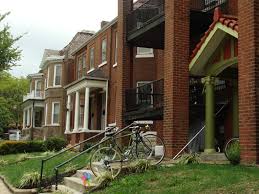
St. Louis was the first place I used Air B&B.  We were staying in the upper part of a fourplex on Flad Avenue, in the Shaw neighborhood, chosen because it was a short walk to the Missouri Botanical Garden.  Shaw appeared to be a historically African American neighborhood that was being gentrified.

Flad ave

We had been instructed to park behind the building, but a pack of bearded, plaid-shirted hipsters who resembled Neanderthals were unloading a truck in the alley.  They smiled dumbly at us and clearly weren’t going to put themselves out to get out of our way, so we parked on the street.

I had received several texts from the Air B&B owner, Yuri, about gaining entrance, and it went without a hitch.  There were two bedrooms, a bath and a kitchen that would be our base for exactly 17 hours.

Death, Doom, Darkness, and Dinner

This is the latest post in a series about a road trip to New Orleans that starts here.

Lynn and I dumped our bags in our room at the Quality Inn, then headed in to central Oxford. Since visiting the Civil Rights Museum in Memphis, I had thought it would be a nice bookend to visit the University of Mississippi campus where James Meredith was denied entrance as the first African American student.  Riots ensued, and two people died before he was finally allowed to enroll.

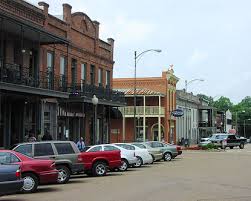
After passing another five miles of chain stores, we turned a corner and suddenly it was like we had entered a portal into ye olde tyme worlde. The old town square was compact; we walked around its circumference in 10 minutes.  There were the usual plethora of gift shops and upscale women’s clothing stores.  Maybe because it’s a university town, there were also two good bookstores.

Ox Town Sq Sq Books Bookstore

I had finished reading Memoir of a Geisha.  I won’t claim it was Great Literature, but it was a good story.  At the end of the first chapter I had already been thinking, “Oh no!  I don’t want this to end!  What will I read when I finish it?”

At Square Books, I found Geisha, a Life by Mineko Iwasaki, who the author of Memoir of a Geisha had interviewed extensively for his book.  Apparently she was so unhappy with how he portrayed geisha life that she decided to write her own side of the story.  I was a little leery of how well it could be written, since she’d had no academic schooling and I don’t believe she speaks English.  But it turned out to be every bit of a page turner as the first book.

At Rebel Bookstore I bought The Optimist’s Daughter by Eudora Welty whom I’d never read.  Believe me, it’s not optimistic.  Southern writers tend to be dark and slow paced and there’s always a funeral.  Faulkner is the best example.  I enjoy a good Faulker, but you have to be in the right frame of mind.  If you are depressed when you attempt to read As I Lay Dying, it might put you over the edge.  Lynn had never heard of Faulker, who grew up in Oxford.

In case you’re wondering, other famous Southern writers—at least to Americans—include Kate Chopin (The Awakening), Robert Penn Warren (All the King’s Men), Katherine Anne Porter (Ship of Fools and many short stories), Flannery O’Connor (Wise Blood), Carson McCullers (The Heart is a Lonely Hunter), Harper Lee (To Kill a Mockingbird), Truman Capote (In Cold Blood), William Styron (Sophie’s Choice), Anne Tyler (The Accidental Tourist), Barbara Kingsolver (The Poisonwood Bible), Anne Rice (Interview with the Vampire), Ernest Gaines (A Lesson Before Dying), John Grisham (The Firm), Pat Conroy (Prince of Tides), and James Dickey (Deliverance).  If you’ve read any of these, you know most of them are about themes like child molestation, racism, death, rape, adolescent angst, murder, poverty, and of course, vampires.

One of my all-time favorite novels is Their Eyes were Watching God, by Zora Neale Hurston, an African-American writer who was born in Notasulga, Alabama.

There are two major exceptions to the rule that southern writers pen morbidly dark tales.  One is Margaret Mitchell, who wrote Gone with the Wind.  The other is Mark Twain, author of The Adventures of Huckleberry Finn and The Adventures of Tom Sawyer.

After buying our books, we searched for a place to eat and found a steakhouse.  Lynn treated.  I rarely have steak (ha ha!) and it was delicious.  We had a long conversation about mustards and in the end, agreed that brown was superior to yellow.  This was not as boring as it sounds.

Then we drove through the University of Mississippi campus looking for a memorial to James Meredith, which we never found.  I don’t know if there is one.  If there isn’t, there should be.  What we did see was one fraternity and sorority house after another.

“We don’t have them in England,” Lynn said.  “Were they formed to keep Black students out?” Lynn asked.  I had no idea, but we would find out in St. Louis.

Tiny Boxes, Big Boxes

This is the latest post in a series about a road trip to New Orleans that starts here.

When I was planning the trip, I intentionally chose a stop in Oxford, Mississippi as an ironic nod to that other Oxford where Lynn and I had met.  But mostly, I wanted to stop in one smallish town, after Chicago, Memphis, and New Orleans.  Oxford’s population is around 20,000, so it’s not that small, but it is in comparison to the others.

And yet it turned out to be the type of place I had dreaded.

In his 1989 book The Lost Continent: Travels in Small Town America, Bill Bryson writes about how every town has the same chain stores and restaurants. 1989!  How much worse would it be now, I feared?  Was I going to drive 2,660 miles just to see the same stores I could see in my own town?

When I was a kid, there was a tiny store at the end of our block called Goldenbergs. I don’t know what these little stores are called elsewhere but in the US we called them “Mom and Pop” or “Dime Stores.”  (A dime is 10 cents, for you readers outside the US.)

They were called Mom and Pop because they were usually run by a married couple and the family lived above the store.

I remember standing inside on the creaky wood floors gazing up at the jars of candy on the countertop.  This was where the dime came in—you could buy a single piece of Laffy Taffy, a small pack of Necco Wafers, or a roll of Smarties for a dime.  These were called penny candy, but by the time I was spending my newspaper delivery money I guess inflation had nudged them up to a dime.

Penny Candy

Mr. and Mrs. Goldenberg had been on there for decades.  When my mother was five, two of her cousins died of meningitis and their house had to be quarantined.  There was a yellow tape circling the property.  I suppose it said something like: Do Not Cross by Order of the Department of Public Health.  Every day Mr. Goldenberg would dip under the tape to deposit a box of food on the back step—then run like hell.

I only have a fuzzy memory of Goldnbergs because it was torn down when I was 10 and replaced with an automatic car wash.

Entering Oxford required driving a five-mile gauntlet of Costcos, Walmarts, Home Depots, and other “Big Box” stores.  We’ve gone from the dime store to the warehouse store, and mom and pop are probably working at the register making minimum wage with no benefits.  Who buys only one piece of candy?  That’s for suckers!  Now you can spend your weekends in a windowless warehouse and get a case of candy.  It’ll be so cheap—you have to buy it!

On Monday you can brag about how you got a case of 500 Mars Bars for only $50.  Who cares if they’ll be stale by the time you can eat them all, or if you really shouldn’t be eating them at all?  They’re so cheap!  Watch out for that one coworker, the one who will try to one-up you with his story about the 100 rolls of paper towels he got for $129.

The main drag into Oxford also featured the predictable chains: Olive Garden, Batteries Plus, Panera, Tires Plus, Walgreens, and Starbucks.

And I had booked us into a Quality Inn—a chain!  It was across from Express Lube and flanked by Starbucks and Verizon.

Lynn checked us in and as soon as she opened her mouth, the manager, who was Indian, asked, “Where are you from?”

“North London,” she replied.

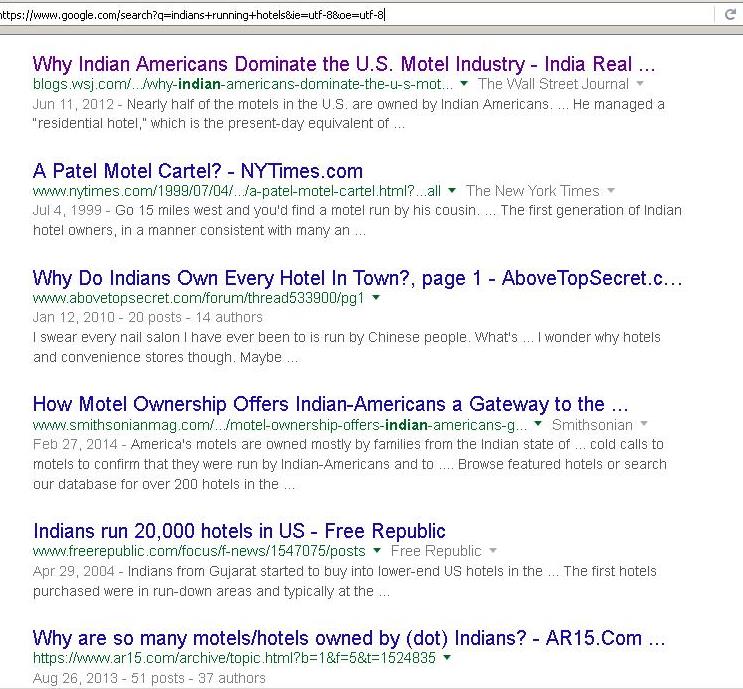
“I’m from north London too!” he exclaimed.  It may seem strange that an Indian guy from London would be running a Quality Inn in Mississippi, but Indians actually own half the hotels and motels in America.  I’m not making that up:

Indians

There were little Indian-influenced flourishes, like a glittery, purple-topped table in our room, that gave a bit of relief from the bland, tan town of Oxford.  At least what we’d seen of it so far.

Super Sonic, Not

This is the latest post in a series about a road trip to New Orleans that starts here.

The route from New Orleans to Oxford was the same as the one we’d taken going south, only this time I had no car worries so I was able to enjoy the beauty of the landscape.  We passed Ponchatoula, Natalbany, Amite City, Fluker, Osyka.

It started to rain, and I mean hard.  I drove on, in denial, the deluge so loud Lynn and I could barely hear each other talk, and so thick we couldn’t see the car in front of us or the shoulders of the highway.

Finally I saw semi trucks pulled over to the side of the road, common sense prevailed, and I took the next exit, McComb.  It was nearly lunchtime, so why not try some local delicacy?

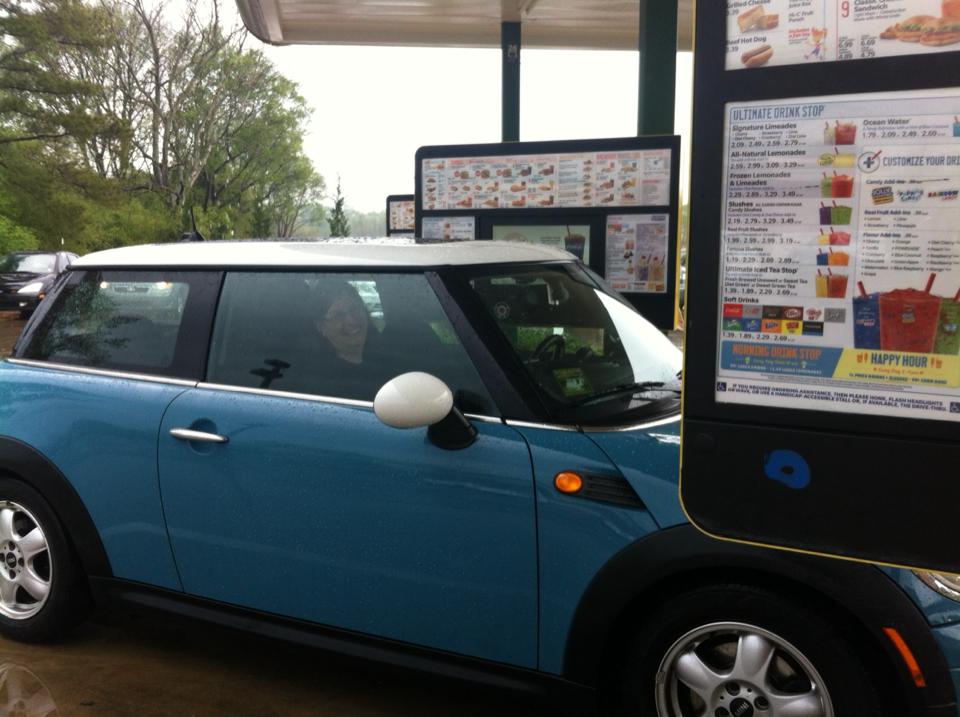
I spied a Sonic.  Perfect!  Drive-in restaurants are such an American thing; I was excited that Lynn would get to experience one.

The only other drive in I’d ever been to was Porky’s in St. Paul, where I had worked as a car hop for one month when I was 16.  The floors were so greasy I had to grip the countertops as I skidded my way around the kitchen.  Porky’s was a dive frequented by bikers and guys with muscle cars, who aren’t exactly great tippers.  After retrieving the umpteenth food tray with a one cent tip and cigarette butts stubbed out in ketchup cups, I told the owner to fuck himself and walked out.  Porky’s has since been torn down and replaced with some bland chain store.

Porky's

Sonics are a chain, and they’re all new and shiny.  They’ve even got bathrooms.  Our eyes bugged out at the menu: once again, everything was deep fried and the drinks were neon colored.  Why?  Do a lot of people think, “Yum!” when they see neon?

Sonic

Lynn and I ordered without any language difficulties and a perky teenager named LaShonda delivered our food.  I had the Super Crunch Chicken Strip DinnerTM with tater tots, which were a staple of the American diet back when “convenience food” was a novelty.  Now they’re back.  There was also Texas Toast, which is very thick toast, and, in case that wasn’t enough brown food, one onion ring.

In the photo below it looks delicious, but this is not how it appeared in its cardboard box.  Everything was slightly wilted and smushed together in a small pool of grease.

Super Crunch

“Don’t bother asking if the chicken is free range,” I laughed at Lynn.  The chicken, if that’s what it really was, looked and tasted like thick white rubber bands that had been soaked in solvent until they were pliable enough to chew.  I gagged and couldn’t eat more than a few bites.  I should have known when I saw “boneless chicken wings” on the menu that we were not in for a nice surprise—a chain restaurant with good food.  Lynn managed to choke down her burger and a few limp fries.

The rain had let up so we pulled back onto the highway.

Bogue Chitto, Zetus, New Sight, Hazelhurst, Gallatin, Crystal Springs … “I imagine Crystal Springs is a delightful place,” said Lynn, deadpan.  “Oh yeah!” I nodded.  Pickens, Ebenezer, Durant, Possumneck.  Wait, whatPossumneck—we laughed?  Even if we hadn’t just left our Australian friend Christine, a.k.a. possum, in New Orleans, it was still a funny name.

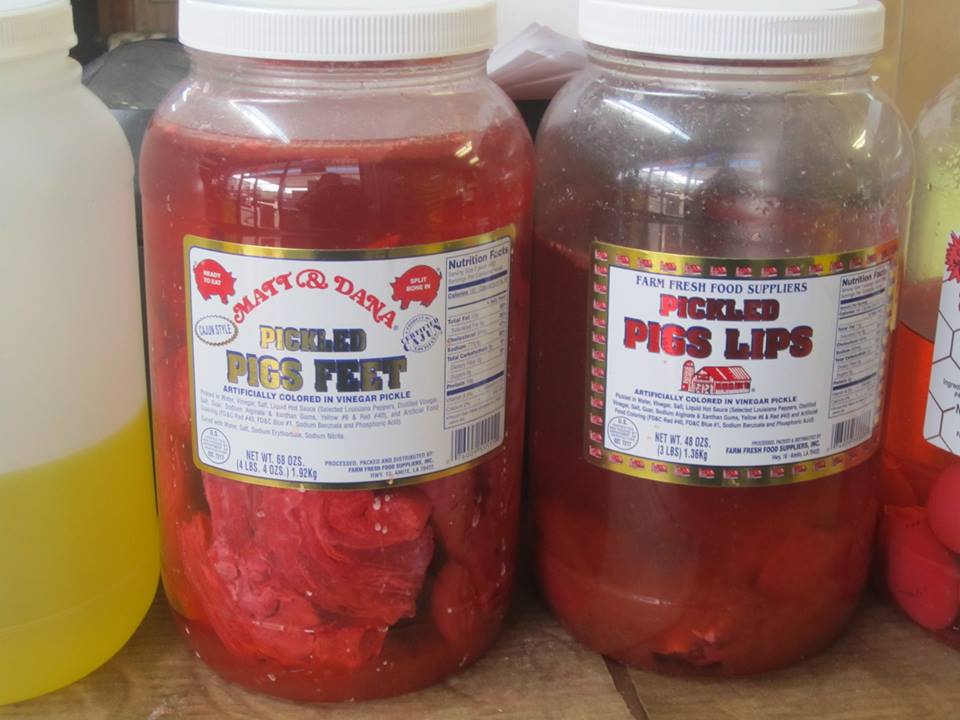
Vaiden, Winona, Grenada, Coffeeville.  I was running low on gas and pulled off the highway but there was no town at the top of the ramp.  I drove into the countryside, assuming we would hit a town eventually, and we did.  I can’t recall its name; it could have been French Camp, Bruce, Eupora, or Paris.  It was a very small, sad, dilapidated town.  From the looks we got, mine was the first Mini Cooper any of the residents had ever seen.  I gassed up and went in to pay just in time to hear Lynn shriek, “No!”  I reached her as she was surreptitiously photographing the giant jars of pickled pigs things and what appeared to be a neon drink, or condensed urine.  Yum!

pigs lips

Festival Fever

This is the latest post in a series about a road trip to New Orleans that starts here.

Our last day in New Orleans.

We started the usual way, the four of us out on the street: “Should we go to the right?” one of us would say.

“Are you asking, or do you want to go right?”

“I don’t care.”

“Well I’d like to go left.  I saw any interesting house that way and I’d like to get a photo of it.”

Disappointed look.

“Do you want to go to the left?  If you do, just say so!”

“No, I really don’t mind what we do.”

So we went to the right.

Disappointed look.

There’s a lot of talk about us Minnesotans being passive aggressive.  We hint at things instead of just saying what we want.  I try not to do that, but sometimes I feel I’m being mean just stating what I want.  I’ve traveled a lot; I’ve lived and worked with people from lots of countries and cultures.  Except for the Donald Trumps of the world, the desire to avoid confrontation—even the appearance of confrontation—seems universal.

A Mimosa at 10 in the morning always helps to smooth out bumpy interactions, so we ordered four, then wandered around the French Market.  This is a vast collection of booths with vendors selling everything from Mardi Gras masks and beads, dried soups and artisanal soaps, artwork and Alligator heads.  I bought an alligator head for my six-year-old nephew.  This would secure my position as adored aunt.  I found a voodoo doll for a friend; it was made in China.  Everything was made in China, of course, except maybe the alligator heads.

There was a Tsunami of Stuff.  That’s how the world is now.  I will probably sound old here, but when I was a kid and young adult I don’t recall there being so many shops that sold gifts and other useless things.  There also weren’t as many thrift stores, probably because we weren’t buying knick knacks at gift stores for our friends, who would later secretly re-gift them or drop them off at the Salvation Army.

By now, the fifth day of the festival, the French Quarter was filthy, smelly, and heaving with people.  The weekend brought in a younger crowd.  Molly and I drank beers while we walked along; this is a particular rare pleasure for me.  The only other time I can recall being allowed to do this was at the Notting Hill Festival in London, where I enjoyed a Strong Bow while having my ear drums assaulted by 10 Caribbean steel drum bands playing at once.

In Minnesota, you have to wear a neon wrist band and stand in a corral like a criminal to enjoy a beer at a festival.

We found a place to sit, in the sun, and listened a band called to Cha Wa, which is a “Mardi Gras Indian funk band.”

Cha Wa

They were great.  We walked to the waterfront, which was a 98% African American crowd.  It was great to see, after visiting the Civil Rights Museum, so many people— young and old, families and couples, flocks of teens—just out and enjoying themselves.

We took the streetcar back toward our neighborhood.  Don’t call it a trolley—apparently that’s very important to the natives.  It goes about five miles per hour, but we weren’t in any hurry.  At one point we stopped and the driver got out and wiggled the cable by hand to get us going again.

A few more drinks on Frenchman Street, a few more incredible bands.  It was the last fever peak of the festival before reality hit on Monday morning.  The drunks were sloppy, the streets were greasy, music was everywhere, I saw a guy wearing a green chicken costume, and someone else wearing a skull mask riding a unicycle.

The next day Molly flew north to Minneapolis/St. Paul, Minnesota, where her husband would pick her up and drive her home to St. Croix Falls, Wisconsin.  Christine left to catch her flight back to Oxford, England.  Lynn and I headed north in the Happy Mini, also toward Oxford—Oxford, Mississippi.

Special Sauce, Special Spice

This is the latest in a series of posts about a road trip to New Orleans that starts here.

You may be wondering about the food in New Orleans.  Well let me give you a tip.  A coworker who is a foodie had visited the city a month before I was there.  Her advice had been: “There are a million restaurants, and if you’re walking around all day in the sun, you can get really hungry and then you end up walking into whatever restaurant doesn’t have a line, and you can get crappy food, or great food.”  So her advice was to make time to research places to eat and have a couple on our list every day for those hungry moments.

We didn’t do that, and so we had some crappy food and some great food.  If you like deep-fried everything, you would love New Orleans, because that’s easy to find. Deep fried seafood—no texture anymore, so you can’t even tell what it was—and something called a Po’ Boy, which is a basically a submarine sandwich with beef but also comes filled with fried sea food.  Then of course there are the French fries, deep fried mushrooms, deep fried green beans … you get the picture.  The New Orleans signature sweet is a Beignet, which is a deep-fried pastry sprinkled with powdered sugar.  And just in case all the deep fried stuff doesn’t provide enough lubrication to grease your swallows, everything was accompanied by oily sauces.

Bad Fish Beignet

My son, Vince, who has been a cook for many years, says that if food is deep fried by a competent cook—and this means submerged quickly into very hot oil—it’s not very greasy at all.  That’s not the kind of deep fried food we had. The kind we had was the kind where the first bite is delicious because you’ve waited so long to eat, and then all the bites after that just taste like grease.  My stomach feels queasy just thinking about it.

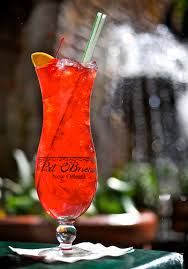
To accompany all this unnaturally brown food, New Orleans offers up unnaturally colored drinks. These seem to contain mostly sugar and food coloring, with a splash of bottom-shelf alcohol.

red drink Green Drinks

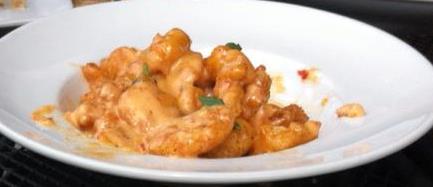
But there was also good food, which I define as simple and tasty, which we found by accident about 50% of the time.  I’m a seafood lover who lives in the middle of the North American continent, so I don’t often have shrimp or scallops that weren’t frozen and defrosted.

But here we were so near to the Gulf of Mexico.  This meal below satisfied; the fish is Redfish, which I’d never heard of.  It’s blackened, which is a southern cooking technique using Cajun spices; the butter gives the fish a blackened appearance and trust me, it is delicious.

Good Fish

There were crawfish boils everywhere. For 10 bucks you could gorge yourself on a peel ‘n’ eat platter of them.

Crawfish boil

When I was a kid I used to catch what we called cray fish in the Mississippi River, but the river was so polluted then we couldn’t eat our catch.

There was a wonderful food hall across the street from our B&B which had stalls serving Vietnamese, Thai, and local dishes, and this is where we had our best meals.  My favorite was a curried crawfish dish.

There are two dishes associated with the south: Jumbalaya and Gumbo.  Gumbo is a spicy stew with southern vegetables like okra and peppers and with chicken, crawfish, shrimp and/or Andouille, a pork sausage that’s a New Orleans staple.  Jambalaya is a rice dish with similar ingredients.  Both are pick-and-choose kind of recipes; there’s no “right” way to make them—it’s about the spice.

I don’t eat pork.  If I had been in Minnesota, there would have been vegan and vegetarian and gluten-free and artisanal options available, but this was New Orleans.  Every iteration of Gumbo and Jambalaya contained Andouille, so I never tried either dish.  And in case you think I’m kidding about the artisanal gumbo, a week after I came home Vince and I ate out and by chance walked into a southern-style restaurant, at which I was able to order gumbo with vegan Andouille.

Cooper versus Cruiser

This is the latest in a series of posts about a road trip to New Orleans that starts here.

Finally, I will shut up about my car, I promise.  I got to the garage, met Tracy, who was a woman, and after I paid the bill she flagged down a guy to lead me to my car.

“Honey,” she called out to him, “Will ya’ll show this here Miss Anne where her PT Cruiser is?”

PT Cruiser!?

Thankfully the guy got it.  “Ya’ll got a Mini Cooper, right? Ya’ll insulted she called it a PT Cruiser?” he laughed.

“I’ve never been so insulted!”

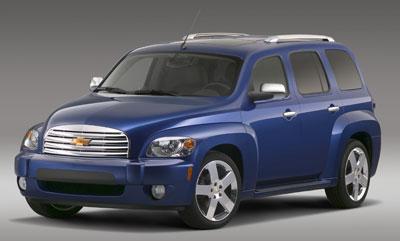
In my opinion, PT Cruisers are novelty cars for retired people who really want a Sports Utility Vehicle (SUV) but can’t admit it.  The PT Cruiser allows them to drive a giant gas-guzzling vehicle and pretend they’re quirky and eccentric.  Despite the fact that I was getting all-new spark plugs, I still affirm that the Mini is a finely-engineered vehicle.  And mine was nine years old, after all.

PT Cruiser

I raced back to the B&B, parked the car in front, and parked myself in the courtyard under the Kumquat tree with a book and a glass of wine. Molly texted to ask if I wanted them to come  join me.  “no enjoy yourselves and take your time.”  If there was something called a “sub-text,” I would have typed, “No!  Stay away!  I need to be alone!”

Courtyard-Bench-sm

This is how you know if you’re an introvert or an extrovert.  It’s not about whether you like people or parties or crowds, or have a lot of friends.  It’s about what you do to recharge when you’re drained. I’m an introvert, because as much as I love my friends and parties and crowds, I just want to be alone when I’ve been through a stressful experience.

So I sat under the Kumquat tree for hours.  I was reading Memoirs of a Geisha, and I hadn’t expected it to be so fascinating.  How accurate was it, I wondered? I would never dream of asking my sister-in-law Akiko, who has a PhD.  I think she would be horrified that I would think she knew anything about geishas.

-f-g-memoirs-of-a-geisha-31766513-500-233

Hours later, Lynn, Christine, and Molly strolled in and I was happy to see them.

“Why was I so stressed about a stupid car?” I wondered out loud.

“Because you didn’t know if you’d get here,” Christine said.

“You’re emotionally attached to it,” said Lynn. “I had a Mazda Miata convertible that was my baby.  When we moved to Scotland I finally sold her because I could only drive her once a year.  When they took her away I cried!”

“It was five hundred and fifty bucks!” Molly chimed in.

When I was in my 20s and 30s, an unplanned $550 expense would have been a disaster.  I would have had to borrow money from my mother, or put it on a credit card.  I would have had to cut back on some other essential item, like food or cigarettes or beer.

Slowly, slowly, I’ve worked my way out of debt and into financial safety.  If I had worked for Wells Fargo this would have gone a lot faster, but I’ve always worked for charities.  Like I’ve written before, you can work for a nonprofit and have a good life, if you’re very, very careful about your spending.  Saving, even small amounts, is super important too, because the interest eventually piles on and one day you look at your balance and think, “Whoa!  How did it get so big!”  Of course it can go down, too, if you’re invested in the stock market, so don’t look at it when the market’s down, and whatever you do, don’t sell at the bottom.

Sorry, I go off on tangents, I know.

You may be wondering if New Orleans is an expensive destination, and I think the answer is no, if you can find reasonably-priced accommodation.  They’re still rebuilding since Hurricane Katrina, so there’s a housing shortage.  Plan way ahead, especially if you’re going during a festival.  If you can gather a group of friends together and split the cost four ways, it’s very affordable.  And more fun.

Car Talk

This is the latest post in a series about a road trip to New Orleans that starts here.

If you love cemeteries like I do, you would love New Orleans.  Bodies are buried in above-ground crypts so the … whatever it is that oozes from decomposing bodies doesn’t seep into the groundwater.  Thanks to the heat, bodies decompose quickly and fresh ones can be added onto the pile in after only a year.

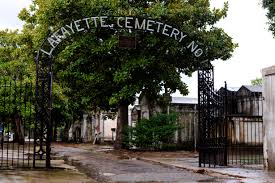
Lafayette Cemetery #1 is not to be confused with St. Louis Cemetery #1, where the voodoo queen Marie Laveau is buried.  I visited that one my first time in New Orleans, and the two cemeteries look the same except that Lafayette is in the posh Garden District and St. Louis is in Treme, which as depicted in the hit HBO crime series.

The four of us split up and wandered around.  I was wondering over this rubber duckie-themed tomb when my phone rang and an androgynous voice asked for “Miss Anne.”

Rubber Duck Grave

“This here is Tracy,” s/he drawled, calling ya’ll bout your car.  It’s lookin’ real bad …”

The line went dead.  I hit redial.  The connection wouldn’t work. I wandered around for another 20 minutes, clutching my phone and willing it to ring.

When it finally did, Tracy laid it on me: “It needs all new spark plugs,” s/he said.

“How much?” I asked.

“A’m sorrah Miss Anne, but I hate to tell ya it’s gonna be ….” Click.

Lynn, trying to be helpful, said, “That’s what I thought all along!  Spark plugs—and now you know that your car has spark plugs!”

I don’t remember what I said but it wasn’t nice. She went silent.  By then we had “done” the cemetery and re-joined a walking tour of the Garden District, featuring the houses of Nicholas Cage and Sandra Bullock.  It was hot.  The phone kept ringing then going dead.  For an hour.

Finally, Tracy got through. “What?” I yelled.  “I can’t hear you!”  Other members of the tour were giving me dirty looks.  I finally got that it was going to cost me $800.  Since my worst case scenario had been that the car would be a total loss, this was actually a bit of a relief, but still not a welcome amount of money to have to lay out on vacation.  Or anytime.

“It’ll take fahv days to get the parts from the dealership in Baton Rouge,” Tracy informed me.

“Five days!  But I have to be in Minnesota on Wednesday!” I moaned.

“Unless ya’ll want to use generic parts, Miss Anne” s/he said.

“Of course I do!” I exclaimed.

“Then it’ll cost ya’ll $550.”  Now I felt like I was getting off easy.  It’s all relative.

After the walking tour we sought refuge from the heat in Starbucks.  I apologized to Lynn, and she accepted.  No drama.  I don’t know what she would say, but I wasn’t surprised that in 11 days spending 24 hours together, there wouldn’t be some disagreement.

We caught the Hop On Hop Off bus again and got off at the restaurant recommended by the guide.  I always figure these are the restaurants owned by the guide’s brother in law, but so what?  It was really good.  In no time Tracy called again to say my car was ready, and I left my pals standing on a street corner in the blazing sun to wait for the bus while I hailed a cab.

The cabbie’s English was not good, but that didn’t stop him from telling me that Tracy’s garage was “too many crooks, and too much expensive.”  He informed me that I should have asked him where to take my car.  Right.  If I could have gone back in time … I changed the subject.

“Where are you from?”

“Palestine,” he replied.

“I was in the Palestinian territories last year.”

He stared at me in the rear-view window.

“You are a Jewish!” he said.

“Ye…sss.” Was he going to take me to a remote spot in Treme, stab me, and dump my body in St. Louis Cemetery #1?

But instead he exclaimed, “We cousins!  You, me … Jew, Arab … we must try to get along!”

Big Talkers, Long Talkers

This is the latest post in a series about a road trip to New Orleans that starts here.

I mentioned in a previous post that the owner of our B&B, Nancy, displayed photos of Donald Trump on her wall.  There was also a picture of her with Bill and Hillary Clinton.  As you walked down the hall toward our room, there it was on the left, and the Trump photos were on the right, appropriately enough.  But there were about six photos of Trump vs. one of the Clintons.

I knew from stalking her online that Nancy had been the executive producer of Trump’s show, The Celebrity Apprentice, before moving to New Orleans and opening a B&B.

celebrity-apprentice_510

To make you travel lovers drool, she also produced The Amazing Race, in which pairs of contestants complete challenges in exotic locations, and she traveled around the world four times.

Amazing Race

Nancy now had a darling six-year-old daughter who flitted around the B&B and they lived above us in their own snug quarters.

Nancy

Running a B&B wouldn’t be for me.  The first time some guest asked for vegan Andouille, I’d put up the For Sale sign.  But Nancy was endlessly patient and sincere.  She grew up in the south and went to graduate school at nearby Tulane.  She loves New Orleans and seemed to truly enjoy helping other people explore the city.  Maybe she didn’t get demanding guests.  Maybe if she did, they were nothing compared with working for Donald Trump.  Her time on the show would have been a great informal apprenticeship for running a service business.

The photos didn’t bother me; I thought they were weirdly amusing, but they bothered Molly, who is a Bernie Sanders fan.

“How can she have pictures of Donald Trump on her wall?!  She’s so sweet!  He’s a misogynist!  He’s a racist!  He’s a smug, arrogant asshole!”

So I asked Nancy, “We’re curious to know what Donald Trump is like.  Is he the same now as when you were working with him?”

Nancy seemed to consider her words carefully.  “He’s a very good businessman.”  We waited for the rest, and we got it, but I won’t quote her.  She only used one word, but that said it all.

“She must get asked all the time,” I said to Molly after Nancy left us to help another guest.

“Leave it to you to ask!” Molly replied, laughing at me.

I get this all the time.  In my job review a few months ago I was faulted for being “too direct.”  I really must practice hinting more, instead of just saying what I’m thinking.

Nancy had a guy working for her named Johnny.  He cleaned, baked, fixed things, and most of all, talked.  He was the southern version of our friend David at the Old Chicago Inn.  Johnny was one of the reasons it took us so long to get going in the morning.  He would plunk himself down in a chair near the four of us and talk.  And talk and talk and talk.  He talked about his previous jobs, being in the marines, and the secrets of making kumquat marmalade.

People who play wind instruments like the flute do something called circular breathing which allows them to play without interrupting the music to inhale.  I think long talkers do something similar so there’s never a pause where you could interject, “I’m sorry, but we really must leave now.”  The good thing about one-way talkers is that—usually—they know they talk too much.  You can be direct with them and they don’t take it personally.

“We have to leave now, Johnny,” I would say.

“Ha, ha, ha!  Ah know ah talk a lot.  Ya’ll have a wonderful day now.”

We wandered for an hour trying to find the stop for the Hop On Hop Off bus, which had been rerouted due to the festival.  We finally caught sight of one of their familiar red double-decker buses and rode it to Lafayette Cemetery Number 1, which is where I got the call about my car.

Lafayette