Tag Archives: Italy

Alt Amalfi

This is a series of posts about Italy, Malta, and Spain that starts here.

I had seen the one attraction in Amalfi, the Paper Museum, in under 15 minutes.  I wandered back toward the center of town, then saw a little sign that said “Ancient Stairs.”  Of course I had to follow it.

Whoever wrote the sign wasn’t kidding.  The stairs were stone, worn concave by thousands of footsteps.  They were also slippery as hell—at one junction my left leg slid left and my right slid behind me, leaving me face down, arms splayed in the “worshipful peon” position.

Having torn my knee ligament two years ago, I was relieved to get up and feel okay.  I was also reminded of one of the pitfalls of traveling alone.  The town was deserted.  Who would have helped me up, then down all those stairs if I had torn my MCL?  I began paying more attention to my steps.

The stairs led up and around and up and back and down and up and around.  Here are a couple scenic views along the way:

plantsmailboxes

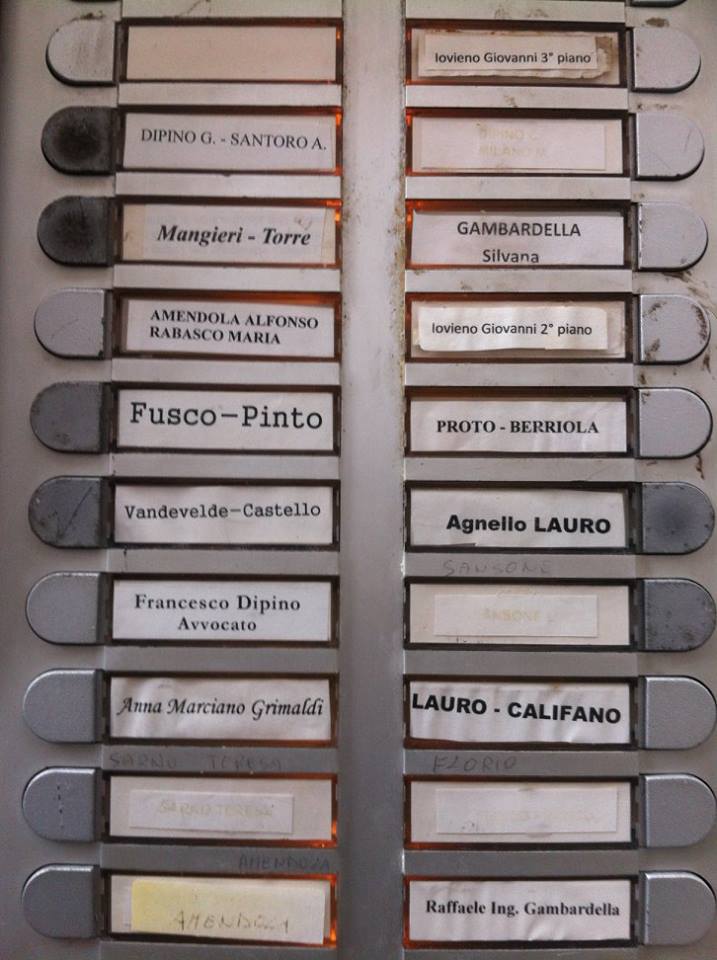
These mailboxes may seem unremarkable if you are Italian, but in Minnesota everyone is named Johnson, Swanson, and Anderson, so they were charmingly exotic to me.

There was another sign that pointed to a Cimitero.  I love cemeteries and, having no other plan, decided to visit.

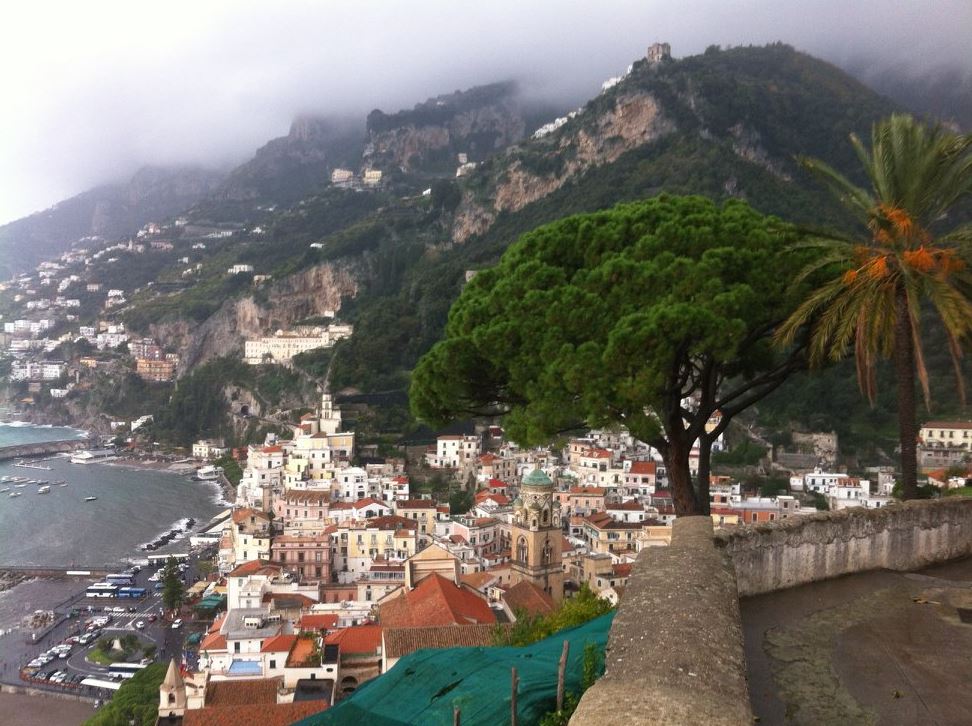
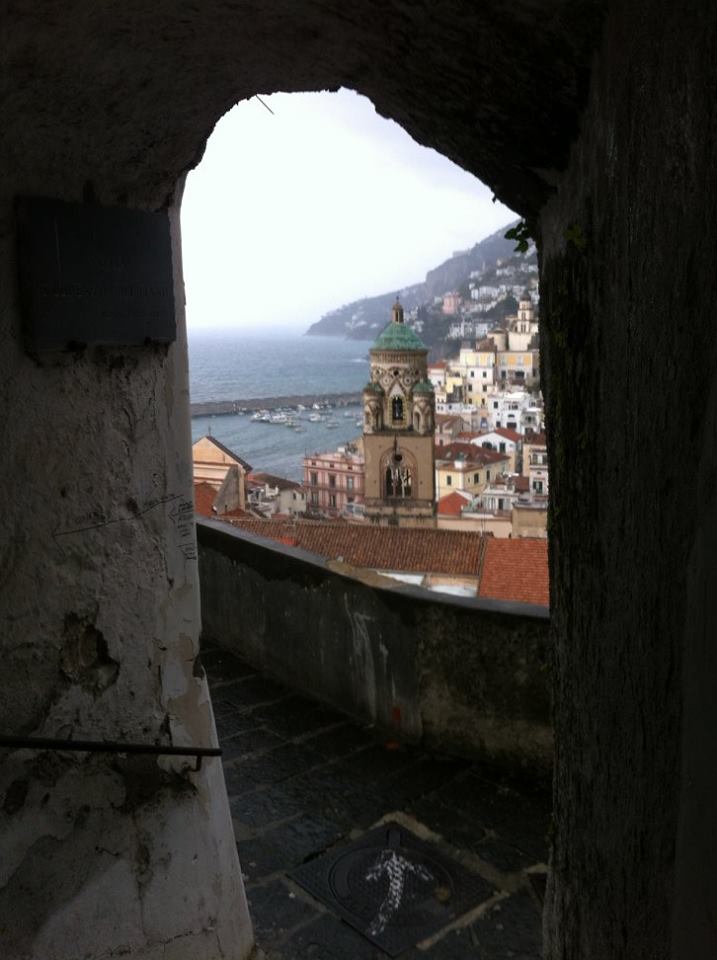
There were no more Cimitero signs, just crude arrows hand-painted here on a wall and there on stair.  Some of the walls were so close together that the sides of my umbrella brushed against them.  I climbed, and climbed, and counted steps: 200, 300, 400 … every so often the view would open up before me:
view view-3

Heartbreakingly beautiful, eh, even with the rain?

There were more lovely mysterious entryways.  I would have loved to be invited in for lunch:

tile-entrance

500, 600, 700 … Here’s a tip: Go while your knees are still good.

800 … I wondered why the cemetery was at the top of the mountain.  Wasn’t that kind of unhygienic?  I had not seen a single human until now, when a couple came my way and said with in rough English, “The trail is closed.”

I figured they couldn’t possibly be headed for the cemetery.  Only I was weird enough to hike 800 stairs to see headstones.  So I smiled and kept going.

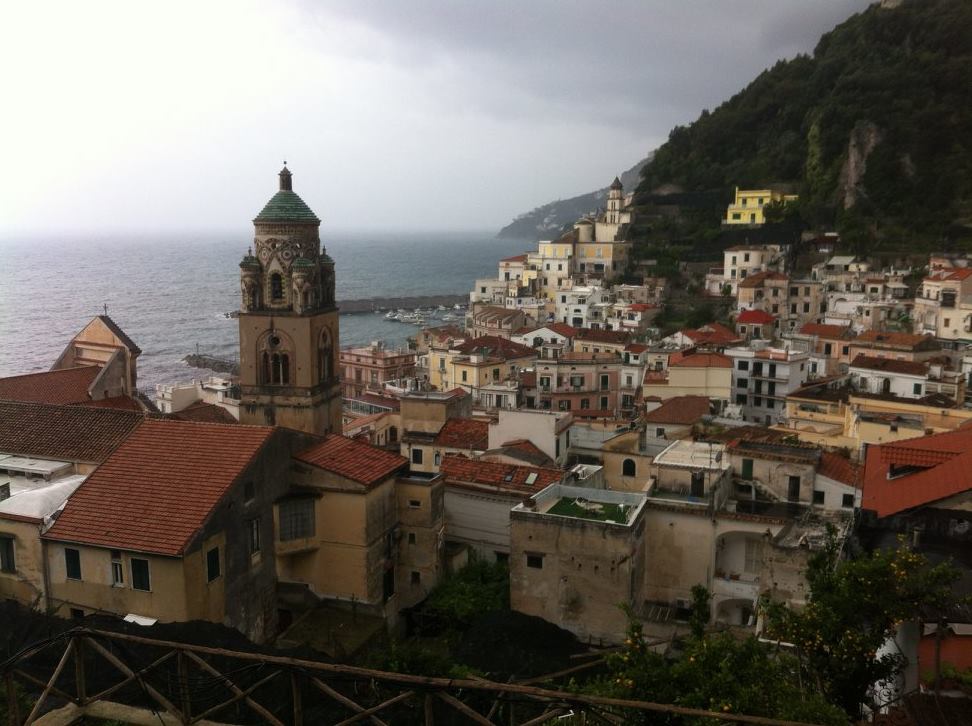
“But it is still beautiful,” said the woman over her shoulder as they hiked down.  And it was:
view-2

This was as far as I got because when I turned around from shooting this photo I saw the sign for the cemetery, which had closed five minutes earlier.  FIVE minutes!  Again, this is one of the hazards of traveling in the off season, many sites have limited hours.
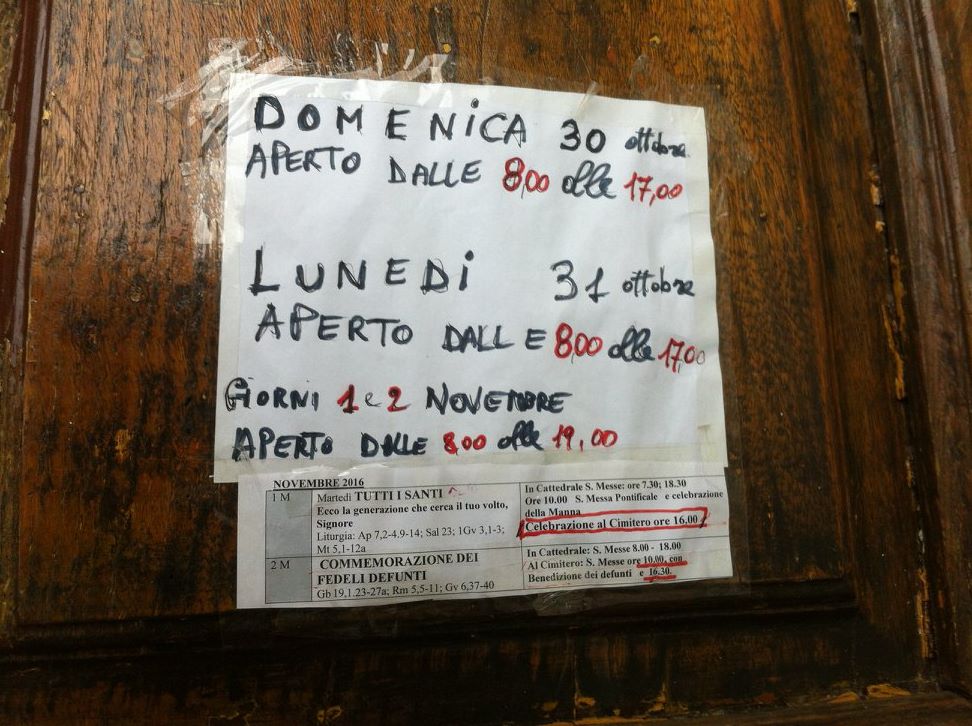
closed

The hiking couple had been right, there was an orange plastic fence across the path just beyond the cemetery entrance.  I stood there a moment, waiting for some special feeling and, feeling none, turned around and walked back down the 800 steps.

All that hiking had helped me work up an appetite, and not for a protein bar.  I found a hole-in-the wall pizzeria (it seemed like every restaurant in Italy was a “pizzeria”).

For 4€ I got an enormous sandwich with grilled red peppers, eggplant, and onions smothered in melted mozzarella, and a Coke Pink, which was everywhere.

Since I come from a land where we must huddle inside for six months of the year due to the cold, I always sit outside when I’m traveling, even if it’s raining, which it still was.  I pulled up a café table under the awning, leaning in to stay dry.

There was a bored English middle-aged couple sitting nearby, and a pair of middle aged Italian women.  Suddenly one of them said to me in perfect English, “You made a joke.”

What?

“You made a joke in the museum.  I’m an English teacher.  I understood.”

We laughed and chatted about languages; it was nice to have a little human interaction.  Then the English guy asked me what I thought about Donald Trump.  What a buzz kill.  I made a noncommittal comment, wolfed down my food, and walked off.
Papered

This is a series of posts about Italy, Malta, and Spain that starts here.

Bells, bells, bells.  If you like being awakened by bells, you would love Italy.  This was my 7:00 am Sunday wake up call in Sorrento.

Today I would go to the Amalfi Coast.  Tomorrow would be Capri, and I would try to squeeze in Pompeii on my way back to Rome.

But first, some breakfast, where I chatted with my fellow hotel guests.  There were a couple of empty nesters from Australia and an English couple with a son who appeared to be around 12.  They were all wearing that khaki travel uniform—you know, the one with the many-pocketed vests and matching many-pocketed trousers?

I asked about Pompeii—had they gone?  Was it a must see?  Could I “do it” in an afternoon?

“We spent five hours at Pompeii and could have stayed longer, but it started to get dark,” said the Australian guy.

“We spent the better part of the day there,” said the English husband.  “Andrew is studying the ancient world and it’s been wonderful for him to see it outside of text books.”  Andrew looked embarrassed.  “In fact Andrew has been like our personal tour guide,” said his mother.  Andrew slumped in his chair.

“Well I’d better get going then,” I said.

I traced the taxi route back to the train station, and there was a bus to the coast waiting for me.  Well, waiting.  I bought my 8€ all-day ticket and settled down for the ride.

When most people think of the Amalfi Coast, they envision intense blue sea, dizzying cliffs, and charming, sun-washed towns.  I had the dizzying part, but my day on the Amalfi Coast featured rain, rain, and more rain.  The sea was slate grey.  It was windy and my umbrella kept blowing inside out, then flipping back and splattering me with rain.  It was still beautiful, just in a different way.  The wind moved the clouds around quickly, changing the light by the minute.

The bus wound along narrow roads with mountain walls on one side and cliffs on the other.  Occasionally there were shrines on the side of the road—for buses that had gone over the side?  I eyed the windows.  If I was the sole survivor of a fall over the cliff, which I was sure would be the case, the windows only opened about six inches wide.  Could I squeeze through?  I noted the location of the hammer of life.

In no time we arrived in Positano, which I had decided to skip.  Why?  I just didn’t think I could do justice to more than two towns in one day, so I had picked Amalfi and one other TBD.  It felt too soon to get off the bus in Positano.

I hopped off in Amalfi, taking care to note the location from which the bus would depart.  I didn’t have a plan aside from visiting the Paper Museum, for which there were signs every few yards.  This was refreshing.  I arrived at the museum and bought my 3€ ticket from a young woman who told me to wait by the door for the tour.  I looked around.  I was the only one in the room, which displayed handmade paper gifts I wanted to check out, but I figured I’d better stay put for when the tour group arrived.  Two minutes later the young woman walked over and said “I will take you on the tour now.”

The museum was a former family-run paper factory.  In the basement, my guide showed me vats of pulp, had me smear pulp over a strainer, then showed me the presses which were no longer in use.  “That’s the tour,” she told me.  It had been 10 minutes long, but charming.

Back upstairs, a group of about 30 Italian tourists was crowded into the room waiting for their tour.  I bought some paper and an old man emerged from nowhere to gift wrap it meticulously when I told him it was for my mother.

“I guess men really can wrap presents,” I joked out loud.  Nobody else laughed.  I strode out to explore more of Amalfi.

In the Dark

This is a series of posts about Italy, Malta, and Spain that starts here.

After a day of sitting on trains I was eager to get out and explore Sorrento.  It was dark and rainy, but that’s what hats with brims and umbrellas are for.  I found the ocean overlook and although it was dark, I got a sense of the sea’s grandeur and felt excited about traveling along the coast the next day.  I think I went inside a church that was on my list, the Chiesa di San Francisco, but I couldn’t find a sign so who knows?  I think I sat in the Villa Communale, but again there were no signs, so I’m not sure.  It was lovely, despite being dark, dotted with pairs of lovers on benches under the lemon trees.  Reading the guidebook back home, I had pictured myself here on a sunny day, gazing out over the intense blue sea looking glamorous and catching the eye of an attractive—preferably wealthy—widower.

There was supposed to be a marina nearby with “wonderful seafood restaurants,” but everything was dark and shuttered for the season.  I saw a sign for the Museo Correale, which I knew was open until 8:00 pm.  I followed the direction of the sign, then walked and walked.  I never saw another sign and it got darker the further I got from the center.  I wandered back toward the hotel, through alleys of stores which were still bustling, and bought some of the obligatory lemon soap, pasta, and dried spices.

The pasta made me hungry but since it was only 7:00, no restaurants were open.  Only 7:00.  In Minnesota, dinnertime is 5:30.  I decided to dine on a protein bar in my hotel room.  Eating protein bars in Italy may sound pathetic, but they’re a huge money saver; I always bring a box in my suitcase, along with dried fruit and nuts.

There was still a crowd in front of the Church of San Antonino.  Why?  I pried my way through and slowly moved up the entry steps as others came out.  I made it to the entryway but was too short to see what was going on inside.  A priest was going on in a soporific monotone on a loudspeaker as bells chimed over our heads.  I took this very brief video just to capture the audio scene.

My hotel room door was still closed but popped open at my touch.  Inside, I flipped the deadbolt.  It had been a long day, I was tired and damp.  I had read 300 pages of The Other Boleyn Girl on the train and looked forward to finishing it in the bath with a glass of wine, even though I knew it didn’t have a happy ending.

But alas, there was no corkscrew.  I picked up the phone and there was no dial tone.  I had no choice but to take the elevator down to the ground floor and ask the desk guy whose nametag said Diego for one.  “I’ll deliver one up eh-soon,” he promised.

I went back upstairs and waited.  Eventually Diego appeared with the essential tool, quickly left, and I stripped and started the bath water.  That’s when the lights went out.  After moaning and wishing they would magically re-appear, I re-dressed and took the elevator back down.  “I will eh-start her up in a minute,” Diego promised again.  I went back up and sat on my bed and listened to the bells.

Then I thought, the power in the rest of the hotel is onThink, Anne.  What would you do at home?   I found the fuse box in the closet, flipped the breaker, and the lights came on.  Just then the door popped open and Diego stood there, looking a little wary, like maybe I was luring him into a trap.  I could hear him asking me in his Spanish accent, “Are you trying to eh-seduce me, Mrs. Robinson?”

“I figured it out!” I exclaimed proudly.

“Good,” he replied, “because the electric she likes to go off in this room.”

Getting There

This is a series of posts about Italy, Malta, and Spain that starts here.

I was on a train traveling from Naples to Sorrento, or to Campania.  I won’t keep you in suspense; the train eventually arrived in Sorrento, which is in the region of Campania.  It was a mystery to me why the train a region as the final destination instead of the city.

I spent almost two hours on a train whose destination I was unsure of.  I refused to ask anyone for help because I didn’t want to embarrass myself.  I thought about getting off, going back to Naples, and trying again.  I told myself that the worst case scenario would be if I had to take yet another train from “Campania” to Sorrento.  In the midst of my fretting, we approached Pompeii.  It had started to rain, hard.  Should I still get off there?  Where there any covered areas or was it all outside?  Maybe if I got off I could make sure I got on a train to Sorrento this time.  It was already 3:00 pm and darkness would fall at 5:30.  Was it possible to “do” Pompeii in two hours?  At the stop, inertia won and I stayed on the train to take my chances on where I would end up.  Who knew?  Maybe Campania was a nice city.

It’s not a very exciting ending, I know.  The point of this little story is that I learned some things about myself and traveling:

1) Despite what the travel guides say, European train travel is not “as easy as 1, 2, 3!”

2) I would rather end up in the wrong city than ask strangers for help.

3) Given a choice between taking a warm, dry train to the wrong city or spending a rainy afternoon in a muddy archaeological site, I will stay on the train.

The Hotel Rivoli had emailed to ask if I wanted a pick me up at the train station.  “Oh sure,” I thought, “You want to send your brother in law, who will over charge me.”  I didn’t reply.

I’m not usually that suspicious or rude but it appeared the hotel was only a 10-minute walk.  I had written down the route:  From Via Marziale, left on Corso Italia past Piazza Tasso and Piazza S Antonino, right on Largo Padre Reginaldo Giuliani, right on Via Santa Maria delle Grazie just in front of S Antonino Church.  How hard could that be?

Except that it was still raining when I arrived, so I hailed a cab.  I did what you’re supposed to do—ask how much the fare is before getting in—and the answer was €15.

I don’t know if this is true for you, but it’s interesting how I had spent hours looking at Google maps to sketch out how I would get from one place to another, and it all looked completely different once I was actually there.  While technically it would have been a short walk, given my track record of getting lost I would probably have ended up in the next town.  Five minutes later, the driver dropped me at the entrance of an alley that was too narrow for motor vehicles and pointed to the hotel.  I had to squeeze through a crowd in front of the Church of San Antonino to get to my hotel.

“You took a taxi?” asked the young woman at the desk.  “Fifteen euros!?” she exclaimed.  “We only charge five.”

My room was on the top floor—the third floor—and after that cramped little place in Rome I loved its spaciousness.  It was also decorated with clean, modern furnishings instead of 1950s polyester cabbage roses.

Unfortunately, the lock didn’t work and the door kept popping open.  The rain had stopped and I was dying to explore.  I flagged down a blonde, blue-eyed young woman whose name tag said Ugne.

“Oh, it works fine!” she smiled as she slowly demonstrated how to lock a door.  I smiled and waited until the door popped open.  “Oh no!  I will get help!”  She trotted off, and after waiting 15 minutes I pulled the door shut as tightly as I could, hoped for the best, and went out for a wander.

Naples to Sorrento via Compania

This is a series about Italy, Malta, and Spain that starts here.

The guidebooks and online travel guides all damned Naples.  “Noisy, crowded, filthy, smelly, and teeming with pickpockets and con artists,” was typical.  This was not alluring, so I intended to spend just enough time in Naples to transfer from one train to another.

The high-speed train to Naples was as advertised: fast, clean and comfortable, and punctual.  I was right on schedule!  I proceeded to wander around the Naples train station for almost an hour.  There had been a bathroom on the train but if you’ve ever used a toilet inside a fast-moving train, you’ll know why I held out for the train station.

There were no signs to indicate where the toilet was.  I walked what felt like a city block to one end of the station, then all the way to the opposite end.  Finally I spotted an information booth and asked the attendant.  The toilet was downstairs and, once I got there, I discovered it cost a Euro.  I didn’t have any coins so I walked back up to where the shops were.  When I waved my arms to make the toilet exit door open, half a dozen people pushed their way in without paying.  What a sucker I was!

I hiked back upstairs, grateful to be suitcase-free, and wandered to and fro trying to find the train to Sorrento.  It was called the Circumvesuviana—after Mount Vesuvius, I guess.  I found the train signage, such as it was, bewildering.  There seemed to be multiple names for the same train.  Or maybe it was like the Amtrak Acela, where Amtrak is the name of the company while Acela is a specific train?  Regardless, I saw no signs for the Circumvesuviana—which wouldn’t be hard to spot given how long its name was.

I approached the information booth attendant again, who informed me it was … downstairs.  It was at the end of a very long tunnel and I arrived to find throngs of people milling about the turnstiles.  Why?  There was nothing else there except a pastry shop, but they weren’t buying pastries or tickets for the Circumvesuviana.  I pushed my way through the crowd, bought my ticket, and slipped through the turnstile.

Here’s the station as we pulled away; other than this I didn’t see any graffiti or dodgy characters.

naples-train-station

After the high speed train from Rome, the Circumvesuviana felt kind of old-timey—like a kiddie train at a fun fair.  There was lurching, stopping with no explanation in the middle of nowhere, and the occasional alarming metal-on-metal screeching noise.

It slowly wound its way out of the city.  Finally!  I was on my way to Sorrento.  I begun to relax.  I had survived the Naples train station without being mugged, and I had gotten on the right train.  I could just sit back and enjoy the scenery.

Less than five minutes later, we stopped at a station.  Then another station, and another.  Little did I know, there were 33 stops between Naples and Sorrento.  Basically, the Circumvesuviana is the local bus.  All I knew was, this was taking forever, and I had planned to stop in Pompeii on the way to Sorrento.

A recorded voice came on to announce something in Italian, and thankfully it was repeated in English.   The announcement was so long that by the time it finished we had stopped at a few more stops.  There was the usually stuff about not sticking your head out the window, especially if the train was approaching a tunnel.

The British-accented voice finally reached the end “… and our final destination, Campania.”

Campania!  What?  I sat up and scanned the car, expecting other travelers to look alarmed, but they were all asleep or staring unconcernedly at their phones.  There was no official to ask; did the train even have a driver?   There were no route maps in the car.  There was no wifi so I couldn’t pull up Google map. (I had opted not to pay for international data.) 

Then I caught a glimpse of the sea on my right.  Use common sense, Anne.  If Mt. Vesuvius appeared on the left—which it did after a few minutes—we were heading south.  But to where?

Trains Times Three

This is a series of posts about Italy, Malta, and Spain that starts here.

I spent a day visiting all the sites I could in Rome: Piazza Navona, the Quirinale, Trevi Foundation, the Spanish Steps, and the Coliseum complex.  Everything took twice as long as planned because I got lost several times on the way.

I had read a lot about what went on inside the Coliseum—e.g.: the tens of thousands of humans and animals slaughtered there in gruesome entertainments, the clever pulley systems for lifting hippos and lions up from the basement to spring upon the hapless gladiators, the seating system that made it clear which of the 50,000 spectators were vestal virgins, senators, knights, or plebeians.

coliseum-inside

I ran into this Chinese volleyball team, who I had also seen at the Vatican Museum.

basketball-team

I had not known that the Coliseum was built using “the spoils of the Jewish campaign.”

jewish-campaign

You probably can’t read this, but I love how this is worded.  If you didn’t know better, you might think that the Jews had carried out the campaign, rather than the campaign being carried out against them.  This was about the only interpretive signage in the Coliseum, so I was glad I had rented an audio guide.

I have to say that my visit was spoiled by the swarms of self-absorbed selfie takers.  I wanted to just stand and take it all in, but they were literally thrusting themselves and their selfie sticks and their cameras in my face at every turn.  I gave them lots of withering looks and told them off in my head, but they didn’t pay me any attention.

I was most moved by the Pantheon—something about its austerity—and the fact that it was the first of many churches I would see that had been built on top of an earlier Roman, Jewish, or Muslim place of worship.

pantheon

The hole in the dome is open to the elements, and I was excited to see rain splashing down on the marble floor, since it had been raining since my arrival.  Alas, this was the one hour that the rain ceased.  I wandered back to the hotel—I can always find my way back— feeling satisfied.  Tomorrow I would leave for Sorrento and the Amalfi Coast.

This part of my journey had given me the most of what I call “Kindergarten stomach”—that part scared, part excited anxiety I had before the first day of school every year when I was a kid.

My plan was to take a train from Rome to Naples, then another train to Sorrento, stopping halfway to spend the afternoon at Pompeii.  I had booked a hotel in Sorrento, which would be my base.  From there, I would catch the coastal bus and hop on and hop off in Amalfi, Portofino, and Ravello.  The following day I would take a boat from Sorrento to Capri and spend the day there.

The following day at 6am, I would take the train back to Naples, then another train to Rome, then a third train to the airport to catch my 11am flight to Malta.  “It’s so easy to zip around Italy by train!” claimed the guidebooks. And so I had planned this precision operation, with no room for train strikes, rain delays, or a leisurely breakfast.

Then I had an epiphany.  I cancelled my last night in Sorrento and booked myself back into the Hotel Italia in Rome.  I would spend the night before my flight to Malta in Rome so I wouldn’t have a heart-pounding relay race to the airport.  As a bonus, this meant the Hotel Italia was more than happy to store my suitcase while I went to the Amalfi coast with just a back pack.  So no lugging a case on and off and on and off and on and off of three trains.

I don’t expect you to follow all of this, especially if you’ve never been to Italy.  My lesson is just this: plan ahead, but be prepared to change your plans if you realize they’re ridiculous once you arrive.

Art and The Avocado

This is a series of posts about Italy, Malta, and Spain that starts here.

As I exited the Borghese Gallery at exactly 2:00 pm I wondered, Why Caravaggio?  Why Bernini? Why did they become famous, while hundreds of other artists who had created most of the art in the gallery remained nameless nobodies?  How do some artists “break out” from the pack? Is it talent, connections, luck, or what?

I could appreciate how difficult it must have been to carve fingers out of marble.  Were no other sculptors able to do that—is that why Bernini stands out?  I could see how Caravaggio’s paintings were darker than his peers.  Is that why he’s considered so much greater than other painters?  Was “darker” a breakthrough in the 16th Century, like cubism would be in the 20th?  Even the worst artist in the gallery—if there was one—was infinitely better than I could ever be.  I felt like a philistine and resolved, as usual, to read up on what I had seen when I returned home.

I sat on a bench outside the gallery next to an elderly couple and pulled out my map so I could think about where to go next.  The man leaned over to me and asked where I was from.  He had never heard of Minnesota and his English was so-so, but that didn’t stop him from talking without interruption for 20 minutes straight.

He commandeered my map so I couldn’t walk away.  He was very nice but he made enough suggestions to keep me busy in Rome for a month.  “You must walk over to the other side of the river and see the Church of St. Celestine of the Bloody Hand,” he said enthusiastically.  “It’s like no other church you’ve ever seen!  It will only take you about a half hour to get there by taxi.”  I made up that church name, of course.

He paused, then sighed, “Ah, that’s-a-Roma.”

His wife leaned forward to peer around him at me with a look that said, “He always does this.”  She must have been 80 but she didn’t have a hair out of place and she was wearing a skirt and high heels.  He was wearing a black trench coat, open so I could see his tweed suit and silk tie.  They were both wearing boxy, trendy eyeglasses.

He said something that sounded like “I am an avocado.”  What?  “A lawyer—retired,” he said in English.  Ah, an avvocato—as in legal advocate— I nodded.

“You must see the Caravaggios in the Church of the Holy Martyrs of the Flagellation,” came next.  “Ah, that’s-a-Roma.”

“You are by yourself?” he asked.  “Alone?”  When I nodded he looked back at his wife and I couldn’t see their faces but I imagined they exchanged pitying glances.

Finally, I maintained eye contact and smiled while gently extracting my map from his hands, then walked off down the tree-lined lane.  They were such a sweet couple.  Why wasn’t I part of a sweet couple?  Why?  What had I done wrong?  Would I ever meet Mr. Right?  Why was I the Only One in the World who was alone?  Blah, blah, blah went my thoughts.  A few tears escaped, and I thought this would be a good time to sit on a bench, rest a bit, and gather my thoughts.  But counterintuitively, it’s often when I’m over tired that I have the urge to Press On No Matter What.  I was determined to find one of the things the old man had recommended—a church in the Piazza del Popolo which had two Caravaggios.

Despite it being close by, I got lost.  I consulted the map, then got lost again.   It was hot, I was hungry and tired.  The thoughts started again: What’s wrong with you?  You’re such an idiot.  No one else gets lost this much.  Finally I stumbled into the church and gazed at the Caravaggios.  Meh.  I think I had OD’d on art.  After three days of nonstop touring, I told myself I had nothing to prove.  I walked back to my hotel, polished off my complimentary prosecco, and slept for 12 hours.

Stories as Old as Time

This is a series of posts about Italy, Malta, and Spain that starts here.

The Borghese, pronounced borrrr-geh’-see-ah, was once a private estate originally owned by a cardinal who was the nephew of a pope.  There was a lot of money to be made in the Catholic Church 500 years ago, which is partly what sparked the Reformation.

The gallery is one building in a sprawling complex.  There was the villa itself, where successive owners lived before the last ones bequeathed it to the state.  There were parks filled with statuary and fountains, and then there was the gallery.  I didn’t see the villa, but I imagine it isn’t too shabby.  So if you were lucky enough to live here in the 17th Century, the gallery was your own private art museum.

My group of a dozen New Yorkers, Floridians, Hoosiers, Ottowans, and one Dutch couple were led around efficiently by our guide, Mario, who said he was an art student.  He was around 35, so I think he may have meant he was a lifelong student of art.

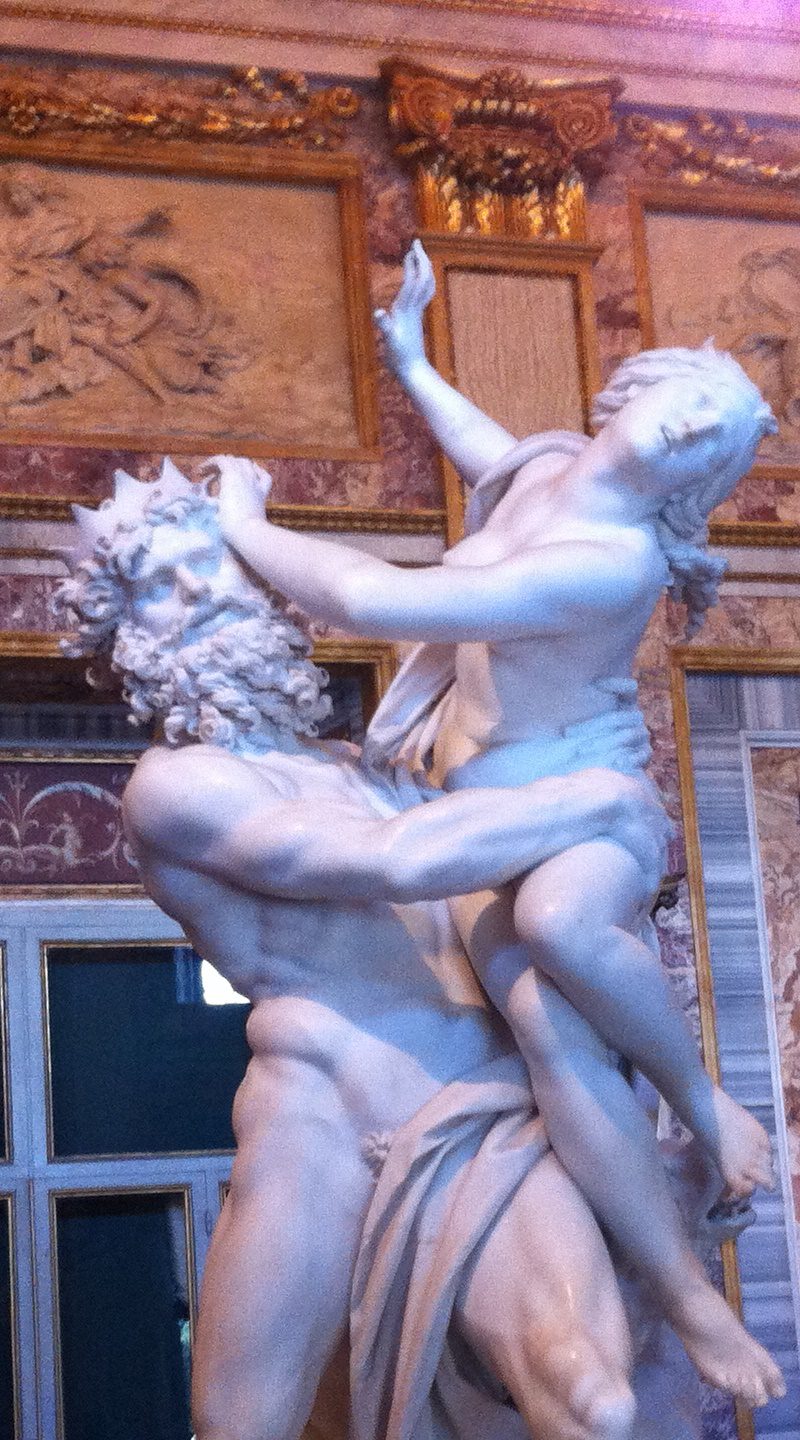
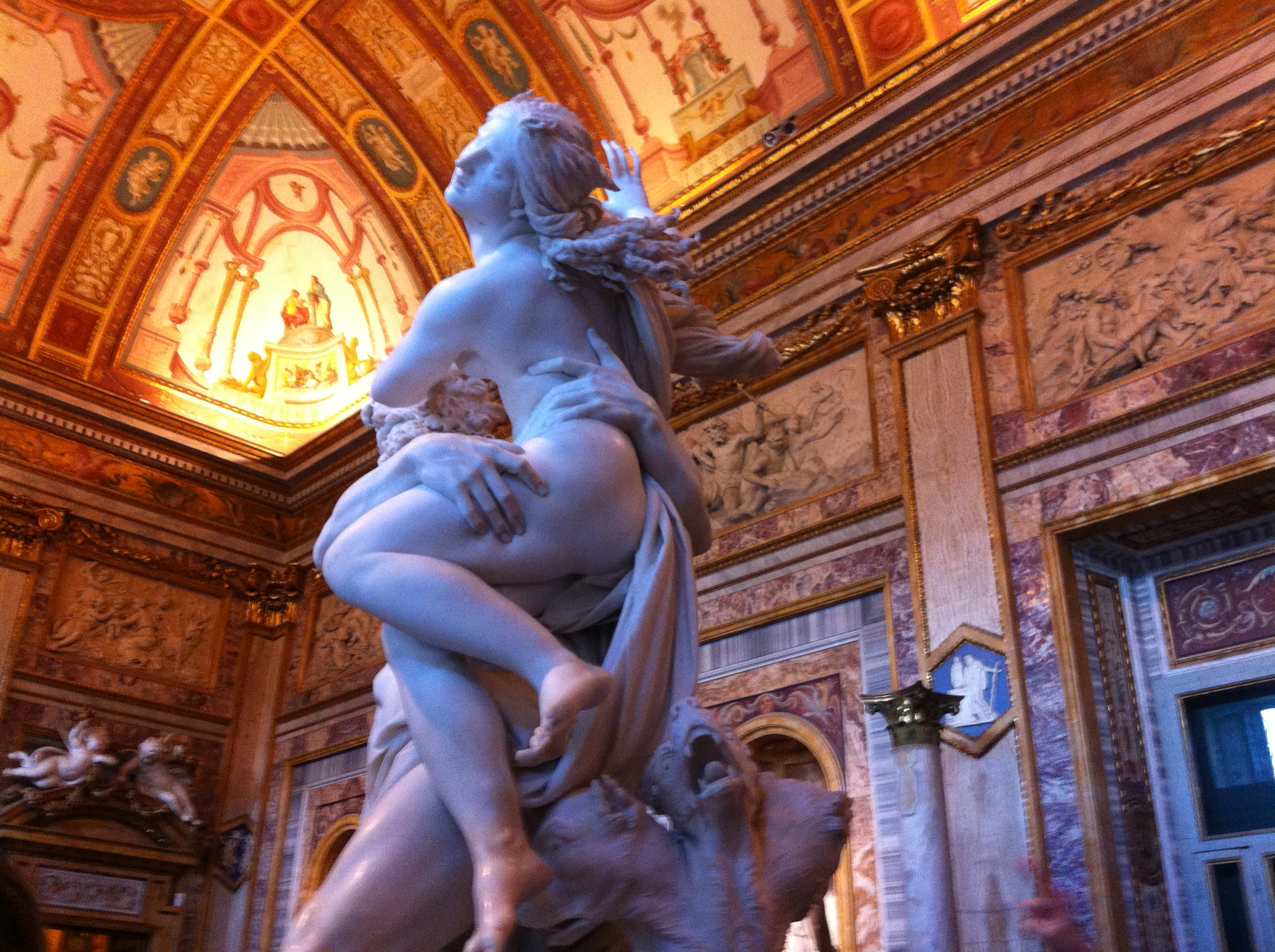
The first room featured a sculpture by Bernini, the Rape of Persephone (by Hades, the king of hell).  According to Mario, they “lived happily ever after.”  Really.

rape-of-persephone

Despite the repulsive subject, I couldn’t help but marvel at the lifelike bodies carved out of a block of solid marble.  Look at Hades’ fingers sinking into Persephone’s flesh.

rape-of-persephone-2

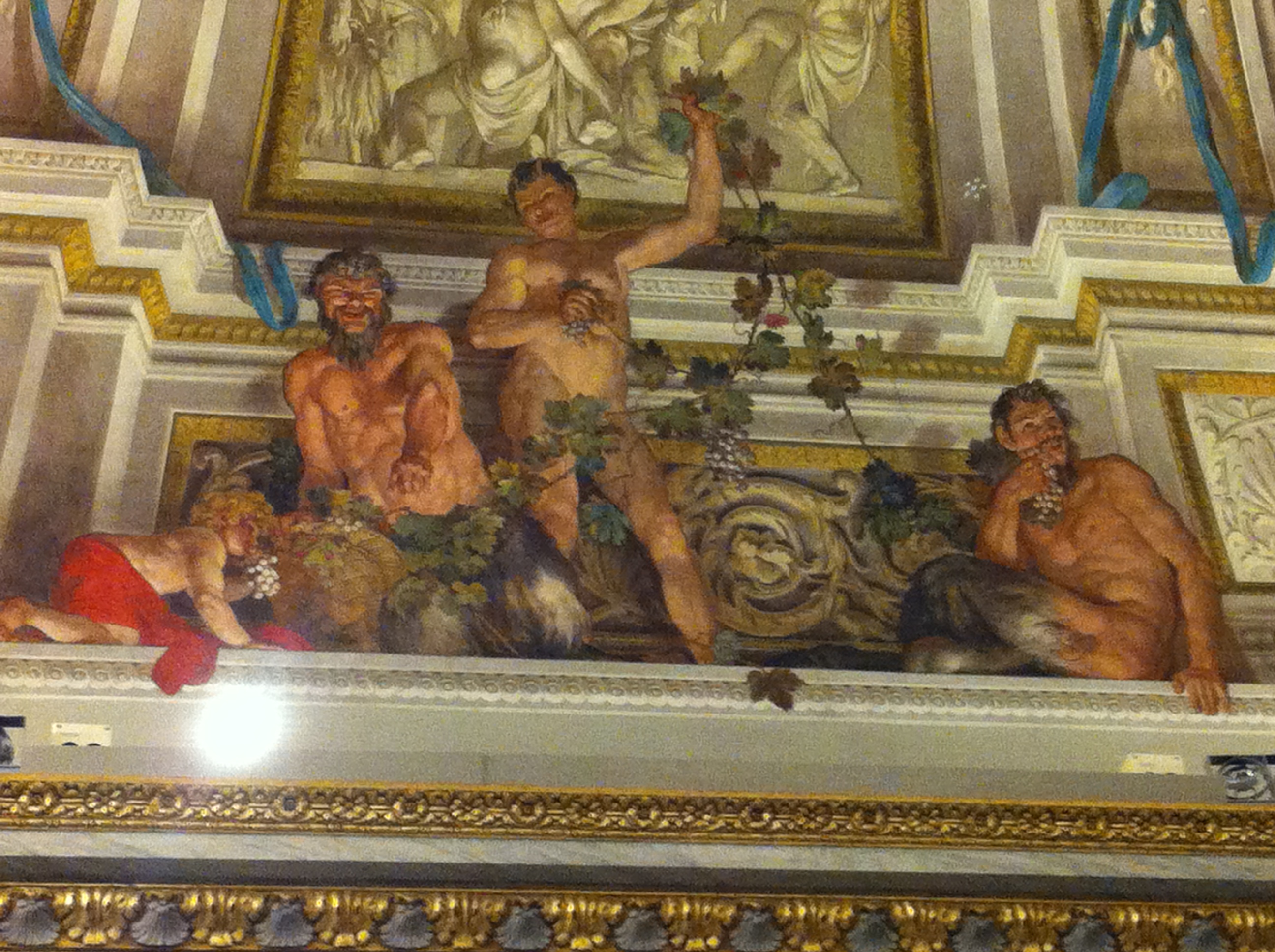
The Rape was the centerpiece in the room, but every inch of the room was covered with art.  Even the walls, floors, and doors were works of art because they had been painted to look like marble or other precious materials.  I wondered how much just one of the friezes above the door would be worth, and what anonymous artist had produced it.

In a hallway, there were these 3D murals on the ceiling:

3d

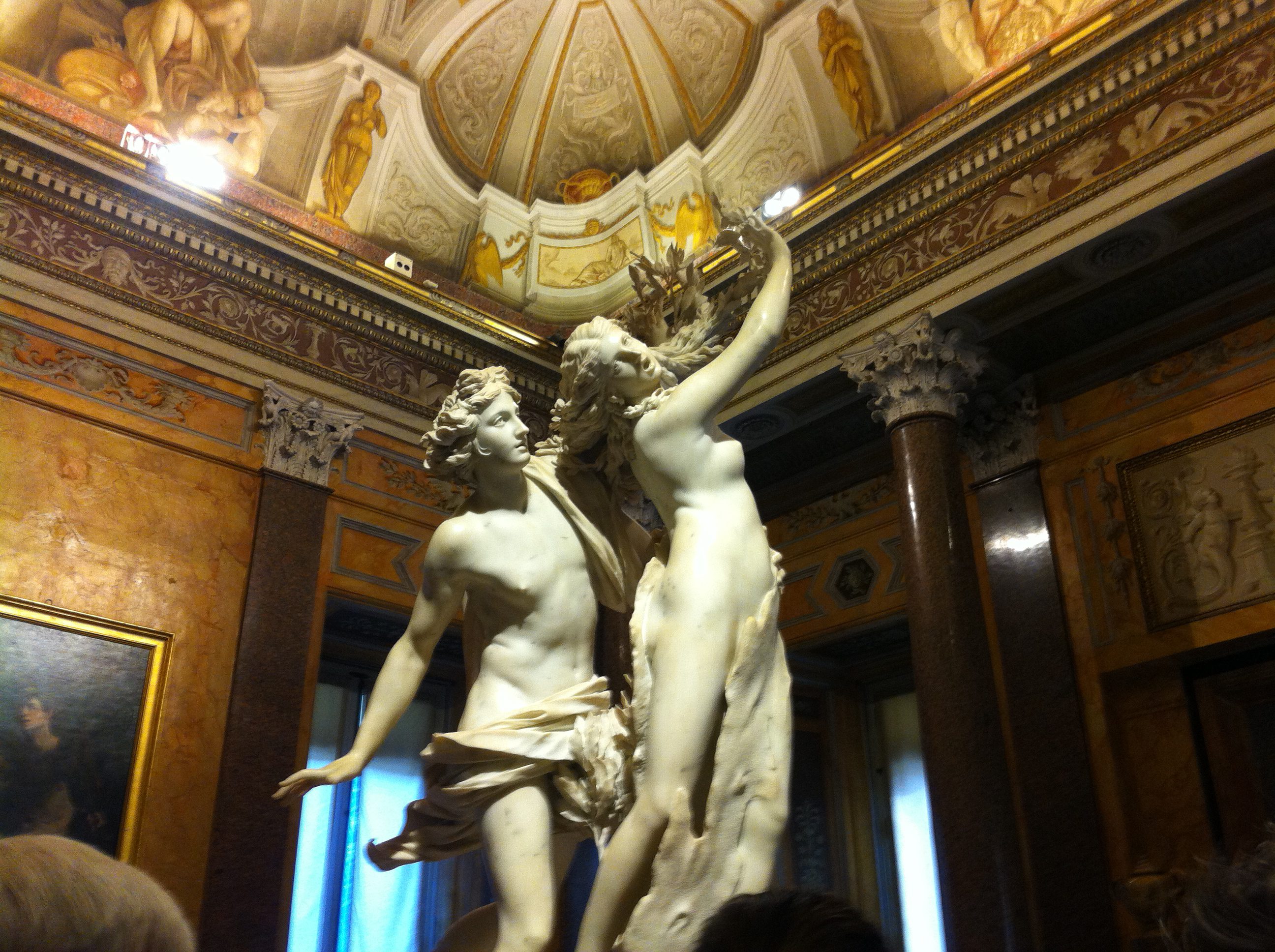
The next room featured another guy (Apollo), who couldn’t keep his hands off a woman (Daphne) who had said “No.”  She pleaded for help to her father, the river god Ladon; and he turned her into a tree.  How did Bernini know where to start?  How did he carve the arms and fingers without cracking one off?

apollo-and-daphne

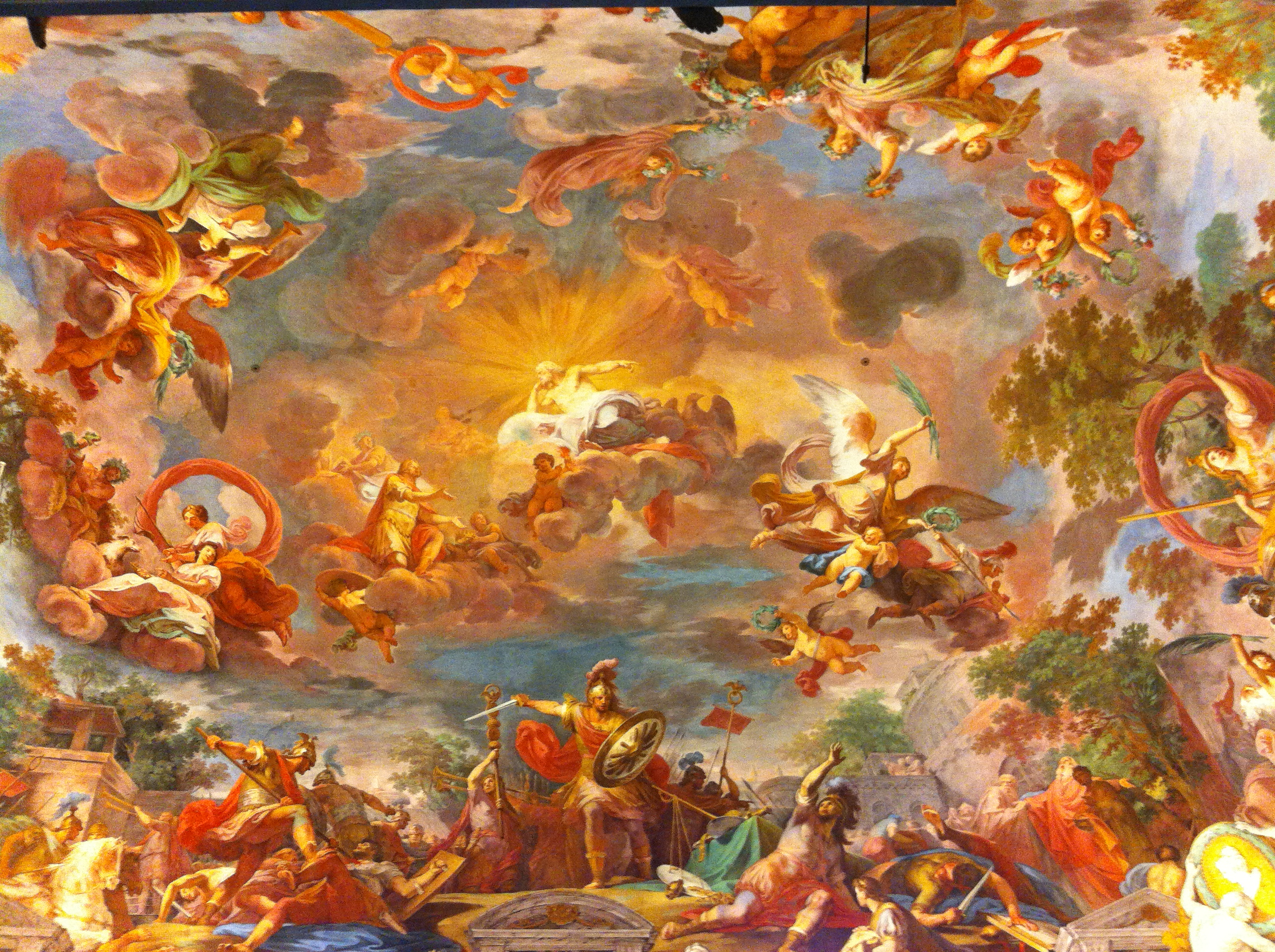
We passed through an enormous room that was closed for renovation, but we stopped to appreciate the ceiling; this is one small section:

ceiling

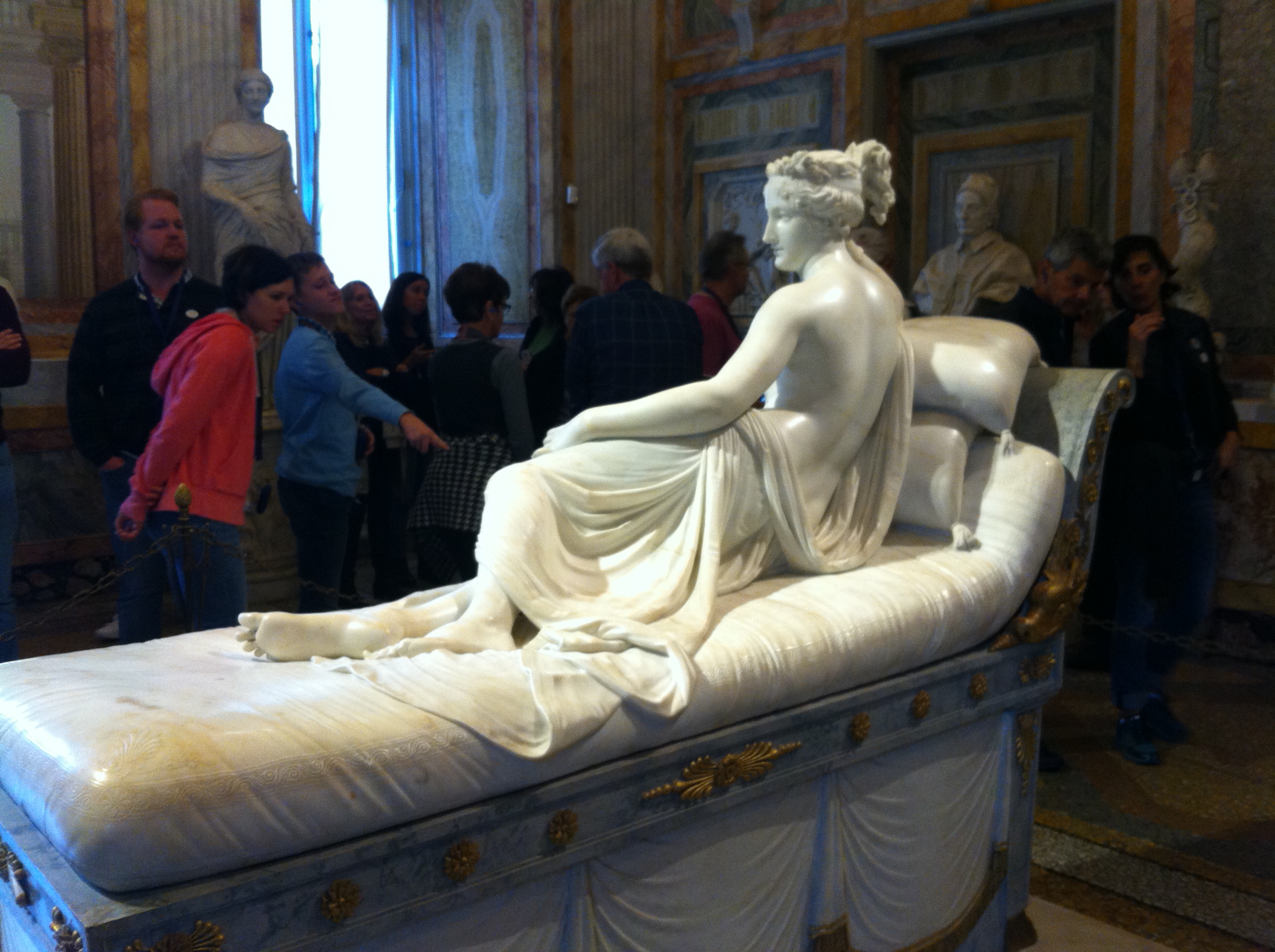
There was a sculpture of Napolean’s sister Pauline, who was married to a Borghese for the political alliance. Note the wrinkles in the marble “mattress.”

pauline-b

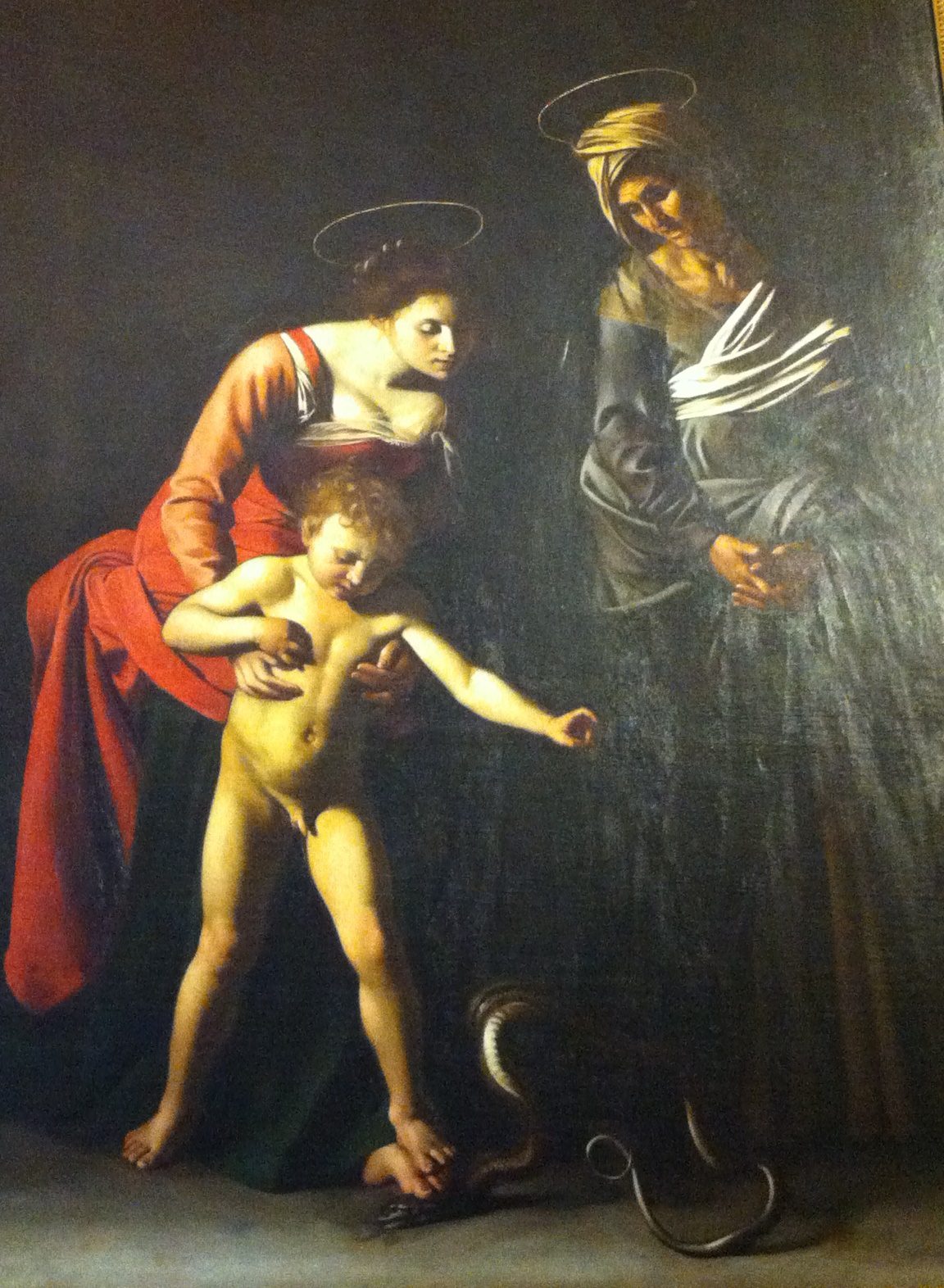
Then there were the paintings by Caravaggio.  This one had been banned because it depicted Mary with cleavage and was unflattering of her mother, Anne.  Full frontal male nudity, I guess, was not a problem.

caravaggio

Continuing along the rape theme, there was this painting of Susanna being raped by the elders.

rape-of-shoshana

The painting below depicts a virtuous vs. sinful woman. It’s not what you think—the naked one is virtuous because she isn’t hiding anything.  You know us women–always keeping important secrets from men.

virgin-whore

After an hour and a half, Mario said we could walk around by ourselves until our timed ejection at 2pm.  I had read about a statue by Bernini called The Hermaphrodite—female from behind, male in front. Mario had led us past it without comment and it was pushed against a wall—for modesty’s sake?  Was male nudity deemed unseemly when it was an adult?  But there were plenty of other statues of naked men throughout the gallery.  Was it because of the gender fluidity of the statue?

hermaphrodite

I had not expected to encounter these themes of rape, of women being objects for barter and use by men, and of the mixed attitudes toward nudity. Aside from The Hermaphrodite, I didn’t go looking for any of these works; they were highlights of the gallery featured on the tour. Mario didn’t interpret or make any sociopolitical commentary.

Open a newspaper anywhere, any day, and there will be stories about rape and human trafficking and women being killed by stalkers. I’m not one to say “nothing ever changes.” The world is safer and saner in many ways than it was four hundred years ago.  But art suggests that human nature, emotions, and impulses don’t change.


This Way to the ?

This is a series of posts about Italy, Malta, and Spain that starts here.  I’ll be posting every other day for a while until the travel posts catch up with real time.

After five hours in the Vatican Museum, St. Peter’s Square and Basilica were anticlimactic.  The square was … well, a square, and it was filled with white plastic stacking chairs.  There were also plastic ropes demarcating lines this way and that like you would see at Disneyland.  I didn’t bother trying to photograph it because there was no way to capture how big it was without plastic paraphernalia in the way.  St. Peter’s Basilica was … huge, of course.  Maybe, after the glorious collections of the Vatican Museum, I was just beyond being wowed any further.

I did make tremendous progress on a census of nuns and priests I had started upon my arrival.  But it was the Vatican, after all, and I lost track when I reached 12 nuns and nine priests in less than an hour.  This was more nuns and priests than I had seen in the previous 30 years of my life.  Almost all of them appeared to be from the developing world.

The hotel desk clerk had been right, there did seem to be a lot of Argentinians around, drawn by the Argentinian Pope.  I could hear Spanish everywhere.  Its cadence was like a relentless rat-a-tat-tat, whereas Italian was more circular.

This may sound cliché and insensitive, but it’s true.  I didn’t see one obese person aside from a few Americans, who were clearly distinguishable by their sloppy sweats and athletic shoes.  Why are we such slobs?  You can’t even go to an orchestra performance anymore without half the people wearing jeans and sweatshirts with sports logos.

By contrast, the Spaniards and Italians were impeccably dressed—the men with flawlessly-shined dress shoes, women in heels and skirts, everyone in black finely-tailored overcoats.  The women had clearly made an effort to style their hair and accessorize.  Many of the men wore hats.  Not baseball caps—real dress hats like real men should wear.  Boy do I sound old.

What did I wear?  I compromised comfort and style by alternating between two black and grey outfits topped by a silver puffer vest with zip-able pockets, one of which was inside; a secure stash for cash and cards.  I switched my Dr. Scholl’s gel inserts between black boots and a pair of black Coach shoes that were really trainers but looked dressier.

I took the subway back to my hotel, thinking I would nap but I couldn’t.  I boomeranged back out into the streets and wandered around, eventually eating dinner in a tiny ristorante where the first of many waiters asked, “Only one?”

I had a ticket for the next day for the Borghese Gallery, which I’d never heard of until I started reading “Top 10 Rome” lists.  The ticket purchase required me to choose a seat, as if I were going to a concert.  Sometimes just buying a ticket is an adventure in itself.

borghese-2

borghese

My emailed ticket listed three different entry times and an exit time, so I wasn’t sure if I had booked a tour, a concert, a museum, or what.

I got to there early which was good because the place was run like a Swiss clock.  I waited in line to exchange my emailed ticket for a fancy one:

borghese-3

I never saw this passageway.

I got into another line to check my coat and bag, which was mandatory.  Then, being sensible, I waited in line for the bathroom, then got into line for the tour.  All of this took place in a cramped underground room with a hundred other people trying to figure out what they were supposed to be doing.

Finally it became clear to me that the tour was mandatory—you couldn’t wander through on your own and you were required to leave at the time indicated on the back of your ticket.  We all got radio receivers with headphones so the guide could talk at a normal volume.  At precisely 11:10 am, my group—Group 11—followed our guide to a fifth and final line where a guard scanned our tickets and then on into the gallery.

Bits n Bobs n Dogs n Gods

This is a series of posts about Italy, Malta, and Spain that starts here.

As you might expect, the Vatican Museum contained hundreds of paintings of the Virgin Mary, crucifixions, and saints being burned at the stake, beheaded, and otherwise martyred.  I’ll focus on the non-religious treasures.

It was the off season, but still crowded.  Once inside, 99% of the visitors made a beeline to the elevator so they could get to the “main event”—the Sistine Chapel—asap.  My friend Lynn had told me that in their rush to get to the chapel, most people miss a splendid collection of art along the way.  I couldn’t remember exactly what she had written, so I just stopped and looked around.  Voila!  There was a massive spiral ramp leading to the same destination as the elevators.

None of my photos turned out, so you’ll just have to imagine a spiral ramp like in a parking ramp, maybe eight stories high, but instead of concrete it was made of marble, brass, and wood.  And it was lined with exquisite models of ships and boats.  I love maritime art, so I was happy although I was sure this wasn’t what Lynn had meant.

The display was meant to illustrate the world’s seafaring cultures over time, from the Phoenicians to Papua New Guinean headhunters, the Yoruba of Nigeria, Native Americans, the Vikings, the Chinese, the Spanish, the English.  The models at the bottom of the ramp were of birch-bark canoes with naked warriors holding spears, and as you walked up the boats became more sophisticated, their occupants wore more clothes, and they were armed with more deadly weapons.

I had it all to myself.  I felt lucky but a little sad.  Some anonymous team of historians, art curators, and skilled model builders had devoted years of their lives to telling this story, and hardly anyone knew it existed.

At the top of the ramp I rejoined the crush of visitors pressing on to the Sistine Chapel, but then I diverged when I noticed a room full of statuary.  Was this what Lynn had meant?  There were no placards describing who they were but they looked really old.  I know that sounds dumb—everything in the Vatican is old—but I decided to believe that these were the treasured works of art that everyone misses.  Everyone except me, ha ha.  There was nothing about them on the map, but I did notice that there were about 30 rooms between me and the Sistine Chapel, and suddenly I didn’t feel so smart.  I glanced at each statue for a couple seconds, then scurried on.

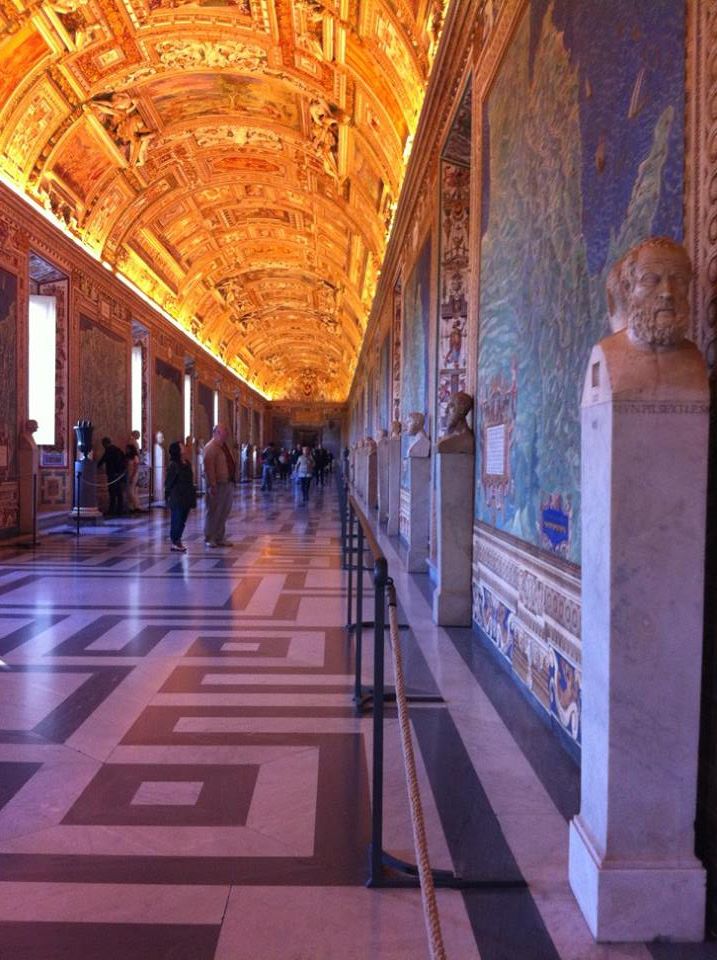
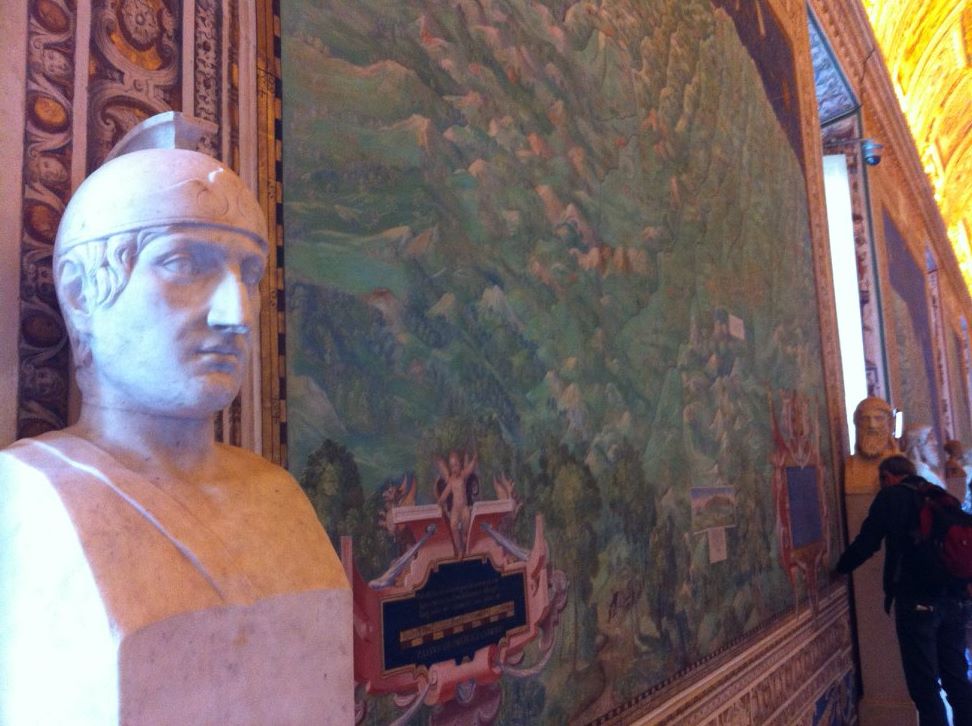
The map room was what its name implies: a room filled with maps of all the Italian regions.  My photos won’t do it justice, but you’ll get the idea. This was the room where they plotted empire.

map-room-vault map side-view

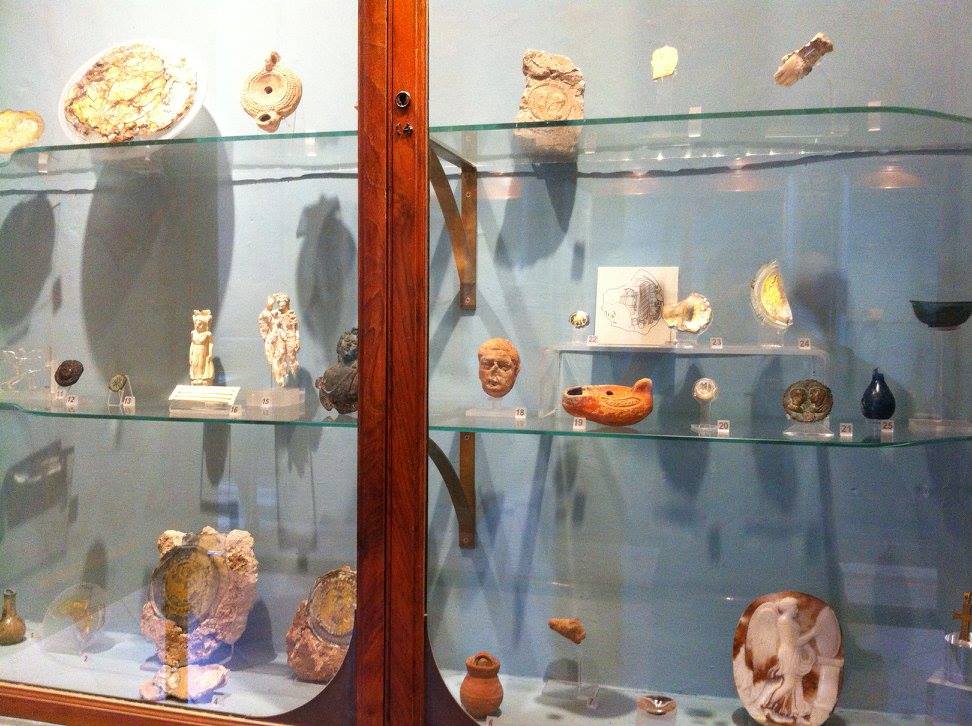
Next were the rooms I’ll call the “Bits and Bobs Collection,” room after room with cupboards full of ancient glass, pottery, coins, etc.  I could imagine some flunky saying to his superior, “Your holiness, what shall I do with this pottery lantern?  It’s only from the Roman period.”

“Oh, throw it in a cupboard in the back room with all the other bits and bobs.”

cupboards bits-and-bobs

This 1510 map was in the bits and bobs collection.  Do you recognize it?

map-of-us

There were rooms crammed with art depicting animals.

animal-room

After several hours I managed to find the Sistine Chapel.  I would love to be one of the guards who stand on a platform and yell over and over, “No photos!”  You’ve seen art from the chapel a hundred times, so I won’t write about it.

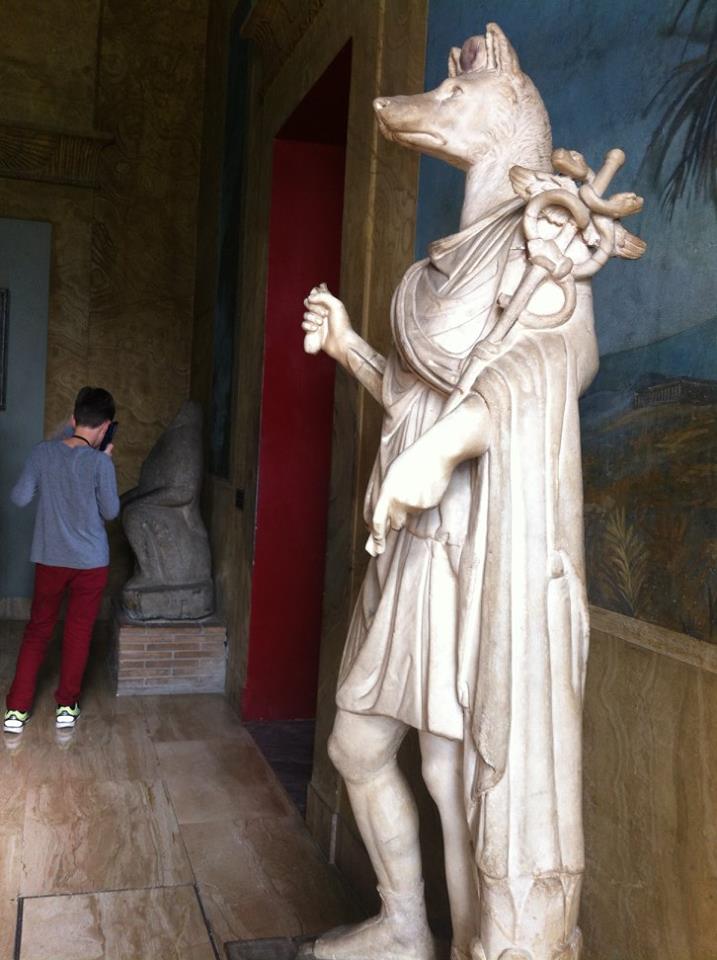
Next up: the Egyptian collection.  My favorite was Anubis, the dog god and perhaps the world’s first palindrome.

anubis

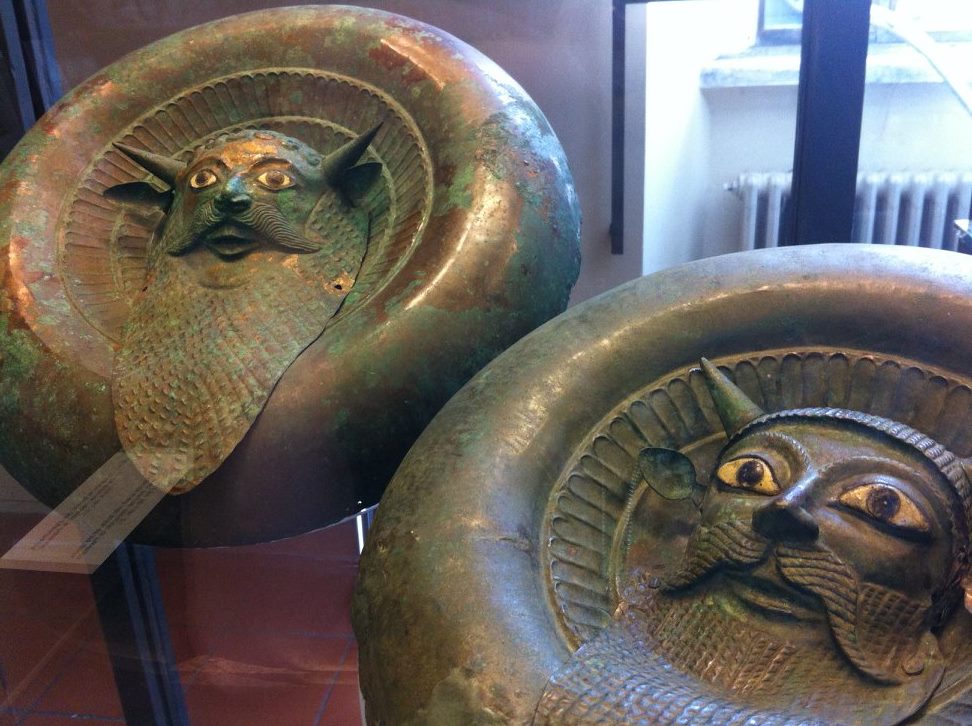
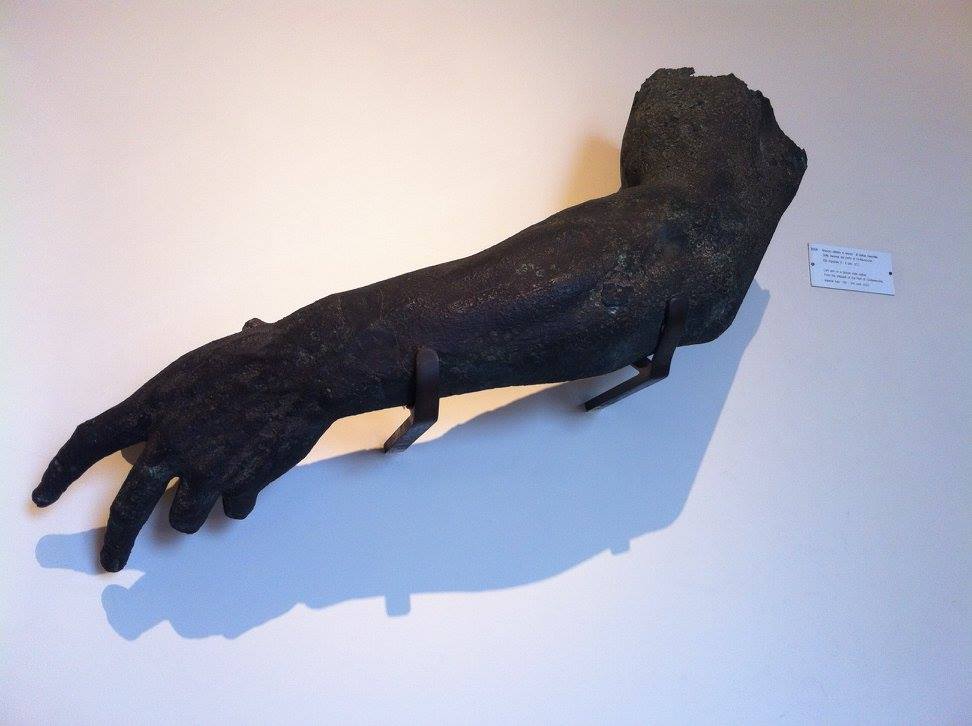
Lastly was the Etruscan collection.  Not much is known about this civilization that founded Rome, and even less was provided in signage at the museum.  I learned that they were the “bridge between the Romans and the Celts,” but what does that mean?

etruscan-eyes etruscan-arm

It was 2pm; I took a break to enjoy the views from the windows, ate a protein bar, then exited and walked toward St. Peter’s Square.

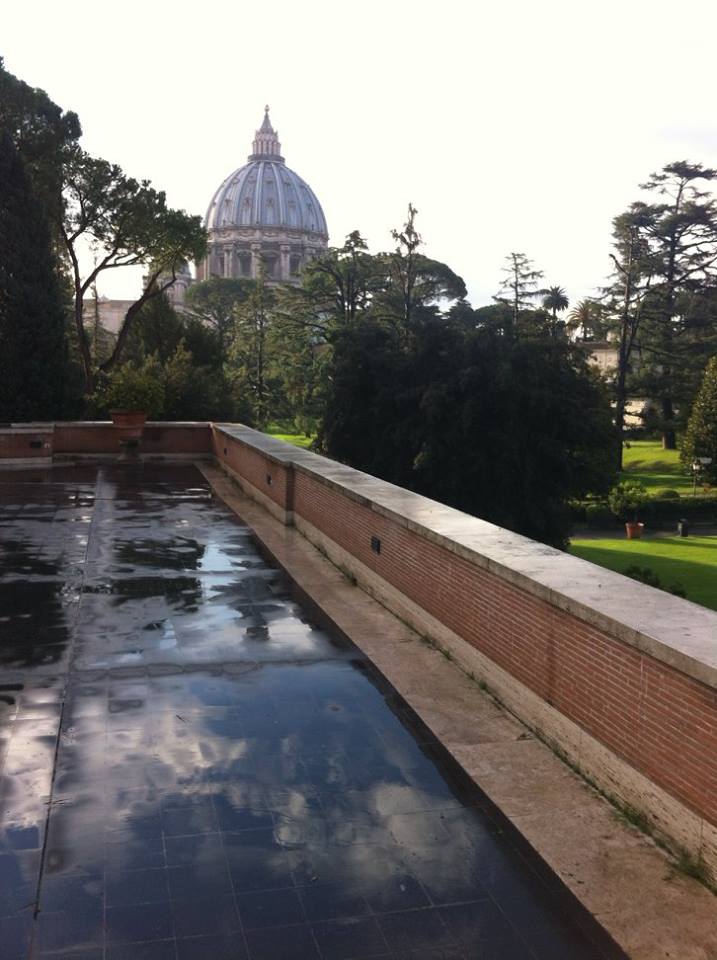
view-from-vatican st-peters-dome