Tag Archives: prison industrial complex

Me, Mom

Before I continue to the exciting conclusion of the road trip, I am sharing this post from Vince’s blog he wrote for Mother’s Day.

Mom, I know I’ve let you down. Over, and over again I’ve made a mess of my life and brought both of us shame.  There were years where you were unable to explain my whereabouts to family and friends, and times where you yourself didn’t know where I was. I’ve put you through more pain and distress than I care to recall.  I’ve not been a son to you for many years, and I have lost your trust far too many times.

But for some reason, you still love me. It’s an unconditional love that I’ve felt nowhere else. Even recently when we didn’t see eye to eye when we lived together, there was never any doubt that you loved me.  I wish I could promise that I will never be lead astray again by the temptation and allure of alcohol and the world of drugs, but I cannot because it’s the nature of the disease that I am always at risk of going back. Tomorrow, when we go out on our secret trip to an unknown location for Mother’s Day lunch, I will be repairing some of the damage I have caused. I will be repairing the bond that had been broken for so long as a result of my actions. I have nobody to blame but myself, which leaves only me to clean up the mess. And so far, I think it’s working.

It’s hard work, searching inside myself to figure out what’s been broken for so long. But through writing this blog, attending A.A., and working with a sponsor, I’m starting to change my life. I no longer do these things to avoid going back to prison, I do them because I want to be out here living life and being with my family as much as I can.

Although you had help from some family members raising me for a small portion of my childhood, I know that you were solely responsible for bringing me up and I know that you not only did the best you could without a father present, you truly were an amazing Mother, I just didn’t see it until later in life.

You imparted upon me how to be a good, loving person, and it took me about 20 years longer than it should have to recognize that. The things you showed me are the things I strive to emulate now because I know that they are righteous, moral, and honorable.

It doesn’t get any more honest than that. You were instrumental in keeping me sane throughout my prison term. You wrote to me, sent me money, and answered my calls. Not everybody is as lucky, or has a person that loves them no matter what. You moved just to accommodate me living with you when I got out, and I am so grateful for that. I may not have acted like it when I lived there, but that was because I was ashamed of myself, and I shut myself in my room, and my own little world where I felt comfortable. I’m breaking out of that shell slowly, and I won’t forget that it’s because of you that I’m even out here in the first place and had a warm safe place to sleep. Sometimes it takes a while to realize what I have to be grateful for, but eventually it comes.

Tomorrow is your day, and I’m excited that I have the ability to take you out for the day, and the means to make it happen. I think this will be the best Mother’s Day we’ve ever spent together, and I look forward to many more.

Mom, I know I’ve let you down. But I’m going to make it up by becoming a good son, and making up for all the hurt I’ve caused. I love you, Mom.

I told Vince, over the sushi feast he had planned, that I appreciated the post. I also told him that by changing his life, he is making amends to me and he never has to apologize for his past actions again.

Sushi n MeSushi n V

Jim Crow, Old and New

This is the latest in a series of posts about a road trip from St. Paul to New Orleans that starts here.

If you don’t learn something about yourself when you travel … well, that’s okay—I’m not going to sermonize—but I was pleased to learn something important about myself in Memphis.

In the morning, Lynn and I took a walk along the riverfront, which is beautiful:

memphis_riverfront

We walked back to Beale Street, found a restaurant, and ordered breakfast. We were excited to try southern foods like grits and biscuits.  We waited, and waited.  You could say this restaurant put the “wait” in waitress.  She kept coming by and giving us a dose of another southern treat—calling us “honey”, “sweetie”, and “darlin’” as in: “Your food’ll be up in just a minute, darlins’”

It seemed like half the morning passed away before we got our meals, then we wolfed them down and headed over to the National Civil Rights Museum.

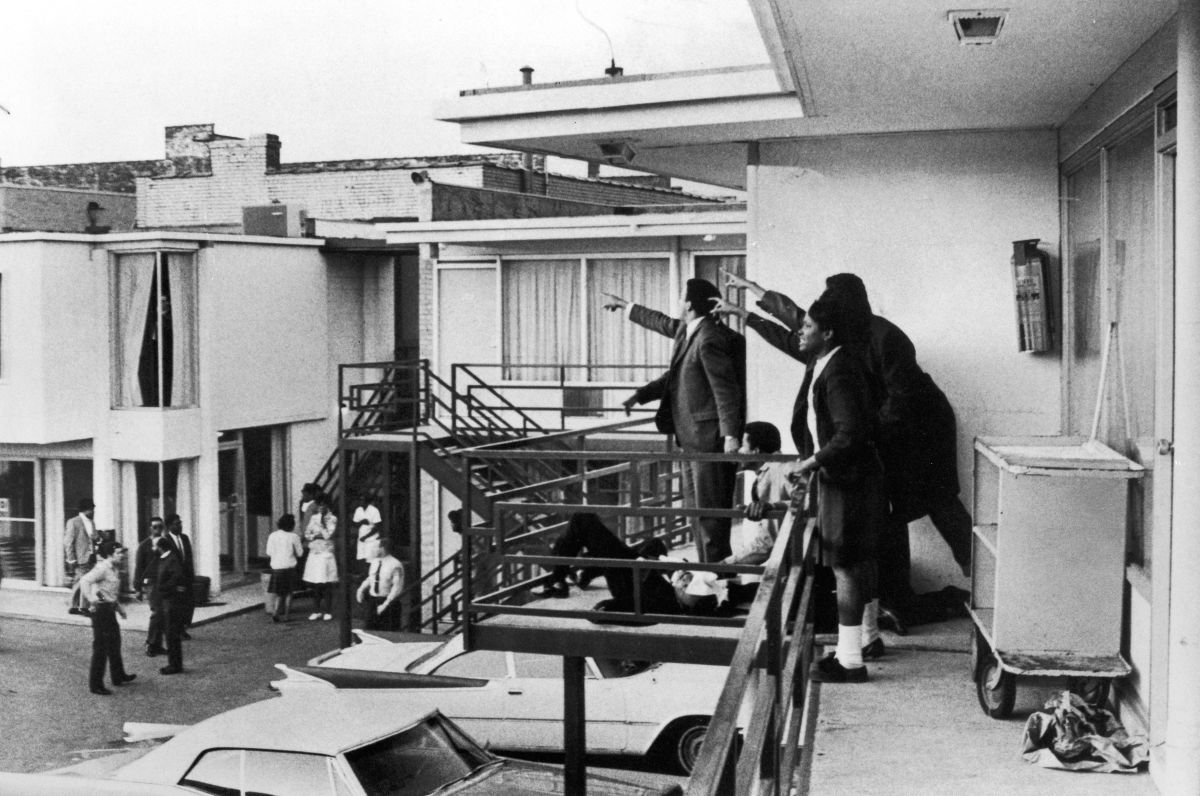
It was difficult to find—there was no signage—but then we turned a corner and there it was, the former Lorraine Motel where the Rev. Martin Luther King Jr. was assassinated.  I recognized it immediately, having seen it a hundred times in iconic photos.

TENNESSEE, UNITED STATES - APRIL 04:  Civil rights leader Andrew Young (L) and others standing on balcony of Lorraine motel pointing in direction of assailant after assassination of civil rights leader Dr. Martin Luther King, Jr., who is lying at their feet.  (Photo by Joseph Louw/The LIFE Images Collection/Getty Images)

And this was the beginning of learning something about myself, because I got so choked up I had to turn away so no one would see me in tears.

I have been to Holocaust museums in Washington, DC; Jerusalem, Berlin, Prague, Chicago, and elsewhere, and they’ve been tear-filled experiences too.  But then, I’m Jewish.  Were my tears only because the story was about my people?  That fear—that I only felt empathy for my own kind—was laid to rest in Memphis.

Can a Man

I wiped my tears away but they welled up continually inside the museum, which was one long, sad horror show that traced the abuse of African Americans from slave days up through the assassination in 1968.

There was a large group of school children, mostly African American, going through with docents.  I wondered what they felt seeing Africans in chains, the police dogs, the fire hoses?  If it was my kid I would want to be on the tour to put my arm around him.  There was the usual laughing and fooling around that any group of kids will exhibit, but I wondered if they would have trouble sleeping that night.

I commented to Lynn, “A coworker of mine at Oxfam used to find every opportunity to mention, ‘the UK never had slavery’ in a superior tone.”

“We may not have had slaves in the country, but we certainly benefited and participated in the system,” Lynn replied as we read a display about how global the slave trade was.

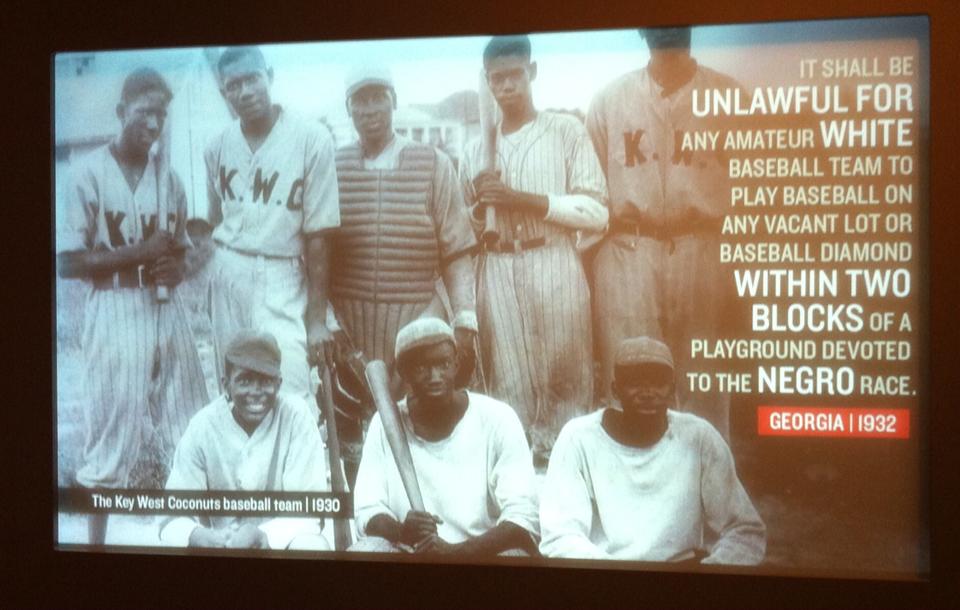
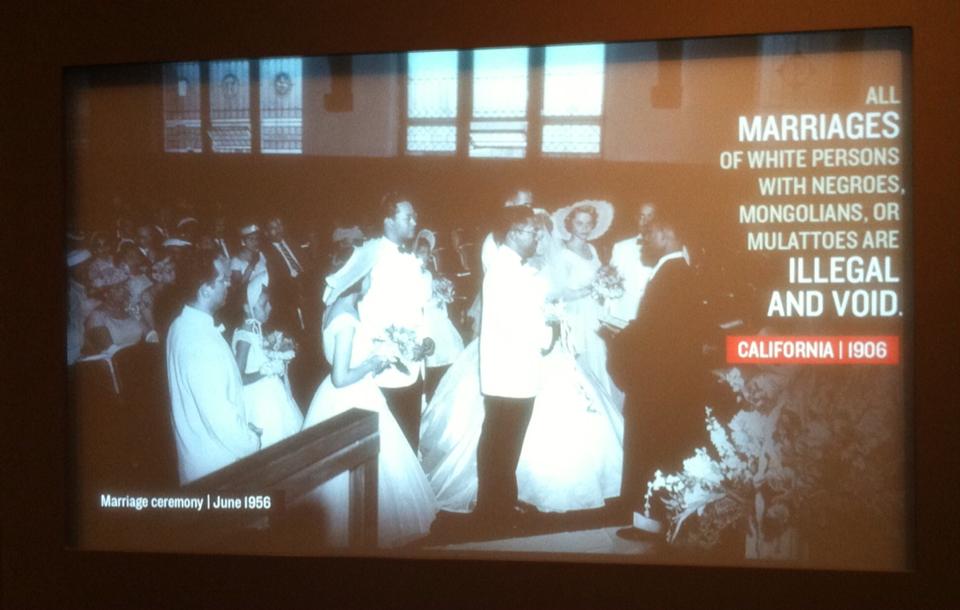
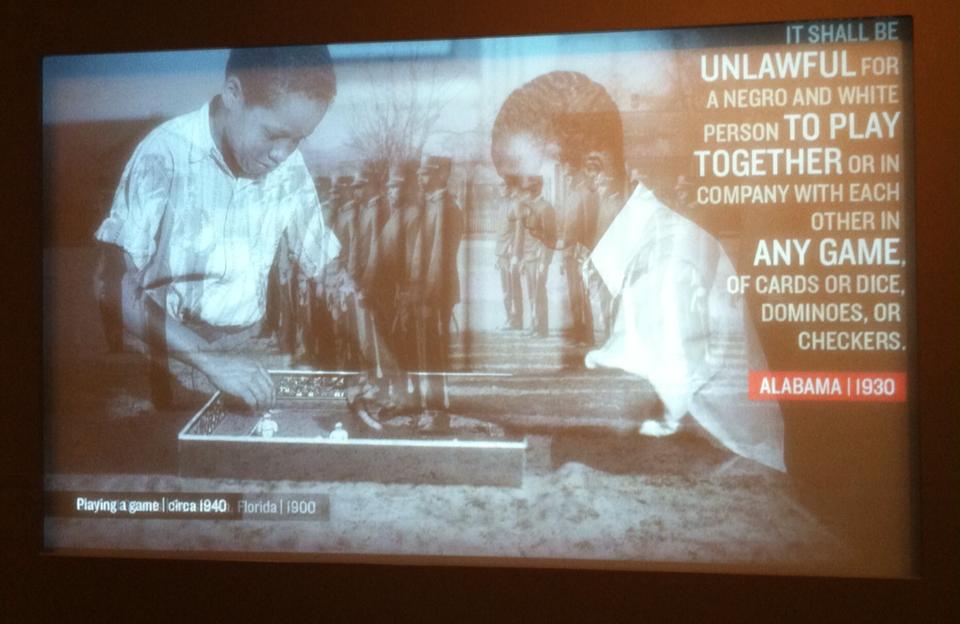
And of course it didn’t end with the abolition of slavery.  “Jim Crow” was the system in the southern United States from reconstruction up through the civil rights era in the 60s that kept “negros” in their place.  Here are a few of the ridiculous laws from that time:

Baseball Law Mulattos Checkers

Really?  Checkers!?  Who knew checkers could subvert the social order?

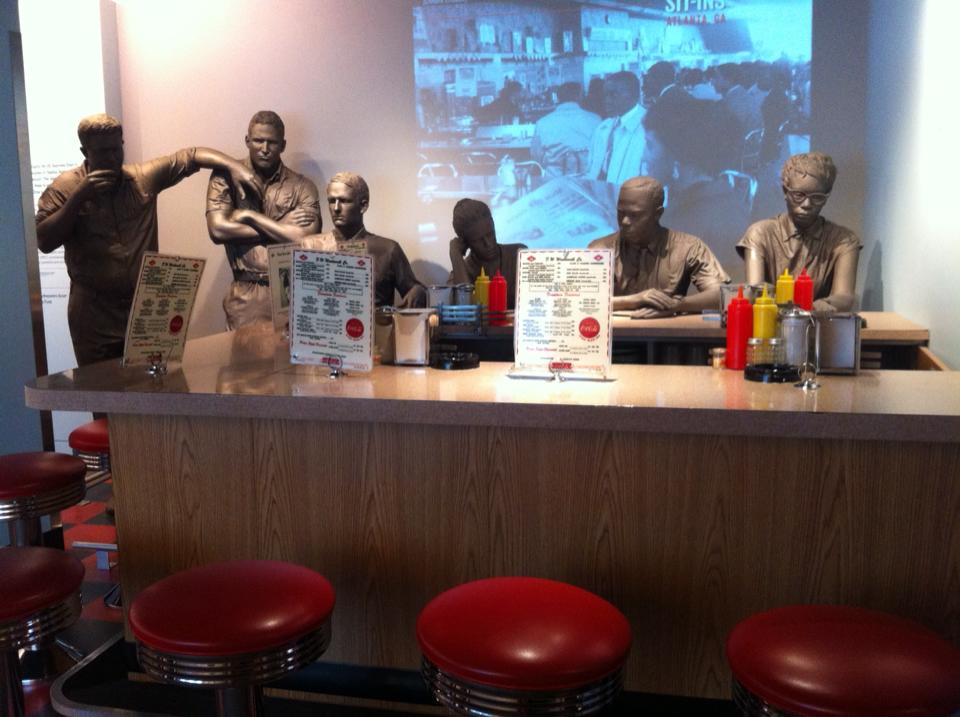
Then we marched slowly through exhibits about bus boycotts, lunch counter protests, and strikes.  Then there were the cross burnings, lynchings, and bombings by white racists; somewhat counterbalanced by the support of white and other allies (including Jews).

Lunch Counter I am a Man Bus Boycott Activists

I watched a video about James Meredith, the first black student to be accepted to the University of Mississippi, in Oxford Mississippi.  Of course he hadn’t mentioned his race in his application, and when he showed up to enroll all hell broke loose.  After weeks of rioting by whites, which resulted in two deaths, he was reluctantly let in, and as Lynn read later, he did graduate and lived a normal life afterwards.

The museum was really well done.  There was a second building that explored African American activism post 1968, but after three or four hours in the first building we had to leave.

Last week Vince and I talked to a group about mass incarceration.  One of the audience members referred to it as the New Jim Crow.  I agree, although in my opinion it’s about poverty, addiction, mental health, and class as much as racism.

Time to Make a Move

Greetings from Oxford, Mississippi! This is a post written by Vince about his move. It will be bittersweet to come home to an empty house.

Time to Make a Move

Just shy of seven months as a free man, I am happy to report that, as a 37-year-old, I am moving out of my mother’s home. Again. Maybe for the fourth time in my life, and hopefully for the last.

I alluded to this in my last post but not before because I didn’t want to get overexcited about it until it was actually approved by my agents. Now it is official, and I can proudly relate this information to you: I AM MOVING!  Just two short days from now.

I have written about this move before, but as a failed attempt at leaving the nest possibly too early.  I’m moving into a house with two sober guys from the program, one of which I was in prison with, and I’ve worked with for some time. He no longer works with me, but we remain friends. I don’t know the other guy, but he’s sober, and that counts for a lot.

I’ve been to see the house once.  It’s small as you can see in the picture, but I’ll have my own room, so it isn’t like a sober house environment. There isn’t a house manager that watches over us, or anybody to give us random shakedowns and breathalyzers. I have my agents for that. This is a step forward.

V's House

It couldn’t come at a better time, in my opinion, as I will be moving on to the next phase of Intensive Supervised Release program soon after. That will open up a lot more time that I can spend doing things I want to do like go to more meetings, and spending more time with my family. I am also finishing the last three hours of my community service this week.

It’s all lining up.  Everything is going well in so many ways.  So I need to be really careful. For somebody like me, good news can be all I need to trick myself into thinking I deserve a reward.  Maybe I can go out and celebrate with just one drink, or just a little crack (“A little” crack doesn’t actually exist. It’s an all or nothing drug. For more information, go here). I mean, at this point I’ve built myself a pretty good network of people that I can reach out to if the urge hits me, but it’s always good to layer on the protection.

This disease of mine can also be described as an allergy. When I drink or do drugs, things just go haywire. My body responds differently to them than normal people.  Also, my allergy in particular is a little more severe than say, a gluten allergy. Oh, also I don’t believe that’s a real allergy, but I’m not a Doctor.  Anyhow, let’s say that somebody with a gluten allergy accidentally ingests some flour. Well, maybe an hour or so later, they fart a little and that causes some slight discomfort or embarrassment. Well, when I ingest a little alcohol, or maybe some meth, my world flips upside down.  I can no longer take care of myself financially, mentally, or physically. And this allergy affects others, too.  For example, if I smoke crack, you may no longer have a television, and some of your smaller valuables may go missing as well.

Simply put, chemicals make me not give a fuck about you or me.  And I’d really like to avoid all of that so that’s why I’ve immersed myself in this program of Alcoholics Anonymous. I’m not worried about relapsing because of my new place and my new freedoms, I’m excited to see what I can do with them.  And I’m really happy to be able to share this with you people. For you that are new to this blog, I encourage you to see where it all started almost two years ago with just five pieces of writing paper and a 3” flexible safety pen behind the unforgiving bars at St. Cloud Men’s Reformatory/State Prison.

Telling It

It’s always difficult to transition back to current life after writing a series like the last one about camping in Wales and Mini extravaganza.

I love traveling, and then I love coming home—so I can start planning the next trip. When you read this, I will be in Chicago on my way to New Orleans from Minneapolis/St. Paul.  Live blogging a road trip sounds good, but I really just want to be there, in the moment.  My friends are coming all the way from Scotland, Oxford, and Wisconsin—I think it would be rude and weird to say, “Sorry guys, I’ve got to rush back to the hotel to write a blog post.”

But it’ll be fun to write about afterwards; travel writing is a way to enjoy the trip again.

A few updates, and back to the other theme of Breaking Free, my road trip with my son through the worlds of mass incarceration, addiction, and redemption.

I saw a notice for a lecture at the U of MN by Dr. Christopher Uggen, Martindale Chair and Distinguished McKnight Professor of Sociology and Law.  It quoted him, “We think of probation as a humane alternative to incarceration. It’s not.”  This is a concept I can’t emphasize often enough—just because you’re out of prison now, doesn’t mean you’re “over it.”

So I was a little concerned about Vince talking with Jewish Community Action, a local group advocating for prison reforms.  I had shared the blog with them, and they invited Vince and me to meet with them, which we did a few days ago.  It happened to be in the same building as Vince’s probation agents.  Would he be “triggered” by rehashing his story?  He still seemed uncomfortable in social situations sometimes.

We met with a young woman named Angela, who listened intently, asked questions, and filled us in on their plans. She talked about the changes they want made to sentencing, and Vince had some insights she hadn’t been aware of.  I can’t explain what he said, but the depth of knowledge you gain about these things by actually being inside is like a mini master’s degree program.

She talked about how they are trying to block the privatization of the prison in Appleton, Minnesota, which has been closed for years.  It wasn’t true, she said, that it would create a lot of jobs, or that conditions are better in private prisons.

“Word is,” Vince said, “among the prison population, that conditions are much better in the private prisons.  Better food, better paying work, more activities.”

This took her, and me, by surprise.  “I wonder if there’s a marketing campaign to spread that idea,” I suggested.  “After my experience with paying for phone time and email, I know those companies are good at promoting themselves.”  But how could anyone get access to the population inside?  I was Vince’s mom, and it had been maddeningly hard for me to communicate with him.

Vince talked about prison drugs (common) and rape (uncommon), MyPillow and Bob Barker products, not being able to vote, and his terms of probation.  It was very relaxed, and I give a lot of credit to Angela—turns out she was a former social worker.

Vince had told us he had to be home at 6:30.  Suddenly Angela said, “I just remembered that clock is slow …”  It was 6:21.  Vince jumped up, ran down the hall and waved at his agent, then bolted out the door.

Later, at home, he said, “I could have talked for hours.” I was so proud of him.  He’s doing so well.

He’s doing so well, in fact, that he announced he may move out soon.  Another ex offender lives in a three-bedroom house that has an opening.  The landlord is accepting of ex offenders.

I felt sad.  I know it’s normal for a 37-year-old man to want to live on his own, and I fully support that.  It was really rocky in the beginning when he came to live here.  We had been separated by miles and drugs and prison for so many years.  Now we get along fine.  I enjoy having him around.  He could do more cleaning, but no one’s perfect.

Updates Part II

In the prison good news / bad news” category, I’ve got some doozies.

First, I was highly amused to read about a brilliant project in which prisoners create portraits of people they think should be in prison. This was in The Guardian—a liberal British newspaper that reliably reports on the most embarrassing elements of American life:

“To find the artists, the activists approached art rehabilitation programs in prisons, but those groups were not interested in being involved with something political. So the pair turned to eBay, where there is a section devoted to art made by prisoners and sold by family members. They found similar prison art networks on Facebook and began conversations with the families of people whose worked they liked. From there, word spread around prisoners and other artists began sending them work.”

No surprise, they’ve captured (ha ha) the usual suspects (ha ha ha) in art: the Koch brothers, Goldman Sachs’ Lloyd Blankfein, BP’s former boss Tony Hayward. But then there was the CEO of one of my favorite companies, along with Pillow King and Bob Barker Inc. (that’s sarcastic, in case you can’t tell): JPay.

I was disappointed to see that the guy’s name is Ryan Shapiro. He must have a Catholic mom and a Jewish dad. I hate to see stories that reinforce the stereotype that Jews are better at making money than most people. Exploiting—oops, I mean “providing services” to prisoners and their families is very, very lucrative.

JPay Prez

Speaking of Jews and prison, a local organization called Jewish Community Action (JCA) has taken up two prison-related issues:

“Jewish Community Action is currently working on two campaigns related to criminal justice reform and the impact of mass incarceration: One addressing the for-profit private prison system and seeking to push back on the building and opening of private prisons in Minnesota, and one demanding the restoration of voting rights to felons who have completed incarceration and are living and working in their communities.”

I wrote to the executive director and shared the link to this blog. I can’t remember exactly what I wrote; I share the blog with a lot of similar organizations and usually hear nothing back. I mentioned that we’re Jewish and that we’d be happy to support their efforts if we were able. The executive director and two staff members replied—first, to assure me that ours is not the only Jewish family that’s had a run-in with the law or the prison system and second, to ask if Vince and I would come in and meet with them. That will be in a couple weeks and I’ll write more after we meet.

I am not a big fan of Oprah; I have nothing against her but she tends to promote books like The Book Thief, which I regard as one of the most poorly-written books I’ve ever read. But she is currently promoting a book written by an ex offender, Shaka Senghor, called Writing My Wrongs: Life, Death, and Redemption in an American Prison. Next week, Oprah will air an interview with Senghor on her network, OWN TV. I haven’t read the book; I’m only mentioning it because it’s written by an ex offender.

I’ve only ever read one prison memoir, and I can highly recommend it: Willow in a Storm, by James Peter Taylor. The writing is just okay, but the story is harrowing and heart breaking and he tells it real.

Finally, there is this (in the end) uplifting story about Albert Woodfox, who spent FORTY YEARS in solitary for the murder of a prison guard at Angola prison in Louisiana.  He maintained his innocence all these years.  He was released on his 69th birthday.

Updates

Travel, addiction, prison … sometimes I feel I have to justify why I write about these seemingly unrelated topics. How about this: they all fall under the meta theme of “feeling trapped, or just bored, and wanting to escape.” There—does that explain it?

I was at a big work meeting and we were discussing human rights in the countries where we operate in the Middle East and Africa. Someone said, “What about solitary confinement? Shouldn’t we be advocating against it?” Everyone clamored in agreement. As far as I know, I am the only employee with a family member who has actually been in solitary. I was tempted to raise my hand and make a speech about how, if we decided to advocate against solitary confinement, we’d damn well better include the United States. But I didn’t feel like being a spokesperson for prison reform that morning.

Vince is off lockdown, after a month of confinement to the house except for work and AA meetings. It may not sound that bad—after all he had Facebook and phone to communicate with friends. He could binge-watch movies and cook real food and look out windows and take a shower without 50 other guys around. He had a pretty good attitude toward it, but I know he was really chaffing toward the end. He had steadily been earning freedoms after his release, then they were all taken away. The offense was so petty compared to the consequence. Most of all, he just had no power or choice about his comings and goings.

Regardless, it’s over now, and today we are doing a make-up birthday outing for me—going to hear the Minnesota Orchestra play the entire score of Sgt. Pepper’s Lonely Heart’s Club Band, accompanied by some Finnish choir. I expect it will be either fantastic or dreadful.

Nothing has happened with the Sentencing Reform and Corrections Act of 2015 in the five weeks since I wrote about it and about how Republicans are using its bipartisan popularity to shove in language making it harder to prosecute corporate criminals.

Then there’s the controversy swirling around The Violent Crime Control and Law Enforcement Act of 1994, which is being blamed for creating mass incarceration. Bernie Sanders says he only signed it because of the good stuff in it, even though he disagreed with the sentencing parts. Hillary has been confronted by Black Lives Matter activists about ruining millions of Black people’s lives because she voted for it. Bill Clinton has disavowed it—his own law. I give him credit for that, even though it may only be a political tactic. Ugh. I would have to write five more posts to get to the bottom of that one, if I ever could.

Anyway, a poll from Pew Charitable Trusts shows that all Americans—Democrats, Republicans, Independents, men, women, Latinos, African Americans, seniors, young voters, and even law enforcement households agree we need to fix our broken federal prisons system. If you’re an American and you agree, please sign this petition urging Congress to pass the Act now. These are all the celebs who are endorsing the call for reform.

new_Cut50_Celebs-04_REVISED-900px

A lot of what I do in my job involves raising funding from foundations. I was happy to see that 42 foundations have banned the box on their employment applications that asks, “Have you ever been convicted of a felony?” This is really only symbolic, since foundations have abysmal records of hiring people of color or even just people who aren’t wealthy and well connected. But they are calling on all philanthropic institutions to follow suit, so maybe it’ll catch on.

Anytime anyone speaks out in support of ex offenders I am thrilled. The president of the Rosenberg Foundation, in announcing the foundations’ move, said, “It is time to end the pervasive discrimination against people with past criminal records. The era of mass incarceration and the war on drugs have done severe damage to families and communities, with an enormously disproportionate impact on people of color. Everyone deserves a second chance and the opportunity to compete for a job.”

Go West, Ye Seekers!

This is the third in a series of posts about a road trip to South Dakota that starts here.

The trip was a good start in helping my organization figure out how it can reach many more torture survivors using technology. But first, you’re probably all wondering about the four-hour drive—was it scenic? Here is a photo of the view out my window:

Snow

And another one; notice how I included a post in this one, just to spice it up:

Snow2

But wait! There was more to see as we got closer to Sioux Falls, like these billboards:

SF BIllboard

Yes, Sioux Falls has jobs. Their unemployment rate is the 4th lowest in the country—an eye-popping 2.3%, which is actually a problem.

It’s a nice small city, with about 165,000 people and growing. There appears to be more diversity than you would expect, with immigrants attracted to jobs in the Morrell meat packing plant and other industries. There’s no corporate income tax in South Dakota, so a lot of banks and credit cards companies are based there. And as in St. Paul and Minneapolis, where there are corporate headquarters, there is an orchestra, an airport, good restaurants and high-end shops, public art, and nice parks with bike paths.

There’s also no individual income tax in South Dakota, so if you’re looking for a job, you can find one in Sioux Falls and live like a monarch.

Our first visit was to Avera, which is a health system. It was founded by nuns which has become the largest provider of telemedicine in the U.S. What does that look like? I had no idea what to expect. But then we were led onto a sort of viewing deck from which we could see hives of doctors, nurses, pharmacists, and technicians tending to patients and lending back up to doctors in dozens of hospitals and clinics in 10 states. There was an e-ER, and e-Urgent Care, e-pharmacy, and so on.

There is a monitor, camera, and microphone installed at the foot of each patient’s bed in the hospital in, say…Thermopolis, Wyoming (an actual place). The doctor there can’t figure out what’s going on with a patient—in such a small place he just doesn’t see enough variety to recognize sepsis, or some other serious but not very common condition. The Avera e-docs can actually see and talk to the patient, diagnose him, recommend treatment, then monitor his vitals to make sure he’s responding—all from 677 miles away.

They also demonstrated an app that patients can use like urgent care, without having to leave the house. All their medical records are available to the clinician, who the patient can see and talk with via a secure Skype-like application that is compliant with all our complex medical privacy laws in the U.S.

Then, just for me, one of our hosts discussed their eCorrectional Health program. “Usually when a prisoner is seriously ill, they have to transfer him to a hospital, which can cost thousands of dollars. With eCorrectional Health, the facility physician can get a diagnosis and treatment recommendations without having to take the prisoner out of the prison. It saves a lot of resources.

“Everyone is happy…well, except for the prisoner, who doesn’t get a change of scenery.”

Knowing the medical, dental, optometry, and pharmacy “care” Vince received inside three different prisons, I think this eCorrectional thing may be a vast improvement. Prisoners may not get to leave prison, but they probably receive better care, from people whose humanity hasn’t been tainted and warped from working in the prison system.

We left Avera with our mouths hanging open, we were so impressed. The potential to expand the number of clients we reach is mind boggling. We’ve got a long way to go, but we’ll talk with Avera next week about potentially partnering to pilot something.

The Fox and the Hen House

This is the second in a series of posts about a road trip to South Dakota that starts here.

When you think about it, South Dakota makes sense. It’s a very rural state where people have a hard time getting to an ER or clinic. Therefore the largest provider of telemedicine in the world is in South Dakota. We’ll also visit a guy who is the CEO of the country’s largest ethanol producer, and his wife, who have an interest in east Africa.

Then we’ll visit the Helmsley Trust, which is named for the late Leona Helmsley. One of Leona Helmsley’s grandsons lives in South Dakota, and I imagine that’s why the trust is in Sioux Falls. Leona, originally named Lena Rosenthal, was the daughter of Polish Jewish immigrants and became a hotel tycoon in New York City. Sadly she spent time in prison for income tax evasion and was controversial for being demanding. I’m sure she was demanding. You don’t get to be a billionaire by being meek. But when Donald Trump is demanding, no one thinks twice about it.

Leona Helmsley left $12 million to her dog in her will, and the Helmsley Trust, which has around $5.4 billion in assets, was originally mandated to only benefit dogs.

By the time you read this I’ll be back from this exciting trip and will let you know how it went. I don’t expect anyone to write us a big check. Fund raising—or development as it’s called in the US, is a long-term process of relationship building.

Here are a few prison-related updates.

Close to home, Vince got the final word on his punishment for not answering the phone when a probation agent called. He’ll be on lockdown for a total of a month and have an extra month added to his probation. I told a friend about it; she works for the St. Paul City Council and was an admin at the St. Paul Police Department before that so she is no stranger to bureaucracies and the sometimes difficult people who work in them.

“I always figure the guy had a fight with his wife,” was her assessment. “If he hadn’t, or if Vince had a different agent that day,” Vince’d still be on track to finish his probation on time.”

“Are they trying to goad him into doing something that’ll send him back to prison?” I wondered. “He also got two parking tickets that day—one was for parking more than 12 inches from the curb. Do you think they could be in cahoots with the police?”

“No,” she laughed. “They’re not that organized. It’s just random.”

On the prison reform front, the New York Times ran an editorial, “Holding Sentence Reform Hostage.” The pending legislation would “reduce absurdly long mandatory minimum sentences for many nonviolent drug crimes, give judges more control over the terms of punishment and provide inmates with more opportunities to get out early by participating in rehabilitation programs.”

Some Republicans are scaremongering, Willy Horton style. At least that sort of makes sense.

But some Republicans say they won’t approve the bill unless it includes a change in federal law that would make corporations and their executives harder to prosecute for environmental or financial crimes. This has nothing to do with prison reform but is a standard tactic used by politicians to get what they want without having to work hard for it. I know, it’s hard to believe they could be much lazier.

In my opinion, this is evil. I don’t like to call people evil, I really don’t. But making it easier for companies like BP or Goldman Sachs to get off the hook?

In related but also absurd-news category, there’s this item: Former Tyco CEO, Who Served Time in Prison, Appointed Chair of Prisoner-Assistance Nonprofit.

Dennis Kozlowski, who did six years for stealing millions of dollars from his own company, is now in charge of the Fortune Society, a nonprofit that helps former prisoners find jobs, housing, health care, and education.  What a great idea: putting an old, white, rich man–a former thief–in charge of a  nonprofit with $10.8 million in assets.  How nice for him.  What could possibly go wrong?

Housespotting

 Today is my last day housesitting for my friend. It’s been two glorious weeks of having a place to myself. It isn’t that Vince is a terrible roommate. The timing has worked out well, because Vince has been on lockdown for the whole time, meaning he cannot leave the house except for work and a couple AA meetings. I hope he has enjoyed having the place to himself; I think I get on his nerves.

My friend is a psychotherapist and her husband is a retired computer-something from the university. So they’re middle class but combined they can afford this four-bedroom house in the most sought-after neighborhood of St. Paul, St. Anthony Park. The house has at least twice as much space as my condo, and it’s got 25 windows vs. eight in my place, so it’s flooded with light. That means a lot during a Minnesota winter. I could never, ever afford to buy a house like it on my own, so I’m enjoying it while I can.

St. Anthony Park is near the university’s very large St. Paul campus, which is focused on agriculture, so there are lots of open fields—probably sown with GMO crops—but they look pretty even in the winter. And there’s a great collection of mid-Century modern homes nearby, so I’ve been enjoying walks among them.

mid mod 4mid mod 1

mid mod 3mid mod 2

Another reason I’m enjoying this stint in St. Anthony is that I just like change, in general. I like having to travel a different route to the gym, cooking in a new kitchen, perusing other people’s bookshelves, and even just figuring out how to use unfamiliar appliances.

My commute to work from the condo isn’t long—15-20 minutes—but this house is only 5 minutes away, so I’ve been a happy commuter for two weeks.

Those are the obvious reasons I am enjoying my house sitting gig, but most of all, I like being alone. And I feel like I have to justify that somehow, because our society frowns on that.

Think about it: The police catch a serial killer. The TV news interviews his next door neighbor. What does she always say? “He kept to himself.” As if that explains why he murdered people.

I happened to catch a TV show about eccentric people in Minnesota. They were interviewing the sister of Francis Johnson maker of the world’s largest twine ball. When asked what she though motivated her brother to undertake such an endeavor, her answer was, “Well you know, he never did marry.”

Loner, recluse, hermit. I am struggling to come up with a list of similar negative words for extreme extroverts.

I just realized that this post will go up on Valentine’s Day. Happy Valentine’s Day to you all! I don’t have a valentine this year, but I never rule out the possibility that I could bump into Mr. Right at the grocery or happy hour or on a plane. It’s been 56 years and it hasn’t happened yet. I would be happy if that happened, but will also be content if it doesn’t.

I just sent a valentine to U.S. Speaker of the House Paul Ryan, urging him to pass the prison reform bill currently under consideration in Congress.  It was easy–please do the same if you are a US citizen.  Just watch this video valentine from Alicia Keys, then submit the form that follows it.

Alicia and Paul

Two Lists

The New Orleans trip is beginning to take shape. My English friend Lynn will fly over to St. Paul from Aberdeen, Scotland, where she lives. We’ll hit the road and wend our way south, taking about three days to reach New Orleans. I booked a suite in a B&B. Our friend Christine, an Australian who lives in Oxford but spends much of her time working in Africa or Asia, will fly over to join us, as will my cousin Molly, who turns 50 that week.

So it’ll be four of us all together for French Quarter Festival, then Lynn and I will drive a different route back. My friend Ferruh also lives there with his wife. They’re Turkish. He’s a drummer who used to play in a belly-dancing troupe, then moved to Denmark and then the US, all the while working on his PhD. Now he teaches at Tulane. He’s a great guy and I hope we can all have dinner together.

I alternate between worrying: “What if the car breaks down in rural Tennessee?” and feeling excited about the music, the heat, riding in a swamp boat and feeding marshmallows to alligators, touring a creole plantation and one of New Orleans’ fantastic cemeteries, maybe getting in on a second line, which I was lucky enough to do last time I was there.

My mom’s husband, Jim, is from St. Louis, so I sat down with him and pored over an atlas. He is 86 now and done with road trips, but they took some great ones and they love to talk about them. It must be hard to know that you’ll never drive to St. Louie again, or fly to Phoenix to escape the winter cold.

Jim had drawn up a list of things to do and see in St. Louis and Memphis:

Jim's List

I find these scraps of the folks’ handwriting endearing.

Jim told me about the great Italian neighborhood I had to visit in St. Louis. “We called it Dago Hill when I was a kid,” he said a little sheepishly. “But now it’s just called The Hill.”

I also want to write a bit of an update on Vince and how well he is doing despite the challenges he still faces.

When he was put on indefinite lockdown he was phlegmatic about it. “They’re trying to get me to react,” was his take on it. “And I’m not going to. This too shall pass.”

I know it’s called Alcoholics Anonymous, but it’s no secret that Vince is in the program and I think it’s okay to say that he’s really working it—he found a sponsor, who is like a mentor, and they are working on the 12 steps together.

He’s taking care of his health. He hasn’t taken up smoking since being on the outside. Besides just being bad for you in every way except for being an instant stress reliever, smoking is hugely linked to drinking and drugs and can trigger a relapse.

My sister gave him a used Bowflex machine. It’s in our basement, which could win an award for grossest, creepiest basement ever. But he goes down there and uses it. I told him he should feel free to clean the basement up and make it his man cave.

He’s eating decent food. It would be easy for him to buy lunch at the Arby’s that a few blocks from his work, but instead he packs a lunch every day. He even bought lettuce and whole grain bread! We’re talking about bacon sandwiches, just to assure you he hasn’t completely gone around the bend and become a gluten-free, chewy crunchy vegan.

Vince was beginning to meet people and make friends when he was granted more time out of the house. That’s off the table now due to the indefinite lockdown. Thanks to social media, he can still be in touch with the outside world.

Most gratifying of all is Vince’s gratitude—for those who send words of encouragement, read his blog, and in particular to the anonymous person who gave him a new laptop so he no longer has to type his posts with two fingers on his phone.