Tag Archives: travel

A Case of the What Ifs

In three weeks I will be on my big road trip to New Orleans.  My friend Lynn arrives on Saturday afternoon from Scotland and we’ll head out the next morning.

Here’s the itinerary I’ve mapped out:

Sunday, April 3: 8-hour drive from St. Paul to Chicago with a stop for lunch with cousins and a niece in Madison, Wisconsin.  I am told we must see the protest singers at the state capital.  I have no idea who or what they are.

Monday, April 4: A full day in Chicago—Millennium Park, architectural boat tour, another niece

Tuesday, April 5: 8-hour drive from Chicago to Memphis, check out Beale Street and Sun Studio or the Rock ‘n’ Soul Museum.

Wed, April 6: Visit the National Civil Rights Museum which is in the Memphis motel where Martin Luther King was assassinated, then hit the road for the 7-hour drive to New Orleans

Wed-Sun, April 6-10: In New Orleans for 5 days!  French Quarter Festival will be on, and there are so many other things to do, like an alligator swamp boat ride, plantation tours, and fabulous architecture, gardens, and cemeteries.

Monday, April 11: 6-hour drive from New Orleans to Oxford, Mississippi.  The University of Mississippi at Oxford is where America’s university system was forcefully integrated.  I also wanted to stay in at least one sort-of-small city.  Oxford’s population is 20,000, although I don’t know if that accounts for university students.

Tuesday, April 12: 6-hour drive from Oxford to St. Louis.  Dinner with a friend from grad school, preferably in The Hill neighborhood renowned for its Italian food.  At least eight people have told me we must—must! visit the City Museum.  They say it’s lots of fun, that you can play around on the art like a kid, but it’s really for adults.  I’m not that good at fun, but it is something I’m working on.  I wonder if Lynn, being English, will find it fun.  I’m not at all clear on what it is, but we’re going to find out.

Wednesday, April 13: 8.5-hour drive from St. Louis to St. Paul to get Lynn to the airport in time for her late evening flight.

Whew.  I admit I am anxious about how it will all play out.  What if the route times on Google maps don’t allow time for bathroom breaks or lunches?  That would mean all my times are off.  What if the routes aren’t scenic?  What if Lynn thinks all Americans are racist yahoos?  What if every city is just a mass of Walmarts, Star Bucks, and strip malls?  What if my GPS breaks and we get lost?  What if one of us is mugged?  What if the museums aren’t open on the day we’re there?  What if my back hurts from so much driving?  What if we get into a fight over what to do in New Orleans?  What if we arrive after dark in one of these big cities and the hotel has no record of our registration?  What if a meteorite hits the car?  What if the car breaks down in a bayou and we hear banjo music?

My anxiety is nothing like it used to be, but it’s interesting to notice it.  I’ve learned a lot of tricks for dealing with anxiety over the years.  Some of the ones that work best for me are to:

– bring myself out of my head to focus on my surroundings.  Notice that I am not currently in my car surrounded by alligator-filled swamps or muggers, but in a chair in my dining room writing this post.  This usually helps bring me back to reality.

– remember that nothing lasts.  I may feel anxious right now, but it will pass if I don’t latch on to it.  It’ll probably come back, but then it will pass again.  So it’s not permanent.  If it did get to be constant and lasted for a week, I would call a professional.

– know that, if I do end up surrounded by hillbillies, I will deal with it then.  For now, I only need to do the next indicated thing—finish this post and post it.  And so I will.

The Awakening

This is the seventh post in a series that started here.

I wrote in the first post in this series, “Wrestling with Restless,” that I would eventually make a point about my question: “Why would I want to leave Minnesota, one of the cleanest, healthiest, most progressive states in the U.S.—a state with great microbreweries—to go study/work/volunteer in a developing country?”

I’m finally at the point of making the point.

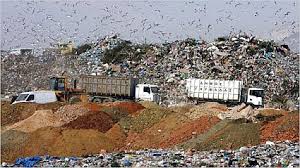
I was on a bus in central Mexico with 50 other mostly American Spanish-immersion students, and we had just been directed to gaze upon a garbage dump a big as a mountain.  It was beautiful—from afar.  Trash is colorful.  Flocks of seagulls soared and reeled above it and the sun glinted off the metal and glass it contained.  Our guide had called it a garbage dump city.  Why would anyone live in a garbage dump?  The stench would be overpowering!  Think of the filth and the disgusting things you would see!

To my relief, we didn’t stop but kept going until we arrived at Nuetros Pequeños Hermanos, or Our Little Brothers and Sisters.  As I mentioned previously, the Spanish school we attended specialized in Spanish for social workers, health care professionals, and teachers.  I wasn’t any of those; I just had just liked the school so much the first time that I wanted to return for more.   Now here I was, about to tour an orphanage.

We piled out of the bus and someone walked us around.  This is how I know I was having a Yerkes-Dodson moment, because I cannot remember whether it was a man or a woman or a priest or one of the older kids or a volunteer.

“We have 550 children here, from toddlers to teenagers,” the guide informed us.  “Most of them aren’t orphans; their parents are just too poor to feed them.  Or they’re alcoholics, or unwed mothers, or mentally ill, or in prison.”  The guide talked as we walked.  We passed a half dozen teenage boys shaving the heads of little boys.  We stood and listened in a dorm with rows of bunk beds and cartoon murals on the walls.

“Then there are the children from the garbage dump city,” the guide said.  I was transfixed.  “Hundreds of families make their living by picking through the rubbish and salvaging anything that can be sold.  Mostly it’s metals like copper but also appliances, furniture, shoes ….  We send buses every morning to pick up about 250 children.  We bring them here, give them showers, delouse them and put them in clean clothes, and they spend the day in school here.  Then we bring them home at the end of the day.”

Home.  To the garbage dump city.

We kept walking; we saw the dark little volunteer quarters and the kitchen garden tended by the older children.  A teenage girl and boy were flirting over a fence.  Since it was a Catholic home, I assumed there was no sex education or birth control.  How many babies were born here, to children like them?

The census of children is lower now than when I was there, but at that time, as I did the math, they were in charge of feeding, educating, housing, clothing, and providing health care to about 800 children.

“We have a dozen homes in nine countries,” the guide stated.  This is the moment when I had my “international awakening,” for lack of a better term.  I don’t know if there are homes like this any more in the U.S.  There are thousands of children are in the foster care system.

But the scale of this … for every adorable, doe-eyed two year old there were a dozen or a hundred more who needed someone to care for them.

I felt like I was in one of those videos where the camera pulls back from the earth so you feel lifted off the ground. You look down on the tree tops, then you can see rivers and highways, then shorelines of countries.  You zoom out farther until you are looking down on the blue marble we called Earth, and then out, out, out until you can see the Milky Way.

The Mountain

This is the sixth post in a series on studying Spanish in Mexico that starts here.

I returned from my inaugural week of Spanish immersion and started graduate school. A few months later, I returned for three more weeks.

It was on this was the trip that I had my “international awakening”—the experience that committed me to working in international development. Years before, I had worked for the American Refugee Committee for two years on contract, writing their newsletters and annual reports. I read a lot of background materials and interviewed employees to get material. I already knew that terrible things were happening in Sudan; this work required me to know the gory details. However, nothing compares to being there.

I returned to the same school and requested a home stay with Mirta. I couldn’t wait to see her again and bask in the warmth of her household. Since I was in grad school, I could take all the classes I wanted in addition to those in my program, so I already had a semester of Spanish under my belt and I was excited to be able to talk to her more. Things had been falling into place: The maid’s name wasn’t Ella. “Ella,” meant “she” in Spanish. If you know Spanish you may be shaking your head that I didn’t know this sooner, but it was one of many light-bulb moments in learning a language I found thrilling.

Since I was staying for three weeks, I would be more involved in the life of the school. Cemanahuac specializes in Spanish for teachers, social workers, and heath care professionals. They asked me to bring donations of vitamins if I could, so I took up a collection and filled a suitcase.

Lisa n Alex

This is my former housemate and her son. I financed this trip, and many to come, with funds from my part-time student job, student loans, and rent from people who shared my space or rented the whole place when I went for extended periods.

Mirta had no recollection of me. I felt wounded. That first week in Cuernavaca had been so vivid to me. I attempted to jog her memory, “I’m from Minn-eh-sota, near Can-a-da, where it’s very cold, remember?” I said in Spanish.

She gave me a kindly but blank look. She nodded and smiled but it was obvious I was a blank slate to her. I knew Mirta was married to an elderly, retired doctor she had to care for and support. She had this big compound too, and she worked as hard as the maid to keep it up. Mirta needed students to pay the bills. She was saintly, listening to our stammering, canned Spanish 101 attempts at conversation. She was genuinely warm. We weren’t all white 22 year olds. But as soon as one student left another arrived, and we probably all blurred together.

There’s a phenomenon where people go on tours of slums in the developing world and snap photos of the residents like they’re zoo animals. I hope I wasn’t like that, but my mouth may have gaped open a few times.

I was really into my Spanish studies and hadn’t paid much attention to where we were going for a “field trip” on Saturday. About 50 of us traipsed onto a bus and we drove for an hour. My head was swiveling back and forth from whatever conversation I was having with the student in the seat next to me—she was an African American woman who worked for the U.S. State Department as some kind of administrator and lived in Washington, D.C.—and the scenery out the window.

I was looking at her when I saw her eyes lock on to something in the distance over my shoulder. “What is that?” she wondered.

I turned to look and my first thought was, “A mountain?”

“But look how colorful it is. And why are there so many seagulls?”

“It’s beautiful,” I said.

Then one of our teachers stood up, pointed to the mountain, and announced, “Welcome to Miacatlán garbage dump city.”

Garbage City GullsG Dump City

Zizzybalooba

This is the fifth post in a series on studying Spanish in Mexico that starts here.

Zoe managed to get her footing over the course of the week but she couldn’t wait to get home. She was from Salinas, California. Her mother was from Spain, her father was Portuguese, and they had chosen to not expose her to either of their native tongues. They wanted her to be American.

“It’s funny what people think an ‘American’ is”, I said.

“And I’m a social worker, in California!” She laughed at the absurdity. “All my clients speak Spanish. They start speaking Spanish to me because they assume I speak it. Then when they realize I don’t, they have their kids interpret. All they have to do, if they want to hide anything from me, is to speak Spanish—right in front of my face.” It was clearly humiliating for her.

The next morning Zoe put her hair in a ponytail and after a breakfast of tortillas and beans with white crumbly cheese and pastries we ventured out to the street, caught the combi, and found our way to the school.

Mine was the Spanish for Dummies class. It wasn’t called that, of course. The school’s philosophy was pure immersion. The instructor spoke in Spanish and had us repeat after her. There were lots of written handouts with kindergartenish illustrations which helped. If she explained any rules of grammar or defined any words, that was lost on me.

This was a great learning method for me because I over think things. If there had been any opportunity to discuss things in English, I would have spent half the class asking questions about sentence construction and verb conjugation. That would have been fascinating and I would have gained a lot on an intellectual level but I wouldn’t have learned how to ask for a bottle of milk in a store.

Immersion is amazing—it works, and it works fast. I attended classes five hours a day and spent hours on my homework in the evening. Zoe and I spoke English together occasionally but we were on different schedules so it didn’t interfere with our learning.

The only other time I heard English was as I left the school each evening. Cemanahuac has English classes for Mexican business professionals in the evenings, taught by a young English woman. I could hear them chanting, “My name is Richard. I am a solicitor. I go to the cinema at the week-end.” Funny that they were learning British English, I thought. But maybe having an English accent would give them a leg up if they wanted to work in the U.S. We’re so dazzled by English accents.

On Day Four I passed an important milestone. I was able to walk into a store after school and ask for a six-pack of beer. I had read that women in Mexico don’t drink, but that American women weren’t really considered women, so it was okay for us. Yay! I bought a six-pack of Negra Modelo, sat in the garden by the pool, and had a couple brewskis while I did my homework.

On my last day I was able to ask my teacher what English sounded like to her. I could now understand about 70 percent of what she and Mirta said. Of course they talked very slowly and clearly and didn’t use big words. But when I arrived, Spanish had only sounded like a babbling brook, lifting, and dropping, and splashing like watery music.

“Zshuh zshah zshuh sha sha,” was her musical interpretation of English. It wasn’t nearly as bouncy as Spanish and sounded suspiciously like Russian. I did my version of how Spanish sounded to me and we laughed.

I was in love—with Mexico, sunshine and warmth, my teacher, the birds of paradise, Spanish, Negra Modelo, Mirta, and most of all, feeling good about myself for beginning to master a new language at 40.

I had been fired from my job and was about to start graduate school. I would have a part time grad assistantship with totally flexible hours. Before I left Cuernavaca I signed up to return for three more weeks.

Two Birds in Paradise

This is the fourth post in a series on studying Spanish in Mexico that starts here.

My host mother and I had been tossed around in the back of the mini bus for 20 minutes when she jumped up and exclaimed what I could only guess meant, “We’re here!”

The combi slowed to a roll but didn’t actually stop as we stepped off in front of an office.

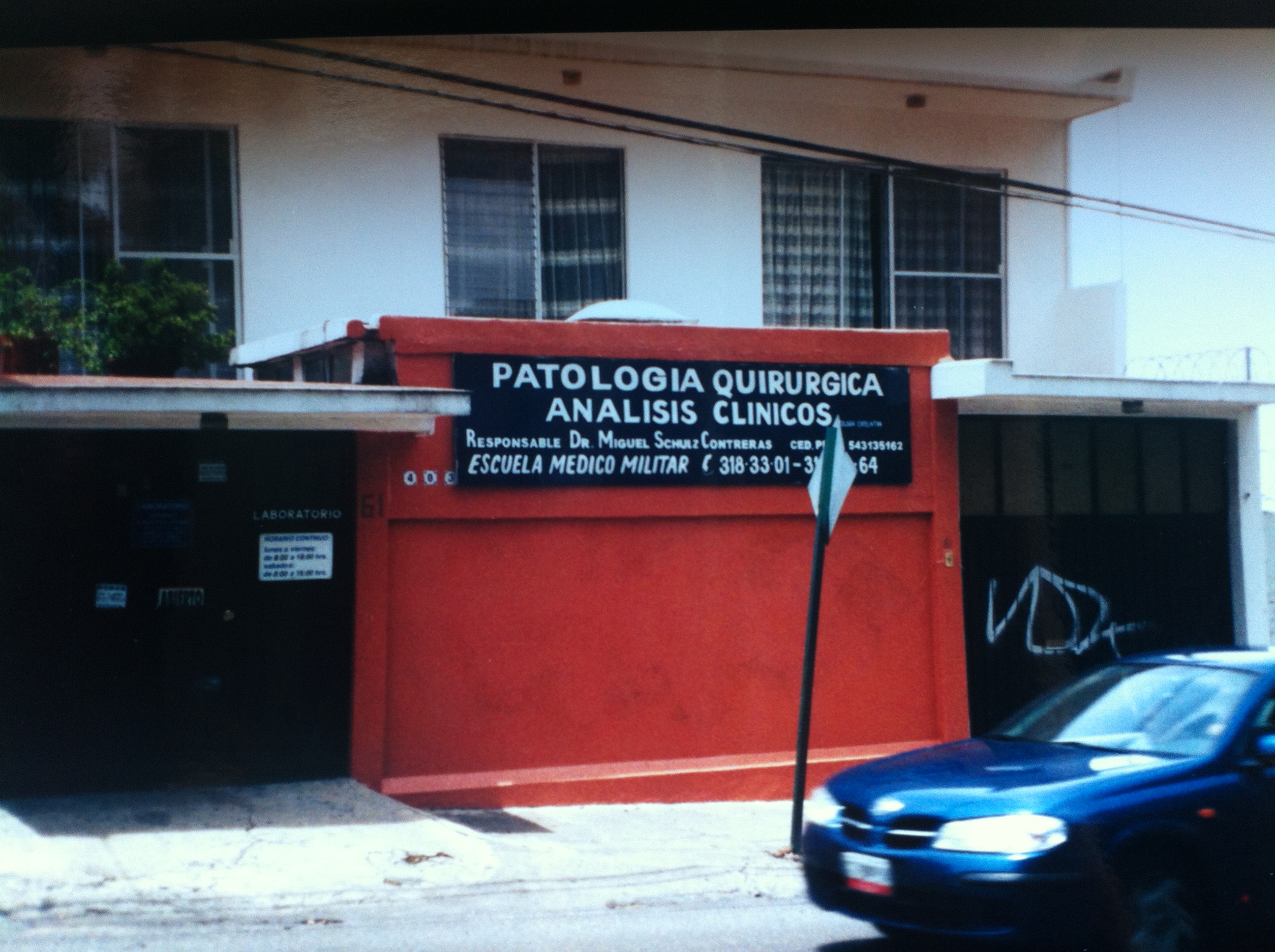
Patologia

Mirta led me to the locked gate to the right—the one with graffiti scrawled on it, handed me a key, and showed me how to use it.

Now that we were here—now that I had made it from the airport to the hotel, taken a bus to Cuernavaca, seen the school, and successfully managed to keep up with Mirta, my tension drained away and I suddenly “got” a word: llave—key.

I felt joy.  I could do this!  I could get around in a foreign country, meet exciting new people, and learn a foreign language!  I only had to memorize about 10,000 more words and learn how to conjugate 500 verbs.

If you live in Los Angeles or Miami, Mirta’s house would be unremarkable.  It was a walled compound with a main house, another smaller house, and a garden with a pool.

Cuerna Home

Mirta walked me into the kitchen of the main house, wagging her finger to indicate that the rest of the place was off limits.  Darn, I wouldn’t be able to relax on that plastic-covered couch under the oil painting of The Last Supper I caught a glimpse of from the kitchen.

She also made clear that the fridge was off limits.  She demonstrated how to use the five-gallon water bottle which was to be my only source of water.  She laid down the times for breakfast, lunch, and dinner.  It was amazing how much she could communicate with charades-like gestures.

A young woman entered with a toddler.  I assumed this was Mirta’s daughter and grandson until she picked up a mop and started swabbing the floor.  From what I could gather, her name was Ella.

I followed Mirta like a duckling to the smaller house where I would spend the week.  Everything was covered in green tile except the ceiling.  It would have felt like an asylum except that the window looked out on the garden full of Birds of Paradise.  Those are run-of-the-mill in Mexico—like daisies in Minnesota—but to me they were spectacular and I would later amuse Mirta by taking endless photos of them.

Bird of Paradise

Mirta pointed to the bare bulb in the middle of the sitting room ceiling and made clear that I was not to waste electricity.  She oriented me to the bathroom, showing me eight fingers to indicate how many minutes of hot water were available to shower each day.  There was a drain in the floor with a plate over it and a brick on top of the plate.  Do not remove, I was warned, with some scary faces.  In Minnesota, we get rats coming up from the river through the sewers into people’s basement toilets.  I wondered if that was the foe here, or something else?

Mirta opened the bedroom door to reveal two twin beds.  A young woman was hunched over on one of them, holding a blow dryer and looking dejected.

“Hi, I’m Zoe,” she said, in a North American accent.  I had known I would share my quarters with another student, and this was her.  Mirta showcased the one-drawer night stand next to my bed, then exited with a reminder about meal times.

“My blow dryer won’t work!”  Zoe exclaimed.  She started to whimper quietly.  “I forgot to bring an adapter.  Do you have one?”

When I said no she wondered out loud, “I wonder if Mirta has a blow dryer she would let me use?”  I thought that was highly unlikely, given we weren’t allowed beyond the kitchen or even to open the refrigerator.   Zoe really started to cry.  “And I can’t call my parents!  My cell doesn’t work and Mirta won’t let me make a long-distance call on her phone!”

I was afraid Zoe was destined to be an example of a Yerkes-Dodson Law fail.

Losing My Words

This is the third post in a series about studying Spanish in Mexico that starts here.

And so I arrived in Cuernavaca, Mexico, to drench myself in Spanish language and culture for a week.

Through this company, Amerispan, I had bought a cheap package that included my classes and a homestay. I had splurged and spent an extra $40 or something for someone to meet me at the bus station and take me to the school. I made that call after seeing that the school was called Cemanahuac. What?! That didn’t sound Spanish, and I had no idea how to pronounce it. Now I see that they’ve added a helpful transliteration to their website: sem-ah-NOW-ock, and I can tell you that was the name used by the Aztecs to refer to their world.

For the umpteenth time I apologize for my lousy photos:

Cemanahuac PoolCemanahuac Hut

If you live in Indonesia or El Salvador or anywhere else that is tropical, you won’t think anything of this place. But to me, coming from a cold, drab grey Minnesota winter, it was paradise. I could hardly believe that I was going to spend a week studying here. I would have been happy to skip the studying and spend the week lying by the pool with a book.

Amerispan no longer lists Cemanahuac as a language school choice on its website. That’s sad, and I wonder if it’s due to all the drug gang violence, or something else?

I wandered around the school, probably with a dazed smile on my face, until someone called my name: “Anna Mah-eeeertz?” I don’t know how long they had been calling it before I realized it was me.

I knew from studying up on the Amerispan website that someone from my host family would come to take me to the home, but now I had left English behind—completely. That was their philosophy, total immersion.

But it wasn’t too hard to figure out that the secretary of the school was introducing me to a woman whose name was apparently Mierda. I could see the other office employees behind her, laughing up their sleeves. I would learn eventually that Mirta was Cuban, and that Mirta was a Cuban name. But she pronounced it Mierda and in Mexico and elsewhere Mierda means shit.

Mirta seemed oblivious to this, and as I got to know her better over the course of the week I found she was one of those happy, smiling people who just ignore bad things. Mirta was about 60. She was plump in a matronly way, with dark red hair, and she was dressed like my grandma used to dress in the 70s—in polyester elastic waist pants and a button up shirt—both in pastel colors, and sturdy black shoes.

She pointed toward the exit and said what sounded like, “Yabba da dabba da blabba de doo.”

All I could do was smile and nod; I didn’t even know to ask, “Que?” and even if I had I couldn’t have understood the answer. I followed her out into the street.

She walked so fast I had to hop skip to keep up with her. We reached a corner and she pointed to a bread store and said something. Then we turned, turned again at the next corner, walked about three more blocks, and while she talked and pointed to things along the way. We came to a crazily busy intersection where she stood for a while talking and gesticulating some more, until a mini bus arrived. She pointed to above the windshield, and I could make out a number and what I assumed was the month of Noviembre. Why would a bus route be named a date? I followed her on to the combi and she showed me the coins I had to pay, which meant nothing to me.

This was my introduction to the wonders of combi décor. There were several small statues of the Virgin Mary glued to the dashboard, the rest of the surface was covered in orange fake fur, and there were holy cards suspended above the driver’s head. We needed all the good-luck juju, for sure, as the bus lurched out into the stream of traffic.

Yikes, Yerkes!

This is the second in a series of posts about studying Spanish in Mexico that starts here.

My life had gone off the rails shortly after my 40th birthday and it seemed like the obvious thing to do was to run away to Mexico and learn Spanish. I had never been to Mexico. I had studied Spanish in high school, but Spanish class followed my free hour, which I spent smoking pot, so while I probably appeared to be enjoying the class immensely, the only words I had retained were cerveza and fiesta. Those weren’t going to get me a bus ticket.

But somehow I managed to fly to Mexico City, then take a bus to Cuernavaca. I was well prepared by Amerispan, the company I used to find a language school.

It just occurred to me that I am actually a sort of expert on travel, study, and volunteering abroad programs due to all the things sparked by this first trip to Mexico.

First, I wrote my master’s thesis on international immersion programs (meaning that you live with a host family in order to learn about culture and/or language). I researched a dozen of them and read up on the psychology of immersion learning. Did you know there’s a psychological theory called the Yerkes-Dodson law which says that the ideal learning experience requires you to be pushed out of your comfort zone—but if you are pushed too far your mind will shut down?

Second, I have participated in half a dozen immersion programs. There was the Volunteers for Peace trip, where I babysat Pakistani kids and studied racism with a group of other volunteers in the East End of London. There were my four trips with Amerispan. I did an internship for Global Volunteers, which offers “volunteer vacations.” There was my trip to Cuba to deliver medical supplies with the Marin Interfaith Taskforce on the Americas. I went back to England to volunteer for Oxfam, then got a full-time job there. I spent two months interviewing human rights activists in Nairobi, Kenya under the auspices of American Jewish World Service.

There was one close call. A few years ago, I had a plane ticket to go to Kolkata, India to volunteer for two years with CUSO International. This is a Canadian organization similar to the Peace Corps but without the political agenda. They flew me to Vancouver for a three-day interview and to Ottawa for five days of training. I had received all my shots, had my letter of resignation ready, and was packing my belongings to put them in storage.

Then I read the blog of the volunteer I would be replacing. She described coming home to find a giant rat standing on its hind legs on her bed and hissing at her. “I’m not afraid of rats,” I told myself. She painted a picture of her lodgings, a windowless room with no air con or even a fan, in a city where the average daily temperature was 104F (40C). “Well I wanted to get away from winters!” was my rationale for why I could hack it. But then there was her description of the pitch dark shower that had soft muck on the floor from which giant winged insects arose when she started the water—which was only a dribble—I immediately wrote to CUSO and backed out.

I felt a little guilty, but I would have felt worse if they had had to pay to wack-evac me later.

Third, I am co-teaching a class about this whole subject, for the second year. Last night we talked about the spectrum of providers. This blog doesn’t have any advertising, so I’ll give Amerispan a shout out here, again. I think it’s great because it really helps you think through what your priorities are and what you can tolerate. They specialize in language studies, study abroad, and international volunteer opportunities. They gave me enough guidance to find my way to Cuernavaca on my own, but it was loose enough that I got my fill of adventure. And that’s what gives you a feeling of accomplishment and scratches the itch for the next trip.

Wrestling with Restless

I started a blog in 2011 and fizzled out after about six weeks.  It was called Wrestling with Restless, and that could still be a perfect theme for me.

I’ve got a great life, from any outside perspective.  I’m healthy.  I have friends and family I’m connected to.  I’ve got an interesting job that pays decently and has good benefits.  My condo is beautiful and my son is out of prison and doing well.  I live in an area where the cost of living is reasonable and you can always find a parking spot.  We’re big on the arts—we’ve got loads of theater companies, symphony orchestras and chamber orchestras and operas, modern and traditional art museums, and sports teams.  Not that I care about sports.

It’s clean here.  It’s green.  We have good tap water.  It’s diverse—not like New York City diverse, but we’ve got the largest populations of Somali and Hmong and Burmese immigrants in the U.S.  There’s an international airport 10 minutes from my house but there’s also a state park with a lake and two rivers 5 minutes from the airport.  We’ve got light rail and bike lanes and farmers markets and microbreweries and farm-to-table restaurants and someone has even proposed opening a mill to make artisanal flour.  We’re one of the most progressive states, politically.   We’re always on those lists like “Top 10 Cities for Working Moms,” “Best Overall Quality of Life,” “Greenest Cities,” “Most LGBT Friendly Cities,” and on and on.

So why would I want to leave?

When I turned 40, in short order my boyfriend dumped me, I was fired from my job, and I was diagnosed with Multiple Sclerosis.  So I did what anyone would do—I booked myself into a one-week Spanish immersion class in Mexico.

I looked out the plane window as we flew over Mexico City.  I timed it—20 minutes to fly across from one end to the other.  That’s a long time!  I had never traveled to a developing country before, except to Cost Rica the year before with the ex-boyfriend, and we had stayed at a luxury resort.  When the exit doors of the airport slid open, a hundred men started yelling and waving at me.  “It’s a riot!” I thought, but they were only taxi drivers trying to get my business.

I picked the closest one, who took me to the hotel where I would spend one night before taking a bus to my school, in Cuernavaca.  At the desk, the clerk asked me, “Cual es su nombre?” and I answered “Uno,” thinking nombre must mean number, as in how many are in your party.  He somehow got my name out of me, then rattled off the list of things desk clerks tell you, including that something was “el sexto.”  I clutched my belongings about me and hurried off to my room, where it dawned on me he had been saying “sixth floor,” not propositioning me for sex.

That’s right, I spoke only about 10 words of Spanish.  I sat in my tiny concrete room trying to memorize the key phrases I would need to buy a bus ticket and get to Cuernavaca the next day.  There was one very small, square window near the top of the high ceiling, and all night I heard what sounded like a rabid baboon baying.  There was no glass or screen on the window.  Could whatever it was get into my room?  Why hadn’t I brought that mace someone had given me as a parting gift and which I had left at home to show how worry free I was?

As is usual with my series of posts, I will eventually make a point that that connects to my original question.

But until then: I have mentioned a lot of companies on this blog—Bob Barker, Pillow King, Mega Bank, Industrial Chemicals, Inc, etc.—always with withering disdain.  I am happy to now highly recommend a company called Amerispan.  I went to Mexico three times and to Spain once to study Spanish with the help of Amerispan.  My niece used them to do the same in Costa Rica.   More about them next time.

The Nitty Gritty

I wrote in my last post about how you can find adventure close to home. But you can experience it even closer—inside your own head. The best example I can give, for me, is the rush of adrenaline I get when I am planning a trip. Not on a trip, just anticipating it. Looking at maps, checking airfares, considering the pros and cons of various destinations, imagining all the fun I will have with my friends.

I’ve written about how these kinds of thoughts cause physical reactions in my body, like a racing heart and sweaty palms. But I’ve never known how that works.

Strangely enough it was an article about solitary confinement that explained the phenomenon. Solitary confinement: the opposite of travel, right? The full title of the article is “How would you do in Supermax? The answer may lie with imagination and grit.”

First, here’s the negative side of solitary, which will be no surprise to anyone with a shred of empathy:

“Solitary confinement has been linked to a variety of profoundly negative psychological outcomes, including suicidal tendencies and spatial and cognitive distortions. Confinement-induced stress can shrink parts of the brain, including the hippocampus, which is responsible for memory, spatial orientation, and control of emotions. In addition to these measurable effects, prisoners often report bizarre and disturbing subjective experiences after they leave supermax. Some say the world regularly collapses in on itself. Others report they are unable to lead ordinary conversations, or think clearly for any length of time. The psychiatrist Sandra Schank puts it this way: “It’s a standard psychiatric concept, if you put people in isolation, they will go insane.”

But here’s where the article veers away from the usual, “it’s horrible, we should stop it” article about solitary. This article examines how some prisoners use mental imagery to survive, and even rehabilitate themselves.

Mental imagery is basically imagining something so vividly that it affects you physically or psychologically. Lots of us do this involuntarily—for instance since I am terrified of public speaking, if I have to give some remarks I will probably have involuntary flashes of imagining myself stammering and making a fool of myself, and this will make me even more nervous, and it may actually cause me to do what I feared.

On the other hand, controlled mental imagery is considered so effective that it is used by athletes to improve their performance. Before a competition, for instance, they will close their eyes and imagine every detail of a successful performance, and this contributes to their bodies and minds performing successfully in reality.

With all external stimulation stripped away, some people in solitary use controlled mental imagery to stay sharp, pass the time, and keep their spirits up. No one tells them about it, or how to do it; they somehow figure it out on their own.

Why are some prisoners in solitary able to summon controlled mental imagery to improve their lot, while most are at the mercy of involuntary mental images?

That’s the second point of the article. The thinking is that this small subset of prisoners possesses a quality called grit. I’ve always wondered how it is that I overcame the odds and became as successful as I am, when there are so many other unmarried teen moms out there who are still mired in poverty. Well, I’ve got grit. If you want to find out if you have it, here’s an online test. Apparently I am in the 90th-99th percentile of other users who have taken it.

What is grit? I would call it “stick-to-it-tiveness.” An innate persistence, perseverance, single mindedness, and diligence despite setbacks.

So some prisoners, who happen to have grit, are able to use controlled mental imagery to improve themselves and leave prison better, not broken.

Where does grit come from? Why do some people have it and others don’t? Can it be learned? I don’t know the answers to these questions. I do know that if I could bottle grit and sell it, I would be a wealthy woman.

In Pig’s Eye

I’ve been writing about a road trip to South Dakota that I took for work last week. I can’t say a lot more about it. There were some eyebrow-raising moments which have to remain confidential.

But one of my intentions in blogging is to demonstrate how you can experience adventure close to home—and even in your head. You don’t have to spend thousands on a trip abroad. Your own neighborhood can hold surprises.

I’ve lived in St. Paul almost all my life. It’s not that big of a city—about 300,000 people. I went for a long walk on a Sunday afternoon and found the following things that were new to me.

I crossed the Smith Avenue Bridge, which everyone calls the High Bridge, because it’s, well, high. The High Bridge was new to me. What a view.  I know, my photos are not the best, but they’ll give you the general idea.

Bridgeview 2

Sadly, because it’s high, the High Bridge is one of the preferred bridges in the Twin Cities for people to jump from. There was this tender note from a stranger to a stranger.

Bridge Memorial

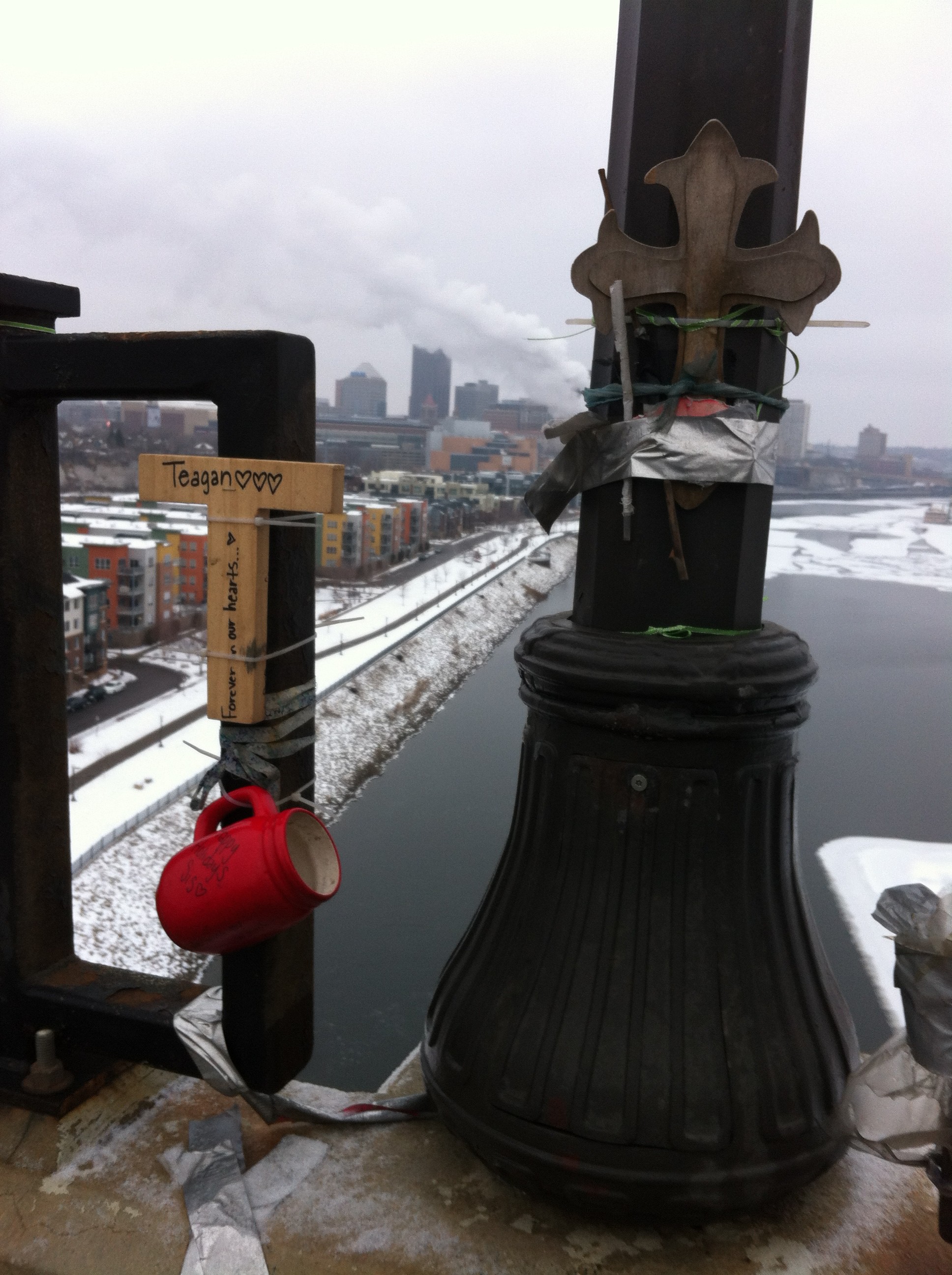
There was this makeshift shrine to someone named Teagan. I don’t know if she was the same person to whom the note in the previous photo was written, or a second jumper.

Suicide Shrine

Someone has been thinking about how to prevent suicides from the High Bridge. I don’t know. Would you have the presence of mind to call the number, or would you even see it if you were intent on jumping off a bridge?

Suicide Hotline

Ah, the sun came out, very welcome after being reminded of suicide at every footstep. This is a view from the Wabasha Bridge toward the train bridge.  I don’t know the name of the train bridge; everyone just calls it The Train Bridge.

Bridge View

Now I was in Kellogg Mall, a long strip of greenery between downtown and the river.  I don’t normally read plaques. Because I travel so much, if I read every plaque (and spent time on every portrait of the Madonna and Child, for that matter), I would never do anything else.  But this one said something about Fr. Lucian Galtier, who gave St. Paul its name.

SP Walk Rock

At the base of the rock there was a bag containing a hat, scarf, and mittens with a note that said, “I’m not lost! Please use to keep warm!” Presumably this is for some homeless person who has a preference for pink.

Scarf in a Bag

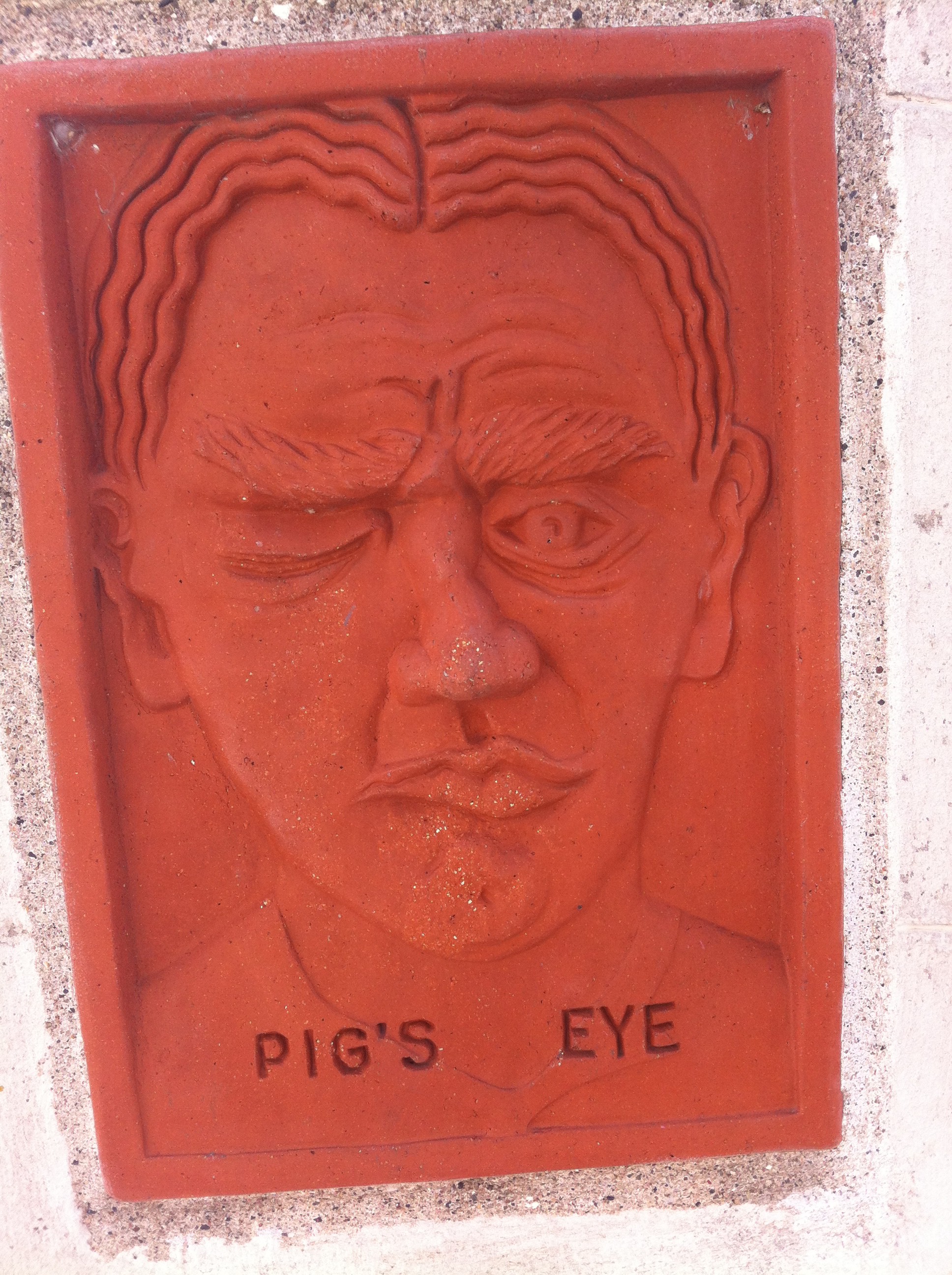
If it hadn’t been for Fr. Galtier, St. Paul might still be called Pig’s Eye. Pig’s Eye Parrant was a blind-in-one-eye French Canadian fur trader who squatted outside Fort Snelling, near present-day St. Paul.  He made hootch and sold it to the soldiers, then eventually built a shack on the river landing below what would become St. Paul, becoming our first civilian resident. The details are sketchy, but it makes a good myth and we have a pretty good beer named Pig’s Eye as a result.

Pigs Eye Close UP

So go for a walk!  Think how you would tell the story of what you see to a good friend, or to a stranger.  Get out of your rut. Take a different route than the one you’re used to. Take a left turn instead of a right. Follow that path into the woods you’ve always wondered about. Notice things. Snap some pics, or not.  Adventure is all around you if you hold the right attitude of inquisitiveness.