Tag Archives: travel

Go West, Ye Seekers!

This is the third in a series of posts about a road trip to South Dakota that starts here.

The trip was a good start in helping my organization figure out how it can reach many more torture survivors using technology. But first, you’re probably all wondering about the four-hour drive—was it scenic? Here is a photo of the view out my window:

Snow

And another one; notice how I included a post in this one, just to spice it up:

Snow2

But wait! There was more to see as we got closer to Sioux Falls, like these billboards:

SF BIllboard

Yes, Sioux Falls has jobs. Their unemployment rate is the 4th lowest in the country—an eye-popping 2.3%, which is actually a problem.

It’s a nice small city, with about 165,000 people and growing. There appears to be more diversity than you would expect, with immigrants attracted to jobs in the Morrell meat packing plant and other industries. There’s no corporate income tax in South Dakota, so a lot of banks and credit cards companies are based there. And as in St. Paul and Minneapolis, where there are corporate headquarters, there is an orchestra, an airport, good restaurants and high-end shops, public art, and nice parks with bike paths.

There’s also no individual income tax in South Dakota, so if you’re looking for a job, you can find one in Sioux Falls and live like a monarch.

Our first visit was to Avera, which is a health system. It was founded by nuns which has become the largest provider of telemedicine in the U.S. What does that look like? I had no idea what to expect. But then we were led onto a sort of viewing deck from which we could see hives of doctors, nurses, pharmacists, and technicians tending to patients and lending back up to doctors in dozens of hospitals and clinics in 10 states. There was an e-ER, and e-Urgent Care, e-pharmacy, and so on.

There is a monitor, camera, and microphone installed at the foot of each patient’s bed in the hospital in, say…Thermopolis, Wyoming (an actual place). The doctor there can’t figure out what’s going on with a patient—in such a small place he just doesn’t see enough variety to recognize sepsis, or some other serious but not very common condition. The Avera e-docs can actually see and talk to the patient, diagnose him, recommend treatment, then monitor his vitals to make sure he’s responding—all from 677 miles away.

They also demonstrated an app that patients can use like urgent care, without having to leave the house. All their medical records are available to the clinician, who the patient can see and talk with via a secure Skype-like application that is compliant with all our complex medical privacy laws in the U.S.

Then, just for me, one of our hosts discussed their eCorrectional Health program. “Usually when a prisoner is seriously ill, they have to transfer him to a hospital, which can cost thousands of dollars. With eCorrectional Health, the facility physician can get a diagnosis and treatment recommendations without having to take the prisoner out of the prison. It saves a lot of resources.

“Everyone is happy…well, except for the prisoner, who doesn’t get a change of scenery.”

Knowing the medical, dental, optometry, and pharmacy “care” Vince received inside three different prisons, I think this eCorrectional thing may be a vast improvement. Prisoners may not get to leave prison, but they probably receive better care, from people whose humanity hasn’t been tainted and warped from working in the prison system.

We left Avera with our mouths hanging open, we were so impressed. The potential to expand the number of clients we reach is mind boggling. We’ve got a long way to go, but we’ll talk with Avera next week about potentially partnering to pilot something.


Dakota Bound

I’m on a road trip! No, not to New Orleans. Believe it or not, I am going to meet with three potential donors in Sioux Falls, South Dakota. Yee haw!

Here’s the deal. The Center for Victims of Torture, where I work, does psychotherapy, physical therapy, and social work for survivors of torture and war trauma. We do it in groups in Jordan, for instance, because all the clients speak the same language. We do it on an individual basis in Minnesota, because clients come from 36 different countries and speak myriad languages which must often be translated, which doubles the time everything takes.

This is all good as far as it goes, except that there are an estimated 1.3 million torture survivors in the US alone. We do a lot of training to try to equip professionals outside of CVT to recognize and help torture survivors. But there’s also no way we can train every doctor, social worker, cop, or immigration officer that might come into contact with a survivor.

People have been talking about doing something with technology at CVT for years, but without funding that’s just dreaming. Part of my job is to find new sources of funding, and that’s what I hope I’ve done. I won’t bore you with the details, but there are three HUGE international development innovation funds that we hope to tap. To do this, we need to find partners who know how to reach patients in remote or difficult to access situations. That’s why we’re going to South Dakota.

It’s so important, when you’re trying to get people fired up about complicated ideas, that you have the right people on your team. My co-pilots on this trip are a colleague who is from Sioux Falls and whose father has opened some doors for us, and CVT’s clinical advisor for our international programs, who is Kenyan and a PhD psycholgist. He describes the needs this way:

In Nairobi, there are thousands of Somali torture survivors living in the slums who are not there legally, under the protection of the United Nations. They literally cannot leave their dwellings during the day, because the Kenyan police will round them up and shake them down for bribes. Which would you choose: Pay a bribe, or be sent back to Somalia where you may face certain death? They may not have iphones, but could we develop a text-based therapy intervention?

Among the survivors who are in Nairobi legally, there are many Congolese and people of other non-English speaking nationalities. Kenya is an English-speaking country. The refugee kids may have already missed years of schooling due to being forced to serve as child soldiers and living on the run or hiding. Now they spend 12 hours a day in school—regular school, plus an extra block of time added on to learn English. They have survived unimaginable horrors. Many of them need psychotherapy or physical therapy, but they don’t have time for it. Could we develop a game-like therapy intervention that would appeal to youth?

CVT also works in Dadaab, the largest refugee camp on earth, in northern Kenya near the Somali border. Its population is about the same as Minneapolis—about 350,000 people. Could we do tele-therapy with them—either mental health or physical? If so we could reach so many more people. We could also use videoconferencing to train our own and other organizations’ staff.


“Do they all have smart phones in Dadaab?” I asked. I have been to Nairobi but not Dadaab.

“I don’t know,” he replied. “We would have to do a survey to determine who has the old Nokias, how many have smart phones. The Chinese are making big inroads into the African market with cheap smart phones. Most Kenyans use their mobiles for everything. They don’t have tablets or desk tops or TVs or land lines. They’ve basically skipped over those generations of devices and they do everything on mobiles.”

I love projects like this. They’re big, messy, uncertain, and complicated. They require me to work with people with whom I don’t normally interact. They may have big payoffs. And in this case they require a road trip.

Two Lists

The New Orleans trip is beginning to take shape. My English friend Lynn will fly over to St. Paul from Aberdeen, Scotland, where she lives. We’ll hit the road and wend our way south, taking about three days to reach New Orleans. I booked a suite in a B&B. Our friend Christine, an Australian who lives in Oxford but spends much of her time working in Africa or Asia, will fly over to join us, as will my cousin Molly, who turns 50 that week.

So it’ll be four of us all together for French Quarter Festival, then Lynn and I will drive a different route back. My friend Ferruh also lives there with his wife. They’re Turkish. He’s a drummer who used to play in a belly-dancing troupe, then moved to Denmark and then the US, all the while working on his PhD. Now he teaches at Tulane. He’s a great guy and I hope we can all have dinner together.

I alternate between worrying: “What if the car breaks down in rural Tennessee?” and feeling excited about the music, the heat, riding in a swamp boat and feeding marshmallows to alligators, touring a creole plantation and one of New Orleans’ fantastic cemeteries, maybe getting in on a second line, which I was lucky enough to do last time I was there.

My mom’s husband, Jim, is from St. Louis, so I sat down with him and pored over an atlas. He is 86 now and done with road trips, but they took some great ones and they love to talk about them. It must be hard to know that you’ll never drive to St. Louie again, or fly to Phoenix to escape the winter cold.

Jim had drawn up a list of things to do and see in St. Louis and Memphis:

Jim's List

I find these scraps of the folks’ handwriting endearing.

Jim told me about the great Italian neighborhood I had to visit in St. Louis. “We called it Dago Hill when I was a kid,” he said a little sheepishly. “But now it’s just called The Hill.”

I also want to write a bit of an update on Vince and how well he is doing despite the challenges he still faces.

When he was put on indefinite lockdown he was phlegmatic about it. “They’re trying to get me to react,” was his take on it. “And I’m not going to. This too shall pass.”

I know it’s called Alcoholics Anonymous, but it’s no secret that Vince is in the program and I think it’s okay to say that he’s really working it—he found a sponsor, who is like a mentor, and they are working on the 12 steps together.

He’s taking care of his health. He hasn’t taken up smoking since being on the outside. Besides just being bad for you in every way except for being an instant stress reliever, smoking is hugely linked to drinking and drugs and can trigger a relapse.

My sister gave him a used Bowflex machine. It’s in our basement, which could win an award for grossest, creepiest basement ever. But he goes down there and uses it. I told him he should feel free to clean the basement up and make it his man cave.

He’s eating decent food. It would be easy for him to buy lunch at the Arby’s that a few blocks from his work, but instead he packs a lunch every day. He even bought lettuce and whole grain bread! We’re talking about bacon sandwiches, just to assure you he hasn’t completely gone around the bend and become a gluten-free, chewy crunchy vegan.

Vince was beginning to meet people and make friends when he was granted more time out of the house. That’s off the table now due to the indefinite lockdown. Thanks to social media, he can still be in touch with the outside world.

Most gratifying of all is Vince’s gratitude—for those who send words of encouragement, read his blog, and in particular to the anonymous person who gave him a new laptop so he no longer has to type his posts with two fingers on his phone.

Reductive Seduction

There’s a great article circulating among international development people that also addresses mass incarceration in the US. Who knew there were so many connections between these two worlds of mine?

Written by Courtney Martin, it’s titled, “The Reductive Seduction of Other People’s Problems.” I’ll quote the opening here:

“Let’s pretend, for a moment, that you are a 22-year-old college student in Kampala, Uganda. You’re sitting in class and discreetly scrolling through Facebook on your phone. You see that there has been another mass shooting in America, this time in a place called San Bernardino. You’ve never heard of it. You’ve never been to America. But you’ve certainly heard a lot about gun violence in the U.S. It seems like a new mass shooting happens every week.

“You wonder if you could go there and get stricter gun legislation passed. You’d be a hero to the American people, a problem-solver, a lifesaver. How hard could it be? Maybe there’s a fellowship for high-minded people like you to go to America after college and train as social entrepreneurs. You could start the nonprofit organization that ends mass shootings, maybe even win a humanitarian award by the time you are 30.

“Sound hopelessly naïve? Maybe even a little deluded? It is. And yet, it’s not much different from how too many Americans think about social change in the ‘Global South.’”

These are real Tindr photos from her article:

World SaverWorld Saver2

Martin goes on to write about the problem of mass incarceration in this country—where are all the new graduates lined up to campaign for change on that? I’ve never met one. I have, however, met many young people who fervently want to work for my organization. Whenever we post a job, we get hundreds of applications, even for admin positions. We get a lot of candidates who can recite all 30 articles of the Universal Declaration of Human Rights, but they can’t enter names into a data base without lots of mistakes. They have no interest in fundraising, finance, HR, or any of the other jobs that keep a nonprofit organization humming. They want to get their foot in the door, then jump to the first “meaningful” job that comes open.

They’re not bad people. I don’t blame them for wanting a job that might send them off around the world to help torture survivors, a job that will cause their peers to fawn over them with admiration. As an English friend once said, “You’ve got a job that’s every Lib Dem’s wet dream.” I once had a woman bow down to me when I told her where I work. Super uncomfortable.

And let’s face it, for those of us who crave the exotic, Nairobi fits the bill a lot better than Moose Lake, Minnesota.

When I was in the Occupied Palestinian Territories … there — I did that thing that my set does. We start sentences with, “When I was in Peru …” or Ethiopia, or wherever. I’m sure people who don’t travel to those places, or who wouldn’t be caught dead in those places, find it really annoying.

But, when I was in the Occupied Palestinian Territories, I was invited to write an article about it for a local publication. I did, but I also wrote about Vince’s being in prison, mass incarceration, and how people in the US seem to care a lot more about Palestinians than prisoners who live a few miles away. I can’t be sure why, but they never published it.

You may be thinking, “Who is she to criticize–why doesn’t she work on prison reform?  Erm…I am, in my own way.  There’s nothing wrong with wanting to work on international issues; just be aware of your motivations and your ego.

To quote Martin’s article further: “Most American kids … have some sense of how multi-faceted problems like mass incarceration really are. Choosing to work on that issue … means studying sentencing reform. The privatization of prisons. Cutting-edge approaches already underway, like restorative justice and rehabilitation. And then synthesizing, from all that studying, a sense of what direction a solution lies in and steadfastly moving toward it.”

Maybe Martin’s article will inspire someone to become the Martin Luther King Jr. of prison reform.

Via con Dios, Cuba

This is the eighth post in a series about Cuba that starts here.

We flew back to Havana without incident and checked back in to our dark, quiet-as-a-graveyard hotel.

Here’s another thing I didn’t get while I was there and I can only make up an explanation for you now: I attended a Passover Seder in Havana—Seders remained legal after the revolution. I also attended an Easter mass—and was told that masses had just been legalized. Why would Seders be legal but not masses?

It could be because almost the entire Jewish population of Cuba fled the country after the revolution. After all, we’d seen this movie before. Why wait to find out the ending? Only 1,500 Jews remain in Cuba, compared with 60% of the population that is Roman Catholic, or 6.5 million people. Which would you find more threatening?

The Seder was a community one at a synagogue. It was packed, as Seders always are; there were Jews from the Bahamas, Texas, Israel, and lots of American students. I sat across from a pudgy, red-headed oaf from Indiana or somewhere in the Midwest who was married to a Cuban woman who looked like Bianca Jagger in her heyday. I’m sorry to say that my people are not immune from the syndrome where misfit western men snag beautiful wives in the developing world. But that sounds mean. I only sat across from him for an hour. Maybe he was usually courteous and kind.

On our last night, we were invited to a “Defense of the Revolution #62 Block Party.” Other members of our group had been to these before and told me that neighborhoods organized them to thank visitors for their donations. This in no way prepared me for what I saw when I stepped off the bus.

I thought there must be some mistake. Had we stumbled upon a protest? A wedding? A baseball game? No, these hundreds of people were waiting for us. There had to be at least 200 people out on the street, with precious, expensive electric lights strung up festively, a band and a dance area, and tables laden with food.

Ed and some of the other guys unloaded the medical supplies we had brought; I have no idea where they had been stored all week. Our donation consisted of bandages, cotton balls, and Q-tips—granted there were crates of them, but still … here were hundreds of people lined up to greet us as though we were foreign dignitaries or rock stars.

I was stunned and embarrassed. Our donation was puny compared to the effort they were putting out. Plus, I had agreed to interpret Ed’s remarks into Spanish. I had pictured half a dozen people, not hundreds.

Mi en Cuba

I managed to stammer out a few remarks into a microphone. Everyone applauded as though they had understood me. I fell back into a chair and they brought me a plate of food. It all tasted like dessert because even the savory foods were loaded with sugar. The music and dancing started, and our group was forgotten. I realized this wasn’t about us—it must have been the case that Cubans are allowed to hold big gatherings like this if they had a patriotic reason. I don’t know for sure, but maybe we had given them that reason. Bringing gifts gave them an excuse to show us their stuff, and stay up all night having a good time. Who knows?  Another mystery.

On our bus ride back to the hotel late that night, our guide explained that there were no extremes of rich and poor in Cuba. Yeah, I thought, because all the rich people skedaddled to Miami. He kept referring to “the special period” and I asked Ed to explain. “That’s when the Soviet Union collapsed and Cuba lost all its subsidies,” he said. “It can’t survive under the U.S. embargo without a patron.”

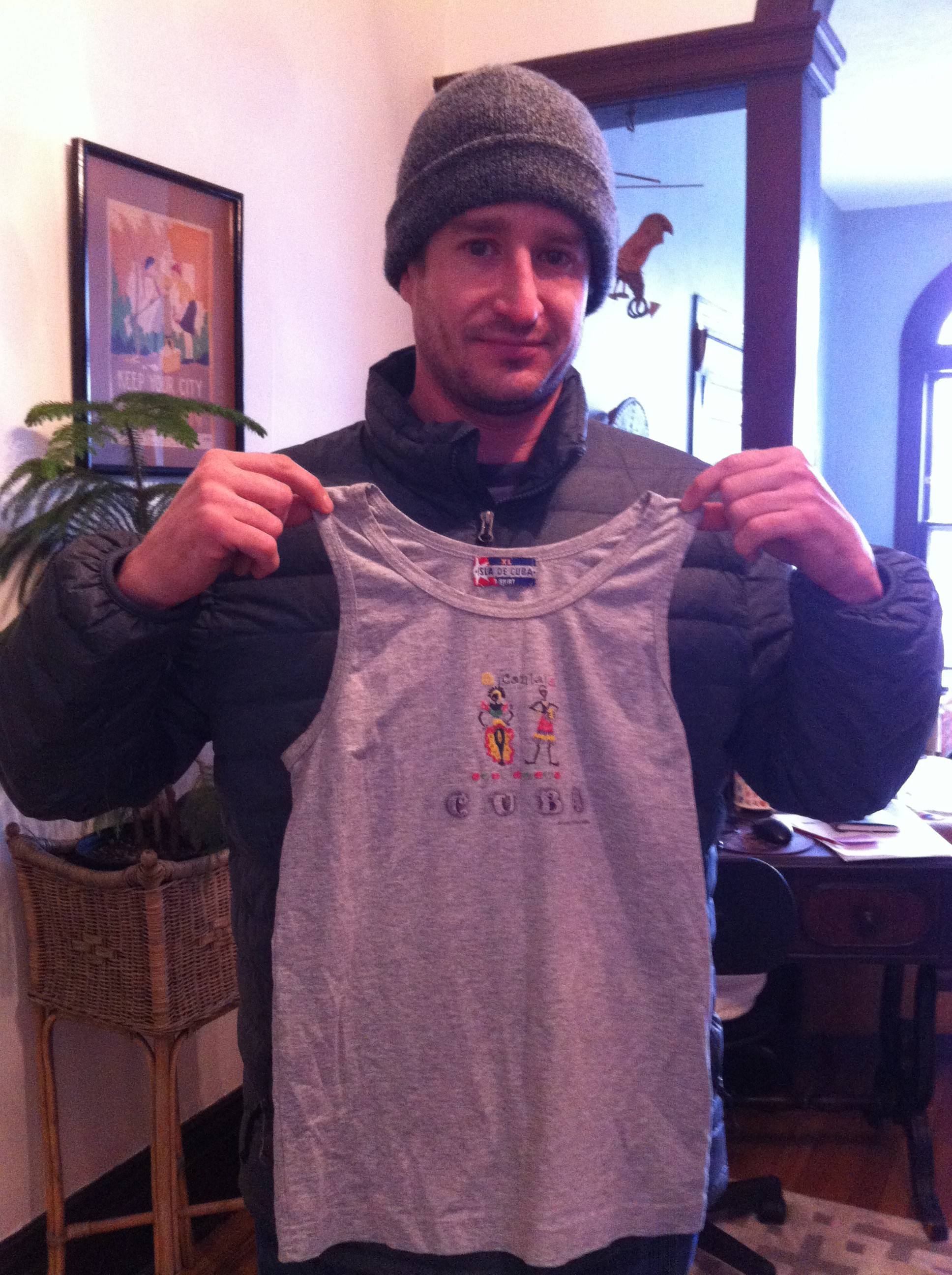
When we checked out the next day, the guy at the desk offered T-shirts for sale, as modeled here by Vince. It’s an extra large. Right—for a Cuban, maybe.

Cuba Tshirt

I hope this series has been food for thought as Americans consider electing Bernie Sanders, a Democratic Socialist, for President.

Gittin’ in Trouble

This is the seventh post in a series about Cuba that starts here.

Before we left Santiago de Cuba, we took an excursion to the nearby Parque Nacional de Gran Peidra—a sort of national park. I love the outdoors and got excited that we might go on a hike, but we only skirted the park on our way to our real destination, Guantanamo Bay.

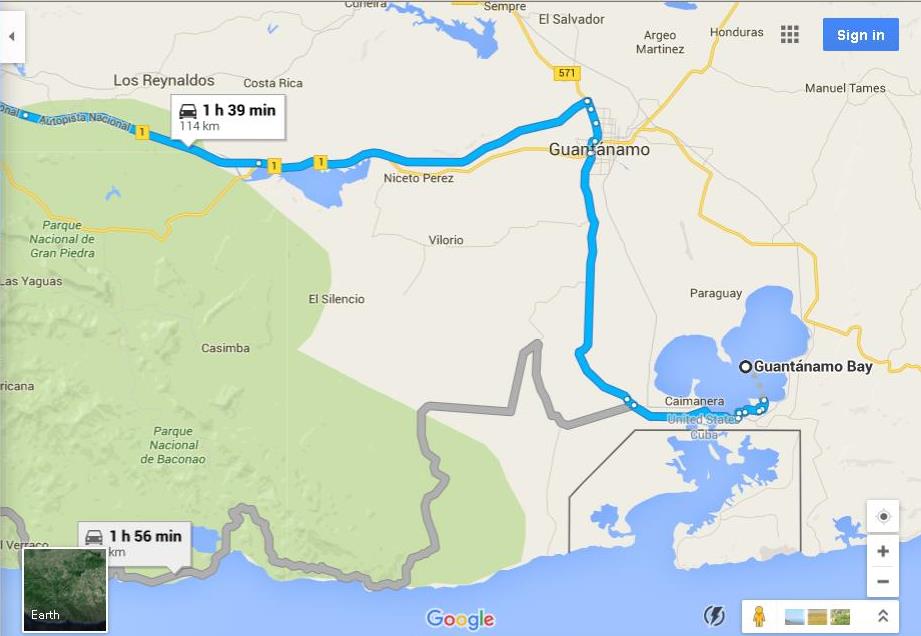
If you look at Google maps, it’s really confusing. What you would think was the U.S. territory with the detention center is marked as Cuban territory. Google has steered me wrong before, mostly memorably in Nairobi where it sent me to a slum instead of to the Ford Foundation’s offices, so I would never count on it except for a rough approximation.

Guantanamo

There was excitement on the bus as we got closer to Guantanamo. “Get out your OFAC letter!” someone exclaimed. “We’re being tailed by the CIA!”

As I mentioned previously, we were required to carry letters from the U.S. Office of Foreign Assets Control at all times to show we were there legally. I couldn’t imagine we would get anywhere near Gitmo—you didn’t have to see it to know it would be surrounded by 20-foot razor-wire fences and heavily-armed guards. What were we going to do, ram the gate? That would put a crimp in my plans to apply for jobs with the CIA and the Foreign Service!

But then the bus stopped, and most of us waited while a couple of Interfaith Task Forcers got off and held an animated conversation with the driver and our guide. Then we turned around and went back to Santiago. I will never know how the leaders of the Task Force talked our guide and the Cuban bus driver into driving to Guantanamo Bay, or how close we really got, or exactly where its limits are.

That’s the thing about travel, if you’re doing it right. You’ll come home shaking your head and laughing to yourself because there was some mysterious situation for which you’ll never have an explanation. That’s assuming no one got hurt or arrested, of course.

Now that I am working for the Center for Victims of Torture, it would be hugely prestigious to be able to say casually, “I was arrested at Guantanamo a couple years ago.”

CVT has been active in advocating for the closure of Guantanamo. First—obviously—because we, torture people there (yes, we, if you’re an American). Half the American population (and I think we can guess who their presidential candidates are) believe there’s nothing wrong with torture. “How we gonna catch the bad guys if we don’t torture people, huh?”

I could write 10 posts about why that’s a dumb statement, but for now I’ll just say, if you think torture is okay, go read someone else’s blog. And even if I thought it was okay, it’s still illegal.

The Universal Declaration of Human Rights, which came about in response to the WWII and specifically the Holocaust, outlawed torture. Ronald Reagan signed the international Convention Against Torture in 1984. President Obama issued an executive order on his second day in office banning torture. In November last year, Congress passed the National Defense Authorization Act, which “placed all U.S. government interrogations under the United States Army Field Manual on Interrogations, and requires that the International Committee of the Red Cross have prompt access to all prisoners in United States’ custody.” In other words, there are grownups in charge now.

Very few people know everything that’s gone on at Gitmo, but we do know that people have been detained indefinitely, without charge or trial. If you imagine yourself in one of those prisoner’s paper slippers, you will understand why they go on hunger strikes. We then subject them to another form of torture, forced feeding. If you wonder, “how bad could that be?” watch this video of the rapper Mos Def being force fed; he volunteered to show us what it really involves.

Back in Santiago, none of this was on my mind. My biggest concern was finishing my master’s and getting a job. Vince’s time in prison, and researching prison for this blog, changed all that.

When Worlds Collide

I’ve been writing a series of posts about traveling in Cuba that starts here. I am pausing that for a day to write about an unsettling experience where my worlds collided.

I volunteer with the Minnesota International NGO Network, or MINN. MINN is composed of Minnesota companies and nonprofits that work overseas, like my employer, the Center for Victims of Torture (CVT).

Last year MINN launched a class called MINNspire, which helps 50-somethings to explore doing something abroad. This could be anything from volunteering with Peace Corps, to teaching English as a second language, to consulting on communications, as I have done. MINN isn’t there to find them placements; we’re there to guide them through the thought process. I led one of the four sessions last year and will do the same this year—I think.

I was excited that we had 18 people registered—about twice the number as last year. It’s kind of a big commitment to come to something after work, in the dark, during the winter.

I walked in and said hi to my friend Carolyn, one of the four facilitators of the class. There were already two students in the room. Carolyn said to me, in a way that told me we might have an “issue”, “Something really interesting happened with registration. I spoke to a Rotary Club that happened to have a lot of members of the DOC, and we’ve got 10 people from the DOC registered for the class.”

The Department of Corrections. The people I never wanted anything to do with, ever again.

I had come from work, where I had spent the day writing about Eritrean torture survivors. Eritrea is known as the “North Korea of Africa.” They have forced conscription, which means every young man must join the military or go to prison. In the military, they are worked like slaves and their service is indefinite. If they try to escape, Eritrea throws them into underground prisons where they are tortured. If they make it to Ethiopia, they wind up in refugee camps with no future, and their family back home is persecuted. Sometimes they try fleeing to Israel, the one country that reluctantly takes them in, but often they are caught by—essentially—desert pirates called Rashida who hold them for ransom, torturing them while their families listen helplessly on the other end of the phone.

As you might imagine, a lot of Eritrean torture survivors have PTSD, and that is where CVT comes in. We provide trauma therapy and we hope to add physical therapy next year.

So I was writing about this all day and then I stepped into a room of people who had been my and my son’s tormentors for a year and a half.

I am in no way comparing what I went through to what Eritreans have endured. My point is that I know firsthand what a flashback feels like. A surge of adrenaline surged through me. My heart started racing and my palms got sweaty. I felt a powerful urge to bolt.

“I figure if I was a prison warden for 20 years, I can do anything!” one of the women exclaimed. The thought of her volunteering in an orphanage made me uneasy.

“My son just finished the boot camp program,” I told them. Might as well get it out there before she said something that would cause me shoot my mouth off. They oohed and ahhed said what a great program that was.

Carolyn knows my back story and has a high EQ.   She emailed later:

“I would never imagine that you would come face to face with your oppressor in MINNspire.  I mean, last year you were in Palestine, looking for ways to collaborate, professionally, with enemies of the Jewish state and now you come to St Paul and you are asked to teach the people whom you’ve written about for years.

“ I have to shake my head at what the universe is throwing at you.  But if anyone can handle it, you can.”

I hope she’s right, because I thought about backing out of the class but I’ve decided to stick it out.  I’ll keep you posted.

Sig Heil, la Revolucion

This is the sixth post in a series about Cuba that starts here.

I was in Santiago de Cuba with my 82-year-old new best friend, Shirley, and the Marin Interfaith Task Force on the Americas.

We went to hear music, the ostensible reason we had flown over 500 miles in a Russian rust bucket of a plane with pilots who worried about funny noises. The music happened in a very decrepit but charming sort of open hall with cavernous ceilings and rickety benches for seating, if you could find a space to sit. The walls had peeling layers of old paint in different colors; I knew people in the states who would have paid big money to get that look.

“These guys are famous!” exuded Ed. “I can’t believe how lucky we are to hear them live!” I had never heard of the band and couldn’t tell them from the ones that preceded or followed them. Not that they weren’t great—to my unsophisticated ear they all sounded marvelous. There were no CDs or T-shirts for sale, and no posters I could take a photo of to help me remember who they were.

The next day we toured Castillo de San Pedro de la Roca, a 17th Century Spanish fort. All I remember about that is how hot, hot, hot it was, and how I kept trying to find a sliver of shade to stand in while the guide yammered on about history.

We went to a (thankfully) shaded glen to listen to a priestess speak about Santeria, an African religion practiced in some parts of Cuba. There were endless gods and goddesses of wind, water, fire, battle, fertility, and so on. It was all very interesting but I forgot all of it by the next day. I have friends who can recite historical dates and names—in which year the artist Diego Blahblabla painted that Madonna with child in that old church in such-and-such a small city. But not me. If I hadn’t jotted notes each night in my hotel room I would never have remembered as much as I have here. And of course the great goddess Google has helped me reconstruct a lot as well.

We toured a primary school. Our guide explained that education was compulsory to 9th grade, so everyone can read and write. Well education is compulsory through 10th grade in the U.S., but that doesn’t mean everyone can read and write. There are things you hear on tours in other countries that are just best to keep your mouth shut about.

The guide told us about the Cuban emphasis on arts—painting, music, dance, literature. Everyone played a musical instrument, wrote poetry, or could illustrate a point with interpretive dance. Then there was the love of baseball. All boys played baseball and loved it. So much for women being full comrades. I figured there were at least a couple boys who did not love baseball and would have preferred to be ballet dancers. In my head I heard my friend Bette, the one who is married to a Cubano who has made documentary films about baseball, saying “They promote the arts and baseball because they are disciplines. They distract people from how hunger, and their lack of basic rights.”

Our guide paraded the children out onto the playground for us, where they sang a patriotic song and made a disturbing gesture very much like the Hitler salute.

Cuban Kids

We went inside and viewed an empty classroom, which had rows and rows of new computers. “These were donated by the Spanish government,” our guide said proudly.

This was when I forgot to keep my mouth shut. “So the kids can surf the Internet?” I asked.

“These computers are state of the art,” the guide continued, ignoring my question.

“Do you get a fast Internet connection?” I kept on, cluelessly.

“They have the highest memory capacity available in the world.”

Oops, I finally got it. There was no Internet. Nowadays Cubans can buy “access”—meaning the government blocks many sites and monitors what users look at—for $2 an hour, a huge expense for the average person who earns $20 a month.

Beinvenidos al Hotel California

This is the fifth post in a series about Cuba that starts here.

After a few days in Havana we packed our bags and flew to Santiago de Cuba, a city on the other end of the island. The plane took off as soon as the last passenger stepped on board, half an hour before our scheduled departure. What if that person had been half an hour late? Would we have waited for him?

The plane was basic. The little signs you see in planes, the ones that say, “Fine for Tampering with Smoke Alarm” were in Russian. At least, I assumed it was Russian, and that they said the usual things. The seat tray in front of me was a piece of plywood held in place by chains and hooks that would have cost $5 at Ace Hardware. As we ascended, mist seeped into the cabin. No one else seemed alarmed so I tried to stay calm.

About an hour into the flight, the co-pilot came on to make an announcement. I could understand his Spanish perfectly; maybe he wasn’t Cuban. I was happy to be able to tell my group what was going on. “Ladies and gentlemen,” I translated, “We are hearing a strange noise somewhere in the aircraft and we can’t figure out what it is, so we’re going to turn around and go back to Havana.” Everyone laughed nervously, then fell silent as the plane banked steeply.

We sat on the ground in Havana for a while before taking off again. “Ladies and gentlemen,” the co-pilot said as we took off, “We apologize for the delay. The pilot is new and neither of us has flown this kind of plane before.” What “kind of plane” did he mean, I wondered? A Russian plane? A run-down plane? There was no mention of the funny noise. Presumably whatever had been rattling had been fixed, or determined to not be life threatening.

The first thing you notice about Santiago is that it is HOT. Hot as hell and humid. I don’t mind heat to a point, but if it’s too hot, this Minnesota-bred traveler’s brain and body become lethargic. We had flown almost 550 miles to experience “real” Cuban music that could not be heard in the capitol. I’m not a music connoisseur; most music sounds good to me unless it’s horribly out of key or country (which seem like the same thing to me), so I was skeptical.

We were transported to our “hotel”, which seemed to be some kind of abandoned camp compound with whitewashed, cement buildings spread out over several acres. I checked into my room and collapsed onto the bed, so out of it that I wondered if I was being drugged. Of course there was no air con, not even a fan, and no window screens, which allowed clouds of gnat-sized mosquitos into the room. The walls were bare and white, there was a bare bulb overhead and a double bed with a thin white sheet. The bathroom was the same as in Havana, with one threadbare towel and transparent toilet paper but instead of a flimsy toilet seat there was no toilet seat. Nice!

I turned on the black and white TV and there was only one channel; I believe Bonanza was on again. I groaned and attempted to wrap myself in the sheet like a giant burrito to keep the mosquitos at bay.

I woke up to knocking.

“Come to the pool!” a woman’s voice called.

Pool!? I detangled myself from the sheet and saw that my left arm, which had fallen out of the burrito, was covered with hundreds of tiny red welts. I flung the door open and there was one of my fellow travelers, an 80-something lady who had been subjected to a strip search at the airport upon our arrival and had taken it all in stride. She had a bottle of rum in one hand and a cigar in the other. Ten minutes later we were floating on a life preserver in the deserted but clean pool, sipping smoooth rum out of the bottle and smoking an even smoooother cigar. Cuba was heaven.

Cigars? Cigarettes?

This is the fourth post in a series about Cuba that starts here.

I was in Havana with the Marin Interfaith Task Force on the Americas, which has a tour coming up in April if you’re keen to visit the island.

Before the U.S. began its rapprochement with Cuba, Americans either had to go there illegally by flying from Canada or Mexico, or were required to have permission from the U.S. Treasury’s Office of Foreign Assets Control, or OFAC. And on these government-sanctioned trips, it wasn’t like you could just do whatever you wanted; the itinerary had to be vetted and approved and you couldn’t go off leash from your tour group. We carried OFAC letters on us at all times and, according to Ed, our Marin Task Force leader, OFAC probably had someone tailing us. And our Cuban guide was probably reporting back to his masters about … what? As I wrote in the first post, the Task Force was composed of a bunch of old hippies and me. But maybe the Task Force had been infiltrated by the CIA, and Ed was a plant?

I think in 10 years we will look back on this period and laugh about it. It was very cloak and dagger, and needlessly so.

I know, I know, you want me to stop going on about the politics and write about the rum and cigars and food and music, right?

Okay. First, the food. Everywhere we went, it was pretty much the same. Chicken, rice, and cabbage. Rice, chicken, and cabbage. Cabbage, chicken and rice. Obviously they had no problem providing themselves with these staples. According to Ed, the CIA had purposely introduced a swine plague that killed all the pigs on the island; that was why there was no pork. Why they couldn’t have grown something colorful–a little Swiss Chard or some carrots, I don’t know.

If you like sugar, you would love Cuba. Every drink is loaded with it, and we were offered desserts galore. The Cuba Libre was the standard drink, and it seemed to contain rum, mint leaves, and about a half a cup of sugar.

We toured a rum factory, which looked like something out of Victorian England. It appeared to have been built and hundred years before and never updated. Not that there’s necessarily anything wrong with that—they certainly cranked out some smooth rum. We all bought bottles “to support the economy.”

We toured a cigar factory. The images here are from the Great Google but look similar to my tour, during which we weren’t allowed to take photos.

Cigar FactoryCigar Factory 2

The cigar factory is the single most vivid memory from the trip because the aroma was like nothing I’ve experienced before or since. Heavenly.

I bought a box “for a friend.” This is one of the reasons I love travel. I spend money on things I would never buy at home, and I can tell myself they’re gifts or that I’m supported a developing economy. And then I can enjoy them myself.

The cigar factory was also notable because it was a multistory, rickety, wood frame building. It reminded me of a barn inside, with bales of tobacco leaves piled around the perimeters and men standing at wooden tables in the center rolling the cigars (and cigarettes) by hand. One match and the whole place would have gone up like a roman candle. The workers were allowed a cigar allowance, we were told.

This seemed contrary to the anti-smoking campaign I’d heard about, in which Fidel was lauded for quitting and everyone was encouraged to follow the example of el Comandante Jefe.

When I returned to my hotel room and went to put my bottle of rum in the fridge, I found two eggs inside, wrapped in an embroidered handkerchief. Were they a gift, or had the maid forgotten her lunch? If they weren’t a gift, maybe the dancing lady hadn’t been a gift either. Maybe I should leave some money for it? I left a $10 bill with a note in my execrable written Spanish that this was for the beautiful dancing lady. I hoped the same maid came every day so there wouldn’t be an unfortunate misunderstanding.