Tag Archives: travel

Welcome, Now Go Away

This is a series of posts about spending the summer abroad that starts here.

Greetings from Copenhagen!  Obviously I got here, and the journey was pretty smooth.

My flight to London from Minneapolis was sold out.  There were only two open seats, in the last row.  I was in the second-to-last row with a guy who introduced himself to me as Chuck.  “Chatty Chuck,” I immediately dubbed him in my head.  I flagged down a flight attendant and asked if Chuck or I could move to the empty row but she explained they were reserved for the flight crew.  I felt rude as I donned my earplugs and sleep mask while Chuck chatted away, but within minutes I was sound asleep.  When I woke after the plane leveled off, Chuck was in the back row.  “They said they wouldn’t need these after all,” he reported excitedly. I flopped down across two seats of heavenly sleeping comfort.

Now, two seats on an airplane are still not much room.  I’m 5’ 3” and still had to assume a fetal position.  But I was horizontal.  And I had my full-sized feather pillow, which gave me something soft to rest my head on instead of the arm rest.

It was the best sleep over I’ve ever had.  I woke the next morning at 11:30 London time, a half hour before arrival, and slugged down two cups of coffee.

My vertigo was gone.  My mother, a neurobiologist in her mind, had predicted, “that thing—you know, that airplane pressure thing,” might make it go and I had snickered but maybe she was on to something.  Now doctors could just prescribe a trans-Atlantic flight for vertigo.

One of my fears was that, because my trip is so long, border control at Heathrow might think I was entering the UK to stay.  I had an envelope with financial documents to prove I had assets in the US—a property, savings, a job to return to.  But the agent asked to see proof of my onward flight to Copenhagen.  When I checked in, the SAS (Scandinavian Airlines) website had promised to send my boarding pass via text “right away,” but it never materialized.

I was explaining this to the agent.  She looked annoyed and bored.  Imagine all the lame stories they must hear.  Typical of an immigration hall, there were signs saying, “The use of Mobile Phones is Expressly Forbidden in this Area.”  I asked permission to use mine so I could show an email with the flight confirmation.  She sighed and said yes, as though that was the most obvious thing in the world and why hadn’t I done it already?  The email wouldn’t load.  She rolled her eyes and said as though speaking to a very naughty five year old, “Madam, I will make a special allowance this time.  But in future, I strongly suggest you do not rely so heavily on technology.”

“But I don’t have a printer at home….”  She stamped my passport by way of saying, “Don’t Care!  Next!” and away I went.  In my passport was stamped this friendly message, “No work or recourse to public funds.”

I wonder what we stamp in visitors’ passports when they enter the US?  If anyone knows, please share.  Since I couldn’t go on the dole in England, I would just have to move on to Copenhagen.  But first I had to get my luggage, check back in, go through security, and hang out at Heathrow for five hours.

To my dismay, there was a five-inch-long gash in my suitcase.  I had been lucky enough to find an “It” bag, the lightest bag in the world, on sale at TJ Maxx. The Delta agent was very solicitous, giving me a claim number, telling me to register it online asap, and fruitlessly trying to tape up the gash with tape that immediately fell off.  As long as the gash doesn’t lengthen, I should be okay.  I’ve got some duct tape in my bag I packed to mend mosquito netting in Ethiopia.  I am keeping my expectations for the claim—for instance if Delta even responds to it within six months—very low.

How to Give Yourself a Migraine

This is a series of posts about spending the summer abroad that starts here.

After my last post, I feel I should write about the stressors of planning a summer abroad.

I would never claim it’s easy.  It takes a lot of planning and discipline—especially when you work part-time for a nonprofit—to spread out the expenses.

For instance, my renters wanted my place but with two caveats.  They wanted: 1) a queen sized bed; and 2) an air conditioner.

The AC was easy—buy the smallest possible unit because my bedroom is minuscule—pop it into the window.  Ha ha.  There were many tears, shrieks, and F bombs.  But it’s done, and I may use the AC myself.
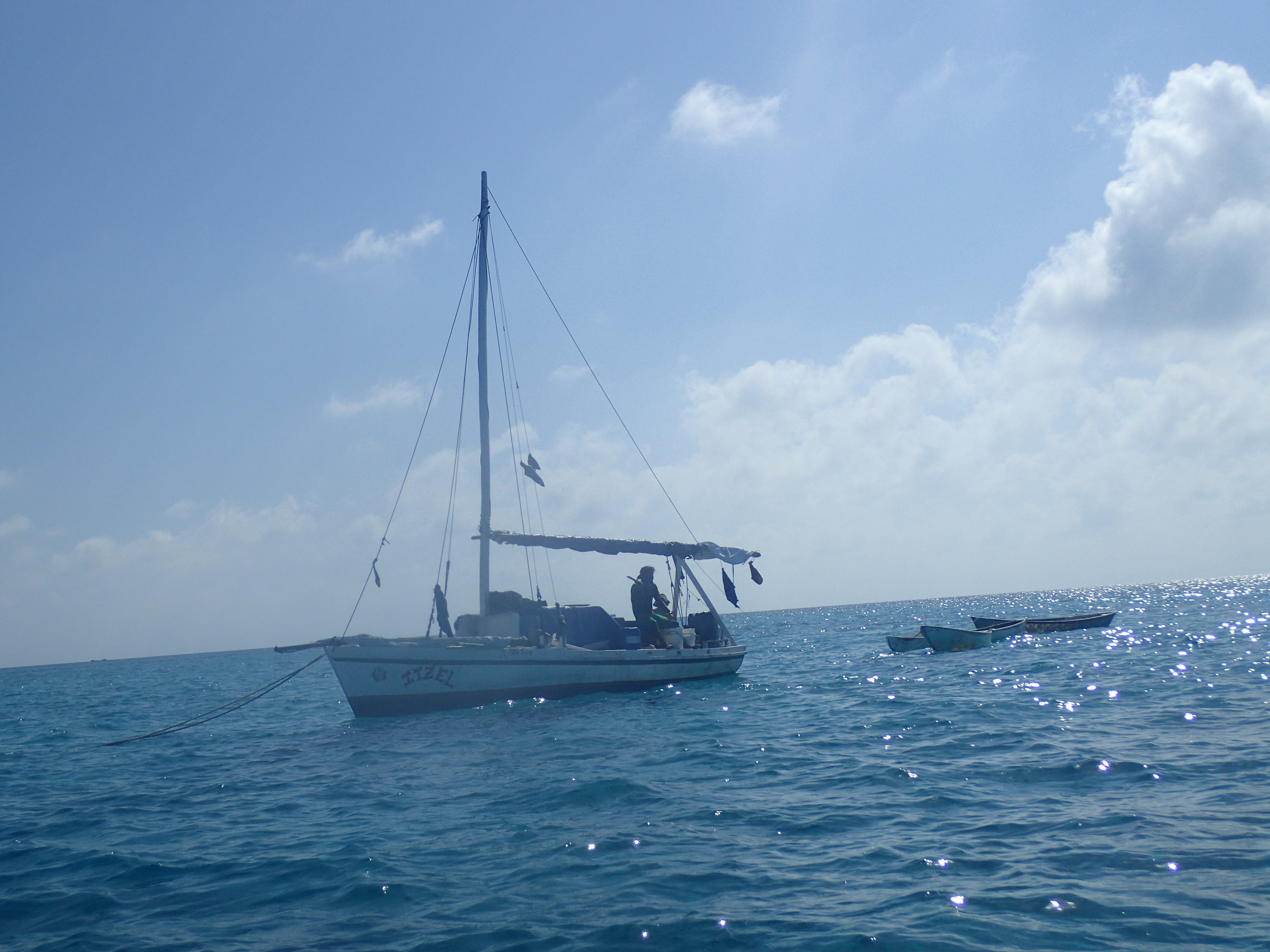
The bed?  Another matter.  I love(d) my soft full-sized mattress but gave it up to my son.  Then I bought a bed in a box from Walmart.  These things are amazing.  They come in a box the size of a medium sized TV.  You open the box and phooosh!  In a couple minutes you’ve got a queen sized mattress.  Be sure not to open the box in a hallway!

I hate spending money at Walmart but there’s a reason people shop there—it’s the cheapest—and this mattress and frame are actually really good quality.  The mattress is hard as a rock which I hate, but apparently most people prefer.

I was all set with the renters.  Then, one month prior to departure, I made the decision to sell my condo. There are various reasons for this, but the timing was due to it being a red hot market for lower-priced properties like mine.

The day I called my realtor, I began to feel a dull vibrating roar in my head.  Did I mention that, in addition to getting ready to spend three months abroad it was also Proposal Hell Month at work?  I have never felt so overwhelmed, and so productive, in my life.

If you’ve ever sold a house, you know there are a ton of decisions and paperwork to deal with.  You have to get your house pristinely clean and keep it that way at all times.  You have to drop everything and leave to make way for showings.

I woke up the morning after my decision, rolled over in bed, and felt like I was on the deck of a heaving ship.  Damn—vertigo!  I’ve had it 2-3 times before and I know it’s the result of me being pushed beyond my limit of stress.

The house went on the market.  There were 20 showings in three days, and four offers by the end of the fourth day.  I will make a nice profit, although it will just make up for the last time I sold a condo, at the bottom of the Great Recession in 2009.  It’s my turn.

The renters are protected—I made sure of that.  My realtor will sign all the closing paperwork for me in June and I’ll rent my own condo from the buyer for a month when I get home.

Home.  Where is home? Where will I go next?  I have no idea.

I went to see my doctor, then to a dizzy clinic.  I’ve seen two physical therapists and don’t feel any better.  They think it may be a Vestibular Migraine.  This is a migraine without the headache.  It still sucks plenty, because one symptom is episodes where so much pressure builds up in my head that I feel like I’m having a stroke.

The worst part of this whole summer adventure has been trying to buy a new phone from ATT.  I’ve been using the same iPhone 4 for five years and it was time for a change.  I tried over and over to buy an iPhone SE from ATT, but apparently they don’t like people spending money with their company because they screwed up the order half a dozen ways.

I know, first world problems.

I think I’m ready.  I can’t wait to have some down time. I don’t know when I’ll post again, but I’ll write from across the ocean eventually.

See you on the other side!

How to Spend the Summer Abroad

This is a series of posts about spending the summer abroad.  The idea germinated from an offer to housesit for a friend in Windsor, England, for the month of July.

When I tell people I’ll be gone for the whole summer their first question is usually, “What are you going to do with your place?”

I’ve fought and struggled for everything in life, but the answer to this question unfolded easily, so I figure it was meant to be.

When I got the offer to housesit, I searched Craig’s List to see if there was anyone out there who might be interested in renting my place for July. The first posting that popped up was from a couple looking to rent a place for the summer.  They are originally from Minneapolis, are retired in Florida, and they want to be in Minnesota to spend time with their kids and grandkids during the glory days of summer.

They seemed like ideal renters.  He is a retired insurance agent.  It was highly unlikely they would be having any wild parties.  So I expanded my thinking to being gone for the whole summer. This couple also agreed to rent my car, which will cover my car payment.  I live in a condo, and the management company agreed to manage the rental for a 7% cut.  That seemed reasonable—what could I do anyway if the toilet in my condo overflowed while I’m was in Ethiopia?  The management company will deal with it.

I can’t afford to not work.  Being away for three months requires working remotely; something my employer is okay with because I’ve proven myself.

I currently work 90% time and love it. On my two unpaid days per month, I go to the bank, the farmer’s market, the grocery, post office, liquor store, library, pharmacy—during the week, and then I actually have a weekend.  I have paid a price for it, which is that people view you as not being a “high powered” career ladder climber.  In the U.S. in particular, we highly value people who come in at 7am, work til 7pm, check work email 24/7, and forfeit their vacation time.  I like my job, but I enjoy so many other things too, like blogging, being outdoors, spending time with people I love, and travel.

Back to the summer plan: there are so many moving pieces.  Rental income must be reported to the IRS.  Several people have said, “Just don’t report it; they’ll never find out.”  I’m one of those suckers who believes in paying my share.  Plus I don’t want to go to prison.  So I’ll report it, but to offset it, I will go down to working 80% time.  That means a four-day work week.  The paid time off I’ve stockpiled, plus the summer holidays, will mean I’m basically working an average of three days a week.

I realize many people cannot afford to work part time, so I feel really fortunate.  After slogging away at my career for 30 years, I make a certain level of income that, if I am frugal, allows me to do this.

I’ve been paying for flights and Air B&Bs and trains as I can afford them over the last four months, so my June travels are paid for except for food and miscellaneous.  In July I’ll be house sitting and in August I’ll be a house guest, so I won’t have accommodation expense.

This is where I need to point out, if it isn’t obvious, that I have very good and generous friends.  I met Lynn and Sam when I was working in England 10 years ago.  Facebook and email and What’s App make it easier to maintain friendships across the ocean.  But I’ve also physically visited Lynn and Rob and vice versa, over the years—which takes time and money and effort.  I met my Dutch friend, Ingrid, before the Internet existed.  We wrote letters a couple times a year; she came to the US twice and I visited her twice.

I didn’t make these efforts to maintain friendships because I wanted a free place to stay, but it’s a bonus!

A Summer Abroad

This is the last in a series of posts about Belize that starts here, and the first in a series of posts about spending the summer abroad.

When I returned from Belize, my legs were so itchy from bug bites and I had to run to the bathroom so often that I didn’t get a good night’s sleep for a week.  Going to a developing country with an experienced tour provider is no guarantee of protection; you still have to look out for yourself.  I should have clocked on to the water situation sooner—that Jungle Jeanie’s was filling our “drinking water” jug with tap water.  I’m not saying that Jungle Jeanie’s was trying to hoodwink us.  Maybe they were dropping chlorine tablets into the water and thinking that was sufficient, but it wasn’t.

I don’t think there was anything I could have done to prevent the bug bites.  We all had different kinds of repellant and none of them worked.

Post-trip, we went around and around about how to share photos. We tried Dropbox but quickly ran into the storage limit and no one volunteered to pay for a higher one.  I created albums on Facebook and shared the links to them.  Others sent photos the old fashioned way, via email.

I think some tour companies create websites on which customers can share photos, but Wilderness Inquiry doesn’t offer that.  There could be a great business opportunity for someone who contracted with tour companies to manage their groups’ photos—editing, curating, and making them available to technology-averse oldsters.

I have thought of friending Emily on Facebook but can’t find her.  I searched for her exact name in my email just now and found this photo she took in a gas station bathroom which demonstrates our shared interest in foreign signage.

Would I go on another Wilderness Inquiry trip?  Absolutely.  Would I recommend it to others?  Yes.  This is the 4th time I’ve traveled with a group.  I went to England with Volunteers for Peace, to Israel with 175 Jews from Minnesota, to Portugal with a British company called Newmarket Tours, and now to Belize and Guatemala with Wilderness Inquiry.

In general, tours are less stress because they do all the planning and take care of almost everything for you on the ground.  They vet your accommodations.  They get your bag from the airport to the hotel, pay the bill at the restaurant, and communicate with the local guides. I haven’t done the math, but I’m sure this trip cost a lot less than if I had arranged everything on my own—especially taking my time into consideration.

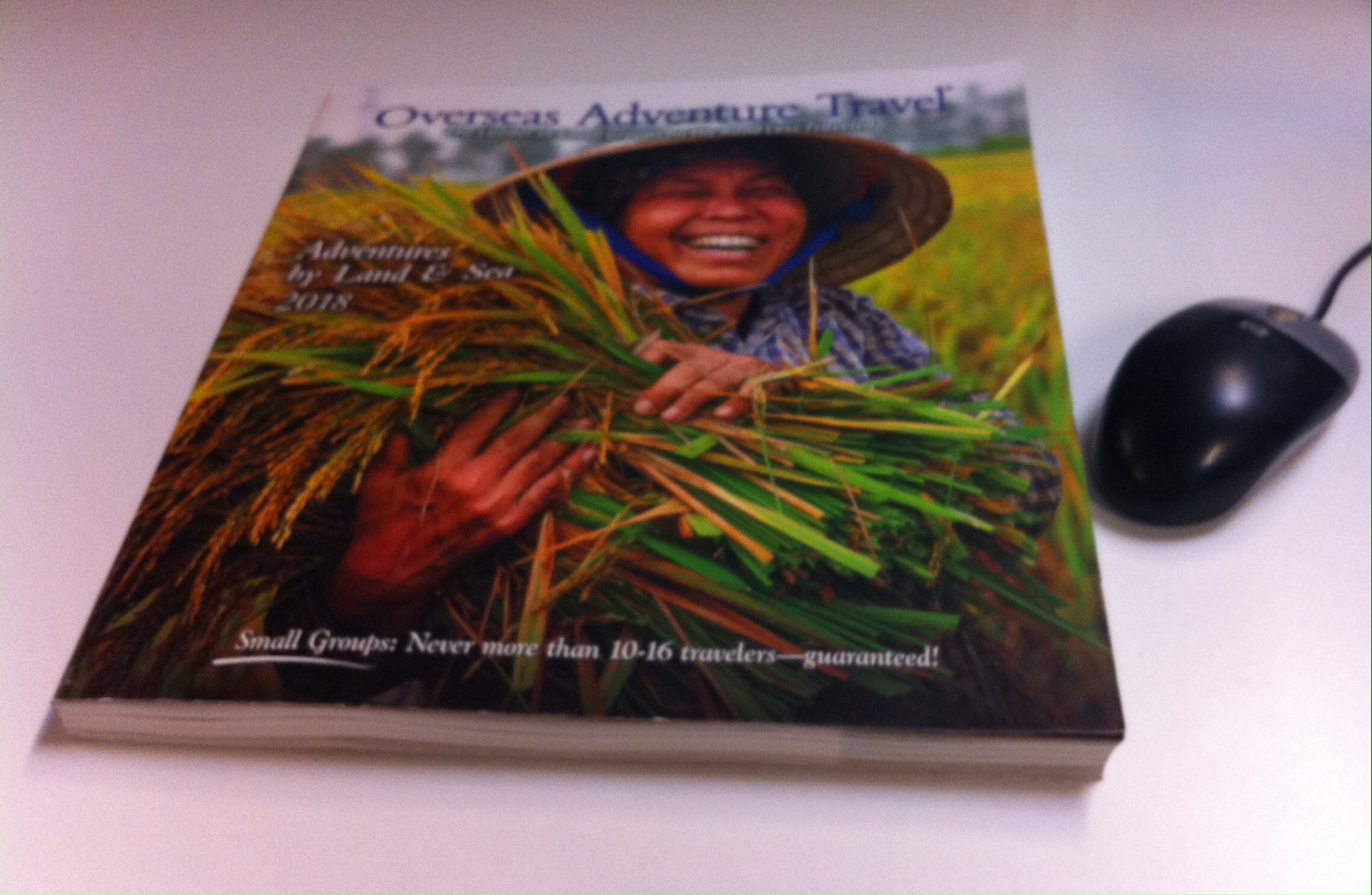
You have to be open to being with other people 24/7.  You have to be willing to skip a day of activities if you need alone time. If you are traveling solo, you have to fork over the single supplement—which is substantial—unless you go with an outfit like Wilderness Inquiry that will match you with a roommate.  Overseas Adventure Travel is the only other company I am aware of that doesn’t charge the single supplement (on most trips).  However, I recently tried to be taken off their mailing list and their website makes it almost impossible.  In fact, a week after submitting my request, I got this catalogue.

It’s like porn for travelers, but it makes me wonder about their customer service.

As I write this, it’s 12 hours til I get on a plane to London.  From there, I’ll fly to Copenhagen, Denmark and spend a few days there.  When you read this, I will be in Utrecht (the Netherlands) with my friend Ingrid who I met on that Volunteers for Peace trip.  After spending time doing fun summer Dutch things, we’ll take a train to Salzburg, Austria.  Salzburg is famous as the “Sound of Music” city and I’ve heard it’s cheesy but I don’t care.

From Salzburg, I’ll go to Ethiopia for work.  After that, I’ll spend the rest of the summer in England and Scotland.

Buh Bye Belize

This is a series of posts about Belize that starts here.

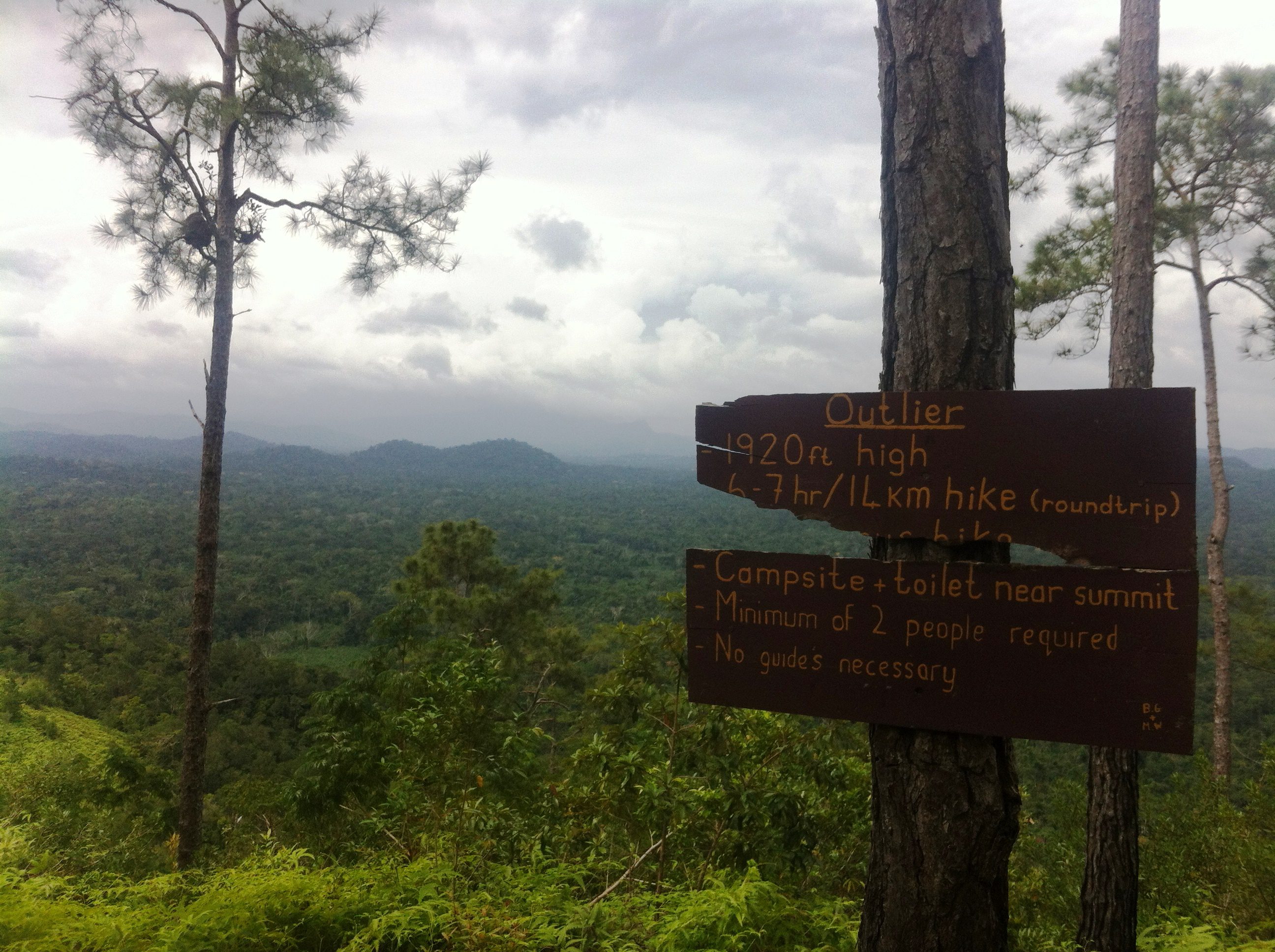
Atop Victoria Peak, I went off by myself and gazed at the view.
Travel is made of moments like this. There’s all the frantic planning, the upsets when things go wrong, the annoyances of other people and disappointments in yourself.  Then there are the moments where you find yourself feeling accomplished and staring at a beautiful view—and not thinking about what’s next, or being bothered by other people still blabbering away.
Serenity.  Mindfulness.  Presence.  In the moment. Whatever you call it, it feels wonderful and I experience it much more when I’m traveling than in my “real” life.

After savoring our hiking feat and the rewarding views, we descended.  Liz and Mike immediately flanked me.

“I’d like to hike alone,” I said.  Whereas earlier I would have spoken through gritted teeth and my irritation might have been hurtful, now I was pleasant but firm.

Mark was behind them, giving me a bemused look.

Liz and Mike looked surprised but walked off, blabbering away loudly about nothing.

Why can’t people stand to being alone, or in silence?

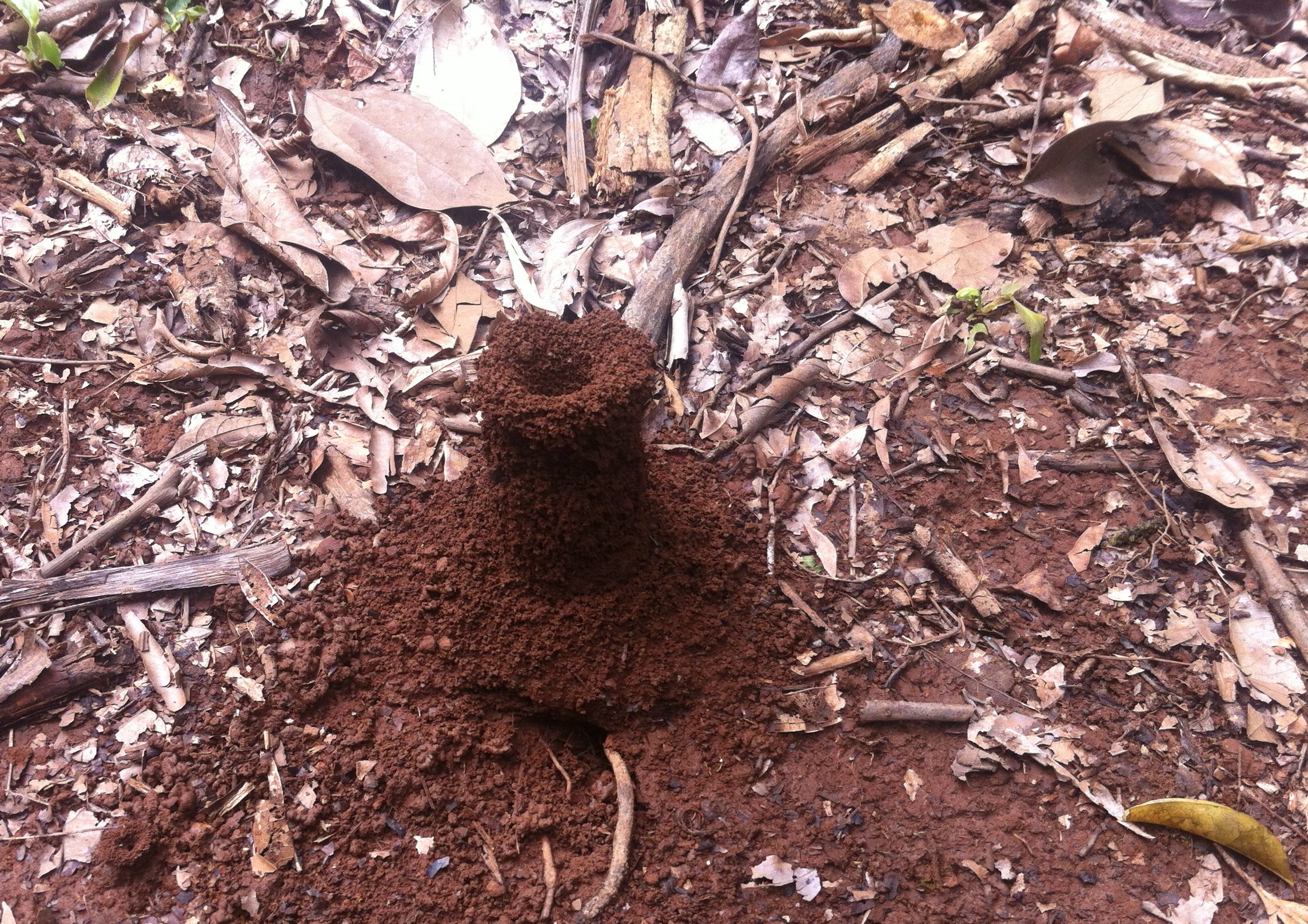
I took my time walking down, since descending is harder on the knees than climbing. I have no knee problems and I’d like to keep it that way. I came across Emily, and she and I walked together for a while, not talking except to point out an occasional find, like this eight-inch high anthill.

Then I spotted a spotted moth about the size of my open hand and silently pointed it out to Emily.  We watched it flit from tree to tree.

Back in Hopkins, we had a last fancy supper at a local club.  The waiter patiently answered “Yes ma’am,” “No ma’am,” as Joan asked about gluten and dairy and meat and eggs and MSG.

The talk turned to what we would be happy to get home to.  Smooth roads was number one. That led to talk of cars.

“I drive a Prius,” Joan said drearily.  Of course you do, I thought.

“Anne drives a Mini Cooper,” Mark said enthusiastically.  “It’s the smallest BMW and it’s as fuel-efficient as a Prius.  They’re such cool cars.”  I was so happy he had said it and not me. I am as much a snob about my car as any Prius driver.  “And they’re really fun to drive!” I added.

“I smile whenever I see one,” Mark said.

You might think I hated certain people on this trip.  I didn’t. They bugged me from time to time and the feeling might have been mutual. I wasn’t going to change them.  All I could do was try to be aware of, and keep a lid on, my tendencies toward sanctimoniousness and speaking like a walking encyclopedia.

This is one of the tradeoffs of group travel.  And for the moments of snorkeling heaven and climbing a mountain peak, it was worth it.

Our last day in Belize.  As on the other mornings, I walked down to the beach to see if a yoga session had materialized.  It hadn’t.  I did a few forward falls and mountain poses and headed back to the lodge for coffee.

Jeanie came in and said, “Whew!  What a great yoga session!”

“What?  Where?  I was just down on the beach and no one was there.”

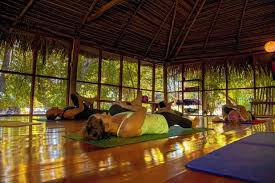
“In the yoga studio,” she replied.  Yoga studio?  A detail she had omitted.  She led me through the jungle to what was, by far, the most beautiful building at Jeanie’s (and it was minus the people in this photo).

This side trip made me the last person into the van, where I wound up in the back row between Liz and Mike.  Emily, in front, turned and gave me a look that said, “Nah, nah … so happy it’s not me!”  We shared a secret laugh and that helped.

Our legs were covered with bites—hundreds of them.  We were also feeling the effects of the water.  I won’t go into detail, but let’s say we were relieved to arrive at the airport.

My flight was first, so I yelled, “Safe travels, everyone!” and ran off with a backwards wave.

Rising Above (or Not)

This is a series of posts about Belize that starts here.

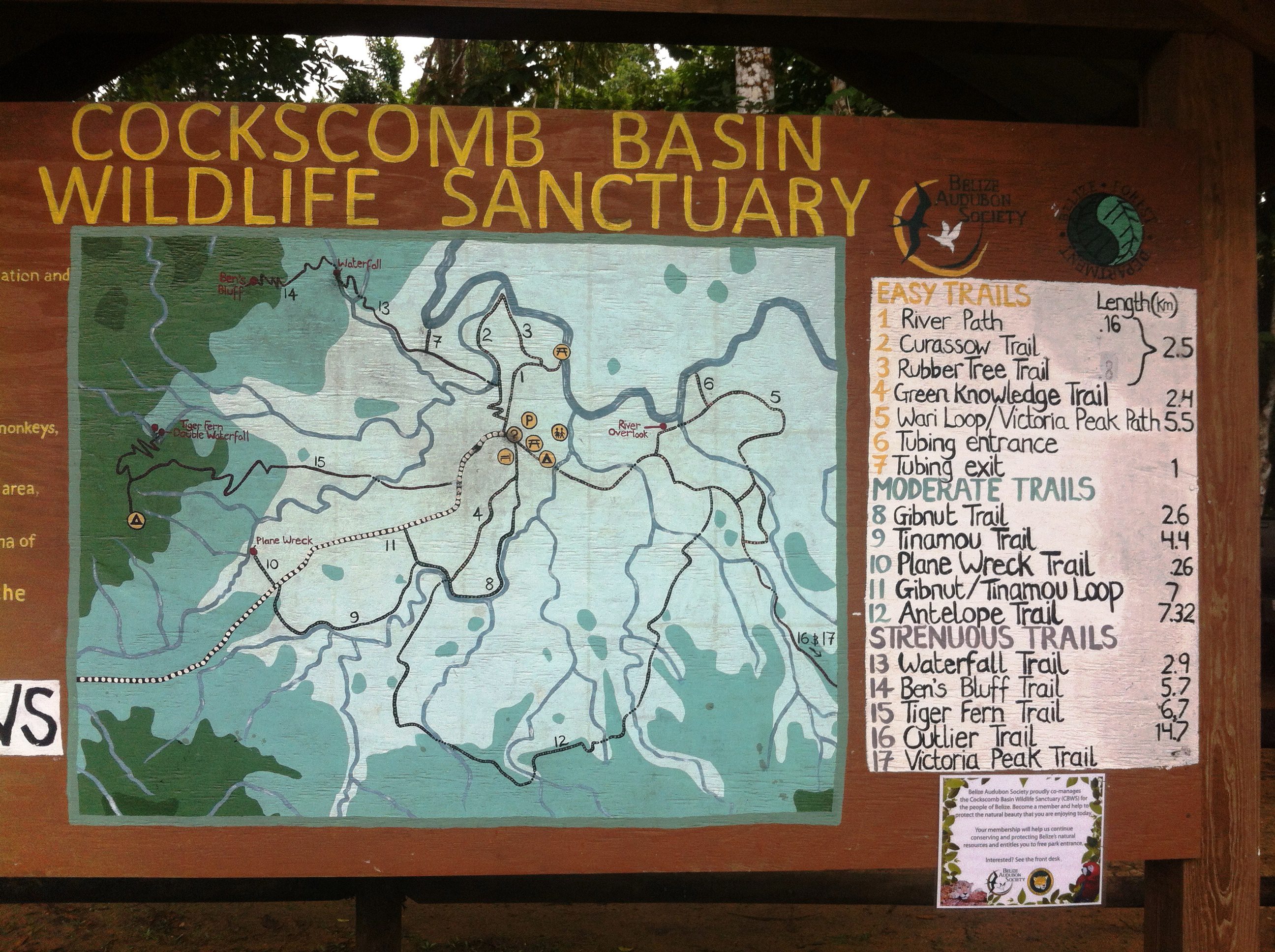
This post will have a lot of photos from our hike up Victoria Peak, the second highest point in Belize.  First, we stood and looked at the map for about 20 minutes.

Our intermediate objective was a waterfall where we could swim, but it was listed under “strenuous” and Joan, with her arm in a sling, wasn’t up for that.

“It’s the only way to get to Victoria Peak,” said Mark.  “Maybe you can rest by the falls while the rest of us continue on.”  And that’s what we did.

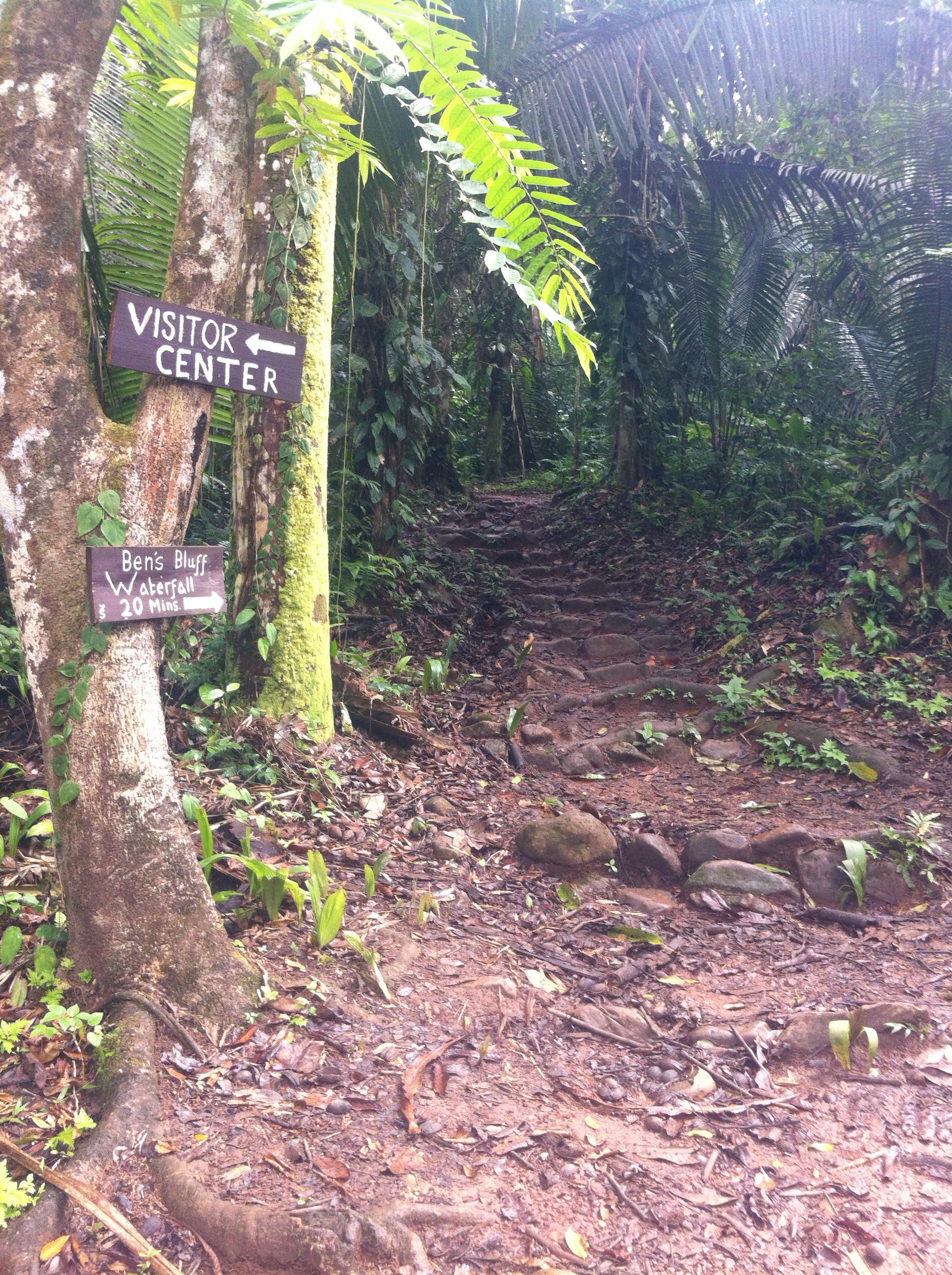
I’ve done a lot of hiking and I was pretty confident that “strenuous” wouldn’t really be strenuous—that they just called it that for out-of-shape hiking newbies. And I was right; the trail was pretty flat, if uneven.

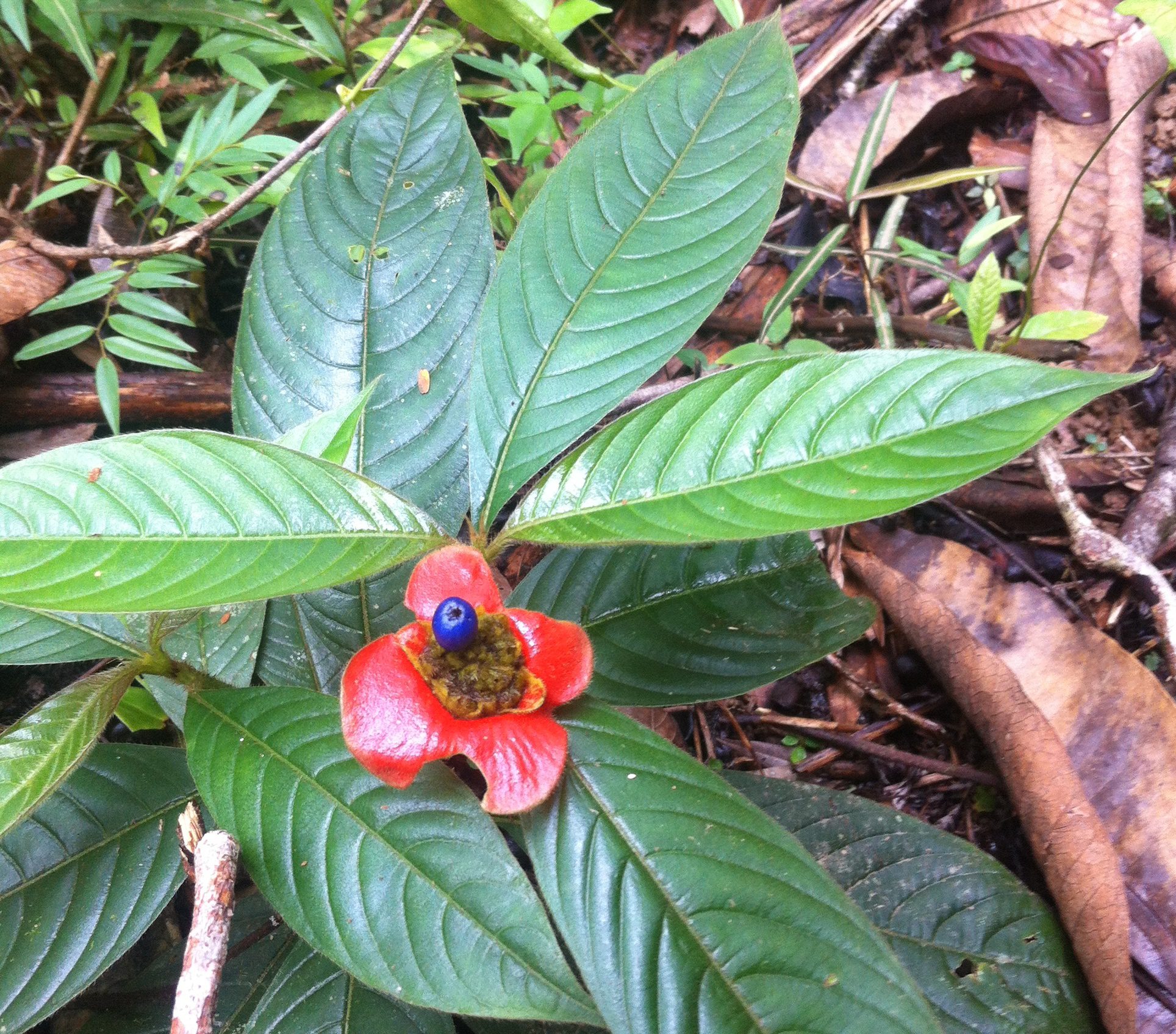
I stopped every few feet to take photos of the plant life.  These are the tiny ones.

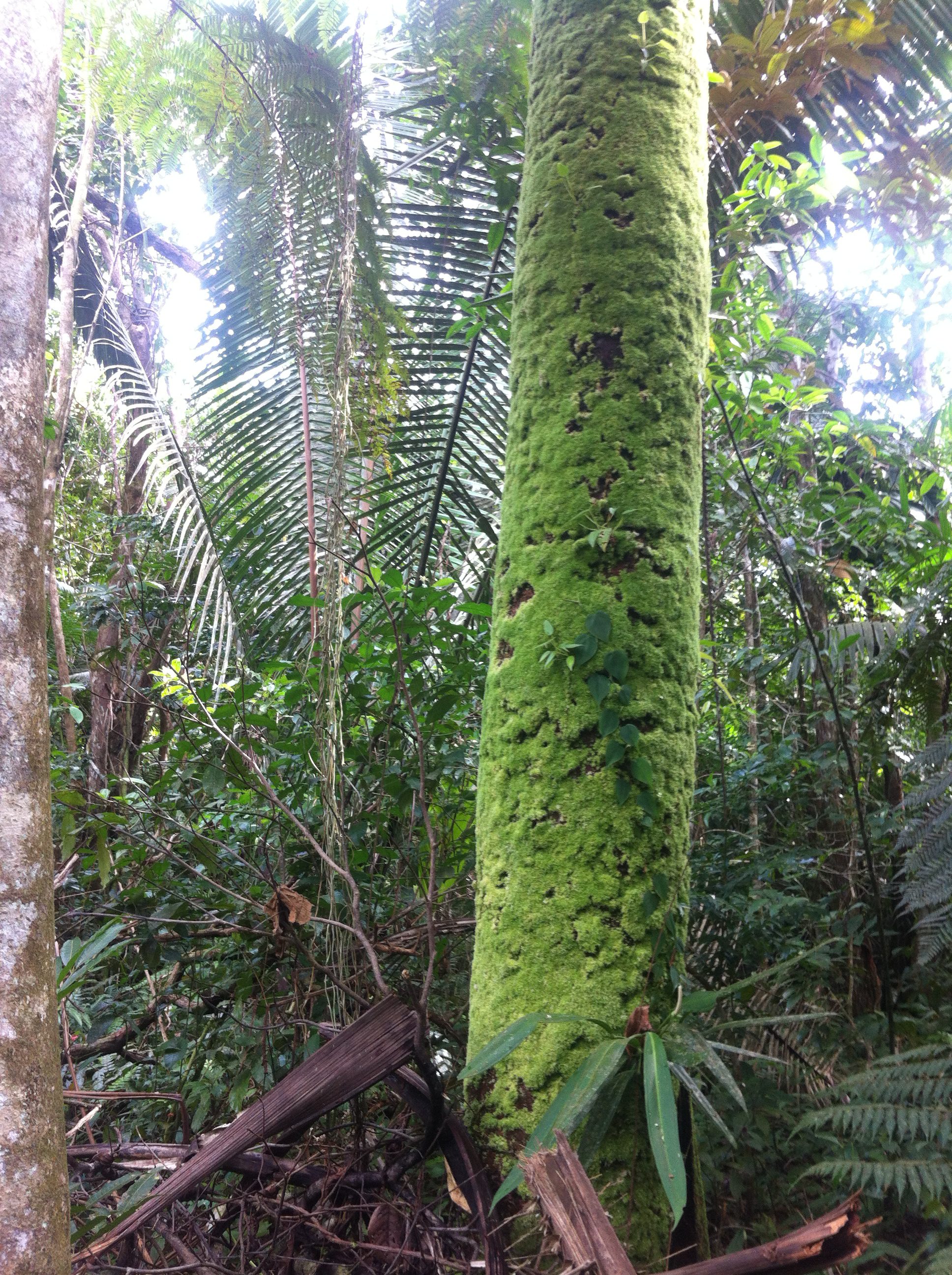
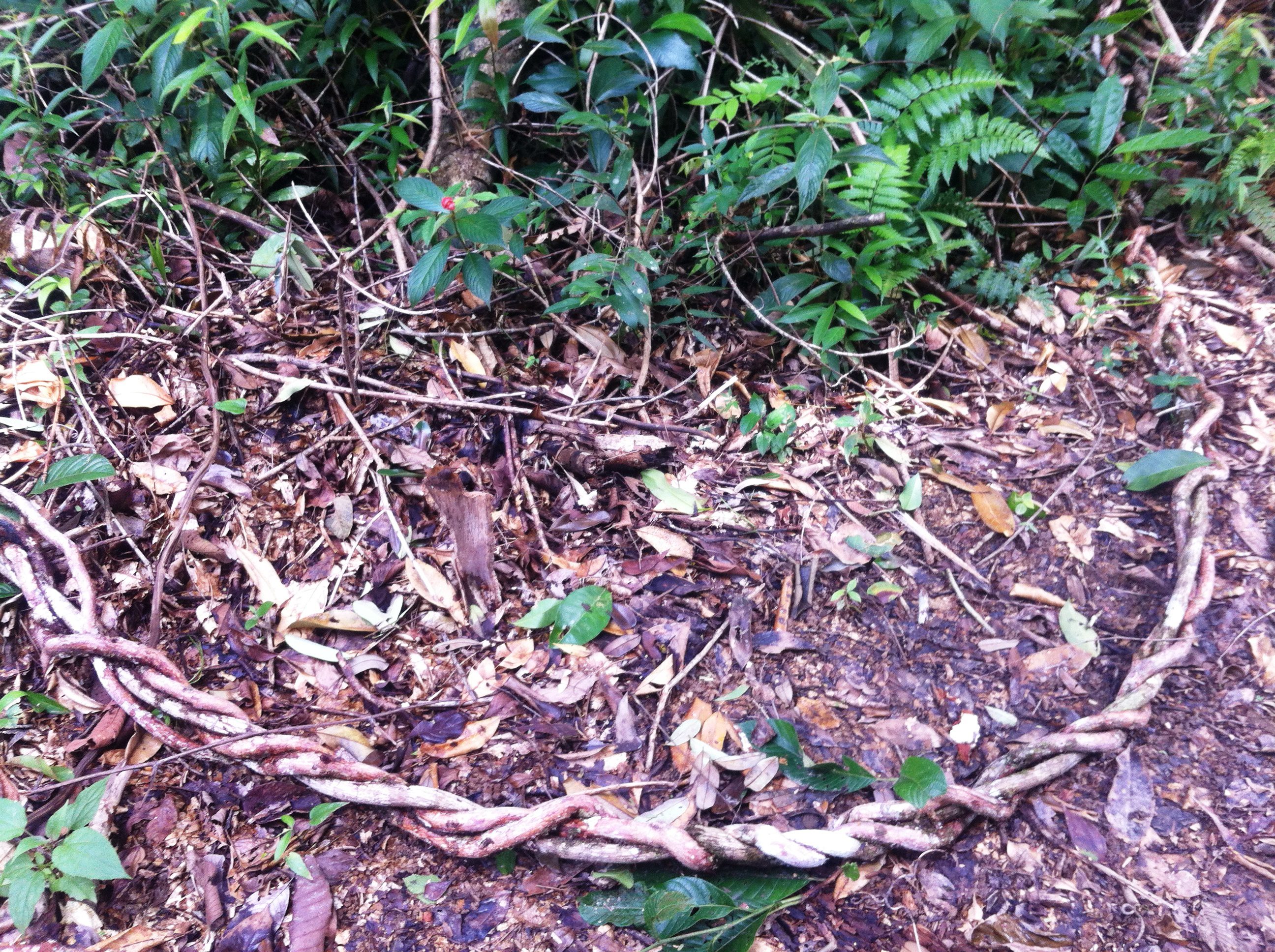
Then there were the majestic trees, giant ferns, and braided vines.

Liz and Mike were talking loudly.  Every time I snapped a photo Liz would exclaim, “Good eye! Ah wouldna never seen that.  That’s something I never woulda seen.”

“Go on ahead, I’ll catch up,” I said.

“Oh no you don’t; we’ve got our eyes on you, baby!” Mike replied, with a guffaw that indicated he thought he was being funny.

There is a rule in hiking where the group should never let any member out of sight.  I was falling behind because I was taking so many pictures and because I wanted to hear the birds.  Mike and Liz were justified in keeping me in sight, but I wished they would stop blabbing.

“I wonder why we don’t hear any birds,” Mike boomed.

“I think if we’re quiet, we will,” I suggested.

That didn’t’ work.  They discussed how far it was to the peak and Liz used her pet phrase, “Close enough for government work,” twice.

In the van on the way to the park, Stan had told me about his last two years as a postal worker, learning new software that helped mail arrive from Point A to Point B anywhere in the continental US in two days. It’s amazing when you think about it.

I thought about all the government proposals I’ve worked on that funded rehabilitation for survivors of torture and war trauma. We work hard to be precise, even down to the GPS coordinates of the refugee camps.  But hey, maybe next time I would write, “Just give us the money and we’ll do a pretty good job—close enough for government work!”

We reached the waterfall and half of us stripped down to our swim suits and waded in.  The water was ice cold and refreshing. We frolicked until our sweat and sunscreen and bug spray washed downstream, then put our clothes back on over our wet suits and left Joan on a bench while we ascended to the peak.

The hike to Victoria Peak is not for sissies. It’s steep and long.  When we started, it was hot and humid and our swim suits under our clothes created a personal sauna effect.  Squads of biting insects attacked our ankles and legs.  We re-applied bug spray but that didn’t deter them.

The landscape changed from steamy, close-packed jungle to open, ferny woodland with pine trees.

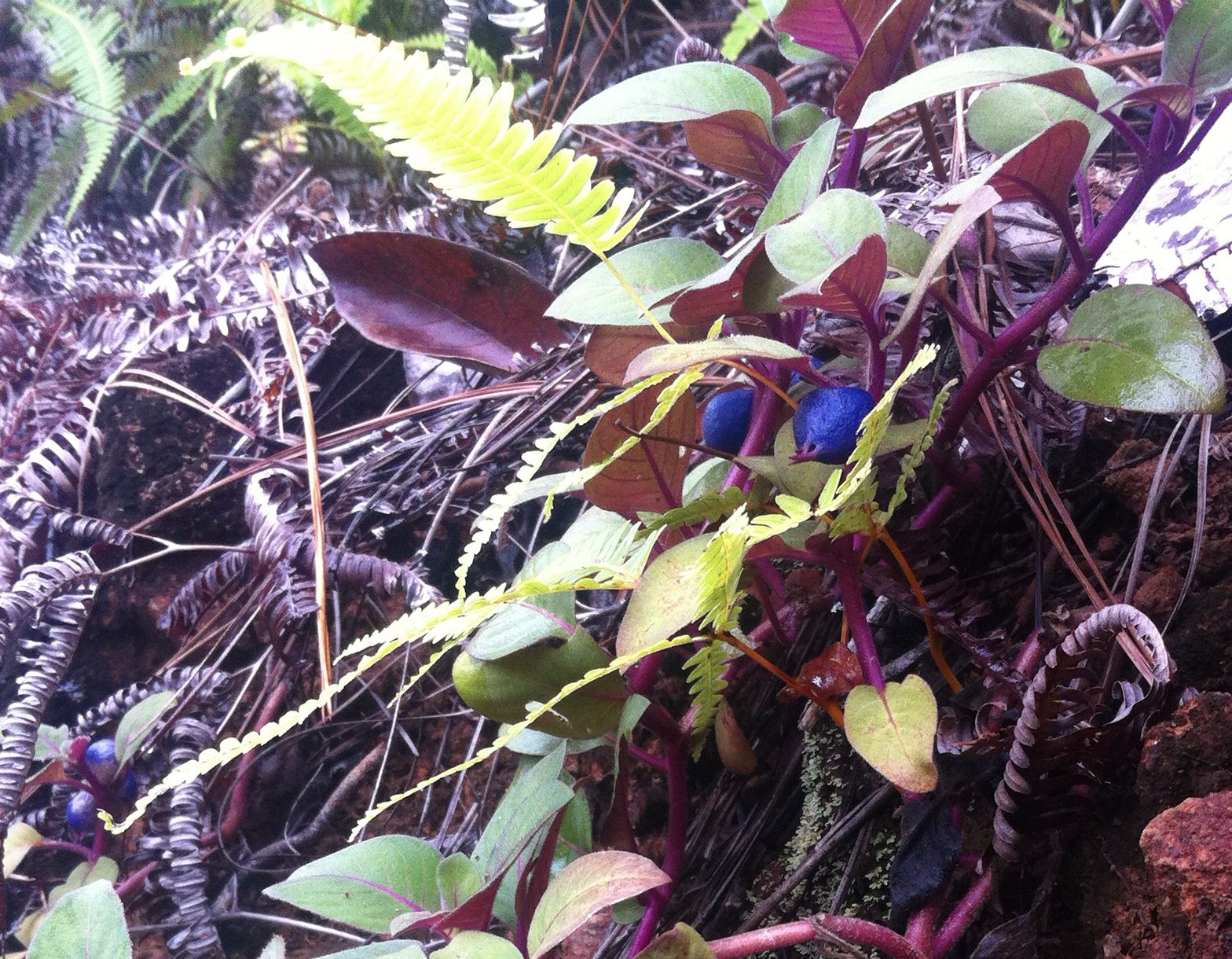
As I staggered up the switchbacks, I caught sight of these tiny, iridescent cobalt berries.

Emily was breathing heavily.  She gave up and sat on a log to enjoy the view while we went on to the peak.

There was discussion of the 13 extra feet we would have had to hike to reach the highest peak in Belize.  Once more, Liz said, “Close enough for government work.”

I turned to Stan and asked, “As a government worker, weren’t you glad you could be sloppy?  I sure am!”  Stan gave a low laugh and edged away from us.  I knew Liz’s digs about government workers had bugged him too but he didn’t want to be drawn in.  Liz squirmed and pretended she hadn’t heard me.

I walked off; Stan took this photo of me with a telephoto lens, contemplating the view.

Bible Bangers and Tummy Troubles

This is a series of posts about Belize that starts here.

One of the missionaries had followed me into the store.

“Are you from here?” he asked.

Do I look like I’m from here? I thought, but responded no.

“Do you have a few minutes to hear God’s holy word?”

No,” I said firmly. “I’m busy buying mouse glue.  Besides, I’m Jewish.”

He pulled back as though I had said, “I drink the blood of Christian children,” which in his mind was likely synonymous with “Jewish.”

“Well, Christ bless you and have a blessed day,” he said as he handed me this card and hurried off to save other souls.

The back has more judgmental drivel, and their contact info, but I’m not going to share that.  This kind of thing really pisses me off.  Aren’t there any sinners to save in Iowa?  Sure there are, but Iowa is cold, so here they were, probably with all their expenses paid by their congregation, proselytizing in the sunshine.

I walked around the neighborhoods of Havana and Harlem.  This is a typical street scene.

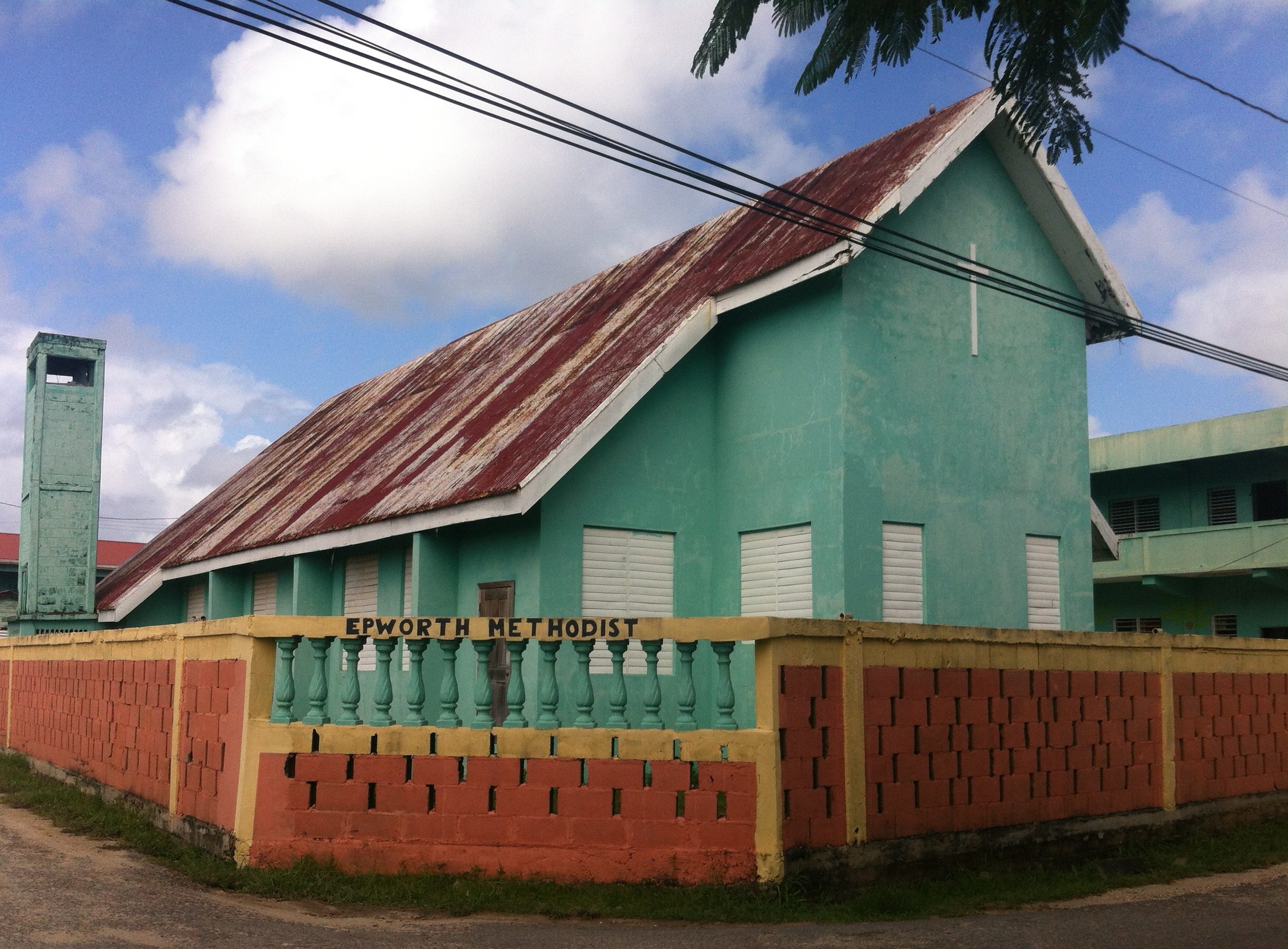
There were churches on every corner, so again, why the need for missionaries from the US?  Here is Epworth Methodist.

The housing stock varied from run-down shacks that seemed inhabitable, to perfectly-maintained villas.

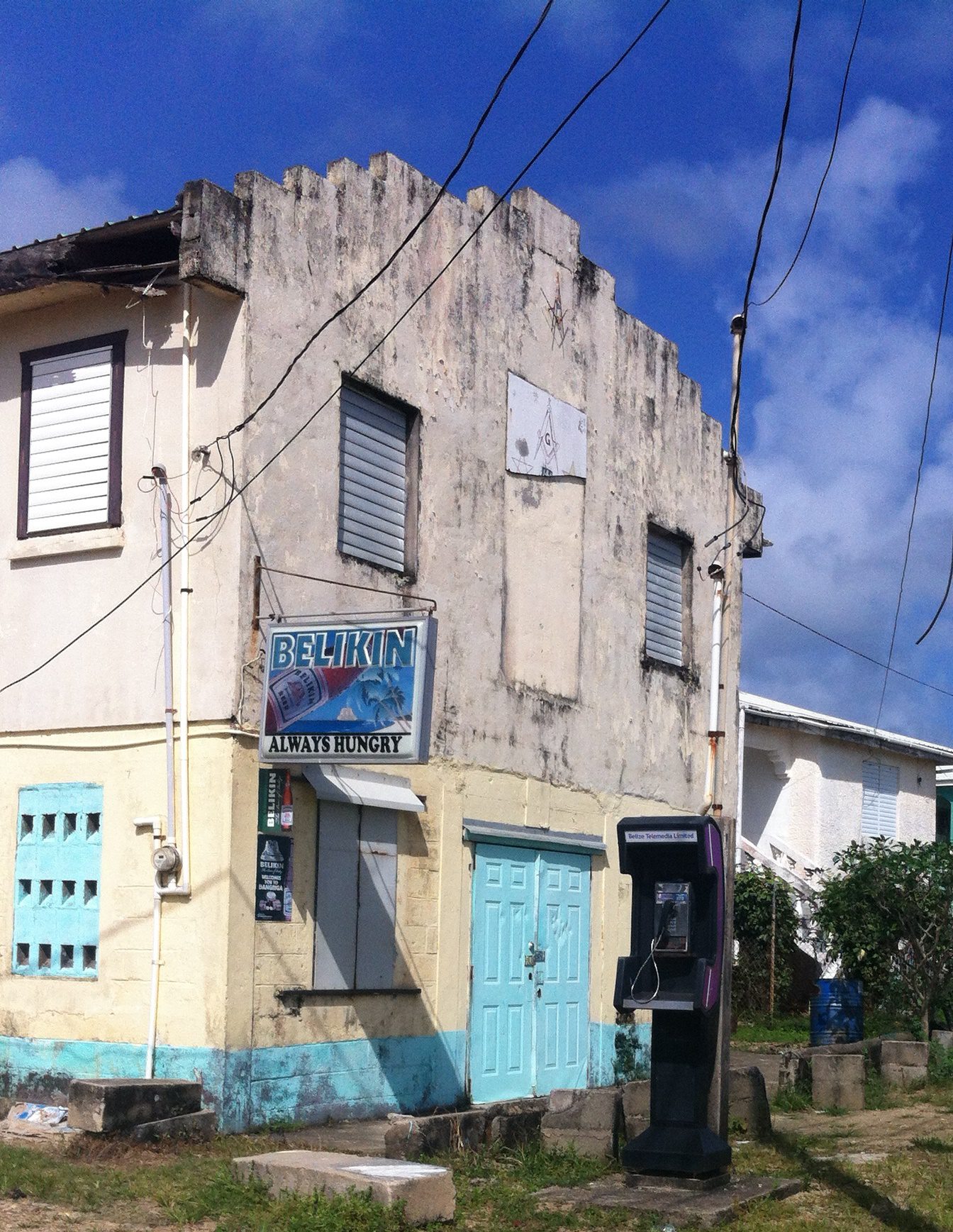
I loved the name of this restaurant, “Always Hungry.” I wasn’t sure if I would want to eat there, but it was good to know they had a pay phone outside in case I needed one.

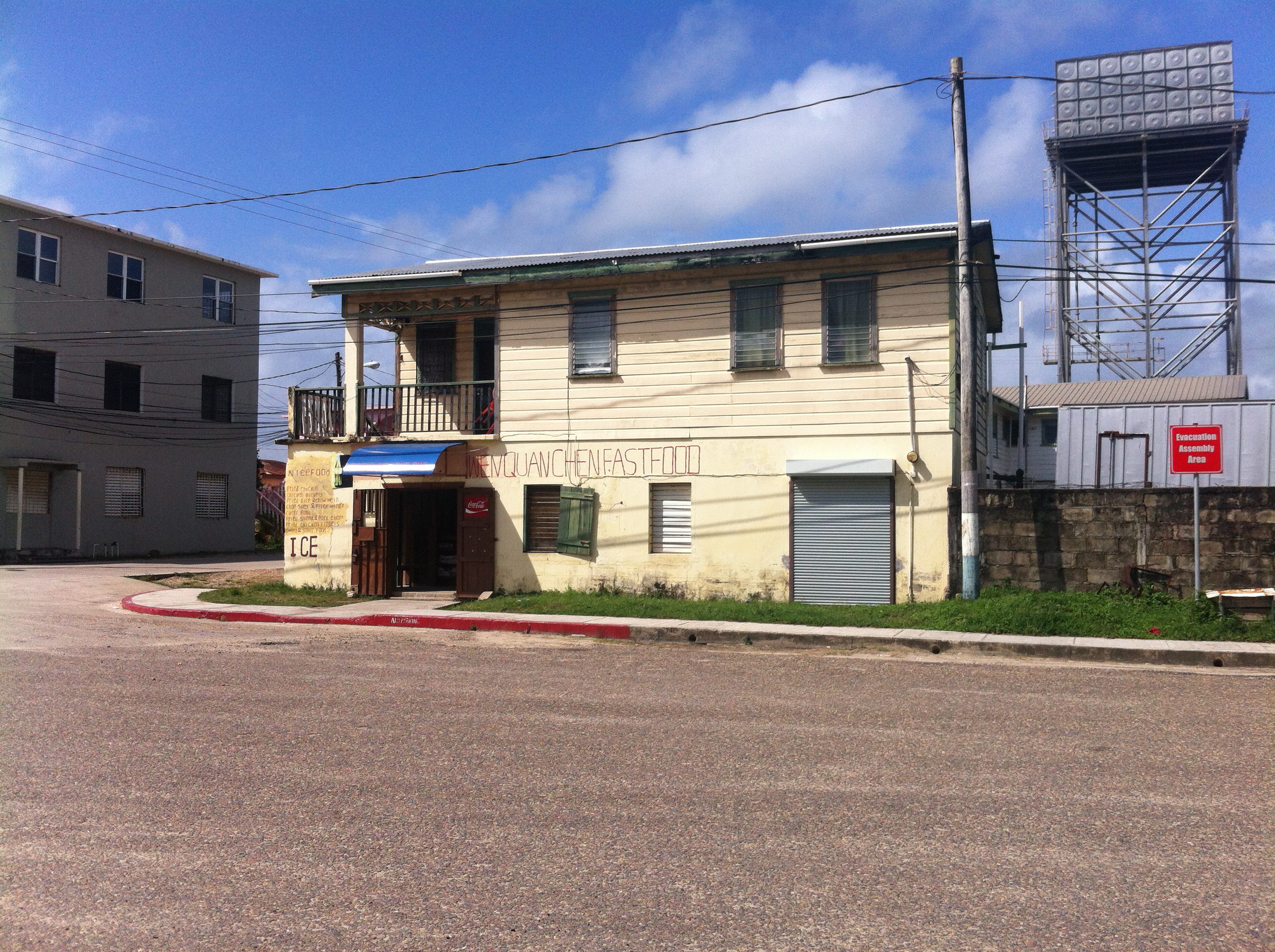
There were a number of “fast food” restaurants; this is Wen Quan Chen Fast Foods:

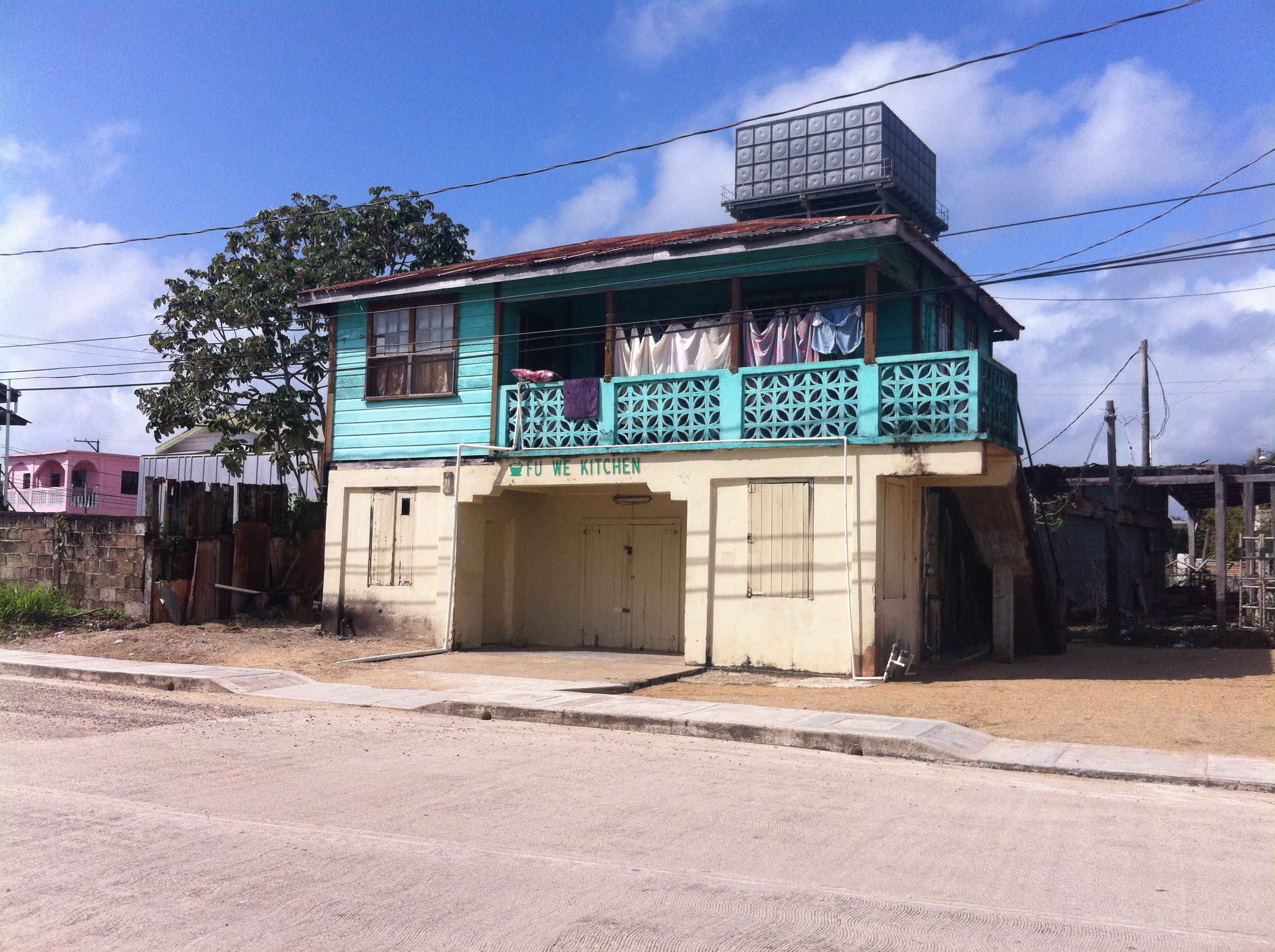
And another Chinese restaurant, Fu We Kitchen:

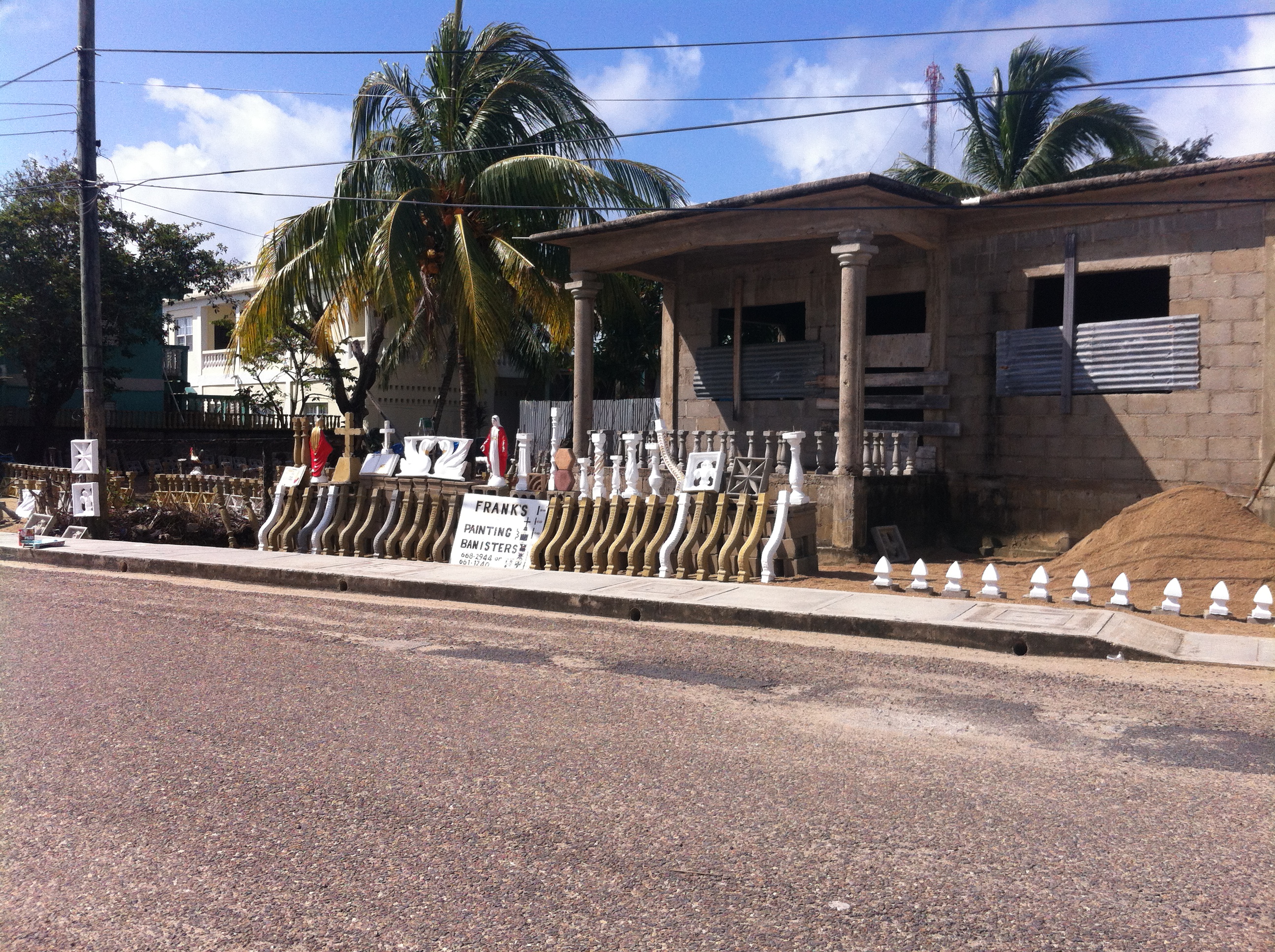
I liked this combination of services—Frank’s banisters and tombstones:

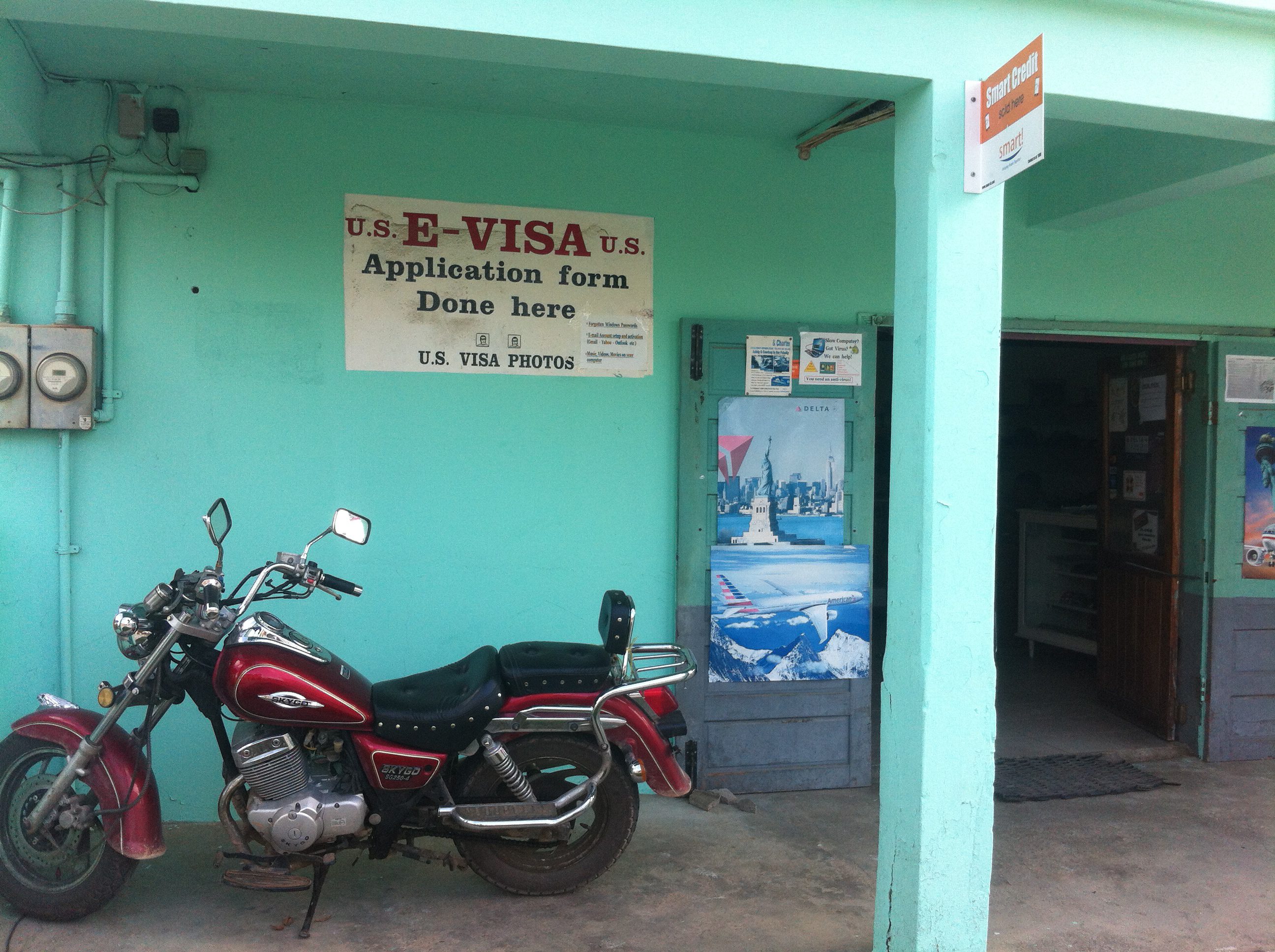
I wonder how much longer this place will stay in business now that we are making it so difficult for anyone to enter the US:

Our group rendezvoused at the van and drove back to the spot where we had watched birds, but after much searching we couldn’t find Trudy’s shoe.

We stopped to get gas and a man was sitting between the pumps ladling something out of a 10-gallon plastic drum into empty glass bottles.  Other customers were snapping up the bottles so I called out the window, “Whatcha got there?”

“It’s Irish mess!” he answered enthusiastically.  “It’s a mess o’ seaweed and spices.  Very refreshing, and only 50 cents.”

Mark pulled a handful of coins out of his pocket and I said in a low voice, “Think about the water.”  He slipped the coins back in his pocket.  We had all started having tummy troubles.

“I don’t understand it,” said Mark.  Jeanie supplied drinking water in a five-gallon jug in the lodge for $1 per liter. We had all assumed it was purified.

I thought about it and asked Mark, “Have you ever seen a truck delivering new bottles of water?”

He paused thoughtfully. “No, now that you mention it.”

“So they just refill the same five-gallon jug from the tap in the kitchen, I’m guessing.  We might as well fill our bottles directly from the tap.  That’d be free.”

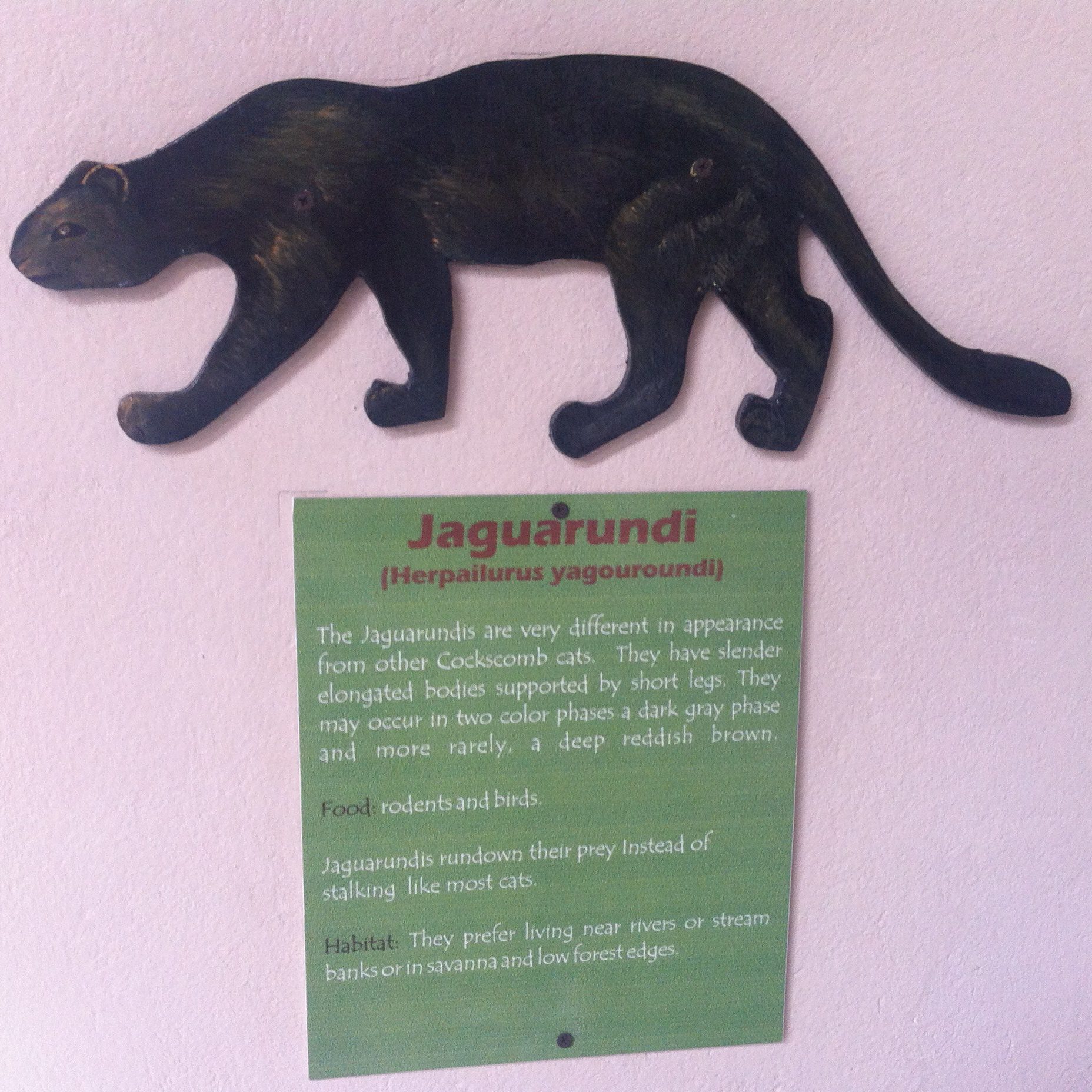
After lunch, we were off to Cockscomb Basin.  As we drove down the long entry driveway, something big and black slithered quickly across the road.  When we arrived at the preserve, which had a well-funded interpretive center, we immediately identified the critter as a Jaguarundi. This was promising; we were all excited about what else we might see here.

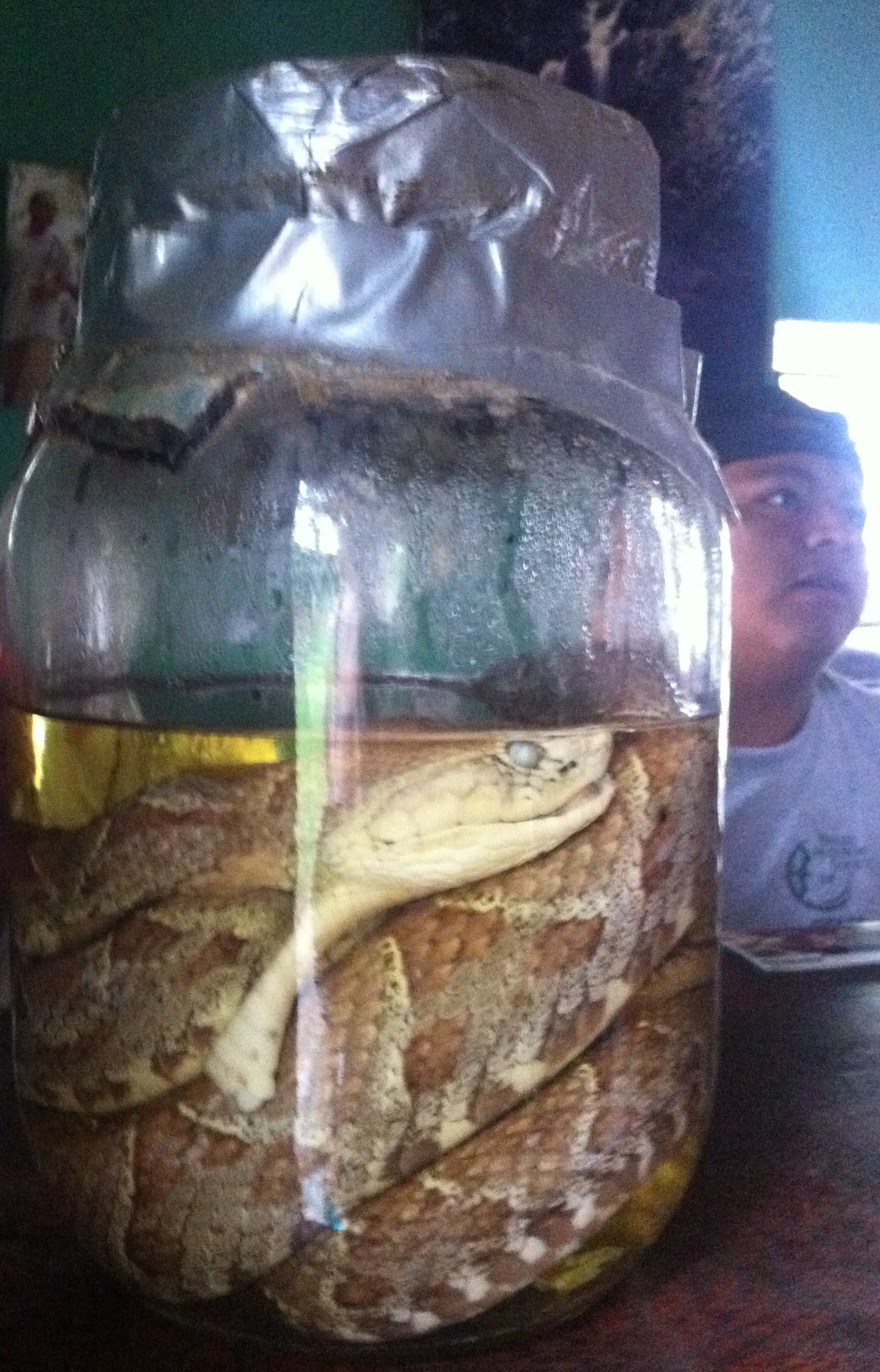
In the office, Mark was having a hard time convincing the guy at the desk to let us in because we didn’t have a reservation or a local guide.  I think the contents of the jar were meant as a warning of what could go wrong if we wandered through on our own.

I’m not sure how Mark got us in and I don’t need to know, but we were soon hiking through the jungle on our way to Victoria Peak—at 3,675 feet the second-highest mountain in Belize.  Doyle’s Peak is the highest, but it only beats Victoria by 13 feet.  I had no sense of how high 3,675 feet was and I’m glad I didn’t or I might have skipped it.

Shoeless in Dandriga

This is a series of posts about Belize that starts here.

Our last full day in Belize.  The plan was, as the itinerary stated, to “Visit the famed Cockscomb Basin Jaguar Preserve for a guided tour of the jungle. Run by the Belize Audubon Society, the Cockscomb Basin is one of the last refuges for the Jaguar, as well as many other species of birds and animals.”

But first, Mark wanted to go to the nearest large town to get cash, since Jeanie had informed us there was no ATM in Hopkins.  Trudy, Stan, Mark and I went along for the ride to Dandriga, which was half an hour north on very smooth, new roads.

We passed Mennonites in horse-drawn buggies.  They had established farms along the route, and I feel bad saying this but their houses were perfectly tidy, without a board out of place nor a rusty awning in sight.  By contrast, the other houses all appeared to be in advanced states of decay.  Siding was missing, windows were boarded up, anything metal was rusty.  Was this due to the Mennonites having more money? The Mennonites came voluntarily, whereas other Belizeans were brought as slaves or at the very best, subjugated.  Did the Mennonites have some sort of uber pioneer protestant work ethic?

I was about to write “natives” vs. Mennonites, then realized the current Mennonites are just as “native” as anyone else, since their forebears emigrated from Holland in the 17th Century.

We pulled over on the side of the road to watch flocks of birds in the wetlands.  Trudy kicked off her shoes and squashed through the mud.

In Dandriga, Mark reminded us to get $40.00 cash for the airport exit fee.  Mike had some trouble using his card and went inside.

“The teller said we could have gone to their Hopkins branch,” he said when he emerged.  “It’s in a place called Trinnie’s that rents kayaks.”

We decided to wander around Dandriga for an hour. Trudy went back to the van to get her shoes and returned, frantically pointing at her feet.  Without Emily, we had no way of knowing what was wrong.  Mark dug a notepad and pen out of the glovebox.

“One of my shoes is gone!”  Trudy wrote.

“It must have fallen out of the van when we stopped,” Stan suggested.

So Trudy sat in the van.

The first thing you would notice about Dandriga, unless you were Trudy, were the missionaries on the main corner with megaphones, shouting that we are all going to hell if we drank alcohol or fornicated.

Once I heard them pronounce “out” and “about,” I knew they were American, not Canadian.  They were blond and plump and extremely sun burned. If someone did this on my street, I would be seriously annoyed and demand that the police shut them down.  But no one in Dandriga seemed to mind, they just smiled and nodded and kept walking.

All the shops were Chinese owned, with the exception of one Indian place called Jai.

I went into a store called The Price is Right, bought a bag of pecans labeled “For Sale at Costco Only,” and munched on them while I looked around.

There was a large section of glucose products.  Was it cheaper and easier to consume glucose than real food?  The thought made me queasy.

Belizeans apparently inherited a love of beans from their days as a British colony.  These were one-gallon cans.

And in case you spilled beans on yourself, there was a large selection of bleaches.

The prices were marked by hand. Couldn’t they afford one of those price label makers?  I wondered where Koleston Hair Color came from.  The name sounded too close to colon for me.

My favorite item was the Mouse Glue. So many questions….can you also use it to catch elephants?  How does it “kill rat & mouse without poison”?  Do you have to dispatch the poor rodent yourself once it’s helplessly mired in the glue?  What is mocosity and just how strong is it?  How would I avoid stepping in this goo myself in the middle of the night?  And where do dragon hunters fit into the picture?

Elder, Kickin’ It

This is a series of posts about Belize that starts here.

In the real world, there is more bad news in addition to all the shenanigans in Washington.  Every day there are reports about all the people overdosing on Carfentanil, a synthetic opioid 10,000 times more potent than morphine.  The anniversary of Prince’s death just passed; he overdosed on a similar drug, Fentanyl.  Carfentanil was developed as a large animal anesthetic.  Really?  Who takes drugs like that?

Sadly, my dad did.  It was his birthday recently; he would have been 81 if he hadn’t overdosed in a Wisconsin motel room nearly 50 years ago, aged 32.  He died of a lethal combination of alcohol and Paraldehyde, which used to be prescribed to treat alcoholism.  Paraldehyde is classified as a “hypnotic” and has mostly been replaced by safer drugs. Was it an accident or intentional?  I’ll never know.  What I do notice is how little emotion I feel about it anymore.  That’s taken a long time and a lot of work.  He loved to travel, so I like to think he would be happy about my adventures.

After our snorkeling day, we were herded onto the van by Mark to attend a Garifuna drumming performance at the Hopkins Cultural Center.  It took an hour for us to drive the mile distance as the crow flies.  It was a very dark night. Thank goodness there were potholes the size of bathtubs full of water, which reflected the light from the three streetlights in town.

Eventually we were ushered into a large thatched-roof hut where we waited for our supper.  A woman about my age was the cook, and she was obviously working her ass off. She had been summoned on five minutes notice to produce food for 20 people, and after an hour her young adult children served up bowls of hudutu and fry bread.  Again, it was full of bones, but we were so hungry we had no complaints.

A 30-something man in a dashiki jumped up on the stage and started shouting into the mic.  “Let’s give a hand to Elder Elspeth for the wonderful meal!”

Elder?  If she was an elder, that made me one too.

The guy, whose name was Myron, launched into a long, disconnected rant about Garifuna culture.  I had read about it in the guide books, and he seemed to be making stuff up.  Garifuna is a language and a culture brought by mixed-race slaves from the Caribbean to Honduras, Nicaragua, and British Honduras—as Belize was then called—in the early 19th Century.  I asked a question; I don’t recall what it was because he angrily yelled, “No!” at me and resumed his animated monologue.  He seemed to have a chip on his shoulder.  He was very muscular—maybe he had ‘roid rage.

Myron went on for half an hour, then two other men joined him and they began drumming and singing manically in the Garifuna language.  It reminded me of a pow wow, where the first song is really cool, the second one is good, and then they all sound alike.

Despite it being ear-splittingly loud, I was trying hard not to nod off, as were the other snorkelers. Mercifully the trio only played five songs.  Then they jumped off the stage and started selling CDs and passing a hat for tips.  It was clear they couldn’t wait for us to get out of there.

Midnight.  One hundred Fahrenheit with 99% humidity.  I lay in my bed in the middle of the room, between Trudy and Emily.  Our table and chairs had disappeared while we were gone but we were beyond curious about why things came and went.

My Restless Legs Syndrome is always worse when it’s humid.  It sounds like a silly condition, but it’s ruined more nights of sleep than any worry or noise or excess of caffeine or alcohol.  Just as I’m falling asleep, I get a creeping feeling around my knees and have an overpowering urge to Move My Legs.

Then music started up in the distance, a low throbbing beat.  This would last for hours, I thought, as I kick, kick, kicked to the beat.

Suspended

This is a series of posts about Belize that starts here.

We sat in the sand under a shade tree enjoying our lunch break before more snorkeling.

Here’s something I never knew about snorkeling: it is very dehydrating.  There are lots of articles about it; it’s something about the lack of gravity when you’re in the water, apparently.  Whatever the case, the public toilet on the island was half a mile off, so we all started pretending we couldn’t get enough of the water, wading in and saying things like, “Ooh, I just can’t stay away from of this beautiful water!”  What else could we do?

Emily and I had become pals.  We had both lived and worked or gone to school in other countries. We lived in the same neighborhood now.  And we had both been observing the martyrdom, endless list of food restrictions, and other “interesting” behavior of our fellow tour members.

“Do you have any gluten-free options?” asked Joan as the pulled-pork sandwiches were being handed out.  Lincoln, our boat captain, smiled and shook his head no.  Joan sat back in the shade, her arm still in a makeshift sling from her fall the first day.  She didn’t say, “I’ll just go hungry then,” but she didn’t need to; it was all in her body language.  Neither she nor Liz had gone in the water. This wasn’t surprising about Joan, who was stick-thin and sickly looking and had fibromyalgia.  But Liz was in good shape.

“Ah just didn’t feel lahk it,” she drawled.  If she was hoping we would ask her to explain why, she was disappointed.

The rest of us really couldn’t wait to get back in. As we were putt-putting out to the reef area, I spoke with Vanessa, our guide.

Vanessa had finished two years of college to become an English teacher.  Then she got this summer job as a snorkeling guide and she never went back.  I can’t say I blame her.  When she said she missed writing, I suggested she could write a blog about snorkeling and she liked that idea.  I hope she does it.

We approached a boat where fishermen were cleaning their catch of conches and throwing the leftover scraps into the sea.

We jumped in, and almost immediately I said into my mask, “That looks like a turtle!” only it sounded like, “Flaploogglaga blurpple!”

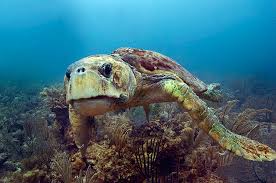
And it was a turtle, an old Loggerhead about five feet from snout to tail.  This is not “our” turtle but it’ll give you an idea of what she looked like.

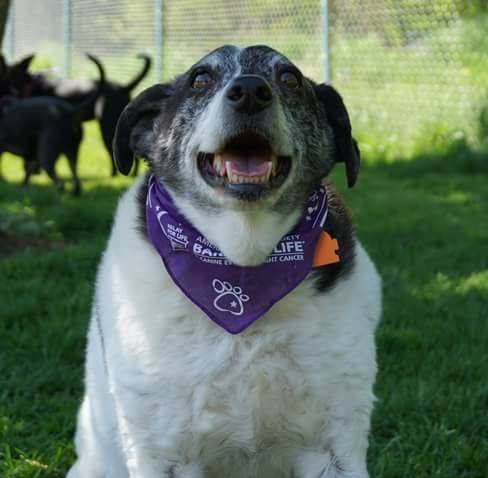
She reminded me of my son’s ancient dinosaur-like dog, Willie, without the purple bandana.

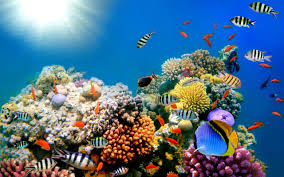
Then there were the rays—Eagle rays and Spotted Rays—also as long as I was tall, also prehistoric looking, also a photo stolen off the web.

I wish I could say I took these photos, but as you know if you’ve been reading this blog for a while, I take terrible photos above water, never mind below water.

But other people in my group had Go-Pros and water proof cameras.

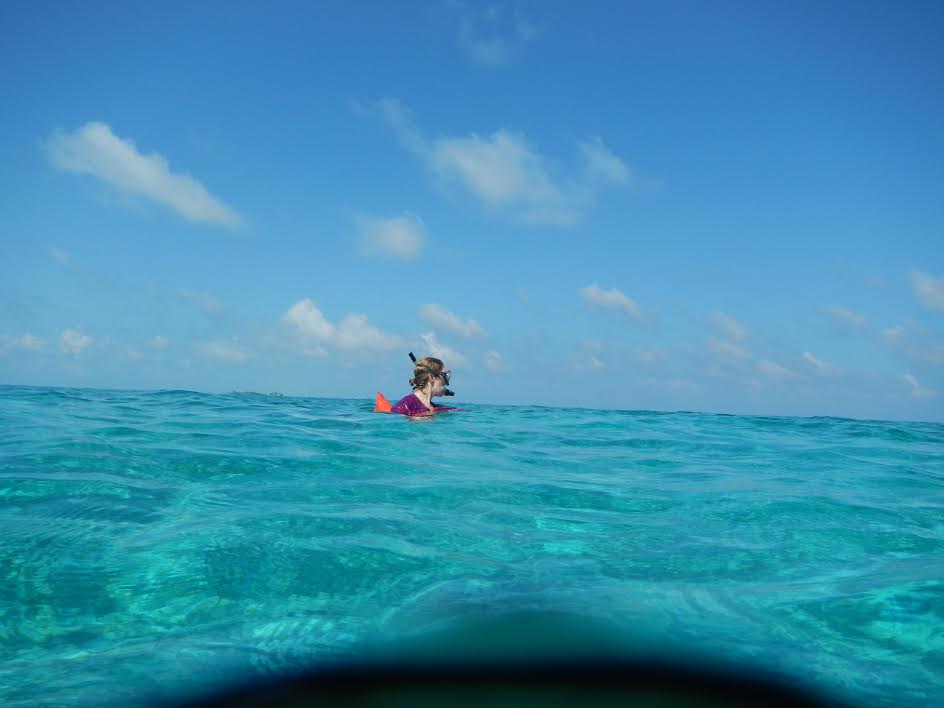
Here I am, looking like a scene out of Jaws:

Lincoln and Vanessa kept calling out, “Over here!  There’s a lobster / Garfish / Lionfish / Clownfish!  Everyone would swim after them to have a look.  Everyone but me. I reached an area where the sea floor must have been 30 feet below me but the water was so clear it felt like I was suspended in air.  Suddenly I felt panic that I would plummet to the bottom.  That passed and I just floated meditatively.  Doing nothing, going nowhere.  No To-Do list.  I caught myself thinking, “I can’t wait to do this again!” then laughed at myself and focused on the fact that I was there, in heaven, right now.

The meditative mood stayed with me for the rest of the evening.  Walking back to Jeanie’s, we were passed by a teenage boy on a tuk tuk—a motor scooter—with a fat baby balanced on the handle bars.  The baby was laughing with delight as the scooter bucked up and down over the potholes.  I vowed to be more like a baby—unafraid, in the moment, joyful.