Tag Archives: travel

Heaven

This is a series of posts about Belize that starts here.

The gang returned from watching Scarlet Macaws.  None had been exsanguinated by crocodile syndrome.  That was good.  Much as some of them irritated me, I wouldn’t want anyone to go that way.

I was sitting in the lodge having a beer when they pulled up in the van.

“Hey there, good lookin’!” shouted Mike.  This was how he was.  From the first day when he sat next to me in the van and read every sign out loud, he had touched my arm, or nudged me, and said things like, “Lucky me, I get to sit next to a pretty lady!” and “Look at that bird, baby!”

I had chosen to ignore him rather than say anything.  Joan, his wife, rolled her eyes at me when he said these things.

He wasn’t a creeper, he was just a clueless, harmless dork.

They ordered drinks and sat around talking about their day.  They had seen lots of birds, including Scarlet Macaws.  The sun set and it was time to head to a local restaurant for dinner.  Mark drove the van while most of us walked so we wouldn’t have our digestive systems jostled.

The restaurant was called Innie’s.  Innie, the proprietor, was what we used to call a “full-figured” woman.  She was around 65, and she explained, “I’ve got seven daughters, and they’ve all got names that rhyme with mine—Ginnie, Winnie, Minnie, Vinnie—for Vincenza—and they all run businesses.  Ginnie’s got herself a hair salon, Minnie does taxes, Skinnie rents scooters, two of them run another restaurant.”

The specialty of the house was hudutu, a fish stew made with coconut milk which sounded delicious but which took an hour to appear and had so many bones you couldn’t really appreciate it.   It was served with the bread that came with every meal—something like Native American fry bread.  It was okay.

Walking back to Jungle Jeanie’s, Mike pointed at a grove of tall slender plants and wondered what they were.

“I think it’s sugar cane,” I said.

“No, it’s not, he said.

Ugh.  Whatever.

We returned to our respective huts.  In ours, a twin bed had appeared in the middle of the room on the first level.

“I don’t care who gets it,” said Liz.

I wasn’t going to play the “I don’t care but I really do” game.

“Good!”  I said, “then I will.”

Snorkeling was the agenda for the whole Day Six.  I wasn’t really up for it; I get claustrophobic and I don’t know how to swim.  I seriously considered having another day of nothing on the beach.

But I went, and it was the best day yet.  Maybe the best day of my life.

Our guide suggested I wear a life preserver around my waist so I wouldn’t have to even think about staying afloat.  I had no pride around that; it was a great idea.  I donned the snorkel and mask, sat on the sand in the shallow water, and tried to put my face underwater.  Once, twice, three times—I couldn’t do it.

This felt like a matter of pride.  I was going to at least get my face underwater once.  I finally did, and was instantly hooked.

How to describe it?  I floated near the water’s surface and gazed at hundreds of species of fish and coral.  All colors, all shapes, large and small.  The water was warm and clear as air.  It was like flying, like flying in a dream.  I couldn’t help exclaiming, “Wow! I see a clown fish!” except it sounded like “Waaaahhhh, aslubbba blabba blish!”  Then I laughed, which also sounded funny and made me laugh more.  No one could hear me.  It was one of the rare times in my life that I felt childlike wonder and playful joy.

We snorkeled for hours, then they rounded us up for lunch on a small island with million dollar homes.  We sat on the beach and munched on our pulled pork sandwiches.  Emily, being married to a Muslim, didn’t eat pork either, so the guides gave us their BBQ chicken sandwiches and we were all happy.

A Long Night

This is a series of posts about Belize that starts here.

The first night at Jungle Jeanie’s was a long one.  It was hot and humid.  Because our hut was in the jungle and not on the shore, there was no breeze.  My hair turned into a giant fuzzball.  My skin felt soft as a baby’s bottom, but there was no one to appreciate it.

This was also the night that Liz started to fart.  The first time, she did the thing that middle-aged women do—“Oops, sorry! Tee hee hee,” like they are embarrassed.  But then she kept farting and stopped apologizing or even acknowledging it.  I was sharing a small, stuffy loft with her.

I climbed over her and down the ladder to the bathroom all four of us would share for the next four nights.  I sat on the toilet trying to figure out where I could go to get some shut eye.  The hammocks on the beach looked tempting but what about the mosquitos?  Then I heard a thump, thump, thumping and Trudy pounded on the door.  It was no use, I couldn’t say, “I’ll be out in a minute,” since she couldn’t hear me.

I handed the loo over to her and sat in the dark at the table in the center of the room.  Except that it wasn’t dark.  “I’m watching Game of Thrones,” explained Emily from her bed, from which emanated the bright glow of her phone.

“I can’t believe how noisy Trudy is,” I remarked, listening to her clunking around in the bathroom.

“Oh yeah,” said Emily.  “People think deaf households are quiet, but they’re actually noisier than most because they aren’t getting feedback.  They’re always slamming doors, throwing things on the floor, and yelling.”  And farting with impunity, I thought.

She put down her phone and sat up.  We talked for a while, about how she went to Tanzania for college, met her future husband on the first day, and got engaged two days later.  “We’ve been married for 20 years and have four kids, so we had pretty good instincts.  Or we just got lucky.”  She and her family lived a few blocks from me in St. Paul.  They went back to Tanzania to visit his family every year.

Trudy came out of the bathroom and started signing.

“She’s pissed off about the bed,” Emily translated.  “It’s lumpy.  But she’s always pissed off or crabby about something.”

“Are you friends?” I asked.

“No!  We just met in Belize.  Wilderness Inquiry taps a pool of interpreters for these trips, and my number came up.  With Trudy it’s her way or the highway.  I don’t think I’d want to interpret for her on a regular basis.  Of course, she probably had to be hard and demanding to get anything in life.”

Trudy was sitting on the edge of her bed moaning and groaning, which I took to mean that her back hurt.  Liz was snoring up in the loft.

“She was put a home for deaf children in the 50s, when she was five,” Emily continued.   She signed to Trudy that she was telling me this.

Five.  How heartbreaking.

Trudy nodded and added in sign, “Yes, it wasn’t a nice place.  They were assholes to me.”

And yet, she had attended college, had a career, married, and had four children.  Her husband had also been an asshole.  She’d divorced five years earlier and had been traveling ever since.

After talking for an hour, I reluctantly climbed back up to the loft.  Finally, around 2am, we all settled down and slept.

Until 5am.  Today was a field trip to the Mayan village of Red Bank to see Scarlet Macaws.  It would involve kayaking and hiking and a picnic lunch by the river.

I waved as they all drove off.  “Watch out for crocodiles,” I whispered sweetly.

I was going to have a Day Off.  I was going to be alone!  I lay in a hammock and read a book, “The Trip to Echo Spring: On writing and drinking,” by an English journalist.  I took a bumpy ride on one of Jeanie’s broken down bicycles with no helmet, brakes, or gears, then napped.

Jungle Jeanie’s

This is a series of posts about Belize that starts here.

On the way to our next resort, we passed roadside wetlands with flocks of egrets, king fishers, sand pipers, and a half dozen other birds I didn’t know the names of.  Mark would pull over so Stan, our bird man, could check them out with his binoculars and add any new names to his running list.

No one minded the frequent stops.  We had been in Belize now for four days and were finally decompressing. This is about average, I have found. The first few days of a holiday you are excited to be there, meeting new people, weighing all the optional activities, adjusting to the heat, food, culture, and then—phoooooooph—like a balloon losing air, you collapse.  In a good way.

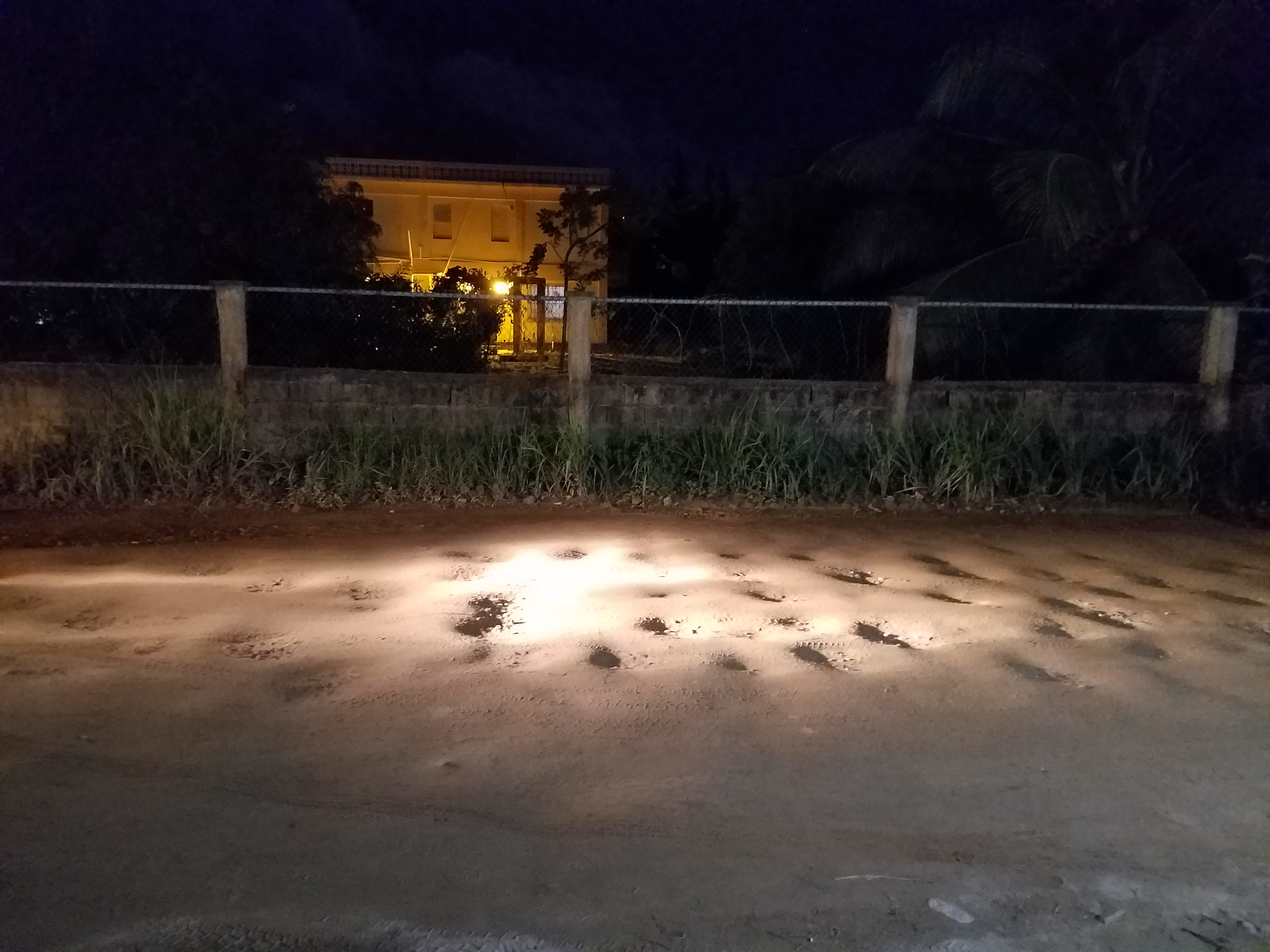
We arrived in the little town of Hopkins.  I’ve described how bad the roads are in Belize, the one road in Hopkins was worse than the worst of them. It took us 20 minutes to go one mile, and by the time arrived at our destination I had full-blown heartburn.  This is a shot of the road at night.

It was worth it.  We arrived at Jungle Jeanie’s which is—as the sign says, “By the Sea”—the Caribbean Sea.

We hung out in the lodge, which had indoor and outdoor dining areas and a bar.  In a few minutes Jeanie appeared.  She and her husband had moved from western Canada to Belize 20 years earlier.  He had died about five years ago.  She appeared to be about 85, frail and tottering but with a game smile that told you she loved what she did.  She spoke haltingly, welcoming us and assigning us to our huts, telling us the house rules (joke—there were none except relax and have fun) and offering us a welcome drink of fresh mango juice.

Jeanie had a staff of Belizean cooks and bookkeepers and handy men who had been with her for many years.  “We’re like a big family,” she said.

“And there’s yoga every morning at 9:00, although this week it’s only on Tuesday and Thursday at 9:30.”

At Jeanie’s I would not be sharing a room with Liz.  I would be sharing a room with Liz and Trudy, our deaf companion, and her interpreter Emily.  I made a beeline for our hut but Trudy and Emily had gotten there first and staked out their beds.

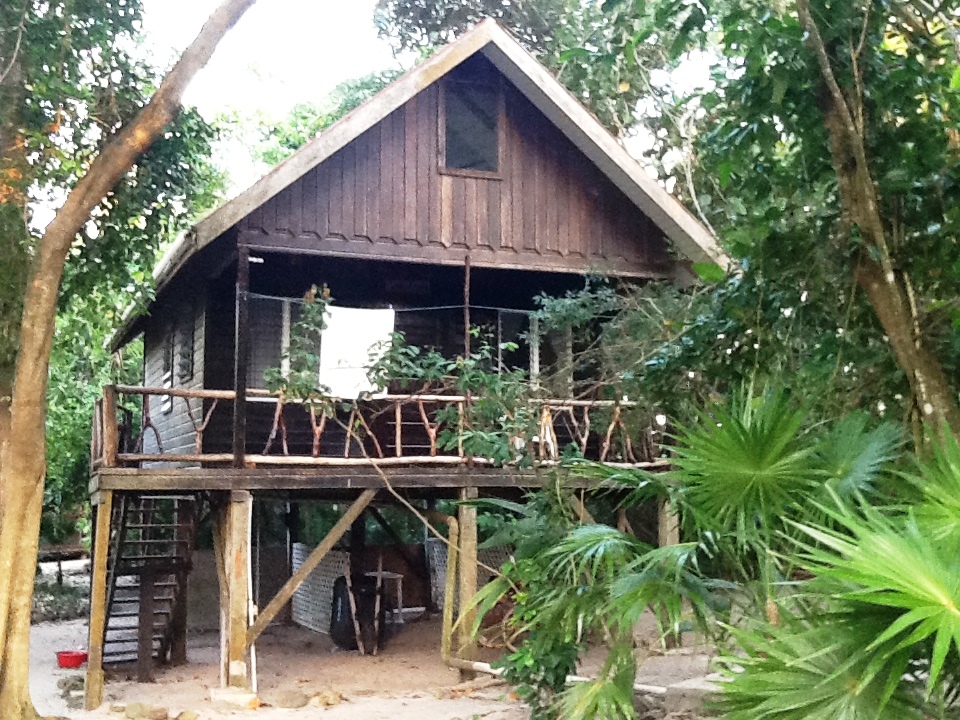
If you have any physical handicap, Jeanie’s would not be the place for you. First you walked across uneven paving stones set in shifting sand to get to the hut.  Then there was a set of stairs to get to the first floor.  If you got stuck up in loft as I did, that required climbing a very steeply pitched ladder and heaving yourself over a low wall.  I realize this is far from the worst “problem” in the world.  However, I immediately imagined myself falling backwards off the ladder in the dark.

Liz and I would be sharing the loft, a low, slant-ceilinged space with two mattresses on the floor that was hot as hell.  Liz had snagged the mattress near the ladder and I refused to play the game of “I don’t mind which one I sleep on.”  I would have to crawl over her to climb down to the bathroom.

Others among us were unhappy with the arrangements.  Inga and Jesse had been assigned to share a romantic one-bedroom cottage on the beach with Mark, our leader. He had a cot on the porch and would have to walk through their bedroom to get to the bathroom.  Stan and Stacy, who were married but not to each other, had been assigned to a one-room cottage with two twin beds.

Words were said in private. Perhaps some money exchanged hands.  The beach cottage dwellers were reassigned but Liz and I were stuck in the loft.

This is one reason why I tag my posts with “Budget Travel”

Liz and I shrugged and laughed and agreed it would be an incentive to spend as much time outdoors as possible.

Night had fallen.  There was a full moon.  Life was good.

Monkeys and Migrants

This is a series of posts about Belize that starts here.

We stopped at Guanacaste National Park to eat our picnic lunch, hike, and have a swim.

It was a sweet but sad place.  Like any state park in the US, it had an interpretive center.

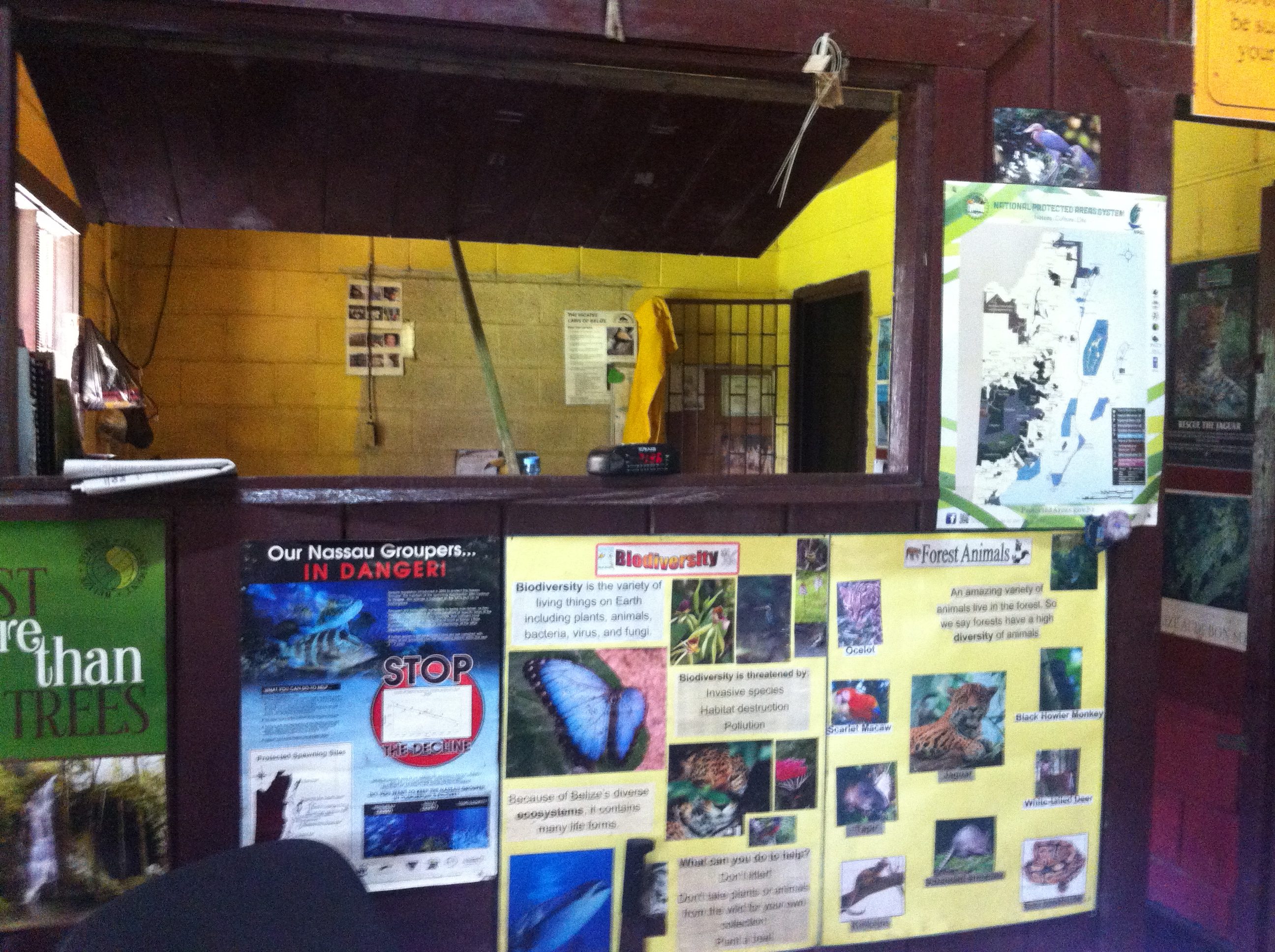
The lone park ranger, Uriah, seemed pleased to have visitors. We used the bathroom, which was worse than the one at the gas station, then politely looked at the home-made displays.  There were no lights except for the sun coming in the window.  No lights, but there was a pay phone.

“You can hike,” Uriah said hesitatingly, “But many snakes have come up from the river banks since the rains.  It’s very muddy, and they hide in the mud.  Most of them won’t attack … unless you step on her, then she will bite.”

Our group was silent, for once. Then Jan asked, “Most of them?”

“Some, they are very aggressive, like the Yellow Jaw.  And she is very toxic.  There are many species of snake, but only eight are poisonous.”

“Only eight….” Stan repeated pensively.

“And where is the swimming?” ventured Mark, the eternal optimist.  I was wearing my swim suit under my clothes, dripping with sweat, and couldn’t wait to jump into the water.

“Ahh … I would not try swimming today,” Uriah answered. “The river is too flooded; the currents too strong.  It’s so muddy you can’t see the crocodiles.”

I’ve traveled a lot.  I’ve encountered many local guides who tell horror stories about venomous snakes, giant spiders, and large carnivores that will tear off your arm. Usually it’s just BS.  But Uriah was a serious guy, like a lot of park rangers.  If he was telling us not to hike or swim, I was heeding his advice.

People do get dragged away by crocodiles in Belize; this is an excerpt from an article in a Belizean newspaper about a croc attack.

“Dr. Mario Estradaban conducted a post mortem examination on the body on Tuesday, September 19th, which certified the cause of death to be exsanguination traumatic amputation of the upper limbs due to crocodile syndrome.”
Mark, being young, male, and probably believing he was invincible, tried to rally us. “I’m game for a little hike, if anyone wants to join me.”  The three men in our group disappeared into the jungle behind him, if for no other reason than to not look like wimps.

We womenfolk laid out the lunch.  News of the health benefits of whole grains and unprocessed food has apparently not yet reached Belize.  We were going to feast on sandwiches of soft white bread, cheese food slices, some kind of pork bologna imported from Germany, and tomatoes and cucumbers.  My sandwich, minus the bologna, was delicious.  That’s one of the things I enjoy about traveling; I give myself permission to just eat whatever is put in front of me, never mind how fatty, sugary, or processed it is.  We also had dried plantain chips flavored with cayenne which were delicious.

The men returned after about 10 minutes. “It’s too muddy,” Mark reported.  “It’s like, six inches deep.”  Mike, Stan, and Jessie, coming up behind him, looked relieved.

“Look! Monkeys!” exclaimed Inga.  Not more than a few yards away, a group of big black monkeys were swinging in the tree tops.  Everyone ran over to the clearing among the trees to watch the show.

“Yes, this is our family,” narrated Uriah.  “The mother, the baby, and six others who hang around.  They are Howler Monkeys but we call them baboons.”

I stood next to Uriah.  He was tall and thin, his skin greyish, his face drawn but with remarkable iridescent, olive-colored eyes.  He appeared to be about 45; he seemed weary, not the vigorous, outdoorsy type.  I asked if he lived nearby and he laughed ruefully.

“Oh yes, I live in the office,” he said.  “I sleep under the desk.  My family lives in the far north, in Santa Elena on the Mexican border but my job is here.  I only go home once a month.  My wife, she is sick ….”

We drove off, leaving Uriah to sleep alone in the dark with the snakes.

Colonials

This is a series of posts about Belize and Guatemala that starts here.

We had left Guatemala and were driving to Hopkins, Belize. On the way we would stop for a picnic and a hike around Guanacaste National Park, with the promise of a swim in the Roaring Creek waterfalls.

We stopped for gas and to use the bathroom.  I wondered about this cigarette brand:

I can’t imagine this brand going down well in Nairobi or Mumbai.  Belizeans must have a more laid back attitude toward their colonial past.

The bathroom had no light, no water, and no toilet seat.  There was a sign with detailed hand-written instructions posted over the sink that you could see if the door was open.  Since there was a line of people waiting to use the loo I didn’t want to hold them up so I only saw enough of the sign to know that it was kind of like an algorithm: If you were a man you followed the instructions on the left, women on the right.  Women were instructed to sit on the nonexistent toilet seat, not squat over it, which would result in pee all over the place.

The smell told me there had been many women who had not read the instructions.  It’s all about perspective, though.  I can say with confidence that this roadside bathroom was better than a similar one I used in Cuba, which had the added feature of an old woman who stood there while you peed, then poured a bucket of water down the toilet because it didn’t flush, and then asked you for a dollar.

There was more spine-crunching driving, but how can you complain when you’re sailing along the Hummingbird Highway through the Mayan Mountains?  The scenery was spectacular. It rained off and on and became more humid.  I love humidity.  Despite the fact that it makes my Restless Legs worse, it makes my skin soft and my hair wavier.  And looking good is what matters, right?

I was sitting next to Liz.  This was Day Three, and the first time I noticed that she nattered on nonstop about everything and nothing.  She had a curious way of repeating each observation.  For instance she would say, “I’ve never seen anything like that,” followed immediately by, “That’s something I’ve never seen.”  This was all in a southern drawl, because she was originally from somewhere further south than Cincinnati; Alabama, I think. The volume of her speech was also more suited to a noisy barroom than a quiet van.

What is it that makes someone need to talk—compulsively?  At first I nodded in acknowledgement at everything she said.  Once I noticed she was basically talking about nothing but just because she couldn’t help herself, I turned my head to the window to gaze at the scenery.  It felt rude.  But wasn’t she being rude by yammering nonstop while everyone else was trying to enjoy the peaceful views?  I fought the urge to turn my head back to her and start nodding again.

She kept talking, and talking, and talking.  She even said at one point, to no one, “Ah know ah talk too much!” followed by a forced, too-long laugh. This was when I remembered that—in my experience—people who talk too much know it, and they aren’t overly sensitive when people ignore them.

I stopped feeling rude.  I also avoided sitting next to Liz for the rest of the trip.

We stopped and shopped for lunch in a Chinese-owned store.  I didn’t take an official census, but I would estimate that 75% of the businesses in Belize are Chinese owned. Here are some items I found amusing, mysterious, or revolting:

Cashew wine!?  Industrial-sized cans of jalapenos?  Ramen, possibly containing real men?

Sadly, I was going to be home when the National Domino Playoffs took place:

I blame the power of advertising; the men and I bought Belikins and drank them while we waited for others to check out.  I jokingly asked Mark, “Okay if we finish these in the van?” and he said, nonchalantly, “Sure.” I have a feeling this was not official policy, but I didn’t ask twice.

Sounds and Signs

This is a series of posts about Belize and Guatemala that starts here.

Exhausted, we arrived back at Don David’s.  There was no bickering between Liz and me; we fell onto our beds and slept.

When I think back on this trip, there are five or six moments when I said to myself, “That was my favorite moment!”  As usual, no matter how tired am, I awoke at 5am.  I got dressed and followed the bird sounds out toward the lake.  I was alone, and the sunrise, the topography, and the birds made me feel like I was witnessing the dawn of creation.

Until I heard the high-pitched, whiny roar of what we in Minnesota call a crotch rocket—someone was up before me, probably going to work on his Yamaha scooter.

But that didn’t spoil it.  I had experienced 30 seconds of serenity, with nothing but the sounds and colors of the world waking up.  Silence, peace, serenity…call it whatever you will…it’s so rare.  I can still recall this moment if I make an effort.  And watch the video I took.

At the end of this video you can see the mountain that resembles a sleeping crocodile. It has a name and a back story that I can’t remember, but local legend has it that it saved the people from some peril and now sleeps nearby in case they need him again.

It’s not just external things that distract us from moments of beauty.  I am programmed by habit to immediately think, “Food! Coffee!” upon waking, and today was no exception.  I ambled up the lawn to the lodge, to find Stan already there.

“Look at my list!” he exclaimed like a kid who collected baseball cards.  He was juggling an illustrated laminated poster called “Birds of Central America,” his binoculars, a notebook, and a cup of coffee.

I don’t know much about birds, but this morning I enjoyed watching them with Stan. “This guide says there are over 740 bird species in Guatemala!” I have no idea which ones we saw, but here are some of the funny names off of the laminated poster: Slaty-breasted Tinamou, Fulvous Whistling Duck, Rufous-bellied Chachalaca, Pale-vented Pigeon, Common Potoo, Dusky Nightjar, Cocos Cuckoo, and the Greenish Puffleg. There must have been 50 species of hummingbirds alone.

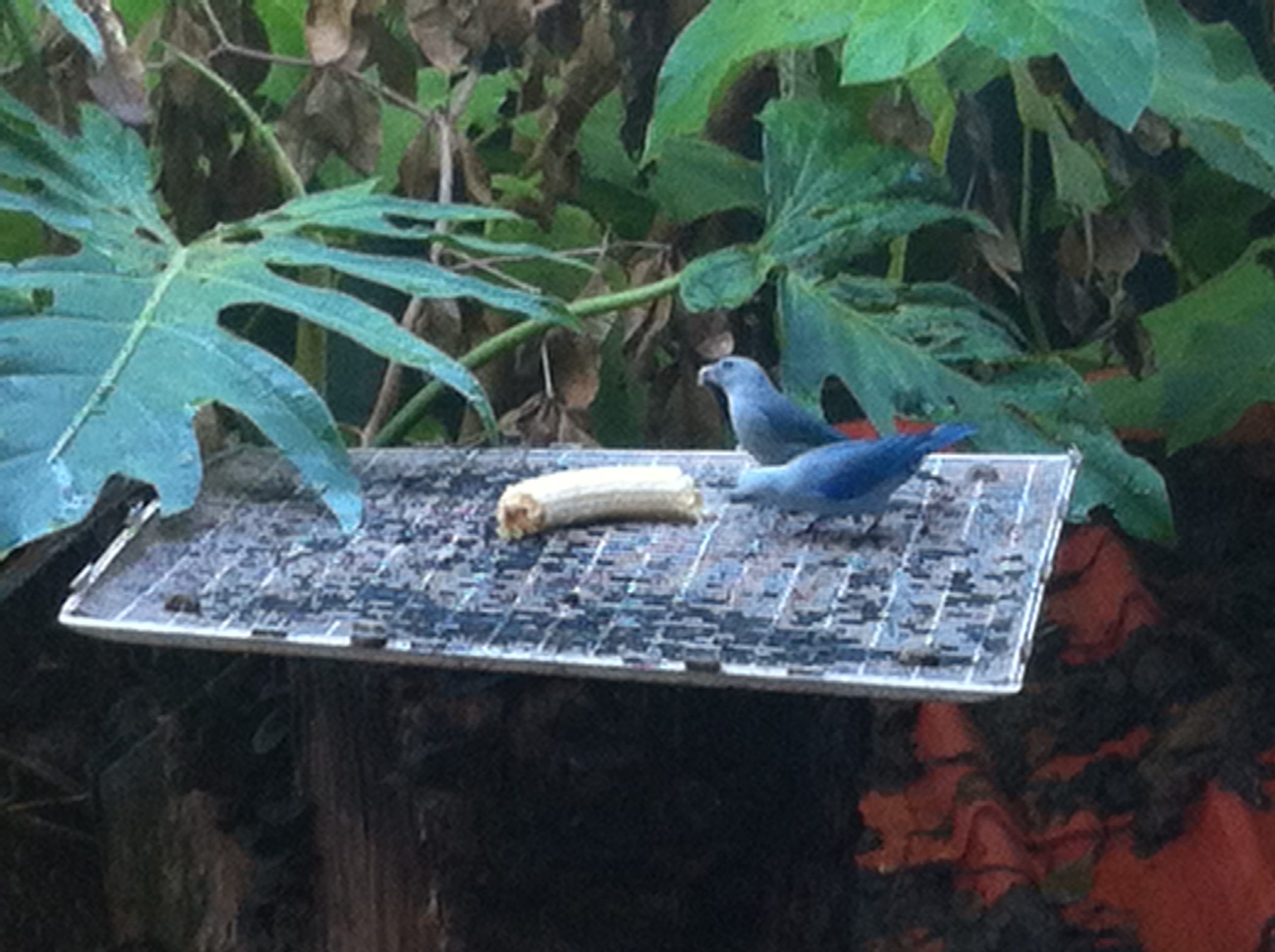
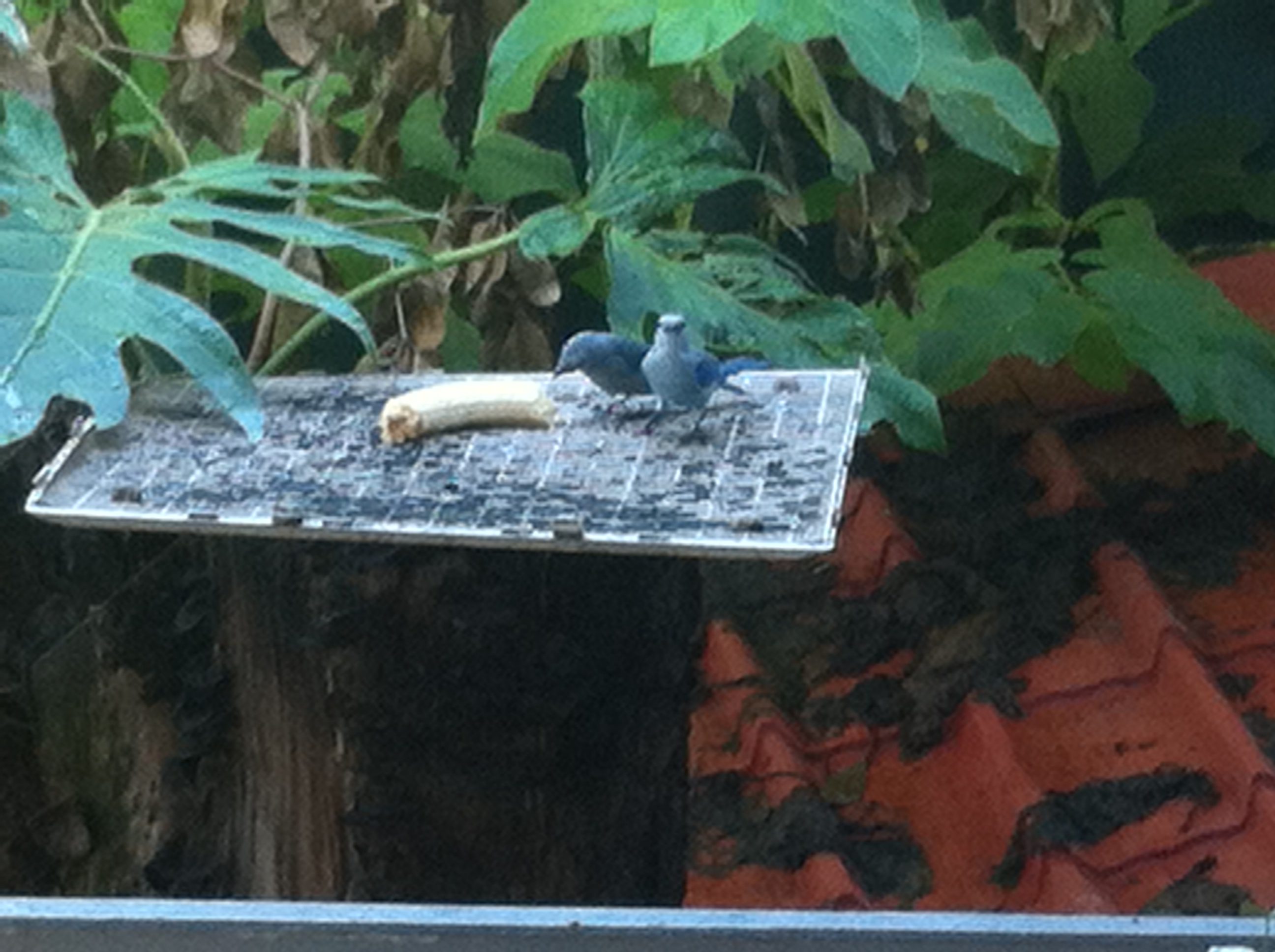
There were clouds of birds around the feeding platforms.  I managed to snap these two little fellows eating bananas.  Who knew that birds ate bananas?

Too soon, it was time to drive back to Belize.

This time the border crossing was faster, and our young fixers were nowhere to be seen.  Maybe they were in school, uniformed with the money earned from us and other travelers?

It was still a slow process, and loading up on coffee necessitated that we had to use a bathroom.  I led Liz and Trudy on a search.  We found the right shack, one of the many little businesses that had sprung up to take advantage of the hundreds of people crossing back and forth over the border each day.

The sign said, “Toilet, $1.”  As an American, I am always grateful that my currency is so widely accepted.  For $1.00, you got an outhouse perched over the river that looked like the house made of sticks in the story of the three little pigs, and six squares of toilet paper.

The proprietor was trying to explain to Trudy where the toilets were.  “She’s deaf,” I said in Spanish, proud of myself for knowing the word for “deaf”, which is “sordo.”

He turned to Trudy and started signing!  What were the odds of that—that the proprietor of a bathroom business at the Guatemala-Belize border crossing would know American Sign Language?  We all had a good laugh, a good pee, and rejoined the line.

In real time, I have exceeded my limit for stress.  How do I know?  Because I have vertigo.  I feel like I am in one of those inflatable bouncy houses you see at kiddie fairs.

I can handle a lot of stress.  What pushed me over the edge was my decision to sell my condo.  I  can’t take the noise from the upstairs neighbors.  It would be a wonderful home for someone who is deaf, so if you know anyone deaf who is house hunting, please spread the word.

A Tip Says a Thousand Words

This is a series of posts about Belize and Guatemala that starts here.

José Luis went with us to a roadside supper club where we feasted post-Tikal.  We were the only customers in the cavernous dining room.  There were party rooms and even a pool with a playground outside where people must have held birthday parties and other events.

I read the history of the place on the menu and learned that it was a chain. Like a lot of chains, they had gimmicks, like neon-colored drinks with lots of sugar and not much alcohol, and something like fondue pots that came out flaming and none of us knew what to do with.

Just my luck, their specialty was pork sausage, so I ordered the one chicken item.  It was way too salty, as was all the food.  But José Luis had chosen the place, the atmosphere and the staff were nice, and there were flush toilets.

The service was super slow, so we sat for three or four hours waiting to order, waiting for our food, and waiting to settle up.  Then we waited some more, because this meal was part of our tour package and Mark hadn’t known he needed to inform his credit card company that he would be in Guatemala. After many phone calls it was resolved, but it took an hour and a half.

As the sun was setting, we drove back toward Lake Itza and Don David’s.  We were exhausted, having been up since before dawn, walking all day soaked with rain, then ingesting a giant meal composed of fat, salt, and sugar and sitting around for hours.

But José Luis had one more sight he wanted to show us, the island city of Flores in Lake Itza.  None of us really wanted to go, but we respected José Luis and didn’t want to be rude.  Maybe it would be amazing. Too bad it would take an hour to get there.

Viewed from the mainland, Flores looked magical, with colored lights reflecting in the darkened water. We crossed a causeway and were there.  From the back of the van I couldn’t hear everything, but I think we were there because it was a tourist town, mostly for Guatemalans.  It had more restaurants like the one we had just left—we could see people drinking their syrupy neon-colored drinks on patios.  We could hear music thumping from hotel discos and see couples strolling around holding hands.  It probably was a nice romantic getaway, though a bit crowded for my taste.

We drove on to drop José Luis off.  He lived in a sizeable city which took another hour to get to, and he wanted Mark to drive around so he could show us that they had amenities like a stadium and a Walmart-like store.  I had money out to tip José Luis but he slipped out of the van unceremoniously and was gone into the night.  I asked Mark if he had tipped José Luis and he said yes, he had tipped for all of us.  It had been the same in the restaurant.  He wouldn’t say how much he had tipped in either case.

I knew it wasn’t Mark’s decision.  There were certain things he had obviously been instructed not to share with his travelers.  If I re-read the trip materials I probably would see that tips were included.  But I really didn’t like it, because tipping varies so much from one person to another.  Some people are unnecessarily generous and some are cheapskates.  Did Wilderness Inquiry have a set percent and if so, what was it?  And what were the norms in Guatemala, and what were the expectations of Guatemalans?

No one else seemed remotely concerned, and I didn’t care so much about the restaurant, but José Luis had spent a whole evening with us, then a full day and another evening. Was he saying to his wife right now, “Those cheap bastard Americans!  Eighteen hours of work for a $50 tip!” or “Honey, pack your bags and get the kids in the car!  We’re having that holiday in Flores I’ve been promising you, thanks to those wonderful, generous Americans!”

Tikal

This is a series of posts about Belize and Guatemala that starts here.

Finally, Tikal.

This was where I regretted being a cheapskate and buying a rain jacket at the Goodwill.  It looked like a rain jacket and—most important—it looked good on me, but it turned out to be about as waterproof as a burlap bag.

It was raining when we arrived and it rained for the first hour.  And I don’t mean drizzle, I mean full-on, relentless downpour.  I guess this is why it’s called a rain forest.  And this was the dry season.

There were no modern buildings, and only a few sheltered places, like the toilets.  But it wasn’t like I was going to get cold.  It was around 90F, so I made up my mind that it was just water and it wasn’t going to spoil my time in Tikal.

I don’t know what I had expected.  I have been to Machu Picchu and Petra.  Tikal turned out to be similar in scale to Petra but verdant like Machu Picchu, and of course completely unique.  We were there from 8am until 3pm, so I won’t try to retell all the history or describe the structures, society, or ceremonies that took place there.  We walked as José Luis talked, stopping here and there to really dig into something, like this stele:

These are some of the structures you may have seen in movies.

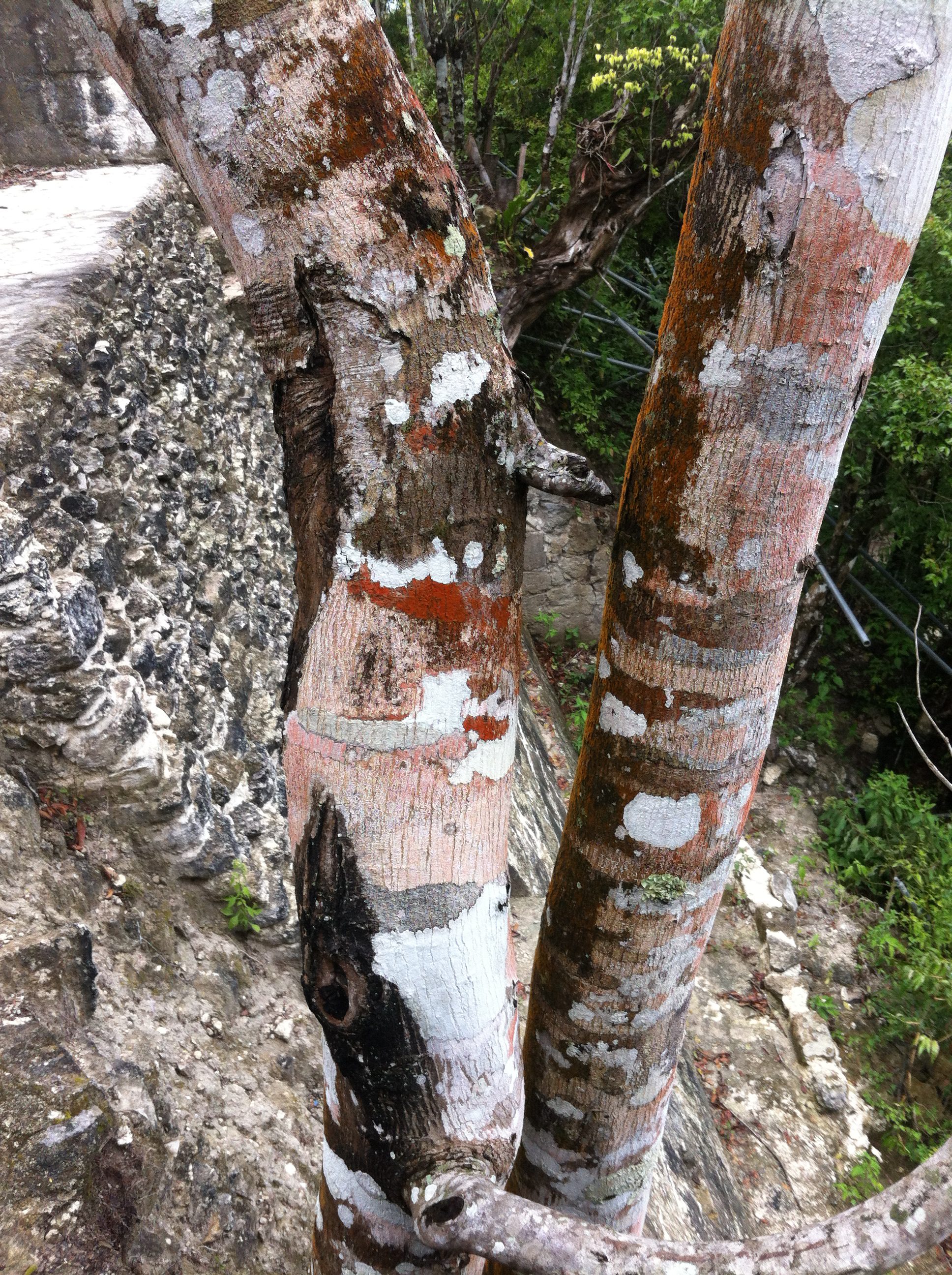
What I hadn’t expected was the amazing flora, especially the tree bark, which called to mind abstract impressionist art.

This is the (a?) Tree of Life.

This photo isn’t great, but it’ll give you an idea of how, high in the Tree of Life’s branches, there are air ferns.

You know, those little plants you can buy in the checkout line at the grocery?

Except that at Tikal, they were as big as tumbleweeds.

“And inside those ferns,” said José Luis, are growing other ferns, and cacti and other plants.  The birds nest in the air ferns and leave seeds in their droppings, which grow into plants.”

So the Tree of Life is host to ferns, which host birds, which result in other plants growing a hundred feet above the forest floor.  It was a “wow” moment.

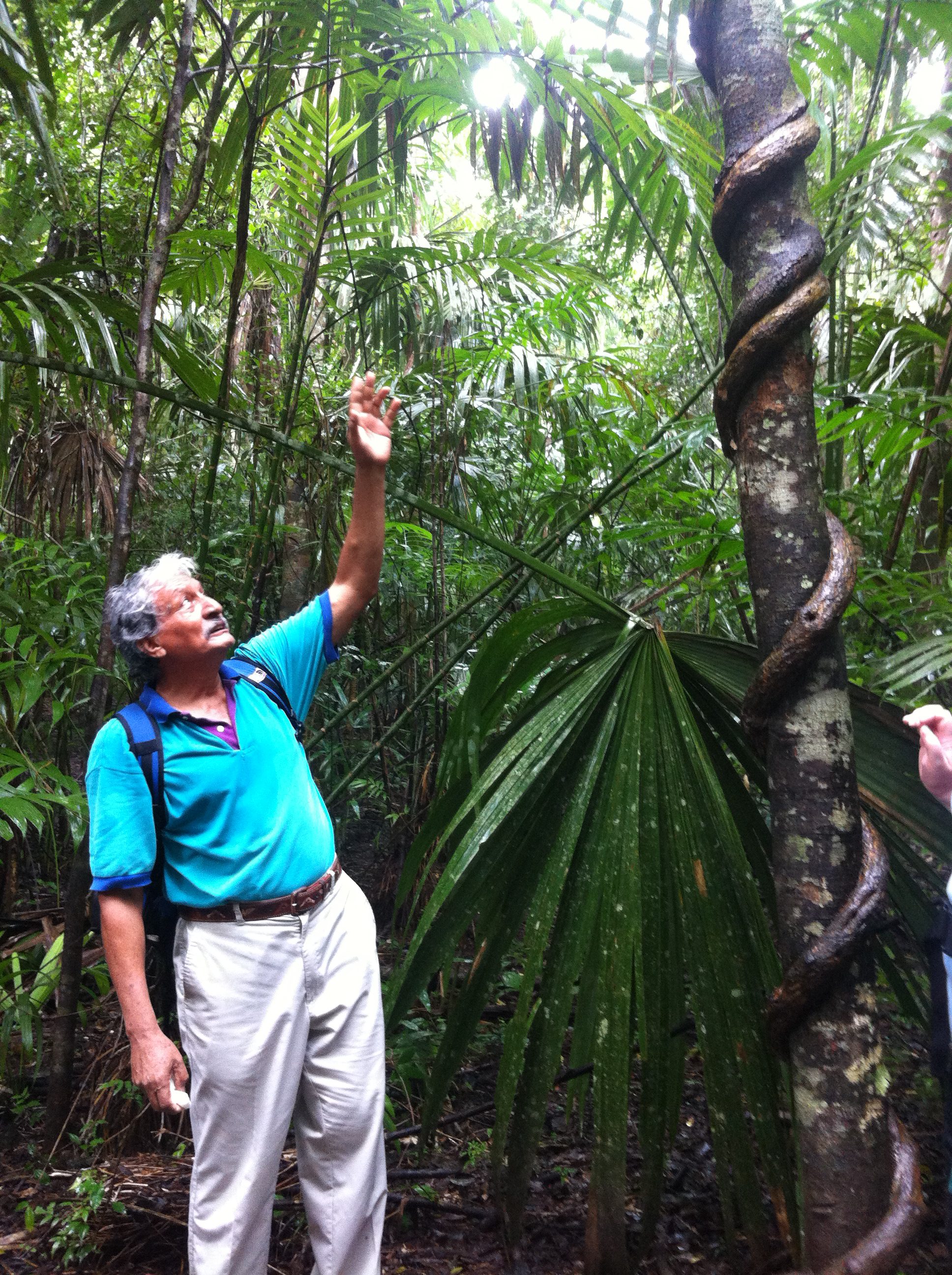
Here’s another codependent but deadly plant relationship:

The vine uses the tree to reach the sunlight, in the process killing the tree, and then the vine dies as well.

We stopped at a gum tree and José Luis explained how gum was harvested and the history of Tikal and the Wrigley Company.  I have a piece of gum every day and I knew it had fake sweetener in it but I didn’t know that most gum is synthetic (plastic!) nowadays. [Note to self: research gum that actually contains gum.]

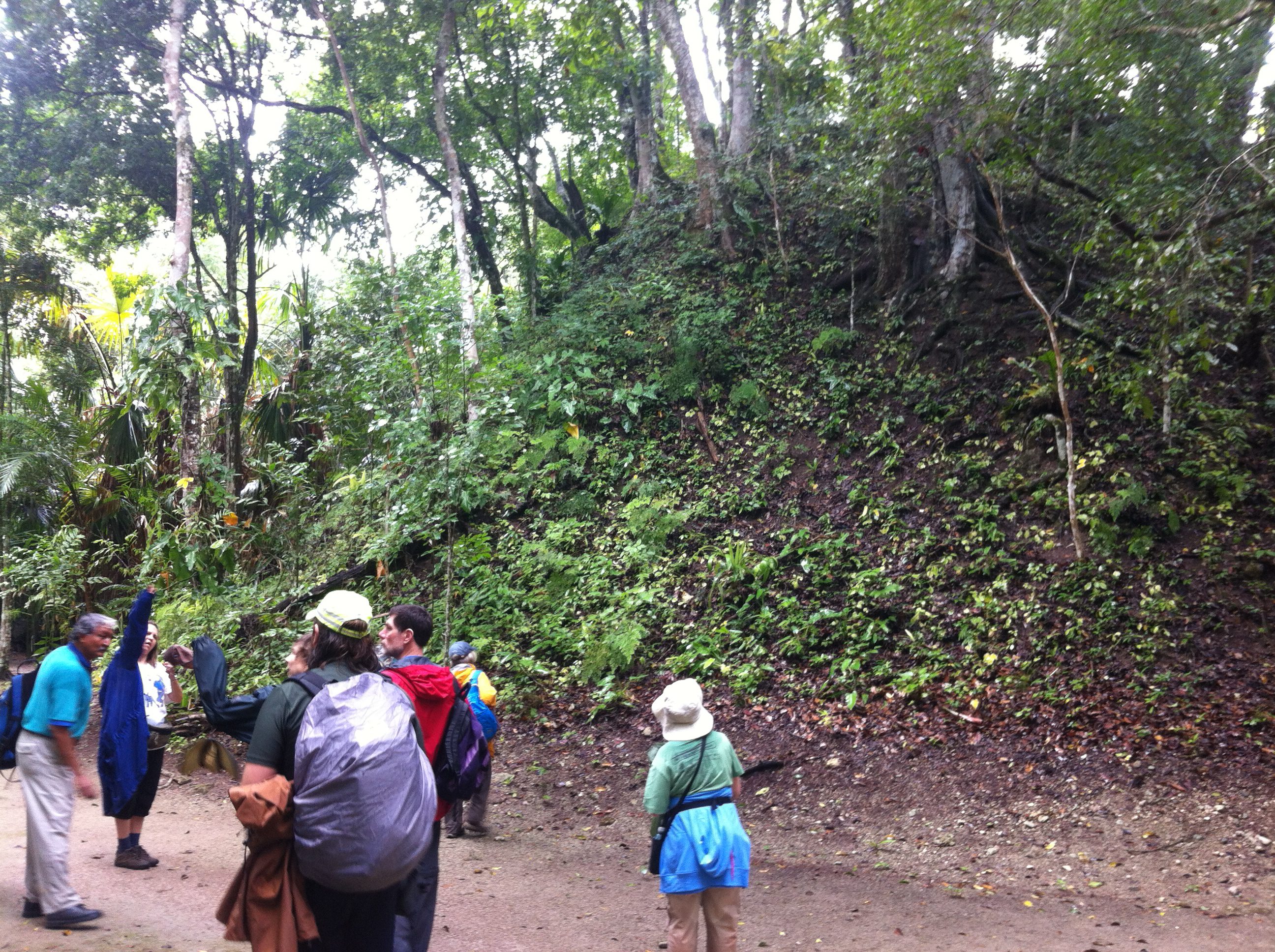
We walked through miles of hill-lined paths, which I thought were unremarkable until José Luis pointed out that the “hills” were actually unexcavated pyramids and other structures that had been buried under centuries of plant life and death. There would never be enough money to uncover all of them, but new technologies like lasers were being used to at least trace their outlines.

We hiked to the top of one of the tallest structures and again—a wow moment—what a view.  That’s me on the right, a snapped by Stan.  Everyone on the trip was very thoughtful about taking photos of each other, especially of the people who were traveling solo.

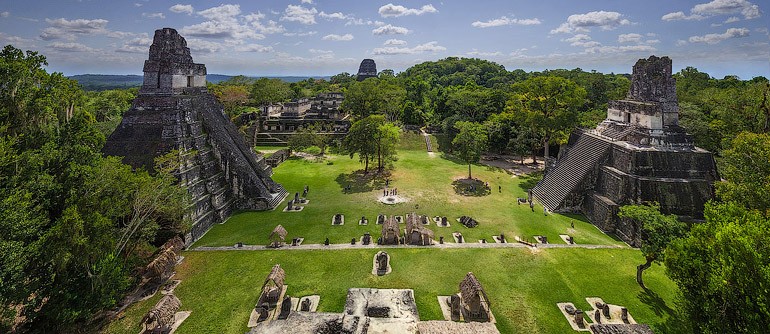
The last stop was the plaza major; there’s no way to capture it all so I plucked this aerial photo off the Internet.

As I wrote in a previous post, Tikal wasn’t a city, but a ceremonial center.  José Luis went into great detail about the sports played here.  They sounded tiresome, but then I am not a sports lover.

It was a very long day, like walking through the biggest museum in the world, a museum without a roof.  I had worried that my fellow travelers who had allergies, illnesses, martyr complexes, and possibly broken bones, would fade long before we reached the plaza, but Tikal’s magic must have sustained them. We rode in silent awe all the way back to Don David’s.

I Don’t (Do) Mind

This is a series of posts about Belize and Guatemala that starts here.

Tikal would be a bucket list visit for anyone. This is from the itinerary:

“Tikal has over 17,000 stone buildings, most of them unexcavated. Our guide has a wealth of knowledge about Tikal and the Mayans—he helps you hear the roar of the crowd as if a Mayan king were making his entrance. From the scene of Temple V in ‘Star Wars’ to the growl of the Howler Monkeys, Tikal offers an experience like no other.”

At dinner with our guide, José Luis, he told how he had studied with professors of archaeology, anthropology, and cosmology at the University of California Berkeley and Yale.  “Study” probably isn’t the right word.  He had spent months at a time consulting with these professors in Berkeley and New Haven and had hosted them here. I don’t think he had an actual degree in anything, but so what—he was from the local area, had been a guide for 30 years, and had read and studied and consulted with other experts.  He was a seeker, curious, open minded.  José Luis was soft spoken, with a shaggy mane of hair and big mustache that make me think of Albert Einstein.  He was also that wisest kind of man—who knew there was much he didn’t know.

The rooms at Casa de Don David were basic.  A bare bulb hung from the ceiling, and the beds were so crammed into the small space I had to climb over the foot of Liz’s bed to get to the bathroom.  My mattress sagged in the middle and the pillow was lumpy.

“Are you okay with AC?” I asked.  “I don’t really like AC, but I’ve got Restless Legs and they’re always worse when it’s humid.”

“It doesn’t matter to me,” Liz replied.  “But we could just open the window.”

“Do you prefer to have the window open?” I asked.

“I’m fine either way,” she said.

“Okay, then I’ll turn on the AC.” I waved the remote toward the window unit above her bed.

“What if we opened the window?” Liz hinted again.

“You said you didn’t care either way,” I answered.

“Well maybe we could sort of open the window just a little bit.”  And so we turned on the AC and left the window open a crack.

The next morning we assembled at 5:30am in the lodge, gulped down cups of coffee, and inspected the bag lunches the kitchen had prepared.  The gluten-free people handed over their sandwiches and cookies to others.

Mike’s wife, Joan, appeared with a black eye and her arm in a makeshift sling.  Her hand and wrist were puffed up to twice their normal size, and horribly bruised.  “I tripped on a sidewalk paver,” she explained.  We suggested she see a doctor.

“Don’t worry about me; I’ve got high pain tolerance from my fibromyalgia.”

That’s good, I thought.  It would be really inconvenient if her wrist was broken and she had to be airlifted from Tikal.

We piled into the van with one extra person, José Luis.  Stan was a good sport and huddled in the luggage section in the fetal position.

As we entered the grounds of Tikal, José Luis warned that we must never, never, never wander off by ourselves.

“The jungle is so dense,” he explained, “that once you are a few meters in, you can’t hear or see the road.

“There was a German explorer who thought he would go of on his own, since he had climbed Kilimanjaro and paddled the Amazon.  He had a GPS.  But GPS don’t work here.  It’s a dead spot.  He was missing for four days and nearly died of exposure.  We have to rescue people all the time”

“How far is a meter?” Liz asked no one in particular.  “I can never remember my metric system.”

“It’s about the same as a yard,” Stan answered from the back.  “A yard and a few inches, I think.”

“Close enough for government work,” Liz said.  I had never heard this phrase before and didn’t give it much thought until the third or fourth time Liz used it.

Comings and Goings

Back to Belize.  This is a series of posts about Belize and Guatemala that starts here.

My group had exited Belize.  Now, we had to get the van out.  As we waited, two pre-teen boys approached us.

“We will help you cross the border,” one exclaimed enthusiastically in English. That was all the English he knew.  It was unclear how they proposed to help us, aside from loitering around and smiling a lot at us.  Maybe they were counting on us gringos falling in love with their adorableness and giving them big tips.

I chatted with them in Spanish and learned that Juan was Mexican but his family had fled to Guatemala to escape gang violence.  He didn’t say where his father was; it was just his mother and nine siblings.

“Why aren’t you in school?” I asked.

“We don’t have money for uniforms,” he answered.

Miguel was Guatemalan and he had a similar story about his family not being able to afford uniforms.  Was it true?  Who knows.  It is a common problem around the world.

After an hour our van was released and we lined up at Guatemalan border control.  As is usual for border controls, one line was for foreigners and one was for nationals.  Our line included a bunch of old hippies in flowing skirts and Birkenstocks, some Mennonite women in flowing skirts and veils that made them look like nuns, and us—by now disheveled from standing in the scorching sun.

The other line was composed of local women in flowing skirts and sandals, nuns, and bedraggled small business people carrying Hefty bags full of bagged crisps they had bought on one side and would sell on the other.

Our line was tall, their line was short. Our line was pale and sunburned, theirs was brown and sunburned. Our line was anxious and loud and full of questions; theirs was quiet and patient.

Juan and Miguel hovered nearby, “helping” us.  After 45 minutes I approached the counter and the border control agent flipped through my passport.  “Oh my, you have traveled a lot,” he commented, smiling.  He lingered over the colorful visa stamps for Kenya and Jordan. He was the first and only border control agent I’ve encountered who was friendly.

Stamp.  I was in. While we waited for everyone in the group to get through, we approached the money changers with fistfuls of currency to trade our Belizean dollars for Guatemalan Quetzals. Here is a Belizean Dollar; I love that Queen Elizabeth is sharing space with a jaguar.

And here is a Quetzal:

I don’t know who the guy is but he sure is handsome, if you can overlook the mustache.

There was a black truck nearby, probably seized from narcos, that was wrapped in so much Crime Scene tape it looked like a Christmas present.  Without thinking, I whipped out my phone and snapped a photo of it.

Mike stepped forward, “No photos!”

Yikes, he was right, I dropped my phone in my pocket and thankfully wasn’t hauled in for questioning.  I won’t compound my recklessness by posting it on my blog.

It was time to leave our fixers, Juan and Miguel.  I gave them a couple bucks each and I think others in my group did as well.  Not bad for a couple of hours work, and I hope they really did use the money for school costs.

Off we were to the town of El Remate, our perch for Tikal the next day.  As we drove I jotted down Spanish words I didn’t know to check later.  There was a sign I didn’t know the meaning of: “Poblado.”  I later learned it meant populated area.  It was posted every mile or so, which would seem to dilute its warning to watch out for kids running across the road.

We pulled up at La Casa de Don David, our hotel. I ran down to the viewing platform overlooking Lake Itza to catch the sunset. There was a system by which you could order drinks on a phone, and the lodge delivered them via zip line, accompanied by disco lights and music.

But who needed alcohol, really, with views like this?