Category Archives: prisoners rights

Updates Part II

In the prison good news / bad news” category, I’ve got some doozies.

First, I was highly amused to read about a brilliant project in which prisoners create portraits of people they think should be in prison. This was in The Guardian—a liberal British newspaper that reliably reports on the most embarrassing elements of American life:

“To find the artists, the activists approached art rehabilitation programs in prisons, but those groups were not interested in being involved with something political. So the pair turned to eBay, where there is a section devoted to art made by prisoners and sold by family members. They found similar prison art networks on Facebook and began conversations with the families of people whose worked they liked. From there, word spread around prisoners and other artists began sending them work.”

No surprise, they’ve captured (ha ha) the usual suspects (ha ha ha) in art: the Koch brothers, Goldman Sachs’ Lloyd Blankfein, BP’s former boss Tony Hayward. But then there was the CEO of one of my favorite companies, along with Pillow King and Bob Barker Inc. (that’s sarcastic, in case you can’t tell): JPay.

I was disappointed to see that the guy’s name is Ryan Shapiro. He must have a Catholic mom and a Jewish dad. I hate to see stories that reinforce the stereotype that Jews are better at making money than most people. Exploiting—oops, I mean “providing services” to prisoners and their families is very, very lucrative.

JPay Prez

Speaking of Jews and prison, a local organization called Jewish Community Action (JCA) has taken up two prison-related issues:

“Jewish Community Action is currently working on two campaigns related to criminal justice reform and the impact of mass incarceration: One addressing the for-profit private prison system and seeking to push back on the building and opening of private prisons in Minnesota, and one demanding the restoration of voting rights to felons who have completed incarceration and are living and working in their communities.”

I wrote to the executive director and shared the link to this blog. I can’t remember exactly what I wrote; I share the blog with a lot of similar organizations and usually hear nothing back. I mentioned that we’re Jewish and that we’d be happy to support their efforts if we were able. The executive director and two staff members replied—first, to assure me that ours is not the only Jewish family that’s had a run-in with the law or the prison system and second, to ask if Vince and I would come in and meet with them. That will be in a couple weeks and I’ll write more after we meet.

I am not a big fan of Oprah; I have nothing against her but she tends to promote books like The Book Thief, which I regard as one of the most poorly-written books I’ve ever read. But she is currently promoting a book written by an ex offender, Shaka Senghor, called Writing My Wrongs: Life, Death, and Redemption in an American Prison. Next week, Oprah will air an interview with Senghor on her network, OWN TV. I haven’t read the book; I’m only mentioning it because it’s written by an ex offender.

I’ve only ever read one prison memoir, and I can highly recommend it: Willow in a Storm, by James Peter Taylor. The writing is just okay, but the story is harrowing and heart breaking and he tells it real.

Finally, there is this (in the end) uplifting story about Albert Woodfox, who spent FORTY YEARS in solitary for the murder of a prison guard at Angola prison in Louisiana.  He maintained his innocence all these years.  He was released on his 69th birthday.

Updates

Travel, addiction, prison … sometimes I feel I have to justify why I write about these seemingly unrelated topics. How about this: they all fall under the meta theme of “feeling trapped, or just bored, and wanting to escape.” There—does that explain it?

I was at a big work meeting and we were discussing human rights in the countries where we operate in the Middle East and Africa. Someone said, “What about solitary confinement? Shouldn’t we be advocating against it?” Everyone clamored in agreement. As far as I know, I am the only employee with a family member who has actually been in solitary. I was tempted to raise my hand and make a speech about how, if we decided to advocate against solitary confinement, we’d damn well better include the United States. But I didn’t feel like being a spokesperson for prison reform that morning.

Vince is off lockdown, after a month of confinement to the house except for work and AA meetings. It may not sound that bad—after all he had Facebook and phone to communicate with friends. He could binge-watch movies and cook real food and look out windows and take a shower without 50 other guys around. He had a pretty good attitude toward it, but I know he was really chaffing toward the end. He had steadily been earning freedoms after his release, then they were all taken away. The offense was so petty compared to the consequence. Most of all, he just had no power or choice about his comings and goings.

Regardless, it’s over now, and today we are doing a make-up birthday outing for me—going to hear the Minnesota Orchestra play the entire score of Sgt. Pepper’s Lonely Heart’s Club Band, accompanied by some Finnish choir. I expect it will be either fantastic or dreadful.

Nothing has happened with the Sentencing Reform and Corrections Act of 2015 in the five weeks since I wrote about it and about how Republicans are using its bipartisan popularity to shove in language making it harder to prosecute corporate criminals.

Then there’s the controversy swirling around The Violent Crime Control and Law Enforcement Act of 1994, which is being blamed for creating mass incarceration. Bernie Sanders says he only signed it because of the good stuff in it, even though he disagreed with the sentencing parts. Hillary has been confronted by Black Lives Matter activists about ruining millions of Black people’s lives because she voted for it. Bill Clinton has disavowed it—his own law. I give him credit for that, even though it may only be a political tactic. Ugh. I would have to write five more posts to get to the bottom of that one, if I ever could.

Anyway, a poll from Pew Charitable Trusts shows that all Americans—Democrats, Republicans, Independents, men, women, Latinos, African Americans, seniors, young voters, and even law enforcement households agree we need to fix our broken federal prisons system. If you’re an American and you agree, please sign this petition urging Congress to pass the Act now. These are all the celebs who are endorsing the call for reform.

new_Cut50_Celebs-04_REVISED-900px

A lot of what I do in my job involves raising funding from foundations. I was happy to see that 42 foundations have banned the box on their employment applications that asks, “Have you ever been convicted of a felony?” This is really only symbolic, since foundations have abysmal records of hiring people of color or even just people who aren’t wealthy and well connected. But they are calling on all philanthropic institutions to follow suit, so maybe it’ll catch on.

Anytime anyone speaks out in support of ex offenders I am thrilled. The president of the Rosenberg Foundation, in announcing the foundations’ move, said, “It is time to end the pervasive discrimination against people with past criminal records. The era of mass incarceration and the war on drugs have done severe damage to families and communities, with an enormously disproportionate impact on people of color. Everyone deserves a second chance and the opportunity to compete for a job.”

Go West, Ye Seekers!

This is the third in a series of posts about a road trip to South Dakota that starts here.

The trip was a good start in helping my organization figure out how it can reach many more torture survivors using technology. But first, you’re probably all wondering about the four-hour drive—was it scenic? Here is a photo of the view out my window:

Snow

And another one; notice how I included a post in this one, just to spice it up:

Snow2

But wait! There was more to see as we got closer to Sioux Falls, like these billboards:

SF BIllboard

Yes, Sioux Falls has jobs. Their unemployment rate is the 4th lowest in the country—an eye-popping 2.3%, which is actually a problem.

It’s a nice small city, with about 165,000 people and growing. There appears to be more diversity than you would expect, with immigrants attracted to jobs in the Morrell meat packing plant and other industries. There’s no corporate income tax in South Dakota, so a lot of banks and credit cards companies are based there. And as in St. Paul and Minneapolis, where there are corporate headquarters, there is an orchestra, an airport, good restaurants and high-end shops, public art, and nice parks with bike paths.

There’s also no individual income tax in South Dakota, so if you’re looking for a job, you can find one in Sioux Falls and live like a monarch.

Our first visit was to Avera, which is a health system. It was founded by nuns which has become the largest provider of telemedicine in the U.S. What does that look like? I had no idea what to expect. But then we were led onto a sort of viewing deck from which we could see hives of doctors, nurses, pharmacists, and technicians tending to patients and lending back up to doctors in dozens of hospitals and clinics in 10 states. There was an e-ER, and e-Urgent Care, e-pharmacy, and so on.

There is a monitor, camera, and microphone installed at the foot of each patient’s bed in the hospital in, say…Thermopolis, Wyoming (an actual place). The doctor there can’t figure out what’s going on with a patient—in such a small place he just doesn’t see enough variety to recognize sepsis, or some other serious but not very common condition. The Avera e-docs can actually see and talk to the patient, diagnose him, recommend treatment, then monitor his vitals to make sure he’s responding—all from 677 miles away.

They also demonstrated an app that patients can use like urgent care, without having to leave the house. All their medical records are available to the clinician, who the patient can see and talk with via a secure Skype-like application that is compliant with all our complex medical privacy laws in the U.S.

Then, just for me, one of our hosts discussed their eCorrectional Health program. “Usually when a prisoner is seriously ill, they have to transfer him to a hospital, which can cost thousands of dollars. With eCorrectional Health, the facility physician can get a diagnosis and treatment recommendations without having to take the prisoner out of the prison. It saves a lot of resources.

“Everyone is happy…well, except for the prisoner, who doesn’t get a change of scenery.”

Knowing the medical, dental, optometry, and pharmacy “care” Vince received inside three different prisons, I think this eCorrectional thing may be a vast improvement. Prisoners may not get to leave prison, but they probably receive better care, from people whose humanity hasn’t been tainted and warped from working in the prison system.

We left Avera with our mouths hanging open, we were so impressed. The potential to expand the number of clients we reach is mind boggling. We’ve got a long way to go, but we’ll talk with Avera next week about potentially partnering to pilot something.

The Fox and the Hen House

This is the second in a series of posts about a road trip to South Dakota that starts here.

When you think about it, South Dakota makes sense. It’s a very rural state where people have a hard time getting to an ER or clinic. Therefore the largest provider of telemedicine in the world is in South Dakota. We’ll also visit a guy who is the CEO of the country’s largest ethanol producer, and his wife, who have an interest in east Africa.

Then we’ll visit the Helmsley Trust, which is named for the late Leona Helmsley. One of Leona Helmsley’s grandsons lives in South Dakota, and I imagine that’s why the trust is in Sioux Falls. Leona, originally named Lena Rosenthal, was the daughter of Polish Jewish immigrants and became a hotel tycoon in New York City. Sadly she spent time in prison for income tax evasion and was controversial for being demanding. I’m sure she was demanding. You don’t get to be a billionaire by being meek. But when Donald Trump is demanding, no one thinks twice about it.

Leona Helmsley left $12 million to her dog in her will, and the Helmsley Trust, which has around $5.4 billion in assets, was originally mandated to only benefit dogs.

By the time you read this I’ll be back from this exciting trip and will let you know how it went. I don’t expect anyone to write us a big check. Fund raising—or development as it’s called in the US, is a long-term process of relationship building.

Here are a few prison-related updates.

Close to home, Vince got the final word on his punishment for not answering the phone when a probation agent called. He’ll be on lockdown for a total of a month and have an extra month added to his probation. I told a friend about it; she works for the St. Paul City Council and was an admin at the St. Paul Police Department before that so she is no stranger to bureaucracies and the sometimes difficult people who work in them.

“I always figure the guy had a fight with his wife,” was her assessment. “If he hadn’t, or if Vince had a different agent that day,” Vince’d still be on track to finish his probation on time.”

“Are they trying to goad him into doing something that’ll send him back to prison?” I wondered. “He also got two parking tickets that day—one was for parking more than 12 inches from the curb. Do you think they could be in cahoots with the police?”

“No,” she laughed. “They’re not that organized. It’s just random.”

On the prison reform front, the New York Times ran an editorial, “Holding Sentence Reform Hostage.” The pending legislation would “reduce absurdly long mandatory minimum sentences for many nonviolent drug crimes, give judges more control over the terms of punishment and provide inmates with more opportunities to get out early by participating in rehabilitation programs.”

Some Republicans are scaremongering, Willy Horton style. At least that sort of makes sense.

But some Republicans say they won’t approve the bill unless it includes a change in federal law that would make corporations and their executives harder to prosecute for environmental or financial crimes. This has nothing to do with prison reform but is a standard tactic used by politicians to get what they want without having to work hard for it. I know, it’s hard to believe they could be much lazier.

In my opinion, this is evil. I don’t like to call people evil, I really don’t. But making it easier for companies like BP or Goldman Sachs to get off the hook?

In related but also absurd-news category, there’s this item: Former Tyco CEO, Who Served Time in Prison, Appointed Chair of Prisoner-Assistance Nonprofit.

Dennis Kozlowski, who did six years for stealing millions of dollars from his own company, is now in charge of the Fortune Society, a nonprofit that helps former prisoners find jobs, housing, health care, and education.  What a great idea: putting an old, white, rich man–a former thief–in charge of a  nonprofit with $10.8 million in assets.  How nice for him.  What could possibly go wrong?

Reductive Seduction

There’s a great article circulating among international development people that also addresses mass incarceration in the US. Who knew there were so many connections between these two worlds of mine?

Written by Courtney Martin, it’s titled, “The Reductive Seduction of Other People’s Problems.” I’ll quote the opening here:

“Let’s pretend, for a moment, that you are a 22-year-old college student in Kampala, Uganda. You’re sitting in class and discreetly scrolling through Facebook on your phone. You see that there has been another mass shooting in America, this time in a place called San Bernardino. You’ve never heard of it. You’ve never been to America. But you’ve certainly heard a lot about gun violence in the U.S. It seems like a new mass shooting happens every week.

“You wonder if you could go there and get stricter gun legislation passed. You’d be a hero to the American people, a problem-solver, a lifesaver. How hard could it be? Maybe there’s a fellowship for high-minded people like you to go to America after college and train as social entrepreneurs. You could start the nonprofit organization that ends mass shootings, maybe even win a humanitarian award by the time you are 30.

“Sound hopelessly naïve? Maybe even a little deluded? It is. And yet, it’s not much different from how too many Americans think about social change in the ‘Global South.’”

These are real Tindr photos from her article:

World SaverWorld Saver2

Martin goes on to write about the problem of mass incarceration in this country—where are all the new graduates lined up to campaign for change on that? I’ve never met one. I have, however, met many young people who fervently want to work for my organization. Whenever we post a job, we get hundreds of applications, even for admin positions. We get a lot of candidates who can recite all 30 articles of the Universal Declaration of Human Rights, but they can’t enter names into a data base without lots of mistakes. They have no interest in fundraising, finance, HR, or any of the other jobs that keep a nonprofit organization humming. They want to get their foot in the door, then jump to the first “meaningful” job that comes open.

They’re not bad people. I don’t blame them for wanting a job that might send them off around the world to help torture survivors, a job that will cause their peers to fawn over them with admiration. As an English friend once said, “You’ve got a job that’s every Lib Dem’s wet dream.” I once had a woman bow down to me when I told her where I work. Super uncomfortable.

And let’s face it, for those of us who crave the exotic, Nairobi fits the bill a lot better than Moose Lake, Minnesota.

When I was in the Occupied Palestinian Territories … there — I did that thing that my set does. We start sentences with, “When I was in Peru …” or Ethiopia, or wherever. I’m sure people who don’t travel to those places, or who wouldn’t be caught dead in those places, find it really annoying.

But, when I was in the Occupied Palestinian Territories, I was invited to write an article about it for a local publication. I did, but I also wrote about Vince’s being in prison, mass incarceration, and how people in the US seem to care a lot more about Palestinians than prisoners who live a few miles away. I can’t be sure why, but they never published it.

You may be thinking, “Who is she to criticize–why doesn’t she work on prison reform?  Erm…I am, in my own way.  There’s nothing wrong with wanting to work on international issues; just be aware of your motivations and your ego.

To quote Martin’s article further: “Most American kids … have some sense of how multi-faceted problems like mass incarceration really are. Choosing to work on that issue … means studying sentencing reform. The privatization of prisons. Cutting-edge approaches already underway, like restorative justice and rehabilitation. And then synthesizing, from all that studying, a sense of what direction a solution lies in and steadfastly moving toward it.”

Maybe Martin’s article will inspire someone to become the Martin Luther King Jr. of prison reform.

Locked Down

As I write this, the phone is ringing. The landline, that is, that I am required to have as a condition of Vince living with me. I had forgotten how loud a landline phone is, and we can’t turn it on silent because Vince has to answer it when he’s home. He’s not home now but I hesitate to turn it off because I might forget to turn it back on, and that could get him into trouble.

When we first got it, there were numerous calls for Mohamed, apparently the previous number holder. Those finally tapered off, but there are still calls now and then. Like now. And the phone is still ringing … 15, 16, 17 rings … I am tempted to pick it up and tell whoever it is to bugger off, but if it’s a robo caller, that just verifies that the number is a potential customer to be strafed with more calls. Still ringing … 18, 19, 20 … ah, silence, finally!

My birthday was last week, and I asked Vince if he would consider going to a classical music concert with me at the James J. Hill House, St. Paul’s equivalent of Downton Abbey.

HillHill Hall

I was pleasantly surprised when he said yes. In fact, he was excited to go, and he spent the next few weeks searching for nice clothes to wear. I told him that Minnesotans are sloppy, but he wanted to dress up anyway. I thought that was great. I always dress up too.

He found a good pair of men’s dress shoes during his community service job at the Goodwill. If you’re a thrift store shopper, you know that decent shoes are the hardest thing to find second hand.

I’m house sitting for a friend for two weeks, and it’s heavenly to have my own place. I’m sure Vince is happy to have the condo to himself, too. Unfortunately, this was the week that the condo association chose to have the chimneys cleaned, and the sweep dropped his tools down our chimney, breaking the flue control so it’s stuck open, allowing all the warm air to be sucked out. I’m just home to write this post, and it’s really cold in here. After many calls back and forth, a guy finally came and shoved a tarp up inside of the chimney. He promised someone would come back “soon” to fix the flue.

It was also at the Goodwill that our concert plan came undone. Vince’s probation officer called him twice, and Vince didn’t answer because he just didn’t hear his phone ring. It’s true, cell phones don’t ring nearly as loudly as landlines. Vince works in a warehouse amid fork lifts and dumpsters and people yelling, so that seemed like a reasonable explanation, but not to a probation agent. Or at least, not to this one on this particular day.

The agent put him on indefinite lock down, which means Vince can’t leave the house except for work or AA meetings. So he’s back to square one.

This happened just a few hours after I posted this piece about the Department of Corrections people in the class I am co teaching. Connection? I don’t know. Just because you’re paranoid doesn’t mean someone isn’t really out to get you, right? And I had written and rewritten this piece to tone it down in case someone with the DOC was monitoring the blog.

This all happened the day before the concert. Vince called his agent and left a message asking for an exception for this one night—his mom’s birthday, tickets reserved weeks in advance, etc. The agent never even called him back. I told Vince we will go to another event.

I went to the concert by myself. The mansion was open for wandering, and it is splendid. Some people, including me, were dressed up but most were not. The woman in front of me looked as though she had just gotten out of bed and hadn’t bothered to run a comb through her hair. Yuck. The music was not good. I go to a lot of classical concerts and it’s rare to have someone play painfully badly, but this was the night. Oh well. I went, and that’s what counts.

Gittin’ in Trouble

This is the seventh post in a series about Cuba that starts here.

Before we left Santiago de Cuba, we took an excursion to the nearby Parque Nacional de Gran Peidra—a sort of national park. I love the outdoors and got excited that we might go on a hike, but we only skirted the park on our way to our real destination, Guantanamo Bay.

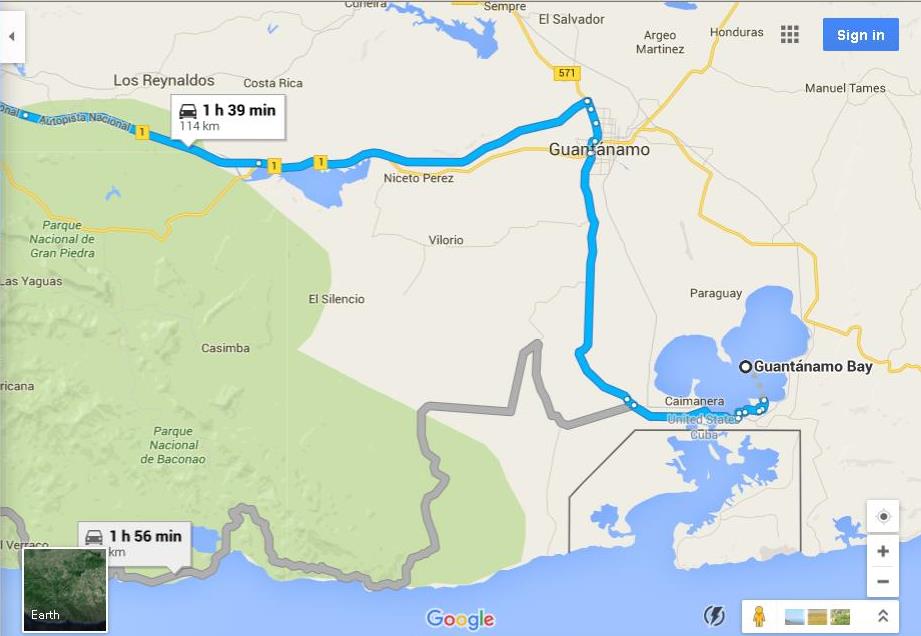
If you look at Google maps, it’s really confusing. What you would think was the U.S. territory with the detention center is marked as Cuban territory. Google has steered me wrong before, mostly memorably in Nairobi where it sent me to a slum instead of to the Ford Foundation’s offices, so I would never count on it except for a rough approximation.

Guantanamo

There was excitement on the bus as we got closer to Guantanamo. “Get out your OFAC letter!” someone exclaimed. “We’re being tailed by the CIA!”

As I mentioned previously, we were required to carry letters from the U.S. Office of Foreign Assets Control at all times to show we were there legally. I couldn’t imagine we would get anywhere near Gitmo—you didn’t have to see it to know it would be surrounded by 20-foot razor-wire fences and heavily-armed guards. What were we going to do, ram the gate? That would put a crimp in my plans to apply for jobs with the CIA and the Foreign Service!

But then the bus stopped, and most of us waited while a couple of Interfaith Task Forcers got off and held an animated conversation with the driver and our guide. Then we turned around and went back to Santiago. I will never know how the leaders of the Task Force talked our guide and the Cuban bus driver into driving to Guantanamo Bay, or how close we really got, or exactly where its limits are.

That’s the thing about travel, if you’re doing it right. You’ll come home shaking your head and laughing to yourself because there was some mysterious situation for which you’ll never have an explanation. That’s assuming no one got hurt or arrested, of course.

Now that I am working for the Center for Victims of Torture, it would be hugely prestigious to be able to say casually, “I was arrested at Guantanamo a couple years ago.”

CVT has been active in advocating for the closure of Guantanamo. First—obviously—because we, torture people there (yes, we, if you’re an American). Half the American population (and I think we can guess who their presidential candidates are) believe there’s nothing wrong with torture. “How we gonna catch the bad guys if we don’t torture people, huh?”

I could write 10 posts about why that’s a dumb statement, but for now I’ll just say, if you think torture is okay, go read someone else’s blog. And even if I thought it was okay, it’s still illegal.

The Universal Declaration of Human Rights, which came about in response to the WWII and specifically the Holocaust, outlawed torture. Ronald Reagan signed the international Convention Against Torture in 1984. President Obama issued an executive order on his second day in office banning torture. In November last year, Congress passed the National Defense Authorization Act, which “placed all U.S. government interrogations under the United States Army Field Manual on Interrogations, and requires that the International Committee of the Red Cross have prompt access to all prisoners in United States’ custody.” In other words, there are grownups in charge now.

Very few people know everything that’s gone on at Gitmo, but we do know that people have been detained indefinitely, without charge or trial. If you imagine yourself in one of those prisoner’s paper slippers, you will understand why they go on hunger strikes. We then subject them to another form of torture, forced feeding. If you wonder, “how bad could that be?” watch this video of the rapper Mos Def being force fed; he volunteered to show us what it really involves.

Back in Santiago, none of this was on my mind. My biggest concern was finishing my master’s and getting a job. Vince’s time in prison, and researching prison for this blog, changed all that.

When Worlds Collide

I’ve been writing a series of posts about traveling in Cuba that starts here. I am pausing that for a day to write about an unsettling experience where my worlds collided.

I volunteer with the Minnesota International NGO Network, or MINN. MINN is composed of Minnesota companies and nonprofits that work overseas, like my employer, the Center for Victims of Torture (CVT).

Last year MINN launched a class called MINNspire, which helps 50-somethings to explore doing something abroad. This could be anything from volunteering with Peace Corps, to teaching English as a second language, to consulting on communications, as I have done. MINN isn’t there to find them placements; we’re there to guide them through the thought process. I led one of the four sessions last year and will do the same this year—I think.

I was excited that we had 18 people registered—about twice the number as last year. It’s kind of a big commitment to come to something after work, in the dark, during the winter.

I walked in and said hi to my friend Carolyn, one of the four facilitators of the class. There were already two students in the room. Carolyn said to me, in a way that told me we might have an “issue”, “Something really interesting happened with registration. I spoke to a Rotary Club that happened to have a lot of members of the DOC, and we’ve got 10 people from the DOC registered for the class.”

The Department of Corrections. The people I never wanted anything to do with, ever again.

I had come from work, where I had spent the day writing about Eritrean torture survivors. Eritrea is known as the “North Korea of Africa.” They have forced conscription, which means every young man must join the military or go to prison. In the military, they are worked like slaves and their service is indefinite. If they try to escape, Eritrea throws them into underground prisons where they are tortured. If they make it to Ethiopia, they wind up in refugee camps with no future, and their family back home is persecuted. Sometimes they try fleeing to Israel, the one country that reluctantly takes them in, but often they are caught by—essentially—desert pirates called Rashida who hold them for ransom, torturing them while their families listen helplessly on the other end of the phone.

As you might imagine, a lot of Eritrean torture survivors have PTSD, and that is where CVT comes in. We provide trauma therapy and we hope to add physical therapy next year.

So I was writing about this all day and then I stepped into a room of people who had been my and my son’s tormentors for a year and a half.

I am in no way comparing what I went through to what Eritreans have endured. My point is that I know firsthand what a flashback feels like. A surge of adrenaline surged through me. My heart started racing and my palms got sweaty. I felt a powerful urge to bolt.

“I figure if I was a prison warden for 20 years, I can do anything!” one of the women exclaimed. The thought of her volunteering in an orphanage made me uneasy.

“My son just finished the boot camp program,” I told them. Might as well get it out there before she said something that would cause me shoot my mouth off. They oohed and ahhed said what a great program that was.

Carolyn knows my back story and has a high EQ.   She emailed later:

“I would never imagine that you would come face to face with your oppressor in MINNspire.  I mean, last year you were in Palestine, looking for ways to collaborate, professionally, with enemies of the Jewish state and now you come to St Paul and you are asked to teach the people whom you’ve written about for years.

“ I have to shake my head at what the universe is throwing at you.  But if anyone can handle it, you can.”

I hope she’s right, because I thought about backing out of the class but I’ve decided to stick it out.  I’ll keep you posted.

The Fine Print

I got another email from my friends at JPay. They are so sentimental! They know that home is where the heart is, and they’re just like a family. And they have such a great sense of humor; it says, “there’s snowplace like home” – get it?

Oh, I almost missed it. In very small print at the bottom they mention that their terms of service changed the day before they sent this email. Could it be that they said all that other nice stuff to distract me from that legally-required notice?

I decided to check out the terms, even though I am no longer a customer (yeah!). The payment terms of service are over 2,200 words long. And that’s just for starters. There are email terms of service (1,700 words), video visit terms of service (1,850), and music player terms of service (1,870). There is a subpoena policy, a privacy policy, and a consumer protection policy.

All of which is to say, “if you buy anything from us, don’t bother complaining or trying to sue us, because we’ve got lawyers and we’ve thought of everything.”

I’m going to unsubscribe from JPay now. It’s been fun, but they’re just too easy of a target and they bring out a mean, sarcastic streak in me that I don’t want to feed.

Hedgehogs, Mice, and Echidnas, Oh My

I pride myself on writing realistically about life. You can count on me to tell the truth as I know it, to question everything, and to imagine the worst case scenario. I don’t know why the Pentagon hasn’t called me yet to offer me a disaster-planning job.

But that doesn’t mean I’m depressed, or even “unhappy”—the more generic term. Being a highly-analytical thinker has its rewards. I notice and think about things that other people do not. There’s often absurd fodder for laughs. Sometimes I’m the only one laughing, but that’s okay, right?

There was an article in the Sunday paper about a study that debunked the popular myth that “happy” people are healthier and live longer. Yes! My friend who works in an old folks home—or whatever they’ve been rebranded as now—has always said, “There are plenty of miserable, crabby 90 year olds. And they’ve always been that way, because their kids tell me they have.”

About five years ago, I kicked the depression that had dogged me all my life. Since then I have felt mostly contentment, punctuated with the normal situationally-appropriate emotions. I felt angry when my landlord raised my rent $300 a month, which forced me to move. I was stressed when I moved again three months later so Vince could live with me. I was anxious when Vince was in solitary confinement. I cried for everything my sister and her kids went through when she had cancer. I felt awe hiking in Petra, in the Jordanian desert, and nervous about crossing over into the Palestinian territories. I felt powerless rage when I was banned from visiting Vince. I had a blast with my friends in Berlin. I’ve been bored at work. I was proud when Vince led his squad at his graduation from boot camp. I am excited at the prospect of remodeling my kitchen.

Hey, I guess I just wrote my Christmas letter!  What a year it’s been.

None of it lasts. Some people figure this out somehow, much earlier in life than I did. Emotions come and go. The pleasant and the unpleasant, they’re all fleeting. So enjoy the nice ones while they last and know that the bad ones will dissipate. Don’t panic if you feel blue once in a while. Don’t latch on to the negative feelings or thoughts. If the blues don’t go away for weeks, of course, seek professional help.

In the last week I’ve had some really good times with people I love.

Yesterday I took my mother to tour the Purcell Cutts House, a prairie-style home build in 1913 and owned by the Minneapolis Institute of Arts. This is the living room:

Purcell Cutts

The guide explained that the simple, serene style was in part a reaction to the chaos of the age. The architect was from Chicago, which was the industrial center of the U.S. Meat packing and other industries attracted droves of immigrants and African Americans from the south. There wasn’t enough housing, and the water and sewer systems weren’t up to par. There were no child labor laws, workers’ compensation, welfare, or social security.

So architects brought nature and art inside. Obviously this was not a house that could be produced on a mass scale. The immigrants and African Americans still lived in poorly-heated hovels. But at least this one architect could escape all that and find sanctuary at home!

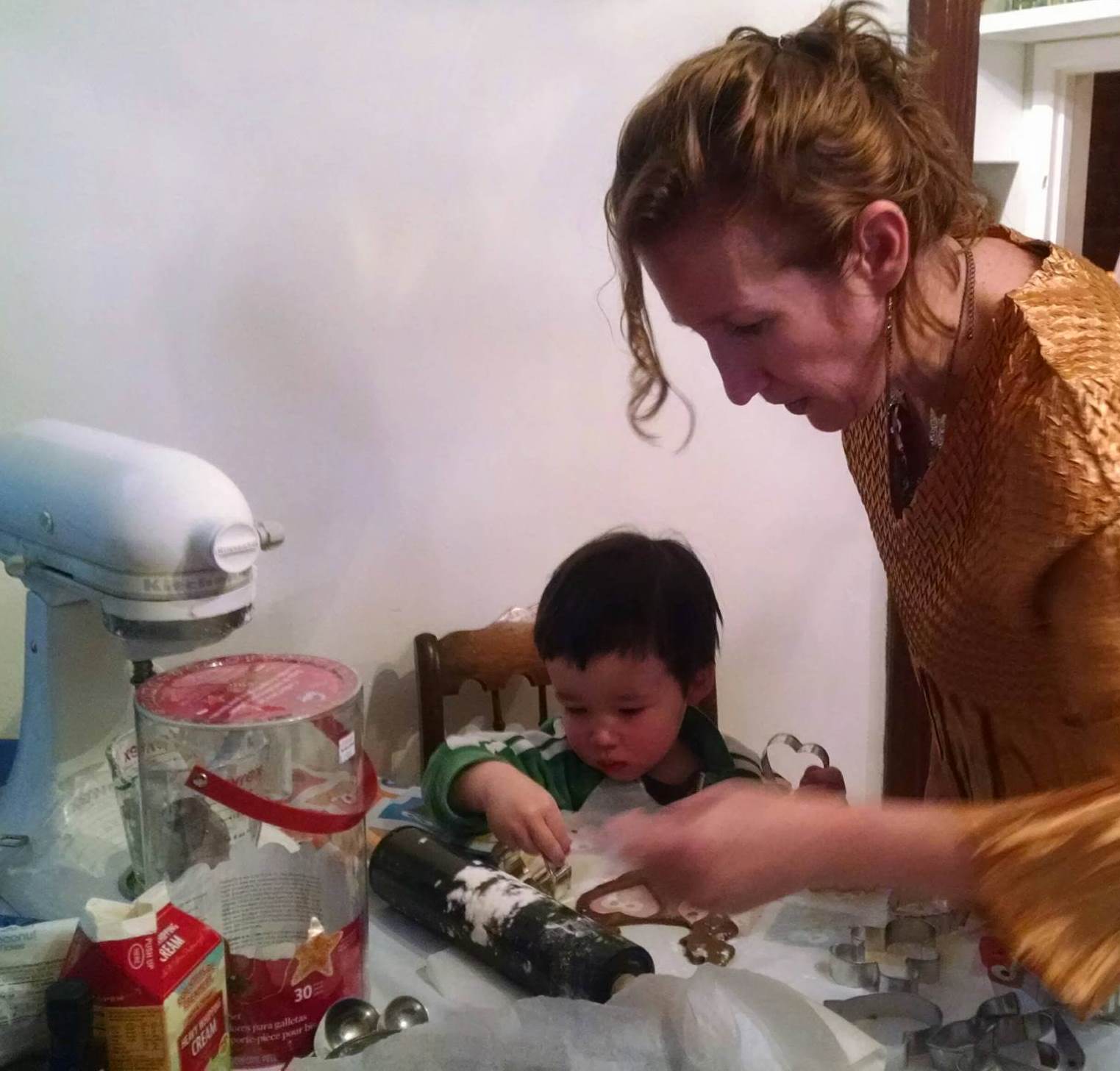
Last weekend, I hosted a cookie-baking party for Vince and his cousins.

Hannukah HedgehogsTaisei n me

They’re not pretty, but we had fun. Strangely, Vince and I had prepared enough dough to yield 16 dozen cookies but only nine dozen made it to the final stage. Hmmm…or should I say, Mmmmm….cookie dough?

So enjoy the moments that contain things you love. In my case: design, craftsmanship, nature, history. Kids, creativity, and cookie dough.