Category Archives: solitary confinement

Gittin’ in Trouble

This is the seventh post in a series about Cuba that starts here.

Before we left Santiago de Cuba, we took an excursion to the nearby Parque Nacional de Gran Peidra—a sort of national park. I love the outdoors and got excited that we might go on a hike, but we only skirted the park on our way to our real destination, Guantanamo Bay.

If you look at Google maps, it’s really confusing. What you would think was the U.S. territory with the detention center is marked as Cuban territory. Google has steered me wrong before, mostly memorably in Nairobi where it sent me to a slum instead of to the Ford Foundation’s offices, so I would never count on it except for a rough approximation.
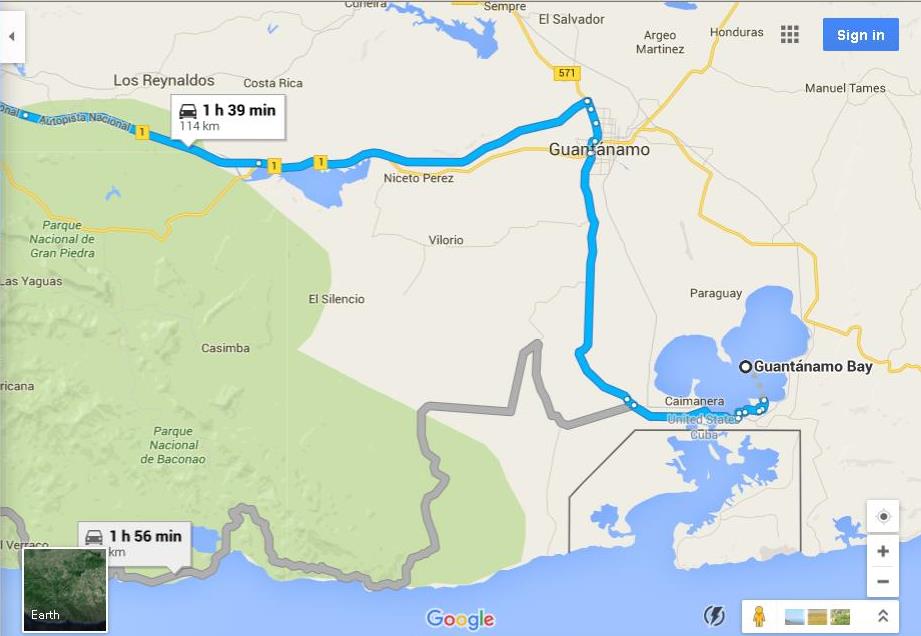
Guantanamo

There was excitement on the bus as we got closer to Guantanamo. “Get out your OFAC letter!” someone exclaimed. “We’re being tailed by the CIA!”

As I mentioned previously, we were required to carry letters from the U.S. Office of Foreign Assets Control at all times to show we were there legally. I couldn’t imagine we would get anywhere near Gitmo—you didn’t have to see it to know it would be surrounded by 20-foot razor-wire fences and heavily-armed guards. What were we going to do, ram the gate? That would put a crimp in my plans to apply for jobs with the CIA and the Foreign Service!

But then the bus stopped, and most of us waited while a couple of Interfaith Task Forcers got off and held an animated conversation with the driver and our guide. Then we turned around and went back to Santiago. I will never know how the leaders of the Task Force talked our guide and the Cuban bus driver into driving to Guantanamo Bay, or how close we really got, or exactly where its limits are.

That’s the thing about travel, if you’re doing it right. You’ll come home shaking your head and laughing to yourself because there was some mysterious situation for which you’ll never have an explanation. That’s assuming no one got hurt or arrested, of course.

Now that I am working for the Center for Victims of Torture, it would be hugely prestigious to be able to say casually, “I was arrested at Guantanamo a couple years ago.”

CVT has been active in advocating for the closure of Guantanamo. First—obviously—because we, torture people there (yes, we, if you’re an American). Half the American population (and I think we can guess who their presidential candidates are) believe there’s nothing wrong with torture. “How we gonna catch the bad guys if we don’t torture people, huh?”

I could write 10 posts about why that’s a dumb statement, but for now I’ll just say, if you think torture is okay, go read someone else’s blog. And even if I thought it was okay, it’s still illegal.

The Universal Declaration of Human Rights, which came about in response to the WWII and specifically the Holocaust, outlawed torture. Ronald Reagan signed the international Convention Against Torture in 1984. President Obama issued an executive order on his second day in office banning torture. In November last year, Congress passed the National Defense Authorization Act, which “placed all U.S. government interrogations under the United States Army Field Manual on Interrogations, and requires that the International Committee of the Red Cross have prompt access to all prisoners in United States’ custody.” In other words, there are grownups in charge now.

Very few people know everything that’s gone on at Gitmo, but we do know that people have been detained indefinitely, without charge or trial. If you imagine yourself in one of those prisoner’s paper slippers, you will understand why they go on hunger strikes. We then subject them to another form of torture, forced feeding. If you wonder, “how bad could that be?” watch this video of the rapper Mos Def being force fed; he volunteered to show us what it really involves.

Back in Santiago, none of this was on my mind. My biggest concern was finishing my master’s and getting a job. Vince’s time in prison, and researching prison for this blog, changed all that.


Hedgehogs, Mice, and Echidnas, Oh My

I pride myself on writing realistically about life. You can count on me to tell the truth as I know it, to question everything, and to imagine the worst case scenario. I don’t know why the Pentagon hasn’t called me yet to offer me a disaster-planning job.

But that doesn’t mean I’m depressed, or even “unhappy”—the more generic term. Being a highly-analytical thinker has its rewards. I notice and think about things that other people do not. There’s often absurd fodder for laughs. Sometimes I’m the only one laughing, but that’s okay, right?

There was an article in the Sunday paper about a study that debunked the popular myth that “happy” people are healthier and live longer. Yes! My friend who works in an old folks home—or whatever they’ve been rebranded as now—has always said, “There are plenty of miserable, crabby 90 year olds. And they’ve always been that way, because their kids tell me they have.”

About five years ago, I kicked the depression that had dogged me all my life. Since then I have felt mostly contentment, punctuated with the normal situationally-appropriate emotions. I felt angry when my landlord raised my rent $300 a month, which forced me to move. I was stressed when I moved again three months later so Vince could live with me. I was anxious when Vince was in solitary confinement. I cried for everything my sister and her kids went through when she had cancer. I felt awe hiking in Petra, in the Jordanian desert, and nervous about crossing over into the Palestinian territories. I felt powerless rage when I was banned from visiting Vince. I had a blast with my friends in Berlin. I’ve been bored at work. I was proud when Vince led his squad at his graduation from boot camp. I am excited at the prospect of remodeling my kitchen.

Hey, I guess I just wrote my Christmas letter!  What a year it’s been.

None of it lasts. Some people figure this out somehow, much earlier in life than I did. Emotions come and go. The pleasant and the unpleasant, they’re all fleeting. So enjoy the nice ones while they last and know that the bad ones will dissipate. Don’t panic if you feel blue once in a while. Don’t latch on to the negative feelings or thoughts. If the blues don’t go away for weeks, of course, seek professional help.

In the last week I’ve had some really good times with people I love.

Yesterday I took my mother to tour the Purcell Cutts House, a prairie-style home build in 1913 and owned by the Minneapolis Institute of Arts. This is the living room:

Purcell Cutts

The guide explained that the simple, serene style was in part a reaction to the chaos of the age. The architect was from Chicago, which was the industrial center of the U.S. Meat packing and other industries attracted droves of immigrants and African Americans from the south. There wasn’t enough housing, and the water and sewer systems weren’t up to par. There were no child labor laws, workers’ compensation, welfare, or social security.

So architects brought nature and art inside. Obviously this was not a house that could be produced on a mass scale. The immigrants and African Americans still lived in poorly-heated hovels. But at least this one architect could escape all that and find sanctuary at home!

Last weekend, I hosted a cookie-baking party for Vince and his cousins.

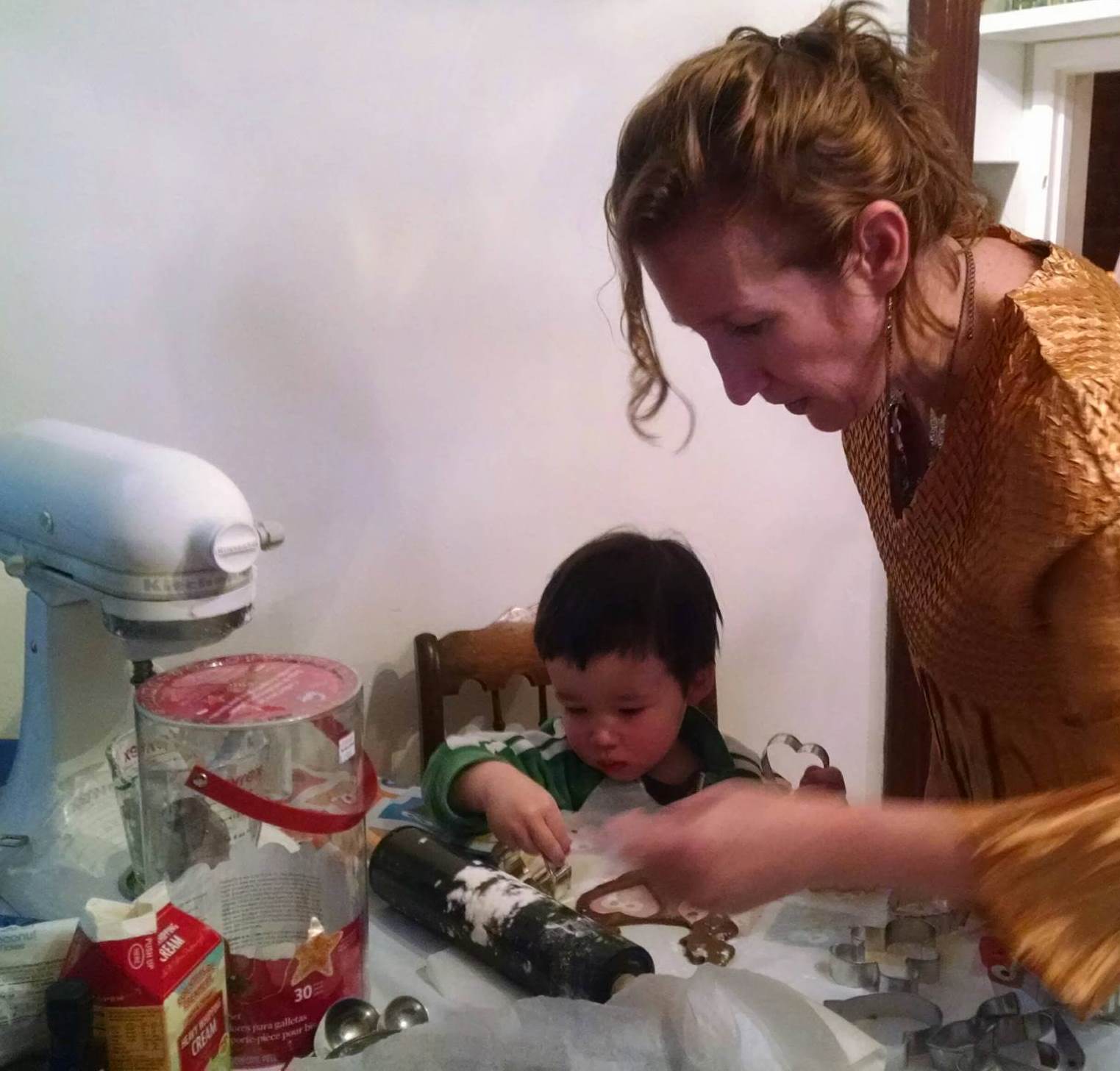
Hannukah HedgehogsTaisei n me

They’re not pretty, but we had fun. Strangely, Vince and I had prepared enough dough to yield 16 dozen cookies but only nine dozen made it to the final stage. Hmmm…or should I say, Mmmmm….cookie dough?

So enjoy the moments that contain things you love. In my case: design, craftsmanship, nature, history. Kids, creativity, and cookie dough.

Au Mal Pain

As usual, the prison news includes the good, the bad, and the disgusting.

The good: If I didn’t work in fundraising I might not have caught this item.  The California Endowment has announced it will divest its assets from companies that run private prisons, jails, detention centers, and correctional facilities.  This is fantastic!  The California Endowment is a foundation with $3,668,459,217 in assets.  That’s real money, and maybe it will start a trend.  I look at foundation tax returns almost every day, so I see where they invest their money.  It’s disgusting to see a foundation with a portion of its assets invested in a weapons manufacturer, for instance, and making grants for international poverty programs.  In part, it’s all the small arms the U.S. peddles to warlords abroad that destabilize developing countries and keep them impoverished.  That’s an extreme example but I bet it’s not that uncommon.  If you have retirement investments, you too may own part of Alliant Techsystems or Prison Corporation of America, and you are probably earning fantastic rates of return.

The not-so-good news, also in California, is a report that found abuse, racism, and cover ups a physically isolated prison about 90 miles northwest of Reno.  The town in which the prison is located, Susanville, has fewer than 16,000 people, and the two correctional facilities are its largest employers.  “Employees form tight-knit social groups known as “cars” that can foster what the report terms “a code of silence” that makes it difficult to report wrongdoing.”  They are accused of abusing physically-disabled and minority prisoners, inciting attacks against sex offenders, and conspiring to impede the investigation.   The prison’s nearly 3,500 inmates won’t report abuse because they fear the nearly 1,000 employees will find out and retaliate.  If this is true in this case, why wouldn’t it be true in Moose Lake, where Vince was incarcerated?  Moose Lake has a population of only about 2,700 and, as you might guess from its name, it’s in the sticks.

Then there are two items that would be ridiculous if they weren’t true.

First, rapper Nicki Minaj did a December 10 interview with Billboard Magazine in which she spoke out against mass incarceration, lengthy drug sentences, and the racial bias in sentencing: “What it has become is not a war on drugs.  It has become slavery.  When I see how many people are in jail, I feel like, ‘Wait a minute. Our government is aware of these statistics and thinks it’s OK?’ The sentences are inhumane.”

Earlier this year, she had said about Barak Obama’s prison clemency program, “I thought it was so important when he went to prisons and spoke to people who got 20 and 30 and 40 and 50 years for drugs. There are women who are raped, people who are killed and [offenders] don’t even serve 20 years.”

I guess you could call it a case of bad timing, then when Minaj’s brother was arrested December 3 for raping a 12-year-old girl.  She posted his $100,000 bail.  Blood is thicker than principles, I guess, and I’m not being sarcastic.  As his sister, she probably believes there’s a good explanation.

Last, in prison food news, the New York Times reports that the state’s prisons have announced they will stop serving Disciplinary Loaf—also known as NutriLoaf—to prisoners in solitary confinement.  It was served with a side of cabbage.

God, sometimes I wonder if you think I make this stuff up—that’s why I provide links.

This menu change is part of a slew of reforms to solitary confinement practices.  It was brought about as the result of a lawsuit by the American Civil Liberties Union, whose director said, “Food is very important to prisoners in a deprived and harsh environment; it is one of the very few things they have to look forward to.”

I’ve pasted the recipe below in case you want to serve it to your family over the holidays.

Recipe for Nutraloaf

Makes 50 loaves.

Ingredients

5 pounds whole wheat flour

20 pounds all purpose flour

1.5 gallons milk, 1 percent

8 ounces fast active dry yeast

4 pounds sugar

2 ounces salt

2.5 pounds powdered milk, nonfat

2 pounds margarine

5 pounds shredded potatoes (with skin)

2 pounds shredded carrots


Preparation

  1. Preheat oven to 350 degrees.
  2. Heat milk to 105 degrees, then add sugar, salt and yeast. Let stand for 5 minutes.
  3. Add both flours and dry milk, then mix.
  4. Add margarine, potatoes and carrots. Mix for 10 minutes.
  5. Cover bowl with plastic wrap and let dough rise.
  6. Grease and flour loaf pans and add dough.
  7. Bake loaves for 40 to 45 minutes.


Sincerely, Barak Obama

I wrote to the White House about a month ago to thank President Obama for his efforts to lower incarceration rates through sentencing reform, reintegration programs and other “upstream” measures. I thought I would share the response I received.  Too bad the White House seal and other graphics don’t show up:

Dear Anne:

Thank you for writing, and for sharing your son’s story.  Today, our criminal justice system holds approximately 2.2 million Americans behind bars, at a cost to taxpayers of $80 billion per year.  Many of these individuals are violent criminals who are off the streets thanks to hard‑working police officers and prosecutors, but many others who are incarcerated are non‑violent offenders whose punishments do not always fit their crimes.  We have to make sure that our justice system is fair and effective and is doing what it can to make individuals, their families, and their communities stronger.

My Administration has taken concrete steps to enhance public safety while also making our system more just.  By channeling resources into early childhood education and issuing discipline guidance to our schools, we are creating pathways to success instead of pipelines to prison.  Through initiatives like “My Brother’s Keeper,” we are promoting reforms to the juvenile justice system and reaching young people before they’re locked into a cycle from which they cannot recover.  Additionally, the Justice Department’s “Smart on Crime” and “Justice Reinvestment” initiatives aim to address the unnecessary use of mandatory minimums in the Federal system and work with states to lower their incarceration numbers and reinvest in crime prevention services.

For currently incarcerated individuals, my Administration has supported critical improvements to our prison system that target overcrowding, solitary confinement, gang activity, and sexual assault.  We are promoting rehabilitation programs that have been proven to decrease the likelihood of a repeat offense, and we are expanding reintegration programs—such as those supported by the Second Chance Act—that work with government agencies and non‑profit organizations to help provide access to employment, education, housing, and health care for the nearly 600,000 inmates released annually.  In addition, I directed the Office of Personnel Management to “ban the box” on most Federal job applications in order to end the practice of disqualifying people simply because of a mistake they made in their past.

While my Administration remains committed to taking action to improve all phases of the criminal justice system, it is time for Congress to act.  Meaningful sentencing reform and juvenile justice reform legislation would make a crucial contribution to improving public safety, reducing runaway incarceration costs, and making our criminal justice system fairer.  There is strong bipartisan support in Congress to achieve these goals, and I am encouraged that the Senate and House will continue to work cooperatively to get a bill to my desk.

Thank you again for writing.  Throughout my Presidency and beyond it, I will continue working to keep our communities safe and make our justice system fair.  To learn more about these efforts, visit www.WhiteHouse.gov/Issues/Civil‑Rights/Justice.

Sincerely,

Barack Obama

Seeing how Vince struggles with the after effects of being imprisoned, it is comforting to know that lawmakers on both sides agree the system must change—drastically, and now—and that my president cares enough about this to take it on even after he leaves office. I believe this is the only issue Republicans and Democrats agree on and are working on together nowadays, which tells you a lot about how messed up the system is.

A Break from Breaking Free

ANNE

Vince says he’s hit a wall with the blogging, and I need more than 10 minutes notice to come up with new material.  After over a year of blogging and nearly 200 posts, I’d say we’ve earned a break.

We’ll be back.  If you haven’t yet binge read the thing from the beginning, start here and click on the right-pointing arrow at the bottom of each post to proceed.  Feel free to share with others, and thanks for reading.


Bill Clinton Confesses

ANNE

No, it’s not what you think!  But Bill’s confession at the end of this July 16 editorial in the New York Times is a positive thing, and I think the piece is worth publishing verbatim, even if it is a bit longer than our usual posts.

President Obama Takes on the Prison Crisis

On Thursday, for the first time in American history, a president walked into a federal prison. President Obama was there to see for himself a small piece of the damage that the nation’s decades-long binge of mass incarceration has wrought.

Mr. Obama’s visit to El Reno, a medium-security prison in Oklahoma, capped off a week in which he spoke powerfully about the failings of a criminal justice system that has damaged an entire generation of Americans, locking up millions — disproportionately men of color — at a crippling cost to them, their families and communities, as well as to the taxpayers and society as a whole.

Speaking to reporters after touring the cells, Mr. Obama reflected on the people he met there. “These are young people who made mistakes that aren’t that different than the mistakes that I made, and the mistakes that a lot of you guys made. The difference is they did not have the kinds of support structures, the second chances, the resources that would allow them to survive those mistakes.”

This indisputable argument has been made by many others, most notably former Attorney General Eric Holder Jr., who was the administration’s most powerful advocate for sweeping justice reforms. But it is more significant coming from the president, not just in his words but in his actions. On Monday Mr. Obama commuted the sentences of 46 people, most serving 20 years or more, for nonviolent drug crimes. It was a tiny fraction of the more than 30,000 people seeking clemency, but the gesture recognized some of the injustices of America’s harsh justice system.

On Tuesday, in a wide-ranging speech to the N.A.A.C.P. [National Association for the Advancement of Colored People], Mr. Obama explained that people who commit violent crimes are not the reason for the exploding federal prison population over the last few decades. Most of the growth has come instead from nonviolent, low-level drug offenders caught up in absurdly harsh mandatory minimum sentences that bear no relation to the seriousness of their offense or to the maintenance of public safety.

“If you’re a low-level drug dealer, or you violate your parole, you owe some debt to society,” Mr. Obama said. “You have to be held accountable and make amends. But you don’t owe 20 years. You don’t owe a life sentence.”

Mandatory minimums like these should be reduced or eliminated completely, he said. Judges should have more discretion to shape sentences and to use alternatives to prison, like drug courts or community programs, that are cheaper and can be more effective at keeping people from returning to crime.

Mr. Obama also put a spotlight on intolerable conditions, like overuse of solitary confinement in which more than 80,000 inmates nationwide are held on any given day. Many are being punished for minor infractions or are suffering from mental illness. “Do we really think it makes sense to lock so many people alone in tiny cells for 23 hours a day, sometimes for months or even years at a time?” Mr. Obama asked. He said he asked the Justice Department to review this practice.

He talked about community investment, especially in early-childhood education and in lower-income minority communities, as the best way to stop crime before it starts. And he spoke of the importance of removing barriers to employment, housing and voting for former prisoners. “Justice is not only the absence of oppression,” Mr. Obama said, “it is the presence of opportunity.”

As Mr. Obama acknowledged, however, his powers are limited. Any comprehensive solution to this criminal justice catastrophe must come from Congress and the state legislatures which for decades enacted severe sentencing laws and countless other harmful measures. In recent years, the opposite trend has taken hold as lawmakers in both conservative and liberal states have reduced populations in state prisons — where the vast majority of inmates are held — as well as crime rates.

It’s time that Congress fixed the federal system. After failed efforts at reform, an ambitious new bill called the SAFE Justice Act is winning supporters, including, on Thursday, the House speaker, John Boehner, and may have enough bipartisan support to pass. It would, among several other helpful provisions, eliminate mandatory minimums for many low-level drug crimes and create educational and other programs in prison that have been shown to reduce recidivism.

One sign of how far the politics of criminal justice has shifted was a remark by former president Bill Clinton, who signed a 1994 law that played a key role in the soaring growth of America’s prison system. On Wednesday, Mr. Clinton said, “I signed a bill that made the problem worse. And I want to admit it.” It was a long overdue admission, and another notable moment in a week full of them.

Have a Nice Day

ANNE

The drum beat of stories about prison continues.

Last week, every day on my drive in to work, I heard a different story about prison on National Public Radio’s Marketplace Tech Report. At the end of each segment they said, “Go to our special website for this series to read more” but I can’t find it. The series is called Jailbreak (clever, huh?) and if you can find the link please let me know.

But in the process of trying to find the Jailbreak series I found a dozen great short podcasts on NPR. There’s one called, “Connecting inmates with their children through books,” another about for-profit prison companies adjusting to a new era. Apparently the prison population has decreased slightly, which is bad for their business model. What a shame!

There was a story about keeping mental health patients stable and out of jail. I don’t expect you to listen to all these stories, but they are a good representation of the economic, health, and social issues that all intersect in prison.

There was one story I could barely stand to finish listening to. From Solitary to the Streets was much as the title implies: prisoners, kept in solitary confinement for years, then set free with no support or resources. It’s an 11-minute podcast that will break your heart, if you have one. This is the kind of story that gets me so mad and upset that I worry I might drive off the road. Vince was in solitary confinement for less than a week and I think he would say it was the worst part of his one-year in prison so far.

This same week, there was news that Ross Ulbricht, creator of the Silk Road black market website where people could buy drugs and fake IDs, launder money, and conduct all sorts of other nefarious activities, was sentenced to life in prison. Life in prison. He’s 30 years old. Obviously the guy is a jerk with no moral compass. But life? I don’t know enough about the story yet to be suspicious about the government’s motives, but I’m sure that will come.

Back to the subject of jail breaks, the story that’s been fascinating to me is the real New York prison break. I won’t post a link because there are frequent developments. How did they get power tools? How did they communicate with each other and their presumed accomplices to create such a brazen and fine-tuned plan? How did they cut through the walls of their cells and the steam pipe without being heard? And the smiley face! Was that part of the plan that they snickered over for months, or was it spontaneous?

Smiley

I have caught myself cheering them on, then remind myself that these guys are murderers. I have to check my allegiances; I firmly believe in the rule of law and the 10 Commandments. I’m pretty sure I wouldn’t succumb to the sweet-talking B.S. of a lifer and smuggle in power tools to help him escape. But I can’t wait for the book and the movie to come out.

Visit Denied

ANNE

I took the day off work to go visit Vince before I left for the Middle East, but I never saw him. I was denied a visit because my shirt was too “low cut.” Here I am out in the parking lot after I was ejected, showing off my slutty, low-cut shirt.

Low Cut

The correctional officer, a guy named Volk, told me I would have to go home and change my shirt.

Go home? I live two hours away. Then he suggested I drive into Moose Lake and buy a T-shirt. I protested that my shirt was not low cut; what was the definition of low cut? If there was one he didn’t know what it was. I pointed out that I was not showing cleavage; in fact I was physically incapable of doing so…. I said several times, “I can’t believe I have to say these things to a strange man in a prison. I’m a 55-year-old woman here to visit my son. I am not wearing a low-cut top!” I felt so shamed. Did I look slutty? I doubted my own judgment.

That’s when he said, “Well ma’am, it’s for your own protection. See, if you bent over, then they could see …”

That’s when I blew it–I kind of called him a pervert.  OKAY I did call him a pervert. Visit Denied.

I asked to talk to his supervisor. He said she was not working that day. I asked to talk to a supervisor. He said there were none working that day. I laughed, incredulous, “So you are running the whole prison?” I asked for his supervisor’s name and phone number. He said, “You can look it up on the website, lady.”

I started bawling and stumbled out the doors. A female CO was coming in and asked me if I was alright. I managed to blubber out my story and then said, “I think it was all a big power trip!” Of course she couldn’t say anything but the look of complicit agreement on her face was clear.

I asked some visitors coming into the prison to snap a picture of me. I called my sister from my car. A group of officers came up to my door and yelled, “You have to leave! You can not sit here in the parking lot.” I rolled down my window, not understanding what could possibly be the problem. “You have to leave right now!” the closest one barked.

I drove out of the facility and called my sister again from the parking lot of the Dollar Store. “Volk’s brother-in-law probably owns the Dollar Store, conveniently located right outside the prison and handily ready to sell overpriced T-shirts!”

“Well I don’t know about that,” she said, “but he sure was on a power trip. Now drive safely; you’ve got another two-hour drive ahead of you—don’t make things worse by veering off the Interstate.”

Vince called me just as I was about to enter the freeway, and I pulled over to take his call. He had been sitting in the visiting room when he was called to the desk and told he would not have a visit due to a “clothing issue.”

“I couldn’t imagine what the hell that would be—my mom?”

“I feel so ashamed! I’m so sorry! I was so looking forward to seeing you!” I kept repeating. It really felt like it was my fault, like I had been trying to sneak in with my low-cut blouse to show all the inmates.

“Mom, this is what we have to put up with every day. If I had called a C.O. a pervert, I’d be back in solitary right now. We have to suck it up all the time. I’m proud of you, mom!”

I wondered, as I drove home, had the guard picked me out at random? Or did he have a big blue-collar chip on his shoulder toward well-dressed yuppies? Or did he sincerely think like a pervert, because after all, one out of four inmates at Moose Lake is there for sexual assault? Is it his job to see every bit of exposed skin as a potential incident?

Sprung!

VINCE

I made it!  Right after breakfast they changed me out of solitary and took me downstairs to Unit 10, the best unit according to word of mouth.

Already I’ve heard good news.  People are going to Boot Camp early!  One guy said his letter told him April, and he’s locked in for February!

This place is massive.  Until I get a job, I’m only allowed out of my cell until noon, after my first day.  Once I have a job, I’m free to spend my day training or reading or really doing anything I choose.  So far I have chosen to take a really long shower, with all my own hygiene items.  And that was exactly what I needed.

Next step, figure out my schedule, then develop a routine.  I know sooner than later I have to get to the P90X workout.  Cardio is huge at Boot Camp, along with five miles per day, the P90X is used in winter.  Five miles is rain or snow or shine.  I’m a little nervous about getting started.  I know I can do it, it’s just a matter of keeping focused.  I have trouble keeping my thoughts on one activity for very long.

Or on one subject, for that matter.  Next subject.  Actually, I’ll continue on Lanesboro.

I have mentioned the town in previous posts, about working in a couple of the restaurants there.  Well that’s not all I did.

OK, sorry, I’ll have to get back to Lanesboro.  I did my first real cardio exercise in quite a while.  To qualify for Boot Camp, you have to be able to walk or run a mile in 14 minutes.  I failed, but not by too much.  I will try every day and I will improve.  I also played four games of volleyball.  So I kept my heart rate up for about an hour, and it felt pretty good.

I watched about five minutes of people doing the P90X thing.  All I have to say to the person that invented that is Fuck You.  Fuckin asshole.

Lanesboro is a town of 788.  It has been named the B&B Capital of America or some such shit.  So in the summer, the town can swell into the thousands.  10,000 or more for Buffalo Bill Days.  In the winter, however, almost everything closes down…except for the bars.

That’s where I learned that it’s okay to have six beers before breakfast, skip breakfast, and go straight to the bar to start getting a good buzz on.

Usually by noon I could be near blackout, eat a small lunch, then go home and take a nap. That way I could go out and get drunk with the evening crowd too.

Even on my work days I could show up fairly hammered as long as I could function.  I could even pull beers off the tap during the slow days of winter to keep a nice, even buzz.

Pause…Good news: It’s not the P90X that we have to do and practice.  It’s the Reebok Step video.  My apologies to the creator of the P90X workout.  I’m sure it’s a fine program.  For insane people.  My verbal assault was out of line.

Solitary, Still

VINCE

It wasn’t always the hard stuff.

Shortly after I lost my job at the ice cream plant, one of my close friends wore a wire into my apartment and attempted to buy some meth from me.  Fortunately, I had been tipped off that his house had been raided not even an hour before he showed up.  I slammed the door in his face, and started thinking.  I had a standing offer to move to Fountain with an old friend and his girlfriend, and I took them up on it.  The first night there I started back up with my heavy drinking, and I didn’t stop until seven years later when I got into the hard stuff again.  But it was a fun seven years!

After one very trying month living in a trailer in Fountain with a man that couldn’t control his anger while drunk, which was all day every day, I moved a short distance to the town I was working in, Lanesboro.  **Pause**  If you ever get a chance to get a copy of the book, Inadmissible Evidence by Phillip Friedman, do it.  But before you read it, just go ahead and burn it.  Or if you want to know what it’s like in prison isolation, read it.  Thank you for your time.  **Play**