Tag Archives: prison

Reductive Seduction

There’s a great article circulating among international development people that also addresses mass incarceration in the US. Who knew there were so many connections between these two worlds of mine?

Written by Courtney Martin, it’s titled, “The Reductive Seduction of Other People’s Problems.” I’ll quote the opening here:

“Let’s pretend, for a moment, that you are a 22-year-old college student in Kampala, Uganda. You’re sitting in class and discreetly scrolling through Facebook on your phone. You see that there has been another mass shooting in America, this time in a place called San Bernardino. You’ve never heard of it. You’ve never been to America. But you’ve certainly heard a lot about gun violence in the U.S. It seems like a new mass shooting happens every week.

“You wonder if you could go there and get stricter gun legislation passed. You’d be a hero to the American people, a problem-solver, a lifesaver. How hard could it be? Maybe there’s a fellowship for high-minded people like you to go to America after college and train as social entrepreneurs. You could start the nonprofit organization that ends mass shootings, maybe even win a humanitarian award by the time you are 30.

“Sound hopelessly naïve? Maybe even a little deluded? It is. And yet, it’s not much different from how too many Americans think about social change in the ‘Global South.’”

These are real Tindr photos from her article:

World SaverWorld Saver2

Martin goes on to write about the problem of mass incarceration in this country—where are all the new graduates lined up to campaign for change on that? I’ve never met one. I have, however, met many young people who fervently want to work for my organization. Whenever we post a job, we get hundreds of applications, even for admin positions. We get a lot of candidates who can recite all 30 articles of the Universal Declaration of Human Rights, but they can’t enter names into a data base without lots of mistakes. They have no interest in fundraising, finance, HR, or any of the other jobs that keep a nonprofit organization humming. They want to get their foot in the door, then jump to the first “meaningful” job that comes open.

They’re not bad people. I don’t blame them for wanting a job that might send them off around the world to help torture survivors, a job that will cause their peers to fawn over them with admiration. As an English friend once said, “You’ve got a job that’s every Lib Dem’s wet dream.” I once had a woman bow down to me when I told her where I work. Super uncomfortable.

And let’s face it, for those of us who crave the exotic, Nairobi fits the bill a lot better than Moose Lake, Minnesota.

When I was in the Occupied Palestinian Territories … there — I did that thing that my set does. We start sentences with, “When I was in Peru …” or Ethiopia, or wherever. I’m sure people who don’t travel to those places, or who wouldn’t be caught dead in those places, find it really annoying.

But, when I was in the Occupied Palestinian Territories, I was invited to write an article about it for a local publication. I did, but I also wrote about Vince’s being in prison, mass incarceration, and how people in the US seem to care a lot more about Palestinians than prisoners who live a few miles away. I can’t be sure why, but they never published it.

You may be thinking, “Who is she to criticize–why doesn’t she work on prison reform?  Erm…I am, in my own way.  There’s nothing wrong with wanting to work on international issues; just be aware of your motivations and your ego.

To quote Martin’s article further: “Most American kids … have some sense of how multi-faceted problems like mass incarceration really are. Choosing to work on that issue … means studying sentencing reform. The privatization of prisons. Cutting-edge approaches already underway, like restorative justice and rehabilitation. And then synthesizing, from all that studying, a sense of what direction a solution lies in and steadfastly moving toward it.”

Maybe Martin’s article will inspire someone to become the Martin Luther King Jr. of prison reform.


Locked Down

As I write this, the phone is ringing. The landline, that is, that I am required to have as a condition of Vince living with me. I had forgotten how loud a landline phone is, and we can’t turn it on silent because Vince has to answer it when he’s home. He’s not home now but I hesitate to turn it off because I might forget to turn it back on, and that could get him into trouble.

When we first got it, there were numerous calls for Mohamed, apparently the previous number holder. Those finally tapered off, but there are still calls now and then. Like now. And the phone is still ringing … 15, 16, 17 rings … I am tempted to pick it up and tell whoever it is to bugger off, but if it’s a robo caller, that just verifies that the number is a potential customer to be strafed with more calls. Still ringing … 18, 19, 20 … ah, silence, finally!

My birthday was last week, and I asked Vince if he would consider going to a classical music concert with me at the James J. Hill House, St. Paul’s equivalent of Downton Abbey.

HillHill Hall

I was pleasantly surprised when he said yes. In fact, he was excited to go, and he spent the next few weeks searching for nice clothes to wear. I told him that Minnesotans are sloppy, but he wanted to dress up anyway. I thought that was great. I always dress up too.

He found a good pair of men’s dress shoes during his community service job at the Goodwill. If you’re a thrift store shopper, you know that decent shoes are the hardest thing to find second hand.

I’m house sitting for a friend for two weeks, and it’s heavenly to have my own place. I’m sure Vince is happy to have the condo to himself, too. Unfortunately, this was the week that the condo association chose to have the chimneys cleaned, and the sweep dropped his tools down our chimney, breaking the flue control so it’s stuck open, allowing all the warm air to be sucked out. I’m just home to write this post, and it’s really cold in here. After many calls back and forth, a guy finally came and shoved a tarp up inside of the chimney. He promised someone would come back “soon” to fix the flue.

It was also at the Goodwill that our concert plan came undone. Vince’s probation officer called him twice, and Vince didn’t answer because he just didn’t hear his phone ring. It’s true, cell phones don’t ring nearly as loudly as landlines. Vince works in a warehouse amid fork lifts and dumpsters and people yelling, so that seemed like a reasonable explanation, but not to a probation agent. Or at least, not to this one on this particular day.

The agent put him on indefinite lock down, which means Vince can’t leave the house except for work or AA meetings. So he’s back to square one.

This happened just a few hours after I posted this piece about the Department of Corrections people in the class I am co teaching. Connection? I don’t know. Just because you’re paranoid doesn’t mean someone isn’t really out to get you, right? And I had written and rewritten this piece to tone it down in case someone with the DOC was monitoring the blog.

This all happened the day before the concert. Vince called his agent and left a message asking for an exception for this one night—his mom’s birthday, tickets reserved weeks in advance, etc. The agent never even called him back. I told Vince we will go to another event.

I went to the concert by myself. The mansion was open for wandering, and it is splendid. Some people, including me, were dressed up but most were not. The woman in front of me looked as though she had just gotten out of bed and hadn’t bothered to run a comb through her hair. Yuck. The music was not good. I go to a lot of classical concerts and it’s rare to have someone play painfully badly, but this was the night. Oh well. I went, and that’s what counts.

Gittin’ in Trouble

This is the seventh post in a series about Cuba that starts here.

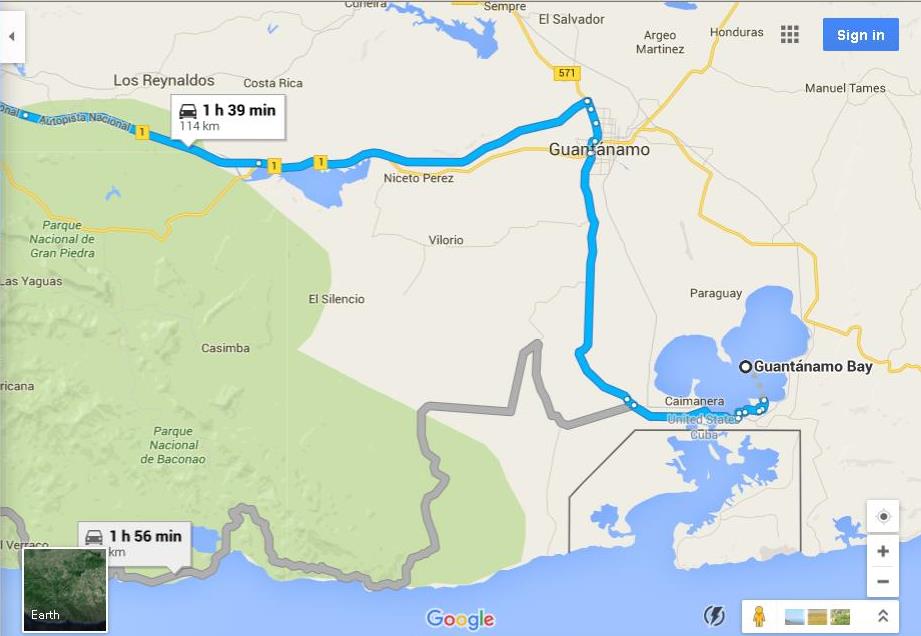
Before we left Santiago de Cuba, we took an excursion to the nearby Parque Nacional de Gran Peidra—a sort of national park. I love the outdoors and got excited that we might go on a hike, but we only skirted the park on our way to our real destination, Guantanamo Bay.

If you look at Google maps, it’s really confusing. What you would think was the U.S. territory with the detention center is marked as Cuban territory. Google has steered me wrong before, mostly memorably in Nairobi where it sent me to a slum instead of to the Ford Foundation’s offices, so I would never count on it except for a rough approximation.

Guantanamo

There was excitement on the bus as we got closer to Guantanamo. “Get out your OFAC letter!” someone exclaimed. “We’re being tailed by the CIA!”

As I mentioned previously, we were required to carry letters from the U.S. Office of Foreign Assets Control at all times to show we were there legally. I couldn’t imagine we would get anywhere near Gitmo—you didn’t have to see it to know it would be surrounded by 20-foot razor-wire fences and heavily-armed guards. What were we going to do, ram the gate? That would put a crimp in my plans to apply for jobs with the CIA and the Foreign Service!

But then the bus stopped, and most of us waited while a couple of Interfaith Task Forcers got off and held an animated conversation with the driver and our guide. Then we turned around and went back to Santiago. I will never know how the leaders of the Task Force talked our guide and the Cuban bus driver into driving to Guantanamo Bay, or how close we really got, or exactly where its limits are.

That’s the thing about travel, if you’re doing it right. You’ll come home shaking your head and laughing to yourself because there was some mysterious situation for which you’ll never have an explanation. That’s assuming no one got hurt or arrested, of course.

Now that I am working for the Center for Victims of Torture, it would be hugely prestigious to be able to say casually, “I was arrested at Guantanamo a couple years ago.”

CVT has been active in advocating for the closure of Guantanamo. First—obviously—because we, torture people there (yes, we, if you’re an American). Half the American population (and I think we can guess who their presidential candidates are) believe there’s nothing wrong with torture. “How we gonna catch the bad guys if we don’t torture people, huh?”

I could write 10 posts about why that’s a dumb statement, but for now I’ll just say, if you think torture is okay, go read someone else’s blog. And even if I thought it was okay, it’s still illegal.

The Universal Declaration of Human Rights, which came about in response to the WWII and specifically the Holocaust, outlawed torture. Ronald Reagan signed the international Convention Against Torture in 1984. President Obama issued an executive order on his second day in office banning torture. In November last year, Congress passed the National Defense Authorization Act, which “placed all U.S. government interrogations under the United States Army Field Manual on Interrogations, and requires that the International Committee of the Red Cross have prompt access to all prisoners in United States’ custody.” In other words, there are grownups in charge now.

Very few people know everything that’s gone on at Gitmo, but we do know that people have been detained indefinitely, without charge or trial. If you imagine yourself in one of those prisoner’s paper slippers, you will understand why they go on hunger strikes. We then subject them to another form of torture, forced feeding. If you wonder, “how bad could that be?” watch this video of the rapper Mos Def being force fed; he volunteered to show us what it really involves.

Back in Santiago, none of this was on my mind. My biggest concern was finishing my master’s and getting a job. Vince’s time in prison, and researching prison for this blog, changed all that.

When Worlds Collide

I’ve been writing a series of posts about traveling in Cuba that starts here. I am pausing that for a day to write about an unsettling experience where my worlds collided.

I volunteer with the Minnesota International NGO Network, or MINN. MINN is composed of Minnesota companies and nonprofits that work overseas, like my employer, the Center for Victims of Torture (CVT).

Last year MINN launched a class called MINNspire, which helps 50-somethings to explore doing something abroad. This could be anything from volunteering with Peace Corps, to teaching English as a second language, to consulting on communications, as I have done. MINN isn’t there to find them placements; we’re there to guide them through the thought process. I led one of the four sessions last year and will do the same this year—I think.

I was excited that we had 18 people registered—about twice the number as last year. It’s kind of a big commitment to come to something after work, in the dark, during the winter.

I walked in and said hi to my friend Carolyn, one of the four facilitators of the class. There were already two students in the room. Carolyn said to me, in a way that told me we might have an “issue”, “Something really interesting happened with registration. I spoke to a Rotary Club that happened to have a lot of members of the DOC, and we’ve got 10 people from the DOC registered for the class.”

The Department of Corrections. The people I never wanted anything to do with, ever again.

I had come from work, where I had spent the day writing about Eritrean torture survivors. Eritrea is known as the “North Korea of Africa.” They have forced conscription, which means every young man must join the military or go to prison. In the military, they are worked like slaves and their service is indefinite. If they try to escape, Eritrea throws them into underground prisons where they are tortured. If they make it to Ethiopia, they wind up in refugee camps with no future, and their family back home is persecuted. Sometimes they try fleeing to Israel, the one country that reluctantly takes them in, but often they are caught by—essentially—desert pirates called Rashida who hold them for ransom, torturing them while their families listen helplessly on the other end of the phone.

As you might imagine, a lot of Eritrean torture survivors have PTSD, and that is where CVT comes in. We provide trauma therapy and we hope to add physical therapy next year.

So I was writing about this all day and then I stepped into a room of people who had been my and my son’s tormentors for a year and a half.

I am in no way comparing what I went through to what Eritreans have endured. My point is that I know firsthand what a flashback feels like. A surge of adrenaline surged through me. My heart started racing and my palms got sweaty. I felt a powerful urge to bolt.

“I figure if I was a prison warden for 20 years, I can do anything!” one of the women exclaimed. The thought of her volunteering in an orphanage made me uneasy.

“My son just finished the boot camp program,” I told them. Might as well get it out there before she said something that would cause me shoot my mouth off. They oohed and ahhed said what a great program that was.

Carolyn knows my back story and has a high EQ.   She emailed later:

“I would never imagine that you would come face to face with your oppressor in MINNspire.  I mean, last year you were in Palestine, looking for ways to collaborate, professionally, with enemies of the Jewish state and now you come to St Paul and you are asked to teach the people whom you’ve written about for years.

“ I have to shake my head at what the universe is throwing at you.  But if anyone can handle it, you can.”

I hope she’s right, because I thought about backing out of the class but I’ve decided to stick it out.  I’ll keep you posted.

UN-Doing the War on Drugs

I ended my last post by saying I would write about a road trip I am contemplating, from St. Paul to New Orleans.  I don’t know enough to write about it yet, so for now I will revert to one of this blog’s main topics, addiction—and all the consequences of addiction and trying to stop it.

I’m very excited that the United Nations will hold a review of the whole drug control system in April in New York.  It’s called the Special Session of the United Nations General Assembly on the World Drug Problem, or the horrible acronym UNGASS. I’d like to thank the Open Societies Foundation (OSF) for its reporting on this.  OSF promotes research documenting the heavy costs of the war on drugs and shares success stories from countries that have implemented smart policies.  I’ve plagiarized their recent blog posts quite heavily here.

The last time the UN had a special session on drugs, in 1998, the focus was “the total elimination of drugs from the world.”  Ha!  I wonder if there were any actual addicts or former drug dealers involved in coming up with that totally unrealistic goal.

Because it didn’t go well.  The war on drugs has led to public health crises, mass incarceration, corruption, and black market–fueled violence.  Governments—especially those in Latin America that have to deal with the fallout of bad drug policies—have pushed for this UNGASS.

Citizens are fed up too.  A few years ago, a coalition of organizations and individuals in Uruguay pushed until the country voted to become the first country in the world to establish a legal, government-controlled marijuana market.  The main objective of the law was to eliminate narcotrafficking.  But they also have a positive goal, to make the new marijuana production chain beneficial for poor segments of society and a sustainable business for small producers with limited resources.

For the first time, there is significant dissent at the local, national, and international levels.

UNGASS is an opportunity to put an end to the horrors of the drug war and instead prioritize health, human rights, and safety.

I didn’t even know that there was an International Narcotics Control Board, did you?  That sounds creepy.  And it acts like a bully, apparently.

For instance, in the 90s, Switzerland had a major drug problem.  There were open-air drug scenes and one of the highest rates of HIV in Western Europe.  The government pioneered services such as heroin prescriptions, supervised consumption rooms, and community-based treatment.  The Swiss people approved this policy through a series of referenda.

What happened?  The number of new heroin users declined from 850 in 1990 to 150 in 2002; drug-related deaths declined by more than 50 percent; new HIV infections dropped 87 percent, and there was a 90 percent reduction of property crime committed by people who use drugs.

But the UN’s Control Board accused the Swiss of “aiding and abetting the commission of crimes involving illegal drug possession and use.”

On the other hand, when Bulgaria introduced a law that made possession of tiny amounts of drugs punishable with mandatory incarceration for as long as 15 years, the Control Board praised their “political commitment and the will to deal with drug abuse.”  I’ve never been to Bulgaria, but life in a Bulgarian prison sounds horrifying.

OSF is publishing a series of reports in advance of UNGASS, including research into drug courts and their unintended consequences, and an examination of how the drug war affects girls and women uniquely.  You can sign up for their updates here.  Want to get more involved or have a say?  Check out this cool website, Stop the Harm.

So there!  After my recent buzzkill series of posts, I’m happy to share with you some good news and some easy ways to contribute to fixing this world’s drug problem—for real this time.

The Slog

This is the third of three posts, the first and second are here. If you started reading this blog for the prison theme you may be wondering, what does any of this have to do with Vince going to prison? I don’t know if it does—you tell me.

And so I informed people of my decision, which I had known from the moment I’d found out I was pregnant again: I would give the baby up for adoption.

I told Judy, the Catholic Charities social worker, and her eyes lighted up. “I do have a few reservations,” I told her about what I had learned about adopted people in my Abnormal Psychology class. Judy laughed lightly and handed me a clipboard with forms. While I was signing them she said, “We have to trust that God knows what’s best for us. Even if it’s painful—especially if it’s painful, we just have to put ourselves in God’s loving hands.” I thought this was muddled but made a mental note to try to pray in my spare time.

I told my college advisor. “My due date is right before finals but I promise there won’t be any interruptions in my attendance.” She looked a little stunned and said, “We’ll understand if you need to take some time off.”

“No, no—that won’t be necessary,” I cut her off. I didn’t want them to cut me any slack. I would graduate on time. The whole point of this plan was to do what was best for all three of us, so I needed to graduate and get a job.

The other point of the plan was to keep it all hush-hush. I would stay away from the family, my friends, and the whole neighborhood where they all lived. If my grandma called and asked if she could visit me, I would make an excuse to keep her away. It would only be for six months, right? It wasn’t as extreme as the case of Margie, a girl I knew in high school, who went through her whole pregnancy and adoption while living in her family’s house. None of them ever talked about it. Now that was weird.

So there Vince and I sat, alone, on his first birthday. I had called The Creep and invited him but he had “some really important business” to take care of. In other words, a drug deal. I only saw him once again in the ensuing 36 years.

V 1st Bday

I did what you’re supposed to do for a baby’s first birthday. I made a cake with one candle and let him eat it with his fingers and smear it all over the place. And I cried…and cried.

Then I stiffened myself and plunged my feelings way down into the deep freeze and didn’t feel anything again for a year. That’s the thing about avoiding negative feelings—it makes you unable to experience positive ones, either.

Life went on as before. I trudged through the snow to the daycare, studied furiously, and cleaned the house as though I was in boot camp. As happened during my first pregnancy, perverts tried to pick me up at the bus stop, in stores, in the elevator of my building.

The student who had pressured me to have an abortion was disappointed when I told him I was going the adoption route. “That’s…I’m sorry, but that’s just selfish,” he said. “That poor kid,” he said, staring at my belly.

Sometimes students I didn’t know would try to strike up a conversation.

“When’s your baby due?” they would ask brightly.

“April,” I would respond flatly, giving them fair warning that proceeding with the conversation would be a mistake.

“Do you want a boy or a girl?”

“I don’t really care, since I’m giving it up for adoption.”

This would result in sputtering and something like, “You’re so brave—good luck!” as they backed their way out of the room as fast as possible. I hated that line—“You’re so brave.”

Now that I had set my course I didn’t second guess it, but if you had asked me I might have said I was just being practical.

Tumblin’ and Floppin’

What was I thinking when I gave Vince a rock tumbler for Christmas? It’s his long-time hobby, and this is probably the third one I’ve bought him, but it’s the first time I’ve lived with the sound of it, cruncha-rugga-chugga-rugga 24/7. I don’t know how he can sleep with it in his room. .

Here’s an update on Vince’s and my living-together situation.

If I come home and he’s in the living room, he immediately gets up, goes to his room and shuts the door, and doesn’t come out again until the next morning. If I’m the one in the living room when he comes home, he goes straight to his room and doesn’t come out until the next morning. He doesn’t slam the door, so there’s nothing to point to and say, “Stop doing that!”

When we run into each other in the morning, the exchange is:

“Good morning.”

“Good morning.”

“Have a nice day.”

“You too.”

When I ask, “What are you up to today?” he tells me, but there is a tone, as though he thinks I am prying. If I call to him inside his bedroom, there is a long pause during which I imagine he is rolling his eyes, and then a drawn-out, “Yeh-sss?”

I managed to catch him long enough one day to say that people who live in the same house usually talk to each other now and then. He seemed to think I was trying to trick him into talking.

Things came to a head on Christmas day. I found myself crying in my room (into a pillow, so Vince wouldn’t hear, because I didn’t want him to think I was trying to manipulate him). I had been out 16 of the last 18 nights, trying to give him space.

I was tired. I had lost perspective. Was it nosy to ask, “How are you?” Was everything I did annoying? Was the sound of my voice noxious? Should I confront him? Try to be nicer? Suggest we go to counseling together? Ask him to move out? Go live in a motel? Was I acting like a martyr? Maybe if I bought some non-floppy slippers—because surely the sound of my footsteps must drive him crazy.

I recognize Vince’s behavior because I’ve acted the same in the past.

I had a roommate; I’ll call her Irene. She was from Ontario and taught theology at a local private university.

I could not stand being in the same room with her. Everything about her irritated me—her denim dresses and sturdy shoes, the giant jar of Branston Pickle in the fridge, the fact that her favorite color was navy blue.

When I heard her key in the door I would scurry to my room, silently shut the door, and not emerge until I knew the coast was clear. If she tried to make conversation I would deflect it with a curt answer and a stiff demeanor. If I did have to communicate something to her, I left a note on the dining room table.

Poor Irene! She was such a nice person, a good person. She had a sharp wit and obviously was no dummy. We could have had great conversations if I had been open to that. She was also wise, I see in retrospect, because she never got ruffled by my behavior, never seemed to take it personally.

And it wasn’t about her—I can see that now. It was about me being laid off from my job, Vince being missing for the umpteenth time, and other stressful events I can’t even recall now.

So Irene, if you ever read this, I apologize unequivocally. I was horrible to you. Better yet, I will write you an email after I finish this post, and apologize directly.

Vince, here is my version of a note on the dining room table to you. You’re doing so well (a job, a car—health insurance! 19 months of sobriety!). But I know it’s hard to have a social life under the probation restrictions. The solstice has passed, the days are getting longer, soon your time “off leash” time will double.

Now about that rock tumbler….

The Fine Print

I got another email from my friends at JPay. They are so sentimental! They know that home is where the heart is, and they’re just like a family. And they have such a great sense of humor; it says, “there’s snowplace like home” – get it?

Oh, I almost missed it. In very small print at the bottom they mention that their terms of service changed the day before they sent this email. Could it be that they said all that other nice stuff to distract me from that legally-required notice?

I decided to check out the terms, even though I am no longer a customer (yeah!). The payment terms of service are over 2,200 words long. And that’s just for starters. There are email terms of service (1,700 words), video visit terms of service (1,850), and music player terms of service (1,870). There is a subpoena policy, a privacy policy, and a consumer protection policy.

All of which is to say, “if you buy anything from us, don’t bother complaining or trying to sue us, because we’ve got lawyers and we’ve thought of everything.”

I’m going to unsubscribe from JPay now. It’s been fun, but they’re just too easy of a target and they bring out a mean, sarcastic streak in me that I don’t want to feed.

Hedgehogs, Mice, and Echidnas, Oh My

I pride myself on writing realistically about life. You can count on me to tell the truth as I know it, to question everything, and to imagine the worst case scenario. I don’t know why the Pentagon hasn’t called me yet to offer me a disaster-planning job.

But that doesn’t mean I’m depressed, or even “unhappy”—the more generic term. Being a highly-analytical thinker has its rewards. I notice and think about things that other people do not. There’s often absurd fodder for laughs. Sometimes I’m the only one laughing, but that’s okay, right?

There was an article in the Sunday paper about a study that debunked the popular myth that “happy” people are healthier and live longer. Yes! My friend who works in an old folks home—or whatever they’ve been rebranded as now—has always said, “There are plenty of miserable, crabby 90 year olds. And they’ve always been that way, because their kids tell me they have.”

About five years ago, I kicked the depression that had dogged me all my life. Since then I have felt mostly contentment, punctuated with the normal situationally-appropriate emotions. I felt angry when my landlord raised my rent $300 a month, which forced me to move. I was stressed when I moved again three months later so Vince could live with me. I was anxious when Vince was in solitary confinement. I cried for everything my sister and her kids went through when she had cancer. I felt awe hiking in Petra, in the Jordanian desert, and nervous about crossing over into the Palestinian territories. I felt powerless rage when I was banned from visiting Vince. I had a blast with my friends in Berlin. I’ve been bored at work. I was proud when Vince led his squad at his graduation from boot camp. I am excited at the prospect of remodeling my kitchen.

Hey, I guess I just wrote my Christmas letter!  What a year it’s been.

None of it lasts. Some people figure this out somehow, much earlier in life than I did. Emotions come and go. The pleasant and the unpleasant, they’re all fleeting. So enjoy the nice ones while they last and know that the bad ones will dissipate. Don’t panic if you feel blue once in a while. Don’t latch on to the negative feelings or thoughts. If the blues don’t go away for weeks, of course, seek professional help.

In the last week I’ve had some really good times with people I love.

Yesterday I took my mother to tour the Purcell Cutts House, a prairie-style home build in 1913 and owned by the Minneapolis Institute of Arts. This is the living room:

Purcell Cutts

The guide explained that the simple, serene style was in part a reaction to the chaos of the age. The architect was from Chicago, which was the industrial center of the U.S. Meat packing and other industries attracted droves of immigrants and African Americans from the south. There wasn’t enough housing, and the water and sewer systems weren’t up to par. There were no child labor laws, workers’ compensation, welfare, or social security.

So architects brought nature and art inside. Obviously this was not a house that could be produced on a mass scale. The immigrants and African Americans still lived in poorly-heated hovels. But at least this one architect could escape all that and find sanctuary at home!

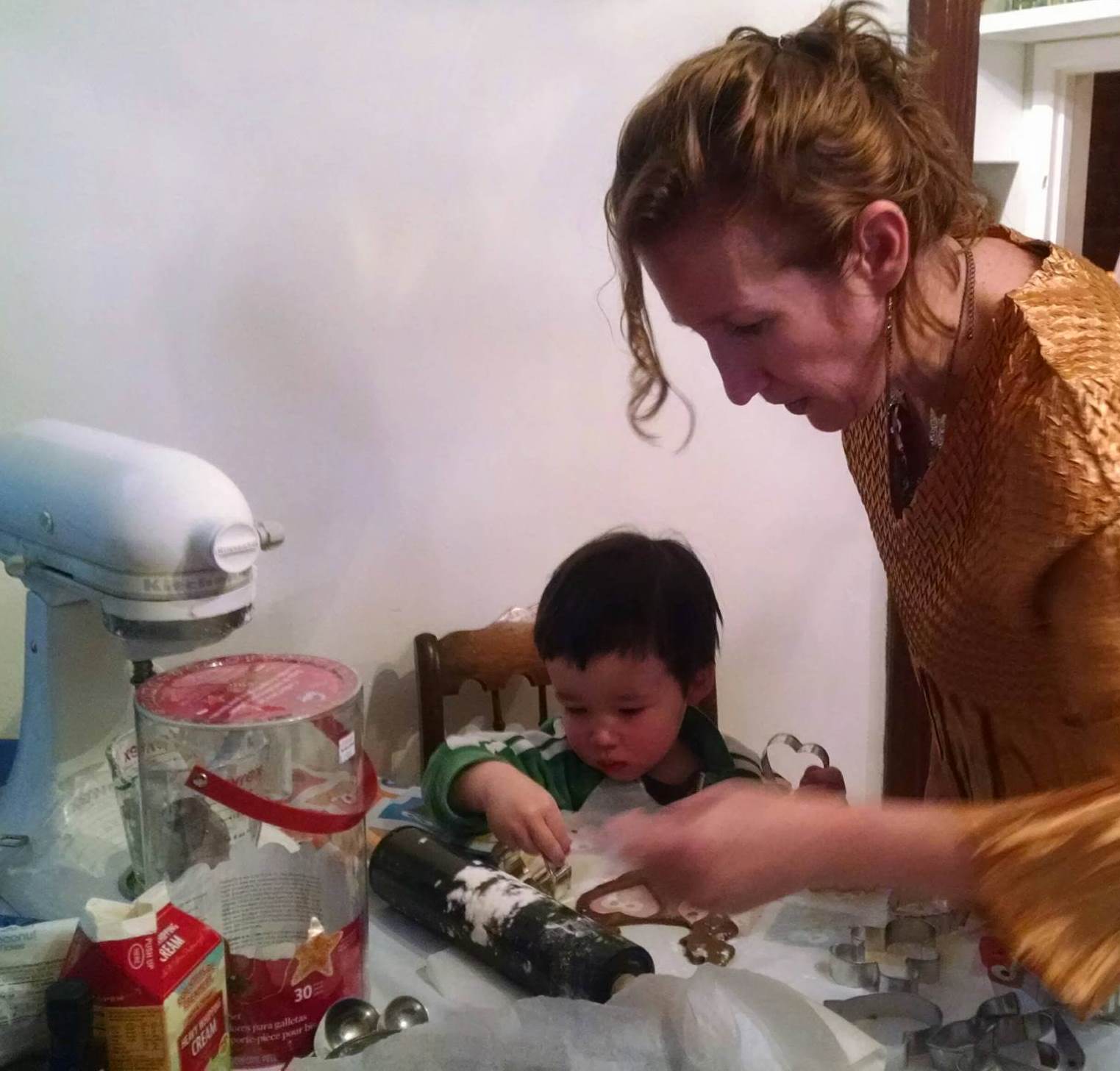
Last weekend, I hosted a cookie-baking party for Vince and his cousins.

Hannukah HedgehogsTaisei n me

They’re not pretty, but we had fun. Strangely, Vince and I had prepared enough dough to yield 16 dozen cookies but only nine dozen made it to the final stage. Hmmm…or should I say, Mmmmm….cookie dough?

So enjoy the moments that contain things you love. In my case: design, craftsmanship, nature, history. Kids, creativity, and cookie dough.

Au Mal Pain

As usual, the prison news includes the good, the bad, and the disgusting.

The good: If I didn’t work in fundraising I might not have caught this item.  The California Endowment has announced it will divest its assets from companies that run private prisons, jails, detention centers, and correctional facilities.  This is fantastic!  The California Endowment is a foundation with $3,668,459,217 in assets.  That’s real money, and maybe it will start a trend.  I look at foundation tax returns almost every day, so I see where they invest their money.  It’s disgusting to see a foundation with a portion of its assets invested in a weapons manufacturer, for instance, and making grants for international poverty programs.  In part, it’s all the small arms the U.S. peddles to warlords abroad that destabilize developing countries and keep them impoverished.  That’s an extreme example but I bet it’s not that uncommon.  If you have retirement investments, you too may own part of Alliant Techsystems or Prison Corporation of America, and you are probably earning fantastic rates of return.

The not-so-good news, also in California, is a report that found abuse, racism, and cover ups a physically isolated prison about 90 miles northwest of Reno.  The town in which the prison is located, Susanville, has fewer than 16,000 people, and the two correctional facilities are its largest employers.  “Employees form tight-knit social groups known as “cars” that can foster what the report terms “a code of silence” that makes it difficult to report wrongdoing.”  They are accused of abusing physically-disabled and minority prisoners, inciting attacks against sex offenders, and conspiring to impede the investigation.   The prison’s nearly 3,500 inmates won’t report abuse because they fear the nearly 1,000 employees will find out and retaliate.  If this is true in this case, why wouldn’t it be true in Moose Lake, where Vince was incarcerated?  Moose Lake has a population of only about 2,700 and, as you might guess from its name, it’s in the sticks.

Then there are two items that would be ridiculous if they weren’t true.

First, rapper Nicki Minaj did a December 10 interview with Billboard Magazine in which she spoke out against mass incarceration, lengthy drug sentences, and the racial bias in sentencing: “What it has become is not a war on drugs.  It has become slavery.  When I see how many people are in jail, I feel like, ‘Wait a minute. Our government is aware of these statistics and thinks it’s OK?’ The sentences are inhumane.”

Earlier this year, she had said about Barak Obama’s prison clemency program, “I thought it was so important when he went to prisons and spoke to people who got 20 and 30 and 40 and 50 years for drugs. There are women who are raped, people who are killed and [offenders] don’t even serve 20 years.”

I guess you could call it a case of bad timing, then when Minaj’s brother was arrested December 3 for raping a 12-year-old girl.  She posted his $100,000 bail.  Blood is thicker than principles, I guess, and I’m not being sarcastic.  As his sister, she probably believes there’s a good explanation.

Last, in prison food news, the New York Times reports that the state’s prisons have announced they will stop serving Disciplinary Loaf—also known as NutriLoaf—to prisoners in solitary confinement.  It was served with a side of cabbage.

God, sometimes I wonder if you think I make this stuff up—that’s why I provide links.

This menu change is part of a slew of reforms to solitary confinement practices.  It was brought about as the result of a lawsuit by the American Civil Liberties Union, whose director said, “Food is very important to prisoners in a deprived and harsh environment; it is one of the very few things they have to look forward to.”

I’ve pasted the recipe below in case you want to serve it to your family over the holidays.

Recipe for Nutraloaf

Makes 50 loaves.

Ingredients

5 pounds whole wheat flour

20 pounds all purpose flour

1.5 gallons milk, 1 percent

8 ounces fast active dry yeast

4 pounds sugar

2 ounces salt

2.5 pounds powdered milk, nonfat

2 pounds margarine

5 pounds shredded potatoes (with skin)

2 pounds shredded carrots


Preparation

  1. Preheat oven to 350 degrees.
  2. Heat milk to 105 degrees, then add sugar, salt and yeast. Let stand for 5 minutes.
  3. Add both flours and dry milk, then mix.
  4. Add margarine, potatoes and carrots. Mix for 10 minutes.
  5. Cover bowl with plastic wrap and let dough rise.
  6. Grease and flour loaf pans and add dough.
  7. Bake loaves for 40 to 45 minutes.